Blog

  • Sony Ericsson earns first profit in almost two years

    Most conversations about smartphones these days seem to start and end with either Apple's iPhone or Research in Motion's BlackBerry. But in case anybody has forgotten, old guard phone makers such as Sony Ericsson are still around.

    Mark Sue, analyst with RBC Capital Markets, took a look at the first quarter 2010 results of Sony Ericsson (a joint venture between Sony and LM Ericsson Telephone Co.) and found some reason for optimism.

    "Sony Ericsson lost quite a bit of market share during the March quarter in terms of units but sold these lower units at higher prices helping this struggling venture to turn a profit," Mr. Sue said in a note.

    During the quarter, the company shipped 10.5 million devices, far short of Mr. Sue's forecast of 14 million and consensus 13.1 million units. However, Sony Ericsson actually returned to profitability for the first time in almost two years, earning 21-million euros.

    The rebound comes on the heels of a "much-needed" restructuring and new product portfolio, including some new smartphones, he said.

    "Despite the unit share loss in the mid-to-low end, Sony Ericsson is enjoying a promising reception for its Xperia X10 and Vivaz smartphones," Mr. Sue said. "Similar to Motorola, HTC and others Sony Ericsson is making a big bet on Android."

    It's enough to pull the struggling joint Japanese-Swedish venture into a tie with Motorola for fifth with about 3.8% market share, trailing Nokia, Samsung, LG and Research in Motion, he said.

    Mr. Sue maintains a Sector Perform rating with a price target of US$12 for LM Ericson, listed on the NASDAQ.

    Eric Lam

  • The best BMW concept

    The best BMW concept

  • RunKeeper Lands on Android

    Coordinated nicely with the Boston Marathon today, RunKeeper takes the starting line on Android 2.x devices. This software is among my personal favorites as it uses a phone’s GPS to track and report on any type of mobile exercise: running, cross-country skiing, and hiking to name a few. Up to now, however, I was missing RunKeeper because it was iPhone-only and I adopted a Google Nexus One over three months ago. RunKeeper: it’s good to see you again.

    This first version, free in the Android Market, offers just the basics but I’d expect to see an offering comparable to the RunKeeper Pro app in the near future. For now, expect time, distance, speed, pace, calories, and map tracking with RunKeeper for Android. Of course, you can listen to music while using the app, and there are configurable voice cues for pace on the iPhone version which I hope to see added soon to the Android app.

    Perhaps the best part of RunKeeper is the online tracking of all workouts, something I demonstrated in my video review a few months back. I use the tracking to see the impact of elevation changes on my running pace. And recently, the RunKeeper folks added live broadcasting of workouts to friends and family. If you haven’t seen it, today’s the day because RunKeeper founder, Jason Jacobs, is running in Boston and you can follow along in here real-time.

    Since using the Nexus One, I had to find an alternative app for workout tracking. It’s worth a mention that SportyPal fit the bill for me these past few months. I personally prefer RunKeeper’s interface and ease of use, but SportyPal works well. I already had six months worth of workout data in RunKeeper, so I decided to stay put — manually entering workouts as a workaround. Now I can focus on actually doing my workouts, and not entering them into a phone or computer, thanks to the new RunKeeper for Android version.

    Related research on GigaOM Pro (sub req’d):

    Location-Based Services: From Mobile to Mobility

  • iPad 3G Available On May 7

    Apple has announced that the 3G model of the iPad will be made available on May 7.

    News of the launch comes following an update to the Apple online store, which finally details the U.S. availability of the 3G capable device. Of course, the listed release date applies only to the U.S. and does not involve the unfortunate delayed international launch.

    For those interested in the 3G model of Apple’s tablet, it starts at $629 for a 16GB device, with the top-of-the-line 64GB model coming in at $829. However those who do choose to plump for the 3G device, just like our very own Patrick Hunt, will have to sign up for an AT&T data plan. AT&T is currently offering 3G iPad owners two contract-free options — $14.99 a month for 250MB, and an unlimited plan for $30 per month.

    When the iPad does eventually launch internationally this coming May it is hoped that both the Wi-Fi and 3G capable models will be available from day one, and many European carriers have already announced intentions to carry Apple’s device.

    Interestingly Apple’s website lists the shipping date as “by May 7th,” hinting that for those who have already ordered there device could be sent out a few days before.

    So if you live outside the U.S. the wait for the iPad continues. But for those within the U.S., the wait for the 3G is now only a few weeks away, unless you’re Steve Wozniak that is.

  • McDonald’s Trains New Employees with this Nintendo DS Game [Nintendo]

    In this Bloomberg report, we get a brief look at McDonald’s own DS employee training software that’s used in Japan. It’s like Cooking Mama, just a lot more depressing when you “win.” [Kotaku] More »


  • Ride the City bike routing service hits the iPhone


    Friends of CG Jordan Anderson and Vaidila Kungys, creators of Ride the City New York just released their first Ride the City iPhone app [download] for NYC. The app, like the service, offers safe bike routes through New York and is based on the OpenStreetMap project. It costs $1.99.

    To use it, you simply enter your start and end points and then follow the route. The map takes into consideration low-traffic roads as well as dedicated bike lanes to get you from point A to a Russian bath house in the East Village.

    It also works on the iPad, but it will be hard to keep one hand free to signal when you’re lugging your slate around.

    Some points from their announcement:

    As on the website, the iPhone app steers you toward routes that maximize the use of bike lanes, bike paths, greenways, and other bike-friendly streets. Routes avoid high-traffic streets and steep climbs.
    You can select your preferred route sensitivity: direct, safe, or safer. Or you can change them on the fly.
    The directions are displayed on the map with an easy-to-read scrollable screen – perfect for double-checking your trip when taking a break.
    Find the nearest bike shops (and get directions to one) with just one touch.
    We’ve placed a Report an Error button prominently on the map so you can provide instant feedback to report a mistake on the map or to suggest a better way around.
    As on the website, Ride the City utilizes a CloudMade basemap that is sourced from OpenStreetMap, the volunteer community mapping project that is making a free map of the world.

    The app was built by developers at Door3.


  • Burnouts on the Go: Streetfire releases iPhone app

    Filed under: , ,

    Because you need one more app on your iPhone and then you… um, win? StreetFire introduces its StreetVid app for instant access to all the two- and four-wheeled hoonage you can stand, plus its weekly shows and caption contests. If the soon-to-come iPhone 4G really does video, it’ll be even easier for you to “upload yourself doing something stupid.” Not the kind of thing that will make you any more productive, but it will put more smoking rubber in your pocket, and that’s why we’re all really here, no?

    [Source: StreetFire]

    Burnouts on the Go: Streetfire releases iPhone app originally appeared on Autoblog on Mon, 19 Apr 2010 08:27:00 EST. Please see our terms for use of feeds.

    Read | Permalink | Email this | Comments

  • Data Sheets Lie and How To Truly Measure the Performance and Security of a Network Device

    Have you ever questioned the performance and security claims on a data sheet? Have you ever wondered how the network equipment you deploy would hold up against an actual cyber attack and high-stress application load? At any point did you want a repeatable and deterministic score of a device’s performance and security rather than rely on data sheet assurances? The answer is most likely yes and it is why we wanted to look into this topic during our next webcast.

    Certification for performance and security is nothing new; in fact, we have come to expect it for everything from our phones to our automobiles. Yet network equipment, which supports our businesses and governments, has no standardized certification for performance and security. Instead we rely on statements made in product marketing literature, which are based on best-case scenarios, not real world truths.

    In this free webcast, we will:

    • Discuss the importance of using a repeatable, deterministic methodology for definitively measuring the performance, security and stability of network equipment.
    • Review data sheets from a handful of leading network equipment brands and expose some of the most common performance and security myths.
    • Apply this methodology to leading network equipment brands to reveal their true performance, security and stability capabilities.
    • Discuss the importance of the BreakingPoint Resiliency Score and the methodology behind it.
    • Demonstrate how you can quickly and cost-effectively determine the resiliency of network equipment.

    Register Now:

    BreakingPoint Webcast April 28: Data Sheets Lie: How To Truly Measure the Performance, Security and Stability of Network Devices

    network device resiliency

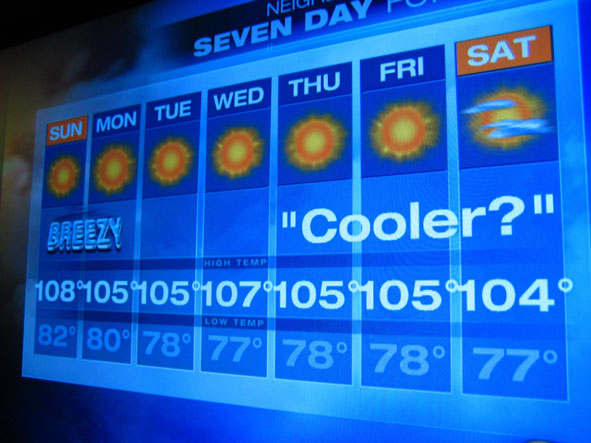
  • TV weathercasters know which way the wind blows – Weather reporters can teach climate science

    A little more than half, or 54 percent, of U.S. weathercasters accept that climate change is happening. And in many local television newsrooms, weathercasters have become the de facto science reporters at their station. Edward Maibach, who headed a recent study surveying professionals in the field, sees this as an opportunity for enhancing their role as informal science educators.  Science Progress’s Andrew Plemmons Pratt has the story in this repost.

    Previous public surveys demonstrate that weathercasters are the second-most trusted source of information on climate change. For Maibach, director of the Center for Climate Change Communication at George Mason University, that finding was unexpected. The first is climate scientists themselves, and running a distant third are “friends and family.” “That clued us into the fact that our nation’s weathercasters are a potentially important source of informal education about climate change,” he said in an interview with Science Progress. He spoke about his new research with Andrew Light, a Senior Fellow at the Center for American Progress focusing on international energy policy, and the director of the Center for Global Ethics at George Mason. (The podcast audio is accessible above.)

    The latest study from the Center for Climate Change Communication is the largest and most representative survey of TV weathercasters to date, and its findings on how this group of professionals thinks about climate change science and news generated significant media attention, including a front-page story at The New York Times. Coverage like that is hard to earn, and Maibach is grateful for it, though he disagrees with the conclusions. Much of the media attention has been on the 25 percent of respondents who said that global warming isn’t happening at all. But as Maibach points out, the idea that this group is “a hotbed of climate change skepticism turned out to not be the case.”

    “We see this as a ‘glass already half full’ finding,” he said, referring to the majority of weathercasters who accept global warming. “To the extend to which they were not currently acting as climate change educators, we wanted to identify the path to cultivate them as an important source of education for the public.”

    Maibach says the data points to that opportunity, as two out of three survey respondents said they were interested in educating their viewers about the relationship between local weather and the changing global climate.

    Weathercasters as informal science educators
    The latest survey confirms other findings on the small fraction of dedicated science reporting at local outlets. The study reached almost 1,400 weathercasters who belong to the two major professional associations, the American Meteorological Society and the National Weather Association. Almost all, or 94 percent of the 571 respondents, said they are the only full-time staffer covering science or environmental issues at their station. Some 79 percent embraced this role, a fact the American Meteorological Society already recognizes. The organization, Maibach says, sees an opportunity to embrace weathercasters as “station scientists” and is pursuing educational programs to support them.

    Moreover, weathercasters share their professional expertise not just on air, but at local school and adult education events. Almost 70 percent of the respondents do between one and three speaking events each month, building loyalty that helps draw viewers to their broadcasts. According to the survey, a small proportion of these weathercasters are incorporating climate change information into their broadcasts, but a large proportion of them are finding ways to address the issue in their community presentations.

    For Maibach, the “Ah-ha!” moment of the study came from looking at the responses from those participants who said they were interested in communicating more information on climate change. Ninety percent of that group indicated that a variety of relatively simple resources would help them do their jobs more effectively. They needed access to peer-reviewed journal articles, which are typically locked behind paywalls. They need to be able to interview media-savvy climate scientists. Most valuable, they said, are high-quality graphics and animations explaining key concepts of climate science. His group is now working with climate science communication experts to produce these resources.

    Andrew Light pointed out that federal government already plays an important role supplying these types of resources, as NASA and the National Oceanic and Atmospheric Administration produce a wealth of climate science information. As well, he suggested that a move within NOAA to create a National Climate Service will further ramp up the amount of accessible information. Administrator Jane Lubchenco is particularly interested in filling this information gap, he said.

    Meteorological myths

    While about four out of five weathercasters are men, there is a diversity of professional and educational backgrounds within the community. Previous research shows that about half of the practicing weathercasters in the United States are meteorologists, certified by the AMS or the NWA. Some hold scientific degrees, some have journalism backgrounds, and some simply come to the role through experience in broadcasting.

    But the survey results also dispel the notion that there is a rift between weathercasters and professional climate scientists, who tend to be academic researchers. “Approximately three out of four of our respondents look at climate scientists as a trustworthy source of information about climate change,” said Maibach. “That’s good news.”

    The myth of this “culture gap” between meteorologists and climatologists, he said, rests on an assumption that forecasters, who struggle to model weather a few days into the future, consider it hubris to claim that they should trust climate models that are decades in scope. But the trust meteorologists say they have in climate scientists doesn’t support this idea, said Maibach.

    Light suggested that the immediate media response to the survey may have rested upon this explanation, which he called “seat-of-the-pants sociology—of the working class meteorologists who ‘don’t get no respect.’” In that context, the survey fit into a particular storyline about the the continuing fallout of the overhyped “Climategate” incident, in which computer hackers stole emails from climate researchers at the University of East Anglia in the United Kingdom. The content of the years of private correspondence revealed scientists besieged by freedom of information requests from climate skeptics, and global warming deniers said the information undermined climate science itself. A recent inquiry of the British House of Commons found no basis for either that claim, nor others leveled against the Climate Research Unit at the University, its director, Phil Jones, and the research on historical climate data the group manages.

    “None of that has changed any of the overwhelming consensus on the causes of anthropogenic global warming and what are the necessary solutions,” said Light.

    In the present media climate, the release of the survey data did create the opportunity for “talking head debates” on cable news, said Light, pitting high-profile weathercasters who deny climate change against scientists who accept the facts.

    Setting up the discussion as a debate reinforces the notion that there is disagreement within the scientific community, said Maibach. “And that’s a totally erroneous notion.” Approximately 97 percent of climate scientists who are active researchers say that climate change is real and human-caused. “So this notion that there is still disagreement out there in the scientific community about climate change is fundamentally wrong.”

    Climate change as a public health hazard
    Maibach’s goal for future projects supported by this research is to enable “local weathercasters to make the connection between the conditions we are living with here, in our community, and the changing global climate.” People have a sense that climate change is “happening somewhere else,” he said, “We understand there is a problem, but it isn’t our problem.”

    “The way in which the climate change story has been framed historically is as an environmental problem,” he explains, and it is unquestionably an immense environmental problem. But it is also a public health problem, and before turning to climate change research in 2007, Maibach’s career focused on public health communications. “As a result of 25 or more years in the field, I’m absolutely convinced that for the American people, health is right up along with baseball, mom, and apple pie,” he said—it is something of immense social value. He aims to engage citizens “at a fundamentally deeper, more values-based level” by magnifying research on the public health impacts of climate change.

    The Obama administration focuses its discussion of climate change on jobs in clean energy industries and energy security, Light points out. Because it takes time to train scientists to communicate on the expanding set of issues, including the public health threats, it could be effective to provide that information to weathercasters in the near term.

    Maibach reports that he is already working with small group of 18 weathercasters who are actively using their platform to talk about climate change as informal science education.

    He is also collaborating with the weather team at WLTX, the CBS affiliate in Columbia, South Carolina, headed by Jim Gandy, to become “climate change educators in their community.” Climate Central, a nonprofit that provides scientific information on the issue, will develop graphics, and for the next year, the station will try to help its viewers better understand climate change science and the impacts the global phenomenon has on the local area. If the effort is effective, then Maibach’s group will have a strong case for scaling it.

    Andrew Plemmons Pratt is the managing editor for Science Progress. Click here for the podcast with Andrew related to this post.

    Related Posts:

  • Peak Oil is Soooo …. May of 2008

    Paul Kedrosky has a post on waning interest in peak oil ion spite of climbing oil prices – Peak Oil is Soooo …. May of 2008.

    Despite gas prices having climbed a good chunk of the way back up to 2008 levels, the level of worry about higher prices hasn’t seemed as high this time around. To test that, I pulled data from Google Trends on searches for “peak oil” and compared that to WTI crude prices over the same period. As this graph shows, while the two moved up together in 2007/2008, this time around “peak oil” and higher prices have disconnected in the public awareness — at least for now.

    Why might that be? One explanation is that oil prices haven’t climbed as fast as they did in early 2008, with the slope of the ascent being a primary source of worries. Second, with consumers having seen prices considerably higher than today’s just two years ago, perhaps they have become desensitized to oil at “merely” $87 a barrel. Of course, if either or both are true it wouldn’t take much to turn around perception and have people paranoid about peak oil again: higher prices or a faster ascent would do the deed in short order.


  • South Korean Broadband Is the Fastest in the World

    To say that the Internet is getting faster is like saying the Earth revolves around the Sun, it’s not going to surprise anyone. But to say how much faster and what countries lead the pack, that’s another story. Thankfully, we have Akamai’s State of the Internet quarterly report to help us out. The report for the fourth quarter… (read more)

  • Antonio’s Hitches His Hopes to Austin Beutner’s Star

    In the brutal world of mergers and acquisitions, the key to success in gobbling up poorly managed firms is focusing on the core business and scaling back runaway costs.

    That’s how Austin Beutner made his fortune at the giant Blackstone Group and later in his own boutique private equity firm Evercore Partners.
    Thumbnail image for AntonioBeutne1.jpg
    It’s a ruthless business and Beutner was one of the best at it. You get rid of failed managers, bring in smart, tough people, fire a lot of workers, demand wage concessions, eliminate unproductive functions and rebuild a lean and mean business that generates big profits. Then, you sell it for an even bigger profit.

    So, now that he’s moved to the public sector, generously working for a buck a year, how is Beutner applying his method for success as he takes over as the ninth DWP general manager in 10 years?

    “The first job is finding a permanent general
    manager,” Beutner told RIck Orlov in the Daily News in a revealing interview on Sunday. “You cannot expect to have an agency
    develop any stability when there is so much turnover at the top.”

    OK, a good place to start no doubt, and hopefully the new boss will actually know something about running a utility unlike many of those who have been in charge in recent years. With people like David Freeman hanging around that has proven impossible but Beutner is no David Freeman so he will undoubtedly find a capable person from outside.

    We also learn he is not a hands-on manager, interim or not, and will not operate from the lavish 15th floor office of the GM at the DWP building, preferring to stay at City Hall.

    “Hire good people and hold them accountable…What I want to do is make sure the mayor, the commission and the City
    council are all sharing the same information…and see what we can do to restore
    trust.”

    Wait just a  minute, the mayor and DWP Commission are the problem as much as anyone. They are the cause of the loss of trust. And the Council doesn’t care about trust, its members are only concerned about the wrath of the public and business community because of DWP’s out-of-control costs, soaring rates, mismanagement, endless sweetheart deals, failure to plan, total lack of honesty and transparency — just to name a few problems.

    But none of that is mentioned by Beutner — ratepayers aren’t even a phrase that enters his mind.

    But Brian D’Arcy does. Beutner has already met with the IBEW union boss and made peace, guaranteeing him that his power and his inflated wage deals are not in jeopardy. antoniobeutner.jpg

    “What people don’t realize is that at the DWP, labor is only
    25 percent of its cost,” Beutner said. “And, they do a good job in their
    work. What I want to do is look at the other three-quarters of the
    agency and make sure costs are in line. People have made labor the issue
    and I don’t think it’s the top issue facing the agency.” 

    So the people who “have made labor the issue” are obviously of no importance even though wages and benefits are 20 to 40 percent too high and hundreds of jobs are nothing but featherbedding and workplace discipline is lax.

    And what does he mean by “costs are in line”? In line with what? In line with how the mayor wants to enrich his pals and portray himself as the greenest big mayor in America even if it bankrupts the city and many of its residents and businesses?

    Beutner was hired to create jobs and is in charge of all the big pots of money in a dozen city agencies including the harbor, airport and planning. So is he being put directly in charge of the DWP to use his business skills to reduce costs and focus on the core business of supplying the city water and power or to use all the money the DWP can get its hands on for subsidies to buy jobs no matter how many jobs are killed by rate hikes?

    Since he played a key role in the rate hike fiasco recently, let’s look at what the rubber-stamp for mayoral policy DWP Board is up to at its meeting on Tuesday.


    First up is approval of contracts to keep the Scattergood power
    line project
    moving despite widespread complaints from Westsiders
    that it threatens their health and quality of life.

    That’s
    followed by giving vast amounts of water for the massive Grand
    Avenue project,
    water that is available because we’ve cut our own
    water use by nearly 20 percent even as we face soaring water bills and
    bursting pipes thanks to DWP’s well-documented ineptitude. The developer
    paid the $10,000 cost of DWP research into determining there’s enough
    water and designing a long list of conservation measures. $10,000?

    Then,
    there are deals being cut with Inyo County
    and Mammoth
    Lakes
    that will help officials there with economic development in
    exchange for letting the DWP cover Owens Lake with 80 square miles of
    solar panels — a project the scale and cost of which is unlike anthing the  has ever seen.

    Don’t be impatient, it gets worst fast.

    Item 13:
    involves a $668,444 three-year contract with Huron Consulting for
    “Strategic Plan and Competitive Intelligence Implementation Consulting
    and Services.”

    This is the same firm that was paid $150,000 for
    an instant analysis that was used to promote Measure B by DWP officials
    even as they were suppressing a comprehensive five-year study by PA
    Consulting that showed the utility was badly managed and operating in
    the dark without a strategic plan.

    So if DWP wants to keep the
    public ignorant, they hire Huron to fudge an uncritical strategic plan
    to go with the $775,000: in contracts the firm already has for solar
    energy projects and other schemes.

    It is nothing but a blatant
    payoff that will deepen public mistrust — something that ought to mean Beutner will
    put a stop to it if the public trust counts in his calculus.

    Will he object to Item 14’s
    transfer of  “11 substitute tree surgeon assistants” from Street
    Services to be paid from DWP operating revenues or the payment of $123.7
    million in subsidies for DWP workers and retirees health plans under Item 17?

    And
    how does Item
    22
    for buying a property with DWP funds so that the CRA can
    subsidize private companies to cash in on “clean technology” fit into
    the nation’s largest utility’s mission to provide water and power to the
    city?

    Or does this go to the heart of what Beutner’s real
    mission is: Using his credibility to disarm the business community so he
    can raise rates to buy jobs?

    Or maybe the nearly $700 million a
    year the mayor wants from increased rates right now is to buy wind power from
    Oregon
    under a long-term contract at the astronomical price of
    nearly $100 per megawatt/hour — five times the price of coal, twice the
    price of gas — and for the DWP to own and install solar panels atop
    city buildings under a 40-year deal with General Services, Item 23?

    These,
    of course, are all rhetorical questions. The answers are obvious. What
    is going on is just a continuation of the ripping off the public to feed
    the insatiable appetite of the IBEW and the mayor and his pals for our
    money without regard to public costs and benefits.

    Everything on
    Tuesday’s agenda flies right in the face of Beutner’s own success based
    on taking over failing businesses, cutting costs and focusing on the
    core mission.

    They are clearing the decks in advance of the
    Council’s approval without objection or any serious questioning beyond
    some posturing for their own self-aggrandizement.

    This just sets
    the stage for approval of the 20 to 30 percent rate hikes that will
    actually be more like 50 percent for many businesses and homeowners
    because they intend to provide massive subsidies to businesses and
    residents facing “hardships” and subsidies to anyone who will bring jobs
    to the city, even if most of them are in sweatshops or pay no more than
    the living wage.

  • Iran court sentences 3 progressive activists to prison

    [JURIST] A Tehran Revolutionary Court on Monday sentenced three prominent progressive activists to six years in prison in connection with protests following the controversial re-election of Iranian President Mahmoud Ahmadinejad in June. According to the state-run Islamic Republic News Agency (IRNA), Mohsen Mirdamadi, Mostafa Tajzadeh, and Davood Soleimani were convicted of spreading propaganda against the government. The men are high-ranking officials of the Islamic Iran Participation Front (IIPF), a pro-democracy reformist political party that supported opposition leader Mir Hossein Mousavi in the disputed election. In addition to the jail time, the court also banned them from participation in political activity for 10 years.
    The Iranian government has arrested hundreds in a crackdown on anti-government activity in the wake of protests over Ahmadenijad’s re-election, drawing criticism from international human rights groups and advocacy organizations. Iranian authorities jailed prominent Iranian journalist Mohammad Nourizad and reform movement leader Hossein Marashi on similar charges in April and March, respectively. Also in March, an Iranian appeals court upheld the death sentence of 20-year-old student Mohammad Amin Valian, who took part in anti-government protests in December. In February, the US and EU jointly issued a statement condemning Iran’s action against protesters and political dissenters.

  • Could the Splintered Future of the Internet Save Advertising?

    After Google’s historic public offering in 2004, analysts assumed that the company’s moneymaker, online advertising, would similarly lift other tech start-ups into the IPO stratosphere. It hasn’t worked out (ask any publisher). If anything, Google’s success has tantalized entrepreneurs with a false narrative: Start small, grow an audience, wait for ad revenue to come. Starting small is easy, given the Web’s low barrier to entry. Growing an audience is possible, given the universal accessibility of URLs. But waiting is the hardest part, especially if the thing you’re waiting for is ad revenue to cover significant overhead or investment. Low prices, low click-through rates, short attention spans and millions of pageviews with inflated impressions have helped drive down ad value for online companies.

    But as the Internet moves off our laps and into our hands in the form of phones and e-readers, the future of ads might be changing with it. Manisha Verma, in this interesting overview of the promise and problems of Web ads, provides a useful summary of the phenomenon some analysts are calling the Splinternet. This portmanteau suggests a future where people like you and me increasingly access the Internet through the proprietary applications of smart phones and e-readers (like Apple’s app store for iPhone, iPad) rather than through universally accessible site URLs on laptop browsers.

    The golden age of the Web – a unified aggregation of sites people
    accessed using standard or similarly formatted PCs and browsers, is
    being replaced slowly by new-age iPhones, Androids, Kindles, Tablets,
    and TVs connecting to the Web. The whole framework of the Web (and thus
    web based marketing) is based on the premise that everything is
    compatible in format. Now, suddenly, Apps that work on the iphone,
    don’t work on Android. Widgets for FiOS TV don’t work anywhere else.
    Also, more and more of the interesting content on the Web is
    increasingly hidden behind passwords – such as in Facebook.

    The splintering of the Internet provides challenges and opportunities (those fraternal twins of corporate ambiguity) for ad-based companies. The evolution is important because the “golden age of the Web” was golden for free content, but not for paid content. In the Splinternet, users are more willing to pay for content. Consider: one estimate put the Apple app economy at $2.4 billion per year in 2009. If Web advertising is failing to cover overhead on site accessed via laptop, then perhaps paid apps with revenue shared between the proprietary platform and the content-maker could offer a way out of the morass. On the other hand, the splintering incurs additional development costs. Rather than run the same portfolio of banner ads across your Web pages, developers have to build custom applications for each platform.

    In short, the good news about the Splinternet is that it scrapes the moss off of companies’ tired, old “business plans” (1. Build audience. 2. Wait.) by forcing them to innovate. The bad news is that, well, the new plan might not be any more profitable than the old one.


    Email this Article
    Add to digg
    Add to Reddit
    Add to Twitter
    Add to del.icio.us
    Add to StumbleUpon
    Add to Facebook


  • Hideki Kamiya wants Nintendo to force him to make a Star Fox game

    Shigeru Miyamoto loves Star Fox. Bayonetta creator Hideki Kamiya feels the same way. In fact, he’s even willing to make one, but only if Nintendo forces him to.

  • 2010 ACM Awards Winners

    The 45th Academy of Country Music Awards was held in Las Vegas on Sunday night — and it was the ladies’ night to shine. Lady Antebellum , Miranda Lambert, and Carrie Underwood were among the big winners of the night.

    Carrie made history by becoming the first woman to win entertainer of the year twice at the ACMs. She also celebrated her 12th consecutive No. 1 single with “Cowboy Casanova,” the lead single from her third album Play On.

    — Entertainer of the year: Carrie Underwood

    — Top male vocalist: Brad Paisley

    — Top female vocalist: Miranda Lambert

    — Top vocal group: Lady Antebellum

    — Top vocal duo: Brooks & Dunn

    — Top new artist: Luke Bryan

    — Top new solo vocalist: Luke Bryan

    — Top new vocal duo: Joey + Rory

    — Top new vocal group: Gloriana

    — Album of the year: “Revolution,” Miranda Lambert

    — Single record of the year: “Need You Now,” Lady Antebellum

    — Song of the year: “Need You Now,” Lady Antebellum

    — Video of the year: White Liar,” Miranda Lambert

    — Vocal event of the year: “Hillbilly Bone,” Blake Shelton featuring Trace Adkins


  • The difficulty of balancing Earth’s ‘energy budget’

    New York Times: Greenhouse gases emitted by human activities help trap more heat in the Earth’s atmosphere, warming the planet. But a new analysis warns that scientists don’t fully understand where all that heat is going.

    They can’t explain where about half the heat that has built up on Earth in recent years has gone, warn Kevin Trenberth and John Fasullo, researchers at the National Center for Atmospheric Research.

    That inability to balance the Earth’s “energy budget” will make it harder to weigh the merits of policies to fight climate change and determine which natural events are driven by warming, the pair say in a “Perspectives” essay published in the latest issue of the journal Science.

    Researchers are able to track overall changes in the amount of energy coming in and out of the Earth’s atmosphere using satellites. They know that the amount of energy coming to Earth outweighs the amount leaving — and the leftover energy is driving global warming.

    But the problem, according to Trenberth and Fasullo, is that researchers have trouble pinpointing which parts of the Earth are storing heat.

    The planet’s oceans absorb about 90 percent of incoming energy in the form of heat, but measurements collected between 2004 and 2008 show that the rate at which oceans are absorbing heat is slowing, even as emissions of heat-trapping gases have risen

    Read more>>

  • Nuevo SEAT Alhambra 2010

    Seat_Alhambra_2010

    Hace poco más de un mes podíamos ver en el Salón de Ginebra la presentación del nuevo Volkswagen Sharan, ahora es el turno de la marca española que ha presentado el Seat Alhambra que comparten la misma plataforma. El nuevo alhambra ha crecido 22 centímetros y otros 9 de ancho lo que le permite tener un mayor espacio y comodidad en su interior.

    Una de las novedades más importantes es que añade por primera vez las puertas traseras correderas. En su diseño a penas a grandes diferencias con el Sharan aunque quizás el Alhambra tenga una imagen poderosa y deportiva con sus distintivos pasarruedas o los amplios grupos ópticos.

    En cuanto a su interior puede acomodar hasta un máximo de 7 adultos además si se requiere mayor espacio de carga los asientos pueden desaparecer bajo el suelo a través del sistema “Easy-Fold” con lo que se puede llegar hasta unos 2.297 litros de capacidad. En su gama de motores ofrece tanto TSI como TDI, los primero van desde una potencia de 150 CV hasta los 200 CV, mientras que los TDI son dos, uno de 140 CV y otro de 170 CV.

    Seat_Alhambra_2010

    Entre todos estos motores el más destacado es el 2.0 TDI de 140 CV ya que gracias al sistema Start/Stop y la función de recuperación de energía el Seat Alhambra tiene unos consumos de 5,5 litros por cada 100 kilómetros con unas emisiones de 143 g/km. Sin embargo tendremos que esperar hasta Septiembre para poder verlo en el mercado.

    Fuente | Seat


  • Goldman Sach, airlines, USD, earnings – Vialoux

    U.S. equity index futures are lower this morning. S&P 500 futures are down 5 points in pre-opening comments. Equity markets around the world are responding to continuing concerns on several issues including the SEC charge against Goldman Sachs, continuing concerns about Greece’s sovereign debt and fallout from the volcano eruption in Iceland. Weakest international equity index overnight was the Shanghai Composite Index, down 4.8%. And now the latest news! This morning, the United Kingdom and Germany opened investigations on Goldman Sach’s corporate finance activities. In addition, negotiations with Greece on a possible bailout have been delayed due to travel disruptions related to the volcano eruption in Iceland.

    European based airline stocks are down sharply this morning. Commercial flights throughout northern Europe no longer are flying due to concerns about possible damage to aircraft if they fly through volcanic ash.

    Goldman Sachs slipped another 2% in overnight trading.

    The U.S. Dollar strengthened and the Euro weakened on overnight events. Commodities priced in U.S. Dollars including crude oil, gold, silver and copper traded lower.

    Index futures moved lower despite better than expected first quarter earnings released this morning by Halliburton, M&T Bank, Hasbro, Eli Lilly and Citigroup. Only Citigroup moved higher on the news.

    Cenovus fell 2% after BMO Capital downgraded the stock from Outperform to Market Perform. 

    Don Vialoux, chartered market technician, is the author of a free
    daily report on equity markets, sectors, commodities, equities and
    Exchange-Traded Funds. For more visit Don Vialoux's Web site