By now, you surely know that Jodi Arias was found guilty of first-degree murder. The case had captured the attention of America, but we won’t see the conclusion until a sentence is handed down. The sentencing has been delayed, though, so why don’t you watch a recap of the verdict from everybody’s favorite Taiwanese animators at NMA while you wait.
Blog
-
Oppo working on successor to Oppo Find 5 with Snapdragon 800 and 8MP front-facing camera

Although Oppo isn’t yet a household name, it is still known for its high-end phones with some of the best specs available on the market. There are rumors that the company is already working on a successor to the speedy and semi-affordable Oppo Find 5.
The next Oppo Find is allegedly scheduled to launch in the fall, and is rumored to feature a Snapdragon 800 SoC. Further specs include a 5-inch display with 1080p resolution, 2GB of RAM, a 13MP main camera, and— wait for it— an 8MP front-facing camera. That’s right folks, get ready to send some high-quality Snapchats and Skype calls.
Remember, all of this is strictly rumored information, so don’t get your hopes up just yet. We’ll be sure to keep you guys updated when any more information is leaked.
Source: My Drivers
Via: PhoneArenaCome comment on this article: Oppo working on successor to Oppo Find 5 with Snapdragon 800 and 8MP front-facing camera
Visit TalkAndroid for Android news, Android guides, and much more! -
Hottest Supermodel on Earth is Kate Upton, According to Vogue
Kate Upton has graced the cover of many magazines, and but Until this month, however, she had not yet had her face (and body) on the cover of Vogue. This month, Upton can finally claim that honor.
Vogue announced this week that an interview with Upton is the cover story for the June issue of Vogue, titled “How Kate Upton Became the Hottest Supermodel on Earth.” The publication announced the cover story through posts on its various social media channels:
The 20-year-old supermodel told Vogue that she’s learned to live with the media’s constant speculation and debate about her body. She goes on to once again debunk the rumors that have been swirling in the tabloids about her love life. Upton also mentions that she would like to act, saying, “I’m American – more is more!”
A short behind-the-scenes look at Upton’s classy photo shoot has been posted by Vogue:
-
Weekly Wrap Up: “We Move Forward”
Watch the West Wing Week here.
Launching the Jobs & Opportunity Tour: On Thursday, the President was in Austin to launch his Middle Class Jobs & Opportunity Tour. Austin is leading the nation in manufacturing and tech job growth and is a benchmark for “a thriving, rising middle class and a dynamic, cutting-edge economy.” The President met with high school students, local residents, and entrepreneurs as he toured the city.
The President also announced two executive actions to help make America a magnet for jobs and manufacturing. The Administration is launching competitions to create three new manufacturing innovation institutes and is also requiring government data to be more open and accessible to fuel entrepreneurship and economic growth.
- A Plan to Revitalize American Manufacturing
- Manufacturing Innovation Institutes Explained in 60 Seconds
- Learn more about the Administration’s open data efforts
- Landmark Steps to Liberate Open Data
President Park of South Korea Visit: On Tuesday, President Obama was joined by South Korean President Park Geun-hye for a joint press conference. Park is South Korea’s first female president and the visit was her first foreign trip as head of her nation. The visit marked the 60th anniversary of our alliance, and both leaders made it clear they will not tolerate North Korea’s threats and provocations.
The United States and the Republic of Korea are as united as ever. And faced with new international sanctions, North Korea is more isolated than ever. In short, the days when North Korea could create a crisis and elicit concessions — those days are over.
South Korea has been a strong economic partner, and in part due to the the Korea-U.S. Free Trade Agreement, American automobile exports are up almost 50 percent. The agreement is projected to boost U.S. exports by $10 billion and support tens of thousands of American jobs, while also creating jobs in Korea.
-
Congratulations Samsung— the Galaxy S 4 is set to be featured on BBC’s Watchdog

There have more more than a few of us who have complained about Samsung’s habit of loading up
crapunnecessaryextra apps on its flagship devices, but it looks like the BBC has had enough of Sammy’s shenanigans. The famed British network will air a special episode of its Watchdog series pointing out some very serious issues that identified on the 16GB variant of the Galaxy S 4 smartphone. In fact, Host Anne Robinson poses this simple question best: “Samsung… claims that its brand new Galaxy phone has an extra-large memory, but what did it forget to mention“? Well– while the smartphone no doubt introduces some well… “unique” apps, much of the apps take up an extraordinary space on the device, resulting in roughly only half of the total storage capacity being available to brand-new owners.Naturally, Samsung will probably want to rebuke the bold Watchdog claim by highlighting its 16GB Galaxy S 4 certainly has a microSD slot for users to take advantage of, but remember— regular apps can only be installed onto the phone’s internal memory, so there is the potential for owners to simply run out of room. Moreover, owners can always buy the larger capacity variants of the device as well because well— bigger is better anyways.
Hit the break to check out the teaser video for yourself.
Click here to view the embedded video.
Come comment on this article: Congratulations Samsung— the Galaxy S 4 is set to be featured on BBC’s Watchdog
Visit TalkAndroid for Android news, Android guides, and much more! -
Google Drive document lists go down, then come back up
Google Drive had some issues midday Friday, as users took to Twitter to report that they were finding their Drive file containers empty.
Google Drive is down … I goofed off too long and was about to get some work started and now it's not there. Figures!—
Karen Groves (@grovesdesign) May 10, 2013Google Drive seems to be down. Damn!—
Elise Descamps (@elidesc) May 10, 2013Obligatory "Google Drive is Down" tweet.—
Steven Cary (@sjcary) May 10, 2013Google acknowledged that issues were afoot by indicating a “service disruption on its Apps Status Dashboard.

Google Drive service disruption reported on Google’s App Status Dashboard
“We’re investigating reports of an issue with Google Drive. We will provide more information shortly,” Google reported.
Google PR had no further information to share.
According to the dashboard, the last time Drive service was disrupted was on April 17, for around three hours. Gmail, Talk, Groups, Contacts and other Google products were also affected. The day before that, there had been “a misconfiguration of (the) user authentication system,” which prompted login requests to ping fewer servers than what is normal. The problem turned out to be a capacity issue, as opposed to a heavy influx of traffic.
Before the April 17 incident, there were “disruptions” to Google Drive on March 18, 19 and 21.
Despite Friday’s disruption, files did show up back on the main drive at around noon Pacific time, though, so the disruption did not last long.
Nevertheless, this sort of event doesn’t help Google’s efforts to bring enterprises on board with Google Apps. It might also hurt Google prospects at gaining customers on Google Compute Engine and the Google Cloud Platform, as more enterprises flock to and expand their use of Amazon Web Services and other public clouds.

Related research and analysis from GigaOM Pro:
Subscriber content. Sign up for a free trial.- NewNet Q4: Platform mania and social commerce shakeout
- A field guide to cloud computing: current trends, future opportunities
- The evolution of consumer-media cloud storage


-
Equinix Unveils New ‘Crown Jewel’ for Ashburn Campus

The new Equinix DC11 data center is the largest facility yet on the company’s six-building primary campus in Ashburn, Virginia. (Photo: Equinix)
Equinix keeps growing in northern Virginia, expanding the largest Internet exchange in North America with the largest facility yet on an already immense campus. The new DC11 facility will support growing network traffic in Ashburn, which shows no signs of slowing as the integral East Coast network hub.
DC11 the company’s eighth facility in northern Virginia, and physically sits next to DC6 on the Equinix Ashburn campus. The 230,000 square foot facility has room for 120,000 square feet of colocation space, with the initial phase adding more than 42,000 square feet of space, enough for 1,200 cabinets. In terms of power, there’s 15 megawatts of critical potential.
DC11 is one of eight fiber-connected buildings on a single campus with more than 500,000 square feet of data center space. The DC11 project represents about $79 million in capital investment, another indication of the growing demand for data center space in northern Virginia.
New Crown Jewel for Ashburn Campus
Equinix is known for a distinctive look to their facilities, but data center design is evolving on a regular basis. The facility also includes flex space for business continuity and disaster recovery, as well as several amenities. The data center isn’t a cold, faceless entity anymore. It’s a community, and DC11 is the crown jewel in an already impressive cluster of buildings.
The facility employs overhead ducting rather than raised floor, as is the long-time practice at Equinix. It has state-of-the-art security meeting the most stringent requirements, including perimeter fencing around the entire campus, guard house with controlled parking entry, mantrap entry, biometric hand-reader access, 24×7 guards and recorded CCTV monitors throughout the facilities.
Equinix continues to see strong demand across a number of verticals, including cloud and IT content media and retail. As it is Ashburn, government is also a big vertical, and DC11 meets Federal Data Center Consolidation Initiative mandates for efficiency, as well as industry compliance frameworks such as HIPAA and PCI. DC11 offers access to the five leading providers of the GSA Networx Telecom services contract: AT&T, CenturyLink, Level 3 Communications, Sprint and Verizon.
Retail Also Solid in Ashburn
Ashburn is the key East Coast data center market (along with New York Metro) and continues to see a flurry of activity. Ashburn is a key communications hub for heavily populated U.S. East Cost and European markets, with a high concentration of IT, telecommunications, biotech, federal government, and international organizations setting up shop in the area.
While many of the facilities being built are more focused on the wholesale sector of the data center market, Equinix is leading the pack in terms of retail colocation. That can be partially attributed to its connectivity story. The campus in Ashburn features more than 10,000 cross connects, over 900 networks and direct access to 90% of internet routes. Connections are available to more than 300 network carriers, 140 clout and IT service providers, and 100 content and digital media companies.
Equinix also has a thriving ecosystem of over 4,000 businesses in the Equinix marketplace. Equinix has over 95 data centers and over 7 million square feet of space worldwide.
-
Google Drive Experiences Service Disruption
Update: Google has now updated the Apps Status dashboard indicating that the issue is resolved:
The problem with Google Drive should be resolved. We apologize for the inconvenience and thank you for your patience and continued support. Please rest assured that system reliability is a top priority at Google, and we are making continuous improvements to make our systems better.
Google Drive is experiencing a service disruption. Numerous people are complaining about issues like not being able to access certain documents they have saved.
The issue has been reported by a few outlets, and Google has updated its Apps Status Dashboard acknowledging the problem.
It was last updated at 3:00, and it says:
We’re investigating reports of an issue with Google Drive. We will provide more information shortly.
Here’s what people are saying on Twitter:
@julpepitone Didn’t you hear? As of 2014 Google Docs will only be visible with Google Glass.
— matt stuart (@mattxs) May 10, 2013
Google docs is pissing me off, it doesn’t have a word count so I have no idea when to block-quote this stupid research paper -.-
— Jacob Wisniewski (@jacoblee5106) May 10, 2013
Looks like @google docs is down.
— Dave Zapcic (@davezapcic) May 10, 2013
Apparently Google Docs is down – interesting that I can access Docs online but none of my docs show up – probably means Drive itself is down
— Craig Walker (@storminwalker) May 10, 2013
GOOGLE DOCS YOU ARE NOT SUPPOSED TO BE DOWN STUPID GOOGLE DOCS WHAT DO I DO NOW OH LAMENT LAMENT LAMENT.
— Matt Baxter-Reynolds (@mbrit) May 10, 2013
-
Bing and Facebook up in a tree, k-i-s-s-i-n-g

Way back in 2007, Microsoft purchased a fraction of Facebook. The social network returned the favor in February by buying Atlas. The two tech goliaths are still smitten with one another, and today we learn that Microsoft search engine Bing gets closer to your friends.
Now the search engine is integrating Facebook comments directly into the sidebar that appears to the right side of search results. “Starting today, you will see comments on a relevant Facebook post within sidebar, as well as the ability add your own, all without having to leave Bing. You can also Like a post directly from Bing. Now you can see what your friends might know about what you’re searching for and engage with them directly without leaving the search page”, Nektarios Ioannides, program manager for Bing, explains.
What does this mean? Say you are searching for an artist’s ticket information. If your friend has posted this data in a Facebook post or comment, it will now be visible within those search results. “I comment directly to her post letting her know that I’d love to join her for the concert. I’ve gone from simply browsing to attending a concert in just a few easy steps – all thanks to Bing”, Ioannides says.
To make this work for yourself, simply go to www.bing.com and in the top, right corner of the page connect your Facebook account to Bing. Microsoft promises to honor your account security settings, at least until the next security vulnerability is discovered.
Photo Credit: DL Pohl/Shutterstock
-
X marks the spot: This week’s TEDx Talks all about education

A view of the stage before TEDxDelft. Photo: Roy Borghouts
From dancing math to teaching in languages other than English – this week’s X marks the spot is a selection of TEDx Talks about rethinking education. Each week, TEDx chooses four of our favorite talks, highlighting just a few of the enlightening speakers from the TEDx community, and its diverse constellation of ideas worth spreading. Below, find this week’s edition on education.
Teaching math through movement: Erik Stern and Karl Schaffer at TEDxManhattanBeach
Erik Stern and Karl Schaffer took their love of dance into the classroom. Now, they promote the teaching of complicated mathematics concepts to kids using the power of movement, as they demonstrate. (Filmed at TEDxManhattanBeach.)Teach for tomorrow’s world: David Garner at TEDxIndianapolis
With new technology, rapid changes in the global economy, and an evolving workforce, we have an urgent need to improve the way we teach, says David Garner. He explains why we should leave behind outdated models like specialization and standardization and move to a more multidisciplinary approach. (Filmed at TEDxIndianapolis.)Language and the wealth gap: Phiwayinkosi Mbuyazi at TEDxSoweto
In a passionate talk, Phiwayinkosi Mbuyazi takes issue with the convention of teaching international students in English, suggesting that this practice often hurts much more than it helps. (Filmed at TEDxSoweto.)Teach both 007 and MacGyver: Marc Chun at TEDxDenverTeachers
“Why am I learning this?” It’s a question familiar to parents and teachers alike. Marc Chun and other researchers set out to discover how students actually use general knowledge — and he now recommends curriculums that focus on creativity in solving problems. (TEDxDenverTeachers.)Below, find some highlights from the TEDx blog this week:
- 5 TEDx Talks in honor of teacher appreciation week
- Bosons, bicycles and big data: 7 things we learned from TEDxCERN
- Is it better or worse to drink while exercising? Evidence from Dr. Timothy Noakes at TEDxCapetown
- 5 TEDx Talks on DNA
- The first TEDx playlist featuring TEDx Talks entirely in Spanish

-
For smartphone buyers, bigger is increasingly better

-
Struggling Google Wallet reportedly abandons the idea of plastic cards
It’s been two years since Google launched its mobile payments platform, Google Wallet, but the initiative has been slow to take off. The company had reportedly planned to launch a plastic card that could be used at merchants who don’t accept tap-and-go NFC payments. On Friday, though, AllThingsD reported that Google has abandoned the idea.
AllThingsD said the change of plan was included in a memo that also announced the departure of Google Wallet head Osama Bedier. The report cited sources who said that “Google CEO Larry Page abruptly killed the card launch plan after he was displeased with a glitchy run-through last week. He had long been skeptical of a physical card solution, with several sources saying he felt it did not press forward innovation as payments startups like Square have done.”
Google Wallet has also been hampered by its lack of partnerships with mobile carriers and platforms. It is available through Sprint, Virgin Mobile and some other carriers on select Samsung and LG phones but is not supported by Verizon, AT&T or T-Mobile, and does not work on the iPhone.

Related research and analysis from GigaOM Pro:
Subscriber content. Sign up for a free trial.- 2012: Data, spectrum and the race to LTE
- Forecast: the future of near field communication
- Opportunities and challenges for mobile deals

-
Financial Times comes to Flipboard [Q&A]

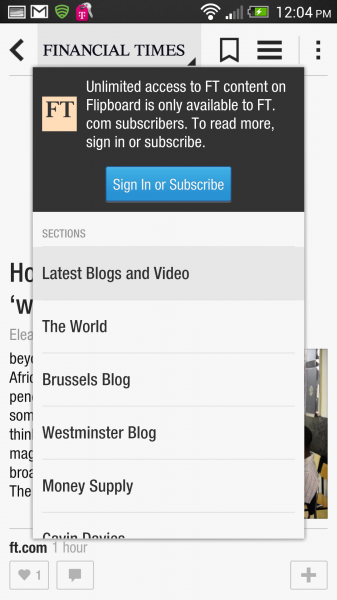
May 9 was a big day for Flipboard. The personal news app launched a new version on Android, bringing feature parity with iOS, and the Financial Times debuted as a content provider. FT is unique among magazine news publications, by making people pay. Free rides are short lived; the newspaper lets registered users view a limited number of stories per month. More than that, requires a subscription.
Many people look at Flipboard as a pretty news aggregator — a smorgasbord of valuable content served up for free; eat as much as you like. Financial Times brings the pay model with it. You still need a FT account. Registered users are limited to blogs and video, while subscribers get access to everything. I wonder if personal paper apps like Flipboard aren’t the future news, with some — even more — content behind the paywall.
Charl Porter, group product manager, graciously took time to answer questions about the Financial Times’ business model and how Flipboard fits into the overall strategy. Remember, FT is among the rare publications for which people pay.
BN: As a journalist, I am rather mortified by what the Google economy does to news. Free content supported by advertising, particularly when there is too much ad space to fill, isn’t tenable. How is it Financial Times succeeds by making people pay?
CP: The FT’s business is based on dual revenue streams (content and advertising), and more people than ever in our 125-year history are readers and subscribers of FT content.
We provide premium and essential news, commentary and analysis to an audience of over 600,000 paid subscribers (print and digital), who believe that FT content is worth paying for. Our successful channel-neutral strategy offers readers flexibility in how they choose to receive our content, and at its core is the metered access model we pioneered in 2007. Thanks to our digital access model, we now have deep knowledge of our audience and can apply data analytics for smarter marketing.
BN: Why Flipboard?
CP: We recognized early on that the continued success of our business depends on our ability to adapt to changing reader habits, and launching on a leading mobile app like Flipboard is a natural development for the Financial Times.
Mobile continues to drive growth and now accounts for a third of all FT.com page views, driving 15 percent of digital subscriptions.
Social media has changed the way people interact with brands, consume content and connect with each other. This is particularly true of the media industry and the way consumers discover and share news. At the FT, this deeper engagement with our audiences helps drive growth, and in 2012 the volume of visits to FT.com driven by social media grew by 35 percent.
 BN: Why Flipboard now — and not sooner?
CP: We have been in discussions with Fliboard for a couple of years now to make sure that our proposition would work for both parties and across platforms, given we want to offer readers a multi-channel subscription with a single login. This launch has combined the FT’s award-winning journalism with a personalized reading experience on Flipboard. It also strengthens our presence on Android.
BN: How do you see apps like Flipboard, or even Google Currents, changing how people consume news?
CP: I see it as an opportunity for publishers like the FT to engage readers across multiple channels and devices. Our partnership with Flipboard allows reader to consume FT content in a new format using the same login as they would on FT.com or the FT web app. It’s a great way to get our brand out there without compromising our business model. We are still able to retain a direct relationship with our readers, which is key to our strategy.
BN: To be honest, I used to be a Financial Times subscriber but the Android tablet app just couldn’t satisfy. How would you compare the Flipboard experience?
CP: Flipboard provides an engaging leanback experience, and the app has successfully replicated the ‘browsability’ of a magazine. Our partnership with Flipboard does extend our presence on Android but we are working on enhancing the overall FT experience on Android. Our award-winning HTML5 FT web app now has more than 3.8 million users and was recently redesigned. The app is currently available on iOS now cleaner and easier to use, with more personalization and a choice of a static morning edition or a dynamically updating version.
BN: Flipboard lets users create custom magazines, of sorts. How does Financial Times sees this, and other mechanisms like it, fitting into broader editorial content and revenue-generating strategies?
CP: The social aspect of Flipboard’s custom magazines is exciting and we hope to play a part in that by allowing readers to use FT content within custom magazines while also experimenting with FT branded magazines.
We also have a dedicated iPad app for our award-winning How To Spend It magazine, which aesthetically matches its printed counterpart whilst offering the dynamism and immediacy of the web. The revenue on our HTSI platforms (tablet and desktop) more than doubled year on year.
-
Games for the weekend: Gravity Hook HD
Games for the Weekend is a weekly feature aimed at helping you avoid doing something constructive with your downtime. Each Friday we’ll be recommending a game for Mac, iPhone or iPad that we think is awesome. Here is one cool enough to keep you busy during this weekend.
 Gravity Hook HD ($0.99, Universal) is a high scoring arcade-style game that is more challenging than it may first appear. If there were such a genre for side-scrolling puzzle games, this game would define that genre. Except for one minor detail: it’s vertical.
In Gravity Hook, your robot shoots out a grappling hook towards an orb that you believe is stable enough to propel the robot upward. The problem is that the orb is not attached to anything. As the robot is pulled closer to the orb, the orb is getting pulled closer to the robot. Gameplay is simple enough to get the hang of — just tap on the orb you want to attach the hook to and the robot shoots its hook at that orb. As the robot moves upward, more orbs become visible for you to grab on to. When you select a new orb, the robot releases the hook from the orb it is currently attached to and fires the hook to the new orb.

Sounds simple enough, but there is one slight catch. The closer the robot is to an orb when it gets attached, the faster the robot moves toward it. So fast, in fact, that the robot can use the momentum to fling itself up even higher. The opposite has its ill effects as well: the farther away the robot is from an orb when it gets attached, the slower the robot moves toward it. If the robot happens to be too far away at the time it gets attached, it will fall further away from the orb rather than get closer. You can, however, attempt to recover from choosing an object that was too far away by targeting a closer object. The problem is that your downward momentum is often times too much for the cable to handle. Extending the cable between the robot and the orb too much will cause it to snap. With no cable to cast out, the robot will fall, crashing downward and ending the game.

The orbs themselves have different properties as well. The farther up you go, the more complex the choices get. Toward the bottom of the game, the green orbs you grapple on to are quite benign and easy enough to get the hang of. The blue orbs on the other hand turn into mines as soon as you attach to them. When attached, a timer starts counting down. Detaching from the blue orbs stops the timer. If you stay attached too long and end up bumping into the blue orbs as you get pulled closer to them, the blue orb will explode and destroy the robot in the process.

The gray orbs are chained to one another and will quickly break free. Once free from the other gray orbs, they begin to plummet toward the ground. Staying attached to them for too long and the robot will be pulled to the ground with them. And the red orbs, lets just say you need to avoid those at all costs. With all of the objects the idea is basically the same, don’t stay too attached to any one object for too long. Use your momentum to propel the robot upward to the next collection of orbs.

There is a classic play mode as well. I found the classic mode to be much more challenging than the normal play mode. So you might want to get the hang of things in the HD version before you try out the classic eight-bit version. The first rendition of the game was originally inspired by a program that was use to teach students how to type if you can imagine that. Whichever version you feel more comfortable playing, this is the weekend to grab hold of Gravity Hook.

Related research and analysis from GigaOM Pro:
Subscriber content. Sign up for a free trial.- How do developers ride the Siri wave?
- Connectivity means making the machine disappear
- Access vs. ownership: Why UltraViolet has already lost

-
RGIII to Marry Rebecca Liddicoat This Summer
Robert Griffin III is well-known for his skill as the Washington Redskins’ quarterback and for winning the 2011 Heisman Trophy. Now, though, RGII (as he’s sometimes known) is about to experience a great milestone in his personal life.
RGIII’s mother, Jackie Griffin, sat down with DC TV news station Fox 5 this week and revealed that Griffin will be getting married this summer. He will be marrying his long-time girlfriend Rebecca Liddicoat, though no specific date was revealed.
The couple are reported to have met while they were still students at Baylor. Griffin proposed in October 2011 after a game against Kansas State.
Griffin was born in Okinawa, Japan and grew up in a military family, moving throughout the U.S. during his childhood. He attended Baylor University, where he racked up 110 touchdowns and over 10,000 passing yards as the Bears’ quarterback. In addition to winning the Heisman, he was the second draft pick in the 2012 NFL Draft and the cover athlete for EA’s NCAA Football 13 video game.
DC Breaking Local News Weather Sports FOX 5 WTTG
-
With Cloud Drive Photos, Amazon makes a play to be the cloud app for iOS photos
Not happy with PhotoStream on your iOS device? Amazon now has its own cloud-based offering for iOS: Amazon Cloud Drive Photos. It was released on the iOS App Store on Thursday.
Apple’s issues with mobile photos and cloud storage were brought to light this week with a great post from an app developer, Peter Nixey. In a widely circulated personal blog post, he expressed his frustration with Apple’s current approach to managing photos on the desktop and on mobile. He presciently noted there would be a time when competitors — he named Google or Dropbox — would come along with better cloud-storage options for mobile photos.
Well, here comes Amazon with one such solution. Cloud Drive Photos, already available on Android, is a place to store all your photos (“thousands,” according to the company). Images taken with an iPhone or iPod touch get uploaded automatically to Cloud Drive when the app is opened. And you can also see any of your photos stored in the cloud on the device with the app. It’s free, and available on the iOS App Store now.
Just like Google with Maps, Search and Mail and Facebook with social things, Apple’s biggest and most important competitors are repeatedly besting Apple on its own platform when it comes to producing well designed, popular basic apps that are core to the mobile experience.
This Amazon app is different than, say, Yahoo being better at making a weather app than Apple. Or Kindle being a better ereader app than iBooks — sort of embarrassing, but not really areas Apple considers its core mission.
But the secret behind Amazon’s cloud-based photo storage is something at which Amazon is verifiably awesome, and something at which Apple is not: the cloud. Even with its billion-dollar data center and more on the way, Apple repeatedly struggles with keeping its cloud-based services reliable for users. And even when things are added to iCloud, like photos, some users still run into problems, as outlined in the link above, with multiple copies or confusing organization.
The more troubling part of it all is that Apple’s cloud services aren’t just supposed to be something added on to its hardware offerings. Linking users’ data, whether it’s photos, music, videos, documents, email or messages, and making it accessible regardless of device, is part of Apple’s plan for growth. As CEO Tim Cook has said, it’s at the centerpiece of its strategy for the next decade.
Apple’s going to have to start offering far better core mobile apps that connect with its cloud if it doesn’t want Amazon and others to peel users off to their own services.

Related research and analysis from GigaOM Pro:
Subscriber content. Sign up for a free trial.- Analyzing the wearable computing market
- The future of mobile: a segment analysis by GigaOM Pro
- Mobile Q2: Smartphone growth surges; iPad’s rule continues

-
Open source flight, from the Drone Lab to Twitter: Q&A with Dave Lester
I recently had the chance to catch up with Dave Lester, a soon-to-be graduate of UC Berkeley’s School of Information and a web developer who has been involved in a number of open source initiatives. Dave has been working on bringing technology together with the humanities and education through an un-conference he co-founded, and in his former role as assistant director of the Maryland Institute for Technology in the Humanities. We talked about his drone hacking project, the importance of code integration, and his upcoming foray into open source at Twitter in an email interview.
How did you become interested in open source and community building?
I was contributing to an open source web publishing system for digital archives called Omeka. The primary goal of Omeka is to make publishing digital archives of historical photographs and stories as easy as publishing a blog. We patterned our community strategy around Mozilla and WordPress, trying to create a ladder of contributions where people of varying skill levels could get involved, and I was helping coordinate developer community growth. Shortly after launching our first public beta, we realized that the community of interested users was more diverse than we imagined, not only from museums and archives but also libraries.
For me, community building began mostly as a way of understanding and negotiating the differences and needs of these institutions. You need direct, personal connections with your users in order to understand their needs; in the process, you start to draw connections between the work of others and play a role of matchmaker.
My interest in community building led me to help co-found THATCamp, The Humanities and Technology Camp, an un-conference. THATCamp is a BarCamp-style event, bringing together technologists and humanists to create sessions related to digital humanities. Sessions vary from event to event, but my favorites have always been ones that focus on building. And since 2008, there have been over 100 THATCamp events around the world.
You’re involved in open web projects through the Mozilla Foundation, right?
 I’ve been working as an Integration Engineer Contractor with the Open Badges team at Mozilla, mostly helping third-party developers integrate with APIs to create and display badges. Open Badges is a standard to recognize learning online through the open sharing of digital badges, It’s an exciting approach to informal learning and using badges as a way to capture achievements that are otherwise not visible on a resume.
One of my contributions to the project has been creating several WordPress plugins to make it easier to issue and display badges; it’s important that a variety of platforms adopt the standard to give the community a variety of ways to hook into our infrastructure.
You’re also interested in hacking hardware, such as drones. What has this taught you about coding?
This semester I helped organize a group of fellow graduate students at UC Berkeley to form what we’ve called “Drone Lab”, an informal group that has met weekly to hack, discuss, and investigate creative and problem-solving uses of consumer-grade quadcopters. These are hobbyist toys that you can buy at your local shopping mall, but the ability to control them using software that you script unleashes the potential to tap into their cameras and sensors from heights and hard-to-reach places that are new and exciting. What we ended up focusing our hacking on were new ways to control the quadcopters, including voice and tracking head movements.

What I found fascinating the last several months was introducing several of my classmates to Node.JS through programming these drones. Learning to program can often be a frustrating and unrewarding experience, but with just a proper development environment and a few lines of Javascript, you can fly a copter. Programming shouldn’t be limited to terminal windows, and the feedback of seeing the drone fly can be very rewarding. This also fosters creativity and unexpected things – sometimes you’ll see the drone do something in flight that seems odd, which prompts new questions about your code and experimentation that can be less common in programming.
So were you part of last year’s TacoCopter stunt?
TacoCopter is a project that I’m not involved with; I believe it’s meant to be more of a joke than a real thing. Still, there’s something intriguing and futuristic about a flying robot delivering Mexican food that gets people’s attention. We joke a lot about delivering tacos via drones.
What do you see on the horizon for programming and the open source movement?
In the age of GitHub where it’s easy for anyone to share code online and gain a following, the proliferation of projects both big and small can come at the expense of a clear way to integrate various codebases together. In my experience, it’s often the “glue code” and examples that are most valuable to users who want to use your software; the last 10 percent, so to speak. To be effective in open source community building, understanding those needs of integration is crucial and something I’ll be spending a lot of time working on.
In general, I’m excited to see more companies using and releasing open source software, not for the goal of selling it but in an effort to develop better services and give back to communities that they benefit from. The precise model for how this software will be supported, grown, managed, and sustained is still to be defined; these are often projects without a software foundation. I hope to see more coordination and partnerships among companies regarding open source contributions.
Finally, what’s next after you finish your Master’s?
I’ll be joining Twitter as an Open Source Advocate in June. I’ll be responsible for building relationships with communities to drive adoption of our open source projects and APIs. Twitter has over 100 open source projects, and as an organization has made a big investment in using and releasing open source software.
time to make it official with a tweet: in June I am joining @twitteross as an Open Source Advocate. I’m pumped!
— Dave Lester (@davelester) May 8, 2013
Images via OpenBadges.org, UC Berkeley School of Information

Related research and analysis from GigaOM Pro:
Subscriber content. Sign up for a free trial.- The 2013 task management tools market
- How consumer media will change in 2013
- Examining the rise of crowd labor platforms in 2012

-
New ad shows that HTC is literally fighting dirty [video]

-
Kidnap Victim Shuns Family For Not Looking For Her
Kidnap victim Michelle Knight has requested that her family members not visit her in the hospital as she recovers from what has been an 11-year ordeal, apparently because those closest to her didn’t look for her after she disappeared.
32-year old Knight vanished in 2002 after a custody dispute involving her then-young son, and her family thought she had run away. When kidnapper and rapist Ariel Castro allowed Knight and the two other women he held captive–Amanda Berry, 27, and Gina DeJesus, 23–to watch television, he taunted them with footage of candlelight vigils held in their honor. Knight’s family held no vigil, in part because they believed she’d left of her own will.
“They took him and she went out and took off and never came back,” said her grandmother. The family did file a missing persons report, however.
Knight, who was held the longest of the three women, reportedly suffered five miscarriages at the hands of Castro, who allegedly beat her in the stomach and starved her while she was pregnant. She remains in the hospital’s care, though the other two women have been released. Ohio prosecutors say they are pursuing a charge of aggravated murder on Knight’s behalf, which carries a possible death sentence.
The three women were rescued earlier this week after Amanda Berry saw her chance to escape with her 6-year old daughter and took it, banging on the outer door of the home to get the attention of anyone nearby. Neighbor Charles Ramsey was just finishing dinner when he heard the noise.
“I’m eating my McDonald’s; I come outside; I see this girl going nuts,” he said. “I knew something was wrong when a little pretty white girl ran into a black man’s arms. Something is wrong here. Dead giveaway!”
Investigators said today that they’ve confirmed that Berry’s daughter belongs to Castro.
-
UCLA stem cell researchers move toward treatment for rare genetic nerve disease
Led by Dr. Peiyee Lee and Dr. Richard Gatti, researchers at the Eli and Edythe Broad Center of Regenerative Medicine and Stem Cell Research at UCLA have used induced pluripotent stem (iPS) cells to advance disease-in-a-dish modeling of a rare genetic disorder, ataxia telangiectasia (A-T).Their discovery shows the positive effects of drugs that may lead to effective new treatments for the neurodegenerative disease. iPS cells are made from patients’ skin cells, rather than from embryos, and they can become any type of cells, including brain cells, in the laboratory. The study appears online ahead of print in the journal Nature Communications.People with A-T begin life with neurological deficits that become devastating through progressive loss of function in a part of the brain called the cerebellum, which leads to severe difficulty with movement and coordination. A-T patients also suffer frequent infections due to their weakened immune systems and have an increased risk for cancer. The disease is caused by lost function in a gene, ATM, that normally repairs damaged DNA in the cells and preserves normal function.Developing a human neural cell model to understand A-T’s neurodegenerative process — and create a platform for testing new treatments — was critical because the disease presents differently in humans and laboratory animals. Scientists commonly use mouse models to study A-T, but mice with the disease do not experience the more debilitating effects that humans do. In mice with A-T, the cerebellum appears normal and they do not exhibit the obvious degeneration seen in the human brain.Lee and colleagues used iPS cell–derived neural cells developed from skin cells of A-T patients with a specific type of genetic mutation to create a disease-in-a-dish model. In the laboratory, researchers were able to model the characteristics of A-T, such as the cell’s lack of ATM protein and its inability to repair DNA damage. The model also allowed the researchers to identify potential new therapeutic drugs, called small molecule read-through (SMRT) compounds, that increase ATM protein activity and improve the model cells’ ability to repair damaged DNA.“A-T patients with no ATM activity have severe disease but patients with some ATM activity do much better,” Lee said. “This makes our discovery promising, because even a small increase in the ATM activity induced by the SMRT drug can potentially translate to positive effects for patients, slowing disease progression and hopefully improving their quality of life.”These studies suggest that SMRT compounds may have positive effects on all other cell types in the body, potentially improving A-T patients’ immune function and decreasing their susceptibility to cancer.Additionally, the patient-specific iPS cell–derived neural cells in this study combined with the SMRT compounds can be an invaluable tool for understanding the development and progression of A-T. This iPS cell–neural cell A-T disease model also can be a platform to identify more potent SMRT drugs. The SMRT drugs identified using this model can potentially be applied to most other genetic diseases with the same type of mutations.This research was supported by training and research grants from the California Institute of Regenerative Medicine, the National Institutes of Health, APRAT, A-T Ease and Scott Richards Foundation.The Eli and Edythe Broad Center of Regenerative Medicine and Stem Cell Research: UCLA’s stem cell center was launched in 2005 with a UCLA commitment of $20 million over five years. A $20 million gift from the Eli and Edythe Broad Foundation in 2007 resulted in the renaming of the center. With more than 200 members, the Broad Stem Cell Research Center is committed to a multidisciplinary, integrated collaboration among scientific, academic and medical disciplines for the purpose of understanding adult and human embryonic stem cells. The center supports innovation, excellence and the highest ethical standards focused on stem cell research with the intent of facilitating basic scientific inquiry directed toward future clinical applications to treat disease. The center is a collaboration of the David Geffen School of Medicine at UCLA, UCLA’s Jonsson Cancer Center, the UCLA Henry Samueli School of Engineering and Applied Science and the UCLA College of Letters and Science.For more news, visit the UCLA Newsroom and follow us on Twitter.


