[JURIST] A judge for US District Court for the Western District of Wisconsin ruled Thursday that the National Day of Prayer is an unconstitutional government endorsement of religion. Judge Barbara Crabb issued summary judgment in favor of the Freedom from Religion Foundation, which challenged 36 USC § 119, establishing a day of prayer. The statute, passed in 1952 and amended in 1988 to make it the first Thursday in May, says the president will declare the day so people “may turn to God in prayer and meditation at churches, in groups, and as individuals.” In her ruling, Crabb said the National Day of Prayer violates the First Amendment’s Establishment Clause:
It goes beyond mere “acknowledgment” of religion because its sole purpose is to encourage all citizens to engage in prayer, an inherently religious exercise that serves no secular function in this context. In this instance, the government has taken sides on a matter that must be left to individual conscience. “When the government associates one set of religious beliefs with the state and identifies nonadherents as outsiders, it encroaches upon the individual’s decision about whether and how to worship.”The White House said that President Barack Obama still intends to recognize the day of prayer as he did last year.Last month, the US Court of Appeals for the Ninth Circuit ruled that a teacher-led recitation of the Pledge of Allegiance in public schools does not violate the Constitution’s Establishment Clause. The court also upheld the use of the phrase “In God We Trust” on currency. In November, the US Court of Appeals for the Third Circuit ruled that a school district’s policy prohibiting the performance of religious holiday songs does not violate the Establishment Clause. Also that month, a judge for the US District Court for the District of South Carolina ruled that license plates produced by the state bearing a picture of a cross in front of a stained glass window and the words “I Believe” violate the Constitution.
Blog
-
Federal judge rules National Day of Prayer unconstitutional
-
2006: Google considered a PR campaign against content owners’ ‘foot-dragging’
By Scott M. Fulton, III, Betanews
In what may have, by now, become an exercise in the airing of corporate dirty laundry (or, in some cases, not even dirty), Viacom yesterday released more evidentiary documents from its court battle with Google. This second round of what was promised to be three public releases (though there could be more to come) includes confidential Google executive presentations from the period prior to its acquisition of YouTube, when the company was considering instead bolstering Google Video to become more competitive.
Rather than being incriminating, the documents paint Google executives to be cunning, shrewd, and eager to assume the mantle of the moral high ground. But they also reveal instances where the company considered pressing its high-ground position to its advantage, with prospective PR campaigns and likely incentives to the press that would encourage the viewpoint that media companies such as Viacom (parent of Paramount Pictures and MTV Networks) were behind the times, inflexible, and unwilling to open up their content vaults for fair use.
One bullet point recommendation for consideration from a June 2006 presentation on strategic directions for Google Video, concerned the use of a PR campaign to coerce media companies, explicitly including Viacom (whose logo appeared on one slide along with others’), to make more “viral” video available for premium (paying) users. “Threaten a change in copyright policy as part of a PR campaign complaining about harm to users’ interests through content owner foot-dragging — use threat to get standard deal sign-up,” the suggestion read.
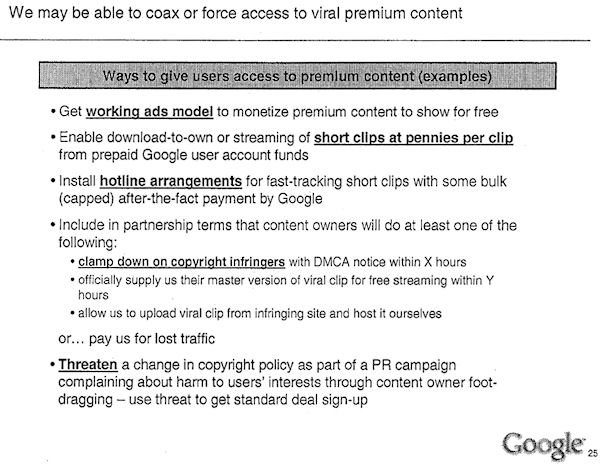
A slide from a 2006 Google executives’ presentation showing they considered retaliating against content owners with a press campaign. From documents released April 15 by Viacom.
Although a Viacom press statement yesterday accused Google of “explicitly advocating that Google use the threat of copyright theft to advance its business interests,” a closer read of the presentation in its entirety, and an understanding of the context in which it was made, suggests another interpretation: Google may have been considering the implementation of a new policy whereby content owners such as Viacom would have been more directly responsible for material that users may have uploaded, forcing them to more publicly prohibit the specific use of certain clips or segments of video. Imagine how Viacom might have looked if they had to post a public message saying, “You can’t watch clips from Iron Man yet,” on a big public display. Google would develop a “review tool” to help premium content partners scan the system for clips from Iron Man and other properties, but in the absence of action on the partners’ part, Google would compel the press to publish articles that paint partners as dinosaurs.
Again, this is not what Google actually did — as we all know, Google acquired YouTube instead. But this examination of the strategy the company could have used to combat YouTube — a strategy which may very well have actually worked — demonstrates the kind of template that Google uses when framing a corporate strategy. This is a template we may very well see Google put to use today, as it considers whether to release the VP8 codec it acquired in the purchase of On2 Technologies, under an open source or royalty-free license.
In a later slide from the 2006 presentation, Google executives consider the ramifications of three different copyright policy choices for Google Video (GV). One of them is the use of digital rights management technology for premium content. If it had taken that step, the slide suggested, GV’s content team would have been tasked with prompting partners including Viacom to make more viral content available, perhaps in shorter streams or promotional clips. Other slides, as well as other documents and presentations from the same period, make it clear Google was aware of partners’ concerns that Google was not in the business of promoting content, or featuring or spotlighting some shows for a limited time like a video rental store would…or like YouTube had started doing. But Google was also under the impression (possibly a very correct one) that if it threw away its organic advertising model in favor of a pre-scheduled promotional platform, it would fail to build an audience, and maybe even drive away its existing audience.
So one alternative under consideration was the exact opposite of adding DRM: It considered letting clips happen, if you will. People would upload them, just as they do on YouTube. Under the right circumstances, though, those people could be doing the content owners a favor, especially if GV and those owners had a deal to present those clips anyway.
But content owners tend to decide which clips they don’t want visible, after they’re already visible. In which case, a slide suggested, in the event of loosening content restrictions for clips, the company could “Support partners’ use of review tools,” and, “Reach out to non-partner content owners — actively promote review tool.”
Problem is, beyond evangelism, no one could force content owners to use that review tool. So the plan would address that eventuality: “Increase staffing and/or resources to content acquisition, ops, and legal teams to handle complaints and potential litigation,” and, “Limit damage through public policy, investor relations, press and premium partner meetings.”
The presentation also showed that Google carefully examined the ramifications of building a video system that forced content owners to explicitly “opt out” their own premium clips. In a slide entitled, “Potential results of changing copyright enforcement policies,” sure, traffic would improve as users found more and more stuff available, especially those choice “viral” clips. But that influx of users could muddy the waters for Google in determining which specific segments of interesting video could be developed for more refined tastes among small to moderate pockets of GV users. It was here that Google envisioned its real payoff: distinguishing itself from YouTube by providing not viral video, but very interesting video such as documentaries, symposiums, educational works, and stuff small groups of people would pay big money for. In the company’s metaphor, where paid premium content such as big movies would be the “head” and user-submitted videos of possums chasing squirrels would be the “tail,” this payoff segment was called the “torso.” Google reasoned that, if it opened up the floodgates for “tail” content that ended up including bits of “head” content, it would render itself less capable of generating user communities and social networks around “torso” content.
Which, history revealed, was absolutely correct.
In the eventuality of loosening the “tail,” Google executives reasoned they would need to mitigate the problem by “Modifying copyright protection through applying public pressure through increased collaboration with content owners and indirect pressure through press and public policy.” As a result, the executives predicted, “Some content owners sue Google” (again, very wise). Another potential problem would be certain smarter elements of the press detecting two conflicting messages from the company — one for loosening copyright for “tail” video content, and another for respecting copyright for all those literary copyright holders whose works were being digitized by Google’s ongoing project with the world’s major libraries.
The bottom line could be affected, executives reasoned, as the company’s AdSense and other platform advertisers “Wish to avoid negative associations.” So contrary to Viacom’s public assertion that Google was advocating a thwarting of copyright policy to compel content owners to disgorge their clips before a maddening public horde, the evidence actually shows where Google executives logically weighed the negative ramifications of possible public policy changes.
It also shows the beginning of the no-win scenario that eventually led Google to purchase YouTube rather than compete.
Complete documents from the Viacom v. YouTube case are obtainable from this Viacom Web page.
-
Jay-Z Sues Boston Red Sox Star David Ortiz For Swiping 40/40 Club Name
Jay-Z despises copycats — which is precisely why the “Big Pimpin’” star has slapped Boston Red Sox first baseman David Ortiz with a $5 million lawsuit for swagger-jacking his club name. You see Ortiz named his new club in the Dominican Republic Forty-Forty — which kinda sounds exactly like Jay’s 40/40 chain here in the States.

The suit — filed by Jay and his business partner Juan Perez in Manhattan federal court on Thursday — accused Ortiz and his sister, Albania Ortiz, of trademark infringement, unjust enrichment, and “false designation of sponsorship” in connection with the Forty Forty nightclub they opened in their Caribbean native last year.
The suit also charges The Ortiz Family with “cybersquatting,” for running a Spanish-language website at www.fortyforty.net.
Jay-Z and Perez own 40/40 Clubs in New York City, Atlantic City, and Las Vegas, with plans to open further venues in Tokyo and Macau. They claim Ortiz is trying to capitalize on the success of their chain by swiping the name they came up with more than seven years ago.
“David Ortiz is fully aware of plaintiff’s Manhattan 40/40 Club, since he had been a patron there on several occasions long before he opened his infringing Forty/Forty Club,” read the lawsuit filed in Manhattan Federal Court.
-
College Professor Outsources Grading Papers To Asia

As you struggle to repay your student loans, you can at least comfort yourself with the knowledge that your papers were graded by qualified professors and teaching assistants, and not by housewives in Bangalore. Students attending college today… may not be so lucky.
A company called EduMetry is here to help professors who want their students to have more detailed feedback on their writing than faculty or their TAs actually have time to give. Graders work in India, Singapore, Malaysia…but some are also based in the United States.
Company officials would not say how many colleges use the service, but Mr. Rajam acknowledges that the concept of anonymous and offshore grading is often difficult for colleges to swallow.
Those that have signed up are a mix of for-profit and nonprofit institutions, many of them business schools, both in the United States and overseas. Professors and administrators say they have been won over by on-the-job performance. “This is what they do for a living,” says Ms. Whisenant. “We’re working with professionals.”
Grading papers can be drudgery, but won’t someone please think of all the underemployed humanities majors right here in the United States?
Some Papers Are Uploaded to Bangalore to Be Graded (Thanks, Joanna!) [Chronicle of Higher Education]
-
A Response to Robert Bird and Peggy Chaudhry by David Orozco
by David Orozco
[David Orozco is an Assistant Professor of Business Law at Michigan Technical University]
Professors Bird and Chaudhry provide an insightful and timely analysis of European Law related to the repackaging and relabeling of grey goods, specifically pharmaceutical products. The analysis navigates readers through the morass of legal confusion and uncertainty in this area of international law. A couple of questions were raised by the paper that I would specifically like to address to the authors. First, given that the property system has provided little legal certainty in this area, why not resort to the law of contract? Can pharmaceutical companies, for example, embed contractual provisions with distributors that would shift economic and legal risk for products that somehow deviate from the expected distribution chain? This contractual risk would be imposed against a particular firm, so would EU trade law be circumvented in this regard, by resorting to contract law?
It also seems like the law has created a perfect Catch-22 scenario. The authors state that “[w]hen this [reputational] harm occurs, the mark owner can object unless the use is necessary to enter the market.” It seems as if trademark law attempts to reward the drug manufacturers’ marketing behavior and investments in brand equity on the one hand, and yet the trade laws penalize them for this since the argument will be made by parallel importers that they cannot compete unless they appropriate the valuable mark. The Article dissects the complex nuances of this paradoxical state of affairs.
Finally, it would be interesting to learn a bit more about how grey market goods become grey market goods. What occurs within the supply and distribution chain that allows for this to happen? Are there ethical concerns related to fraud or breach of contract regarding how these good enter the stream of commerce during re-importation? Should these facts be weighed in at all in the preceding analysis of the economic and legal implications of grey market activity?
-
Reach Toshiba Executive Customer Service

Your laptop is a craptop, the hold music won’t stop and the call center won’t talk, so you’re looking for a guy at the Toshiba top to get you back on top. Guy Lugo is that guy:
Guy Lugo
949-461-4153 -
Why It’s Not Inevitable That Other Wall Street Banks Are Going To Get Dinged (GS, MS, BAC, C, JPM)

All the big financial stocks are selling off on the news that Goldman Sachs (GS) is being charged by the SEC for subprime mortgage fraud.
The SEC itself says the charges are part of a broader investigation.
So does this mean that more charges against other banks are inevitable?
No.
Remember, Goldman Sachs isn’t being charged for selling CDOs. It’s not even being charged for selling CDOs that were structured by a hedge fund (Paulson & Co.).
It’s being charged for something very specific, that its employee Fabrice Tourre mislead investors about who selected the assets, and what direction he was betting on.
Unless teh SEC can fine a Fabrice Tourre at Barclays (BCS), Bank of America (BAC), Citigroup (C), Morgan Stanley (MS), and JPMorgan (JPM) then they’ll probably be unlikely to pull the trigger.
Now see the full guide to our coverage here >
Join the conversation about this story »
-
The Athletic Brain | The Loom
 In the April issue of Discover, I take a look at the mind of the athlete. We may think of sports as a matter of muscle, but the brain is vital as well. And in becoming great athletes, people develop unusual brains. This transformation only makes sense–any intense training can change the brain, whether it’s practicing the piano or learning Mandarin. But for some reason, the idea that being a great athlete is, in part, a cerebral exercise still comes as a surprise. In fact, according to this ESPN take on my column, it’s downright disappointing.
-
Where Are They Now? – Round 2
 What is in a story about personal health and wellness? We all have them; every one of us. Yours might be about your relationship with food, or about your body image, or about weight loss, or about overcoming illness or injury. If you’ve read my book you’re familiar with mine. I was a cardio junkie who swallowed the Conventional Wisdom-bait, hook, line and sinker for many years, paid the price, and then rebuilt my life using the powerful principles described in The Primal Blueprint. Whatever the theme, though, one thing can be certain. Health is a journey. It has its ups and downs, struggles and achievements, moments of dramatic change, plateaus and periods of homeostasis. Health is not static. And this is a good thing! It means that at any time we have the opportunity to reverse course and begin sending our genes the right signals for positive expression.
Last week we all had the pleasure of reading how the Primal lives of Griff, Michelle, Melissa and Sterling have been progressing. This week you’ll hear back from Apurva, Diana, Lisa and Christian. Find out what they’ve learned, experienced and come up against since last we heard from them, and then maybe take a moment to reflect on what your narrative is and what it could become. What is your story up to this point, April 16, 2010? Now get creative. Imagine what your story will be 1, 10, or 20 years from now. Are you healthy, energetic, happy and productive, or are you out of shape, tired and struggling through life? Tell yourself the story of your future self, and then take the steps to make it a reality. Read on for a little real life inspiration…
Apurva
Hello Mark, thanks for your interest in my progress. I think the last time I sent you details about how my lifestyle changes were going was in March 2008, which makes it 2 years now.
Two years ago, I was on my way to getting primal and had enjoyed dramatic initial results. Since then, the progress has continued, albeit gradually, and involving a lot more effort. At that time, I had dropped a lot of fat and was bordering on looking skinny-fat. My diet was mostly primal, but carbs were not totally eliminated, and I was liable to the occasional binge. I also consumed a lot of fruit (a cup of papaya for breakfast, bananas, apples, etc.) My workouts were based on de Vany’s superset training involving quite a lot of isolation movement. My goals then were to get rid of the stubborn fat and to build muscle.
In the past two years, the changes in my diet and exercise have been quite big. Nowadays, I eat almost 100% primally: only meat, fish, eggs, vegetables, all by-and-large locally and organically grown. My fruit intake is severely curtailed, though in the spring and summer I help myself to the berries that become available on the local farmers’ market. My nut consumption has dropped significantly from the initially copious amounts that I consumed when I first made the shift away from carbs. I do indulge in red wine and dark chocolate.
As far as exercise goes, I have been doing CrossFit regularly for nearly 20 months now. I work off the main site WODs, scaled according to the recommendations at crossfitbrandx.com. I also regularly do yoga, play tennis, bike around town, and sprint every week or so (except when all the fields are drenched). I usually do 3-4 CrossFit workouts in the week, yoga 2-3 times a week. So it is a pretty active lifestyle.
I think the biggest change from two years ago is in my relationship to food and in my physical capacity.
As far as food goes, I feel I have made it to a place where my natural response to food is exactly where I want it to be. If I am not hungry, I can easily not eat, or eat a little if the social situation demands it. If something carby (like bread on a restaurant table) is placed in front of me, it is easy to resist, or have the temptation be automatically wiped out with one bite. Hunger is very bearable, and I know how to eat so that I never feel full, and almost always leave a meal with a satisfied feeling. I think this highly tuned natural response is the best thing that has happened in the last year.
In terms of physical capacity, I think a workout last week showed just how far I have come: when I started CrossFit, I could not do a single pull up and barely 7-8 dips at a stretch. Last week, I did a workout that included 120 pull ups, 120 dips, and weighted squats. My time was not great, but the fact that I could do that much work in a single session was striking to me. My times on the benchmark CF workouts continue to fall, my score on the CrossFit Total has increased by more than 150 since I started. And I have not gotten so much as a sore throat or a sniffling nose for years (touch wood)!
So I am in quite a good place as far as health and fitness goes. It took a lot of effort and a lot of tinkering to create this lifestyle. I have hit many plateaus, and have realized that not all the recommendations on the site worked: intermittent fasting did not really make a difference (I tried it for 15 months); the general idea that you can eat as much fat and protein as you want as long as you cut the carbs did not apply to me (I have realized that was consuming way to many calories for my system and as a result the stubborn fat was going nowhere); etc.
In the past two years, I feel that I have learnt many valuable lessons on fitness and health:
I have learnt that one has to find one’s own niche within the “Ten laws of the Primal Blueprint,” and that there is no silver bullet to finding the path of sustainable and continued progress. What worked yesterday will probably not work tomorrow, and what works for somebody else will probably not work for you. It is all about sharpening awareness of what is happening in your system and then experimenting with your lifestyle to find a way forward. Finally, it is important to have tangible, coherent, metrics (the Crossfit Workouts are great in that respect, and so is your waist size) so that you can gauge progress. But defining goals and identifying those metrics is again a very personal thing.
But I think my biggest gain in the last two years has been in fully accepting that building and maintaining fitness and health is a process and not a destination. One has to be willing to adapt to ones circumstances as they change. I have found that the “Ten Laws of the Primal Blueprint” provide wonderful guidance on how to adapt in the most healthful and effortless way. In addition, the experimental and empirical flavor of your work truly encourage the near constant tinkering that is necessary if one is to make long-lasting improvements to one’s life. It is in these capacities that the Primal Blueprint has proven invaluable to me in my fitness journey.
Read Apurva’s original Success Story here.
Diana
I’m still working hard to get rid of those last few inches around the middle. It’s coming down to loose skin at this point, and I’ve started taking donations to save up for surgery to fix some of the aesthetic issues that come from big weight loss. My weight has increased by about 5 pounds since I’m currently working on building some very nice muscle, especially in my arms. My legs are much stronger than they used to be, even when I was running. I can do REAL push-ups now! I’ve also started living in Vibrams, my hair is thicker and healthier after discontinuing shampoo, and my skin looks better than it ever has. I’m hoping by next summer, between intense workouts and maybe a little nip/tuck to be in a bikini for the first time in my life. This summer I plan on taking a 20-mile trek from my apartment to my parents’ house… just to see what it’s like to travel the old fashioned way.

Grok On, and thanks for all the help.

Read Diana’s original Success Story here. Also, check out Diana’s blog, The Wilderness Childe.
Lisa
When last we met, you were getting a slightly different perspective from me than most. I wasn’t the poster child for a ripped, sleek body and I certainly didn’t have the “luxury”, if you will, of changing all aspects of my life to Primal. Being a full-time mother, caregiver (to an elderly parent with dementia) wife and business owner has essentially trapped me in a life that is seemingly incompatible with the Primal Lifestyle. But I’ve decided to not worry about that and be what I call “Primal inspired” instead (or sometimes, when I’m having a rough day “Primal enough”).
I was trying to decide what I could share with you in terms of further success as my weight hadn’t changed much. But what I’ve come up is that I think I’ve succeeded with health and well-being during some of the most challenging times of my life and I suspect my diet has also been positively directly linked to my continued fertility too. Sure, it’s anecdotal, but I think there is something to it.
Specifically, I realized that this fall…when we had our WORST wedding season yet (again, our business is wedding photography)…that I managed to survive it WITHOUT GAINING WEIGHT. Wow. Do you realize what this meant for me? I mean, for at least the last 4 years if not more, I have gained weight every fall wedding season. Even when I lost weight earlier in the year, each and every time October rolled around, I’d finally give in to the stress (and lack of time to exercise) and my weight would jump back up…which set me up nicely for the holidays (**sarcasm alert**) and it’s been a rough haul ever since. It was the classic yo-yo pattern I’m sure so many of you know. But this year…eating according to the Primal Blueprint…it was FINALLY different. The photo I’m sharing is from October! I felt like I finally broke the cycle. And honestly, until the week after Christmas, I did fairly well. I did indulge a bit too much in sugary treats, but the first of year was back on track again.

So why have I no longer dropped weight since then? Well, because I have some amazing news. I’m pregnant! I am expecting our second child at the end of September.
It was quite a surprise for us and I was stunned by the news, but I feel utterly and exceptionally blessed. Though I can’t prove it, I’ve often wondered about my low carb lifestyle and my fertility. I’m not saying there was ever anything wrong that I knew about, but I’m amazed that here I am — “later in life” (I’m turning 40 in a little over a month) — and I’ve had no problems becoming pregnant. And I’m feeling good with no complications thus far (keeping fingers crossed). It seems all I’ve heard from SO many women is that they’ve had issues regarding that. As a matter of fact, I only have one friend who hasn’t had some kind of fertility issue. And the more you hear those things, the more you wonder if it’s your fate too.
Add to that some more information I read recently when I was at the OB office: There was an article on increasing your fertility that involved things like reducing sugar intake (and grains too – refined carbs in general work against fertility), going organic, avoiding chemicals such as BPA, and a bunch of other things that really made me stop and take note. These are all the things I’ve done that can be attributed to my LC lifestyle! And things have only gotten better over the years as I took on advice from the Eadeses (Protein Power) and then further tweaked my lifestyle according to Mark Sisson’s Primal Blueprint.
I guess what I’m trying to say is that I think eating and living as I have have poised me for the best chances and I’m encouraged to think what a good lifestyle this has been in SO many more ways than just looking good naked, ya know? It’s the kind of things I need to keep reminding myself about to encourage continued adherence.
Just in case you’re curious, just like last time (eating LC also) I’ve had no morning sickness and relatively mild symptoms overall. My bloodwork just came back wonderful and I’m not the least bit worried about gestational diabetes (didn’t have it last time, don’t expect to have it this time). I am exercising a bit lighter than before and listening to my body. And I’m resting even more when I can. Every PB law really fits perfectly into a good pregnancy lifestyle, including play time with my son, and I’m doing just that. (I just need the NY winter to give way to spring!) I’m also doing my best to forgive myself my carb transgressions when they happen. And they do happen. But it’s ok because I know exactly where to go once I get off track. So where am I now? In a Primal Pregnancy and feeling great. Tired, sure. But great.
Read Lisa’s original Success Story here.
Christian
My life since going primal about a year ago has been nothing but positive. I am currently happy with the way I look/feel and have only focused on maintenance for quite sometime now. Maintenance has been quite easy for me. Even when I go crazy at times with the 80/20 rule, my body seems to be able to recover from a time to time carb binge fest without much struggle. I thought I’d see some major set backs after a week long business trip to S. Korea, where I consumed way too much alcohol and grain infested foods that I love so much and grew up on… but to the contrary, it didn’t do much damage at all. Now if were to permanently relocate there, I might be in big trouble…
Lately, I’ve been experimenting more with intermittent fasting and have added it more frequently to my schedule due to the convenience factor, but I’ll eat if I feel hungry or social situations dictate I should. I work out a bit less than I’ve ever done. Probably about 1-3 times heavy lifting (10-30 mins) and an occasional sprint or jogging session with walking added in through out the week. My fat percentage is still under 10% and weight has not fluctuated. The primal lifestyle really seems to be effortless.
My biggest challenge lately has been to shut my mouth to those who are not seeking advice. While I’ve gotten better, I can’t help but want to help people when I see them struggling with conventional wisdom of losing weight. I have to keep reminding myself that it’s not for everyone… well at least not yet…=)
Thanks,
ChristianP.S. I haven’t taken a photo of myself without a shirt on in a while… it’s been cold on the east coast. I’ll try to send you an updated photo, but I pretty much look the same as I did last year…

Read Christian’s original Success Story here.
Get Free Health Tips, Recipes and Workouts Delivered to Your Inbox
Related posts:
-
Resultados de pruebas de la protección de asientos contra el latigazo cervical, del Centro Zaragoza

Ser víctima de un choque por alcance puede resultar con lesiones cervicales y lumbares más serias que estar involucrados en algún otro tipo de choque, en donde en cierta medida tenemos un mínimo de tiempo para reaccionar por instinto. Creo que a casi todos nos ha tocado un choque sorpresivo en donde somos impactados al estar con el coche parado y, para los que por suerte no les haya sucedido, os aseguro que no es una experiencia agradable.
En España, la problemática de lesiones por alcance da unas estadísticas contundentes: el 98% de las lesiones cervicales se originan en accidentes de tráfico. En relación a las protección que ofrecen los asientos de los coches en el mercado, International Insurance Whiplash Prevention Group (IIWPG) junto con el Centro Zaragoza, que hace investigaciones por cuenta de 21 aseguradoras de España y Portugal, entregó resultados de pruebas de asientos hechas a 251 vehículos de 38 marcas distintas. Los resultados son regulares: ni muy buenos pero tampoco tan malos.
El 51% de los asientos probados obtiene la calificación de “bueno”, mientras que el 20% ha sido calificado de “poco eficaz” y el 9% de “muy poco eficaz”. Al menos, las cifras han mejorado si los comparamos con los resultados obtenidos en pruebas similares realizadas en el año 2005, en donde el 36% de los asientos del mercado español sacaba la puntuación más baja.
Entre las marcas con los mejores resultados, se encontraron que los Audi, BMW, Volvo, Honda, Alfa Romeo, Mercedes y Subaru ofrecían asientos con la mejor protección, mientras que los Ford, Hyundai, Kia, Renault y Seat se quedaron en aceptables.
Pero llegamos a los resultados más pobres y aqui es donde encontramos una mezcla de coches de lujo con coches de precios muy accesibles: el Citroën C2, Citroën C4 VTR, Dodge Nitro, Fiat Panda, Fiat Doblo, Fiat Multipla, Jaguar X-Type, Jaguar X-Type Sport, Jeep Cherokee, Kia Rio, Kia Sportage, Lexus GS (con asiento pasivo), Mitsubishi Colt, Mitsubishi Shogun, Peugeot 308 CC (asiento pasivo), Proton Gen 2, Suzuki Splash, Toyota Verso (asiento pasivo), Opel Aguila (asiento pasivo), Opel Meriva y el Volkswagen Sharan.
Por lo que se ve, las marcas todavía nos deben una mejora en la seguridad de los asientos que eviten las dolorosas lesiones cervicales de los choques por alcance o, al menos, que ofrezcan la mayor protección posible.

Fuente | Centro Zaragoza
-
Samsung Galaxy S coming to T-Mobile?

There’s no better way to enter the weekend than with a juicy rumor to keep the rumor mill churning. Since CTIA, Android fans have been anxiously awaiting the announcement of new devices thought to be launched across the various carriers, with less than desirable progress to speak of. So far we’ve seen the official announcement of the HTC EVO 4G (with no date or price yet) on Sprint, and the Droid Incredible by HTC, which was just made official yesterday on VZW. Other than that, we’re expecting the recently announced HTC triple-play (Desire, Legend, and HD Mini), as well as the Samsung Galaxy S which has recently been rumored as headed to AT&T.
Looks like we might have some good news for T-Mobile Android fans. It’s far from official, but the Bluetooth Special Interest Group has recently certified a device that could very well be the T-Mobile version of the Samsung Galaxy S. The device, SGH-T959 (later described as T939), is described as “a Full Touch phone with reinforced features…4.0 inch AMOLED screen…TouchWIZ 3.0…embedded Android OS… [and] supports EDGE/GSM Tri-Band (850/900/1800).”
UnwiredView is suggesting that the “T” in front of the three numbers in the model number reveals that whatever the phone is, it’s headed to T-Mobile. In addition to the Bluetooth certification, there is also a Wi-Fi certification, and a UAProf that exist, solidifying some of the specs and letting us know that the phone will be running Android. But don’t get too excited yet, there are still a few reasons to be hesitant. According to Phandroid, you’ll notice that the T959 is also referred to as the T939 which is the model number of the Samsung Behold II. In addition, in the UAProf, the resolution does not match up with what it should be.
So, we’re still not out of the woods and this is still classified as a major rumor, but who’s excited about the possibility of the Samsung Galaxy S on T-Mobile? Sound off in the comments!
Via Phandroid, UnwiredView
-
AT&T Blocks June Employee Vacations For iPhone 4 Launch? [Unconfirmed]

AT&T is telling employees not to take vacation in June, according to Boy Genius Report. You know what that means: iPhone 4 is right on schedule. More »
-
The WePad gets a hands-on demo on video
The WePad seemed to spring up out of nowhere a few weeks ago and although the initial renders looked nice there hasn’t been any actual hands-on video of the device going through its paces until now.
Unfortunately the touchscreen is apparently one of the pieces of the puzzle that hasn’t been placed yet so the demo on the WePad hardware is done using a mouse plugged in via USB (the second device you see in the video is a different slate running the software so don’t infer too much from that.) Obviously the touch experience is critical so it is a bit of a downer that they don’t have it worked out yet; however, the fact that you have not just one, but two USB ports to circumvent that problem is a win.
Specs wise the WePad is very much a slate netbook as it runs on a 1.66 GHz Intel Atom N450, integrated GMA 3150 graphics, a 1.3 MP webcam, an SD card reader, bluetooth, and the aforementioned USB ports. There are two models; one includes 16GB storage and WiFi and the other 32GB storage, WiFi, GPS, and 3G. The screen is definitely a highlight at 11.6″ and 1366×768 resolution it could certainly serve up a very nice browsing and multimedia experience.
The current pricing on a straight Euros to U.S. dollars conversion is $608 for the 16GB wifi version and $770 for the 32GB wifi, GPS, and 3G version.
Neofonie, the company behind the WePad, views it foremost as a news consumption device, but it offers a fully featured OS with a browser with full flash support and they intend to get approval for the Android Market as well as the Adobe Air Marketplace.
Take a peak at the video and see what you think; if you like what you see hit the source link at the bottom of the post for a few more videos that they have posted to their YouTube channel.
This is scheduled for release in Germany in July with no word on an international launch date at the moment and that means that it would have a whole lot of competition from the likes of Notion Ink, MSI, HP, Dell, Toshiba, and possibly even Google themselves if it would ever make it to U.S. shores.
Related Posts
-
What If More Money Makes People Less Inclined To Create?

This post is part of the Entrepreneurship series – sponsored by AcceptPay from American Express, a new online solution that lets you electronically invoice customers and accept online payments-all in one place. Offer more payment options, manage your cash flow and get paid faster with AcceptPay. Learn more here.
Of course, the content of this post consists entirely of the thoughts and opinions of the author.The entire premise behind copyright law is that by making sure there is enough financial remuneration, people will be more interested in creating more great content. The argument of those who push for ever stronger copyright law is always based on this very premise, with the often explicit claim being “if artists can’t make enough money making art, they’ll do something else instead” while suggesting that would be a net negative to society. Now I’m all for artists making money and being able to create more art. It’s why I spend so much time discussing business models that work for those artists. But what if that entire concept — that we need this monetary incentive to create — is bunk?
Peter Friedman points us to a short piece by Malcolm Gladwell, discussing the findings of Dan Pink in his new book Drive, which compiles tons of scientific research on motivation — and finds that money can actually hinder, rather than help, the incentives to create:
His jumping-off point is the academic work done over the past few decades that consistently shows that financial rewards hinder creativity. These studies have been around for a while. But Pink follows through on their implications in a way that is provocative and fascinating. The way we structure organizations and innovation, after all, almost always assumes that the prospect of financial reward is the prime human motivator. We think that the more we pay people, the better results we’ll get. But what if that isn’t true? What the research shows, instead, is that the great wellspring of creativity is intrinsic motivation–that is, I do my best work for personal rewards (out of love or intellectual fulfillment) and not external motivation (money).
Indeed, the more you think about this, the more obvious it becomes. There are lots of reasons why people do things, and economic motivation is for marginal benefit, which some (bad) economists equate directly to cash. But many people value other things much more than cold hard cash — and it’s quite interesting to see that the pursuit of money may actually hinder aspects of creativity.
Again, this is not to say artists should not get paid. I’m very much in favor of business models where artists do get paid. But it absolutely calls into question the very central argument for copyright, and suggests that, if anything, copyright may hinder the incentive to create, rather than promote it. This is a big, big deal — and if we had an evidence-based copyright regime, rather than a faith-based one, it’s something that Congress would consider. Tragically, that seems quite unlikely any time soon.
Permalink | Comments | Email This Story
-
Sprint Android 2.1 Hitting HTC Hero and Samsung Moment in May
So, would you like some kind of confirmation as to when you’re going to get some Android 2.1 goodness on your Sprint Android-based devices? You know the ones: the HTC Hero and Samsung Moment. Well, looks like we can finally put ourselves to some type of ease, as we’ve just seen an internal Sprint screenshot that details (without much detail) the upcoming release of the Android 2.1 upgrade.

We can also pretty much confirm that Sprint wanted to give the upgrade to the two Android handsets on its network at the same time. For whatever reason, they apparently wanted to make it reasonably fair for everybody. In any event, as you can see from the images herein, Sprint is saying that the upgrade to Android 2.1 for both the HTC Hero and Samsung Moment will be coming in early May. We’ll assume that’s the first week, but we could also see somewhere in the second week, too.

Those of you out there sitting on your hands, waiting every day for some kind of update to hit your phones should probably relax now. You’ve always known the update is coming, but now you can have some solace knowing it won’t be this month. So, start enjoying your phone as they are, because here soon they’re going to get a nice face lift. Excited?
[via AndroidForums]
-
Libertarian paternalism series at Cato Unbound
Lynne Kiesling
I’ve been meaning to write about the libertarian paternalism series at Cato Unbound for a week or so, but have been too busy to pull it off. Happily, Ilya Somin has a good post that touches on a couple of the themes I wanted to raise (and I second his recommendation to read the series, and the Whitman posts specifically). In particular, he points out that the libertarian paternalism arguments do have a double standard because they focus on the cognitive biases of individuals in making consumption and investment decisions, but they fail to apply the same behavioral analysis to policymakers and regulators.
It may well be that private citizens acting in markets and civil society often make decisions that they later regret because of cognitive errors. However, regulators and voters are people too. They also might make bad decisions because of cognitive errors. Libertarian paternalist scholars generally ignore this possibility by implicitly comparing perfectly rational regulators with often irrational consumers. But there is no a priori reason to believe that the former are more rational than the latter.
He then goes on to discuss the cognitive biases of regulators, and voters, and their implications for these policy “nudges”. I know that there are several electricity regulators and policymakers who, being naturally attuned to the top-down control culture and history of the industry but also wanting some expansion of individual choice, see the concept of “nudge” as a way to overcome the biases and transaction costs associated with individual consumers paying attention to their electricity consumption. These policymakers should also pay attention to their own biases, though, and the ways that their inclinations to control and manage economic outcomes lead them to focus on outcomes that actually may not be in the best interest of individuals, and may therefore lead to either a decline in economic welfare or a set of unintended consequences as people innovate around the nudges. Or both.

-
Jeremy Clarkson Quotes: 15 More For Your Enjoyment

It’s been almost a year since we printed 25 Awsome Jeremy Clarkson Quotes; despite this, it remains one of our most popular and most searched topics. Who doesn’t admire Jezza’s sense of humor and his ability to drive a car at speed. His fixation on British cars may be a bit odd, as is his insistance that American cars have electrical problems, but we love him anyway. In honor of the weekend, here are a few more Clarkson quotes for you to enjoy.
On Lancia automobiles

The Lancia Fulvia, more beautiful than going down on Charlize Theron. Or something.
On driving a Lancia Stratos kit car: “The steering wheel is perilously close to where my testes used to be before the seat belt jammed them up into my lungs.”
On the build quality of the Lancia Beta: “It was made of steel so thin that on a windy day it would actually change shape.”
On the styling of the Lancia Fulvia: “It really is as pretty as the sun setting over Charlize Theron.”
On women in cars

Emma Parker Bowles
On women driving the Renault Scenic, a boxy four door hatchback: “It is the oddest thing, but I’ve never seen anyone driving a Scenic with whom I would like to mate. Once I saw a pretty girl in a Prius, and occasionally you see someone ageing well in a Peugeot. But Scenics are always driven by gargoyles.”
On women who drive fast cars: “There is nothing to warm the cockles of my tumescence more than the sight of a girl in a serious car. Emma Parker-Bowles, for instance, has a Mitsubishi Evo VIII and the thought of that, honestly, keeps me awake at night.Just yesterday I saw a middle-aged housewife in rural clothes screaming down the M40 in a Lotus Elise. I nearly grew a third leg.”
On his wife’s ability to multitask: “My wife can cook supper, pacify a baby and make complicated tennis arrangements with friends on the phone all at the same time. And not once has she ever put the receiver down to find she’s inadvertently cooked the baby and rocked the sausages to sleep.”
On cars with overly stiff suspensions

The 911 GT3, Chechen Edition
On the Porsche 911 GT3: “In essence, it’s a stripped out, ready-to-race version of the Carrera 2. So you get a roll cage instead of back seats and a massive fuel tank instead of a boot. You also get tyres that are nigh on slick, a spoiler big enough to serve as a landing strip for small aircraft and a ride quality with all the give and compliance of a Chechen terrorist.”
On the Renault Twingo Sport’s harsh ride: “On some bumps, the jolt is so bad that your lungs can come off.”
On various BMWs

The BMW X5 M, now powered by sliced dolphin or clubbed baby seals.
On the new M5: “There is only one feature in the M5’s electronic armoury that’s good; it’s a little button marked with an M on the steering wheel. Quite what M might stand for, I have no idea. Motorsport? Mohawk? Mombasa? I like to think it might be M*********** because that’s the effect it has.”
On the motor in the BMW X5, M version: “The results (of the M spec motor) are as dramatic as putting a furious weasel in your underpants. This car would be less annoying to ecomentalists if it ran on sliced dolphin.”
On various Audis

The Audi Q7 V12 TDI; when too much torque still isn't enough.
On Audi’s Q7, equipped with the V12 TDI motor: “The whole point of buying a diesel car is to save money. Having a V12 turbo diesel is like turning your central heating off at home and then keeping warm by burning Rembrandts.”
On Audi’s versus Trabants: “It wasn’t so bad when everyone had a Trabant, but in a unified Germany they were sharing the roads with Audis, and it was a mix as devastating as Baileys and lime juice. You may remember that in ‘95 an entire East German family in their Trabant was killed when it hit an A8. And the Audi driver? He went home with a broken radiator grille.”
Miscellaneous Jezza ramblings

The Bentley Brooklands, in lunar white, presumably.
On driving the Bentley Brooklands on local roads: “It gave me some sense of what it would be like to park the moon.”
On cars with acoustically tuned exhausts: “The noise they make is as fake as a hooker’s smile.”
On the Corvette Z06 as a daily driver: “At low revs, the engine sounds like it’s fueled with spanners… as something to live with every day, I’d rather have bird flu.”
-
Teaching Economics with Children’s Literature: What is Money?

What is money? written by Mary Firestone and illustrated by Enoch Peterson is an easy to read book about why money is used, currencies of the world and how bills and coins are made. If explains to us that without money, people have to barter or trade so money makes it easier to get what you want. We learn that buying is like trading and that people trade their time and skills for money and then trade money for things. The book is written in a kid friendly manner, has great real pictures and includes fun facts on many of the pages. There is a hands on activity at the end of the book as well as a glossary, a couple of additional book suggestions and directions for how to find safe, fun internet sites related to this book.
Curriculum Connections:
This book would be perfect to use in the introduction of money. It could be used with younger kids to explain that people work to earn money to buy things they want (Va SOL K.7 b) as well as slightly older kids to distinguish between the use of barter and the use of money in exchange for goods and services (Va SOL 2.8). This would be a good book to have in the classroom as a resource and could probably be read by second graders.
Additional Resources:
Visit Dollar the Dragon to learn more about banks, checks, savings, atms, and more.
The FDIC learning bank is a website for students, teachers and parents to learn about the FDIC with your tour guide, Carmen Cents, the pig.
Donut Dinero is a lesson plan which includes bartering activities.
Needs and Wants provides background information as well as activities.
General Information:
Book: What is Money?
Author: Mary Firestone
Illustrator: Enoch Peterson
Publisher: First Fact Books
Publication Date: 2004
Pages: 24
Grade Range: K-3
ISBN: 9780736826426 -
Santa Anita Park Race 6 Horse Racing Betting Pick Friday 4-16-10
With our horse racing pick on Friday we will select from Race 6 at Santa Anita. The sixth at Santa Anita is a starter allowance for fillies and mares 4 years old and up going 1 mile on the turf for $16,000. With our free pick we will play on #12 Lilly Fa Pootz to win. Race 6 is scheduled for a post time of 6:36PM Eastern Time and you can watch it on TVG.Lilly Fa Pootz will have the services of Rafael Bejarano in the saddle and is trained by Jerry Hollendorfer. This 5 year old mare is coming off a good second at this distance and turf course at Santa back on March 17th where she produced an 88 Brisnet figure against a $50,000 claiming field. Jockey trainer combo has produced 33% winners the past 60 days. She has a good work on April 11th producing a bullet in preparation for this one.
Play #12 Lilly Fa Pootz to win race 6 at Santa Anita 5-2 on the Morning Line.
Post Time at 6:36PM Eastern Time televised by TVG
Courtesy of Tonys Picks