Blog
-
Peugeot 3008: Crossover chegará ao Brasil custando até 100 mil reais
Um misto de crossover e minivan. Assim podemos descrever o que realmente é o Peugeot 3008, modelo que a marca francesa deve lançar em breve no país.De acordo com a marca, durante evento na Espanha, o 3008 deverá chegar ao Brasil com preços entre 90 mil reais e 100 mil reais.No entanto, o 3008 tem seu motor mais potente um 2.0 com apenas 150 cv, bem abaixo de concorrentes como Dodge Journey e VW Tiguan. Mesmo assim a marca vai apostar na inovação para ganhar clientes. -
Climate Crock takes on Lord Monckton, Part 2
Here’s Part 2 of Peter Sinclair, our favorite climate de-crocker, taking on The Viscount Monckton of Brenchley (TVMOB):
More on TVMOB here:
- Climate Crock takes on Lord Monckton aka TVMOB
- Lord Monckton meltdown: “I’m not going to shake the hands of Hitler youth.”
- TVMOB hate speech shocker: Lord Monckton repeats and expands on his charge that those who embrace climate science are “Hitler youth” and fascists.
- TVMOB shocker: Activists decried as “Hitler Youth” for crashing Americans For Prosperity’s global warming event in Copenhagen
- Irony-gate: Viscount Monckton, a British peer, says his paper was peer-reviewed by a scientist.
- How to diss-a-peer: Real Climate Scientists take on TVMOB
- Deltoid at ScienceBlogs: Monckton’s triple counting and here.
- Irony-gate 2: Modern day Tea Partiers outsource denial to Lord Monckton — a British peer!
-
Android called closed, cunning, evil

Research Director Andreas Constantinou from analyst firm Vision Mobile has laid out a pretty detailed explanation why Android is possible the most closed open source OS in the world, and how Google continue to control both companies and end users who use the software.
Noting the free software came with an elaborate set of control points that allows Google to bundle its own services and control the exact software and hardware make-up on every handset, they claim Android is the best example of how a company can use open source to build up interest and community participation, while running a very tight commercial model.
They have identified 8 control points:
1. Private branches. Some companies have privileged access 6 months before everyone else to new development lines, meaning the ones that toe the line get to tout the latest version of the OS, while everyone else ships devices that look old when they are brand new.
2. Speed of evolution. Related to this, Google iterates the Android platform at a speed that’s unprecedented for the mobile industry, releasing 4 major updates (1.6 to 2.1) in 18 months, causing OEMs wanting to build on Android to have no choice but to stay close to Google so as not to lose on new features/bug fixes released.
3. Closed review process. All code reviewers work for Google, meaning very few community contributions get in and often no reason is offered on rejection.
4. Incomplete software. The public SDK lacks key building blocks missing are radio integration, international language packs, operator packs – and of course Google’s closed source apps like Market, Gmail and GTalk.
5. Gated developer community. Control of the Android Market is one of the strongest control points as no OEM would dare produce a handset that doesn’t tap into it.
6. Anti-fragmentation agreement. OHA members have signed a commitment not to release handsets which are not Compatibility Test Suite compliant . CTS precludes OEMs from creating stripped-down versions of Android that would fit on mass-market phones
7. Private roadmap. Currently the roadmap published publicly is a year out of date (Q1 2009) and to get a sneak peak into the private roadmap you need Google’s blessing.
8. Android trademark. Google holds the trademark to the Android name and it can only be leveraged with Google’s blessing.
In short, it’s either the Google way or the highway.
Constantinou concludes that Android is no more open – and no less closed – than Windows Mobile, Apple OSX or PalmOS, despite its Open Source veneer, and is simply a tool for Google to achieve its own ends, currently advertising but ultimately much wider, including mobile payment and voice traffic control.
Read the full thesis at VisionMobile.com here.
Is Google pulling the wool over everyone’s eyes? Let us know your views below.
-
Oxfam’s teams and aid on their way to Qinghai Earthquake
International agency Oxfam has sent out two teams of aid experts to earthquake hit Qinghai and Sichuan provinces. The teams have been sent from the agency’s offices in Lanzhou and Chengdu in Sichuan and the neighbouring province of Gansu.
The teams will be distributing 2,000 blankets and 2,000 rolls of plastic sheeting for emergency shelter in Yushu County and Shiqu County in Sichuan. Some 600 tents will also be sent to the disaster area.
“Qinghai is one of China’s poorest provinces. Poverty is the key reason why people are vulnerable to disasters and more likely to suffer during such events. To make matters worse, the high altitude and thin air of Yushu County has made rescue work difficult.
“The biting cold weather has also posed huge challenges. During this season, the temperature could drop to below zero. Oxfam has prioritised sending blankets and emergency shelter for the survivors,” said Wei Mingtao of Oxfam Hong Kong.
-
Great Decisions: Expert to Visit UT to Talk about U.S.-China Relations
KNOXVILLE — David Michael Lampton, dean of faculty and director of China studies at the Johns Hopkins School of Advanced International Studies, will speak about “U.S.-China Security Relations” on April 20 at the University of Tennessee, Knoxville.
Lampton’s talk, which begins at 7 p.m. in the Great Room of the International House, is part of the Great Decisions Program, coordinated by the Center for International Education and funded by the Ready for the World initiative to bring speakers from around the country to UT this semester to address our nation’s most pressing foreign policy issues.
The final Great Decisions Program lecture will take place on April 28. Retired Ambassador Barbara K. Bodine, lecturer in public and international policy, and director and scholar in the Nation’s Service Initiative at the Woodrow Wilson School of Public and International Affairs at Princeton University, will speak on “The Persian Gulf.” The lecture begins at 7 p.m. at the Howard H. Baker Jr. Center for Public Policy.
—
C O N T A C T :
Amy Blakely (865-974-5034, [email protected])
-
New Ransomware Targets Porn Pirates, Makes Copyright Threats
Ransomware viruses that hijack a a user’s computer and demand payment for snake-oil anti-virus software are nothing new, but there’s a new twist on it in Japan. A new virus targets people downloading hentai (an explicit form of anime cartoons) from P2P networks, and poses as an installation screen for a game that asks for users’ personal info. Once this is entered, it starts taking screengrabs of users’ web activity, which it posts online under their name, and asks for payment of 1500 yen (about $16) to “settle your violation of copyright law” and take down the page. There’s a similar scam running in Europe, says a security firm, in which a virus scans a computer’s hard drive, and regardless of what it finds, demands payment of $400 for a “pretrial settlement” of copyright infringement claims. Essentially these scams are just online versions of what firms like Digiprotect, ACS:Law and Davenport Lyons do through the mail — send out thousands of letters demanding people pay up for supposedly downloading copyrighted content. That scheme (which manages to ensnare plenty of innocent users) is quite profitable for the firms that run it — so it shouldn’t be too surprising to see malware scammers move in. It’s an interesting question, though: really, what’s the fundamental difference between what the malware peddlers and these supposedly legitimate companies are doing?
Permalink | Comments | Email This Story
-
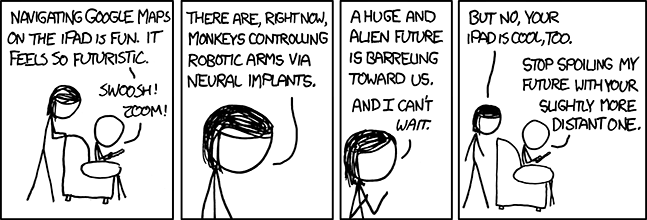
xkcd spookiness
xkcd is reading my mind (click to enlarge) …
Spooky. I am one with xkmind. Except that not only can I wait, I would really prefer that the future spare my children too.The xkcd story is pure 21st century geek culture. How geek? On Google Reader xkcd gets over 100 “likes” within hours of release. That’s probably the fastest and highest “like” rating in the entire geek universe.How geek? Here’s the official xkcd reuse permission policy …… If it’s a not-for-profit publication, you need no permission — just print them with attribution to xkcd.com. If it’s a for-profit operation, I will probably give you permission if you email me to let me know. You can post xkcd in your blog (whether ad-supported or not) with no need to get my permission…Munroe makes money by selling xkcd paraphernalia and a book of favorites …… In September 2009 Munroe released a book, entitled xkcd: volume 0, containing selected xkcd comics.[80] The book was published by breadpig, under a Creative Commons license, with all of the publisher’s profits donated to Room to Read to promote literacy and education in the developing world. Six months after release, the book has sold over 25,000 copies. The book tour in New York City and Silicon Valley was a fundraiser for Room to Read that raised $32,000 to build a school in Laos….
Update: I corrected the original post. Munroe’s publisher has donated the book profits, but Munroe can keep his well deserved share. -
FIA, Briatore put an end to legal saga
Filed under: Motorsports, Government/Legal, Renault

It’s been a long, drawn-out affair extending back two years since the 2008 Singapore Grand Prix. That’s when then-Renault F1 chiefs Flavio Briatore and Pat Symonds allegedly instructed their rookie driver Nelson Piquet Jr to crash on purpose and give the advantage to his world-champion wingman Fernando Alonso. The scandal erupted the following/last season when Piquet blew the whistle. Briatore and Symonds were summarily excommunicated from Formula One and any FIA-regulated racing series (which is pretty much all of them).
Briatore fought back and had the ruling overturned in court on procedural grounds. The FIA said it would appeal Flavio’s appeal (and we’re not talking about his famous supermodel-luring swagger here), but now the two parties have apparently reached an out-of-court settlement.
Both Briatore and Symonds will soon be cleared to return to F1 or other FIA-sanctioned series, beginning at the start of 2013 F1 season and the end of 2011 for other racing disciplines. In the meantime, the FIA is abandoning further legal recourse, citing the best interest of the organization and of motorsport as its motivation.
[Source: Autosport | Image: Paul Gilham/Getty]
FIA, Briatore put an end to legal saga originally appeared on Autoblog on Fri, 16 Apr 2010 08:01:00 EST. Please see our terms for use of feeds.
Read | Permalink | Email this | Comments
-
Brabus Vanish one-off: Mercedes SL 65 black series
The Mercedes SL 65 AMG Black Series gets the Brabus treatment, becoming the one-off Brabus Vanish. The one-off SL 65 AMG may not be your cup of tea, but the exclusivity of the car can hardly be denied. It has the same twin turbo 6.0 V12 to which Brabus has added two larger turbines, for a total of 800 hp. The transmission system has been totally revised and a new, larger braking system has been added.
With its 800 hp the Brabus Vanish should also be super-fast due to its carbon fibre bonnet. The customer who ordered this model originally purchased it in pearl white and the current matte black finish is a kind of surface film added. On the inside we see red stitching and the Brabus and Vanish logos, which are also included on the brake calipers.
-
Pumping tax dollars to big oil – Getting priorities right on tax subsidies for oil companies

ExxonMobil paid no U.S. federal income tax in 2009. In fact, it was entitled to a $156 million tax refund. Why? CAP’s Sima J. Gandhi, has the answer in this repost.
The answer is more boring than you think: It overpaid its 2008 taxes.
ExxonMobil was required to bolster its pension plan by $3 billion when the market went down in 2008. According to Alan Jeffers, Exxon’s media relations manager, this overpayment reduced the amount of taxes owed in 2008, but the tax adjustment wasn’t made until one year later, which led to an overpayment and the refund in 2009.
But what’s more interesting about this story is Exxon’s effective income tax rate. Exxon has over the past couple years paid a U.S. federal income tax that is about 10 percent lower than its non-U.S. effective tax rate. Other oil companies also pay less, and in some years this difference has approached 50 percentage points.*
Oil companies pay less in U.S. taxes in part because they receive generous tax subsidies. These subsidies will cost the U.S. government about $3 billion next year in lost revenue and nearly $20 billion over the next five years.
Tax expenditures are government spending through the tax code. They are distributed through deductions, exclusions, credits, exemptions, preferential tax rates, and deferrals. What makes them look different from grants or checks is that they are delivered through the tax code as part of tax expenditure spending programs.
These tax expenditures can amount to a significant portion of federal subsidies for oil and gas. The cost of tax expenditure programs for oil and gas companies made up about 88 percent of total federal subsidies in 2006.
As Jeffers stated, “I’m not in a position to make a judgment on the tax policy, but what it is we adhere to.” Tax expenditures are simply a function of our country’s tax policy.
Exxon will continue to adhere to current tax policy, enjoying the tax subsidies it receives from it…unless Congress cuts these subsidies.
And there’s good reason to believe that Congress should cut them. The billions in tax subsidies we spend each year should support government priorities that generate results and value for the American people. And it’s not clear that a few billion in subsidies for oil companies does much to impact their business decisions.
According to estimates from the Office of Economic Policy at the Department of Treasury, removing subsidies for the oil industry would at most affect domestic production by less than one-half of 1 percent.
Billions of dollars in tax subsidies can make or break some industries, but they may not be as important to oil companies. Even Exxon recognizes that other types of government action may affect its bottom line more than tax subsidies. Jeffers noted, “We are advocating for opening up public resources. [Support for oil companies] is fundamentally about what you want your public policy to do.”
So billions in tax subsidies may not be doing much of anything. But who would look a gift horse in the mouth? Eliminating these billions could make a real difference to American taxpayers.
Cutting this spending could help reduce our fiscal deficit. President Obama is creating a bipartisan commission to examine spending cuts that will reduce the deficit. The $20 billion saved over the next five years from eliminating these programs would be enough to cover this year’s Federal Drug Administration’s budget and the operations of the Smithsonian Institution, with a little left over.
Or the federal government could use the savings to fund America’s transition to a clean energy economy by financing a Green Bank, making thousands of homes energy efficient, building new transmission lines, or extending financial supports for renewable energies. Real money is at stake.
Tax expenditure spending programs should support public policies. Our country has made clear its commitment to clean energy. President Obama, along with 19 other world leaders at the G-20 conference in Pittsburg, signed a pledge to phase out subsidies for fossil fuels. If the government’s energy policy supports clean energy initiatives, it doesn’t make sense to put billions in tax subsidies for oil companies.
As Jeffers said, “Determine what your public policy is, and then you have a number of levers to obtain that goal. It’s not for me to say whether tax is an appropriate lever or not, that’s for someone else.”
That someone else is Congress.
*Effective tax rates calculated under the methodology used by Citizens for Tax Justice.
Sima Gandhi is a Senior Policy Analyst with the Doing What Works project at the Center for American Progress.
For more information on tax expenditures, see:

-
NATO-Caused Civilian Casualties Increasing in Afghanistan
USA Today obtained statistics from NATO’s International Security Assistance Force, Gen. Stanley McChrystal’s command in Afghanistan, that show an increase in civilian casualties attributable to NATO forces during the first three months of 2010 relative to the same period in 2009:
NATO troops accidentally killed 72 civilians in the first three months of 2010, up from 29 in the same period in 2009, according to figures the International Security Assistance Force gave USA TODAY. The numbers were released after Gen. Stanley McChrystal, the top U.S. commander in Afghanistan, issued measures to protect ordinary Afghans.
McChrystal’s command and supporters had loudly trumpeted United Nations statistics in January that showed the proportion of ISAF-caused civilian casualties to decline last year. A spokesman, British Lt. Cmdr. Iain Baxter, told the paper that “the pace of operations this year is considerably higher than last.” Which may be true, but strategically, that makes the rise in ISAF-caused casualties worse for ISAF. If Afghan civilians are seeing ISAF troops more and more, and they’re also seeing ISAF troops kill more of their countrymen, then the resultant embitterment is likely to compound, not diminish.
In fact, McChrystal put it best in his June confirmation hearing:
“I believe the perception caused by civilian casualties is one of the most dangerous enemies we face,” McChrystal said, as the loss of popular support “will be strategically decisive,” which is to say the war will be lost. He vows to review “all” U.S. procedures in Afghanistan to ensure that casualties will be minimized “except in self-defense.” McChrystal expects he’ll need more intelligence, surveillance and reconnaissance assets to get “more precision … to reduce civilian casualties and to reduce the impact [of U.S. troops] on the civilian population.” It’s not “a panacea,” but “the more you’ve got, the smarter you are as a force.”
Now McChrystal intends to push into Kandahar, a more densely populated area than the Helmand areas where he has placed most of his operational emphasis to date. Already President Hamid Karzai said he will oppose any Kandahar action without local support, and on a recent trip with McChrystal to a local shura, the elders shouted, “We are not happy” about the impending operation. McChrystal told the Pentagon press corps in March that “one of the things we’ll be doing [ahead of the Kandahar operation] in the shaping is working with political leaders to try to get an outcome that makes sense,” adding, “before we do a military operation in Afghanistan, we really have got to get the consent of the people who are going to be affected by that operation.” It might not have been outright veto power over the operation, but it certainly tethered the Kandahar operation to local support. And now Gareth Porter thinks McChrystal’s command is backing away from that because it’s getting an answer it doesn’t like.
What will McChrystal do?
-
Fentanyl Patch Lawsuit Settlement Reached Over Fatal Overdose
A settlement has been reached by parties involved in a fentanyl patch lawsuit stemming from the fatal overdose of an Illinois man on the powerful painkiller.
Leigh Ann Cruse filed the wrongful death lawsuit in Madison County Circuit Court against a number of fentanyl pain patch manufacturers in 2007, including Johnson & Johnson, Janssen Pharmaceutical Products, and Alza Corporation. Cruse alleged that the companies were responsible for the death of her husband, Cliff Cruse, who died in April 2006 from a fentanyl overdose after using the pain patches for about a month.
The lawsuit originally included Tri-City Neurology Associates Ltd. and Dr. Syed Ali of Granite City as defendants, however they were dismissed from the lawsuit last month, according to a story in the St. Clair Record.
The fentanyl patch contains a powerful fentanyl gel, which is 100-times stronger than morphine. The gel is supposed to be contained within the patch and delivered in a regulated fashion through a membrane placed on the skin. The original Duragesic patch was designed and distributed by Johnson & Johnson, but the pain patch is now available from a number of generic drug makers.
The FDA has received reports of hundreds of fentanyl overdoses and deaths associated with the use of the Duragesic patch and generic pain patches. The deaths have been caused when too much of the medication was delivered through the membrane or as a result of manufacturing defects which allowed the fentanyl gel to leak directly onto the skin.
Cruse’s lawsuit charged the defendants with strict product liability, negligence, breach of warranty, among other claims. The case was scheduled for trial to being on April 19, and the parties reached a settlement of the fentanyl patch lawsuit on April 9. Terms of the agreement have not been disclosed.
Out of the first four fentanyl patch wrongful death lawsuits against Johnson & Johnson to go to trial over problems with their Duragesic patch, plaintiffs have been successful in each case, with juries awarding a combined total of more than $36 million in damages.
-
GE’s Consumer loans: Still Ugly (GE)
This slide from GE’s (GE) earnings presentation is telling because it shows just how little its consumer loan portfolio is improving (in terms of delinquencies). As the company puts it, there are signs of stabilization.

Join the conversation about this story »
-
MobileTechRoundup 205 — That’s Incredible!
A downloadable MP3 of show will be available right here approximately 2 hours after the live show.
HOSTS: James Kendrick (Houston), Matthew Miller (Seattle) and Kevin C. Tofel (Philadelphia)
TOPICS:
- Microsoft Kin
- Zune HD 4.5 updates
- HTC Incredible coming soon
- Hands on with some AMD notebooks
- iPhone OS 4.0
- What happened to the smartbooks?
- MeeGo tries to fit in a crowded market
- How much life is left in Palm?
CONTACT US: Email us or leave us a voicemail on our SkypeLine!
SUBSCRIBE: Use this RSS feed with your favorite podcatcher or click this link to add us to iTunes

-
Exposure to Lead Linked to Puberty Delay in Boys: Study
The findings of a new scientific study suggest that low levels of exposure to lead, far short of what is considered lead poisoning, could delay puberty in boys.
The study was published online by the medial journal Pediatrics earlier this month. While the effects of delayed puberty on an individual level was only a few months, researchers said it could push more boys into the category of a “clinical delay” – puberty that does not start until age 13 or later – which could lead to depression, low self-esteem and eating disorders.
Researchers enrolled 489 Russian boys from 2003 through 2005, starting at ages 8 to 9, and monitored them through May 2008. They determined that the onset of puberty occurred six to eight months later in boys who had more than 5 milligrams per deciliter of lead in their blood.
The U.S. Centers for Disease Control and Prevention (CDC) consider 10 milligrams of lead per deciliter of blood to be the level of concern for exposure to lead. The CDC estimates that approximately 250,000 children in the U.S. have blood lead levels that high or higher.
One of the more common causes of lead exposure in the United States is lead paint, which was banned in 1978 due to the risk of severe and permanent brain damage and developmental problems, particularly in children. However, a number of older homes still contain the toxic paint on the walls, and if it flakes or peals off, young children could ingest the paint chips or breathe dust that comes from the paint, resulting in lead poisoning.
Lead paint poisoning can result in nervous system injury, brain damage, seizures or convulsions, growth or mental retardation, coma and even death for young children. Lawsuits over lead poisoning have been filed against landlords and property owners who failed to correctly clean up remnants of lead paint or properly minimize lead exposure to children living in their properties.
While high levels of lead exposure are often the focus of scientists, recent research has highlighted the effects of even low levels of exposure to lead on children. Other studies have tied low lead exposure to the development of kidney damage and depression and panic disorders.
-
Senior Policy Analyst to Speak on Global Security at Baker Center
KNOXVILLE — Tammy Taylor, senior policy analyst for the U.S. President’s Office of Science and Technology Policy (OSTP) will visit the University of Tennessee, Knoxville, on April 19 to talk about global security.
The event, free and open to the public, will begin at 7 p.m. in the Toyota Auditorium at the Howard H. Baker Jr. Center for Public Policy, 1640 Cumberland Ave.
Taylor’s presentation, “Office of Science and Technology Policy: Understanding Nuclear Denotation Response Preparedness,” will discuss how the mission and goals of OSTP are accomplished through interagency coordination.
Taylor coordinates radiological and nuclear-related science and technology interests for the National Security and International Affairs Directorate at OSTP. She also leads the Nuclear Defense Research and Development Research and Development Subcommittee of the National Science and Technology Council.
The Baker Center, which opened at UT in 2003, develops programs and promotes research to further the public’s knowledge of our system of governance, and to highlight the critical importance of public service, a hallmark of Baker’s career. For more about the Baker Center, see http://www.bakercenter.utk.edu.
—
C O N T A C T :
Amy Blakely (865-974-5034, [email protected])
-
Side Effects of Epilepsy, Depression Drugs May Raise Suicide Risk: Study
The results of a new study seem to confirm that side effects of some drugs used to treat epilepsy and depression, such as Neurontin, Lamictal and other medications, may increase the risk of suicide.
The epilepsy drug suicide study was published in the April 14 issue of the Journal of the American Medical Association (JAMA), backing up a 2008 determination by the FDA that anticonvulsants can double the risk of suicidal thoughts and attempts. The drugs are often prescribed “off-label” for unapproved uses such as the treatment of migraines, depression and bipolar disorder; conditions that already carry a higher risk of suicide.
Researchers from the U.S. took data from the HealthCore Integrated Research Database, which keeps extensive records on drug prescriptions and adverse side effects, and looked at about 300,000 patients ages 15 or older who took anticonvulsant medications between July 2001 and December 2006. The researchers found an increased risk of suicide among users of the anticonvulsants Neurontin, Lamictal, Trileptal, Gabitril and valproate when they compared them to the use of Topamax, an older anticonvulsant.
Researchers found a total of 868 suicidal acts or violent deaths among the users, including 801 attempted suicides, 26 suicides that ended in death and 41 violent deaths. They did not track suicidal thoughts and tendencies in the study. However, the findings do add weight to the FDA’s own investigations into the suicidal effects of anticonvulsants. In 2008, the FDA required Neurontin and similar epilepsy drugs to begin carrying label warnings alerting users to the risk of suicidal thoughts.
Despite the results, scientists have cautioned that the suicides are comparatively rare and that epilepsy patients should not stop taking the medications.
The results of the study come just days after Pfizer settled a neurontin suicide lawsuit for about $400,000, which alleged the drug maker failed to adequately warn about the risk. In another recent case, Pfizer was found guilty of illegally promoting Neurontin for off-label uses, and ordered to pay $142 million in damages in a case brought by the Kaiser Foundation Health Plan Inc., a subsidiary of Kaiser Permanente.
-
Google Chinese to English – a rare good result
Google translate is built into Google Reader. That allows me to follow someone who shares both English and Chinese material.Google’s translation of the Chinese content is usually unreadable. Each sentence seems more or less correct, but the sum is incoherent.Today, however, I came across a post I could read. The sentences were still a bit stilted, but the paragraphs were coherent. Overall it read like a bilingual native Chinese speaker writing in quite good English.The trick is that the interview was conducted in English, then human translated to Chinese, then Google machine (statistically) translated back to English. The Chinese translation must have preserved quite a bit of the original sentence structure; enough that the reverse translation worked quite well.Fascinating!