Blog

  • Google Now Has $26.5 Billion in Cash

    Google has announced its first-quarter financial results and they’re even more positive than analysts expected. The company brought in $6.77 billion in the first quarter of 2010, a 23-percent increase over the same period last year. Net income rose 37 percent year-over-year to $1.96 billion.

    “Google performed very well in the first qu… (read more)

  • Building a Green Economy

    Paul Krugman has a (long) article in the New York Times on the transition to a clean energy economy – Building a Green Economy.

    If you listen to climate scientists — and despite the relentless campaign to discredit their work, you should — it is long past time to do something about emissions of carbon dioxide and other greenhouse gases. If we continue with business as usual, they say, we are facing a rise in global temperatures that will be little short of apocalyptic. And to avoid that apocalypse, we have to wean our economy from the use of fossil fuels, coal above all.

    But is it possible to make drastic cuts in greenhouse-gas emissions without destroying our economy?

    Like the debate over climate change itself, the debate over climate economics looks very different from the inside than it often does in popular media. The casual reader might have the impression that there are real doubts about whether emissions can be reduced without inflicting severe damage on the economy. In fact, once you filter out the noise generated by special-interest groups, you discover that there is widespread agreement among environmental economists that a market-based program to deal with the threat of climate change — one that limits carbon emissions by putting a price on them — can achieve large results at modest, though not trivial, cost. There is, however, much less agreement on how fast we should move, whether major conservation efforts should start almost immediately or be gradually increased over the course of many decades.

    In what follows, I will offer a brief survey of the economics of climate change or, more precisely, the economics of lessening climate change. I’ll try to lay out the areas of broad agreement as well as those that remain in major dispute. First, though, a primer in the basic economics of environmental protection.

    Environmental Econ 101

    If there’s a single central insight in economics, it’s this: There are mutual gains from transactions between consenting adults. If the going price of widgets is $10 and I buy a widget, it must be because that widget is worth more than $10 to me. If you sell a widget at that price, it must be because it costs you less than $10 to make it. So buying and selling in the widget market works to the benefit of both buyers and sellers. More than that, some careful analysis shows that if there is effective competition in the widget market, so that the price ends up matching the number of widgets people want to buy to the number of widgets other people want to sell, the outcome is to maximize the total gains to producers and consumers. Free markets are “efficient” — which, in economics-speak as opposed to plain English, means that nobody can be made better off without making someone else worse off.

    Now, efficiency isn’t everything. In particular, there is no reason to assume that free markets will deliver an outcome that we consider fair or just. So the case for market efficiency says nothing about whether we should have, say, some form of guaranteed health insurance, aid to the poor and so forth. But the logic of basic economics says that we should try to achieve social goals through “aftermarket” interventions. That is, we should let markets do their job, making efficient use of the nation’s resources, then utilize taxes and transfers to help those whom the market passes by.

    But what if a deal between consenting adults imposes costs on people who are not part of the exchange? What if you manufacture a widget and I buy it, to our mutual benefit, but the process of producing that widget involves dumping toxic sludge into other people’s drinking water? When there are “negative externalities” — costs that economic actors impose on others without paying a price for their actions — any presumption that the market economy, left to its own devices, will do the right thing goes out the window. So what should we do? Environmental economics is all about answering that question.

    One way to deal with negative externalities is to make rules that prohibit or at least limit behavior that imposes especially high costs on others. That’s what we did in the first major wave of environmental legislation in the early 1970s: cars were required to meet emission standards for the chemicals that cause smog, factories were required to limit the volume of effluent they dumped into waterways and so on. And this approach yielded results; America’s air and water became a lot cleaner in the decades that followed. …

    Dave Roberts has a few comments about the article at Grist, in what he dubs “A plea for hippie economics” – Hey Paul Krugman: How about less econ theory and more econ mechanics?.

    Many people, including me and, um, Al Gore, have recommended Paul Krugman’s primer on climate economics. It’s a top-notch introduction and a welcome antidote to the ignorance and hysteria that characterize most media coverage of climate policy. Read it!

    In describing environmental economics, however, Krugman simply passes along many of its flaws. Economist James Barrett identified a few of them. I want to echo and reinforce one of the points he made.

    “Not that bad” ain’t good

    The great sin of conventional economics is the assumption of rationality. According to rational choice theory, individuals act to maximize their self-interest; ergo, markets based on free exchange of goods and services will yield maximally efficient distribution of resources. A free market is, in German philosopher Gottfried Leibniz’s terms, the best of all possible worlds. Most of what economists miss about energy can be traced to to the lingering effect of this assumption.

    Now, every time I bring this up, people come out of the woodwork to tell me I’m constructing a caricature, and everybody knows about market failures. Which is ironic, since the people who bitch about rational choice theory more than anyone I know are economists. (Again: see James Barrett. Or anything Dean Baker’s ever written. Or the entire field of behavioral economics.) What they tell me is that the most common macroeconomic models still rest on the assumption of rational choice; that the most influential names in the field still work with the assumption; that new approaches are still marginal and viewed with skepticism by modelers; and that laypeople’s understanding of economics is heavily colored by it.

    Anyway, the assumptions of rational choice theory are the only way to explain something like this — and that’s one of a dozen articles I could cite. They are the only way to explain the results of the economic models used by the CBO to score climate legislation. They’re the only way to explain the conventional wisdom in D.C. that climate legislation is all about costs. After all, as Barrett says, “with everyone constantly and correctly optimizing their behavior, there is nothing the government can do to make us any better off.”

    Lamentably, Krugman’s article reenforces that conventional wisdom. He concludes that pricing carbon is the Ultimate Climate Policy (maaaybe we can tack on a few performance standards for coal plants). According to mainstream economic modeling, a carbon price will inhibit GDP growth. Krugman’s cri de couer is as follows: “Restricting emissions would slow economic growth — but not by much.” Freeeeeedooooom!

    “Not as bad as you might have worried” may be a convincing argument to pointy-headed intellectuals, but it hasn’t exactly gotten the public fired up. To boot, it’s almost certainly incorrect. Krugman simply ignores the panoply of policies proven to boost economic productivity and reduce emissions.

    They exist! Long ago, in the Dark Ages (1997), over 2,500 economists, including nine Nobel Laureates, endorsed “The Economists’ Statement on Climate Change.” The second of three propositions in that statement was:

    2. Economic studies have found that there are many potential policies to reduce greenhouse-gas emissions for which the total benefits outweigh the total costs. For the United States in particular, sound economic analysis shows that there are policy options that would slow climate change without harming American living standards, and these measures may in fact improve U.S. productivity in the longer run. …

    But my objection to Krugman’s take on climate economics is even more basic. To see what I mean, consider this passage:

    If there’s a single central insight in economics, it’s this: There are mutual gains from transactions between consenting adults. … Free markets are “efficient” — which, in economics-speak as opposed to plain English, means that nobody can be made better off without making someone else worse off.

    But what if a deal between consenting adults imposes costs on people who are not part of the exchange? What if you manufacture a widget and I buy it, to our mutual benefit, but the process of producing that widget involves dumping toxic sludge into other people’s drinking water? When there are “negative externalities” — costs that economic actors impose on others without paying a price for their actions — any presumption that the market economy, left to its own devices, will do the right thing goes out the window. So what should we do? Environmental economics is all about answering that question.

    Perhaps inadvertently, Krugman reveals how environmental economists seem to think of their work. Assume a free market filled with exchanges among “consenting adults.” Then introduce a negative externality — say, CO2 emissions. What’s the proper response? Viewed in that light, obviously the right response is to put a price on the externality. Done! That’s why the environmental economist’s approach to climate policy always seems to be: price carbon and get out of the way.

    But … and this is a gargantuan but (quit snickering) … why would you assume a free market? Are there free markets in energy anywhere in the world? If so I’m not familiar with them. Everyone involved in energy markets is always and already operating within a skein of existing market distortions. We live in a fallen world.


  • Has the New York Times Run Afoul of the FTC’s Endorsement Guides?

    Terry Heaton and Jeff Jarvis have commented recently on the conflicts of interest implicated by the adulatory coverage of the iPad in the New York Times and other media companies. They point first to the expectation that widespread adoption of the iPad will foster consumer adoption of a platform where media giants can show their content for a fee — thus enabling them to move more easily to a paywall revenue model.

    Dan Gillmor shares these concerns, but notes an even more concrete conflict of interest — Apple’s advertising of the iPad consistently features a screenshot of the New York Times app, including of course the Times’ logo. Although Apple no doubt hopes to show that its device can be used to read the Times, surely attractive content to many of its target consumers, the image is also terrific advertising for the New York Times. Gillmor indicates that he has no doubt that Times’ reviewers truly believe the contents of their swooning coverage of the iPad, but argues that the benefit that the Times is receiving is a conflict of interest that ought to be overtly acknowledged and discussed by Times management. Yet, he reports, nobody from the Times has been willing to respond to his questions about the issue, such as whether the Times has received any compensation for the display of its logo on the iPad as shown in the ads. Gillmor raised these concerns a week ago, and the Times has yet to address publicly the possible conflict.

    One may well wonder whether Apple or the Times has violated the Federal Trade Commission’s Guides Concerning the Use of Endorsements and Testimonials in Advertising. The placement of the Times’ logo in Apple’s ads is surely a thing of great value, and readers of the Times’ reviews might well want to take the provision of free advertising to the Times into account in deciding whether to give full credence to the objectivity of the Times’ news reports and reviews of the product. The benefit of having such advertising could well be a “material connection” that has to be disclosed both by Apple and by the Times under section 255.5 of the FTC Guides, as illustrated by Example 7.

    Surely, what’s good for bloggers who praise products ought to be good for the New York Times and professional journalists.

    Permalink | Comments | Email This Story


  • Infinity Web Browser for Android phones

    Found under: Android, Internet, Browser, Infinity,

    Infinity Web Browser for Android phones is is not only a full functioned browser to help you surf web smoothly but also specializes the following differentiated features from others Tabbed browsing Multiple language instant news portal for multiple countries and regions around the world All-in-one search including web image blog Youtube video local business news book and patent Built-in full featured text web page translator Built-in RSS feed subscription and online

    Read More

    Read more in mobile format

  • Fandango Movies – Times and Tickets app is now available for your Android

    Found under: Android, Movies, Freeware, Tickets, Theaters, Fandango,

    Fandango Movies for Android phones is app that lets you watch trailers view fan ratings use the phones GPS to find the closest theaters the movies playing at them. Browsing movies finding theaters and purchasing tickets is made very easy with this app. Here is video preview of the appDownload Fandango Movies

    Read More

    Read more in mobile format

  • Three New Nikon DSLRs Leaked, With Launch Expected Very Soon [Digital Cameras]

    As the D3000 has been kicking around since last July, it’s nearing the time we should be seeing a worthy upgrade. That’s what Nikon Rumors is reporting anyway, with some intriguing leaks about three new DSLRs. More »


  • Divorce Advice: How Optimism Helped One Woman in Heartbreak Hell

    Filed under: , , ,

    The end of Stacy Morrison’s marriage came as a shock – to her. But as the editor-in-chief of Redbook magazine reports in her new book, Falling Apart in One Piece: One Optimist’s Journey Through the Hell of Divorce, instead of wallowing (too long) in self-pity and bitterness, she decided to take a high road and rebuild a “connected breakup” with her now ex-husband. Here, she describes why she decided to get past the anger, hold onto the best parts of the past, and create a more peaceful life for her son.

    Q: How did you marriage end? Were you surprised?

    A: One beautiful spring evening, as I was making dinner, my husband let out a big sigh. When I turned to him to ask what was wrong, he said, “I’m done.” Meaning done with our marriage. It came out of the blue, but as I later discovered, it’s hard to know which pebble that trips you up in your marriage is the iceberg, with something huge and immovable lurking underneath, the thing that can foretell the end of your marriage.

    Q: Tell me about the somewhat unconventional arrangement you came to post-divorce. Why does it work for you?

    Continue reading Divorce Advice: How Optimism Helped One Woman in Heartbreak Hell

    Permalink | Email this | Comments

  • The recession was a blessing for digital marketing, says Ford’s Jim Farley

    2011 Ford FocusThe recent financial crisis has led to the creation of new opportunities for digital marketing, according to Ford marketing boss Jim Farley who spoke at the Advertising Age’s Digital Conference.

    He said that in this kind of economy, everything would have to work. He claims that if the economy didn’t make a dive then everyone wouldn’t have been able to experiment the way that they have. He said further that Ford’s production quality online has been better than its broadcast. Farley, who is Ford’s group vice president of global marketing, regards the experimentation that he mentioned earlier to be the “democratization of marketing” and that it is actually the most important transition the company is making. Ford, which has long advocated for the turning over of the brand to consumers, has brought this belief not only to the digital space but through its TV spots as well. Many have given the TV spots that featured real Ford owners plenty of positive reviews. Farley said that with these customers telling their stories, the company has earned credibility. Farley said that Ford is also rethinking the manner that it approaches media planning. He said that the upfront media buys have left him feeling that there is something not quite right about spending huge money on traditional broadcast media just to get frequency.

    [via autonews – sub. required]

    Vw Golf VI Collectors EditionVw Golf VI Collectors EditionVw Golf VI Collectors EditionVw Golf VI Collectors EditionVw Golf VI Collectors EditionVw Golf VI Collectors EditionVw Golf VI Collectors EditionVw Golf VI Collectors EditionVw Golf VI Collectors EditionVw Golf VI Collectors Edition

    Source: Car news, Car reviews, Spy shots

  • 2010-04-16 Spike activity

    Quick links from the past week in mind and brain news:

    Should kids be bribed to do well in school? asks Time magazine. Oldest trick in the book tested out by researchers.

    Neurophilosophy covers a study finding that wrinkle smoothing Botox injections may diminish the experience of emotion owing to their paralysing effect on facial muscles.

    There’s an article that traces the history of placebo controlled studies back through tests of mesmerism into their origin in Christian exorcism rites in The Lancet.

    Not Exactly Rocket Science has the best coverage of the headline making study that shows reduced racial biases in children with William’s syndrome – a genetic condition that is linked to virtually absent social anxiety.

    Emotion’s Alchemy: how emotional expression and emotional feeling are handled differently by the brain are discussed in a great article for Seed Magazine.

    Savage Minds, the excellent anthropology blog, is looking for an assistant editor to join the team.

    ABC Radio National’s All in the Mind has an excellent programme on personal construct psychology and its possible application to understanding serial killers. A few straw men thrown in by the interviewees but a compelling programme.

    The New York Times has an article on the recently revived and ongoing clinical research into the potential of hallucinogenic drugs.

    ‘Sleeping Beauty Paraphilia’ and body image disturbance after brain injury. The Neurocritic covers a fascinating case from the medical literature.

    Prospect Magazine has a brief article on psychology of voting and the curious things that can influence the electability of candidates.

    “I have decided that my campaign against Strunk and White’s toxic little compendium of unfollowable dumb advice, bungled grammar claims, and outright mendacity must be taken directly to America’s colleges”. Language Log rallies the troops.

    The Independent has a brief piece on the development of the forthcoming DSM-V psychiatric manual.

    Essential reading from The Neurocritic that evaluates the new study that claims to have found the first direct evidence for mirror neurons in humans.

    The Fortean Times has an excellent article on the ‘Dream Machine‘ – essentially a rotating lampshade that can induce hallucinations in some people that was directly drawn from neurophysiology research from neurology research.

    There are six psychological reasons consumer culture is unsatisfying over at the mighty PsyBlog.

    Eurozine has a piece on ‘neurocapitalism‘ that notes that neuroscience “aggressively seeks to establish hermeneutic supremacy”. Bless. Actually, if you can wade through the jargon actually not too bad an article.

    “If it wasn’t for war, porn and fast food, we might all still be living in caves”. ABC Radio National’s Counterpoint discusses the role of competition in technology development.

    Not So Humble Pie has instructions on how to make the most delicious looking brain cupcakes ever.

    There’s an article on the observation that some people with movement disorder Parkinson’s disease can ride bikes perfectly well in The New York Times.

    Pharmalot covers a new study finding that there is no difference among antidepressants in raising a youngster’s risk of suicidal thoughts.

    The [average] friendship patterns of [American] men are discussed in an article for the Wall Street Journal.

    DrugMonkey has a classic interview about the effects of street drugs from Ali G.

    There’s a review of the G.tec intendiX at-home mind-reading kit over at Wired UK. Only £8,500. Doesn’t read minds.

  • Bimba Introduces its First Rod-Type Electric Actuator

    After more than 50 years of pneumatic leadership, Bimba announced today the introduction of its first ever, rod-type electric actuator, the Original Line Electric (OLE).

    OLE actuators are designed, built, and tested to provide the longest life, greatest durability, highest speed, and most thrust per dollar. With speeds up to 22 inches per second, strokes to 18 inches standard, and thrusts up to 350 pounds, these new actuators can address a wide range of applications. The unique modular design can be ordered with or without motors and drivers’ from Bimba, enabling engineers to use their preferred stepper or servo brand.

    “This is our most exciting new product launch in more than 10 years,” said Scott Meldeau, Vice President of Sales and Marketing for Bimba. “Now we can meet our customers’ electric actuation needs with the same value for which they’ve come to rely on our pneumatic solutions, including easy configuration and ordering, on-time delivery, competitive price and superior quality.”

    The OLE product line is available in 1.5, 2, and 3 inch diameters with standard options including trunnion, block front, clevis, pivot, and foot mounts, reverse parallel motor mounts with rear pivot or clevis, step motors, drivers, encoders, brakes, washdown ratings, female rod threads, and switches.

    All OLE models are available four working days from receipt of order on orders of 5 units or fewer, and are covered by a 1-year warranty. For detailed performance, selection, and ordering information visit: www.bimba.com/ole

  • HAUSER S35-200 Automatic bore- and contour grinding

    Range of adjustment X, Y: 500 x 300 mm Vertical adjustment of grinding head (W): 450 mm Clearance between grinding motor (45S) and table: 0-500 mm
    Distance between the spindle center and the column: 365 mm

    max. diameter ground (with grinding wheel 100 mm):
    without extension plate: 230 mm with extension plate: 360 mm

    Table
    Working surface: 600 x 380 mm

    Control
    S35-200 with CNC control GE-Fanuc 31i

  • Micronor Housing for Encoder

    Housing for Ecnoder. We can install all types of standard hollow shaft encoder in a robust housing. Imputratios possible.

    Encoder: all types of hollow shaft encoder Input ratios:1:1….10:1 (step down) Input ratios:1:1…1:6 (step up) Protection: IP 63 (option IP 68, or stanless)

    Geared limit switched are combinations of appliances consisting of an input shaft, gear reducer, signal transmitter and limit or safety switches. If desired, encoders, resolvers, power interfaces or potentiometers can also be integrated.

  • Center detent for telescopic slides extending to either side

    Schock telescopic slides are perfectly adapted to the relevant technical and economical requirements together with the customer. The center detent feature fixes ball bearing slides extending to either side in closed position. Schock offers two different versions: one center detent with identical push-in force and pull-out force and a another patented center detent for perfectly easy operation. Due to its low push-in force combined with a high pull-out force, the drawer can gently be moved into the closed position without overpassing the detent.

  • Variable Orifice Desuperheater (VO-II and VO-76)

    VO-II

    The Copes-Vulcan Variable Orifice Desuperheater is recognized as an industry leader.

    It can easily meet the most demanding needs for desuperheating in both power and process industries. It offers extremely fine control and exceptional turndown that is limited only by the rangeability of the coolant control valve.

    VO-76

    The Copes-Vulcan VO-76 is especially well suited for high pressure and temperature service (e.g. ANSI 1500 and above). It is particularly adaptable where custom fitting to new or existing piping is a problem. The VO-76 provides alternatives where limited space or changes in header diameter are factors.

    Features:

    The VO II offers extremely fine control and exceptional turndown that is limited only by the rangeability of the coolant control valve itself. Typically the unit can achieve a rangeability of 100:1 when matched with a Copes-Vulcan control valve fitted with Cascade trim design.

    Due to excellent mixing of vapor and coolant, control is possible throughout the entire operating range to within 5 °F (2.5 °C) of the set point, which can be as close as 10 °F (5 °C) above saturation.

    The coolant pressure, which is required at the inlet to the VO II need only be 5 PSI (0.35 bar) above the pressure of the vapor being desuperheated.

    Since virtually all the desuperheating occurs within the body itself, usually no pipe liners or long downstream straight pipe runs are necessary.

  • Introducing the PPC19W-45GM and its Infinite Applications

    BCM announced the launch of our PPC19W-45GM Panel PC last month. We are pleased to discuss more about what applications may be suited for this multi-purpose panel PC.

    Reminder – The Features of the PPC19W-45GM Panel PC

    The System

    The PPC19W-45GM is a 19” WXGA wide screen with optional touch and it features the Intel® Mobile GM45 Express Chipset with integrated Intel® Graphic Media Accelerator 4500MHD delivering 3D and powerful graphics performance. It also provides dual display via HDMI/DVI/VGA output, built-in HD speakers, dual Gigabit Ethernet, WiFi ready, VESA mountable installation, and user friendly easy access interfaces. This product is FCC, CE, and UL certified as both a system and barebone (for select OEMs) and will be ready for mass production in Q2, 2010.

    The Look and the Installation
    Unlike most industrial panel PC units designed for the shop floor, the PPC19W-45GM offers a much softer and elegant look suitable for a non-factory environment yet maintains the features of extended lifecycle and revision control as required by majority of embedded applications. The size of the 19 inch wide screen panel design is unique among other panel PC suppliers. The ultra-slim design is only 2.75” thick comparable to typical LCD monitors and the plastic finish supports a high gloss finish. The PPC19W-45GM is compatible with standard 100x100mm VESA mountable devices. The Panel PC is operated via DC power through the DC-in connector. A 19V AC to DC adapter and an anti-wobble desktop stand are included in the standard packaging. For more detailed product specifications, please visit http://www.bcmcom.com/bcm_product_PPC19W-45GM.htm?PPC19W0410.

    So, where and what type of applications can a PPC19W-45GM be applied?

    High-end Casino – serves as the hotel check-in portal and the in-room self service workstation for the executive suites.

    Today newer technologies are rapidly changing the world we live in as well as the expectation that such technology will be common place in many of our everyday encounters. Of course, touch panels have steadily become a part of the gaming industry with many modern casinos upgrading their facilities and services in order to attract more and more domestic and international guests. BCM’s PPC19W-45GM can be used in many aspects in casinos due to its sleek and elegant look and space-saving wall mountable (via VESA mount) design. It can serve as a hotel check-in/check-out Kiosk, and information portal, a player tracking interface, or as an elegant POS terminal at a cosmopolitan club, bar, or casino restaurant.

    Besides the Kiosk and POS, the panel PC can be used installed in executive hotel rooms and suites as a multi-functional in-room self-service kiosk where guests can do many things without leaving their rooms. With PPC19W-45GM installed in each room, a guest can place the orders of room services; check out the show schedules and book the tickets; check-in/check-out hotel rooms or check-in their airlines; surfing on the internet or check email without having to use the equipment in hotel’s business center. The PPC19W-45GM supports high graphics performances. An optional slim CD/DVD drive is provided for guest/kids to play their own video games or movies. Moreover the guests may be able to play the casino games in their rooms through the interactive Kiosk.

  • Gadda Bell furnaces

    Our extensive experience in this sector has given Gadda the ability to satisfy the requirements of customers from a variety of sectors, with solutions that are both reliable and rational.

    Over the years GADDA products have become established thanks to their high-tech content and their level of reliability, which has made our company one of the main manufacturers of industrial furnaces.

    BELL FURNACES
    Maximum load capacity: 50 ton
    eheating type: high-speed gas burners Operating temperature range: 500-1100°C Controlled cooling Bell hoisting speed: 250 mm/sec

  • Interval Training: Does High Intensity Burn More Calories?

    Filed under: , ,

    Last night I was watching TV and saw a commercial for the latest piece of miracle exercise crap: The Ab Circle Pro. I won’t even dignify this product’s existence by pointing out what’s wrong with it.

    There is no shortage of “secret” weight-loss techniques that allegedly “turn your metabolism into an UNSTOPPABLE FAT INCINERATING BLAST FURNACE!!!” but not all of them are as blatantly idiotic as the aforementioned torture device available now for only three easy payments of too damn much money. While High Intensity Interval Training (HIIT) is a legitimate form of training to improve performance in competitive aerobic athletes, the way it’s been lauded as the ultimate fat-burning exercise is a myth that is in need of busting…

    How HIIT supposedly burns many extra calories is via Excess Post-exercise Oxygen Consumption (EPOC), which is a whole other exercise myth. The EPOC myth states that after intense exercise the metabolism stays elevated for a prolonged period of time and burns significant extra calories. EPOC does exist, but I refer to it as a myth because its caloric-burning abilities have been overblown.

    Continue reading Interval Training: Does High Intensity Burn More Calories?

    Permalink | Email this | Comments

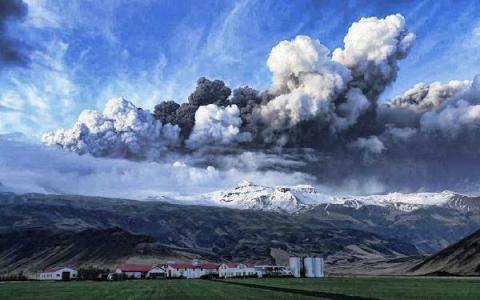
  • Icelandic Ash Cloud Grounds Europe

    How much bad news do you want?  Let me give it too you.  This sucker is right on schedule after announcing its birth a month or so ago.  Substantial lava movement is under way and we are now getting an idea of its scale.  This is going to go on all summer and will affect agriculture in Europe.  Not the time to be brave with your vulnerable crops.
    I suspect that we are seeing a typical ash cloud on a typical eruption day.  It will normally pass toward northern Europe.  The present question is how much cooling will be caused in Northern Europe.
    I do not know how dangerous the plume is a thousand miles downwind to aircraft and it is a good bet that neither does the industry.   They are about to get a one time opportunity to produce all the necessary data.  It may turn out possible to fly out of the plume throughout Europe fairly easily with a minor damage cost.  We do not know that yet.
    In fact the real danger of these plumes was only recently understood through fairly dramatic incidents.  How would you like to disembark from a plane all nice and shiny without a speck of paint?  It is possible that density and size is low enough to accept short passage.
    The problem of course is that we have to work around this now.  It will be a recurrent problem all summer and the planes do have to fly.


    Ash cloud from Iceland volcano halts air traffic across Europe, effects reverberate worldwide
    Thu Apr 15, 11:03 AM
    By Jill Lawless,Robert Barr, The Associated Press
    LONDON – An ash cloud from Iceland’s spewing volcano halted air traffic across a wide swath of Europe on Thursday, grounding planes on a scale unseen since the 2001 terror attacks as authorities stopped all flights over Britain, Ireland and the Nordic countries.
    Thousand of flights were cancelled, stranding tens of thousands of passengers, and officials said it was not clear when it would be safe enough to fly again.
    In a sobering comment, one scientist in Iceland said the ejection of volcanic ash – and therefore possible disruptions in air travel – could continue for days or even weeks.
    With the cloud drifting south and east across Britain, the country’s air traffic service banned all non-emergency flights until at least 7 a.m. (0600GMT, 2 a.m. EDT) Friday. Irish authorities closed their air space for at least eight hours, and aviation authorities in Denmark, Norway, Sweden and Finland took similar precautions.
    The move shut down London‘s five major airports including Heathrow, a major trans-Atlantic hub that handles over 1,200 flights and 180,000 passengers per day. Airport shutdowns and flight cancellations spread across Europe – to France, Belgium, the Netherlands, Denmark, Ireland, Sweden, Finland and Switzerland – and the effects reverberated worldwide.
    Airlines in the United States were cancelling some flights to Europe and delaying others. In Washington, the Federal Aviation Administration said it was working with airlines to try to reroute some flights around the massive ash cloud.
    Flights from Asia, Africa and the Middle East to Heathrow and other top European hubs were also put on hold.
    The volcano’s smoke and ash poses a threat to aircraft because it can affect visibility, and microscopic debris can get sucked into airplane engines and can cause them to shut down. The plume, which rose to between 20,000 feet and 36,000 feet (6,000 metres and 11,000 metres), lies above the Atlantic Ocean close to the flight paths for most routes from the U.S. east coast to Europe.
    It was not the first time air traffic has been halted by a volcano, but such widespread disruption has not been seen the Sept. 11, 2001 terror attacks.
    “There hasn’t been a bigger one,” said William Voss, president of the U.S.-based Flight Safety Foundation, who praised aviation authorities and Eurocontrol, the European air traffic control organization, for closing down airspace. “This has prevented airliners wondering about, with their engines flaming out along the way.”
    At Heathrow, passengers milled around, looking at closed check-in desks and gazing up at departure boards listing rows of cancellations.
    “It’s so ridiculous it is almost amusing,” said Cambridge University researcher Rachel Baker, 23, who had planned to meet her American boyfriend in Boston but got no farther than Heathrow.
    “I just wish I was on a beach in Mexico,” said Ann Cochrane, 58, of Toronto, a passenger stranded in Glasgow.
    The National Air Traffic Service said Britain had not halted all flights in its space in living memory, although most flights were grounded after Sept. 11. Heathrow was also closed by fog for two days in 1952.
    In Iceland, hundreds of people have fled rising floodwaters since the volcano under the Eyjafjallajokull (ay-yah-FYAH’-plah-yer-kuh-duhl) glacier erupted Wednesday for the second time in less than a month. As water gushed down the mountainside, rivers rose up to 10 feet (3 metres) by Wednesday night, slicing the island nation’s main road in half.
    The volcano still spewed ash and steam Thursday, but the floods had subsided. Some ash was falling on uninhabited areas, but most was being blown by westerly winds toward northern Europe, including Britain, about 1,200 miles (2,000 kilometres) away.
    “It is likely that the production of ash will continue at a comparable level for some days or weeks. But where it disrupts travel, that depends on the weather,” said Einar Kjartansson, a geophysicist at the Icelandic Meteorological Office. “It depends how the wind carries the ash.”
    The ash cloud did not disrupt operations at Iceland‘s Keflavik airport or caused problems in the capital of Reykjavik, but has affected the southeastern part of the island, said meteorologist Thorsteinn Jonsson. In one area, visibility was reduced to 150 metres (yards) Thursday, he said, and farmers were advised to keep livestock indoors to protect them from eating the abrasive ash.
    In Paris, all flights north were cancelled until midnight. In Copenhagen, spokesman Henrik Peter Joergensen said some 25,000 passengers were affected.
    “At the present time it is impossible to say when we will resume flying,” Joergensen said.
    Eurostar train services to France and Belgium and cross-Channel ferries were packed as travellers sought ways out of Britain. P&O ferries said it had booked a passenger on its Dover-Calais route who was trying to get to Beijing – he hoped to fly from Paris instead of London.
    The U.S. Geological Survey says about 100 aircraft have run into volcanic ash from 1983 to 2000. In some cases engines shut down briefly after sucking in volcanic debris, but there have been no fatal incidents.
    Kjartansson said until the 1980s, airlines were less cautious about flying through volcanic clouds.
    “There were some close calls and now they are being more careful,” he said.
    In 1989, a KLM Royal Dutch Airlines Boeing 747 flew into an ash cloud from Alaska‘s Redoubt volcano and lost all power, dropping from 25,000 feet to 12,000 feet (7,500 metres to 3,600) before the crew could get the engines restarted. The plane landed safely.
    In another incident in the 1980s, a British Airways 747 flew into a dust cloud and the grit sandblasted the windscreen. The pilot had to stand and look out a side window to land safely.
    Last month’s eruption at the same volcano occurred in an area where there was no glacial ice – lessening the overall risk. Wednesday’s eruption, however, occurred beneath a glacial cap. If the eruption continues, and there is a supply of cold water, the lava will chill quickly and fragment into glass.
    If the volcano keeps erupting, there’s no end to the flight disruptions it could cause.
    “When there is lava erupting close to very cold water, the lava chills quickly and turns essentially into small glass particles that get carried into the eruption plume,” said Colin Macpherson, a geologist with the University of Durham. “The risk to flights depends on a combination of factors – namely whether the volcano keeps behaving the way it has and the weather patterns.”
    Iceland, a nation of 320,000 people, sits on a large volcanic hot spot in the Atlantic‘s mid-oceanic ridge, and has a history of devastating eruptions.
    The worst was the 1783 eruption of the Laki volcano, which spewed a toxic cloud over Europe with devastating consequences. At least 9,000 people, a quarter of the population of Iceland, died, many from the famine caused by the eruption, and many more emigrated. The cloud may have killed more than 20,000 people in eastern England and an estimated 16,000 in France.
    AP reporters Jennifer Quinn, Paisley Dodds, Danica Kirka and Chonel LaPorte in London, Ian MacDougall in Oslo, Shawn Pogatchnik in Dublin, Jan Olsen in Copenhagen, Gretchen Mahan in Brussels, Mike Corder in Amsterdam, Adam Schreck in Dubai, Bradley Klapper and Frank Jordans in Geneva and Matti Huuhtanen in Helsinki contributed to this report.
  • Eating Meat: Myths About Meat Digestion

    Filed under: , ,


    If you’ve visited Thatsfit.ca recently, you’ve heard about the 30-Day Challenge in which three participants have signed on to eliminate all sources of gluten, dairy, caffeine, alcohol and processed foods from their diets for 30 days to see how they feel at the end of it.

    One reader following the challenge sent me a very good question about meat-eating during the challenge. She writes: “I’m quite surprised you have not eliminated meat from the 30-Day Challenge. Meat, even free-range or grain fed (organic), once out of the stomach, sits in our intestines for 24-72 hours depending on the type (chicken, beef pork), producing very toxic acids that many cancers feed off of. Dead meat in our bodies is very toxic and causes a number of ailments. What’s the reason for not adding the elimination of meat to the 30-Day Challenge?”

    There are a lot of myths out there surrounding the issue of meat consumption. Much of what you read about meat is simply not true. Firstly, meat does not sit in our intestines for 24-72 hours. A healthy digestive system eliminates all foods within 18-24 hours, from the time you swallow it. You can test this by eating beets with your meat and then keeping an eye on the toilet. If anything is “sitting” in your digestive tract, you have a much bigger problem than meat consumption. And although protein foods do have an acidifying effect on the body, this can (in fact, needs to) be countered by alkalizing foods. And while cancer is said to thrive in an acidic environment, acidifying foods cannot be eliminated completely or else you would not be getting any protein. The key is balance.

    Continue reading Eating Meat: Myths About Meat Digestion

    Permalink | Email this | Comments