Blog

  • Best Care at Lower Cost: The Path to Continuously Learning Health Care in America

    Final Book Now Available

    America’s health care system has become too complex and costly to continue business as usual. Best Care at Lower Cost explains that inefficiencies, an overwhelming amount of data, and other economic and quality barriers hinder progress in improving health and threaten the nation’s economic stability and global competitiveness. According to this report, the knowledge and tools exist to put the health system on the right course to achieve continuous improvement and better quality care at a lower cost.

    The costs of the system’s current inefficiency underscore the urgent need for a systemwide transformation. About 30 percent of health spending in 2009–roughly $750 billion–was wasted on unnecessary services, excessive administrative costs, fraud, and other problems. Moreover, inefficiencies cause needless suffering. By one estimate, roughly 75,000 deaths might have been averted in 2005 if every state had delivered care at the quality level of the best performing state. This report states that the way health care providers currently train, practice, and learn new information cannot keep pace with the flood of research discoveries and technological advances.

    About 75 million Americans have more than one chronic condition, requiring coordination among multiple specialists and therapies, which can increase the potential for miscommunication, misdiagnosis, potentially conflicting interventions, and dangerous drug interactions. Best Care at Lower Cost emphasizes that a better use of data is a critical element of a continuously improving health system, such as mobile technologies and electronic health records that offer significant potential to capture and share health data better. In order for this to occur, the National Coordinator for Health Information Technology, IT developers, and standard-setting organizations should ensure that these systems are robust and interoperable. Clinicians and care organizations should fully adopt these technologies, and patients should be encouraged to use tools, such as personal health information portals, to actively engage in their care.

    This book is a call to action that will guide health care providers; administrators; caregivers; policy makers; health professionals; federal, state, and local government agencies; private and public health organizations; and educational institutions.

    [Read the full report]

    Topics: Health and Medicine

  • Networking Company Cyan Prices Initial Public Offering

    Here’s some of today’s noteworthy links for the networking sector of the data center industry:

    Cyan Prices IPO.  Cyan (CYNI) a provider of software defined networking (SDN) and packet-optical platforms for network operators, announced the pricing of its initial public offering of 8,000,000 shares of common stock at $11.00 per share. Shares began trading May 9 on the New York Stock Exchange under the symbol CYNI, and ended the day at $11.14. Petaluma, California-based Cyan was founded in 2006 and has raised over $30 million in funding. Late last year, Cyan launched its software defined networking Blue Planet software, aimed at enabling service providers of all types to virtualize their networks.

    Fujitsu Develops SDN-based Platform. Fujitsu announced the development of FUJITSU Intelligent Networking and Computing Architecture, a new architecture for network-wide ICT platform optimization based on the principles of software defined networking (SDN). The new architecture employs a software-based approach to intelligently and flexibly enable optimized control over three unique domains: data centers, wide area networks, and smart devices. In the initial phase, Fujitsu is offering the following products based on this architecture: an updated version of unified administration and control software for server, storage and network resources, a new switch that supports network virtualization, and a new virtual appliance platform.

    Exinda Network Optimization Suite EnhancedExinda announced significant enhancements to the its Network Optimization suite that uniquely combines WAN Optimization, Network Control and Application Monitoring into an integrated solution specifically designed to meet the growing requirements of mid-market enterprises and educational institutions. With the release of its 6.4 firmware, the Exinda suite integrates many of these tools into a single converged solution that allows network managers better control of their network and create a more predictable user experience for applications that rely on it. “With the growth of tools for network management and the lack of integration between these tools, the complexity of performance management has increased,” said Jim Rapoza, senior network analyst for Aberdeen Group. “However, there has been a push among companies to deploy products that offer a single integrated platform for network control, along with deep visibility into user experience and application performance. Aberdeen Group data shows that 88 percent of organizations have or plan to centralize network and application performance and user experience visibility. By deploying an all-in-one integrated platform, these organizations are working to meet user demand, manage cost, and maintain or improve the overall quality of their network and application experience.”

    Silver Peak joins NEC. Silver Peak Systems  announced it has joined NEC Corporation of America (NEC) to include its data acceleration software as part of NEC’s new Software-Defined Networking (SDN) Application Center.  The NEC SDN Application Center focuses on solutions that address customers’ top-of-mind network concerns. “Silver Peak’s leadership in delivering software-based WAN optimization is the perfect complement to NEC’s market-leading ProgrammableFlow Network Suite,” said Don Clark, director of business development, IT Platform Technologies, NEC Corporation of America. “Silver Peak virtual products plug into our new SDN Application Center to give customers maximum flexibility and performance for extending business-critical applications across any distance.”

  • Samsung will reportedly launch an Android notebook in the coming months

    Samsung AndroidBook release date
    Earlier reports have indicated that Google and its partners are preparing to launch Android-powered notebooks that could debut later this year. Ming-Chi Kuo of KGI Securities notes that Samsung is just one of many companies that will launch such a product within the coming months, 9to5Google reported. The analyst warns that these “AndroidBooks” won’t be announced at Google’s upcoming I/O Developers Conference due to the delayed launch of Android 5.0, however, which is meant to help further bridge the gap between computers and smartphones.

    Continue reading…

  • Wade Robson: Nervous Breakdown Preceded Molestation Claims

    In the 2005, when Michael Jackson was on trial for molestation charges, Wade Robson defended the King of Pop in court, stating that Jackson never molested him or anyone he knew. Since that time, Robson has gone on to become an award-winning choreographer, working with stars such as Justin Timberlake and creating routines for the network TV show So You Think You Can Dance. He reportedly stayed friends with Jackson until the singer’s death.

    This week, Robson recanted his past claims, now stating that he was, in fact, molested by Jackson. According to a TMZ report, Robson is now calling Jackson a “monster” who molested him for seven years, from age 7 to 14.

    Robson’s Lawyer stated that Robson had a nervous breakdown last year due to his past. TMZ is now citing unnamed “sources close to the Robson family” as saying Robson began breaking contracts and attending therapy in March 2012.

    The claims came as a shock to Robson’s family and Jackson’s fans, as Robson had always staunchly defended the pop star against the allegations. His about-face has prompted much speculation on Twitter over whether Robson was lying in the past or is lying now:

    (Image courtesy Wade Robson/Wikimedia Commons)

  • Here’s Five Minutes Of New Watch Dogs Gameplay

    Despite having been announced almost a year ago, we haven’t seen much gameplay from Watch Dogs. Ubisoft prefers to trot out the same gameplay footage we’ve been seeing since February whenever they show it off to the press. That all changed this week with a new gameplay demo.

    Official PlayStation Magazine was able to sit down with a new gameplay demo that features a gameplay element that we haven’t seen yet. The demo reveals that players will have to take over local bases before they can hack electronic devices in a district.

    The above demo is running on a PC, but it’s said to be running on next-gen specs. In other words, the PlayStation 4 and next Xbox version of Watch Dogs should match what you’re seeing above.

    Watch Dogs will launch on November 19 for PC, PS3, Xbox 360 and Wii U. It will also be out on the PS4 and the next Xbox on or near their respective launches.

  • Following the money in health tech: accelerators galore nationwide

    The tech hubs on the coasts aren’t the only places where innovation in digital health is taking root. Last month, four new health technology startup programs made headlines, including a new Healthbox program in Jacksonville, Fla., the Dreamit Health accelerator in Philadelphia and the Health Wildcatters in Dallas, Tex.  (This week, The Iron Yard in Greenville, S.C. also jumped on the bandwagon.)

    For technology to make meaningful improvements in health care, it has to penetrate communities across the country — so it’s a positive sign that digital health hubs are popping up nationwide (even though it could intensify the much-discussed “Series A crunch.”)

    In total, April was an off-the-charts month for health technology funding, according to data from Startup Health. The sector raised a total of $322.72 million, which is an increase of 404 percent over the same period last year.

    Here’s a quick look at last month’s activity:

    startuphealth_April

    Related research and analysis from GigaOM Pro:
    Subscriber content. Sign up for a free trial.


  • Big Data News: Cloudera, Splunk, Clustrix, Teradata

    News from the worlds of big data, databases and data analytics includes announcements by Cloudera and Splunk, investment madeinto Clustrix and Terradata Analytics finished a deployment for a large retailer.

    Cloudera and Splunk form big data alliance.  Cloudera announced that it has formed a strategic alliance with Splunk (SPLK) to deliver big data analytics across the enterprise. The relationship ensures best-in-class integration of the Splunk Enterprise platform for real-time operational intelligence to Cloudera Enterprise, using Splunk Hadoop Connect, which provides bi-directional integration to easily and reliably move data between Splunk Enterprise and Hadoop. “Splunk’s mission is to make data accessible, usable and valuable to everyone. By working together, Splunk and Cloudera deliver big data analytics that span the needs of any organization,” said Bill Gaylord, senior vice president of business development, Splunk. “The integration of Splunk Enterprise and CDH through Splunk Hadoop Connect provides customers a way to easily and reliably transfer data between the systems. This allows customers to easily use Splunk’s best-in-class machine data ingestion and management to deliver data to Hadoop, or ingest data into Splunk from Hadoop, such as the output of Hadoop MapReduce jobs and easily analyze and visualize that data.”

    Clustrix raises $16.5 million.  Scale-out SQL database company Clustrix announced the completion of a $16.5 million round of funding by current investors Sequoia Capital, U.S. Venture Partners, ATA Ventures, and Don Listwin. This the total capital raised to date to $46.5 million. Last month, the company released Clustrix 5.0 on Amazon Web Services and published a breakthrough real-time analytics performance benchmark for its scale-out SQL database, demonstrating a 50x advantage compared to legacy scale-up databases on AWS. “The combination of big data and cloud computing has broken the legacy database, creating an industry transition to new scale-out database platforms.” said Robin Purohit, CEO at Clustrix. “The Clustrix scale-out SQL database is battle-tested in mission-critical customer applications all over the world, providing unprecedented levels of performance, scalability, and real-time analytics. In our next phase of growth, we are making it easy for developers to build their next great application on our platform.”

    Woolworths completes Teradata Analytics implementation. Teradata (TDC) announced that Woolworths Limited, based in Australia and one of the world’s top twenty retailers, has completed implementation of its Teradata Data Warehouse Appliance platform in collaboration with Teradata Professional Services. The new data warehouse environment, fusing the most powerful new database software and hardware, serves as the point of integration for continuously rising volumes of detailed customer data. Woolworths’ decision to go with Teradata is part of an on-going program of business and technology investment, renewal and expansion,” said Priscilla Patroni, Business Technology Services, Woolworths. “We see growth ahead of us and this system will enable this by providing the analytic insight we want – to see our customers more clearly and serve them more personally.”

  • Samsung Galaxy S4 32GB arrives at AT&T

    Today, another Galaxy S4 variant goes on sale at AT&T — 32GB and yours for $249.99 with two-year contract. Buyers looking for commitment-freedom pay $669.99. The S4 joins HTC One as hottest smartphone of the season. Both pack gorgeous 1080p displays. The One is my choice for design; other benefits include booming front-facing speakers and low-light photography. Samsung packs in larger screen and loads more software capabilities.

    For the US carrier selling more iPhones than any other, AT&T makes Galaxy S4 quite the priority, jumping ahead of competitors selling the 16GB model and carrying its larger-capacity cousin. Preorders started April 16, with the 16GB phone in stores two weeks later.

    Samsung launched the S4 during a New York gala on March 14. The phone is actually a tad smaller than its predecessor but packs in larger display (5 inches). The South Korean manufacturer focuses more on software innovations than hardware for the newer handset.

    Among them:

    • Air Gesture lets users wave over the phone to manipulate some controls, such as choosing music or scrolling web pages. Related: Air Wave allows people to hover their fingers to manipulate the screen.
    • Dual Video Call permits use of both cameras simultaneously so that the caller on the other end can see other people, say, at a party.
    • Eraser removes unwanted objects (or people) from photos. Who hasn’t wanted to do that?
    • Group Play lets S4 users share documents, music, games and more, even combining up to eight handsets to create a speaker system (using Share Music).
    • S Health tracks some personal biological functions, such as calorie burn, heart rate and pulse and pulls them together into a mini report.
    • S Translate is quite futuristic. Think Star Trek’s universal translator. The feature can translate 9 languages, including speech-to-text and text-to-speech capabilities. While the service needs a network connection for optimal use, there is basic vocabulary on device for basic translation.
    • S Voice Car is a voice-activated system for using Galaxy S IV hands-free.

    Galaxy S4 specs: 5-inch Super AMOLED with 1920 x 1080 resolution and 441 pixels per inch; 1.9GHz quad-core processor; 2GB of RAM; 16GB, 32GB storage (expandable up to 64GB with microSD card); 13-megapixel auto-focus rear-facing and 2MP front-facing cameras; 1080p video recording; 4G: LTE; WiFi N/AC; GPS + GLONASS; NFC; Bluetooth 4; IR LED; MHL 2; accelerometer; barometer; gyroscope; geomagnetic, gesture, proximity, RGB light and temperature & humidity sensors; 2600 mAh removable battery; and Android 4.2.2 with TouchWiz UI. Measures 136.6 x 69.8 x 7.9 mm and weighs 130 grams. AT&T’s prices: $199.99 (16GB) and $249.99 (32GB).

    Personally, I debated between the S4 and HTC One, and bought the latter. Storage is 32GB and 64GB, $199.99 for the small capacity or $299.99 for the larger. AT&T currently offers a trade-promotion on both handsets — $100. Unless you have a clunker feature phone, try Craigslist first. You likely can sell an older phone for more than what the carrier offers.

    Many of you are really interested in Galaxy S4. More than 3,000 people responded to our buying poll. Fifty-three percent planned to preorder or buy “as soon as available”. Only 15 percent answered “No”.

    Of course, buying polls merely express intentions. What people say they will do isn’t often what they do. If you’re one of the people answering affirmatively to buying right away, please tell us if you actually did and which model. If so, how do you like the S4?

  • Google Glass Will ‘Definitely’ Get Someone Punched In The Face By This CEO

    Meetup CEO Scott Heiferman wants to punch someone in the face wearing Google Glass. It’s not entirely clear whether that means he wants to punch someone wearing Google Glass in the face or if he wants to punch someone in the face while wearing Google Glass.

    Business Insider put out this video of him talking about the device:

    Heiferman says, “Google Glass? Well, I’m definitely going to punch someone in the face wearing a Google Glasses. I’ve never punched anyone in the face in my life. I’m generally a peaceful guy. If you’ve ever seen a three-year-old using an iPad, you’ll know why I smashed an iPad with a sledgehammer. It’s so damn compelling, and that has implications.”

    He continues, “We’re going from ten to fifteen seconds to get my phone, you know, turn it on, open Facebook, and see something interesting…well now, with Google Glass, and the watch, we’ve gone from like ten to fifteen seconds to interestingness down to like three to five seconds to interestingness, and now once it’s on my wrist, and like you know, plastered on my eyeballs, that’s like down to one second to interestingness.”

    “It basically means that you’re gonna be an asshole,” he says. “it’s easier and easier for you to ignore real people around you, and sometimes that’s totally fine, but on this relentless pursuit – the train is barreling down, and saying, distraction is just a fact of life. We have to consider what it means.”

    He concludes, “And I’m not saying like, ‘Let’s sit back and ponder the nature of culture, and the future of society,’ in that way. I’m just saying, you gotta punch someone in the face wearing Google Glasses.”

    Business Insider itself says he wants “to punch anyone wearing Google Glass in the face.” That would certainly be in line with his “assholes” comment. Still, whenever he says it in the interview, the wording sounds more like he wants to punch someone in the face while wearing Google Glass.

    “Compelling…Interestingness…”

    “I’m definitely going to punch someone in the face wearing a Google Glasses…I’m just saying, you gotta punch someone in the face wearing Google Glasses.”

    Either way, he’s definitely going to punch someone in the face, and Google Glass will be involved.

  • Take that, iPad mini: Retina display Nexus 7 at Google I/O says analyst

    While Apple fans are waiting for an iPad mini with improved screen, Android enthusiasts may see the Nexus 7 get its own Retina display next week. KGI Securities analyst Ming-Chi Kuo penned a research note that AppleInsider read and Kuo expects Google’s small slate to gain a 1920 x 1200 display at Google’s I/O Developer event, which takes place May 15 to May 17.

    Kuo’s expectations aren’t that different from earlier Reuters reports, whose sources in April indicated a high-resolution display, faster processor and doubling of device memory to 2 GB coming to the next model Nexus 7. Reuters suggested a 1920 x 1080 panel at 315 pixels per inch, while Kuo figures a 1920 x 1200 display at 323 PPI.

    A Qualcomm APQ8064 chip will power the updated tablet, says Kuo, which is the same Snapdragon 600 currently used in the LG Optimus G Pro, Samsung Galaxy S 4 and HTC One smartphones. Wireless charging, an LTE option, 5 megapixel rear camera and Android 4.3 are also expected by the analyst.

    These specifications sound right to me and I do expect Google to introduce a refreshed Nexus 7 at its developer event. I don’t think, however, that Google will be able to maintain the $199.99 current starting price for an updated Nexus 7. Even if the device comes in at a $249 to $299 range for a base Wi-Fi model, it’s less than Apple’s non-Retina iPad mini, which is $329. I still give some advantage to the iPad line, however, as I see more applications optimized for higher-resolution screens on iOS than on Android.

    Related research and analysis from GigaOM Pro:
    Subscriber content. Sign up for a free trial.


  • Ping.it: Not a Google Reader replacement, but a tool to discover emerging viral content

    Want to know which YouTube videos were most popular on Reddit? Or what the top stories are across 10 different news sites? Ping.it aims to help with a new web tool that lets users create custom “probes” to surface specific content across the web.

    Ping.it, an Oslo, Norway-based startup, has been around since 2009 and has experimented with a number of business models, but it launched in public beta this week as a content discovery service. Ping.it’s main feature is “probes,” which it describes on its blog as “small apps which go out and retrieve information from across the Web on behalf of the user. They can be created, edited, shared and subscribed to – all by Ping.it users.”

    “I see Ping.it as a new step forward in content discovery using elements from traditional RSS Readers and social media,” founder Marcus Lian told me. “Google Reader was discontinued for a reason – time to move on.”

    Here are a few of the probes that users have created already:

    Users can subscribe to existing probes or create their own. There are a number of limitations, however:

    • Right now, there’s a very slim choice of metrics you can use to filter a probe. You can filter based on keyword, Facebook likes and YouTube likes, but there’s not an option yet to, for example, filter based on how many times a story has been tweeted, or how many times it’s been shared on Facebook. Those features are coming, though: Lian tells me that Ping.it is already internally testing “number of tweets, Facebook shares and Facebook rating, our own invention: just divide likes by shares, and the more likes per share, the better).
      Ping.it
    • Creating a probe is not intuitive: It’s not obvious how to filter for popularity on YouTube, until you actually look at an example of an already created probe that does this. Luckily, each public probe can be “copied” and then modified. Lian says it will be easier soon.
    • Ping.it is a web application only. Once you create a probe, it is added to a “collection” that you can only access through Ping.it’s website. And while Ping.it relies on RSS to create probes, you can’t actually create a probe and then subscribe to it through an RSS reader — again, it can only be accessed through Ping.it. Mobile access is coming soon, Lian said.

    Overall, it’s still clunky, Ping.it is worth checking out — particularly as a way to stay on top of emerging viral content.

    Related research and analysis from GigaOM Pro:
    Subscriber content. Sign up for a free trial.


  • Is Facebook barking up the wrong tree with Home?

    Facebook Home Galaxy S4 HTC One
    Is Facebook doing its homework? We trust that Facebook is analyzing usage stats when deciding which handsets to address with its Home rollout, but it seems odd that Samsung’s Galaxy S4 and the HTC One, which both became supported by Home on Friday, would be high on the list of devices used by hardcore Facebook addicts — the ones Home is likely best suited for. Home is an immersive software suite that takes over an Android phone’s home screen and app launcher, replacing them with a river of Facebook photos and a new launcher that provides quick access to various Facebook features. Could a Facebook takeover possibly be something the average Galaxy S4 or HTC One user is looking for?

    Continue reading…

  • Surprise Is Still the Most Powerful Marketing Tool

    Life has never been more predictable.

    Yelp provides an early-warning system for dining out, by helping us avoid bad restaurants and alerting us to must-try items at good ones. Facebook lets us investigate a potential romantic interest before the first date. Turn-by-turn instructions from Google Maps prevent us from ever getting lost.

    The same thing is happening in marketing organizations. “Big Data” is the latest buzzword in our industry. Data-rich practices such as econometric modeling, analytics and copy-testing offer brand managers an alluring promise of precision and predictability. Pull lever X, out will pop Y as a result.

    All this is good — mostly. These tools can certainly make our profession more efficient. But they also can make brands less exciting and surprising. With all of this information at our disposal, we risk robbing brands of opportunities for serendipity — the delightful surprises that happen when we least expect them, attracting the attention of consumers.

    Pursuing innovations in “big data” is essential, but that doesn’t mean we should ignore the element of surprise, because surprise is still probably the most powerful marketing tool of all. Here’s why.

    Surprise is addictive. Surprise is like crack for your brain. Scientists at Emory and Baylor used MRIs to measure changes in human brain activity in response to a sequence of pleasurable stimuli, using fruit juice and water. The patterns of juice and water squirts were either predictable or completely unpredictable. Contrary to the researchers’ expectations, the reward pathways in the brain responded most strongly to the unpredictable sequence of squirts. “The region lights up like a Christmas tree on the MRI,” said Dr. Read Montague, an associate professor of neuroscience at Baylor. “That suggests people are designed to crave the unexpected.” Birchbox, a subscription service that sends customers a box of mystery beauty products each month, and Phish, the rock band that never performs the same show twice, proves that entire business models can be built around this insight.

    Surprise changes behavior.
    Remember your psychology 101 class and the idea of cognitive dissonance? Surprise introduces us to new stimuli, which we must then reconcile with shifts in our beliefs and behavior. “It’s been known for a long time that it’s unexpected events, in particular, that drive learning,” says Wael Asaad, assistant professor of neurosurgery at Brown University. Thinking in terms of desired consumer behavior can unlock innovative strategies. When developing an advertising campaign we are often too focused on the question of “What do we need to say?” Instead, we should focus on the question of “What expectations do our customers and prospects hold, and how can we turn those on their head?”

    Surprise is cheap. All it takes is a dime to make someone’s day. Psychologist Norbert Schwarz conducted a study in which a dime was placed near a copy machine. When the subjects who found the dime were surveyed shortly after their discovery, their overall satisfaction with life was substantially higher than the subjects who did not find a coin. Rather than attempt to beat the competition with epic production budgets and media plans, marketers should think about how to cram surprising brand stories into the smallest space possible. Consider how Virgin America infuses charm and creativity into everything from website downtime notifications to safety videos.

    Surprise turbocharges emotions. Psychologist Robert Plutchik’s psychoevolutionary theory of emotion classifies our feelings into primary emotions, such as anger or fear, and more nuanced secondary emotions that combine these, like bittersweet (happiness + sadness) or guilt (happiness + fear). The interesting thing about surprise is that it appears to amplify whatever you’re feeling. When we’re surprised and angry, we’re outraged. Remember what happened when Netflix raised subscription prices without warning? Combine happiness with surprise, and you hit the upper register of the feeling-good scale. This helps explain why Zappos goes to such lengths to deliver shoes before they are promised, and why the word “delight” is almost always preceded by the words “surprise and.”

    Surprise fuels passionate relationships. Whether it’s sending a a new lover flowers on a random Tuesday (“just because”), or sealing the deal with a memorable marriage proposal, romance is all about surprise. One experiment conducted among middle-aged married couples found that engaging in less common, but more “exciting” activities like skiing or dancing led to greater marriage satisfaction than pursuing activities that are more common and “pleasant,” like seeing a movie or cooking together. The same principles apply to business relationships. Marketers typically spend the bulk of their creative energy making themselves look attractive to potential customers. It’s easy to forget you need to look sexy and charming to your current ones to keep the spark alive.

    As CMOs push their staffs and agencies to be faster, cheaper and more accountable, they also need to push the brand organization to be more surprising. Unfortunately, there doesn’t appear to be much in the way of academic research or enterprise-grade software to make this happen. It really comes down to a question of imagination and bravery. And, I suspect, it has something to do with being open to situations where you might be surprised yourself.

  • Emerging markets to fuel airline spending trajectory

    Emerging markets may not have all the technological know-how in civil aerospace, but from China across the world to Brazil, they do have the cash.

    The civil aerospace sector performed well in 2013, according to Societe Generale data, trading at a 4 percent premium over the MSCI world index, while the defence sector has steadied, and in the medium to long term civil aerospace should be supported by strong orderbooks from emerging economies.

    Research from PwC shows the global aviation industry is set to increase by 3.3 percent to 68 billion by 2022, driven by an increase in fleet size.

    Last month China decided to ease a boycott of $11 billion in Airbus jet orders. A letter seen by Reuters gives a breakdown of the A330 orders, the details of which have been mostly kept secret awaiting final approval from the Chinese government.

    They include 10 aircraft for Air China, 10 for Hainan Airlines, 10 for China Southern and 15 for China Eastern. The letter said first deliveries were tentatively scheduled for mid-2013.

    China has already become the largest maintenance repairs and operations  market in Asia-Pacific and is expected to grow 9 to 10 percent annually, to reach $70 billion by 2015.

    On Tuesday, Airbus results showed a sharp rise in first quarter core profit, with revenues rising 9 percent, though the aerospace group said it had consumed a significant quantity of cash to boost inventories for new projects.

    Research from Societe Generale shows the largest order backlog for the industry comes from the Latin American share of the market, with an increase in aviation orders to 37 percent of the market in 2011 from 3 percent in 2000, a general trend that is set to grow given rising fuel prices.

    Higher fuel prices means airlines will look to replace their fleet with more fuel-efficient aircraft and growing populations will bring increasing numbers of passengers. An increase in passenger traffic for the 2014 Football world cup championships in Rio de Janiero and the Olympic games in 2016 will fuel part of this.

    SocGen has this:

    With emerging economies now accounting for almost half of new orders, and Airbus and Boeing boasting eight-year backlogs, large jet delivery growth looks well set for the medium and long term.

    Compared to last year EADS, the parent company of Airbus, Bombardier aerospace and Boeing are set to increase deliveries of commercial aircraft while revenues are set to grow at Boeing. EADS will see its orders drop for 2013 but the sector is due to see resilient earnings, research shows. Soc Gen has ‘buy’ ratings for EADS, Safran, Megitt and MTU as a result.

    Research shows China accounts for 7 percent of Boeing’s sales. Outside the BRICs, demand for western aviation technology is evident. Oil-rich Kuwait is looking at plans by its state-owned airline Kuwait Airways to buy 25 new Airbus jets, a source told Reuters, a deal that could be worth up to $3 billion dollars.

    Indian aerospace is also enjoying a round of investment through a series of joint ventures.

    Source: PWC

    For those curious about the global aviation industry’s outlook, the Paris airshow on June 18 should leave clear a slipstream.

  • Arias: Bomb Threat Delays Sentencing

    On Wednesday afternoon, Jodi Arias was found guilty by a jury of murdering her former boyfriend. She was found to have murdered Travis Alexander, stabbing him nearly 30 times, slitting his throat, and shooting him in the head with a gun before leaving his body in his shower. Her story of self-defense from domestic abuse did not convince the jury.

    Now that she’s been convicted, the question on everyone’s mind is whether or not she will receive the death penalty for her crime. Unfortunately, followers of the trial have had to wait a while longer for the sentencing.

    According to an Associated Press report, a bomb threat tweeted shortly after the verdict was announced delayed the sentencing while authorities swept the courthouse. Police were able to track the tweeter to a hotel in Phoenix, and a man named Laquint Cherry has been arrested for felony threats.

    The tweets began on a Twitter account with the handle @GrimlinSkeleton shortly after Arias was found guilty. The tweeter stated that IEDs (Improvised Explosive Devices) had been planted in the Phoenix court room where the Arias trial took place. Subsequent tweets insulted Arias’ victim, challenged authorities, and were generally trolling:

    The account’s last tweet went out shortly before Cherry was arrested:

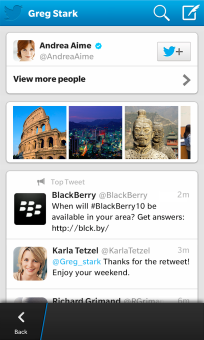
  • LinkedIn and Twitter apps come with new features on BlackBerry 10

    Late yesterday, Canadian manufacturer BlackBerry announced yet another range of updates for the LinkedIn and Twitter apps on BlackBerry 10. The latest iterations are designed to bring the social networking apps on par with their Android, iOS and Windows Phone counterparts and, according to BlackBerry, to “make it easier than ever to stay connected and do more with your social and professional contacts, while on the go”.

    Twitter is on its third noteworthy update in the past couple of months — the first one arrived in early-March while the second released weeks later. The latest iteration sports two major improvements, the first of which is the ability to display more content while searching. Users can view photos, relevant profiles and searches as well as tweets and top tweets on the same page.

    The second improvement is less important by comparison. Twitter users on BlackBery 10 can now take advantage of automatic caching, which is designed to deliver the latest updates from the feed without manually refreshing it. This feature is already available on other platforms such as Windows Phone.

    By contrast, the LinkedIn app is on its second major update in the last two months, with the previous one arriving in early-March alongside Twitter. There are a couple of notable new features introduced in the latest iteration.

    The first one is the ability to import address book information from BlackBerry 10 to LinkedIn, which allows users to discover their existing contacts on the business-oriented social network.

    LinkedIn users on BlackBerry 10 can view more information about companies, such as their description, available job listings, news and updates, similar companies as well as connection details.

    The LinkedIn app on BlackBerry 10 now sports a number of UI related changes that BlackBerry says includes “improved visual styling, better pull-down functionalities for refreshes, touch-down feedback on clicking list items, and more” and “inbox enhancements, deleting and archiving messages, people search improvements, and the ability to update your profile photo from within the app”.

    LinkedIn 10.0.3/10.1.3 and Twitter 10.0.3/10.1.3 are available to download from BlackBerry World.

  • Google prepping an Androidbook, smartwatch, and ‘over-the-top’ TV box, but neither will appear at Google I/O

    Android_Bugdroid_On_TV

    Earlier we told you what the specs are going to be for the updated Nexus 7 according to KGI securities analyst Ming-Chi Kuo. Ironically, Kuo has a very good track record when it comes to predicting Apple products. Other than revealing the Nexus 7 specs he said that Google will be coming out with an Androidbook laptop, and “over-the-top” TV box, and a smartwatch, but unfortunately we won’t see them next week at Google I/O since they are only in the planning stages.

    We have already heard rumors about an Androidbook and a smartwatch so this isn’t surprising, but it’s further confirmation. As far as a TV box, this is something I, and a lot of our readers, have been hoping for. Google TV has been a huge disappointment, and I am still trying to figure out why they bothered with the Nexus Q. A TV box is desperately needed, and I can only wish that it would debut next week at Google I/O, but it appears that won’t be the case.

    source: AppleInsider

    Come comment on this article: Google prepping an Androidbook, smartwatch, and ‘over-the-top’ TV box, but neither will appear at Google I/O

  • Government Pulls 3D Printed Gun From Defcad, Says It May Violate ITAR

    It was really only a matter of time.

    The United States Department of Defense Trade Controls has demanded that Cody Wilson of Defense Distributed pull the blueprints for the first fully 3D printed gun from Defcad. Wanting to stay on the right side of the law, Wilson has complied. The following message, accompanied by the Department of State seal, is on the Liberator page at Defcad:

    This file has been removed from public access at the request of the US Department of Defense Trade Controls. Until further notice, the United States government claims control of the information.

    None of this is too surprising really. Alongside the Liberator, the government also requested that Wilson pull the blueprints for the other components that Defense Distributed has made over the past few months. The government will be examining the Liberator and the components to see if they comply with the ITAR, or International Traffic in Arms Regulations.

    It’s not known when, or if, the files will be back up on Defcad. That being said, it’s not like the files have been completely removed from the Internet. That’s all but impossible. Over 100,000 people downloaded the file since going up earlier this week, and it’s already being hosted on a number of other Web sites, including The Pirate Bay. Those who want to download the blueprints will be able to do so regardless of any action taken by the government.

    While we wait for the government to make its final say on whether The Liberator violates the ITAR, check out this partially 3D printed longbow:

    [h/t: Forbes]

  • Huawei issues Save The Date invitations for a “Beauty” event

    huawei_beauty_invite-580x408


    We know that Huawei certainly has something up its sleeves to show the masses, but it appears that the wait is finally over for us to see its next flagship device. The Chinese manufacturing giant recently sent out Save The Date invites for a June 18th event which clearly highlights its new “Beauty” theme. While nothing is concrete, it is widely expected that this event will give us the formal launch of what should be the Ascend P2 smartphone. Or we could end up seeing something else completely, but you can bet the world will be eagerly awaiting to see how “beautiful” Huawei can be.


    Come comment on this article: Huawei issues Save The Date invitations for a “Beauty” event

  • Stamp Prices May Soon Increase Again [Report]

    You know how the U.S. Postal Service keeps raising the price of postage? Well, get used to it, because it looks like the price of stamps may soon be rising again.

    A report out from CNN Money says USPS board chief Mickey Barnett said the board has directed the USPS to “evaluate price increases,” while also noting that, “as a board we are loathe to pursue this approach.”

    It’s no secret that the post office is struggling to make ends meet these days. You’ve most likely heard of the grand plan to eliminate Saturday mail service, but that approach was recently shut down, or at least delayed, as Congress, last month, passed a resolution that the USPS said gave it no choice but to backtrack. More on that here.

    In April, the U.S. House Oversight and Government Reform Committee held a hearing in which Postmaster General Patrick Donahoe discussed the Postal Service’s losses.

    “In the past two years, the Postal Service has recorded $21 billion in losses, including a default of $11.1 billion in payments to the United States Treasury,” he said. “The Postal Service has exhausted its borrowing authority and continues to contend with dangerously low liquidity. We are losing $25 million a day, and we are on an unsustainable path.”

    First class mail use has dropped 28% since 2007, he said, complaining that restrictive laws governing the Postal Service prevent it “from fully responding to these changes in consumer behavior.”

    Something has to give somewhere. Unfortunately for consumers, that may mean paying more to send mail.