Seattle-based Lucid Commerce, a provider of business intelligence software and data for direct marketers, has closed a $4 million Series B funding round, according to a report in VentureWire this morning. New York-based Greycroft Partners led the round, the report said, and OVP Venture Partners, in Kirkland, WA, participated. OVP led Lucid’s $2.5 million Series A funding in 2008. Last September, there were reports that the company had raised part of its Series B round. Lucid Commerce is led by co-founder and CEO Tyson Roberts, a former aQuantive employee.
Sen. Lindsey Graham (R-S.C.) leads the charge against Attorney General Eric Holder’s effort to try Khalid Shaikh Mohammed in civilian court. But when it comes to indefinite detention, they found a lot of common ground.
Holder acknowledged earlier in the hearing that the administration was still working on what would be a reviewable determination that a detainee whom the administration would neither charge with terrorism offenses nor release posed a threat to the United States, in addition to receiving a habeas petition from a federal judge. Graham said he “applauded” that effort, since the determination could be a “de facto life sentence,” and urged the administration to look to Congress for helping craft such a procedure. Totally coincidentally, I’m sure, Graham is working on his own such indefinite detention proposal.
If I understand Graham and Holder correctly, what they’re describing sounds an awful lot like what used to prevail at Guantanamo Bay: a one-time determination that a detainee posed a sufficient threat to the U.S. to justify placement in Guantanamo, known as a Combatant Status Review Tribunal, with an annual determination of whether the threat from the detainee remains in place, known as an Administrative Review Board. In this case, though, there would be the additional, independent step of a federal judge’s habeas corpus review.
Sony has opened the doors to its much anticipated exhibition “Contemplating Monolithic Design” at Milano Salone del Mobile, presenting the latest in Sony’s creativity. Exclusively for this exhibition, Sony designers have worked with Edward Barber and Jay Osgerby to explore, through conceptual archetypes, the extension and integration of electronics, with furniture and architectural design. Visitors are offered a glimpse of how pushing the boundaries of technology and design could shape the living room of the future.
The seed for this exhibition was Sony’s new design concept, Monolithic Design. The concept of this new design, seeking only what is essential, leads us to consider the sense of presence that products bring to a space. This ideal has the potential to change the face of future home entertainment in the context of interior design. The exhibition at Milano Salone del Mobile intentionally pushes the boundaries of the core concept of Monolithic Design and serves to elevate this design language to the next level. The result is an experimental vision symbolising a deeper integration of product within contemporary lifestyles.
Kaz Ichikawa, project leader, Sony Creative Center commented, “For this exhibition we wanted to present a vision of what can be achieved through consumer electronics design and an integration with furniture and home architecture. The exhibition offers visitors the chance to experience a journey through the pursuit in finding the definitive balance between making a statement yet working in harmony with surroundings. We have presented this in five areas, each are experimental works in progress that illustrate varying scenario’s representing Sony’s vision of how products can integrate with contemporary interiors. It is extremely exciting for Sony to be displaying such forward-thinking and thought-provoking conceptual ideas on such an international scale.”
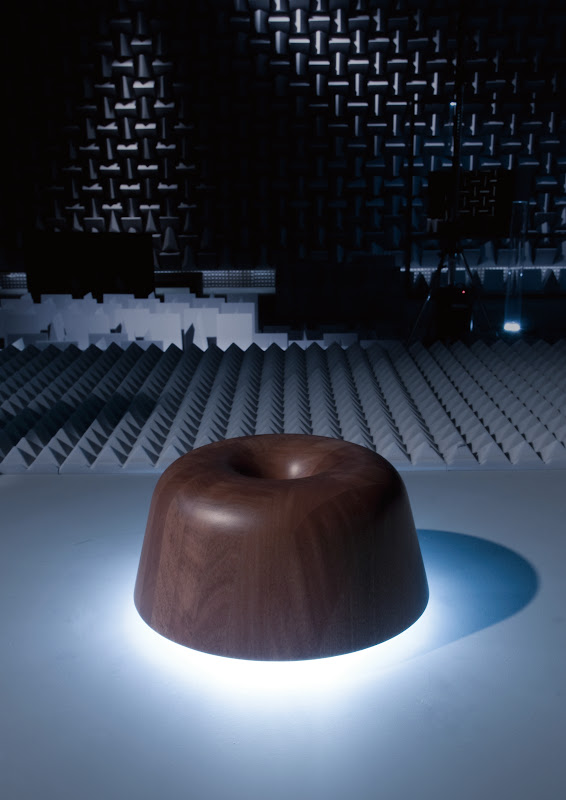
Edward Barber and Jay Osgerby said of the exhibition, “Our thinking was to create abstract objects for the everyday living environment, to show suggestions of how the Sony technologies might appear in our lives. We found it most interesting to explore abstracted, pure forms, each one representing a different area of the living space. We have used simple raw materials, since these seemed a strong partner for the great complexity of the microtechnology that they were paired with. In forming and resolving our ideas we came to four new archetypes that to us represented all the possibilities of the new Sony technologies in the home.”
The setting for this experiential revelation is an anechoic chamber; filled with sound absorbing cones to create a noiseless space. Anechoic spaces allow for a keen sense of hearing, our vision becomes sharper, leading us to tune in to the reality of the things around us. We invite the visitors to focus their senses on the new realm unfolding around them, conveyed in the five areas of archetypes.
Area 1: Icon (The essence of Monolithic Design)
In this space Sony presents an installation representing the essence of Monolithic Design at its purest and its most symbolic level. The object is set, in a monumental style, into a slab of slate, representing the dynamic, elegant presence of a form, which stands quiet and calm, yet penetrates the earth and air of its entire environment.
Area 2: Insight (Sound and light in a single object)
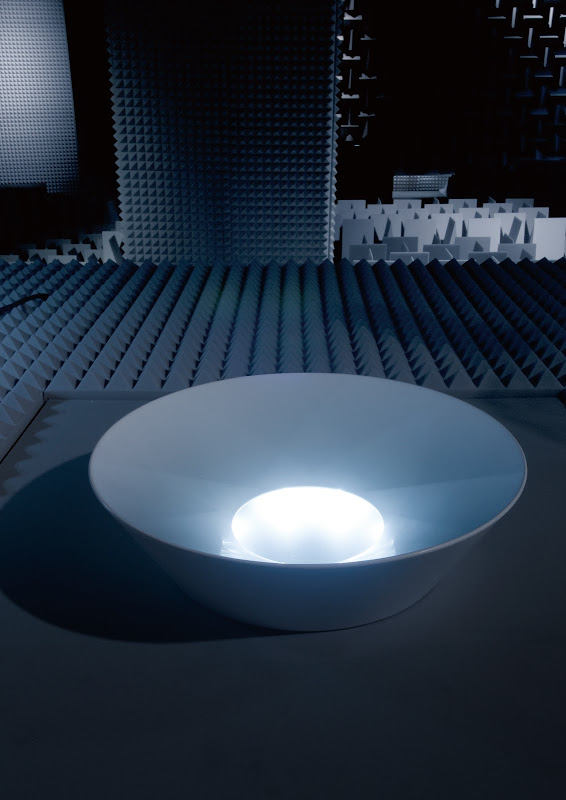
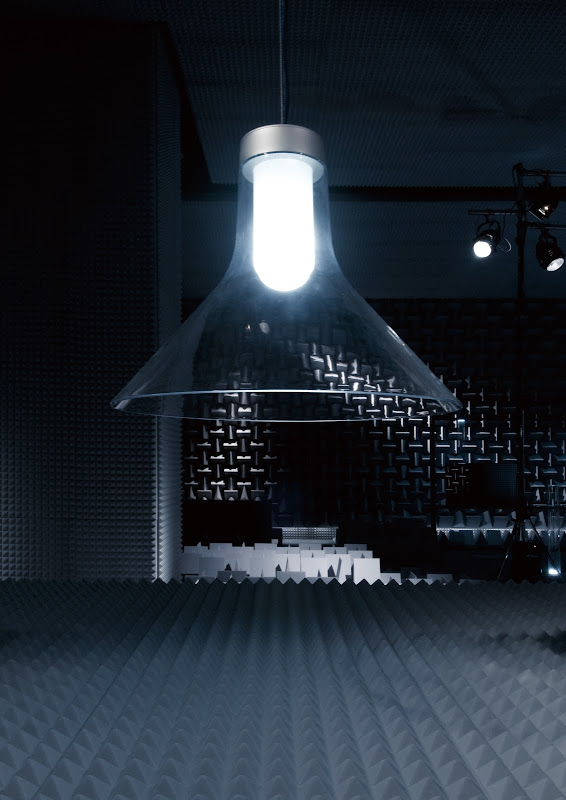
Visitors in area two will experience a demonstration of how sound and light may integrate and coexist in interior spaces. Owing to the development of Sony’s unique speaker drive system, vertical drive-technology and proprietary digital signal processing technology, speakers can be now integrated to LED lighting to maintain the personalized decor. Here the archetypes apply materials such as cultured marble, wood and organic glass that fits comfortably within multiple home environments.
The harmony of the glow radiating from the light with the sound emanating from the omni-directional speaker producing 360° acoustic field embodies a new archetype.
Area 3: Intimate (Personal visual sound field)
An exercise in the essential. Pairing a television with near-field speakers yields a private sphere of entertainment that offers a soundstage with impressive presence. In this personal space, we can immerse ourselves in audio and video content without disturbing others or being distracted. Within the space stand a stool, television and stand, and near-field speaker and stand, creating a new personal experience.
Area 4: Integrate (Visual sound furniture)
Area four offers a variant on Monolithic Design expression, with an intelligent connection to furniture and interior space. The mechanical aspect of television or audio systems is neatly incorporated in this archetype to express a new face in furniture. Here, the archetype creates audio without imposition of a mass of imposing technology. The material was made by stererolithography, a 3D printing process providing a pattern and unique structure which have been uniquely designed to achieve acoustic transparency.
Area 5: Install (Architectural furniture integrated with sound lights)
This area connects all elements of light, space and sound. Experimental products and furniture populate this experiential space of an abstracted living room. The essential pieces of a speaker, lights and television do not dominate any space, yet their powerful simplicity is immediately apparent.
In the quest for Monolithic Design, Sony limited the focus to essential elements, however, as the diverse examples on display show – from lighting to furniture to architecture and living space – the potential to inspire pieces that blend seamlessly into many settings is unlimited.
‘Contemplating Monolithic Design’ by Sony is open for public viewing from 14th to 19th April in the impressive space of Officine Stendhal at Via Stendhal 35 in Milano, Italy.
Even though front-loading washing machines are generally more efficient and clean your dirty duds better than old-school top-loading machines, some surveys show that around 3 out of 4 American households are still loading from above. Our brighter brethren at Consumer Reports endeavored to find out why.
Price: With some rare exceptions, front-loading washers are anywhere from 25-50% more expensive than comparable top-loading machines.
Vibration: Some front-loaders cause significant vibration, often perceived as the machines being noisy. If your washer is situated on a wood floor, or if it’s within earshot of your living room or bedroom, this can be a big annoyance.
Ergonomics: Bending over to load and unload a front-loader can takes its toll on your back.
Mold: Moisture and debris trapped in the seal of a front-loader door can cause a mold problem, especially if you run cold-water loads on a regular basis.
Over at CR, they have some tips on how to deal with the mold issue, if that’s a concern of yours.
Most of you already know that the 2012 Mercedes CLS 63 AMG is slated to compete with the likes of Porsche Panamera and the Audi A7, what you may not know is that it was spied testing in Nürburgring. The 2012 model is very close to hitting the production floor and a good indication of that is the prototype loosing its veil on the test circuit in Germany, where most of the cars are found heavily clad. The commuter is looking very aggressive and sporty and gets blessed with LED running daytime lights. From what we’re being told the 2012 four-door Mercedes CLS 63 AMG is getting an all-new 5.5L twin-turbo V8 engine that will churn 536bhp and it will be mated to a 7-speed automatic transmission. It will go on sale in Europe as early as next year. [via WCF]
[Professor Brian Cheffins is the S.J. Berwin Professor of Corporate Law at the University of Cambridge Faculty of Law]
As Prof. Bruner points out in his insightful Article, in the literature on comparative corporate governance, there is a tendency to treat the United States and the United Kingdom as being very similar across key dimensions.He shows convincingly that in fact there are key differences between corporate governance in the two countries, focusing in particular on greater “shareholder-centrism” in British public companies in comparison to their U.S. counterparts.He then seeks to account for the discrepancy in terms of political economy, arguing that shareholders loom larger in the corporate law context in the United Kingdom than they do in the United States because in Britain other constituencies affiliated with corporations (“stakeholders”) have greater extra-corporate protection.
Prof. Bruner’s Article makes a series of valuable and intriguing points.However, from a comparative perspective, one is nevertheless left with a nagging question: Is the United Kingdom really markedly more shareholder-friendly than the United States?There in fact is reason to doubt this is the case.
It no doubt is true that U.K. shareholders have greater shareholder governance rights—powers enjoyed by shareholders over key decisions in the firm.However, as I have pointed out in an Article co-written with John Armour, Bernard Black and Richard Nolan (Private Enforcement of Corporate Law: An Empirical Comparison of the UK and US, 6 Journal of Empirical Legal Studies, 687 (2009)), civil procedure rules and substantive corporate law are considerably more “plaintiff friendly” in the United States than the United Kingdom.The greater ability of U.S. shareholders to sue to protect their rights arguably largely compensates for inferior protection along other dimensions.
Prof. Bruner briefly acknowledges in his paper that the greater capacity of shareholders to sue in the United States may narrow the gap in shareholder orientation between Britain and the U.S. (at p. 609).The Article I have written with Armour, Black and Nolan provides empirical data that indicates the point merits greater attention.For instance, while it is reasonably common for directors of U.S. public companies to be sued for damages under corporate law, we found, based on a search of cases filed in the United Kingdom, only one instance in three years where a case was filed against directors of a publicly traded company under corporate law claiming damages.Moreover, while our U.S. search uncovered 355 cases over a seven year period launched in state or federal courts against directors of a publicly traded company involving a claim for damages for breach of duty that resulted in a published opinion, one has to go back to the early 1980s to find a reported U.K. case where a director of a public company was a defendant in a derivative suit.
As Prof. Bruner points out (at p. 609), the extent to which litigation has deterrent value in the corporate context is unknown.Nevertheless, with the private enforcement gap between the United Kingdom and the United States being as large as we have found, the extent to which the United Kingdom is more “shareholder friendly” than the United States remains at best unclear.
Good news for BlackBerry Bold 9700 handset owners — SlingPlayer Mobile is now supported on your device! Obviously you need some SlingBox hardware to stream live television from the home to the handset. But if you have that, you can download and install the software for remote media control and playback. The SlingPlayer Mobile client works on both AT&T and T-Mobile 9700 phones and isn’t restricted to Wi-Fi only. That means you can watch live or recorded television on the go over 3G networks.
A SlingPlayer Mobile license will set you back a one-time $29.99 fee, but Sling says you can transfer an existing license key at no charge. The only exception to that rule is for iPhone or iPod Touch version keys. I don’t have a Bold 9700 — and I’m still waiting for the Android version of SlingPlayer Mobile — but I’d imagine that live television would look awful nice on the small but high resolution 480 x 320 display of a 9700.
Related content on GigaOM Pro (subscription required):
Wow, I can safely say I never thought I’d come up with a title like that. Later this year NASA will be sending a new permanent resident to the International Space Station. At 300 lbs. the R2 robot is all upper body strength with just a head, torso, two arms and two hands. He’s set to launch on the space shuttle Discovery in September and once unloaded the goal is to see how the R2 performs in zero gravity.
Alan Taub, vice president of GM’s global research and development states: “The work done by GM and NASA engineers also will help us validate manufacturing technologies that will improve the health and safety of our GM team members at our manufacturing plants throughout the world.”
You have to admit that all of this stuff is pretty darn cool and is very reminiscent of something from Arthur C. Clark’s famed 2001. Who knows, maybe one day we will have walking, talking robotic friends. Only time will tell, but with happenings like these the future looks to be very exciting.
If you have an issue with your Sirius XM Radio service or a billing problem, and vanilla customer service behind the 1-800 number just can’t seem to get it right, no matter how hard you try, you might try emailing the people running the company. Here are their email addresses:
It’s not every day you get the chance to hear a half dozen executives from successful startups speak openly about how their companies managed to get to where they are. In fact, its most likely that to get that kind of access in one day, you’d have to be at some high-priced convention that costs several hundred dollars to attend. This isn’t the case, however, with Starter Day, an event hosted by software makers Atlassian that will showcase six CEOs and founders from various startups, including Boxee, Aardvark and Pandora.
Sponsor
The event takes place on June 9th in San Francisco and will only cost $50 for anyone to attend. Atlassian’s products help companies collaborate on software development projects, and the executives participating in Starter Day hail from companies that have experienced this first hand. But Starter Day is not a chance for them to blab on about how amazing they think Atlassian to be; instead, the guests will speak on a variety of topics centered around building a successful startup.
Steve Ginsberg, vice president of technical operations for Pandora, will speak about his company’s operations and issues with scalability, while Aardvark co-founder Nathan Stoll will discuss how he and his colleagues incorporated user centered design and advanced algorithms into their engineering. Avner Ronen, CEO and co-founder of Boxee will also give a speech he has titled “Underdog 101: Question Everything” which will teach you “everything you need to learn by listening & not listening to anyone else.”
The other speakers include Glenn Kelman of real estate startup Redfin, Mike Volpe of marketing software makers HubSpot, and Jochen Frey, CTO of Scout Labs, which makes tools for social media metrics. Atlassian co-founders Mike Cannon-Brookes and Scott Farquhar will kick off the event with a discussion about bootstrapping a startup, and a surprise speaker yet to be unveiled is also slated to speak.
Atlassian’s marketing VP Jay Simons says the event spawned from the company’s surprise that so many small businesses and startups were using their software. Atlassian provides a $10 starter licence for their products, and Simons says that since its inception, over 40,000 starter licences have been sold. Since they recognized a large group of their customers were small businesses, Simons says they created Starter Day as a way for startups that may not be able to afford attending their larger customer conference, which begins shortly after the event, to participate in the weekend’s activities.
This is a fantastic opportunity for young companies and entrepreneurs to hear from the leaders of some of the most successful startups of the last few years. As prominent as these companies are, they all began as startups at one point, and the advice they will undoubtedly provide at Starter Day is sure to be a wealth of information to any startup or entrepreneur looking for an edge.
Plenty of broadcasters are still upset over the digital TV transition, in which they lost their analog spectrum rights — rights which they never had to pay for — as the FCC sought to reclaim it and put it towards more efficient and useful purposes. Getting the analog spectrum for free, and then having it replaced with the digital spectrum, again for free, was a massive government handout that’s formed the bedrock of broadcasters’ businesses. It’s a tradeoff that’s worked well: the broadcasters get the chance to make some money, and the public gets free over-the-air TV. But broadcasters are now looking for another handout, making noise that the FCC should mandate that every cell phone sold in the US have a digital TV receiver in it (via Ars Technica). It’s a great plan, according to broadcasters, because (of course) it will make us all safer. The TVs in every phone are apparently the best way to distribute information in case of public-safety emergencies, so we should all have them. Never mind, of course, that when there aren’t emergencies on, we can all tune in to great television programming brought to us by our totally altruistic broadcaster friends.
Apparently it’s a foolproof plan, because first, the FCC could mandate it (just like they took away the analog channels, we are reminded), and second, Americans replace their phones so frequently, that the life-saving feature could make its way into most of our phones within 5 years. One major oversight in the piece, though: there’s no mention of who’s going to pay for all of these tuners, which we’ll interpret to mean that it sure as hell won’t be the broadcasters who will conveniently then rely on them to help generate revenues. If the real interest here is public safety, why not mandate plain old radio receivers, which are much cheaper, and much more easily integrated into mobile phones? Maybe because public safety isn’t the real interest?
It’s time for American consumers to stop being scared of small diesel cars. Currently, we can’t think of a single automaker that isn’t shelling out bags of money to research and develop new hybrid powertrains – cars that are efficient first and fun-to-drive second (or third, or fourth). Diesel vehicles, on the other hand, offer a different sort of solution. Gobs of torque delivered at low revs and impressive fuel economy work together without sacrificing too much in the way of driving pleasure. Besides, does anyone really want to live in “One Nation Under Prius?”
Volkswagen introduced us to its new Jetta TDI a little over a year ago, proving that clean diesel technology offers a way forward for anyone who gives a hoot about driver involvement. Now, the automaker has fitted its well-received 2.0-liter diesel engine in the all-new sixth-generation Golf. Can this hatch prove to America that it’s possible to fuse efficiency and enthusiasm together in a high-quality package? Can you really have your cake and eat it, too? Hit the jump to find out.
Assurant, a provider of specialized insurance products and services, has announced the release of their new Android application, Benefit Tools. Designed to help find a local dentist, the app uses Google Maps and GPS to help hunt down a nearby dental office.
“We always look for ways to keep our products and communications relevant to our customers and sales force, and the way they use technology is always changing,” says Rever. “It’s very gratifying to be able to provide an industry-first tool that will help Assurant Employee Benefits connect in a new and meaningful way.”
Aside from finding local dentists, the app also give users updates via company news and Twitter feeds. It’s expected that more features and add-ons are integrated with future releases. Look for Assurant Benefit Tools in the Android Market with the rock bottom price of FREE.
Might We Suggest…
Quick Look: Grade Ticker (Video Demo) Grade Ticker is a simple, but incredibly useful app for professors and teachers. Leave it open next to you as you grade an exam and tally the point deductions as you go. Eliminating the need to go bac…
Remember how he hasn’t taken his team to a bowl game in his first two years, breaking a ridiculously long streak during an era where teams who go .500 can go to the postseason?
Remember his record against the rest of the conference?
Gov. Pat Quinn and Illinois National Guard leaders gathered here at the Consulate General of the Republic of Poland today to pay respects to Republic of Poland President Lech Kaczynski, military leaders and other Polish dignitaries who were killed in the April 10 plane crash…
An unwelcomed rush of cold water flooded through the laced tongues of their combat boots as they forced their way through the stagnant water. The tips of their oars broke through the yellowish milky film that had settled atop the water and they were off…
More than 100 Airmen of the 193rd Special Operations Wing’s 201st Rapid Engineer Deployable Heavy Operational Repair Squadron Engineers returned to Fort Indiantown Gap today after a six-month deployment to locations throughout Iraq and Afghanistan…




 It’s not every day you get the chance to hear a half dozen executives from successful startups speak openly about how their companies managed to get to where they are. In fact, its most likely that to get that kind of access in one day, you’d have to be at some high-priced convention that costs several hundred dollars to attend. This isn’t the case, however, with
  The other speakers include Glenn Kelman of real estate startup


