Blog

  • Android Handbook: Android knowledge in your pocket.

    Have you ever been approached while using your Android phone or asked in the middle of a conversation; what are the specs of that phone? Most cases you can answer with the basics like screen size and resolution. What if the concerned person would like to know more or maybe like to compare Android phones? Now instead of browsing the web or guessing, there is an app that does all the work for you. Introducing Android Handbook!

    Not one of the most useful apps around, but if there are specifics you need to know about any Android phone released or soon to be released it has what you need. You can search by manufacturer to narrow down your choices which is nice. It displays the device by the manufacturer, name of the device, version, and the release date. As far as I can see, the info is pretty accurate. There is a nice little note at the bottom of the screen: “We will keep database up to date!”

    Pros:

    • Information is accurate and up to date
    • Easily accessible and information is compiled in one place for convenience
    • Gallery feature to view a screenshot of the device you’ve selected

    Cons:

    • UI could use some polishing
    • More screenshots of the selected device
    • Font could be a little bit bigger

    In Closing:
    Android Handbook can be a useful tool for determining a future phone purchase or maybe just to compare your phone against a new release. Not an app for everyone but it is available on the Market at your disposal.

    Note: This review was submitted by Terrell Zeigler as part of our app review contest.


    Related Posts

  • SAE 2010: Next-gen Ford EcoBoost engines to get even more efficient with cooled EGR

    Filed under: ,

    Over the course of 2010, Ford plans to aggressively ramp up its EcoBoost engine strategy with two new four-cylinder engines and the first rear-wheel-drive application of the boosted 3.5-liter V6. However, this is just the beginning as Ford is already hard at work on the next generation of EcoBoost engines. At the SAE World Congress on Wednesday, Dan Kapp, director of powertrain research and advanced engineering, and Bob Fascetti, director of large gas and diesel engine engineering, will be announcing that the next generation EcoBoost engines are adding cooled exhaust gas recirculation (EGR) systems.

    Just like the direct injection and turbocharging used on the current EcoBoost mills, cooled EGR is derived from diesel engines. Exhaust gas is routed back into the combustion chamber to reduce the combustion temperatures. Controlling the combustion temperature has a number of benefits, primarily allowing the use of a leaner air/fuel mixture, which would normally burn hotter and thus produce more nitrogen oxide emissions. Running the exhaust gas through a heat exchanger before sending it into the intake stream improves the cooling effect further.

    Using cooled EGR will also allow the use of even higher compression ratios without getting into knock situations. Engineers will be able to downsize engines even further without sacrificing power and torque. Overall, Ford estimates cooled EGR will improve EcoBoost efficiency by an additional five percent, further closing the gap between gasoline and diesel. More power, less fuel – it’s a win/win scenario.

    [Source: Ford]

    Continue reading SAE 2010: Next-gen Ford EcoBoost engines to get even more efficient with cooled EGR

    SAE 2010: Next-gen Ford EcoBoost engines to get even more efficient with cooled EGR originally appeared on Autoblog on Wed, 14 Apr 2010 00:01:00 EST. Please see our terms for use of feeds.

    Permalink | Email this | Comments

  • Scores Killed in China Quake

    Wednesday, April 14, 2010
    07:21 Mecca time, 04:21 GMT

    Scores killed in China quake

    Television images indicate significant damage

    A magnitude 6.9 earthquake has killed at least 67 people in a mountainous rural area in western China, officials and state media say.

    Many others were trapped under houses and troops were dispatched to the area on Wednesday amid fears that many residents could be without shelter in temperatures below freezing.

    The quake and at least three aftershocks – some more than 6.0 in magnitude – that struck the ethnic Tibetan town of Yushu in Qinghai province, on the Tibetan plateau, caused many low, brick buildings to collapse.

    Most of the region’s low residential buildings had fallen, Huang Limin, a government official in Yushu, told state television.

    Zhuo De, a resident of Yushu who spoke by phone from the capital of Qinghai province after contacting his family in Yushu, said “maybe dozens were injured, maybe more – it’s hard to say”.

    “The homes are built with thick walls and are strong, but if they collapsed they could hurt many people inside.”

    People from the Yushu prefecture highway department were frantically trying to dig out colleagues trapped in a collapsed building, Ji Guodong, a department official, said by telephone.

    The quake, with a depth of 10km, was centred in the mountains that divide Qinghai province from the Tibet Autonomous Region.

    The Tibetan plateau is regularly shaken by earthquakes, but casualties are usually minimal because so few people live there.

    The foothills to the south and east of the area are home to herders and Tibetan monasteries, while the area to the north and west is arid and largely empty.

    Source: Agencies

  • First step towards carbon-free ‘power-plant’

    Plants, including algae blooms such as this, could be a source of high-efficiency, clean b...

    We’ve looked at recent research into the development of artificial photosynthesis to generate clean power, but now researchers at Stanford University have been successful in harnessing energy directly from plants as they convert sunlight into chemical energy. The researchers say it could be the first step toward generating high-efficiency bioelectricity that doesn’t give off carbon dioxide as a byproduct…
    Continue Reading First step towards carbon-free ‘power-plant’

    Tags: ,
    ,
    ,

    Related Articles:


  • SugarSync: This magic briefcase won’t let you down.

    Have you ever been in a spot where you really need a file that just happens to be on your home computer or is on a USB stick somewhere under the seat of your car? SugarSync is an app that lets you access the files that you choose to sync between your computers and their servers from the palm of your hand.

    The app has a slick, polished interface that is easy to use and set up. SugarSync isn’t groundbreaking in their way of bringing “cloud” file management and file storage/syncing to you, but their way of bringing your most important files to your Android phone is remarkable.

    Rundown:

    • SugarSync account needed. You may choose from Free with 2 GB of storage up to large amounts of data backup at monthly/yearly rates.
    • Full desktop client available for file management on your PC or Mac.
    • “Magic Briefcase” folder that automatically syncs between all computers and phones that you have on the account.
    • Integrated file explorer and photo gallery.

    Pros:

    • Automatically syncs your mobile photos (if you choose to).
    • Access your files from any computer in the world with internet access.
    • Easy way to collaborate and share folders to anyone. You can email links for secure access. This is good if the file you are sharing is too large to email.
    • Works great for when you are browsing wallpapers and such on your PC, you can save files to your synced folder and they automatically end up on your phone. No need to mount your USB cord!

    Cons:

    • Large files can be sluggish to load over 3G. Not a fault of the app though.
    • Removes excuses for losing schoolwork.

    Wrap Up:
    SugarSync is a slick little app and once you get used to using it on your phone and beyond, you realize how many headaches it really saves you.

    Note: This review was submitted by Micah Vainikka as part of our app review contest.


    Related Posts

  • Android Fragmentation Dwindling


    The device dashboard over at the official Android Developers site has been updated after months of inactivity.  With the Motorola Droid recently getting bumped up to Android 2.1 over the last couple of weeks, it’s no surprise that Android had dwindled down to 3 major builds (1.5, 1.6, and 2.1).  The promising news comes in knowing that nearly every Android handset in the United Sates will be at Android 2.1 at some point over the next few months!  Sprint has plans to get their Hero and Moment phones up to snuff while Motorola will get their lineup on track by Q3 of this year.

    Might We Suggest…


  • NAB: Sony’s HDR-CX550V Handycam Goes Pro With HXR-MC50J Bundle

    The HDR-CX550V Handycam camcorder announced back at CES 2010 is outfitted with a professional-quality wide angle Sony G Lens and an “Exmor R” CMOS image sensor for superior low-light performance. Sony has realized many enthusiasts are using these camcorders in the field, and are set to offer a cool bundle called the HXR-MC50J this July that give it greater flexibility for aspiring filmmakers. Items in this add-on kit include a lens hood, external microphone, and a NP-FV70 high capacity battery.

    Other key specifications of the hardware itself include 1080i HD video recording, 12-megapixel images, 64GB embedded Flash memory, 10X optical zoom, Optical SteadyShot, and built-in GPS receiver. There’s also an incredible 3.5 inch LCD screen that is capable of 921k colors. Not too shabby.

    Picture courtesy of AV Watch.

  • Student Professional Awareness Conference

    Come get prepared for the professional world. The Student Professional Awareness Conference will develop, implement, and promote activities designed to increase professional awareness among students. The conference will be held on Saturday, April 24th from 9am-2pm. The keynote speaker will be Jim Watson and the registration fee is only $5. There will be breakfast, lunch, a raffle, and door prizes and pre-registration is required. You can fill out the online form to register for this event. For more information, email [email protected].

  • Day 1: Warrior Games – EngiNerds 3.0 Results

    The EngiNerds team competed in day 1 of Warrior Games Activities!!! The results are as following:

    1. Table Tennis – 1st Place Thanks to: Teng Liu and Vrushen Pathak

    2. Ultimate Frisbee- 2nd Place!!! Thanks to: Alisha John, Eric Gingrich, John Herbon, Justin Filipp and Liz Halash

    Keep the momentum going for the rest of the week, come out and cheer for the rest of the EngiNerds’ Squad.

    Game Schedule can be found here.

  • Invitation to attend the Demystify Your Digital Life Symposium

    Are you interested in science and technology? Are you curious how modern
    electronics like laptops, desktops, game consoles, and LCD monitors work? You
    are in luck! The Computer Organization and Design class is organizing a
    symposium in which the students of this senior-level class will give
    presentations on various modern computer technologies.

    Topics to be covered:
    Intel Core i7 Microarchitecure
    AMD Barcelona Microarchitecture
    Sun T2 Microprocessor
    The Cell Microprocessor (in PlayStation 3)
    GeForce Series 9 Graphics Card
    LCD Technology
    Cloud Computing
    Open to public, including High‐school, college, and university students and their
    parents

    Free Admission in State Hall Room 0118 from 7:30-9:25 pm

    Come learn about new computer technologies
    Know how computer engineers make things happen

  • Microsoft KIN smartphone targets social networking

    Microsoft KIN ONE and TWO, touch screen sliders that have been designed for with the socia...

    Microsoft says its new KIN Windows phone has been designed specifically for people who are actively navigating their social lives – and let’s face it, who isn’t? The software giant has partnered with Verizon Wireless, Vodafone and Sharp to deliver the product exclusively to the US (Verizon Wireless), Germany, Italy, Spain the UK (Vodafone). KIN melds a handset, online services and the PC with new experiences called the Loop, Spot and Studio. There are two models – KIN ONE and KINE TWO, both with touch screens and slide out keyboards…
    Continue Reading Microsoft KIN smartphone targets social networking

    Tags: ,
    ,
    ,
    ,
    ,

    Related Articles:


  • Why the Law of War Permits the U.S. to Detain and Try 16-Year-Olds Like Omar Khadr

    by Julian Ku

    Christopher Jencks, Chief of the International Law Branch of the Office of the Judge Advocate General, has a pretty compelling defense here of the legality of the U.S. detention and trial of Canadian Omar Khadr for violations of the law of war, despite the fact that Khadr was not quite 16 when he committed his alleged crimes.  The heart of his analysis seems to be based on Additional Protocols of the Geneva Conventions (which the U.S. is not a party to but to which it adheres as a matter of policy).

    Additional Protocol I, which deals with IAC, discusses the protection of children in art. 77. While art. 77 affords special protections, those protections apply to children under 15. Even then, the special protections do not preclude children, even those under 15, from being arrested, detained, or interned if they take a direct part in hostilities. Under AP I, persons who had not reached 18 years of age when they committed an offense related to armed conflict are not subject to the death penalty. The clear inference is that such individuals may be held criminally responsible for their actions and subject to punishment, just not capital punishment.

    Additional Protocol II, which deals with NIAC, describes the care and aid children require in art. 4, and in slightly more detail than AP I. It does so first as applied to children who do not take a direct part in hostilities or who have ceased to take part in hostilities. It then qualifies that the special protections remain applicable to children under 15 who have taken a direct part of hostilities. Again though, the special protections do not include protection or immunity from internment or detention, and wouldn’t apply to Khadr anyway as he was not under 15.

  • Gen McChrystal Orders ROE Review

    KABUL- One day after US troops mistakenly opened fire on a passenger bus in Kandahar, killing four civilians and wounding 18, the top American commander in Afghanistan has ordered a mandatory review of the rules of engagement by all American and coalition forces.

    Last year, Gen. Stanley McChrystal implemented strict new rules limiting the use of air power and restricting the troops ability to fire on insurgents unless they were certain no civilians were in harm’s way.

    Despite the new rules, Afghans civilian deaths have continued mount. Though a recent UN report says that the number of Afghans killed by coalitions troops has been reduced.

    The recent civilian deaths, which provoked large protests in Kandahar city Monday, could not have come at a worse time for coalition commanders. US and Afghan officials are actively trying to persuade skeptical tribal elders to support the upcoming offensive in Kandahar – and tensions were already high before the bus shooting. According to several US officials who spoke to Fox News on the condition of anonymity, the mandatory review is a direct response to the growing concern that “additional civilian deaths will undermine the upcoming NATO offensive in Kandahar.”

    Earlier this spring, Gen. McChrystal told coalition troops that most of the shootings at military check points were unnecessary, and urged troops to use more caution when making decisions to fire.

  • Trade of the Decade II

    Guest essay: Daily Reckoning Group Research Project: Trade of the Decade, Part II By Joel Bowman

    We asked. You answered.

    We asked you, the Daily Reckoning readers, to submit your ideas for the “Trade of the Decade.” You responded with a flood of excellent responses. We regret that we cannot publish them all.

    Yesterday, we presented some of your submissions. Today, we present a few more. So without further ado, here’s goes:

    Reader B. Bundsen kicks off today’s selection with a call to “Buy stupidity; sell responsibility.”

    We like the thinking behind this one. It was probably considered “stupid” to buy gold circa 2000, right?

    “I think the short (US) stocks/long gold trade is still a winner,” chimes another reader, A. Urhina. “If I were pressed for an alternative I would probably go for short UK gilts (a variation on Bill’s short for the decade) and long well-balanced emerging market economies (are there any?)”

    A reader by the name of Anil opted for a wetter buy side recommendation.

    “Buy: Water Sector. PHO is one bet, but there are several others,” he writes.

    “Sell: Oil. Everyone expects oil to be more expensive, so my bet is that we come up with alternatives which reduces the demand for light sweet crude.”

    Next, an anonymous reader suggests, “[the] best bull trade of the decade will be medical records software companies. First they will sell the software, mandated into the market for a while, then they will collect for licenses and updates.

    “[The] best short position of the decade will be bonds – generally, municipal bonds; specifically, general obligations for California, Illinois, New Jersey, and large cities like New York, Philly, and LA.”

    C. Cummings, another reader, offered this pair trade:

    “Buy: Agriculture, and the more global the agriculture equity, the better. There are plenty of ways to play this, this most straightforward being DBA. Or 50% DBA and 50% MOO (my preference).

    “Sell: the US Dollar; this is probably going to be the trade of the century and not just the decade. Lots of ways to play this one too, the easiest being UDN, or long-dated puts on the dollar for more leverage. I prefer this approach versus shorting the government bills/notes/bonds because it is simpler and probably less subject to manipulation.”

    Government manipulation, Mr. Cummings? Well we never…!

    “Go long emerging markets,” was reader D. Dartt’s vote, “especially Brazil and India. Be careful not to load up too much on Russia and China. Short the Euro.”

    On a slightly different line of thinking, a reader named Danny suggests this simple long/short:

    “Buy small mammals, sell dinosaurs.

    “More concretely,” Danny explains, “Buy biotechnology (BTK) and sell utilities (DJU). Buy biotech because it will continue to grow very fast and eventually biotech will encompass nanotech and make a number of industrial sectors obsolete. Sell utilities because there will be a growing trend towards self-sufficiency, and more people will get off the grid for things like electricity and water. Affordable technology will make that possible. So big utilities will be the newspaper sector of the current decade.”

    Reader A. Slinkard suggests:

    “Short: Biofuels and US Treasuries. Both are dead ends. Buy: Natural gas and iron ore. Both have tremendous potential in the next decade.”

    A reader by the name of C. Gaylord offers an opinion sure to raise the ire of the goldbugs:

    “Let’s get EVERYONE riled up!” he writes. “SELL GOLD!! Gold has had a good run the last decade. It’s time for a change although gold will probably still go up over 4 times. Buy the three metals needed most that are just getting started in industry. Molybdenum, Lithium and Titanium. Moly – makes steel stronger. Lithium – for all the new Hybird batteries. Titanium – will be needed to make the strength of steel stronger so they can use less, thereby reducing the cost and weight of the new Hybird cars and airplanes.

    “Buy base metals that are underpriced: lead, copper, iron. There is one simpler trade,” concludes Mr. Gaylord. “SELL paper money. It will all be useless.”

    Another reader, John, suggests we “buy the makers of rose-tinted spectacles” and “short everything else.”

    And from Italy, Mr. Monticello reckons we ought to “Short 50% Euro and 50% Yen. Go long 25% each in bonds: Brazilian real, Turkish lira, Australian dollar, Norwegian kroner.”

    “Unless I have no brain,” writes another reader, D. Mol, “this is a no- brainer: Buy precious metals. Sell or short all bonds.”

    Then there’s this one, from Agora Financial Reserve member, M. Readling:

    “You are probably looking for something more specific, but a couple of years ago I told a less-than-perceptive friend that he should be long anything that can be packed up and shipped to China (like wheat), and short anything that couldn’t (like his house). I don’t know if he bought any wheat, or not, but he is still in that house. Judging from what he said the other day, maybe not much longer.”

    J. Scharp told us to “buy wheat and short Los Angeles real estate.”

    J. Pratt reckons we ought to go “Short 30-year US Bonds (real surprise, eh?) and long equally corn, soybeans and wheat.”

    F. Merciadri agrees: “Short Cities, Long Rural Areas.”

    “In simple terms,” adds another reader, Bruce, “sell cash, buy seeds! The cash in our hand – or more correctly the Federal Reserve notes – has been on a wave of popularity while completely devoid of any true value. On the other side of the trade is an asset class that has been trivialized by cheap imports and farm subsidies that have made it an asset we take for granted.

    “Food is a major expense for most of the world,” reasons Bruce, “and will most likely regain that position here as the correction continues. Farmland, seeds, livestock and gardening tools seem a sure place to put your cash. So long as the sun and rain continue, (things that the Government can’t tax or mess with), the planting of food crops is a fairly sure way of multiplying your value. With a few dollars spent now, the following years could be spent eating from your investment. Not only will you eat for a long time on the returns, but you will undoubtedly eat better, and the exercise and good food will make you healthier. This in a time of rationed health care will be even more beneficial.”

    With another trade straight from the ground beneath us, R. Sharp chimes in:

    “I like rare earth elements – mining and processing. This is currently a hot item because rare earths are essential in manufacturing high- performance magnets needed for electric cars and wind turbines, as well as for optical materials in advanced TV screens. China, which for many years has had a near monopoly on rare earth mining and production, is now limiting exports, a situation that is likely to get worse before it gets better.

    “Because of China’s monopoly in mining and production,” continues Mr. Sharp, “I’d look at mining ventures outside China, particularly by American, Australian and Canadian companies. One never knows about the future, but I like the risk/reward ratio here.”

    D. Wogstad agrees:

    “A market segment of interest that I believe holds great promise this decade is ‘rare earth metals.’ These are metals used to produce high- powered permanent magnets which in turn are used in motors and generators. With increased emphasis on alternative energy (specifically wind power) and non-polluting automobiles, there will be significant demand for wind turbine generators and electric motors to propel automobiles.

    “Unfortunately for the United States, this market is being cornered by the Chinese. But for the savvy investor, cornered markets mean skewed pricing and extraordinary profits.

    “On the sell side,” continues reader Wogstad, “anything in the ‘semi- luxury goods’ category won’t fare too well. The continuing demise of the middle class in the United States will curtail the sales many goods formerly aspired to by the middle class; jewelry, furs, boats, etc. I think this decade will be characterized by the middle class living within their now diminished means.”

    And finally today, a reader S. Carter sent in the following thoughtful comments:

    “Sell: Electric Utilities at peaks (well, don’t wait for peaks, just SELL!)

    “Premise: Essentially, fixed dividends based on a highly regulated model produce the equivalent downside of a long-term T-Bill with additional exposures. As rising commodity pricing, rapidly increasing health care/benefits expenses related to its workforce and generally expanding operating costs to keep an aging infrastructure functional. Add also the need to install extremely expensive mercury, NOx and SOx emissions controls on conventional generating stations, and the eventual cost of CO2 mitigation, and the average utility ratepayer is looking at forking out a lot of dough in the form of rate increases (+100%) with no visible improvement in service. Electricity is a commodity, and brand loyalty is a tough thing to achieve.

    “Now the tougher question: What to buy? Commodities, particularly oil and agriculture.

    “Premise: Peak global oil production coupled with massive increases in demand from India, China and other emerging economies point to severe shortages and higher prices to serve as the rationing mechanism. Supply and demand will be in balance when the cost of the last (i.e. most expensive deep salt or oil shale reservoir) barrel of oil produced plus a ‘reasonable’ return is recovered in the price, and the last buyer is willing to pay that price. Price elasticity is surprising with this commodity, and a double or triple from the current low ‘$80’s/bbl seems likely over the next 10 years. Add in the long-term fall of the value of the dollar, and you could see even greater upward pressure on oil pricing.

    “Global inventories of agricultural products are at the lowest levels in decades (listen to Jim Rogers), and tillable land is hard to come by outside of Brazil. Buy ETFs focused on corn, wheat, soybeans and rice (load up now – in fact, store some in your basement: Not the ETF shares, but the ag commodities themselves! That’s not just talking your book; it’s putting your money where your mouth is…)”

    Your Fellow Readers
    for The Daily Reckoning Australia

    Similar Posts:

  • Iran Complains to United Nations Over U.S. Nuclear Threat

    Iran complains to U.N. over U.S. nuclear “threat”

    Tue, Apr 13 2010
    By Patrick Worsnip

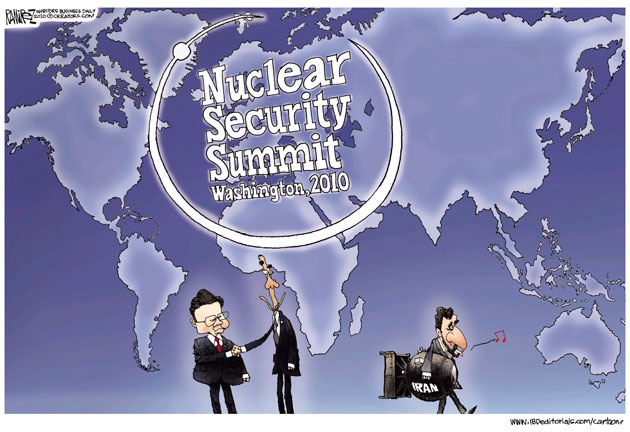
    UNITED NATIONS (Reuters) – Iran complained to the United Nations on Tuesday over what it called a U.S. threat to attack it with atomic weapons, accusing Washington of nuclear blackmail in violation of the U.N. charter.

    President Barack Obama made clear last week that Iran and North Korea, both involved in nuclear disputes with the West, were excluded from new limits on the use of U.S. atomic weapons.

    A letter from Iranian Ambassador Mohammad Khazaee to U.N. Secretary-General Ban Ki-moon and the Security Council and General Assembly presidents called on the United Nations to “strongly oppose the threat of use of nuclear weapons and to reject it.”

    Statements by Obama and other U.S. officials were “tantamount to nuclear blackmail against a non-nuclear-weapon state” and breached U.S. obligations under the U.N. charter to refrain from the threat or use of force, Khazaee said.

    “Such remarks by the U.S. officials display once again the reliance of the U.S. government on (a) militarized approach to various issues, to which the threats of use of nuclear weapons are not a solution at all,” he added.

    They also posed “a real threat to international peace and security and undermine the credibility” of the nuclear Non-Proliferation Treaty, the envoy said.

    Obama is urging other global powers to agree to a fourth round of U.N. sanctions against Iran over its refusal to halt nuclear work that the West suspects is aimed at making bombs, a charge Iran denies.

    He pressed the case for sanctions at a 47-nation nuclear summit in Washington on Tuesday, at which he won pledges from world leaders to take joint action to prevent terrorist groups from getting nuclear weapons.

    But Khazaee said that Iran, as a victim of weapons of mass destruction — a reference to Iraq’s use of poison gas against it in a 1980-88 war — was firmly committed to a world free from such weapons.

    The United States, the only country to have used nuclear weapons — against Japan in World War Two — “continues to illegitimately designate a non-nuclear weapon state as target of its nuclear weapons and contemplates military plans accordingly,” he said.

    U.N. members “should not condone or tolerate such nuclear blackmail in (the) 21st century,” the Iranian envoy said.

    (Editing by Vicki Allen)

  • Desaparecido in Buenos Aires

    We recalled Elizabeth’s words:

    “You can be successful by accident. You can have a family by accident. But you can’t have a successful family by accident.”

    The blue lights of police cars lit up the street in front of where we are staying in Buenos Aires. Your editor had summoned them after his youngest son, Edward, 16, had failed to come home. It was 2 AM.

    “He’s tall, dressed in a blue shirt and jeans…” we explained.

    “Is it normal for him to stay out without calling you?” asked the federale.

    “No…he’s usually a good boy.”

    “Maybe he is just out with his friends.”

    “But we just got here. He doesn’t have any friends here.”

    “Looks like he has some now.”

    Two hours later, we called off the manhunt. Edward came home. Not a care in the world.

    “What’s the matter? Why are you still up, Dad?” he wanted to know.

    “Answer one of my questions first.”

    “What?”

    “Where were you until 4 AM?”

    “I was just out at a club, dancing…”

    It is useless to argue with a teenager. Especially at 4 AM.

    “Go to bed. We’ll talk about it in the morning…”

    “Okay…sorry…”

    “When you told the police that your son had disappeared…did you say ‘desaparecido?’” asked a friend. “They’re sensitive about that. Because they rounded up thousands of young people they didn’t like and ‘disappeared them’ in the ’80s.

    “You should have said: ‘My son has disappeared. No, I’m not blaming you. I just want to find him.’”

    Regards,

    Bill Bonner
    for The Daily Reckoning Australia

    Similar Posts:

  • China Might Actually Be Cooling Its Infamous Loan Growth

    New bank loans in China are already 30% of the government’s full year 7.5 trillion-yuan target, according to the latest March data. The year to date loans figure sounds large relative to the target, but it could be because loans are usually front-loaded each year. On a year over year basis, new loans have been fallen for January, February, and March, as shown below.

    Chart

    China Daily:

    The fresh credit for the first three months is about half of the record 4.58 trillion yuan disbursed by Chinese banks a year ago, when the economy took a hard hit from the global financial crisis.

    The average monthly new loans in the first quarter stood at around 860 billion yuan, compared with 444.2 billion yuan and 1.5 trillion yuan during the same periods of 2008 and 2009.

    “The pace of credit growth will gradually return to normal as the record money supply from a year back would help shore up the Chinese economy effectively,” a source at the nation’s banking regulator said.

    Read more here >

    Join the conversation about this story »

  • Electrifying Turkey

    24 – 02 – 2010

    A concerted effort to both increase the country’s generating capacity and increase the proportion of capacity in private hands makes Turkey’s power sector an area few would want to miss out on. Opportunities abound in 2010 and beyond. By Mark Kolmar.

    Turkey only escaped the inconvenience and ignominy of electricity shortages in 2009 due to lower demand amid lower economic activity. Demand is expected to return to growth in 2010, at rate of between 4% and 6%, and continue at 6%−8% per year between now and 2017. The Ministry of Energy and Natural Resources (MENR) has estimated that the country will need between 40GW and 56GW of additional power on top of its existing 41GW by 2020 − at a cost of US$100bn.

    Average per capita consumption is very low in Turkey compared with many of its Western neighbours, suggesting room for demand to grow that urbanisation and a young, growing population will fill. Electricity consumption in the country grew by 92% between the mid-1990s and mid-200s – a rate that only China and South Korea exceeded.

    The prevailing conditions of demand growth mean that not only is the dampening effect of the economic downturn temporary, but it is minimal. One local banker estimates when the economy drops by 5% or 6%, electricity demand drops perhaps 1% – when the economy is rising again, demand growth will outpace it.

    Inevitably, the result of this predicament is greenfield investments. With the demand so clear, banks are very interested. The quantity of new capacity required in the short to medium-term also means that thermal, typically coal-fired, plants will be providing the bulk of the additional generation in the foreseeable future. Many thermal plants postponed in recent years are returning to the market.

    Evonik Steag, Germany’s fifth largest power firm, and Oyak, Turkey’s armed forces pension fund (and both the country’s first and still-largest privately-owned pension fund) are developing a new 625MW plant to go alongside their existing project, the 1,320MW hard coal-fired Isken power plant at Iskenderun bay in the south-east of Turkey. Royal Bank of Scotland is financial adviser.

    The new Ayas project will cost US$1.35bn, financed through a combination of equity, ECA-covered debt and commercial debt. Sinosure is covering, backing China National Machinery and Equipment Import and Export Corporation’s (CMEC’s) involvement as EPC contractor on a turn-key, fixed-price deal. Bank of China, China Construction Bank and ICBC have been mandated on the Sinosure facility. Turkish and international banks are poring over details of the commercial facility.

    The new plant will be split between Evonik and Oyak on the same 51/49 basis as the Isken plant, which has been operating since 2003. A critical difference is in the off-take, however. Where Isken, one of the original build and operate (BO) schemes tendered in 1997, is backed by a Treasury-guaranteed 20-year power purchase agreement (PPA) with state utility TEAS for 85% of the power, Ayas will sell on a merchant basis. Even given the agreed need for additional power in coming years, market-risk will be an important consideration for lenders.

    The merchant route is expected to become increasingly common for plants. A number of the existing BOTs have price guarantees, but those are all coming to an end over the course of the next decade. Evonik and Oyas are aiming for a Q2 financial close for Ayas.

    RWE and Turcas are developing a 775MW plant in Denizli, in Western Turkey. RWE is the majority shareholder on the combined cycle gas turbine plant with a 70% stake. Greek firm Metka has the EPC; Siemens will supply major components. Projected cost is €450m, and commissioning is scheduled for 2012.

    Also on the way is a 900MW gas-fired plant being planned by Akenerji. Akenerji bought a 98.99% stake in Egemer Elektrik Uretim in March 2009, giving it control of Egemer’s licence for a 900MW natural gas-fired plant in Hatay. ING is advising on the plant financing, which is scheduled for operations in Q4 2012.

    The financing is likely to be heavily backed by export credit agencies (ECAs). Akenerji is 37.5% owned by Czech utility CEZ, and co-owned by Akkok Group, as well as being quoted on the Turkish stock exchange. It is looking to double its 358MW power output over the next two years, and to be generating 3GW within six years.

    Others with more embryonic plans include Anadolu Group, which is planning a 1,200MW coal-fired plant in the north, as part of a €2bn investment in energy projects to boost its generating capacity to more than 2GW. It is in talks with equity partners for a number of initiatives. Park Teknik has applied to build an 864MW natural gas power plant in Mersin, and Suez-Guney Elektrik (owned by Tractebel, Mimag and Samko) plans to build a 1,320MW coal-fired plant in Adana.

    The difficulties that coal plants, particularly lignite-fired examples, present in meeting carbon obligations and EU entry requirements on clean energy, combined with high gas prices, give renewables a great boost in attractiveness. A draft renewables law is on its way to shape the environment for new green power, determining feed-in tariffs for wind, hydro, solar, although much investment will inevitably be delayed until this is in place.

    Doğan, Doğuş and Unit signed a US$750m loan with four local banks for the US$1bn 513MW Boyabat hydropower project last month (PFI 426). Due to the 65.4km2 reservoir being above eligible size, the project will not benefit from the offtake price guarantee, which typically provides a 5.5 euro cents per kWh price for the first 10 years of production.

    New hydro generation totalling 60TWh−100TWh is targeted by 2023, but developing can be expensive due to taxes, including a tax of up to US$0.047/kWh to State Hydraulic Works (DSI) for water use. Accordingly, wind generation is also an attractive option.

    Since 2007’s energy efficiency law, installed wind capacity has grown from 50MW to more than 800MW. The Ministry of Energy and Natural Resources estimates that the country has potential for 48GW, and wants windfarms’ contribution to total energy production to grow from 15% to 34% by 2020.

    The contribution nuclear power can make to Turkey’s energy mix is less clear. Tetas cancelled the tender for a 3GW–5GW nuclear power plant in December, after a court ruled the tender invalid due to disputes over pricing the electricity. An Inter RAO/Atomstroyexport/Park Teknik consortium had been awarded the contract in September 2008, after a three-month tender process in which it was the only group to submit a bid.

    As well as new generation capacity, the country is pushing to reform the wider electricity sector. In June, the World Bank approved a 23.5-year, €548.4m loan aimed at supporting policies of improving sustainable electricity supply security, ensuring financial viability of the electricity sector, improving operational efficiency and the conditions for attracting enhanced private investments, and improving energy efficiency in supply and consumption. Key to improving operational efficiency and conditions for private investment are the privatisation plans for both distribution companies and generation plants.

    Last week, four televised auctions saw the Vangolu, Firat, Camblibel and Uludag power distribution grids privatised. Limak won the largest on offer, the Uludag grid, with a US$940m bid. Uludag is the country’s fifth largest grid with a 10,940GW capacity.

    Aksa Elektrik won the smallest, Vangolu, as well as Firat, with bids of US$100.1m and US$230.25m respectively. Kolin Insaat Elektrik’s US$258.5m bid was the highest for the Camlibel grid. The Firat and Camlibel grids each have about 700,000 customers and a 2,100GW capacity.

    The auctioned grids highlight the wildly varying efficiency of the network – the Vangolu grid has the second highest rate of loss in the country, suffering a 55.9% lost or stolen rate in 2008. Firat, Camlibel and Uludag have comparatively low corresponding figures of 10.5%, 8.8% and 6%.

    The sales follow three previous auctions in November, in which Eti Gumus was highest bidder at US$485m for the Osmangazi grid (which consumed 5,042GWh in 2008), Calik Enerji bid US$441.5m for the Yesilirmak grid (4,063GWh) and Aksa Elektrik bid US$227m for the Coruh grid (2,268GWh). The sales will fund investment in the grid. The pace is intended to increase in 2010, with receipts totalling US$7bn targeted after poor market conditions last year inhibited activity.

    As well as distribution grids, generating plants are also to be sold. Most of the country’s generating capacity is privately owned, and it is hoped that sell-offs will not only raise funds, but increase efficiency, competitiveness and encourage foreign direct investment.

    Plants totalling 16GW are to be privatised within the next three years, at a cost of between US$16bn and US$20bn. It is hoped that 3GW−4GW of that will be sold this year, at a cost of US$6bn, although the chunkier portions of this will be towards the end of the year. Citigroup, Oyak, Master and SOCOIN won the advisory mandate for the sale of EUAS’s power assets in September.
    Plants are being divided into portfolios according to capacity for the sales, with the smallest, plants of less than 10MW, coming first. The first phase is made up of small run-of-the-river hydros. The total capacity involved in this market-testing first round is 142MW, split between 19 groups of assets each containing one or more hydros each.

    Bids came in on February 19. Although small, the package will be a test-case of market appetite for the larger packages coming later in the year and beyond. The first phase auction is expected to last about six months. Approximate prices of US$1.0−$1.5 per MW are expected.

    Power plants being lined up for the first of the larger portfolios are expected to include the 1,120MW gas-fired Hamitabat scheme, the 1,034MW Soma coal-fired scheme, the 600MW Seyitomer coal-fired scheme and the 320MW Can thermal project. NRG was near to buying the Seyitomer plant in 1999 under a previous privatisation drive.
    A great number of players are eagerly awaiting the arrival of these larger plants on the market. Gama Energy is planning an IPO this year for 30%−35% of the company in order to provide funds for new projects and to take part in the power privatisations.

    www.hbc.com.tr/index-4_PFI_ElectrifyingTurkey.html

  • Ultimate GPS showdown for Android

    I am always on the hunt for the newest and greatest apps and GPS services are no exception. Are phone based GPS apps really better than personal navigation devices? I believe they are. Phone based GPS systems have the ability to do much more complex tasks that would be impossible without a wireless data network. With five different GPS apps available to Android, which one is best?

    Note: To make this easy I have listed the apps below in order from my highest recommendation to lowest recommendation.

    Google Maps Navigation

    Google Maps with navigation is available for Android 1.6 and higher. This suite has proven itself and is currently the most popular GPS app for Android 1.6 users and above. It includes many features that no other GPS apps are able to provide, such as Street View and Satellite views. Another nice feature is that it integrated with Google Buzz, which allows you to view “Buzzes” right on the map, at the location they were posted. Google Maps also features reviews on many of the points of interest.

    Pros:

    • Most Points of Interest
    • Live Traffic
    • Offers a street view of your destination
    • Satellite views
    • Maps are very detailed and up to date
    • Free

    Cons:

    • Maps are not stored on the device so if you lose cell phone reception and leave the route it caches, things can go very wrong.
    • The text to speech engine can be hard to understand at times
    • No way to display your current speed
    • Can only navigate you to one place at a time, you cannot do multi-destination routing

    CoPilot

    If you do a lot of traveling and often travel off your planned routes CoPilot is for you. CoPilot’s software works on maps that are downloaded to the SD card on the phone. The larger storage of a SD card allows you to fit the maps for all of North America on the phone. CoPilot also has a nice interface that is easy to use while driving. If you are used to a conventional GPS system like a Garmin, CoPilot is the closest you will come in terms on interface. I also prefer the voice alerts much better on CoPilot than on Google Maps. Copilot does everything you need in a GPS app, even thought it may not include some of the fancier features like Street View.

    Pros:

    • Maps stored on SD card
    • Live features such as weather, traffic and fuel prices
    • Most driver rriendly UI
    • Supports multi-destination routing

    Cons:

    • Price, the app costs $29.99 USD but is only a one time fee
    • Requires an SD card with at least 2GB of free space

    Waze

    The best way to describe Waze is GPS mixed with Google Buzz and Twitter. People who use Waze are called “Wazers”. Every Wazer is shown on the app, so when you are driving you can see other people using the app near you. Wazers can post anything from speed traps to car crashes on the map (you can even include pictures). You also have the ability to message other people on the map inside the app. In areas with many Wazers the maps works great and sometimes even has more up to date traffic then Google Maps. The Waze app also turns driving into a game by letting you drive over virtual objects which give you points. There is even a leader board for this point system. Currently I wouldn’t trust the app to navigate me to places of importance, but it makes driving much more fun. I believe that in a few years time this app will be very popular and become more accurate as more people begin to use it.

    Pros:

    • A very social GPS app that can integrate into Twitter
    • The ability to see other people around you using the app
    • Report traffic and even take pictures of the incident and post it to the Waze Map
    • Driving becomes a game, which makes trips fun
    • Free

    Cons:

    • GPS maps are not very accurate in places with few or no Wazers
    • Does not always take you on the best route
    • UI needs improvement
    • Occasionally crashes or lags
    • Waze doesn’t allow routes longer than 200 miles

    Wisepilot

    WisePilot is another GPS app for Android. Honestly I feel this app doesn’t set itself apart from any of the other GPS apps enough to justify a $69.95 per year price tag. Yes, it does get you to point to point. It does have points of interest and voice alerts, but so do the free apps along with CoPilot. The one thing that it does do, is it lets you manage all your routes online. This can be a very nice feature if you are planning a trip. You can map out an entire trip from start to finish, including places to eat and the gas stations you will have to stop at, all on their website.

    Pros:

    • Manage trips and favorites on their site via MYWISEPILOT

    Cons:

    • Pricey, The app costs $69.95 per year
    • UI not as polished as I would like
    • Doesn’t set itself above any other GPS apps

    Telenav

    Telenav was the first big thing for GPS apps on Android. Many G1 users began to use this app before Google Maps integrated navigation. Telenav gives you access to over 10 million points of interest, gas prices, traffic and much more. Although it was once the most popular GPS app, it has now fallen to the bottom of the list. Due to its high price tag and lack to support all devices, Telenav has earned itself my least favorable GPS app of the group.

    Pros:

    • Easy to use
    • Audible directions that make sense

    Cons:

    • No support for more recent devices
    • Most expensive app at $69.99 per year

    Conclusion

    Out of all the GPS apps I reviewed, I am still partial to Google Maps Navigation. For me this app does exactly what I need it to. It functions as my yellow pages and also gives me reviews on places I might go. I don’t travel much out of town, but if I did I could see how paying for CoPilot would benefit me and I would recommend this option to anyone who needs the maps to be stored locally. CoPilot also has several features Google Maps does not offer such as fuel prices and multi-destination routing.


    Related Posts

  • Markets Are Showing Why Greece’s ‘Successful’ Bond Sale Yesterday Sucked

    greek helmet blood paint

    Yesterday we were perplexed by the description of Greece’s 6-month and 1-year government bills sale as ‘successful’. It appeared to attract a lot of demand, but yields Greece had to pay investors were extremely high for such short-term money, for example the 1-year bill sold at 4.85% which is far higher than it was just back in mid-January.

    To recap: “Yet Greece can’t fund itself entirely on short-term debt, so let’s wait and see how 10-year Greek bonds do. Because 4.85% for 1-year money still seems extremely expensive to us right now and still a bad sign for market confidence in the country’s finances… despite the surge in buying demand.”

    Clearly we weren’t the only ones nonplussed by Greece’s auction yesterday since 10-year Greek bond are now deteriorating. Their yield is surging back towards the 7% mark and it appears there was a reason for the apparently ‘strong’ buying demand yesterday.

    WSJ:

    Analysts say the auction wasn’t necessarily a good gauge of foreign demand. Greek banks tend to be heavy bidders at such auctions, while foreign investors prefer longer-term maturities, and the 10-year bond yield climbed Tuesday to 6.86%.

    Greek banks don’t count as a source of buying demand we should use as an indicator, since they essentially fall into the potential-bailout camp along with the Greek government, in the case of a crisis. They might as well pick up short-term debt at decent yields since if the Greek government is at risk of default they’ll be in deep trouble regardless, so they mind as well have picked up some decent short-term yield along the way.

    Fair enough, we’ve been rightly told how short-term yields can sometimes be a more important indicator than long-term ones for Greece, but in this case, in terms of judging market confidence based on the most recent bill auction, we’ll take the deterioration in 10-year bonds as a sign that yesterday’s ‘successful’ auction wasn’t so hot.

    The next big day will be May 19th, when Greece has to pay back a $8.7 billion bond that will mature.

    Join the conversation about this story »