Blog

  • Startup Healthfundr wants to bring equity crowdfunding to medical technology

    Health entrepreneurs looking for relatively small amounts of seed funding can turn to crowdfunding sites like Medstartr or Health Tech Hatch. But if they need funding in the $2.5 to $5 million range, they’re largely left to venture capitalists, strategic funders or other traditional investors.

    Healthfundr, a startup launching Thursday, wants to give health entrepreneurs another option while opening up investing options to a wider pool of people.

    Generally speaking, these are pretty good days for digital health startups. According to accelerator Rock Healtb, for example, funding in digital health was up 35 percent in the first quarter of this year.

    But Healthfundr founder and CEO Jared Iverson said that not all areas in health technology are getting strong investor interest — for example, medical device startups haven’t received the same kind of backing as health IT startups. And he added that he wants to make investing in health and medical technology less intimidating to the average investor.

    “We want to broaden our reach and move past what I call the good ol’ boys’ clubs, angel groups and people in the know, who get access to these deals, to reach doctors and other people that qualify as accredited investors but may not know how to plug,” he said.

    Since June of last year, Iverson, a former securities attorney, and his small team have been working to build Healthfundr’s platform, identify potential startups, reach out to investors and make sure it’s compliant with regulatory requirements.

    Similar to San Francisco-based CircleUp, which provides an investment platform for consumer startups, securities on HealthFundr’s site are offered through broker dealer ARI Financial Services, Inc. With each startup accepted to the platform, it negotiates a commission based on the amount raised or an equity stake.  When it’s implemented, the JOBS Act will enable a broader set of investors to participate in crowdfunding. But even now, Iverson said Healthfundr supports investors under an existing regulation.

    Instead of an AngelList or Gust, which offer open marketplaces of startups for investors, Healthfundr deliberately keeps its community of startups small. So far, Healthfundr has accepted three startups to its site and will add two more soon.

    Part of its mission, Iverson said, is to make health investing more accessible to investors, and careful curation is an important part of that. In an effort to educate investors, it also helps founders present themselves through explanatory videos, arranges conference calls and enables one-on-one phone calls and meetings through the site.

    While it doesn’t have hard requirements for startups, Iverson said it looks for those that have already gained some traction, earned revenue and raised funding from investors. The point of the site isn’t to be an option of last resort for startups struggling with traditional investors, but to work with companies that may want more flexible terms than what a venture capitalist would offer and support a new model of investing.

    Related research and analysis from GigaOM Pro:
    Subscriber content. Sign up for a free trial.


  • How to Listen When Someone Is Venting

    Disclaimer: It’s probably not a good idea to read this before you eat.

    I still remember how it felt when, as a medical student, I drained my first abscess in a patient. We called the procedure “I & D” which stands for “Incision and Drainage” (I told you not to read this just before you eat).

    When you do an I & D, you locate what is the most protruding and bulging part of the abscess, wipe it off with alcohol, than pierce it with a scalpel. At that point the pus comes out first, followed by any blood. After this procedure, you may put the person on an antibiotic. Over time, the wound heals from the inside out. If you don’t drain the abscess first, and just start with the antibiotics, the undrained pus may prevent the wound from healing.

    Today as a practicing business psychiatrist and CEO advisor, I’ve noticed that when you’re faced with an upset customer, client, employee, shareholder, child, parent, spouse, friend, it can actually feel like they’re bulging with emotion and about to explode. Your instinctual and intuitive reaction may be to try to calm them down, urge them to cool off, suggest it’s not worth getting so upset about. And sometimes that may work. But in cases where they’re really upset, you may need to drain their emotional abscess just as you would have to do with a physical abscess. In those situations, asking them to calm down before they’ve vented will be about as useful as skipping straight to antibiotics before cleaning their wound.

    And yet a lot of people don’t know how to listen to someone venting. Usually, people take one of two attitudes. Option 1 is to jump in and give advice — but this is not the same as listening, and the person doing the venting may respond with “Just listen to me! Don’t tell me what to do.” Option 2 (usually attempted after Option 1) is to swing to the other extreme, and sit there silently. But this doesn’t actively help the person doing the venting to drain their negative emotions. Consequently, it is about as rewarding as venting to your dog.

    The way to listen when someone is venting is to ask them the following three questions:

    1. What are you most frustrated about? This is a good question because when you ask them about their feelings, it often sounds condescending. And if you start out focusing on their anger, it sounds as if you are coldly telling them to get a hold on themselves, which may work, but more often will just cause the pressure inside them to build up even more. However, asking them about their frustration is less judgmental and can have the same effect as sticking a scalpel into their abcess. Let them vent their feelings and when they finish, pick any of their words that had a lot of emotion attached. These can be words such as “Never,” “Screwed up,” or any other words spoken with high inflection. Then reply with, “Say more about “never” (or “screwed up,” etc.) That will help them drain even more.

    2. What are you most angry about? This is where their emotional pus drains. Again let them finish and have them go deeper by asking them, “Say more about _________ .” Don’t take issue with them or get into a debate, just know that they really need to get this off their chest — and if you listen without interrupting them, while also inviting them to say even more, they will. If you struggle to listen when someone is venting because intense negative feelings make you feel upset yourself, try this: Look them straight in the left eye (which is connected to their right emotional brain) and imagine you are looking into the eye of a hurricane, allowing whatever they’re yelling to go over your shoulders instead of hitting you straight in your eyes.

    3. What are you really worried about? This is like the blood that comes out of wound following the pus. It is as the core of their emotional wound. If you have listened and not taken issue with their frustration and anger, they will speak to you about what they’re really worried about. Again push them to go deeper by asking them: “Say more about ___________.” After they finish getting to the bottom of it, respond with, “Now I understand why you are so frustrated, angry and worried. Since we can’t turn back time, let’s put our heads together to check out your options from here. Okay?”

    As I have written before, when people are upset, it matters less what you tell them than what you enable them to tell you. After they get their feelings off their chest, that’s when they can then have a constructive conversation with you. And not before.

  • Dekko unveils ‘real-world OS’ that augments reality for devices like Google Glass [video]

    Dekko Real World OS
    It might not be the next iPad, but there is no question that Google Glass is buzzing right now. Google’s connected eyewear has set the tech media aflutter and pundits are now calling wearable computing devices the next big thing. As we all watch the wearable computing story play out, San Francisco-based startup Dekko has secured $3.2 million in new funding to build out “the visual layer for wearable computing devices like Google Glass.”

    Continue reading…

  • Study finds that bacteria organize according to ‘rich-get-richer’ principle

    Bacteria on a surface wander around and often organize into highly resilient communities known as biofilms. It turns out that they organize in a rich-get-richer pattern similar to many economies, according to a new study by researchers at UCLA, Northwestern University and the University of Washington.
    The study, published online May 8 in the journal Nature, is the first to identify the strategy by which bacteria form the micro-colonies that become biofilms, which can cause lethal infections. The research may have significant implications for battling stubborn bacterial infections that do not respond to antibiotics.
     
    Bacteria in biofilms behave very differently from free-swimming bacteria. Within biofilms, bacteria change their gene expression patterns and are far more resistant to antibiotics and the body’s immune defenses than individual, free-swimming bacteria, because they mass together and are protected by a matrix of proteins, DNA and long, chain-like sugar molecules called polysaccharides. This makes seemingly routine infections potentially deadly.
     
    Gerard Wong, professor of bioengineering at the UCLA Henry Samueli School of Engineering and Applied Science, member of the California NanoSystems Institute, and professor of chemistry and biochemstry at UCLA; Erik Luijten, professor of materials science and engineering and of applied mathematics at Northwestern University; and Matthew R. Parsek, professor of microbiology at the University of Washington, led a team of researchers who elucidated the early formation of biofilms by developing algorithms that describe the movements of the different strains of the bacterium Pseudomonas aeruginosa and by conducting computer simulations to map the bacteria’s movements. P. aeruginosa can cause lethal, difficult-to-treat infections, including those found in cystic fibrosis and AIDS patients.
     
    Surprisingly, the researchers found that the individual bacteria that start the formation of micro-colonies have no special, inherent qualities. As bacteria move across a surface, they leave trails composed of a specific type of polysaccharide called Psl. “Some of the bacteria remained fixed in position,” Parsek said. “But some moved around on the surface, apparently randomly, but leaving a trail that influenced the surface behavior of other bacteria that encountered it.”
     
    Bacteria arriving later also lay trails, but their movements tend to be guided by the trails from the pioneers. This network of trails creates a process of positive feedback and enables bacteria to organize into micro-colonies that mature into biofilms. By being at the right place at the right time, and by using communally produced polysaccharides, a small number of lucky cells — often ones that come later — become the first to form micro-colonies. Cells in micro-colonies have many survival advantages over other bacteria.
     
    Interestingly, these biofilms develop in accordance with Zipf’s Law, which has been used to describe the phenomenon of a small portion of a population controlling the majority of that population’s wealth. “It turns out bacteria do something similar,” Wong said. “A small number of bacteria have the best access to the lion’s share of communally produced polysaccharides.”
     
    Wong said the research may provide insight into how to fight antibiotic-resistant bacteria. “Typically, when we want to get rid of bacteria, we just kill them with antibiotics,” he said. “As a result, they develop defense mechanisms and grow stronger. Maybe that’s not always the best way to treat biofilms. Perhaps we can regulate bacterial communities the way we regulate economies. Our work suggests that new treatment options may use incentives and communications, as well as punishment, to control bacterial communities.”
     
    Luijten said that the group’s findings were possible because the researchers drew knowledge from their various individual disciplines. “Only through combination of the totally different types of expertise of three different research groups has it been possible to disentangle what is going on, and how polysaccharides influence the organization of bacteria into micro-colonies.”
     
    Postdoctoral researcher Kun Zhao of UCLA’s Department of Bioengineering and senior fellow Boo Shan Tseng of the University of Washington are the paper’s lead authors. The principal investigators are Wong, Parsek and Luijten. Other authors include Joe Harrison of the University of Washington, Professor Fan Jin of the University of Science and Technology of China in Hefei, Northwestern University graduate student Bernard Beckerman and UCLA graduate student Maxsim Gibiansky. Harrison is now an assistant professor at the University of Calgary.
     
    The research was supported by the National Institutes of Health, the National Science Foundation, the Cystic Fibrosis Foundation, the Natural Sciences and Engineering Research Council of Canada and a UCLA Transdisciplinary Research Grant.
     
    The UCLA Henry Samueli School of Engineering and Applied Science, established in 1945, offers 28 academic and professional degree programs and has an enrollment of more than 5,000 students. The school’s distinguished faculty are leading research to address many of the critical challenges of the 21st century, including renewable energy, clean water, health care, wireless sensing and networking, and cyber-security. Ranked among the top 10 engineering schools at public universities nationwide, the school is home to eight multimillion-dollar interdisciplinary research centers in wireless sensor systems, wireless health, nanoelectronics, nanomedicine, renewable energy, customized computing, the smart grid, and the Internet, all funded by federal and private agencies and individual donors.
     
    For more news, visit the UCLA Newsroom and follow us on Twitter.

  • Sponsored post: Explore social discovery at Glimpse: 20% off tickets

    Glimpse, the social discovery conference, is returning to San Francisco on Wed., June 12, to reignite the conversation around the discovery of people, products and places. As a Glimpse media sponsor, GigaOM is offering 20 percent off early-bird tickets to its readers.

    Glimpse will be a day to discuss how the social sphere has permeated the everyday lives of consumers. Mingle with driving forces in the social discovery space, including CEOs, product gurus and directors shaping social experiences for brands and consumers alike, helping and guiding people in their daily decisions around what to buy, who to date and where to go. Taking place at San Francisco’s Bently Reserve, our stage will host experts from Facebook, Tagged, LinkedIn, Twitter, Pandora, Zappos and more companies leading today’s social trends.

    Don’t miss this opportunity to see moderators from top-tier publications such as GigaOM, Fortune, Bloomberg Businessweek and VentureBeat as they ask the questions that you haven’t seen answered. To get the special GigaOM 20 percent discount on your 2013 Glimpse tickets, head to the Glimpse Eventbrite page and enter code: GO@GLIMPSE

    We look forward to seeing you in our audience and diving into what’s in the future for social discovery.


  • PassBox – Review

    There is no need to emphasize the need for a password manager, since almost every online activity is secured through a username and a countersign. Solutions for storing this sensitive information are many, and most of them are very easy to use.

    PassBox is not far from this description but, unlike the popular solutions in its category, it does not integrate in web br… (read more)

  • Microsoft Has Offered To Buy Nook Media For $1 Billion [Report]

    Microsoft invested $300 million into Barnes & Noble last year to create the Nook media subsidiary. Now the company may be looking to outright acquire the subsidiary from the national bookstore chain.

    TechCrunch is reporting that Microsoft has offered to buy Nook Media from Barnes & Noble for a cool $1 billion. The information came from internal documents that also revealed the bookstore’s plans to completely renovate the Nook brand next year.

    Aside from the Microsoft acquisition, the documents also say that Nook is planning on ditching its Android-based Nook HD and HD+ tablets in 2014. It’s a little strange considering that Nook just pushed the Google Play store onto these tablets, but it would be part of a larger move that would see Nook going mostly digital. In other words, Nook would be another third-party app on other devices with no dedicated hardware for itself.

    Speaking of hardware, it seems that Nook may continue making e-readers despite ditching the tablet business. The logic here is that Nook will follow the gradual decline in e-reader sales while milking the business for as long as it can.

    While that’s all well and interesting, the big news is here is a Microsoft buyout. It would only make sense, especially with Nook’s intention to go all digital, as Microsoft needs a killer app for its Windows 8 tablets. There’s already a Nook app for Windows 8, but a Microsoft-controlled and curated Nook app would be right up the Redmond-based company’s alley. It would also help the company compete with Amazon, Google and Apple – all of which operate their own e-book stores.

    What makes this more interesting is the suggestion that Microsoft will be introducing a smaller Windows 8 tablet later this year alongside Windows Blue. A Microsoft-branded Nook app launching with Windows Blue could work wonders with a marketing campaign focusing on how Windows 8 provides music, movies and books from the Start menu.

    Of couse, we can’t forget that a Microsoft buyout would fit well with Barnes & Noble founder Leonard Riggio’s plans to buy the Barnes & Noble retail operation while ditching the Nook business. Both could work together to ensure that Microsoft takes on the digital operation while Riggio can procede with his plans to take Barnes & Noble private.

  • Cray Offers Air-Cooled Version of its XC30 Supercomputer

    Cray announced a new addition to its XC30 systems, with the XC30-AC (air-cooled) supercomputer. The new model includes all of the advanced high performance computing (HPC) technologies offered in the Cray XC30 system, and features aggressive price points intended to attract a new a class of HPC users – the technical enterprise.

    The air cooled model economizes the packaging, networking, cooling and power options of the Cray XC30, while balancing customer price/performance requirements.  Prices for the XC30-AC start at $500,000. The XC30-AC enables technical enterprise HPC users in a variety of industries to apply supercomputing resources towards solving technical and business challenges. Additionally Cray has a line of cluster supercomputer offerings, the CS300 cluster supercomputers, to compliment the XC30-AC systems.

    “Innovation is not limited to Fortune 100 companies. There are many Fortune 1000 companies, and even departments within Fortune 100 companies, with a growing need for a supercomputing system that provides a critical tool for taking advantage of performing complex simulations,” said Peg Williams, Cray’s senior vice president of high performance computing systems.

    Cray states that the new model has all of the features and functionality of its high-end Cray XC30 systems, and is suited for technical enterprise customers, helping them access supercomputing capacity at a lower price.

    The XC30-AC has allowed Cray to enter new markets for its supercomputers, with early customers including a global consumer electronics company and a global financial services company. It is targeted at less-traditional HPC segments, as well as a broader class of users in more traditional HPC markets, such as academia, defense and earth sciences. While the XC30-AC contains many of the features of the XC30, it differs in that it is air cooled, has physically smaller compute cabinets with 16 vertical blades per cabinet, has a single fan for bottom-to-top vertical air flow, and has a lower power option supporting either 480V or 208V operation.

    “Cray has a history of leveraging the supercomputing technologies featured in their high-end systems, and economically repackaging those same technologies to offer solutions to fit the needs of HPC users with smaller budgets,” said Earl Joseph, IDC program vice president for HPC. “Simulation is no longer bound by the high-end data center, and Cray’s new XC30-AC system continues the company’s tradition of creating purpose-built systems that appeal to new customers in expanding segments of the supercomputing market.”

  • Google Translate for Android 2.7 adds 16 more languages (but not Klingon — yet)

    Google Translate for Android 2.7, a major update, is available. There’s one new feature — support for the website’s Phrasebook feature — and an extension of the app’s camera-input feature to support an additional 16 languages.

    The app is basically an extension of the Google Translate website, allowing users to translate both text and speech between more than 70 different languages.

    Users wishing to take advantage of the camera-input feature should take a photo of the sign or text in question, then select the portion that requires translating using their finger. Google Translate for Android will then attempt to detect the text and translate it into the user’s native language. The 16 new languages supported in version 2.7 are primarily based in the Baltic, central and southern regions of Europe, but also include Icelandic and Indonesian.

    The new Phrasebook feature basically gives Android users access to the Phrasebook already in use via the Google Translate website. This allows users to build a library of phrases they use regularly or wish to have easy access to while on the road, and utilises their Google Account to sync the Phrasebook across multiple devices. The Phrasebook replaces the old Favourites feature, with existing favourites added to the user’s Phrasebook.

    Google Translate for Android 2.7 is available now as a free download for Android devices, while Google Translate 1.3.1 is also available for iPhone and iPad, albeit without support for camera input or Phrasebooks.

  • ASUS releases “We Transform” teaser video in preparation for Computex 2013, more to come

    asus-computex-teaser

    As Computex 2013 approaches, ASUS prepares to make a pretty big splash at the trade show.  The company recently released a teaser video showing their newest, sleekest innovations and how they impact daily life.  Using the tagline, “We Transform,” ASUS hopes to attract plenty of attention at Computex this year.  On ASUS’ site for the event there are spaces for other future videos and we’ll be sure to keep you updated when they add anything new.

    Check out the video after the break.

    Click here to view the embedded video.


    Source: ASUS


    Come comment on this article: ASUS releases “We Transform” teaser video in preparation for Computex 2013, more to come

  • Landmark Steps to Liberate Open Data

    Watch this video on YouTube

    Today, as he heads to Austin, Texas, for a Middle Class Jobs and Opportunity Tour, President Obama signed an Executive Order directing historic steps to make government-held data more accessible to the public and to entrepreneurs and others as fuel for innovation and economic growth. The Executive Order declares that information is a valuable resource and strategic asset for the Nation. We couldn’t agree more.

    Under the terms of the Executive Order and a new Open Data Policy released today by the Office of Science and Technology Policy and the Office of Management and Budget, all newly generated government data will be required to be made available in open, machine-readable formats, greatly enhancing their accessibility and usefulness, while ensuring privacy and security.

    During his visit to Austin, President Obama will meet with technology entrepreneurs who are hiring workers with cutting-edge skills and creating the tools and products that will drive America’s long term economic growth.  This includes technology entrepreneurs utilizing government data to grow their company.  Under the President’s Open Data Executive Order, more data will be made available allowing these types of entrepreneurs and companies to take advantage of this information, fueling economic growth in communities across the Nation.

    read more

  • Recent Samsung patent filings reveal how flexible displays will work

    Samsung_Flexible_Display_Bending_Patent

    We were hopeful that we would see Samsung’s flexible display by the end of the year, but 2014 seems more likely. In the meantime, we can get a little taste of what is coming from a couple of patent filings. The first one is based on the overall design and interaction from the controller that detects how much the display is bent. The above image shows a controller that controls the image displayed based on bending information received by the sensor. The display can be bent concavely or convexly and the display will zoom in or zoom out accordingly. You can even roll the display. The touch screen is capacitive and includes a top film, a first layer, and second layer. The bottom includes the ”bending detection part”.

    The second patent involves curved smartphone displays. The Galaxy Nexus already featured a slight curve, but this patent implies that the curve would be horizontal rather than vertical. You will notice in the image below that there is a flip-out feature around the camera. Unfortunately this design patent doesn’t explain it. Your guess is as good as mine. Maybe better.

    Samsung_Curved_Smartphone_Display_PatentSources: Patentbolt (1) / Patenbolt (2)

    Come comment on this article: Recent Samsung patent filings reveal how flexible displays will work

  • Nun Convicted For Nuclear Weapons Protest

    Catholics are no strangers to protests, and even nuns and priests have been arrested on occasion during protests. This week, an 83-year-old nun was convicted for her participation in a break-in protest at a nuclear facility last July.

    According to a BBC News report, Sister Megan Rice and two other protesters, Michael Walli and Greg Boertje-Obed, were convicted this week of sabotage and depredation of government property. The trio cut a fence and broke into the Y-12 facility in Oak Ridge, Tennessee, which processes and stores uranium for use in nuclear weapons. They threw baby bottles filled with human blood onto the walls of the facility.

    The protesters are part of a group called Transform Now Plowshares. The group issued a statement in conjunction with the protest, stating that the facility is “an ongoing criminal endeavor in violation of international al treaty law…” From a separate statement:

    We come to the Y-12 facility because our very humanity rejects the designs of nuclearism, empire and war. Our faith in love and nonviolence encourages us to believe that our activity here is necessary; that we come to invite transformation, undo the past and present work of Y-12; disarm and end any further efforts to increase the Y-12 capacity for an economy and social structure based upon war-making and empire-building.

    Sister Rice is well-known for her anti-war activism. According to a New York Times feature on Rice published in August 2012, she has been arrested “40 or 50 times” for civil disobedience.

    Rice and her fellow protesters now face up to 20 years in prison for what authorities believe is one of the most serious U.S. nuclear facility security breaches in history.

  • David Moyes To Take Over As Manager Of Manchester United

    It looks like Manchester United officially has its replacement for Alex Ferguson, who stepped down as manager this week. Ferguson’s replacement will reportedly be David Moyes, who is said to have signed a long-term six-year deal, and will take over as Manager on July 1st.

    CNN tweets:

    The Guardian has also confirmed the news with Manchester United, and reports that Moyes will start after his completing his season with Everton. His first official game will reportedly be the Community Shield against either Manchester City or Wigan at Wembley on August 11th. The report quotes Moyes:

    “I know how hard it will be to follow the best manager ever, but the opportunity to manage Manchester United isn’t something that comes around very often and I’m really looking forward to taking up the post next season.”

    Ferguson, who as won 38 trophies for the club, will become a director and ambassador for it. He is 71 years old.

    More background on Moyes here.

  • Microsoft yanks bizarre ‘training camp’ ads that compare Windows 8 to watermelons [video]

    Windows 8 Training Camp Ads
    The good news for Microsoft: It seems to realize that Gap-style dance routines are no longer the best way to sell computers. The bad news: Its new marketing direction involves watermelon kung-fu. Neowin reports that Microsoft’s official YouTube page this week posted and then quickly removed three new advertisements for something called “Windows 8 Training Camp” that all failed to actually show Windows 8 at any point during the ads.

    Continue reading…

  • Swallowed By Hippo: A Man’s Harrowing Tale

    River guide Paul Templer was an experienced traveler by the age of 27; he led tours down the Zambezi River in Zimbabwe many times, and had encountered rambunctious animals there before. But none would prove to be so terrifying as the hippo that nearly ate him 17 years ago.

    Templer recently sat down and wrote his tale for the Guardian and says he had met the same hippo before; it had even rushed at him in a “half-hearted” way when he moved to close to its territory. But on this day, the bull would become so agitated that a half-hearted attack grew into a full-fledged riot.

    “We were near the end of the tour, the light was softening and we were taking in the tranquillity,” Templer wrote. “The solid whack I felt behind me took me by surprise. I turned just in time to see Evans, who had been flung out of his boat, flying through the air. His boat, with his two clients still in it, had been lifted half out of the water on the back of the huge bull hippo.”

    Templer says he shouted to the other guides to get their clients to safety before turning to try and grab Evans. But just as he was about to grab the man’s hand, he was enveloped in darkness.

    “There was no transition at all, no sense of approaching danger. It was as if I had suddenly gone blind and deaf,” he says.

    What happened next is enough to make any reader shudder in terror.

    “I was aware that my legs were surrounded by water, but my top half was almost dry. I seemed to be trapped in something slimy. There was a terrible, sulfurous smell, like rotten eggs, and a tremendous pressure against my chest. My arms were trapped but I managed to free one hand and felt around – my palm passed through the wiry bristles of the hippo’s snout. It was only then that I realized I was underwater, trapped up to my waist in his mouth.”

    He managed to free himself when the hippo took a breath, only to be dragged under again. Just when he began to resign himself to a dark, watery death, the animal spat him out and he was dragged to safety by his friends. He was alive, but just barely; the hippo left him with over 40 puncture wounds–one so deep that part of his lung was visible–and only one arm.

    As for Templer’s friend Evans, he wasn’t so lucky. His body was found downriver two days later.

    “Attempts were made to find and kill the rogue hippo, but he seemed to have gone into hiding,” Templer says. ” I’m convinced, though, that I met him one more time. Two years later I led an expedition down the Zambezi and as we drifted past the stretch where the attack had taken place, a huge hippo lurched out of the water next to my canoe. I screamed so loudly that those with me said they’d never heard anything like it. He dived back under and was never seen again. I’d bet my life savings it was the same hippo, determined to have the final word.”

  • Live fast, stay protected

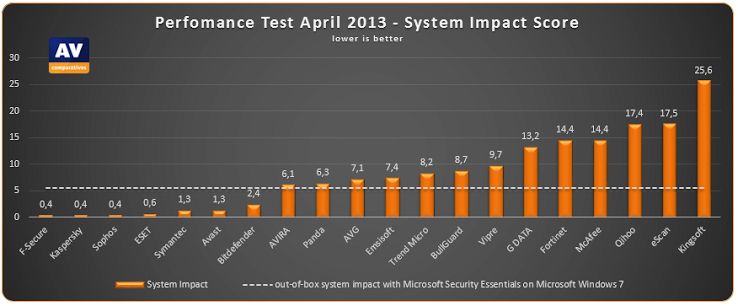
    Independent testing organization AV-Comparatives has released its latest performance tests evaluating the impact of security software on system performance. It carried out the tests on a 64-bit Windows 7 system and measured a number of everyday activities including copying files, installing and uninstalling applications and launching programs as well as running the PCMark 7 benchmarking suite.

    The results of these tests have been used to produce a system impact score measuring how much difference the various antivirus programs make compared to having no security installed at all. This makes for some interesting reading.

    At the top of the tree tied with impact scores of 0.4 (lower is better here by the way) come F-Secure, Sophos and Kaspersky. Second with a score of 0.6 comes ESET. Of what you might call the household names Symantec does best with a score of 1.3 whilst McAfee turns in a disappointing 14.4.

    Microsoft’s own Security Essentials scores a reasonable 5.6, behind BitDefender’s 2.4 but ahead of AVG’s 7.1 and BullGuard’s 8.7. Bottom of those tested comes Kingsoft with an impact score of 25.6. You can read the full results and the test methodology by visiting the AV-Comparatives  site.

    Of course all of this only tells you how the software impacts on your PC, not how well it protects you. As always with security there’s a trade off involved but if performance matters then the report will at least help you make an informed decision. You can find data on comparative protection levels elsewhere on AV-Comparatives to help you make up your mind.

  • Tesla Review From Consumer Reports Is Publication’s Best-Ever For A Car

    The 2013 Tesla Model S has received a rave review from Consumer Reports. This was just published (though a subscriptions is required), and is bound to be huge for the car maker.

    The car got a 99 out of 100, which is reportedly the highest it has ever rated a car. Here’s Consumer Reports’ overview:

    The Tesla Model S takes everything you know about cars and stands it on its head. It’s a very agile, super-quick electric luxury sedan (with a hatchback!) that seats seven and gets the equivalent of 84 mpg. Got your attention yet? With the 85 kWh battery, the largest available, it can go between 180 and 225 miles on a charge, depending on the weather. That’s about twice as far as any other electric car. With optional equipment, it can be charged from empty in as little as five hours. Performance all-around is exceptional, with short stops, a superb ride, and an eerily hushed cabin. Almost all controls are done through a quick and capable iPad-like center screen. Tight access and visibility and initial teething pains are demerits, as is the luxury-car price.

    Here’s their quick take:

    “We’ve been testing cars at Consumer Reports for a very long time, but we’ve never seen anything quite like the Tesla Model S,” says Jake Fisher, Director, Auto Testing at Consumer Reports. “This car performs better than anything we’ver ever tested before. Let me repeat that – not just the best electric car, but the best car. It does just about everything really, really well.”

    The car, he says, ties as the quietest car they’ve ever tested, in addition to be extremely energy efficient.

    It turns out that 99 out of 100 was originally 110 out of 100. Matt Hardigree at Gawker’s Jalopnik says:

    I spoke with CR’s Jake Fisher who explained to me that the car actually scored 110 out of a 100-point scale, but that because of the limitations still inherent in owning an electric car (range, access to charging) they regularly subtract about 10% from a car’s score. It’s still the best score they’ve ever given, tied only with the 2007 Lexus LS but that car, according to Fisher, isn’t even in the same league as the Model S.

    The car is designed and built in California. The rear wheel drive vehicle does not use gasoline, and is engineered to perform in both hot and cold climates. It accelerates to 60 mph in 4.2 seconds, according to Tesla (though Consumer Reports said a “lightning quick 5.6 seconds”). More specs here.

  • Achievement unlocked! Android gaming console Ouya raises $15M

    Ouya, the company behind a small $99 Android gaming console, has picked up $15 million in funding. The investment, announced on Thursday, follows the $8.6 million raised by Ouya on the crowd-sourced Kickstarter platform in August of 2012. Long-time executive at EA, Bing Gordon, will be joining the Ouya board as part of the deal, which was funded by Kleiner Perkins Caufield & Byers (KPCB), along with participation from the Mayfield Fund, NVIDIA, Shasta Ventures, and Occam Partners.

    The Ouya console is a small box, designed by Yves Behar, that runs Google’s Android software on an Nvidia Tegra 3 chip. The console costs $99 with additional controllers priced at $49 each. Unlike other gaming devices, Ouya focuses on a free-to-play model:

    “For gamers, every game will be free to play: what this means is that there will at least be a free demo, or you’ll be able to play the entirety of the game for free but may have access to additional items, upgrades, or other features that come at a cost.

    For developers, free to play means that they can set their own prices. Developers know best: There is no better way to sell a game than to have folks that have actually touched the game share glowing reviews with their friends. By allowing some form of free play, we’ll help them do just that.”

    Some early Kickstarter backers of the Ouya project have received their devices but the general public won’t be able to purchase one until June 25 in the U.S., Canada, and the U.K. through retailers Amazon, Best Buy, GAME, GameStop, and Target. The company is taking pre-orders now, however.

    While the funding is important to help the Ouya founders complete their vision, the bigger help may be having Gordon join the board. Early reviews show the Ouya to still be a work in progress in areas, while some have even called the device a “beta”. With guidance from Gordon — and the additional $15 million in funding — Ouya could prove to be a better gaming console than originally expected.

    Related research and analysis from GigaOM Pro:
    Subscriber content. Sign up for a free trial.