Blog

  • Greenspan calls out Congress on sub-prime crisis

    04.13.10 06:20 AM posted by Drew McKissick

    So what caused the collapse of financial institutions and the economic crisis / recession? Well, conservatives have maintained since the beginning that it was pretty much the logical outcome of lending money to people that can’t pay it back. Which leads to the institutions those people are supposed to pay back losing money…which led us to bailouts, etc.., etc..

    But the real question is what caused the bad lending in the first place? Well, a few days ago, former Fed Chairman Alan Greenspan went before Congress and pretty much laid the blame exactly where it belongs. Which means it wasn’t appreciated and won’t be paid attention to, but…

    "While the roots of the crisis were global, it was securitized U.S. subprime mortgages that served as the crisis’ immediate trigger," Mr. Greenspan explained. "The surge in demand for mortgage-backed securities was heavily driven by Fannie Mae and Freddie Mac, which were pressed by the Department of Housing and Urban Development and the Congress to expand affordable housing commitments." Unfortunately, Fannie Mae and Freddie Mac weren’t the only government agencies to feel the pressure. Mr. Greenspan also noted, "I sat through meeting after meeting in which the pressures on the Federal Reserve – and on, I might add, all of the other regulatory agencies – to enhance lending were remarkable."

    In other words, cheap housing policies. Don’t expect to hear too much about this in the "mainstream media" outlets. Especially since we’re almost at the point where housing is to be declared a "right"…right along with health care. read more »

    http://www.conservativeoutpost.com/g…ubprime_crisis

  • Our Quixotic President And Reckless Endangerment.

    04.13.10 04:14 AM posted by Skip MacLure

    It seems like events are rushing to greet some sort of an event horizon. There are just too many disparate potential flash points not to be completely realistic. The Middle East region is a sizzling hot spot that could have a region wide conflict start from any of a half-dozen different sources.

    North Korea is the next most obvious subject, with a very unstable government and internal power issues. They have been increasingly bellicose and tensions are sky-high between the two Koreas, since rumors still persist that the South Korean naval corvette ‘Cheonan’ may have been sunk by a north Korean torpedo.


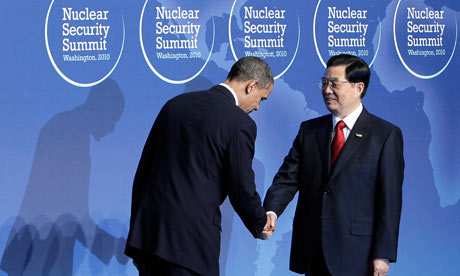
    Obama bows to China’s Hu Jintao.

    China is another factor, they have already taken the measure of Barack Hussein Obama and found him to be foolish and naive. They will use his indecisiveness to initiate some ‘incident’ over the island republic of China called Taiwan. China has been drooling over Taiwan for a very long time. China has also increased the number of missiles and artillery facing Taiwan from the mainland. With a timid Barack Obama at the helm, the Chinese may feel the time has come for a little adventurism.

    Obama has a miserable record of insulting one ally after another and, as in the case of Israel, withdrawing arms, munitions and spare parts, in the face of increasing threats and a potential regional war. It doesn’t take these folks very long to realize that this President, this government, not only cannot be trusted but will actively work for the benefit of their enemies while feigning friendship to them. read more »

    http://www.conservativeoutpost.com/o…s_endangerment

  • Americans for Prosperity to Launch 2nd Swing of ‘Regulation Reality Tour’ Across Colo

    04.12.10 09:53 AM

    While the Environmental Protection Agency tries to force an intrusive global warming regulatory scheme on the American people without so much as a vote of Congress, Americans for Prosperity, the free-market grassroots group that brought you the Hot Air Tour, is launching the 2nd swing of its Regulation Reality Tour in Colorado, April 19-21.

    read more

    http://www.americansforprosperity.or…cross-colorado

  • A Trade Deal that Symbolizes Freedom and Democracy

    On 04.13.10 08:00 AM posted by Anthony B. Kim

    <ahref="http://blog.heritage.org/wp-content/uploads/SKOREA-US-FTA.jpg"></p><atitle="http://www.washingtonpost.com/wp-dyn/content/article/2010/04/11/AR2010041102508.html" href="http://www.washingtonpost.com/wp-dyn/content/article/2010/04/11/AR2010041102508.html">An April 12 article in the Washington Post poses a timely question concerning one of our longtime friends:* “In a world of dangerously failed states and willful challengers to American leadership, South Korea is an astoundingly successful democracy that wants to be friends. But will America say yes?”

    At the center of this challenging question lies <atitle="http://www.ustr.gov/united-states-and-korea-conclude-historic-trade-agreement" href="http://www.ustr.gov/united-states-and-korea-conclude-historic-trade-agreement">a free trade agreement that Washington and Seoul signed almost three years ago, back in June 2007. The agreement, commonly known as the KORUS FTA, has been characterized as “strong and balanced” and as “an agreement for the 21st century.”<spanid="more-31189"></span>

    Unfortunately, the final step for the agreement has been stymied by U.S. politics. Bowing to domestic labor union pressure, President Obama has not moved the pact forward for Congressional ratification.

    It would be easy to dismiss the hesitation we’re seeing in the Obama Administration over the trade deal with South Korea as just another chapter in the ongoing debate between free traders and protectionists. After all, the usual suspects are raising all the protectionist arguments.

    Yet this FTA is about much more than trade and investment. South Korea has successfully transformed itself from a country devastated by war into one of Asia’s most vibrant market-oriented democracies. According to <atitle="http://www.heritage.org/index/Country/SouthKorea" href="http://www.heritage.org/index/Country/SouthKorea">the Heritage Foundation’s 2010 <emtitle="http://www.heritage.org/index/Country/SouthKorea">Index of Economic Freedom</em>, South Korea now ranks as the word’s 31st freest economy, jumping 9 places in the last year. In addition, the country has shown itself to be a willing partner of the U.S. in endeavors around the world. As the Post article points out, South Korea is willing “to cooperate with the United States in Haiti, Afghanistan and beyond. Would the United States really allow narrow-interest politics to limit such an opportunity?”

    2010 marks the 60th anniversary of the Korean War, a conflict in which America and South Korea fought together in defense of freedom and democracy. There could be no more appropriate time to seal a trade deal that will foster a future of <atitle="http://www.heritage.org/Research/Lecture/The-Status-of-the-US-Korea-Relationship-in-2010" href="http://www.heritage.org/Research/Lecture/The-Status-of-the-US-Korea-Relationship-in-2010">lasting alliance for the two nations.

    http://blog.heritage.org/2010/04/13/…and-democracy/

  • Newt Gingrich Speaks at Heritage Today

    On 04.13.10 06:55 AM posted by Rob Bluey

    </p>Former Speaker Newt Gingrich, architect of the “Contract with America” and general chairman of American Solutions, visits The Heritage Foundation today to speak at <ahref="http://thebloggersbriefing.com/">The Bloggers Briefing. The live feed from Ustream.tv will begin shortly after 12 noon ET.

    Tune in to hear Gingrich’s prescription for America and what lies ahead for conservatives, particularly in the wake of Obamacare’s passage.

    http://blog.heritage.org/2010/04/13/…eritage-today/

  • Morning Bell: Andy Stern’s America

    On 04.13.10 05:45 AM posted by Conn Carroll

    <ahref="http://blog.heritage.org/wp-content/uploads/SEIU-10-4-131.jpg"></p>Last night, <ahref="http://www.politico.com/blogs/bensmith/0410/SEIU_official_Stern_to_resign.html?showall">Politi co reported that Service Employees International Union President Andrew Stern is expected to resign and, according to <ahref="http://www.nytimes.com/2010/04/13/us/13union.html?ref=todayspaper">The New York Times, the resignation is about to happen very soon. If Stern does resign, he will be doing so while at the top of his game. Stern told <ahref="http://www.lasvegassun.com/news/2009/may/10/stern-unplugged-seiu-chief-labor-movement-and-card/">The Las Vegas Sun last year: “We spent a fortune to elect Barack Obama – $60.7 million to be exact – and we’re proud of it.” President Obama is well aware of his huge debt to the SEIU. That is why he admits in his autobiography, <ahref="http://victor-lee.com/empiresonline.net/files/Books/Barack%20Obama%20-%20The%20Audacity%20of%20Hope%20(Thoughts%20on%20R eclaiming%20the%20American%20Dream)/Obam_0307382095_oeb_c04_r1.htm">“I owe those unions.” And it also explains why<ahref="http://blogs.wsj.com/washwire/2009/10/30/seius-stern-tops-white-house-visitor-list/"> Stern is the most frequent Obama White House visitor, according to official visitor logs.

    Stern’s access to President Obama has already paid huge dividends including: <ahref="http://online.wsj.com/article/SB124227027965718333.html">an $862 billion stimulus that prevented states from having to cut-back government union jobs or wages; <ahref="http://blog.heritage.org/2010/03/16/morning-bell-is-now-really-the-time-to-create-a-new-2-5-trillion-entitlement/">$2.5 trillion in new government health care spending, much of which will go to unionized health care providers; and <ahref="http://blog.heritage.org/2010/03/29/seius-white-house-visits-are-paying-off/">the appointment of SEIU associate general counsel Craig Becker to the National Labor Relations Board. The NYT <ahref="http://www.nytimes.com/2010/04/13/us/13union.html?ref=todayspaper">describes the SEIU under Stern’s tenure as “the nation’s most politically active union, with 1.9 million members.” The marriage of politics to union organizing has been great for SEIU membership, making it <ahref="http://www.seiu.org/2008/01/SEIU-Drives-Growth-as-Union-Workforce-Increases-for-the-First-Time-in-Years.php">the fastest-growing union in America.<spanid="more-31157"></span>

    But what has been great for SEIU’s membership rolls has not been good for the SEIU’s bottom line. Growing union membership through politics is expensive. <ahref="http://online.wsj.com/article/SB124458836591599769.html">The Wall Street Journal reports that as recently as 2002, total SEIU liabilities were about $8 million. But by 2008, the union owed more than $156 million, a 30% increase over the $120 million it owed in 2007. And make no mistake, lobbying government is where Stern believes the future of SEIU is. After President Obama’s election, SEIU fired 75 national field staff and organizers so that the SEIU could <ahref="http://www.washingtonpost.com/wp-dyn/content/article/2009/03/18/AR2009031800709.html">“reallocate resources … to lobbying and communications in Washington.”

    In fact, taking a more critical look at SEIU’s recent growth, <ahref="http://www.washingtonpost.com/wp-dyn/content/article/2010/04/13/AR2010041300017.html">The Washington Post reports: “some of its biggest gains in recent years were less the result of shoe-leather organizing and more the result of deals with major employers or politicians — including former Illinois Gov. Rod Blagojevich.” Specifically, <ahref="http://voiceforchildcare.org/news/2006/3/9/illinois-gov-signs-first-ever-contract.html">Blagojevich signed a state law handing over 49,000 state child care workers to SEIU local 880, <ahref="http://www.seiulocal880.com/index.php?id=668">which is run by the notorious community organizing group ACORN. <ahref="http://laborpains.org/index.php/2008/12/11/seius-pay-for-play-scandal/">The deal nearly tripled SEIU 880’s income from $7 million in 2005 to $21 million in 2007. This came after SEIU’s Illinois Political Action Committee <ahref="http://www.followthemoney.org/database/StateGlance/candidate.phtml?c=79667">gave Gov. Blagojevich $908,000, making it the single largest campaign contributor for his re-election campaign.

    It is no coincidence that under Stern’s tenure <ahref="http://www.heritage.org/Research/Reports/2010/01/Majority%20of%20Union%20Members%20Now%20Work%20for %20the%20Government">the number of government union members surpassed the number of private sector union members for the first time in our nation’s history. There are two reasons for this: 1) <ahref="http://blog.heritage.org/2009/05/22/morning-bell-how-big-labor-hurts-you/">Unions kill private sector jobs, and unionized companies earn profits 15% lower than those of comparable non-union firms. This makes unionized firms less competitive, which is why unionized manufacturing jobs fell 75% between 1977 and 2008, while non-union manufacturing INCREASED 6% over that same time. 2) Government union jobs face no competition. Public sector unionization has exploded in the past decade as leaders like Stern realized politics paid much better than the free market. <ahref="http://www.seiu.org/our-union/index.php">Under Stern’s leadership, SEIU has become the nation’s second largest government union with over half of its membership drawing a paycheck on the taxpayers dime.

    Explaining how organized labor really works, US Court of Appeals judge for the 7th Circuit Richard Posner <ahref="http://www.becker-posner-blog.com/archives/2008/12/can_the_united.html">recently wrote:

    The goal of unions is to redistribute wealth from the owners and managers of firms, and from workers willing to work for very low wages, to the unionized workers and the union’s officers. … Unions, in other words, are worker cartels. … There is also a long history of union corruption. And some union activity is extortionate: the union and the employer tacitly agree that as long as the employer gives the workers a wage increase slightly above the union dues, the union will leave the employer alone.

    Except that in Stern’s America, union management no longer redistribute wealth from firms to union members. With the majority of union members now working for the government, Andy Stern and his cohorts are extorting money from you, the taxpayer. And where is that money going? Not into shoring up union member pensions. Those are woefully underfunded. No, the Andy Sterns of the world turn around and use their taxpayer-funded government union dues to lobby for an even larger government that can pay for even more government union jobs. Andy Stern’s America is a perpetual government dependency machine.

    And don’t think for a second that Stern’s retirement means he is gone for good. <ahref="http://www.theatlantic.com/politics/archive/2010/02/obama-names-seius-stern-to-deficit-commission/36701/">Stern is still a proud member of President Obama’s deficit commission. Complete reliance on government growth, crippling debt, and Blagojevich-style corruption. That is what Andy Stern did to the SEIU, and it is what Stern and President Obama will do to this country.

    Quick Hits:

    • According to the Congressional Research Service, <ahref="http://www.nytimes.com/2010/04/13/us/politics/13health.html?ref=todayspaper">when Congress passed Obamacare, they accidentally revoked their own current health care coverage before the law created any viable alternatives.
    • <ahref="http://www.latimes.com/features/health/la-na-health-premiums13-2010apr13,0,6241013.story">The Los Angeles Times reports that despite public outrage over double-digit health insurance rate hikes, Obamacare does nothing to prevent them.
    • According to the Joint Committee on Taxation, <ahref="http://thehill.com/blogs/on-the-money/domestic-taxes/91669-healthcare-law-socks-middle-class-with-a-39-billion-tax-increase">taxpayers earning less than $200,000 a year will pay roughly $3.9 billion more in taxes — in 2019 alone — due to Obamacare.
    • According to <ahref=" http://www.rasmussenreports.com/public_content/politics/current_events/healthcare/april_2010/47_say_repeal_of_health_care_law_will_be_good_for_ economy">Rasmussen Reports, by a 14-point margin (47%-33%) American voters believe repeal of Obamacare will be good for the economy.
    • The Commerce Department’s Bureau of Economic Analysis <ahref="http://www.washingtontimes.com/news/2010/apr/13/personal-income-falls-32-during-obamas-15-months/">found that real personal income for Americans – excluding government payouts such as Social Security – has fallen by 3.2 percent since President Obama took office in January 2009.

    http://blog.heritage.org/2010/04/13/…0%99s-america/

  • What iPhone OS 4 Doesn’t Give the iPhone 3G [IPhone]

    Obsolescence, meet iPhone. It’s true, iPhone OS 4 won’t touch the original iPhone at all. But even the iPhone 3G is getting shafted quite a bit with iPhone OS 4. More »


  • Do Journalists ‘Grieve’ the Decline of Journalism?

    Spinning off a speech by AFL-CIO President Richard Trumpka at Harvard about why working people are angry,  Ezra Klein makes this point comparing the reaction to job losses in manufacturing to job losses in journalism:

    Consider the way elites
    have treated the decline of journalism jobs and the decline of
    manufacturing jobs. Both sectors are fundamentally suffering from the
    same thing: A technological revolution that has made the large,
    well-paid workforces of yesteryear into a competitive disadvantage in
    the modern economy. But where the decline of manufacturing was greeted
    with sanguine talk about “retraining,” the decline of journalism has
    been greeted with something akin to grief.

    Grief from whom? Not from many publishing journalists.

    Much ink spilled over the tumultuous growing pains (or “decline”) of journalism has been marked with the same breathless, excitable, often crude and always knowing style with which writers tackle just about anything in violent transformation. Look at the Clay Shirkys and Jeff Jarvis’, Slate’s Jack Shafer, or the New York Times’ David Carr, or anything or Gawker. It certainly seems like many journalists come to praise the new, rather than bury the dead trees.

    Newspapers are dying! Newspapers are dying! If this is grief, it is a bizarre way to grieve. Sometimes its exuberance borders on celebration. Journalism’s breathless coverage of its own demise is one part habit (journalists like to run themselves out of breath), one part natural schadenfreude, and one part whatever psychological term is appropriate for that safe, yet thrilled feeling one gets when watching a violent thunderstorm from inside a safe house.

    But it also comes from a deeper belief that the transformation within journalism — like the transformation in manufacturing — has the potential to make the industry better, smarter, faster, more efficient. It’s not just the new media gurus who think there is value in simple aggregation, or complex interactive graphs, or blogging public policy twenty times a day (Harold Pollack called the health care reform story “the best-covered news story, ever.”) There are Web sites that exist primarily to chronicle and lead the transformation because they find it interesting and important. Executives at newspaper and magazines companies consistently hail the challenges of new media as unprecedented opportunities to provide richer stories to the widest audience in history (the ones not named Rupert Murdoch, anyway).

    Klein is right that creative destruction is violent. People can get angry, and sometimes they should. But it is not self-evident that journalists are cheering creative destruction in every industry except their own.


    Email this Article
    Add to digg
    Add to Reddit
    Add to Twitter
    Add to del.icio.us
    Add to StumbleUpon
    Add to Facebook


  • Summer time: Consumer Reports ranks the top convertibles for 2010

    Consumer Reports gave the Infiniti G37 Convertible, Lexus IS 250C and the Audi A5 Cabriolet convertibles an overall score of “Very Good,” topping Consumer Reports tests’ of three four-seat convertibles for the May 2010 issue. The publication also tested two less expensive convertibles including the Mazda MX-5 Miata and the Mini Cooper S Convertible.

    The Infiniti G37 Convertible and IS 250C earned “Very Good” overall road-test scores of 77, slightly beating the Audi A5 convertible, which earned a test score of 74. All three convertibles beat other competitors including the previously tested Volkswagen Eos (78) and BMW 328i (76) .

    Click here to get prices on the Infiniti G37 Convertible.

    “The G37 has many of the qualities CR’s testers like in the sedan configuration. The IS 250 should satisfy those looking for a refined and easygoing convertible, making both of them good choices,” said David Champion, senior director of Consumer Reports’ Auto Test Center in East Haddam, Connecticut.

    Click here to read our review on the 2009 Infiniti G37 S Convertible.

    In the convertibles tested, Consumer Reports only gave the Miata a “Recommended” rating since it said it doesn’t have sufficient reliability data on the IS 250C, A5, G37 Convertible, and Cooper S Convertible.

    Review: 2009 Infiniti G37 Convertible:

    Review: 2009 Infiniti G37 Convertible Review: 2009 Infiniti G37 Convertible Review: 2009 Infiniti G37 Convertible Review: 2009 Infiniti G37 Convertible

    All Photos Copyright © 2009 Omar Rana – egmCarTech.

    – By: Omar Rana


  • Judge blocks Mass. insurers from instituting double-digit rate hikes, for now

    By Matt Holdridge

    From the Boston Globe:

    A Suffolk Superior Court judge yesterday denied a request that would have let six Massachusetts health insurers go forward with double-digit rate hikes for tens of thousands of small businesses and individuals, setting up a protracted battle that could become a test of government’s role in controlling health care costs.

    Judge Stephen E. Neel’s decision against granting the preliminary injunction sought by insurance companies means the state’s rejection of 235 proposed rate increases stands for now. The higher rates would have taken effect April 1.

    The judge rejected the companies’ contention that the insurance market would be thrust into chaos if they could not quickly institute the higher rates. But the ruling is not the final chapter in the battle. Insurers are pursuing appeals within the Division of Insurance. If their appeals are turned down, the court would take up the case later this spring.

    This is likely a look at what is to come nationally – health insurance as a regulated monopoly, special commissions to monitor prices, and ultimately lower quality for consumers. 

    Although, as we’ve pointed out numerous times, there hasn’t been a free market in health care for at least 50 years, and the recently passed bill only makes that situation worse. 

    As Gennady Stolyarov II states in his article Why Public Utility Monopolies Fail

    …because the government is a coercive monopoly, it is immune to competition, having barred all prospective competitors from the utility market via the threat of force. The government cannot know what the true cost of its service is, since it did not allow the competitive process to discover it. Rather, whatever value the government designates to be the “cost” will be an arbitrary number.

    In a competitive market, private businessmen — driven by the profit motive — would have continually discovered better ways to provide utility services. They would have figured out hitherto unknown ways to cut costs, increase productivity, and eliminate waste.

    The government, by restricting competition, prevents these discoveries from taking place and relegates all the consumers of public utilities to having to pay far more than they otherwise might have.

    We must continue to fight on. 


  • Bristol Palin Is A Fan Of MTV “16 And Pregnant”

    As one who knows what it’s like to be 17 and pregnant, GOP daughter Bristol Palin is a big fan of 16 and Pregnant, the MTV docu-soap that follows expectant teen mothers as they live through the consequences of their premature pregnancies.

    “I hope other young girls and even young guys should know that having a child is not glamorous at all,” the 19-year-old daughter of conservative politican Sarah Palin tells MTV.com.

    Bristol says she appreciates that 16 & Pregnant doesn’t “glamorize” teen sex or early motherhood.

    “They make it seem like there are no consequences to it. But there are tremendous consequences,” she added. “‘16 and Pregnant’ shows that.”

    Bristol — who has a one-year-old son with her high school sweetheart Levi Johnston — recently starred in an anti-teen pregnancy campaign with The Candie’s Foundation.

  • Vonage comes to Android

    Vonage Logo

    Great news! Vonage has expanded their compatibility to Android phones. As it stands, only customers of AT&T and T-Mobile will be able to use the VoIP service, as Vonage has Sprint and Verizon listed as incompatible with their service at this time (GSM only).  Senior vice president of product management, Michael Tempora, gave us all this piece of information about Vonage’s plans to expand their services:

    “We are focused on ensuring that our customers can enjoy all the benefits of their Vonage service from any location using any device that can access the Internet. We will continue to expand our offerings in 2010 to include a robust set of voice and messaging services that utilize Wi-Fi and 3G wireless networks.”

    Since Verizon has exclusivity on Skype, a lot of people are searching for an alternative. Vonage is definitely a service to consider. While Vonage is a paid service, you will get unlimited international calling to over 60 countries using Wi-Fi and cell signal for $24.99 per month, which is an incredible deal if you make international calls frequently. Another great deal from Vonage is available if you get the Vonage World Mobile for $24.99 per month, you are eligible to save $10 per month on Vonage World Home.

    Vonage for Android is compatible with phones running Android OS 1.5 or higher on the GSM side only. If you are interested in picking up the application, it can be found in the Android Market.  If you already have Vonage World Mobile, let us know what you think of it so far in the comments below!

    Via: Phandroid


  • Congress Flies Free Overseas

    By Tim Shoemaker

    Paul Singer, writing for Roll Call, has an interesting article this morning that should be raising some eyebrows.  Thanks to a Korean War-era law regarding Congressional travel, members of Congress and their staff are able to travel abroad without footing the bill.

    When a Congressional committee holds a field hearing in Wisconsin or a Member of Congress flies to a conference in Arkansas with a few staff members, those travel costs are paid for out of the annual budgets of either the committee’s or the Member’s office.

    But when a Congressional delegation travels overseas, the accommodations are made by the State Department and billed back to a government account that automatically refills itself and has no spending limit attached.  [emphasis added]

    So you may ask, where does this ‘magical’ account receive its funds from?  Good question…

    For years, the Treasury Department used revenues from sales of grain abroad or the income from foreign assistance loans to pay for Congressional travel, but in 1977 the U.S. comptroller general ruled that practice out of bounds.

    So Congress amended the provision in 1978 to establish that “whenever local currencies owned by the United States are not otherwise available” to pay for local travel costs, “the Treasury shall purchase such local currencies as may be necessary for such purposes, using any funds in the treasury not otherwise appropriated.”

    Translation: The government can use whatever funds it has lying around to pay the travel costs of Congressional delegations overseas.

    You will definitely want to read the rest to find out just how well some of our “public servants” are living when they travel abroad… How does $250 ‘petty cash’ per traveler per day sound?

  • 13 Reasons You Should Sell Your House Now Before It’s Too Late

    detroit demolitionLast quarter we posted 12 Charts You MUST See Before You Even Think About Buying A Home.

    Contrarian mortgage broker and editor of newobservations.net, Michael David White has given us the latest picture on these scary charts. The housing market is more precarious than ever. That’s why you should rent, not buy. And if you’re thinking about selling, don’t wait another day.

    Here are the scary charts >

    Yes, home affordability has improved a lot, but…

    Yes, home affordability has improved a lot, but...

    Inventory is still very high

    Inventory is still very high

    Housing supply is picking back up

    Housing supply is picking back up

    Delinquent mortgages are high… and could lead to a huge property influx

    Delinquent mortgages are high... and could lead to a huge property influx

    There’s still a huge mortgage mess

    There's still a huge mortgage mess

    Underwater mortgages are the ten-ton gorilla

    Underwater mortgages are the ten-ton gorilla

    15% of borrowers are 30‐days late or worse. The cure rate at 60‐days late is almost zero.

    15% of borrowers are 30‐days late or worse. The cure rate at 60‐days late is almost zero.

    History says property value will fall through 2012

    History says property value will fall through 2012

    We assume prices will return to the 100-year FLATLINE

    We assume prices will return to the 100-year FLATLINE

    Based on four major indexes, prices have another 17% to fall

    Based on four major indexes, prices have another 17% to fall

    Housing bubbles were greater abroad… and have further to fall

    Housing bubbles were greater abroad... and have further to fall

    Rates WILL rise… and then real estate demand will fall

    Rates WILL rise... and then real estate demand will fall

    Considering massive government intervention, unit sales are frighteningly low

    Considering massive government intervention, unit sales are frighteningly low

    Don’t miss…

    Don't miss...

    Image: Zillow

    Join the conversation about this story »

  • First Lady Michelle Obama Lands in Haiti

    For all of you that have been wanting First Lady Michelle Obama to visit Haiti, your wish has come true. Mrs Obama landed in Haiti a short while ago en route to Mexico. According to White House Pool Reporter, Jacqueline Charles, Caribbean Correspondent for the Miami Herald…

    First Lady Michelle Obama and Dr. Jill Biden arrived in a quake-battered Port-au-Prince, Haiti Tuesday. The two landed at 10:40 am, taking a helicopter tour of the Haitian capital where more than a million people are homeless, many living underneath tents and tarps.

    Their visit comes a day after Haitians acknowledged the three-month anniversary of the Jan. 12th, 7.0-magnitude earthquake that ripped through the capital and four smaller southern cities.

    The Obama administration released this statement about the visit, which was kept hush until the landing:“First Lady Michelle Obama and Dr. Jill Biden are visiting Haiti to underscore to the Haitian people and the Haitian government the enduring U.S. commitment to help Haiti recover and rebuild, especially as we enter the rainy and hurricane seasons, and to thank the women and men across the whole of the U.S. government for their extraordinary efforts in Haiti during the past three months. They will also reach out to the UN and international relief communities in recognition of the truly global effort underway to help Haiti.

    Posted by Aminah Hanan

    Post to Twitter Post to Plurk Post to Yahoo Buzz Post to Delicious Post to Digg Post to Facebook Post to MySpace Post to Ping.fm Post to Reddit Post to StumbleUpon

  • Rights groups concerned over Fiji draft media law

    [JURIST] International rights organizations voiced concern Tuesday about a draft media law the Fijian government is slated to approve in the near future. The Media Industry Development Decree 2010 includes several provisions that could result in the imprisonment of journalists for up to five years and stiff fines. Pacific Researcher for Amnesty International (AI) Apolosi Bose criticized the legislation, saying, “he Fijian government is giving itself a license to imprison or bankrupt its critics. The decree will further restrain the media from reporting government and military abuses, for fear of reprisals through a kangaroo court.” International Federation of Journalists General Secretary Aidan White said last week:
    It is not surprising that Fiji’s regime says it will drop its emergency regulations once the media decree is adopted. The decree is clearly focused on the regime retaining control and entrenching its highly oppressive restrictions, not only on the media but on members of the public who might wish to express dissenting views.Of particular concern is provision 21, which bars content that “(a) is against the public interest or order; (b) is against national interest; (c) offends against good taste or decency; or (d) creates communal discord,” and provisions 25 and 26, which penalize media representatives who fail to provide documentation or information requested or refuse searches and seizures for which law enforcement authorities have obtained a warrant. Failure to adhere to provisions could result in fines of up $500,000 for a mass media institutions, and fines of up to $100,000 for editors, publishers, and journalists and up to fives years imprisonment. The tribunal overseeing implementation of the Media Industry Development Decree will be led by a presidential appointee, casting doubt on that entity’s independence. The law is expected to be approved during a Cabinet meeting in the near future.Fiji has been in turmoil since former president Ratu Josefa Iloilo suspended the constitution last April and revoked the appointment of all judicial officers after an appeals court ruling declaring the appointment of the military government following the 2006 coup unconstitutional. Bainimarama took control in the wake of the coup, which ousted former Fijian prime minister Laisenia Qarase. More recently, the Commonwealth of Nations suspended Fiji from its organization in September because it failed to meet the September 1 deadline for reinstating a constitutional democracy and opening a national dialogue. The Pacific Islands Forum suspended Fiji’s membership in the 16-nation bloc in May after Fiji’s current military government failed to meet a May 1 deadline to schedule elections. Bainimarama announced plans in July to establish a new constitution by September 2013. In its 2009 Human Rights Report on Fiji, the US State Department noted deteriorating conditions in the areas of judicial independence and media freedom.

  • It’s Not Easy Being Green, But Datapipe Is Making A Solid Effort

    windmill“Data centers” and “clean energy” are usually contradictory terms. A server facility contains rows after row of servers running 24/7 and refrigerated to the hilt — by definition, an energy-intensive operation. In fact, data centers use an estimated 1.5% of the nation’s electricity consumption already and the EPA expects their usage to increase by 12 percent annually. 
    Datapipe, a leading provider of managed hosting and IT services — and Business Insider’s hosting partner — is taking steps to change that. 
    Datapipe has teamed up with Constellation NewEnergy to power its Somerset One facility using 100% renewable electricity.  This move will reduce more than 9.5 million pounds of carbon emissions annually.  Datapipe is also preparing to open its Somerset Three data center, which will run on the same NewMix Wind energy solution as Somerset One.
    Kudos to Business Insider’s partner, Datapipe, for reducing its carbon footprint!

    Find out more about Sponsor Posts.

    Join the conversation about this story »


  • Dueling Derivatives Op-Eds

    This morning, Treasury Secretary Timothy Geithner published an opinion piece in The Washington Post. In it, he argues:

    Ending “too big to fail” also requires building stronger shock absorbers throughout the system so it can better withstand the next financial storm. To do that, the Senate bill closes loopholes and opportunities for arbitrage, and it brings key markets, such as those for derivatives, out of the shadows. Transparency will lower costs for users of derivatives, such as industrial or agriculture companies, allowing them to more effectively manage their risk. It will enable regulators to more effectively monitor risks of all significant derivatives players and financial institutions, and prevent fraud, manipulation and abuse. And by bringing standardized derivatives into central clearing houses and trading facilities, the Senate bill would reduce the risk that the derivatives market will again threaten the entire financial system.

    Sen. Judd Gregg (R-N.H.) had a detailed opinion piece in Bloomberg on the same topic:

    Congress’s aim for OTC regulation is to reduce systemic risk to the financial system by, at the very least, providing an efficient regulatory structure that reduces the frequency and severity of market liquidity problems.

    By and large, the swaps market is a wholesale, institutional market where most trades are large, block-sized transactions. Mandatory exchange trading would reduce market liquidity and increase execution costs for the ultimate end-user of these swaps. Advocates for mandated exchange trading want to decrease bid-ask spreads, which would theoretically lower the cost of these products, but they fail to understand the market sensitivities.

    Mandating real-time dissemination of swap transaction price and quote data will require market participants to announce their trading interests to the entire market and allow others to step in front of their trades, moving the market against their hedges. In such an environment, market liquidity for swap transactions will decrease dramatically, if not disappear altogether.

    To unpack: Geithner and Gregg sound like they might be at (incomprehensible) loggerheads, but they are not actually saying very different things. Geithner wants to exchange-trade derivatives, making pricing and volume information open to the market. Gregg argues that if pricing and volume information are public, the market will react to that information, making certain trades more expensive or even impossible. Both agree that exchange-trading derivatives will reduce fees for Wall Street banks and provide transparency into the true cost of swaps and other financial instruments.

    There is a backdrop to the two wonky op-eds: Derivatives are the newest battleground between Democrats and Republicans, reformers and Wall Street. The Obama administration is currently pressuring the Senate Agricultural Committee (which is writing the derivatives part of the legislation) to ensure that the rules aren’t so loose as to exempt many financial firms and non-banks from using the exchanges.

  • Wait! Maybe Retail Deflation Isn’t So Clear (WMT, WFMI)

    wal-mart walmart

    Charles Grom at JPMorgan has some excellent insights into food retail pricing. These are some interesting observations that you can check out.

    ————

    • &#9679  Take 1: Whole Paycheck? Not Anymore. Based on our checks, it appears that Whole Foods continues to stick to the course, with select price cuts throughout the store as opposed to a broad promotional strategy. While the company’s prices are still higher than KR/SWY/HT by roughly 14%, on average, this is down from last December (~19%). Of note, we did observe two important trends in the store: (1) the company has launched a special “One Day Deal,” promotion that highlights new savings every Friday and (2) traffic has improved with customers purchasing both discretionary and non-discretionary products – see our FC note out 3/30/10, Whole Foods: Trends Firming to the Upside, Overweight” for additional color on Overweight-rated WFMI.
     
    • &#9679  Take 2: Wal-Mart’s New Rollback Strategy Appears More Strategic: On April 1st, Wal-Mart launched a new wave of price rollbacks across its entire chain to help solidify its price leadership position. During our field work, we observed (1) enhanced signage used to identify new price cuts (Rollbacks) and bring attention to already low prices (Unbelievable Buys, Save More), (2) the use of end caps to highlight new rollback merchandise, and (3) the return of Action Alley. However, in spite of all the visual signs of price investment throughout the store, the average price in our 31-item basket (entirely food/consumables) actually increased 2.3% sequentially from February. This increase comes on top of a 1.9% uptick from January to February. Importantly, we found it difficult to determine which price cuts in food/consumables were incremental and which were a result of standard promotions the retailer typically puts in place. When it’s all said and done, however, Wal-Mart is still priced ~12.0% lower than the traditional grocers, on average (vs. 15.6% lower in February).
     
    • &#9679  Take 3: Kroger Slowly Pumps the Brakes: In April, we saw ongoing signs that Kroger has begun to tap the brakes on its heavy price investment (as CEO David Dillon indicated on the company’s 4Q call) and shifted its focus to more targeted promotions. For example, this was the first month in 2010 that the grocer hasn’t run its 10 items for $10 promotion – instead opting to focus price cuts on Passover and Easter products. As a result, average prices at the grocer increased 1.4% in April, which follows a 2.9% increase from January to February. On observations, traffic looked relatively in-line with February levels, but the number of items in the basket was noticeably higher than in our previous visit.

    Join the conversation about this story »