Blog

  • Reid reaffirms plans for floor debate on bipartisan climate and clean energy jobs bill – Alaska’s Begich on bill’s chances: “I’d give it a 60 percent shot out of 100, which is better than two months ago.”

    The Senate’s top Democrat said yesterday he is still dedicated to spending valuable floor time this year on comprehensive climate and energy legislation, but the three sponsors of the plan may have to go member-by-member in order to deliver a package capable of mustering 60 votes.

    Majority Leader Harry Reid (D-Nev.) said he wants to bring the bill from Sens. John Kerry (D-Mass.), Lindsey Graham (R-S.C.) and Joe Lieberman (I-Conn.) to the floor later this spring or summer.

    “We’re going to really try very hard,” Reid told reporters. Asked if the July 4th recess was his target for the floor debate, he said, “I don’t have a definite time. A lot is waiting until we get the bill. I’ve been pushing very hard to get the bill.”

    Looks like the most important environmental debate of our time very likely will, in fact, be happening this spring and summer, as this E&E Daily (subs. req’d) story today makes clear.

    Lieberman says the bipartisan bill is still on track to be released next week:

    Kerry, Graham and Lieberman are planning to release their bill (which is expected to place different emission limits on different sectors of the economy and expand domestic oil, gas and nuclear power production) next week to coincide with the 40th anniversary of Earth Day on April 22. “There’s some issues we’re closing out, discussing,” Lieberman said. “But we’re making progress, and as far as I’m concerned, we’re still on track to introduce next week.”

    The Senate trio’s path to 60 votes starts with a core of 41 supporters of climate legislation….

    Getting to 60 votes, however, will not be easy:

    Graham said he is not expecting all 60 votes to line up at once on the climate and energy bill, but he predicted the sponsors would get there eventually if enough industry and environmental groups sign off on an overall compromise.

    “How you get to 60 votes is you get people creating a safety net for politicians,” Graham said. “A moderate Democrat or a Republican won’t be able to get on board I don’t think unless you have some business interests speaking out who have never spoken out before. Environmentalists are going to have to be comfortable enough to support the process. Not all of them, but some of them. We’re trying to create a safety net to get to 60 votes.”

    The biggest subset of fence sitters includes 10 Democrats from states with a heavy reliance on coal, oil, natural gas and trade-sensitive industries. Senate aides acknowledge that Kerry, Graham and Lieberman are building their bill around this core group of Democrats, including Sens. Sherrod Brown of Ohio, Debbie Stabenow of Michigan, Mark Begich of Alaska, Robert Byrd of West Virginia and Mary Landrieu of Louisiana.

    To date, several of the fence sitters have praised the Kerry-led process but are waiting to see if what gets introduced comes close to meeting their demands — or whether it is even in the ballpark of what they can negotiate with.

    Brown said in July that I’m not going to be part of a filibuster on climate change,” even if he can’t ultimately support the final bill.

    The conventional wisdom in town is that a comprehensive bill has less than 50% chance of passing, but at least one fence sitter gives it better odds:

    Begich said he has already gotten much of what he wanted when it comes to production of natural gas and oil drilling on the outer continental shelf, as well as revenue sharing for states that agree to offshore oil drilling. “Those three seem to be moving in the right direction,” Begich said, adding that he is waiting to see specifics on money for oil spill research and adaptation.

    Asked if he thought the climate bill had a chance of passing the Senate, Begich said, “I’d give it a 60 percent shot out of 100, which is better than two months ago.”

    The bill seem unlikely to get support from several Dems — Likely ‘no’ votes include some combination of Nelson, Lincoln, Bayh, Dorgan, Landrieu, and Webb.

    So Moderate Republicans will be the key to this bill having any chance:

    Moderate Republicans on the radar of sponsors and the White House include Murkowski and Sens. Judd Gregg of New Hampshire, George LeMieux of Florida, Scott Brown of Massachusetts, Richard Lugar of Indiana, and George Voinovich of Ohio.

    “There’s a path to five or six Republicans,” Obama’s top energy and climate adviser, Carol Browner, recently told The New York Times.

    The Republicans have thus far sent mixed signals about what they expect from the legislative process.

    Gregg, perhaps the biggest GOP target for climate authors, has said he wants to use revenue raised by the program to curb taxes. He also said he is focused on oil security. “My primary interest is in reducing our reliance on foreign energy sources and to stop exporting lots of capital that should be used here,” he said last month.

    LeMieux, appointed last year by Florida Gov. Charlie Crist (R), has been urging the climate bill authors to emphasize nuclear power with faster licensing at the Nuclear Regulatory Commission and push the commercial trucking industry toward natural gas.

    Brown, elected in January, has sidestepped comment on the details of the climate proposal, though Kerry has said he has spoken with his new colleague on the issue.

    Stay tuned for the Battle Royale.

    Related Post:

  • George Lopez Welcomes Conan O’Brien To TBS

    George Lopez is pulling out “The Welcome Wagon” for his new partner in late-night, Conan O’Brien.

    On Monday, former Tonight Show host Conan O’Brien announced that he is heading to TBS to host a flagship late-night show on the basic cable network, which is expected to air Mon.-Thurs. beginning in November. While most comedy fans were excited to hear about Conan’s move, many were concerned about where the one-hour 11 PM program would leave George, whose Lopez Tonight show also airs on the network.

    In his opening monologue Monday, a gracious George notified fans that Lopez Tonight will move to midnight, but will remain on TBS. He also noted that he is happy to have the redhead funny guy join the network as his official lead-in.

    Hey, that can’t be bad for ratings, right?

    “If you haven’t heard by now, Conan O’Brien will be joining us on late night on TBS. Welcome! Welcome!” George said. “I want to say this, I want to say that I am completely 100% on board with this move,” he noted. “I talked to Conan on Wednesday and I talked to him last night and I said, ‘I welcome you into my deep loving embrace. Then I said, ‘Let’s take the party and make it bigger and take it into the next generation of late night TV. Lets do that! Lets do that! Lets do that!’

    “Everybody’s heard of ‘I’m With CoCo’ but now everybody can ‘Go LoCo,’” he laughed.

  • Hershey’s Kisses with Macadamia Nuts, reviewed

    Hershey’s Kisses with Macadamia Nuts,

    One of my favorite things about Hawaii is the prevalence of macadamia nuts in so many food items. They’re in pancakes, cookies and breads, crusted onto perfectly cooked fish, and dipped in chocolate and packed into boxes for tourists to take home. Macadamia nut production is a big industry for Hawaii, and anyone visiting will benefit by finding the tasty, buttery nut in so many things. For instance, I spotted this bag of Hershey’s Kisses with Macadamia Nuts while I was on my way to the airport after my recent trip to Kauai. Unlike other chocolate-macadamia candies, these caught my eye because I had never seen the nuts in Hershey’s kisses before – was it a new item? or a limited edition product?

    It turns out that these little kisses are only sold in Hawaii. Hershey’s bought Mauna Loa, a company that produces macadamia nuts on the big island, a few years ago and put out this regional kiss flavor soon afterward. Each milk chocolate kiss has about half of a macadamia nut inside. Some were a bit bigger than others, but none were small. The nuts were crisp, buttery and a great match for the chocolate. I haven’t had too many kisses lately, but if I had access to these year round, that just might change because they were so good.

    As far as souveniers go, these also make a great take-home treat because you get so many candies in one package, and they cost a bit less (at least at the stores I was in) than the macadamia nut candies that were packed up just for tourists. The cashier who rang up my purchase asked if I had had these before. When I said no, she warned that I wouldn’t go back to regular kisses afterwards. I might have to, given the distance between me and a ready supply of these, but it will definitely be something I pick up earlier on my next trip to Hawaii so I can enjoy them while I’m on vacation, too.

  • Canadian M&A value drops in Q1, volume rises

    Takeover activity in Canada may be mixed but continued strength for the loonie could keep foreign investors interested in deals.

    “As its currency continues to flex its value and peak closer to the dollar, Canada can expect to see continued interest from foreign investors seeking valued assets,” mergermarket said in its Q1 2010 Canadian M&A round-up.

    As Sinopec’s recent purchase of ConocoPhillips’ 9% stake in the Syncrude oil sands project demonstrates, Asian businesses are looking to Canada to increase their supply of natural resources through acquisitions and joint ventures.
    At the same time, Canadian banks are expected to look at cross-border opportunities in financial services, mergermarket said.

    “Indeed, activity in the Energy, Mining & Utilities sectors will continue to play a major role in Canada’s M&A landscape in both overall deal value and volume.”

    The report showed that the value of Canadian M&A dipped 60% year-over-year in the first three months of 2010. The total fell from US$24.6-billion in Q1 2009 to US$9.9-billion in the same period this year. Deal volume, however, rose 40% with 91 deals announced in the first three months of 2010, compared to just 65 in 2009.

    The figures also saw Technology Media and Telecoms (TMT) make up the largest portion of inbound deals in Q1. Historically, this is not an active sector in Canada but it represented 41% of the total, with six deals worth US$215-million. This was primarily due to U.S.-based Quad/Graphics Inc. offering to acquire World Color Press for a deal value of US$1.3-billion.

    Energy, Mining & Utilities was the second most active sector, accounting for 22.5% of inbound M&A activity, down from 27% during the same period in 2009.

    In terms Canadian firms looking abroad for deals, outbound M&A saw a healthy mix of activity across a variety of sectors.
    Real Estate represented 39% of the value of Canadian deals in Q1, followed by Financial Services at 24%. However, in terms of volume, Real Estate deals only made up 5% of outbound M&A.

    The report showed that deal values in the Energy sector have been declining consistently since the first quarter of 2009. It also pointed out that U.S. companies are the most active acquirers in Canada and vice-versa. The largest outbound transaction was Brookfield Asset Management Inc.’s purchase of a 26% stake in U.S.-based General Growth Properties Inc. for US$2.5-billion.

    UBS took the top spot by deal value at US$3.8-billion, just US$347-million ahead of CIBC World Markets, Canada’s leading firm by volume.  TD Securities came second by volume with 12 deals worth a total of US$2.4-billion.

    Osler Hosking & Harcourt topped the legal league tables in terms of value with with five deals worth US$4.2-billion. Stikeman Elliott was the most active law firm in Canada, advising on 18 deals in the first quarter.

    Jonathan Ratner

  • Game on: Google hires “Developer Advocate” for games

    Google is ready to get serious about bringing more games to their platforms. Industry veteran Mark DeLoura was named “Developer Advocate” for games at Google and will begin the position today. DeLoura’s previous positions included manager of developer relations at Sony Computer Entertainment America, technical director at Ubisoft, and lead engineer at Nintendo.

    We have witnessed Google trying to court the gaming crowd by giving them free phones, but this is their first public hire of a position that focuses solely on game development and game developers.

    “I personally feel that Google hiring someone specifically to focus on games is a signal from the company that they recognize the growing importance of games as a medium. In this time of great disruption in the game industry, there are a huge number of opportunities for developers.”Mark DeLouraGoogle Developer Advocate

    Android phones like the Nexus One and Droid are capable of pumping out some impressive graphics, but many of the high-profile game studios have yet to adopt the platform. As Android continues to expand to more powerful devices, there will be massive opportunities for gaming. Hopefully this new hire will bring more attention to the Android platform and my future Google TV will replace my home console system.

    Related Posts

  • Not Only Is The Distressed Debt Party Boat Crowded, The Deck Space Is Shrinking Too

    What’s one way to know that distressed debt has become too popular a trade? There’s less and less debt qualified as ‘distressed’ because buyers have bid-down yields too low for too many issues.

    Distressed Debt Investor (DDI) points out how to be classified as ‘distressed’, debt must trade a yield that is 1000 basis points above U.S. treasury yields. Thus rising treasuries and rallying distressed bonds have removed many issues from the ‘distressed’ classification.

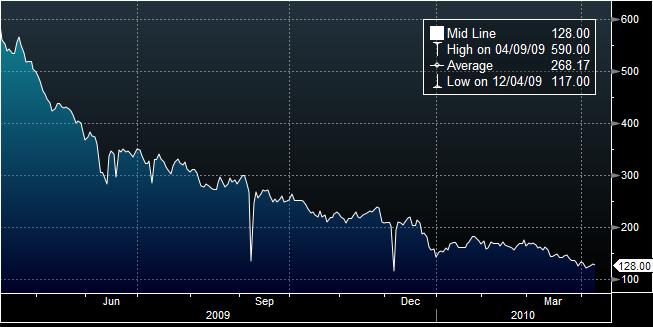
    The chart below shows how the number of issuers classified as ‘distressed’ has fallen:

    DDI:

    “This represents the number of issuers whose distressed bonds traded during the previous day’s market. Distressed is defined as any bond that trades at greater than 1000 basis points over the benchmark treasury.”

    Chart

    Now we wouldn’t be surprised to see that there were substantially less bonds trading as distressed right now versus, say February 2009. What surprised us was how much the universe continued to shrink since December of 2009, even after massive rallies for distressed debt earlier in the year.

    You can see in the chart below how we went from over 200 to just 128 issuers since mid-December:

    Chart

    Rising U.S. treasury yields have played their part here as well, but suffice to say that for investors jumping into distressed debt funds these days they are crowding into an increasingly tight space.

    (Charts via DDI, Tip via Abnormal Returns)

    Join the conversation about this story »

  • Founder of Free, Remote Medical Service to Receive 2010 Inamori Ethics Prize at Case Western Reserve University

    Stan Brock of Remote Area Medical (RAM) to be honored September 1 by the
    Inamori International Center for Ethics and Excellence

    Stan Brock

    Stan Brock, the humanitarian who has been delivering free health care worldwide through his nonprofit organization Remote Area Medical (RAM) for 25 years, will be recognized as the recipient of the 2010 Inamori Ethics Prize, awarded by the Inamori International Center for Ethics and Excellence at Case Western Reserve University.

    Brock, who assembles teams of volunteer doctors, nurses, dentists and other health care professionals to provide free medical services anywhere they are needed, will receive the honor on September 1 at the Inamori International Center at Case Western Reserve University in Cleveland, Ohio. Brock will give a keynote address and take part in a panel discussion as part of the celebration.

    He joins Dr. Francis S. Collins, previous leader of the Human Genome Project, and The Honorable Mary Robinson, former President of Ireland and former U.N. High Commissioner on Human Rights, as winners of the prize.

    “It’s very easy to become overwhelmed by all the suffering in the world and feel like there’s nothing you can do to help,” said Shannon French, director of the Inamori Center. “Stan Brock’s story teaches us that if we are willing to tackle just one problem with passion and persistence, we can make a real difference. The work of RAM has improved and even saved thousands of lives and touched countless hearts.”

    A native of Great Britain and former host of the popular NBC television series “Wild Kingdom,” Brock’s experiences living and working as a cowboy and a bush pilot in the central Amazon basin of Guyana inspired him to create RAM. There and during his travels with the nature show, Brock saw firsthand how people suffer and how their lives are endangered without accessible medical services.

    Over the years, Brock realized just as people in developing countries often have to travel hours or days to see a doctor, similar circumstances exist for people in remote areas of the United States. And even in urban centers, Americans without insurance might as well be miles from medical services.

    In 1992, Brock began to focus RAM efforts in the United States, where the organization now provides 64 percent of its services. But U.S. laws that prohibit health care professionals from practicing across state lines hampered Brock’s early outreach.

    RAM is headquartered near Brock’s home in Tennessee, where, with his influence, the aptly titled Volunteer State has changed its laws to make it possible for many medical volunteers to legally serve beyond state boundaries. Brock continues efforts to affect laws across the country.

    RAM healthcare providers have served hundreds of thousands of people and tens of thousands of animals. RAM projects include the Guyana Air Ambulance service, the Guyana Cervical Cancer Project, and the Rural America Program. RAM conducts its medical missions wherever they are needed, regardless of danger or difficult conditions, from conflict-torn East Africa to post-earthquake Haiti. Nicknamed “Saint Stan,” Brock himself takes no salary and lives in an abandoned schoolhouse in Tennessee with no luxuries of any kind. He has no family and no other pursuits, working tirelessly day after day to bring healthcare and hope to desperate people from the hills of Appalachia to the mountains of Nepal.

    “When we asked Dr. Inamori to give us an example of the type of person we should honor with this prize, he said, ‘Mother Theresa.’ Stan Brock certainly fits that model. He is hard-working, humble and utterly selfless, and he has dedicated his life to the service of those in need,” French said.

    It is impossible to know how many people owe their lives to this modest and humble man.

    About the Inamori Ethics Prize

    Presented annually to an individual who has demonstrated exemplary ethical leadership, the Inamori Ethics Prize honors those whose actions and influence have greatly improved the condition of humankind. First awarded in 2008, the Inamori Ethics Prize carries with it a monetary award, which is intended to support the recipient’s ongoing work. Each year’s recipient is conferred the prize at Case Western Reserve University, where he or she also delivers a public lecture about his or her work and the challenges that lie ahead.

    In its short lifespan, the Inamori Ethics Prize has become an indicator of additional honors. Not long after receiving the honor, Francis S. Collins was named director of the National Institutes of Health, while Mary Robinson was honored with a Presidential Medal of Freedom following the announcement of her Inamori Ethics Prize award and received the prestigious “Entrepreneur for the World” Award from the World Entrepreneurship Forum shortly thereafter.

    About the Inamori International Center for Ethics and Excellence

    The Inamori International Center for Ethics and Excellence began in July 2006 as the result of a generous gift from Kazuo Inamori and the Inamori Foundation of Kyoto, Japan. Dr. Inamori, founder of the Kyocera Corporation, believes that “people have no higher calling than to serve the greater good of humankind and society” and “the future of humanity can be assured only through the balance of scientific progress and spiritual maturity.”

    For more information contact Susan Griffith, 216.368.1004.

  • State Medical Boards Often Fail to Protect Patients from Bad Care: Report

    A new report by the consumer advocacy group Public Citizen suggests that many state medical boards are not protecting patients from doctors practicing substandard medicine, potentially exposing consumers to a risk of medical mistakes by failing to take serious disciplinary actions against bad doctors.

    The group released its annual ranking of state medical boards last week, looking at the number of serious disciplinary actions each state took against doctors from 2007 through 2009. Researchers said they found considerable evidence that most state medical boards are not disciplining doctors enough.

    Public Citizen’s Health Research Group used recently released data from the Federation of State Medical Boards (FSMB) to calculate the number of severe disciplinary actions taken per 1,000 physicians in each state. To eliminate the large variability in states with fewer doctors, the researchers looked at data from a three-year period.

    Researchers determined that on average only 3.05 serious disciplinary actions were taken for every 1,000 doctors. Minnesota ranked the lowest, with only 1.07 actions per 1,000 physicians. The state most likely to discipline doctors was Alaska, with 7.89 serious actions per 1,000 physicians.

    “There is considerable evidence that most boards are under-disciplining physicians,” according to Dr. Sidney Wolf, director of Public Citizen’s Health Research Group. “Most states are not living up to their obligations to protect patients from doctors who are practicing medicine in a substandard manner.”

    Public Citizen researchers say that information from previous years show that the number of disciplinary actions reflects a failing on the part of state boards to appropriately penalize doctors. In 2006, the organization published a report on doctors penalized for criminal activity and found that in 67 percent of all insurance fraud convictions and 37 percent of all inappropriate drug use convictions, state medical boards only took non-severe disciplinary action.

    The report details not only which states are the best and worst performers, but also which states have improved over time and which have fallen to lower levels of discipline. Public Citizen said one of the more disturbing trends is that the most populated states tend to rank low as far as disciplinary action. Florida is consistently in the bottom 10, and California ranked 11th worst this year. The only state among the 15 most populous states in the country to rank in the top 10 was Ohio, with 5.43 actions per 1,000 physicians.

  • Deal of the Day – Harmony 510 for $49


    Logitech Harmony 510 Advanced Universal Remote Control

    You can pick up a Harmony 510 Universal Remote for $49 or a Harmony 510 with IR repeater for $97 until 1PM with NewEgg’s (affiliate) Shell Shocker Deal for today.  Note that the remote is of the “recertified” variety

    Shell Shocker! Exclusive Daily Deals- the jaw-dropping savings will leave you in shock at Newegg.com


    via Hack7MC on Twitter


  • New clues emerge in post-Katrina vigilante shooting at Algiers Point

    algiers_point.JPGby A.C. Thompson, ProPublica, and Brendan McCarthy, Times-Picayune

    Three days after Hurricane Katrina turned New Orleans into a ghost
    town, somebody shot Donnell Herrington twice in Algiers Point, ripping a
    hole in his throat.

    Herrington, who is African-American, says he
    was ambushed by a group of armed white men who attacked without warning
    or provocation. He barely survived the shooting, which shredded his
    internal jugular vein, a key vessel that transports blood from the brain
    to the heart. He believes the assault was racially motivated.

    No
    one has ever been charged in the incident, but now, more than four
    years later, at least two figures have come forward with information
    implicating a neighborhood man in the attack. These two people linked
    Roland Bourgeois Jr. to the shooting in interviews with ProPublica, the
    Times-Picayune and PBS’ “Frontline.”


    Terri Benjamin, who lived in the area,
    said she saw Bourgeois, 47, pledge to shoot anybody with skin “darker
    than a brown paper bag
    ” while
    clutching a shotgun. At one point, she said, he held up the
    blood-drenched baseball cap of a man who’d just been shot.

    Bourgeois’
    mother, Pam Pitre, said her son did fire his shotgun at an
    African-American man that day in Algiers Point, and acknowledged that he
    kept the man’s hat. Pitre, who insists her son “is not a racist,” said
    Bourgeois was accompanied by another man who also fired shots.

    Herrington,
    whose story closely tracks with the accounts of Pitre and Benjamin,
    lost his navy blue baseball cap when he was shot. After viewing a photo
    of Bourgeois, Herrington identified the man as one of his attackers.
    Bourgeois, he said, “definitely was one of the guys I saw that day. … I
    definitely remember him. He was one of ’em.”

    Bourgeois, who has
    not been charged with any crime, declined to be interviewed.

    The Herrington
    shooting
    is the subject of an
    ongoing probe by U.S. Department of Justice attorneys and FBI agents, who
    are examining claims
    that white
    residents of Algiers Point attacked African-Americans in a spate of
    racially motivated violence in the days after Katrina tore through
    Louisiana. Over the past several months, federal prosecutors have
    questioned numerous witnesses about the alleged hate crimes in grand
    jury proceedings.

    At the U.S. Department of Justice, spokesperson
    Xochitl Hinojosa said she couldn’t comment on the investigation.

    So
    far, the hate crimes probe has been overshadowed by a sprawling federal investigation of
    the New Orleans Police Department
    ,
    an effort that’s snared guilty pleas from three former officers for
    crimes committed in the aftermath of the storm. But the accounts of what
    transpired in Algiers Point may soon force the city to revisit another
    painful episode from those grim days.

    ‘I thought it was
    over’

    The floodwaters that spilled over much of New
    Orleans didn’t touch Algiers Point.

    Still, the catastrophe
    prompted the neighborhood’s residents — most of whom are white — to
    take action. Within days, a band of 15 to 30 locals had taken up
    weapons, barricaded the streets with downed trees and debris, and begun
    regular patrols of the area. Residents say they were trying to keep
    their homes from being overrun by thieves and outlaws.

    “There’s
    no black and white issue here,” said Clyde Price III, a white man who
    lived next door to Bourgeois for many years.

    But others,
    including Malik Rahim, the co-founder of the activist group Common
    Ground Relief, who was in Algiers Point in the days after the storm,
    believe the neighborhood militia carried out a series of hate crimes,
    threatening and shooting black people who walked into the area.

    Herrington
    said that the attack on him occurred on Sept. 1, 2005, as he strode
    toward the Algiers Point ferry terminal with his cousin, Marcel
    Alexander, and a friend, Chris Collins.

    As part
    of a rescue mission called Operation Dunkirk, the U.S. Coast Guard had
    created a makeshift evacuation center at the terminal. Using an array of
    watercraft, sailors transported thousands of flood victims from St.
    Bernard Parish and East Bank neighborhoods to the ferry terminal; from
    there, they were bused out of town.

    Herrington, 33, and his
    companions say they were aiming to get on one of those buses.

    But
    as the trio approached the intersection of Pelican Avenue and Vallette
    Street, a white man pointed a shotgun at Herrington and, without saying a
    word, squeezed the trigger, according to Herrington. “I thought I was
    about to die,” he said. “I thought it was over.”

    The first
    shotgun blast ripped into his throat, torso and arms. Somehow,
    Herrington got to his feet and began running. He remembers two more
    armed men joining the first gunman. As he tried to escape, he says, a
    second blast struck him in the back.

    Both Alexander and Collins
    witnessed the shooting — and both also suffered minor gunshot wounds. “I thought Donnell was dead,” recalled Alexander, who backs up his
    cousin’s account. “I thought that I would never see Donnell no more.”

    Alexander, who was 17, said he and Collins were briefly taken
    prisoner by a group of about five armed white men, one of whom
    threatened to set them on fire. Eventually, though, the men let
    Alexander and Collins go.

    Bleeding, Herrington staggered to the
    home of an African-American couple who drove him to West Jefferson
    Medical Center, where doctors discovered buckshot in his arms, chest,
    abdomen and back, X-ray reports show. A cluster of pellets had torn open
    the internal jugular vein along the right side of his throat, according
    to medical records and one of Herrington’s surgeons, Dr. Charles
    Thomas. At 3:43 p.m., he underwent surgery to repair the shredded vein.

    Herrington is adamant that he and his companions did nothing to
    provoke the incidents. “We were just in the neighborhood for a few
    minutes,” he said. “We were just passing through.” The only way to the
    ferry terminal from his home, he noted, was through Algiers Point.

    Over the course of several interviews,
    Herrington remembered one last detail about his ordeal: He’d been
    wearing a navy blue baseball cap bearing the logo of either the New York
    Yankees or the Detroit Tigers. During the scramble, he said, the hat
    must have fallen off his head.

    ‘Big-game hunting’

    As Terri Benjamin and her aunt, Eudith Rodney, walked along Pelican
    Avenue that day, the reverberating boom of gunfire echoed through the
    thick, humid air.

    Fearful, the women began running toward the
    safety of Benjamin’s home. As they neared Vallette Street, they
    encountered a group of armed white men, Benjamin said in an interview.

    Among the men, Benjamin recalled, was Roland Bourgeois Jr., who
    lived just two doors down on Vallette Street. Bourgeois was gripping a
    shotgun and celebrating.

    “My neighbor was jumping up and down,
    hootin’ and hollerin’ like he was big-game hunting and he got the big
    one,” she said. “All of his friends were rallying him on, and they were
    cheering.”

    A beefy character with a shaved head, Bourgeois
    screamed “I got one!” and boasted that he’d shot a “looter,” said
    Benjamin, who shared her story with a federal grand jury on March 25.

    Before long, she said, another armed man — someone Benjamin didn’t
    recognize — showed up with news: The person Bourgeois had shot was
    wounded but alive a few blocks away.

    According to Benjamin,
    Bourgeois said, “I’m gonna kill that nigger,” and ran, barefoot and
    shirtless, down the street before turning and jogging out of view.

    Benjamin
    heard another gunshot.

    Bourgeois ran back to join the group of
    gun-equipped men standing in the street, she said. “He came back with a
    baseball cap that had blood on it. And I knew there was blood on the cap
    because it ran onto his arm. And he brandished the cap for all of his
    friends,” Benjamin said. “Everybody cheered. They were happy for him.”

    Benjamin, who is ethnically mixed — white, Latino and
    African-American — was waiting for an uncle and cousin, both of whom
    are African-American, to come to her house. She feared Bourgeois and the
    other men would attack her relatives.

    “I went to him and asked
    him to spare their lives,” Benjamin remembered. “He said, ‘Darlin’, anything
    coming up that street darker than a brown paper bag
    is gettin’ shot.’”

    Traumatized,
    Benjamin moved out of the state after Katrina, but just weeks ago, she
    made two trips to the neighborhood, accompanied by a federal prosecutor
    and an FBI agent who asked her to retrace her steps.

    The
    investigators, she said, were interested in Bourgeois. “They asked me
    specifically about him,” Benjamin said. Assistant U.S. Attorney Forrest
    Christian also questioned her about a “sidekick” of Bourgeois, she said.

    ‘Like gang members’

    Bourgeois may be guilty
    of poor judgment, but he didn’t commit a hate crime, according to his
    mother, Pam Pitre.

    In a recent interview, she explained her
    understanding of the shooting her son participated in. Pitre said she’s
    discussed the shooting in detail with Bourgeois, and testified before
    the grand jury about it.

    In Pitre’s telling, Bourgeois
    encountered three dangerous and “arrogant” African-American males who’d
    been trying to break into parked cars, Pitre said. “He said they looked
    like gang members to him,” she recalled.

    After the trio of black
    men tried to move one of the barricades blocking the street, Bourgeois
    and another man began shooting at them, said Pitre. “Both men had guns.
    Both fired,” she said, adding that she didn’t know the name of the other
    shooter.

    According to Pitre, the shots were meant to “scare,”
    not to kill.

    When the gunfire stopped, Bourgeois “picked up the
    baseball cap” that had fallen from the head of one of the shooting
    victims, according Pitre, who said her son kept the hat until she
    convinced him to get rid of it.

    Pitre says the shooting had
    nothing to do with skin color. “If they want to say it was a bad
    decision — yes, it was. But it wasn’t a hate crime,” she said. “He is
    not a racist — and that’s what bothers me more than anything else.”

    Bourgeois
    was terrified by the lawlessness that followed the storm and flooding,
    she said. He was threatened by a group of African-Americans, she said,
    and “pelted with bottles” in the days before the shooting occurred.

    The
    only reason the matter came to the attention of federal authorities,
    Pitre maintained, is that “this man Roland shot survived and is telling
    his tale.”

    Bourgeois’ family has owned property in Algiers Point
    for decades, and around the neighborhood he’s known as a dog lover.
    Aside from a 1992 arrest for possession of marijuana, he has no criminal
    record in Orleans Parish.

    Civil court records show Bourgeois has
    at least two children. He is now residing with his mother in
    Mississippi.

    Price, his former neighbor, said Bourgeois has been
    unfairly tarred as a racist. “Everyone paints a bad picture of him
    because he’s a big, white bald dude and a gun fanatic,” said Price. “They think it was all racism. But it wasn’t.’

    Still, Price
    acknowledged, Bourgeois has a habit of referring to African-Americans as “niggers.”

    ‘A racial statement’

    Over the
    past year, FBI agents have interviewed Herrington numerous times and
    have canvassed the neighborhood, going door-to-door in an effort to
    locate witnesses to the shooting. One local who was questioned by agents
    said they were seeking information about approximately 30 Algiers Point
    residents.

    At this point, however, it’s unclear whether the
    probe will lead to criminal indictments.

    Herrington continues to
    feel anger about what happened to him.

    “To me, it was a hate
    crime,” he said. “It was a racial statement.” He thinks if his skin was a
    different hue — if he’d been a “white guy” striding through the
    neighborhood, en route to the ferry terminal — “it wouldn’t have
    happened to me.”

    Editor’s note: The Roland
    Bourgeois Jr. in this story should not be confused with the Metairie,
    La., physician of the same name.

    FRONTLINE Producer
    Oriana Zill de Granados contributed to this report.

    (Photo of the Algiers Point neighborhood by Muffuletta via Wikipedia.)

  • O exótico conceito elétrico Saic Leaf será apresentado em Pequim

    Conceito eletrico Saic Leaf

    A companhia chinesa SAIC – Shangai Automotive Industry Corporation, 3ª maior companhia do país, nos mostrou o seu exótico carro conceito que será apresentado no Salão do Automóvel de Pequim, mostrando a alternativa da companhia no combate a poluição da atmosfera. Ele se chama Leaf, folha em inglês.

    Embora com o mesmo nome, ele não tem nada a ver com o Nissan Leaf que possui motorização elétrica, tendo em comum apenas o fato de serem ecologicamente correto. Sua carroceria mistura elementos antigos com os atuais. Seu design nos lembra dos antigos calhambeques das décadas de 30,40 e 50, princialmente pelo formato de seu teto.

    Contudo é no teto em forma de folha do conceito Saic Leaf que está uma de sua principais características, já que ele é equipado com painéis solares que produzem e armazenam energia elétrica. Além disso, o seu teto pode movimentar-se para obter uma melhor posição na obtenção dos raios solares e ainda é capaz de produzir uma certa quantidade de O2 (oxigênio).

    Alem disso, o Saic Leaf possui uma especie de hélice em suas rodas, que de acordo com a companhia conseguem transformar a força do vento em outra fonte de energia para o veiculo, através de sua movimentação. Essa uma das novidades que serão apresentadas no Salão do Automóvel de Pequim 2010.

    Conceito eletrico Saic Leaf
    Conceito eletrico Saic LeafConceito eletrico Saic LeafConceito eletrico Saic LeafConceito eletrico Saic Leaf

    Conceito eletrico Saic Leaf

    Fonte: AutoCar


  • Mint Coming to Android

    Are you looking for a good budgeting and expense tracking app? Mint may be the solution to your problems. They are currently working on bringing this app to Android. Between Mint’s web-based service and their iPhone app, they provide great service to over 2 million users.

    The Mint app will be connected to their website, you will be able to budget, analyze and track your spending right from your Android handset. This is very useful for when you want to track your account while you’re out and about. There is currently no release date set for this app, Mint has recently released the following statement on their site:

    Customer feedback and requests help determine upcoming products and features from Mint.com. In the coming months, the Mint team plans to address user requests, adding support for thousands of additional financial institutions and an Android application to expand its mobile presence beyond its award-winning iPhone application.

    [via Mint]

  • It’s a MacBook Pro Parade

    All focus on Apple may be aimed at the iPad and the new iAd service but Cupertino is still conducting business as usual. A refreshed line of MacBooks has been announced to keep Apple’s core business chugging along. The new MacBooks get faster processors and longer battery life to keep things interesting.

    The baby MacBook Pro — the 13.3-inch model — gains faster Intel Core 2 Duo processor options and a 10-hour battery life from the 63.5 WHr battery. The little MacBook Pro is available in two configurations, a 2.4 GHz model for $1,199 and a 2.66 GHz model for $1,499. Memory and hard drive options are available for extra cost.

    Larger models are now available with Core i5 and Core i7 processor options. The 15-inch MacBook Pro is now available in three models ranging from $1,799 – $2,199. The 17-inch model comes with a Core i5 processor clocking in at 2.53 GHz for $2,299, but is available with a Core i7 option (2.66 GHz).

    Apple has added a usability feature to the new line, consisting of inertial scrolling on the glass trackpad. There are three solid-state disk (SSD) options available at time of order. It is not clear if the quoted 10-hour battery life on the 13-inch MacBook Pro is with an SSD inside.

    Images courtesy of Apple

    Related GigaOM Pro Content (sub req’d)

  • Opera Mini Brings Choice To The App Store

    After much debate and speculation as to whether or not Apple would accept it, Opera’s mobile browser, known as Opera Mini, is now finally available for the iPhone and can be downloaded from the App Store.

    The free browser application, which prides itself on its speed, was sent off to Apple for approval on March 23, nearly three weeks ago, and at the time many were unsure as to what Apple’s final decision would be. Therefore, today’s decision comes as somewhat of a welcome surprise.

    But does this move display a possible turn in Apple’s strict policy on not allowing apps that compete with the pre-installed software applications, in this case Safari? It would seem not, as Opera has cleverly made its browser just different enough to not upset the guys in Cupertino. Unlike Safari, Opera Mini does not make use of the WebKit engine, instead, the new mobile browser loads websites via a proxy, which in turn means pages are not rendered directly on the device itself, bypassing any possible problems Apple may have with how code is seen.

    Opera’s proxy compresses up-to 90 percent of data, resulting in a faster load time. The app also promises to reduce bandwidth consumption. In addition to packing in attractive speed features, the app also boasts a feature similar to that of Safari’s Top Sites. Known as Speed Dial, the feature offers visual access to nine of your favorite sites.

    Whether this will open the app store up to more browser choice is yet to be seen, but the introduction of Opera’s browser to the store is an interesting one. You can find out more about Opera’s journey to the app store in Liam’s post.

    Related GigaOM Pro Research: What Does the Future Hold For Browsers?

  • Volkswagen pode se unir à Suzuki para construção de carros ecológico na Tailândia


    A mais nova parceria entre as grandes montadoras da indústria automobilística pode ser entre o Grupo Volkswagen e a Suzuki Motor, que pretendem iniciar um projeto de carro ecologicamente correto na Tailândia. As duas companhias (que compartilham suas ações no mercado financeiro) planejam agora se ajudarem em projetos ao redor do mundo para reduzir custos.

    Como era de se esperar, a maior parte de seus projetos estarão concentrados em países emergentes, e serão investidos pela Sukuzi cerca de $235 milhões em uma fábrica que produzirá 120.000 unidades por ano de veículos ecológicos, sob as normas do programa tailandês de carros ecológicos.

    Outro setor que vai ser alvo de uma força-tarefa entre montadoras vai ser provavelmente a Índia. Curiosamente, a Nissan se mostrou insatisfeita com a atual parceria entre a Suzuki e a Volks no mercado.

    Via | Inside Line


  • Healthy parks critical for human health

    From protecting communities against natural disasters, providing clean water and food security, and helping to alleviate poverty, national parks serve humanity in many more ways than simply helping to preserve wildlife, according to a 10-year global study released by WWF today.

    The new book presents a decade of research as a compilation of case studies from around the world demonstrating the importance of protected areas for human wellbeing.

    Arguments for Protected Areas: Multiple Benefits for Conservation and Use was launched in Melbourne today at the Healthy Parks, Healthy People Congress by former NSW Environment Minister Bob Debus, and concurrently at WWF’s global headquarters in Gland, Switzerland.

    "Critics often say protected areas lock-up resources and detract from human wellbeing but this comprehensive study shows quite the opposite is true," Mr Debus said.

    "Parks give back to society many times over what we put into protecting and managing them in terms of clean water and clean air and the many billions of dollars in nature-based tourism spending every year.

    "In Australia, for example, the Australian Government’s Indigenous Protected Area and ranger programs have greatly improved social and economic conditions for participating Indigenous communities."

    Organisations that have contributed to the study include the United Nations Development Program, the World Bank, the International Strategy for Disaster Reduction, the World Health Organisation, and the IUCN-World Commission on Protected Areas.

    Major benefits documented in the study include:

    • Climate control: protected areas store 47 billion tonnes of carbon world wide and a reactively soaking up more from the air.
    • Disaster mitigation: protected mangroves, reefs, forests and floodplains buffer human communities against storms, flood, mudslides and even tsunamis.
    • Clean water: a third of the world’s largest cities obtain a significant portion of their clean drinking water from protected areas.
    • Food security: protected areas harbour wild plant and animal genetic resources worth many billions of dollars every year to pharmaceutical and agricultural industries.
    • Poverty reduction: protected areas prevent over-exploitation of wild harvested plants and animals, especially fish stocks that poor communities depend on. They also provide cash revenue from tourism valued at hundreds of billions worldwide.
    • Cultural heritage: protected areas also protect many natural or semi-natural religious and cultural sites of great importance to human communities.

    Notes

    Bob Debus was Minister for the Environment in NSW for eight years from 1999 to 2007 when he entered federal parliament and served on the Rudd cabinet. He recently announced his impending retirement from politics. Mr Debus is available for interviews from 10am on Tues 13th April by arrangement with the media contacts shown below.

    Many partners have been involved in WWF’s Arguments for Protection project over the past 10 years including: the United Nations Development Program, The World Bank, the International Strategy for Disaster Reduction, the World Health Organisation, Alliance of Religions and Conservation (ARC), University of Birmingham, IUCN-World Commission on Protected Areas, The Nature Conservancy, and the Wildlife Conservation Society.The study is also being launched globally in Switzerland by WWF’s Director General, Jim Leape.

    Also present and available to talk at the Melbourne launch are lead authors Nigel Dudley and Sue Stolton of Equilibrium Research, Chair of the IUCN’s World Commission on Protected areas (WCPA) Nik Lopoukhine, and Vice Chair for Oceania Penelope Figgis AO, Chair of Australia’s Indigenous Advisory Council Chrissy Grant and senior parks agency officials from Colombia, Tanzania and Canada.

    The study represents a synthesis of seven reports developed in WWF’s Arguments for Protection see here.

    The study release includes a book, a CD, a set of Powerpoint presentations and a Protected Areas Benefits Assessment Tool all published by Earthscan press.

    More information

    Charles Stevens, WWF-Australia, 0424 649 689 or [email protected]

    Sarah Bladen, WWF-International, +41 79 415 0220 or [email protected]

    Penny Underwood, Mediawise, 03 9818 8540 or [email protected]

  • Kitchen Tour: John Makes It Look So Easy

    john-c-kitclg1.jpgWe know that it’s easy to blame the kitchen if the dish doesn’t turn out right, or even as an excuse for not cooking in the first place. Well, John is a chef at 4-star restaurants and doesn’t seem to have a problem creating wonderfully edible things anywhere!

    johncsmall.jpg

    Read Full Post


  • HTC HD Mini Review: A Really Lousy iPhone Nano [Windows Mobile]

    The HTC HD Mini is to the HD2 what the iPhone Nano would be to the original iPhone. It’s well-built and charmingly small, but its OS is too dated to ever enjoy very much. More »


  • First Look: April 13

    “Just Say No to Wall Street: Putting a Stop to the Earnings Game” by the Monitor Group’s Joseph Fuller and HBS professor emeritus Michael C. Jensen explains the temptations facing analysts and managers to cook up unrealistic and potentially dangerous earnings expectations. After reviewing Wall Street’s complicity in the implosions of Enron and Nortel Networks, the authors recommend and explain new “rules of engagement” such as “Managers must work to make their organizations far more transparent to investors and to the markets” and “Managers should not simply presume that analysts are wrong when disagreement occurs.” Fuller and Jensen’s article appears in the Journal of Applied Corporate Finance.

    Heads-up for summer: Driven to Lead: Good, Bad, and Misguided Leadership by HBS professor emeritus Paul R. Lawrence outlines a framework for leadership development using the four drive theory of human behavior (to acquire, to defend, to comprehend, and to bond). Jossey-Bass publishes Driven to Lead in August.

    The case “International Lobbying and The Dow Chemical Company” addresses how Dow’s CEO, Andrew Liveris, should adapt to developments in regulation of the chemical industry. How should he assess and balance company strategy, business-government relations both domestically and internationally, and the demands of stakeholders such as environment nongovernmental organizations?

    — Martha Lagace

    Publications

    Driven to Lead: Good, Bad, and Misguided Leadership

    Author: Paul R. Lawrence
    Publication: Jossey-Bass, forthcoming (2010)
    Abstract

    The author applies the four drive theory of human behavior (to acquire, to defend, to comprehend, to bond) to the leadership realm and explains the history of leadership in political, economic, and symbolic institutions as a result of one of three types of leadership: good leadership, misguided leadership, and evil leadership. This innovative book outlines a framework of human behavior that can be used to cultivate stellar leadership/leaders, which balances the four drives while avoiding negative leadership and leaders who are missing the drive to bond.

    Order the Book: http://www.wiley.com/WileyCDA/WileyTitle/productCd-0470623845.html

    Market Heterogeneity and Local Capacity Decisions in Services

    Authors: Dennis Campbell and Frances X. Frei
    Publication: Manufacturing and Service Operations Management (forthcoming)
    Abstract

    We empirically document factors that influence how local operating managers use discretion to balance the tradeoff between service capacity costs and customer sensitivity to service time. Our findings, using data from one of the largest financial services providers in the U.S., indicate that customer sensitivity to service time varies widely and predictably with observable market characteristics. In turn, we find evidence that local operating managers account for market specific customer sensitivities to service times by deviating frequently and in predictable ways from the recommendations offered by a centralized capacity planning model. Finally, we document that these discretionary capacity supply decisions exhibit a strong learning effect whereby experienced operating managers place more weight than their less experienced counterparts on the market-specific tradeoff between service capacity costs and customer sensitivity to service times. Overall, our results demonstrate both the importance of local knowledge as an input in service operations and the potential for incorporating richer data on customer behavior and preferences into service cost and productivity standard metrics.

    Optimal Value and Growth Tilts in Long-Horizon Portfolios

    Authors: W. Jakub Jurkek and Luis M. Viceira
    Publication: Review of Finance (forthcoming)
    Abstract

    We develop an analytical solution to the dynamic portfolio choice problem of an investor with power utility defined over wealth at a finite horizon, who faces a time-varying investment opportunity set, parameterized using a flexible vector autoregression. We apply this framework to study the horizon effects in the allocations of equity-only investors, who hold a mix of value and growth indices, and a more general investor, who also has access to Treasury bills and bonds. We find that the mean allocation of equity-only investors is heavily tilted towards value stocks at short horizons, but the magnitude of this tilt declines dramatically with the investment horizon, implying that growth is less risky than value at long horizons. Investors with access to bills and bonds exhibit similar behavior when value and growth tilts are computed relative to the total equity allocation of the portfolio. However, after accounting for the propensity of these investors to increase their total equity allocation as the horizon increases, the mean value tilt of the optimal allocation is shown to be positive and stable across time.

    Download the paper: http://www.people.hbs.edu/lviceira/JV_GV_20100223.pdf

    Bond Risk, Bond Return Volatility, and the Term Structure of Interest Rates

    Author: Luis M. Viceira
    Publication: International Journal of Forecasting (forthcoming)
    Abstract

    This paper explores time variation in bond risk, as measured by the covariation of bond returns with stock returns and with consumption growth, and in the volatility of bond returns. A robust stylized fact in empirical finance is that the spread between the yield on long-term bonds and short-term bonds forecasts positively future excess returns on bonds at varying horizons, and that the short-term nominal interest rate forecasts positively stock return volatility and exchange rate volatility. This paper presents evidence that movements in both the short-term nominal interest rate and the yield spread are positively related to changes in subsequent realized bond risk and bond return volatility. The yield spread appears to proxy for business conditions, while the short rate appears to proxy for inflation and economic uncertainty. A decomposition of bond betas into a real cash flow risk component and a discount rate risk component shows that yield spreads have offsetting effects in each component. A widening yield spread is correlated with reduced cash-flow (or inflationary) risk for bonds, but it is also correlated with larger discount rate risk for bonds. The short rate forecasts only the discount rate component of bond beta.

    Download the paper: http://www.people.hbs.edu/lviceira/bbeta20100210-all.pdf

    The Euro as a Reserve Currency for Global Investors

    Authors: Luis M. Viceira and Ricardo Gimeno
    Publication: Spain in the EMU (forthcoming)

    An abstract is unavailable at this time.

    Download the paper: http://www.people.hbs.edu/lviceira/Europroject_20091112-ALL.pdf

    What Makes a City Entrepreneurial?

    Authors: Edward L. Glaeser and William R. Kerr
    Publication: In Rappaport Institute/Taubman Center Policy Brief, John F. Kennedy School of Government, Harvard University, 2010.

    An abstract is unavailable at this time.

    Working Papers

    The Global Agglomeration of Multinational Firms

    Authors: Laura Alfaro and Maggie Chen
    Abstract

    The proliferation of multinational activities has led to the emergence of new industrial clusters around the world. In this paper, we examine how “first nature” location fundamentals and “second nature” agglomeration economies jointly determine the global landscape of multinational firms. Using a unique worldwide plant dataset that reports detailed location, ownership, and operation information for plants in more than 100 countries, we construct a spatially continuous index to measure the significance and extent of agglomeration between multinational firms. Our analysis indicates that multinationals’ agglomeration goes above and beyond first-nature driven geographic concentration due to market size, comparative advantage, and trade costs. Second-nature forces including knowledge spillovers, capital-market externalities, and vertical production linkages also play a significant role. In comparison to domestic plants, knowledge spillovers and capital market externalities exert a stronger impact on multinational firms while labor market pooling has a weaker effect. These findings remain robust when we examine entry decisions and explore the process of agglomeration.

    Download the paper: http://www.hbs.edu/research/pdf/10-043.pdf

    Introductory Reading for Being a Leader and the Effective Exercise of Leadership: An Ontological Model

    Authors: Werner Erhard, Michael C. Jensen, Steve Zaffron, and Kari L. Granger
    Abstract

    This paper is the sixth of six pre-course reading assignments for an experimental leadership course developed by the authors over five years (2004-2008) at the University of Rochester Simon School of Business working with students, alumni, executives, and faculty from various academic institutions. It is currently taught at the U.S. Air Force Academy, was taught in June 2009 at the Erasmus Academie in Rotterdam, and a version is currently taught at University of Rochester Simon School of Business and the Erasmus University Law School. This course will be taught at the Mays School of Business, Texas A&M University June 9 to June 16, 2010.

    Download the paper: http://ssrn.com/abstract=1238158

    Just Say No to Wall Street: Putting a Stop to the Earnings Game

    Authors: Joseph Fuller and Michael C. Jensen
    Abstract

    Putting an end to the “earnings game” requires that CEOs reclaim the initiative by avoiding earnings guidance and managing expectations in such a way that their stocks trade reasonably close to their intrinsic value. In place of earnings forecasts, management should provide information about the company’s strategic goals and main value drivers. They should also discuss the risks associated with the strategies and management’s plans to deal with them.
    Using the experiences of several companies, the authors illustrate the dangers of conforming to market pressures for unrealistic growth targets. They argue that an overvalued stock, by encouraging overpriced acquisitions and other risky, value-destroying bets, can be as damaging to the long-run health of a company as an undervalued stock.

    CEOs and CFOs put themselves in a bind by providing earnings guidance and then making decisions designed to meet Wall Street’s expectations for quarterly earnings. When earnings appear to be coming in short of projections, top managers often react by suggesting or demanding that middle- and lower-level managers redo their forecasts, plans, and budgets. In some cases, top executives simply acquiesce to increasingly unrealistic analyst forecasts and adopt them as the basis for setting organizational goals and developing internal budgets. But in cases where external expectations are impossible to meet, either approach sets up the firm and its managers for failure, and in the process, value is destroyed.

    Download the paper: http://ssrn.com/abstract=1583563

    Fluid Teams and Fluid Tasks: The Impact of Diversity in Experience and Team Familiarity

    Authors: Robert S. Huckman and Bradley R. Staats
    Abstract

    In this paper, we consider how fluid teams and fluid tasks interact to affect team performance. We study the effect of diversity in experience on a team’s ability to respond to changing tasks by separately examining interpersonal team diversity (i.e., the difference in experience across the entire team) and intrapersonal team diversity (i.e., whether individuals on the team are more or less specialized). We also examine whether team familiarity—team members’ prior experience working with one another—helps teams to cope with the expected challenges created by changing tasks and greater interpersonal team diversity. Using detailed project—and individual-level data from an Indian software services firm, we find that the interaction of task change and intrapersonal diversity is related to improved project performance while the interaction of task change and interpersonal diversity is related to worse project performance. These results suggest that though diverse experience across team members decreases flexibility to change, diverse experience within team members increases flexibility. Additionally, we find that team familiarity partially alleviates the negative effect of interpersonal diversity on two of our three dimensions of project performance. Our results highlight the need for more nuanced approaches to leveraging experience in managing teams.

    Download the paper: http://www.hbs.edu/research/pdf/09-145.pdf

    Cases & Course Materials

    Note on Direct Selling in Developing Economies

    Michael Chu and Joel Segre
    Harvard Business School Case 310-068

    Informal and formal direct selling play a particularly important role in developing countries characterized by markets with limited retail sectors. This note explores the practice of direct selling for the company, the sales person, and the consumer, as well as the potential of direct selling as a means of reaching the base of the pyramid for both commercial and social purposes.

    Purchase this case:
    http://cb.hbsp.harvard.edu/cb/product/310068-PDF-ENG

    International Lobbying and The Dow Chemical Company (A)

    Arthur A. Daemmrich
    Harvard Business School Case 710-027

    This case explores company strategy, business-government relations, and collective action challenges associated with international and domestic lobbying regarding regulation of the chemical industry. In the fall of 2006, a five-year legislative process for a major new law regulating chemicals in the European Union appeared to be nearing its conclusion. REACH—the Registration, Evaluation, Authorization, and Restriction of Chemicals—would create a new European Chemicals Agency, require companies to submit testing data on existing and new compounds, and restrict the manufacture of hazardous substances. Andrew Liveris, CEO of the Dow Chemical Company, has to decide whether the company should engage in direct discussions with the European Parliament and Commission, with the implication that the company can influence the regulations but also would have to support the final outcome. The case summarizes Dow’s history, competitive dynamics in the sector, and regulation of the chemical industry before describing the REACH legislative process and various approaches to lobbying used by chemical companies, trade groups, and environmental NGOs.

    Purchase this case:
    http://cb.hbsp.harvard.edu/cb/product/710027-PDF-ENG

    Purchase the supplement:
    http://cb.hbsp.harvard.edu/cb/product/710028-PDF-ENG

    Ricoh Company, Ltd.

    Robert G. Eccles, Amy C. Edmondson, Marco Iansiti, and Akiko Kanno
    Harvard Business School Case 610-053

    Ricoh, the Japanese copier manufacturer, is committed to reducing its environmental impact to one-eighth of its 2000 levels by 2050. It has already introduced three stages of environmental awareness to its operations, and its recycled copier business broke even in 2006. The company developed environmental accounting methods and produces annual environmental and sustainability reports, but Ricoh is concerned that investors may not take these efforts into account.

    Purchase this case:
    http://cb.hbsp.harvard.edu/cb/product/610053-PDF-ENG

    Living PlanIT

    Robert G. Eccles, Amy C. Edmondson, Susan Thyne, and Tiona Zuzul
    Harvard Business School Case 410-081

    Living PlanIT is a start-up company that has developed a new, innovative business model for sustainable urbanization. This model reflects the software and technology backgrounds of its founders, Steve Lewis and Malcolm Hutchinson, and is in vivid contrast to other models for green or smart cities that are variations on a massive real estate development project. The main economic engine driving Living PlanIT’s model is a partner channel strategy adopted from the high technology industry. The case shows how the Living PlanIT business model has evolved from the original vision of Lewis and Hutchinson to radically transform the construction industry to a go-to-market partnership model using the real estate as a “showroom” for evolving sustainable urban technology—a $3 trillion global market over the next 20 years. Living PlanIT is developing its first project, a new city called PlanIT Valley, outside of Porto, Portugal. The company has clarified its vision and is moving into the implementation phase, which involves fundraising, signing up channel partners, and negotiating various issues with the Portuguese government for its pilot project. Success in PlanIT Valley will translate into a strong market position as global population and demand for new cities increases, particularly in developing countries such as China and India.

    Purchase this case:
    http://cb.hbsp.harvard.edu/cb/product/410081-PDF-ENG

    Carolina for Kibera

    Kathleen L. McGinn and Cailin B. Hammer
    Harvard Business School Case 910-017

    A growing NGO based in Kibera, Nairobi, Kenya, is facing a complete change in leadership as the founders step back. At the same time, a $1 million grant presents new opportunities and challenges.

    Purchase this case:
    http://cb.hbsp.harvard.edu/cb/product/910017-PDF-ENG

    Transforming ASUSTeK: Breaking from the Past

    Willy Shih, Ho Howard Yu, and Hung-Chang Chiu
    Harvard Business School Case 610-041

    What happens when an original design manufacturer (ODM) firm tries to transform itself into a branded goods seller? The case traces the evolution of ASUSTeK from a motherboard supplier, to an ODM of desktop and notebook PCs, through its split into three companies that separately pursue the branded business, ODM, and contract manufacturing. Chairman Jonney Shih has to not only confront the challenges of brand building, but he must also build new organizational capabilities in ASUSTeK, while Pegatron struggles to win business from ASUSTeK’s former customers and now competitors. The case offers an opportunity to apply the lens of disruptive innovations to a discussion of outsourcing, examining the consequences for firms like HP and Dell that have outsourced most of their computer product design to ODM firms like ASUSTeK, only to watch them morph into competitors. Students can also examine how organizational resources, processes, and values can shape or limit its ability to move into new areas.

    Purchase this case:
    http://cb.hbsp.harvard.edu/cb/product/610041-PDF-ENG

  • ADVANCES IN FINE WATERJET TECHNOLOGY

    As a specialist, STM already has 10 years experience in fine waterjet technology, as impressively demonstrated by the JETMax precision compact cutting system.

    Bischofshofen. Fine waterjet cutting technology is the shooting star of the miniaturised components industry. By reducing the kerf to only
    0.3 mm, accuracies as fine as 10 µm are attainable. Filigrees and highly precise workpieces from a wide range of materials can be cut without problem using a fine waterjet, where use of alternative, heat-generating cutting technologies would cause distortion or edge hardening. This benefit is especially advantageous in hard metal processing, particularly in the production of hard metal tools. In general, the smallest metal, composite, plastic, ceramic and glass components as used in the mechanical engineering, electronics, automotive, chemical, jewellery, watch making and food industries can be optimally processed. Even now there are still only very few systems available on the market which can meet the challenges of this technically supreme discipline. In contrast to many new providers, the waterjet specialists from STM, Austria and Maximator JET, Germany have been developing fine waterjet cutting machines since 2001 and today have available
    a wide range of high-performance compact systems. Thanks to the modular configuration of these precision compact cutting systems, they can be perfectly matched to highly specialised cutting tasks and cut workpieces ten times as accurately as traditional waterjet cutting systems.

    Further information:

    Stein-Moser GmbH I Salzburger Straße 77 I 5500 Bischofshofen I Austria I Phone +43. (0) 6462. 30 30 0 I Fax +43. (0) 6462. 30 30 5 I [email protected] I www.stm.at

    Press contact: YNet – Agency for Communication & Media Design | Wilfried Hummel | Dorfwerfen 66 | 5452 Pfarrwerfen | Austria I Phone +43. (0) 6468 8911-0 Fax +43. (0) 6468 8911-12 | [email protected]