Blog

  • With so much potential for energy efficiency, why is the South so inefficient?

    by David Roberts

    When it comes to energy reform, the American South has often been a deadweight, anchoring the country to the status quo. There are any number reasons why: It’s oil, coal, and nuke country. It’s heavily Republican. Many of the affluent white men who dominate its politics view energy as part of the culture war, another attack by hippies on the American way of life. Plus they like trucks.

    But one phenomenon more than any other shapes the South’s attitude toward energy policy. It lies beneath all the others, yet it’s the least well-understood and the most rarely discussed. What is it?

    Instead of ruining the surprise, let’s take a quick detour that will help make the point.

    Energy efficiency in the South

    According to a report released this morning, for every dollar the South invests in energy efficiency, it will receive an average of $2.25 in benefits over the next 20 years in jobs, economic growth, and lower bills.

    Energy Efficiency in the South” is a detailed new study from researchers at the Georgia Institute of Technology and Duke University’s Nicholas Institute; it uses models based on U.S. Energy Information Administration forecasts to estimate the benefits of various energy efficiency policies across three sectors: residential, commercial, and industrial. The conclusions, while in keeping with past research on the subject, are nonetheless pretty jaw-dropping.

    According to the study, an aggressive set of energy efficiency policies in the region could:

    1. Prevent energy consumption from growing over the next 20 years. In the absence of such initiatives, energy consumption in these three sectors is forecast to grow by approximately 13 percent between 2010 and 2030.

    2. Generate new jobs, cut utility bills and sustain economic growth.  Overall utility bills would be reduced by $41 billion each year in 2020 and $71 billion in 2030; the average residential electricity bills would decline by $26 per month in 2020 and $50 per month in 2030; electricity rate increases would be moderated; and 380,000 new jobs would be created by 2020 (annual job growth increases to 520,000 new jobs in 2030). The region’s economy is anticipated to grow by $1.23 billion in 2020 and $2.12 billion in 2030.

    3. Reduce the need for new power plants.  Almost 25 gigawatts of older power plants would be retired and the construction of up to 50 gigawatts of new plants (equal to the amount of electricity produced by 100 power plants) would be avoided.

    4. Result in substantial water conservation. The reduction in power plant capacity would save southern NERC regions 8.6 billion gallons of freshwater in 2020 and 20.1 billion gallons in 2030.

    (Left off this list are the incredible health benefits of reducing fossil fuel use.)

    The reason efficiency has such potential in the South is that it’s the least efficient region of the country and the most fossil-fuel dependent. Low-hanging fruit abound. And it’s not just that the region as a whole would benefit, it’s that the benefits are incredibly egalitarian. Virtually everyone in the region would see their fortunes improved.

    So, let’s see: Create jobs, save ratepayers money, save businesses money, save state governments money, save lives, spur economic growth … seems like a no-brainer! A case study for forward-looking public policy. And yet, despite their obvious benefits, such policies are not forthcoming in the South, and they’re unlikely to appear any time soon. Why is that?

    Southern means Southern Company

    Here we return to the single biggest factor in the South’s energy intransigence: the energy companies that dominate it are not participants in a competitive market. Most of the region’s utilities are regulated monopolies, which means their customers and their profits are guaranteed by law. They don’t compete; they manage state regulators, which is a whole different kind of skill. They are involved in cozy, good ol’ boy relationships with those regulators that in some cases stretch back generations. They have their way of doing things and it works for them. Why would they want change?

    In particular, regulated monopoly utilities have one way to make more money: build more power plants and sell more power. They convince regulators to offer a set return on capital, and then they deploy the capital to get the return. So all that decreased consumption? All those savings on power bills? All those avoided power plants? That’s all bad news for southern utilities. It translates directly into lost revenue for them.

    That’s why Southern Company, the region’s largest utility, has more lobbyists in D.C. than any other energy company, almost double the runner up. Its position has always been secured through influence over politicians. It’s got a bunch of dirty old power plants grandfathered under the Clean Air Act. It’s got guaranteed access to a growing rate base. It’s trying its damndest to keep any hint of market competition or other radical changes as far away as possible. And the last thing it wants is for its customers to start using less of its product.

    It’s a damn shame. If we treated efficiency as an energy source, we would see that the South has access to an enormous reserve of it. It’s an abundant supply, and it’s cheap—cheaper than coal, cheaper than nukes, cheaper than natural gas. The South is a veritable … dare I say it? … no, I shouldn’t … but I must … Saudi Arabia of energy efficiency.

    But the presence of huge demand and cheap supply means nothing unless there is a market set up to bring the one to the other. And there’s no market in the South. Energy incumbents control policy in the region, and they’ve been publicizing costs and privatizing profits for decades. They don’t want a new competitor. It’s that simple.

    Related Links:

    New Jersey to put ex-strippers to work weatherizing homes

    Home Star advances in the House

    Tapping the power of energy efficiency


  • One Report: Better Strategy through Integrated Reporting

    Q&A with: Robert G. Eccles and Michael P. Krzus
    Published: April 12, 2010
    Author: Martha Lagace

    How can managers better identify, describe, and confront the issues of environmental and social sustainability that their companies increasingly encounter? One answer is One Report, a method of integrating information about financial and nonfinancial performance into a single, jargon-free document.

    There are two main reasons to use One Report, according to its originators, Robert G. Eccles and Michael P. Krzus: First, such integration allows companies a clear view of risks to and opportunities in their own strategy. Second, One Report speaks with one voice to all stakeholders, who can even engage with the company via Web 2.0 tools and technologies. One Report is thus an essential element of demonstrating and building transparency and trust.

    Why is One Report important now?

    “The capital markets and our planet have simultaneously reached a fork in the road. One path continues the status quo. The other and new path is a commitment to a better society, stronger financial markets, and a healthier environment,” say Eccles, a senior lecturer at HBS specializing in corporate reporting, and Krzus, a public policy and external affairs partner with Grant Thornton LLP. They recently authored One Report: Integrated Reporting for a Sustainable Strategy.

    “This new path isn’t easy,” they continue. “We are trying to solve a collective action problem where many actors must collaborate together, including companies, investors, accounting firms, sell-side analysts, regulators and standard setters, and NGOs and civil society itself. We all have a responsibility for making integrated reporting the dominant practice.”

    In an e-mail interview, they explain why company adoption of integrated reporting is essential for sustainable strategies and society.

    Martha Lagace: How do you define One Report?

    Robert G. Eccles and Michael P. Krzus: One Report is the integration of information about financial and nonfinancial performance in a single document. By “nonfinancial” we mean the kind of information that is typically provided in a company’s corporate social responsibility or sustainability report regarding its performance in environmental, social, and governance terms.

    But One Report doesn’t mean “only One Report,” since a company can use the Internet to provide more detailed information of interest to specific stakeholders. Through Web 2.0 tools and technologies, a company can engage with all stakeholders in a meaningful dialogue that includes listening as well as simply reporting or talking. By listening, the company learns about the needs and expectations of all stakeholders, how well it is meeting those needs and expectations, and what information will be most useful in reporting on this.

    Q: What is deficient about current reports?

    A: The King Code of Governance for South Africa 2009 [PDF] describes the problem in a way that is applicable to every listed company in the world:

    “The market capitalisation of any company listed on the [Johannesburg Stock Exchange] equals its economic value and not its book value. The financial report of a company, as seen in its balance sheet and profit and loss statement, is a photograph of a moment in time of its financial position. In buying a share on any stock exchange, the purchaser makes an assessment of the economic value of a company. The assessment considers the value of matters not accounted for, such as future earnings, brand, goodwill, the quality of its board and management, reputation, strategy and other sustainability aspects. The informed investor assesses the quality of the company’s risk management and whether it has considered the sustainability issues pertinent to its business.”

    Q: What are the benefits of more integrated reporting?

    A: We see four primary benefits to companies:

    1. Greater clarity about the relationship between financial and nonfinancial key performance indicators. This will help managers understand and confront the trade-offs necessary to balance financial and societal demands.
    2. Better management decisions. As noted by the creators of the Balanced Scorecard, HBS professor Robert S. Kaplan and David P. Norton, there is compelling evidence that better measurement, and therefore better information, leads to better decision-making.
    3. Deeper engagement with the broad stakeholder community. First, it will help shareholders focus on more than short-term returns and better understand the investments necessary to ensure long-term viability. Second, other stakeholders will begin to appreciate the need for a company to make a profit if it is to create value over the long term.
    4. Lower reputational risk resulting from integrated reporting. Stakeholder engagement leads to better mutual understanding. Clear and consistent communications about a company’s financial and nonfinancial performance will be the basis for a constructive two-way conversation.

    Q: What challenges do managers face by encouraging more transparency?

    A: Transparency is not the challenge. Globalization, the Internet, and instant communications combine to subject every corporate action to scrutiny whether the company communicates or not. This reality puts every company’s reputation and brand at risk. The challenge is whether every corporate CEO has the courage of his or her convictions to accept their intergenerational responsibility for the quality of life in our society and at the same time deliver long-term profitability.

    Q: What company or companies are leaders in conducting and communicating integrated reporting, and why?

    A: The Dutch health-care and electronics company Philips; the Danish pharmaceutical company Novo Nordisk; the Brazilian cosmetics company Natura; and the U.S.-based technology and aerospace company United Technologies all come to mind. All have done a very good job of demonstrating and explaining the relationship between financial and nonfinancial performance. Perhaps more importantly, all have created robust Web sites to provide stakeholders with additional information not included in their printed reports. And all are deeply engaged in an ongoing dialogue with their stakeholders.

    Q: How should companies take the first steps to adopt integrated reporting?

    A: The experience of the German chemical company BASF provides an excellent model to follow.

    1. Understand stakeholder information needs—that is, answer the questions, What information do stakeholders need? What information do companies provide that stakeholders do not use?
    2. Based on dialogue with all stakeholders, create an information gap analysis, develop and implement necessary methodologies for creating missing content, and consult with the board to determine an “optimal level of transparency.”

    The foregoing two steps will identify what needs to be done to align the organization to support One Report in terms of measurement methodologies, processes, policies, structure, compensation, internal reporting, and external reporting.

    Excerpt from One Report: Integrated Reporting for a Sustainable Strategy

    By Robert G. Eccles and Michael P. Krzus

    The Case for One Report

    One Report: Better Strategy through Integrated Reporting

    There are two main reasons why companies should adopt One Report in their external reporting. The first is that it is a key element of taking sustainability seriously, once the company has created a truly sustainable strategy, by responding to the risks and opportunities created by the need to ensure a sustainable society. The second reason is that the simplification from One Report’s single message to all stakeholders is a key element of improving corporate disclosure and transparency. Philips cited both of these reasons in its explanation for why it decided to produce a single, integrated report for 2008.

    Of course, One Report is not a panacea or silver bullet solution to making sustainability more than a public relations campaign or resolving the complex issues regarding improving corporate disclosure for all stakeholders. Really taking sustainability seriously requires understanding the risks and opportunities created by environmental and social issues and trends and responding to both in a meaningful way. When and where a sincere commitment to sustainability and transparent disclosure exist, an integrated report becomes a cornerstone to improving both, since it provides a point of focus and discipline.

    Some simple and pragmatic guidelines can be used to make the company’s reporting as useful as possible to all stakeholders. By simplifying the language and avoiding the use of jargon or “legalese,” the narratives in One Report are made more accessible to a broad spectrum of readers. Quantitative information in tables that stand out and use of color ensure that the key points of the data are clear and also helpful.7 Easily navigable corporate Web sites make it easy to find information online, as do internal and external links to related information. By leveraging the spatial qualities of the Internet with drill-down capabilities in which summary data are provided, the company enables the user to get more detailed data one or two levels down. Data presented in an XBRL format make it easy to download and analyze.

    It is certainly true that a company can be clearly committed to sustainability without producing One Report. Ricoh is a good example of this. Sustainability is at the core of the company’s strategy and how it is managed, yet Ricoh produced three external reports: annual, environmental sustainability, and corporate social responsibility. It is also true that a company can be committed to as earnest disclosure and transparent reporting as possible without being committed to sustainability. In this case, the company would have a classic shareholder-only financial focus and would be striving to do the best job possible in reporting and explaining its financial results.

    But if a company is truly committed to sustainability (a claim being made by more and more companies) and if a company is truly committed to as transparent reporting as possible (another claim being made by more and more companies), then the case for One Report is a compelling one. The assertion “What gets measured gets managed” applies here. Just as the Balanced Scorecard provides for better internal management and implementation of strategy by focusing on both financial results and the factors that produce them, One Report adds the discipline that comes from external reporting to the discipline that comes from internal reporting. Reporting on both financial and nonfinancial performance to all stakeholders strengthens management’s desire to show good results, particularly if financial and other incentives are tied to these results and commitments are in terms of future goals and targets. This was the case at Natura and UTC; both companies were candid about whether or not past targets had been achieved.

    Practicing integrated reporting brings four major benefits to the company. First, it provides greater clarity about relationships and commitments. Second, it leads to better decisions. Third, it deepens engagement with all stakeholders. Fourth, it lowers reputational risk. Taken together, these benefits make the development, implementation, and reporting of a sustainable strategy for a sustainable society mutually reinforcing processes. We discuss each of these benefits in turn next.

    Greater Clarity about Relationships and Commitments

    It is easy for a company to make the sweeping statement “We believe that sustainability is good for our shareholders” or “By pursuing sound environmental, social, and governance policies we are creating value for our shareholders, all other stakeholders, and society at large.” Of course, sustainable strategies are not that easy. Investments to improve energy efficiency and reduce carbon emissions can have a positive return on investment but hurt earnings and cash flow in the short term. Some commitments may actually result in a wealth transfer from shareholders to another stakeholder group, such as paying a “living wage” that is above market labor rates—although this can ultimately benefit shareholders by attracting customers who support this. A sustainable strategy with a multi-stakeholder perspective means that sometimes trade-offs must be made. As Joshua Margolis and James Walsh point out, “Managers face a vexing reality. They must find a way to do their work even as seemingly financial and society demands intensify.” 8 Rather than ignoring them or pretending that they do not exist, managers need to directly confront these trade-offs and be clear on the choices they’ve made and why—recognizing that some stakeholder group will inevitably be disappointed in the decision.

    One Report begins with identifying the most important financial and ESG metrics for the company in its given industry and the strategy it is pursuing to achieve its goals. In some cases, revenue growth may be critical; in others, earnings growth is more important. In some cases, reducing carbon emissions may be the most important environmental objective, and in others it may be reducing the amount of water used. Racial and gender diversity can be a priority, but so too is ensuring some minimal amount of training for all employees every year.

    The real essence of One Report is in describing what management believes the relationships between these key financial and nonfinancial metrics to be. Most companies have a great deal of work to do in this area. A 2008 KPMG CSR survey found that “Only a minority 16 percent of G250 companies quantified the value of corporate responsibility performance specifically for their analyst and investor stakeholders,” an issue that needs to be addressed in order to convince mainstream investors of the company’s sustainable strategy. 9 Quantifying the value of CSR starts by answering the following questions: Which ESG topics represent opportunities to improve financial performance, such as through increased revenues for green products or decreased costs through greater energy efficiency? Which ESG topics represent risks and cause spending to protect against the downside in terms of the destruction of shareholder value? Which ESG topics are not risks, but the company is committed to making investments to create value for other stakeholders even if this is at a cost to shareholders? Obviously the dividing lines between these categories of risks, opportunities, and “other commitments” are not well defined. Over a sufficiently long period of time, what looks like an “other commitment” might turn out to be value-enhancing for shareholders, particularly since the state of the world will change in unpredictable ways. One Report gives management the opportunity to clarify the dividing line and explain how other commitments have become value-enhancing activities.

    As management develops a better understanding of the relationships between financial and nonfinancial performance through modeling and analysis, improving internal systems and measurement methodologies as necessary, it can re-evaluate what is included in its categories of risks, opportunities, and choices. One Report challenges management to be much more granular about how they are “doing well (for shareholders) by doing good (for stakeholders).” It challenges them to be as explicit as possible in a cause-and-effect sense of how good outcomes on a particular aspect of ESG lead to good outcomes on a particular financial metric. Ideally, the lag times and functionality (e.g., linear, asymptotic, or exponential) will also be specified, although data limitations typically make this very hard to do. Many ESG metrics are still being developed and have not been in place for most companies long enough to explore time-series relationships; we envision that this will change over time. As it does, the capability of companies to develop and implement sustainable strategies for a sustainable society will improve.

    Better Decisions

    As management attempts to be as explicit as possible about the relationships between financial and nonfinancial outcomes, it inevitably finds that for some, good metrics do not exist, and for others, they are very hard to develop. This can be an excuse for not doing the hard analytical work necessary to specify and validate the relationships that are believed to exist. The better response is to improve poor measurement methodologies and invent new ones for useful metrics that do not yet exist. The result will be better information for better decisions.

    In some cases, better information comes from simply combining data that already exist in the firm but are spread across different parts of the company. Some metrics, such as customer satisfaction (like the Net Promoter Score used by Allianz), require going outside the company’s boundaries to gather the necessary data. Different measurement methodologies will need to be used, including aggregating data from transactions (e.g., number of calls from whistleblowers), measurement of physical processes (e.g., carbon emissions), and surveys (e.g., of customer and employee satisfaction).

    Kaplan and Norton’s voluminous body of work on the Balanced Scorecard provides compelling arguments and evidence for how better measurement leads to better management decisions. When information is reported externally, the standards for its reliability are especially high. The higher quality metrics required for external reporting provide higher-quality internal information and this results in higher quality decisions.
    The external transparency of the results of these decisions adds an additional incentive for making them good ones.

    Developing greater clarity about the relationships between financial and nonfinancial information, developing the supporting metrics to test and validate these relationships, and then pulling all of this performance information together in One Report requires a high level of internal collaboration across functions and business units. As each unit sees its role in a broader context and begins to better understand the consequences of its decisions on other units, better decisions that craft and reinforce a sustainable strategy will be made for the company as a whole.

    Deeper Engagement with All Stakeholders

    As companies realize the benefits of better decisions from higher levels of internal collaboration, they will naturally seek to obtain these same benefits from higher levels of external collaboration through stakeholder engagement in order to better understand their expectations, obviously useful for internal decision making. The 2008 KPMG survey found that “understanding key stakeholder expectations” was the most important reason cited for stakeholder engagement by 59 percent of the respondents. 10 External stakeholders can provide useful input to the decision-making process. Initially, collaboration will be between individual internal units and their external counterparts, but eventually this collaboration will become cross-functional and cross-stakeholder in nature.

    The implicit theory behind having annual reports that focus on financial performance and separate CSR reports that focus on nonfinancial performance is that these reports are audience-specific and meet each reader’s information needs. However, in our world, where companies are facing the demands of many stakeholders, it is essential that every stakeholder understands how its interests are related to those of others and to the factors that contribute to the level of performance that is being met. A single-issue focus by a stakeholder is as irresponsible as a company’s singular focus on short-term profits for shareholders. Just as companies must take a more integrated approach to their external reporting, stakeholders must take a more integrated view about how their interests are related to others’ interests.

    One Report eliminates the artificial and unhelpful analytical distinction between shareholders and stakeholders. The former are simply one particular type of stakeholder, and all stakeholders have convergent and competing interests to varying degrees. We disagree with the argument that a separate CSR report “empowers” other stakeholders by treating them as a separate and distinct audience deserving of its own report. Instead, it marginalizes them by putting this information in a separate report from the official document that must be audited and filed with the appropriate regulatory agency.

    A separate CSR report also marginalizes the importance of nonfinancial information to shareholders. While Socially Responsible Investment (SRI) funds pay some attention to them, primarily for screening rather than resource allocation purposes, most investors find the reports unhelpful because they contain little in the way of information useful for investment decisions. Ricoh is a case in point.

    Putting all performance information into One Report in an integrated way challenges all stakeholders to take a more holistic perspective. Shareholders cannot just focus on short-term profits; they need to understand that a company’s ability to earn profits over the long term will require investments that come at a short-term cost, or even value transfers that preserve its legitimacy and continued existence in order to earn profits in the future. Conversely, other stakeholders need to understand that companies need to make a profit in order to survive and grow. Failure to do so means that eventually they will not be able to fulfill the needs of other stakeholders or may even fail to survive.

    Additionally, One Report ensures that a coherent and consistent message is going out to all stakeholders. It creates the platform for one conversation in which all stakeholders can and must participate. While it is natural for particular stakeholders to want to engage with their corporate counterparts due to a common issue focus—such as environmental groups with environment, health, and safety; consumer interest groups with product development and marketing; and community groups with human resources—it runs the risk of creating “splinter groups” or factions along issue lines that make it difficult for the company to communicate and act in a coherent way. The result is often mixed messages to external parties and internal confusion about priorities.

    Engagement is not easy. It takes time and effort. It requires listening as well as talking. But it is through engagement that companies remain aware of the interests of their different stakeholders and how these interests are in alignment or conflict with each other. A great deal of engagement is already taking place today in many companies, initiated both by them and by their various stakeholders. Examples include the kind of engagement that comes from active investors—such as on issues of corporate governance, executive compensation, and climate change—and from NGOs—such as on human rights and climate change. Engagement provides the basis for an ongoing dialogue between the company and its stakeholders. The company should also encourage engagement and dialogue among the various stakeholders to help create a single collective conversation rather than many separate and disjointed ones about society’s expectations for the company.

    Lower Reputational Risk

    Not surprisingly, as corporate social responsibility and sustainability have increased in importance, so has managing reputational risk, which is now seen as one of the most important and difficult risks to manage. A survey of senior executives by The Economist Intelligence Unit found that, as a priority, reputational risk ranked first and distinctly ahead of regulatory risk and human capital risks, which tied for second. It also found that the key reasons cited for difficulties in managing reputational risk were the lack of established tools and techniques; no identified person with responsibility for the issue; poor coordination between the board, risk management, and corporate communications; and poor communications with external stakeholders. 11 All of these difficulties can be overcome by the process and communication that necessarily go hand-in-hand with CSR reporting. Leslie Gaines-Ross, Chief Reputation Strategist of Weber Shandwick, commented that “In today’s multi-stakeholder and multi-channel society, CEOs are increasingly concerned about reputational risk, both for their company and themselves.
    Now is the time for CEOs to carefully explain their companies to stakeholders, engage in productive two-way conversations, and clearly communicate their contributions to the market and society. If stakeholders are left on their own to unify all the information they need about an enterprise, companies could find themselves vulnerable to misinformation and hearsay and put their reputations at risk.” 12

    Robert G. Eccles, Scott C. Newquist, and Roland Schatz cited three major determinants of reputational risk: a reputation/reality gap (the company’s external reputation is greater than its ability to consistently meet expectations through actual performance), changing beliefs and expectations (actions considered acceptable become unacceptable as social norms and values change), and weak internal coordination (actions by one group create expectations that another group cannot meet). To manage reputational risk, they cite three corresponding actions13 and for each of them One Report can play a meaningful role. First, to address the reputation/reality gap, the company needs to objectively assess reputation and reality. An integrated view of the company’s financial and nonfinancial performance, provided by One Report, will help identify areas at risk, since it will make clearer the areas where a company’s reputation is based on overlapping performance outcomes.

    Second is the need to assess and accept the impact of changing beliefs and expectations. These can happen suddenly (such as a major accident that is a catalyst for new safety standards) or emerge more slowly over a long period of time (such as the gradual crescendo of concern about carbon emissions over the past few decades). Through constant monitoring of trends, social attitudes, and the media, the company can improve its awareness of how social norms and values are changing. Through the deeper engagement process, One Report facilitates a dialogue that can identify new themes and concerns across more than one stakeholder group, helping the company become more aware of early-stage changes in expectations that will become more widely held and supported.

    Finally, the solution to weak internal coordination is to put a well-defined process in place that includes all of the groups (e.g., investor relations; public relations; corporate communications; marketing; environment, health, and safety (EH&S); operations; and risk management) whose input is necessary for managing reputational risk. One person needs to be explicitly put in charge of this process to ensure that it works in a collaborative, cross-functional fashion. Similarly, producing One Report requires an integrated process that involves all of these groups and the same degree of collaboration. Given the close relationship between integrated reporting and managing reputational risk, these processes should be coordinated to avoid redundancies and confusion.

    Footnotes:

    7. For more on the visual representation of data and information, see: Tufte,
    Edward R. The Visual Display of Quantitative Information. Cheshire, CT: Graphics Press, 1983; Envisioning Information. Cheshire, CT: Graphics Press, 1990; Visual Explanations: Images and Quantities, Evidence and Narrative. Cheshire, CT: Graphics Press, 1997; and Beautiful Evidence. Cheshire, CT: Graphics Press, 2006.

    8. Margolis, Joshua D. and Walsh, James P. “Misery Loves Companies: Rethinking Social Initiatives by Business,” Administrative Science Quarterly, v. 48, is. 2, 2003: 268-305, p. 296.

    9. KPMG. International Survey of Corporate Responsibility Reporting 2008, p. 31.

    10. Ibid., p. 31.

    11. The Economist Intelligence Unit. Reputation: Risk of Risks, white paper,
    December 2005, p. 5, 22.

    12. Leslie Gaines-Ross, e-mail correspondence with Robert Eccles, September 22, 2009.

    13. Eccles, Robert G., Newquist, Scott C., and Schatz, Roland. “Reputation and Its Risks.” Harvard Business Review, v. 85, is. 2, 2007, pp. 104-114.

    About the author

    Martha Lagace is the senior editor of HBS Working Knowledge.

    Integrated Reporting.org

    Excerpt reprinted with permission of John Wiley & Sons, Inc. Robert G. Eccles and Michael P. Krzus, One Report: Integrated Reporting for a Sustainable Strategy, 2010. Copyright © 2010 by Robert G. Eccles and Michael P. Krzus. All rights reserved.

  • The Infographic to End All Infographics [Image Cache]

    100% of this infographic parody hits the nail right on the head. Confused? Allow us to contextualize that number with a pie chart and the color yellow. See a bigger version at: [Flickr via Daring Fireball] More »


  • F1 Pocket 2010 for Windows Mobile reviewed

    F1 Pocket 2010 is a simple app that brings all the stats and fixtures from Formula One in to the palm of your hand on windows mobile. To day we take a closer look at the app and see if the app is worth the download.

    Read the full review at BestWindowsMobileApps.com here.


  • NFL now officially available on Verizon Android smartphones

    Verizon NFL app

    There you go, folks. If you were holding out for Verizon to officially launch its NFL service, it’s now available. All you have to do is text NFL to 8915 or go to VerizonWireless.com/nfl, and you can snag the official app.

  • “Brownie Husband” Brings Emotional Eating To Delicious New Level

    Tina Fey’s new fake commercial for a product called “Brownie Husband” is delicious and gross. (Whoever made the prop should get a special award.) It captures in one ridiculous product all the promises advertisers make about filling your emotional needs, with just a microwave and a vacuum-molded plastic tray. It’s also kind of food porn-y. Watch it below.


    “Saturday Night Live Recap” [New York]

  • Report: Strong Canadian loonie leads to Porsche price cuts

    Filed under: , ,

    Put this down as a public service announcement for rich people: A strong loonie is what our neighbors to the north have all been waiting for. Thanks to the loonie’s climb up the currency value charts, Porsche has dropped prices of its line by two percent. A Boxster is suddenly $4,000 loonies cheaper than a few months ago, at $55,600 ($55,467 U.S.) vs. $59,600 ($59,457 U.S.), and the number-one-selling Cayenne is now $54,200 ($54,070 U.S.). There’s probably no better time to convince your wife to bring a 911 Turbo home – after all, spend more, save more.

    [Source: Globe and Mail]

    Report: Strong Canadian loonie leads to Porsche price cuts originally appeared on Autoblog on Mon, 12 Apr 2010 08:58:00 EST. Please see our terms for use of feeds.

    Read | Permalink | Email this | Comments

  • Omaha Foreclosed Homes: Some of the Lowest in the U.S.

    The number of Omaha foreclosed homes remains as one of the lowest in the whole United States. This is primarily due to the low number of loan delinquencies in the city and the whole state.

    Omaha Foreclosed Homes: Some of the Lowest in the U.S.

    The Lender Processing Services (LPS) has released the latest data on nationwide mortgage loan delinquency which showed that out of 7.5 American homeowners, there is one who is either delayed in paying the mortgage or is already facing foreclosure.

    The company also reported that total loan delinquencies have increased to 9.97% as of the end of 2009. The figure translates to a monthly increase of 5.46%. Loan delinquency numbers were produced minus foreclosures.

    Meanwhile, mortgage loans that are about to go to delinquency are pegged at 5.01%, while improved loans are at 1.52%. The rate of foreclosure as of November 2009 is 3.19% and is expected to climb higher when the data for the first quarter of 2010 becomes available.

    Despite the bleak prediction, there are still good news as some states and cities recorded low levels of delinquent loans for the period covered by LPS. Omaha foreclosed homes remain very low as Nebraska made it as one of the top states in terms of having the lowest number of loan delinquencies.
     
    Foreclosed homes for sale in Nebraska remain few as majority of state borrowers continue to be diligent in paying their loans. Along with Nebraska, states like Vermont, Oregon, Wyoming, North Dakota and Iowa are also included in the list of U.S. states with low levels of delinquent mortgages.

    Market analysts have asserted that the low number of foreclosed homes for sale in Nebraska and in other states that joined Nebraska in the list of low delinquency rates can be partly credited to several government efforts like the Home Affordable Modification Program; which was designed to mitigate foreclosures in all types of residences, including mobile homes.

    Although there is continuous decline in foreclosure starts, LPS warns that this should not be taken as a good sign since increased loan delinquency will eventually create a surge of foreclosures once these loans become overdue.

    The number of Omaha foreclosed homes remains at a decent level compared with other major cities in the U.S. Market analysts have explained that this is largely due to the overall low level of loan delinquency in the whole state of Nebraska.

  • Snooki Sunlove Spray Tan Infomercial

    Jersey Shore’s own Snooki, everyone’s favorite “guidette” Oompa Loompa, has found her true calling after landing a gig as the new face and body of Sunlove self-tanning lotions.

    Watch as the pint-sized barfly makes her way around the streets of NYC hawking the bottle bronzer.

    Snook says: “I just heard about Sunlove not too long ago and then I tried it out. It doesn’t leave your face greasy, and there’s no bad smell to it like other spray tans. I never used spray tanners until this one because I usually just went tanning. But you know after the taxing, you don’t want to deal with that, and friggin’ cancer—so this is a great product to replace all the bad stuff of tanning.”

    CLICK HERE To Read Snooki’s interview on Sunlove with the May issue of Allure


  • Study Examines Effectiveness of Telemonitoring Vital Signs

    Like the bleeps of an alarm clock, TeleCare, a home monitoring device, gives the chronically ill a wake-up call: “It’s time to take your vitals.”

    Researchers from Case Western Reserve University and Cleveland State University will study how effective TeleCare, a device the size of an alarm clock, is in keeping individuals with complex health issues healthy and out of the hospital.

    CWRU’s University Center on Aging and Health awarded a one-year pilot grant to investigators Elizabeth Madigan from the Frances Payne Bolton School of Nursing, Rebecca Boxer from the School of Medicine at CWRU, and Amir Poreh from Cleveland State, for the study, “Supporting Self-Management with Telehealth for Patients with Multiple Morbidity.”

    The researchers will work with the 40 patients under the care of the Cleveland Visiting Nurses Association (VNA) of Ohio, headquartered in Cleveland. The patients suffer from one or more of the following illnesses: heart failure, chronic obstructive pulmonary disease (COPD) and diabetes. They also experience symptoms of depression, anxiety or difficulties making decisions.

    The Cleveland VNA has about 100 TeleCare monitors in use to track heart rates, blood pressures, oxygen saturation, temperature, weight and blood sugar of patients on days when the visiting nurses do not make house calls.

    When the device announces the time to take vital signs, the patient plugs the device into the telephone jack, attaches various pieces of medical equipment (like a blood pressure cuff or scales) to the device and then records the data. The information is sent directly to a specially-trained VNA nurse at a computer station, who tracks the data for health changes that signify a potential medical issue.

    According to Madigan, the technology allows health care organizations like the VNA to monitor and extend care beyond the regular home visit and find changes in the health condition before it might reach a critical stage.

    An example says Madigan, who is a professor of nursing, is an elevated weight gain in a person with heart failure — a sign of potential fluid overload.

    “Generally patients like this monitoring,” said. While it is distant monitoring, “it’s another set of eyes on their health conditions.”

    The VNA has used the monitors for about seven years, but past studies on home telehealth monitoring have been done on the ideal or controlled patients.

    Because the targeted illnesses in this study also are associated with cognitive or mental health changes, the researchers want to see if the technology is effective in helping “the real patient with real issues” manage their illnesses.

    “We hope to find out which patients benefit the most from telehealth monitoring,” Madigan said.

  • Firefox Is 40 Percent Less Crash Prone than It Was 5 Months Ago

    Mozilla figured it was time for a little pat on the back for itself and released some interesting statistics relating to crashes in Firefox. The organization says that Firefox is now 40 percent more stable than it was just five months ago. The big accomplishment, Mozilla says, is due to a focused effort on part of the development t… (read more)

  • Crude oil back to US$100+ by 2013

    The past year or so has been rough sledding for crude oil prices, but happy times are here again thanks to demand from developing economies, a new note said Monday.

    Martin King, analyst with First Energy Capital, could barely contain his excitement as he raised his 2010 price target for West Texas crude to US$83 a barrel, up US$6 from his previous outlook.

    "We still love crude oil. Just as we did from the depths of the price despair at the start of 2009 and into 2010, we have been bullish," he said in a note. "We are becoming increasingly so with this update, and feel there is much more upside to come in the crude oil pricing story for many years into the future."

    He expects crude to eventually cross the US$100 threshold again, to US$110 by 2013. In the meantime, look for US$87 in 2011 and US$95 in 2012.

    Mr. King also forecasts the losses in oil demand over the past two years will be wiped out by the end of the year, as non-OECD countries approach 50% of global demand.

    And while prices were largely range-bound between US$70 and US$85 a barrel during the first quarter, that is also expected to be set aside in the second quarter for a move into US$85 to US$89 range.

    However, there will likely not be a "runaway" in prices from now into 2011. Rather, prices will pick up steadily.

    "[It is] more akin to what happened in the early 2000s, where structural forces in the global marketplace generated a steady but consistent rise in prices," he said. "For the price bulls, it is a steady run to higher prices, just not a stampede."

    Eric Lam

  • Confiram o vídeo do conceito Lamborghini Minotauro

    Imagens do conceito elétrico da Lamborghini

    Como a vida deve continuar mesmo nas dificuldades, novos modelos de Lamborghini já começam a aparecer nos esboços, como é o caso do “Minotauro”, um conceito elétrico prodzido pelo design Andrei Avarvarii, em parceria com a própria montadora.

    Usando um estilo futurista, o Minotauro faz parte de um dos objetivos de Avarvarii, que quer desenvolver o carro com linhas suaves e aceitáveis em um prazo de 10 anos. O Minotauro seria semelhante ao Murciélago em algumas coisas, mas teria 4 motores elétricos, sendo 2 dianteiros de 76 cv cada, e dois na parte traseira de 177cv cada, totalizando 506 cv.

    O seu interior seria melhor aproveitado, já que o tradicional motor V12 não estaria presente no centro do carro, e um terceiro lugar de passageiro seria incluso. Outra coisa interessante (apesar de super estranha) é que os donos do Minotauro de verdade poderão disputar partidas de jogos de corrida online contra jogadores de Playstation, através de uma integração com a Playstation Network. Vamos esperar os resultados até 2020 então, tudo é possível nos tempos de hoje. EDIT: Eu ia colocar um vídeo do Youtube mostrando informações do carro, mas o mesmo foi desativado na manhã de hoje (12) pelo próprio Avarvarii. Por que será? Fiquem com uma galeria de imagens então que não podem ser apagadas.

    Imagens do conceito elétrico da Lamborghini
    Imagens do conceito elétrico da LamborghiniImagens do conceito elétrico da LamborghiniImagens do conceito elétrico da LamborghiniImagens do conceito elétrico da LamborghiniImagens do conceito elétrico da LamborghiniImagens do conceito elétrico da LamborghiniImagens do conceito elétrico da LamborghiniImagens do conceito elétrico da LamborghiniImagens do conceito elétrico da LamborghiniImagens do conceito elétrico da LamborghiniImagens do conceito elétrico da LamborghiniImagens do conceito elétrico da LamborghiniImagens do conceito elétrico da LamborghiniImagens do conceito elétrico da LamborghiniImagens do conceito elétrico da LamborghiniImagens do conceito elétrico da LamborghiniImagens do conceito elétrico da LamborghiniImagens do conceito elétrico da LamborghiniImagens do conceito elétrico da LamborghiniImagens do conceito elétrico da LamborghiniImagens do conceito elétrico da LamborghiniImagens do conceito elétrico da LamborghiniImagens do conceito elétrico da LamborghiniImagens do conceito elétrico da LamborghiniImagens do conceito elétrico da LamborghiniImagens do conceito elétrico da LamborghiniImagens do conceito elétrico da LamborghiniImagens do conceito elétrico da LamborghiniImagens do conceito elétrico da LamborghiniImagens do conceito elétrico da LamborghiniImagens do conceito elétrico da LamborghiniImagens do conceito elétrico da LamborghiniImagens do conceito elétrico da LamborghiniImagens do conceito elétrico da LamborghiniImagens do conceito elétrico da LamborghiniImagens do conceito elétrico da LamborghiniImagens do conceito elétrico da LamborghiniImagens do conceito elétrico da LamborghiniImagens do conceito elétrico da LamborghiniImagens do conceito elétrico da LamborghiniImagens do conceito elétrico da LamborghiniImagens do conceito elétrico da LamborghiniImagens do conceito elétrico da LamborghiniImagens do conceito elétrico da LamborghiniImagens do conceito elétrico da LamborghiniImagens do conceito elétrico da LamborghiniImagens do conceito elétrico da Lamborghini

    Via | Autoblog.it


  • Wildflower Pilgrimage Celebrates 60th Year

    Sixty years ago it was just a seed of an idea inside Bart Leiper’s head — a celebration of the Great Smoky Mountains National Park. Leiper, general manager of Gatlinburg’s Chamber of Commerce, wanted to develop an event that showcased the vast amount of flora and fauna in the park. He wrote Samuel Meyer, then head of the botany department at the University of Tennessee, Knoxville, requesting the department to arrange a so-called spring flower jubilee.

    Seeing the opportunity to turn the park into a giant outdoor classroom for students, botanists and nature-lovers alike, Meyer agreed. He recruited UT professors Fred Norris and Royal Shanks to work alongside Great Smoky Mountains National Park naturalist Art Stupka and the city of Gatlinburg to organize the first ever Spring Wildflower Pilgrimage in the Smokies.

    The forecast called for rain the April weekend of the event, and that had Gatlinburg Garden Club member Lucinda Ogle worried. She feared that the wet weather would limit the pilgrims’ access to the trails and they would not get to experience the pristine beauty of the diverse flora and fauna that coat the mountainsides.

    So Ogle improvised.

    She washed a case of 24 glass Coca Cola bottles, picked some of the rarest flower specimens from her own woodland garden, placed them in the bottles and carried them to the pilgrimage meeting. Her Coke bottle flower garden saved the day and has remained a centerpiece of the pilgrimage.

    Even though National Geographic magazine covered the 1951 pilgrimage, the event had humble beginnings. Little more than a 100 participants attended 10 tours led by 11 leaders over a two-day period.

    But the pilgrimage grew wildly in popularity. Within 30 years, more than a 1,000 participants made the trek from more than 30 states to view the explosion of colors and variety of wildlife that call the Great Smoky Mountains home.

    Today, the pilgrimage is a five-day celebration with 115 leaders and more than 150 programs, featuring natural history walks, motorcades, photographic tours, art classes and indoor seminars. The tours showcase the abundant varieties of plants, birds, reptiles and amphibians native to the Smokies. Some trips last all day, others but a few hours.

    A team made up of members of UT Knoxville’s Division of Biology and Department of Ecology and Evolutionary Biology, the Great Smoky Mountains National Park, and the Tennessee Valley Authority selects the trips each year. UT Knoxville provides the leaders and the other sponsors provide logistical support.

    This year’s pilgrimage will be April 21 through 25. Online registration is now open at http://www.springwildflowerpilgrimage.org.

    UT Interim President Jan Simek will speak at 7:30 p.m. on Friday, April 23, at the W.L. Mills Conference Center in Gatlinburg. His talk, “Prehistoric Art in Tennessee,” will explore how prehistoric people in this area decorated their landscape with religious symbols both above and below the ground.

    Along with outdoor programs and tours, the W.L. Mills Conference Center — the event’s registration site in Gatlinburg — will feature art exhibitions, merchants and related activities. Tickets are $75 per person for two or more days. Single-day tickets are available for $40. Student tickets are $10 and must be verified with a student ID.

    The Wildflower Pilgrimage is a joint venture of the UT Knoxville Department of Ecology and Evolutionary Biology, the Arrowmont School of Arts and Crafts, the City of Gatlinburg Department of Tourism, the Friends of the Smoky Mountains National Park, the Gatlinburg Garden Club, the Great Smoky Mountains Association, the Great Smoky Mountains National Park, the Tennessee Valley Authority and the Southern Appalachian Botanical Society.

    For more information, call 865-436-7318, Ext. 222, Monday through Friday from 9 a.m. to 4 p.m. or visit http://www.springwildflowerpilgrimage.org. Lodging information is also available on the site.

  • Big Surge in Indianapolis Foreclosed Homes Stirs Concern

    A big surge in number of Indianapolis foreclosed homes is feared by officials in the metro area and in the state of Indiana as the pace of mortgage defaults and foreclosure has been rising over the first months of the year.

    Big Surge in Indianapolis Foreclosed Homes Stirs Concern

    According to a real estate consultancy firm, the number of mortgage loans in Indianapolis and all other parts of Indiana that became delinquent by three months or more has jumped up in January this year to its highest point in more than 12 months.

    The number of residential units that became bank-owned foreclosed homes for sale in Indiana in February was still high at 1,514 units, equivalent to a high 35 percent of all foreclosures filed statewide in February. Despite a slowdown in pace of statewide foreclosure activity, there were still almost 4,400 village properties and other types of housing units that were notified they are already delinquent or foreclosed in February.

    In February, according to a property market research firm, over 1,500 residential units in the ten-county Indianapolis metropolitan area were given notices of delinquency and foreclosure. The number of Indianapolis foreclosed homes is expected by analysts to jump up because of the high mortgage delinquency rate in the metro area. Almost eight percent of all residential mortgage loans in the area have become delinquent by 3 months or more.

    According to analysts, despite earlier positive outlook for Indianapolis, the high number of workers who lost their jobs and failed to find new jobs may block earlier signs of recovery to prosper. The surplus in available housing units and the still high number of distressed properties are additional burdens weighing down on the Indianapolis housing market.

    Local realtors even fear that the rise in number of lower-priced properties may push down prices further down, although improved home affordability has been encouraging local buyers and out-of-state investors to buy properties in the area.

    Federal foreclosure programs like the Hope Now program and bank efforts like the Chase loan modification initiative have not succeeded in stopping foreclosure activity. Chase has increased the number of its employees focusing on loan modification and has intensified its efforts in Indiana, but not many are getting qualified for the bank modification scheme because of unemployment.

    According to one of the biggest real estate businesses in the area, Indianapolis foreclosed homes and other distressed properties accounted for nearly 30 percent of all residential sales last year.

  • Spotted in Detroit: Pre-production 2011 Chevrolet Volt

    Filed under: , ,

    We’ve still got about six and a half months until the official Job One production date for the Chevrolet Volt, but GM’s plug-in savior is popping up on the streets around Detroit. Most of the Volts spotted in public are from the fleet of 80 IVER prototypes GM built last summer; cars with unpainted black bumpers and primer gray finishes. A few of those mules have been completely trimmed out for use as demonstrators such as the one we drove last December.

    This weekend a camera crew from Detroit’s Channel 7 News spotted one of these finished cars. We can’t tell from these photos if this is one of the IVERs or one of the new production validation cars that started rolling out of the Detroit-Hamtramck assembly plant a couple of weeks ago. Either way, every time we see a Volt in the wild, it feels a bit more real. A tip of the hat to Vince!

    [Source: WXYZ.com]

    Spotted in Detroit: Pre-production 2011 Chevrolet Volt originally appeared on Autoblog on Mon, 12 Apr 2010 08:39:00 EST. Please see our terms for use of feeds.

    Permalink | Email this | Comments

  • Iran, North Korea, Pakistan and the Nuclear Posture Review’s Cautionary Tale

    Iran may not be in compliance with the Nuclear Nonproliferation Treaty. North Korea withdrew from it in 2003. According to the Obama administration’s new Nuclear Posture Review, if those two countries or any other NPT violator/non-signatory attacks the U.S., “all bets are off,” Secretary of State Hillary Rodham Clinton told CBS’s Bob Schieffer yesterday. The New York Times reports that the Iranian regime plans to protest the NPR’s new declaratory posture to the United Nations.

    Clinton, however, explained that the new declaratory posture for when the U.S. will reserve the right to nuclear retaliation isn’t actually aimed at Iran or North Korea. It’s to put the rest of the world on notice that there are severe security risks for not being a good-faith member of the Nuclear Nonproliferation Treaty:

    [The NPR] is also clear that this is putting everybody on notice. We don’t want more countries to go down the path that North Korea and Iran are. And some countries might have gotten the wrong idea, if they looked at those two over the last years. And so we want to be very clear. We will not use nuclear weapons in retaliation if you do not have nuclear weapons and are in compliance with the NPT.

    What she might also have added is that since most of the rest of the world’s nations are good-faith members of the NPT, then the world is arguably more likely to support a U.S. effort that tethers nuclear defense to compliance with an international treaty. That calculation will face its first test when the U.S. pushes for economic sanctions against Iran at the U.N. Security Council later this spring.

    One big question in the new U.S. doctrine concerns Pakistan. Pakistan isn’t a member of the Nuclear Nonproliferation Treaty. Its security services, particularly the powerful Inter-Services Intelligence agency, have nebulous ties to al-Qaeda and its affiliates, the people whom today’s Nuclear Security Summit in Washington is concerned with preventing from getting nuclear materials. Those extremists have proven their intent to attack America. The Obama administration surely does not want to even implicitly threaten Pakistan, a nation with whom it has taken great pains for the last year-plus to cultivate relations. But if al-Qaeda in Pakistan directs an attack against the U.S., what does the NPR say about retaliation in that case? What effort must the U.S. accordingly make to determine possible ISI complicity? What does the NPR look like in Islamabad? Already, according to The New York Times, President Obama is paying some calculated inattention to increased Pakistani nuclear development at the summit this week.

  • Newsweek Gets Coal Terribly Wrong

    Daniel Stone published a dreadful piece on coal and energy over at Newsweek’s The Gaggle called “West Virginia Mine Disaster Unlikely to Affect National Energy Debate.”  Guest blogger JW Randolph of Appalachian Voices, debunks it fully in this WR repost.

    David Roberts at Grist responded to Energy Committee Staffer Bill Wicker for a quote he had in the article, and it’s well worth the read. But the article was so full of misinformation and false pretexts that I wanted to spend some pixels correcting a few things, beginning with this paragraph:

    Coal is the one fuel that powers most of what we do. It accounts for 49 percent of American power consumption, and as demand for power increases while the cost of alternatives (wind, solar, biofuels) remains high, coal is poised to play a bigger, not smaller, role in our energy landscape. To put it more crassly, the cost of coal is just too cheap. A kilowatt hour of coal power costs about $0.04, less than a third of renewables.

    Facts:

    A) For 2009, coal provided just 44.6% of electricity, not the 49% Stone suggests (likely from the 2008 data.) If you are looking at “energy” then it is 22-23%, much less.


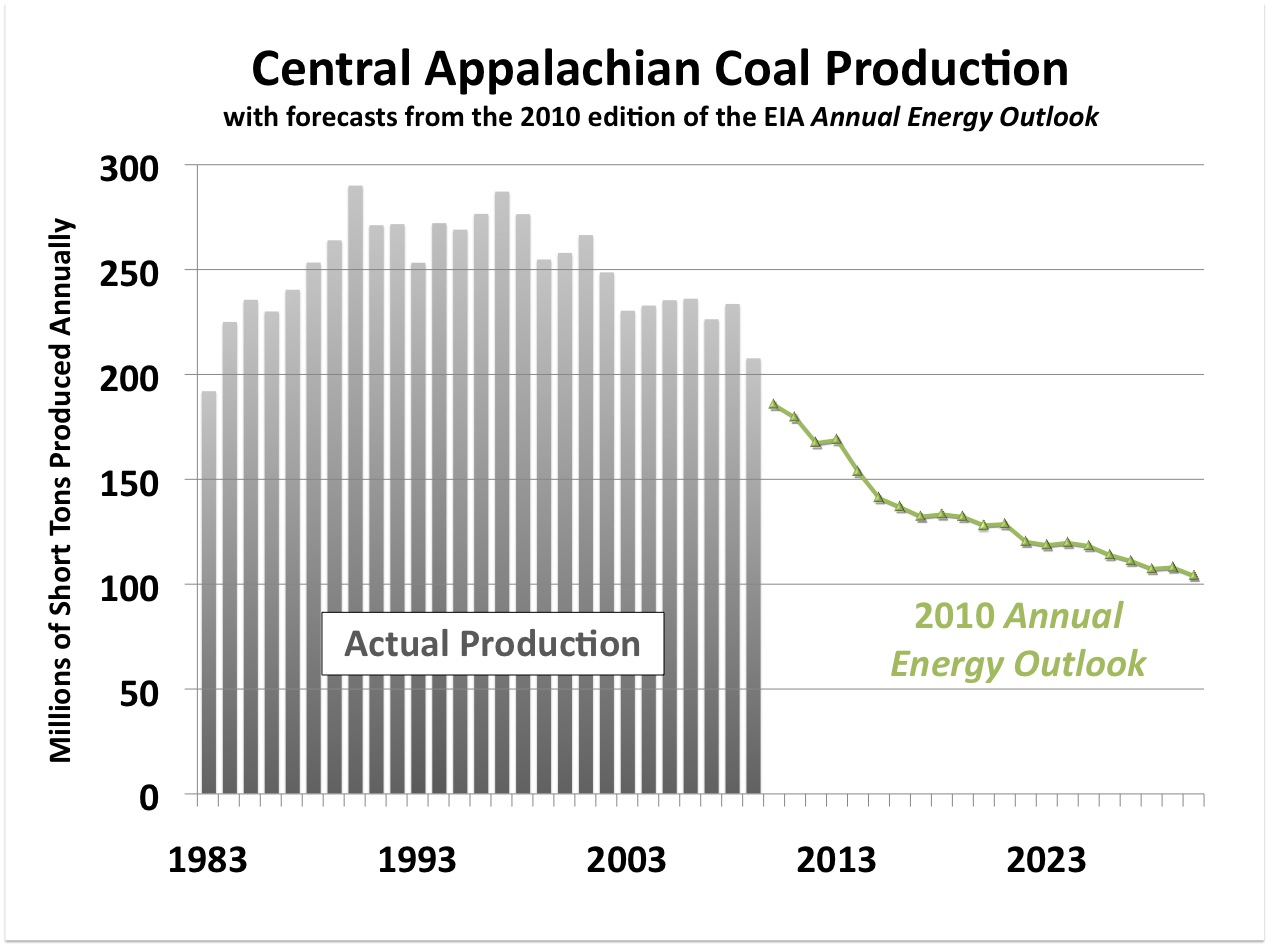
    B) Saying that coal is poised to play a “bigger” role is ridiculous. Coal is declining, particularly production in Central Appalachia. It has been declining for the past two decades and is projected to continue downward. But not only that. It is getting deeper, thinner, and of less quality. The heat content is in decline as well, meaning that it takes more tons of coal to produce the same amount of electricity.

    C) Delivered costs of coal are wildly different in different locations and in different coal plants. Central Appalachian coal (like that in West Virginia) is the most expensive coal on the domestic market.

    D) Stone uses ballpark figures for the cost of a coal plant that is already built, but renewables that are not yet built. If you are looking at building a new coal plant versus investing in renewables, the two are cost competitive, even without a price on coal pollution (EIA). In fact, except for solar, nothing even doubles the cost of coal, and that’s without CCS.

    E) The deeper we go for thinner seams of less quality coal, the more expensive central Appalachian coal gets and the more competitive natural gas, wind, geothermal, or biomass may look. The same is true for safety regulations. Coal companies fight them tooth and nail because safety isn’t free. This has an impact on energy policy. You can’t look at mining safety in a vacuum.

    Secondly, I am concerned that many in the news media continually fail to appreciate the sacrifice of coal miners, whose deaths occur with alarming frequency both at home and overseas. Mr. Stone continues:

    The reason safety isn’t included [in the cost of energy] is because accidents—from mine cave-ins to oil-rig deaths—don’t happen often enough for safety to become a formidable factor in the national discussion on our energy future. What’s more, the playing field isn’t all that tilted. Despite a bad week for coal miners, wind has also been fatal—14 men were killed working with wind energy in the mid ’90s, and more since, according to wind-industry analyst Paul Gipe. Not to mention the risks posed by nuclear. While most sectors have undergone regulation over the past few years to root out dangerous components, the reality is that all energy sectors are still risky in many ways.

    Facts:

    A) Mining accidents happen all the time in the US. Over 300 people have died mining coal in the United States just in the last decade, nearly always exceeding 20 per year. It’s just that there isn’t always media saturation. Over 51,000 people have died mining coal in China in the same time period. That’s more than 3600 times the numbers that have been “killed by wind” in just one country and in half the time span.

    B) Speaking of which, Mr. Stone uses MONSTROUS false equivalency regarding the different energy sectors. He says 14 people were killed working with wind energy in the mid-90s? What does that even mean? First of all, Gipe’s numbers are worldwide. That doesn’t even compare to the number of deaths from mining and processing coal in the United States alone. 18 people died in accidents mining coal in the US just last year, and that was a “great” year. Add in the 10,000 US coal miners who die each decade from black lung disease, and Mr. Stone’s comparison becomes even more toxic.

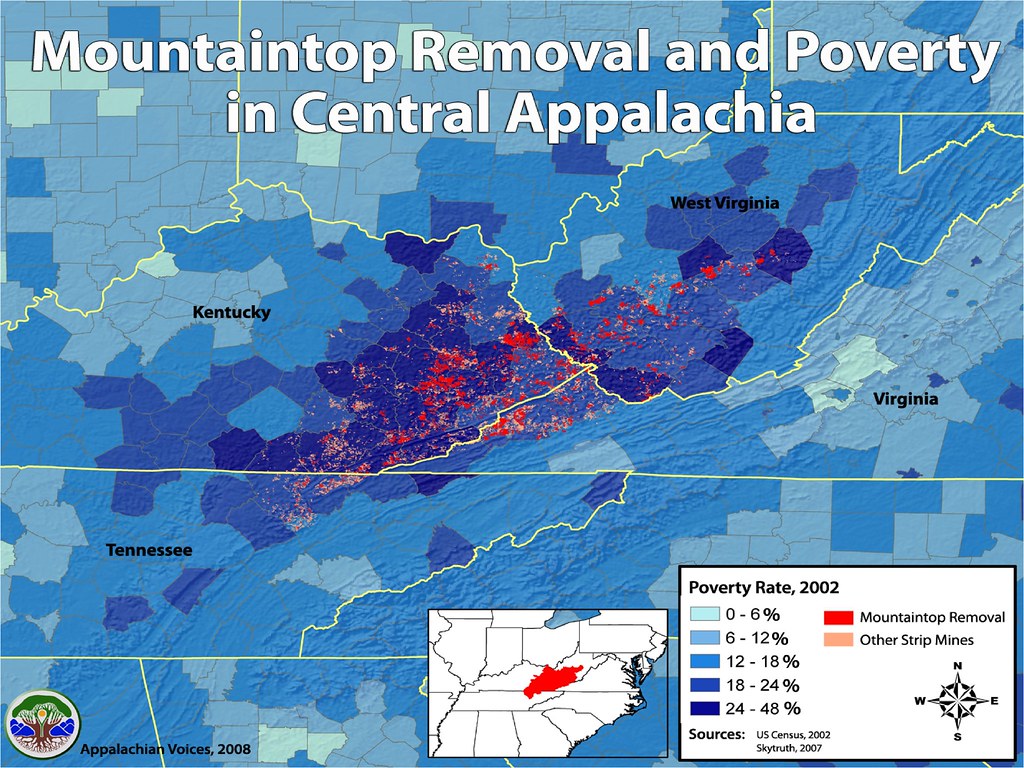
    C) You can’t look at energy in a vacuum. Policy makers certainly don’t. Look at the externalized cost of what is happening to coal communities, particularly in Appalachia. Not only has coal had a negative impact on endemic Appalachian poverty, but the health costs are estimated to be more than $42 billion every year due to health impacts and life lost. There is no cost comparison. There is no risk comparison.

    – Daniel Stone

    Related Posts:

  • Kitty Kelley Oprah Biography Hits Shelves This Week

    Kitty Kelley’s new and unauthorized Oprah biography hits shelves tomorrow. Will you be reading it?

    The silver-haired but anything but matronly Kelley, 68, appeared on NBC’s The TODAY Show Monday, where she told correspondent Matt Lauer that she believes a number of media personalities — including Barbara Walters, Larry King, and Rachael Ray — declined to be interviewed for her book, entitled Oprah: A Biography due to fear “Oprah Backlash.”

    Visit msnbc.com for breaking news, world news, and news about the economy


  • Blogging the Kintisch Point of Inquiry Show, Part II: Is It Reasonable to Fear “Playing God”? | The Intersection

    Once again: If you haven’t yet, I encourage you to download or stream my fourth (and so far, I think, best) Point of Inquiry program–with Eli Kintisch on the subject of geoengineering. All this week on the blog, I’m going to be discussing issues raised on the show–so having heard it will be kind of an essential baseline. I’m always trying to become a better interviewer, so with this next post, I want to zoom in on an area where I failed to press my interview subject as I probably should have. And that is the relationship between religious beliefs and opposition to geoengineering. At around minute 9:15, I asked Eli about religious opposition to geoengineering–basically, about the folks who say that we shouldn’t “play God.” He gave a very detailed answer, essentially signaling that, hey, yeah, this is a lot like genetically modified foods–some people think the impulse to interfere with “nature,” to remake it in the way that only “God” is supposed to do, is wrong. I have no doubt this impulse is out there. But I don’t find it to be at all a rational argument, or a sound basis for public policy. When it comes to the genetics of …