Blog

  • Bill Clinton and the Devil’s Larder


    I would like to take the observations described herein a little farther.  This applies in the developed world also.  Industrial agriculture is and was a huge experiment that is running its course.  It works because machinery expanded an individual’s ability to farm in certain highly specialized ways.  After that was in place the normal course of business allowed capital to support such efficiencies.  This was a generational transition.
    There is no point in selling cheap subsidized rice grown in Arkansas to folks in Haiti who simply have no cash to pay for it and who cannot sell their produce into the USA because they are competing with a subsidized product.
    A proper application of comparative advantage starts with the elimination of subsidies or alternately providing matching subsidies.  I rather think that a million peasant rice growers in Haiti with everyone working for little or nothing would easily produce ample rice for the USA market.
    Such a step would revitalize Haitian agriculture and begin the process of rapid improvement that in a couple of generations will completely transform the island’s agriculture to say nothing of everything else.
    Haiti, U.S. ag policy reform, and Bill Clinton
    DEVIL’S LARDER
    7 APR 2010 7:41 AM

    What have Haiti‘s recent calamities taught U.S. decision makers about foreign policy with regard to agriculture?
    Haiti imports nearly half of the food consumed there–and 80 percent of its rice, the national staple. In the past two years, the country has undergone two major shocks: the global spike in food commodity prices in 2008, and this year’s devastating earthquake. In both cases, the dearth of domestic food production, combined with the complete absence of rice reserves, translated to widespread hunger and misery.
    For a nation to rely on global commodity markets for its sustenance is to depend on forces completely out of its citizens’ control. Actions in other countries–say, the U.S. government’s decision to ramp up ethanol production in 2007–can price millions out of food markets. Natural disasters can quickly morph into monstrous human tragedies. In Haiti, a people with a long history of toughness and resourcefulness become frightfully vulnerable.
    For 30 years now, U.S. policy makers and the so-called “Washington Consensus” institutions–the IMF and the World Bank–have goaded “developing nations” to forget about food security and instead focus on leveraging their “comparative advantages” to earn hard currency through foreign trade. Typically, those advantages end up being large pools of cheap labor and natural resources. As for feeding the domestic population, the global commodity market would take care of that.
    The 2008 food crisis, which pushed hundreds of millions from mere poverty to flat-out hunger, exposed the absurdity of that policy. No country threw its farmers to the wolves more decisively than Haiti, which just a generation ago grew most of its own food and was a net rice exporter. And now their are signs that U.S, policy makers are rethinking the old advice, as Tom Laskawy recently reported here.
    Bill Clinton is a paid-up member of the foreign policy establishment: former President, current UN envoy to Haiti, husband of the Secretary of State. Speaking of his decision in the 1990s to push Haiti to accept cheap, subsidized U.S. rice imports at the expense of its own farmers, Clinton told he Senate Foreign Relations Committee that… (transcription of the Clinton quotes pulled from the Democracy Now website.) 
    Since 1981, the United States has followed a policy, until the last year or so when we started rethinking it, that we rich countries that produce a lot of food should sell it to poor countries and relieve them of the burden of producing their own food, so, thank goodness, they can leap directly into the industrial era. It has not worked. It may have been good for some of my farmers in Arkansas, but it has not worked. It was a mistake. It was a mistake that I was a party to. I am not pointing the finger at anybody. I did that. I have to live every day with the consequences of the lost capacity to produce a rice crop in Haiti to feed those people, because of what I did. Nobody else.
    That’s a remarkable statement. He later referred to the destruction of Haiti‘s rice farmers as a “devil’s bargain. He added this:
    And it’s [the old ag policy] failed everywhere it’s been tried. And you just can’t take the food chain out of production. And it also undermines a lot of the culture, the fabric of life, the sense of self-determination.
    But then in later remarks, Clinton called into questions the lessons he had actually learned. Speaking of Haiti specifically, he said this:
    And we–that’s a lot of what we’re doing now. We’re thinking about how can we get the coffee production up, how can we get other kinds of-the mango production up–we had an announcement on that yesterday–the avocados, lots of other things.
    By mentioning coffee, mangoes, and avocados, Clinton seems to be indicating an emphasis on export crops. To understand why this is deeply problematic, you have to fully understand the old policies. The idea went like this. Well-capitalized farmers in the globe’s temperate zones — essentially, the U.S., Europe, Brazil, and Argentina — would produce high-volume staple crops like corn, soy, and wheat. In the tropical and sub-tropical zones, farmers would forget staple crops and focus on “high-value” (and labor-intensive) fruit, vegetables, and flowers for the northern countries, where consumers can pay high prices for them. Comparative advantage at work: capital-intensive crops in the temperate zones; labor-intensive crops in the hot zones.
    But the idea was always perverse. Global trade in food makes sense in cases of genuine surplus and shortage; but it becomes problematic when it becomes the driving force behind ag policy. Why should Haiti‘s farmers focus on growing mangoes, avocados, and coffee for Americans when people there lack access to sufficient food? Why should Chile‘s prime farmland be occupied by flower production for the U.S.–instead of food for Chileans to eat?
    Moreover, farms that have sufficient scale to profitably reach these markets tend to be huge plantations, as Paul Roberts shows in his 2008 book The End of Food. He cites the case of Kenya. In textbook terms, an emphasis on export crops looks like a raging success in Kenya–the country exports $200 million in horticultural products per year, the engine of Africa’s second-largest export economy.
    And yet, smallholder farmers are increasingly iced out of that booming export market. “[T]he share of Kenya’s foreign-bound produce grown by smallholders has fallen from nearly half in 1980 to less than a sixth today,” Roberts reports. The main way most Kenyans interact with such agriculture is as plantation laborers–earning an average wage of three dollars per day.
    Such arrangements don’t eliminate poverty; they enshrine it. Indeed, while laborers toil on plantations and Kenya sends literally tons of pristine fruit, vegetables, and flowers north to Europe, “about one-third of the [Kenyan] population is chronically undernourished,” the FAO reports.
    So, it’s disturbing to hear Bill Clinton talking about reviving Haiti‘s agriculture through export crops, and not through supporting smallholder farmers and linking them with consumers in Haiti‘s cities. I love tropical crops like coffee as much as anyone; and if coffee and mango production for export can be structured in a way that boosts small-farmer incomes, then fine. But until Haiti can feed itself, the spectacle of U.S. policy titans obsessing about export markets seems absurd: farce piled on tragedy.

    right:{ m r 03 p}- m:15.0pt;margin-left: 0in;text-align:justify’>Bake at 400 degrees F for 20 minutes or until a toothpick inserted into the center of the dish comes out clean.

    Appalachian-style Wilted Salad

    This salad is very similar to the classic French salad of frisee aux lardons with a poached egg. However, this version is straight out of Appalachia. Traditionally the salad would include foraged spring greens, like dandelions and lamb’s quarters, as well as wild ramps. It’s just what the body needs to awaken it from winter’s slumber.
    Makes 4 side salad servings
    1/2 pound young spring lettuces
    1 spring onion or ramp, sliced thinly
    2 slices thick cut or slab bacon, cut into 1-inch pieces
    3 tablespoons apple-cider vinegar
    1 tablespoon honey
    1 hard-boiled egg, chopped
    Salt and ground black pepper
    Wash lettuce and spin is a salad spinner until very dry. Place in a serving bowl with the spring onions.
    Cook bacon in over medium heat until crisp. Transfer with a slotted spoon and to drain on paper towels. Hold bacon drippings warm in the pan over low heat.
    Stir the vinegar and honey into the bacon drippings. Increase the heat to medium and cook the mixture until it is just bubbles.
    Pour the hot dressing immediately over the lettuce and onions, tossing to coat and wilt the greens just slightly. Season with salt and pepper, top with chopped boiled egg, and serve immediately. 
    Top of Form
    Bottom of Form
  • A turning point in Haiti’s history?

    Three months to the day since the Haiti earthquake, huge challenges remain. But thanks to extraordinarily determined people doing amazing, innovative work, there is genuine hope for the future. Oxfam Great Britain’s CEO Barbara Stocking has been there to see for herself.

    Barbara watches a public health promoter from Oxfam teaching kids of camp Delmas 3 to sinn songs about handwashing. Photo: Lina Holguin.

    Barbara watches a public health promoter from Oxfam teaching kids of camp Delmas 3 to sinn songs about handwashing. Photo: Lina Holguin.

    Driving up the hill in Petionville past our office, destroyed in the earthquake, my first impression was how much work had been done to clean up the rubble and rubbish of the area. A contrast to the suffering behind walls and in the huge number of small camps. Also a contrast to Carrefour Feuille, very close to the epicentre, where you still climb over rubble to get around.

    On my visit I had the chance to see real contrasts. Near the centre I visited a small (3,500 people) camp which was well organised and where our water and sanitation work is really helping. Latrines are a real problem. The owners of the land of many of the camps do not want latrines dug there, and/or it may be impossible to build latrines on rock or concrete so a lot of innovation is needed.

    An innovative alternative to latrines

    At this site I saw latrines on raised areas where the huge tanks only have to be emptied every few weeks. From our surveys we know that a lot of people use toilets in their old damaged homes or, like so many people across the developing world, they use plastic bags. We have another innovation – peepoo bags – where both the contents get treated and the bag dissolves in a few weeks, so they can all be thrown into big waste pits. It brings it home to you how people lived (and live) before (and after) the earthquake.

    Barbara meets members of Cantine Populaire in Carrefour feuille in Port-au-Prince.  The women organise themeselves to provide food for their community. Photo: Lina Holguin.

    Barbara meets members of Cantine Populaire in Carrefour feuille in Port-au-Prince. The women organise themeselves to provide food for their community. Photo: Lina Holguin.

    The work of the Haitian people is very impressive. I visited a community kitchen in Carrefour Feuille that feeds 80 of the most vulnerable people every day. It is one of 56 kitchens there with another 50 to be set up soon in the neighbouring quarter, and perhaps another 250 kitchens in the Delmas area. We pay women, who used to have food stalls, to cook the meals and we pay for the food. The women who cook in the kitchens have formed small community groups. The kitchens provide hope and solidarity to people as well as food.

    Clearly traumatised

    This spirit is badly needed as people are so clearly traumatised. We have over 200 Haitian staff now, as I met them they were enthusiastic as they talked about our work but their faces became drawn and pained if I asked them about their lives now. With those I already know a gentle question brings tears into their eyes. Most are staying with friends or relations (or vice versa) in cramped conditions, yet they are working hard and look so clean and smart. A small miracle in the circumstances.

    Another example I saw of community work was the cleaning of one of the major canals that takes rainwater down the hills into the sea. Like the canals in many shantytowns across the world, the one in Cité Soleil is filthy and full of rubbish. Community teams, again paid by us as part of a cash-for-work scheme, are clearing out all the rubbish so that water can flow down again. This is very important now as when the rains come the water can flow and this means the areas lower down are not flooded.

    Race against the rainy season

    The other area of our work is shelter. It is a race against time to get enough plastic sheeting to everyone for the rainy season. Tents that have been provided (not by us but by others) tend to leak or they are just too big for the space available. The Government, United Nations and European Union agencies are concerned about the rains coming and the hurricane season. Some people will have to move from the lower areas of camps and we were starting work this week on a new camp for 20,000 people.

    Another option is for people to go back to their homes even if partially destroyed but, of course, they are afraid to do so in case they are dangerous. We have led the way in getting structural engineers to assess houses. They mark them green, or, amber (safe to live in but needing repair), or, red (unsafe and needing to be knocked down). There are now 200 or more engineers assessing houses.

    Reaching 300,000 people

    Barbara also visited the Women's Association of Poulie in Belladere, on the border with the Dominican Republic. They talked about the support they need to produce more food and contribute to feeding displaced people arriving in their region and in Port-au-Prince. Photo: Lina Holguin.

    Barbara also visited the Women’s Association of Poulie in Belladere, on the border with the Dominican Republic. They talked about the support they need to produce more food and contribute to feeding displaced people arriving in their region and in Port-au-Prince. Photo: Lina Holguin.

    So our work covers our traditional areas of water, sanitation and public health as well as very different and imaginative schemes. As I left, the number of beneficiaries we were reaching in one way or another was 300,000. Of course everyone worries what will happen in the long term. We recently took the initiative by asking the people themselves what they wanted in a survey. The top two items were jobs and education. It was a surprise that these came even higher up their priorities than shelter. It demonstrated once again that people don’t want handouts they really want to fend for themselves.

    A turning point?

    There is much concern too about how reconstruction can be led. It is so important that it is the Haitian Government and the Haitian people that do lead and yet the Government is quite weak and will need a lot of support. Donor Governments also need to make long-term commitments not just to rebuilding but to making a complete change to Haiti – for example, enabling the Government to provide good health and education.

    Everyone hopes, as Oxfam does too, that the earthquake can be a turning point in Haiti’s history. It is a beautiful and fertile island; it feels that it should be possible.

    More on Oxfam’s Haiti earthquake response

    Haiti: keeping up the good work (video report from Oxfam’s Humanitarian Director Jane Cocking).

    Make a regular donation to the Oxfam 365 emergency fund

  • Kitchen Organization Tour: A Visit With Bento Expert Biggie of Lunch In a Box

    2008_07_24-BentoTour.jpg

    Apparently we were a little late to the party last month when we predicted that Bento was a coming trend. We get it now: Bento is already a popular way to pack your lunch (or any meal), get your kids to eat, have some fun and express yourself, and help save the planet with a little less waste.

    One of the most popular and comprehensive bento websites is Lunch in a Box, where you’ll find photos, top-tips and recipes, an online store for bento gear and an amazing list of bento links. We stopped by recently to visit Lunch in a Box’s Biggie for a mini-kitchen tour.

    Read Full Post


  • Corn Bread Cuisine


    Having grown up on a diet of country food, I have some appreciation for the contents of this article.  It includes a recipe for corn bread with contained vegetables.  A bit complicated I think.  Corn bread is a simple basic recipe that has always gone well with butter and syrup.  This is quite a departure.
    It also underscores the point that corn bread has not matured fully as a common part of an everyday sophisticated diet as has pasta and bread.  Most also forget that folks who ate polenta were commonly looked down on in parts of Europe not too long ago, yet today it has somehow found an honored place.
    If raised bread simply did not exist, corn bread would take its place rather well. 
    I hope work such as this helps create more interest in cornbread and that it simply becomes more commonly available outside its traditional homeland.
    The real ‘Food Revolution’ starts with healthy Appalachian cornbread
    8 APR 2010 12:07 PM
    Why can\’t a revolution based on traditional Appalachian food ways be televised?
    Having watched the first three episodes, I’ve been thinking a lot about Jamie Oliver’s “Food Revolution” TV Show. Who can argue with his efforts to get fresh food into West Virginia‘s schools? No doubt, the pantries and fridges in most school cafeterias need to be purged and restocked.
    However, from what I can tell so far, our imported food revolutionary could stand to slow down and think a little bit harder about what he’s up to.
    First, Oliver has demonstrated little knowledge of (or interest in) the traditional food culture of the region whose people he has set out to “save.” Over the decades, Southern Appalachians have been plagued by many well meaning do-gooders who wanted to teach those poor, underprivileged folks how to act more civilized–and eat better. Problem is, time and again, those reformers proved to be wrong.
    According to the scholar and Appalachian native Elizabeth Engelhardt, for example, public health officials in the early 20th century targeted cornbread as the latest source of diet-based diseases in the South. Activists set out to create a social revolution in Appalachia by switching mountain women from cornbread to beaten biscuits, the symbol of aristocratic Southern cooking, for which their efforts were sardonically christened the “Beaten Biscuit Crusade.”
    These biscuits required prohibitively expensive wheat flour, elaborate middle-class equipment– including a marble slab and modern ovens– and much more labor and time than their common cornbread. Beaten biscuits became an aspirational dish, separating the privileged from the poor and—following now discredited public-heath logic–the healthy from the unhealthy.
    On the contrary, replacing whole-grain, freshly milled cornmeal with chemically bleached, nutrient-stripped, shelf-stable industrial flour proved nothing but detrimental to Appalachian health. You need only watch Appalshop’s 1977 documentary Waterground, about fifth-generation miller Walter Winebarger, to know that traditional wisdom foresaw this sad outcome.
    Cornbread is just one of a long list of other traditional foods that were replaced with inferior industrial ones–many of which succeeded through propaganda campaigns. Lard from pastured hogs was demonized (largely by nutritionists funded by the vegetable oil industry) and replaced by now-maligned partially hydrogenated vegetable shortening, touted for its “purity.” Fresh-churned butter gave way to another trans-fat bomb, margarine. Much-beloved, live-cultured, and naturally low-fat buttermilk was banished in favor of inert, homogenized, pasteurized, growth hormone-injected, high-fat milk. Wholesome beans, greens, and cornbread gave way to sad casseroles based on canned soup and highly processed “cheese food.”
    Overall, I worry that Oliver’s “Food Revolution” show obscures the fact that our food crisis is a symptom of underlying structural problems. In Appalachia, the government watched idly while the coal industry grabbed control of the region’s abundant natural resources. Widespread erosion of topsoil, contamination of drinking water, devastation of forests, and gut-wrenching destruction of the world’s oldest mountain range has resulted. The area remains in dire need of environmental protection. Is it any wonder why its economy is in ruins and the people in Huntington, West Virginia, are the unhealthiest in the country, as Oliver repeatedly reminds us?
    Then there’s the workers’ rights crisis. Since stagnant wages compelled many women to leave the household and go to work a generation ago, who is supposed to make the from-scratch meals Oliver talks about? Many working mothers are on the clock until 5 or 6 o’clock. Add to that a long commute that many families endure to find jobs, and there is just no way. The system is unsustainable. Long hours at sedentary jobs with fast-food lunches produce unhealthy parents who then produce unhealthy children.
    Moreover, the outrageous school district nutrition guidelines that Oliver struggles with are just one of a whole host of government policies that prop up the industrial food system that supplies most school cafeterias.
    Our food system’s problems run deep–and the solutions won’t come easy. However, we can begin by recognizing, celebrating, and supporting wholesome, traditional foodways. They hang on despite being ground down by industrialization. Here, we find much-needed common ground between two often opposed groups–the liberal outsider and the mountain old-timer. This partnership could provide the fire for a real, lasting food revolution–one that heals Appalachian people, Appalachian economies, and Appalachian environments.

    In that spirit, here are a couple of recipes meant to fuel a food revolution while celebrating mountain food culture, clean and healthy environments, and glorious spring!

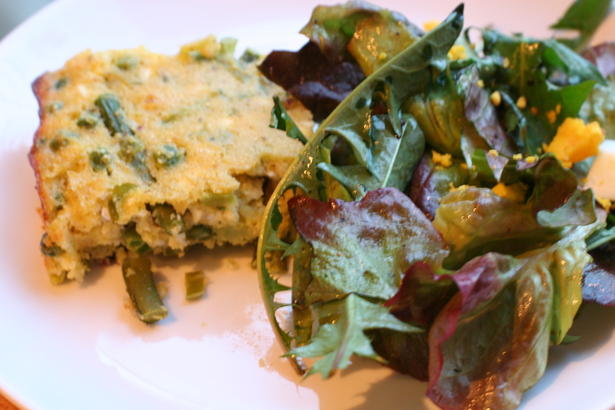
    Spring Vegetable Cornbread 

    This recipe is my effort to reinvent a family favorite recipe for broccoli cornbread. Broccoli cornbread might sound healthy, but it’s not. The original recipe calls for a very sweet cornbread mix heavy on preservatives and trans fats, and light on nutrition. It also calls for a full two sticks of butter, or–worse–margarine. In my version, I’ve slashed the amount of butter, tripled the amount of vegetables, and relied on traditional, stone-ground ,organic cornmeal instead of a commercial mix. This recipe is still a cinch to pull together and the resulting dish exceptionally moist and chocked full of naturally sweet vegetables that kids love.
    It takes less than 10 minutes to prep and 20 minutes to cook. I know that finding lots of fresh vegetables in rural areas can be difficult, so I’ve even tried this with a variety of frozen vegetables. It works great, and frozen are definitely the better nutritional alternative to canned (unless they are home canned). This recipe is also endlessly adaptable–try a summer vegetable cornbread bake with fresh corn, green beans, peppers, and tomatoes. It works just as well as a side dish as it does a main course.
    5 cups mixed spring vegetables, cut into bite size pieces (frozen vegetables are fine and you can even use the microwave to steam them .if it’s more convenient). I used asparagus, leeks, snap peas, and broccoli in about equal amounts. 

    1/2 teaspoon salt
    1/2 teaspoon pepper
    2 cups stone ground organic cornmeal
    1 1/2 teaspoons salt
    1 1/2 teaspoons baking powder
    4 eggs
    1 Tablespoon honey
    2 cups cottage cheese (I used 2%)
    6 Tablespoons unsalted butter (you can substitute olive oil if you prefer)
    Preheat oven 400 degrees F.
    Cut fresh vegetables into bite size pieces and steam until just tender. Frozen vegetables can simply be defrosted. Sprinkle with ½ teaspoon salt and ½ teaspoon black pepper and set aside.
    In a 9-by-13 inch baking dish, place the 6 Tablespoons butter and place in the oven to melt.
    In a mixing bowl whisk together cornmeal, 1 ½ teaspoons salt, and 1 ½ teaspoons baking powder
    To the cornmeal mixture whisk in four eggs, cottage cheese, and 1 tablespoon honey. Fold in the steamed vegetables.
    Remove the baking dish of melted butter from the oven. Pour about ½ of the butter into the cornbread batter and whisk to combine. Then pour the batter into the baking dish with the rest of the melted butter and use a spatula to spread the batter evenly.
    Bake at 400 degrees F for 20 minutes or until a toothpick inserted into the center of the dish comes out clean.
    Appalachian-style Wilted Salad

    This salad is very similar to the classic French salad of frisee aux lardons with a poached egg. However, this version is straight out of Appalachia. Traditionally the salad would include foraged spring greens, like dandelions and lamb’s quarters, as well as wild ramps. It’s just what the body needs to awaken it from winter’s slumber.
    Makes 4 side salad servings
    1/2 pound young spring lettuces
    1 spring onion or ramp, sliced thinly
    2 slices thick cut or slab bacon, cut into 1-inch pieces
    3 tablespoons apple-cider vinegar
    1 tablespoon honey
    1 hard-boiled egg, chopped
    Salt and ground black pepper
    Wash lettuce and spin is a salad spinner until very dry. Place in a serving bowl with the spring onions.
    Cook bacon in over medium heat until crisp. Transfer with a slotted spoon and to drain on paper towels. Hold bacon drippings warm in the pan over low heat.
    Stir the vinegar and honey into the bacon drippings. Increase the heat to medium and cook the mixture until it is just bubbles.
    Pour the hot dressing immediately over the lettuce and onions, tossing to coat and wilt the greens just slightly. Season with salt and pepper, top with chopped boiled egg, and serve immediately. 
    Top of Form
    Bottom of Form
  • The Hidden Secrets of iPhone OS 4 [IPhone]

    Though iPhone OS 4’s real potency will come when developers seize the new tools and build multitasking apps that do crazy, crazy things, many of the OS’s inherent secrets are coming to light. More »


  • List of Bad Things Attributed to Global Warming


    This is more humor than any creditable science.  About two years ago, the global warming propaganda machine created such pressure that any scientist that wished to attract funding somehow found a way to mention global warming in his grant applications and obviously into the paper production.  Two years of effort has produced this mountain of perfectly good science hiding under the same umbrella.


    It is still not quite as bad as the cure for cancer umbrella which rolled on for decades.  This one at least ended pretty badly a few weeks back.


    This is a typical case of jumping on a strong horse to advance one’s own work.  Let us hope that few suffer any real damage.  After all, it was all about PR.


    A Complete List Of Bad Things Attributed To Global Warming

    Hardly a day goes by that the media don’t blame something on global warming. Or so it seems. The British-based science watchdog, Number Watch, wondered just how many and went to the trouble of documenting them.
    It has kept on its Web site a near-comprehensive set of links to a long list of things attributed by either scientific research or the media to global warming. As you read it, some items will strike you as contradictory. Others, perhaps, as merely absurd. And still others as factually impossible.
    However they strike you, in perusing the list one thing will become clear: just how much the fear of global warming has come to taint both science and news reporting on the issue.
    Following is the list of phenomena (756 entries in all) linked at one time or another to warming. They range from acne, bubonic plague and a drop in circumcisions to Yellow fever, whale beachings, walrus stampedes, witchcraft executions and the threat of zebra mussels.
    Actual links to stories that make the claims listed below can be found at http://www.numberwatch.co.uk/warmlist.htm. (Below the list are some claims that no longer have working Internet links.)
    The list:
    Acne, agricultural land increase, Afghan poppies destroyed, aged deaths, poppies more potent, Africa devastated, Africa in conflict, African aid threatened, African summer frost, aggressive weeds, Air France crash, air pressure changes, airport farewells virtual, airport malaria, Agulhas current, Alaskan towns slowly destroyed, al-Qaida and Taliban being helped, allergy increase, allergy season longer, alligators in the Thames, Alps melting, Amazon a desert, American Dream end, amphibians breeding earlier (or not), anaphylactic reactions to bee stings, ancient forests dramatically changed, animals head for the hills, animals shrink, Antarctic grass flourishes, Antarctic ice grows, Antarctic ice shrinks, Antarctic sea life at risk, anxiety treatment, algal blooms, archaeological sites threatened, Arctic bogs melt, Arctic in bloom, Arctic ice free, Arctic ice melt faster, Arctic lakes disappear, Arctic tundra lost, Arctic warming (not), a rose by any other name smells of nothing, asteroid strike risk, asthma, Atlantic less salty, Atlantic more salty, atmospheric circulation modified, attack of the killer jellyfish, avalanches reduced, avalanches increased, Baghdad snow, Bahrain under water, bananas grow, barbarization, bats decline, beer and bread prices to soar, beer better, beer worse, beetle infestation, bet for $10,000, big melt faster, billion-dollar research projects, billion homeless, billions face risk, billions of deaths, bird distributions change, bird loss accelerating, bird strikes, bird visitors drop, birds confused, birds decline (Wales), birds driven north, birds face longer migrations, birds return early, birds shrink (Australia), birds shrink (U.S.), bittern boom ends, blackbirds stop singing, blackbirds threatened, Black Hawk down, blizzards, blood contaminated, blue mussels return, borders redrawn, bluetongue, brain-eating amoebae, brains shrink, bridge collapse (Minneapolis), Britain one big city, Britain Siberian, Britain’s bananas, British monsoon, brothels struggle, brown Ireland, bubonic plague, Buddhist temple threatened, building collapse, building season extension, bushfires, butterflies move north,butterflies reeling, carbon crimes, camel deaths, cancer deaths in England, cannibalism, caterpillar biomass shift, cave paintings threatened, childhood insomnia, Cholera, circumcision in decline, cirrus disappearance, civil unrest, cloud increase, coast beauty spots lost, cockroach migration, cod go south, coffee threatened, coffee berry borer, coffee berry disease, cold climate creatures survive, cold spells (Australia), cold wave (India), cold weather (world), computer models, conferences, conflict, conflict with Russia, consumers foot the bill, coral bleaching, coral fish suffer, coral reefs dying, coral reefs grow,coral reefs shrink, coral reefs twilight, cost of trillions, cougar attacks, crabgrass menace, cradle of civilization threatened, creatures move uphill, crime increase, crocodile sex, crops devastated, crumbling roads, buildings and sewage systems, curriculum change, cyclones (Australia), danger to kid’s health, Dartford Warbler plague, deadly virus outbreaks, death rate increase (U.S.), deaths to reach 6 million, Dengue hemorrhagic fever, depression, desert advance, desert retreat, destruction of the environment, dig sites threatened, disasters, diseases move north, dog disease, dozen deadly diseases — or not, drought, ducks and geese decline, dust bowl in the corn belt, earlier pollen season, Earth axis tilt, Earth biodiversity crisis, Earth dying, Earth even hotter, Earth light dimming, Earth lopsided, Earth melting, Earth morbid fever, Earth on fast track, Earth past point of no return, Earth slowing down, Earth spins faster, Earth to explode, Earth upside down, earthquakes, earthquakes redux, El Nino intensification, end of the world as we know it, erosion, emerging infections, encephalitis, English villages lost, equality threatened, Europe simultaneously baking and freezing, eutrophication, evolution accelerating, expansion of university climate groups, extinctions (human, civilization, koalas, logic, Inuit, smallest butterfly, cod, penguins, pikas, polar bears, possums, walrus, tigers, toads,turtles, plants, ladybirds, rhinoceros, salmon, trout, wild flowers, woodlice, a million species, half of all animal and plant species, mountain species, not polar bears, barrier reef, leaches, salamanders, tropical insects) experts muzzled, extreme changes to California, fading fall foliage, fainting, famine, farmers benefit, farmers go under, farm output boost, farming soil decline, fashion disaster, fever, figurehead sacked, fir cone bonanza, fires fanned in Nepal, fish bigger, fish catches drop, fish downsize, fish deaf, fish get lost, fish head north, fish shrinking, fish stocks at risk, fish stocks decline, five million illnesses, flesh eating disease, flies on Everest, flood patterns change, floods, floods of beaches and cities, flood of migrants, flood preparation for crisis, flora dispersed, Florida economic decline, flowers in peril, fog increase in San Francisco, fog decrease in San Francisco, food poisoning, food prices rise, food prices soar, food security threat, football team migration, forest decline, forest expansion, foundations threatened, frog with extra heads, frosts, frostbite, frost damage increased, fungi fruitful, fungi invasion, games change, Garden of Eden wilts, geese decline in Hampshire, genetic changes, genetic diversity decline, gene pools slashed, geysers imperiled, giant icebergs (Australia), giant oysters invade, giant pythons invade, giant squid migrate, gingerbread houses collapse, glacial earthquakes, glacial retreat, glacier grows (California), glaciers on Snowden, glacier wrapped, global cooling, glowing clouds, golf course to drown, golf Masters wrecked, grain output drop (China), grandstanding, grasslands wetter, gravity shift, Great Barrier Reef 95% dead, Great Lakes drop, great tits cope, greening of the North, Grey whales lose weight, Gulf Stream failure, habitat loss, haggis threatened, Hantavirus pulmonary syndrome, harvest increase, harvest shrinkage, hay fever epidemic, health affected, health of children harmed, health risks (even more) heart disease, heart attacks and strokes (Australia), heat waves, hedgehogs bald, hibernation affected, hibernation ends too soon, hibernation ends too late, homeless 50 million, hornets, human development faces unprecedented reversal, human fertility reduced, human health risk, human race oblivion, hurricanes, hurricane reduction, hurricanes fewer, hurricanes more intense, hurricanes not, hydropower problems, hyperthermia deaths, ice age, ice sheet growth, ice sheet shrinkage, icebergs, illness and death, inclement weather, India drowning, infrastructure failure (Canada), indigestion, industry threatened, infectious diseases, inflation in China, insect explosion, insect invasion, insurance premium rises, Inuit displacement, Inuit poisoned, Inuit suing, invasion of alien worms, invasion of Antarctic aliens, invasion of Asian carp, invasion of cats, invasion of crabgrass, invasion of herons, invasion of jellyfish, invasion of king crabs, invasion of midges,invasion of slugs, island disappears, islands sinking, Italy robbed of pasta, itchier poison ivy, jellyfish explosion, jet stream drifts north, jets fall from sky, Kew Gardens taxed, kidney stones, killer cornflakes, killing us, kitten boom, koalas under threat, krill decline, lake and stream productivity decline, lake empties, lake shrinking and growing, landslides, landslides of ice at 140 mph, large trees decline, lawsuits increase,lawsuit successful, lawyers’ income increased, lawyers want more, legionnaires’ surge, lives lost, lives saved, Loch Ness monster dead, locust plagues suppressed, lush growth in rain forests, Lyme disease, Malaria, malnutrition, mammoth dung melt, mango harvest fails, Maple production advanced, Maple syrup shortage, marine diseases, marine food chain decimated, Meaching (end of the world), Meat eating to stop, Mediterranean rises, megacryometeors, Melanoma, Melanoma decline, mental illness, methane emissions from plants, methane burps, methane runaway, melting permafrost, Middle Kingdom convulses, migration, migratory birds huge losses, microbes to decompose soil carbon more rapidly, minorities hit, monkeys at risk, monkeys on the move, Mont Blanc grows, monuments imperiled, moose dying, more bad air days, more research needed, mortality increased, mosquitoes adapting, mountain (Everest) shrinking, mountaineers fears, mountains break up, mountains green and flowering, mountains taller, mortality lower, murder rate increase, musk ox decline, Myanmar cyclone, narwhals at risk, National Parks damaged, National security implications, native wildlife overwhelmed, natural disasters quadruple, new islands, next ice age, NFL threatened, Nile delta damaged, noctilucent clouds, no effect in India, Northwest Passage opened, nuclear plants bloom, oaks dying, oaks move north, oblivion, ocean acidification, ocean acidification faster, ocean dead spots, ocean dead zones unleashed, ocean deserts expand, ocean waves speed up, Olympic Games to end, opera house to be destroyed, outdoor hockey threatened, oxygen depletion zones, ozone repair slowed, ozone rise, penguin chicks frozen, penguin chicks smaller, penguins replaced by jellyfish, personal carbon rationing,pest outbreaks, pests increase,phenology shifts, pines decline, pirate population decrease, plankton blooms, plankton wiped out, plants lose protein, plants march north, plants move uphill, polar bears aggressive, polar bears cannibalistic, polar bears deaf, polar bears drowning, polar tours scrapped, popcorn rise, porpoise astray, profits collapse, psychiatric illness, puffin decline, pushes poor women into prostitution, rabid bats, radars taken out, railroad tracks deformed, rainfall increase, rape wave, refugees, reindeer endangered, reindeer larger, release of ancient frozen viruses, resorts disappear, rice threatened, rice yields crash, rift on Capitol Hill, rioting and nuclear war, river flow impacted, rivers raised, road accidents, roads wear out, robins rampant, rocky peaks crack apart, roof of the world a desert, rooftop bars, Ross river disease, ruins ruined, Russia under pressure, salinity reduction, salinity increase, Salmonella, salmon stronger, satellites accelerate, school closures, sea level rise, sea level rise faster, seals mating more, seismic activity, sewer bills rise, severe thunderstorms, sex change, sexual promiscuity, shark attacks, sharks booming, sharks moving north, sheep change color, sheep shrink, shop closures, short-nosed dogs endangered, shrimp sex problems, shrinking ponds, shrinking sheep, shrinking shrine, Sidney Opera House wiped out, ski resorts threatened, slow death, smaller brains, smelt down, smog, snowfall decrease, snowfall increase, snowfall heavy, snow thicker, soaring food prices, societal collapse, soil change, songbirds change eating habits, sour grapes, space problem, spectacular orchids, spiders getting bigger, spiders invade Scotland, squid larger, squid population explosion, squid tamed, squirrels reproduce earlier, stingray invasion, storms wetter, stratospheric cooling, street crime to increase,subsidence, suicide, swordfish in the Baltic, Tabasco tragedy, taxes, tectonic plate movement, terrorists (India), thatched cottages at risk, threat to peace, ticks move northward (Sweden), tides rise, tigers eat people, tomatoes rot, tornado outbreak, tourism increase, toxic seaweed, trade barriers, trade winds weakened, traffic jams, transportation threatened, tree foliage increase (U.K.), tree growth slowed, tree growth faster, trees in trouble, trees less colorful, trees more colorful, trees lush, trees on Antarctica, treelines change, tropics expansion, tropopause raised, truffle shortage, truffles down, turtles crash, turtle feminized, turtles lay earlier, UFO sightings, U.K. coastal impact, U.K. Katrina, Vampire moths, Venice flooded, violin decline, volcanic eruptions, walrus pups orphaned, walrus stampede, wars over water, wars sparked, wars threaten billions, wasps, water bills double, water scarcity (20% of increase), wave of natural disasters, waves bigger, weather out of its mind, weather patterns awry, weather patterns last longer, Western aid cancelled out, West Nile fever, whale beachings, whales lose weight, whales move north, whales wiped out, wheat yields crushed in Australia, wildfires,wind shift, wind reduced, winds stronger, winds weaker, wine — Australian baked, wine — harm to Australian industry, wine industry damage (California), wine industry disaster (U.S.), wine — more English, wine — England too hot, wine — German boon, wine — no more French, wine passé (Napa), wine — Scotland best, wine stronger, winters in Britain colder, winter in Britain dead, witchcraft executions, wolverine decline, wolves eat more moose, wolves eat less, workers laid off, World at war, World War 4, World bankruptcy, World in crisis, World in flames, Yellow fever, zebra mussel threat, zoonotic diseases.
  • Ferrai 599 GTO configurator online

    Ferrari 599 GTO car configurator

    The Ferrari 599 GTO configurator is online for those lucky customers with enough money to afford this vehicle, and for those of us who want to play with the 599 GTO and dream of owning one. Some of the 599 GTO configurator features include classic and metallic body tints, as well as the racing livery and twin racing colours available.

    Three different wheel varieties are available, and the 599 GTO can be ordered with five different caliper colours. The interior is rich in personalisation options including carbonfibre finishes, coloured stitching, personalised seatbelts – right down to the background colour of the rev counter. The 599 GTO and its options are about as race-oriented as you’ll get on a road Ferrari. Just watch out for the options price list

    Ferrari 599 GTO car configurator

    Ferrari 599 GTO car configurator Ferrari 599 GTO car configurator Ferrari 599 GTO car configurator Ferrari 599 GTO car configurator


  • Adobe Launches Creative Suite 5

    Adobe has announced the launch of its Creative Suite 5, the latest release in the long line of products well known to graphic designers, web developers and anyone in the creative industries. It’s a massive release, with all the 14 products in the suite being upgraded. Creative Suite 5 also adds Adobe Flash Catalyst to the lineup, a tool designed to allow users wi… (read more)

  • handyCalc: More calculator than you can handle

    There are a lot of calculator apps in the Android Marketplace and a lot of them are pretty good, but while most are specialized tip calculators, handyCalc comes to the table with pretty much everything under the sun.

    Right off the bat, handyCalc scores points for offering a tutorial when you first run the application. This demo walks you through some of the UI gestures, solving expressions and using trigonometric and other advanced functions. You find out that it can solve linear and non-linear equations, draw graphs of functions and even let you define your own functions to use in advanced calculations.

    As a bonus handyCalc also acts as an almost universal converter (currency, measurement units, etc). It can subtract dates to find the number of days between them and help with statistical calculation by automatically suggesting the average of a sum. It even allows saving your work to a file for later use.

    The good:

    • Very sleek user interface
    • Full featured scientific calculator
    • Can solve fractions as integer or decimal and trigonometric problems as degree or radian
    • Draws the graph of any function
    • Supports saving and loading files
    • Free in the Android Marketplace

    Improvements I would like to see:

    • There’s a glitch when writing extremely long fractions (they go off screen) that I hope that get’s fixed before my next math exam

    The bottom line:
    handyCalc is indeed very handy and I’d recommend it to anyone in need of a scientific calculator that does most of the job for you.

    Note: This review was submitted by Alexandru-Ioan Dobrinescu as part of our app review contest.


    Related Posts

  • I.B.M. and Saudi Researchers Collaborate on Solar-Powered Desalination Technology

    The NYT has an article on <a
    href="http://peakenergy.blogspot.com/2008/05/solving-our-water-problems-desalination.html">solar
    power desalination</a>in Saudi Arabia, somewhat surprisingly using
    concentrating solar PV (CPV) rather than <a
    href="http://peakenergy.blogspot.com/2008/04/concentrating-on-important-things-solar.html">solar
    thermal energy</a> – <a
    href="http://greeninc.blogs.nytimes.com/2010/04/07/i-b-m-and-saudi-researchers-collaborate-on-solar-powered-desalination-technology/">I.B.M.
    and Saudi Researchers Collaborate on Solar-Powered Desalination
    Technology</a>.
    <blockquote>I.B.M. and a Saudi Arabian research institute are
    collaborating to develop a desalination plant powered by a new type of
    solar technology.

    The goal is to build a desalination project in the Saudi city of Al
    Khafji capable of producing 7.9 million gallons of water a day that
    would supply 100,000 people.

    Desalination is an energy-intensive process, which has limited the
    deployment of such plants outside desert regions like the Middle East.
    But I.B.M. and the Saudi research institute, the King Abdulaziz City
    for Science and Technology, plan to dramatically reduce the
    electricity costs by building a 10-megawatt solar farm that deploys
    ultra-high concentrator photovoltaic arrays.

    The technology will concentrate the sun 1,500 times on a solar cell to
    boost efficiency. That's about three times the solar concentration of
    most concentrating photovoltaic panels currently in operation.

    Sharon Nunes, vice president of I.B.M.'s Big Green Innovations
    division, said in an interview Tuesday that the key to increasing the
    solar panels' efficiency was a device called a liquid metal thermal
    interface. A legacy of Big Blue's mainframe computer work, the liquid
    metal thermal interface acts as a heat sink to cool the extreme
    temperatures generated by concentrating photovoltaic systems.

    "The solar component is something we've been implementing and that we
    have done testing on for the past two years," Ms. Nunes said. "We're
    quite confident with the results."

    I.B.M. has not yet revealed the efficiency of such a solar system at
    converting sunlight into electricity. But Jenny Hunter, a company
    spokeswoman, said it was expected to be a significant increase over
    current concentrating photovoltaic technology.

    I.B.M. has had discussions with solar developers about using the
    technology, Ms. Nunes said.

    The researchers are still exploring options to run the plant when the
    sun is not shining, looking at technologies to store solar electricity
    as well conventional power sources. To further cut energy costs, the
    company and Saudi researchers said they had developed a nanomembrane
    that desalinates water and removes toxins while using less
    electricity.</blockquote>


  • Ferrari Reveals Awesome New 599 GTO

    Faster than an Enzo and More Universally Appealing
    Canadian Auto Press

    For a small company, relative to mainstream brands, Ferrari has a full lineup of models and updates them more often than a lot of major players.  Each is special, but some are more special than others.  Enter the 599 GTO, a car that the prancing horse brand holds in such high esteem that it’s endowed it with a name as legendary as the iconic marque itself.

    2010 Ferrari 599 GTO

    2010 Ferrari 599 GTO

    It all started with the 250 GTO of the ‘60s, followed up by the radical 288 GTO of the ‘80s.  Now the latest to wear the Gran Turismo Omologato badge is about to shake up the supercar status quo when it makes its first public entrance at the Beijing Motor Show later this month.

    The 599 GTO bridges the gap between the larger volume 599 GTB Fiorano and the track-special 599XX.  It gets the same 6.0-litre V12 as the Fiorano, a descendent of the Enzo, but output goes from 612 horsepower to 661, while torque increases by 9 lb-ft to 457.

    Torque, critical at takeoff, will be less of an issue in the GTO thanks to the result of a weight loss program that sees the new model some 195 kilos (430 lbs) lighter than the 599 GTB Fiorano, at 1,495 kilograms (3,295 lbs).  This allows a charge to 100 km/h in only 3.35 seconds, while the terminal velocity is a mean 335 km/h (208 mph).  Was it coincidence that the GTO’s sprint time to 100 and top speed arrive are near identical twins (other than the decimal point)?  Probably, but impressive just the same.  Another stat that should impress is the 599 GTO’s Fiorano track lap time of only 1 minute, 24 seconds, which, if you’ve kept track, makes it quicker than the Enzo.

    Stylistically the GTO is reworked from the GTB Fiorano, with a new vented hood, revised front splitter, revamped side sills, new diffuser, rear spoiler, and wheels of course, the latter featuring 10 spokes and a 20-inch diameter, plus the inclusion of F1-style wheel donuts to improve aerodynamics.

    Considering the state of the world economy it’s amazing to some that a £300,000 (equivalent of $461,000 CAD) sports car can find 599 buyers, the limited allotment available, but Ferrari never seems to have a problem finding buyers for its specialty cars, or its more mainstream ones.


  • UW Pulls in $300M From Stimulus, Places Big Bet for the Future on Genomics

    University of Washington
    Luke Timmerman wrote:

    The woman in charge of spinning University of Washington technology out into the business world, Linden Rhoads, boldly predicted a year ago that UW would pull in $300 million from the federal stimulus. Now one of UW’s top genome scientists, Debbie Nickerson, has confirmed the number, and says a big chunk of the loot is going into her cutting-edge lab.

    The UW has been awarded about $300 million from the American Recovery and Reinvestment Act, AKA the “stimulus,” Nickerson said Friday at the Technology Alliance’s Science and Technology Discovery Series. That investment has created about 2,000 local jobs, Nickerson says. About $25 million of taxpayer money, funneled via the National Institutes of Health, has been used to create a new Northwest Genome Center.

    (After double-checking with help from UW computer scientist Ed Lazowska, I found that $193 million of stimulus money has arrived at the university already; the total climbs to $270 million when counting the second year of guaranteed stimulus grants, and to $300 million if you count stimulus grants for things other than research.)

    Those are big-time dollars, and a lot of responsibility to deliver a payoff. But Nickerson, doesn’t come across as someone full of self-important hot air. A native of Queens, NY, where her family calls her “Dr. Genomey” pronounced like “Juh-know-me?” in a Queens accent. She was unusually good at breaking down the sometimes impenetrable jargon of genomics into plain English, and explaining why the Northwest Genome Center matters.

    Debbie Nickerson

    Debbie Nickerson

    “This is my new Corvette,” Nickerson said.

    The center—which also has received support from the Washington Research Foundation and the state’s Life Sciences Discovery Fund—is more about the potential for the science and human health than it really is about jobs. While Nickerson has been able to hire a few biotech industry veterans during the downturn, and some promising college grads, which she notes in this NIH-produced video, she didn’t say exactly how many people the Northwest Genome Center has hired.

    Most of the work involves highly automated operation of “next-generation” gene sequencing instruments. These tools, and the software that helps store the data, have enough horsepower to plow through a sequence of about a billion A, C, G, and T chemical base pairs every day. That’s up from a few million per day a decade ago, and about a thousand a day back in 1992 when people doubted whether something like the Human Genome Project was even possible.

    Today’s machines don’t make perfectly accurate reads on the first run-through, but they are fast enough that it’s practical for scientists to run through a genome 50 times over to correct for errors, Nickerson says.

    That speed and efficiency allows genome scientists to ask new questions, Nickerson says, like how tiny variations can make a big difference in physical traits. (She illustrated that with a slide that highlighted the difference in height between NBA star Shaquille O’Neal …Next Page »

    UNDERWRITERS AND PARTNERS


  • International man of mystery

    The SMH had an interesting profile of WikiLeaks founder (another big
    fan of <a href="http://peakenergy.blogspot.com/2007/06/shockwave-rider.html">transparency</a>)
    Julian Assange on the weekend – <a
    href="http://www.smh.com.au/technology/technology-news/international-man-of-mystery-20100409-ryvf.html">International
    man of mystery</a>.
    <blockquote>On the Al Jazeera television network, an overbearing host
    was grilling Julian Assange, one of the founders of WikiLeaks, the
    online drop zone for whistleblowers.

    Assange, an Australian who rarely makes public appearances and
    shuffles around the world with little more than a rucksack and a
    laptop, quickly dealt with his haughty inquisitor. Lean and tall with
    a handsome, distant face, long grey locks and dressed in a a dark
    suit, Assange, in his late 30s, is a commanding presence.

    He has a deep broadcaster's voice and gave measured, drum-tight
    answers about the blow he had just dealt the US military with
    WikiLeak's release of footage of an American helicopter gunship
    killing Iraqi citizens and two Reuters journalists on a Baghdad street
    in July 2007.

    The video, shot from the helicopter, includes the voices of soldiers
    urging a gravely wounded Reuters photographer to pick up his weapon
    (they apparently did not realise it was a camera) so he could be
    lawfully finished off with the aircraft's deadly 30mm cannon. When a
    beaten-up van slithers to a halt and its passer-by occupants tumble
    out to aid the wounded, they too are gunned down. Only two maimed
    children survive.

    It becomes clear why the military has resisted the demands of Reuters
    and others for the release of the video; the military had long claimed
    it did not know how the Reuters journalists had died and it initially
    withheld the fact that children were present.

    Assange resisted Al Jazeera's invitation to savage US authorities for
    their years of dissembling, remarking simply: ''There was certainly
    spinning the message and it does seem like there has been a
    cover-up.''

    He didn't need to say more; by week's end the video had been viewed
    4.8 million times. Its impact upon the reputation of US servicemen in
    Iraq is devastating. Another US military video – showing last year's
    bombing of Afghan villages as they siphoned fuel from a tanker
    hijacked by the Taliban – is also coming to WikiLeaks.

    Clearly someone inside the military has begun leaking, elevating
    WikiLeaks and Assange overnight from mainstream journalism's fringes
    to a must-see news breaker. ''This is a whole new world of how stories
    get out,'' declared Sree Screenivasan, a professor of digital media at
    the Columbia University journalism school in New York.

    Yet for all its ideals in support of openness and freedom of
    information, those behind WikiLeaks – especially its key founder,
    Assange – dwell in shadows and intrigue. …

    He has rarely spoken of his upbringing in Australia or life outside of
    his work, arguing that to do so may assist those who want him and
    WikiLeaks silenced.

    But the trail of his life is across the internet, as coded and
    mysterious as the man he is today. It begins – publicly at least – in
    October 1991 when Assange, then a teenager, was charged with 30
    computer hacking offences.

    Prosecutors alleged he and others hacked the systems of the Australian
    National University, RMIT and Telecom. They had even managed to
    remotely monitor the Australian Federal Police investigation into
    their activities, Operation Weather.

    Assange admitted 24 hacking charges and was placed on a good behaviour
    bond and ordered to pay $2100. The investigation in Australia began
    after an audacious attack on NASA's computers in 1989.

    The word ''WANK'' appeared in big letters on NASA monitors, an acronym
    for Worms Against Nuclear Killers. Underneath was an Australian
    connection – lines from a Midnight Oil song. Whoever did it was never
    identified.

    In 1997 an astonishing book was published in Melbourne. It sold a
    respectable 10,000 hard copies but, when it was made available free on
    the internet it was downloaded 400,000 times within two years.

    Underground told the riveting inside story of the city's computer
    hackers and Assange was prominently billed in it as a researcher for
    the book's author, Dr Suelette Dreyfus, now an academic researcher. It
    opened with a detailed account of the NASA attack.

    Dreyfus wrote glowingly of Assange's efforts: ''Julian had worked
    thousands of hours doing painstaking research; discovering and
    cultivating sources, digging with great resourcefulness into obscure
    data bases and legal papers – not to mention providing valuable
    editorial advice.''

    The book did not name the Melbourne hackers but used their online
    identities and told their story. The records of Assange's court case
    and his biographical details on WikiLeaks match the story of Mendax –
    one of the hacker's online identities in Underground. …

    For his epigraph in the online edition of Underground, Assange used an
    Oscar Wilde quote: ''Man is least himself when he talks in his own
    person. Give him a mask, and he will tell you the truth.''

    Is Mendax the real Julian Assange?</blockquote>


  • Kung-Fu Live: Martial arts motion tech game

    All you wannabe martial artists, here’s your chance. Virtual Air Guitar is one company intent on giving you the bext experience for camera games, and up next from them is Kung-Fu Live.


  • America’s Environmental Apathy Continues

    Americans have no more desire in 2010 to be environmentally friendly than they did in 2000.

    According to the large Gallup poll conducted March 4 – 7, Americans surveyed show very little desire to increase their more environmentally friendly actions. And though approximately three in four recycle, have reduced their household energy usage and buy environmentally friendly products, this number has hardly changed since 2000.

    The largest positive response the poll recorded was the likelihood to voluntarily recycle newspaper, glass, aluminium, motor oil and other items, with 9 out of 10 people admitting to such activity. (more…)

  • Is Photoshop CS5 worth the upgrade? New features and improvements unboxed

    Is Photoshop CS5 worth the upgrade? New features and improvements unboxed

    The official announcement of the much anticipated Adobe Creative Suite 5 has just hit the airwaves ahead of a global online launch event taking place just hours from now. With an eye-catching, lengthy list of new features to digest, the top question is whether it’s worth the upgrade from the already feature packed CS4?..
    Continue Reading Is Photoshop CS5 worth the upgrade? New features and improvements unboxed

    Tags: ,
    ,

    Related Articles:


  • Ask Umbra on birth control, single-serve coffee, and sanitizing countertops

    by Umbra Fisk

    Send your question to Umbra!

    Q. Dear Umbra,

    In
    light of Lisa Hymas’ current
    series on GINKing,
    can you fill us in on the most eco-friendly forms of birth control currently
    available?

    Keeping
    It Kid Free
    Seattle

    A. Dearest Kid
    Free,

    Indeed the “green inclinations, no kids” (GINK) posts have caused quite the stir. I’ve only dared to
    poke the issue with a 10-foot pole a few times in the
    past, but I think it’s a topic that deserves its place in the sun. I’ve also
    broached the subject of contraception previously,
    but it’s been several years and is totally worth another look.

    Any form of birth control is greener than no birth control at all, as it aims
    to prevent the addition of yet another human to our already overburdened planet
    and its resources.

    But let’s say that going permanent with a vasectomy or tubal ligation (truly green, GINK-approved, no more condom waste) is not yet a commitment you’re ready to make.  Fair enough. No judgement here. I’d certainly hate to have to eat my words should a mini-Umbra pop into the picture down the road.

    Also, I completely understand if you are abstaining from abstinence. The next best option, effectiveness-wise would be an IUD, which either contains copper or releases the hormone progestin, as do implants. Both IUDs and implants are quite small and last for years; however, I’d probably opt for the copper as the greenest choice, what with synthetic hormone production and all.

    But not comfortable with the IUD? Birth control shots, rings, pills, and patches work just fine—they all release progestin or a combo of progestin and estrogen. Aside from the hormone issues, the plastic film over the plastic cover in the paper box, which contains a zillion-page booklet of all the awful things that can happen if you take the drug, seems like overkill packaging-wise for something you use every single month. Hey, birth control companies, can’t you just give each patient one little booklet for the duration of the prescription?

    My second fav option behind the copper IUD in terms of eco-ness is a reusable barrier—a diaphragm or cervical cap. Both basically get in the way of the sperms’ journey to the egg and can last a couple of years. However, in terms of effectiveness, 15–25 pregnancies result each year out of 100 women with this method—the same as with male and female condoms. And speaking of old faithful, ah, the condom. Indeed they do produce
    some waste, but in the grand scheme of things (i.e., possibly producing another
    human being), I’d say it’s somewhat inconsequential. Especially given that
    condoms, most of which are made of biodegradable latex (though chemical
    additives can complicate the process), represent 0.001 percent of trash
    American households produce annually. But whatever you do, don’t flush that
    condom: In addition to wasting water, it’ll just end up as a sewage solid, and
    the sewage staff will have to pick it out and put it in the trash themselves.
    Vom.

    And if you
    feel slightly stifled by your BC options, take this stroll through the evolution
    of birth control
    , and thank your lucky stars that we’re no longer bound
    into chastity belts, having to blow up condoms before use, or using a
    vagina-scalding gem called Lysol douche.

    Ouchily,
    Umbra

    Q. Hello,
    Umbra!

    The
    massive company I work for recently got Keurig machines. I noticed that the K-Cups are not recyclable and are made from
    “other or #7 plastic” which is not healthy when heated.

    Anything
    in mind that can be done (e.g., posting about them on Grist!) other than me calling them and asking them to change it
    (which I have four times now)?

    Have
    a good one!

    Ron
    M.

    A. Dearest
    Ron,

    So annoyed myself with these little individual-cup-producing plastic
    buckets of coffee, despite the fact that the company says it’s “researching alternatives
    to the K-Cup portion pack’s petroleum-based materials
    .” Normally
    I would consider this one of those small things not to sweat so much, but it’s so easily avoided. According to parent company Green Mountain Coffee Roasters’ website, more
    than 2.7 million K-Cup portion packs were brewed every day in 2008 alone. That’s
    a lot of unnecessary plastic whiling away the years (and years and years) in
    the landfill—not to mention the petroleum that went into making them.

    You
    said you’ve called “them” four times and asked them to change it—who are you
    calling? Your supervisor? HR? Maybe talk to your boss to make sure you’re
    contacting the right people within the company first. Then get a posse
    together. Several voices are much louder than just one—even if it’s heard four
    times over. Start a petition or draft an email everyone can send to show the
    peeps in charge that there are lots of employees that feel the same way you do.
    And be sure to offer an alternative—like coffee grounds and a reusable filter
    (actually, I see that K-Cups even has a reusable
    filter option
    ). It always chaps my hide when people say they disagree with
    an idea but don’t offer up any sort of alternative.

    Or
    perhaps some guerilla-marketing-style, anti-single-serve-coffee posters near
    the machines would do the trick. Additionally, I always find it helpful to
    include cute pictures of puppies when
    I want to get a point across. Best of luck to you!

    Javaly,
    Umbra

    Q. Dear Umbra,

    Some
    years ago I read about a study that recommended a nontoxic way to sanitize
    counters: two spray bottles—one with vinegar, one with peroxide. Spray till damp;
    the order doesn’t matter. Let dry.

    I
    can’t find a reference for this. It seems like the USDA did the study.

    Kathy
    Salt
    Lake City

    A. Dearest
    Kathy,

    Good
    memory—that was more than a decade ago! However, it wasn’t the USDA; it was
    Susan Sumner, a food scientist at Virginia Polytechnic Institute and State
    University, who discovered vinegar and peroxide’s combined sanitizing power,
    which she found would kill almost all Salmonella, Shigella, and E. coli
    bacteria. And it’s not just for counters; you can use it to clean cutting
    boards and vegetables too (just give the veggies a rinse with water after
    spraying them).

    Sumner in Science News Online in 1996: “If
    the acetic acid got rid of 100 organisms, the hydrogen peroxide would get rid
    of 10,000, and the two together would get rid of 100,000.”

    All you
    need is regular white vinegar and 3 percent hydrogen peroxide (the same stuff
    you’d buy at the drugstore) in two separate spray bottles—don’t mix the two in
    one container, as it can form a weak peracetic acid, which can be highly
    corrosive. Spray one and then the other onto the surface; the order doesn’t
    matter. And voila!

    Bacteria-freely,
    Umbra

    Related Links:

    Why even the childless should care about school lunch

    A teacher openly crusades for better school food—and gets seared

    We need birth control, not geoengineering


  • E.J. Dionne: Ohio Senate primary could indicate trends for this fall

    GAMBIER, Ohio – Ohio’s U.S. Senate campaign offers an excellent preview of what this fall’s midterm elections will be like: Everyone in the race wants to be an outsider, everyone pledges to break with politics as usual and everyone is talking about jobs.

    Those running against Washington include Republican Rob Portman, even though he was elected to Congress in 1993 after working for the first President Bush and then held two high-level jobs in George W. Bush’s administration. “My concern is that Washington doesn’t seem to get it,” Portman says in an interview.

    The Democrats, to the dismay of many in the party, face a primary between two of their leading state officials, Lt. Gov. Lee Fisher and Secretary of State Jennifer Brunner.

    Brunner, low on cash and endorsements, proudly turns her problems into an advantage. “I ended up getting painted as an outsider – thank God,” she tells me.

    In a year when independence seems chic, Brunner argues that she may be the Democrats’ answer to Scott Brown, who rode his outsider status and his pickup truck to an unanticipated Republican victory.

    “I do drive a pickup truck,” Brunner says, “but I was already doing it – I needed it for my dogs.” She is about to trade it in for a school bus that may win her comparisons with the late Sen. Paul Wellstone, the progressive champion who rode a school bus to an upset victory in Minnesota.

    Brunner is still slightly behind Fisher, who is also a former state attorney general and state legislator. But polls show about 40 percent of Democrats undecided in their primary. Fisher, with refreshing humility, suggests that the electorate has other things on its mind.

    “Because so many people are trying to hold on to their jobs, or find a job, or put food on the table, this race is not a high priority,” he says.

    Although Fisher takes Brunner’s challenge seriously – he predicts the May 4 primary will be close – he has concentrated most of his fire on Portman and the Republican’s links to the second President Bush.

    “I’m not somebody who’s spent most of his life in the corridors of Washington, D.C.,” Fisher says. “We’re in the deepest economic ditch of most of our lifetimes, and two of the people holding the shovels were George Bush and Rob Portman.”

    Fisher’s comments point to why Ohio could give the country one of its most revealing Senate contests. The seat is open because of the retirement of Sen. George Voinovich, a Republican, and should give Democrats a chance for a gain to balance off expected losses in other states.

    Neither Fisher nor Brunner has to answer for a record in Washington. And Portman’s close ties to Bush 43 create an opportunity for disaffected voters to target the unpopular former president rather than the current one as the object of their scorn.

    But this very opportunity is why many Democrats wish that Brunner and Fisher weren’t campaigning against each other. Portman is generally well-liked, especially in his Cincinnati home base, combining conservative views with a moderate demeanor.

    Portman has already raised $6 million, and Democrats fear that while their candidates deplete their treasuries battling each other, Portman will be able to spend lavishly on television as soon as the primary is over. They worry this might discourage the national party from focusing on Ohio.

    And Portman insists that voters “are not looking back” to the Bush years, though he can’t resist adding that when he left the second Bush administration, “unemployment was half of where it is today.”

    With strong support from Democratic elected officials (including Gov. Ted Strickland), the experienced Fisher is a modest favorite in the Democratic race, especially since he is likely to swamp Brunner in advertising. But Brunner has won the affection of many party progressives, and her underdog status may yet help her in a year likely to be kind to political insurgents.

    As for the fall, Fisher believes that several more months of economic growth will improve the climate for Democrats. And he adds: “Much of the unrest and anger we’re seeing is directed much more at Washington and Wall Street than at any particular political party.”

    Every Democratic Senate and House candidate with the good fortune of not being an incumbent this year hopes that Fisher is right.

  • Editorial: Perks of the past return to haunt

    Many local governments are in an economic tailspin. The recession slashed sales taxes and the collapsing housing market drastically lowered property taxes. Those losses of revenue translate into fewer cops, shuttered mental health clinics, neglected parks and dangerously high caseloads for social workers who watch over vulnerable children.

    As city and county layoffs mount and services shrink, pension payouts soar, consuming a grossly disproportionate share of local government budgets. One official aptly described the phenomenon. “My concern,” he told The Bee, “is that county government is becoming a pension provider that provides government services on the side.”

    But it’s not just counties. Consider the city of Roseville. As Phillip Reese and other McClatchy reporters documented in Sunday’s Bee, the city has had to lay off 150 workers – one-tenth of its work force – to balance its budget in the face of falling revenue. Still Roseville must pay $18 million into its employee pension fund this year, 12 percent more than it paid two years ago and more than it pays for all its park and recreation programs combined. Even with the contribution hike, the city’s unfunded pension liability – the difference in what the city’s pension system can pay and what it needs to cover its future obligations – stands at $111 million.

    Not just the stock market

    The tumbling stock market explains part of the problem. Local governments must backfill for massive market losses.

    But huge pay hikes and retirement benefit boosts are equally, if not more, to blame. Between 2000 and 2008 the average pay for all local government employees in California shot up a staggering 40 percent, from $46,073 to $64,284.

    Again, Roseville stands out. In 2006, the City Council there made headlines when it approved a contract that boosted its city manager’s pay 16 percent, to $241,000, a record in the region at that time.

    On top of generous pay raises, the Legislature approved and Gov. Gray Davis signed hefty public pension benefit increases.

    Prodded by the state, most local governments approved “3 percent at age 50” pension formulas for safety workers, police and firefighters. Pensions are calculated by multiplying 3 percent times their years of service times their highest year’s pay. After 30 years on the job most cops and firefighters earn 90 percent of pay in retirement.

    In jurisdictions like Sacramento County that are governed by the 1937 Retirement Act, sheriff’s deputies can earn 100 percent of pay when they retire. Given that, it’s hardly surprising the $100,000 Pension Club, a list of retired public employee who collect more than $100,000 a year in pensions, is dominated by police and firefighters.

    Non-safety local government workers earn generous pensions as well. Most receive 2 percent of their highest year’s salary, times years of service at age 55. But some local governments have been even more generous.

    Roseville stands out

    Roseville, again, approved a 2.7 percent at 55 formula. After 30 years on the job, a non-safety Roseville employee earning $75,000 a year would collect $67,750 a year in retirement. That same worker in the city of Sacramento, which maintained a 2 percent at 55 formula, would collect a $45,000 annual pension.

    High pay, lavish pensions and bad advice from actuaries about what higher pension benefits would cost have left some local governments on the brink of bankruptcy. The city of Vallejo filed for bankruptcy protection two years ago. Other local governments may be contemplating it. An increasing number of elected officials acknowledge that public employee pension costs are unsustainable both financially and politically. The public is being fleeced, forced to pay more for retired government workers while services shrink.

    Many local elected leaders are considering pension rollbacks for newly hired workers. But rollbacks by a few cities or counties are not enough.

    Pension bloat began in the Legislature and that’s where a rollback to reasonable levels must begin. At minimum, the Legislature should lower pension benefits for all newly hired state and local government workers. If the Legislature does not act, eventually a disgusted public will.

  • Bloomberg confirms Palm up for sale, HTC interested

    gavel_auction Bloomberg has managed to confirm speculation that Palm is looking for a bidder. Their sources told them the company is working with Goldman Sachs Group Inc. and Frank Quattrone’s Qatalyst Partners to seek buyers, and that Lenovo, who recently re-entered the handset market, and HTC were interested. Dell has apparently already taken a pass on the offer.

    As before, all parties involved declined to comment, but Bloomberg’s sources suggest the process may start as early as this week.

    The two different buyers likely offer two very different fates for the Sunnyvale company.  Under Lenovo its likely most of the company structure will remain intact, and the operating system will see wider distribution on more handsets, as Lenovo uses the company’s carrier relations and smartphone expertise to seek a foothold in the western market.

    On the other hand the Palm company itself does not have much to offer HTC, which already has great expertise in both hardware and software, and better carrier relationships than Palm.  Even the value of Palm’s brand name has suffered recently, after a disastrous advertising campaign last year.

    While many would like the webOS to live on under HTC, the likelihood is that HTC is buying the company mainly as an insurance policy against being sued to competitors for patent infringement.  While some may say that this move is rather expensive at the likely sales price of $1 billion, half of HTC’s $4.55 billion 2009 revenue came from USA, and the company would suffer greatly if it sales were blocked there.

    WebOS handsets have also been poorly received in the market, with more than 1 million handsets  believed to be sitting on shelves waiting for buyers. The company has not seen a profit for more than 11 quarters, and is expected to burn through $150 to $200 million during its current quarter, between $1.5 to $2 million dollars per day. Keeping the company going as a viable entity will therefore likely be a case of throwing good money after bad and be much more expensive even in the short term.

    Do our readers think a Palm acquisition by HTC would be a good idea? Let us know below.

    Via Engadget.com