Blog

  • SOLO-TREC – The world’s first unmanned underwater vehicle powered by renewable energy

    solo trec

    Eco Factor: Self-sustainable UUV uses the energy of the ocean for practically limitless energy supply.

    SOLO-TREC, or Sounding Oceanographic Lagrangian Observer – Thermal RECharging, is powered by Navy-funded thermal engine that is accomplishing a feat that no other underwater vessel has ever done. The engine uses the energy of the ocean to derive more energy than it consumes and offers a way to generate practically limitless energy.

    (more…)

  • 1969 Volkswagen Squareback gets a new all-electric life

    electric vw squareback_1

    Eco Factor: Zero-emission vehicle modified to run on an electric engine.

    We all know that producing new vehicles requires a lot of precious energy. While new processes are being evolved to reduce energy consumption, retrofitting old vehicles with next-gen engines does seem pretty cool. Project Green Machine is working on a similar technique by resurrecting a rusting vehicle and giving it a clean electric engine.

    (more…)

  • FBI Plans Temporary Suspension Of Fingerprint-Based Background Checks

    Posted: 04.09.10 09:13 AM

    The Federal Bureau of Investigation has notified state law enforcement agencies that all fingerprint-based background checks necessary for Right-to-Carry permit applications will be temporarily suspended from April 28, 2010, to May 3, 2010.

    Source: http://www.nraila.org/Legislation/Read.aspx?ID=5711

  • Forest Planning Rule Will Affect Hunting And Target Shooting

    Posted: 04.09.10 09:10 AM

    The Forest Service is working on a new planning rule that will guide future development of land management plans for the 193 million acres within the National Forest System.

    Source: http://www.nraila.org/Legislation/Read.aspx?ID=5710

  • Mississippi: Carry Reform, Park Carry Bill Signed into Law!

    Posted: 04.09.10 08:50 AM

    Governor Haley Barbour (R) has signed SB 2862, NRA-backed legislation sponsored by State Senator Gray Tollison (D-9), into law!

    Source: http://www.nraila.org/Legislation/Read.aspx?ID=5709

  • Vermont: Mentored Hunting Bill Still Pending in Committee

    Posted: 04.09.10 08:47 AM

    House Bill 243, introduced by State Representative Steve Adams (R-Windsor-4), is still pending in the Senate Natural Resources and Energy Committee.H. 243 would establish a mentored hunting license that would allow prospective hunters to try their hand at hunting before being compelled to complete a hunter education course. Apprentice hunters would have to be directly supervised in the field by a mentor who is at least 21 years-old and who holds a valid hunting license. Experience in more than two-dozen other states with these laws shows that this kind of mentored hunting programs are exceptionally safe and will bring many new hunters into the field. There is no reason to believe that the citizens of Vermont will prove to be the exception to this outstanding track record.

    Source: http://www.nraila.org/Legislation/Read.aspx?ID=5708

  • Preemption Clean-Up Bill Heads to Governorâ??s Desk in Nebraska!

    Posted: 04.09.10 08:26 AM

    LB 817, a preemption clean-up bill, was passed unanimously yesterday on its final reading. The bill proceeds to Governor Dave Heinemanâ??s (R) desk for his consideration.

    Source: http://www.nraila.org/Legislation/Read.aspx?ID=5707

  • Russia Sets Limits on U.N. Iran Sanctions

    On 04.09.10 03:00 PM posted by James Phillips

    <ahref="http://blog.heritage.org/wp-content/uploads/2008/11/medvedev_081110.jpg"></p>The Obama Administration continues to talk up the prospects for strong U.N. sanctions on Iran at the same time that it is becoming increasingly clear the United States is unlikely to persuade Russia and China to approve anything stronger than a mild slap on the wrist for their Iranian friends. Yesterday President Obama said “We are going to be pushing very hard to make sure that both <ahref="http://www.washingtonpost.com/wp-dyn/content/article/2010/04/08/AR2010040803866.html">smart and strong sanctions end up being in place soon to send a signal to Iran and other countries that this is an issue that the international community takes seriously.”

    But Obama’s naïve belief in the seriousness of the “international community” was immediately contradicted by Russian Prime Minister Dmitry Medvedev, who made it clear that Moscow sees things differently.*Although he agreed that nations should not “turn a blind eye” to Iran’s nuclear defiance, he indicated that Russia would not support sanctions that would punish Iran’s people or encourage regime change.*He told reporters in Prague, where he and Obama signed an arms control agreement on nuclear weapons, that: “Let me put it straightforward.*<ahref="http://www.washingtonpost.com/wp-dyn/content/article/2010/04/08/AR2010040803866.html">I have outlined our limits for such sanctions.”<spanid="more-31048"></span>

    Faced with diplomatic foot-dragging from Russia, and even stronger resistance from China, the Obama Administration has dropped its talk about imposing “crippling sanctions” against Iran.*Secretary of State Hillary Clinton last month lowered the bar by talking about “sanctions with bite.” But any sanctions that come out of the U.N. Security Council are likely to be <ahref="http://www.heritage.org/Research/Reports/2010/04/Iran-Economic-Sanctions-at-the-UN-Security-Council-The-Incredible-Shrinking-Resolution">relatively toothless.

    Such weak sanctions are unlikely to make much of an impact on the defiant Iranian regime.*In fact the head of Iran’s nuclear program, Ali Akbar Salehi, today announced that Iran is building a <ahref="http://www.reuters.com/article/idUSTRE6382JJ20100409">new generation of centrifuges that can enrich uranium ten times faster than previous models.

    Another Iranian official <ahref="http://www.reuters.com/article/idUSTRE6362IJ20100409">warned today that Tehran would depend on its violent friends, not the “international community,” to take action against the United States if it threatened Iran’s security.*Ahmad Khatami, a member of Iran’s Assembly of Experts, said that “If America makes a crazy move, its interests will be endangered by Iran’s allies around the globe.”*That is not exactly the kind of engagement that the Obama Administration has been seeking in its failed effort to resolve festering issues with Iran.

    http://blog.heritage.org/2010/04/09/…ran-sanctions/

  • Side Effects: Doctor Participation May Vary

    On 04.09.10 02:00 PM posted by Richard Sherwood

    <ahref="http://blog.heritage.org/tag/side-effects/"></p>In recent years, the United States has faced a growing <ahref="http://www.forbes.com/2008/12/02/health-doctor-shortage-forbeslife-cx_rr_1202health.html">shortage of physicians.* Under Obamacare, it will only get worse. <ahref="http://news.yahoo.com/s/ap/20100328/ap_on_he_me/us_med_healthbeat_primary_care">Industry experts predict a 40,000 shortfall in doctors over the next decade

    There are two factors at play here.* First, the <ahref="http://news.yahoo.com/s/ap/20100328/ap_on_he_me/us_med_healthbeat_primary_care">existing supply of primary care physicians will not be able to keep up with the increased demand posed by millions of newly-covered patients.* Second, and even more alarming, many physicians feel compelled to <ahref="http://www.cnsnews.com/news/article/62812">voluntarily leave the profession when the bill starts to affect their practices.

    Call it a double-edged sword on physician supply.* It creates demand for more physicians as it encourages doctors to leave the profession entirely. *Under Obamacare, physician workload is expected to increase, even as federal health programs cut reimbursement rates for the docs.* “Work more for less” is not a slogan calculated to attract more workers to the field or improve the quality of care.<spanid="more-30753"></span>

    <ahref="http://www.cnsnews.com/news/article/62812">According to a recent study conducted by Medicus Firm, a physician consulting group, over 29 percent of 1,200 doctors surveyed said that they would leave the medical profession or retire early if Obamacare were enacted.* Nearly two-thirds (63 percent) said they would not recommend their profession in the wake of the new law.

    Medicus Managing Director <ahref="http://www.cnsnews.com/news/article/62812">Kevin Perpetua remarked:

    The overwhelming prediction from physicians is that health reform, if implemented inappropriately, could create a detrimental combination of circumstances, and result in an environment in which it is not possible for most physicians to continue practicing medicine…Health-care reform and increasing government control of medicine may be the final straw that causes the physician workforce to break down.

    A physician shortage will undermine the bill’s entire premise of extending and improving coverage to all Americans.* Shortages hinder patient access to care and can reduce the quality of care given by overextended physicians.

    The new health care law extends health coverage to millions… on paper.* But given the law’s disincentives for physicians, patients may find it harder and harder to find doctor.* And those who do may find longer waiting times and much less time with the doctor in the examining room.

    For more information on health reforms that won’t create such problems, <ahref="http://thf_media.s3.amazonaws.com/2008/pdf/bg2128.pdf">click here.

    Rick Sherwood currently is a member of the Young Leaders Program at the Heritage Foundation. For more information on interning at Heritage, please visit: <ahref="http://www.heritage.org/About/Internships-Young-Leaders/The-Heritage-Foundation-Internship-Program">http://www.heritage.org/About/Intern…rnship-Program

    http://blog.heritage.org/2010/04/09/…tion-may-vary/

  • SOCOM 4 Beta confirmed

    The PlayStation Move event in Seattle apparently yielded some very interesting news, one of which is the confirmation of a Beta for SOCOM 4 on the PlayStation 3.


  • Late Late Night FDL: Club ‘Ganja’ Poodle

    Early Show: Peter Tosh “Legalize It” (Acoustic)
    Late Show: Buddy Guy and The Rolling StonesChampagne and Reefer

    What’s on your mind tonight?

  • Google Android Market Sees Application Boost In March

    Found under: Android, Market, Stats, iPhone, Apple, Apps,

    Google Android is on roll even though Apple is stealing all the limelight at the moment the little OS that is standing up to the mighty iPhone OS. Applications are the bread and butter of any mobile OS if it plans on surviving we see this truth with the Apple iPhone and now it appears Android is heading on the same path things are looking up for the big G.AndroLib a website where you can search for whatever Android application has come up with some really good statistics regarding ho

    Read More

    Read more in mobile format

  • Hawaiian Solar Thermal Project Incorporates Geothermal Technology

    Sustainable Business news has an article on an interesting experiment
    in small scale solar thermal power generation in Hawaii - <a
    href="http://www.sustainablebusiness.com/index.cfm/go/news.display/id/20086">Hawaiian
    Solar Thermal Project Incorporates Geothermal Technology</a>.
    <blockquote>A new hybrid power plant to be built in Hawaii will
    combine solar thermal technology for harnessing the sun's heat with a
    power-generating turbine designed for geothermal applications.

    Solar thermal company Albiasa Corporation (Albiasa) announced a letter
    of intent for the project with utility Pacific Light & Power (PLP).

    Traditionally, solar thermal plants focus the heat of the sun to
    create steam which then drives a turbine to produce power. These power
    plants are generally designed for dozens or even hundreds of megawatts
    in capacity, which allows them to operate more efficiently.

    However, using geothermal turbine technology thta is designed to
    squeeze extra energy out of lower-heat liquids, engineers think they
    can make equally efficient solar thermal plants at smaller scales.

    The Kauai 1 project in Hawaii will be only 10 megawatts (MW) in size,
    and Albiasa will supply equipment for solar collection and thermal
    energy storage.

    Albiasa and PLP are working with Ram Power, Inc. (RPI) to incorporate
    the company's geothermal technology, which combines traditional steam
    turbine equipment with an organic rankine cycle to extend power
    production and enhance part-load performance.

    Situated on 100 acres of dormant farm land between the towns of Kekaha
    and Waimea on the Hawaiian island of Kauai, PLP Kauai 1 will be the
    first utility scale renewable power generation facility in Kauai and
    the largest solar project in Hawaii. PLP is currently negotiating a
    long term power purchase agreement with Kauai Island Utility
    Cooperative (KIUC).

    Construction of the project is scheduled to begin late this year and
    could be completed as early as the end of 2011. PLP Kauai 1 will
    include up to three hours of heat transfer fluid storage with the
    flexibility to shift power generation during the day. </blockquote>


  • Activision countersues: West and Zampella delayed Modern Warfare 3 pre-prod

    The main story should have been the countersuit filed by Activision against ex-Infinity Ward big bosses, Jason West and Vince Zampella. However, focus quickly shifted to something else more enticing than this legal drama, and all it took

  • Chinese solar giant Suntech shifts strategy

    Technology Review has an article on Suntech's increasing focus on research – <a href="http://www.technologyreview.com/business/25016/?nlid=2885">China's solar giant shifts its strategy</a>.
    <blockquote>The solar industry is entering a new era in which investment in R&D–and the new technologies it produces–will be crucial for solar companies to survive, says Stuart Wenham, the chief technology officer of Suntech Power Holdings, based in Wuxi, China, one of the largest solar panel manufacturers in the world. But don't expect radical changes to solar panels, at least for the next several years, he says. The best new technologies will be those that can easily be integrated into existing production lines and work with existing suppliers.

    The solar-power market is undergoing radical reorganization. Countries such as Germany and Spain are scaling back solar incentives even as other countries, such as the United States and China, are implementing new ones. In the next few years, the United States and China are expected to become the largest markets for solar panels. Suntech, for one, is well positioned for the new markets, as one of few Chinese companies that have established themselves in the U.S., says Sam Jaffe, an analyst with IDC Energy Insights, in Framingham, MA. The solar market, which has been doubling every couple of years, exists today almost completely as a result of government incentives such as "feed-in tariffs" that guarantee that solar power can be sold for high prices. These incentives, put in place during the past decade, caused demand to ramp up quickly, too fast for suppliers of the high-grade silicon needed for most solar panels to keep up. But now a big increase in the number of silicon suppliers, paired with the economic downturn, has helped balance supply and demand. …

    Now, however, even if the solar market were to double this year and next, the silicon suppliers would have no trouble keeping up, which will help keep prices for solar panels relatively low, Wenham says. In that scenario, only the companies with the best technology will be able to sell their products at prices that are high enough to make a decent profit. "Those that don't have good technology will probably end up being bought up by companies that do," he says.</blockquote>
    <center><a href="http://www.flickr.com/photos/7781445@N08/4479251193/"><img src="http://farm5.static.flickr.com/4010/4479251193_cfda7f0899.jpg"/></a></center>


  • Why Twitter Buying Tweetie is Great News

    Before tonight there were probably 30 to 50 teams making a serious play to build the best mobile client for Twitter. Tonight one of those teams was annointed the official selection of Twitter itself and its leader at least is now a millionaire.

    People are saying that the acquisition of Tweetie by Twitter is bad news for the ecosystem of 3rd party developers that made Twitter so much more useful for millions of people. In truth though, those odds were pretty good for all of them. Tonight’s news demonstrates again that independent developers can code their way into cash, equity and a job at one of the hottest startups on the web. That bodes well for those of us who love to use the software built by all of them, too.

    Sponsor

    Tweetie developer Loren Brichter is just 4 years out of college. He graduated from Tufts in 2006 and got a job doing embedded graphics and iPhone development for Apple through July, 2007. That month, the iPhone 3G was released and that year Time Magazine named it the invention of the year. After more than a year of development Tweetie was launched in November, 2008. Less than 18 months later Brichter and Twitter announced tonight that Tweetie has been acquired and will become “Twitter for iPhone.”
    Between cash and equity, Brichter must be a millionaire on paper at least. Brichter’s one employee is Ash Ponders, who is in Spain and isn’t saying anything on Twitter tonight. These guys built a service that won the big contest. If there were (and this is generous) 50 viable mobile Twitter clients – do you really think any of them launched this kind of business expecting better odds than that?

    There are a number of other companies that could have become the official mobile app for Twitter but at this stage of the game Tweetie was an obvious choice. It loads fast, is relatively feature rich, is attractively designed and has proven popular with users.

    Tweetie offers an attractive and simple desktop Twitter client, but was most valued for its iPhone version. Its strongest competitors were Twitterific, Tweetdeck and Seesmic. Twitterific is beautiful and perhaps a viable ad-supported small business but is too complicated to be appreciated by all but power users. (It’s great on the iPad though.) Seesmic is strong on the smaller Android platform and is extending beyond Twitter alone.

    Tweetdeck is the most powerful 3rd party Twitter app but it has higher aspirations, is exploring development of sophisticated Artificial Intelligence, is more complex than mainstream users need and is most likely to be bought by an enterprise, media or financial services company – not Twitter itself.

    Tweetie is the everyperson’s Twitter app. Twitter is chronically confusing for mainstream users, something the company has been trying desperately to change. If you are looking for a simple, attractive Twitter app for casual use then Tweetie on the desktop works great. When you’re on a mobile phone, that’s really all you ever need. In his blog post tonight Loren Brichter mentioned “simplifying the Twitter experience.” That’s something Twitter needs and something he’s very qualified to help do.

    There is still a place for other, more complex, Twitter apps. Media companies around the world (including this one) are finding Tweetdeck invaluable in carefully parsing the stream of Tweets for high-value nuggets. Seesmic is believed to be working closely with Microsoft in order to bring social media stream reading to all kinds of different platforms.

    But tonight one of the many Twitter apps hit it big. That’s good news for app developers in general and for the users who would use their software. Go ahead and build a client for a major social network. Odds are it won’t prove a viable business, but if you were risk averse then building a Twitter client startup is probably the last thing on earth you’d do anyway. The fairy tale came true for one of these companies. That’s reason enough for many more developers to build many more innovative apps in the future.

    Discuss


  • Federal jury rules against new union seeking to represent healthcare workers

    A federal jury in San Francisco ruled Friday against an insurgent union fighting the giant Service Employees International Union for representation of tens of thousands of healthcare workers throughout California.

    The civil case is the latest chapter in the nasty battle pitting the breakaway National Union of Healthcare Workers against the SEIU, one of the nation’s largest unions.

    The rival group split off from the SEIU in January 2009 amid a bitter jurisdictional dispute. The SEIU filed suit in federal court, accusing the breakaway unit and its leaders of sabotage, theft, vandalism and other offenses. The NUHW and its leader, Sal Rosselli, denied any wrongdoing.

    The SEIU originally sought some $25 million in damages. Testimony in the case lasted almost two weeks in U.S. District Court in San Francisco.

    The federal jury, while finding in SEIU’s favor, awarded a much smaller amount, though how much the NUHW is required to pay remained in dispute. The SEIU said the rival union and its officers, including Rosselli, are liable for more than $1.5 million in damages. The NUHW said the amount owed was $737,850.

    The SEIU hailed the verdict in a case that exposed “a scheme to undermine the well-being of union members.”

    The NUHW called the lawsuit part of a “smear campaign” and said it planned to appeal.

    The rival union said the case cost the SEIU $10 million in legal fees. Steve Trossman, an SEIU spokesman, called the figure “totally fabricated,” adding that the legal fees were probably less than $5 million.

    The NUHW has been mounting an aggressive effort to unseat the SEIU as collective bargaining representative for healthcare workers at hospitals, clinics, nursing homes and other sites throughout the state. The bitter battle has split union ranks nationwide.

    — Patrick J. McDonnell

  • Prime Minister Tells West to Face Reality

    PM tells West to face reality

    New Ziana-Herald Reporter

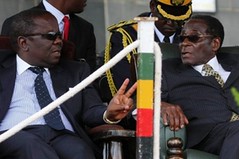
    PRIME MINISTER Morgan Tsvangirai said on Thursday President Mugabe is part of the solution to the political equation in the country and the West should recognise this.

    Addressing delegates to the Zimbabwe-Africa Business Opportunities Day commemorations, PM Tsvangirai advised cynics to accept the reality of the country’s political situation.

    “If there are sceptics in the United States who think and wish one day President Mugabe will wake up dead then they are mistaken,” he said.

    PM Tsvangirai urged the Western world to recognise the progress the inclusive Government had made, particularly in stabilising the economy.

    “We need to be rewarded for the progress. We are not where we are supposed to be, but certainly we are where we never thought we would be sometime last year,” he added.

    The West is understood to be holding back from lifting the debilitating economic sanctions in the hope that the economic malaise can lead to regime change.

    PM Tsvangirai said Government was creating an environment conducive for foreign investment and business should not fear the indigenisation and economic empowerment regulations.

    He explained that under the empowerment programme, Government was not seizing shareholding but wanted it placed on the open market so that ordinary Zimbabweans could buy into large corporations.

    “As government we are working on creating an investment climate that will result in our natural assets being used for economic growth,” he said.

    PM Tsvangirai urged the business community to interact positively with foreign counterparts to promote international investment.

    “If you go out there and paint a bad picture no one will come to invest in the country,” the PM said.

    There have been attempts by the local private and foreign media to demonise Zimbabwe’s empowerment regulations.

    The laws seek to ensure Zimbabweans own at least 51 percent of any companies that are worth more than US$500 000.

    The indiginisation drive has received widespread support from progressive elements of society who believe that it will result in true economic independence following the equally revolutionary land reform programme. — New Ziana-Herald Reporter

  • Foreigners Abducted in Niger Delta

    Friday, April 09, 2010
    22:09 Mecca time, 19:09 GMT

    Foreigners abducted in Niger delta

    Fighters in the Niger delta has launched attacks and abducted hundreds of people since 2006

    Four foreign workers have been abducted by armed men in Nigeria’s oil-rich River State.

    An official said one police officer was killed as the three Syrians and one Lebanese, all working on a construction site, were seized near Port Harcourt in the Niger delta.

    “About 10 or more kidnappers, all armed with automatic weapons, fired many rounds. The hoodlums kidnapped four expatriate workers – three Syrians and one Lebanese,” Rita Abbey, a police spokeswoman, said on Friday.

    “One of our policemen attached to the company was killed by the hoodlums.”

    Abbey said no group or individual had yet claimed responsibility for Thursday’s abductions and no ransom has been demanded so far.

    Hundreds of mostly foreign and local oil workers have been kidnapped in the volatile Niger delta since 2006. Most have been released unharmed, and some were freed only after ransom payments.

    Fighters, who demand that the federal government send more oil-industry funds to Nigeria’s southern region, have launched numerous attacks on oil-installations in the area and fought government troops since January 2006.

    On March 31, a local employee of French oil group Total was abducted on his way to work in Port Harcourt.

    Source: Agencies

  • More Banker Outrage: Protesters Plan Marches on Wall Street Banks

    Published on Friday, April 9, 2010 by ABC News

    More Banker Outrage: Protesters Plan Marches on Wall Street Banks

    Activists, Union Members Will Take to the Streets Again, but Are They Having any Impact?

    by Alice Gomstyn and Rachel Humphries
    ABC News

    Outrage over bonuses, bailouts and home foreclosures have prompted angry demonstrations at bank office buildings, bank conferences and even bankers’ homes since the financial crisis began. With Wall Street reform proposals up for debate in Congress and bank shareholder meetings taking place later this month, protest organizers say they’re getting ready to rally the troops again with several new demonstrations expected to draw thousands.

    “There’s something fundamentally wrong with an economic and political system that allows the big banks to rewrite all the rules to stay afloat while allowing entire communities to collapse in the wake of the disaster caused by Wall Street,” Anna Burger, the secretary-treasurer of the Service Employees International Union , said on a conference call with reporters Thursday. “That’s why we’re escalating and expanding this campaign.”

    The SEIU, one of the most vocal critics of Wall Street and big U.S. banks, is part of a coalition of at least six groups — including the AFL-CIO; the National People’s Action, a racial and economic justice advocacy group; PICO National Network, a faith-based group; and North Carolina United Power, an organization of religious and community groups — planning demonstrations across the country later this month.

    Organizers are calling on banks to help people stay in their homes, offer more small business loans, stop offering financing to payday lenders and stop attempts to block financial reforms. They say they’re targeting their demands at the country’s biggest banks: Bank of America, Citigroup , Goldman Sachs , JPMorgan Chase, Morgan Stanley and Wells Fargo.

    The American Bankers Association, one of the banking industry’s top lobbying groups, declined to comment on the planned protests. Last October, an ABA conference in Chicago drew 5,000 protesters, organizers say.

    A spokeswoman for Bank of America, which will be the target of at least two demonstrations scheduled for later this month, said of the protesters: “While we understand their passion on the issue, we don’t necessarily agree with some of their statements and approaches.”

    On Wall Street itself, news of the planned protests was met with disdain by some of the street’s rank and file.

    “I mean, there is a lot of excess on Wall Street, you know, with the bonuses, but there are people that deserve it,” said Michael Maresca, an information technology employee at JPMorgan Chase. “People down here work very, very hard … I think there’s also a lot to blame outside of Wall Street, with the Federal Reserve, politicians, the Federal Reserve, all those guys that have been involved — there’s a lot of blame to go around, I think. It’s directed at the wrong place.”

    Wall Street Workers Weary of Bank Protests

    Alan Valdes, a trader with DMC Securities, said he didn’t think bank protests help anyone and have kept people from taking advantage of a lucrative rebound in the stock market.

    “We’ve still got problems, and we’ve still got a lot of headwinds ahead — there’s no question about it. But (for the market) to be up 75 percent in a year — that’s a great market,” he said. “To keep bashing Wall Street, I think, is wrong. It sends the wrong message to the public … With all this bashing that’s going on, a lot of people, I think have stayed away from the market.”

    Jerry, an employee at a Wall Street law firm who did not want his last name used, said he didn’t see the new protests accomplishing much.

    “They protest down there all the time,” he said, “but it’s not going to do nothing.”

    How effective previous protests have been remains in question.

    When it comes to changing public policy, behind-the-scenes moves, including lobbying politicians and bureaucrats , typically work better than “outsider tactics” like demonstrations, said Dean Lacy, a professor of government at Dartmouth College.

    While much attention is paid to the massive amounts of cash that banks and lobbying groups pump into political campaigns, Lacy said lobbyists also have an advantage over grassroots protesters because they can make more targeted moves, such as urging a Congressional committee to block a specific provision in a bill or influencing an agency to change its enforcement of an existing policy.

    “Protests tend to not have precise targets but seek broad-based change,” Lacy said.

    Single protests, he said, tend not to be effective. A series of demonstrations like those of the civil rights movement, however, can successfully draw media attention and raise public awareness, which may ultimately lead to policy changes, he said.

    Bank protests thus far, he said, “have probably raised public awareness about executive pay and the bailouts of banks and other financial institutions.”

    Protests are planned for the last week of the month at the Wells Fargo shareholder meeting in San Francisco; at the Bank of America shareholders’ meeting in Charlotte, N.C.; outside a Bank of America building in Kansas City; and on Wall Street. Next month, the groups will also converge on K Street in Washington D.C. to protest banks’ lobbying of elected officials.

    PR Campaign by JPMorgan’s Dimon?

    When asked about the expected protests at their bank buildings, both Wells Fargo and Bank of America representatives cited their banks’ track records in addressing some of the issues raised by activisits.

    A Wells Fargo spokeswoman said the bank recognizes that “Americans are demanding more from their financial institutions during these difficult economic times” and that it is “committed to serving the financial needs of businesses and individuals, keeping credit flowing, and working to help those in financial distress find solutions.”

    The bank, she said in an e-mail, provided $711 billion in loans and lines of credit last year.

    A Bank of America spokeswoman said that BofA last year extended $758 billion in credit in both the consumer and commercial sectors, more than any other bank, and that it has invested more than $8 million in grants to tackle hunger and housing needs. Information about the Bank of America’s work in these areas, she said, is available in its quarterly impact statement on the bank’s Web site.

    In Thursday’s call, Burger singled out JPMorgan Chase CEO Jamie Dimon as “leading the PR campaign to rebrand Wall Street,” noting that the bank spent $6.2 million on lobbying last year.

    “The American people aren’t buying Jamie’s PR campaign,” she said.

    A JPMorgan Chase spokeswoman declined to comment.

    JPMorgan Chase is known, along with Goldman Sachs, for avoiding many of the pitfalls of the financial crisis.

    In his annual letter to shareholders earlier this month, Dimon said “punitive efforts” against banks hurts ordinary shareholders and that”vilify(ing) whole industries” denigrates “much of what made this country successful.”

    “When we reduce the debate over responsibility and regulation to simplistic and inaccurate notions, such as Main Street vs. Wall Street, big business vs. small business or big banks vs. small banks, we are indiscriminately blaming the good and the bad ? this is simply another form of ignorance and prejudice,” Dimon wrote.