Blog

  • Verizon’s doing something on Monday … Incredible? Or just Pink? (or football?)

    Verizon Monday

    So Verizon has some "journey" that it’s beginning on Monday. While we’re all waiting on the HTC Incredible to be announced any day now, we’re not quite sure it fits the "it’s new, it’s unique" line that Big Red’s touting here. Instead, it’s quite possible that it’s referring to the fabled Microsoft "Project Pink" that’s also rumored to be announced then, and that certainly would match up the "let’s get social" line. (FWIW: Engadget’s thinking the same thing.)

    Hey, we definitely want to see the Incredible announced and released, like, yesterday. But we’re not going to put all our eggs in that basket just yet. [via BerryScoop]

    Update: @slundberg01 offers another theory: "The journey on Monday for Verizon is NFL mobile. It releases Monday. There will be new phones but that’s not Monday. that’s why if you look at that flyer it was a football thrown through the paper."

  • Macy Gray “Beauty In The World” Music VIDEO Premiere

    Check out the new video from Macy Gray: “Beauty In The World” is the first single from the Grammy winner’s upcoming fifth studio album, The Sellout.


  • Juliet vs. Juliet: Did Someone Forget To Tell Hollywood You Can’t Copyright An Idea?

    A few years back, we wrote about the oddity of Hollywood studios often paying newspapers or others for “the rights” to a particular news story. But, there’s no legal reason why you need to do so (with — potentially — a few exceptions for the more modern concept of publicity rights) in most cases. That’s because a news story is based on facts, and you can’t copyright facts. You also can’t copyright an idea. Now, there are plenty of good reasons why movie studios do pay for such “rights” even if they don’t need to. For example, by licensing the rights, they also get access to certain people who know the story better than others. It also can lend an air of legitimacy to the movie. However, perhaps one reason why studios license the rights to an idea or a news story is because they don’t even realize they don’t have to.

    That’s the only explanation I can come up with for the ongoing lawsuit between two movie studios over who can make and/or release a movie about people seeking advice in love by leaving letters at the supposed gravestone of Juliet Capulet (of “Romeo &” fame). Apparently, two separate studios made movies on the topic, and one is suing to stop the other from releasing the movie.


    There’s Summit Entertainment, who is releasing a movie called Letters to Juliet, which they made after licensing a book by the same name, that told the story of the letters left at the gravestone and of a girl who responds to one of them. But then there’s EPV Enterprises, who is asking for Summit’s movie to be blocked, noting that it’s working on a “Juliet” movie itself, called Dear Juliet — which it licensed from a group called Club di Giulietta, who has (in real life) been responding to those letters.

    While the two movies may be based on the same premise, it sounds like they’re very different in terms of the actual story. And we’ve certainly seen similar movies come from multiple studios around the same time (Antz/Bugs Life, Dante’s Peak/Volcano, Deep Impact/Armageddon, The Illusionist/The Prestige, etc…). While Summit says it’s working to settle the lawsuit before a ruling is reached, it seems likely that it should prevail in any lawsuit as well. You can’t copyright facts or basic ideas — and it doesn’t look like these two movies are the same — just built off the same idea.

    Permalink | Comments | Email This Story


  • Toyota develops “SMART” process for quick on-site evaluation of uninteneded acceleration cases

    Filed under: , ,

    Ever since the whole Toyota recall debacle exploded late in 2009, one of the company’s biggest problems has been the way it has responded to the problems. Many have criticized Toyota for either ignoring the problems or pretending that there is nothing wrong, but the company is now seeking to address that appearance by setting up rapid response teams to deal with reported incidents of unintended acceleration.

    For example, when a pair of alleged “unintended acceleration” incidents happened in San Diego and Connecticut, Toyota jumped in, sending out investigators to join government officials in trying to find out what happened.The new Swift Market Analysis Response Team (SMART) will now be immediately dispatched to the site of any reported unintended acceleration incident. The teams will consist of product engineers, field technical specialists and specially trained dealer technicians.

    Whenever dealers or Toyota are notified of an incident, the SMART team will head out to the site to evaluate the vehicle and gather evidence. Engineers from Toyota’s Japanese product development teams will also assist in the analysis. Hopefully, a more thorough investigation of every reported case will provide Toyota with a larger pool of data from which it can gain a better understanding of what may or may not be happening. Even if there is not actually a problem, Toyota needs to prove so conclusively, because if these kinds of incidents continue happening, they will only damage the company’s reputation further. Official press release after the jump.

    [Source: Toyota | Image: CNN]

    Continue reading Toyota develops “SMART” process for quick on-site evaluation of uninteneded acceleration cases

    Toyota develops “SMART” process for quick on-site evaluation of uninteneded acceleration cases originally appeared on Autoblog on Fri, 09 Apr 2010 13:58:00 EST. Please see our terms for use of feeds.

    Permalink | Email this | Comments

  • Electrically powered truck can haul thousands of pounds of freight

    balqon.jpg
    At the mention of an electric vehicle, the only picture that comes to mind is of a compact 2-4 seater vehicle. However, the Port of Los Angeles has recently put into service world’s first all-electric truck, the Balqon XE20. Powered by lithium-ion batteries, the Balqon XE20 can cover a distance of 50 miles on a complete charge. It takes 6-8 hours to charge completely. It also has a quick charge facility which charges the Li-ion batteries up to 60% in an hour. The locally built XE20 can carry a staggering 60,000lbs of freight, which is equal to a fully loaded 40-feet container.

    These freight trucks make more than 1.2 million trips between the Port of LA and a local railyard. If the all-electric XE20s were to be used for this purpose, it could eliminate around 35,000 tonnes of tailpipe emissions. The XE20 is a great way to conserver the environment while saving on fuel costs.
    [wired]

  • Fun Blogs: Where We Post For the Love of It

    Link blogs, light blogs, blogs on the side; found treasures and half-formed thoughts – it turns out that many members of the ReadWriteWeb team are also publishing on Posterous, Tumblr and other casual blogging platforms.

    These are the places you can learn about the people behind the news and analysis here at ReadWriteWeb. Where you can find cool little videos and images that we want to share but that don’t cross the thresh-hold for full-scale RWW blogging. Publishing and reading on these platforms is a lot of fun. We’ve listed some of the fun blogs published by members of our team below. We’d love for our readers to share links to your sites like this if you have them.

    Sponsor

    Richard MacManus, our Founder and Editor, writes about his travels outside his home in New Zealand, music, books and art using the Soup.io platform at VelvetsFan.com.

    I, Marshall Kirkpatrick, maintain a Posterous blog at Marshallk.posterous.com. I post a lot from my phone there, I post images and random thoughts about life in Portland, Oregon, my chickens and the tech news industry.

    Morning writer in Florida Sarah Perez uses Tumblr at sarahintampa.tumblr.com to post “random pictures, videos and infographics I come across on the web,” she says.

    Portland based morning news writer Frederic Lardinois scored the cool domain DishWasherOnMars and uses it to post “stuff I don’t get to blog about and that I want to share with my Twitter followers.”

    Morning news writer Mike Melanson records his experiences as a hyper-mobile blogger in Austin, Texas on his Posterous blog.

    RWW’s webmaster Jared Smith shares “(hopefully) useful tidbits about Web development, UX, and other geeky pursuits” on his Posterous from Charleston, South Carolina.

    Portland based Enterprise and ReadWriteCloud writer Alex Williams uses Tumblr at AlexHWilliams.com. “Hazard is my middle name,” he says and he’s not kidding, it really is. He calls it “my place to feed my personal interests.”

    Production Editor Abraham Hyatt is in Portland, too and publishes “just your run-of-the-mill photo blog” on his Posterous.

    Eugene, Oregon based research team member and ReadWriteStart contributor Audrey Watters uses Posterous too. She says it’s “where I post my ideas too long for twitter and too malformed for my blog.”

    Portland-based Justin Houk, a member of the research team here as well, calls GeoPDX.net his “say anything, speak my mind, and voices in my head blog.”

    How about you, dear readers? Where is the ReadWriteWeb community posting their found items, fleeting thoughts and other curated digital ephemera? We’d love to know, so share your link in comments below. We’d love to know what these services mean to you, too.

    Discuss


  • Will Employment Improve More Quickly Than Anticipated?

    With retailers reporting cheerier reports for March than analysts expected, some economists and econo-pundits are beginning to revise their skepticism about the duration of high unemployment. The logic goes: if spending ramps up more quickly than anticipated, then the U.S. economy will improve fast too. That will create more jobs than we thought.

    For a few examples of newfound optimism, check out a Bloomberg article here and one by Floyd Norris in the New York Times here. Is there now reason to believe that employment will experience a steep recovery? Not when you consider the structural changes in the economy and depths of underemployment.

    Structural vs. Cyclical

    Most recessions are cyclically driven. The business cycle hits a trough, firms lay off workers. As the economy recovers, those workers get hired back before long. This time it’s different. The real estate industry experienced a major correction. Many people who were in that sector can expect to experience prolonged unemployment. Even when the broader economy improves, real estate will not return to its 2005-2006 levels.

    Proof of this can be seen by analyzing the latest job numbers from the BLS and comparing them to stats in prior reports. The economy has lost 8.2 million jobs since the recession began in December 2007. That’s 5.9% of total jobs at that time. The key is thinking about how those might be recovered.

    Construction is a perfect example of an industry with real estate-driven jobs that won’t be coming back for a very long time. The sector saw a peak around August of 2006, with 7.7 million jobs. As of March, there were just 5.6 million. That’s loss of 2.1 million jobs, representing a 28% decline. The financial services industry tells a similar, but less severe, story: it lost 750,000 jobs since December 2006, amounting to 9%. Again, many of those aren’t coming back.

    Now compare that with cyclical industries. Leisure and hospitality is a perfect example. It lost 500,000 jobs, but that was just a 3.7% decline. Retail trade is also cyclical. Its decline was more significant at 7.3%, but that’s still lower on a percentage basis compared to the structural losses above.

    Underemployment Much Worse

    The official unemployment numbers don’t tell the whole story either. There are also other Americans who want jobs but aren’t included in these totals for reasons like being discouraged. In addition to the 15 million unemployed according to BLS, an additional 5.7 million more want a job but don’t have one. There are 1.4 million more people in this category than in March 2007.

    A much grimmer number would include those wanting to work full-time but can only find part-time work. They are considered employed, even though their job situation is unsatisfactory. This accounts for another 9.1 million Americans. That number was less than half that — just 4.2 million — in March 2003.

    This means, in addition to the 15 million unemployed, there are another 14.8 million who are underemployed. A true labor market recovery would need to find those others full time jobs as well. So the mountain that the U.S. economy must climb to pull out of this recession is much higher than even the 9.7% unemployment rate suggests. In order to get us back to the 4.4% “natural” unemployment rate in March 2003, we need 14.4 million more full-time jobs. Even if we have a steady growth of 300,000 jobs per month (about twice the 160,000 in March), then that would still take four years.


    Email this Article
    Add to digg
    Add to Reddit
    Add to Twitter
    Add to del.icio.us
    Add to StumbleUpon
    Add to Facebook


  • BMW Classic Center Now Accepts Customer Cars, Adds Motorsports Division

    Our appreciation for roundel-badged vehicles extends to legacy BMWs, so we’re happy to learn that the German automaker is increasing its support for classic vehicles.

    The biggest news is that the BMW Classic Center has opened its doors to the public. Heretofore the division only worked on restoring and maintaining historic vehicles for the company’s internal collections. The new Historic Workshop will accept commissions from outside customers who want their Bimmer or Beemer rebuilt.

    Current projects in the workshop include a 1970s-era BMW 3.0 CSi. Though that particular model was only ever offered with a manual transmission, the car’s current owner wants an automatic swapped in instead—we cry heresy. Regardless, the Historic Workshop has access to company documents and tools that will make the swap possible. They’re also restoring an M1 which was left outside in Malaysia for so long that it was filled with termite nests.

    If you want to do the resto work yourself, BMW Classic Center offers a growing list of original (i.e. from BMW) parts, starting with those for the R 24 motorcycle that entered production just after World War II, up through the 1994-model-year 7-series. Also available are reconditioned engines with a two-year warranty: send BMW your old, broken mill and they’ll send back a replacement that’s “as good as a new engine.” The parts catalogue is online at www.bmw-classic.com.

    And if they don’t have the part you need, BMW Classic Center can make it. The Historic Workshop has access to original technical drawings, so if the tooling for certain parts has been lost or destroyed, they can recreate parts from scratch. To prevent that from happening, though, the Classic Center takes custody of as much tooling and production equipment as possible after production of a car or bike is discontinued.

    Of course, not every BMW fan lives in Germany. There’s now a BMW Classic Center in Switzerland and the company will soon open shop in the U.S.

    If you race a classic BMW, you’re in luck too. BMW Classic has launched a motorsports division that caters to providing parts and restoration help for owners who race their cars. Some of those are road cars converted to track duty, while others are historical BMW racers still seeing competitive action. To demonstrate its prowess, the motorsports group will rebuild a 1964 Mini Cooper S Mark 1 and a 1970s-era BMW 1602 Touring for racing duty.

    Related posts:

    1. BMW Adds Real-Time Fuel Prices, Weather, and Stock Quotes to BMW Search
    2. 2012 BMW 3-series Adds a Turbo Four, Hybrid, and Hatchback to the Range – Car News
    3. Old Cars in Frankfurt: Big BMW Bloodlines
  • How Can Business Profitably Solve Environmental Problems?

    Mix together equal parts Fortune 500 senior executives, environmental activists, cleantech journalists, investors and other leading green thinkers, sprinkle them throughout panel discussions over three days in Southern California and what do you get? Brainstorm Green! The second annual conference from Fortune Magazine will be held next week and promises to be quite the green business event.

    The theme of the conference is “How can business profitably help solve the world’s big environmental problems?” and the agenda includes speeches from Walmart Chairman Lee Scott, founder and editor of Whole Earth Catalog Stewart Brand, Patagonia founder Yvon Chouinard and many more. There are panel discussions on everything cleantech: biofuels, electric vehicles, nuclear energy and even clean coal (asking if it’s an oxymoron). Other panel topics include building a sustainable supply chain, developing a corporate water strategy, motivating employees with green and geoengineering.

    If you aren’t planning to attend, you have two options to follow the action. First, Fortune will allow free online viewing for portions of the conference. In talking to conference organizers, it sounds like they already have hundreds of people signed up. Second, I will be in the audience, posting thoughts on Twitter and reporting details on this blog. If you have any questions that you would like to see asked of the participants, leave them in the comments below or tweet them at me.

  • Vonage Arrives for T-Mobile and AT&T Handsets


    Vonage has announced the release of their new Android application for T-Mobile and AT&T customers. Starting immediately, users can download the free app and enjoy free domestic WiFi calling as well as outbound international calling at discounted rates.

    “We are focused on ensuring that our customers can enjoy all the benefits of their Vonage service from any location using any device that can access the Internet,” said Michael Tempora, senior vice president of product management. “We will continue to expand our offerings in 2010 to include a robust set of voice and messaging services that utilize Wi-Fi and 3G wireless networks.”

    Features of Vonage Mobile include:

    • UNLIMITED calling to more than 60 countries for only $24.99/month†
    • Dial directly from your existing address book contacts without calling cards or PIN codes
    • Works with your existing mobile phone and current rate plan‡
    • Plus, make unlimited local and long distance calls over WiFi* when you’re abroad using mobile VOIP, without wasting cell minutes

    Most Commented Posts


  • Elizabeth Taylor Engaged To Wed Jason Winters

    Ninth time’s the charm for Dame Elizabeth Taylor. Celebrity informants are reporting that the screen legend, now 78, recently accepted a proposal from 49-year-old businessman Jason Winters, who happens to be Janet Jackson’s new manager.

    A tipster tells Us Weekly: “It’s no secret that they’ve been together forever and are in love, so it wouldn’t be a surprise if they were engaged. Right now they are keeping it between them. She didn’t think she’d fall in love again, but since Jason came into her life that has all changed.”

    Some of Liz’s previous marriages include Conrad Hiton (the grand-uncle of Paris and Nicky Hilton) Eddie Fisher (Carrie Fisher’s father; he famously left Debbie Reynolds for Liz), and Richard Burton (two separate times).
    Taylor was last married to construction worker Larry Fortensky. That marriage ended in divorce in 1996.


  • Sensible pessimism

    IN TODAY’S New York Times Floyd Norris makes the case that the relative pessimism concerning the state of the American economy is overdone, and things are actually looking pretty rosy. I think there is a grain of truth to his analysis, in that expectations tend to lag events, and so the economy will persistently surprise to the downside during contraction and persistently surprise to the upside during recovery. And he’s right that the American economy has almost certainly exited recession (though silly in chiding Barack Obama for being cautious about declaring as much, given the state of the labour market). But I think that worriers are right to approach this recovery as cautiously as they have. Mr Norris writes:

    The employment report for March, released a week ago, was a milestone that has been little noted. The household survey, from which the unemployment rate is calculated, showed a gain during the first quarter of this year of 1.1 million jobs, the best performance since the spring of 2005.

    True, the more widely reported numbers from the survey of employers are not as good. But those numbers are subject to heavy revision as better data becomes available. At the turning points for employment after the last two downturns, those numbers turned out to be far better than was reported at the time.

    He’s right about the employment gain. But employment remains about 7.5 million jobs below the peak level of November 2007. And in the meantime, population has grown. So here’s what that employment recovery looks like, adjusted for growth in the total population:

    That’s the evolution of the employment-population ratio. Feel the good vibes? And that, essentially, is the whole of Mr Norris’ argument. That while the scale of the job loss in this recession has been easily the worst in the postwar period, that while the age-adjusted unemployment rate has been easily the highest of the postwar period, that while the share of unemployed in the category of long-term unemployment is easily the highest of the postwar period, there has nonetheless been an increase of in employment of 0.8% over the last quarter. He also mentions that stock prices are up. True, but the jobless recovery has provided a boost of sorts there, as higher productivity and stagnant wages have goosed corporate profits.

    The broader economy is all right. Housing is weak enough to still be dangerous, but recovery looks fairly safe for the moment. Those with full-time jobs are much less likely to lose them than they were a year or six month ago. But there are 15 million unemployed Americans, and hiring is at record low rates. That suggests a long and grinding end to above-normal unemployment. Mr Norris closes:

    In 1982, Democrats scoffed at a surging stock market and thought a severe recession would last for a very long time. They were confident that the economy would doom Ronald Reagan’s re-election campaign in 1984. All they had to do was make clear they offered a stark alternative to the failing policies of the incumbent.

    Change a few words (Reagan to Obama, Democrats to Republicans, 1984 to 2012) and you have an accurate description of the current political climate. Could the Republicans be as wrong now as the Democrats were then?

    Mr Reagan was re-elected, and frankly, the odds for Mr Obama’s re-election look pretty good. It’s worth pointing out that the change in the unemployment rate is as important to public opinion as is the level. But remember, the election of 1984 came two full years after the end of recession, and those were two years during which economic growth was far more rapid than anything being forecast for America by any reputable organisation. Annual real economic growth in 1984 was 7.2%. And the share of long-term unemployed workers in total unemployment peaked at half the current level in the recession of the early 1980s. And in November of 1984, the unemployment rate was still 7.2%. When this recession began, the unemployment rate was 4.7%. In the last recession, the unemployment rate never got above 6.2%.

    The state of the labour market is a real worry, and the effect of the drag from high levels of long-term unemployment is difficult to predict. Now is no time to declare victory and take a vacation.

  • Why the President’s Targeted Killings are Illegal (According to Professor O’Connell)

    by Julian Ku

    Kevin has done, and is doing, a very nice job of critiquing the legality of the Obama Administration’s targeted killing policy.  On the critical side, it is also worth noting the views of Mary Ellen O’Connell, Professor at Notre Dame, who has become a leading public critic of the legality of this policy.  Her basic point is that international law only permits such killings on the battlefield, and any killings off of the battlefield (as she defines it) are illegal acts of extrajudicial murder. This would be true whether or not the U.S. actor is a privileged combatant.  I think this makes sense, even if I doubt it is right.  It does show, however, that the Obama and Bush Administration’s policies as to the nature of this war is pretty close (and getting closer).  Because it is President Obama, and because he has folks like Harold Koh, Neal Katyal, and Marty Lederman to defend these views, I don’t think there will be nearly the same level of controversy as during the Bush years.

  • Methuselah Protocol


    I established some months back that a reinterpretation of the Noah story in concert with other conforming conjectures told a story of the establishment of human colonies on the post Pleistocene Nonconformity Earth.  The text itself retains survivals that supported both the story and the likelihood this text was a translation of an original report in an original language.

    It follows that the initial leaders of the colony retained their original life spans during the millennial build out of the colony.  We have the lifespan of Methuselah in particular.

    Science is now clearly unraveling the necessary protocols to extend human life spans and this report by this company in the midst of the necessary research endeaver pretty clearly spells out were we are at.    There is obviously rising optimism and the suggestion that this generation may well gain some of the benefits.

    If we accept the Methuselah story as just given and I suggest that my reinterpretation gives us a consistent data base and little choice, then this work is about restoring that level of human longevity.  It is not about immortality but about been able to spend a great number of years in the fullness of health on earth.

    That is well worth supporting.

    Overview of BioTime’s Reversal of the Aging of Human Cells

    An Overview with Questions & Answers


    Summary:
    • BioTime and its collaborators reported on March 16, 2010 in a scientific paper titled “Spontaneous Reversal of the Developmental Aging of Normal Human Cells Following Transcriptional Reprogramming” the reversal of human cellular aging. The paper is online at
    • The Company reported that by selecting for cells with sufficient levels of the immortalizing protein telomerase, they were able to reset the clock of aging back to the embryonic state.
    • Using the new technologies of reprogramming, BioTime scientists showed that time’s arrow of development, as well as aging, could be reversed.
    • BioTime revealed why existing Induced Pluripotent Stem (iPS) cell lines being studied showed signs of premature aging, and a means to overcome that roadblock.
    • This new capability does not require the use of human embryos or egg cells.
    • BioTime’s reversal of developmental aging may be the seed for future technologies that will one day allow young cells of any kind to be produced that might be useful for aging patients in repairing the heart, the blood system, the brain, and the retina, as well as many others applications. In this way, we might increase the “healthspan,” that is, the years free from expensive and debilitating disease.
    The Role of Gerontological Research in Society Today
    The science of the biology of aging (gerontology) is increasingly a strategic focus for the medical community, the pharmaceutical industry, and government. The United States, China, and many other developing countries are about to experience an unprecedented tsunami of aging people with an unprecedented demand for medical care associated with the chronic debilities of aging. Data on this demographic trend published by the Bureau of the Census is available online on this site or from the US Census Bureau at http://www.census.gov/prod/2006pubs/p23-209.pdf.

    A Brief Summary of BioTime’s Technology

    The approach BioTime scientists have taken to devise new strategies for the treatment of age-related disease begins with the recognition that the human life cycle uses both “mortal” and “immortal” cells. One of the remarkable things about life is that it continues generation after generation through our children, while the individual human being inevitably ages and dies. Curious about how some cells (those in the reproductive lineage also known as the germ-line) accomplish this unending task, gerontologists began to investigate the internal molecular machinery of life, looking for the differences in mortal and immortal cells. “Immortal” cells are those of the reproductive lineage that have the potential to continually make babies generation after generation, forever. In contrast, the cells of the human body such as blood, brain, and muscle cells (somatic cells) have an irrevocably finite lifespan and are therefore called “mortal.” An amazing fact about life is that our bodies are the offshoots of lines of these immortal cells that have been proliferating since the dawn of life on earth. They, unlike the individual human being, have no dead ancestors. So, the question is, “Why?”



    Figure 1. The dichotomy of germ-line and somatic cells. Germ-line cells continue in an unlimited immortal proliferation of mitosis and meiosis (the latter not shown) while somatic cells are destined to die with the individual.

    The “Clock” of Cellular Aging

    In the 1960s, Leonard Hayflick demonstrated that cells from the human body have a finite capacity to divide. That is, when grown in the laboratory, they divide perhaps 70 times and then age and stop. In the years that followed, gerontologists began to study this aging of cells in the lab dish in an effort to solve the riddle of human aging. Finally, in the late 1990s, the use of Dr. Hayflick’s cellular aging model led to the identification of the central clocking mechanism. The “clock” of cellular aging was shown to be in the DNA of every cell, in a region called the “telomere” or “end part” of the chromosomes. Telomeres have often been compared to the protective plastic ends on our shoelaces (see Fig. 2 below). In 1998 it was demonstrated that a gene expressed in the germ-line cells called telomerase continually rewinds this clock of aging, keeping it at the appropriate embryonic setting, allowing the reproductive cells to proliferate without limit and making babies born young. However, when cells begin to branch out to make the human body, the immortalizing enzyme is turned off and as a result, telomeres shorten every time cells divide (hence their mortality). Telomeres are long enough at the beginning of life to allow all the cell doublings necessary to make a baby, to allow the person to grow to adulthood, and to allow cell division in the adult for up to approximately a century. However, progressively over time, telomeres shorten; aged (senescent) cells accumulate in tissues throughout the body and are thought to lead to age-related changes in the body.



    Figure 2. Human chromosomes are shown in blue. Telomeres are illuminated in green at the chromosome ends.

    It was appreciated very early on that cancer cells have abnormally reactivated the immortalizing enzyme, telomerase, giving the rapidly proliferating tumor cells the ability replicate out of control forever. So, to intervene in aging without causing an undue risk of cancer, scientists sought a way to carefully turn telomerase on when needed and then to turn it off again to make young (but not immortal) cells to repair the tissues worn out with age in the human body.

    The approach settled on was to attempt to isolate cells from the immortal human germ-line that naturally maintain long and youthful telomeres when they are in the germ-line state and that turn off telomerase when the cells of the human body begin to form as they do naturally in each human generation. In 1998 the first such naturally immortal cells were cultured from the human germ-line and they were called “human embryonic stem cells.”

    There was a great deal of excitement in the scientific community relating to these cells because for the first time it was possible to devise technologies that would allow the manufacture of all the cells of the human body on a very large scale. This, in principle, could lead to a wide array of products useful in repairing tissues like the heart, brain, bones, eyes, and many other tissues that have never been possible to repair before. As a result, this new field came to be called “regenerative medicine.”

    However, the fact that these cells came from the earliest stages of human life, shortly after the egg cell is fertilized by sperm, has caused the use of human embryonic stem cells to be controversial for some people. In 2001, President Bush allowed federal funding to be used on embryonic stem cell lines created before 2001, but not those made thereafter. This despite the fact that the embryos had not yet begun to develop (i.e., were not yet a pregnancy), and were destined to be discarded in the process of in vitro fertilization (IVF).

    A Cellular Time Machine

    In 1997 when Dolly the sheep was cloned, it occurred to some scientists that the transfer of DNA from the aged cells of the body into an egg cell was capable of changing the state of the cell in what could be compared to a cellular time machine. Despite the rumors that Dolly the sheep was born old because she came from an aged breast cell (hence her being named after Dolly Parton), scientists soon demonstrated that the cloning process really could reverse both the process of specialization of the body cell to make embryonic cells again, and surprisingly, cloning could also reset the clock of aging in cells. So, just like the immortal perpetuation of the species, cloning would allow a baby animal cloned from an aged body cell to be born young, and theoretically, the process could be repeated forever. If this could be tapped in the cause of medicine, it might be possible, similarly, to make unlimited young replacement body cell types forever to repair cells and tissues worn out with age. Early efforts to clone human embryonic stem cells, a process called therapeutic cloning to distinguish it from human reproductive cloning (the cloning of a human being), led to cloned embryos that would only grow to a small number of cells. In addition to the difficulties in making human therapeutic cloning efficient, the difficulty of sourcing human egg cells and the intense ethical controversy over the use of cloning in medicine made progress in the field relatively difficult. The good news is that in the years that followed, scientists identified some of the molecules within the egg cell that accomplish the work of cloning. These discoveries allowed these molecules to be used in such a way that egg cells were not required and no embryos were cloned. In other words, a cell type, such as a skin cell, could be coaxed back to an embryonic state in an ethically noncontroversial manner. Because these cells do not come from an embryo, they are called “induced pluripotent stem (iPS) cells” instead of embryonic stem cells. This transformation of a body cell back to an embryonic state uses proteins that are master regulators of other genes called “transcription factors.” Therefore this process is called “transcriptional reprogramming” or “iPS” technology. These cells exhibit pluripotent capabilities, meaning they have the potential to mature into all of the cell types or tissues types — skin, blood, bone or retinal cells, for example.



    Figure 3. By understanding the molecules called “transcription factors” within the egg cell that is capable of returning cells in the body back to an embryonic state, they were able to turn back the clock of biology, a process called “reprogramming.”
    However, recently, scientists reported that iPS cells show evidence of premature aging when induced to become cells of the body such as blood-forming cells (Feng et al, 2010). In some cells that have abnormal regulation of telomerase — an enzyme that maintains telomere length, there was evidence that iPS could at least partially rewind the clock of aging (Agarwal; et al, 2010); however, suggestions that iPS cells might generally be prematurely old caused concern over the new technology.

    Reversal of Developmental Aging

    In BioTime’s report, we show that the premature aging observed in the existing iPS cell lines studied was due to the fact that the telomere clock of cellular aging in at least many of the lines being used in the scientific community is set at a relatively old (short) level. However, using a system where cells with the same DNA type at young embryonic states, as well as aged states were used, BioTime scientists reported that by looking for cells with sufficient levels of the immortalizing protein telomerase, they were able to reset the clock of aging back to the embryonic state. So, both the process of development wherein the germ-line cells specialize into the cells of the body, and also the telomere clock of aging was reported in the study. This reversal of developmental aging may be the seed for future technologies that will one day allow young cells of any kind to be produced for aging patients for use in repairing the heart, the blood system, the brain, and the retina, as well as many others applications.


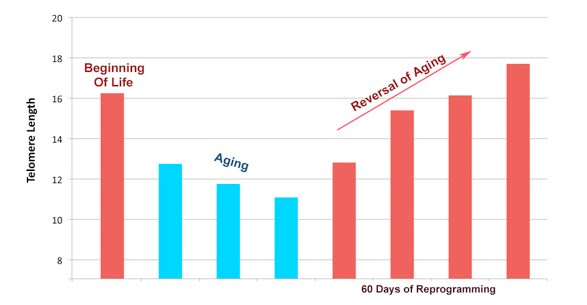
    Figure 4. In BioTime’s publication, the clock of cellular aging (telomere length) was measured in cells at the very beginning of life (embryonic stem cells). Then body cell types were made from those cells and they were observed to become mortal and to age from telomere shortening. Then, using these cells with the same DNA type, the application of iPS cell technology with careful studies of the levels of the immortalizing gene telomerase, allowed the complete reversal of developmental aging.

    A presentation Dr. Michael West, CEO of BioTime Inc., recently gave on this technology is available online at 

    Shaping a U.S. Policy on Interventional Gerontology
    We are at a critical nexus in our history. The aging of our population is occurring at an unprecedented rate due to the aging of the baby boom population. The cost of this age wave will cause economic, as well as personal human suffering. The United States has historically approached serious challenges in the past with courage and creativity, with an eye on the compassionate application of science. There is just enough time to begin to apply the new advances in regenerative medicine if we begin today.


    Figure 5. Summary of the reversal of developmental aging. In normal development and aging, the immortal cells from the reproductive lineage of cells make all of the cells of the human body that will age and die with the individual. Using the new technologies of reprogramming, BioTime scientists showed that time’s arrow of development as well as aging could be reversed, potentially one day leading to the ability to make any young cell type useful in repairing those worn out with age.

    Dr. Michael D. West is the Chief Executive Officer of BioTime, Inc. (NYSE-Amex: BTIM) and OncoCyte Corporation of Alameda, California. The Companies are focused on developing an array of research and therapeutic products using human embryonic stem cell technology. He received his Ph.D. from Baylor College of Medicine in 1989 concentrating on the biology of cellular aging. He has focused his academic and business career on the application of developmental biology to the age-related degenerative disease. He was the Founder of Geron Corporation of Menlo Park, California (Nasdaq: GERN) and from 1990 to 1998 he was a Director, and Vice President, where he initiated and managed programs in telomerase diagnostics, oligonucleotide-based telomerase inhibition as anti-tumor therapy, and the cloning and use of telomerase in telomerase-mediated therapy wherein telomerase is utilized to immortalize human cells. From 1995 to 1998 he organized and managed the research collaboration between Geron and its academic collaborators James Thomson and John Gearhart that led to the first isolation of human embryonic stem and human embryonic germ cells. From 1998 to 2007 he was President and Chief Scientific Officer at Advanced Cell Technology, Inc. (OTCBB: ACTC) where he managed programs in animal cloning, human somatic cell nuclear transfer, retinal differentiation, and ACTCellerate, a technology for the multiplex derivation and characterization of clonal human embryonic progenitor cell lines.
    About BioTime, Inc.

    BioTime, headquartered in Alameda, California, is a biotechnology company focused on regenerative medicine, blood plasma volume expanders, and low temperature medicine. BioTime develops and markets research products in the field of stem cells and regenerative medicine through its wholly owned subsidiary Embryome Sciences, Inc. BioTime’s subsidiary OncoCyte Corporation focuses on the therapeutic applications of stem cell technology in cancer. BioTime also plans to develop therapeutic products in China for the treatment of ophthalmologic, skin, musculo-skeletal system and hematologic diseases, including the targeting of genetically modified stem cells to tumors as a novel means of treating currently incurable forms of cancer through its subsidiary BioTime Asia. In addition to its stem cell products, BioTime markets blood plasma volume expanders and related technology for use in surgery, emergency trauma treatment, and other applications. BioTime’s lead product, Hextend®, is a blood plasma volume expander manufactured and distributed in the U.S. by Hospira, Inc. and in South Korea by CJ CheilJedang Corp. under exclusive licensing agreements. Additional information about BioTime can be found on the web at www.biotimeinc.com.
    Forward-Looking Statements

    Statements pertaining to future financial and/or operating results, future growth in research, technology, clinical development and potential opportunities for the company and its subsidiary, along with other statements about the future expectations, beliefs, goals, plans, or prospects expressed by management constitute forward-looking statements. Any statements that are not historical fact (including, but not limited to statements that contain words such as “will,” “believes,” “plans,” “anticipates,” “expects,” “estimates,”) should also be considered to be forward-looking statements. Forward-looking statements involve risks and uncertainties, including, without limitation, risks inherent in the development and/or commercialization of potential products, uncertainty in the results of clinical trials or regulatory approvals, need and ability to obtain future capital, and maintenance of intellectual property rights. Actual results may differ materially from the results anticipated in these forward-looking statements and as such should be evaluated together with the many uncertainties that affect the company’s business, particularly those mentioned in the cautionary statements found in the company’s Securities and Exchange Commission filings. The company disclaims any intent or obligation to update these forward-looking statements.
  • Basically, Investors Aren’t Even Remotely Concerned About Holding Stock Over Greece’s Big Weekend

    happy turkey

    All those emergency meetings and fears of a bank run aren’t scaring investors.

    Dep ite it being a Friday and all, and despite the opportunity to sell for a little profit after some volatility earlier in the week, stocks are comfortably.

    It’s hard not to think this is moral hazard writ large. Nobody really thinks leaders will allow anything bad to happen (no matter how much they talk), so it’s too early to jump off the train.

    Though there’s still a little over an hour to go, so… who knows.

    Join the conversation about this story »

  • Tube Downloader – A different way to get videos and music to your device

    Have you ever been looking for a song or video and you just can’t seem to find it anywhere else but YouTube, Daily Motion, or Google video? I’ve encountered that problem several times when the song on YouTube is a remix of a song I like. With Tube Downloader, not only are you able to download videos from YouTube, Daily Motion, and Google video but you’re also able to choose if you’d like to only download the music.

    Tube Downloader Free by Koyote Soft Mobile allows you to search for the video straight from the app. It then takes you to the results page where you can find the video you’re looking for. When a video is selected a menu comes up with options in which you can preview the video before downloading, an information tab, download as video option, download as Mp3 (medium quality) option, and also a download as AAC (Highest Quality) option.

    Pros

    • You can strip a song from the video directly on your phone.
    • Different formats – Mp3, AAC

    Cons

    • It takes a really long time to fetch videos or even preview them.
    • Many people on the market have complained that the app has stopped working or gives constant errors. I’ve experienced a few of these errors but overall you can see past these errors but a fix would be much loved by everyone.

    Final Verdict: This app is a definite must have on any phone. There is a free version and a paid version. The free version is a pretty awesome. The paid version is €1.99 and the developer well deserves it for such a great app.

    Note: This review was submitted by Erick Romero as part of our app review contest.

    Phone and version used: Nexus One, version 1.14


    Related Posts

  • Google updates Nexus One for Wind Mobile compatability

    wind nexus

    The Nexus One finally became official in Canada, where it first started on Rogers, then followed by Bell and Telus, and now Wind Mobile has been added to the list of official carriers. While many users have already been using their Nexus One’s on Wind Mobile, it is always good to see the name officially on the list. So yet another carrier to become official on the Nexus One before Verizon and Sprint, what gives? [via Mobile Syrup]

  • Should Canadians go shopping for U.S. stocks?

    Stephen Gordon, a professor of economics at Laval, is skeptical of the argument that Canadian investors should use the strong loonie to snap up U.S. stocks.

    He presents a chart on his Worthwhile Canadian Initiative blog that demonstrates that investing in the S&P 500 would have been a disappointing experience for Canadian investors over the past decade. The Toronto Stock Exchange did an average of 11% a year better than the S&P 500 in Canadian dollar terms over the past decade as the greenback steadily slipped in value versus the loonie.
     
    If you go further back, however, the relationship becomes murkier. Between 1983 and 2010, “there are more and longer periods where the S&P 500 outperformed the TSX” in Canadian dollar terms. These generally coincided with periods where the loonie was depreciating.

    Fair enough. But from an asset allocation perspective, it’s difficult to know what to make of Gordon’s argument. If you have a classic balanced portfolio with, say, a 20% weighting in U.S. stocks, the recent rise of the loonie has put you underweight in that asset category. Doesn’t it make sense to rebalance? And doesn’t that involve buying U.S. stocks? If you follow Gordon’s logic to its logical limit, you would not only avoid buying U.S. stocks but sell the ones you already own. You would wind up with a portfolio composed only of loonie-denominated assets—which doesn’t seem like a well diversified investing strategy.

    Freelance business journalist Ian McGugan blogs for the Financial Post

  • All Amazon’s AT&T Phones On Sale For 1 Cent [Dealzmodo]

    If you’re set to hop on board AT&T’s network, Amazon has a tasty deal: it’s selling every AT&T phone it offers for one penny, with a new 2-year contract. Among those included: the Motorola Backflip and the BlackBerry Bold 9700. More »


  • Smokejumpers: Jumping Into Danger Zones

    There are firefighters.

    And then, there are Smokejumpers. 

    With only about 400 nationwide, Smokejumpers are an elite group of pros who parachute into forest fires to surround and attack them, fast. During fire season, California’s Smokejmpers live and train north of Sacramento, in Redding, next to city’s airport. It was there we met the newest recruits in the middle of an intense, 6-week training course that resembles basic training in the military. 

    By the time they’re accepted into the program, rookies have already spent years fighting fires, usually with Hot Shot crews or the U.S. Forest Service. What they learn at Smokejumper School is how to leap out of a fixed wing airplane at 1,000 feet, how to maneuver their parachute in shifting winds, and how to hit the ground without breaking a leg.

    Once the jumpers land safely, the plane drops them their gear: cargo boxes of shovels, and chainsaws that are used to cut containment lines, which starve the fire of fuel and keep it from spreading. The boxes also contain enough food and water to last 3 days in the remote wilderness. 

    Once the fire is completely out, Smokejumpers must haul all their equipment and rigging out on their backs… that’s about 125 lbs. after nights of little or no sleep, and days of backbreaking work in the middle of nowhere.

    Along with rigorous conditioning and classwork, the rookies practice exit jumps, landings, and rapelling, in case their chute gets caught in a tree. Since that does happen, Smokejumpers must also become skilled tailors. A long row of sewing machines is a surreal sight, as hardened firefighters patch up their torn parachutes and jumpsuits.

    There are nearly 400 Smokejumpers in the US, including 40 in California. Of the 200 professional firefighters who applied to become California Smokejumpers last year, only five made the cut, including Jim Rebeneck, a former Hot Shot from Craig, Colorado.

    “We’ve only been together a couple weeks, but you know, we’re already pretty tight and just relying on each other, keeping eachother in it mentally,” he says.

    While leaping out of the airplane becomes fairly routine over time, experienced jumpers say the biggest challenge is hitting the “jump spot,” which might be a few hundred feet, or a mile away, from the flames.  Sometimes they hit it exactly. Other times, they barely make it, on account of shifting winds, tall trees and big rocks. If they totally miss it, they’re in for a long hike with 80 lbs. of gear on their back. 

    They jump roughly 65 fires a year, usually fires sparked by lightning, and are often the first responders. Their quick arrival and fast action can literally save property, and lives.

    “We take the risk of jumping into a fire so a lot of other people don’t have to, over time,” says veteran Josh Matheisen, who’s closing in on 300 jumps. He says it’s the most exciting, rewarding job in the world. The rookies we met say that’s why they’re here.

    In California, fire season starts almost as soon as the winter rains subside– and by May 1st, these Smokejumpers will on duty and standing by 24/7. 

    -Claudia Cowan, in Redding, California