Blog

  • Arizona: House to vote on Right-to-Carry bill

    Posted: 04.08.10 01:15 AM

    The Arizona House has scheduled a vote on legislation that would make Arizona the third state allowing people to carry concealed weapons without a permit. The House is set to vote on the bill on Thursday. The Senate approved the measure last week.

    Source: http://www.nraila.org/News/Read/InTheNews.aspx?ID=13651

  • Tennessee: House panel rejects local gun bans for restaurants

    Posted: 04.08.10 01:14 AM

    The Right-to-Carry in restaurants bill jumped another legislative hurdle Wednesday after its supporters defeated an attempt to give local governments authority to block the law from going into effect in their jurisdictions.

    Source: http://www.nraila.org/News/Read/InTheNews.aspx?ID=13650

  • Texas wipes out Right-to-Carry permit backlog

    Posted: 04.08.10 01:13 AM

    Texas has nearly wiped out a backlog of concealed handgun permit applications. Department of Public Safety officials said Wednesday only 34 applications are considered late, down from about 8,300 in August. The background check is now fully automated, and DPS hired temporary workers to help catch up.

    Source: http://www.nraila.org/News/Read/InTheNews.aspx?ID=13649

  • South Africa: Amnesty confuses gun owners

    Posted: 04.08.10 01:12 AM

    As the 2010 firearms amnesty draws to a close this weekend many gun owners are seeking advice after receiving mixed messages from the police and gun dealers, the SA Gunowners’ Association (Saga) said on Thursday. Spokesman Martin Hood said in a statement that the police ministry was acting in bad faith by saying the amnesty period, which ends on April 11, must be used to update old firearm licenses.

    Source: http://www.nraila.org/News/Read/InTheNews.aspx?ID=13648

  • A Sneak Attack on NYC?s Electric Bill

    On 04.08.10 12:00 PM posted by Jack Spencer

    The New York Department of Environmental Conservation is guaranteeing that New Yorkers will soon have to pay even more for electricity — when they can get it.

    The department just rejected Indian Point’s request for a water-quality certificate, which the plant needs to keep operating one reactor running after 2013, and the other after 2015. (The plant also needs its license renewed by the federal Nuclear Regulatory Commission, but that’s a different battle.)

    A court fight is expected, but if this holds up, New York City in particular is in trouble: Indian Point provides about a third of Gotham’s power (and nuclear plants overall generate 31 percent of electricity statewide).

    Even assuming that power can be replaced, it won’t come cheap: Nuclear power is the least expensive form of electricity produced in the United States. And New Yorkers already pay more than a third above the US average for electricity (17.8 cents per killowatt-hour, six cents above average).

    Making this even more absurd, there’s no genuine environmental problem here — and the department is making things worse by insisting on a more expensive, and probably less effective, “solution.”

    The State denied the certificate largely because Indian Point’s water-intake system, which draws water from the Hudson to cool the reactors, kills about 1 billion aquatic organisms annually — mostly eggs, larvae and plankton.

    That sounds significant — but industry studies show that Indian Point has had virtually no impact on the populations of life in the Hudson as a whole. The plant draws only about 1 percent of the passing water, returning most of it — and the “kill rate” seems well within the bounds of the ecosystem’s ability to replace. (We’re largely talking microorganisms here.)

    The problem is that the regulation looks only at the mortality rate at the intake structure, not on how the intake structure affects overall environmental quality.

    Nevertheless, Entergy, the plants’ owner, has agreed to make changes. It would install a system of screens underwater to reduce the number of organisms killed by up to 90 percent. This retrofit would cost between $100 million and $200 million and could be in place in a few years.

    But the regulators aren’t satisfied: They’re demanding a larger system that would require the construction of cooling towers — a process of up to 15 years. Thanks to various regulatory delays (see below), these wouldn’t be online until about 2030. The system would cost more than a billion dollars and take the power plant offline for a year.

    It’s also fraught with problems:

    • During the decades of construction, nothing would be in place for decades to save the organisms that regulators claim to be protecting.
    • Cooling-tower systems are often criticized by environmentalists — they use about twice as much water as the current system. Indeed, thanks to evaporation (which is what the towers are for), we’re talking about a net loss to the Hudson of more than a billion gallons of water a day.
    • The project would also require a massive excavation of soil and bedrock. While this is environmentally manageable, it’s unnecessary, disruptive to the area — and very expensive.
    • Add the regulatory realities. For example, the huge cooling towers likely wouldn’t satisfy state visual-impact regulations. And building them would require a host of zoning and land-use authorizations from multiple local jurisdictions — many of which have said they won’t support tower construction.
    • Plus, about half of New England’s natural gas runs through pipelines that cross the Indian Point site. These would have to be rerouted and new right-of-ways established — a regulatory nightmare in and of itself, since the same sort of local activists that want Indian Point gone will also fight gas-pipeline construction.

    Bottom line: The Department of Environmental Conservation is basically imposing hurdles that Indian Point almost certainly can’t clear — which suggests what the real agenda is here. The fact that it’s demand in such an unfeasible system when better, more attainable alternatives are available is just confirmation.

    That is: The decision to deny Indian Point its water-quality certificate is a bid to close the plant down — possibly with an eye on then shuttering other nuclear plants with similar cooling systems across the state or even nationwide.

    This isn’t state bureaucrats doing their job — it’s an ideologically-driven move that could cost New York a vital source of clean, affordable energy.

    First printed in The New York Post.

    http://blog.heritage.org/2010/04/08/…electric-bill/

  • The Kyrgyz Republic Cries for Economic Freedom

    On 04.08.10 11:41 AM posted by Anthony B. Kim

    The Kyrgyz Republic, host to a strategic U.S. airbase at the Manas airport, is in political turmoil triggered, at least on the surface, by government-mandated price hikes in fuel, electricity, and mobile phone rates. The landlocked economy is one of the poorest of the former Soviet Union, and the economy’s transition to economic freedom has lagged far behind the more Western –oriented former Soviet republics like Georgia or the states along the Baltic Sea.

    Over the years, the Kyrgyz Republic has implemented some positive economic reforms, notably introducing a more flexible labor code and implementing a flat tax rate of 10 percent for both individuals and corporations. However, the country’s overall economic development has been severely constrained by widespread corruption and a weak judiciary. According to the Heritage Foundation’s 2010 Index of Economic Freedom, the Kyrgyz Republic scores just 18 points on the 0-100 scale for freedom from corruption, with the editors noting that “corruption is endemic at all levels of society.”

    President Kurmanbeck Bakiyev, apparently toppled by the current unrest, came into power in 2005 during the country’s so-called Tulip Revolution, with a pledge of more meaningful economic development and democracy. Instead, the country got a different type of sweeping reform that transferred: “management of the economy and security to new bodies controlled by [Mr. Bakiyev’s] family and close associates,” as noted by the Financial Times.

    It is not surprising when people denied economic freedom seek change through political means. If government controls the means of production, all economic decisions become political decisions as well. And when avenues of political protest are blocked, blood runs in the streets.

    http://blog.heritage.org/2010/04/08/…nomic-freedom/

  • Freedom: Key Indicator of Support for America’s Interests in the U.N.

    On 04.08.10 11:00 AM posted by Anthony B. Kim

    In her March 30 speech at the opening ceremony of the National Model U.N., Ambassador Susan E. Rice, U.S. Permanent Representative to the United Nations, pointed out that:

    Important as the United Nations is as a vehicle to promote global security, foster broad-based development, and advance collective interests, the UN is far from perfect. A serious gap still separates the vision of the UN’s founders from the institution of today. The Security Council still stumbles when interests and values diverge, as they do over such issues as Darfur, Zimbabwe, Burma and Sri Lanka. In the General Assembly, member states too often let political theater distract from real deliberation and decision.

    Not surprisingly, with its complex system of organizations, funds, programs, offices, and other bodies, the U.N. is indeed a profoundly bureaucratic and political body. The U.N.’s 192 members seek to advance their various, and often conflicting interests. As Heritage Foundation Vice President Kim Holmes points out in Liberty’s Best Hope: American Leadership for the 21st Century, “the original principles of freedom and democracy that inspired the founders of the U.N. have been lost in a cynical power game that essentially defines legitimacy and ‘democracy’ as whatever a majority of U.N. members say it is.”

    The American public has correctly recognized the difficulty of working through the U.N. to advance U.S. interests and has expressed frustration with the systematic shortcomings that plague the international organization. As a recent Gallup poll noted, “Americans have never held the United Nations in particularly high esteem.” Since 2003, an average of only 32 percent of Americans have agreed that the U.N. is “doing a good job,” with the lowest approval rating of 26 percent recorded in 2009.

    Indeed, many diplomatic initiatives of America, the largest contributor to the U.N. budget, often meet with blockages and delays by other member nations. Of course, expecting every U.N. member to follow America’s lead is not realistic. Even America’s strongest allies do not agree with the U.S. on every vote. However, America could champion its positions more effectively in the General Assembly, particularly by seeking to build and strengthen coalitions among economically and politically free U.N. members. As shown in research led by Heritage’s U.N. expert Brett Schaefer, “the more economically and politically free a country is, the more likely it is to support America’s diplomatic initiatives in the U.N.”

    In her speech, Ambassador Rice also emphasized the importance of coming together “to advance America’s interests, to stand up for America’s values, and to strengthen our common security by investing in our common humanity.” Forging stronger coalitions with economically and politically free countries in the U.N. will serve as an indispensable long-term diplomatic tool for advancing American priorities.

    However, the reality is that a majority of the U.N. is neither economically nor politically free and the near term prospects for them to become free are slight. The majority of these countries do, however, receive U.S. assistance each year. Yet, according to an annual State Department report on voting practices in the U.N., about 95 percent of U.S. foreign aid recipients voted against the U.S. in a majority of the non-consensus votes, and over 72 percent voted against the U.S. in a majority of the non-consensus votes deemed “important” by the U.S. Department of State.

    If it is to influence these countries, America must also show that it does not view the U.N. as a penalty free zone in which recipients of billions in U.S. aid dollars are free to vote against the U.S. with impunity. If America is to improve this situation, it must be willing to link U.S. assistance to support for key U.S. priorities in the U.N. and other international organizations.

    http://blog.heritage.org/2010/04/08/…ts-in-the-u-n/

  • The Two Faces of Obama’s Human Rights Policy

    On 04.08.10 10:00 AM posted by Helle Dale

    If you are a human rights activist or suffer under the yoke of an oppressive regime, do not expect the United States to be rushing to your assistance these days. As the U.S. government persists in pursuing engagement with less than savory regimes – such as those of Cuba and Iran – those who fight for liberty for their citizens are feeling the pinch.

    Groups supporting freedom for the citizens of Iran have felt the change in tone since President Obama took office. One example was the defunding of the Iran Human Rights Documentation Center in New Haven, Connecticut, which was denied a $2.7 million grant last fall. Also, despite the fact that Secretary of State Hillary Clinton in January declared open*season on Internet censorship on part of the U.S. government, the State Department has yet to walk the walk.*“We stand for a single Internet where all of humanity has equal access to knowledge and ideas. And we recognize that the world’s information infrastructure will become what we and others make of it. Now, this challenge may be new, but our responsibility to help ensure the free exchange of ideas goes back to the birth of our republic,” she said. Fine words, but what is the reality?

    In this case, the State Department is sitting on a sizable chunk of appropriated funding — $30 million in this year’s budget — for “circumvention” technology aimed at fighting Internet censorship.*This is money that could actually help shorten the timeline for when people in Iran (or China or Cuba for that matter) will be able to share their ideas freely.*Yet, State’s bureau of Democracy, Human Rights and Labor is dragging its feet on releasing the money. Sen. Sam Brownback (R-KS), as a consequence, has threatened to place a hold on Obama administration nominees until something happens.

    Similarly, support for democracy activists in Cuba is getting the squeeze – but this time from the Democratic Chairman of the Senate Foreign Relations Committee, Sen. John Kerry (D-MA). In the case of Cuba, the Obama administration set out to embrace engagement with the Raoul Castro regime and eased the ban on Americans traveling to Cuba (some 300,000 are expected to make the journey in 2010). Yet, tensions between Washington and Havana have recently arisen over the fact that Cuba holds a Maryland-based USAID subcontractor, Alan P. Gross, who was detained in December and has been held since then without charge. According to Politico, Gross was at the time engaged in distributing*telecommunications equipment to Cuba’s Jewish community on a USAID subcontract to promote democracy and civil society.

    As a consequence, the Obama administration is changing its tack somewhat on Cuba to the dismay of Sen. Kerry. The powerful senator, according to The Miami Herald, has put a hold funding for democracy assistance, for which $40 million was appropriated for 2009 and 2010, through the State Department and USAID.* This is allegedly with the purpose of reviewing whether the money is giving Americans taxpayers their money’s worth. A lack of desire to confront the abuses of the Cuban regime seems a more likely reason.

    Rhetoric from Washington about human rights and freedom does not go very far, and in fact becomes counterproductive, unless policy commitments and funding are there to back it up. Emissions of hot air are not likely to impress the world’s dictators.

    http://blog.heritage.org/2010/04/08/…rights-policy/

  • This Treaty was Over Before it STARTed

    On 04.08.10 09:13 AM posted by Conn Carroll

    Shortly after Presidents Barack Obama and Dmitri Medvedev signed the New START agreement this morning, the Kremlin released the following statement:

    The Treaty between the Russian Federation and the United States of America on the Reduction and Limitation of Strategic Offensive Arms signed in Prague on April 8, 2010, can operate and be viable only if the United States of America refrains from developing its missile defence capabilities quantitatively or qualitatively.

    Consequently, the exceptional circumstances referred to in Article 14 of the Treaty include increasing the capabilities of the United States of America’s missile defence system in such a way that threatens the potential of the strategic nuclear forces of the Russian Federation.

    Section 3 of Article 14 reads:

    Each Party shall, in exercising its national sovereignty, have the right to withdraw from this Treaty if it decides that extraordinary events related to the subject matter of this Treaty have jeopardized its supreme interests.

    So basically Russia has already informed the United States that this Treaty is dead letter if the Obama administration develops missile defense capabilities in any way. The Obama administration may have scrapped land based missile defense installations in Poland and the Czech Republic, but Defense Secretary Roberts Gates’ 2010 Ballistic Missile Defense Review has made it clear that “further developing proven” missile defense capabilities is “a critical national security priority.”

    As New York University professor of Russian Studies and History Stephen Cohen told MSNBC just seconds after Presidents Obama and Medvedev signed the agreement: “Politically it is an unstable treaty.”

    http://blog.heritage.org/2010/04/08/…re-it-started/

  • What You Won’t Read in the Media about the New Birth Data

    On 04.08.10 09:00 AM posted by Christine Kim

    Tuesday, the Centers for Disease Control and Prevention (CDC) released preliminary U.S. birth data for 2008.* A flurry of news stories followed.

    Two statistics dominated the headlines: the total number of births fell by 2 percent, after peaking in 2007, and teen birthrates declined as well, reversing a slight two-year uptick.

    But the mainstream media completely ignored the most genuinely concerning trend in childbearing.* In 2008, more than 4 in 10 children, or about 1.7 million births, were born to unmarried mothers.

    For decades, unmarried childbearing has been trending unrelentingly upward.* In 1960, about 5.3 percent of all births were to unmarried mothers.* Ten years later, it had doubled to 10.7 percent.* By 1980, it was 18.4 percent, and in 1990, 28 percent.

    The 1996 welfare reform, which aimed to reduce out-of-wedlock childbearing as it is a primary cause of child poverty, slowed its growth rate for a few years, but by 2003, it resumed the dramatic climb, an increase of 17 percent in 5 years.

    In 2008, 40.6 percent of all births in the U.S, were to unwed mothers, according to the new CDC report.* While unwed teenage childbearing comprised one-half of all unmarried births in 1975, in 2008, the 133,000 births to those under age 18 comprised less than 8 percent of all unmarried births (22 percent if 18- and 19-year-olds are included).

    Indeed, out-of-wedlock childbearing has largely become a twenty-something phenomenon.* About 37 percent of all unwed births were to the young twenty-something, and another 23 percent to unmarried women in their late twenties.

    Why should the steady increase in unwed childbearing concern the public?

    For one, “the 1.7 million out-of-wedlock births are an overwhelming catastrophe for the taxpayers and society.” Heritage senior research fellow Robert Rector explains:

    The steady growth of out-of-wedlock childbearing and the general collapse of marriage lie at the heart of the mushrooming welfare/dependence state.* This year taxpayers will spend over $300 billion providing means-tested welfare aid to single parents.* The average single mother receives nearly three dollars in government benefits for each one dollar in taxes paid.* These subsidies are largely funded by the heavy taxes paid by higher income married couples.

    The public cost of unwed childbearing is burdensome, but weighty social concerns loom large as well.* Heritage’s Robert Rector further explains:

    The U.S. is rapidly evolving into a two caste system with marriage and education at the dividing line.* Children in the top half of the population are born to married couples with a college education; children in the bottom half are born to single mothers with a high school degree or less.

    The disappearance of marriage in low income communities is the predominant cause of child poverty in the U.S. today.* If poor single mothers were married to the fathers of their children, two thirds would immediately escape from poverty.* In addition, the absence of husbands from the home is a strong contributing factor to crime, school failure, drug abuse, emotional disturbance and a host of other social problems.

    And how have the Obama administration and the Congress responded to these worrying trends?

    They have proposed to effectively eliminate the only remaining federal program to strengthen marriage.* Instead, the administration and the Congress have created two new programs, including one in the healthcare legislation, that implicitly endorse a message of permissiveness among teens.* Costing about $200 million per year, the new programs fund additional comprehensive sex-ed, and add to the existing $610 million per year that already support these programs.

    For five decades, unwed childbearing has risen steadily, with no indication of relenting. Yet the only government response has been to spend more, a failing solution that also undermines the institution of marriage.

    http://blog.heritage.org/2010/04/08/…ew-birth-data/

  • Side Effects: States Will Feel the Effects of Obamacare

    On 04.08.10 08:00 AM posted by Kathryn Nix

    The national health reform rammed through Congress is giving state officials headaches. Writing in The Wall Street Journal, Indiana Governor Mitch Daniels outlines several problems states will have to deal with as a result of Obamacare.

    For example, Daniels now faces the prospect of terminating a popular insurance program for low-income Indiana residents. The “Healthy Indiana Plan” includes health savings accounts that have been widely popular with the program’s participants. Due to new health care law, however, Indiana will most likely have to dump the “Healthy Indiana” enrollees into Medicaid.

    Moreover, the Legislature will probably have to hike state taxes. Though federal funds will cover–initially—the medical cost of expanding Medicaid rolls, the states must cover the additional administrative costs. And the feds won’t cover the extra health costs forever. In later years, states have to pick up the tab of expanding benefits as well. At the end of the day, the Medicaid expansion will prove far more costly than “Healthy Indiana.”

    Daniels also notes that states must now weigh the possibility of dropping insurance coverage for their employees. It might be much cheaper just to pay the new federal penalty for not offering insurance, and letting state government workers use lavish federal subsidies to buy individual or family coverage in the new exchange. A Heritage analysis shows that’s one way private companies with a high proportion of insured, low-income workers can cut operating costs. It might work for some state governments, too.

    Of course, when state governments save in that way, others pay. Hoosier taxpayers would wind up paying the penalty imposed on the state government not complying with the law’s employer mandate. And federal taxpayers would pick up the tab for the subsidies given to help state workers buy coverage in the exchange.

    The unintended consequences of Obamacare outlined by Gov. Daniels demonstrate why we would have been better off letting the states take the lead in reforming the health insurance market. A federalist approach allows states to adopt reforms that best suit the needs and desires of their residents.

    To learn more about successful state health care reform, click here.

    http://blog.heritage.org/2010/04/08/…-of-obamacare/

  • NRC Decision Game Changer for Nuclear Blue Ribbon Commission

    On 04.08.10 07:40 AM posted by Jack Spencer

    The Secretary of Energy’s request that the Blue Ribbon Commission on America’s Nuclear Future not consider Yucca Mountain has been debatable from the beginning.* After all, America’s electricity ratepayers have already invested over $10 billion into the repository.* And besides that, federal statute clearly states that Yucca Mountain will be the nation’s repository.* Whether or not that is the best policy, it is the law.* Ignoring this investment and federal statute seemed like bad policy from the start.*

    However, the Nuclear Regulatory Commission changed what seemed to be bad policy to definitive bad policy on April 6 when it announced that it will not consider the Department of Energy’s motion to withdraw its application to construct Yucca until related lawsuits, which question the legality of DOE’s motion, are settled. Given that such lawsuits could take years to resolve, ignoring Yucca in light of this development would undermine the Commission’s credibility. The fact is that the Commission could well finish its safety review and be prepared to authorize Yucca’s construction by the time the courts finish their business and if the courts decide that DOE’s motion is illegal, then any Commission recommendation that ignores Yucca would be moot.

    That is not to say that the Commission was not going to consider Yucca anyway. It is made up of inquisitive professionals who clearly want to resolve a decade old problem and it is staffed by extremely intelligent and able individuals. That said, the Secretary’s charge to not consider Yucca comes with considerable weight and the Commission surely would prefer to follow his guidance. However, the NRC’s decision should provide the Commission with adequate justification to respectfully decline the Secretary’s request to ignore Yucca.

    Considering Yucca, however, does not mean recommending Yucca. The Commission should first come to a conclusion about Yucca Mountain’s viability. If it determines that Yucca is not technically viable, then it should simply defend that conclusion. However, if the commission concludes that it is viable and still determines that Yucca Mountain is not fit for nuclear waste disposal, then it should also state why that site should not be part of a comprehensive national nuclear waste disposition strategy and put forth a detailed recommendation on how to disengage from the program.

    On the other hand, the Commission could well conclude that Yucca is feasible and should be considered. Under this scenario, the Commission could bring high value to the debate but putting forth recommendations on how to ameliorate the underlying issues that have stifled Yucca’s progress, such as how to make Nevada a true partner in the process. One idea might be to consider making the license available to a third party, such as a private sector non-profit or even the state of Nevada. The new license holder could then negotiate a workable solution that would fully represent the interests of all parities. This process of negotiation was absent from the original decision to name Yucca the waste repository site. If no workable path forward is developed, then Yucca dies on Nevada’s terms. If an agreement could be reached, then Nevada could enjoy the many economic benefits of hosting such a facility.

    By slowing the Administration’s sprint to kill Yucca Mountain, the NRC has provided all parties an opportunity to think through the best policy solution moving forward. The Blue Ribbon Commission should grasp this opportunity to provide a truly comprehensive set of recommendations. Only by considering all options will the Commission truly be able to put the best set of recommendations forward.

    http://blog.heritage.org/2010/04/08/…on-commission/

  • High-Tax, High-Spend Model Still Does Not Work

    On 04.08.10 07:00 AM posted by Alex Adrianson

    State government finances are in a bad way, and for an examination of why that is the case, see the latest edition of “Rich States, Poor States,” released this week by the American Legislative Exchange Council. The basic story, as anyone following state fiscal issues will surely know, is that too many states went on spending binges in the early part of the decade when revenue was rolling in, but didn’t leave enough in reserve to handle the collapse in revenues caused by the 2008-2009 recession. The ALEC volume is, as past editions have been, chock full of great information. For instance:

    • Did you know that if states had just kept their spending growth the same as population growth plus inflation between 2002 and 2007, they could have maintained all their services and still provided a $500 billion tax cut?
    • Why did states leave nothing in reserve? Political pressure, especially from government employee unions is a big part of the story. State legislatures, for instance,*have lavishly enhanced pension benefits, but state employees should have little confidence that the states will ultimately make good on those promises. Only 9 percent of state pension plans have enough assets to be considered safe according to government standards.
    • Many state legislatures, unwilling to take on the well-organized lobbies for government spending, have resorted to raising taxes on the rich. But that will only exacerbate the boom-and-bust budget cycles, as Maryland’s experience demonstrates:

    Politicians in Annapolis created a millionaire tax bracket, raising the top marginal income-tax rate to 6.25 percent. … Already, Maryland has seen a one-third decline in tax returns from millionaire households. The rich have literally disappeared from the state tax collectors’ sights. Instead of the state coffers gaining the extra $107 million the politicians predicted, millionaires paid $257 million less in taxes than they did last year… . [Internal citations omitted.]

    • Yes, taxpayers and businesses vote with their feet, because some states’ policies—e.g., lower taxes, less labor regulation—are better for the economy than others. Utah, Colorado, Arizona, South Dakota, and Florida are the top five ranking states in the ALEC-Laffer State Economic Competitiveness Index for 2010. The top ten states in that index have had population growth of 18.5 percent over the decade 1998-2008, while the ten lowest ranking states had population growth of only 5.2 percent over that period.

    Cross-posted at Insider Online.

    http://blog.heritage.org/2010/04/08/…does-not-work/

  • Check Out the 2010 Budget Chart Book?New and Improved!

    On 04.08.10 05:37 AM posted by Nicola Moore

    The federal budget is on an unsustainable course with red ink as far as the eye can see, so it is especially important for Americans to understand spending, taxes, and debt.

    The Heritage Foundation’s Budget Chart Book is a user-friendly way to learn about the federal budget in pictures.

    As Federal Spending Chart 1 shows, spending has been on the rise—even before the recession and stimulus bill—and will continue to climb steeply under President Obama.

    Washington is planning to pay for this and more spending with tax hikes, but as Federal Revenue Charts 1 and 9 reveal, taxes are already a hefty burden and will reach unprecedented levels in the future.

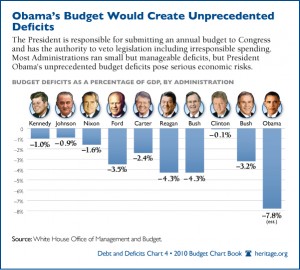
    Yet spending continues to grow far faster than revenues, creating record deficits. President Obama’s annual deficits will add more to the federal debt than every other president before him combined, causing the debt to skyrocket as Debt and Deficits Chart 3 illustrates. The main reason America finds itself on a precipice of disastrous deficits is from spending on the three major entitlements—Social Security, Medicare, and Medicaid.

    As Entitlements Chart 2 shows, these programs will double in size in a few decades. But Chart 10 explains spending cuts alone can’t pay for entitlements, and the level of taxes, shown in Chart 8, required to pay for the programs would devastate the economy.

    Tough policy choices and strong entitlement reforms are necessary to get the budget back on track. The Budget Chart Book will help you appreciate the size and scope of the decisions policymakers must enact to protect America’s fiscal future.

    Visit today to view the federal budget in pictures, download copies, view interactive charts, and share charts on your blog or social networks.

    http://blog.heritage.org/2010/04/08/…-and-improved/

  • Report: Top Gear seen filming segment on erupting Icelandic volcano

    Filed under: , , ,

    It probably could have been foreseen that an erupting volcano in Iceland would be an irresistible lure for Top Gear. The smell of lava in the gave James May, Jeremy Clarkson, and Richard Hammond the urge to outfit a vehicle and drive from Reykjavik to the top of the caldera. Specifically, rather, it gave them the urge to get a vehicle outfitted by Arctic Trucks to make the attempt.

    The Google oneline translating team has left us a bit in the dark on this one, but aside from installing a cold water system to keep the tires cool, it doesn’t appear much else was done to the truck. Any of you Icelanders out there, feel free to fill us in. And for the rest of you – and us! – at least we have one segment to look forward to in the coming season. Hat tip to Baldur!

    [Source: MBL.is (translated) | Image: Daniel Örn – CC 2.0]

    Report: Top Gear seen filming segment on erupting Icelandic volcano originally appeared on Autoblog on Thu, 08 Apr 2010 15:58:00 EST. Please see our terms for use of feeds.

    Read | Permalink | Email this | Comments

  • Review: HTC HD2 on T-Mobile


    Short Version: Pity the poor HD2. It’s one of the most amazing phones I’ve seen all year but like some ultra-evolved dinosaur at the end of the Cretaceous period, it was born just as a cataclysmic asteroid (Windows Phone 7) was about to change the entire ecosystem. Still, for someone looking for a great media phone and one of the best Windows Mobile Phones I’ve ever seen, you could do worse.

    Features:

    • Tethering enabled
    • Striking 4.3-inch screen
    • 1GHz processor
    • 5-megapixel camera with flash
    • $199 with 2-year contract

    Pros:

    • Amazing screen
    • Great media features
    • Thin and light

    Cons:

    • Windows 6.5 with no current upgrade path
    • A bit big
    • Includes two Transformers movies

    The Device
    The best thing about the HD2 is that it looks nothing like a Windows Mobile device. For years Windows Mobile has popped up in interface and usability elements like herpes at Studio 54 – it’s always been there, you just have to press the right buttons and you’ll see it. For example, viewing emails used to dump you into Windows Mobiles’ sub par email browser and when you hit the “Start” menu you’d see an ugly list of apps. Somewhere in there was a task manager and a few other vestiges of 1990s technology that Microsoft stuffed into the device.

    Windows Mobile 6.5 repaired some of these problems by making most menus icon-based and HTC took things to their obvious conclusion by overlaying their excellent Sense UI over the entire thing. Now you get photorealistic weather icons, easy access to media and messaging functions, and a great experience overall.

    The device itself is mostly screen. It has a beautiful 4.3-inch 480 X 800 WVGA touchscreen with a set of buttons for calls as well as Windows, Home, and Back keys along the bottom. There is a full sized headphone jack on the bottom and the phone comes with 16GB of storage. It als includes Blockbuster on Demand access as well as free access to mobiTV for a month. As I mentioned above, T-Mobile included Transformers and Transformers 2: Let’s Try to Make More Money. Obviously these movies are easy selling points for those with light brain damage.

    The Good
    The central metaphor is a taskbar that appears along the bottom of the screen that contains a number of activities including Home – showing a set of icons including camera, Facebook, YouTube, etc. – as well as Messages, Mail, Browser, Photos, Stocks, Twitter, and Search. The Weather screen is actually quite striking and shows the current time and weather appear in a very cool animation across the screen. Cloud days get delightful clouds while sunny days get, obviously, sun. HTC does this sort of thing well. Their design is beautiful and they do an excellent job of mixing photorealism with readable text to make a great UI.

    Going past these initial screens you delve deeper into Windows Mobile 6.5 and, ultimately, despair. Everything works as it should and, in theory, this is more an app phone than a smart phone. It has a 5-megapixel camera with autofocus and flash, Bluetooth stereo support, as well as tethering. Generally it has all the right pieces in all the right places. But then we come to the elephant in the room: Windows Phone 7.

    The Bad

    The HD2 is a great phone. If you’re in the market for a nice media phone and have to have Windows Mobile for work, get this one. It’s one of the best. If you don’t, then you may want to wait. As far as we know, as of this writing, this phone will not support the new version of Windows Mobile (Windows Phone 7).

    Again, if you upgrade every year or eight months, do what you feel. This is a good Windows Mobile Phone and on par with the iPhone in terms of media features. However, the idea that this phone will soon be extinct is disconcerting.

    Bottom Line
    If you want to future proof your phone investment, you need to rethink the HD2. It’s such a great device – slim, sexy, and plenty of power – but it is like buying the last Palm OS phone just before the Pre is launched. In a few months this phone will be vaguely outdated and in a year it will be obsolete. I do not envy T-Mobile and HTC in their damned-if-you-do/damned-if-you-don’t position, but I want to make it clear that buying this phone, while not a gamble per se, puts the owner in an odd position: they will love the phone but will be very jealous of Windows Phone 7 when it drops.

    Perhaps I’m wrong. Maybe WP7 will slip onto here like a pat of butter on a good steak. Only time will tell.



  • Apple Takes Developers Hostage in War on Adobe [Iphone Os 4]

    We all know that you can’t run Flash on Apple’s mobile devices. But now Apple is trying to make it impossible to develop for iPhones in any other development environment but Apple’s own. Oh boy. More »


  • FDA: Your Antibacterial Soap May Be No Better Than My Regular Soap

    Responding to concerns from Congress, the FDA announced today that they are in the process of reviewing how consumers use triclosan, an antibacterial agent used in soap and many other products. And while the FDA says it doesn’t have enough info to tell people not to use soaps containing triclosan, it also doesn’t see any evidence that adding triclosan to soap makes any difference.

    Reads a statement posted on the FDA’s site:

    At this time, the agency does not have evidence that triclosan in antibacterial soaps and body washes provides any benefit over washing with regular soap and water.

    In January, Rep. Edward J. Markey, chairman of the House Energy and Commerce Subcommittee on Energy and the Environment, sent a letter to the FDA asking them to look into triclosan:

    Despite the fact that this chemical is found in everything from soaps to socks, there are many troubling questions about triclosan’s effectiveness and potentially harmful effects, especially for children

    While they complete their look into triclosan, the FDA has also posted a document of things you should know about the antibacterial and fun facts about triclosan like:

    * It was first registered as a pesticide in 1969
    * Triclosan is incorporated in conveyor belts, fire hoses, dye bath vats, or ice-making equipment as an antimicrobial pesticide.

  • AES Adds 700 MW To Wind Project Pipeline

    Power developer AES acquisition of a  UK and Polish wind developer will add 700 megawatts to its European project portfolio.

    The company’s wind unit, AES Wind Generation, acquired British developer Your Energy Ltd as well as  a 51 percent stake in a wind portfolio from 3E, a Polish wind developer.

    AES is expected to invest about $400 million over the next five years to fully develop the projects. Of that amount, the company will spend  $120 million to launch construction on 200 megawatts by the end of 2011.

    Over the past year, AES has come online with 213 megawatts of wind power in France, Scotland and Bulgaria.

    Under the 2009 EU Renewable Energy Directive, both the U.K. and Poland must meet 15 percent of their gross energy consumption through renewables by 2020.

    AES Wind Generation has approximately 1,700 MW of wind capacity in operation globally.

    Image: iStockphoto

  • HTC Incredible Specs Confirmed via Leaked User Manual


    The presumed final specs for the HTC Incredible have made their way online thanks to a leaked user guide.  If you’re feeling up to it, you can peruse the entire 200+ page document, reading up on everything the phone does.  For those of you who are just about the hardware and only care about the facts, here’s what you’re looking at:

    • 1GHz Qualcomm Snapdragon
    • Android 2.1, Sense UI
    • Camera: 8MP with AF, flash
    • Memory: 576MB RAM/512MB ROM
    • 8GB Internal Storage, expandable via microSD
    • Screen: 3.7-inch AMOLED at 480×800.
    • Dimensions: 4.63×2.30×0.47 inches.
    • Weight: 4.6 ounces with battery.
    • Battery: 1300 mAh
    • aGPS, Digital compass, Proximity Sensor, Light sensor
    • Bluetooth 2.1, WiFi 802.11 b/g/n
    • 3.5mm headphone jack

    As many of you enthusiasts might know, the Incredible is strikingly similar to the Nexus One and HTC Desire in terms of specs.  It’s probably safe to assume that this is the type of Android phone HTC will be putting out for the next few months.  No sense in going back to the 528MHz chips at this point.  Look for the Incredible on April 29th at a Verizon or Best Buy near you!

    Might We Suggest…

    • Hey Verizon, Just Announce the Incredible Already!
      Anyone following Android can tell you that current holder of worst kept secret is Verizon’s forthcoming handset, the HTC Incredible.  The tiny bits of information hitting the internet have gone from a…