Blog

  • Weathercaster vs. Climate Scientists, The Colbert Debate [VIDEO]

    Yesterday, Stephen Colbert hosted a debate between climate change scientist Brenda Ekwurzel and Weatherman Joe Bastardi. The two came on the Colbert Report set, to debate the recent findings of a recent poll that showed that 25 percent of television weatherman believe climate change is a hoax (Bastardi’s position).

    Watch:

    The Colbert Report Mon – Thurs 11:30pm / 10:30c
    Science Catfight – Joe Bastardi vs. Brenda Ekwurzel
    www.colbertnation.com
    Colbert Report Full Episodes Political Humor Health Care Reform

  • Getting the Suitable Microwave Oven

    red microwaves red microwave ovens

    It has been a while since microwave and microwave oven were invented and used by most of us. In fact, it will be very rare occasion when we go into a kitchen that is without the microwave or the microwave oven. People have been so busy that sometimes they cook using food processor and microwave because they do not have to monitor the progress of the cooking.

    It is also safe to say that the microwave oven technology have been improving over the times and most of the innovation and improvement of technology focuses on how to use less electricity while doing the same thing. Now people are focusing on the design of the microwave and because of this, we are seeing more of the fancy design of microwave such as red microwaves or red microwave oven.

    Red is always associate with cool and sleek and the color usually matches the whole kitchen design. There are many types of red microwaves that are available in the market, where the red microwave oven can be use for heating up the food while there is red microwave oven with grilling capability that allows more than just heating up the food like baking a cake. The one with the heating up capability definitely cost a lot cheaper than the grilling microwave oven, while there is microwave oven that has the combination function of both heating and grilling capability which costs a lot more, but with whole loads of functions.

    Getting the red microwave is stylish, however because of the exterior; one has to make sure that the kitchen finishing is matching with the red color of the red microwave to produce a warm kitchen.

    Tags: red microwave, red microwaves, red microwave ovens, red, microwave

  • The Moonwatch Is One of Very Few Accessories for Werewolves [Fashion]

    “This watch? Oh, it just warns me when I’ll turn into a berserk beast capable to ripping off your head, chomping you entrails, surfing on vans, hooking up with Willow, hooking up with Bella, you know, normal werewolf stuff.” More »


  • Pakistan assembly approves bill to curb presidential powers

    [JURIST] Pakistan’s National Assembly on Thursday unanimously passed a constitutional amendment that would curtail the powers of the president. The 18th Amendment Bill would reverse the expansion of presidential powers under former military leader Pervez Musharraf by transferring presidential powers to the office of the prime minister, effectively reserving the presidency as a figurehead. Among other changes, the president would no longer have the power to dissolve parliament, dismiss the prime minister, or appoint the chief of the armed forces. The bill must be approved by a two-thirds majority of the Senate and be signed by President Asif Ali Zardari before becoming law.
    The introduction of the bill comes amid controversy over reopening corruption investigations against Zardari. Last week, Pakistan’s Attorney General Anwar Mansoor announced his resignation over controversy surrounding a Supreme Court order to investigate corruption allegations against Zardari. Earlier that week, Swiss authorities denied a request from Pakistan’s National Accountability Bureau, refusing to reopen a corruption investigation against Zardari. Aides to Zardari believe that presidential immunity protects him from prosecution, even after the Supreme Court overturned an amnesty law implemented by Musharraf. The amnesty was signed by Musharraf as part of a power-sharing accord allowing former Pakistani prime minister Benazir Bhutto to return to the country despite corruption charges she had faced.

  • Understanding mine safety – the libertarian solution

    Everything you need to know about mine safety (emphases mine) …

    How to connect mining disasters and climate change – How the World Works – Salon.com

    … And then there’s the famous memo sent by Blankenship in October 2005 to all ‘Deep Mine Superintendents.’ …

    “SUBJECT: RUNNING COAL

    If you have been asked by your group presidents, supervisors, engineers, to do anything else other than to run coal (i.e. – build overcasts, do construction jobs, or whatever) you need to ignore them and run coal. This memo is necessary only because we seem not to understand that the coal pays the bills.”

    Mine ‘overcasts’ are critical to proper mine ventilation, and for many miners, Blankenship’s memo made it abundantly clear exactly what Massey’s ‘top priority’ was, and is.”

    Libertarians, this is why we need government.

  • For This Deep-Sea Animal, Oxygen-Free Is the Way to Be | 80beats

    LoriciferanMicroorganisms can live the far reaches of the planet, in extreme temperatures and pressures, and in some cases even without oxygen. But now scientists say they have found the first multicellular organisms inhabiting an anoxic environment. In other words: They’ve found the first animals living without oxygen.

    They belong to the group called loriciferans, a phylum of creatures that live in marine sediment. About a millimeter long, they look something like a half-jellyfish, half-crab. The beasts live in conditions that would kill every other known animal. As well as lacking oxygen, the sediments are choked with salt and swamped with hydrogen sulphide gas [New Scientist].

    Roberto Danovaro and his colleagues, who documented this find in BMC Biology, had been searching the salty, oxygen-free depths of the Mediterranean Sea down below 10,000 feet for life. When previous searches turned up animal bodies, he says, researchers wrote them off, thinking they had fallen to those depths from oxygenated waters closer to the surface. But Danovaro says his team recovered living loriciferans from the area, including ones with eggs.

    Unlike plants, all previously discovered animals, and fungi, the newly discovered animal species don’t use mitochondria, the cellular organelle that converts sugar and oxygen into water, CO2 and, energy, to power their cells [Popular Science]. Instead, the animals pack the hydrogenosome organelle, a feature common among the miccoorganisms that live in oxygen-free zones.

    Danovaro’s find should lead other life-hunters to start seeking animal life in locations that had been labeled inhospitable to animals, like subduction zones, hydrothermal vents, and other places only simpler organisms had been discovered. And every time we push back the preconceived limits of life on our own planet, it excites those seeking life on others. Says oceanographer Lisa Levin: “Are there metazoans on other planets with atmospheres different from our own?” Levin added. “Our ability to answer this question would be strengthened considerably by more intensive studies of animal-microbe interactions in extreme settings of our own inner space — the deep ocean” [LiveScience].

    Related Content:
    DISCOVER: Science Nation Video: Extremophile Hunter
    DISCOVER: Looking for Life in All the Wrong Places
    80beats: Tiny Invertebrates Survive a Trip Through the Vacuum of Space
    80beats: Where Would Martian Life Hang Out? Under a Giant Volcano, Naturally

    Image: Roberto Danovaro


  • Keeping growth on the fast track: WEF Latin America

    At yesterday’s opening session of the World Economic Forum’s Latin America summit, Colombian President Alvaro Uribe Velez was joined by Ferdinando “Nani” Beccalli-Falco, President & CEO of GE International – who offered ideas on development as the region builds on its current economic successes. “These few things – they are ‘motherhood and apple pie’ as my American friends say — they are simple things,” Nani told the audience. “But prosperity and success always come out of the simple things we can think of.”


    A rebroadcast of the opening session is available above. Nani’s remarks begin at the 46-minute mark. You can advance to that time by hitting the play button and then clicking the time bar running along the bottom of the video screen.

    “One that is difficult to put in place as it is a long-term effort is education,” Nani stressed to the business and government leaders gathered in Cartagena, Colombia. “I travel to many countries and see many places. I can tell you that the places that flourish are the ones that have the two E’s: The ‘E’ of Energy – and I’m not talking about oil or gas – I’m talking about the ability of lighting bulbs. And Education. You see the countries that have energy but no education go nowhere. And countries that have education but no energy don’t go anywhere. The countries you see prospering are the ones that have both of these, heavily invested.”

    Praising the major infrastructure projects currently underway in the region – including Colombia’s current roadway construction projects, Nani said, “We see great investments in infrastructure…. I think there are still big needs of power, big needs of water, for electricity, big needs for roads, for airports. These need to happen in order to bring these economies to the level where they belong and where they can prosper.”

    Nani observed that the between 1981 and 2007, the world experienced a phenomenal type of growth that had not been seen before, driven by the introduction of new technologies and the phenomenon of globalization. With hundreds of millions of people entering a new way of life in places such as China and India, the need for commodities exploded and Latin America was one of the regions that benefited as immense wealth was created in the process.

    But now is the time, he said, to diversify. Pointing to the Middle East as an example, he noted how the economies there are rapidly diversifying away from oil and into a range of other industries. Nani also underscored the need to ensure that old threats do not emerge, such as those of political and democratic instability, he said. “Another mistake is the return to protectionism, a return to high import duties, and a return to a taxation system that does not conform to taxation systems in other parts of the world,” he said. “Tell me an economy in history that has prospered putting big import duties or taxation.”

    To a round of applause, Nani said “one other important point is the absolute elimination of corruption. Corruption is always a threat to development. Corruption leads to uncompetitive environments…. I am appealing to governments to really fight this enemy. It is the enemy for economic development. Following up on corruption is the concept of governance: clean, well-constructed illuminated governments is very important.”

    Learn more in these GE Reports stories:
    * “Taking a look at GE in Brazil during WEF Latin America
    * “Putting flare gas on the firing line at the WEF in Davos
    * “Switching smart grids from ‘demo’ to ‘deploy’ at WEF
    * “Brazil’s turbines sweetly hum with sugar-based ethanol
    * “The sugar-land express: Brazil orders 50 locomotives
    * “Brazil’s new Azul airline inks $1B services deal with GE
    * “GE wins $250 million offshore drilling contract in Brazil
    * “Brazil boosts clean gas in the Amazon; wind in the East

  • Photos Released in Aftermath of the FBI Assassination of Detroit Imam Luqman Ameen Abdullah

    Photos released in imam slaying

    By ERIC D. LAWRENCE
    FREE PRESS STAFF WRITER

    A Muslim group released five photos today taken as part of the investigation into the fatal shooting of a cleric during a raid by FBI agents in Dearborn last year.

    The Michigan chapter of the Council on American-Islamic Relations (CAIR) released the five photos of the body of Imam Luqman Ameen Abdullah to the media from among 75 photos obtained from the Wayne County Medical Examiner’s Office. The photos were released to CAIR after the imam’s widow, Amina Abdullah,and one of his sons, Mujahid Carswell, approved the request.

    Three of the photos are close-ups showing missing teeth as well as cuts, gashes and other injuries on Abdullah’s face and head. CAIR questions whether the latter injuries are from the police dog that the FBI says was fatally shot by the imam.

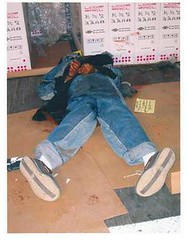
    Two photos show Abdullah on the ground after he was killed. One shows him lying face down with his hands cuffed behind his back — something authorities have said is standard procedure.

    Dawud Walid, the council’s executive director, said nationally known forensic pathologist Dr. Cyril Wecht has been asked to review both the autopsy report and the photos.

    “There are a lot of questions, and the photos raise more questions,” Walid said, adding that other photos were deemed too graphic by the family and CAIR to release to the media. The Free Press is only showing the photo of the imam handcuffed and face down because of similar concerns.

    According to the autopsy, Abdullah was shot 20 times, with one bullet causing two wounds.

    The FBI has said it acted appropriately in the two-year investigation, raid and shootout that left Abdullah dead. Agents on the Oct. 28 raid wanted to arrest the cleric and 10 other people on suspicion of dealing in stolen goods.

    Delays in the release of the autopsy report and completion of a Dearborn Police investigation have fueled criticism of the case’s handling. The FBI and the Department of Justice are also reviewing the matter.

    FBI spokeswoman Sandra Berchtoldsaid today that the agency had no comment on the release of the photos.

    Omar Regan, one of Abdullah’s 13 children, said he washed his father’s body after he was killed, but was still troubled seeing the photos.

    “It’s clear that something went wrong,” he told the Free Press.

    Livonia Police Chief Robert Stevenson recounted today a run-in with Abdullah in 1980 when the imam was known as Christopher Thomas. Stevenson, who was a patrol officer at the time, stopped a car in which Abdullah was a passenger because its brake lights weren’t working.

    Abdullah, who was carrying a gun in a shoulder holster, fought with then-Officer Stevenson outside the car and tried to grab the gun, he said. Abdullah was arrested after Officer David Wilkie arrived and pointed his own gun at Abdullah.

    Contact ERIC D. LAWRENCE: 313-223-4272 or [email protected].

    April 7, 2010 http://detnews.com/article/20100407/METRO01/4070405

    Autopsy photos released of slain imam

    SANTIAGO ESPARZA
    The Detroit News

    Southfield –The Council on American-Islamic Relations Michigan office released photos today that it says show evidence not detailed in official reports of the Oct. 28 fatal shooting of an imam during an FBI sting.

    As result of preliminary government reports, CAIR has called for an independent investigation of the slaying of Imam Luqman Ameen Abdullah, saying his body had injuries not detailed in an autopsy report and that the new photos back their claims.

    CAIR says it believes the photos capture injuries that could have come from an FBI dog also killed in the incident despite the autopsy report listing the cause of those injuries as inconclusive. CAIR obtained the photos from the medical examiner.

    Federal authorities have said that Abdullah shot the FBI dog and fired at agents during the raid on an FBI-controlled Dearborn warehouse in October, warranting the return fire that ultimately killed the Muslim cleric. FBI officials have alleged Abdullah was part of a ring fencing stolen goods.

    The five photos show numerous cuts and scratches on the face of Abdullah. One shows the cleric handcuffed on a floor that’s stained with what appears to be blood.

    CAIR has maintained since October that Abdullah may have been attacked by the FBI dog, prompting the fatal shooting that left Abdullah struck 20 times.

    The Dearborn Police Department and U.S. Department of Justice are investigating the shooting but have not completed their probes.

    The FBI was not available for comment this morning.

    Due to their graphic nature, The Detroit News and detnews.com have decided not to run the photos.

    [email protected]”>[email protected] (313) 222-2320

  • Llega al Fiat 500 el nuevo motor Multijet II

    multijetii.jpg

    Fiat anunció que incorpora a la gama del 500 el nuevo propulsor common rail Multijet de II generación, con sistema Start&Stop de serie. Desarrollado y producido por FPT (Fiat Powertrain Technologies), el 1. 3 Multijet II de 95 CV pertenece a la segunda generación de los propulsores Multijet y está dotado de nuevos inyectores common rail que, mediante una servoválvula hidráulica contrapesada, controlan, con una gran precisión, la cantidad de gasóleo inyectada en la cámara de combustión.

    La secuencia de inyección es más rápida y flexible respecto al pasado (hasta 8 inyecciones dentro de un mismo ciclo). Esto le permite al motor mejorar el control de la combustión diésel, con efectos benéficos en términos de consumos, emisiones, acústica y conducción.

    El nuevo propulsor de 95 CV está provisto de un turbocompresor de geometría variable, que asegura una sobrealimentación optimizada en todo el campo de funcionamiento. Los consumos se estarían reduciendo hasta un 8% en el ciclo urbano, debido también al sistema Start&Stop que gestiona el apagado temporal del motor y su posterior arranque. Con homologación Euro5, el nuevo 1,3 litros incorpora directamente el filtro de partículas (DPF) en el compartimiento del motor, con el fin de mejorar su rendimiento y hacerlo todavía más eficaz desde los primeros instantes de funcionamiento del motor, tras un arranque en frío.

    Tras su incorporación con el Fiat 500, esta nueva tecnología se irá introduciendo al resto de los modelos, empezando por el Punto Evo, en septiembre de 2010.

    Los precios en España de los modelos que incorporen el nuevo Multijet II, serán los siguientes (detallando también su nivel de emisiones):

    multijetii-precios.jpg


  • Nightmare Digital Economy Bill Passes Through Commons in the UK

    In a move that probably shouldn’t surprise anyone, the controversial Digital Economy Bill was passed by the British Parliament Commons chamber with an overwhelming majority. The mock debate was rushed through Parliament, which will be dissolved ahead of the upcoming General Elections in the UK. Most of the bill was written by the r… (read more)

  • German Catholic Church sexual abuse hotline flooded with calls

    ackermann

    Trier Bishop Stephan Ackermann launches hotline on March 30, 2010. Text reads : "victims of sexual abuse"/Johannes Eisele

    A German hotline for victims of sexual abuse by clerics was deluged with thousands of calls in the week after the Roman Catholic Church launched the counseling service in a bid to restore trust.

    Some 13,293 people attempted to call the hotline over the course of the first week but only 2,670 were able to connect with the overwhelmed 11 counselors on duty, church officials said.

    “We didn’t expect so many calls,” said Stephan Kronenburg, spokesman for the diocese of Trier where the hotline control center is located. “It’s been well received. Many have called to say they’re grateful for it.”

    On its first day, the hotline received 4,459 calls but the counselors, who work in four-hour shifts, were only able to handle 162 and the service was forced to shut down temporarily. In addition to the 11 counselors handling the phones, seven are dedicated to online queries.

    Read the full story here.

    Follow FaithWorld on Twitter at RTRFaithWorld

  • Glendale lifts ban on professional boxing

    Professional boxing will be allowed in Glendale under a plan approved by the City Council.


    Boxing
    was banned 62 years ago under the pretext that the matches would have
    an “unwholesome” impact on the city. But local boxing promoter Kahren
    Harutyunyan last year successfully lobbied the City Council for a test
    run. His company, Art of Boxing Productions, hosted two events at the
    Glendale Civic Auditorium, generating $19,342 for the venue.


    Harutyunyan on Wednesday said he was glad he had the chance to demonstrate that boxing could be beneficial to the city.


    “I am extremely satisfied, happy and proud with the entire process,” he said.


    Other
    pro fighting events, such as mixed-martial arts and kick-boxing, are still banned
    under the revised ordinance, and officials made it clear that they
    would continue to closely monitor planned matches.


    Councilman
    Frank Quintero said several measures, including physical examinations,
    are taken to ensure the boxers are safe during their bouts.

    “It’s sanctioned,” he said. “It’s licensed and it’s controlled. It’s not just a street fight.”

    Read the full story here.

    — Veronica Rocha in the Glendale News-Press

  • Don’t buy Metal Sonic DLC for 800 Microsoft points

    Just a quick warning if you’re planning to get the Metal Sonic DLC for Sonic & Sega All-Stars Racing, make sure that the price is right. By “right”, I mean 560 Microsoft Points. Unfortunately, a pricing

  • Krugman on Cap-and-Trade: "We Can Do This"

    Paul Krugman has a virtuoso piece about the economics of climate change in this weekend’s New York Times Magazine. He methodically disassembles climate skeptic arguments and builds a case for a cap-and-trade approach to cutting emissions. Action should be taken immediately and aggressively, he argues, due to the possibility of a “doomsday scenario” for future generations.

    Whichever side of the climate change and cap-and-trade debate you’re on, it’s worth reading. It’s also quite long, so here’s a summary of Krugman’s main points:

    1. Climate Change: It’s happening. It’s time to trust the scientists, drown out the naysaying, and tackle the problem using economic incentives.

    2. Cap-and-Trade: It’s the best option for a market-based solution, which is the only viable way to address greenhouse gases. An emissions tax is less flexible.

    3. Cost: Cap-and-trade will slow economic growth, but only by a very small amount.

    4. Conservatives: Their obstinate resistance to the science of climate change and the economic tools for tackling it does not mesh with the rest of their worldview. Whatever happened to Reagan’s “magic of the marketplace?” The Republican Party’s attempt to convince Americans that we can’t afford to put a price on carbon is “a political ploy rather than a reasoned economic judgment.”

    5. China: If the world’s biggest greenhouse gas emitter refuses to participate in emissions reductions, the U.S. and the E.U. should resort to carbon tariffs. Corralling global participation will be tough, but with a few key players on board, it will be doable.  

    (Nav Image Credit: A6U571N/flickr)


    Email this Article
    Add to digg
    Add to Reddit
    Add to Twitter
    Add to del.icio.us
    Add to StumbleUpon
    Add to Facebook


  • Creative Introduces ZEN X-Fi Style Portable Media Players

    zenplayer 300x209 Creative Introduces ZEN X Fi Style Portable Media PlayersWhile everyone is still drowning in Apple announcements and iPad fever, Creative has quietly announced the release of the Creative ZEN X-Fi Style and the Creative ZEN Style series of portable media players. The Creative ZEN X-Fi Style and Creative ZEN Style series of portable media players are now enhanced with new designer looks. The players specs haven’t changed all that much but their new bodies are kind of snazzy. gI zenplayer2.JPG Creative Introduces ZEN X Fi Style Portable Media Players

    The Creative ZEN X-Fi Style portable media player is an updated player with a stylish form factor with the built-in X-Fi technology as music tracks are restored to replace audio quality lost in compression. The Creative ZEN X-Fi Style is currently available for pre-order and will be available from April 14th, 2010 onwards at retail prices of $79.99 (8GB), $99.99 (16GB) and $169.99 (32GB).

    The Creative ZEN Style series of portable media players comprises the Creative ZEN Style 100 and Creative ZEN Style 300. The Creative ZEN Style 300 has all the features of the Creative ZEN Style 100 and is further enhanced with a built-in speaker and FM radio and bright 1.8-inch TFT display. Available in black is the Creative ZEN Style 300 which is 4GB. Creative Zen Style 100 versions are available in white and blue and come in 8GB and 16GB capacities. The Creative ZEN Style series is currently retails for prices of US$49.99 (4GB), US$59.99 (8GB) and US$79.99 (16GB)

    [Via PR Web]

  • Playful Breakfasts: Pancake Molds to Make You Smile

    Sure, they’re kind of a kitchen uni-tasker, but who doesn’t love a nice heart-shaped pancake for breakfast? Or how about a cow? A space alien, perhaps? There are so many fun pancake molds these days, it’s hard to choose!

    Read Full Post

  • Alan Greenspan, Regulator?

    Alan Greenspan made his own case for significant financial services regulation yesterday adding to the growing momentum for important legislative reform. But, you would hardly know it from reading the newspapers.

    Testifying before the congressionally created Financial Crisis Inquiry Commission, Greenspan removed his libertarian cloak and spent a significant portion of his testimony in new regulatory garb arguing:

    • Poor private sector decision-making, especially poor private sector risk management and creation of incomprehensible financial products, lead to the credit crisis.
    • Even with the breakdown of private risk management and the collapse of private counter-party credit surveillance, “the financial system would have held together had the second bulwark against crisis — our regulatory system — functioned effectively. But, under crisis pressure, it too failed.”
    • Structural regulation is critical because regulators “who are required to forecast have had a woeful record of chronic failure. History tells us they cannot identify the timing of a crisis, or anticipate exactly where it will be located or how large the losses and spillovers will be.”
    • To deal with “inherently unforeseeable shocks, there are two primary regulatory imperatives: (1) increased risk-based capital and liquidity requirements on banks and (2) significant increases in collateral requirements for globally traded financial products, irrespective of the financial institutions making the trades.” With adequate capital, debtors will be repaid and contagion avoided. “All losses accrue to common shareholders.”
    • Moreover, firms simply cannot be allowed to become “too big too fail,” taking excessive risk because of the need for government to save the individual company to save the financial system. Greenspan proposes special contingent capital bonds which convert to equity in an emergency and creation of a special bankruptcy facility for orderly liquidation with statutorily defined “haircuts” for creditors.
    • Enforcement against financial misrepresentation and fraud must be significantly increased.
    • In sum, the next pending crisis will no doubt exhibit a plethora of new assets which have unintended toxic characteristics, which no one has heard of before, and which no one can forecast today. “But if capital and collateral are adequate…[t]ax payers will not be at risk. Financial institutions will no longer be capable of privatizing profit and socializing losses.”

    But, this testimony wasn’t what the major papers reported. The New York Times: “Fed Reviews Find Errors in Oversight of Citigroup.” Wall Street Journal: “Greenspan Grilled Over Role in the Financial Crisis.” The Financial Times: “Greenspan Mauled Over Role in Meltdown.” The Washington Post: “Greenspan Defends Decisions Before Panel Investigating Crisis.”

    The stories themselves featured sharp interchanges between panel members and Greenspan over the Fed’s past role. Conflict will always prevail over consensus in the daily news cycle. But Greenspan’s points are some of the fundamental concepts which reformers have been advancing for more than a year since the financial crisis broke down upon us (but hardly all, for example, regulatory assessment of systemic risk). Organizational authority and actual implementation are critical — issues Greenspan didn’t (couldn’t) address in a piece of testimony. But Greenspan’s arrival at the regulatory party is one of the last pieces of a bipartisan consensus that significant regulatory reform to ensure the safety and soundness of the financial system is necessary — and is likely to be enacted this year.

    So, in many respects, this is the real news from his testimony. The commissioners on the Financial Crisis Inquiry Commission can develop their views — and write their report. But, the irony is that is report isn’t due until after the fall elections — and after major financial services reform, which has been the subject of a year’s debate already, has been voted up (or down).

    This focus on conflict, and down-playing of general support for major financial reform, has also characterized recent coverage of two other major figures in the world of finance: Lloyd Blankfein of Goldman Sachs and Jamie Dimon of J.P. Morgan Chase.

    Blankfein recently issued his letter to shareholders and news reports focused on an attempt to explain how Goldman had always acted in the interests of customers, and not traded against those interests. Yet in the letter, Blankfein said business was at fault and repeated his call for major regulatory reforms to ensure safety and soundness (while, of course, preserving room for creativity and innovation), a position developed in much more detail in his own testimony before the Financial Crisis Inquiry Commission. That testimony addressed the major issues of capital adequacy, leverage, size, transparency, and moral hazard which are central to the debate. But it was overshadowed in news reports by harsh commissioner questioning.

    Similarly, the Wall Street Journal recently ran a piece on Dimon’s opposition to some pieces of the financial reform packages. It gave only a sentence or two to a long section in Mr. Dimon’s own recent letter to shareholders on the failure of the private sector and the need for regulatory reform, especially in the areas of systemic risk and resolution of large, failing financial institutions.

    From one perspective, one can take with a pillar of salt the pronouncements of Messrs. Greenspan, Blankfein and Dimon in favor of reform. Each has his own self-interested agenda and broad principles about safety and soundness are not the same thing as meaningful details and effective implementation.

    Yet, from another perspective, their views — especially Greenspan’s — do show the power of the idea that private financial sector institutions were a primary cause of the meltdown (despite roles played by many other actors in causing the crisis) and that significant government regulation is needed. When we step back, this consensus is likely to lead to another major shift in government involvement in the economy (after health care).
     
    On the same day, that it reported the conflict over Greenspan’s testimony about the past role of the Federal Reserve, The Financial Times ran a story headlined “U.S. Financial Reform Picking Up Momentum.” Hard issues — such as appropriate consumer protections and methods for handling large, failing firms — remain. But the call for major changes from all points on the political spectrum — symbolized now by Greenspan, too — suggest that compromises will be found and legislation passed: legislation, like health care reform, that will be far from perfect but will effect major change.


    Email this Article
    Add to digg
    Add to Reddit
    Add to Twitter
    Add to del.icio.us
    Add to StumbleUpon
    Add to Facebook


  • Lawmaker seeks probe of Sarah Palin’s planned appearance at California university

    A California lawmaker is calling for the state attorney general to investigate the circumstances surrounding Sarah Palin’s upcoming appearance at a state university.

    Palin is scheduled to appear at Cal State Stanislaus’ 50th anniversary gala on June 25 — a fundraiser that has stoked controversy.

    State Sen. Leland Yee (D-San Francisco) on Wednesday accused Cal State Stanislaus officials of violating the public trust by failing to disclose documents about the event. He has asked Atty. Gen. Jerry Brown to investigate.

    Yee and the nonprofit group Californians Aware filed public-records requests with the university last week, seeking documents relating to Palin’s appearance, particularly how much she is being paid. 

    A campus official said there were no such documents, but Yee’s office acquired a March 29 e-mail about the Palin appearance sent by a university vice president, which Yee said should have been disclosed. 

    The university responded Wednesday that it did not provide the e-mail because it was circulated to faculty and staff and the public-records request excluded documents prepared for public release.

    — Carla Rivera

    Photo: Sarah Palin. Credit: Associated Press

  • Is euro sell off overdone?

    The euro is suffering due to a big fat Greek headache. Worries that the country will default on its debt, and stall a recovery on the continent, pushed the currency down to a two-week low against the U.S. dollar.

    But one currency watcher says euro concerns might be a little overdone.

    “The market does need to learn that Greece comprises just over 2% of the eurozone GDP. As such, at some point, we believe, the market will need to get used to Greece's woes,” said Axel Merk, president and chief investment officer at Merk Investments. “There's life beyond Greece; as a result, we are positive on the long-term outlook of the euro.

    Mr. Merk’s company runs three currency funds, one of which – the US$440-million Merk Hard Currency Fund – counts the euro as its biggest holding (the Canadian dollar ranks a close second).

    He noted the spread on Greek bonds over German equivalents hit a new high (peaking at 442 basis points), which he believes is appropriate. Nevertheless, he argued some market participants are failing to take into account some factors that are weighing on the euro. The whole note argument is here, but in short, he says:

    • Should the International Monetary Policy get involved, the loans it would grant would be senior to outstanding government debt. “It is absolutely justified by the market to demand a higher premium on outstanding debt given the prospect of IMF involvement.”

    • With IMF involvement, there's a high probability that existing debt may be restructured. “Policy makers don't like to call debt restructuring a default, but it is a partial default that may trigger payment under CDS rules. As a result, it is perfectly appropriate for credit default swaps to rise.”

    Paul Vieira

  • Mitsubishi WD-82738: 82 Inches of 3D TV For Only $3800 [HomeTheater]

    Mitsubishi announced three new lines of (relatively) affordable 3D Home Cinema TVs today, but the one that sticks out? An 82-inch DLP that puts jumbo-sized 3D in your home for under $4,000. More »