Blog

  • Farewell, Keyboard – Generation I Will Grow Up on Touchscreens

    The analysts at Gartner must have been fairly impressed with the Apple iPad because their latest research report predicts that over 50% of the computers purchased for children will have touchscreens by 2015. In this case, Gartner defines children as those under the age of 15 or, as we like to call them, “Generation I.” (This is the new, hipper terminology for children of the 2000’s once dubbed “Generation Z” or “digital natives.”) They’re the ones born into a world where computers and cellphones are introduced as baby toys, where the iPod has always existed and where everyone they know can be found on Facebook. And now, it seems, they’re going to grow up with computers in an entirely different way, too.

    Sponsor

    As a new parent myself, I’m simultaneously fascinated and fearful of the way technology has infiltrated our lives. My four-month-old loves to “color” on the iPad. (If only I had recorded that! I could have made Techmeme!) But on the other hand, I worry that one day she’ll prefer her virtual touchscreen to crayons and blank paper. I wonder about the implications of bedtime stories read on a cold, metallic device instead of selected from a packed shelf of favorite books – tangible objects that can be grasped by little hands, objects which have a feeling of permanence in this world. Will the child who grows up playing on an iPad still enjoy a family game night of fold-out boards, plastic pieces and dice? Will she ever learn to shuffle a deck of cards?

    When the computer was just a screen, keyboard and mouse, it remained, for all its usefulness, a tool. A means to an end. It was something you used at work, a replacement for pen and ink, a way to communicate with others in far off places, but ultimately, it was just a thing. Now, thanks to the mobile web, tablets and yes, Apple and their iToys, the computer isn’t just a thing anymore. It’s an everything. 160,000 applications and counting in the iTunes App Store with new iPad apps being added every day. The iPad can replace any real-world object you own: a book, a music player, a TV set, a DVD player, a coloring book, a board game, an artist’s canvas, a notepad, a DJ’s turntable, a globe, a map and so on.

    And for the children being born into this new digital age, it will.

    Whether or not the analysts at Garnter are right on the money about the percentages and timeframe in which this occurs – in addition to their guesstimates about touchscreen adoption, they’re predicting over half of U.S. schools will specify touch and/or pen input within the next 5 years – they have at least pegged this trend accurately. Touch is the future.

    And you, with your clickety-clackety keyboard and push-button mouse will be the “old fogie” whining about how you just can’t adapt to typing on glass.

    Discuss


  • Three options for Greece

    Greece’s situation is dire and it faces three ugly but realistic options, according to Peter Boone of the London School of Economics and Simon Johnson of MIT.

    One is to embark on an austerity program—a true austerity program, not the cosmetic fix-ups that the Greek government has already announced. Greece would have to chop its government spending by 10% of GDP. If it chooses this option, the pain over the next two to three years would be intense. Expect strikes, violence, political chaos.

    The second option would be to default on the country’s debt but keep the euro. If this is what happens, foreign lenders should expect to lose 65% of the face value of their loans, which would imply huge losses at many European banks. And Greece would still have to cut its government spending.

    The third option is for Greece to default on its debt and exit the euro. This is the option that may make the most sense, since it would allow Greece to peg a new currency at a much lower level than the euro to restore competitiveness. But it would be a slap in the face to the European political elite and it would still mean pain for many European banks.

    Boone and Johnson say the one option that doesn’t make sense is for Europe to try and muddle through with help from the International Monetary Fund. The problem is simply too big for that. Greece’s ratio of debt to GDP is already 114% and will rise to 150% by 2012. At current rates, servicing this debt would mean that Greece would have to transfer 9% of its GDP to debt holders in other countries for years to come. That is not going to happen. Better face the problem now, say Boone and Johnson, than try to kick it down the road.

    Freelance business journalist Ian McGugan blogs for the Financial Post

  • The German menace

    THE OECD has released its latest economic outlook for member nations. It includes this interesting chart:

    Just looking at that, with which country would you guess American leaders are most concerned, so far as global imbalances go?

    Focusing on the bigger picture, the OECD report is generally positive. Recovery is likely to be sluggish across much of the OECD, and debt issues loom, but inflation is well in hand, financial conditions are generally good, and global trade has recovered nicely. The aggressive global response to what was, remember, a Depression-like shock to the economy has averted a Depression-like outcome.

  • CISCO Systems offer training Israeli women

    Cisco Systems has teamed up with the Peres Center for Peace to offer unemployed women computer courses.  It’s part of an effort to give women who don’t have the money for school a chance to get educated and hopefully placed into a new job.

  • ITM Power HFuel Station Getting Ready for Prime Time

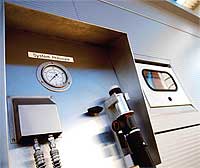
    After months of silence, ITM Power is starting to release some details about its HFuel hydrogen refueling unit. The HFuel system can be used for hydrogen refueling in a commercial setting.

    The hydrogen fuel produced from the ITM Power HFuel system meets the purity requirements for running it through a car’s fuel cell. At a cost benefit for refueling H2ICE vehicles, the hydrogen purity can be downgraded.

    The HFuel unit is composed of electrolyzers, compressors and hydrogen storage tanks. The typical hydrogen fuel dispensed will be 5,000 psi but this can be upgraded to 10,000 psi if desired.

    One of the most interesting features of the HFuel system is its scalable, modular design. It only takes 3 days to set up the HFuel system, it can be easily transported from one location to another and it is easy to upgrade as traffic to the refueling station grows. Plus it is able to produce up to 50 kg per day of hydrogen fuel.

    Refueling cars at the station will only take 3 minutes. The HFuel system only needs water and an electrical source to work. The electricity can be provided by renewable resources such as wind or solar, making it a very green hydrogen station indeed.

    The ITM Power HFuel hydrogen fueling station along with its other products will be shown at the Hannover Messe, in Germany April 19 – 23, 2010 and at the NHA Hydrogen Conference and Expo in Long Beach, California May 3 – 6, 2010.

    What are noticeably missing from the lineup of products that ITM Power is offering are the much awaited Home Energy Pack and Home Hydrogen Fueling Station that I had talked about in July 2009 and July 2008 respectively.

    The modular ITM Power HFuel hydrogen fueling station will indeed be a step forward toward implementing a hydrogen highway fueling system in many locations. In addition, the home hydrogen products also need to be given their due as progress marches forward.

  • CA Prop 15: Whitman’s Purchase of Governor’s Race Shows Need for Clean Money

    You may know by now that Meg Whitman added $20 million more of her own money to her campaign war chest this week, bringing her personal stake in the California gubernatorial race to $59 million. Fortunately, she does have her limits: she says she won’t go a dime above $150 million. (Because she needed some help, the state Chamber of Commerce is attacking the Democrat in the race, Jerry Brown.)

    This Whitman’s sampler is only the most egregious of a trend toward self-funding of outrageous sums in elections. Michael Bloomberg, Jon Corzine, and dozens of other uber-rich men and women have stratified our political space, widening the gap between the electable and the unelectable. Very few Senators are not millionaires; very often the first question out of a political operative’s mouth about a new candidate is “can they self-fund?”

    Massive self-funding has the possibility of backfiring, of course, with charges of “buying the election” hurled at Whitman from her primary challenger and her Democratic opponent. And there are certainly isolated examples of big money self-funders doing a belly-flop: Al Cecchi right here in California in 1998 comes to mind. But Whitman is actually testing a model of spending comparable to a corporate marketing budget, where nothing else in the same space can even get in a word to challenge it. “We’ve never seen anything like it,” said longtime California journos Jerry Roberts and Phil Trounstine.

    As it happens, we have an opportunity to see if Whitman’s purchase of the election can spark an immediate backlash. Because on the same day as her Republican primary in June, there’s an initiative on the ballot, Prop. 15, which would create a pilot program for public financing for the Secretary of State’s races starting in 2014. It would also drops a restriction for local governments to allow clean money elections in their municipalities. Robert Cruickshank writes:

    Here’s the background. In 1988, Proposition 68 made it to the June ballot, an initiative that would have created a public financing system for statewide elections. Polls showed it was likely to pass, so the legislature under Speaker Willie Brown, and with the encouragement of Governor George Deukmejian, placed a competing proposal on the same ballot, Proposition 73. Prop 73 provided some campaign contribution limits, but also barred anyone from being elected to office who had received public funds […]

    Prop 15 would reverse the Prop 73 restriction – which is why it has to go to the ballot in the first place. If Prop 15 passes, local governments will be able to create their own publicly funded elections systems, though they’ll have to also create the funding source. The state legislature could also expand public funding to other statewide offices as well, including governor, but they too would have to create a new funding source.

    As Meg Whitman dumps another $20 million into her campaign, it’s another reminder of how Californians need publicly funded elections to return democracy to this state and power to its people. Prop 15 opens the way to such reforms, and should be strongly supported. For more info on Prop 15 and how you can help pass it, go to YesFairElections.org.

    Incidentally, Prop. 15’s financing for the Secretary of State’s race would be financed by a tax on lobbyists. Might as well charge the people who run Sacramento.

    There’s a hope that the incredible amount of money and advertising Whitman is putting into the election will create an overkill effect and just make people sick of her. We will know whether it will lead people to conjure if another way is possible for financing elections. Prop. 15, aside from being good policy, could signal a desire from the voters to end the buying of our elections.


  • Nissan GT-R “Inheritance” Video

    Let’s see: greed, drunken women, a classic 240Z, a Morgan Aero 8, a Porsche 911 Turbo, a Nissan GT-R, an amazing lakeside road and a moral lesson. I’d say this video pretty much covers it all in six minutes.

    I’m not sure if this short film by Dylan Osborn was ever used by Nissan in advertising, but it should have been. It’s a whole lot more entertaining than the “driving marital aid” video used by Kia.


  • Mystery Glasses-Less 3DTV With Integrated Blu-ray Player Appears On Amazon [3dTv]

    A mystery 3DTV has turned up on Amazon, sans picture but with a retail price of $6,000. Who’d have the nerve to charge that much, Sony? Samsung? No—it’s StreamTV. Whoever they are. More »


  • Haiti, U.S. ag policy reform, and Bill Clinton

    by Tom Philpott

    Bill Clinton speaks at the UN. What lessons has he learned about agriculture? Photo: United Nations Development ProgrammeWhat have Haiti’s recent calamities taught U.S. decision makers about foreign policy with regard to agriculture?

    Haiti imports nearly half of the food consumed there—and 80 percent of its rice, the national staple. In the past two years, the country has undergone two major shocks: the global spike in food commodity prices in 2008, and this year’s devastating earthquake. In both cases, the dearth of domestic food production, combined with the complete absence of rice reserves, translated to widespread hunger and misery.

    For a nation to rely on global commodity markets for its sustenance is to depend on forces completely out of its citizens’ control. Actions in other countries—say, the U.S. government’s decision to ramp up ethanol production in 2007—can price millions out of food markets. Natural disasters can quickly morph into monstrous human tragedies. In Haiti, a people with a long history of toughness and resourcefulness become frightfully vulnerable.

    For 30 years now, U.S. policy makers and the so-called “Washington Consensus” institutions—the IMF and the World Bank—have goaded “developing nations” to forget about food security and instead focus on leveraging their “comparative advantages” to earn hard currency through foreign trade. Typically, those advantages end up being large pools of cheap labor and natural resources. As for feeding the domestic population, the global commodity market would take care of that.

    The 2008 food crisis, which pushed hundreds of millions from mere poverty to flat-out hunger, exposed the absurdity of that policy. No country threw its farmers to the wolves more decisively than Haiti, which just a generation ago grew most of its own food and was a net rice exporter. And now their are signs that U.S, policy makers are rethinking the old advice, as Tom Laskawy recently reported here.

    Bill Clinton is a paid-up member of the foreign policy establishment: former President, current UN envoy to Haiti, husband of the Secretary of State. Speaking of his decision in the 1990s to push Haiti to accept cheap, subsidized U.S. rice imports at the expense of its own farmers, Clinton told he Senate Foreign Relations Committee that… (transcription of the Clinton quotes pulled from the Democracy Now website.) 

    Since 1981, the United States has followed a policy, until the last year or so when we started rethinking it, that we rich countries that produce a lot of food should sell it to poor countries and relieve them of the burden of producing their own food, so, thank goodness, they can leap directly into the industrial era. It has not worked. It may have been good for some of my farmers in Arkansas, but it has not worked. It was a mistake. It was a mistake that I was a party to. I am not pointing the finger at anybody. I did that. I have to live every day with the consequences of the lost capacity to produce a rice crop in Haiti to feed those people, because of what I did. Nobody else.

    That’s a remarkable statement. He later referred to the destruction of Haiti’s rice farmers as a “devil’s bargain. He added this:

    And it’s [the old ag policy] failed everywhere it’s been tried. And you just can’t take the food chain out of production. And it also undermines a lot of the culture, the fabric of life, the sense of self-determination.

    But then in later remarks, Clinton called into questions the lessons he had actually learned. Speaking of Haiti specifically, he said this:

    And we—that’s a lot of what we’re doing now. We’re thinking about how can we get the coffee production up, how can we get other kinds of-the mango production up—we had an announcement on that yesterday—the avocados, lots of other things.

    By mentioning coffee, mangoes, and avocados, Clinton seems to be indicating an emphasis on export crops. To understand why this is deeply problematic, you have to fully understand the old policies. The idea went like this. Well-capitalized farmers in the globe’s temperate zones—essentially, the U.S., Europe, Brazil, and Argentina—would produce high-volume staple crops like corn, soy, and wheat. In the tropical and sub-tropical zones, farmers would forget staple crops and focus on “high-value” (and labor-intensive) fruit, vegetables, and flowers for the northern countries, where consumers can pay high prices for them. Comparative advantage at work: capital-intensive crops in the temperate zones; labor-intensive crops in the hot zones.

    But the idea was always perverse. Global trade in food makes sense in cases of genuine surplus and shortage; but it becomes problematic when it becomes the driving force behind ag policy. Why should Haiti’s farmers focus on growing mangoes, avocados, and coffee for Americans when people there lack access to sufficient food? Why should Chile’s prime farmland be occupied by flower production for the U.S.—instead of food for Chileans to eat?

    Moreover, farms that have sufficient scale to profitably reach these markets tend to be huge plantations, as Paul Roberts shows in his 2008 book The End of Food. He cites the case of Kenya. In textbook terms, an emphasis on export crops looks like a raging success in Kenya—the country exports $200 million in horticultural products per year, the engine of Africa’s second-largest export economy.

    And yet, smallholder farmers are increasingly iced out of that booming export market. “[T]he share of Kenya’s foreign-bound produce grown by smallholders has fallen from nearly half in 1980 to less than a sixth today,” Roberts reports. The main way most Kenyans interact with such agriculture is as plantation laborers—earning an average wage of three dollars per day.

    Such arrangements don’t eliminate poverty; they enshrine it. Indeed, while laborers toil on plantations and Kenya sends literally tons of pristine fruit, vegetables, and flowers north to Europe, “about one-third of the [Kenyan] population is chronically undernourished,” the FAO reports.

    So, it’s disturbing to hear Bill Clinton talking about reviving Haiti’s agriculture through export crops, and not through supporting smallholder farmers and linking them with consumers in Haiti’s cities. I love tropical crops like coffee as much as anyone; and if coffee and mango production for export can be structured in a way that boosts small-farmer incomes, then fine. But until Haiti can feed itself, the spectacle of U.S. policy titans obsessing about export markets seems absurd: farce piled on tragedy.

    Related Links:

    Farm saved by community featured on CNN

    A view into the U.S. diet

    How export-focused agriculture has failed everyone it was meant to help


  • How to Prevent Cyberattacks

    India, Yahoo, Google, and the U.S. government finally have something in common: Chinese cyberattacks.

    Hackers in China have been siphoning Indian national security information for eight months now. In recent weeks, there have been China-based attacks on Yahoo! and Google users, and computer spies launched an attack from China and stole terabytes of data on the Air Force’s Joint Strike Fighter program.

    The attacks underscore just how difficult it has been for countries and corporations to establish viable cyberdefenses. A recent National Research Council report is attempting to make a start. The report, the first part of a broad attempt to find viable options for a cyberdefense policy, identifies three general approaches, each with its own drawbacks.

    The first is a passive defense in which security is strengthened in preparation for an attack. This has been the de facto approach for some time, but it fails for two reasons, according to the NRC’s Committee on Deterring Cyberattacks. Passive defenses have been too focused on improving vendor and user security, to the detriment of securing infrastructure. For passive defenses, they have to withstand an infinite variety of evolving attacks. As the authors write, that “places a heavy and asymmetric burden on a defensive posture that employs only passive defense.”

    The second option is to take a Cold War approach akin to nuclear deterrence. If the United States’ Internet infrastructure is attacked, the theory goes, it should retaliate with its well-developed offensive capabilities. The problem, as evidenced by recent events, is that conclusively identifying the perpetrators is difficult. In security circles this is known as the attribution problem: The attacks may come from servers based in China, but proving the ultimate culprit is often impossible, whether it’s a foreign government or a rogue group.

    The last of the general approaches is to focus on combating antagonistic behavior by establishing multilateral international agreements. Of course, as with our current agreements, they’re hard to enforce and collecting intelligence on the development of cyberarmies and the origin of cyberattacks is unimaginably hard. The authors seem most optimistic about this approach, but it still only applies to state actors and not rogue groups.

    The report ends with a list of over 50 questions. It’s only the beginning of a search for viable options, but while each of the approaches mentioned above have their problems, combining all three approaches may yield the best results.


    Email this Article
    Add to digg
    Add to Reddit
    Add to Twitter
    Add to del.icio.us
    Add to StumbleUpon
    Add to Facebook


  • Lindsay Lohan E-Trade Lawsuit Spells Financial Disaster For “Milkaholic Baby” Actress Jenn Harris

    The struggling young actress who lent her voice to “Milkaholic Baby Lindsay” in the E-Trade Super Bowl ad that prompted a chuckle-inducing lawsuit from a peeved-off Lindsay Lohan is steaming that the legal drama has tied up her paycheck.

    Jenn Harris says she could be robbed of the residual payments she’s counting on to pay off her student loans, thanks to La Lohan’s legal manuever to bilk $100 million from the Wall Street firm.

    “I wanna sue her for stalemating my residuals,” Harris fumed in a posting on her Facebook fan page this week. “I did nothing to her to f – – – with my student loan payments like this.”

    Harris is getting her revenge by spoofing Lindsay in a new NYC stage show where she stumbles around chain smoking before drenching herself in a gallon of milk.

    The New York Post writes: “Harris created a wild new act that went over like gangbusters at its recent debut at downtown’s Joe’s Pub. She stumbled around the stage in sunglasses, a Lohan-like wig and a diaper over black leggings. Waving a cigarette, she did a drunken karaoke cover of Jason Derulo’s ‘In My Head’ For the grand finale, she poured a gallon of milk on herself.”


  • Deadly Sound Bullets Spring From Newton’s Cradle [Science]

    Everyone’s favorite clacking desktop amusement has been weaponized. Well, almost: researchers at Cal Tech have used Newton’s Cradle as a jumping off point for an acoustic weapon capable of ripping through a submarine with its sonic bullets. More »


  • RM to auction huge collection of muscle cars in Southern California

    Filed under: ,

    RM’s Classic Muscle & Modern Performance Auction Cars – Click above for high-res image gallery

    Muscle car fans and collectors take note – make sure to put June 19th down on your schedule. That’s the day that RM Auctions has set to schedule off a private muscle car collection in San Diego, and more than 80 fine examples of American iron will be looking for new homes.

    The auction will be highlighted by some of the performance icons of the muscle car era including an ultra rare 1969 Chevrolet Corvette L88, a 1970 Chevrolet Chevelle LS6 Convertible, a 1969 Pontiac GTO Judge, a 1970 Boss 429 Mustang and a pair of 1969 Camaro Z28s. The best part? All of the cars will be offered at no reserve. You can read more details about the auction in the press release after the jump or head over to RM’s web site for the full list of cars up for sale.

    [Source: RM Auctions, Image courtesy of RM Auctions / Darin Schnabel]

    Continue reading RM to auction huge collection of muscle cars in Southern California

    RM to auction huge collection of muscle cars in Southern California originally appeared on Autoblog on Wed, 07 Apr 2010 09:39:00 EST. Please see our terms for use of feeds.

    Permalink | Email this | Comments

  • The Constitutionality of President Obama’s Targeted Killing of U.S. Citizens

    by Julian Ku

    The NYT reports that the Obama Administration has authorized the targeted killing of an American citizen, the radical Muslim cleric Anwar al-Awlaki, The article notes the international law justification for his killing: he is an avowed member of Al Qaeda actively engaged in hostilities against the U.S.  Under either the law of armed conflict or the general law of self-defense, the Administration probably has the legal authority to kill him.  (Unless international human rights law applies, but the administration plainly believes this law does not apply). 

    But, as I noted here a few months ago, this international law analysis does not answer questions about al-Awlaki’s constitutional rights.  Under U.S. Supreme Court precedents, U.S. citizens often can invoke constitutional rights against the U.S. government, even when they are abroad. (See Reid v. Covert). Maybe this is a situation where granting constitutional protections would be, as Justice Harlan  suggested, “impracticable and anomalous.”  It certainly seems that way, and I assume the Obama Administration has concluded that the Constitution does not apply.  Alternatively, the Constitution might apply, and the theory is simply that al-Awlaki’s rights substantive and procedural Due Process rights are not being violated.  This seems a harder argument to make, and it would be fascinating to see someone (like Harold Koh again?) make it.

  • LIVE Activity for week of March 29


    Here is a look at the titles people are playing on Xbox LIVE.


    Xbox 360 Top LIVE Titles (based on UU’s)

    1    Modern Warfare 2
    2    Halo 3
    3    Battlefield Bad Co. 2
    4    Call of Duty: WaW
    5    FIFA 10
    6    Call of Duty 4
    7    Game Room ***
    8    GTA IV (Purchase the full game for direct download
    9    Gears of War 2
    10    Left 4 Dead 2
    11    Forza Motorsport 3 (Download the demo)
    12    Splinter Cell Conviction Demo (Download the demo)
    13    FINAL FANTASY XIII
    14    NBA 2K10
    15    Halo 3: ODST
    16    Just Cause 2 Demo (Purchase the game)
    17    Madden NFL 10 (Download the demo)
    18   Borderlands
    19    NHL 10
    20    Assassin's Creed II


    Top Arcade Titles (Full Versions purchased)

    1    Game Room ***
    2     SOUTH PARK LET'S GO TOWER DEFENSE PLAY!
    3     Perfect Dark
    4     MEGA MAN 10
    5     Toy Soldiers
    6     Super Street Fighter II Turbo HD Remix
    7     Defense Grid: The Awakening
    8    Trials HD
    9     Track & Field
    10     Age of Booty
    11     Castle Crashers
    12     Mad Tracks
    13     UNO
    14     Battlefield 1943
    15     LUMINES LIVE
    16     Cyber Troopers Virtual On Oratorio Tangram
    17     Wallace and Gromit Episode 1
    18     Worms 2: Armageddon
    19     Rocket Riot
    20     Marble Blast Ultra

    The above arcade list is based on full versions purchased.
    **Combined sales of all Game Room titles


    Top Indie Games (Full Versions purchased)

    1     The Impossible Avatar Getaway
    2     I MAED A GAM3 W1TH Z0MB1ES!!!1
    3     Avatar Showdown
    4     The Impossible Game
    5     Avatar Bumper Cars
    6     Avatar Drop
    7     Avatar Street Basketball
    8     Miner Dig Deep
    9     Newton's New Tones
    10     Head Shot 2
    11     Stick 'Em Up
    12     Avatar Cannon
    13     Inside Lacrosse's CL2010
    14     Shoot 1UP
    15     TrickShot
    16     Avatar Golf
    17     Qoccer
    18     ZP2K9
    19     Beat Hazard
    20     A Perfect Massage 


    Original Xbox Top Live Titles (based on UU’s)

    1    Halo 2
    2    Star Wars: Battlfrnt 2
    3    Splinter Cell Chaos
    4    Fable
    5    Counter-Strike
    6    Conker: Live Reloaded
    7    Star Wars: Battlefront
    8    Doom 3
    9    SW: Republic Commando
    10    SW: KOTOR


    These lists are based on global unique users connected to Xbox Live or in the case of Arcade and Indie Games, full versions purchased during the week.

    Some content (and therefore the links) may not be available in all regions.


  • Peter Mandelson Accepts Responsibility For Copyright Infringing Political Poster?

    What is it with politicians who push for “three strikes” and other draconian copyright laws always being caught infringing on copyrights themselves? We’ve already covered how Nicolas Sarkozy, who claims credit for the original “three strikes” plan, has been caught infringing on copyrights multiple times.

    Now it appears the same may happening with Lord Peter Mandelson, the unelected politician in the UK (who had been forced to resign twice in his past), who suddenly started pushing for a similar three strikes law — after a UK study had outright rejected it — after dining with entertainment industry bigshots. From that came the Digital Economy Bill.

    But it appears that even Mandelson, the great defender of copyright, isn’t above getting into a bit of trouble with copyright himself. It appears that there’s a bit of a controversy over a recent political ad put together by his Labour party — and Mandelson is taking responsibility for the ad. That was in response to the fact that the ad backfired and seems to have rallied opponents.


    But, as PeteProdge points out, it also appears that the ad very well might infringe on copyrights. That’s because it takes an image from an old (popular) TV show in the UK, and replaces one character’s head with a politician’s head. The link here is a bit full of hyperbole, as it comes from someone who seems to be against orphan works legislation and in favor of even more ridiculous copyright laws. The BBC says that it never would have licensed the use of the program, however there are some questions over who might actually have the right to license the image.

    I’m not entirely sure this is a big deal. One could probably make a pretty strong fair use/parody argument for allowing the use of the image here. However, for a politician who is so in favor of stricter copyright law, you would think he wouldn’t go around using other people’s works.

    Permalink | Comments | Email This Story


  • Ron Paul Returns to Iowa

    By John Tate

    Congressman Ron Paul and Campaign for Liberty are coming to Iowa on May 14-16 for our Iowa Regional Conference and Forum on the Future of Conservatism in America!

    With unconstitutional powergrabs such as ObamaCare opening more Americans to our message and causing them to take action, we have an unprecedented opportunity to turn back the tide of statism.

    Make no mistake about it, we can win this grassroots Revolution.

    But to do so, we’ll have to understand the ins-and-outs of the political process and equip ourselves with the knowledge necessary to pass and defeat key legislation, raise the funds to build, expand, and sustain new efforts at the local and national levels, hold our elected officials accountable, and turn every available opportunity to our advantage in fighting for our liberties.

    C4L’s Iowa Conference will kick off on Friday night, May 14, with a free and open to the public Freedom Celebration featuring Dr. Ron Paul and other special guests.

    Our Saturday, May 15 activities will be highlighted by our grassroots training as well as our open to the public Forum on the Future of Conservatism in America, where we will examine true conservative principles from historical, constitutional, and moral perspectives and clearly articulate the need to reduce the size of government, maximize freedom, and return to the Constitution.

    I’m proud to announce that we’re able to offer tickets to our grassroots training classes, which also includes Saturday lunch with a special guest, for our lowest price ever – only $59!

    Our Iowa Regional Conference will:

    * Strengthen your understanding of history and foundational principles necessary to maintain liberty
    * Teach you how to persuasively communicate our movement’s mission and message
    * Train you in how to recruit, equip, and mobilize an army of informed citizens and build the organizational structure necessary to win
    * Help you master the political process on the local, state, and national level

    The Conference will take place at the Embassy Suites on the River in downtown Des Moines, where we have secured a special discounted rate for Conference attendees. However, this discount is only available for a limited time.

    Click here to visit our Iowa Regional Conference page, where you can register for our training and find out more about the discounted hotel rate.

    Campaign for Liberty and Ron Paul are coming to Iowa to take a stand for the ideas that can revitalize our nation and lead us boldly into the future.

    Join us in Iowa and get the tools you need to take back your neighborhood, your country, and your life!

  • Amoritz GT DR7: O superesportivo brasileiro chega em outubro

    Amoritz GT DR7

    Cada vez mais acostumados a receber os superesportivos importados, o Brasil está preste a receber o seu primeiro modelo próprio dessa categoria. É o que pretende o designer Fernando Morita que através de um misteriosa parceria ainda não revelada, apresentou um teaser do superesportivo brasileiro Amoritz GT DR7.

    Apesar de ainda não ter sido revelado informações oficiais, já sabemos que ele terá o motor V10 de 8.4 litros oriundo do Dodge Viper que originalmente rende 612 cavalos de potencia que recebera um sistema bi-turbo e será convertido para flex, ou movido apenas com o etanol (alc00l). Com isso, a potencia do motor do superesportivo brasileiro ficará ainda maior que o do Dodge Viper.

    Além disso, uma das novidade do Amoritz GT DR7 é a posicionamento central do banco do motorista, da mesma forma que do superesportivo McLaren F1. Esse posicionamento permitiria a exportação do modelo sem a necessidade de maiores modificações, já que em alguns países o posicionamento do volante é obrigatoriamente do lado direito.

    Seu design em forma de cunha e que lembra o visual dos carros da Lamborghini já é um clássico entre os superesportivos. Ele também contará com rodas esportivas de tamanho avantajado e de tamanhos diferentes em seus eixos dianteiros e traseiros. Sua apresentação oficial ocorrerá no mês de outubro, onde serão conhecido mais detalhes, preço e informações técnicas do modelo.

    Fonte: 4WheelsNews


  • Science Wednesday: OnAir: With Diabetes, Higher Air Pollution Risks

    Each week we write about the science behind environmental protection. Previous Science Wednesdays.

    New studies by EPA grantees at Harvard suggest that exposure to air pollution makes the cardiovascular risks associated with diabetes even worse.

    It’s well known that diabetes can cause an array of health problems and impose taxing lifestyle changes on those who suffer from it. But of all burdens associated with diabetes, heart disease may be the gravest.

    Surfing some stats on the Center for Disease Control (CDC) website ,  I discovered that among diabetics, at least 65% of all deaths are attributable to heart disease—compared to just 27% in the population as a whole. What’s more, the American diabetes population is increasing at a very rapid pace(check out the maps I adapted from Maps and Trends in Diabetes.

    Because of the heart-health risks to people with diabetes, EPA scientists suspected that air pollution, which also affects the cardiovascular system, may be particularly harmful to individuals with diabetes.

    A new study has shown that, indeed, individuals with diabetes are twice as likely to be hospitalized for heart problems than those without diabetes.  New EPA grantee studies show that respiratory and stroke deaths related air pollution are also twice as likely in people with diabetes.

    So, why does this matter?

    This new information is critical to the diabetes community and health professionals because it suggests that people with diabetes may need to pay extra attention to where they live and the air they breathe.

    The implication that people with diabetes could be more vulnerable to the effects of air pollution than the general population is a potentially crucial piece of information for air policymakers.

    Under the Clean Air Act , the U.S. EPA is required to set air pollution standards to protect human health. Since there is a wide spectrum of vulnerability to the effects of air pollution, the EPA must design air standards to protect even the most susceptible populations.

    As this preliminary research continues, policymakers will have a much better understanding of susceptibility in the growing population of Americans with diabetes.

    About the Author: Becky Fried is a science writer with EPA’s National Center for Environmental Research. Her OnAir posts are a regular “Science Wednesday” feature.