Blog

  • Travel: On the warpath

    Egypt Today (Omar Mohsen)

    In the past century, Egypt was no stranger to war, whether as a nation confronting foreign enemies or as a proxy for colonial powers. Several of the sites where battles took place and pivotal events unfolded still stand today, making a great themed getaway for history buffs.

    With a bit of effort and imagination, those with a passion for the subject can recapture a bit of the thrill, intrigue and yes, heartbreak, of some of Egypt’s most notable military moments by visiting battle sites and war cemeteries. Some of the getaways make especially poignant trips for those with relatives who fought in the Second World War’s North Africa campaigns.

    Start your journey in Cairo, where a number of neighborhoods and the hotels within played host to British military and intelligence offices during the Second World War. Regrettably, many of these old bastions have been replaced by glitzy modern franchises, but back in the day they were the heart of international intrigue.

    Take yourself back to “Ash Wednesday,” July 1, 1942, when the British General Headquarters and British Embassy in Garden City blanketed Cairo streets in smoke and ash as they torched classified documents upon Germany’s Field Marshal Erwin Rommel’s entry into Egypt.

    Make sure to swing by the houseboats on the Nile banks as your tour continues. These relics pay homage to a time during the two world wars when Cairo was the cloak-and-dagger capital for spies on all sides. But it was in one such houseboat that two German spies, sent from Rommel’s ranks during WWII, attempted to set up a radio post that would deliver information on Allied men and material to the Axis forces near El Alamein. The scheme, codenamed Operation Salaam, fell apart, but before it did, it took on the air of a spy novel, with a bellydancer named Hekmat Fahmy helping the spies, as well as a young man from the Free Officers movement named Anwar El Sadat.

    From there, move on to the War Cemetery in Heliopolis, in which the remains of nearly 2,000 Allied soldiers from WWII are interred and a pavilion is dedicated to the unknown soldiers of WWI.

    For anyone interested in a less approachable modern legacy of the Second World War – unexploded ordinance, which still wounds and kills Bedouin who use the desert battlegrounds to plant olives and herd their animals, you may be interested in a summary of the situation on my Archaeology of Egypt’s Deserts blog.
  • Workout Recovery Food: Four Alternatives to Sports Drinks

    Filed under: , ,


    You’ve just had a great workout. You really worked up a sweat and you know you did some good damage to those muscles. Now, you’re thirsty, hungry and fatigued, so what should you reach for?

    If you’re like millions of North Americans, you’ll probably go for a fluorescent-coloured “sports” beverage because the advertising campaigns have convinced you that they’re better than water. It seems most of us have bought the line that these lab creations are superior at hydrating than the stuff created by nature that we’ve been surviving on for millennia.

    But ask yourself this: Are sugary, artificially-coloured and flavoured, processed beverages really the best thing for your body after you work out? Are they good for you at any time? You obviously care about your body or you wouldn’t be sweating so hard to keeping it healthy – so why feed it something that’s hindering its healthy function?

    Fortunately, there alternatives to these flashy sports drinks.

    Continue reading Workout Recovery Food: Four Alternatives to Sports Drinks

    Permalink | Email this | Comments

  • More re overhaul of Luxor

    Reuters UK (Alexander Dziadosz)

    LUXOR, Egypt (Reuters) – In the dusty streets behind the pasha’s grand villa, bulldozers and forklifts are tearing into the city where Agatha Christie found inspiration and Howard Carter unearthed Tutankhamun.

    Egypt has already cleared out Luxor’s old bazaar, demolished thousands of homes and dozens of Belle Epoque buildings in a push to transform the site of the ancient capital Thebes into a huge open-air museum.

    Officials say the project will preserve temples and draw more tourists, but the work has outraged archaeologists and architects who say it has gutted Luxor’s more recent heritage.

    “They basically want to tear the whole thing down,” said one foreigner who lives in Luxor part of the year, agreeing to speak only if his name was not used.

    “They want it to be all asphalt and strip malls and shopping centres. That’s their idea of modern and progressive.”

    He pointed to the destruction of the 19th-century house of French archaeologist Georges Legrain, demolished to make way for a plaza outside Karnak temple, and plans to knock down the 150-year-old Pasha Andraos villa on the Nile boardwalk.

    While known mostly for temples and tombs, Luxor’s Victorian-era buildings and dusty alleyways have drawn Egyptologists, statesmen and writers for decades.

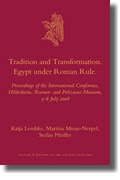
  • New Book: Tradition and Transformation. Egypt under Roman Rule

    Brill

    Book covers like this are always an indication that the book itself is going to cost a small fortune.

    In 30 BCE, Egypt became a province of the Roman empire. Alongside unbroken traditions—especially of the indigenous Egyptian population, but also among the Greek elite—major changes and slow processes of transformation can be observed. The multi-ethnical population was situated between new patterns of rule and traditional lifeways. This tension between change and permanence was investigated during the conference. The last decades have seen an increase in the interest in Roman Egypt with new research from different disciplines—Egyptology, Ancient History, Classical Archaeology, Epigraphy, and Papyrology—providing new insights into the written and archaeological sources, especially into settlement archaeology. Well-known scholars analysed the Egyptian temples, the structure and development of the administration beside archaeological, papyrological, art-historical and cult related questions.
  • Collapsible ladder design gives portability a leg-up

    The collapsible ladder folds down to be ultra portable - as far as ladders go

    There’s no doubt ladders can be unwieldy things to carry around – so much so that the ladder-carrying painter has become a staple of slapstick comedy. Unfortunately carrying a ladder around in real life is generally much less hilarious, although often just as chaotic. A young Israeli design student, Itay Laniado, has come up with a collapsible design that makes getting a ladder from point A to point B so you can get to point C a whole lot easier…

    Tags: ,

    Related Articles:


  • Closing Time: Field of streams – when good things happen to ordinary pitchers

    The high-priced lefty was working in Houston, up against the Berkman-free Astros. The journeyman righty was toiling in Oakland, facing perhaps the weakest lineup in the majors today. The pedestrian lefty was at home against Seattle, cushioned by a mammoth park and facing another underwhelming offense. Good work if you can get it.

    Barry Zito(notes) wasn’t given much fantasy hope entering the season, no matter that he came around nicely in the second half of 2009. Does a six-inning dusting (3 H, 0 R, 1 BB, 5 K) of the punchless Astros change your mind? Ian Snell(notes) had an up-and-down spring – plenty of strikeouts, but a messy ERA. Does a tidy six innings in Oakland (3 H, 1 R, 2 BB, 4 K) put him in your circle of trust? Dallas Braden(notes) entered Tuesday night with a respectable career ERA but nothing else notable to speak of. Will you shift into pickup mode after a 10-strikeout effort against the Mariners?

    If I had to pick up one of these three guys, Zito would get the nod. We’re talking about a former Cy Young winner, no matter if it happened back in the dark ages (once upon a time, Eric Chavez(notes) and Bobby Crosby(notes) got us excited on draft day). Zito gave us a 2.83 ERA and 7.7 K/9 after the break last year, and if nothing else you can selectively spot him around the National League, waiting for the home starts in a pitcher’s yard or the cushy spots on the road. Zito doesn’t throw hard enough to wake a napping baby these days, but if he keeps snapping off his curveball like he did Tuesday, I’m not concerned about the radar gun. Assuming the Giants slot him for a home date with Pittsburgh next Monday, I’m on board.

    Snell’s solid effort was all about picking on the Athletics, something Andy Behrens was begging you to do earlier in the day. Oakland’s basically got a roster of No. 1, No. 6 and No. 9 hitters – there isn’t a single stick that makes sense in the middle of a batting order. Snell was knocked around for most of camp (7.13 ERA, six homers) but he also had 18 strikeouts against three walks. I’m not going to make him a streaming priority by any means, but I’ll at least put him on the list when the matchup looks reasonable. I won’t go near him at Texas this weekend.

    Braden’s start might have been the most surprising of the three; while he had a solid 3.89 ERA over 22 starts last year, he wasn’t throwing the ball by anyone (5.33 K/9) and he never went past seven strikeouts in any start until Tuesday night. I suppose you could consider him on the weekend at Anaheim, depending on where you stand in your head-to-head match. In roto groups, I’d prefer to wait for a different spot.

    Chris Young is a more intriguing roto option than any of the three names listed above and he’s gone in all of my leagues, albeit his current ownership level is right around where Zito trades at. Young cruised through the Diamondbacks Tuesday (6 IP, 1 H, 0 R, 3 BB, 5 K) but let’s keep his flaws well in mind: he’s never gone past 179.1 innings in any season; he’s a fly-ball pitcher who will allow his share of homers, especially outside of Petco; he unwilling or unable to hold runners on base, so speed-laden clubs will get extra bases any time they want them. If Young gets the call at Colorado this weekend, hands off; if the Friars hold him out until Monday’s home game with Atlanta, you have a decision to make.

    In spring training, Mike Gonzalez’s(notes) problem was velocity; Tuesday night, he struggled with location. Either way, the lefty’s first outing for his new Baltimore club was a kick in the stomach – a blown save in the season opener at Tampa.

    The Orioles probably should have had a bigger cushion when the bottom of the ninth rolled around – Rafael Soriano(notes) was all over the place in the top of the inning, leaving the bases loaded – but when you’re a closer, you’re supposed to get those three outs, even if it’s just a one-run margin. Gonzalez was able to get his fastball in the 93 mph range Tuesday after a month in the 80s, but he couldn’t get the ball where he wanted. Sean Rodriguez(notes) roped a single to start the rally, Kelly Shoppach(notes) crushed a double off a belt-high heater and eventually Carl Crawford(notes) ended things with a two-run single, laced off a letter-high fastball.

    Gonzalez’s job isn’t in any danger, of course – his contract (two years, $12 million) guarantees a reasonable leash and at least his velocity returned in the opener – but there was nothing impressive about this debut, either. Clip and save. Jim Johnson(notes) doesn’t have an electric repertoire and he was spotty as a tempt closer late last year, but we should note that he’s the eighth-inning guy in Baltimore and he worked a tidy eighth inning at Tampa (1-2-3, with one strikeout).

     The Yankees tweaked their lineup up against Boston ace Jon Lester(notes); Curtis Granderson(notes) was dropped to the last spot in the order, and Marcus Thames(notes) got the call in left field while Brett Gardner(notes) hit the bench. Gardner eventually replaced Thames and got two at-bats against the Boston bullpen. "It’s not necessarily that we envision [Gardner] as a platoon guy," Joe Girardi told The Journal News. "There could be a situation where you give Nick (Johnson) a day off and you DH (Thames)." Thames has a career .516 slugging percentage against lefties, his one bankable skill.

    Handshakes: Another smooth save for Brian Wilson(notes) (perfect inning, one strikeout), with three holds in front of him. … Mariano Rivera(notes) retired three of four men to lock up New York’s first victory. … Trevor Hoffman(notes) was knocked around a bit (2 H, 1 R) but it’s hard to blow a three-run lead. … Heath Bell(notes) got the job done with a double-play ball and a strikeout. Mike Adams(notes) got the four earlier outs, dancing around three baserunners. … Jon Rauch(notes) rolled to an easy save in Amaheim (1-2-3, two strikeouts), with Matt Guerrier(notes) working a perfect eighth inning.

    Speed Round: Jose Reyes played nine innings in an extended spring training game (2-for-5) and might be able to play with the Mets this weekend. … The aggressive Padres stole three bases at Arizona (Tony Gwynn(notes), Chase Headley(notes), Everth Cabrera(notes)), while Adrian Gonzalez(notes) and Will Venable(notes) clubbed home runs. … Matt Wieters(notes) hit one of three Baltimore homers off James Shields(notes) in Tampa (the Roto Gods sigh), while Evan Longoria(notes) blasted a titanic shot that hasn’t landed yet (the Roto Gods weep). … Ken Macha brought the infield in during the first inning with Colorado, a silly move considering the Brewers were up against ordinary lefty Greg Smith(notes) on the other side. This isn’t 1968, Kenny. … A hitless day for Carlos Gomez(notes), but at least he tried to bunch for a hit (retired by a snappy Todd Helton(notes) play). A better approach, even if the result doesn’t show it. … Nick Johnson(notes) doesn’t have a hit yet for the Yankees but he’s already drawn four walks. The man is an OBP machine. … David Ortiz(notes) is already getting a little testy after an 0-for-7 start. Given how he struggles against lefties and on the road, he’s not someone I want any part of in 2010. … Houston’s bullpen got nine straight outs against San Francisco (courtesy of Jeff Fulchino(notes), Brandon Lyon(notes) and Matt Lindstrom(notes)) but it didn’t matter as the Astros offense was in bagel mode. … Ian Stewart(notes) knocked his second homer in two days, this one an opposite-field clout off left-hander Randy Wolf(notes), and he added a double and triple. The Rockies would be foolish to keep Stewart in the No. 7 slot all year.

  • Book Review: Hieroglyph Detective

    January Magazine (David Middleton)

    Picture this: you wake up deep inside a pyramid with only a single clue as to how you got there: there are hieroglyphs plainly visible on the wall but — alas! — you have no way to read them. What an Earth do you do?

    Well, if you’re lucky and had a bit of foresight before heading out on your locked-in-pyramid adventure, you will have packed a copy of Egyptologist Nigel Strudwick’s handy field guide Hieroglyph Detective: How to Decode the Sacred Language of the Ancient Egyptians (Chronicle Books). With an extra bit of luck, you’ll have had time to study it on the plane during your journey. Or the barge, as the case may be.

    And yes, of course: while most of us are quite unlikely to find ourselves awakening in a tomb, there is still a place in the world for this innovative and expertly creative little book. From the introduction:

    The aim of this book is to provide a practical, easy-to-follow guide to Egyptian hieroglyphics, giving readers sufficient grounding in the pictorial script to enable them to decipher for themselves some of the many inscriptions they will encounter while pursuing their interest in this fascinating civilization.

  • Spider Silk Research


    There is a design principle suggested here that we need to think about.  The protein crystals are sized to optimize strength and ductility, and then weakly bound together in a way that is mutually supported.  This is almost the description of a rope.
    How it could be applied to materials engineering remains to be seen but it is suggestive.
    The promise of course is a clever combination that could be simply extruded into existence while setting up extraordinary strength.  Doing it better with materials at the macro level would be always welcome.
    Spider silk research could lead to new super-materials
    Making bricks from straw may soon be possible and even desirable after scientists found spider silk could make ordinary materials stronger than steel.
    By Richard Alleyne, Science Correspondent

    Published: 14 Mar 2010
    Researchers found that spider silk employs a unique crystal structure that converts an otherwise weak material into one stronger and less brittle than steel or ceramics.
    They believe in future it may be possible to copy spider ingenuity to create new classes of materials that are both incredibly flexible and strong out of cheap, ordinary elements.
    Theoretically, they could even be made from wood, straw or hemp, say the scientists.
    Carbon-based materials made the same way would be even stronger than spider silk.
    A key property of spider silk is its combination of strength and “ductility” – its ability to bend or stretch without breaking.
    Most man-made materials, in contrast, sacrifice strength for ductility. Ceramics, for instance, are strong yet brittle.
    Scientists at the Massachusetts Institute of Technology (MIT) in Cambridge, US, studied the fundamental properties of spider silk using computer models to simulate its structure.
    The silk is made from proteins including some that form thin flat crystals called beta-sheets.
    The researchers found that the size of the crystals was critical.
    When they measured about three nanometres (three millionths of a millimetre) across they made the silk ultra-strong and ductile.
    But if the crystals grew to five nanometres the material became weak and brittle.
    Spider silk was strong despite its components being connected by naturally weak hydrogen chemical bonds, said the scientists.
    The geometry of the crystals allowed the hydrogen bonds to work co-operatively, shielding each other against external forces.
    The researchers, led by Professor Markus Buehler from MIT’s Department of Civil and Environmental Engineering, wrote in the journal Nature Materials: “The application of our findings to the design of synthetic materials could provide us with new material concepts based on inexpensive, abundant constituents.”
  • Bashir Was Ready to Step Down Before the Arrest Warrant? Really?

    by Kevin Jon Heller

    That’s what Rob Crilly claims in an editorial today in the Telegraph:

    Before he was indicted, Bashir told regional leaders and his confidantes that he was ready to step down: after 20 years in office, he was ready for a holiday, and retirement to a smart new villa in the north of Khartoum. Now, fearing arrest by a new regime, he has promised his inner circle that he will fight on.

    I have never heard this claim before, and Crilly provides no support for it.  I’m skeptical, particularly given that Crilly is a leading proponent of the “blame the ICC and the NGOs, not Bashir” movement.  He describes Bashir in the article, for example, as a “pragmatist” who is not “the monster of popular imagination.”  (Apparently, he is just misunderstood by all those mean prosecutors and activists.)  But I’m willing to be convinced.

    Anybody out there know whether Crilly’s claim is accurate?

    UPDATE: An intrepid reader contacted Crilly, who replied, “He said it on at least three different occasions. Sources rock solid.”  Crilly did not identify the sources, and I remain skeptical.  Even if Bashir said it, though, it is difficult to believe that he meant it.  If Bashir had communicated a genuine willingness to step down to the ICC, I think it’s safe to say that the OTP would have been willing to not bring charges against him.

    UPDATE 2: Crilly has a short blog post on Bashir’s alleged statement here.  He says he has been sitting on the information for a while — why, I don’t know.

  • Travel: What to do with children in Egypt

    Egypt Today (John Prosser)

    A look at some of the educational and entertaining areas of Cairo that might keep your children engaged on holiday.

    A fitting place to begin your family’s academic adventures is Dr. Hassan Ragab’s Pharaonic Village. Visitors are transported 4,000 years back in time to a painstakingly recreated pharaonic civilization. As you take a canal-boat tour through the village — complete with rare plants and animals believed to have lived in the region thousands of years ago — actors in period clothing demonstrate ancient methods of cultivation, ship-building and fishing. Museums on the island cover all aspects of ancient Egyptian life; from the building of the Sphinx and the pyramids to the production of papyrus. There’s even a museum explaining how chocolate was discovered and used, with free samples of cocoa of course. With new exhibits constantly being added, the Pharaonic Village is worthy of repeat visits. The village is located on Jacob Island, off the west bank of the Nile about six kilometers south of downtown. Guided tours last from one to three-and-a-half hours, depending on your desired itinerary, with prices starting at $15 (LE 83) per person.

    A more traditional venue for learning about ancient Egyptian culture now also has a great alternative for kids. The children’s gallery at the Egyptian Museum on Tahrir Square, (after coming through the main gate, follow signs round to the left of the main building) teaches children the ways of ancient life through the medium of Lego.

  • Book review: Cleopatra – A biography

    New York Times (Tracy Lee Simmons)

    CLEOPATRA. A Biography
    By Duane W. Roller
    Oxford University Press

    As usual with popular modern book reviews for, part of the review is the summary of the story told by the book’s author. But the reviewer also comments on the way in which the book was written:

    Roller tells his tale smoothly and accessibly. Scholarly digressions are consigned to helpful appendixes that Roller uses as small seminars for airing points of dispute, as a good many remain. What, for example, were the origins of Cleopatra’s mother? Was Cleopatra — the quintessentially vile foreigner according to Octavian’s propaganda — a Roman citizen? (Roller believes she was.) And he offers a digest of classical literary descriptions of the queen and a discussion of her iconography (including coin portraits, which are the only certain likenesses) to pinpoint those elements of her modern identity that only evidence from the period can prove or support.

    The resulting portrait is that of a complex, many-sided figure, a potent Hellenistic ruler who could move the tillers of power as skillfully as any man, and one far and nobly removed from the “constructed icon” of popular imagination.

  • Sequoia Fiery Tree Rings


    This is good to see.  More important is the last bit about the impact of man driven fire control on reproduction.  It is clearly not good at all.
    I have already posted on this subject and this is yet another great example.
    Best practice for almost all forests is the introduction of timed and controlled burns.  We have plenty of data and plenty of need to implement such programs everywhere.  They are clearly necessary for forest health, to say nothing about other parts of the biome.
    The huge burns that ran rampant a couple of years back was a combination of a decadal drought and a great manmade fuel build up.  The fuel must be reduced.  No one understands quite how much fuel hits a forest floor every year.  In the East it rots slowly and is blanketed with moisture holding leaves.  The Indians still burned it all out.
    In the West it tends to get tinder dry.  Walking through a ponderosa pine forest in July is a bit like passing through a gas filled house.  Only a madman would light a match and the forestry department orders folks out.  It really is that obvious.
    In the long run and we actually have the time, what I am saying here is been said by others and this is slowly working its way into text books and study programs.  In time proscribed burns will be done everywhere and in time stakeholders will optimize forests for maximum long term productivity.
    Today we can recognize the problem and tomorrow we can implement proper changes.  Enough knowledge already exists to assure us that most new changes will be for the better.   The sequoias can wait for us to get our act together.
    EARTH’S BIGGEST TREE RINGS TELL FIERY TALES

     Fifty-two giant fallen giant sequoias reveal a 3,000-year-old history of fire and drought after giant chainsaws expose their rings.
    By Larry O’Hanlon | Mon Mar 29, 2010
    Using huge chainsaws and strong backs, the largest trees in the world are finally giving up their 3,000-yearrecord of fires and droughts. No trees, however, were harmed in the making of this fire history.
    “We only used dead trees,” emphasized tree ringresearcher Thomas Swetnam of the University of Arizona. Swetnam led the study that was reported in a recent issue of the journal Fire Ecology. “We spent multiple years collecting the wood and hauling it back to Tucson.”
    The giant sequoias in California‘s Sequoia National Park are far too thick to be cored for the extraction of the pencil-thin cores typically used by tree ring researchers. So the authors of a new report on tree ring evidence of past droughts and fires used all sorts of other tools to slice and dice 52 giant dead and fallen sequoias, lug the pieces back to roads by hand. Then they spent years piecing together the valuable history in their laboratories.
    Among the things they found in the ring record was a very dry and fiery period from 800 to 1300 A.D. That corresponds to a controversial climate interval called the Medieval Warm Period.
    That period was very dry,” said Swetnam. “But we’re not so clear how warm it was.”
    Modern temperatures already exceed those of the Medieval Warm Period, said Swetnam. So if heat has anything to do with fire frequency, we could expect more fires.
    “What makes this work unique is that it goes so far back in time,” said U.S. Geological Survey research ecologist Nathan Stephenson, who has spent a lot of years studying sequoias. Usually if you are working with pines you get centuries. With these you get multi-millennial annual resolution records.”
    But unlike a tree ring history that’s based on just rings, this one is based cross dating rings between various trees the dating of fire scars.
    These scars happen during natural fires when debris close to the tree bakes and burns the trunk, which is otherwise fire resistant. The trees can grow over a lot of these scars, but in cross sections, that can be easily spotted and dated.
    “That way were able to establish a fire chronology,” Swetnam told Discovery News. Of course, there have been other fire chronologies. Some are based, for instance, on charcoal layers found in mountain lakes. But nothing has quite the resolution of tree rings.
    “The punch line from all of this,” said Stephenson, “Is that over at least 2,000 years the most severe (sequoia) reproduction reduction has been in the last 100 years. Human land use changes have had greater effect than the preceding 2,000 years of changing fire regimes.”
    The problem, said Stephenson, is fire suppression. Excluding fires from the sequoia groves, makes it very difficult for sequoia seeds to germinate or have enough space for saplings to get started.
  • Book review: Moines et communautés monastiques en Égypte (IVe-VIIIe siècles)

    Bryn Mawr Classical Review (Review by Shawn W.J. Keough)

    Ewa Wipszycka, Moines et communautés monastiques en Égypte (IVe-VIIIe siècles). JJP supplement 11. Varsovie: Journal of Juristic Papyrology, 2009.
    Ewa Wipszycka’s first contribution to the study of Egyptian monasticism appeared in 1986, and for the past twenty-five years a steady stream of articles from her pen has left its significant imprint on the field and firmly established her reputation as one of the world’s preeminent specialists of the institutional and social history of late antique Egyptian Christianity. The book everywhere bears the mark of a specialist intimately acquainted with an enormous range of source material: Wipszycka skilfully combines the skills of historian, papyrologist and archaeologist, a rare feat. The result is a volume that presents an incredibly detailed description and analysis of Egyptian monastic institutions and communities in which the social conditions and lived realities of late antique monastic centres flanking the Nile are presented in all their fascinating diversity and complexity. Only one previously published essay appears unchanged within this book marking the culmination of a quarter century’s research, while more than fifteen previous studies have been revised, updated and incorporated into the volume, much of which presents new material.

    The volume opens with a lengthy introduction to and consideration of the literary sources undergirding Wipszycka’s study. As the volume is not so much concerned with monastic spirituality or theological controversy as with the social circumstances of Egyptian monastic centres, certain texts appear rarely, if at all (such as the writings of Evagrius of Pontus).

  • The vizier’s door

    Al Ahram Wekkly (Nevine El-Aref)

    According to Zahi Hawass, secretary-general of the Supreme Council of Antiquities (SCA), the door, which is 175cm tall, 100cm wide and 50cm thick, is engraved with religious texts as well as User’s various titles: the mayor of the city; vizier; and inheriting prince.

    User is believed to have come to office in the fifth year of Hatshepsut’s reign. He built a tomb for himself and his wife on the west bank at Luxor (number 61). Mansour Boreik, supervisor of Luxor antiquities and head of the excavation team, said the newly-discovered door was cut from the tomb during the Roman period and used as part of a wall found several months ago by the mission.

  • Weaning Sugar Wednesday #8: Cutting Down The Sugars In Breakfast Food

     Pink_tulips

    To start off with something sweet, that is not a food because we can have sweetness in our lives without cookies or cupcakes, here are some beautiful pink tulips. Spring is here and the weather in Phoenix has just been heavenly with crisp fresh air and blue skies. If you’re thinking of doing a spa or golf weekend, come on down because it is literally perfect weather now. Soon, it will get Africa hot.

    Now that I and many others have gotten absolutely clear on exactly how The American Heart Association defines added sugars, it really has changed how I look at foods because now when I read labels, I look at what is added on top of the natural stuff like say jam for example. Fruit on its own should be sweet enough, but apparently it isn’t because added sugars are still combined with the fruits. Locally, I found Made By Bees, who makes these awesome fruit butters like this Apricot butter with no added sugars. They just use other fruits for added sweetness.

    Yesterday, I dropped my car off at the shop to get fixed and then walked over to Whole Foods to get some breakfast. I get to the hot foods bar and immediately my nose gets a whiff of this creme brulee french toast. 

     Wholefoods_frenchtoast

    Now, of course I’m drooling because the smell of this decadence is literally igniting all my senses. But fortunately, because I have noticed that my taste buds are acclimating to less sugars, the desire to actually taking a bite of this french toast doesn’t even come up because I start thinking of the ginormous amounts of added sugars in this dish, and I ask myself, “Is this how you want to start your day?”

    Easily, I’m like, “Uh no, not really.” Because, I know that eating something like this at 9am is going to make me feel sluggish and heavy. But, I don’t say no either because I know my Inner Resistance Monster will kick in. I just ask myself which choice will satisfy what I need at the moment, and make me feel good.

    Fortunately, I’m satisfied with just inhaling the smells. Who knew? Back in January, I would have definitely at least gotten a very small piece and called it breakfast dessert.

     Fruityogurt_granola

    So, what I do end up getting for breakfast is a cup of mixed fruit made of cantaloupe, strawberries, grapes, mandarin oranges, and bananas from the salad bar, and then topping it with So Delicious brand Pina Colada coconut-milk based yogurt, and topping it all with my favorite maple pecan granola. I felt good. My body felt good, and this is the way I like to start my day…feeling gooood!

    #triedsomethingnew_red2 And how’s your sugar weaning week going? Discover any new tips or try anything new to eat less sugars in the day? If you blogged about it, please share and tag your post, #triedsomethingnew and #foodrevolution as I’m collecting and highlighting anyone who tries something new in their efforts to eat healthier for our new “I tried something new” movement inspired by Jamie Oliver’s Food Revolution.

    I’m very passionate that no one should die or be ill because of a diet related disease because it’s preventable! We can all help each other eat healthier in ways that are fun and adventurous!


  • Chemistry Discovery for Cooking Oil


    This does not sound like it is going to be used any time soon but it is surely suggestive and the protocol is possibly repeatable with other solvents.  Certainly the idea of mixing a switchable solvent into an oil rich mash to effectively collect the oil and then switching it off to repel the remainder wet mash is as energy efficient as one may imagine.
    How it all may work in a process environment is certainly going to be a challenge.
    It certainly is promising and could be important were un processed mash is preferred for the benefit of future processing.  Here they are working with soy beans and even here it is likely too soon.
    Chemistry Discovery May Revolutionize Cooking Oil Production
    by Staff Writers

    London, UK (SPX) Apr 01, 2010

    When carbon dioxide is added, the solvent becomes hydrophilic, meaning it mixes with water and doesn’t like to be in oil. So when carbonated water – carbon dioxide and water – is added to a mixture of the solvent and soybeans, the oil is extracted out of the soybeans and collected. When the carbon dioxide is removed, the solvent switches back to its hydrophobic state.

    A Queen’s University chemistry professor has invented a special solvent that may make cooking oil production more environmentally friendly. Philip Jessop, Canada Research Chair in Green Chemistry, has created a solvent that – when combined with carbon dioxide – extracts oil from soybeans.

    Industries currently make cooking oils using hexane, a cheap, flammable solvent that is a neurotoxin and creates smog. The process also involves distillation, which uses large amounts of energy.
    “Carbon dioxide is famous for global warming – it’s everybody’s favourite gas to hate these days,” says Professor Jessop, who specializes in green chemistry. “My research group is trying to figure out if we can use it for something useful. I figure we may not be able to recycle all the carbon dioxide out there but we can recycle a bit of it and make it contribute to society in a positive way.”
    Jessop’s new method of making oil involves a “switchable” solvent. This solvent is hydrophobic, meaning it mixes with oils and doesn’t like water.
    But when carbon dioxide is added, the solvent becomes hydrophilic, meaning it mixes with water and doesn’t like to be in oil. So when carbonated water – carbon dioxide and water – is added to a mixture of the solvent and soybeans, the oil is extracted out of the soybeans and collected. When the carbon dioxide is removed, the solvent switches back to its hydrophobic state.
    “The water and the solvent can be used again so everything is recycled. The end result is you have extracted soybean oil and there is no energy-consuming distillation required,” says Professor Jessop, who who did research in the 1990s under the supervision of Nobel Chemistry Prize winner Ryoji Noyori.
    While this process has only been done in labs, Professor Jessop says he has already heard from cooking oil companies and GreenCentre Canada who are interested in his research. But the solvent is still years away before it can ever be used in large-scale oil manufacturing.
    Professor Jessop is trying to get rid of the use of volatile chemicals such as hexane by giving industries an option to use a manufacturing process that is both economically and environmentally friendly.
    “The advantage of hexane is that it’s cheap. When you do green chemistry, you have to worry about cost. You can’t just say ‘Look at this, industry, it’s greener!’ If it costs 10 times as much, no one is going to use it,” Professor Jessop says. “So next we have to do the economic calculations to see how much it is going to cost. If manufacturing with this environmentally friendly solvent is really expensive compared to the hexane, we have to figure out how we can we make it cheaper.”
    The results of Jessop’s research have been published in the journal Green Chemistry.
  • Ford Focus RS 500

    Ford Focus RS 500

  • April/May edition Ancient Egypt Magazine now available

    The April/May 2010 issue of “Ancient Egypt” magazine (published in the U.K.) is now available.

    If you are not a subscriber, you can do so online and the magazine is also available as an electronic version. Visit www.ancientegyptmagazine.com

    To celebrate our 10th year of publication any new subscribers will be offered one free issue of the magazine with their subscription, and subscribing is cheaper than buying the magazine from newsstands.

    Our online version may be useful for anyone with a broadband connection who may have difficulty in getting hold of a paper copy of the magazine, or who might want to see a copy before subscribing.

    Contents of the April issue includes;

    • News from Egypt and the World of Egyptology: Another bumper report ‘From our Egypt Correspondent’ brings the latest news and information – you won’t find this anywhere else!. This issue includes reports on new work in and around Alexandria, Giza, Saqqara and Luxor and with an update of the conservation and cleaning work at the temple of Hathor at Dendera.

    • An Alabaster Coffin and Sety I’s Last Secret: Stephen Cross looks at the alabaster coffin of the king, now in a museum in London and finds that the circumstances surrounding its discovery may indicate that the king’s tomb in the Valley of the Kings has more secrets to be revealed. This article is timely as the latest news from the valley indicates that a new discovery has indeed just been made.

    • Thoroughly Modern Mummies: Dr. Ryan Metcalfe reveals how modern science is helping us learn more about the mummification techniques used by ancient Egyptians and the reasons why their methods worked.

    • Amarna Update:: A brief update on the last season of work and developments at the site of Akhenaten and Nefertiti’s city of Akhetaten.

    • Life in Paradise: Tombs of the Nobles at Thebes: An extract from Dr. Zahi Hawass’s new book on the Theban Tombs reveals many tombs unknown to the general public but superbly decorated.

    • The Department of Ancient Egypt and Sudan at the British Museum: In the first of a series of articles on the work of the Department, Dr. Daniel Antoine looks at “Life and Death in the Nile Valley: Bioarchaeological Research at the British Museum”.

    • Tutankhamun’s family revealed by DNA Testing: The results of the recent DNA and CT scanning of a group of royal mummies, confirming/providing the identification of some of the mummies.

    • PerMesut: in our regular feature for younger readers, Hilary Wilson looks at “A sense of Smell”.

    • Net Fishing: our regular look at Egyptology on the Web, tracing the history of ancient Egypt. This issue Victor Blunden looks at the dual reigns Kings and High Priests in the Twenty-first Dynasty.


    Coming articles include:-

    • New excavations in the tombs of the Nobles at Luxor
    • An Ancient Egyptian Fleet of Model Boats now in the Museum of Fine Art in Boston.
    • Minoans and Mycenaeans in ancient Egypt.
    • Travellers in Egypt’s Western Desert
    • Ancient Egyptian boats: Exhibitions and a modern replica sailing in the wake of Hatshepsut.
    • Vetinary practice in ancient Egypt.
    • King Narmer’s Electric Catfish: a biological battery.

  • LG Mini GD880 Phone Has New HTML5-Supporting Phantom Browser [Cellphones]

    On sale later this month after first tantalizing us at MWC in February, LG has confirmed the Mini GD880 will support HTML5 in its “Phantom Browser,” the first time it’s been reeled out by the South Koreans. More »


  • Lamborghini Gallardo Superleggera track pics

    Lamborghini Gallardo LP 570-4 Superleggera track pics

    These picks show the Lamborghini Gallardo LP 570-4 Superleggera on the track. While the new Lamborghini is impressive for its performance figures, it is significant in that it marks the start of an evolution for the brand. The new Lamborghini supercars will focus on bringing weight down and should distinguish themselves for their power-weight ratios.

    The Gallardo Superleggera (’Superlight’) has also been modified to improve aerodynamics and develop a new suspension system for Lamborghini. It really is a benchmark model to defining the Lamborghinis of the future. As already reported, the weight-power ratio is 2.35 kg/hp and we can’t wait to see that reduced even further in the future. See all the pics below of the Gallardo Superleggera on the track.

    Lamborghini Gallardo LP 570-4 Superleggera track pics

    Lamborghini Gallardo LP 570-4 Superleggera track pics Lamborghini Gallardo LP 570-4 Superleggera track pics Lamborghini Gallardo LP 570-4 Superleggera track pics Lamborghini Gallardo LP 570-4 Superleggera track pics

    Lamborghini Gallardo LP 570-4 Superleggera track pics Lamborghini Gallardo LP 570-4 Superleggera track pics Lamborghini Gallardo LP 570-4 Superleggera track pics Lamborghini Gallardo LP 570-4 Superleggera track pics
    Lamborghini Gallardo LP 570-4 Superleggera track pics Lamborghini Gallardo LP 570-4 Superleggera track pics Lamborghini Gallardo LP 570-4 Superleggera track pics Lamborghini Gallardo LP 570-4 Superleggera track pics
    Lamborghini Gallardo LP 570-4 Superleggera track pics Lamborghini Gallardo LP 570-4 Superleggera track pics Lamborghini Gallardo LP 570-4 Superleggera track pics Lamborghini Gallardo LP 570-4 Superleggera track pics
    Lamborghini Gallardo LP 570-4 Superleggera track pics Lamborghini Gallardo LP 570-4 Superleggera track pics Lamborghini Gallardo LP 570-4 Superleggera track pics Lamborghini Gallardo LP 570-4 Superleggera track pics
    Lamborghini Gallardo LP 570-4 Superleggera track pics Lamborghini Gallardo LP 570-4 Superleggera track pics Lamborghini Gallardo LP 570-4 Superleggera track pics Lamborghini Gallardo LP 570-4 Superleggera track pics
    Lamborghini Gallardo LP 570-4 Superleggera track pics Lamborghini Gallardo LP 570-4 Superleggera track pics Lamborghini Gallardo LP 570-4 Superleggera track pics Lamborghini Gallardo LP 570-4 Superleggera track pics
    Lamborghini Gallardo LP 570-4 Superleggera track pics Lamborghini Gallardo LP 570-4 Superleggera track pics Lamborghini Gallardo LP 570-4 Superleggera track pics Lamborghini Gallardo LP 570-4 Superleggera track pics
    Lamborghini Gallardo LP 570-4 Superleggera track pics Lamborghini Gallardo LP 570-4 Superleggera track pics Lamborghini Gallardo LP 570-4 Superleggera track pics Lamborghini Gallardo LP 570-4 Superleggera track pics
    Lamborghini Gallardo LP 570-4 Superleggera track pics Lamborghini Gallardo LP 570-4 Superleggera track pics Lamborghini Gallardo LP 570-4 Superleggera track pics Lamborghini Gallardo LP 570-4 Superleggera track pics
    Lamborghini Gallardo LP 570-4 Superleggera track pics Lamborghini Gallardo LP 570-4 Superleggera track pics Lamborghini Gallardo LP 570-4 Superleggera track pics Lamborghini Gallardo LP 570-4 Superleggera track pics
    Lamborghini Gallardo LP 570-4 Superleggera track pics Lamborghini Gallardo LP 570-4 Superleggera track pics Lamborghini Gallardo LP 570-4 Superleggera track pics Lamborghini Gallardo LP 570-4 Superleggera track pics
    Lamborghini Gallardo LP 570-4 Superleggera track pics Lamborghini Gallardo LP 570-4 Superleggera track pics Lamborghini Gallardo LP 570-4 Superleggera track pics Lamborghini Gallardo LP 570-4 Superleggera track pics
    Lamborghini Gallardo LP 570-4 Superleggera track pics Lamborghini Gallardo LP 570-4 Superleggera track pics Lamborghini Gallardo LP 570-4 Superleggera track pics Lamborghini Gallardo LP 570-4 Superleggera track pics