Blog

  • Woman Eaten by Vultures Stirs Protected Species Debate

    A woman hiking in the Pyrenees mountains in France who fell to her death is igniting a debate over a protected species of vulture.

    According to an International Business Times report, a 52-year-old woman fell down a 300-meter cliff while walking with friends. Vultures immediately took to the body, reducing it to only clothes and bones in less than one hour.

    The event has highlighted calls by some farmers in France to be able to kill the Griffon vulture, a protected species that has been turning to attacking livestock. Recent European Union laws have required dead animal carcasses, a staple of the vultures’ diets, to be burnt to prevent the spread of mad cow disease. According to the IBT report, this policy has “critically” lowered the food available for the vultures.

    Farmers are now making compensation claims for livestock killed or carried off by the birds. Hunters have also complained of the vultures stealing their kills. The birds, which can grow to have 9-foot wingspans and live over 40 years in captivity, are also reportedly spreading out further into Europe in search of food.

    (Image courtesy Ingrid Taylar/Wikimedia Commons)

  • AT&T to release the 32GB Samsung Galaxy S 4 smartphone Friday, May 10th

    AT&T_Samsung_Galaxy_S_4_32GB_Twitter


    Those of you AT&T customers out there who have been itching for the 32GB variation of the Samsung Galaxy S 4 smartphone are officially in luck— the wireless carrier has officially announced it will release the 32GB version this Friday, May 10th. The device won’t cost potential customers too much money as well as the device will run customers $250 on-contract— a modest $50 increase from the standard 16GB version. Considering there have been reports of the 16GB Galaxy S 4 only having roughly half of the on-board storage space available due to the preloading of massive bloatware, the Galaxy S 4 may not be such a bad option for customers— especially those who don’t want to fiddle with the use of microSD cards.

    Unfortunately, it appears that AT&T is the only carrier that will offer the 32GB version for now, but hopefully we will see other U.S. carriers with the variant sooner than later.

    source: AT&T Twitter

    Come comment on this article: AT&T to release the 32GB Samsung Galaxy S 4 smartphone Friday, May 10th

  • An outsider’s view of CenturyLink: Tips for Public-Private Partnership

    Chris Mitchell promotes community networks. He’s at the Institute for Local Self Reliance, so his view makes sense. He follows broadband access closely. Late last week he posted an interesting article on CenturyLink, noting that CenturyLink’s plan for 1 Gbps service in Omaha is an outlier, not a sign of the times to come.

    Chris points out that Omaha – or at least the part of Omaha getting the upgrade – needed the upgrade for technical reasons. And I think it doesn’t hurt that the area getting the upgrade sounds like an affluent area. It’s certainly positive news for Omaha that the upgrade is coming. And if it does well financially, it could be good news for other areas as well – but for the reasons that Chris points out, I agree that it’s probably an outlier, especially in terms of rural communities. Also I’ve heard the folks at CenturyLink say as much. Rural areas are a tough investment – tough terrain, low population density and managers are obliged to make business decisions that benefit shareholders.

    What does this mean for local underserved communities? Chris looks at that question…

    CenturyLink just doesn’t have the money to upgrade most of its communities. Will it in future years? That is a question that Phil Cusick of JPMorgan asked: “Okay. And, so we should look at CapEx as being essentially flat for the next few years?”

    CFO Stewart Ewing response:

    That’s our thinking now. Pretty flat, we could bring it down some, cut it off a little bit depending on. It’s really based on the success of these new initiatives, I mean, what we think we can drive in terms of revenue and margins going forward.

    CenturyLink is not dumb or evil, it just has different priorities for investment than what communities need. The sooner local governments understand this, the better. Heck, CenturyLink itself has made this point in Minnesota:

    We’re a public company. We have shareholders. We have rules and commitments. If you’re smaller, the shareholders are the owners. There’s more flexibility – especially if owners/shareholders are local.

    Minnesota Public Radio summed it up:

    Noting that CenturyLink wants every customer it can find, Ring pointed out that the company nonetheless needs a return on investment that satisfies shareholders and meets the demands of larger commitments and fiduciary responsibilities.

    If you’re a community looking at broadband and you are served by CenturyLink (or CenturyLink is nearby), it still makes sense to invite them to the table to talk about broadband. They know broadband. They may know if your area is expecting an upgrade in the near future. They may be in a position to be swayed by growing interest in broadband. Most providers will talk to specific customers about upgrades to their service – maybe it’s a matter of aggregating those demands. But it’s also wise to keep Chris’ observations in mind. The key to a public-private partnership is finding a solution that meets the needs of the community and commercial provider and the first step may be recognizing that those needs are not necessarily the same.

    An area/project to watch is the North East Central communities. They held a broadband summit in February – inviting community leaders and providers. One of the stated outcomes from the summit was an effort to continue discussion between community leader and providers. Brian Estrem from U-reka Broadband spoke about the moving the public-private effort forward…

  • Samsung to release Galaxy Core – a smaller, cheaper, and weaker GS3

    Samsung_Galaxy_Core

    With this year’s line of Galaxy devices from Samsung comes the Galaxy Core, a mid-range Android with specs at the level of a Galaxy S2.  The new phone has a 1.2GHz dual-core CPU and a 4.3-inch WVGA screen.  It also comes with 1GB of RAM, 8GB of internal storage, an 1800mAh battery and a 5-megapixel rear camera.  The phone will be available in two colors— black and white.

    As for UI, it’s running TouchWiz Nature over 4.1 Jelly Bean.  It’ll feature Smart Stay, S Voice, and Smart Alerts.

    It is unclear which carrier(s) will make the phone available to their customers, but we do know that it will be released at some point this month with a dual-SIM feature.  A single-SIM version will follow in July.  We’ll wait for some more announcements from Samsung to update you guys on the new Galaxy Core. Hit the break for the full press release.

    Samsung Introduces the GALAXY Core for Ideal Portability and Power

    The smartphone combines dual core processing power, compact design, and Dual SIM technology 

    SEOUL, Korea – May 06, 2013 – Samsung Electronics Co., Ltd., a leader in mobile technology and digital solutions, today announced the Samsung GALAXY Core, a smartphone designed to offer users dual core processing power for multitasking, Dual SIM technology for easy transition between work and play, and a wealth of innovative smart features. The GALAXY Core is a device that can operate seamlessly and effectively in all aspects of life.

    The GALAXY Core is the perfect device for the user looking for optimal balance of portability and power. Equipped with a 1.2 GHz dual core processor, the GALAXY Core performs data intensive tasks with speed and ease. The processing power is supported by 8GB of Internal memory and 1GB of RAM so that users can play feature-rich games, multitask and consume limitless media. All of these activities are aided by a beautiful 4.3 inch display, and a long-lasting 1,800mAh battery for extended usage. The device also comes equipped with a 5-megapixel camera, offering flawless and beautiful photos. These features are also supported with the GALAXY Core’s Dual SIM technology, enabling users to access both SIM cards simultaneously.

    Offering innovative mobile solutions to enhance the user experience, the GALAXY Core’s smart features provide advanced tools that continue to set the GALAXY series apart. Utilizing human interactions including voice, movement, and optical commands, the GALAXY Core has a wide array of smart features that include:

    • ‘Smart Stay’: Recognizes when a user is looking at the phone, and saves battery life when a user looks away by
    dimming the screen and powering down using advanced facial recognition
    • ‘Smart Alert’: Alerts the user to missed calls and messages when the device is picked up
    • ‘Motion UI’: Activates common functions such as refresh or mute with simple motion commands
    • ‘S Voice’: Provides voice command functionality

    The GALAXY Core will be available in two different versions – Single SIM from July or Dual SIM from May, depending on the market.

    Network  – HSUPA 5.76 900/2100 EDGE/GPRS 850/900/1800/1900
    Processor – 1.2 GHz Dual Core Application Processor
    Display – 4.3 inch WVGA (480×800) TFT LCD
    OS – Android 4.1 (Jelly Bean)
    Camera – Main(Rear): 5 Mega pixel camera with LED flash Sub  / (Front): VGA camera  / Mode: Best Photo, Continuous, Panorama, Share shot, Smile Shot, Cartoon
    Video – MPEG4, H.263, H.264, VP8, WMV9, VC1 Playback: 480p@30fps, Recording: 480p@30fps
    Audio – MP3, AAC, eAAC, eAAC+, AMR-N/WB, OGG, FLAC, WMA, 3GA, M4A, WAV, Mid, SP-midi, XMF, i-melody FM Radio with RDS  / 3.5mm Ear Jack
    Services & Additional Features – Dual SIM (Optional) / Samsung Apps / Samsung Kies / Samsung Kies Air (Downloadable via Samsung Apps) / Samsung Hub  /Game Hub (Preloaded) / – Readers Hub/ Music Hub (Downloadable via Samsung Apps) / Samsung ChatON mobile communication service / Smart Stay, Smart Alert, Motion UI, S Voice, Voice Unlock
    Google Mobile Services – Google Mobile Services: Google Search, Gmail, Google Play Store, Google Plus, YouTube, Google Talk, Google Maps (Turn-by-turn Navigation), Google Now
    Connectivity – WiFi b/g/n – Bluetooth® 3.0 / MicroUSB / USB 2.0
    Sensor –  Accelerometer, Proximity, Digital Compass
    Memory – 8GB Internal memory + 1GB (RAM) / microSD slot (up to 64GB)
    GPS – A-GPS
    Dimension – 129.3 x 67.6 x 8.95 mm, 124 g
    Battery – Standard battery, Li-ion 1,800 mAh

    * The availability of each Samsung Hub and Google service may differ by country.
    * All functionality, features, specifications and other product information provided in this document including, but not limited to, the benefits, design, pricing, components, performance, availability, and capabilities of the product are subject to change without notice or obligation.
    * Android, Google, Google Search, Gmail, Google Play, Google Plus, YouTube, Google Talk, Google Maps and Google Now are trademarks of Google Inc.


    Come comment on this article: Samsung to release Galaxy Core – a smaller, cheaper, and weaker GS3

  • Here’s What President Obama Told the Class of 2013 at The Ohio State University

    President Barack Obama delivers the commencement address during The Ohio State University (May 5, 2013)

    President Barack Obama delivers the commencement address during The Ohio State University commencement at Ohio Stadium in Columbus, Ohio, May 5, 2013. (Official White House Photo by Pete Souza)

    The Ohio State University is an institution that dedicates itself to “Education for Citizenship” — the Buckeye motto emblazoned on the school seal.

    So when President Obama spoke to the Class of 2013 at the school's graduation, citizenship was his theme.

    "As citizens, we understand that it’s not about what America can do for us," he said. "It’s about what can be done by us, together, through the hard and frustrating but absolutely necessary work of self-government. And, Class of 2013, you have to be involved in that process."

    The President made a pitch for civic connection — for participation in public life, for engagement in national debates, for community service. He pointed to those who stand up in moments of crisis — running toward the damage inflicted by the bombs in Boston to care for survivors, helping neighbors dig out from Hurricane Sandy last fall — as examples.

    "We've seen courage and compassion, a sense of civic duty, and a recognition we are not a collection of strangers; we are bound to one another by a set of ideals and laws and commitments, and a deep devotion to this country that we love," he said. "And that's what citizenship is."

    Above all, he urged survivors to break through the cycle of cynicism that too often cripples progress in this country.

    "Only you can make sure the democracy you inherit is as good as we know it can be," President Obama told the graduates. "But it requires your dedicated, and informed, and engaged citizenship. And that citizenship is a harder, higher road to take, but it leads to a better place."

    Read the full remarks. Or watch the video:

  • Intel debuts Silvermont: mobile chips with powerful battery-sipping abilities

    Once left for dead in the mobile market, Intel is showing signs of a potential comeback. On Monday, the company introduced its new Silvermont chip, promising three times more performance over existing Atom chips or the same current performance using five times less power.

    What’s the secret sauce in the silicon? The chips will use a 22 nanometer process combined with Intel’s Tri-Gate transistors. The Tri-Gate technology is already used in Intel chips for laptops and desktops, but Silvermont will be the first to use it in mobile devices such as tablets.

    AnandTech has a superbly detailed analysis of the new chip, which, according to Intel’s official press release, offers these benefits:

    • A new out-of-order execution engine enables best-in-class, single-threaded performance.
    • A new multi-core and system fabric architecture scalable up to eight cores and enabling greater performance for higher bandwidth, lower latency and more efficient out-of-order support for a more balanced and responsive system.
    • New IA instructions and technologies bringing enhanced performance, virtualization and security management capabilities to support a wide range of products. These instructions build on Intel’s existing support for 64-bit and the breadth of the IA software installed base.
    • Enhanced power management capabilities including a new intelligent burst technology, low-power C states and a wider dynamic range of operation taking advantage of Intel’s 3-D transistors. Intel Burst Technology 2.0 support for single- and multi-core offers great responsiveness scaled for power efficiency.

    I expect we’ll first see Silvermont power a new generation of Windows 8 tablets around the holidays. The current Intel Atom slates running Windows 8 offer the same benefits and experiences of a similarly priced Windows RT slate with an ARM chip. The added benefit is that the tablets with Intel inside run the full Windows 8 software and provide a complete Desktop mode experience.

    The downside is that the chips aren’t powerful enough to provided a superb Windows 8 experience; for that, buyers opt for Intel Core i5 chips and give up battery life in the process. If Intel’s claims of Silvermont are correct, however, a low-priced Windows 8 tablet of the future could offer a big performance boost when needed or provide battery savings if a user prefers it.

    Related research and analysis from GigaOM Pro:
    Subscriber content. Sign up for a free trial.


  • Does Google Glass need an etiquette guide? WSJ seems to think so

    Google Glass Etiquette Guide
    According to some pundits, Google Glass is a doomed geeky gadget destined to follow the Segway into obscurity. If that’s the case, creating an etiquette guide for Google’s connected eyewear seems like a huge waste of time. The Wall Street Journal apparently has some faith in the device though, and it recently published a list of guidelines it wants Google Glass owners to follow once the device launches to the public in 2014.

    Continue reading…

  • Adobe bets that Creative Cloud, not the desktop, is the future

    Talk about a sign of the times. Adobe Systems is ceasing development on its Creative Suite of desktop tools to focus instead on Creative Cloud, a $50-per-month subscription service.

    According to the release, Adobe’s popular desktop tools — Illustrator, PhotoShop, InDesign, Dreamweaver and Premiere Pro — will be rebranded as part of the new Creative Cloud SaaS offering and carry a CC label (e.g. Illustrator becomes IllustratorCC).

    For anyone in the media business –including yours truly — this is a huge milestone. Nearly every publication relied on Illustrator to create artwork, and PhotoShop to tweak and touch up (occasionally rebuild) photographs. InDesign contended with Quark as the page layout and production software of choice.

    According to a company statement:

    “While Creative Suite 6 products will continue to be supported and available for purchase, the company has no plans for future releases of Creative Suite or other CS products. This update to Creative Cloud includes the next generation of Adobe desktop applications — including Photoshop CC, InDesign CC, Illustrator CC, Dreamweaver CC and Premiere Pro CC.”

    Adobe Systems is not facing this cloud dilemma alone. Microsoft is trying to ride the wave while offering Office 365 subscription while continuing to update its legacy Office desktop versions.Who knows how long that will last.

    Related research and analysis from GigaOM Pro:
    Subscriber content. Sign up for a free trial.


  • Bing Heads To Google, Kansas

    Bing is at it again with another “Bing it On” challenge. Actually, it’s pretty much the same challenge, but they’re challenging people again.

    Bing says in a blog post, “With the newest version of the Challenge site, in addition to search results, you’ll get to learn about a new homepage every day, rollover video preview and instant translation all on the same site – some of our unique features that give you even more reasons to fall in love with Bing.”

    They’re kicking off a new nationwide campaign. This time they went to Topeka to ask people if they know that most people prefer Bing search results to Google’s.

    “I’m not sure I believe that,” one participant says, before being wowed by the awesomeness that is Bing.

    As you may recall, a few years ago, Topeka temporarily adopted the name “Google” for its city in a campaign to get Google Fiber (which ultimately debuted in Kansas City).

    “In Google, Kansas, you made me a Bing man,” says one person.

    You can try the challenge here. Just remember that the experience is completely different (for both search engines) than when you actually search on Google or Bing, as it strips out key features like Google’s Knowledge Graph and Bing’s social features.

  • Tablets devastate laptop market

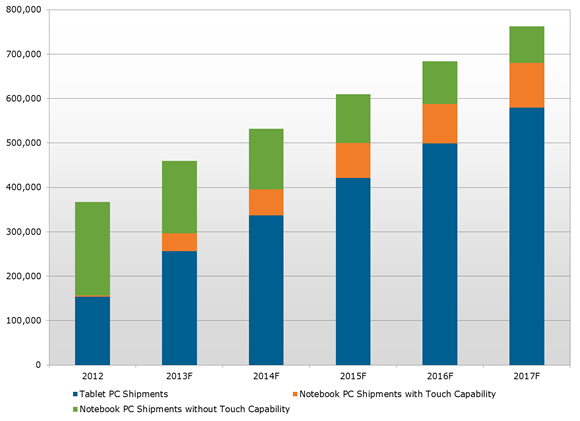
    The white box battle is on, and laptops are losers. The big trend in tablets isn’t iPad, contrary to public convention, but non-big-brand slates, which account for one-third of shipments, according to NPD DisplaySearch. Their success is good for Android, bad for Apple and worse for notebooks.

    The early DOS/Windows PC market succeeded largely because of clones (like those from Compaq) and white label/box manufacturers and build-your-own enthusiasts. BYO isn’t a tablet trend, but white box is, and its greatest impact is growth markets PC manufacturers count on — or at least did.

    “The rapid rise and establishment of white box tablet PCs — tablets made by small local brands, mainly in China — is putting pressure on traditional notebook PCs”, Richard Shim, DisplaySearch senior analyst, says.

    Largely lifted by white box models, tablet shipments will reach 256.5 million this year, eclipsing, as NPD DisplaySearch previously forecast, laptops (203.3 million). The analyst firm expects shipments of the one category to rise 67 percent, while the other falls by 10 percent, respectively. By 2017, tablet shipments will reach 579.4 million, while laptops fall to 183.3 million. That’s right, more than three times as many.

    Emerging Trends

    More isn’t always significant. Handset shipments are about four times PCs but only marginally affect sales. Tablets are similar enough to personal computers that they either displace sales, or replace them. The latter scenario, occurring in markets where PC manufacturers expected years of growth, is the problem.

    “These low-cost tablets are reaching further into emerging regions where notebook PC penetration rates have remained low, resulting in cannibalization by tablet PCs”, Shin says. Keyword: Cannibalization.

    In March, IDC observed similar trend, but from different perspective. “In emerging markets, consumer spending typically starts with mobile phones and, in many cases, moves to tablets before PCs”, Megha Saini, IDC research analyst, says. That reverses a longer trend of handset-to-personal computer migration. Non-big-brand tablets, many localized and selling for less than those from manufacturers like Apple or Samsung, is catalyst for the change.

    Touch Me

    While lower-cost and localization lift shipments, other factors are significant contributors. DisplaySearch sees an overwhelming shift to touch, which for many people delivers superior user experience to PCs and extends what’s familiar on smartphones. As such, expect touch everywhere. DisplaySearch predicts a shipment surge in touchscreen notebooks — up 48 percent next year. Touch will be big among Ultrabooks, and DisplaySearch predicts even MacBook Air will get the capability.

    The dramatically changing market validates Microsoft’s decision to make touch a priority for Windows 8, with Modern UI. “We built Windows 8 with touch and mobility at the center of the experience, which positions us well in this new era”, CFO Peter Klein says. “Consumers and businesses are increasingly shifting their focus to touch and mobility, and as a result, they want touch-enabled computing devices that are ultrathin, lightweight, and have long battery life”.

    Contrary to Apple’s emphasis on apps as an iOS advantage, touch changes everything. Humans are primarily tool users. We look and then touch. Using fingers to touch is more natural and extension of you. There’s more intimacy involved with touching something on the screen than interacting with it via keyboard and mouse. Intimacy and immersion shift away from apps to the broader user experience.

    Windows 8 Wait

    I expect Microsoft to reap big UX payoff as more Windows 8 touch devices come to market. However, Shim sees hardware, not software, driving touch notebook adoption. “Thus far, Windows 8 has had a limited impact on driving touch adoption in notebook PCs, due to a lack of applications needing touch and the high cost of touch on notebook PCs”.

    He emphasizes: “Form factors aimed at differentiation from standard clamshell notebooks will help to drive consumer adoption of touch-enabled notebook PCs, starting in the second half of 2013”.

    Meanwhile, white-box tablets, bringing touch benefits for much lower cost, will drive up shipments and cannibalize notebooks. Oh, and which platform benefits most from the scenario? You know the answer. Android.

    Photo Credit: eteimaging/Shutterstock

  • Gray Hair Cure? Sunlight And This Could Be Answer

    As someone with naturally dark hair, it was pretty distressing when I realized I was following in my dad’s footsteps and going gray prematurely. Hair dye is one relief, but it takes a toll on the strands and tends to fry the ends no matter how much conditioning you do.

    Some scientists think they may have discovered another route, however, after finding that people with gray hair share attributes with people who have vitiligo. Vitiligo is a skin condition which causes patchy spots of discoloration, and is caused by an accumulation of hydrogen peroxide. An enzyme made by the human body called catalase breaks down hydrogen peroxide, but vitiligo blocks its release. Therefore, a synthetic reproduction was on the agenda for scientists, who made something called “pseudo-catalase”. In cream form, the catalase partnered with sunlight returned pigment to the skin and hair of vitiligo patients.

    ‘The improvement of quality of life after total and even partial successful repigmentation has been documented,’ said Dr. Karin Schallreuter.

    Doctors believe this cream could be applied to gray hair in order to restore the color, taking the need for harsh dyes out of the equation.

    “For generations, numerous remedies have been concocted to hide gray hair,” said Dr. Gerald Weissmann, editor-in-chief of The Journal of the Federation of American Societies for Experimental Biology, “but now, for the first time, an actual treatment that gets to the root of the problem has been developed.”

    vitiligo

  • Gore ‘Romney rich’, According to Bloomberg

    Al Gore is well-known for his close 2000 election loss to George W. Bush and for his evangelism on the issue of global warming. However, the former Vice President has been quietly amassing a fortune in the years since his political career ended.

    Bloomberg is reporting that Gore is now ‘Romney rich’, with a net worth that rivals the infamously wealthy 2012 Republican nominee for president, Mitt Romney. Using company filings and tax records, the publication estimates that Gore could be worth more than $200 million. Romney’s net worth is estimated to be close to $250 million.

    The 65-year-old Gore’s riches reportedly come from a variety of sources. Just this year, Gore has made around $100 million from selling investments. The Current TV network was sold in January and Gore nabbed around $70 million for his share of the network. He also sold 59,000 shares of Apple stock he has received for serving on the tech company’s board, netting Gore around $30 million.

    Sales of his global warming books and movie, An Inconvenient Truth, haven’t added to Gore’s wealth. Profit made by Gore on those products has been donated to the nonprofit Climate Reality Project, which Gore founded in 2010.

    Gore’s affluence last came up in 2007, when reports came out that his home in Nashville used significantly more energy than the average American household. Global warming deniers seized on this fact to paint Gore as a hypocrite. In 2010, Gore bought an $8.8 million villa in Montecito, California.

    Gore participated in a Reddit AMA late last year, but did not comment on his growing wealth.

  • Government lab demonstrates stealth quantum security project

    Quantum cryptography is supposed to be a kind of holy grail solution for securing the smart grid, cloud computing, and other sensitive networked resources. The technology is still experimental, with only a handful of companies globally providing quantum key distribution services. Now, researchers at Los Alamos National Lab have quietly revealed that they’ve successfully been running what amounts to a mini quantum internet for the past two-and-a-half years.

    The basic premise of keeping information secret using quantum mechanical phenomena lies in what is popularly called the observer effect. A quantum message, sent as photons, will be permanently altered if someone observes it, so the sender and recipient will be able to tell if there was a breach. What this means currently is that only one-to-one quantum secured communications are possible over a single optical fiber. Routing the message onward is problematic, again because of the observer effect: reading the sending instructions in the message alters the message itself.

    To get around this issue, the Los Alamos scientists developed a hub-and-spoke architecture for their quantum network. The nodes on the network’s spokes can talk to each other via the hub, and quantum security is maintained by messages being converted to conventional bits at the hub, before again being reconverted to quantum bits for further transmission.

    This system is not yet a perfect “pure” quantum internet because its security is only as good as that of the hub, and true node-to-node quantum communications aren’t yet possible. However, the extremely short latencies and the scalability of the system are a significant advance for quantum networked communications. The researchers highlighted some possible applications for the system, including cryptography for the smart grid, where optical fiber is already widely deployed, and as a “retrofit” solution to existing communication infrastructures. Plug-and-play crypto-modules are already in the works, and could be coming to your TV or computer in the not-so-distant future.

    The researchers explain their setup in this video.

    Related research and analysis from GigaOM Pro:
    Subscriber content. Sign up for a free trial.


  • Teen Shoots 6-Year-Old Sister, Young Girl In Stable Condition

    A little over a week after a young boy shot and killed his younger sister, another similar tragedy has occurred after a teen shot his 6-year-old sister in the chest. The difference is that this young girl survived.

    The Sun-Sentinel reports that a 13-year-old boy shot his 6-year-old sister in the chest at their Oakland Park home over the weekend. The weapon was a handgun in which the boy found. It was later revealed that there was no supervision at home at the time of the shooting.

    The accident was reported by Justin Latourette, a neighbor, after he heard a gunshot a little before 7 p.m. He recounted the scene of when they were wheeling the young giri into an ambulance:

    “Her shirt was bloody, and you could see through a piece of gauze that she had a hole in her chest above the heart. Her eyes were wide open in a blank stare, like she was in shock. I’ll never forget that look.”

    Thankfully, the young girl who has now been identified as Angela Divin is said to be improving after she was listed as critical.

  • America’s newfound messaging obsession rocks the mobile app market

    iPhone Messaging Apps Engagement
    What makes Onavo’s AppRank chart so interesting is the sharp contrast it reveals compared to download charts. AppRank tells us what portion of iPhone owners use an app during a month; it describes actual engagement rather than how many consumers have downloaded an app. This is a crucial distinction, because consumers quickly lose interest in most apps they download, yet certain apps with small download volumes turn out to be highly addictive. The most important low-volume, high-engagement app cluster right now consists of new messaging apps gaining serious traction. Both Viber and Kik are hitting 5% engagement levels in America and are growing rapidly.

    Continue reading…

  • Dropbox to host first-ever developers conference this summer

    Dropbox, the file-sync-store-and-share provider to the masses, will host its inaugural developers conference this summer. The event — called DBX — will take place July 9 at San Francisco’s Fort Mason.

    dropboxDetails other than that are sparse but in a blog post the company said it hopes to draw developers and partners wanting to learn about the “Dropbox Platform” and to meet the engineering and design team behind the Dropbox APIs.

    Dropbox now modestly claims “more than 100 million users” and has caused considerable angst among IT heavyweights including Microsoft and IBM, but not necessarily for the same reasons. Microsoft launched SkyDrive — which as of Monday claims 250 million users – in part to catch some of that Dropbox lightning in a bottle.

    IBM forbid the use of Dropbox by its employees, citing security concerns. In fact, many IT staffs across the board view Dropbox and other consumer-grade storage services with anxiety. Their worst nightmare is that employees will send and store sensitive corporate data to this public service. Dropbox has become the epitome of shadow IT.

    Those concerns sparked an explosion of startups angling to be the “Dropbox of the Enterprise.

    Dropbox has been making moves to make its business version more IT friendly. But the vast bulk of the company’s hundred million users are no doubt on the consumer service.

    Related research and analysis from GigaOM Pro:
    Subscriber content. Sign up for a free trial.


  • Six Components of a Great Corporate Culture

    The benefits of a strong corporate culture are both intuitive and supported by social science. According to James L. Heskett, culture “can account for 20-30% of the differential in corporate performance when compared with ‘culturally unremarkable’ competitors.” And HBR writers have offered advice on navigating different geographic cultures, selecting jobs based on culture, changing cultures, and offering feedback across cultures, among other topics.

    But what makes a culture? Each culture is unique and myriad factors go into creating one, but I’ve observed at least six common components of great cultures. Isolating those elements can be the first step to building a differentiated culture and a lasting organization.

    1. Vision: A great culture starts with a vision or mission statement. These simple turns of phrase guide a company’s values and provide it with purpose. That purpose, in turn, orients every decision employees make. When they are deeply authentic and prominently displayed, good vision statements can even help orient customers, suppliers, and other stakeholders. Nonprofits often excel at having compelling, simple vision statements. The Alzheimer’s Association, for example, is dedicated to “a world without Alzheimer’s.” And Oxfam envisions “a just world without poverty.” A vision statement is a simple but foundational element of culture.

    2. Values: A company’s values are the core of its culture. While a vision articulates a company’s purpose, values offer a set of guidelines on the behaviors and mindsets needed to achieve that vision. McKinsey & Company, for example, has a clearly articulated set of values that are prominently communicated to all employees and involve the way that firm vows to serve clients, treat colleagues, and uphold professional standards. Google’s values might be best articulated by their famous phrase, “Don’t be evil.” But they are also enshrined in their “ten things we know to be true.” And while many companies find their values revolve around a few simple topics (employees, clients, professionalism, etc.), the originality of those values is less important than their authenticity.

    3. Practices: Of course, values are of little importance unless they are enshrined in a company’s practices. If an organization professes, “people are our greatest asset,” it should also be ready to invest in people in visible ways. Wegman’s, for example, heralds values like “caring” and “respect,” promising prospects “a job [they’ll] love.” And it follows through in its company practices, ranked by Fortune as the fifth best company to work for. Similarly, if an organization values “flat” hierarchy, it must encourage more junior team members to dissent in discussions without fear or negative repercussions. And whatever an organization’s values, they must be reinforced in review criteria and promotion policies, and baked into the operating principles of daily life in the firm.

    4. People: No company can build a coherent culture without people who either share its core values or possess the willingness and ability to embrace those values. That’s why the greatest firms in the world also have some of the most stringent recruiting policies. According to Charles Ellis, as noted in a recent review of his book What it Takes: Seven Secrets of Success from the World’s Greatest Professional Firms, the best firms are “fanatical about recruiting new employees who are not just the most talented but also the best suited to a particular corporate culture.” Ellis highlights that those firms often have 8-20 people interview each candidate. And as an added benefit, Steven Hunt notes at Monster.com that one study found applicants who were a cultural fit would accept a 7% lower salary, and departments with cultural alignment had 30% less turnover. People stick with cultures they like, and bringing on the right “culture carriers” reinforces the culture an organization already has.

    5. Narrative: Marshall Ganz was once a key part of Caesar Chavez’s United Farm Workers movement and helped structure the organizing platform for Barack Obama’s 2008 presidential campaign. Now a professor at Harvard, one of Ganz’s core areas of research and teaching is the power of narrative. Any organization has a unique history — a unique story. And the ability to unearth that history and craft it into a narrative is a core element of culture creation. The elements of that narrative can be formal — like Coca-Cola, which dedicated an enormous resource to celebrating its heritage and even has a World of Coke museum in Atlanta — or informal, like those stories about how Steve Jobs’ early fascination with calligraphy shaped the aesthetically oriented culture at Apple. But they are more powerful when identified, shaped, and retold as a part of a firm’s ongoing culture.

    6. Place: Why does Pixar have a huge open atrium engineering an environment where firm members run into each other throughout the day and interact in informal, unplanned ways? Why does Mayor Michael Bloomberg prefer his staff sit in a “bullpen” environment, rather than one of separate offices with soundproof doors? And why do tech firms cluster in Silicon Valley and financial firms cluster in London and New York? There are obviously numerous answers to each of these questions, but one clear answer is that place shapes culture. Open architecture is more conducive to certain office behaviors, like collaboration. Certain cities and countries have local cultures that may reinforce or contradict the culture a firm is trying to create. Place — whether geography, architecture, or aesthetic design — impacts the values and behaviors of people in a workplace.

    There are other factors that influence culture. But these six components can provide a firm foundation for shaping a new organization’s culture. And identifying and understanding them more fully in an existing organization can be the first step to revitalizing or reshaping culture in a company looking for change.

  • Boosting ‘cellular garbage disposal’ can delay the aging process, UCLA biologists report

    UCLA life scientists have identified a gene previously implicated in Parkinson’s disease that can delay the onset of aging and extend the healthy life span of fruit flies. The research, they say, could have important implications for aging and disease in humans.
     
    The gene, called parkin, serves at least two vital functions: It marks damaged proteins so that cells can discard them before they become toxic, and it is believed to play a key role in the removal of damaged mitochondria from cells.
     
    “Aging is a major risk factor for the development and progression of many neurodegenerative diseases,” said David Walker, an associate professor of integrative biology and physiology at UCLA and senior author of the research. “We think that our findings shed light on the molecular mechanisms that connect these processes.”
     
    In the research, published today in the early online edition of the journal Proceedings of the National Academy of Sciences, Walker and his colleagues show that parkin can modulate the aging process in fruit flies, which typically live less than two months. The researchers increased parkin levels in the cells of the flies and found that this extended their life span by more than 25 percent, compared with a control group that did not receive additional parkin.
     
    “In the control group, the flies are all dead by Day 50,” Walker said. “In the group with parkin overexpressed, almost half of the population is still alive after 50 days. We have manipulated only one of their roughly 15,000 genes, and yet the consequences for the organism are profound.”
     
    “Just by increasing the levels of parkin, they live substantially longer while remaining healthy, active and fertile,” said Anil Rana, a postdoctoral scholar in Walker’s laboratory and lead author of the research. “That is what we want to achieve in aging research — not only to increase their life span but to increase their health span as well.”
     
    Treatments to increase parkin expression may delay the onset and progression of Parkinson’s disease and other age-related diseases, the biologists believe. (If parkin sounds related to Parkinson’s, it is. While the vast majority of people with the disease get it in older age, some who are born with a mutation in the parkin gene develop early-onset, Parkinson’s-like symptoms.)
     
    “Our research may be telling us that parkin could be an important therapeutic target for neurodegenerative diseases and perhaps other diseases of aging,” Walker said. “Instead of studying the diseases of aging one by one — Parkinson’s disease, Alzheimer’s disease, cancer, stroke, cardiovascular disease, diabetes — we believe it may be possible to intervene in the aging process and delay the onset of many of these diseases. We are not there yet, and it can, of course, take many years, but that is our goal.”
     
    ‘The garbage men in our cells go on strike’
     
    To function properly, proteins must fold correctly, and they fold in complex ways. As we age, our cells accumulate damaged or misfolded proteins. When proteins fold incorrectly, the cellular machinery can sometimes repair them. When it cannot, parkin enables cells to discard the damaged proteins, said Walker, a member of UCLA’s Molecular Biology Institute.
     
    “If a protein is damaged beyond repair, the cell can recognize that and eliminate the protein before it becomes toxic,” he said. “Think of it like a cellular garbage disposal. Parkin helps to mark damaged proteins for disposal. It’s like parkin places a sticker on the damaged protein that says ‘Degrade Me,’ and then the cell gets rid of this protein. That process seems to decline with age. As we get older, the garbage men in our cells go on strike. Overexpressed parkin seems to tell them to get back to work.”
     
    Rana focused on the effects of increased parkin activity at the cellular and tissue levels. Do flies with increased parkin show fewer damaged proteins at an advanced age? “The remarkable finding is yes, indeed,” Walker said.
     
    Parkin has recently been shown to perform a similarly important function with regard to mitochondria, the tiny power generators in cells that control cell growth and tell cells when to live and die. Mitochandria become less efficient and less active as we age, and the loss of mitochondrial activity has been implicated in Alzheimer’s, Parkinson’s and other neurodegenerative diseases, as well as in the aging process, Walker said.
     
    Parkin appears to degrade the damaged mitochondria, perhaps by marking or changing their outer membrane structure, in effect telling the cell, “This is damaged and potentially toxic. Get rid of it.”
     
    If parkin is good, is more parkin even better?
     
    While the researchers found that increased parkin can extend the life of fruit flies, Rana also discovered that too much parkin can have the opposite effect — it becomes toxic to the flies. When he quadrupled the normal amount of parkin, the fruit flies lived substantially longer, but when he increased the amount by a factor of 30, the flies died sooner.
     
    “If you bombard the cell with too much parkin, it could start eliminating healthy proteins,” Rana said.
     
    In the lower doses, however, the scientists found no adverse effects. Walker believes the fruit fly is a good model for studying aging in humans — who also have the parkin gene — because scientists know all of the fruit fly’s genes and can switch individual genes on and off.
     
    Previous research has shown that fruit flies die sooner when you remove parkin, Walker noted.
     
    Walker and Rana do not know what the optimal amount of parkin would be in humans.
     
    While the biologists increased parkin activity in every cell in the fruit fly, Rana also conducted an experiment in which he increased parkin expression only in the nervous system. That, too, was sufficient to make the flies live longer.
     
    “This tells us that parkin is neuroprotective during aging,” Walker said. “However, the beneficial effects of parkin are greater — twice as large — when we increased its expression everywhere.”
     
    “We were excited about this research from the beginning but did not know then that the life span increase would be this impressive,” Rana said.
      
    The image that accompanies this news release shows clumps or aggregates of damaged proteins in an aged brain from a normal fly (left panel) and an age-matched brain with increased neuronal parkin levels (right panel). As can be seen, increasing parkin levels in the aging brain reduces the accumulation of aggregated proteins.
     
    Scientists have found that this kind of protein aggregation occurs in mammals as well, including humans, Rana said.
     
    “Imagine the damage the accumulation of protein trash is doing to the cell,” Walker said. “With increased Parkin, the trash has been collected. Without it, the garbage that should be discarded is accumulating in the cells.”
     
    Walker’s research was funded by the National Institutes of Health’s National Institute on Aging (grants R01 AG037514 and R01 AG040288) and the Ellison Medical Foundation. Rana was supported by a Rubicon fellowship from the Organization for Scientific Research in the Netherlands, where he earned his doctorate (University of Groningen). Michael Rera, a UCLA postdoctoral scholar in Walker’s laboratory, is a co-author of the PNAS research.
     
    UCLA is California’s largest university, with an enrollment of more than 40,000 undergraduate and graduate students. The UCLA College of Letters and Science and the university’s 11 professional schools feature renowned faculty and offer 337 degree programs and majors. UCLA is a national and international leader in the breadth and quality of its academic, research, health care, cultural, continuing education and athletic programs. Six alumni and six faculty have been awarded the Nobel Prize.
     
    For more news, visit the UCLA Newsroom and follow us on Twitter.

  • KISH: Al “Jazeera” Gore’s Get Rich Quick Scheme

    WASHINGTON D.C. — IER Senior Vice President Daniel Kish was quoted in a Bloomberg news article today on Nobel Prize winner and left-wing nouveau riche, former Vice President Al Gore. The article, listed as the top story on the Drudge

  • Argov Joins Berkshire Partners at Advisory Director

    Berkshire Partners said Monday that Gideon Argov will join the firm as an Advisory Director. He will work with Berkshire to source new investment ideas and serve as an operating advisor to portfolio companies. Argov serves as director of J.M. Huber Corp., Beechcraft, Servotronix and Energy Points. He previously served as CEO of Entegris.

    PRESS RELEASE

    Berkshire Partners LLC, the Boston-based investment firm, announced today that Gideon Argov will join the firm as an Advisory Director. Mr. Argov will work with Berkshire to source new investment ideas and serve as an operating advisor to portfolio companies.

    Josh Lutzker, Managing Director of Berkshire, said, “We have had the pleasure of knowing Gideon for many years and have been impressed by his track record of success both internationally and with various industrial companies. Gideon brings a level of expertise to every organization with which he is involved and his skills are evident in the success of the companies he has led. We are proud to have Gideon join the Berkshire team.”

    “Berkshire Partners is a unique combination of outstanding investment results and a culture based on teamwork and partnership,” said Mr. Argov. “I am honored and excited to be joining such a high caliber team.”

    Mr. Argov serves as director of J.M. Huber Corporation, Beechcraft LLC, Servotronix and Energy Points. He is a member of the Council on Foreign Relations and the International Council of the Belfer Center at the John F. Kennedy School of Government. He is involved in numerous non-profit organizations including Beth Israel Deaconess Medical Center in Boston and the Inter-Disciplinary Center (IDC) in Herzliya, Israel where he founded the Shlomo Argov Fellows Program for public sector leadership.

    Gideon previously served as Chief Executive Officer of Entegris, a global provider of materials and components to the semiconductor and electronics industries and was a Managing Director of Parthenon Capital. For nearly a decade, he was Chairman and Chief Executive of Kollmorgen, a factory automation and electro-optical systems provider. Gideon also served as a combat officer and Company Commander in the armored corps of the Israel Defense Forces.

    Gideon graduated with an A.B. (Magna cum Laude) from Harvard University and earned an M.B.A. from Stanford University.

    Berkshire Partners LLC

    About Berkshire Partners LLC
    Berkshire Partners, the Boston-based investment firm, pursues investments in both private equity and marketable securities. Since 1986, the firm has deployed capital from its eight private equity funds with $11 billion in aggregate capital commitments to invest in over 100 middle market companies. Berkshire has developed specific industry experience in several areas including consumer products and retail, business services, industrials, transportation and communications. Within private equity, Berkshire seeks to invest $50 million to $500 million of private equity capital in each portfolio company and has a strong history of partnering with management teams to grow the companies in which it invests with the goal of consistently achieving superior investment returns. The firm invests in marketable securities through Stockbridge, which was founded in 2007 and seeks to manage a concentrated portfolio of attractive long-term investments. Collectively, the firm benefits from its shared experiences, insights and relationships as it pursues its investment activities. For additional information, visit www.berkshirepartners.com.

    The post Argov Joins Berkshire Partners at Advisory Director appeared first on peHUB.