Blog

  • Nexus One accessories hitting T-Mobile retail stores ?

    According to TmoToday, T-Mobile retail stores are receiving accessories for the Nexus One. As in the same Nexus One that isn’t actually available in those T-Mobile retail stores and only available on Google.com/phone. Is it effective strategy to sell accessories for a phone that doesn’t exist in your stores or is this a prelude to the Nexus One finally going the traditional route of becoming available in brick and mortar shops?

    We really don’t know the answer but it’d be a complete change-of-direction with Google’s previous no marketing, web only stance with the Nexus One if it ends up in retail stores. Admittedly it’s a stance that has softened up considering their new advertisements and job hirings but it’d be an interesting move nonetheless. We think Google and T-Mobile would both benefit from the Nexus One hitting T-Mobile retail stores, Google would gain visibility and T-Mobile would gain a flagship device.

    And if the Nexus One makes it way to T-Mobile retail stores, will it make its way to Verizon, Sprint, & maybe even AT&T as well? 

  • What’s In Your Food?

    You’re in the food store and get lost in all the claims about what is healthy and not healthy for you. So you make your way to a vitamin shop or Whole Foods and try your luck there. But when you grab a bag of this, or a bar of that and turn it to check out the label… you are just as lost. What IS all that stuff in there?

    In this article I’d like to discuss the worst and the best ingredients in the so-called healthy bars and drinks. I hope you will find this information helpful in your healthful shopping adventures for the healthiest foods for you and your family.

    MSG—These initials mean Monosodium Glutamate. It is the main flavor enhancer in your local Chinese take-out place. Like Mrs. Dash, MSG enhances flavor especially in frozen and processed foods… and causes people who are allergic to it to experience headaches, rashes and muscle pains. In fact, the American Academy of Pediatrics removed MSG from all products for infants under the age of one after injections into lab animals showed nerve cell damage!

    Despite the fact that MSG has been proven a poisonous substance, it is so widely used that you might not even think where it might be. Cans of tuna? You bet! Turkey breast cold cuts? Absolutely, in some brands! And the result: an increase in neurodegerative diseases like Alzheimer’s, a serious rise in cases of asthma, Parkinson’s disease, migraine headaches and heart trouble.

    Bottom line: Stay away from MSG. Check the label of everything you buy and avoid the brands that include it. And when ordering food from a restaurant, they are obligated by law to NOT include MSG if you specifically tell them you are allergic. Sounds like a plan.

    Maltodextrin—Maltodextrin is essentially a powder derived from potatoes or corn and when combined with other spices and ingredients it becomes a tasty coating for snack foods. This powder food additive is found in items like flavored potato chips, pretzels and crackers.

    While the FDA says this chemical is “safe,” it does not label it as being either healthy or unhealthy. That is, the content amount found in food is so low that it barely counts. Yet, in large quantities it is not healthy. So what is “non toxic” in one bag of chips may not be so healthy when one eats several bags of chips, pretzels, crackers in the course of a week, a month or a year.

    And while the matodextrin processed in North America is derived from potato and corn, the Asian equivalent is manufactured from wheat and is thus not gluten free. This means that if you are prone to migraine headaches, candida or have Celiac disease… you should stay away from snacks imported from Asia.

    Again, check the labels. If an item contains maltodextrin it will say so and if it contains the wheat-based form, this must also be noted on the package. In moderation, the sweet or savory aspect of this additive can be delightful. But over-consumption is unhealthy. Not just because it is a chemical but because the foods it is used to flavor are, themselves, not on the diet plan of any serious wellness program!

    High Fructose Corn Syrup—This sweetener has been called the main culprit in the rise in childhood obesity in the United States… but has been given a clean bill by the Food and Drug Administration (FDA). Talk about bipolar! No wonder we don’t know what is going on with our health. Well, here’s the scoop…

    High-fructose corn syrup (HFCS) is corn syrup that has undergone enzymatic processing to convert its glucose into fructose. This fructose has then been mixed with regular corn syrup, which is 100 percent glucose, and the result is a sweet liquid known as HFCS.

    This liquid is the sweetener found in just about every cold beverage in your local convenience store, including iced tea, sodas and energy drinks. Not only that, but it is also found in so-called healthy foods like tomato soup and yogurt, and less healthy items such as salad dressings and cookies.

    Yes it’s true that the FDA did a 30-year study and found a correlation between HFCS and obesity and that it is worse for your health than plain sugar. Yet the Corn Refiners Association has launched an aggressive advertising campaign to counter these criticisms, claiming that HFCS "is natural" and "has the same natural sweeteners as table sugar.”

    Well, if you have any questions, just look to two of the largest-consumed beverages, Pepsi and Snapple. Both have ditched the nasty stuff and gone back to sweetening their drinks with plain old sugar. Stay away from the HFCS, it will make you fatter than sugar!

    Partially Hydrogenated Oils—Whatever you do, stay clear of hydrogenated and partially hydrogenated oils. They are unnatural and very unhealthy. You see, the original oil is subjected to hydrogenation, which changes its molecular structure. This allows the oil molecules to harden thus giving it a longer shelf life, which is why manufacturers like it. But the changed oils are actually closer to plastic than to oil, and the hydrogenation process kills the omega-3 and omega-6 essential fatty acids, which are the healthy parts of the original oils.

    What this means is that the body does not get the desired antioxidant affect of consuming oils, and the new hydrogenated oils are then treated in the body as fatty foods that the bloodstream can’t process. The result is fat stored in the body. Excess storage of fat in the body and arterial plaque build-up, then, are the big issues with partially hydrogenated oils.

    Avoid foods containing partially hydrogenated oils at all costs. Check the labels on spreads, crackers, cookies, cakes and even some so-called fruit snacks.

    The bottom line is you should eat natural foods and fresh foods and always read the labels. When in doubt, write down the ingredient and do an online search. You just might be surprised at what you find!

    The ones listed above are the worst ingredients found in the foods you eat. These are the “foods” that the FDA says are okay to feed Americans. Yet, we are becoming sicker faster than ever before and suffering long, slow deaths from heart disease, obesity and high cholesterol levels.

    Now I want to tell you about the best ingredients to look for in the foods you eat. These are among the best foods you can eat and should be included in your daily diet. Let’s take a look at what they are.

    Whole Grain–­Before we get to whole grain, let’s first look at “enriched flour” products. These are the breads and rolls and pastas that are first stripped of their outer grain portion, removed of their nutrients and bleached of their natural color. The product is so poor and so value-less that they are “enriched” with vitamins and nutrients. Ridiculous! Forget these products, they are scams and unnatural.

    What you should be grabbing for are whole grain products. These are carbohydrates that are made from the entire grain and contain the original vitamins, nutrients and fiber and are thus good for digestive regularity, normal blood sugar levels, healthy cholesterol levels and optimal brain function.

    When checking out the ingredients on carbohydrate products, looks for those where the first ingredient listed says whole grain, whole wheat, whole meal or whole corn. These will be in the form of bread, pastas, hot cereals, brown rice, bulger, buckwheat, spelt and wild rice. The United States Department Of Agriculture (USDA) suggests that each of us get at least three servings of whole grains every day.

    Soy Lecithin—A product of soybean oil and also extracted from soya beans, soy lecithin is used as an emulsifier in prepared foods. It keeps chocolate from crumbling or splintering, helps dough rise in baked goods and keeps spreadable “butters” and cheeses from separating.

    This product has passed the muster of the American Dietetic Association. It was found not only safe, but also good for you. As a result, soy lecithin also comes in supplement form. You see, it’s packed with choline, which is found in eggs and is known to boost brain development while also preventing heart disease, lowering cholesterol and helps treat dementia. Not too shabby.

    The bottom line is, the USDA says soy lecithin is a safe emulsifier. And keeping your intake below 3.5 grams per day will yield no known side effects. So if you have to grab a bite of a processed food, look for this as its ‘hold it together’ ingredient. Better yet… go for whole, unprocessed foods instead.

    Disodium Phosphate—The liver and gallbladder are so important to your health and wellness. They help purify blood and break down toxins and fats. As far as food preservatives go, disodium phosphate is one of the better ones. In fact, it helps maintain proper pH levels in the body as well as metabolizing cholesterol.

    Disodium phosphate is found in products such as frozen hash browns (to keep their brown color), canned tuna (for buffering and chelating), poultry and pork (as a scalding agent) and potato products (as a sequestrant).

    On the whole it is best to avoid preservatives in foods as they are generally toxic to the body and harmful to the liver. However, disodium phosphate actually supports liver and gallbladder function and has properties that foster good health. So, go ahead and eat limited amounts of preserved meats, fish and potato products—just be sure they are preserved with disodium phosphate and nothing else.

    Riboflavin—Who doesn’t know how vital the B vitamins are to the body? Like magnesium, the B-complex vitamins are essential to so many vital functions of the body. And riboflavin (B2) is among the most important of the group.

    In fact, a deficiency of riboflavin can cause nervous system disorders and lesions on the skin and digestive tract. This water-soluble vitamin helps maintain normal cell function and proper metabolism and aids in the production of energy.

    Vitamin B2 is found in both plant and animal tissue. As such, if you eat a well-balanced diet there will be no need to take a supplement containing this vitamin. Riboflavin can be found in meat, green vegetables and dairy products.

    In conclusion, there are many healthy and unhealthy foods out there. But even among prepared foods, there can be healthy options. The choice is yours to make. So next time you are out shopping, or running to grab a quick snack, check the labels. Look for those foods containing whole grains, soy lecithin, disodium phosphate and riboflavin. They can do a body good!

    Dr. Mark Wiley

  • Try Legumes For Cholesterol Control

    To help control your cholesterol, try adding legumes—or beans—like chickpeas, pinto, kidney, lima, garbanzo, lentil and Northern beans. Findings from Tulane University suggest eating three cups of beans a week may help lower “bad” LDL cholesterol levels. In one study of 300 men and women, patients who ate a legume-rich diet dropped, on average, 14 points in only three weeks.

  • California Attorney General Clears ACORN Of Any Criminal Wrongdoing

    California attorney general clears ACORN of any criminal wrongdoingCalifornia Attorney General Jerry Brown issued a report on Thursday stating that he will not prosecute employees from the Association of Community Organizations for Reform Now (ACORN) or the conservative activists who posed as a prostitute and pimp on a notorious videotape that incriminated the controversial anti-poverty group last year.

    Brown’s office launched the investigation in September after the release of video evidence showing two ACORN employees allegedly giving financial advice to the couple and helping them evade taxation.

    While announcing that his office will not press charges against the organization, Brown, the leading Democratic candidate for governor in California, said the ACORN employees engaged in "highly inappropriate behavior" and that their organization was "disorganized and very poorly managed."

    "A few ACORN members exhibited terrible judgment in videotapes obtained in the investigation," Brown said. "But they didn’t commit prosecutable crimes in California."

    However, the report also indicated that the organization probably violated several civil laws, including dumping 500 pages of confidential information into the trash, failing to file a state tax return and possibly engaging in voter registration fraud in San Diego, The Los Angeles Times reports.
    ADNFCR-1961-ID-19703808-ADNFCR

  • Late Night: What Movies Can Tell Us About What Happened to the US Economy

    As some of you might know by now, business and community development is/are areas that Aunt Toby is very very interested in and passionate about. I grew up in a little industrial town in Upstate New York – a place that ended up in the 1970s with an advertising campaign whose tag line was “Will the last person leaving xxx, please turn out the lights.” I ‘did time’ in economic and workforce development for a gas and electric utility, but that is not what I’m all about tonight.

    I want to talk about the movies. My two favorite movies that deal with economic development and what I think they say to us today about the economy. And I’m hoping someone else out there has other movies that they think say something about the economy and why we are in the state we are in (and NO, you can’t use Wall Street, mention Gordon Gecco, or “Greed is Good.”).

    Movie Number One: “Gung Ho”, where unemployed auto worker Hunt Stevenson (played by Michael Keaton) goes to Japan to try to convince a Japanese car company to come back to their little town and re-open the plant. Hilarity and heartburn ensue when the Japanese arrive and try to establish their operating methods with the American workers. Everyone lives happily ever after when the Japanese supervisors and American workers team up to try to fool the Japanese president who comes for a visit. “I like you; you make me laugh.”

    The core of the issue in this movie is that the American workers are portrayed as not wanting to change. They want all the benefits of the operation; they also don’t want to have to do anything differently from what they have done in the past. There is no discussion about the former management of the factory. From this standpoint, the movie is a rather simplistic view of America’s industrial situation in the 1980s; however, as all generalizations, it does have a core of truth to it, which is that in order for American workers to stay employed and for American business to survive, we all have to be willing to look ahead, be flexible, be partners and change.

    Movie Number Two: “Other People’s Money”, where Larry ‘the Liquidator” Garfield puts an antiquated wire and cable company in play. The speech he makes at the annual stockholder’s meeting has been voted one of the top 100 movie speeches of all time. The factory is old, environmentally polluting, and not making money. Although the owner (played by Gregory Peck), appeals to the stockholders (many of whom are workers in the plant) to vote for the community and the jobs, they vote for the money.

    The core lesson of this film is – once you get past the little romantic interludes between Garfield and the lawyer for the wire and cable company – that the owners of the company basically did not do their job in terms of protecting the company and the employees by looking at what was happening in the wire and cable industry and coming up with new technologies to meet new demands. Again, the writers boiled down some issues but have found a kernel of truth of what happened in the 1970s and 80s to America’s industrial heart: you had companies which made the decision to invest…companies which made the decision to keep doing what they’d been doing for the past 50-100 years..and companies which made the decision that it was a better ‘deal’ for them to just allow the governments of other companies such as China or Mexico to make the investment in industrial training and development and move the operation overseas.

    When I was doing economic development, although there was a lot of drum-beating from the ED consulting companies about workforce quality and ‘clustering’ and issues such as this, in the end, no matter what companies would say, it all boiled down to one thing: The Wanna Factor.

    The Wanna Factor is what makes a company president move his company to Annapolis, Maryland so that he can be on his boat at 4:30 in the afternoon on Fridays. The Wanna Factor is what makes a company president NOT move his business out of the New York City Metro Area because his wife doesn’t want to move their kids out of their private schools and doesn’t want to give up the quality of the retail. The Wanna Factor is what makes a company president move the company because some state has made them an offer that they can’t refuse in terms of PILOT programs or free worker training or other incentives. The Wanna Factor is also the whole issue of Right to Work states. “I Wanna be THERE and I don’t Wanna be here.” It’s not rocket science or productivity or wanting to make jobs, or the workforce average educational attainment or the availability of an interstate exit in both directions.

    All it is, is Wanna.

    Any other movies?
    (photo courtesy of OldSkool)

  • Rural villages near Mexicali bear brunt of quake’s damage

    Farmers in a string of Mexican villages close to the epicenter of Sunday’s magnitude 7.2 earthquake were confronting widespread damage to their homes, schools and churches Monday.

    The temblor ripped giant, jagged fissures in the earth’s surface throughout the rural area, situated about 25 miles southeast of Mexicali. Walls and roofs of many homes and other structures were badly cracked. Water, sewage and power services were not working, and the two-lane road connecting the area to Mexicali was impassable at several places where the earthquake had torn the pavement apart.

    The quake also pushed up water from beneath the earth’s surface, leaving the area a flooded, muddy mess. Many homes and schools were rendered mud bogs, while the landscape took on the look of a checkerboard with huge pools of water separated by dry patches.

    Jorge Alcaraz, 54, lives in Moreno Valley but was visiting family in Nayarit, the village of his childhood. Surveying his brother’s home, which was all but destroyed by the quake, Alcaraz shook his head at the power of the quake as compared with others the area has experienced.

    “This is different, “ he said. “This is very, very different.”

    Each village is home to several hundred families, who work the surrounding wheat and onion fields. Afraid of aftershocks, many people planned to sleep in their frontyards or in small tent encampments.

    The villagers were among the thousands of Mexicans who flocked to an emergency distribution site in the area, where soldiers handed out food rations, water and blankets.

    Paula Camacho, 20 and eight months pregnant, and her sister Rosa, 26, received some food and a blanket but did not arrive in time for the limited water supplies. They said they were planning to sleep in a car.

    “We now have food. I think my baby will be OK,” Camacho said.

    — Tony Perry in Mexicali

  • McCain: “I Never Considered Myself A Maverick”

    Sen. John McCain (R-AZ), who’s trying to fight off a primary challenger who claims McCain is too moderate, has in an interview with Newsweek gone back on his most famous nickname.

    “I never considered myself a maverick,” McCain said.

    TPM has the video compilation that gives the lie to the Mother of all flip-flops:


    Well, if he’s not a maverick, that apparently means that he now does work for a party and he now does work for special interests.

    Of such things are an unlivable climate made.

    Related Posts:

  • Quantum Theory release gets narrowed down to "Summer 2010"

    If you’ll remember, Koei announced back in February the delay of a couple of their games, one being Quantum Theory. There’s a semi-good news regarding this title today, as Koei has given out yet another statement announcing

  • News Flow: Connecting Real-Time News Stories to News Organizations

    newsflow.jpg
    News Flow [newsflow.cartagen.org] is a real-time map of news reporting, which displays both the latest top stories as well as the news organizations which covered them. All featured articles, gathered from over 200 news organizations as well as Google or Yahoo are retrieved during the last few minutes.

    Arcs link the location of the news organizations’ headquarters to the places mentioned in a given article. Viewing news in this way reveals how the choice of ‘top stories’ by news bureaus is geographically unequal, or rather, what areas of the world are neglected by various national news sources.

    See also News Attention Map, Vanishing Point, Google Newsmap, WSJ Timespace, NewsGlobe, What’s Up and Life24.


  • Android TV is made by People of Lava


    If you trust a company named People of Lava, there’s going to be a 42-inch LED-backlit 1080p Android HDTV called ‘Scandinavia’ hitting in September. If you want to know more about the company named People of Lava, well, we’re right there with you. Apparently, People of Lava is based in Sweden and sells their products in Sweden shops, so even though this ‘Scandinavia’ TV is expected to be the first Android TV available, we’re not sure if it’ll ever make its way to the states.

    But the Scandinavia runs Android! It comes with apps such as YouTube, Google Maps, Twitter, Weather, Calendar, and even an App Store. It also packs an 833MHz Arm Cortex A8 processor powering Android 1.5. All this in a nicely designed frame. There’ll even be 47 and 55 inch varieties of the Scandinavia. And it’s a TV that runs Android! We guess we’re mildly interested?

    [people of lava]

  • iPad Problems Begin to Surface

    ipad_medium_size.jpgIn addition to confusion over charging that we covered yesterday, a number of other issues have come to light to mar the iPad’s debut.

    The most common, according to Apple’s iPad support forums, are weak and intermittent Wi-Fi signals and overheating.

    The heat issue might make the beach bums ReadWriteWeb mentioned earlier as early adopters default to other devices – or make the long move to Peter’s Sink, Utah.

    Sponsor

    An additional issue is the apparent inability of the iPad to handle IMAP push email from Yahoo and others.

    Some of these and other problems may be the normal shaking out process of a hardware launch. Some may be genuine design issues. But some, like the “not charging” messages people were getting yesterday, may turn out to be a result of a multitude of expectations. Some expect it to behave like a phone, others like a laptop computer- and in some ways it does neither. It could be some time before expectations, and limitations, are established.

    These issues, again, are rooted in the responsibility of manufacturers in setting those expectations. Were these limitations noted prior to launch? If so, were they not communicated out of a fear of limiting sales?

    ReadWriteWeb has been evaluating the iPad extensively. How has your iPad experience been?

    Discuss


  • The Same Day The NY Times Praised Google For Standing Up To China, The Times Paid Singapore’s Leaders

    Two big stories recently were Google’s decision to effectively leave China and the NY Times’ agreement to pay Singapore’s leaders for daring to refer to the fact that a father and son pair had both been prime minister as a “dynasty.” The Times’ public editor is now comparing the two situations — and while he notes that Singapore is an important market for many media publications, and from a business perspective, the decision makes sense, he seems to suggest that Google got this right, while the Times got it wrong:


    Google faced a similar painful dilemma in China. With potentially billions of dollars at risk, it stuck to its principles, and The Times applauded editorially. I think Google set an example for everyone who believes in the free flow of information.

    Permalink | Comments | Email This Story


  • Tech churn: Cameras yes, but laptops?

    Until I saw this graphic I thought the compact, point and shoot, camera was doing just fine.
    Right. Of course. My iPhone 3G isn’t good enough to replace a point and shoot, but my June 2010 iPhone will. I haven’t been paying attention.
    That’s tech churn. From nowhere to everywhere to nowhere in no time at all. Reminds me of books on CD.
    So is Amit Gupta right that the iPad has made the laptop obsolete? I don’t think so. A good laptop is much closer to a desktop than a Point & Shoot camera is to a DSLR; there’s room for both in the “pro and enthusiast” market. I do agree that specialty OSs such as ChromeOS and iPhoneOS will dominate the “everyday use” end of the market. The form factor is, however, less critical than the usability, security, business model and low operating costs of these next generation environments.
    Remember too that, when the market demands it, an iPhone will support a keyboard and external monitor. Then you have a phone and a laptop …

  • Tea Party Express holds 5 Tea Parties in Michigan

    April 5, 2010
    CONTACT: Levi Russell at (509) 979-6615 or [email protected]

    Tea Party Express to Hold 5 Tea Party
    Rallies Targeting Bart Stupak as
    Part of National Bus Tour
    The Tea Party Express (website: www.TeaPartyExpress.org) has announced that it is expanding its plans to ensure the Defeat of Congressman Bart Stupak in Michigan Congressional District 1.
    As the Tea Party Express traverses through the Upper & Lower Peninsula of Michigan, it will stop for 5 Tea Party Express rallies. This is far and above more rallies than have been held in any other congressional district in America since the inception of the tea party movement.
    Rallies will be held in the following cities in Stupak’s district:
    *Ironwood, MI
    *Escanaba, MI
    *Sault Sainte Marie, MI
    *Cheboygan, MI
    *Petoskey, MI

    The rallies are just the tip of the iceberg. A "Defeat Bart Stupak" TV and radio ad campaign will be launched during the swing through Stupak’s congressional district.
    More and more details will be posted online at: http://www.TeaPartyExpress.org
    This will be a historic chapter in the tea party movement and it will take place in Michigan – a state where failed leadership by tax-and-spend politicians has played a major role in crippling the state’s economy.

    *** *** *** *** *** *** *** *** *** *** *** ***

    Media organizations wishing to embed a reporter on the Tea Party Express national tour, or those seeking more information about the "Tea Party Express" or to schedule an interview with a representative, shouldcontact Levi Russell at (509) 979-6615 or via email at: [email protected]


  • Robot Built to Promote Book Trashes Its Creator’s Kitchen [Robots]

    To promote his book Dot Robot: Atomic Swarm, children’s author Jason Bradbury built a replica of one of the characters, Punk. The only trouble is that—with some CGI help—the spiky, spherical robot turned against his creator. More »


  • Afghanistan Civilian Death Story Just Latest Example of McChrystal’s Deception

    President Obama and Stanley McChrystal discussing Afghanistan strategy last May (Official White House photo by Pete Souza)

    By now, since the New York Times is grudgingly going along with Jerome Starkey’s blockbuster reporting on US Special Operations Forces murdering pregnant Afghan women and manipulating the evidence in an attempt to hide their crimes, it should be painfully obvious to even the most disinterested observer that US forces, and especially US Special Forces, engaged in deception on this case. What I want to point out in this post is that the deception employed here is not a rare, unexpected development, but is instead a designed feature of how our Joint Special Operations Command forces operate under the command of General Stanley McChrystal. Although McChrystal is no longer head of JSOC after assuming command of all forces in Afghanistan, I consider JSOC still to be under his control since his hand-picked aide, William McRaven, is now in command.

    Consider the deceptions we can lay unequivocally at McChrystal’s feet. In this article in The Nation, we find evidence that McChrystal played a large role in the coverup of the Pat Tillman death and that he played a personal role in the hiding of Camp NAMA (a secret prison site in Iraq) from the International Committee of the Red Cross.

    Another deception that is still being investigated relates to the “suicides” at Guantanamo in 2006. Scott Horton pointed out that the secret Camp No at Guantanamo could well have been under JSOC control. The head of JSOC at that time was Stanley McChrystal. Of special relevance is the report that the throats of the prisoners were missing when their bodies were sent to the families for burial. That seems awfully similar to the action of digging bullets out of bodies with knives. In both cases, bodies were cut up to remove incriminating evidence.

    Deception flows easily from JSOC because deception is one of its tasks. . . . Here is Senate testimony from 2003 from Lieutenant General Bryan D. Brown:

    Information operations and information warfare will likely play an increasing role in 21st Century warfare. What role do you envision for U.S. SOCOM in overall U.S. information operations?

    Special operations forces are very aware of the significant role Information Operations (IO) plays in today’s and in future conflicts. In fact, USSOCOM made IO one of the command’s core tasks in 1996. USSOCOM units have successfully employed IO core capabilities in both OEF and OIF, and IO continues to be embedded throughout SOF operations. However, USSOCOM continues to play a very significant role in PSYOP. As you know, USSOCOM owns the preponderance of the Department’s PSYOP forces and capabilities, including the EC-130 Commando Solo radio and TV broadcast aircraft. Due to the high demand for PSYOP forces, USSOCOM is in the process of growing its PSYOP force structure by adding two active duty regional companies and four reserve component tactical companies. This year the command also proposed an Advanced Technologies Concept Demonstration (ACTD) aimed at improving PSYOP planning tools and long range dissemination into denied hostile areas. In addition, USSOCOM is creating a 70 person Joint PSYOP Support Element, to provide dedicated joint PSYOP planning expertise to the Geographic Combatant Commanders, Strategic Command, and the Secretary of Defense.

    Under what circumstances would the Commander, U.S. SOCOM, conduct information operations as a supported combatant commander?

    USSOCOM became the lead for the war on terrorism IO planning after September 11th, 2001. In this new capacity, USSOCOM leads collaborative planning, coordination, and when directed, execution of IO. USSOCOM envisions IO supporting surgical, limited duration, counterterrorism missions, as well as, long range planning to develop coordinated, trans-regional strategies against terrorists and their supporters. Due to Strategic Command’s new Unified Command Plan responsibilities in regard to global IO, USSOCOM is working very closely with Strategic Command to insure mutual IO and PSYOP support and continuity.

    Remember the recent news about Michael Furlong going a bit overboard on hiring contractors for Information Operations? Here is an interesting snippet from the Washington Post coverage:

    Based in Lackland Air Force Base, Tex., the Joint Information Operations Warfare Center is the 435-person lead unit that “plans, integrates and synchronizes information operations in direct support of joint forces commanders . . . across the Defense Department,” according its mission statement. Those operations may include “psychological operations . . . and military deception,” according to a 2006 publication from the office of the Joint Chiefs of Staff. Because senior military officers have had little experience in those areas, they frequently have relied on private contractors.

    After a bit of digging, I found an excerpt from that 2006 Joint Chiefs publication on military deception. What I find interesting in the excerpt is this bit:

    The functions of MILDEC include:

    a. Causing ambiguity, confusion, or misunderstanding in adversary perceptions of friendly critical information, which may include: unit identities, locations, movements, dispositions, weaknesses, capabilities, strengths, supply status, and intentions.

    Was a deception operation put in place to cover the murders of the pregnant Afghan women? Could it have been justified on the basis that admitting the incorrect targeting of this innocent household would reveal a weakness in intelligence gathering for JSOC?

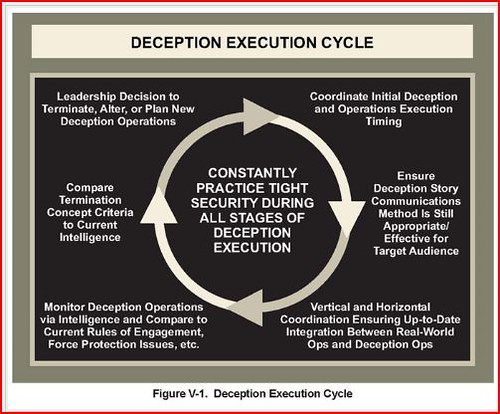
    The excerpt of the document even has this illustration of how deception operations are meant to operate:

    deception operation

    Glenn Greenwald documented today the creation and dissemination of the false story of the murders of the Afghan women. I find Glenn’s description to match pretty closely the deception process described in the illustration. Without Jerome Starkey piercing the veil of deception, the operation most likely would have worked.

  • Former ‘Desperate Housewives’ actress sues producer and ABC, alleging assault and retaliation

    A former cast member of ABC’s “Desperate Housewives” is suing the show’s creator and producer, Marc Cherry, alleging that he physically assaulted her, then killed off her character from the series in retaliation after she reported the assault to the network.

    Nicollette Sheridan, who played Edie Britt until her character was written off the series in early 2009, alleged in the suit filed Monday in Los Angeles County Superior Court that Cherry was dismissive and demeaning to her during the filming of the show.

    In September 2008, Cherry “took her aside and forcefully hit her with his hand across her face and head” during rehearsal after she asked him a question about the script, the suit alleged.
    The subsequent decision to kill Sheridan’s character and fire her from the show despite her character’s popularity was retaliation for her reporting Cherry’s assault to ABC, she alleges in the lawsuit.

    Sheridan said she suffered damages of more than $20 million. The suit also named ABC and Touchstone Television Productions as defendants.

    Sheridan alleged in the suit that Cherry was abusive and hostile toward other actors and writers on the show. After one of the lead actresses on the show spoke to ABC executives, Cherry told Sheridan, “I hope Teri Hatcher gets hit by a car and dies,” the suit alleges.

    "While we have yet to see the actual complaint, we
    investigated similar claims made by Ms. Sheridan last year and found them to be
    without merit," an ABC Studios spokeswoman said. Cherry did not immediately return requests for comment late Monday.

    — Victoria Kim

  • Butt also…

    Sometimes poetry (or any kind of writing) is just fun.

    The Duck
    by Ogden Nash

    Behold the duck.
    It does not cluck.
    A cluck it lacks.
    It quacks.
    It is specially fond
    Of a puddle or pond.
    When it dines or sups,
    It bottoms ups.

  • L.A. financial crisis causes Wall Street firm to reassess utility’s bond rating

    One of the nation’s top bond rating agencies Monday announced it would reassess its bond rating of the Los Angeles Department of Water and Power, a move that Mayor Antonio Villaraigosa blamed on the City Council’s failure to approve electricity rate hikes last week.


    Fitch Ratings withdrew a “AA-" rating it had given on two DWP bonds worth $720 million. That action can lead to a rating downgrade which, if that occurs, could make it more expensive for the DWP to borrow money.


    “Today we are facing the consequences of the city’s failure to enact the necessary rate increases with Fitch Ratings, a major credit rating agency, withdrawing the DWP’s AA- bond rating, thereby costing the ratepayers more in the long run,’’ Villaraigosa said in a statement released Monday evening.


    Villaraigosa said the rate hike, which he supported, would have protected the DWP’s credit rating and helped “avoid the very situation in which we now find ourselves." The mayor had pushed for the hike to cover an increase in the cost of coal, and also for his renewable energy agenda.


    In a statement, Fitch explained that it withdrew its initial rating because the rating agency had assumed the rate increase would be approved.


    Councilwoman Jan Perry said that was an “irresponsible" assumption, since the increase was being reviewed by the council.

    Earlier on Monday, City Controller Wendy Greuel declared an “urgent financial crisis” when DWP officials announced that — due to their inability to get higher rates — they would not recommend contributing a promised $73.5 million to the city’s strained general fund. Greuel said that without that money the only way to continue paying bills in the short term was to begin to drain the city’s already limited emergency reserve.


    Greuel’s announcement was the latest development in an increasingly bitter standoff between the council and the DWP over how much the municipal utility should charge ratepayers and how much it should contribute to the city’s overall treasury.


    DWP officials have proposed rate hikes that would range from roughly 9% for most users to as high as 28% for some. The council has blocked those increases from taking effect, responding to irate reactions from constituents.


    Interim DWP General Manager S. David Freeman, in a letter sent to Greuel on Monday morning, said that he would urge the utility’s board of commissioners — all appointed by Villaraigosa — to withhold the $73.5-million payment. Without the rate increase, he said, the DWP would not have “surplus revenue” to contribute to the city while still paying its own bills.


    — Phil Willon and Maeve Reston at Los Angeles City Hall

  • AVIAddXSubs 9.5

    AVIAddXSubs 9.5

    AVIAddXSubs is a simple free program to incorporate subtitles (XSUB) from .srt (ANSI text, up to 8 srt) or idx/sub (containing up to 8 subtitles) quickly and easily to your avi files containing DivX/XVid video streams. Just place the avi and its associated (same name) srt in the same directory and Drag&Drop the avi on AVIAddXSubs icon or shortcut in your desktop. In 2-3 minutes a new file with divx extension will be created and be ready to play in your hardware DivX player.

    For example from the files:

    lost0318.avi
    lost0318.srt

    you get

    lost0318.divx, to play in your hardware DivX player.

    To see the subtitles you have to activate them through your remote control much like you do with normal DVD. Check the configuration page of the program for the offered options. Maybe you have to put a smaller number at “Vertical Position” field if subtitles are selectable, are selected, but do not appear. The generated file is a regular avi and you can rename it if this helps the player.

    What’s New in version 9.5:

    • Fixed a problem with language display of XSUB subtitles in some players including DivX Player in Windows.

    Homepage: http://www.calcitapp.com/
    Download: AVIAddXSub.zip
    File Size: 856KB


    Copyright © 2008
    Best Freeware Blog | Buy Laptop | Business Software Reviews | astaga.com lifestyle on the net