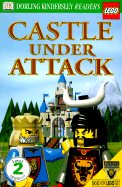
Castle Under Attack written by Nicola Baxter and illustrated by Roger Harris is a book that paints a fascinating picture of everyday life in the Middle Ages. This historical fiction story uses Lego characters to make reading exciting and fun for young children. Throughout the book, there are informational boxes that are full of background information and give real examples of what life was like in a community during the Middle Ages. King Leo and Queen Leonora decide to hold a feast at their castle. An information box describes a castle as being “built in the Middle Ages. People and animals were safe there if an enemy attacked.” For entertainment during the feast, they held a tournament with contests. During the festivities Cedric the Bull, the enemy plotted to attack the castle. Since Cedric the Bull did not succeed at the initial attack, they decided to take the King’s daughter, Princess Storm instead. In the end King Leo and his men surround Cedric the Bull’s men and get Princess Storm back. The bad guys were put in the dungeons and the feast continued.
Curriculum Connections
This book is a super resource for teachers to help students identify how community life in the past is different from present day community life. It also helps young children to see how the daily lives and roles of people in society has changed. (History SOL 2.3) The lesson that is trying to be taught along with the story of character and value is a wonderful example of civics and the traits that make up a good citizen. (Civics SOL 1.10) Lastly this is a great book to encourage better language arts skills because it challenges a young reader with longer sentences and expanded vocabulary.
Additional Resources
Kids-Castle is an interactive website that lets you explore a castle by scrolling over different areas of the castle and clicking on them to see more information about that area
Informational coloring page that contains vocabulary words pertaining to castles that students can color
A word search that contains words about the parts of a castle
General Information
Book: Castle Under Attack Author: Nicola Baxter Illustrator: Roger Harris Publisher: Tandem Library Publication Date: 2000 Pages: 32 Grade Range: K-3 ISBN: 0613244982
As the time period for accepting mailed-in census forms rolls to a close, the Census Bureau will deploy thousands of door-to-door census-takers – and the help of one former senior adviser to President George W. Bush. The Census Bureau today released a new public service announcement featuring Bush Administration alum and Fox News contributor Karl Rove.
“If you’ve not yet mailed back your 2010 census form, it’s not too late,” Rove says in the ad. “Please answer the ten easy questions. They’re almost the same ones Madison helped write for the first census in 1790.” In fact, it was founding father James Madison who made the Census Bureau think “Rove.” Samantha O’Neil, a Public Affairs Specialist with the bureau, tells Fox they found Rove through the Montpelier Foundation, which manages Madison’s estate. “When we were at Montpelier filming a piece with our director, the Montpelier Foundation recommended him as one of their supporters. We just approached him and asked if he wanted to do something relating to the census and the Constitution,” she says.
The ad comes days after Census Bureau Director Robert Groves cited lagging census participation in Rove’s home state. “We’re concerned about the relatively low response from parts of Texas,” Groves said in a March 30th written statement. Some Republicans worry that disillusionment with government expansion will cause a dip in census participation by conservatives. Rove says that’s exactly why he participated in the ad campaign, “The census is used to reapportion the US Congress and I didn’t want people, particularly conservatives, to not be counted. They need to know that this determines what states get.”
Though Rove received two census forms, one for his Washington, D.C. residence and another for his place in Texas, he opted to fill-in the latter, saying his Texas home is the one that counts.
Other participants in the bureau’ s public service announcement campaign include President Obama, Miss America Caressa Cameron, Donny Osmond, and, most recently, civil rights leader Dorothy Height.
Let’s take Hamid Karzai seriously for a moment. The ever-disappointing Afghan president warns that:
the Taliban is turning into a legitimate political movement
Karzai himself will join the Taliban, if America doesn’t support his latest power grab
If either of those things happen, then we’re close to square one in Afghanistan. Getting to this point has cost around $300 billion, according to Congressional reports. Incredibly, next year will be the most expensive yet for Operation Enduring Freedom.
Although the Pentagon doesn’t provide much in the way of war receipts, we’ve got a rough estimate of average defense spending in Afghanistan.
There are lots of things one can insure: a false nose, six-pack abs, celebrity boobs, you get the picture. Add to that: Nestlé’s Butterfinger candy bar. Last week, the world’s largest food company insured its "crispety, crunchety peanut butter" candy brand through global insurance market Lloyd’s of London. (The policy is worth $1 million.) The move was meant to underscore Nestlé’s seriousness behind its brand tagline: "Nobody’s gonna lay a finger on my Butterfinger!" In true insurance spirit, Nestlé that same day (April Fool’s, but "this is no joke," the brand insists) also kicked off an ad campaign to get the word out: Through April 14, consumers can file an online claim if someone indeed touches their Butterfinger. Nestlé will mail out a coupon for one free Butterfinger bar to the first 100,000 consumers. (It’s a no-questions-asked policy.) Geez. If only it were really that way with insurance!
Nothing fazes Reggie Fils-Aime. Motion control from the competition? He’s not concerned. The iPad and Apple’s other touch devices? Same thing. In his opinion, the game experiences on Apple devices don’t even come close to what Nintendo
The sixth edition of O’Reilly Media’s annual Where 2.0 conference wrapped yesterday, possibly the most exciting and definitely the most widely attended edition to date. The premise was consistent with that of previous years: citizen map-making democratizes our world, location is pervasive, and we can be assured of the financial value of geographic data and location-aware advertising. But there was something else going on, too, something new, complex and big: the realization that we need to build services that let people manipulate their world, not just learn about it.
Over the past five years, location has become part of our knowledge at a molecular level; every tweet, image, article and intent includes location information. But why, amidst all the technical advancements that have been made, does the hype center around check-ins and the simplest of geo tools? After all, I’m not suffering from Where 2.0 withdrawal because I want to get another swarm badge or data visualization API or even because I smell money. So why is my heart palpitating and why do I have four new business ideas?
So far, location-based services have been focused on helping people access more information. Yet there’s been no breakthrough success in friend-finding or place-finding applications. That’s because humans don’t want to understand our local environment better — we want to control it!
I believe the unspoken dynamism in this chapter of location and mapping is about reality-modding: intended modification of our environment — both real and virtual — through technology, including manipulation of the physical world via the virtual, and the virtual via the physical. This is not augmented reality or cinematic view, although the blending of the real and virtual is part of it. We want a read/write world.
Check-in mania foreshadows this. Earning mayorship through game play is one thing but checking in and having a friend show up to see you (a common occurrence) is quite another. It’s the 8-bit version of the StarTrek transporter. Twitter, too; I tweet “extra cabbage,” you come get it. While trivial, these examples point to a bigger opportunity in location application design at human- and city-scale, something to which Ben Cerveny’s work with VURB gets really close. The VURB is “investigating how our cultures might come to use networked digital resources to change the way we understand, build, and inhabit cities,” in the process pioneering collaborative redevelopment, responsive environments and urban interfaces. Very cool.
1. Cheap Sensors — Smartphones are a container for a growing number of sensors. Soon we’ll be able to track not just our locations but the spread of disease, pollutants, migration patterns, weather, etc. (Related video: Deborah Estrin, UCLA “Telling Traces”)
2. Behavioral Modification — Kati London of Area/Code Games credits satellites for turning our world into a game board, citing as one example a virtual pirate game that’s manipulated by real sharks swimming in the ocean. Indeed, app developers now regularly incorporate game mechanics and reinforce desired behavior through rewards, incentives and virtual goods. (Related video: Kati London Locative Gaming the Next 10 Years)
3. Abundant Geodata — Maps used to be a spatial canvas that we could fill in with places, landmarks and people. Now the data we collect is reshaping the maps themselves. For example, Waze is creating live maps that show the world in real time based on dynamic traces from mobile phones, and Twitter is able to create polygons based on tweet density — with enough density, a city would have a more accurate look at how neighborhoods shift over time. We can also process, store and distribute geodata to keep pace with the growing amounts of available information. (Related video: Othman Laraki, Twitter “Geostreams”)
The location-based services industry has matured — millions of people use them and millions more want them — and yet its possibilities remain largely unrealized.
Di-Ann Eisnor is the co-founder and former CEO of Platial and Vp community geographer of Waze.
KNOXVILLE — Author and Cormac McCarthy scholar Christopher J. Walsh will speak at the East Tennessee History Center in Knoxville and at Hodges Library at the University of Tennessee, Knoxville, April 7-8.
Walsh will discuss his latest book on McCarthy, “In the Wake of the Sun: Navigating the Southern Works of Cormac McCarthy,” at 7 p.m. Wednesday, April 7, at the East Tennessee History Center, 601 S. Gay St.
On Thursday, April 8, at 4 p.m., Walsh will give a talk on “Publishing With a Digital Press,” in the Hodges Library Auditorium, 1015 Volunteer Blvd. Both events are free and open to the public.
Walsh published “In the Wake of the Sun” with Newfound Press, the UT Libraries’ digital press. The book offers a close textual analysis of all of the Southern works of McCarthy, a Knoxville native, along with an overview of the notable critical responses to the books. Introducing readers, scholars and students to the major themes running through McCarthy’s books, Walsh guides readers through the significant critical dialogues surrounding each text.
“McCarthy’s work obviously reverberates beyond East Tennessee and Appalachia,” Walsh writes in the conclusion to the book, “but we should not underestimate how much the region has informed McCarthy’s artistic development. The humor, tall tales and oral traditions indigenous to the region are lovingly recreated in McCarthy’s Southern texts, and this love of narrative informs his Western and Southwestern works.”
Print copies of the book will be available for purchase for $25 each. His book is available for online viewing by visiting http://www.newfoundpress.utk.edu/pubs/walsh/.
According to an unnamed source speaking to Reuters, the Renault board of directors has called an extraordinary meeting on Tuesday, April 6th, to discuss plans to enter into an agreement with German automaker Daimler. As was the case when Renault teamed up with Japanese automaker Nissan, there will reportedly be an exchange of stock, but not nearly at the same level as Renault’s 44-percent stake in Nissan.
If the board chooses to move forward – and all indications are that it will – an announcement could be made as early as Wednesday detailing the partnership. It’s widely thought that Daimler is keenly interested in Renault’s small car expertise for its less-than-wildly-successful Smart car division, and it seems increasingly likely that the two automakers could jointly develop new city car platforms. Might a more family-friendly ForFour (previous generation seen above) be in the offing as rumored? Stay tuned.
Consumers intrigued by Nissan’s new all-electric vehicle – the LEAF – have been waiting for the answer to the big question: Just how much will going electric cost?
The surprising answer: About $25,000 for American car buyers after federal tax credits.
Last week, Nissan said it will offer the LEAF for $32,780 in the United States. With a $7,500 federal tax credit, the net price drops to $25,280, making it very competitive with Toyota’s popular Prius hybrid.
“Expense has been a challenge for the electric-vehicle market,” said Toshiyuki Shiga, Nissan’s chief operating officer. “We want to mass market our cars, so our goal was to sell them at an affordable price.”
In addition, the manufacturer has abandoned plans to lease the vehicle’s battery separately, eliminating yet another cost that may have alienated potential buyers.
Until now, all-electric vehicles have been best known for high prices and low volume sales. At the moment, the only pure electric car on the market is the $109,000 Tesla Roadster. In setting the price for LEAF, Nissan sized up what it believed to the competition, in particular the Prius, which carries a base price of just under $23,000.
“Price is important. It’s one of the favorite questions we’ve gotten over the past few months,” said Trisha Jung, director of EV marketing for Nissan North America. “We know consumers care about that.”
Chevy Volt. Image: Green Right Now
Nissan’s announcement no doubt raised a few eyebrows at Chevrolet, which has yet to reveal the price on its own entry into the EV market, the Volt. General Motors has floated price estimates approaching $40,000 for Volt, which also will be eligible for federal incentives.
Volt is expected to have a range of about 40 miles before a gasoline engine kicks in to keep the battery charged. LEAF, which doesn’t have such a backup feature, is projected to get about 100 miles on a full charge.
Both are expected to reach the U.S. market later this year.
Have you ever been in the situation where you can’t decide where to eat? Urbanspoon can solve that problem with a simple shake of your phone. Urbanspoon is essentially a ‘restaurant slot machine’ with the outcome being a restaurant choice. The app takes the information from Urbanspoon.com and places it at your fingertips.
Urbanspoon uses three categories when selecting an outcome: neighborhood, cuisine, and price. You can lock down any of the categories to narrow down the search. When there is a restaurant outcome that you are interested in you can get directions and call the restaurant right from the application. You can also access reviews for the restaurant, as well as other Urbanspoon information.
Some other nice features of the app are hidden away in the menu. Here you can pull up nearby restaurants, even change your location, and you can turn off the goofy sounds that the app makes. And you can’t forget that you can search for restaurants right at the top of the app.
I am sorry to say that the app only works on the Droid and Nexus One. It does work on other phones that have been rooted and are running 2.x.
The goods
Free App
Fast and easy to use
Search has voice recognition
Needs improvement
Supported only on the Droid and Nexus One (Android 2.x)
Final Verdict
Urbanspoon is great for those that can never decide where to eat or are always eating at the same places. It’s free, go ahead and give it a try.
Note: This review was submitted by Cole Loomis as part of our app review contest.
A new round of storms is brewing over wind power in New England after a federal advisory panel recommended that the U.S. Interior Department block a controversial $1 billion project that has drawn opposition from local business leaders and politicians.
Concerns about the impact on those attractions prompted the Advisory Council on Historic Preservation to give a thumbs-down to the project. The Council determined that the undertaking would adversely affect 34 historic properties, 16 historic districts, 12 individually significant historic properties and six more properties of religious and cultural significance to local Indian tribes.
Interior Secretary Ken Salazar asked the panel for advice but is not bound to accept its guidance. The Obama administration supports increasing the amount of electricity generated from wind and solar power and other forms of renewable energy. The Cape Wind project would provide electricity to about 400,000 homes and would become the country’s first major offshore wind farm.
In response to the Advisory Council’s findings, Cape Wind issued a press release stating that although it disagreed, it is “pleased that the Interior Secretary has a complete record to make a final decision on the project.”
Salazar is expected to make a decision on the issue by the end of April.
Tim Carney has a terrific column on the legislative history that led up to the prescription drug kerfuffle I read about last week. It makes something clear that I found hard to explain during the back and forth with commenters (as I said to Tim last week, this is the most semantically complicated, and yet least actually complicated, issue I’ve tried to explain in a long while).
Say you have a company that in 2002 was providing drug benefits to its retirees at a hypothetical cost of $2500* per retiree. Each $2500 you pay reduces the taxes you owe by about a third of that amount, so the actual cost of the subsidy to the corporation is about $1700.
In 2003, the Congress passes a Medicare prescription drug benefit. Worried that corporations would drop their benefits and stick the government with the tab, they offer a subsidy for firms that continue their retiree drug benefits. That subsidy, 28% of the total benefit cost (up to a cap), costs the taxpayer on average much less than providing the drug benefits, so it’s a good deal for the taxpayer.
So now the cost to the company for these benefits is $1700-700 or about $1000. The cost to the taxpayer is $2500-1000, or about $1500–still slightly less than Medicare pays for the average Part D beneficiary, but for much more generous benefits. One can argue about the economic distortion, but it’s not your traditional “corporate giveaway”. If it’s a giveaway to anyone, it’s to corporate retirees.
However, had the Congress structured it the way that is now mandated by the new reform, the company would minimize its tax bill by about $600 instead of $800. The cost of the drug benefits to the company would be $1200; the cost to the taxpayer, about $1300.
So this really is an instance of giving the subsidy, and taxing part of it back, because the company was already getting the standard tax subsidy for its retirement benefit. On the one hand, you’re giving them a new subsidy; on the other hand, you’re taking away part of the old subsidy.
Now, that doesn’t tell you whether this was the right thing to do; I don’t know how many companies will drop their now-more-expensive retiree benefits as a result, which is the relevant question. But I feel like a lot of people were struggling with the notion that this was the equivalent of taxing the subsidy, so I thought it worth highlighting.
*This is an arbitrary number mostly chosen because the math is easy. Please do not attempt to engage me in a discussion of whether or not this corresponds with real-world averages.
Beginning this year, Jaguar will include a one-day course at its newly established Jaguar R Performance Academy with the purchase of a 510-hp XFR or XKR. (The same deal is retroactively applied to owners that purchased a 2010 model last year.) Several journalists—myself included—recently had the opportunity to sit in on the driving school’s second meeting at the Las Vegas Motor Speedway for an introduction to the program and, of course, to have some fun with a couple of big cats.
The R Academy currently is a traveling road show of sorts that will visit various race tracks throughout the year near the company’s key markets, which include Las Vegas, as well as Miami (Homestead Miami Speedway), Los Angeles (Auto Club Speedway in Fontana, California), and New York (Monticello Motor Club); a permanent home base for the school is still being looked into.
While the program is more of a responsible way for Jaguar to introduce new owners to the limits of their cars—rather than a full-on track school for experienced handlers—the lessons and exercises that are taught are crucial for anyone who enjoys driving quickly yet safely. And free track time never hurts; I’ve spent a considerable amount of time on race tracks, including another driving school, and still found the program to be both helpful and very enjoyable. The R Academy also brings Jaguar up to par with other premium carmakers, nearly all of which offer their owners some form of high-performance driving instruction, albeit for a fee. What we like about Jaguar’s setup is that it’s included in the sticker prices of the XFR, XKR coupe, and XKR convertible, which start at $80,000, $96,000, and $102,000, respectively. Jaguar says that only XFR and XKR owners are eligible for the R program and that participants must use Jaguar’s vehicles; those that have a 2011 XJ Supersport on order are out of luck.
Although the setup may differ slightly by location, each event includes a classroom lesson on vehicle dynamics and safety, along with autocross exercises and follow-the-leader lapping of a proper road course in both XFR sedans and XKR coupes. Upon settling into the massive media center at the sprawling LVMS complex—which includes 1.5- and 0.4-mile paved ovals, a smaller dirt oval, a 2.5-mile road course, a quarter-mile drag strip, and several off-road tracks—we met our panel of instructors, including racers Roberto Guerrero, Davy Jones, and Adam Andretti (Mario’s nephew), among others, all of whom broke down the intricacies of car control and smooth driving.
Once the instructors went over the settings for the cars’ chassis electronics, we split into groups for a morning of autocross lapping; one group on a conventional multi-turn course of cones, the other on a short, tight oval that was designed to help you find and hit the proper entry and exit points of a corner. Drifting is not the fast way around a track and the instructors were adamant, at first, that we learn the cars with all the safety nets enabled. That didn’t last long, though, as deactivating the cars’ stability controls and using their 5.0-liter V-8s’ 461-lb-ft of torque to pivot around corners was too much fun to resist. So much fun, in fact, that the back end of an XFR stepped out on me and clipped a cone on my final timed autocross run—a three-second penalty that bumped me from first to third on the podium for the day. Bummer.
After a warm lunch back at the media center—and a deluge from the heavens out at the track—we saddled up for an afternoon of laps on LVMS’s soggy 2.5-mile road course. The unassuming track is mostly flat as it snakes around a layout that can be configured into either the full 2.5-mile course or a pair of smaller, 1.5-mile tracks. Offering a mix of surfaces, a lengthy main straight, and an array of tight yet tricky corners, I found the track to be a challenging venue, particularly in the pouring rain. As the tarmac slowly dried throughout the day, we alternated between one-on-one seat time with an instructor and solo lapping in a procession behind one of the hired shoes, the latter being especially helpful for learning how to find the proper line.
The R Academy is not a racing school, but the instructors kept a watchful eye on our progress and gave us plenty of opportunities to run hard and take the cars to their limits of adhesion, which on a wet track with these powerful rear-wheel-drive vehicles was more than exciting at times. It also was highly instructive; the XFR and XKR are practical cars that can be driven daily in a range of weather conditions, and the slippery track forced us to be both smooth and patient when applying the throttle and transitioning at high speeds—we’d all be safer if every motorist took such care when driving home from work on the highway.
Overall, we came away impressed with the Jaguar R Performance Academy, and applaud the company—and every other carmaker that has a similar program—for helping to make its customers better, safer drivers. If anything, I think schools such as this, which allow you to safely explore the limits of both your skills and your vehicle under the guidance of a professional, should be mandatory for all motorists. And I think Jaguar made the right move in including its driving academy in the purchase price of its cars; the couple of owners that attended the school with me completely agreed, noting at the end of the day that they felt both more comfortable about their purchase and safer on the road.
As of this writing, Jaguar is seeing how the school’s first year works out before it announces plans for the future, but a continuation for 2011 with even more venues is likely if all goes well. The R program currently includes just the track element; participants are responsible for travel, lodging, and meals away from the facility. Guest drivers are not allowed, and attendees must be 21 years old and, of course, have a valid driver’s license.
Watch the video below to see some of the day’s snarling antics.
The Eastsider LA is reporting that after last year’s cancellation of the Echo Park Lotus Festival, the event will return in July to Echo Park Lake.
The event may be smaller than residents remember because of budget constraints; organizers need to raise $80,000 to cover the costs of the festival, the Eastsider reports. Here’s an excerpt from the story:
There are plans for live entertainment, food and craft sales, Dragon Boat races and a large section for community booths. But [Leo] Pandac, [head of Los Angeles Lotus Festival Inc.], said his group must find volunteers or [a] low-cost alternative to perform the work once conducted by city employees.
Some other interesting L.A.-area items around the Web:
L.A. bike race: Good Magazine reports on a bike race along the Los Angeles Marathon route:
Wolfpack Hustle, Los Angeles’ "fastest and most notorious bicycle crew," organizes a yearly bike race along the route of the L.A. Marathon the night before the race.
Food truck drama: LAist reports City Councilman Paul Koretz thinks food trucks belong only at construction sites:
The dark side to the food truck craze isn’t the fact that patrons have to stand in long lines, it’s the opposition they collectively face from business owners and elected officials who believe they are eating up profits and over-asserting their place in the city’s workings.
Street art: Hand-painted signs that first appeared in L.A. are popping up in New York, reports Curbed LA:
They’re the work of anonymous street artist (are there any other kind anymore?) TrustoCorp, and he’s gotten around, most recently to New York’s Chinatown and your local supermarket.
Google (NSDQ: GOOG) Android’s U.S. smartphone market share jumped by an impressive 5.2 points in the three months ended in February to 9 percent. Meanwhile, Apple’s iPhone share remained relatively flat, comScore finds.
If those trends continue (and, that’s a big ‘if’), Google could catch-up to the iPhone by the end of the year. Still, BlackBerry-maker Research In Motion remains the pack leader with a dominating 42.1 percent share of the smartphone market.
The big differentiator that Google has going for it is the number of handset makers that are pumping out Android phones. ComScore (NSDQ: SCOR) said the top handset makers in the U.S. are Motorola (NYSE: MOT) (22.3 percent); LG (SEO: 066570) (21.7 percent); Samsung (21.4 percent); Nokia (NYSE: NOK) (8.7 percent) and RIM (NSDQ: RIMM) (8.2 percent).
Of those, the top three are all making handsets based on Android. It’s important to note that these figures are based on current ownership, and not sales, so likely there’s still a ton of Motorola Razrs out there skewing the figures.
Also interestingly, Android and RIM were the only two handset makers to grow in the past three months. RIM grew by 1.3, and Android grew by 5.2 percent. Microsoft (NSDQ: MSFT) dropped the most, losing 4 percentage points and Apple (NSDQ: AAPL) lost 0.1 percent.
Here’s the chart:
1. RIM: 42.1 percent, up 1.3 percent
2. Apple: 25.4 percent, down 0.1 percent
3. Microsoft: 15.1 percent, down 4 percent
4. Google: 9 percent, up 5.2 percent
5. Palm (NSDQ: PALM) 5.4 percent, down 1.8 percent
Sega has claimed time and again that Sonic 4 will be firmly rooted in the franchise’s 16-bit roots. As if to drive that point home, they’ve even added a mine cart level to the downloadable episodic game. You
HTC’s got a patent application for a technology that’ll use accelerometers to detect when a device is shaking, and adjust the orientation of the video accordingly. No more motion sickness! Well, video-related, anyway. More »
I saw an Internet article titled “Texting from Beyond the Grave.” New technology allows a person to imbed a chip in his or her granite tombstone that can be excited by telephones in the future so that a dead person’s typed message can be read out. Maybe a photo, too…
And I thought, “Some people just can’t let go.” But I also wondered if I were to leave such a statement, what my last message to the world might be. Would it be something like, “I told Evie I was sick…” or “Love your neighbor,” something that has been done much better and more often in the Bible. I just do not know. I doubt it would be one of those silly items that people send each other on the Internet each day—you know, one of those stories that is simply too cute to pass up, so you have to send the drivel on. Finding the right message would be a tough decision.
One day in 1944 in middle school a teacher had a boy by the name of Gilbert Lutz stand beside him in class. He commended the boy on his ability to carve. It seems the kid had boldly carved his name in a wood toilet seat in the boys’ bathroom. The teacher finished his special address to the carver by saying, “Of course, if that is where you want your name for all the world to see, you certainly have made your mark on the world.” I heard later that his parents were forced to replace the seat. We students wondered if Gilbert was allowed to keep the old seat so he could frame it and hang it on his wall at home.
So these new granite/electronic tombstones carry with them a great responsibility. But we genealogists can forget about them (and unadorned toilet seats, too) because we are already leaving powerful messages behind. Just a short list of a few generations would do, but many of us are also writing about our lives and the lives of our parents and even their parents. Most of these are monumental tales of proud, inner-directed folks.
I recall a Jewish lady who went to Poland in search of her ancestors. She was directed to a German Concentration Camp where her ancestors were put to death. Hers was a poignant story of bravery and destruction that carried with it a reminder of what can happen when we do not watch our political leaders very, very carefully.
My family was not Jewish (that we know of) but it consisted of soldiers in various wars. One was a corporal under Daniel Boone and General George Rogers Clark around 1784. He was not a big-time hero, but his deeds and deeds of those with whom he served, helped form this country. Those were the days when both mom and dad had to be good shots with a long rifle. Some of my people were Indians as well, so I came from a vast collection of shooters and shootees. They had very instructive tales to tell and I am writing them down as well as I am able.
You may choose a different course, but I believe I will forego the granite messaging service, but will let my genealogy be my testimony, and my message for future generations.
Clean, renewable wind and solar power may be the most-preferred fossil fuel alternatives, but their land-hungry collecting requirements make them difficult options for replacing more conventional power sources, according to a British energy expert.
David MacKay, chief scientific adviser to the United Kingdom’s Department of Energy and Climate Change and a professor of natural philosophy in the Department of Physics at Cambridge University, crunched the numbers on how much energy some sources can generate per unit area to illustrate that renewable types probably will be part of a future energy mix, rather than the solutions.
MacKay, author of the recent book, “Sustainable Energy — Without the Hot Air,” said that to generate enough power to replace fossil fuels, some renewable sources would have to cover enormous swaths of territory. Wind farms, for example, would have to cover half of Britain to meet that nation’s energy needs, he said, adding that he has been accused of being anti-wind for pointing this out. He’s actually pro-wind, he said, but quipped that he’s even more “pro-arithmetic.”
“The message about renewables is that, to make a difference, renewable facilities have to be country-sized,” MacKay said, noting that some people are already fighting construction of wind farms in areas they deem inappropriate.
MacKay spoke Friday (April 2) at the Northwest Laboratories as part of the “Future of Energy” lecture series sponsored by the Harvard University Center for the Environment (HUCE). MacKay was introduced by HUCE director Daniel Schrag, Sturgis Hooper Professor of Geology and professor of environmental science and engineering.
Though MacKay said moving to an all-renewable power system would be difficult, he also said the status quo cannot continue. Fossil fuels are not only warming the globe, they are a finite resource. In addition, he said, the need to import fossil fuels creates security and supply concerns. As much as 90 percent of future energy should come from non-fossil fuel sources, he said.
“We have an addiction to fossil fuels, and it’s not sustainable,” MacKay said.
MacKay broke down current energy demands into simple units and then took a cut-and-paste approach with alternatives, saying he’s not particularly fussy about the exact combination that replaces fossil fuels, as long as it gets done.
The generating capacity per unit area of nuclear power plants is 400 times that of wind farms, making them a potentially useful part of a future mix. Besides wind and solar power, also in the mix could be clean coal plants and hydropower from unconventional sources, such as tides and ocean currents. MacKay also advocated decreasing demand by insulating buildings better, by switching to more efficient building systems such as heat pumps, by turning down thermostats, and by turning off appliances when not in use. Transportation, he said, should be predominantly electric-powered, and solar power generation would be more efficient if plants were built in regions that get lots of sun, such as the Sahara Desert and the American Southwest.
“Getting off fossil fuels will not be easy, but it is possible,” MacKay said.


 I saw an Internet article titled “Texting from Beyond the Grave.” New technology allows a person to imbed a chip in his or her granite tombstone that can be excited by telephones in the future so that a dead person’s typed message can be read out. Maybe a photo, too…