Blog

  • Twitter App Update Brings Local & Tailored Trends, Improved Vine Playback

    Twitter has just released an update to both their iOS and Android apps that allow you to see Trends from all over the world as well as choose to see Trends specifically tailored to your interests and who you follow. The update also brings a few other good improvements like improved playback on Vine videos.

    When accessing Trends on Twitter’s “discover” tab, you’ll now see the option to get “tailored trends” or also to change location. Here’s what Twitter will tell you when you attempt to change location:

    “Tailored Trends are based on your location and who you follow which make them more relevant to your interests. If you change location, you’ll see Trends based around geography only.”

    You can then pick from dozens of locations – mostly larger cities across the world. if you do so, your trends will simply be based on what’s popular around you – it’ll have nothing to do with who you follow.

    With today’s update, replies to retweeted tweets now show both the author of the tweet and the user who retweeted it. Here’s the full list of updates to come along with version 5.6:

    See what’s happening near you or around the world by viewing Trends in hundreds of locations.

    Also:
    • Invite friends to join Twitter from within the app
    • Improved playback of Vine videos
    • Replies to retweeted Tweets now include both the author and person who retweeted the Tweet
    • Enjoy a smoother experience due to bug fixes and other improvements.

    You can download the updates now in the App Store and on Google Play.

  • Z10 helps BlackBerry gain share in April as Apple slips

    BlackBerry Market Share April 2013
    As BlackBerry begins rolling out its second BlackBerry 10 smartphone, the struggling vendor will at least have some good momentum to build on coming out of April. According to market watcher Net Applications, BlackBerry gained usage share in April after losing share in each of the two prior months. While BlackBerry only accounts for a minuscule portion of global mobile usage — 1.51% in April, less than Symbian’s 1.73% — it’s at least moving in the right direction, up from the low of 1.39% it hit in February. IOS shed about 1.5 points in April to fall to a still-dominant 59.04% according to Net Applications, while Android smartphones and tablets gained more than a point to climb to 26.02%.

  • TechCrunch Disrupt New York: Dwolla, Skytree

    TechCrunch Disrupt New York 2013 was held this week in New York City, with plenty of focus on tech disruption, as well as a lot of apps, demonstrations, funding announcements and product announcements. Funding announcements came from SkyTree, which secured $18 million and Dwolla, raising $16.5 million. The event conversation can be followed on Twitter hashtag #TCDisrupt.

    Dwolla raises $16.5 million

    Payments network company Dwolla announced that it has raised $16.5 million in new Series C funding led by Andreessen Horowitz (a16z). The company’s previous investors, Village Ventures, Thrive Capital, and Union Square Ventures also participated in the round. Highlighting Dwolla as an example, legendary venture capitalist Fred Wilson was at TechCrunch Disrupt New York and stated that ”money is information, like bits,” noting that giving currency a spin that puts it in a continuum with the many blogging and content companies that his firm has invested in over the years.

    “A16z makes bets on companies that change the underlying fabric of their markets and, like Facebook, Twitter, and GitHub, we think Dwolla is going to do it in the banking world,” said Scott Weiss, Partner at Andreessen Horowitz and new Dwolla board member, in a statement about the investment. “The fact that Dwolla’s network can simultaneously meet the needs of a complex enterprise or government, while allowing a parent to pay the babysitter with her phone, reflects just how simple and strikingly different this solution is in the marketplace.”

    With the funding Des Moines, Iowa based Dwolla will double its workforce in Iowa and New York.  It will also open an office in San Francisco, adding to existing staff in Des Moines, New York, Omaha, and Kansas City. The Bay area office will be led by Dwolla’s Chief Operating Officer, Charise Flynn, and will be mainly focused on product and business development and marketing.  Dwolla CEO Ben Milne explains why he is so excited about the funding announcement, and why Andreessen Horowitz makes sense – including the fact that he and Marc Andreessen were both born in Cedar Falls, Iowa.

    “The reality is that our fundamental business is allowing anybody with an Internet connection get access to their money and exchange it with anybody else they want to receive it,” Milne says. “A lot of that adoption is going to come instead from third-party platforms and products,” he adds. “I don’t see people going to Dwolla.com more and more – I see them doing that less and less, while our software is just facilitating the payments.”

    Skytree receives $18 million

    Machine learning company Skytree announced that it has closed $18 million in Series A funding with U.S. Venture Partners (USVP) as the lead investor. Package delivery giant UPS and Sun Microsytems co-founder Scott McNealy joined the new investor syndicate. The new financing will help fuel an aggressive growth strategy to disrupt the Big Data Analytics market with enterprise-ready Machine Learning. As part of this transaction, USVP General Partner Rick Lewis has joined Skytree’s Board of Directors.

    “A new era has dawned, in which enterprises are demanding the advanced, real-time business insights that only Machine Learning can provide. Skytree makes the power of Machine Learning available to all enterprises, with a striking performance advantage over their competition. Since the company’s launch in February 2012, customers have validated our view that Skytree has a huge lead in this fast-growing market. Skytree’s team, technology, and customer traction have made Skytree the company to beat in applying Machine Learning for Advanced Analytics,” said Rick Lewis, General Partner, USVP.

  • Microsoft CAN win the hearts of consumers

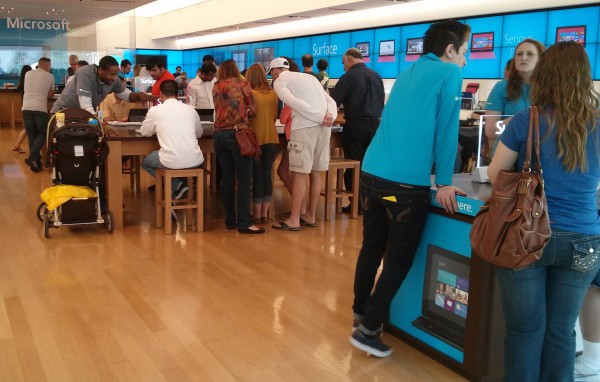
    Many people want Microsoft to die, and the sooner the better. I’m not in that group, although I understand that years upon years of letdowns through viruses, DLL hell, BSODs (Blue Screens of Death) and a myriad of other problems lead many in the tech world (and consumer world, too) to walk away from everything Microsoft. Add to that the growth of the Internet and mobile devices as well as slumping PC sales, and you can see why so many wait with baited breath to see the company go away for good.

    Nevertheless, quarter after quarter Microsoft continues to prove that it still has life and isn’t going anywhere anytime soon. In fact, in 2011, CEO Steve Ballmer explained how the company intends to reinvent around devices and services. Seeing that the growth of mobile devices and the services that support them represent the future of computing, Microsoft responds yet again to the changing world of computing.

    I say, “yet again” because this is not unusual behavior for Microsoft. The company often is chided for being slow and out of touch with current technology trends but I’m not convinced that’s always the case. Microsoft was there when the personal computer took off. The company  was there when it became clear that television would be a major growth area. And Microsoft was there when mobile devices first became a big deal.

    Personal digital assistants (PDAs) were introduced in the mid 1980s by Psion. These devices paved the way for the pocket PC where Microsoft was able to gain significant market share with Windows Mobile. Also popular during this time was the Palm Pilot and devices from other manufacturers like Blackberry, HP, Dell and Compaq.

    While Palm was very effective at making inroads into the consumer world, it wasn’t until 2007 that things really took a turn. Apple introduced the iPhone. This wasn’t Apple’s first foray into the world of mobile computing. The Newton was a PDA device that was introduced to the world back in 1992 but wasn’t a blockbuster hit.

    The iPhone quickly became a smash hit (once the price lowered). It was so successful I sometimes get the impression people believe Apple created a new market, which isn’t true. The transition of mobile devices to the consumer arena was well underway when the first iPhone was introduced. What Apple did do was take an idea that already existed and make it a million times better. Microsoft did this in gaming with the Xbox.

    Apple was able to get a huge lead against its competitors in the consumer space. How was this possible? I believe competitors saw the iPhone as just another “me-too” mobile device. However, Apple understood something that either its competitors didn’t or they simply were too slow to act on it and that is, the world was shifting to simple software backed by compelling user experiences. If consumers weren’t looking for it in 2007, the time would come where they definitely would. It just so turns out that consumers (young people) were actually ready for the shift.

    The Computing Shift

    I previously wrote about how I believe Windows 8 represents an understanding by Microsoft that there is a cultural shift happening that was affecting the way people use computing devices: a shift to a simplified experiences economy and this is the basis for why people are a bit confused and vexed by its Jekyll and Hyde interface.

    A similar thing happened in 2007 with the iPhone. The economy of computing was in process of shifting from being services (not to be confused with software services as commonly used today) based to experiences based. In that article I explain what this means:

    In a services economy an individual cares about goods but more importantly about the services surrounding those goods.

    In an experience economy, services become the stage and goods are the props used to engage the individual in a conversation and immerse them in a story. Services are not enough because they are not as memorable as experiences. Goods and services all remain outside the buyer while for the first-time experiences allow companies to get inside buyers and manipulate them emotionally to purchase their products. Experiences are inherently personal. Through an experience an individual can be engaged not just on an emotional level, but on a physical, intellectual or maybe even a spiritual level. Experiences remain with the individual for some time to come.

    Apple saw it coming and made the right moves. Its competitors didn’t.

    Another Shift

    I believe there is another shift on the horizon. In this shift experiences are still important but they are simpler. I previously wrote:

    Windows 8 tells a story that is more representative of a new way of thinking about computing habits and behavior. It is representative of a shift towards an experience economy but more specifically it represents a shift to a new kind of experience economy: a simplified experience economy.

    This simplified experience economy would be characterized by (1) a reduction in the number of devices consumers need to carry with them, (2) powerful (think processors) mobile computing, and (3) will be deeply personal.

    Simplified Experience Economy

    I believe we’re moving towards a computing culture where users will do most of their work on one device. Let me explain.

    The current mobile world is dominated by devices that are extremely limited in terms of computing capacity and processing power. These devices are mainly used for consuming content. To create content, users need more powerful devices like a laptop/desktop. Currently users have to carry around a phone/tablet device and a laptop or sit at a desktop to get all their computing tasks (consuming/creating) done. I’ve said before that the zenith of computing nirvana is to be able to not only consume content on today’s super thin mobile devices but create content on them as well, with no compromises. The result is that we carry fewer devices, which greatly simplifies our computing experiences. We’re not there yet, but Microsoft with Surface Pro has gotten us closer than anyone else in the market.

    What makes this new computing economy deeply personal? The pervasiveness of more natural ways of interacting with these devices. If you’ve been reading my articles long enough you know I am a huge fan of natural user interface (NUI) technology. The more naturally we can interact with our devices the more personal they become. The ability to switch between input methods based on the real life situation or interface on the screen makes using devices so much easier. I often use the example of my Xbox 360. My couches love to eat my remote controls. So having the ability to use my voice to navigate the interface has been a big plus. A device that once had limited input is made easier to use by expanded input capabilities.

    The simplified experience economy will be one where we can consumer and create on devices that can be interacted with in more natural ways. All of this will be made possible by extremely power processors.

    Mobile Phase 3?

    I am convinced that we are entering a new phase in mobile computing. The first phase saw the introduction of the phone and PDAs. The second phase is characterized by the introduction of the iPhone. The third phase will usher in mobile devices with powerful processors capable of creating and consuming content and multiple input methods (mouse/keyboard, speech, touch, touchless gestures). All is made possible by a cultural shift to a simplified experience economy.

    It appears that we are on the precipice of phase 3. With Windows 8 we are now starting to see the appearance of hybrid devices that operate as both a tablet and a full PC. These devices look like a laptop but the screens are detachable. Windows is the perfect operating system to run on these devices. It’s Jekyll-and-Hyde nature, while ridiculed by many, may be its greatest strength. What other OS on the market is capable of allowing users to consume content and create it all within the same device using powerful applications like Photoshop? None.

    Surface Pro, while not particularly a hybrid device, is definitely a different take on the tablet. It by far is the best stage for Windows 8 and this new shift in computing. All of these devices allow users to work when they want, for as long as they want, wherever they want and however they want. Perhaps this is what Microsoft means when they call Windows 8 a system with no compromises.

    Microsoft on Mobile

    Microsoft was a key player in phase 1, wasted away phase 2 and is well positioned for phase 3. I’m not at all declaring a winner especially since there is a lot to be said about the dominant position of both Android and iOS these days. But unless Google and Apple position themselves for phase 3, it’s not a far-gone conclusion that they could be playing catch up to Microsoft.

    As we survey the current landscape of mobile computing it’s clear the market for computing devices is in transition from traditional computing devices like laptops and desktops to mobile devices like smartphones and tablets. It is in this current market that Microsoft is struggling to make sales. I often have been critical of the company and its apparent slowness to respond to the competition. However, I now consider the possibility that perhaps Microsoft sees something that most of us does not.

    Microsoft officials have said that they see mobile as a long-term play, something more akin to a long journey. That doesn’t sound like the kind of language that should come from a company that believes the clock is ticking on a death watch. It’s quite possible that Microsoft sees the next phase of mobile and wants to get out ahead by giving time to develop and connect newly-built platforms. I don’t have a problem with this at all and in fact I think it’s a great strategy if in fact that really is the case.

    There’s no way Microsoft can take down iOS and Android by creating devices and services that merely match parity with today’s market. Some may be more optimistic about Microsoft’s chances in today’s market, but I’m not. As I’ve argued before, the company needs to go beyond today’s offerings in order to really grab the attention of consumers with highly differentiated devices. Microsoft can win round 3 by improving the developer platform by getting as close as possible to write-one-run-anywhere, which should lead to better and more high profile apps, and finally through improving Windows Phone marketing. The new campaign, “Don’t Fight. Switch” is a great start!

    Microsoft can win the hearts of consumers. It hasn’t yet but I am pretty optimistic that if the company stays the current course, it will. It just won’t happen overnight. Today if you give people a choice, they most likely will not choose Microsoft. The next phase of computing is coming and for a company that traditionally does some its best work during a crisis, I’m not ready to say it doesn’t have a chance.

    Photo Credit: Joe Wilcox

  • Pink: “Reformed Slut” Title Her Own Doing

    Pink opened up to Glamour Magazine recently about what it means to be a new mom, how to make a celebrity relationship work, and why she calls herself a “reformed slut”.

    “It’s my very unsophisticated way of taking the power back,” she explains. “I’ve always had an issue with [the notion that], ‘OK, we’ve both decided to do this. Why am I a slut and you’re the player? You didn’t get anything from me that I didn’t get from you.’”

    The 33-year old singer seems to always be brutally honest in interviews and doesn’t hold much back, but now that she’s a married mother of one, the topic always seems to switch to her family rather than what lies in her past. After a brief split from motocross driver Carey Hart, the two reconciled and are now the parents of 2-year old Willow.

    “Long-term relationships are an everyday choice. It’s harder to be in a marriage than it is to bounce from one relationship to the next,” Pink says. “We’re good because we communicate and we’ve grown up together, not because we don’t fight.”

    Pink appears on the most recent issue of Glamour, showing off that famous chiseled body and her many tattoos.

    Image: Ellen von Unwerth

  • Update on Atrocity Prevention Strategy Implementation

    President Barack Obama Delivers Remarks at the U.S. Holocaust Memorial Museum

    President Barack Obama delivers remarks at the U.S. Holocaust Memorial Museum in Washington, D.C., April 23, 2012.

    (Official White House Photo by Pete Souza)

    On April 23 of last year, President Obama visited the Holocaust Museum, and unveiled a comprehensive strategy to prevent mass atrocities.

    In his remarks at the Museum, the President reflected on places where the United States’ efforts had helped prevent or mitigate surges of violence – and had saved innocent lives. He spoke of our efforts surrounding the South Sudan independence referendum, the measures we had taken to counter the Lord’s Resistance army in Central Africa, and the coalition that we and our allies formed to protect the people of Benghazi.

    The President also noted that for every success we have in preventing and stemming violence, there will always be more work to be done. And he made clear that, for all the challenges we will face, we must continue to do what we can.  We must strive for a future where there is a “place for dignity for every human being,” and make this, “the work of our nation and all nations. “

    read more

  • Your Optimism Might Be Stifling Your Team

    I admit that I’m prone to an optimistic outlook, a belief that most problems can be tackled with hard work and the right mindset. I’ve read the research that indicates that positive thinkers tend to do better in school, work and life. Perhaps I even assumed that optimism was infectious and that people wanted to work with a confident, hopeful leader. In the true spirit of optimism, how could this possibly go wrong?

    Then I found out from a colleague that he didn’t find my optimism nearly as reassuring as I did. We were in the middle of a high-stakes research project with a small window of opportunity to write an article for a prominent academic publication. To pull this off, we needed to complete a complex analysis, do a round of additional research, and actually write the article, all while working on several other projects and operating on a thin budget.

    To me, this seemed like a feasible, interesting challenge, and I enthusiastically dove in. Then at one critical meeting, a more junior colleague turned to me and said, “Liz, I need you to stop saying that!”

    “Saying what?” I asked.

    “Saying that thing you always say — ‘How hard can it be?’” I looked puzzled. He explained, “You say that all the time. ‘How hard can it be? We can do this. After all, how hard can it be?’”

    I recognized what he was saying and began to explain my logic: While I was working for Oracle Corporation, a small but rapidly growing company, I had been thrown into management at the tender age of 24 and was told that I was now in charge of training for the entire company and was tasked with building Oracle University and making it work in globally. I learned to say to myself, “We can do this. After all, how hard can it really be?” Now, I explained how this growth mindset had worked beautifully for me and many of my colleagues over the years. Yet steadfast, my colleague reiterated, “Yes, but that is what I need you to stop saying.”

    “But why?” I probed.

    He paused and said, “Because what we are doing is actually really hard, and I need you to acknowledge that.”

    He wasn’t opposed to the idea that our enormous task was doable; he simply wanted me to acknowledge the reality of the challenge and recognize his struggle. He didn’t want me glossing over the challenge with my coat of optimism. So I did admit, “Yes, what we are doing is hard. It is really, really difficult.” I then assured him that I would do my best to stop saying that thing. Meanwhile, in the back of my mind I told myself “Sure, I can stop saying that. After all, how hard can it be?”

    Is it possible that a can-do attitude that worked so well for you as an individual contributor may actually work against you as a leader? When you play the role of the optimist, you may undervalue the struggle the team is experiencing or their hard-fought learning and work (or give the impression that you do). Your staff may wonder if you have lost your tether to reality. And, when a leader seldom focuses on the problems, it leaves more junior managers to worry about those risks. In fact, by being too optimistic, you may actually be putting your employees in the role of having to play the “sensible pessimist.” Or worse, you might be sending a message that mistakes and failure are not an option because, after all, “How hard can it be?” And yet wise managers know that mistakes are inevitable, and that failure is just the price of creativity.

    Having coached many executives, I know that senior leadership ranks are filled with glass-half-full types (in fact, one might need to be an optimist to cope with the inherent pressure of these positions). Consider how Nike, Inc.’s chief of global design, John Hoke, sparked a transformation in his organization once he realized the restrictive impact his and his management team’s optimism was generating. John gathered his senior leaders for a week-long offsite to explore new thinking in design and how leaders can multiply the talent inside their organization, which I helped facilitate. As I described the profile of the optimistic, creative, energetic leader, John and his team quickly recognized their own reflection and were curious how they might be inadvertently diminishing capability and ingenuity in others. John asked that we pause our agenda to better understand how his own hopeful style of leadership might actually be causing some angst. His team explained the extraordinary pressure they felt to deliver flawless design, every time. With the London Olympics around the corner and a brand promise to sustain, the group insisted that there simply was no room to fail.

    With John’s encouragement, we decided to define a space for experimentation. We rapidly laid out their various work scenarios into two buckets: One where failure was OK and the other where success had to be assured. The group debated each until they agreed on every scenario. Within an hour, they had created a playground — a safe space for their teams to struggle and potentially fail without harming their stakeholders or their business. This thinking rippled across Nike’s design community and sparked leaders like Angela Snow, VP of creative operations and Casey Lehner, senior director of global design operations, to introduce the “risk and iterate” performance goal that encouraged each team member to identify something they would take a risk with and then iterate solutions throughout the year. This effort legitimized the possibility of failure and created safety for designers to tackle the scary problems.

    John Hoke and his management team didn’t lower their aspirations or become less optimistic about the capabilities of their team. But, by acknowledging the downside and recognizing the messy, iterative path of innovation, they liberated their team to go bigger and reach further.

    Go ahead and be optimistic. But first, be sure to acknowledge the downside so your team is free to explore the upside.

  • USPS Leverages Big Data To Fight Fraud

    usps-supercomputing

    When you think “big data,” you probably don’t think of the United States Postal Service (USPS). As it processes more than 528 million pieces of mail each day, the USPS has become an active participant in the big data revolution, and operates one of the most powerful non-classified supercomputing databases in the world.

    Residing in the Eagan IT and Accounting Service Center in Eagan, Minnesota is the core of the USPS supercomputing operations. The supercomputing and revenue protection program helps to cut fraud on its reported $65 billion in annual revenue. To detect fraud on 528 million pieces of mail each day the USPS started building IT architecture in 2006, and has been expanding it ever since.  Simultaneously processing data from 6,100 mail pieces per second requires some hefty compute power.

    “All of this happens in an average of 50 to 100 milliseconds,” says Scot Atkins, USPS program manager. “If something is off – a package with insufficient, duplicated or fraudulent postate – it is detected and intercepted in near real-time. A distribution clerk can reassess a package, errors can be tracked down, and fraud attempts – large or small – are reported to the U.S. Postal Inspection Service for further investigation.”

    The system used to process and detect fraud is impressive. In a recent interview the USPS in-memory database was noted at 16 terabytes, up 6 terabytes from a 2010 Oracle case study report. Coupled with a transactional database it will perform billions of mail piece scans in a standard 15 hour processing day. Real-time scanning performs complex algorithms, powered by a SGI Altix 4700 system. Oracle Data Warehouse keeps fraud results stored in 1.6 terabytes of TimesTen cache, in order to compare and then push back into the Oracle warehouse for long term storage and analysis. Data ingest rates exceed 1.5 million records ingested per second per 16 core blade.

    Fighting fraud, waste and abuse is top of mind for USPS and government organizations, as budgets are cut, and billions of dollars are lost in duplicative payments, overpayments and fictitious vendors.

  • With MetroPCS, T-Mobile could help Apple reach 9 million new potential iPhone buyers

    One of the side benefits of the completion of T-Mobile’s merger today, at least for customers of MetroPCS, is that they will eventually be able to use an iPhone on their current carrier. The all-new T-Mobile hasn’t said when that will be. But there’s also an interesting benefit for Apple when this does happen: the iPhone maker may edge further into the lower-cost smartphone category.

    MetroPCS’s current customers can choose from a variety of feature phones or inexpensive Android-powered smartphones: there’s just one flagship Android device offered, the Samsung Galaxy S III. The vast majority of the devices cost around $99. If MetroPCS subscribers have been waiting for an opportunity to switch to an iPhone, it’s probably less likely they’ll be going for a $200 to $300 iPhone. But the free-on-contract iPhone 4 or $99-with-contract iPhone 4S could be more appealing than their current options.

    This also represents a chance for MetroPCS to convince feature-phone owners to upgrade too. And the trend among late-stage smartphone adopters is that they, in general, go for lower-cost devices.

    A recent survey of iPhone buyers in the U.S. by CIRP showed while the iPhone 5 represented a little over half of all new iPhones purchased, that is a historically low number: never has an Apple device that’s been available for just over one fiscal quarter seen such slow demand. The iPhone 4 and iPhone 4S, either free on contract or $99 with a contract, are more popular than legacy iPhones have ever been.

    T-Mobile says that by joining with MetroPCS, it’s bringing 9 million new customers — and potential new iPhone activations — with it. That might seem small when compared to what T-Mobile already has (a little over 30 million customers) and to what could happen if Apple hooked up with China Mobile. But at this point, Apple needs to expand its footprint anywhere it can. Whether that’s among luxury-brand hungry customers in Tokyo, Shanghai or Moscow who shell out for an iPhone 5, or among smartphone hold-outs who just want a free or very cheap phone, Apple is going to take it.

    Last week, Apple CEO Tim Cook used the example of first-time iPhone buyers in China to explain why he’s OK with this scenario: ”China has an unusually large number of potential first-time smartphone buyers and that’s not lost on us. We’ve seen a significant interest in iPhone 4 there and have recently made it even more affordable to make it even more attractive to those first-time buyers. We’re hopeful that helps iPhone sales in the future.”

    It’s true that trading iPhone 5 sales for the iPhone 4 or 4S could mean lower profits in the end for Apple. But being able to sell smartphones to people who otherwise wouldn’t have purchased an iPhone (either for a feature phone or a cheaper Android device) is not a bad fallback.

    Related research and analysis from GigaOM Pro:
    Subscriber content. Sign up for a free trial.


  • 60,000 customers cut the cord on Comcast cable in Q1

    Comcast Cable Subscriber Losses
    There are now 60,000 fewer households willing to pay Comcast for its cable television services than there were a quarter ago. The New York Times reports that Comcast lost 60,000 cable subscribers over the past quarter, which was “62 percent worse than the more modest losses it reported in the first quarter of 2012.” That said, losing all those cable subscribers hasn’t hurt Comcast’s bottom line since the company also reported Q1 2013 earnings of $1.44 billion, an increase of 17.4% from the earnings it reported in Q1 2012. The Times says that Comcast’s improved earnings “were partly the result of more expensive cable bills for 72% of Comcast’s subscribers.”

  • Aerize Loader Lets You Install Legacy BlackBerry Apps to Your SD Card

    Aerize Loader is an install manager that raises the limit of how many apps you can have installed on your legacy BlackBerry by storing the apps on an SD card.

    appworld.blackberry

    One of the interesting limits of the classic mobile OS is that there’s a specific amount of application memory for each device. If you like apps or have a huge collection of games, fitting them all on the BlackBerry 9800′s 256mb of application memory is impossible.

    Aerize Loader bypasses this limit and returns your BlackBerry back to normal after doing a device reset or a battery pull. Aerize Loader works even if you’re offline and not connected to WiFi or the network.

    Click here to buy Aerize Loader for $4.99 for Legacy OSes 4.5 and above.


  • Sebastião Salgado: A gallery of spectacular photographs

    04-3-291-62 SMALL_wm

    The vast tail of a Southern right whale, photographed near Argentina in 2004.

    Ask photojournalists to name a peer they admire, and Sebastião Salgado’s name is sure to crop up. The Brazilian is renowned for the long-term projects he undertakes, devoting years at a time to documenting the story of a particular people or the evolution of a certain place. Sebastião Salgado: The silent drama of photographySebastião Salgado: The silent drama of photographyAs he describes in the talk he gave at TED2013, his attention to detail and his personal attachment to his subjects caused health problems that nearly killed him.

    Thankfully, he didn’t give up. His most recent project is Genesis, which he describes as “my love letter to the planet” and for which he spent eight years traveling the world to photograph humans, animals and nature in their native glory. (To read more details about Salgado’s process, see this rather lovely Q&A with TED photographer Ryan Lash.) The resulting black-and-white images include the astonishing shot, above, of a Southern right whale, which he photographed in the Valdés Peninsula in Argentina in 2004. Together, the series forms the focus of a book (including a vast, two-volume edition that costs $9,000 and comes complete with a wooden stand designed by the Japanese architect Tadao Ando; mere mortals can pick up a hardcover version for $69.99). There’s also a documentary, Shade and Light, filmed by Salgado’s son and Wim Wenders, and exhibitions in cities around the world.

    The scale is appropriate. This is truly breathtaking work. And, for all that the scenes Salgado captures will likely feel alien to most of us, the images are imbued with no less than the spirit of humanity. If that sounds overblown, seriously, check these out:

    05-1-450-43 SMALL_wm

    An iceberg photographed on the Antarctic Peninsula. Note the “castle tower,” at top right, apparently carved in the ice by wind erosion. (2005.)

    05-3-241-67 SMALL_wm

    Waura Indians fish in the Puilanga Lake near their village in the Upper Xingu region of Brazil’s Mato Grosso state. (2005.)

    07-3-192-57A SMALL_wm

    The Mursi and the Surma women in Ethiopia are, Salgado says, the last women in the world to wear lip plates. It’s unclear precisely why or how this custom evolved, but it is a mark of women of high birth. (2007.)

    08-2-311-41 SMALL_wm

    Teureum is the leader of the Mentawai clan, which lives on Siberut Island in West Sumatra. The shaman is preparing a filter for sago. (2008.)

    09-3-9828 SMALL_wm

    Women of the Zo’é village of Towari Ypy in Brazil. (2009.)

    09-7-12440 SMALL_wm

    Look, ma! No hands! Salgado photographed these chinstrap penguins on icebergs between the Zavodovski and Visokoi islands in the South Sandwich Islands, near Antarctica. (2009.)

    10-2-14196 SMALL_wm

    Shot from Navajo Native American territory, this breathtaking image captures the junction of the Colorado and Little Colorado rivers, at the gateway to the Grand Canyon National Park, in Arizona in the United States. (2010.)

    10-4-7501 SMALL_wm

    Light streams across an elephant disappearing into the bush. Kafue National Park, Zambia. (2010.)

    11-1-267 SMALL_wm

    The Nenet people, living deep within the Yamal peninsula in Siberia, inside the Arctic Circle. (2011.)

  • Grand Theft Auto V: Michael. Franklin. Trevor.

    Grand Theft Auto V

    Is it the guns, hookers, drugs or auto theft that makes the Grand Theft Auto series so enticing? GTA has been around since 1997, and over the last 16 years has developed into the most popular franchise in video game history. The newest version, simply titled Grand Theft Auto V is due out this September and features three main characters, Michael, Franklin and Trevor. GTA V is the most anticipated release on console gaming history for the simple fact that the series has been not only amazingly produced, but offers a level of gaming that has yet to be matched by any other game from any other developer. As mentioned, we’ve still got to wait until fall for “V” to come out, but until then feel free to check out the new cast after the jump.

    Source: Youtube.com

  • Microsoft could generate $8.8 billion annually from Android royalties by 2017

    Microsoft's Android licensing agreements
    Google unlawfully used technology from Oracle, Microsoft and others when creating its Android and Chrome operating systems, leaving its vendor partners exposed. Rather than engaging in expensive and often drawn out lawsuits, a majority of Android vendors have signed licensing agreements with patent holders. Microsoft has already signed licensing agreements with more than 20 Android manufacturers, including big-name players such as HTC, Samsung and LG. The company claims that 80% of Android smartphones sold in the U.S. and most devices sold throughout the world are now covered under its various agreements.

    Continue reading…

  • Law Firm Clifford Chance to Deploy 1600 BlackBerry 10 Smartphones

    Law firm Clifford Chance has announced a fresh deployment of BlackBerry 10 devices for their workforce. The law firm has used BlackBerry for their mobility deployment for the past decade and they’ve committed to adopting the new platform for their 1600 employees.

    clifford__chance_clifford_chance_logo_o

    Clifford Chance is a long standing BlackBerry client, having managed their mobile deployment using BlackBerry for a long time. They’ve announced that they’ll be adopting BlackBerry Enterprise Service 10 along with BlackBerry 10 devices for their employees to communicate with each other securely.

    In addition to their business deployment plans, they will also be using BlackBerry Balance to keep work and personal life separate and encrypted on the smartphone.

  • Company behind ‘digital pill’ with embedded chip raises $62.5M

    Forgetting whether you took your meds will be a thing of the past if Proteus Digital Health has its way.  Last year, the Redwood, Calif. company received FDA clearance for a ”digital pill” that tracks whether patients are taking their medication and how their bodies are responding to it. On Wednesday, Proteus said it had raised an additional $62.5 million to help bring its product to market.

    The company said the second closing of its Series F round (it closed the first round in December) included new investor, database giant Oracle, as well as previous investors Otsuko, Novartis, Sino Portfolio and others.

    Proteus declined to comment on the new funding but, in a statement, CEO Andrew Thompson said the company is looking to its strategic partners to help accelerate its mission by embedding Proteus into already established products and services.

    Since launching in 2003, the company has raised north of $100 million for its ingestible sensor technology. Proteus’s system includes the “digital pill,” a patch worn on the torso and an app on a Bluetooth-enabled mobile device. The sensor, made from a proprietary chip, is about the size of a grain of sand (1 mm square) and is mostly made of silicon.

    Once the sensor is ingested with medication, the magnesium and copper in it reacts with the acid in the stomach to create a small electrical charge that enables it to communicate with the patch and app. The technology then lets the patient to log his medication, as well as share that information with health care providers and/or caregivers.

    Swallowing a digital pill may turn the stomachs of some patients but medication adherence is a major problem. According to the New England Healthcare Institute, patients who don’t take their prescription medication cost the U.S. health care system an estimated $290 billion in avoidable medical costs each year.

    In addition to receiving a minority investment from Oracle, Proteus said the two companies plan to work together in clinical trials and integrate Proteus’ ingestible sensor with Oracle’s clinical trial products, including its life sciences data hub and clinical trial management system, which both use the Oracle Health Sciences Cloud.

    Proteus, which previously received approval from the European Union to market its ingestible sensor, says it plans to launch its first consumer-focused caregiver product Helius in select Lloyds Pharmacy stores in the UK soon,

    Related research and analysis from GigaOM Pro:
    Subscriber content. Sign up for a free trial.


  • Trade In Your Old Smartphone for $100 in AT&T Credit

    How many inactive smartphones do you have sitting around? Chances are the number continues to grow with each new phone you buy. At first having the extra smartphone makes sense. It acts as an insurance plan in case your new one breaks. But when you have three, four, five old smartphones lying around? You should probably start getting rid of them.

    Consumers won’t find many easy options for recycling their old phones, which exacerbates the problem. You could find a gadget bin, where you can dump old electronics, but that old smartphone has to hold some value, right? And so we hold onto them, hoping, but not searching, for a solution.

    Even more problematically, semi-well-known gadget trade-in companies, such as Gazelle.com, are taking in a smaller and smaller array of products. Have a Samsung Galaxy S II on Verizon? It’s the second best-selling Android smartphone of all time, and it’s on the nation’s most popular carrier. Yet you won’t get a dime for it from Gazelle. And so it’s even more likely to sit in a drawer.

    Clearly, the best way to handle gadget recycling is for carriers themselves to offer trade-in programs. You walk into the store with your old phone, you pick out a new one, and you get a trade-in credit applied to the sale. Sounds simple, but few carriers do this. Verizon has in the past, but the values have been absolutely horrible. I tried to trade in a 2010 model BlackBerry when I bought an iPhone in 2011, and they offered me $20 for it.

    ATTTrade

    In another consumer-friendly move, AT&T has started a smartphone trade-in program that offers customers a real incentive: $100 towards the purchase of a new smartphone, service, or accessories. So not only do customers realize actual value for their old phones, but they can apply it right away to the purchase of something new.

    Trading in a newer smartphone that might be of greater value than $100? AT&T will take that into account. So if you want to trade in your Galaxy S3 for something new, you’ll get more than that $100 credit. (Gazelle offered me $165 for my S3, so I imagine AT&T would be willing to offer more as a trade-in.)

    There are conditions to this offer, of course — the press release contains more asterisks than perhaps any other I’ve ever read. It does cover phones up to three years old, so you can certainly trade in a phone from your last contract. That’s actually huge; with Verizon’s trade-in program you rarely get even close to $100 for a two-year-old phone, never mind a three-year-old one. Other than that, you’re pretty much free to trade in what’s eligible and get that credit towards your new phone.

    Current AT&T customers can go to the trade-in website to see if their devices are worth more than $100. AT&T will accept non-AT&T phones, but you’ll have to go to a company owned retailer to make the trade.

    Via Phone Scoop.

    The post Trade In Your Old Smartphone for $100 in AT&T Credit appeared first on MobileMoo.

  • News story: Meeting with President of the United Arab Emirates

    David Cameron has met with the President of the United Arab Emirates, His Highness Khalifa bin Zayed Al Nahyan.

    Following the meeting a Downing Street spokesperson made the following statement:

    The Prime Minister welcomed the Emirati President, His Highness Khalifa bin Zayed Al Nahyan and his delegation to No10 today, as part of the continuing State Visit from the United Arab Emirates.

    The Prime Minister said that the State Visit was a mark of the lasting and strategic importance to Britain of our relationship with the UAE. The two leaders agreed that the relationship had developed significantly in the last year, especially building a deeper and substantive defence partnership and significant new commercial links They discussed the action that the international community should take on the most pressing issues in the Gulf and wider region, including to address the challenge of Iran’s nuclear programme, to end the appalling and dangerous conflict in Syria, and to bring new momentum to the peace process between Israel and Palestine. They agreed on the need for further support to stabilisation and development in Somalia at the London conference next week. They also discussed UK concerns about the treatment of the three British Nationals convicted of drug possession in Dubai.

    The two Leaders agreed to continue close engagement between the two Governments on important issues in the relationship.

  • Siri creator says texting-while-driving study was flawed, Siri is safe

    Siri Driving Safety Study
    A recent study suggesting that Siri and other voice-to-text services are just as dangerous to use while driving as traditional text messing is seriously flawed, according to one of Siri’s co-creators. The study, conducted recently by the Texas Transportation Institute at Texas A&M University, found that drivers who were texting took about twice as long to react as drivers concentrating only on the road. The delayed reaction times were roughly the same for drivers using Siri, but the service’s co-inventor Adam Cheyer argues that the study “seems to have misunderstood how Siri was designed to be used.”

    Continue reading…

  • When Ads For Classic Literature Make Reddit’s ‘WTF’ Section

    An old ad for Filigranes Bookstore, advertising Franz Kafka’s literary classic, The Metamorphosis, has drawn some buzz from the reddit community, appearing in the “WTF” subreddit, and ultimately drawing thousands of upvotes.

    Metamorphosis

    Now that’s a viral ad. The ad is drawing this buzz years after it was released. It’s been around since 2008 at least. That’s the power of reddit.

    Well done, Filigranes.

    Click over to Imgur for a bigger, more NSFW version if you like.