Blog

  • Update hidden Nokia Windows Phone apps with LUMIA pusher

    With the purpose of further improving the user experience on Lumia smartphones, Nokia adds its own apps atop of Windows Phone 8. Most of the extra software is available to download directly from the Nokia collection inside the app store, but the remaining few are hidden from prying eyes.

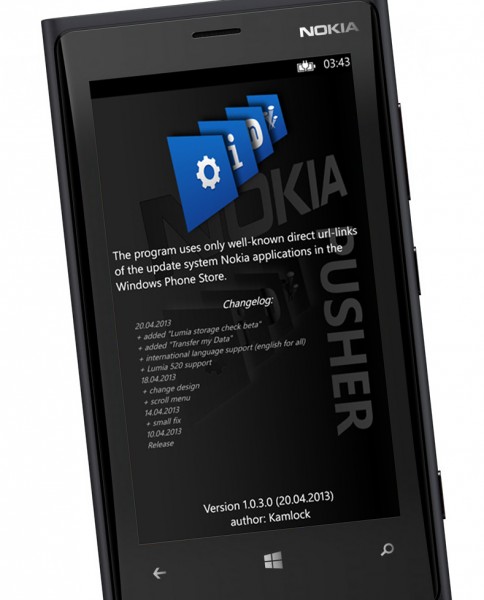
    When an update arrives, Lumia users can only wait for the Store app to display a counter and afterwards allow them to install the latest update. And, as Windows Phone users know, that can take some time — a day or even longer sometimes. So what are your options? Well, you can look up QR codes and scan them or just use the LUMIA pusher app, which allows you to update every single extra right from your Lumia smartphone.

    The Nokia account, extras+info, accessories, network+, feedback to Nokia, access point, display+touch and audio apps, which are all available to use through the Windows Phone Settings menu, can be updated to the latest version using LUMIA pusher.

    The user only has to tap on the item’s name and LUMIA pusher will display the app’s page inside the Windows Phone app store. From there, the user can check for reviews and write a new one, share the app via social networks, email or message, read the description, report the app, view the necessary permissions, and so on.

    LUMIA pusher can also be used to install and update a couple of other exclusive apps such as Transfer my Data and Lumia Storage Check Beta and update the Yandex search engine for Russian Lumia users. That’s just the bonus. The developers should add other software as well, especially from Nokia Beta Labs.

    I like the ease of use that LUMIA pusher delivers, but there is one major caveat. If you have a light background enabled on Windows Phone 8 the app will not take it into account as it normally would.

    The background is dark, which shouldn’t normally be a problem, but instead of keeping the white text with the light background (as it does with the dark one), the app instead uses black for the text. Needless to say, you can’t see much.

    LUMIA pusher is available to download from the Windows Phone Store.

  • GigaOM Chrome Show: New hardware hints and a Skype on the web letdown

    This week’s Chrome podcast kicks off with news that Google is testing Chrome OS on Intel’s fourth-generation chips, which aren’t due out until June. That opens the possibility for more high-end Chromebooks that will have much better battery life. Chris shares his experiences with Chrome OS so far and we answer a few listener questions including one about rolling back to prior software versions.

    We have three tips for Chrome OS users while this week’s showcase extension is for the Chrome browser on Windows and Mac computers. Plus: more about that Skype version for the web you might have heard about.

    Show notes

    Hosts: Chris Albrecht and Kevin C. Tofel

    Got questions, tips or tricks for an upcoming GigaOM Chrome Show? Find Kevin on Google+, Twitter (@kevinctofel) or via e-mail ([email protected])

    (download this episode)

    Subscribe to RSS

    iTunes

    Stitcher Radio

    Related research and analysis from GigaOM Pro:
    Subscriber content. Sign up for a free trial.


  • Should You Share a Room on a Business Trip?

    Years ago, when I worked at Holt, Rhinehart & Winston Educational and Professional Publishing, my female superior and I attended a national teacher’s conference in San Antonio, and were forced to share a hotel room because of a late booking. What could have been a profoundly awkward experience — my boss! in her pajamas! — turned out to be one that strengthened our relationship, allowing us to get to know each other in a way that can rarely be found in the frenzy of daily work. The kind of bonding that I inadvertently experienced may be more frequent these days as the byproduct of a corporate mindset reshaped by Great Recession-driven austerity practices — among them requiring employees to share rooms. Major corporations such as Pfiizer, Bristol Meyers-Squibb and Microsoft have experimented with the practice. Nimbleness and frugality, after all, remain critical to growth, and it’s been interesting to see that even as the economy slowly recovers, plenty of business travelers voluntarily and even eagerly share hotel rooms with colleagues. An Embassy Suites survey of 700 business travelers discovered that “17 percent said they try to share a room with a colleague.”

    Fostering an Entrepreneurial Mindset

    Seth Goldman, the co-founder and CEO of Coca-Cola-acquired Honest Tea, thinks a policy of sharing rooms during business travel helps preserve the entrepreneurial mindset that infused the founding of his company. “Every manager has a P&L that he or she is responsible for,” he says, “and while we don’t make sharing rooms a hard and fast rule, it’s our sense that when people have their own budgets and ownership for their profits, they’ll continue to operate that way.”

    It Can Be Good for Business

    In addition to furthering a sense of entrepreneurialism, Goldman notes that “we spend half as much on hotel rooms as we would if we didn’t share rooms on the road. It makes people think twice about how we spend our money.” But in particular, Goldman says that sharing rooms “allows Honest Tea to save money everywhere that the consumer doesn’t see it, allowing us to invest more in the business.” Rita McGrath, an associate professor at Columbia Business School, echoes Goldman’s findings and estimates that companies “can save as much as 50% in reduced overhead and administrative costs through a room-sharing policy.”

    Danica Kombol, founder of the Atlanta-based social media agency, Everywhere, has even shared hotel rooms at conferences with complete strangers. Before a recent conference, Kombol, who spends at least two weeks every month on the road, had tweeted that she was looking for a “roomie” and another conference attendee named Christine Young responded. For Young, “the best thing about attending conferences is connecting with other like-minded women.” She says the friendships that have been forged have been nothing short of business- and life-changing. “Some of my greatest business contacts,” says Young, “have come from these shared experiences.” Kombol, who once roomed at a conference with a Wal-mart employee she’d never met before, recalls that particular roommate saying that she chose to bunk with a stranger because it “reminded her to be a good steward of the company’s dollars.”

    Kombol and her Everywhere team also often share rooms when the client is paying. It just makes business sense to her, and her clients reward her company for its attention to value. “I would never have dreamed of suggesting that Danica and the Everywhere team bunk up,” says Francis Heid, the Vice President of Media Operations for Advanstar Communications, “but the truth is they do a lot of traveling for us and have visited every Advanstar office around the country, multiple times. The money we’ve saved on hotels is money we can devote to her social media agency, which frankly gets us more bang for both our bucks.”

    Companies Need to Have Across-the-Board Consistent and Transparent Policies

    Like so many programs, how a room-sharing policy is managed will make the difference between success and resentment. Adelma Stanford, a social media engagement manager, responded poorly to a room-sharing policy her former employer, Promethean (a global education company), instituted for junior employees during the recession. Stanford said that the majority of the employees resented the tiered policy and thought, “‘I don’t know these people and shouldn’t have to room with them.’ Many employees chose to pay the difference out of their own pocket so they wouldn’t have to share a room.”

    A former senior associate at Price Waterhouse Coopers, who insisted on anonymity, was okay with bunking with someone, particularly when the economy was in the dumps, but it irked her that more senior management wasn’t asked to make a similar sacrifice. As the associate put it, “at PwC the turnover is high. It’s a demanding job where you regularly feel undervalued and a lot of senior associates were not very happy with this decision because if it was about cutting costs, then every level should have had to bunk.”

    Rita McGrath confirms that a practice of sharing rooms will backfire for management if not uniformly executed. “Where it is particularly demoralizing,” she says, “is when executives insist on penny pinching for their employees but exempt themselves from cost-cutting measures, whether that be sharing hotel spaces or air allowances or whatever. Then people just feel they are being pushed around.”

    When senior management walks the talk, a room-sharing policy is more palatable. McGrath described how for “one of my clients, for instance, the emphasis is on keeping costs low, but the tradeoff is a very generous bonus program so that people feel that when the company saves money they get to share in the benefits. Also, everybody does it, from the “C-suite on down.” Goldman, from Honest Tea, says at his company secretaries and SVPs share rooms, and laughed recalling the time, the night before a big presentation that he shared a room with a VP of sales who “had to sleep with the TV on.” Rather than forcing his employee to turn off the television, Goldman erred on the side of being a good roommate and made do with three hours of sleep. (Granted, many experts — such as HBR blogger Tony Schwartz — would argue that you simply can’t do your job if you don’t sleep.)

    Companies Need To Be Sensitive

    While there are no laws against employees sharing hotel rooms, companies could minimize the potential for unhappiness — or worse — by making the arrangements elective and giving employees a choice over their roommates. A male and female manager at Honest Tea once shared a suite, but “it was sufficiently uncomfortable,” says Goldman, “that we only did that once.” And it’s important for management to know what they are asking of their employees and to acknowledge the sacrifice. Many of those I interviewed said they need private time on the road to “reflect and recharge” and felt the cost of losing precious down time would be greater than the corporate benefit. And Goldman admits that as his business has grown and people from more established companies have joined the company, it’s become more difficult to maintain a culture where “five guys would share a suite.” In fact, he’s made a pledge to the staff that if they meet their profitability goals this year, “everyone will get their own room.”

    Companies need to carefully calibrate their travel policies according to their organization’s culture. Bunking up policies can make employees feel both uncomfortable and undervalued if handled the wrong way. But for many, room-sharing — if respectfully and equitably administered — has the potential to foster not just major cost savings, but also deeper, unanticipated connections that can change the course of a business or a career.

  • Toyota Tundra Best Fuel Economy – A/C or Windows Down

    An ongoing discussion it seems on virtually every automotive website has to do with whether you get better MPG with the A/C on or windows rolled down during the summer. Research finally has a definitive answer for full-size truck owners.

    Toyota Tundra Best Fuel Economy

    What is the better fuel economy strategy when it is hot – A/C or windows down? Research has finally answered this question.

    The researchers at Oak Ridge Laboratory have looked at whether you get better MPG with the A/C on or windows rolled down. The colloquial wisdom has been that running the A/C taxes the engine and burns more fuel. While the window down argument is that you are essentially creating more wind resistance thus burning more fuel. Who is right? Both apparently.

    The researchers tested a 2009 Toyota Corolla and Ford Explorer on a “Burke Porter 300-hp (224-kW) two-wheel-drive dynamometer” inside a laboratory that is ”climate-controlled, and the testing was done at 95°F (35°C).” Originally, the idea was to do the testing on public roads, but likelihood of “too much variation from such factors as humidity, wind direction, and grade (and the resulting transmission shifting activity) over the period of time necessary to provide enough data.”

    The findings reported on SAE.org have found that:

    1. At speeds below 75mph, rolling down the windows is more fuel efficient on both vehicles tested (a Corolla and a Ford Explorer)
    2. At speeds above 75mph, A/C was more fuel efficient on the Corolla, but was NOT more fuel efficient on the Explorer. The reason? The large cabin in the Explorer was hard to cool adequately.
    Toyota Tundra Best Fuel Economy - Window Up or Down - Chart

    Here is the research chart Oak Ridge Laboratories created explaining their findings.

    The bottom line: Tundra owners should probably drive with their windows down all the time if they’re trying to save gas. Car owners, however, can drive with their windows up when they’re on the highway without fear of wasting gas.

    What do you think? Do you agree with these findings?

    Related Posts:

    The post Toyota Tundra Best Fuel Economy – A/C or Windows Down appeared first on Tundra Headquarters Blog.

  • BYOD is Not the Enemy: Using Consumer Tech to Manage the Data Center

    clouds-mobile

    LAS VEGAS – BYOD is not the enemy. Instead, the Bring Your Own Device movement of adopting consumer technology can be of great benefit for an It organization, according to Joseph Furmanski, Associate Director Data Center Facilities and Technology at the University of Pittsburgh Medical Center (UPMC).

    In a presentation Tuesday at the AFCOM Data Center Word Spring 2013 conference, Furmanski outlined how consumer tech such as iPhones and tablets were embraced at UPMC and have become valuable tools for the huge health care provider. Workers bringing their own devices to the workplace are inevitable, he noted, so why not embrace it?

    For UPMC, consumer tech offered a way to do more with less manpower. ”There’s 3 people, we stretch them a lot and want to minimize that,” said Furmanski.

    Furmanski believes adopting consumer tech is important in addressing long-term staffing challenges facing the data center industry. Many in the data center field are no longer spring chickens, and the industry will need younger workers who are accustomed to using iPhones and tablets rather than Blackberries and PCs.

    Attracting A New Generation of Staffers

    “We have to train a new generation and get them excited, and the key is using the tools they use,” said Furmanski, who said his thinking was influenced by discussions at AFCOM and other industry groups on attracting and retaining Millenials. “The people we’re hiring now grew up with this stuff.”

    UPMC operates more than 20 hospitals, with 3,200 physicians and more than 55,000 employees at400 clinical locations, which include hospitals as well as long-term care and senior living facilities. UPMC also operate s a health plan with nearly 1.8-million members.

    With the objective of improving data center management and IOC support, the company began looking at consumer tech, with the stipulations that it would be low or no cost, and must be used in a way that required little to no custom programming. The effort initially focused on the most popular applications: Facebook, Twitter, Dropbox, Evernote, and QR code to perform various functions and communications.

    Quick Deliverables, Quick Wins

    “We had to convince management that we weren’t doing it just to have fun,” said Furmanski. The initial stages were about quick deliverables and quick wins.

    The UPMC’s main data center is in Forbes Tower, a 10,750 square foot facility with limited staff. The hardware is leased on 3-4 year cycles, and they’re heavily virtualized with over 5,000 virtual machines in use. It’s not a large data center, and they are constantly looking at how they can improve efficiencies. This is where consumer tech came into play.

    The first phase of the plan cost under $2,000 in equipment. The staff would use QR codes and code scanners for things like the FM 200 manual, making it easier to access documentation. The staff took video for information purposes, and used Skype to call subject matter experts to solve problems.

    UPMC was able to more effectively use limited staff, save on paper and organize documentation through use of consumer tech.  As time passed, using tablets improved quality and processes and saved the company a lot of paper.

    It wasn’t all smooth. “Integration was the beast that stopped the project,” said Furmanski. Security integration was a particular pain point with devices like iPads and iPhones. “There were a lot of good vertical applications, but we hated logging in over and over,” he said. “There was little to no integration. We talked to a lot of vendors about this.”

    The Surface to the Rescue?

    The company then looks to Microsoft’s Surface tablet, and believes the new Surface Pro will make many of those headaches go away. “Security and content worked really well with it,” said Furmanski. “We found we can run any web or windows based app.” Working with these devices are now a DCIM requirement.

    The company uses these devices to access data on the overall health of the data center. The wealth of applications emerging from app stores for consumer devices is proving useful to UPMC. Staff can view real-time PUE and the environmental control system, all from a tablet. Furmanski says Sharepoint is a key knowledge repository, and Windows 8 and Active directory passes context through, so the silos between apps are breaking down.

    The bottom line for UPMC is that a small staff, with limited investment in consumer tech devices, was able to do more and virtually eliminate the heavy paper usage that plagued the company, Furmanski said. Information is at their fingertips, a limited staff can do more and can access documentation quickly and easily. UPMC will continue to look into how consumer tech can improve its everyday operations.

    By implementing proper usage of BYOD and consumer tech, the data center can greatly improve processes and drive valuable insight, even with limited manpower. There are a wealth of applications from data center management providers coming out every day that increase the value of these devices, so it’s worth looking into the consumerization of data center management.

  • Accudio Free 1.0.0 gives what Apple doesn’t — sweet music on iPhone

    I used to think my iPod touch was the bee’s knees when it came to digital music players. Exposure to true audiophile-friendly models from the likes of Cowon and Colorfly, coupled with listening to FLAC tracks on my budget Sony Xperia phone taught me better, and for a while I was incredibly frustrated with the shortcomings of Apple’s supposedly market-leading player.

    I’ve since discovered that most of that frustration can be targeted at the frankly rubbish Music app that ships with iOS. And now I’m ready to embrace decent sounding music on my iPod touch thanks to a fabulous app called Accudio Free 1.0.0.

    The biggest frustration with Apple’s Music player is its lack of configurability. Sure, you’ve got 22 basic presets to choose from (tap Settings > Music > EQ to access them), but they often make things worse, not better. Apply Bass Booster for example, and the mid and high levels become so muddied as to render most tracks unlistenable.

    Accudio Free offers two key improvements over the default Music player. First, its developers have carefully analysed over 300 pairs of headphones and worked out the best sound settings for each. So your first task on firing up the app is to see if your headphones are included – all of Apple’s basic buds are there, along with a wide range of cheap and not-so-cheap models.

    With your model selected, the app attempts — with great success on the most part — to provide Hi-Fi sound quality through those phones, resulting in an immediate improvement. But there’s more: Accudio also provides a “simulation” mode, which attempts to reproduce the sound quality from a handful of top-quality cans on your current model.

    On its own, this makes a real difference to the sound, but Accudio goes further. The second improvement it offers is not one, but two full sets of graphic equalizer controls. A basic five-bar equalizer, covering sub-bass, bass, vocalist, sibilance and treble, allows you to tweak the reference mode further — up to 10dB in either direction for each frequency.

    And if that wasn’t enough, Accudio also provides you with a Custom Mode that allows you to completely fine-tune all the settings to your personal tastes with a 10-bar equalizer that allows you to pick 10 user-customizable frequencies and tweak them accordingly.

    The Free version tested here limits you to just one reference mode preset and one customizable setting, but upgrading to the Pro version also unlocks some other juicy features, not least of which are support for OGG and lossless FLAC audio formats. Seeing as the true audiophile would pick these over MP3 or Apple’s AAC codec any day of the week, it’s the icing on the cake for frustrated iPhone/iPod touch users.

    Accudio Free is available for free for iPhone, iPod touch and iPad running iOS 4.3 or later. Accudio Pro, available as an in-app upgrade via Settings > Etc > Store, costs $4.99.

    Photo Credit: Joe Wilcox

  • T-Mobile USA’s MetroPCS acquisition now closed

    T-Mobile MetroPCS Acquisition
    T-Mobile USA and MetroPCS are no more. In their place we now find T-Mobile US, the merged entity set to begin trading as TMUS. The Associated Press reported that the acquisition was set to be completed after the closing bell on Tuesday, and the deal is now done; the newly formed entity enters the fray with a market capitalization of about $17 billion. T-Mobile also added 9 million subscribers to its coffers with the deal, so its customer count has now climbed to 43 million — which still makes it the No.4 carrier in the United States. MetroPCS investors are netting $4.08 per share from the deal, and they will also receive half a share of T-Mobile US for each share of MetroPCS common stock they had owned, resulting in a combined 26% stake in the new company.

  • IER Survey: Government Transparency Demanded By Taxpayers

    WASHINGTON D.C. — A survey released today by the Institute for Energy Research reflects growing sentiments among American voters that more transparency from the federal government is needed. IER President Thomas J. Pyle released the following statement concerning the survey …

  • MindMixer Raises $4 Mln

    MindMixer has closed $4 million in funding led by Nelnet. Existing investors Dundee Venture Capital and Optimas Group also participated. MindMixer is an online engagement platform.

    PRESS RELEASE

    MindMixer, an online engagement platform helping hundreds of civic, education and healthcare organizations communicate more effectively with their constituents, today announced the closing of a $4 million investment round.  Nelnet, a leading provider of innovative education products and services, led the round with existing investors Dundee Venture Capital and Optimas Group also participating.
    “MindMixer is poised to positively transform how large organizations, such as school districts and civic groups, across the nation communicate and interact with their desired audiences,” said MindMixer CEO Nick Bowden .  “With this new influx of capital, our online platform will provide more people with a new suite of tools to help them be heard and collectively arrive at solutions to problems, big and small.”
    This new round will fund key developer hires and help the company scale to meet marketplace demand.  Since its 2010 inception, MindMixer has increased its size by 40 percent each quarter and projects to reach 1,000 customers in the educational, healthcare and civic sectors by the end of 2013.  

The staff expansion will also help MindMixer continue to serve its current clients, such as the City of San Francisco, the D.C. public school district, Ohio State University and Coursera, to empower desired audiences to weigh in and provide potential solutions to hot button topics like school closures, deteriorating city infrastructure, and the current engagement pitfalls of massive open online courses.
    “MindMixer is an innovative approach to collaboration and engagement, allowing organizations to cultivate ideas from a broader community,” said Mike Dunlap , CEO of Nelnet. “Nelnet is always looking for ways to improve the way we help associates, students, and schools reach their goals, so we are particularly proud to invest in a steadily growing company that engages people to attain the best results possible. Good ideas are everywhere, and MindMixer takes advantage of this fact with an easy and intuitive user experience.”
    MindMixer will also apply its new capital to enhancing its current set of services and tools.  Over the next few months, the MindMixer platform will feature a new and improved user experience, amplified website as well as significant mobile enhancements.  These new product enhancements will increase community engagement and make conversations and the exchange of ideas between organizations and their desired audiences more efficient.
    More information can be found at www.mindmixer.com/press.
    About MindMixer
MindMixer believes that good, informed ideas are out there, but many don’t make it to the surface or are drowned out by the volume of usual voices. Leveraging the power of the Internet and social media, MindMixer’s online community engagement and social media intelligence tools connect organizations with community members who might not otherwise get involved. With the country’s largest suite of best-in-class engagement technology, MindMixer makes it easier for community leadership and members to have more productive, collaborative discussions than they would using traditional approaches like offline town hall meetings and message boards.
    About Nelnet
Nelnet Inc. (NYSE: NNI), is an innovative education finance and services company focused on providing fee-based processing services and quality education-related products in four core areas: loan financing, loan servicing, payment processing, and education planning.  In addition, Nelnet leverages its strong technology competencies throughout its businesses.  The company’s products and services help students and families plan, prepare, and pay for their education and make administrative and financial processes more efficient for schools and financial organizations.  For more information, visit Nelnet.com.

    The post MindMixer Raises $4 Mln appeared first on peHUB.

  • Local Market Raises $1.5 Mln Funding

    Local Market Launch has closed $1.5 million in Series A funding from Rincon Venture Partners. Local Market is a business listings management startup that has raised total capital of $2.7 million.

    PRESS RELEASE

    Business listings management startup Local Market Launch, launched in 2012 by ValueClick founder Brian Coryat , has secured $1.5 million in Series A funding from Rincon Venture Partners, adding to $1.2 million of founder contributed seed funds, bringing total capital raised to $2.7 million.
    The funds will be used to support rising demand for Local Market Launch’s local presence solutions by multi-location national brands and small and medium-sized businesses. Local Market Launch will also accelerate development and delivery of its partner-branded solutions for local media channel partners.
    A recent study by Google/Nielsen revealed that 73 percent of mobile searches trigger additional action and conversions, such as store visits, calls and purchases. Accurate business listing information is the unassuming workhorse underlying much of today’s local commerce, which is being driven by mobile and online search.
    “Despite the digital revolution of the past 20 years, many businesses, especially small local establishments, have largely been left behind,” said John Greathouse , general partner, Rincon Venture Partners. “As such, there is a tremendous opportunity for Local Market Launch to become the trusted business listings management partner for the world’s small, local businesses, and for national brands targeting locally. When Brian founded ValueClick, he ingrained in the organization the principles of over-delivering value to its customers by consistently developing killer technology and providing unparalleled service. We believe that Local Market Launch will likewise achieve market dominance by following this simple, but difficult to execute, strategy.”
    Coryat founded Local Market Launch to raise the level of quality in business listings data and service. He brings rich experience earned at the forefront of the Internet marketing industry, where he has led several successful ventures, including online advertising company ValueClick, for which he was awarded the Ernst & Young Entrepreneur of the Year Award in 2000 for ecommerce.
    “It’s time to take business listings management to a new level of accuracy and trust, and Local Market Launch is committed to raising the bar,” said Coryat. “We’re excited by the tremendous interest we’re receiving from national brands, multi-location businesses and franchises, as well as channel partners, and we’re truly gratified by Rincon Venture Partners’ confidence in our technology and our vision for the company. With their backing, we will be able to accelerate our growth and fulfill our mission, which is grounded in our commitment to the highest quality standards for our data and customer service.”
    About Local Market Launch
    Local Market Launch delivers business listings management and local presence solutions for national brands, multi-location businesses, franchises, and local SMBs through a growing network of channel partners, including directory publishers, newspaper publishers, broadcast media companies, digital media agencies and certified marketing representatives (CMRs). The company is delivering new standards of quality and service to business listings management that combines the best of DIY technology with the quality-controlled ease of a do-it-for-you solution. Learn more at www.localmarketlaunch.com,www.localsearchoptimization.com, on Twitter @LocalLaunch and @LocalSearchOpt, Facebook https://www.facebook.com/localmarketlaunch and Google+.

    The post Local Market Raises $1.5 Mln Funding appeared first on peHUB.

  • Nelson Global Buys Envall

    Nelson Global Products Inc., which is backed by Wind Point Partners, has acquired Envall. Financial terms weren’t announced. Envall, of Rio Grande do Sul, Brazil, makes tube and hose assemblies.

    PRESS RELEASE

    Nelson Global Products Inc., a global leader in the design and manufacture of tubular and exhaust products for commercial vehicle markets, has acquired Envall, a family-owned tube and hose assemblies manufacturer in Rio Grande do Sul, Brazil.
    Envall, maker of hydraulic and structural tubes, and low-to-high pressure hydraulic hoses, will continue to operate its 90,000 square foot manufacturing plant under the leadership of Irenivo Pereira, formerly a co-owner of the 20-year old operation and newly-appointed general manager.  A strong management team and experienced production technicians also contribute to the operation’s success.
    “This acquisition of Envall broadens Nelson’s global footprint and product portfolio, expanding beyond our previous manufacturing and marketing reach into North America, Australia, India and China,” said Sergio Carvalho , president of Nelson’s On-Highway business unit.
    “Our strategic plan remains focused on expanding our product portfolio for our customers, plus we will enable the Envall operation to diversify into other market segments beyond off-highway and agricultural vehicles,” added Carvalho.
    “The strength of Nelson, the product portfolio and customer relationships will make Envall a stronger and more prosperous company for the markets it serves, as well as its employees,” stated Envall’s Pereira.
    “Nelson is a richer and deeper manufacturing player with the addition of Envall,” said Tom Gosnell , CEO of Nelson. “This transaction is in response to customer requests that we extend our presence into the Brazil and broader South American markets. We are very enthusiastic about this first step here.”
    Nelson Global Products is a portfolio company of Wind Point Partners, a private equity firm headquartered in Chicago. Terms of the acquisition were not disclosed.
    Two months ago, Nelson acquired Water Works Manufacturing in Cambridge, MN.  That expansion also enabled Nelson to grow its capabilities into advanced metal forming for the power sports and infrastructure related industries.
    About Nelson Global Products
    With more than 60 years of engineering and manufacturing history, Nelson Global Products manufactures and markets a broad range of high performance exhaust and tubular products for OEM and aftermarket use for the global on-highway and off-highway markets. The company’s operation includes manufacturing operations in Clinton, TN; Fort Wayne, IN; Peoria, IL; Arcadia-Black River Falls-and Viroqua, WI; and international operations in Scoresby, Australia; Pune, India; and Changzhou, China.
    Among Nelson’s product portfolio are mufflers and silencers; exhaust tube assemblies; EGR and thermal management tubing for emissions systems; pressurized tube assemblies for air-hydraulic-and lubrication; and structural assemblies.

    The post Nelson Global Buys Envall appeared first on peHUB.

  • Platte River Sells Hetsco

    Platte River Equity has sold Hetsco to Global Power Equipment Group. Financial terms weren’t announced. Greenwood, Ind.-based Hetsco provides emergency and planned repairs for brazed aluminum heat exchangers. St. Charles Capital served as financial advisor to Hetsco while TM Capital provided financial advice to Global Power.

    PRESS RELEASE

    Platte River Equity (“Platte River”) today announced the sale of its portfolio company, Hetsco, Inc. (“Hetsco”) to Global Power Equipment Group Inc. (Nasdaq: GLPW) (“Global Power”).
    Headquartered in Greenwood, Indiana and founded in 1981, Hetsco is the leading provider of emergency and planned repairs for brazed aluminum heat exchangers, the critical process equipment used in air separation and other gas processing applications.  Hetsco also provides maintenance, fabrication, construction, relocation and safety services to the leading industrial gas, gas processing, LNG and utility companies.
    “We are proud of Hetsco’s development over the past several years under the leadership of Sam Willard and Steve Powell ,” said Platte River Managing Director Peter Calamari .  “In this environment of increasing investment in industrial gas production and processing, Hetsco is poised for continued success.  We are also pleased that the company will be owned by Global Power, a strong and supportive new partner for Hetsco and its employees.”
    Sam Willard , President of Hetsco, commented, “The financial, strategic and operational support Platte River has provided to Hetsco over the last five years has been invaluable.  We accomplished all we had set out to do, and Platte River was a critical partner in our success.  We look forward to a new chapter of continued growth with Global Power.”
    Luis Manuel Ramírez, President and Chief Executive Officer of Global Power, commented, “We are pleased with the successful closing of this transaction and eager to work with the Hetsco team to develop new opportunities for the expansion of our Services Division.”
    Bartlit Beck Herman Palenchar & Scott LLP served as legal counsel to Platte River, and St. Charles Capital served as the exclusive financial advisor to Hetsco.  Thompson Hine LLP served as legal counsel and TM Capital served as financial advisor to Global Power.
    About Platte River Equity
    Based in Denver, Colorado, Platte River Equity is a private equity firm focused on investments in lower middle market operating companies with enterprise values generally between $20 million and $250 million.  The firm focuses on investing in sectors where it has deep operating and investing background, including aerospace and transportation; energy and industrial products and services; and chemicals, metals and industrial minerals. Platte River Equity manages funds with committed capital in excess of $700 million. Please visit www.platteriverequity.com.
    About Global Power
    Texas-based Global Power Equipment Group Inc. is a design, engineering and manufacturing firm providing a broad array of equipment and services to the global power infrastructure, energy and process industries.  Through its Services Division, the Company provides on-site specialty support and outage management services for commercial nuclear reactors in the United States, maintenance services to fossil and hydroelectric power plants and industrial gas processing services.  Through its Products Division, the Company designs, engineers and manufactures a comprehensive portfolio of equipment for gas turbine power plants and power-related equipment for industrial operations, with over 40 years of power generation industry experience.  With a strong competitive position in its product lines, the Company benefits from a large installed base of equipment in domestic and international markets.  Additional information about Global Power Equipment Group Inc. may be found at www.globalpower.com.

    The post Platte River Sells Hetsco appeared first on peHUB.

  • Ziggo Acquires Esprit Telecom

    Ziggo has completed the acquisition of Esprit Telecom. The Dutch Authority for Consumers and Markets (ACM) gave its approval for the takeover in April.

    PRESS RELEASE

    Ziggo’s previously announced takeover of Esprit Telecom will take effect from 1 May 2013. The company’s results will be consolidated into Ziggo’s on the same date. The Dutch Authority for Consumers and Markets (ACM) gave its approval for the takeover in April.

    The acquisition enables Ziggo to further expand its services for the business market. Esprit Telecom is a leading provider of voice and data services for the SME market in the Netherlands, and has an active sales channel of dealers across the country. The acquisition includes Zoranet, an ICT service provider that focuses on the retail sector.

    About Ziggo
    Ziggo is a Dutch provider of entertainment, information and communication through television, Internet and telephony
    services. The company serves around 2.9 million households, with almost 1.8 million Internet customers, more than 2.2 million customers for digital television and 1.5 million telephony subscribers. Business-to-business customers use services such as data communication, telephony, television and Internet. The company owns a next-generation network capable of providing the bandwidth required for all future services currently foreseen. More information on Ziggo can be found on: www.ziggo.com

    About Esprit Telecom
    Esprit Telecom was founded in 1993, and provides voice and data services to the SME market in the Netherlands. The company has 5,000 clients and an extensive sales channel of 150 resellers and account managers. It is located in Almere, and has 75 employees. Zoranet became a part of Esprit Telecom in 2011. It is a business IT service provider that focuses on the retail sector, with sales driven through resellers and account managers. Located in Zwolle, the company has 23 employees.

    Not for publication

    For more information please contact:

    Press
    Erik van Doeselaar
    Senior Media Relations Officer
    +31 (0)88 717 3414 | [email protected]
    Analysts and Investors
    Wouter van de Putte
    Director Corporate Finance & Investor Relations
    +31 (0)88 717 1799 | [email protected]

    Christian Berghout
    Manager Corporate Finance & Investor Relations
    +31 (0)88 717 1051| [email protected]

    The post Ziggo Acquires Esprit Telecom appeared first on peHUB.

  • Joseph Porten Joins NXT Capital Venture Finance as Director

    NXT Capital Venture Finance has appointed Joseph Porten as a director. Based in NXT Capital’s Silicon Valley office, Porten will focus on identifying investment opportunities among emerging and late-stage growth companies.

    PRESS RELEASE

    NXT Capital Venture Finance today announced that Joseph Porten has joined the group as a Director. Based in NXT Capital’s Silicon Valley office, Porten will focus on identifying investment opportunities among emerging and late-stage growth companies.

    “Joe is an outstanding addition to the NXT Capital Venture Finance team,” said Jan Haas, Group Head. “His broad network and expertise deploying growth capital to later stage technology companies will help NXT Venture Finance further its mission of accelerating innovation with efficient capital.”

    “I’m excited to join the NXT Capital Venture Finance team,” said Porten. “As emerging companies stay private longer and continue to invest heavily ahead of growth, there is increasing demand for late-stage capital. NXT’s platform is ideally positioned to provide efficient, flexible growth capital to meet that demand.”

    Porten was most recently a Vice President at Battery Ventures, where he focused on technology business models in B2B and B2C software, tech-enabled business services and information services. While at Battery, Porten’s investments included Avalara and DrillingInfo.

    Previously, Porten was an associate with Spectrum Equity Investors, a technology-focused private equity firm with $4 billion under management. His experience also includes roles at Concert Capital Partners and LaSalle Bank Corporation.

    Porten earned an M.B.A. in finance and entrepreneurship from the University of Chicago Graduate School of Business and a B.A. in economics from the University of Chicago.

    About NXT Capital Venture Finance: NXT Capital Venture Finance serves entrepreneurs by providing less dilutive, more flexible forms of capital. With offices in Boston and Silicon Valley, NXT Capital Venture Finance has more than $500 million of committed capital to invest in emerging growth companies backed by venture capital and private equity firms, particularly those in the technology and life science sectors. Target clients range from pre-revenue companies led by dedicated entrepreneurs to late-stage, proven businesses seeking $1 million to $20 million of growth capital. For more information, see www.nxtcapitalvf.com.

    About NXT Capital: NXT Capital provides structured financing solutions to middle-market and emerging growth companies, as well as real estate investors, through its Corporate Finance, Equipment Finance, Venture Finance and Real Estate Finance groups. Based in Chicago with offices in New York, Atlanta, Boston, Dallas, Phoenix, Newport Beach, San Francisco and Silicon Valley, NXT Capital targets senior financing opportunities up to $150 million with a hold size up to $50 million.

    PRIVILEGED AND CONFIDENTIAL
    This e-mail message and/or any attachments thereto (the “Communication”) are intended only for the use of the individual or entity to which it is addressed and may contain information that is privileged, confidential and exempt from disclosure. If you are not the intended recipient, or believe that you have received this Communication in error, please do not disseminate, distribute, print, copy, retransmit (except as set forth in the next sentence), or otherwise use this Communication. Instead, please notify the sender of the Communication immediately by return e-mail (including the original message in your reply) and by telephone (you may call NXT Capital toll-free at 1-877-698-6111) and then delete and discard all copies of the e-mail. Thank you.

    This message has been scanned for malware by Websense. www.websense.com

    The post Joseph Porten Joins NXT Capital Venture Finance as Director appeared first on peHUB.

  • Saudi Aramco Energy Ventures Invests in Antech

    Saudi Aramco Energy Ventures, the corporate venturing subsidiary of Saudi Aramco, has made an investment in AnTech. The company is a UK-based developer of directional coiled tubing drilling (DCTD) products and services.

    PRESS RELEASE

    Saudi Aramco Energy Ventures LLC (“SAEV”), the corporate venturing subsidiary of Saudi Aramco, today announced an investment into AnTech Ltd, a UK-based developer of directional coiled tubing drilling (DCTD) products and services.

    AnTech has developed and successfully tested two proprietary DCTD products, COLT™ and POLARIS™. These tools promise to provide better performance, ease of deployment, and lower cost of operation in directional coiled tubing drilling applications.

    SAEV’s investment in AnTech has been made in partnership with Calculus Capital, the specialist UK private equity investor. Both parties have invested similar amounts and these injections will help AnTech take advantage of numerous growth opportunities.

    SAEV CEO Ibrahim Buainain stated “We are delighted to announce this investment into AnTech. Saudi Aramco is today a significant user of directional coiled drilling tubing services and we believe that AnTech’s products will allow DCTD methods to be applied to a wider variety of applications with lower costs and improved outcomes. We expect that SAEV’s engagement with AnTech will accelerate the commercialization of its products and their adoption in the Saudi Arabian market”.

    AnTech Managing Director Toni Miszewski said “We are delighted to have received the financial support of SAEV and Calculus to help us achieve our aggressive growth plans. In addition, the Middle East is a critical target market for our business and the backing of SAEV will help provide the credibility and support we need to bring our tools, services and skills to the region. We can now truly demonstrate the full potential and advantages of DCTD”.

    About Saudi Aramco Energy Ventures – Saudi Aramco Energy Ventures LLC (SAEV) is the corporate venturing subsidiary of Saudi Arabian Oil Company (Saudi Aramco), the world’s leading integrated energy company. Headquartered in Dhahran with offices in North America and Europe, SAEV’s mission is to invest globally in start-ups and high growth companies with technologies of strategic importance to its parent, Saudi Aramco.

    About Calculus Capital Ltd – Calculus, founded in 1999, is a specialist in creating and managing private equity funds for individuals. The firm’s range of Enterprise Investment Scheme (EIS) and Venture Capital Trust (VCT) funds invest in UK unquoted companies. Calculus launched the UK’s first approved EIS fund in 2000 and its entrepreneurial flair, combined with experience and sound commercial judgment has resulted in an impressive track record of investment success.

    About AnTech Ltd – AnTech has been designing and manufacturing innovative products for the oil & gas industry for over 15 years. Throughout this time the company has developed significant expertise in coiled tubing, drilling and downhole measurement and sensing technologies. It is currently commercializing its proprietary COLT™ and POLARIS™ directional coiled tubing drilling tools, which have been successfully trialled in the field. The company is headquartered in Exeter, UK.

    The post Saudi Aramco Energy Ventures Invests in Antech appeared first on peHUB.

  • Saudi Aramco Energy Ventures Backs Sekal AS

    Saudi Aramco Energy Ventures, the corporate venturing subsidiary of Saudi Aramco, has closed an investment into Sekal AS. The business offers real time decision support and automation software, together with related consultancy and support services to the oil and gas industry.

    PRESS RELEASE

    Saudi Aramco Energy Ventures LLC (“SAEV”), the corporate venturing subsidiary of Saudi Aramco, today announced the closing of an investment into Sekal AS, a company that offers real time decision support and automation software, together with related consultancy and support services to the oil and gas industry.

    The company is commercializing two software solutions, DrillScene and DrillTronics, used in drilling operations where rigs have real time data streaming capabilities. DrillScene is a self‐calibrating system that provides real‐time early warnings of impending problems in drilling operations. The driller can respond quicker to take corrective actions, reducing down‐time and improving performance. DrillTronics provides added automation and safeguard features to existing drilling control systems and actively controls key elements of the operation, such as draw‐work, top‐drive and mud pumps.

    CEO of SAEV, Ibrahim Buainain said: “We are delighted to announce SAEV’s latest investment. We believe Sekal’s technology is truly superior to competing alternatives in the market, and will have a significant impact in increasing efficiency, reducing downtime and reducing costs in Saudi Aramco’s drilling operations.”

    About Saudi Aramco Energy Ventures ‐ Saudi Aramco Energy Ventures LLC (SAEV) is the corporate venturing subsidiary of Saudi Arabian Oil Company (Saudi Aramco), the world’s leading integrated energy company. Headquartered in Dhahran with operations in North America and Europe, SAEV’s mission is to invest globally in start‐ups and high growth companies with technologies of strategic importance to its parent, Saudi Aramco.

    For more information about SAEV, please visit www.aramcoventures.com

    About Sekal – Sekal supplies solutions that employ real time data from a rig to perform advanced monitoring and automated drilling by utilizing advanced models. The solutions provide value by early detection of downhole condition deterioration, either as a monitoring service or as a fully integrated solution with the drilling control system. The result is a safer and more efficient drilling process. The company was incorporated in 2011 with headquarters in Sandnes, Norway, and offices in Aberdeen and Houston. The main owners are IRIS, Statoil Technology Invest, SåkorninVest and now Saudi Aramco Energy Ventures.

    For more information about Sekal, please visit: www.sekal.no

    The post Saudi Aramco Energy Ventures Backs Sekal AS appeared first on peHUB.

  • Windows Azure SDK 2.0 for .NET is now available

    Microsoft is on an update streak with Windows Azure, introducing significant new features at a steady pace. For the past couple of months we have witnessed an overwhelming number of changes meant to improve the company’s cloud platform, including the Iaas (Infrastructure as a Service) support announced two weeks ago.

    Microsoft’s latest move in this never-ending chess game with its rivals is the Windows Azure SDK (Software Development Kit) 2.0 for .NET which now features improvements for websites, cloud services, storage, service bus and PowerShell automation. Let’s take a look at what’s new.

    Websites

    Users can more easily publish ASP.NET projects from Visual Studio to Windows Azure by clicking on a couple of buttons and following the dedicated wizard. The new SDK also allows the Visual Studio Server Explorer to be used to manage websites that are deployed using Windows Azure and stream website application logs from the cloud straight to Visual Studio.

    Cloud Services

    The new SDK release builds upon the Windows Azure IaaS support by allowing users to deploy cloud services to the virtual machines unveiled alongside the Infrastructure as a Service feature. Microsoft also introduced a new simultaneous update option (available in Deployment Settings), meant to speed up the deployment process and better diagnostics support.

    Storage

    The main improvement here is the ability to make and delete tables designed for the cloud platform and add, delete and edit entities using Visual Studio Server Explorer. Microsoft says that this will make life easier for the user by requiring less time and simplifying the process of building apps with tables.

    Service Bus

    The Windows Azure SDK 2.0 for .NET comes with an updated Service Bus library which features support for Message Browse, which allows the user to view queued messages without any further complications, Message Pump Programming Model and Auto-delete for Idle Messaging Entities, at a certain interval.

    PowerShell

    The Windows Azure PowerShell — the task automation framework for the cloud platform — now features support for PowerShell 3.0. There are “numerous new PowerShell cmdlets” according to Microsoft, designed to “automate Windows Azure Web Sites, Cloud Services, Virtual Machines, as well as application services including Service Bus and the Windows Azure Store”.

    Windows Azure SDK 2.0 for .NET is available to download from the Windows Azure .NET Developer Center.

    Photo Credit: Andreas Weitzmann/Shutterstock

  • Reuters – Veeva Systems Planning IPO

    Life sciences-focused software company Veeva Systems is planning an initial public offering that could come in the third quarter and has selected banks to lead the deal, writes Reuters. Veeva Systems received $4 million in funding from venture capital firm Emergence Capital in 2008.

    Reuters – Life sciences-focused software company Veeva Systems is planning an initial public offering that could come in the third quarter and has selected banks to lead the deal, according to two people familiar with the matter.

    The Pleasanton, California-based company has hired Morgan Stanley and Deutsche Bank AG, the sources said on Tuesday. The sources declined to speak publicly because the matter is private.

    Veeva Systems, Morgan Stanley and Deutsche Bank declined to comment.

    Veeva, which competes with Oracle, provides Web-based software for pharmaceutical representatives that allows them to track drug information and to provide documentation and data to their sales forces.

    Veeva has also built a content management system for pharmaceutical companies to manage information related to drug development to maintain compliance and speed up the approval process.

    The company generated around $120 million in annual revenue last year and is profitable, one of the sources said. It has more than 150 customers including large pharmaceutical companies like AstraZeneca PLC, Bayer, Eli Lilly & Co and Novartis AG, as well as biotech firms.

    Veeva Systems received $4 million in funding from venture capital firm Emergence Capital in 2008.

    The post Reuters – Veeva Systems Planning IPO appeared first on peHUB.

  • Thanks to Splitsider, Exquisite Corpse Project documents the making of a film, and the end of an era

    When the book is written on the rise of web video in the 2000s, the easiest way to explore the majority of those early pioneers will be by tracking sketch comedy troupes — groups born of live comedy venues, which then moved onto YouTube and other platforms in search of wider audiences.

    Some of these troupes, such as Human Giant and Derrick Comedy, gave birth to comedy stars like Rob Huebel, Aziz Ansari and Donald Glover — but what nearly all of these sketch troupes have in common is the fact that most of them aren’t really working together anymore.

    One of these troupes was Olde English, which rose to prominence in 2006 and 2007, with popular shorts including One Picture Every Day and Akon Calls T-Pain. But their latest project might be their last: A feature-length film, riffing off the titular party game, called The Exquisite Corpse Project.

    Exquisite Corpse Project is a hybrid of comedy and drama, documentary and fiction, and also, in its unique way, a coming-of-age story. The film tracks five filmmakers, either former members of Olde English or frequent collaborators, who co-wrote a feature-length film; each person, however, was only able to read the last five pages of the previous section before writing their section.

    The results are a mish-mash of different genres and stories, with characters changing personality and in some cases even names depending on the whims of the writers. The actors remain the same, but the story is in constant flux.

    In between clips of the various segments, meanwhile, the filmmakers are interviewed: Some of whom were fully engaged with the project and some of whom might have been deliberately trying to sabotage it.

    But according to director/producer Ben Popik, who spearheaded the project, it was an opportunity to work with his friends one last time, before they permanently scattered from Brooklyn to other careers and destinations, including Los Angeles and Belize.

    Appropriately enough, Exquisite Corpse Project has found its home in digital distribution, similar in style to the model being developed by VHX and Chill Direct. However, Exquisite Corpse can be found via a new player on the scene: The Awl comedy brand Splitsider, which launched the Splitsider Presents brand with the release of Exquisite Corpse.

    Pay attention when you download, though — while Exquisite Corpse only costs $5, Splitsider has some very specific rules for its purchase. From the landing page:

    “You can download the video 5 times. Once you’ve got it, it’s yours to do with as you like: sync it to your Zune, stream it over wi-fi to your spouse, burn
    it to DVD, etc.”

    “You get 3 video streams and each stream lasts 6 hours. When they’re all gone, you will need to purchase the show again to do more streaming. (Download a copy to keep it forever.)”

    Exquisite Corpse Project is the sort of film that defines niche — an independent docu-comedy about the making of a movie — however, it fits well with a brand like Splitsider’s. It’ll be interesting to see what comes of this approach, and what other projects Splitsider decides to take on.

    Related research and analysis from GigaOM Pro:
    Subscriber content. Sign up for a free trial.


  • Samsung Galaxy S4 — it’s just a damn phone [review]

    After a year-and-a-half on an iPhone 4S, I’m now on the current cutting-edge of smartphonery: Samsung Galaxy S4. I’ve used the phone for almost 3 days now. It’s good. I’m excited. Are there any ball games on tonight?

    Where was I? Oh yeah, the phone. I’m so excited that I could…do something that excited people do. Honestly, it’s a phone. It’s a very nice phone with some great features, a great physical design and a lot of bling features that I’ll probably never use. I can believe it’s the best of the Android phones, but I haven’t tested all the others.

    Second Choice

    The GS4 was not my first choice. What I really wanted was a Windows Phone, but two problems stopped me: There are still a number of severe gaps in the app ecosystem, which I find surprising at this point. The market share may seem small, but Windows Phone user base is large in absolute numbers. As my colleague Joe Wilcox wrote two days ago, Windows Phone adopters tend to be first-time smartphone buyers, so they haven’t established app preferences. It’s an opportunity for both the big and small companies. And yet, there’s still no Adobe Reader for Windows Phone and the Microsoft PDF reader is a piece of garbage.

    I still might have sucked it up and gone ahead, but the Nokia 920 — clearly the best Windows Phone and one of the best phones of any type has a sealed battery — and I will never again buy a phone with a sealed battery.

    So Android looked like the logical choice, and Samsung the easy decision. The electronics giant’s phones aren’t just popular, they’re highly-regarded and have the richest ecosystem outside of Apple’s. Right around this time the Galaxy S4 became available so I pre-ordered, and AT&T delivered early.

    Unfortunately, when trying to activate last Saturday I ran into a problem: To do so online you need an order number and an activation number. I had no activation number because my online order status was still “preordered”, even though I had the phone for a couple days. Calling support deliverd bad news: they are only available Monday-Friday (even though the webpage says they’re also open on weekends) and support chat was offline. Monday morning I activated GS4 on the phone with customer service, but it took almost half an hour because of the confusion in their systems.

    It’s Huge

    The Galaxy S4 is conspicuously larger than my iPhone 4S (136.6 x 69.8 x 7.9 vs. 115.2 x 58.66 x 9.3 — all mm) and yet lighter (130 vs. 140 grams). The iPhone 5 changed things: it’s almost as tall as the GS4 and much lighter, but as narrow as the 4S.

    But the display differences, at least in specs, are still profound: The GS4’s screen is 130 mm diagonal vs. the iPhone 5’s 100 mm, the GS4 resolution is 1920 x 1080 vs. the iPhone 5’s 1136 x 640 and pixel density is 441 to 326, in favor of the Samsung. Obviously the size difference in screens stands out, but the quality difference? I’m of the opinion that the iPhone 5 meets or exceeds my “as good as I’ll ever be able to discern” standard. I can’t see any quality difference in the GS4, but I’m sure others can (especially after being informed of the specs).

    Beyond the physical phone, Samsung has put a lot of resources into customizing this distribution of Android to distinguish it from others. You’ll never hear them use the word “Android”. It’s all a Samsung product.

    To me, the most impressive and useful distinction is the ability, which Samsung has had for almost a year, to run two apps at the same time on the screen. I expect to use this a lot, even though only a few apps work in this mode. The South Korean company also has better security features for centralized device management than other Android vendors — and for some time — and are increasing that lead, not that any of this applies to my phone.

    Too Much of a Good Thing

    I don’t expect to use most of the new stuff in the GS4. I’ll likely end up disabling all the off-screen gesture stuff (“Air Gestures”). It’s too easy to invoke by accident and works badly in my admittedly-brief testing. The Air Gestures use a sensor at the top of the phone to allow you to:

    • See “important information” quickly when the screen is off.
    • Move around in a document or between images by waving your hand in front of the screen without touching it. (This is the best example of a feature easy to invoke accidentally.)
    • Accept a call by waving your hand in front of the sensor.
    • A related feature called Air View lets you preview certain content, like the names of contacts from their speed dial number, by hovering your finger over them.

    Finally, there is Smart Screen, which is probably the most publicized feature of Galaxy S4. The sensor and camera look at your eyes to determine what part of the screen you’re looking at and use that to scroll the content as appropriate. I really did try this and couldn’t get it working. Maybe I could with some more effort, but what I can’t get myself to do is care. A friend who has tested it is more hopeful.

    All the conventional Android stuff like widgets is there, too, and all the apps. So far I think probably made the decision, but I’m not excited like the people on the Samsung TV commercials. It’s just a phone, and the thrill is gone.