Blog

  • Data Center Links: Cobalt, NYI, Primus

    Here’s our review of some of this week’s noteworthy links for the data center industry:

    Cobalt selected by Zeneva.  Cobalt Data Centers announced that it has been selected by Florida-based Zeneva for its west coast interconnection and operations hub.  “We are excited to access the Cobalt Cheyenne ecosystem,” said Timothy Lee, director of operations of Zeneva. “We’re building our own network, and as an emerging cloud provider having access to Level 3, TW Telecom, Hurricane Electric and numerous other carriers was very important. Cobalt is rapidly becoming known for its connectivity and fast growing ecosystem of content and cloud providers, so it was an obvious fit for a high performance cloud operation like Zeneva. And we intend to offer our full suite of products, including network and colocation, to West Coast users via the Cobalt platform.”

    Clickbank expands at NYI.  NYI announced that Clickbank has increased its infrastructure footprint at NYI, a New York speciality data center solutions provider. After starting with NYI in the Bridgewater, New Jersey data center in 2010 Clickbank has upgraded to a customized colocation solution. ”As one of the first tenants at their New Jersey facility, I am happy to report that all the efficiencies that NYI promised have not only come true, they have helped our business immeasurably,” said Mark Hellbusch, Director of IT Operations for ClickBank. “With the upgrade, we look forward to continued growth for all of our vendors and partners.”

    BLACKIRON sold to Rogers Communications. Primus Telecommunications (PTGI) announced that it has sold BLACKIRON Data, its pure data center operations in Canada, to Rogers Communications for approximately CAD$200 million. BLACKIRON owns and operates eight data centers in five major cities in Canada, with approximately 4,000 customers. “The sale of BLACKIRON Data to Rogers marks a successful monetization of one of our worldwide assets. Looking ahead, the Board will consider various options for deploying the net cash proceeds of this sale,” said Peter D. Aquino, Executive Chariman of Primus.” Having separated our data center assets, rebranded BLACKIRON Data, and through our commitment to investing in fully certified Tier III capacity expansions and a second-generation cloud platform, we created a highly attractive portfolio across Canada,” added Andrew Day, President and CEO of Primus. “We are extremely proud of BLACKIRON’s employee contribution in building this great company,” said AJ Byers, President, BLACKIRON Data. “As part of Rogers Business Solutions going forward, we are confident that BLACKIRON will continue to grow and flourish as a customer-focused and best-in-class data centre and cloud-based services provider”.

  • Old Samsung NFC TecTile tags don’t work with the Samsung Galaxy S 4

    samsung-tectiles

    Samsung has upgraded the Galaxy S 4′s NFC chipset in a way that it no longer communicates with older Samsung NFC tags called TecTiles. When asked about this problem Samsung had this to say:

    Samsung is introducing TecTile 2, an update to the original TecTile NFC programmable tags, which will be available in the coming weeks. TecTile 2 will use the current NFC technology on the market, allowing Samsung customers to further incorporate NFC into their daily lives and to use with the latest Samsung Mobile products and services, including the Galaxy S 4. As industry standards continue to evolve, Samsung remains committed to meeting those standards and adapting its technologies if necessary. Samsung customers can also fully utilize TecTiles 2 with existing Samsung Mobile NFC-enabled Android smartphones currently in market.

    This is good news for the new people adopting the technology, but I can’t help to feel sad for all the people that were given the orginal TecTiles and now have to buy something else along with a new phone. That’s the accessory business.

    Source: AnandTech
    Via: GSMArena

    Come comment on this article: Old Samsung NFC TecTile tags don’t work with the Samsung Galaxy S 4

  • AppFog drops Rackspace support

    AppFog, the Platform as a Service that pledged to run your applications on (almost) any cloud, is now one cloud down. As of May 2, the company is “turning off” the Rackspace infrastructure option. An email message announcing the change of plans sent April 27 told customers they could no longer create new applications on Rackspace as of that date.

    While helping users host applications on five public clouds was one of Appfog’s main selling points, “it’s also become increasingly resource-intensive to maintain so many instances of our infrastructure,” AppFog CEO Lucas Carlson wrote in the email. He referred users to the AppFog Console, which will enable them to clone their application onto new target infrastructure.

    Carlson could not be reached for comment Monday morning, but, Generally speaking, PaaS adoption by business users has been sketchy at best. Many developers love PaaS because it makes development and testing very easy, but once the applications are built, many companies prefer to run them in-house (i.e., not on a public cloud). And, more specifically, there have been rumors  that AppFog was seeking investment or even a potential buyout.

    AppFog tried to end-run that argument by allowing deployment on private clouds as well, but it’s unclear how well that effort has gone. There has also been angst among companies, including AppFog, that built their PaaS offerings atop the Cloud Foundry framework. That was true when Cloud Foundry resided under VMware, and remains true since it was spun off to Pivotal, which is now selling its own Cloud Foundry PaaS that competes with third-party options.

    I’ve reached out to Carlson for comment and will update this story when he responds.

    Update: Carlson would not comment on rationale for dropping Rackspace but did say that AppFog has hundreds of paying customers and that his goal is to “build a big company in a big space.” AppFog still supports Amazon Web Services in three regions — North America, Europe and Asia as well as HP’s cloud.

    This story was updated at 7:25 a.m. PST with Carlson’s comment.

    Related research and analysis from GigaOM Pro:
    Subscriber content. Sign up for a free trial.


  • Square Register Gets Smarter for Restaurants

    According to Square, the amount of restaurants using Square Register as their main point of sale system has tripled in the past year. Not only that, but the amount of money that they have processed has quadrupled.

    “There are already tens of thousands of merchants in the food industry are increasingly adopting Square for its simple interface, smart analytics, continuous updates, and low processing fees,” says Square.

    And with that, the’ve just launched an update to Square Register that helps “quick-serve” restaurants better run their kitchens.

    First off, food merchants can now utilize new order modifiers. “Orders are recorded more accurately and communication with the kitchen is faster, creating a seamless experience on both sides of the counter,” says Square.

    Plus, custom tickets are now available, giving kitchens a better way to make sure special orders are being processed correctly.

    “In an industry where speed, accuracy, and a great customer experience are essential to success, Square Register gives quick serve restaurants tools that are powerful, intuitive, and affordable,” said Square co-founder and CEO Jack Dorsey. “Square is focused on connecting businesses with customers and now, more than ever, merchants can concentrate on providing great food for their customers.”

    Back in February, Square unveiled a new “business in a box” package deal point of sale system. For $299, you can get two Square Readers, an iPad stand, and a cash drawer. Of course, Square Register has the ability to wirelessly print receipts and tickets, but that hardware will cost you extra.

  • Tsarnaev Held Behind Steel Door in Prison Hospital

    Boston Marathon bombing suspect Dzhokhar Tsarnaev is now being held under tight security in a federal prison hospital.

    According to a report from CBS, the surviving Tsarnaev brother is being held in a cell with a steel door at Federal Medical Center Devens. The facility is located just outside of Boston.

    Tsarnaev’s room also reportedly has a viewing window and video surveillance. Medical personnel at the facility monitor inmates in shifts. A prison spokesperson told CBS that keeping the bombing suspect locked up was “business as usual” for the facility.

    Tsarnaev was injured in the same firefight with police in which his brother, Tamerlan, was killed. Though Dzhokhar was able to escape on that occasion, a city-wide manhunt eventually located the 19-year-old in a boat parked in a Watertown, Massachusetts backyard.

    Another detail about the Tsarnaev brothers also emerged this weekend. Russian police reportedly recorded a phone call in 2011 between Tamerlan and his mother, during which the suspected bomber talked of his radical religious views.

  • Samsung Announces The Galaxy Tab 3, Gets A May Release

    The original Galaxy Tab helped to popularize the 7-inch tablet when it was released in 2010. Samsung then began to experiment with different sizes in 2011, but returned to the original branding with the Galaxy Tab 2 in 2012. Now the company is sticking with the branding in 2013 with the Galaxy Tab 3.

    Samsung announced today that it intends to launch the Galaxy Tab 3 in May. The company is also working on a 3G capable version of the Galaxy Tab 3 that will launch in June. Samsung says it has made a number of enhancements to the design and internal hardware to increase performance and usability:

  • Easy Handgrip and Portability: Its compact, one-hand grip form factor ensures users can hold comfortably for hours as well as store in a pocket or small bag for reading and entertainment on the go. The sleek and stylish design encompasses thinner bezel than the previous GALAXY Tab 2 (7.0).
  • Better Multimedia Performance: Powered by a 1.2GHz Dual Core processor, the device allows for faster downloads and sharing, while providing easy access to videos, apps, games, and the web. Offered with either 8/16 of internal storage plus up to 64GB of expandable memory, the device has plenty of space to hold your favorite photos, music, apps, videos and more.
  • Enhanced User Experience: The GALAXY Tab 3 7-inch is equipped to better capture life’s moments in stunning clarity and resolution with its 3-megapixel camera rear camera and 1.3 -megapixel front camera. Combined with the latest Android 4.1 (Jelly Bean), it allows users to share photos, videos, and life’s special moments through a few quick taps and swipes.
  • The Galaxy Tab 3 is an upgrade from the Tab 2 in most areas except for the display. Samsung is still keeping with the 1024×600 display that was in the Tab 2. This particular series of tablets is meant for the cost-conscious, but it would have been nice to see Samsung upgrade the Tab 3 to at least a 1280×800 display.

    That being said, the target audience for the Tab 3 will probably not care much for the display resolution. It will be marketed at the consumer that wants an inexpensive tablet.

    Of course, Samsung will have to compete with Google’s own Nexus 7. The current hardware is already better than the Tab 3, and rumors point to the next Nexus 7 being much better. With Google’s low pricing, Samsung will have to convince consumers that it provides a better Android experience despite having inferior specs.

  • Court backs artist in Rasta case: less copyright control for image owners?

    An influential appeals court sided with famed appropriation artist Richard Prince in a copyright case that has been closely watched in high art and legal circles. The decision, handed down last week in New York, is likely to have ripples beyond the art world and to provide more grist for the debate over how much control artists should have over their images.

    The controversy turned  on art projects in which Prince incorporated photographs from Yes Rasta, a portrait book about Rastafarians by photographer Patrick Cariou. In some cases, Prince altered the photos so the originals could barely be recognized:

    Rasta screenshots, Richard Prince

    But in other cases, Prince made only minor alterations, such as adding face blotches and a blue guitar:

    Richard Prince, Rasta

    Cariou, who earned about $8,000 from the sale of his book, sued Prince for copyright infringement. Prince, whose individual works fetched up to $2 million, argued that his modifications amounted to a “fair use” exception under copyright law.

    In 2011, a federal judge sided with Cariou and issued an injunction against Prince and an order for any unsold works to be destroyed (they were not).

    Can judges be art critics?

    In her decision, U.S. District Judge Deborah Batts concluded that Prince’s work was not transformative — and did not qualify for fair use — because it didn’t satirize or otherwise comment on the original photographs. On appeal, a unanimous three-judge court wrote that Batts got the law wrong and said there was no such requirement under fair use.

    Citing Andy Warhol’s Campbell Soup cans and the rap group 2 Live Crew’s parody of “Pretty Woman,” the appeals court noted that many fair use cases did indeed comment on the original, but that this was not essential. In the case of Prince, the court said, his works are transformative in part because they are “hectic and provocative” compared to Cariou’s serene and beautiful photographs.

    On a technical level, the “transformative” requirement is just a sub-step in one part of a four-pronged fair use analysis. Increasingly, however, it’s also becoming a shorthand for courts to determine if someone is using an image in a new and legitimate fashion, or just ripping off and devaluing the original.

    In resolving the Prince case, the appeals court found that 25 of the 30 images were transformative but added that it did could not say “confidently” whether five of the others — including the blue guitar picture — were as well. It returned the case to the original judge to mull over the five pictures in more detail.

    One of the three appeals court judges stated, however, that he was uncomfortable acting in the role of art critic and that the original judge should re-evaluate all 30 pictures with the help of expert opinion and other evidence:

    “Indeed, while I admit freely that I am not an art critic or expert, I fail to see how the majority in its appellate role can ‘confidently’ draw a distinction  […]  Certainly we are not merely to use our personal art views to make the new legal application to the facts of this case … It would be extremely uncomfortable for me to do so in my appellate capacity, let alone my limited art experience.”

    So what is “transformative” on the internet?

    The Prince decision could affect not just the art world, but internet culture as well. That’s because the decision comes at a time when images are becoming ever more central to online news and social media platforms — and while the rules for using them are unclear.

    Sites like BuzzFeed, for instance, have taken an aggressive approach to image appropriation, declaring that almost any use is “transformative.” This approach is well-suited to the fast-paced, mash-up style of internet journalism but is also a source of frustration to photographers and others who feel artists deserve more control over their work.

    The Prince ruling, while not a green light for anyone to use photographs as they see fit, appears to provide broader legal cover to appropriation artists and experimenters. Here’s the decision itself with some of the more significant passages underlined:

    Cariou v Prince, 2nd Circ


    Related research and analysis from GigaOM Pro:
    Subscriber content. Sign up for a free trial.


  • What U.S. E-Commerce Can Learn from Its Global Copycats

    When it comes to e-commerce across the globe, I’ve noticed a very interesting trend. Every new market I look at seems to have an Amazon-style copycat — a website that looks, functions, and sells products a lot like a well-known online retailer. If imitation is the greatest form of flattery, Amazon should be blushing.

    In India there’s Flipkart, in Russia there’s Ozon, and in Thailand, Indonesia, and other South East Asia markets there’s Lazada. Amazon has no local presence in these countries except in India. Even in India, though, Amazon’s activity is severely limited due to foreign direct investment restrictions.

    As the builder of a thriving online business in the U.S., Amazon must be tired seeing others rip it off. I know about this kind of thing first-hand. At eBay in the 2000s we experienced this same situation. Frustration came quickly when we couldn’t launch localized country sites or hire teams fast enough to stay in front of the international imitators. We were unable to capitalize on first mover advantage. Moving slowly meant losing markets and, later, having to buy our way back in.

    But first mover advantage is a simplistic tenet of global strategy. It is based on the idea that a business model can readily be transported from one country to another. In some cases this is true. eBay thrived early on in English-speaking markets like the UK, Canada, and Australia. Amazon is strong today in a number of countries including the US, Germany, and Japan. At some point, though, directly applying a US e-commerce model to foreign markets meets trouble. In countries like India, Russia, and Indonesia, even with the vast rise in the middle class consumers, the evolution of e-commerce is not at all obvious.

    E-retailers in these emerging markets are today confronting a number of fundamental issues, a large one being trust. Low credit card penetration and fraud concerns make plastic payments, so common in the US, a tertiary payment method in many countries. Fully 80% of payments made on Russia’s dominant Ozon are Cash on Delivery (COD). Additionally, the national postal systems in India and Russia are distrusted, unreliable, and slow. The web of third party logistics companies is complex and performance is spotty. Does this mean you have to build your own logistics infrastructure, as Flipkart and Ozon are, to effectively deliver to customers? How much can you rely on partners to raise their standards?

    And the fact that these markets are “emerging” presents more limitations, including the harsh reality of low spending power: GDP per capita in India is $3,900 and in Indonesia is $5,000 (compared to the US at $49,800). Fixed line telephone and broadband infrastructure are also very limited in these countries. Telephony is skipping copper and going directly mobile, which means the site experience must be adapted to important mobile buyers.

    With limited purchasing power, low credit card usage, and poor delivery networks, it’s clear that the approach for e-commerce in developing markets has to be different than in the U.S. A hybrid approach has to be developed — one that takes good elements from the U.S. model and adapts it for local customer needs.

    U.S.-based companies have a couple of options for developing this hybrid: One is to do it themselves — they can bring their homegrown models, often with American employees, and figure out how to adapt to local needs. In countries similar to a company’s home market, this can work well. In countries with significant market and cultural differences, this do-it-yourself option often fails.

    A different option is to look to local businesses that are approaching the challenge from the opposite direction. These entrepreneurs start from the local perspective of customer needs and behavior. They look to the proven business models from the U.S. and take the best elements for their country.

    These are the so-called copycats, the Amazon imitators I mentioned above. The job of the copycats is a valuable one. They are not just taking business models, but tailoring them for success. They are figuring out the mix of local and global that will work in their country. They often do this more effectively than the incumbents and they do it with others’ capital.

    Ozon, now Russia’s leading e-commerce company, is a prime example. The company freely uses best practices it finds abroad. From Zappos, it copied the ideas of putting its telephone number on every page (to build trust) and having employees work three days in call centers (to better understand customer issues). In Russia, though, it has to overcome customer reluctance to use credit cards and poor logistics infrastructure. It offers COD payments, a difficult to manage payment method, and built its O-Courier delivery platform which Ozon believes is a key differentiator. It has moved into other product categories such as travel with Ozon.travel. Ozon raised $100 million in 2011 from a consortium of investors, including the Japanese e-commerce giant Rakuten, to continue to build out infrastructure and expand into new categories.

    Once a copycat succeeds, U.S. firms should jump on acquiring the business, the know-how, and the teams. eBay, for example, rapidly built leading positions in its core marketplace business from acquisitions in Germany (Alando in 1999), much of continental Europe (iBazar in 2001), South Korea (Internet Auction Co., also in 2001) and India (Bazee in 2004).

    Upon acquisition, eBay moved quickly to merge the local business and users on to its global trading platform. eBay was trying to achieve two things. On one hand, it wanted to preserve the vital elements of local sites — the features, the marketing approaches, the management teams. On the other hand, eBay wanted to confer advantage from its global codebase and international presence — new site functionality was rolled out to all countries every two weeks and, very importantly, local sellers’ items were given exposure to buyers all around the world.

    Through acquisition, eBay had gained the knowledge and skill to meet local needs. This was hard to for other global players to match. At the same time, eBay brought its system capabilities and worldwide customer exposure to these new-market businesses. This was hard for local players to match. For each market, they had developed a hybrid approach that, at the time, was hard to beat.

    As companies look to expand overseas and develop their own hard-to-beat product offerings, they can take different paths. For the complex international markets, though, sufficiently adapting US products to local needs is tough. Taking advantage of the local copycats, for many, is the best way forward.

  • ‘House of Cards’ Spoof Kicks Off White House Correspondents’ Dinner

    If you missed the annual White House Correspondents Dinner this weekend, here’s what you need to know: Conan O’Brien hosted, and he was pretty good. As was the President, who had some good jokes about Michele Bachmann, birthers, and Michelle Obama’s bangs. He even made a joke about BuzzFeed.

    The whole thing was kicked off by a House of Cards spoof – a 5-minute skit from the set of the popular Netflix original series starring Kevin Spacey. Watch below as members of Congress and the press jockey for seating positions at the dinner:

    Oh, and while you’re at it, here’s the President:

    And here’s Conan:

  • GTCR Sells Actient

    GTCR has sold Actient Holdings to Auxilium Pharmaceuticals. Financial terms were not announced. Lake Forest, Ill.-based Actient is a specialty pharmaceutical company focused on the treatment of urological indications. Jefferies served as Actient’s financial advisor.

    PRESS RELEASE

    GTCR, a leading private equity firm, announced today it has sold its portfolio company, Actient Holdings LLC (“Actient”), to Auxilium Pharmaceuticals Inc. (NASDAQ: AUXL, “Auxilium”), a specialty biopharmaceutical company.  Headquartered in Lake Forest, Illinois, Actient is a specialty pharmaceutical company focused on developing, acquiring and marketing products that significantly improve patient outcomes.

    Actient was formed in March 2009 in partnership with GTCR.  Through a series of five acquisitions, Actient built a diversified portfolio of commercial products and pipeline programs to create a unique specialty pharmaceutical company focused on the treatment of urological indications.

    “Our partnership with Actient CEO Ed Fiorentino exemplifies GTCR’s Leaders Strategy™,” said GTCR Managing Director Dean Mihas.  “We created Actient with a strategy to build a leading specialty pharmaceutical company through the acquisition of companies and products.  Through a series of transactions, Ed and the team have built a growing urology specialty company.  The strategic acquisition of Actient is the culmination of this successful partnership and GTCR’s healthcare strategy.” Ben Daverman, GTCR Vice President, added, “Actient has been an excellent partnership for GTCR, and we are truly appreciative of the many fine efforts by Ed and his management team.”

    “I’d like to thank GTCR for their efforts in helping Actient become a significant specialty company.” said Mr. Fiorentino. “We have had a great partnership with GTCR and we look forward to working with Auxilium to continue Actient’s efforts to develop products that significantly improve patient outcomes.”

    Jefferies LLC served as Actient’s financial advisor and Kirkland & Ellis LLP provided legal counsel.

    About GTCR
    Founded in 1980, GTCR is a leading private equity firm focused on investing in growth companies in the Financial Services & Technology, Healthcare and Information Services & Technology industries. The Chicago-based firm pioneered The Leaders Strategy™ – finding and partnering with management leaders in core domains to identify, acquire and build market-leading companies through transformational acquisitions and organic growth. Since its inception, GTCR has invested more than $10 billion in over 200 companies. For more information, please visit www.gtcr.com.

    About Actient Pharmaceuticals LLC
    Actient is a specialty products company focused on therapeutics to improve patient outcomes. The company was formed to acquire companies and products with a focus on select physician specialties. For more information, please visit www.actientpharma.com.

    The post GTCR Sells Actient appeared first on peHUB.

  • 9-Year Old Killed By Intruder While Home Alone

    A 9-year old girl was found stabbed to death in her home in Calavaras County, California on Saturday, and while police have leads as to who the suspect might be, they don’t have anyone in custody at this time.

    Leila Fowler is believed to have been killed by an intruder while her parents were out, although investigators have questioned her brother, who found her severely injured. She died sometime later of her injuries. He is not considered a suspect at this time, however. Tips and descriptions of at least three different people who might have been the intruder have come into the police station, but no details have been released to the public.

    “We don’t want to lead anybody in the wrong direction,” Sheriff Captain Jim Macedo said.

    Unfortunately, because the family lived in a somewhat rural area, there are few witnesses. Police have set up a tip line and are encouraging anyone with news of anything out of the ordinary on that night to call in. The number is (209) 754-6030.

    “Investigators would like any information relating to subjects who may have unexplained injuries or who have left town unexpectedly after the crime was reported,” officials said in a statement.

    The suspect, according to a police bulletin, is believed to be a white or Hispanic male, about six feet tall with a muscular build. He was wearing a black long-sleeved shirt and blue pants. He is considered to be armed and dangerous.

  • Microsoft releases updated Weather App for Windows 8

    Little more than a month after the company released significant updates for three of its major Windows 8/RT apps, Microsoft unveiled a new set of features for the Weather app. The latest update is aimed at “meteorologists”, but the enhancements are likely to be felt by casual users as well.

    The weather app now introduces “interactive and dynamically” moving maps, a feature which shows cloud cover, precipitations, radar, satellite views and temperatures for the city or region in which the user resides. The functionality should be familiar to people watching the weather forecast on TV.

    There is another new feature available in the updated app, this one aimed at skiers. Weather can now display the atmospheric conditions at ski resorts located in 31 countries worldwide, a feature that will likely come in handy for those heading to colder mountain climates.

    Microsoft is on the right path of improving its core apps for Windows 8 and Windows RT. Even though we’re not seeing many features thrown in at once, the incremental improvements are useful and appreciated.

    The Weather app is available to download from Windows Store.

    Photo Credit: Ovchynnikov Oleksii/Shutterstock

  • Nokia and SAP team up on TwoGo ride-sharing platform

    SAP has launched a cloud-based corporate ride-sharing platform called TwoGo, with Nokia providing the location component.

    The service is for companies that want to quickly roll out a ride-sharing scheme for their employees – as is generally the case with such schemes, the advantages range from greater environment-friendliness to lower petrol costs and the need for fewer parking places. As Peter Graf, SAP’s sustainability chief, put it in a statement:

    “We’ve combined our mobile and cloud technologies into a carpooling solution to help provide immediate economic, environmental and social benefits to companies and their employees. As such, we expect TwoGo to not only help people and businesses save money and greenhouse gas emissions, but to also connect people more closely with each other and with the company they work for.”

    TwoGo works on the web and on mobile devices. Employees can enter their travel preferences, after which Nokia’s Here platform kicks in to display likely matches. Here is (in this writer’s opinion) Nokia’s big hedge against a post-hardware future, and this deal is significant for taking the location-based services platform into the enterprise. “We believe that location will be the new frontier of technology across industries,” Nokia mapping chief Christof Hellmis said in the statement.

    Although it is particularly well-suited to large enterprises — the travel giant Thomas Cook is the first announced customer, having taken part in the beta program – SAP is also pitching TwoGo at smaller companies, as employees of neighbouring businesses can share rides too.

    Handily, TwoGo also works with the likes of Microsoft Outlook and Google Apps (anything iCal-compatible will do) so that ride schedules can be integrated with corporate calendars. SAP has been using TwoGo internally for almost two years, and claims to have “generated more than $5 million in value for the company” through fuel and maintenance savings, lower travel expense reimbursements, cutting down on emissions and, of course, getting more employees talking to one another as they travel to work and back.

    According to a separate blog post from Nokia, TwoGo is currently available for licensing by companies in the U.S. and Germany, with other countries coming online soon.

    Related research and analysis from GigaOM Pro:
    Subscriber content. Sign up for a free trial.


  • Huffington Post to launch in Germany with digital media group Tomorrow Focus

    The Huffington Post is continuing its international expansion with the launch of a German edition, the company announced Monday. It is partnering with Tomorrow Focus, a publicly traded German digital media company, to roll out in Germany, Austria and Switzerland. The German Huffington Post will launch sometime this fall.

    The Huffington Post already has international editions for Canada, the U.K., France, Spain, and most recently, Italy. A Japanese edition will launch May 7.

    “More than any other German Publishing House, Tomorrow Focus has mastered its online transition and built a brand portfolio that is not only wide and deep, but reflects and complements The Huffington Post’s goals and core values,” Huffington Post CEO Jimmy Maymann said in a statement.

    Related research and analysis from GigaOM Pro:
    Subscriber content. Sign up for a free trial.


  • Calculatormatik is a feature-packed calculator and conversion tool

    If you ever need to carry out a quick calculation or unit conversion then there are plenty of online resources which can help. And Google is a great place to start; just enter your calculation in the Search box and see what happens.

    There’s still a place for calculator software, though, especially if it supports a wide range of functions. So we were particularly interested to find Calculatormatik, an extremely versatile tool which crams 100 conversion and calculator-type options into a mere 198KB download.

    As you might expect for a program of this size, the interface is, well, a little basic — just a resizable box with a list of the various calculators. These are arranged in alphabetical order, too, rather than grouped by types, and the names don’t always make it entirely clear what they do. But if you spend a while poking around, you’ll find some useful tools.

    Take the “Area Calculator”, for instance. Sounds simple, but it doesn’t just let you calculate the area of, say, a circle, or square. You can also select an ellipse, a kite, a triangle, trapezoid and more. And there are options to calculate the surface area of cones, cylinders, spheres, a torus and more.

    The “Weight Converter” is similarly varied, with support for converting grams and milligrams, pounds and ounces, grains, stones, Newtons, carats and more.

    There are assorted mathematical tools: a geometric progression calculator, along with quadratic and simultaneous equation solvers. Software-related options include a “Byte Converter” (convert between bits, bytes, kilobytes, megabytes and so on), a “Base64 to String” converter and “MD5 Hash” calculator. And specialist tools cover topics ranging from LED Resistance to Fishing Boat Speed. They’re all basic, and limited in various ways, but still have enough power to come in handy.

    If you’re not the mathematical type, don’t worry, there are plenty of more general tools available. Enter your birth date in the Birthday Calculator to see your age in months, weeks, days, hours and minutes, for instance. Dieters may appreciate the Body Mass Index and Basal Metabolic Rate calculators. There are practical calculators to help you figure out mortgage and lease repayments, compound interest and fuel consumption. And you even get tools which really aren’t calculators at all, though they’re still useful: a simple stopwatch, say, or a random password generator.

    Calculatormatik has definite room for improvement. The interface needs work; it doesn’t matter how far you resize the program window horizontally, for instance, the program will still only display two columns. The individual calculator interfaces generally look as though they’ve been thrown together in seconds. And some kind of program help would be welcome, too, even if only online.

    Even now, though, this is still a fun program with some useful functionality. And there’s almost certainly plenty here for you, whether you’re mathematically-minded or not.

    Photo Credit: kurhan/Shutterstock

  • Exempting telecommunications equipment from sales tax build jobs in North Dakota

    There was an interesting editorial in the Grand Forks Herald over the weekend urging Minnesota to look at creating policies that support technology sector growth. It builds the case that North Dakota has made policies to exempt telecommunications equipment purchases from sales tax and it has reaped benefits; the Minnesota Legislature is looking at doing the opposite.

    There is more to North Dakota’s strong success than the oil boom. Lawmakers in North Dakota at the state and local levels are making sound policy decisions that create a climate favorable to business and job creation. For example, well-known tech firms such as Microsoft are choosing to locate and expand operations in the state. …

    Case in point: North Dakota recently passed legislation that exempts telecommunications equipment purchases from the sales tax, thus creating an incentive and a “welcome sign” to high tech firms to invest in North Dakota’s communications infrastructure.

    Technology is growing exponentially, and this kind of forward-looking policy is sure to put North Dakota in an excellent position to continue to be one of the most attractive places in America for new investment.

    Minnesota, on the other hand, seems to be going in the opposite direction, especially as it relates to new, high-tech investment.

    Minnesota is seriously looking at eliminating its sales tax exemption for telecommunications equipment. Investments in communications equipment is what will help to break down the digital divide, a stated goal of Minnesota’s Gov. Mark Dayton’s broadband taskforce.

    Increasing taxes on investment in this infrastructure is a step backwards for Minnesota if it wants to attract modern business and the jobs it creates.

  • Staying on Top of an Ever-Evolving Industry

    Tom Roberts is President of AFCOM, the leading association supporting the educational and professional development needs of data center professionals around the globe.

    Tom_Roberts_tnTOM ROBERTS
    AFCOM

    As you read this column, I am in Las Vegas surrounded by more than 2,000 of my closest friends from the data center and facilities management fields. As president of AFCOM, I couldn’t think of a better place to be than Data Center World Spring 2013!

    As you know, no one in this industry can afford to grow stale or complacent. There are many ways to stay updated and in-touch, such as with AFCOM’s bi-monthly magazine (Data Center Management magazine), monthly e-mail newsletter (The Communique), a comprehensive Digital Library on our members’ website. All of these can assist data center professionals in gaining relevant and practical education.

    Face-to-Face Interaction With Colleagues

    Yet, there is still nothing that as interactive as face-to-face meetings and conversations, which is why we convene two events per year and support our local chapters. At Data Center World, you’ll find the industry’s “movers and shakers” all under one roof. By that I mean data center professionals from every industry – government, health, financial, education – with expertise in all facets of the data center. Through case studies given by pros who are on the front lines, you can really “dig in” to the information. For example, here’s some thought leaders who will be at DCW:

    • Eric Lakin, manager of ILM Facilities for Trinity Health, will address ILM, one of the least understood but most beneficial long-term strategies an organization with a large amount of data can implement. Business value is the driver for ILM policies including active storage, archiving, and ultimately disposal. His session, “Why You Should Have an Information Lifecycle Management Strategy,” will examine the benefits of an ILM program and discuss the first steps required to make it a reality.
    • Joseph Furmanski, Associate Director of Data Center Facilities and Technology for UPMC, will present a fascinating ongoing project in which consumer technologies are used to manage corporate infrastructure—a shift away from traditional desktops and laptops to tablets and cell phones with apps such as YouTube, Blogspot, DropBox, Skype and QR Codes.
    • Myron Sees, Sr. Staff Data Center Specialist at Chevron, will discuss design standards in a session titled “The Development of Data Center Design Standards for Global Data Centers.” In it, he describes how Chevron developed design standards and standard operating procedures for 100 plus data centers that spanned the globe, yet varied in required redundancy, power, cooling and other requirements.

    Through the years, Data Center World attendees have requested more and more peer interaction so this conference includes a number of “platforums,” a term we coined to refer to idea-generating panels and roundtable discussions. Sometimes the most innovative solutions come from these casual, yet specific settings. They include topics like Business Continuity/Disaster Recovery, Energy Efficiency Rebates and DCIM.

    One Stop Shopping, Too

    Once attendees discover a solution or solutions that fit their data center, they can move to the expo hall, where exhibitors talk specifically about products. The final step is to get face-to-face time in the trade show hall with your companies of choice to help you make a decision.

    At AFCOM, our mission is to advance the education of industry professionals, by providing comprehensive vendor-neutral insight and analysis in key areas affecting all data centers. Data Center World is a cornerstone of our mission to keep the industry “up- to-speed.”

    If you would like to know what’s going on at Data Center World this very moment, visit us on Facebook and Twitter (@DataCenterWorld) or follow all the conference news at Data Center Knowledge (@datacenter).

    Industry Perspectives is a content channel at Data Center Knowledge highlighting thought leadership in the data center arena. See our guidelines and submission process for information on participating. View previously published Industry Perspectives in our Knowledge Library.

  • The Billion Dollar Data Centers

    An overhead view of the server infrastructure in Google’s data center in Council Bluffs, Iowa, where the company has invested more than $1 billion. (Photo: Connie Zhou for Google)

    Maiden. Council Bluffs. Boydton. Bluffdale. And now Lenoir and perhaps Altoona. These are the cities you’d never heard of that have become the homes of billion-dollar server farms.

    Your iTunes downloads, Facebook posts and YouTube videos travel through these small rural communities en route to your desktop and mobile device. The growth of the digital economy is not just reshaping how we use the Internet, but creating a new data center geography in which armadas of servers now reside in suburbs or rural towns, often outnumbering the humans in these communities.

    The economics of hyper-scale computing favor cheap land and cheap electricity, which are unavailable in many of the historic Internet hubs, which are located near major cities. This has created an unusual side effect – major data centers are transforming the economies of small towns around the U.S., placing them on the front line of the race to build out the infrastructure that runs the Internet.

    A handful of these towns have received concentrated investment of more than $1 billion on a campus of server farms. Google, Apple, Microsoft have each deployed these billion-dollar data centers in little-known towns, and Facebook is not far behind.

    Symbols of the New Economy

    These projects have been hailed by governors and economic development officials, who see data centers operated by Internet titans as symbols of the new economy. Huge server farms are hailed as saviors of rural communities, which have often been abandoned by the factories that were once the lifeblood of the local economy.

    Yet data centers don’t fit neatly into the traditional model of economic development engines. They have been reliable generatos of hundreds of construction jobs, which are welcome but temporary. But the advanced level of automation at work in data centers translates into a limited number of permanent full-time jobs, and much of the investment arrives in the form of servers, generators and UPS equipment.

    Here’s a look at the billion-dollar data centers:

    • Maiden, North Carolina – This town of 3,300 people in Catawba County is home to the iDataCenter, Apple’s first company-built data center facility. The campus began with a 500,000 square foot main building and a 30,000 square foot “tactical” data center next store. Apple has since added two massive solar arrays and a “fuel cell farm” featuring Bloom Energy Servers fueled by gas from a nearby landfill.
    • Council Bluffs, Iowa – Google kicked off the data center craze in Iowa in 2007 when it announced plans to invest $600 million in a new facility in this town of 60,000, located just across the Missouri Rover from Omaha . Google clearly loves the location, as three successive rounds of expansion have raised its investment in Council Bluffs to more than $1.5 billion.
    • Boydton, Virginia – With its latest expansion, Microsoft’s investment in its data center campus in southern Virginia has reached $997 million. Microsoft has built more than 316,000 square feet of data center space in Boydton, a town in Mecklenberg County with just 431 residents as of the 2010 census. The company plans two more phases at the data center, a hybrid facility that includes traditional raised-floor space as well as IT-PAC modules.
    • Bluffdale, Utah – The U.S. government is also in the mega-data center business with its $1 billion-plus facility for the National Security Agency (NSA). The secretive project includes a 30-megawatt first phase featuring 100,000 square feet of data center space and 900,00 square feet for technical support and administrative space. Bluffdale, a suburb of Salt Lake City, has about 7,500 residents.
    • Lenoir, North Carolina – This town in Caldwell County in western North Carolina is home to 18,000 residents and more than 50,000 servers. Google opened a $600 million data center in 2007, and this month expanded its investment to more than $1.2 billion.

    There are two other examples of data center clsuters that have transformed small rural communities:

    • Quincy, Washington: This town of 5,000 residents in central Washington state is home to data centers for Microsoft, Yahoo, Sabey, Dell, Intuit and Vantage, which likely total more than $1 billion in investment. The server farms are attracted by the extraordinarily cheap hydro-electric power from dams on the Columbia River , and a climate ideal for using fresh air to cool servers.
    • Prineville, Oregon – Facebook put this central Oregon town of 10,000 residents on the map when it picked Prineville as the location for tis first company-built data center. Apple has also decided to build a major server farm in Prineville. Between the two companies, Prineville may eventually one McDonald’s and six buildings filled with servers housing the world’s music, photos and status updates.

    These locations all offer abundant land for massive facilities that can house of tens of thousand of servers, and the electricity to power these armadas of servers. They offer tax incentives that make it cheaper for data center operators to buy their land and servers. They also offer the opportunity to cool servers using outside air instead of power-hungry chillers, slashing the cost of operating the data center.

    The Economic Impact of a Data Center

    What have these data center developments meant for these communities? Some of the best data comes from Quincy, Washington, where construction of Yahoo and Microsoft data centers boosted property tax values in the city of Quincy from $260 million in 2006 to $764 million in 2009. As a result, property tax collections grew by more than $1.4 million over the period, while school taxes in Quincy grew by $1.6 million.

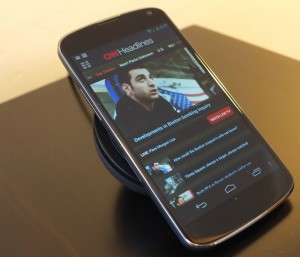
  • I cannot recommend Nexus 4 Wireless Charger [review]

    Gadget geeks love their toys, the more sci-fi the better. Several manufacturers offer wireless charging solutions, Google and LG among them — for Nexus 4. The idea is simple: Rather than plug in the device, you rest it on something else connected to electricity. My question: If the phone lays down to charge anyway, why not just plug in and save, in this instance, $59.99 before tax and shipping?

    I paid Google Play just that in a moment of weakness, and later regret. Don’t bother, and that’s really good advice. The Nexus 4 Wireless Charger is more than a wasteful, redundant accessory. The design is fundamentally flawed, where form goes before function to ruin. If you read no further, take away this: Save your money for something else.

    Charge Me Up

    Inductive charging is a fad that serves only one purpose: To con you to spend more money on needless accessories. You slap down the phone on a charger, which juices the battery in Stargate Universe-like fashion. What sets apart Nexus 4’s add-on apart from others is the half-orb shape, utility and unwanted function as dust-mop.

    Using the wireless charger is easy enough. You plug the USB cord into power brick and device, then set Nexus 4 on the half-orb’s surface, which is Post-it note-like sticky. The adhesive is a huge problem, collecting particles like you wouldn’t believe. Cleaning is difficult, since pieces of paper towel or cloth adhere to the surface. Suffice to say that the Nexus 4 Wireless Charger can look quite gross really fast, even when cared for.

    Charging time is about 4 hours, just as the marketing material states. That’s about twice the time my Nexus 4 takes plugged in directly. But I find the adhesive, while sticky enough for dust, isn’t so good for the smartphone, which succumbs to gravity’s pull. Just a little slippage is enough to stop charging. Strangely, in my environs, this problem typically occurs between 60 percent and 80 percent charge. So it’s too common for me to check at 4 hours only to find partial charge and need to wait another hour or two after repositioning the phone.

    For my purposes, and maybe yours, too, the USB cord is too short. I want to place Nexus 4 Wireless Charger high on my desk, but the cord won’t reach the power strip.

    Let Me Down

    The half-orb nicely elevates the screen, so you can see notifications or easily answer calls with wired or wireless headphones. Two problems: Touching the phone can cause enough slippage to stop charging; the phone is otherwise inaccessible, because it can’t be handled. When plugged into the wall, I can check Google+, respond to text messages or go through email — all of which really needs me to pick up the phone. Voice activation is perhaps an alternative, but not something I tried for this review.

    Bottom line: I see too many shortcomings and not enough benefits. The wireless charger’s design — too sticky for dust and not enough for Nexus 4 — is a big problem, which could be remedied by using a flat surface and no adhesive. Then there is the inductive-charging concept. Connection to electricity is still required. You pass off the device to the wireless charger.

    How wireless is it, really? Inductive charging requires contact — surface to surface. Perhaps in the future there will be real wireless charging, and that has huge potential benefits. But that’s not the tech LG and Google offer.

    Longer charging time is another needless trade-off. Shouldn’t you want to juice up as fast as possible?

    I cannot recommend Nexus 4 Wireless Charger. I wasted $59.99, so you don’t have to.

    Photo Credits: Joe Wilcox

  • More fun facts about AWS usage, this time from Cloudyn

    Last week it was RightScale, now it’s Cloudyn eager to share its new data about how real customers use Amazon Web Services.

    According to a survey by Cloudyn and The Big Data Group of 450 Cloudyn customers — who all use AWS — here are the main takeaways:

    • Amazon’s EC2 constitutes nearly two-thirds (62 percent) of total AWS spending.
    • More than half of those EC2 users now deploy Reserved Instances as part of their deployment.
    • On-demand pricing remains the number one choice for most users — it sucks up 71 percent of all their EC2 spending.
    • The S3 Simple Storage Service is still the most popular storage option, although Glacier, the cheaper archival storage choice, is gaining momentum.
    • The largest constituency among the Cloudyn/AWS users are those who spend less than $50,000 a year on AWS, but they account for just 4 percent of total AWS spending.
    • Just 4 percent of the customers spend more than $1 million a year on AWS, accounting for 52 percent of total spending.
    • Customers who spend less than $50K per year make up the largest group of AWS users, yet account for only 4 percent of total spend.

    cloudynstats

    Cloudyn is one of a half dozen or so startups that have made tracking, monitoring and managing AWS infrastructure their business. Competitors include Cloudability, Newvem and RightScale. And all of them are eager to prove that they can save their customers the most money by guiding their AWS deployment choices. Of course AWS itself is not standing still, building more granular monitoring and management options — including Trusted Advisor –  over time.

    cloudyn2

    Related research and analysis from GigaOM Pro:
    Subscriber content. Sign up for a free trial.