Bing announced Bing Offers today. This is a searchable collection of local deals on the web, aggregated from a “broad” set of partners.
Sound familiar? That’s probably because they launched Bing Deals two years ago, another deals aggregator. Apparently that didn’t work because these days that just redirects to Bing.
So now Bing is at it again with Bing Offers.
“Bing Offers brings together popular deals from across the web in one convenient place, creating a simple way for people to discover and take advantage of great local deals,” a Bing spokesperson tells WebProNews. “Whether looking for a new restaurant to try or a much needed spa treatment, consumers can use Bing Offers to search and filter one of the largest collections of local deals from leading providers. Additionally, Bing Offers is optimized for tablets, mobile and PCs, so people can find great deals no matter what device they use.”
The features as described by Bing:
All your favorite deals in one place: You no longer need to browse through different websites, manage multiple sign-ups or sift-through your inbox. Bing Offers aggregates popular deals across the US to help you discover great deals at the right time and place.
Quickly find the deals you are looking for:Search for your favorite deals by using any business name, category or keyword. Not looking for a specific deal? Then filter out irrelevant offers by location or category including: food, activities, health & fitness, beauty, travel, retail & services.
Available on any device: The Bing Offers experience works seamlessly across tablets, mobile devices, and PCs, so you can use access great deals regardless of where you are.
YouTube is peppered with covers of the classic Radiohead song “Karma Police” off their masterpiece album OK Computer. And it should be – it’s an incredible song. But I guarantee you’ve never heard that song like this before.
The amazing cover comes from Tel-Aviv-based Rotem Shefy (vocals) and Leat Sabbah (cello). They first recorded the song last year, and then launched a Kickstarter project, which is why you see the nicely produced video below.
Assured Labor said it raised $5.5 million in a round led by Capital Indigo and joined by existing investors Great Oaks Venture Capital, Nexus Venture Partners, Kima Ventures, Enzyme Venture Capital, Fabrice Grinda and Jose Marin. The mobile recruitment company said the money will allow it to expand engineering and sales staff to handle emerging markets demand.
PRESS RELEASE
ASSURED LABOR CLOSES $5.5 MILLION FUNDING ROUND LED BY CAPITAL INDIGO
World leader in mobile recruitment poised to accelerate growth in emerging markets
NEW YORK – April 25, 2013 – Assured Labor (www.assuredlabor.com), the world leader in mobile recruitment, announced today that the company has closed a $5.5 million funding round led by Capital Indigo. Capital Indigo joins existing investors including, Great Oaks Venture Capital, Nexus Venture Partners, Kima Ventures, Enzyme Venture Capital, Fabrice Grinda and Jose Marin.
“Our digital recruitment platform is taking off in Mexico and Brazil and we couldn’t be happier to add such an accomplished partner,” said David Reich, Founder and CEO of Assured Labor. “With over 1,000 employers joining Assured Labor each month, this investment will enable us to meet that demand by growing our engineering and sales teams while solidifying our market leadership position in the mid-to-low wage segment.”
“The recruitment market in Latin America is ripe for disruption and nothing comes close to Assured Labor’s offering for recruiting lower wage job seekers. We look forward to supporting the company’s growth in Latin America and beyond,” said Bernardo Paashe, Managing Partner, Capital Indigo, who will be joining Assured Labor’s Board of Directors along with Everardo Camacho, Managing Partner, Capital Indigo.
Assured Labor’s brands in Mexico (www.EmpleoListo.com.mx) and Brazil (www.TrabalhoJa.com.br) have grown to become Latin America’s premier services for recruiting mid-to-low wage full-time employees. By leveraging the Internet, SMS, Voice User Interface and Social Media, Assured Labor enables companies to rapidly identify and reach the best job seekers in their area. With 500,000 registered job seekers and 16,000 employers, Assured Labor has become the region’s top destination for mid-to-low wage digital recruitment.
About Assured Labor
Assured Labor revolutionizes hiring in emerging markets. The service leverages the power of mobile phones and the Internet to rapidly connect employers with the best mid-to-low wage candidates in their area. Founded at MIT, Assured Labor’s disruptive platform is optimized for the realities of the emerging markets where three of four Internet users access the Web sporadically and nearly everyone has a cell phone. The company’s Latin American brands, EmpleoListo & TrabalhoJá, are currently operating in Mexico and Brazil. For more information please visit www.AssuredLabor.com,www.EmpleoListo.com.mx and www.TrabalhoJa.com.br.
About Capital Indigo
Capital Indigo is a Private Equity firm based in Mexico City that is focused on mid-market private equity and mezzanine debt investments in Latin America. As an early-mover in the region’s Private Equity markets, Capital Indigo’s “Fund Indigo 1” invests in high-growth mid-sized enterprises. The fund’s managers share over 30 years of operational, investment and startup experience in Latin America and the United States and play an active role in each of their investments. More information is available at: www.capitalindigo.com.
Even if PC sales continue tanking, Windows 8 could get a significant boost in adoption later this year just from eager gamers picking up the next-generation Xbox. Paul Thurrott of WindowsITPro reports that the next-generation Xbox will release in early November and will run on the “core” version of Windows 8 that “suggests a common apps platform or at least one that is similar to that used by Windows 8.” Thurrott speculates that Microsoft could use the common app development platform as a way to “open up this platform to enthusiast developers” and encourage more development of native Xbox apps.
Clint Eastwood hasn’t been in the headlines much since his much-maligned appearance at the RNC last year, but his wife and daughters are still plugging away at their reality show, “Mrs. Eastwood And Company”. However, it may all be too much for Dina, as she’s just entered a rehab facility in Arizona for depression and anxiety.
There’s been some speculation that the Eastwoods are headed for divorce, as they are rarely seen in public together and reportedly acted awkwardly at the recent wedding of Clint’s daughter Alison.
Reps for the stars say the rehab stint is not for substance abuse of any kind, but details now are scarce. The family has had no comment.
Clint Eastwood’s wife has checked into rehab. She must have finally seen her show on E!
Well, I didn’t receive an invite, but based on the many reports from people who did, Nokia will host a new Lumia-outing event May 14 in London. Oh my, that’s the day before Google I/O, where rumored new Nexus smartphone(s) arrive (don’t believe everything you read on the Internet).
Nokia unveiled flagship phone Lumia 920 in September, and May would be pretty good time to announce a followup. Assuming the typical manufacturing and various country certification (think Federal Communications Commission) delays, a new splashy Lumia would get some breathing room post-launches for HTC One and Samsung Galaxy S4, while getting ahead of the next iPhone. During this week’s earnings conference call, Apple CEO Tim Cook said not to expect any new products until autumn.
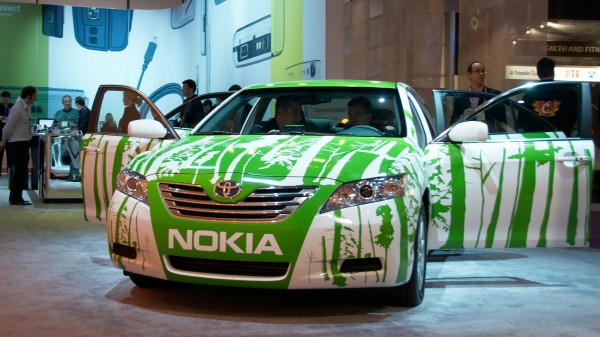
What the geeks all wait for is true PureView, Nokia’s exciting camera tech currently available in the now obsolete (because Symbian is) 808. But that’s anyone’s guess. (Note on the photo, don’t expect a car. I grabbed the image for the Nokia name/logo).
While we all wait for “the next chapter of the Lumia story”, as the invite states, Nokia is Mr. Busybody with more modest handsets.
Yesterday, the Finnish handset maker unveiled feature phone Asha 210. Today, Nokia announced the Lumia 521 for T-Mobile, which debuts on HSN.com and HSN mobile this weekend for $149.95 (price includes car charger and screen protector). Microsoft and select T-Mobile retailers start selling the smartphone on May 11.
Features include: 1GHz Qualcomm 82270 dual-core processor; 4-inch screen (800 by 400 resolution); 512MB RAM; 8GB storage, expandable to 64GB with microSD card; 5-megapixel rear-facing camera; 720p video recording (30 frames per second); HSPA+; WiFi N/E; GPS; and Windows Phone 8.
Francoise Brougher, the former chief small business salesperson for Google has joined Square, taking over the quickly growing mobile payment company’s Business Lead role.
What’s a business lead? We’re a bit confused by the term as well, but according to Square, Brougher will oversee Square’s “growth operations including revenue products, international expansion, customer support, and partnerships.” That’s a big plate.
Brougher was most recently Google’s VP of SMB Global Sales and Operations, where she managed the team in charge of acquiring, growing, and retaining small business advertisers. That experience should serve Brougher well as Square, since a good chunk of its mobile payments revenues comes from 3 million small business owners.
As for international expansion, Brougher has a lot of ground to cover. Outside of the U.S., Square so far has only launched in Canada.
A year ago today, the TED-Ed website launched. Since then, the site has published 175 original animated lessons, ranging from “How simple ideas lead to scientific discoveries“ to “Insults by Shakespeare,” with visits from more than 2,750,000 people. Teachers have used the site to create roughly 2,000 lessons per month around YouTube videos. (Here’s how.)
For an adorable look at more stats from TED-Ed’s first year, head to the TED-Ed blog. Below, we celebrate TED-Ed’s first birthday with our 10 favorite characters from TED-Ed lessons so far.
How is chemistry like dating? Educator Aaron Sams explains in the lesson “How to speed up chemical reactions (and get a date).” Meet Harriet, the red-headed scientist who, in high school, had a run-in with a crush in the hallway that led to a prom date. The process was strangely similar to the way particles move.
In the incredible lesson “Inside a cartoonist’s world,” from The New Yorker cartoonist Liza Donnelly, this character shows the process of how cartoonists work. They are the playwright, director, stage designer, choreographer, and costume designer of these miniature, drawn plays.
Mmmm, pizza. It’s delicious — but also messy to eat. In the lesson “Pizza physics (New York-style)” this animated slice talks you through how to eat pizza neatly, while teaching you the mathematical and physics principals involved in the act.
This green guy represents big unknown numbers — like the number of piano tuners in the city of Chicago and the number of M&Ms in a gigantic bin. In this lesson from educator Michael Mitchell, “A clever way to estimate enormous numbers,” learn a very cool way to estimate using the power of ten.
Affectionately dubbed “yarn lady,” this character appears in the lesson “How do cancer cells behave differently from healthy ones?” Why the name? Because her organs and body are literally made of yarn – some crocheted, some knitted, some simply balled. Find out why the animators chose yarn (and seeds and candy) to bring this lesson to life in this how-to blog post.
John Lloyd gave a classic TED Talk back in 2009 about the many things in the universe that are invisible. The talk got a magical, animated TED-Ed redux this year, in the lesson “What’s invisible? More than you think.” In it, Lloyd becomes a very knowledgeable park ranger walking you through the wonder of the world.
These adorable line drawings are an animated renderings of educator Aaron Reedy and his wife, who was pregnant at the time. In the lesson “Sex determination. More complicated than you thought,” Reedy outlines the surprising factors that helped determine whether he’d have a daughter or a son.
All heroes — from Harry Potter to Katniss Everdeen — are related to this generic hero and his journey. He appears in the lesson “What makes a hero?” in which educator Matthew Winkler walks you through the characteristics and life paths that all heroes have in common.
How did the Earth, not to mention all of space, begin? In this lesson from CERN physicist Tom Whyntie, “The beginning of the universe, for beginners,” we find out. The lesson stars a talking sun, but the highlight for us is the appearance of Edwin Hubble, the scientist who first noticed that our universe is expanding — evidence of the big bang.
We love this fireman and dog from the lesson “Capturing authentic narratives,” from Michele Weldon. The lesson lays out the basics of good journalism — asking interesting questions while interviewing sources from official channels, sources who were affected by the story and sources who have interesting background information.
For senior marketers, it is a very humbling thought. What if your ideas, your thoughts and even your experience as a trained marketing professional didn’t amount to a hill of beans in terms of the brand’s actual advertising performance? What if everything you have been bringing to the table could be debunked with a simple multivariate testing regimen? What if, in short, what your company really needs is not a marketer, but a data scientist?
Let’s take a step back. Don Draper, the lead character on the show Mad Men, has an acutely profound skill in being able to turn a brand insight into an emotion that can bring you to tears. Watch him spin and weave a tale about the profound power that Kodak’s slide carousel could have on the world.
It’s not just the emotional resonance of his pitch and delivery that touches us, but the core insight that he is able to uncover and express. Don Draper is, obviously, a fictitious character but he’s the perfect composite of hundreds (if not thousands) of advertising legends who have roamed our earth. Great advertising is magic. It does more than sell; it tells a story that captivates our imaginations and connects us to a brand — and to others who share in the brand sentiment. It is art for money’s sake. It’s hard to argue that any computer or technology can create that kind of emotional connection or weave that kind of story.
Traditional advertisers will tell you that not much has changed. The job — day in and day out — remains the same: create a compelling enough message that your customers can’t ignore you, generate advertising that creates attention and interest and closes the sale. Rinse and repeat. What we can’t deny is that technology is now penetrating the marketing industry like never before. You could practically hear the Chief Marketing Officer’s bodies hitting the floor in March of last year when the research firm Gartner reported that by 2017, a Chief Marketing Office will be spending more on IT than the Chief Information Officer. It seems almost unfathomable that the marketers will need more technology that the actual technology department, but when you scratch beneath the surface, it all starts to crystallize.
Emerging trends show some fascinating moves in advertising that together paint a powerful and picture as to just how much advertising has changed and how much more change is about to occur.
First, younger digital natives, are becoming increasingly comfortable sharing their personal data online so long as they are deriving a value from the exchange. In a world where many consumers are screaming about their privacy being breached by every website that tracks their clicks, young people seem more-than-fine when it comes to giving up personal information — so long as they get something out it.
Next up, we’re seeing exponential growth in programmatic buying, where automation allows ads and the platforms that display them to come together efficiently, in response to customer behavior, without human intervention. The numbers don’t lie, according to this eMarketer news item: 70% of media buyers and publishers are doing some kind of programmatic buying and 77% of those doing it plan on increasing their spend in the next year. Moreover, the same survey also states that a good chunk of these media entities are thinking about moving entirely to programmatic trading and stopping their direct relationships with publishers.
Third, the challenges of retargeting (the ability to serve advertising that is related to a user’s past online experience — like showing them an ad for a specific shoe that they were looking at on Zappos but never bought) are coming to light. As exciting as that nascent advertising technology is, many agencies and publishers are not able to fully harness the potential of it to make it work effectively… yet. Still, millions of dollars are being poured into this quickly-maturing advertising opportunity, and nobody doubts the future potential that is upon us in terms of delivering measurable advertising without much human (or creative) intervention.
It’s somewhat disheartening to see the lack of enthusiasm that senior marketers have for all of this evolution (or revolution — depending on who you ask). Too many in this industry think their job is to get their ads on the hot new sitcom, put their logo on the baseball stadium, and take clients out to three-martini lunches.
At the Monetate Agility Summit 2013 in Philadelphia at the beginning of April, I shared the stage with famed marketing optimization expert (and friend), Bryan Eisenberg (co-author of bestselling books like Waiting For Your Cat To Bark? and Always Be Testing). He concludes that too many marketers let their ego get in the way. It’s a sobering indictment. In a world where testing creative, landing pages and more can be done in a simple and measurable way, Eisenberg argues that the number one reason senior marketers don’t buy into the data and technology is because they’re worried that the results will prove their intuition wrong. And, that more often than not, those intuitions are wrong.
This weaves a complex story: We have consumers increasingly willing to share personal data, the technology to create hundreds of fast and easy to execute tests, and additional technology to manage the complexity of the media buy behind it and yet we still want to be Don Draper.
Our thinking as marketers needs to shift from “Mad Men” to “math men.” This doesn’t mean that creativity, insight, and storytelling die. It does mean that we can use technology to make us better at how that our human-crafted messages convert to sales.
We marketers have allowed our egos get in the way for too long because we had little else to go by. Now, the excuses are getting thinner and weaker. It turns out that data, programmatic buying, retargeting and more could well usher in a world where advertising delivers on its original promise: to drive more sales and get less expensive as it learns. Now, if only we can let our egos get out of the way.
One big reason Apple’s share prices have crashed over the past few months has been the perception that the company’s period of remarkable growth has ended and that it has now become a typical slow-growing tech behemoth. The best evidence of this has been the significant decline of Apple’s gross margins, which peaked at close to 50% in late 2011 but have now shrunk to 37.5% in the company’s most recent quarter. The big questions, of course, are why have Apple’s gross margins been shrinking and does the company have any hope of returning to its 2011 glory days?
We’re entering the home stretch for GigaOM’s annual Structure event which kicks off in San Francisco June 19. To whet your appetite, we’d like to introduce you to the six really cool startups chosen as this year’s Structure Launchpad finalists, culled from more than 50 candidates.
Structure 2012: Launchpad: Jason Hoffman – Founder and CTO, Joyent, Matt Howard – General Partner, Norwest Venture Partners, Aaref Hilaly – Partner, Sequoia Capital
And the finalists are:
28msec:With offices in Palo Alto and Zurich, this startup aims to streamline the task of writing complex queries against your MongoDB database of choice.
Appscale Systems: This open-source implementation of Google App Engine (GAE) can run on a developer’s laptop, on Amazon Web Services or the Google Compute Engine.
Factor.io; This service lets developers knit together their tools of choice — for source control system, for PaaS, for testing — into a coherent, flexible workflow using an “if-this-then-that” interface.
Metrica: Metrica’s service lets folks use SQL queries against their MongoDB data, cutting the time it takes to create histograms, time series, and scatterplots and other data visualizations.
Saltstack: This startup tool aims to speed up devops tasks including cloud orchestration or in-house server automation and infrastructure management.
Synapsify: The company’s text search and analytics capability can help companies find the most important and relevant content for their needs.
Structure is GigaOM’s flagship conference that focuses on the future of cloud computing and internet infrastructure. For the past seven years, it’s convened the most influential speakers, buyers and vendors for two days of discussion, reporting, and debate.
Startups less than 12 months old with innovative technologies in cloud computing, internet infrastructure, or big data applications were eligible to apply for LaunchPad. The finalists will present their business plans on stage at the Structure conference in San Francisco, June 19-20. Follow @GigaOM on Twitter (#structureconf) to keep apprised of new speakers and sessions.
The New York Times Company remains focused on the long game even as digital subscription growth flattens and advertising shows ongoing weakness. On a Thursday earnings call, executives described new products that it hopes will bring in multiple revenue streams, but cautioned that they would not yield a profit in the near future.
The new offerings will include digital subscriptions that cover niche topics like food and travel for a lower price than the standard subscription. The company is also planning to expand its conference business, develop games and bolster its crossword franchise.
On the call, analysts pressed for details about the new low-priced subscriptions and asked if they would cannibalize the company’s existing digital offerings — which are regarded as essential to the Times‘ future but whose growth has stalled. Times VP Denise Warren said the company had “identified many people interested in a lower price point” but that cannibalization was not an issue because these people “come in at a differeent part on the demand curve.”
CEO Mark Thompson did not provide any price details, but suggested the company could be in a position to charge more to devoted digital subscribers who enjoy getting full-access entirety of the Times’ content. He added that the new niche products could bring in revenue this year but that it “will take till late 2014″ for the new initiatives to result in an operating profit.
For the near future, the Times continues to face serious financial headwinds. The company has recently relied on major increases in its print subscriptions to increase revenue, but may be unable to do so much more. Meanwhile, advertising remains bleak (digital dropped 4 percent last quarter) with executives on the call offering only tepid explanations — like a weak Oscar race — when analysts questioned the Times’ ad sales strategy. The strategy may get an overhaul as when the company fills a new position to head up its ad sales.
An analyst, citing the Times’ large cash reserves, asked if the company had an intention to go private. Thompson, who has just completed his first full quarter as CEO, said no. Executives also said the company would continue to suspend its dividend which provides income to the families that own the Times.
President Barack Obama stands with former Presidents George W. Bush, Bill Clinton, George H.W. Bush, and Jimmy Carter, at the opening of the George W. Bush Presidential Library and Museum in Dallas, Tex., April 25, 2013. Former First Ladies Laura Bush, left, and Hillary Rodham Clinton, right, are also pictured.
(Official White House Photo by Lawrence Jackson)
President and Mrs. Obama were in Dallas today for the dedication of the George W. Bush Presidential Library. It was an historic occasion that brought all the living former Presidents — Jimmy Carter, George H.W. Bush, Bill Clinton and George W. Bush — together for the first time since right before President Obama took office in 2009. They were joined by former First Ladies Roslyn Carter, Barbara Bush, Hillary Clinton (also a former Secretary of State, as President Obama noted) and Laura Bush.
In his remarks, President Obama highlighted the special bond that connects our past presidents, and said that despite disagreement on matters of foreign policy, all of the men on the stage with him shared "a profound respect and reverence for the men and women of our military and their families. And we are united in our determination to comfort the families of the fallen and to care for those who wear the uniform of the United States."
Deutsche Beteiligungs AG (DBAG) of Frankfurt, Germany, and its managed private equity fund, the DBAG Expansion Capital Fund, is investing an undisclosed amount of capital in inexio Informationstechnologie und Telekommunikation KGaA (inexio), a Saarlouis-based broadband provider that services southern Germany.
PRESS RELEASE:
Frankfurt am Main, 25 April 2013. Deutsche Beteiligungs AG (DBAG) and its managed private equity fund, the DBAG Expansion Capital Fund, will invest in inexio Informationstechnologie und Telekommunikation KGaA (inexio), a strongly growing provider of broadband connections. The fresh capital will be geared to support the company’s further growth to become one of the largest providers of broadband connections in rural areas of southern Germany in the coming years. Currently, inexio, which is headquartered in Saarlouis, serves some 1,800 business clients and approximately 20,000 private customers primarily in the German states of Rhineland-Palatinate and Saarland. inexio has continually enlarged its customer base by investing in fibre-optic networks – that is, in a sustainably accessible and rapidly expanding infrastructure that will secure an attractive source of income in the future.
The company focuses on rural areas large parts of which are still without speedy Internet access. At the same time, Internet use is growing continually; particularly industrial businesses are ever more dependent on Internet connections that enable high-speed data transfer. Mayors and district authorities in rural areas therefore often endeavour to bring advanced communication services to their communities or regions, and inexio is one of the strong providers in this market environment in Germany.
The equity investment by DBAG and its co-investment fund will accelerate inexio’s growth. The investment will increase the company’s equity ratio to more than 30 percent and thereby create access to further financing to fund expansion into additional communities in southern Germany. DBAG and the Fund will subscribe to a capital increase for ten percent of the shares and will, moreover, provide profit participation capital. A total of 10.6 million euros will be invested, of which 4.4 million euros will be provided by DBAG. The remaining shares are, for the most part, held by the company founders, who also serve as members of inexio’s management board.
inexio (www.inexio.net) is growing strongly. Founded in 2007, the company recorded total output of about 20 million euros in its 2011/2012 financial year (30 September). It is expected to rise to some 30 million euros this current financial year, and further strong growth is forecast. The company’s expansion is based on the attractiveness of its offering, which differs from that of other competitors in rural regions. Unlike other mobile network providers as well as providers whose services are based on traditional (copper cable) networks of Deutsche Telekom, inexio supplies high-speed Internet access and landline telephony over a fibre-optic network. This premium offering gives inexio a unique positioning regionally.
“Fibre-optic networks as a medium for high-speed data transmission will continue to gain in significance,” said Torsten Grede, Spokesman of the Board of Management of Deutsche Beteiligungs AG, on signing the investment agreement. “With inexio, we have invested in a strong provider operating in a growth market that can be tapped even faster with improved capital resources. We are delighted to be able to support a highly competent and motivated management team in an important stage of the company’s growth.”
Deutsche Beteiligungs AG (www.deutsche-beteiligung.de) is a leading publicly listed private equity company. With a track record of nearly 50 years, it is the oldest private equity firm in Germany. Deutsche Beteiligungs AG focuses on market-leading mid-sized enterprises in Germany and neighbouring European countries. It invests from its own balance sheet and from the assets of co-investment funds. Currently, the company has approximately 1.3 billion euros under management.
As more developers are receiving their pair of Google Glass, the tinkering with the device is heating up. One developer found a very interesting easter egg within Glass itself, which introduces you to the entire Glass team.
Settings -> Device info -> View licenses -> Tap the touchpad 9 times -> Tap Meet Team
Here’s a video demo, including the neat sounds that happen as you keep tapping:
The neat part about the photo is that you can see the entire 360-degree panoramic image by moving your head around. This was hard to show in the MyGlass screencast, since it lags a little bit. We’ve learned that Mike LeBeau, Senior Software Engineer for Google X, is the one who dropped the hidden gem into Glass’ software. He’s appeared on TechCrunch before in a <a target="_blank" href="“>hilarious Google blooper reel.
The team photo has Google co-founder, Sergey Brin, front and center.
I’m sure that more of these easter eggs will pop up over time, but this one is particularly cool since it’s the first time that I’ve seen a panoramic image on the device since I started using it. This functionality could be something that isn’t exposed in the Mirror API as of yet, but once it is, it’ll be a fun one.
Ubiquitous, gesture-controlled interfaces are one step closer to reality, thanks to a new system developed at Carnegie Mellon University. WorldKit lets you create interactive apps on any surface just by waving your hand. The project was announced by the university on Thursday.
Instead of being tethered to your hardware, WorldKit is designed to make access to computing instant and mobile by making the world your touchscreen. Right now, the system involves a ceiling-mounted camera and projector that record hand movements and then project onto the surface of your choice. Some potential uses include TV remote controls, which can be accessed by rubbing the arm of a sofa, or calendars that can be swiped onto doors.
With projectors and depth-sensing cameras (the current system uses a Kinect) getting smaller, the researchers envision a system like WorldKit could eventually fit into a light bulb. Any room thus equipped could become a smart environment, where objects and walls become display surfaces. One member of the research team, Chris Harrison, previously worked on the Skinput device that allows users to turn their own arms into touch interfaces.
In the future, users should be able to design their own interfaces with WorldKit. The system currently allows for things like buttons, multitouch drawing (akin to a whiteboard), and counting the number of object within an interaction “bubble.” The existing prototype still has limited resolution and input dimensions, but hardware advances and future research could allow voice commands or even interaction in free space rather than on surfaces. The CMU team will be presenting their work at CHI2013 on April 30.
Image via Chris Harrison/Carnegie Mellon University
BGR reviewed the BlackBerry Q10 on Tuesday night, and we said it is a great handset for diehard BlackBerry fans desperate for a QWERTY phone. For everyone else, however, we thought the Z10 was a much more impressive phone for people looking to buy a BlackBerry. BlackBerry shared preliminary launch details for the Q10 a few hours before reviews were published, and it said the phone is expected to begin rolling out in the U.S. toward the end of May — priced at $250. Carriers determine their own prices so nothing is set in stone, but at $250 the Q10 will be more expensive than the Samsung Galaxy S4, Apple’s iPhone 5, the HTC One, Nokia’s Lumia 920 and many other high-end smartphones. A number of pundits have called BlackBerry crazy for pricing the phone so high, but we want to know what you think, BlackBerry fans: is the Q10 worth $250? Vote in our poll below and let us know what you think.
If you didn’t have your finger hovering over the “purchase” button for WWDC tickets right at 10 a.m. PT this morning, you probably don’t have a ticket. The tickets to Apple’s annual developers conference in San Francisco sold out in less than five minutes. It’s the fastest the tickets have sold out yet.
The conference runs from June 10 through June 14 this year and the tickets for attendees were not cheap: $1,599. But if you couldn’t afford the tickets or weren’t quick enough, Apple is making the conference a bit more accessible this year.
Instead of waiting weeks after the conference is over, Apple says it will be posting the training session videos online as the conference is going on.
However, as usual, they will be only accessible by registered iOS and Mac developers.
Stardock Software has released ModernMix 1.05, the first major update to its paid-for Windows 8 tool for running full-screen apps in their own window within the confines of the Windows 8 desktop.
Version 1.05 adds background sound support for apps such as Netflix that don’t explicitly support it, meaning users don’t need to focus on the window in order to hear that app’s audio output. The new feature is joined by a preference that allows this support to be switched off if it’s not wanted.
Other changes include making it easier to configure individual app behavior via ModernMix’s own configuration screen. Users can now double-click or right-click an app’s entry under App settings to configure its default behaviour, from whether it opens full-screen (a new setting in version 1.05), minimised or windowed to creating a convenient shortcut to the app on the desktop itself.
Version 1.05 now initiates a “force create” action to ensure the desktop shortcut is created, even if the app has never previously been run. Sadly, on our test machine the desktop shortcuts failed to work, launching the ModernMix configuration screen rather than the app itself — however, apps worked flawlessly using the App shortcuts found on our favoured Start button replacement tool, Classic Shell.
In addition, the App settings page now lists all installed Modern apps, while ModernMix now alerts users when first running the program to the top-right corner overlay, which allows users to switch between full-screen and windowed mode.
Bug fixes for version 1.05 include one that ignored ModernMix’s “Return to the Windows 8 menu” setting when apps were dragged to close them. Another resolution ensures all apps, not those that have been run at least once, are named up correctly in the App settings screen too.
A fix has also been implemented for Netflix playback when the windows is inactive on a secondary display, while the main code has been tweaked to detect if the app launch has been made from the Windows 8 menu or elsewhere to ensure ModernMix correctly implements whatever user-defined options have been set.
ModernMix 1.05 is available now as a free 30-day trial download for PCs running Windows 8 (an email address is required for activating the trial). The full version can be purchased for $4.99.