Blog

  • MoneyPlus Appoints Commercial Director

    UK-based debt management company MoneyPlus Group has appointed Richard Elgott as commercial director. The company is backed by Palatine Private Equity.

    PRESS RELEASE

    Debt management company MoneyPlus Group (MPG), backed by Palatine Private Equity, has appointed Richard Elgott as Commercial Director.

    Elgott has spent the past seven years working in professional services, most recently at Deloitte and, prior to that, KPMG. He is an accountant by profession and has worked in corporate finance and transaction services providing specialist operational advice on strategy, integration and disposals.

    Elgott has significant experience across a range of industry sectors including telecoms, oil and gas, consumer goods and energy. He has also worked with financial services clients including HSBC, Royal Bank of Scotland, ING and Virgin Money. Prior to that he worked in industry in roles for Virgin Media and Littlewoods Pools.
    MPG offers a range of services to improve consumers’ financial situations, including debt management plans and Individual Voluntary Arrangements. It is also extending its offering into other areas, such as insurance and legal services, under the MoneyPlusbrand.
    Palatine originally backed the management buyout of MPG in June 2011. Since then MPG has completed sixacquisitions and employs more than 190 people at its offices in Manchester city centre.
    Chris Davis, Chief Executive Officer at MoneyPlus Group, said: “I am delighted that Richard has decided to join MoneyPlus. This senior appointment underlines our commitment to the future growth of the company. Richard brings with him a wealth of experience and expertise in the financial services sector which will be put to good use by way of our continued expansion in the debt advice sector and in other financial areas in general.”

    Richard Elgott, Commercial Director at MoneyPlus Group, said: “I am delighted to have joined MoneyPlus Group and look forward to working with Chris and his team to deliver against the growth strategy and desire to create an industry leading organisation, both in terms of the range of services we offer and the way in which we provide a quality service to our consumers.”

    ENDS

    Press contact: Chris Hopper / Liam Buckley @ MC2 (0161 236 1352)

    Notes to editors

    About Palatine Private Equity:
    Palatine Private Equity (“Palatine”) was originally known as Zeus Private Equity before rebranding in January 2011. The firm was formed in 2005 by Gary Tipper, Ed Fazakerley and Tony Dickin and closed its maiden fund in December 2007 at £100m.

    From offices in Manchester, London and Bristol, Palatine seeks to invest in established UK companies with enterprise values of up to £50m. The investment team looks at opportunities and provides funding for MBOs, buy and build strategies, acquisition finance, equity release and restructuring. Palatine completed its first successful exit in September 2010, generating a 4.5x return with the secondary buyout of telecommunications provider XLN Telecom, after three consecutive years of profit growth. Palatine’s portfolio currently comprises:

    – Hallmark Hotels: a UK regional 4* hotel chain (Buy and build)
    – MJ Quinn: an infrastructure services business providing electrical, mechanical and fire protection services to the London Underground and rail sector (Buyout)
    – Electranet: a specialist networking services supplier, primarily to public sector organisations (Buyout)
    – MoneyPlus Group: a provider of consumer financial services including Debt Management Plans, IVAs and other financial solutions (Buy and build)
    – Wealth at Work: a provider of financial education and employee wealth management services in the workplace (Buy andbuild)
    – Selection Services: a provider of IT services, delivering a broad array of managed services, hosting and cloud solutions along with bespoke projects and strategic advice (Buy and Build)
    – Chase Templeton: a the leading private medical insurance intermediary (Buy and Build)
    – Playnation: the leading supplier of amusement and entertainment machines and supplies to holiday parks, motorway services, bowling centres and airports (Buyout)

    Liam Buckley

    0161 236 1352 [email protected]

    The post MoneyPlus Appoints Commercial Director appeared first on peHUB.

  • Microsoft continues its childish attacks on Google

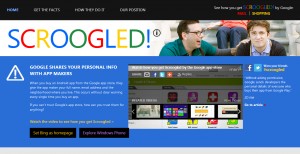
    Microsoft’s Scroogled campaign, in which the technology giant attacks Google for various perceived transgressions, has now turned its sights to Android, or more specifically the Google Play store.

    Past Scroogled “attacks” (aka petty whining) have taken Google to task for using a pay-to-rank practice in Google Shopping, and reading emails in Gmail. The newest complaint is that Google shares your personal info with app makers.

    Or more specifically:

    When you buy an Android app from the Google app store, they give the app maker your full name, email address and the neighborhood where you live. This occurs without clear warning every single time you buy an app.

    If you can’t trust Google’s app store, how can you trust them for anything?

    Microsoft then helpfully provides a couple of videos explaining how this happens (watch them below).

    If you were unaware that Google passes on your information to app makers, and you’re concerned about this, then you’ll probably be thankful to Microsoft for pointing it out. Even though there’s actually nothing particularly nefarious about it. When you buy something from pretty much anywhere on the internet, the seller gets your information. That’s how things work. If you don’t trust a retailer — or an app maker — don’t buy something from them.

    The problem I personally have with the Scroogled campaign is I (like most people) don’t view Microsoft as the people’s champion. It’s not warning consumers, it’s trying to get them to switch from Google to Microsoft (something I’ve actually done, but out of interest rather than any concern about what Google’s doing with my information).

    If Microsoft truly had our best interests at heart, then it would be providing useful advice on what to do to safeguard privacy — like setting up a second Google account purely for purchasing apps. Instead, what it does is say “Unlike Google, Windows Phone Store doesn’t share your personal information with app makers” and then helpfully provides a button to “Explore Windows Phone”.

    Microsoft should, in the interest of full transparency, also perhaps add “Unlike Google, Windows Phone Store doesn’t offer anywhere near the breadth and quality of apps”, but obviously it doesn’t say that because Scroogled isn’t about truth, it’s about trying to snare customers through fear, uncertainty and doubt — instead of wooing them with great products, as a company of Microsoft’s size and standing should be doing.

    The Scroogled campaign continues to be a sad and embarrassing waste of Microsoft’s time and money and really it’s time it was laid to rest now.

    Photo Credit: Denis Belyaevskiy/Shutterstock

  • Viber for BlackBerry finally finds its voice

    The Skype and WhatsApp competitor Viber has at last released a beta version for BlackBerry OS that features voice calling, Viber for BlackBerry 2.4.

    In a statement on Wednesday, the Cyprus-based startup said the new version of its BlackBerry app, which was previewed in January, included free calls to other Viber users for those on BlackBerry OS5 and OS7, as well as “performance improvements” for OS5 and various other bug fixes. However, BlackBerry 10 – the make-or-break latest version of the platform – is not supported.

    “BlackBerry is one of the most important markets for us and represents our third largest user base,” Viber CEO Talmon Marco said. “We are thrilled to bring this community free voice calling, letting them communicate freely with all of their important contacts across multiple platforms.”

    The release means that, over two years after Viber first hit the scene, the only remaining major platforms on which Viber is a voiceless, text-and-photo-only service are Nokia Series 40 and Samsung’s Bada OS. The omission of BlackBerry 10 support isn’t as crazy as it might sound — most BlackBerry users will still be on older versions of the platform, and the company is still launching new BlackBerry OS7 devices in emerging markets.

    Related research and analysis from GigaOM Pro:
    Subscriber content. Sign up for a free trial.


  • Reuters – Foundation Capital Raises Seventh Fund

    Foundation Capital has unveiled its seventh fund, a $282 million pool of money that the venture firm plans on investing in early-stage startups, according to VentureBeat, writes Reuters. Menlo Park, Calif.-based Foundation Capital primarily invests in early stage companies and plans to focus this current fund on consumer technology, information technology, and clean technology.

    Reuters – Foundation Capital announced its seventh fund today, a $282 million pool of money that the venture firm plans on investing in early-stage startups.

    Menlo Park, Calif.-based Foundation Capital has handled a total of $2.7 billion since it was first founded 17 years ago. This firm primarily invests in early-stage companies and plans to focus this current fund on consumer technology, information technology, and clean technology.

    Eight of the venture firm’s partners will invest from this funding, including Charles Moldow and Ashmeet Sidana who we chatted with last year about the state of venture capital and then unique relationship VCs have with each other. Moldow refers to it as “coopatition” a little cooperation and little competition mixed in together.

    Some of the most well-known companies that Foundation Capital has invested in includes Chegg, Ebates, and Netflix.

    The post Reuters – Foundation Capital Raises Seventh Fund appeared first on peHUB.

  • Reuters – KKR Hires Hirano from AlixPartners as Japan Head

    US private equity firm KKR has hired Hirofumi Hirano from AlixPartners Asia to serve as its chief executive officer of KKR Japan as it expands its presence in the country, writes Reuters. Shusaku Minoda, the current chief executive of the local unit, will become chairman of KKR Japan, KKR said in a statement.

    Reuters – U.S private equity firm KKR & Co LP said on Wednesday it has hired Hirofumi Hirano from AlixPartners Asia LLC to serve as its chief executive officer of KKR Japan as it expands its presence in the country.

    Shusaku Minoda, the current chief executive of the local unit, will become chairman of KKR Japan, KKR said in a statement. Both appointments take effect on April 15.

    Hirano served as head of Asia’s financial service industry at AlixPartners, which specializes in corporate turnarounds. Prior to joining AlixPartners, he was chief executive at a merchant banking unit of a Japanese brokerage now known as SMBC Nikko Securities, according to the statement.

    KKR last month added two specialists to its Japan team, increasing its headcount to 12. The firm also last month agreed to sell Intelligence Holdings, a staffing agency it bought in 2010, to a local rival Temp Holdings, after doubling the value of the company.

    KKR also in 2011 made a joint investment with Japanese trading house Itochu Corp in U.S. oil and gas firm Samson Investment Co for more than $7.2 billion.

    The post Reuters – KKR Hires Hirano from AlixPartners as Japan Head appeared first on peHUB.

  • Reuters – Thermo Bids for Life Tech

    Thermo Fisher Scientific made a binding offer for Life Technologies Corp as private equity firms raced to finalize a consortium to take the genetic testing equipment maker private, writes Reuters. Life Tech, with a current market value of more than $11 billion, has become an attractive target due to its strength in advanced diagnostics and gene sequencing and if Thermo Fisher were to prevail, the deal would make it a major player in the genetic sequencing market.

    PRESS RELEASE

    Thermo Fisher Scientific Inc made a binding offer for Life Technologies Corp on Tuesday as private equity firms raced to finalize a consortium to take the genetic testing equipment maker private, several people familiar with the matter said.

    Life Tech, with a current market value of more than $11 billion, has become an attractive target due to its strength in advanced diagnostics and gene sequencing and if Thermo Fisher were to prevail, the deal would make it a major player in the genetic sequencing market.

    It would be also be by far its biggest deal since the $12.8 billion merger in 2006 of Thermo Electron and Fisher Scientific International that created the world’s largest maker of scientific equipment and laboratory instruments.

    Thermo Fisher met a bid deadline on Tuesday but private equity firms working on a joint bid missed it and were working late into the evening to secure the equity required to support an offer, the people said.

    Blackstone Group LP, Carlyle Group LP and Singapore’s state investor Temasek Holdings were in talks with KKR & Co LP about securing the required equity and finalizing a buyout consortium, the people said.

    Life Technologies would likely accept an offer past the bid deadline to keep the process competitive, the people added.

    Thermo Fisher is bidding more than $65 per each Life Tech share, two of the people said. While the exact price could not be learned, Thermo had been considering a bid of $65 to $70 per share, sources said last week.

    The private equity group would likely bid close to $65 per share, two separate people said.

    All the people asked not to be named because details of the auction are not public. Life Technologies, Thermo Fisher, KKR, Blackstone and Carlyle declined to comment while Temasek did not respond to a request for comment.

    Shares of Life Tech ended up 1.3 percent at $66.19 on Tuesday, giving it a market value of $11.3 billion. They are up 33 percent so far this year on expectations of a possible deal, outperforming a 9.6 percent rise in the S&P 500 index.

    At this level, Life Tech trades at 14.6 times forward 12-month earnings compared to an average 13.6 times for its peer group, according to Thomson Reuters data.

    Carlsbad, California-based Life Tech, which has hired advisers to explore a sale, had also attracted interest from industrial and healthcare conglomerate Danaher Corp and drugmaker Roche Holding AG, people familiar with the matter told Reuters previously.

    While their position could not be confirmed, one of the people said that neither of these two companies had carried out the procedural work necessary ahead of the bid deadline that would have allowed them to make offers. Danaher and Roche did not respond to requests for comment.

    Roche, which has its own diagnostics business, made a hostile run at genetic sequencing company Illumina Inc last year but walked away from the $6.8 billion offer, refusing demands to raise the bid.

    Life Tech is itself the product of the combination of two companies — Invitrogen, a maker of cultures used in the manufacture of biotech medicines, and Applied Biosystems, a genetic testing company.

    If Thermo Fisher wins the auction, it would also boost its presence in scientific research, genetic analysis and applied sciences, creating a healthcare technology giant with annual revenues of over $16 billion and some 50,000 employees.

    At a range of $65 to $70 per share for Life Tech, Thermo Fisher believes the deal would add to its earnings, people familiar with the matter have previously told Reuters.

    (Additional reporting by Bill Berkrot in New York; Editing by Edwina Gibbs)

    The post Reuters – Thermo Bids for Life Tech appeared first on peHUB.

  • ParElastic Raises $5.7m in Series A

    Cloud data management business ParElastic Corporation has raised $5.7 million in a Series A round financing led by General Catalyst Partners. The company’s existing investors including Point Judith Capital, CommonAngels and LaunchCapital also participated in the round. The Series A brings ParElastic’s total financing to $8.7 million.

    PRESS RELEASE

    ParElastic Corporation, an emerging leader in cloud data management, announced today that it has raised $5.7M in a Series A round financing led by General Catalyst Partners. The company’s existing investors including Point Judith Capital, CommonAngels and LaunchCapital also participated in the round. The Series A brings ParElastic’s total financing to $8.7M.
    Larry Bohn, Managing Director at General Catalyst, will join the ParElastic board of directors alongside the company’s founders, Ken Rugg and Amrith Kumar, and noted industry veterans and entrepreneurs, Jit Saxena, founder and CEO of Netezza and Applix, and John Landry, a serial entrepreneur who has held strategic technology leadership positions at IBM, Lotus, Dun & Bradstreet and Cullinet.
    “We are thrilled to have Larry join the ParElastic board,” said Mr. Rugg, founder and CEO of ParElastic. “Larry brings tremendous experience both because he knows what it takes for companies like ours to be successful and scale, and because he has seen his own portfolio companies struggle with exactly the challenges that our solution can address.”
    The company’s product, the ParElastic Database Virtualization Engine™ allows users to execute workloads that exceed the capabilities of a single database server. Unlike NoSQL or NewSQL solutions, however, which require the migration to new database technologies, ParElastic does this by making multiple standard database servers work together as a single virtual database, provisioning only the resources needed to satisfy the demands of the application at any given instant, and requiring absolutely no changes in application code.
    In addition to allowing clients to handle high volume database workloads like digital gaming, eCommerce and social media applications, the product’s multi-tenancy features make it ideal for SaaS environments and, in the future, true relational Database as a Service.
    “The unique combination of elastic scalability and multi-tenancy creates the perfect platform to deliver a transparently-scalable, relational Database as a Service (DBaaS), something that has been impossible until now,” said Bohn. “This presents an opportunity to disrupt the $30B relational database industry as traditional IT migrates to the cloud and new cloud-native applications emerge.”
    In its short life, the company has already been issued 3 patents for the innovative technology behind its product, the ParElastic Database Virtualization Engine™. The solution combines the proven scalable architecture of a parallel database with the flexibility of the cloud and the maturity and stability of standard MySQL servers, while requiring no changes to application code or the introduction of complex sharding code.
    About General Catalyst Partners
    General Catalyst Partners is a venture capital firm that invests in exceptional entrepreneurs who are building the technology-based companies that will lead innovation and transform industries. Founded in 2000, General Catalyst Partners leverages its principals’ extensive operational, business development and technological expertise to provide portfolio companies with a catalyst for success through business-building and partnership development assistance. General Catalyst has offices in Cambridge, MA and Palo Alto, CA. For more information, visit: www.generalcatalyst.com
    About Point Judith Capital
    Point Judith Capital (PJC) is a leading early stage venture capital firm based in Boston, MA. The firm focuses on three rapidly growing sectors rich with innovation: Clean Technology, Internet Technology, and Healthcare Technology. Building positive and collaborative relationships with portfolio company management, the Point Judith Capital Partners take a hands-on approach to investing. PJC’s investment approach is based on the core belief that with the right capital and support, great entrepreneurs can build market-leading companies. For more information, visit: www.pointjudithcapital.com.
    About ParElastic
    Founded in 2010, ParElastic is led by industry veterans with deep database expertise. Heralding from Progress Software and Netezza, co-founders Ken Rugg, CEO, and Amrith Kumar, CTO, understand scalability from years of hands-on experience building some of the world’s largest and most complex systems.
    ParElastic’s patented technology is the only solution that brings the flexibility of cloud architectures to all dimensions of your database. Leveraging existing MySQL servers ParElastic enables unprecedented adaptability to ever changing workloads and information consumption patterns. The ParElastic Database Virtualization Engine™ dramatically increases flexibility by enabling elastic capacity.

    Flex Your Database™, ParElastic Database Virtualization Engine™ and the ParElastic logo are trademarks of ParElastic Corporation. All other trademarks are property of their respective owners.
    Contact Information
    Contact:
    Cathy Maynard-Stedman
    781-609-7901
    Email Contact

    The post ParElastic Raises $5.7m in Series A appeared first on peHUB.

  • Treehouse Secures Series B Financing Led by Kaplan Ventures

    Online coding education platform Treehouse Island has closed its Series B Preferred financing round for a total of $7 million. The funding was led by Kaplan Ventures, with The Social+Capital Partnership also participating in the round.

    PRESS RELEASE

    Treehouse Island, Inc., the online coding education platform, today announced they closed their Series B Preferred financing round for a total of $7 million dollars, led by Kaplan Ventures, with The Social+Capital Partnership also participating in the round.
    “At Treehouse we’re thrilled to be able to wake up every day and work to change lives by making technology education affordable and accessible to everyone in the world. Kaplan’s 75 years of leadership in education and The Social+Capital Partnership’s drive to change the world through innovation are truly inspiring to us, and we’re excited to work with them to achieve our mission,” stated Ryan Carson, Founder and CEO of Treehouse.
    Treehouse reached the customer milestone of 25,000 active students, standing ahead of competitors by employing a full-time teaching staff made up of experienced professionals who develop proprietary, high quality instructional content rather than utilizing crowd-sourced methods. The company’s platform has experienced rapid adoption and continues to grow its active student base. Subscribers are able to access a variety of compelling educational offerings, including virtual video teaching, coding live in the web browser with Treehouse Code Challenges, and learning by doing with Treehouse Console.
    “Improving access to education and delivering outcomes-based learning are at the core of Kaplan’s mission. We actively support companies like Treehouse that share in this mission. We believe that Treehouse has the market-leading offering for delivering targeted, in-demand technology skills training at a low cost, and we are thrilled to support their growth,” said Kate Eberle Walker, Vice President for Corporate Investment and Strategy at Kaplan Ventures — the investment arm of Kaplan, Inc. Ms. Walker will join the Board of Treehouse.
    “Treehouse is already the biggest computer science school in the world and has the potential to be one of the most important,” says Chamath Palihapitiya, founder and managing partner of The Social+Capital Partnership. “They’re creating an education model that massively reduces debt, increases job readiness and drives value in today’s economy. This is exactly what America needs right now.”
    About Kaplan
    Kaplan, Inc. is a leading international provider of educational and career services for individuals, schools, and businesses. Kaplan serves students of all ages through a wide array of offerings including higher education, test preparation, professional training, and programs for kids in grades K through 12. Kaplan is a subsidiary of The Washington Post Company (NYSE: WPO) and its largest division. Kaplan operates an active venture capital fund, Kaplan Ventures, which invests in and supports early-stage education companies. For more information, please visit www.kaplanventures.com.
    About The Social+Capital Partnership
    The Social+Capital Partnership (“Social Capital”) is a partnership of philanthropists, technologists and capitalists utilizing venture capital as a force to create value and change on a global scale. The Partnership is based in Palo Alto, California.
    About Treehouse
    Our mission is to bring affordable Technology education to people everywhere, in order to help them achieve their dreams and change the world.

    The post Treehouse Secures Series B Financing Led by Kaplan Ventures appeared first on peHUB.

  • Accidental Empires, Part 19 — Economics of Scale (Chapter 13)

    Nineteenth in a series. “Computer companies don’t go public to raise money; they go public to make real the wealth of their founders”, Robert X. Cringely explains in this chapter from 1991 tome Accidental Empires. Other organizations do IPOs to fund future investments, whereas many tech firms already sit on mountains of cash when going public.

    We’re at the ballpark, now, and while you and I are taking a second bite from our chilidogs, this is what’s happening in the outfield, according to Rick Miller, a former Gold Glove center fielder for the Bosox and the Angels. When the pitcher’s winding up, and we figure the center fielder’s just stooped over out there, waiting for the photon torpedoes to load and thinking about T-bills or jock itch endorsements, he’s really watching the pitcher and getting ready to catch the ball that has yet to be thrown. Exceptional center fielders use three main factors in judging where the ball will land: what kind of pitch is thrown where in the hitter’s zone, the first six inches of the batter’s swing, and the sound of the ball coming off the bat.

    So Miller watches, then listens, then runs. Except for the most routine of hits, he never looks up to see the ball until he gets to where it is going to land; he just moves to where it should land. This technique works well except at indoor ballparks like the Seattle Kingdome. The acoustics in the Kingdome are such that Miller has to watch the ball for the half-second after it leaves the bat, just like the rest of us would do, and it costs about 20 percent of his range.

    I will never be a Rick Miller. Bob Cringely, the guy who says it shouldn’t take six years to learn to be a blacksmith, wasn’t talking about what it would take to be the world’s best blacksmith. I could start today taking Rick Miller lessons from Rick Miller, and in six years or even sixty years could never duplicate his skills. It’s a bummer, I know, but it’s just too late for me to make the major leagues. Or even the Little League.

    Back in elementary school, when all the other boys were shagging flies and grounders until sundown, I must have been doing something else. For some reason — I don’t remember what I was doing instead — I never played baseball as a kid. And because I never played baseball, I’ll always be in the stands eating chilidogs and never be in center field being Rick Miller.

    There’s only one way to be a Rick Miller, and that’s to start training for the job when you are 8 years old. Ten years and 200,000 pop flies later, you are ready for the minor leagues. Three years after that, it’s time for the majors — the show. There are no short-cuts. A robot, a first-string goalie from the New York Rangers, or a genetically engineered boy from Brazil could not come into the game as an adult and hope to be a factor. Remember Michael Jordan’s dismal performance in the baseball minor leagues.

    Even if Rick Miller himself was doing the teaching, it wouldn’t work. He’d say, “Hear the way the bat sounds? Quick, run to the right! Hear that one? Run to the left! This one’s going long! Back! Back! Back!”

    But they’d all sound the same to you and me. We’d have to hear the sounds and learn to make the associations ourselves over time. We’d need those 200,000 fly balls and the 10 years it would take to catch them all.

    There is no substitute for experience. And except for certain moves that I surprised myself with one evening years ago in the back seat of a DeSoto, there are no skills or knowledge that just spontaneously appear at a certain preprogrammed point in life.

    My mother is unaware of this latter point. She bought me white 100 percent cotton J.C. Penney briefs for the first 18 years of my life and then was surprised during a recent visit to learn that I hadn’t spontaneously switched to boxer shorts like my dad’s. She just assumed that there was some boxer short gene that lay dormant until making itself known to men after high school. There isn’t. I still wear white 100 percent cotton J.C. Penney briefs, Mom. I probably always will.

    And now we’re back in the personal computer business, where there is also no substitute for experience, where good CEOs do not automatically generate from good programmers or engineers, and where everything, including growth, comes at a cost.

    For computer companies, the cost of growth is usually innocence. Many company founders, who have no trouble managing 25 highly motivated techies, fail miserably when their work force has grown to 500 and includes all types of workers. And why shouldn’t they fail? They aren’t trained as managers. They haven’t been working their way up the management ladder in a big company like IBM. More likely, they are 30 years old and suddenly responsible for $30 million in sales, 500 families, and a customer base that keeps asking for service and support. Sometimes the leader, who never really imagined getting stuck in this particular rut, is up to the job and learns how to cope. And sometimes he or she is not up to the job and either destroys the company or is replaced with another plague — professional management.

    There comes a day when the founders start to disappear, and the suits appear, with their M.B.A.s and their ideas about price points, market penetration, and strategic positioning. And because these new people don’t usually understand the inner workings of the computer or the software that is the stuff actually made by the company they now work for, the nerds tend to ignore them, thinking that the suits are only a phase the company is going through on its way to regaining balance and remembering that engineers are the appropriate center of the organization.

    The nerds look on their nontechnical co-workers — the marketing and financial types — as a necessary evil. They have to be kept around in order to make money, though the nerds are damned if they understand what these suits actually do. The techies are like teenagers who sat in the audience of the “Ed Sullivan Show,” watching the Beatles or the Rolling Stones; the kids couldn’t identify with Ed, but they knew he made the show possible, and so they gave him polite applause.

    But the coming of the suits is more than a phase; it’s what makes these companies bigger, sometimes it’s what kills them on the way to being bigger, but either way it changes the character of each company and its leaders forever.

    The great danger that comes with growth is losing the proper balance between technology and business. At the best companies, suits and nerds alike see themselves as part of a greater “us.” That’s the way it was at Lotus before the departure of Mitch Kapor. Kapor could use his TM training and his Woodstock manner to communicate with all types. As Lotus grew and some products were less successful than expected, Kapor found that the messages he was sending to his workers were increasingly dark and unpleasant. Why be worth $100 million and still have the job of giving people bad news? So Mitch Kapor gave up that job to Jim Manzi, who was 34 at the time, a feisty little guy from Yonkers who was perfectly willing to wear the black hat that came with power. But Manzi as CEO lacked understanding of the technology he was selling and the people he was selling it with.

    Manzi was Lotus’s first marketing vice-president, and he was the one who came up with the idea of marketing 1-2-3 directly to corporations, advertising it in business and general interest publications that corporate leaders, rather than computer types, might read. The plan worked brilliantly, and 1-2-3′s success was a phenomenon, selling $1 million worth in its first week on the market. But for all his smarts, Manzi was also a suit in the strongest possible sense. He sold 1-2-3 but didn’t use it. He boasted about his lack of technical knowledge as though it was a virtue not to understand the workings of his company’s major product. His position was that he had people to understand that stuff for him. Being able to sell software so brilliantly while lacking a technical understanding of the product was supposed to make him look all the smarter, a look Manzi wanted very much to cultivate.

    While he was totally reliant on people to explain the lay of the computer landscape, Manzi didn’t know any more about how to use people than he did 1-2-3. Five development heads came and left Lotus in four years, and each of these technical leads consistently went from making Manzi “ecstatic” with their progress to being “dickheads.” Programming went from being down the hall to “in the lab,” which could just as well have been in another country, since Manzi had no idea what was going on there, and his technical people felt no particular need to share their work with him either. At least three major products that would come to have bottom-line importance for Lotus were developed without Manzi’s even knowing they existed because of his isolation from the troops.

    When all of Manzi’s emphasis was on 1-2-3 version 3.0, the advanced spreadsheet that was delayed again and again and would not be born, a couple of programmers working on their own came up with 1-2-3 version 2.2, a significant improvement over the version then shipping. By the time Manzi even knew about 2.2, its authors had quit the company in disgust, leaving behind their code, which eventually made millions for Lotus when it was finally discovered and promoted.

    “May I join you?” Manzi once asked a group of Lotus employees in the company cafeteria, “or do you hate me like everyone else?”

    Poor Jimmy.

    “Manzi is a bad sociopath — one that is incapable of using friends,” claimed Marv Goldschmitt, who ran Lotus’s international operations until 1985. “A good sociopath manipulates and therefore needs to have people around. Manzi, as a bad sociopath, sees people inside Lotus as enemies. He could have kept a lot of good people who left the company — and he should have but saw them as dangerous.”

    This attitude extended even to strategic partners. When Compaq Computer used some of his remarks in a promotional video without his permission, Manzi tore apart his own Compaq computer, stuffed it in a box, and shipped the parts directly to Rod Canion, Compaq’s CEO, with a note saying he didn’t want the thing on his desk anymore.

    With 1-2-3 the largest-selling MS-DOS application, it would have been logical for Manzi to have had a good relationship with Microsoft’s Bill Gates. Nope. Having barely escaped being acquired by Microsoft back in 1984, Manzi had no good feelings for Gates. He specifically tried to keep Lotus from developing a spreadsheet to work under Microsoft’s Windows graphical environment, for example, because he did not want to do anything to assist Gates. But trying to stop a product from happening and actually doing so were different things. Down in the lab, even as Manzi railed against Windows, was Amstel, a low-end Windows spreadsheet developed at Lotus without Manzi’s ever being aware of it. Amstel eventually turned into 1-2-3/Windows, an important Lotus product.

    Manzi saw himself in competition with Gates. Each man wanted to be head of the biggest PC software company. Each wanted to be infinitely rich (though only Gates was). They even competed as car collectors. Gates and Paul Allen dropped $400,000 each into a pair of aluminum-bodied Porsche 959 sports cars, so Manzi also ordered one, even though the cars were never intended to be sold in the United States. Allen and Gates took delivery of serial numbers 197 and 198, and Manzi would have got number 201 except that Porsche decided to stop production at 200. Beaten again by Bill Gates.

    Alienated by choice from the rest of his company, Manzi churned the organization with regular reorganizations, claiming he was fostering innovation but knowing that he was also making it harder for rivals to gain power. Taciturn, feeling so unlovable that he could not trust anyone, Manzi created development groups of up to 200 people, knowing they would be hard to organize against him. Such large groups also guaranteed that new versions of 1-2-3 would be delayed, sometimes for years, as communication problems overwhelmed the large numbers of programmers.

    The bad news about Lotus was slow in coming because the installed base of several million users kept cash flowing long after innovation was stifled. In 1987, right in the middle of this bleak period, Manzi earned $26 million in salary, bonuses, and stock options. But the truth always comes out, and in the case of Lotus, even Manzi eventually had to take a chance and trust someone, in this case Frank King, an old-line manager from IBM who definitely did understand the technology.

    Frank King had been the inventor of SQL, an innovative database language that somehow appeared from the catacombs of IBM. Like nearly every other clever product from IBM, SQL had been developed in secret. King and his group developed SQL in a closet, lied about it, then finally showed it to the big-shots who were too impressed to turn the product down. Frank King knows how to get things done.

    It was King who set up five offices at Lotus, one in every development group, and spent a day per week in each. It was King who discovered the hidden products that had been there all along and who got the long-delayed, though still flawed, Lotus 1-2-3 3.0 unstuck. It was Mitch Kapor and Jim Manzi who made Lotus and Frank King who saved it.

    In a company with a strong founder, power goes to those who sway the founder. In most companies, this eventually means a rise of articulate marketers and a loss of status for developers. That’s what happened at Aldus, inventors of desktop publishing and PageMaker, which turned out to be the compelling application for Apple’s Macintosh computer.

    Aldus was founded by a group of six men who had split away from Atex, a maker of minicomputer-based publishing systems for magazines and newspapers. Atex had an operation in Redmond, Washington, devoted to integrating personal computers as workstations on its systems. When Massachusetts-based Atex decided to close the Redmond operation, Paul Brainerd, who managed the Washington operation, recruited five engineers to start a new company. They set out to invent what came to be called desktop publishing. Brainerd contributed his time and $100,000 to the venture, while the five engineers agreed to work for half what they had been paid at Atex.

    Aldus was originally pitched as a partnership, but, typically, the engineers didn’t pay attention to those organization things. That changed one day when they all met at the courthouse to sign incorporation papers and the others discovered that Brainerd was getting 1 million shares of stock while each of the engineers was getting only 27,000 shares. Brainerd was taking 95 percent of the stock in the company giving the others 1 percent each. The techies balked, refused to sign, and eventually got their holdings doubled. For his $100,000, Brainerd bought 90 percent of Aldus.

    Paul Brainerd was into getting his own way.

    “It’s common for founders of these companies to be abusive,” said Jeremy Jaech, one of the five original Aldus engineers. “Certainly Brainerd, Jobs, and Gates are that way. I looked up to Paul as a father figure, and so did most of the other founders and early staff. I was 29 when we started, and most of the others were even younger. We came to see Paul as the demanding father who could never be pleased. It was like a family situation where, years later, you wonder how you let yourself get so jerked around over what, in retrospect, seems to be so unimportant. ‘Why did I care so much [about what he thought]?’ I keep asking myself.”

    Brainerd’s money lasted six months, long enough to build a prototype of the application and to write a business plan. The first prototype was finished in three months; then Brainerd went on the road, making his pitch to forty-nine venture capitalists before finding his one and only taker. The plan had been to raise $1 million, but only $846,000 was available. It was just enough.

    It wasn’t clear how venture capitalists could assign a value to software companies, so they tended to shy away from software, thinking that hardware was somehow more certain. The VCs were always worried that someone else writing software in another garage would do the same thing, either a little bit quicker or a little bit better. The money people were so uninterested that Brainerd found that most of the VCs, in fact, hadn’t even read the Aldus business plan.

    You need a big partner to start a new product niche in the personal computer business. For Aldus, the partner was Apple, which needed applications to help it sell its expensive LaserWriter printer. Apple’s dealers had been burned by the failure of the Lisa, the HP Laserjet printer was out on the market already and much cheaper, and no software was available that used LaserWriter’s PostScript language. The situation didn’t look good. Apple was worried that the LaserWriter would bomb. Apple needed Aldus. Three LaserWriter prototypes were given to software developers in September 1984. One went to Lotus, one to Microsoft, and one to Aldus, so Apple had a clear sense of the potential importance of PageMaker, the first program specifically for positioning text and graphics on a PostScript printed page.

    Aldus’s original strategy was to show dealers that PageMaker would sell hardware. They kept the number of dealers small to avoid price cutting. The early users were mainly small business-people. Compared to going outside to professional typesetters to prepare their company newsletters and forms, PageMaker saved them time and money and gave them control of the process. It was this last part that actually drove the sale. Traditional typesetting businesses didn’t pay much attention to customers, so small businesspeople were alienated. With Pagemaker and a LaserWriter, they no longer needed the typesetters.

    Aldus surprised the computer world by taking what everyone thought was a vertical application — an application of interest only to a specialized group like professional typesetters — and showed that it was really a horizontal application — an application of interest to nearly every business. Companies didn’t produce as many newsletters as spreadsheets, but nearly all produced at least one or two newsletters, and that was enough to make the Macintosh a success. There was nothing like PageMaker and the LaserWriter in the world of MS-DOS computing.

    The first release of PageMaker was filled with bugs, but microcomputer users are patient, especially with groundbreaking applications. There was talk inside the company of holding PageMaker back for one more revision, but the company was out of money and that would have meant going out of business. Like most other products from software start-ups, PageMaker was shipped when it had to be, not when it was done. Three months later, a second release fixed most of the bigger problems.

    By the late 1980s, Aldus was a success, and Paul Brainerd was a very wealthy man. But Brainerd was trapped too. When Aldus was started, the stated plan was to work like hell for five years and then sell out for a lot of money. That’s the dream of every start-up, but it’s a dream that doesn’t hold up well in the face of reality. Brainerd had discussions with Bill Gates about selling out to Microsoft, but those talks failed and Aldus had no choice but to go public and at least pretend to grow up.

    Companies used to go public to raise capital. They needed money to build a new steel mill or to lay a string of railroad track from here to Chicago, and rather than borrow the money to pay for such expansion, they sold company shares to the investing public. That’s not why computer companies go public.

    Computer companies generally don’t need any money when they go public. Apple Computer was sitting on more than $100 million in cash when it went public in 1979. Microsoft had even more cash than that stashed away when it went public in 1986. These numbers aren’t unusual in the hardware and software businesses, which have always been terrific cash generators.

    It’s not unusual at all for a software company with $50 million in sales to be sitting on $30 million to $40 million in cash. Intel these days has about $8 billion in sales and $2 billion in cash. Microsoft has $2.8 billion in sales and more than $900 million in cash. Apple, with $8 billion in sales, is sitting on a bigger pile of cash than the company will even admit to. At the same time it is laying off workers in the United States and moaning about flat or falling earnings, Apple admits to having $1 billion in cash in the United States, and has at least another billion stashed overseas, with no way to bring it into the United States without paying a lot of taxes. None of these companies has a dime of long-term debt.

    This habit of sitting on a big pile of money originated at Hewlett-Packard in the 1940s. David Packard figured that careful management of inventories and cash flow could generate lots of money over time. Hanging on to that money meant that the next emergency or major expansion could be financed entirely from internal funds. Now every company in Silicon Valley manages its finances the H-P way.

    What’s ironic about all these bags of money lying around the corporate treasuries of Silicon Valley is that although the loot provides insurance for hard times ahead, it actually drags down company earnings. “Sure, I’ve got $600-700 million available, but who needs it?” asked Frank Gaudette, Microsoft’s chief financial officer. “I’ve got to find places to put the money, and then what do I make — 12-15 percent, maybe? Better I should churn the money right back into the company, where we average 40 or 50 percent return on invested capital. We’re losing money on all that cash.”

    But not even Microsoft can grow fast enough to absorb all that money, so the excess is often used to buy back company stock. “It increases the value of the outstanding shares, which is like an untaxed dividend for our shareholders,” Gaudette said.

    While computer companies are aggressive about managing their cash flow, they are usually very conservative about their tax accounting. Most personal computer software companies, for example, don’t depreciate the value of their software; they pretend it has no value at all. IBM carries more than $2 billion on its books as the depreciable value of its software. Microsoft carries no value on its books for MS-DOS or any of its other products. If Microsoft managed its accounting the way IBM does, its earnings would be twice what they are today with no other changes required. That’s why Wall Street loves Microsoft stock.

    So computer companies don’t go public to raise money; they go public to make real the wealth of their founders. Stock options are worthless unless the stock is publicly traded. And only when the stock is traded can founders convert some of their holdings in Acme Software or Acme Computer Hardware into the more dull but durable form of T-bills and real estate—wealth that has meaning, that makes it worthwhile for cousins and grandnephews to fight over after the entrepreneur is dead.

    Bill Gates never wanted to take Microsoft public, but all those kids who’d worked their asses off for their 10,000 shares of founders’ stock wanted to cash out. These early Microsoft employees — the ones walking around wearing FYIFV lapel buttons, which stand for Fuck You. I’m Fully Vested — were millionaires on paper but still unable to qualify for mortgages. They started selling their Microsoft shares privately, gaining the attention of the SEC, which began pushing the company toward an initial public offering. Gates eventually had no choice but to take Microsoft public, making himself a billionaire in the process.

    Companies that don’t grant stock options to employees have no trouble staying private, of course. That’s what happened at WordPerfect Corp., the leading maker of PC word processing software. Started in Utah by a Brigham Young University computer science professor in partnership with the director of the BYU marching band, WordPerfect now has more than $300 million in annual sales yet only three stockholders. The company also has more than $100 million in cash.

    Paul Brainerd was one of those founders who wanted to stabilize his fortune, giving his kids something to fight over. Overnight, Brainerd became very rich by making a public company of Aldus Corp. But Brainerd’s secure fortune, like that of every other entrepreneur turned CEO of a public company, came at a personal cost. Start-ups are built on the idea of working hard for five years and then selling out, but public companies are supposed to last forever. CEOs of public companies stand before analysts and  shareholders, promising ever higher earnings from now until the end of time. Like other entrepreneurs-turned-corporate honcho, Brainerd is rich, but he’s also trapped at Aldus, by both money and ego. His enormous holdings mean that it would take too long to sell all that stock unless he sells the whole company to a larger firm. And there is an emotional cost, too, since he believes that he can’t do it again. This is his chance to be a big shot. Brainerd has a large ego. He needs power, and if he left Aldus, what would he do?

    There are two kinds of software companies; one develops new concepts and pioneers new product areas, and the other works at continuing the evolution of an existing product. These two types of companies, and the people they need to do their jobs well, are very different. Aldus used to be the first type, but today it is very much the second type of company, and the people of Aldus have had to change to fit. Their primary job is to keep improving PageMaker. Public companies with successful products put their money into guaranteed winners, which means upgrades to the core product and add-on programs for it. At Aldus today, all the other products are viewed as supplements to PageMaker, which must be protected. PageMaker is the cash cow.

    Aldus programmers concentrate on new versions of PageMaker, while most other applications sold under the Aldus name are actually bought from outside developers. Freehand, a drawing package, came from a company in Texas called Altsys, which gets a 15 percent royalty on sales. Persuasion, a package for automating business presentations, is another Aldus product gotten from outside, this time with a 12 percent royalty but a bigger down payment. Although it pays 15 percent royalties for products developed outside, Aldus, like most other established software companies, budgets only 6 or 7 percent of sales for internal development projects. This is frustrating for the programmers inside because they are responsible for the vast majority of sales yet are budgeted at a rate only half that of acquired products. Aldus expects more of them yet gives them fewer resources.

    Successful software companies like Aldus quickly become risk averse. They buy outside products for lots of money with the idea that they are buying only good, already completed products that are more likely to succeed. Internal development of new products suffers because of the continual need to revise the cash cow and because the company is afraid of spending too much money developing duds.

    For an example of such risk aversion, consider Aldus’s abortive entry into the word processing software market. Although PageMaker was a desktop publishing program, it originally offered no facility for inputting text. Instead, it read text files from other word processing packages. When Aldus was working on PC PageMaker, which would run under Microsoft Windows on MS-DOS PCs, it seemed logical to add text input, and even to develop Aldus’s own word processing package for Windows. Code-named Flintstone, the Aldus word processor would have had a chance to dominate the young market for Windows word processors.

    By early 1988, a prototype of Flintstone was running, though it was still a year from being ready to ship. That’s when Bill Gates gave Paul Brainerd a demonstration of Word for Windows — Microsoft’s word processor that would compete with Flintstone. Gates told Brainerd that Word for Windows would ship in six to nine months, beating Flintstone to market. Afraid of going head to head against Microsoft, Brainerd canceled Flintstone. Word for Windows finally hit the market two years later.

    While Lotus was a technology company with good marketing that became a marketing company with okay technology, some computer and software companies have always been marketing organizations, dependent on technology from outside. Even these firms can run aground from problems of growth and the transition of power.

    Look at Ashton-Tate. George Tate’s three-person firm contracted in 1980 to market Wayne Ratliff’s database program called Vulcan. Vulcan was a subset of a public domain database called JPLDIS that Ratliff, an engineer at Martin-Marrietta Corp., had used on mainframe computers running at the Jet Propulsion Laboratory in Pasadena. Some have claimed that Ratliff wrote JPLDIS, but the truth is that he only wrote Vulcan, which had a subset of JPLDIS features combined with a full-screen interface, allowing users to seek and sort data by filling out an on-screen form rather than typing a list of cryptic commands.

    Ratliff tried selling Vulcan himself, but the load of running a one-man operation while still working at Martin-Marrietta during the day was wearing. Rather than quit his day job, Ratliff pulled Vulcan from the market, later selling marketing rights to George Tate. The product was renamed dBase II and became the most successful microcomputer database program of its time. Ratliff, who had hoped to earn a total of $100,000 from his relationship with Tate, made millions.

    Ratliff worked for Martin-Marrietta until 1982 while continuing to develop dBase II in his spare time, as required by his contract with Ashton-Tate. There was no program development at all done at Ashton-Tate’s headquarters in Torrance, which was strictly a marketing and finance operation. By 1983, when introduction of the IBM PC-XT with its hard disk drive made clear how big a success dBase II was going to be in the PC-DOS market, Tate bought rights to the program outright and installed Ratliff in Torrance as head of development for dBase III.

    It was at this time, when dBase III was as successful in the database market as Lotus 1-2-3 was among spreadsheets, that George Tate snorted one line of cocaine too many and died of a heart attack at his desk. Suddenly Ashton-Tate had a new CEO, Ed Esber, who had been hired away from Dan Fylstra’s VisiCorp to be marketing vice-president only a few weeks before. Esber, who was 32, was a marketer, not a technologist, and except for the vacuum created by Tate’s sudden death probably would not have been considered for the jobs of president, chairman, and CEO that fell to him.

    In his new position, Esber made the mistake of tipping the balance of power too much in the direction of marketing, then toward finance, and all at a major cost in lost time and bad technology. Marketing figured out what the next program was supposed to do; detailed specifications were written and then distributed to a large number of programmers, who were expected to write modules of code that would work together. Only they didn’t work together, at least not well, in part because the marketers didn’t have a clear concept of what was possible and what wasn’t when the specs were written. These were marketers acting as metaprogrammers and not knowing what the hell they were doing.

    Ashton-Tate began to have the same problems bringing out its next version of dBase—dBase IV—that Lotus was having with 1-2-3 version 3.0. The company bought outside products like Framework, an integrated package that competed with 1-2-3, and MultiMate, a word processor, but even these were allowed to bog down in the bureaucracy that resulted from an organization whose leaders didn’t know what they were doing.

    “Esber thought management of a development group meant going over the phone bills and accusing us of making too many long-distance calls,” said Robert Carr, who wrote Framework and was Ashton-Tate’s chief scientist in those days.

    When dBase IV finally shipped, it was nearly two years late. Worse, it didn’t work well at all. The product was seriously flawed and the programmers knew it. Still, the product was shipped because the finance-oriented company was worried about declining cash flow. They shipped dBase IV only to help sales and earnings. But bad software is its own reward; the resulting firestorm of customer complaints nearly drove the company out of business.

    Ratliff left, and competitors like Nantucket Software and Fox Software created dBase-like programs and dBase add-ons that outperformed the original. Despite having 2.3 million dBase users and over $100 million in the bank, Esber was forced out during the spring of 1990 when Ashton-Tate posted a $41 million loss.

    The week after he was pushed from power, Ed Esber had his first-ever dBase programming lesson.

    The suits first appeared at Microsoft in 1980, right around the time of the IBM deal. Prior to that time, Microsoft was strictly a maker of OEM software sold to computer companies and maybe to the occasional large corporation. Those corporate deals were simple and often clumsily done. In 1979, for example, Microsoft gave Boeing Commercial Airplane Co. the right to buy any Microsoft product for $50 per copy, until the end of time. Today most Microsoft applications sell in the $300 to $500 range, ten years from now they may cost thousands each, but Boeing still would be paying just $50.

    When Microsoft realized its mistake, a blonde suit in her twenties named Jennifer Seman was sent alone to do battle with Boeing’s lawyers. First she dropped the Boeing contract off with Microsoft’s chief counsel for a legal analysis; when she came back a few days later to talk about the contract, it was on the floor, underneath one leg of the lawyer’s chair, still unread.

    That was the way they did things when Microsoft was still small, when what people meant when they said “Microsoft” was a group of kids wearing jeans and T-shirts and working in a cheap office near the freeway in Bellevue. The programmers weren’t just the center of the company in those days, they were the company. There was no infrastructure at all, no management systems, no procedures.

    Microsoft wasn’t very professional back then. A typical Microsoft scene was Gordon Letwin, a top programmer, invading the office of Vern Raburn, head of sales, to measure it and find that Raburn’s office was, as suspected,three inches larger than Letwin’s. Microsoft was a company being run like a fraternity, and, as such, it made perfect sense when one hacker’s expense account included the purchase of a pool table. Boys need toys.

    But Bill Gates knew that to achieve his goals, Microsoft would have to become a much larger company, with attendant big company systems. He didn’t know how to go about creating those systems, so he hired a president, Robert Towne, from an electronics company in Oregon called Tektronix, and a marketing communications whiz, Roland Hansen, who had been instrumental in the success of Neutrogena soap.

    Towne lasted just over a year. The programmers quickly identified him as a dweeb, and ignored him. Gates continually countermanded his orders.

    Hansen’s was a different story. He dealt in the black magic of image and quickly realized that the franchise at Microsoft was Bill Gates. Hansen’s main job would be to make Gates into an industry figure and then a national figure if Microsoft was to become the company its founder imagined it would be. The alternative to Gates was Paul Allen, but the co-founder was too painfully shy to handle the pressure of being in the public spotlight, while Gates looked forward to such encounters. Paul Allen’s idea of a public persona is sitting with his mother in front-row seats for home games of his favorite possession, the Portland Trailblaz-ers of the NBA.

    Even with Gates, Hansen’s work was cut out for him. It would be a challenge to promote a nerd with few social skills, who was only marginally controllable in public situations and sometimes went weeks without bathing. Maybe Neutrogena soap was a fitting precedent.

    To his credit, by 1983 Hansen managed to get Gates’s face on the cover of Time magazine, though Gates was irked that Steve Jobs of Apple had made the cover before he did.

    Massaging Bill’s image did nothing for organizing the company, so Gates went looking for another president after Towne’s departure. By this time, Paul Allen had left the company, suffering from Hodgkin’s disease, and Gates was in total control, which meant, in short, that the company was in real trouble. Fortunately, Gates seemed to know the peril he was in and hired Tandy Corporation’s Jon Shirley to be the new president of Microsoft. Shirley was not a dweeb.

    Gates had been Microsoft’s Tandy account manager when Shirley was head of the Radio Shack computer merchandising operation. Although Shirley had made mistakes at Tandy, notably deciding against 100 percent IBM compatibility for its PC line, that didn’t matter to Gates, who wasn’t hiring Shirley for his technical judgment. Technology was Gates’s job. He was hiring Shirley because he had successfully led the expansion of Tandy’s Radio Shack stores across Europe. Shirley, who joined Radio Shack when he was a teenager, had literally watched Charles Tandy build the chain from the ground up to 7,000 stores worldwide. Shirley was to management what Rick Miller was to center field. Growing up at Radio Shack meant that Shirley knew about organization, leadership, and planning—things that Bill Gates knew nothing about.

    Shirley’s job was to build a business structure for Microsoft that both paralleled and supported the product development organization being built by Gates based on Simonyi’s model. The trick was to Create the systems that would allow the company to grow without diverting it from its focus on software development; Microsoft would ideally become a software development company that also did marketing, sales, support, and service rather than a marketing, sales, support, and service company that also developed software. This idea of nurturing the original purpose of the company while expanding the business organization is something that most software and hardware companies lose sight of as they grow. They managed it at Microsoft by having the programmers continue to report to Bill Gates while everyone on the business side reported to Shirley.

    This was 1983. Microsoft was the second largest software company in the PC industry, was incredibly profitable, was growing at a rate of 100 percent per year, and had no debt. Microsoft was also a mess. There was no chief financial officer. The only company-wide computer system was electronic mail. Accounting systems were erratic. The manufacturing building was the only warehouse. The company was focused almost entirely on doing whatever the programmers wanted to do rather than what their customers were willing to pay for them to do.

    One example of Microsoft’s getting ahead of its customers’ needs was the Microsoft mouse, which Gates had introduced not knowing who, if anyone, would buy it. At first nobody bought mice, and when Shirley started at Microsoft, he found a seven-year supply of electronic rodents on hand.

    Then there was Flight Simulator, the only computer game published by Microsoft. There was no business plan that included a role for computer games in Microsoft’s future. Bill Gates just liked to play Flight Simulator, so Microsoft published it.

    In one day, Shirley hired a chief financial officer, a vice-president of manufacturing, a vice-president of human resources. a head of management information systems, and a head of investor relations. They were all the same person, Frank Gaudette, a wisecracking New Yorker hired away from Frito-Lay, who at 48 became Microsoft’s oldest employee. Six years later, Gaudette was still at Microsoft and still held all his original jobs.

    To meet Gates’s goal of dominating world computing, Microsoft had to expand overseas. The company was already represented in Japan by ASCII, led by Kay Nishi. In Europe, operations were set up in the United Kingdom, France, and Germany, all under Scott Oki. Though Apple Computer didn’t know it, Microsoft’s international expansion was financed entirely with payments made by Apple to finance a special version of Microsoft’s Multiplan spreadsheet program for the Apple IIe. Apple needed Multiplan because Lotus had refused to do a version of 1-2-3 for the IIe. Because Charles Simonyi had designed Multiplan to be very portable, moving it to the Apple lie was easy, and the bulk of Apple’s money was used to buy the world for Microsoft.

    Even with real marketing and sales professionals finally on the job, accounting and computer systems in place, and looking every bit like a big company, Microsoft is still built around Bill Gates, and Bill Gates is still a nerd. During Microsoft’s 1983 national sales meeting, which was held that year in Arizona, a group of company leaders, including Gates and Shirley, went for a walk in the desert to watch the sun set. Gates had been drinking and insisted on climbing up into the crook of a giant saguaro cactus. Shirley looked up at his new boss, who was squatting in the arms of the cactus, greasy hair plastered across his forehead, squinting at the setting sun.

    “Someone get him down from there while he can still father children,” Shirley ordered.

    Reprinted with permission

  • Viki doubles down on content arbitrage with Asian TV and movie deals

    Viki is adding more than 2,000 hours of content from Japan, China, Taiwan, the Philippines and Venezuela to its global TV platform, thanks to new distribution agreements with broadcasters like TV Asahi, Huace and Venevision.

    Viki CEO and co-founder Razmig Hovaghimian told me during a call Tuesday that this is part of the company’s larger strategy of content arbitrage — it cheaply licenses out-of-market content, gets help from its community when it comes to translating these shows and then monetizes that content through advertising.

    Hovaghimian in particular highlighted the deal with Japan’s TV Asahi, which is going to include titles like CSI: Crime Scene Talks 2 and the Tradegy of W. It’s the first time TV Asahi has made any of its content available outside of Japan, and he told me that it took two years to make this happen.

    Viki is one of a number of companies licensing this kind of content to bring it to foreign markets, with others including Dramafever, Crunchyroll and Viewster. One of the differences is that Viki is purely ad-based.

    Viki is also using a very analytic approach towards content licensing, testing out formats with its community and licensing only content that’s popular with its viewers. Hovaghimian said that Viki often stumbles across unexpected niche markets this way. For example, it realized last year that Korean content is big in Latin America, with some shows getting up to 1.3 million viewers on Viki. At that point, it’s not really long tail content anymore, argued Hovaghimian: “We view it as the torso.”

    Related research and analysis from GigaOM Pro:
    Subscriber content. Sign up for a free trial.


    • Medical announcement reveals: Almost everything you’ve been told about prostate cancer is wrong

      Men, especially after the age of 50, have long been told they need to be screened regularly for the dreaded disease of prostate cancer with a prostate-specific antigen (PSA) test. The reason? Because if caught early, this common cancer can be treated before it supposedly…
    • Biotech lies exposed: Genetically-modified corn contains practically no nutrients but is loaded with chemical poisons

      A breakthrough report on the nutritional density of genetically-modified (GM) corn crops demolishes all existing claims that GMOs are “substantially equivalent” to non-GMOs. Entitled 2012 Nutritional Analysis: Comparison of GMO Corn versus Non-GMO Corn, the paper reveals…
    • Bitcoin crashes over 50% just one day after bold public prediction by Mike Adams of Natural News

      In what has to be the most accurate currency crash prediction ever made, bitcoin crashed today from $266 to a low of $105 in a rapid “free fall” market crash pattern, erasing $1 billion in currency valuation in a matter of hours. I openly and publicly predicted all this…
    • Governments block research on using magic mushrooms to treat depression

      “Magic” mushrooms grow naturally throughout the world. The psilocybin within magic mushrooms was used in ancient times for religious ceremonies and recreation. Today though, governments are frightening the population and are banning not only naturally-occurring mushrooms…
    • InnoBio Gets Backing

      InnoBio, a biotech fund managed by CDC Entreprises, and Sofinnova Partners have announced a joint investment in MedDay for 8 million euros ($10.5 million). Created in 2011 by Dr Frédéric Sedel and Dr Guillaume Brion, MedDay is specialised in the treatment of neuro-metabolic diseases.

      PRESS RELEASE

      InnoBio, a biotech fund managed by CDC Entreprises, which is part of the soon to be created BPIFrance[1], and Sofinnova Partners, a leading venture capital firm in Europe specialised in life sciences, announce a joint investment in MedDay for a total amount of 8 million euros.

      Created in 2011 by Dr Frédéric Sedel and Dr Guillaume Brion, MedDay is specialised in the treatment of neuro-metabolic diseases. This investment will finance the development of three compounds all the way through to 2016, including the phase IIb/III studies for a progressive multiple sclerosis treatment stemming from the Assistance Publique des Hôpitaux de Paris. It will also finance the development of an R&D platform in partnership with the Metabolomics Team at the Institute for Biology and Technology, Commissariat à l’énergie atomique (CEA, Saclay). MedDay’s technology platform relies on the work of Dr Frédéric Sedel, a neuroscientist at La Pitié Salpêtrière Hospital (Paris), who has been carrying out pioneering research in neurology to identify rare hereditary metabolic diseases in adults for more than a decade. Dr Frédéric Sedel’s research has led to the identification of new treatments and diagnostic tools for diseases in a field where few treatments, if any, are available. These discoveries are expected to be applicable more broadly in the area of neuropsychiatric diseases. The company is currently incubated at l’Institut du Cerveau et de la Moelle épinière in Paris (ICM).

      Rafaèle Tordjman, Managing Partner at Sofinnova Partners says: “We are thrilled to contribute to MedDay’s development and help further Dr Frédéric Sedel’s research. His metabolic approach to neurologic diseases is radically new and will allow for the development of ground breaking solutions in a field which still suffers from significant unmet need”.
      Chahra Louafi, Investment Director at CDC Entreprises says: “We are convinced that MedDay will confirm the fantastic growth potential we can already foresee through the promising initial results observed in patients”.
      Dr Frédéric Sedel and Dr Guillaume Brion, co-founders of MedDay, add: “We are delighted to welcome Sofinnova Partners and InnoBio as shareholders. Their experience and commitment will allow us to further the development of our technology platform and products”.

      MedDay’s fundraising will finance the phase IIb/III clinical trial of a treatment for progressive multiple sclerosis, MD 1003. Two other proprietary compounds will also benefit from this investment: MD 1103 targeting a subgroup of resistant psychoses and MD 1105 targeting Alzheimer’s disease. The first two compounds have already proven their efficacy and tolerability in small patient groups. By choosing MedDay, CDC Entreprises illustrates InnoBio’s strategy, which consists of supporting innovation within promising start ups and fostering the development of their products in fast growing and new markets. With MedDay, Sofinnova Partners deploys a key component of its investment strategy which focuses on funding entrepreneurs who are developing disruptive technologies or products in the biopharmaceutical, medical devices and industrial biotechnology fields.

      The post InnoBio Gets Backing appeared first on peHUB.

    • CyberLink PowerDVD 13 Ultra review

      After 15 years of development, it’s probably no surprise that PowerDVD has become one of the most powerful and comprehensive media players around. Music, video and movies, DVD and Blu-ray, 3D, DLNA, mobile device syncing, Flickr, Facebook and YouTube – the program does it all.

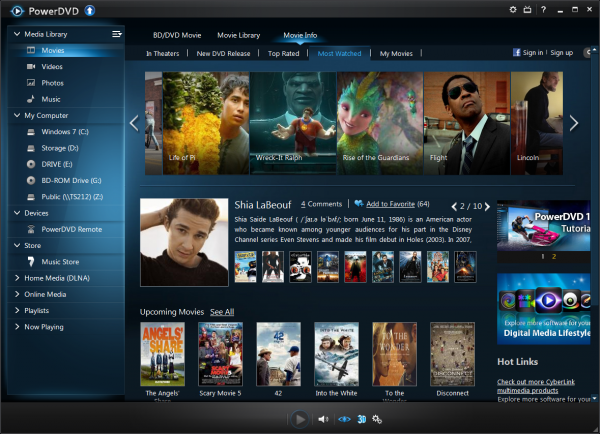
      There’s still plenty of room for improvement, though, and PowerDVD 13 Ultra takes the package forward with a range of new additions. There’s even wider file format support; enhanced video quality for HD footage; a new movie library, complete with cover art (for files as well as discs); a smarter, simplified interface; an all-new subtitling engine; and a new focus on performance to try and make this “the fastest, most responsive PowerDVD ever”.

      Of course, while this all sounds very promising, media players of this complexity also have plenty of room for problems. Could the reality live up to the press release? We installed a copy of PowerDVD 13 Ultra on our test PC and took a closer look.

      Playback and Performance

      PowerDVD 13 Ultra supports a wide range of file formats, particularly video. The current list includes 264, 26L, 3GP, ASF, AVC, AVI, BSF, DIV, DIVX, DVR-MS, FLV, H264, JSV, JVT, M1V, M2T, M4V, MK3D, MKV, MOD, MOV, MP4, MP4V, MPG, MPV, MTS, MVC, QT, TIVO, TOD, TP, TPD, TRP, TS, TTS, VC1, VOB, VRO, WM, WMV and WTV.

      It’s no surprise that the program handled all our test files without difficulty, then, opening and playing them just as we expected.

      And this included some intentionally “difficult” files, in particular a few old and oddly structured AVIs. We tried these with VLC Media Player, and on several occasions it either refused to play the audio, the video, or both; PowerDVD 13 Ultra got everything right, first time.

      When viewing HD footage – on file or disc – you’re now also able to turn on PowerDVD’s TrueTheater technology, which aims to sharpen images, enhance colour and lighting, and generally deliver what CyberLink are calling “quality beyond HD”. It’s one of the headline new features, in fact. So we were surprised to find that, when we viewed an HD YouTube video with it turned on, an alert told us “High-definition content detected. We recommend that you turn off all TrueTheater video technologies… when playing high-definition content.”

      Still, if you ignore any such alerts, and you’ve a powerful enough PC, we felt that TrueTheater generally delivers great results. Whether it’s particular important to have “quality beyond HD” is another issue, but it’s good to have the option.

      Elsewhere, PowerDVD 13 Ultra now supports playing AVCHD 2.0 format video (including AVCHD progressive and AVCHD 3D).

      Audio enhancements see new support for playing the lossless APE format, and the introduction of a new music miniplayer. In a couple of clicks the standard interface can reduce to a 175×175 pixel square with basic playing controls, perhaps handy if you want to listen to music while working on something else. (Although, annoyingly, this is supposed to use your music file cover art, and for some reason PowerDVD ignored ours entirely.)

      And in another headline claim, CyberLink are saying this all happens faster than ever, with anything up to a 58% improvement in Blu-ray movie launch speed (we couldn’t completely verify this, but it is noticeably faster), and “instant” playback for music, video and photos.

      Instant? We decided to put this to the test with a 2.5 GB MPEG video, and it turned out that while PowerDVD opened this in around 1.25 seconds, VLC Media Player managed the same task in about 0.95 seconds (other files showed similar results).

      If you care about fractions of a second, then, you probably won’t be impressed. But even if it’s not quite as “instant” as the competition (which, to be fair, offers far less features), PowerDVD Ultra 13 does fire up quickly, and the program isn’t nearly as bloated and overweight as some people would have you believe.

      Interface Improvements

      While PowerDVD 13 Ultra initially looks much the same as previous editions, take the time to explore and you’ll find plenty of new features.

      Playback is now smarter. PowerDVD 13 automatically rotates photos and videos shot in portrait orientation, for instance. And it automatically resumes file-based movies from where they were stopped, although you do have to click “Stop” for this to work. (If you pause the movie, then click Back, when you play the same video it’ll start at the beginning again).

      There are new ways to manually control playback, too. Clicking the Fast Forward or Rewind buttons launches the Play Speed Navigator, where you can set precise playback speeds up to 32x, or rewind speed up to 16x. You can just press the left key to jump back 8 seconds, the right key to jump forward 30 seconds, a quick way to zoom in on the point you need. Or if you’re heading back further, just hovering your mouse cursor over the navigational slider will display thumbnails of scenes you’ve watched already, helping you find the right spot in just a click or two.

      The interface has plenty of small tweaks, which help make it easier to use. So you can drag anywhere on the video screen to reposition the PowerDVD window. When playing a movie in full screen, the caption bar shows the current time of day, and hovering your mouse cursor over this will display the time it’s due to finish. And if you don’t want to see any controls at all, just move your mouse cursor to the side of the screen and they’ll disappear (move it away to bring them back).

      And new customisation options help you to organise the interface just as you’d like. You can decide exactly what you’d like to display on the caption and playback bar, for instance. And you can also reassign program hotkeys and mouse wheel actions to your preferred tasks.

      Probably the largest addition, though, is the new Movie Library. Point PowerDVD at the folders containing your movies; it’ll display them, automatically assigning cover art; hovering a mouse cursor over a thumbnail will display basic information (genre, release date, studio name, a rating from other users); and you can search for, or filter movies in various ways (“10 recently played movies”, say, or “movies not watched yet”).

      There are links to information on most films via CyberLink’s MoovieLive service, too: you can view cast details, a synopsis and reviews, as well as reading user comments or adding your own (if you’ve a MoovieLive account).

      There are issues here, too. Cover art mismatches are common (our “Panic Button” got assigned the “…Benjamin Button” cover, for instance); the online content isn’t particularly compelling, and the interface is sometimes less than intuitive. But the library is already a neat way to view and organise your movies, and on balance we think it’s a positive addition to the package.

      New Features and Functionality

      While we’ve tried to pick out what we think are some of PowerDVD 13 Ultra’s highlights, the program has plenty of other additions to explore. Like the new subtitle engine, for instance, which allows you to play two subtitles simultaneously for both Blu-ray and MKV/ MP4 movies, as well as setting their size, colour, position and more.

      Elsewhere, Cinema Mode (the simplified interface optimized for remote control) has new touch screen support, and can be used for file playback, as well as discs.

      PowerDVD can now share content on USB or NAS devices, while CyberLink also claims to offer improved DLNA performance (we couldn’t verify the latter, but it’s a complex area and we may simply not have used the appropriate test).

      There are multiple tweaks to try and help address performance issues, including a reduced number of background processes, and a less system-intensive scanning of your media library (with an option to pause this, if required). Which is welcome, although arguably there’s still work to do. We left the program idle after playing, for instance, and found it was using four processes (PowerDVD13.exe, PowerDVD13ML.exe, PowerDVD13Agent.exe, PowerDVD.exe), and consuming around 450MB RAM in total.

      And of course all this builds on a host of pre-existing PowerDVD features, including support for playing 3D files (and displaying 2D media in a 3D format); YouTube, Facebook and Flickr integration; smart device syncing; full 7.1 audio support, and mobile and remote control apps which now come in iOS, Android and Windows 8 forms.

      Is PowerDVD 13 Ultra for you, then? That depends. It’s still fairly expensive, and hasn’t changed radically in this build: if you didn’t like version 12, you probably won’t like this one, either.

      For PowerDVD fans or the uncommitted, though, it’s a different story. PowerDVD 13 Ultra is noticeably faster than before, and a host of small interface and playback tweaks help make the program much easier and more comfortable to use. If you’re particularly interested in one of the areas which has seen a notable upgrade — subtitling, say — then you’ll definitely appreciate the latest developments, and on balance it’s definitely worth giving the trial build a spin.

      Please note, while we’ve discussing the high-end Ultra version here, there are two other editions available. If you don’t need 3D, 7.1 audio, smart device syncing or full DLNA support then we’d consider the Pro build. And the base Deluxe edition is cheaper still, but it doesn’t support Blu-ray – you get standard media and DVD playback support only.

      Verdict: It may not deliver any single revolutionary change, but CyberLink PowerDVD 13 Ultra is still a welcome update, delivering a media player which is faster, easier to use and handles more file types (and offers more playback control) than ever before. If you need a very powerful player — and you don’t mind the price — we’d give it a try.

      We Like: Wide and reliable file format support, enhanced performance, movie library automatically finds cover art, YouTube/ Facebook/ Flickr support, simplified and customizable playback interface, easier movie navigation, excellent subtitle support.

      We Don’t Like: It’s not cheap, regular movie cover art mismatches, still requires plenty of system resources, didn’t display our audio cover art, in one or two areas the interface can be confusing.

      Photo Credit: FotoYakov/Shutterstock

    • Boathouse Capital Supports Accurate Background Growth

      Boathouse Capital has made an investment in Accurate Background. The firm invested $5 million of subordinated debt to support the working capital needs associated with Accurate Background’s continued growth and to facilitate its future strategic plans, including add-on acquisitions. Headquartered in Irvine, CA, Accurate Background offers a complete set of on-demand employment screening services, including criminal, motor vehicle, and other public records searches, employment history, education and professional license verifications, credit checks, and drug and health screening services.

      PRESS RELEASE

      Boathouse Capital is pleased to announce an investment in Accurate Background, Inc. (“Accurate Background” or the “Company”) on March 26, 2013.

      Boathouse Capital invested $5.0 million of subordinated debt to support the working capital needs associated with Accurate Background’s continued rapid growth and to facilitate its future strategic plans, including add-on acquisitions.

      Headquartered in Irvine, CA, Accurate Background offers a complete set of on-demand employment screening services, including criminal, motor vehicle, and other public records searches, employment history, education and professional license verifications, credit checks, and drug and health screening services.

      As one of the largest providers in the $2.6 billion background screening market, Accurate Background operates across the globe servicing large Fortune 500 public companies as well as midsize, family-owned businesses. The Company is recognized throughout the industry for its technologically-advanced solutions and deep customer relationships within the retail/consumer, technology, and distribution industries. Accurate Background’s ability to streamline processes and increase productivity has helped the Company to develop durable relationships with its customers that have enabled it to enjoy an impressive 97% customer retention rate and annual revenue growth of 26% over the past three years.

      Dave Dickerson, President and CEO of Accurate Background, said “We are delighted to bring on Boathouse Capital as a partner that not only understands and appreciates the value of our business but also shares our excitement about the potential for the Company’s bright future. I look forward to entering the next phase of Accurate Background’s development with Boathouse.”

      Bill Dyer, Partner at Boathouse Capital, added “Dave Dickerson and the Accurate Background team have done a fantastic job of creating a well-respected and highly differentiated business model within the fragmented background screening industry. We have been most impressed by the Company’s ingrained focus on achieving high customer satisfaction by offering flexible product solutions and top quality customer service. We look forward to supporting Accurate Background with its growth initiatives as it continues to roll out new products and services to its customer base.”

      As part of the investment, Bill Dyer will join Accurate Background’s Board of Directors.

      D.A Davidson & Co. and Morgan, Lewis and Bockius LLP advised Accurate Background, and Drinker, Biddle & Reath LLP represented Boathouse Capital.

      About Boathouse Capital
      Boathouse Capital is a $120 million private equity firm that invests mezzanine debt and equity into lower middle market businesses across the U.S. Based in Wayne, PA, Boathouse Capital invests $3 million to $12 million into companies in a variety of industries generating EBITDA of $2 million or greater.

      The post Boathouse Capital Supports Accurate Background Growth appeared first on peHUB.

    • NiXEN Partners Appoints Houlot as Partner

      NiXEN Partners has appointed Vincent Houlot as a partner. Houlot joined the firm in 2002.

      PRESS RELEASE

      Vincent Houlot, 37 years old, graduated from Ecole Centrale Paris and Oxford University, began his career in 1998 with the consulting firm Bossard Gemini Consulting.
      In 2002, he joined NiXEN Partners where he has been involved especially in operations such as Aerocan (aluminium aerosol cans), Asteelflash (electronics manufacturing services), Ceva (laboratory specialising in animal health), Malherbe (road haulage), Saverglass (luxury glass bottles), Titanobel (explosives for industrial use).
      About NiXEN Partners:
      NiXEN is an independent private equity firm specialising in Flexible Equity with €634 million of funds under management. As a lead investor, NiXEN provides flexible and personalised solutions addressing all types of capitalistic and strategic development issues for companies with revenues higher than €50 million. Working in its sectors of expertise, NiXEN invests more than €10 million per transaction, in companies with highly committed management teams, executing an ambitious industry consolidation, through buyout and spin-off transactions.
      NiXEN’s main investments include AsteelFlash (electronics manufacturing services), Babeau Seguin (builder of single-family detached homes), Buffalo Grill (steakhouse restaurant chain), Ceva (laboratory specialising in animal health), Labco (pan-European network of clinical laboratories), La Grande Récré (specialist retailer of games and toys), Maisons du Monde (decoration and furniture retailer), Vedici (private clinics for medicine, surgery and obstetrics).
      Press contacts:
      NiXEN Partners

      SHAN
      Jean-Paul Bernardini
      Tel: +33 (0)1 75 77 46 01
      Email: [email protected]
      Pierre Rispoli
      Tel: +33 (0)1 75 77 46 02
      Email: [email protected]
      Mélina Etorre
      Tel: +33 (0)1 44 50 58 77
      Email: [email protected]

      The post NiXEN Partners Appoints Houlot as Partner appeared first on peHUB.

    • Edison Ventures Backs OptionsCity

      Edison Ventures has announced growth capital financing in electronic trading platform provider, OptionsCity Software. Edison’s investment marks the first institutional capital in OptionsCity, and will give Edison a minority ownership stake.

      PRESS RELEASE

      Edison Ventures proudly announces a significant growth capital financing in leading electronic trading platform provider, OptionsCity Software. Edison’s investment marks the first institutional capital in OptionsCity, and will give Edison a minority ownership stake. The investment will accelerate the Company’s sales and marketing efforts, product innovation and international expansion.
      OptionsCity is the developer of award-winning electronic trading and market-marking platform, Metro, that has powered derivative trading since its launch in early 2008. The Company has continued to innovate with the development of its latest product Freeway, a multi-asset trading platform designed to offer developers and traders a comprehensive environment to create, test and deploy algorithmic trading strategies with micro-second execution.
      Mike Cichowski, Principal, and Chris Sugden, Managing Partner, led the investment. Sugden commented that “OptionsCity is a proven innovator. We believe Freeway represents the next major development for options and futures trading. Traders demand a multi-asset capability where they can quickly test and deploy new strategies. OptionsCity’s customers repeatedly confirmed this capability”. Mike Cichowski noted, “OptionsCity is a profitable, fast growing company bringing innovative technology to the derivatives market. We are excited to partner with the management team and assist with the company’s global expansion”. Rob Finn, Vice President who led Edison’s diligence, noted “Hazem and team have built a compelling brand. The technology platform is well positioned for the fast-paced evolution of trading strategies”. Along with this investment, the OptionsCity Board of Directors will expand to include Mike Cichowski, along with Joe Wald, former CEO of EdgeTrade and Executive Vice President at Gain Capital.
      “We selected Edison as a partner – after thorough due diligence – based on their impressive track record of fast-growing businesses as well as their commitment and knowledge of the Financial Technology sector,” remarked OptionsCity CEO Hazem Dawani. “We’re excited to begin a new chapter in the growth of our firm.”
      OptionsCity is Edison’s initial investment in Chicago, the epicenter of options and derivatives trading, and 38th overall in Financial Technology (FinTech). The industry segment includes investments in trading technology, wealth management, specialty finance, financial tech-enabled services and consumer finance. Notable current and previous investments include Gain Capital (Nasdaq: GCAP), Liberty Tax (Nasdaq: TAX), TraderTools, EdgeTrade, Scivantage, Billtrust, FolioDynamix, Princeton Financial Systems, Business Financial Services, Neat, Redvision and Best Software.
      About Edison Ventures
      Established in 1986 Edison partners with entrepreneurs, service providers and other financing sources to build successful companies. Edison provides capital and value-added services to later stage ($5 to 20 million revenue), information technology businesses. Initial investments range from $5 to 10 million. Edison typically serves as sole or lead investor. In addition to providing expansion capital, Edison funds management buyouts, recapitalizations, spinouts and secondary stock purchases.
      Edison’s investment professionals are based in Lawrenceville, NJ, New York, NY, McLean, VA, Needham, MA, and Cleveland, OH. Industry specialties include Financial Technology, Healthcare IT, Interactive Marketing and eCommerce and Enterprise 2.0. Other Edison successes include Best Software, Cambridgesoft, Dendrite, M5 Networks, Marcam, Mathsoft, Octagon, Tangoe, Virtual Edge, Visual Networks, Vocus and many other information technology leaders, which have a combined market value exceeding $5 billion. Edison Ventures currently manages over $700 million and actively making new investments. For more information on Edison Ventures, please visit www.edisonventures.com and follow us on Twitter @edisonventure.
      About OptionsCity Software, Inc.
      As developers of the award-winning Metro electronic trading and market-making platform, Chicago-based OptionsCity Software has helped options traders make markets and trade on the world’s leading derivative markets since 2006. OptionsCity continues to innovate with the development of Freeway, a multi-asset trading platform designed to build, test, and deploy algorithms with micro-second execution. OptionsCity products are built on power, speed and reliability that traders require to have full control over trading, safety, and risk management. OptionsCity is a certified Independent Software Vendor on leading global derivative exchanges and markets.

      Contact:
      Tricia Bradley
      [email protected]
      609-873-9224

      Edison Ventures
      1009 Lenox Drive #4
      Lawrenceville, NJ 08648
      609-896-1900
      609-896-0066 (fax)

      The post Edison Ventures Backs OptionsCity appeared first on peHUB.

    • The Facebook Phone Consensus From 7 Reviews: An Impressive First Try For $99

      Screen Shot 2013-04-09 at 9.14.54 PM

      Why trust one reviewer to tell you what phone to buy? Better to get a consensus, and across reviews by seven leading publications the verdict is that the HTC First features a stylish yet casual design, efficient messaging, reliable battery, and an addictive feed reading experience. But its “apperating system” is confusing, the camera fails in low light, it sacrifices widgets, and has privacy issues.

      (Hint: the answer to my initial question is “So you don’t have to read two hours of HTC First reviews like I just did.”) But after writing my own long review and pouring over New York Times prose, Ars Technica stats, The Verge’s details, and our own MG Siegler’s colorful take, I can tell you Facebook faired surprisingly well despite its inexperience in the handset world.

      The HTC First is not going to change Facebook-haters’ minds, but it will magnify the love of fanboys and draw casual users deeper into the social network. The phone  piggy-backs on Android, turning bland parts visual while leaving an unadulterated OS for those who want to leave Home. If Facebook’s hope was to boost engagement and get an education in mobile operating systems, Home and the HTC First lay a strong foundation.

      But don’t take my word on whether to pre-order. Here are the highlights from some of the best gadget reviewers and tech pundits in the business. Be sure to click through to their articles to get their full opinions.

      Ars Technica’s Florence Ion:

      The First is a very stylish, well-built phone, once again proving that HTC has a penchant for design.

      The Chat Heads feature can best be described as the roommate who quietly knocks on the door and then cracks it open to see if you’re busy. Chat Heads try hard not to distract you so that you can continue to multitask, but they want to subtly alert you that someone has sent you a message.

      I can see the placement of the micro-USB port becoming a bit of an issue in situations where the phone is charging and it needs to be laid horizontally or placed in a car holster for navigation. It’s also awkward trying to type with both hands when the phone is plugged in.

      The screen size wasn’t much of an issue except when reading e-books and text-heavy webpages. Fortunately, there is an option in the Settings menu to make the font bigger, which actually helped significantly.

      In performance tests, the First had results similar to the Samsung Galaxy S III. It appears that Home doesn’t use up that much battery life either, despite its ingrained status within the Android operating system. Overall, the handset was fast and speedy. It didn’t feel like a mid-range handset.

      The Verge’s Dieter Bohn:

      Because of its small size, the First is a pleasure to hold. It nestles comfortably in one hand in a way that few popular Android phones do these days.

      Text is perfectly readable at nearly 90 degrees.

      The screen is very difficult to see in bright sunlight. The First’s camera feels like a throwback to an earlier age when smartphones were nigh-useless in the dark.

      Video on the First is equally forgettable, amplifying hand-shake and displaying the jelly movement effect so common on low-end cameras.

      The HTC First is running stock Android 4.1.2, almost completely unpolluted with apps from AT&T or HTC.

      If you’re a Facebook devotee, or just want a cheap phone that runs well, by all means check out the First (but test the camera before you leave the store). If you absolutely want a smaller-sized Android phone with LTE, the First is probably the best option out there right now.

      Overall score of 7.9 out of 10

      The Wall Street Journal’s Walt Mossberg:

      I found Facebook Home to be easy to use, elegantly designed and addictive. Although I’m a regular Facebook user, I found that, with Home, I paid more attention than ever to my news feed,

      The idea is that during spare moments—say, while waiting in a line—you’ll get immediately hooked by Facebook.

      Facebook Home blocks the one-step camera icon some Android phone makers place on their lock screen to allow you to take pictures without first unlocking the phone.

      With Home, Facebook is essentially staging a land grab of Android. Because it’s so dominant, it makes it less likely that a user with limited time will launch Google products that compete with Facebook, such as Google’s own social network, Google+, or rival services from other companies, such as Twitter.

      Engadget’s Brad Molen:

      Since the First was built to impress the Facebook-savvy, we shouldn’t be surprised that this is one of the most playful-looking handsets HTC has ever made.

      We also need to point out the lack of an LED notification light, which seems like a huge oversight given Facebook Home’s heavy emphasis on alerts and other notifications.

      Unfortunately, there’s no option to add widgets or folders.

      By far, our greatest concern with Home is the impact that it could potentially have on data usage, since it dynamically updates Facebook’s news feed in the background. Fortunately, Facebook includes a three-tier data usage and image quality setting (high, medium and low). The toggle becomes handy for smaller data plans or if you’re getting close to your limit, but oddly a WiFi-only option isn’t available. In our testing, we consumed 93MB in four days on the medium setting; at that pace, Home would snatch up 698MB in a month. Think about it this way: if you have a 2GB plan, Facebook Home would take up more than one-quarter of your data allotment, on the medium plan alone. Now imagine how much the high-usage scenario destroys the average consumer’s data plans. Use Home responsibly, folks.

      Widget lovers will quickly become frustrated by their inability to access their favorite ones without jumping into the stock launcher each time

      Fortunately, the 2,000 mAh Lithium-polymer cell was enough to keep us going for 14 hours of solid use, with Home running on medium usage the entire time.

      All of our cellular connections have been consistently good and the volume was more than sufficient.

      It’s aesthetically pleasing, and surprisingly polished for a 1.0 product.

      In its current state, Home isn’t the best fit for productivity-minded people, although it does offer a bit of mindless entertainment for anyone just looking to burn a minute or two throughout the day

      To put it bluntly, Home won’t convert non-Facebookers into believers, and it won’t encourage people to sign up for the service; it will be a failure in that sense. It may, however, turn casual users into more habitual Likers, commenters and posters, and we have a feeling this is exactly the kind of success Facebook is hoping to reap.

      GigaOm’s Om Malik:

      Facebook has made Android faster by removing a lot of crud that typically ships with Android on carrier-branded phones.

      For a service that is supposed to bring us updates in real time, this isn’t close enough. You can actually feel the slow speed (and infrequency of updates) of the feed when you compare it with the desktop feed which moves at a faster pace.

      The phone has a soft-touch rubber design which is easy to grip and it is something I appreciate because my phone keeps dropping from my hand.

      The New York Times’ David Pogue:

      On the app launcher: If it sounds confusing, that’s because it is. In removing the app-launching function from the Home screen, Facebook has wound up having to reinvent the way you open programs on your phone, and the result feels like a hack.

      Chat Heads are fun and effective, but Facebook’s engineers appear to have overlooked one small detail: Chat Heads are useful only when you receive a message. How are you supposed to initiate a conversation? For that, you have to duck into your app-launcher screen and fire up the Facebook or Facebook Messaging app.

      What does Home add, really? Yes, the ability to see incoming posts on your Home screen; you save one tap. But is it worth losing widgets, wallpaper, app folders and the Android status bar in the process?

      TechCrunch’s MG Siegler:

      It’s really good. I like the HTC First with Facebook Home (the official name, I think) more than the Nexus 4, but less than the iPhone 5.

      [On Cover Feed] It’s surprisingly addictive…because you can swipe to scroll through these images/statuses all without unlocking the phone.

      I think Facebook has really nailed the interaction element on the home screen. I actually wish I could use Instagram and other visual feeds this way as well

      On top of that are the beautiful, elegant notifications that Facebook has created. Simply put: I like them more than both Android and iOS notifications. They feature big, clear app icons (or a person’s face if it’s a Facebook notification) and a snippet of the message you’re receiving.

      I’ll be curious to see Facebook Home running on other hardware like the Galaxy SIV, but I think the fact that you won’t be able to get third-party notifications would be a deal-breaker for me.

      [On password entry]: This is where things start to get a little weird…sometimes you’ll be asked to enter your password from the app list, sometimes before it.

      Even weirder is that you can actually do a few types of Facebook actions — both liking and commenting — without entering any password. In fact, there’s no way to password protect these actions, as far as I can tell. Someone could definitely take your phone and leave comments galore on your friends pictures, no questions asked.

      Chat Heads. Awful name not withstanding, this is absolutely how messaging should be done on a smartphone. Rather than making you open a separate app to get and respond to messages, Chat Heads put a user’s face…on top of whatever you’re doing on your phone.

      [On design flourishes] These touches, while seemingly trivial, give me the same type of feeling I get when using iOS. You can tell that a lot of time and care has been put into the user experience here and it shows, in spades.

      Still, it’s hard to believe this is only Facebook’s first take at Home. This is a very polished and impressive first entry into the space.