Blog

  • Give Workers the Power to Choose: Cave or Commons

    Not so long ago occupying the “corner office” was a sign that managers had reached the pinnacle of status in their organizations. However, the spare bedroom in one’s house has quietly usurped the corner office when it comes to the alpha position in organizations, as increased working from home (or from wherever) has come to signal greater power and autonomy within an organization.

    In this sense, Yahoo CEO Marissa Mayer’s recent dictate to report to work was viewed as much as an attack on individual freedom as an attack on the family. Paradoxically, FastCompany.com published an article that same week about how “employees work beyond the cube,” showcasing Plantronics‘ decision to give their employees the choice to either work from home, commute to headquarters, or join one of three Bay Area locations of NextSpace (shared workspaces). The co-working choice was heralded as a win-win for workers and their companies, with proximity, diversity and choice of location all stimulating creativity. Google then chimed in by saying that they don’t even have a policy — at least that anyone could find — that says when and where people need to work. Their belief is that a workplace that is comfortable, healthy, and inviting drives the desire to be there.

    What these examples all hinge on, however, is autonomy — control over how you use time and space. It is important to realize that when one works from home, that person (typically) has total control over time and space. However, at the office, control over one’s minutes-in-the-day and who’s-standing-at-my-door-now, evaporates. For this reason, I am a big fan of cave-and-commons designs in offices — private spaces (caves) where one can work without being interrupted by colleagues walking by or cube chatter. (Of course, it’s also a good idea to turn your cellphone off.) And close-by, common areas where team members can pull together for critical face-to-face time. If you take all the caves away, people are distracted and interrupted and creativity falters.

    Every organization needs the right balance of caves and commons — and what that precise balance is depends on what the organization’s particular goals and challenges are, and more granularly, what the immediate situation of a work team is. The overarching truth is this: there is no question that physical distance creates barriers to communication. However, constant co-habitation can decrease performance, particularly when people are working on creative tasks. In my work and teaching, many are surprised by the fact that over five decades of research have unequivocally shown that people working alone are more creative than those working in teams. Given that the tasks facing organizations and teams require flexibility, a cave-and-commons approach to organizational design helps ensure that people can work individually, away from potential distractions, but also can nimbly pull themselves together for teamwork.

    How do you know when to emphasize the commons and pull people together, and when to free them up to find and spend time in caves? In my book, Creative Conspiracy, I set out these guiding rules:

    Ring the team dinner bell and find the commons (in other words, get to the office for a team meeting) when:

    • the group first forms (norms and expectations can be set within microseconds of a group’s first meeting);
    • the overarching goal is not clear;
    • trust is low (physical co-presence increases trust and bonding) — for example, oxytocin, the human bonding hormone, is released when people can connect physically;
    • uncertainty is high;
    • a crisis erupts;
    • conflict needs to be resolved (conflicts that are dealt with via email and text start to spiral out of control as compared to face to face interaction) — people are more likely to “flame” each other in an email, but not face to face; and
    • when team members need to give and receive feedback.

    Extend the curfew and allow people to go home or at least find their private, uninterrupted space — perhaps at home:

    • after the group is formed;
    • when the work to be done is clear, deliverables specified and the group has essentially completed a team charter;
    • when status differences exist that might stifle the input of younger, less senior people and their input is needed — for example, when teams meet virtually, merit is the biggest determinant of influence (not personal charisma); and
    • when participation is uneven — for example, when groups meet in person only one person can talk at a time and typically one person dominates — but this is not true when meeting virtually.

    Ideally, every organization should allow some flexibility on the where-and-when-to-work question — if not for any other reason than to optimize performance across the diverse set of challenges that teams face. If organizations don’t take proactive steps, people manufacture their own caves — whether by working from home, putting on earphones to tune out the drivel, or simply slipping out to the local WiFi café. The same is true for commons — there is a human need for people to gather around the water cooler and so, making the workplace inviting in different ways can build community. The challenge for leaders is in achieving the right balance through informal influence and modeling, and formal policy moves.

  • Tidemark beefs up visualizations with infographics instead of bar charts and line graphs

    Tidemark is putting a fresh spin on its cloud-based enterprise performance management applications with infographic-like visualizations of financial planning data, showing that the consumerization trend popular with IT is fit for finance and operations staffers, too.

    Sidestepping static dashboards, Tidemark’s shareable Storylines feature lends itself to adoption by people beyond the chief financial officer, according to company founder and CEO, Christian Gheorghe. The idea was born a few months ago, Gheorghe said.

    He was “frustrated with the fact that we have had all these years to understand businesses better with all kinds of analytical tools, and yet most people can create a fantasy football pool to see (who can) win faster than they can understand how their company is doing from a performance perspective,” he said. The result — infographic formats based around company health, workforce, profitability and other areas — is a “home experience brought to work, not the other way around,” Gheorghe said.

    Tidemark takes less time to implement than legacy offerings from IBM and Oracle — 90 days instead of six to nine months, Gheorghe said. Tidemark, which has raised $35 million from Andreessen Horowitz and Greylock Partners, among others, competes for marketshare in the cloud enterprise performance management space alongside Adaptive Planning, Anaplan and Host Analytics. Whether infographics are the best means or not, the appealing presentation calls to mind the cool visualizations more common in business intelligence, and Tidemark’s competitors might have to come up with their own answers to keep up.

    Related research and analysis from GigaOM Pro:
    Subscriber content. Sign up for a free trial.

  • Click & Grow Turns To Kickstarter To Seed Its 2nd Gen “Smart Herb Garden”

    7hsCJWNHcpPZH1x-SvWW36xuzBqciwBm1cAgmOW-teg

    Another established hardware startup is turning to Kickstarter to help fund its next wares. This time it’s the turn of Click & Grow, maker of the smart garden that lets you grow a plant indoors with little or no intervention. After selling over 50,000 units of its first device, the Palo Alto, U.S. registered company with an R&D lab in Estonia, is launching a crowdfunding campaign to get its second generation product — the Smart Herb Garden — off the ground.

    Hoping to raise a minimum of $75,000, the money will be used to turn a functioning prototype into something production-ready, with a shipping date loosely pegged for September. The Smart Herb Garden builds on Click & Grow’s first product, but with several improvements following feedback from customers; namely that people want to grow more than one plant at a time and that the amount of natural light available in a person’s home is often not enough for healthy plant growth. The new improved version features a built-in LED light, as well as a change in the plant pot part of the design to make it easy to grow three different plants simultaneously, with the same ‘smart’ technology taking care of the heavy lifting. It also plugs into a power socket rather than relying on four AA batteries, while the new design negates the need for a pump or sensor.

    The aim of Click & Grow’s smart garden system is to automatically provide the correct water and nutrient balance needed for indoor plants to grow. The company claims that 3 years of R&D has gone into the Smart Herb Garden, of which the core technology is the growth medium, a nanotech material engineered to “supply plant roots with the right amount of oxygen, water and nutrients at any time”. This is supported by the newly incorporated LED light. In practice, you simply insert the supplied cartridges and fill the reservoir with water. Then power the thing on and — bingo — in a matter of weeks you should see green shoots of awesomeness. If plants are your thing, of course.

    “Very few can afford to launch a new product and fail”

    The Smart Herb Garden starter kit will come with cartridges for basil, thyme and lemon balm. Refills will be available for various herbs, lettuce, mini tomato, chili pepper, and even strawberries, apparently.

    Once it finally reaches market, the Smart Herb Garden is expected to retail for $79 but Kickstarter backers can bag it for $39 for a white model, or at the top tier, $1,000 for a “next generation interactive model”, though the latter is short on details.

    As for why a VC-funded startup would choose to go down the crowdfunding route — Click & Grow has raised over €1.5 million from backers WNB and Primo Holding — founder Mattias Lepp tells TechCrunch that “for makers of novel hardware, Kickstarter is the best place to sense check your ideas before you start assembly lines”.

    It’s hoped Kickstarter will enable the company to validate the market for its new product and get feedback on prices and colour options, dimensions, and the plants that people want to grow. “So I’d say it’s first and foremost a market insights platform,” he says. “And of course, the money also helps at our stage.”

    For hardware companies like Click & Grow who have already had some success and raised funding, it’s not that they can’t afford to start manufacturing a new product, it’s that “very few can afford to launch a new product and fail”, says Lepp.

  • ‘Equality’ Is Facebook’s Top Term Surrounding Same-Sex Marriage Debate

    Yesterday you may have noticed that your Facebook news feed was very red, and that there were a bunch of equals signs everywhere. This was the result of the Supreme Court beginning to hear arguments on California’s Prop 8 same-sex marriage ban. All of the red equals signs were simply marriage equality supporters, well, showing their support.

    The red equals sign was a play on the standard blue and yellow equals sign logo for the Human Rights Campaign.

    Today, Facebook has some quick numbers on the top-buzzing terms over the last day, and it looks like equality has won out.

    According to Facebook’s Talk Meter, which looks at buzz around specific events, the term “Equality” was the most-used term surrounding the gay marriage debate. Facebook says its use was up 5,000% on Tuesday.

    Also:

    The top age group talking about the landmark cases yesterday, in advance of oral arguments, was the 35-44 range followed by 25-34 and 45-54.

    Geographically speaking, people in Washington, D.C. were buzzing the most in anticipation of the hearings, followed by users in Utah, Oklahoma, Arkansas, California, Oregon, New Mexico, Nevada, Arizona, and Colorado.

    Here’s Facebook’s full list of the top ten terms buzzing on the network on Tuesday.

    1. Equality
    2. DOMA
    3. Supreme Court
    4. Perry
    5. Kennedy
    6. Prop 8
    7. Kagan
    8. SCOTUS
    9. Scalia
    10. Defense of Marriage

    Don’t expect the Facebook buzz for same-sex-related and Supreme Court-related topics to die down today. Tuesday, the court heard arguments on California’s Prop 8. But today, the court will begin to hear arguments on the 1996 Defense of Marriage Act, or DOMA, which barred many federal agencies from recognizing same-sex marriage (in terms of some benefits and such). Many high-profile tech companies and other American businesses (including Facebook) have filed a amicus brief arguing that DOMA is simply bad for business.

  • GiveGab Closes $1.5M

    Ithaca, NY-based GiveGab, the developer of a social network for volunteers, has raised $1.5 million in Series A financing. The financing was led by Cayuga Venture Fund, and included participation from New York City-based Great Oaks Venture Capital; Rand Capital SBIC of Buffalo, NY; and Excell Partners of Rochester, NY.

    PRESS RELEASE
    GiveGab, the social network for volunteers, announces it has closed on $1.5 million of Series A funding. The Ithaca-based volunteer management software provider will use the funding to expand the website’s capabilities and business development efforts, including the launch of premium offerings and enhanced volunteer management reporting. The financing was led by Cayuga Venture Fund of Ithaca, NY (www.cvf.biz), and also included New York City-based Great Oaks Venture Capital (www.greatoaksvc.com), Rand Capital SBIC of Buffalo, NY (www.randcapital.com) and Excell Partners of Rochester, NY (www.excellny.com).

    Charlie Mulligan, co-founder and CEO of GiveGab states, “Volunteering makes people happy. We are excited that Cayuga Venture Fund, Great Oaks Venture Capital, Rand Capital and Excell Partners have decided to work with us and provide the resources and connections we need to accomplish our mission: More, happy volunteers.”

    Volunteering enriches people’s lives as well as the communities in which they live. GiveGab identified that matching volunteers with opportunities, and then administratively tracking their volunteer hours was very difficult. The software was developed to make the process of volunteering fun and easy, while helping to make the lives of volunteer managers easier. GiveGab is utilized by schools, nonprofits, and businesses that encourage people to volunteer in their communities.

    “GiveGab has finally figured out how to meet the volunteer tracking, recruitment and profiling needs of both volunteer managers and their volunteers in a creative and fun social media networking platform that already has yielded an impressive following among colleges and universities and non-profit organizations,” said Jennifer Tegan, Partner at Cayuga Venture Fund. “We are excited to see this company grow and reach its full potential with this financing.”

    Ben Lin, Managing Partner at Great Oaks Venture Capital states, “What LinkedIn has done for an individual’s professional career, GiveGab can do for their volunteering efforts. We are excited to be part of GiveGab’s success.”

    About GiveGab

    GiveGab, the social network for volunteers, is dedicated to helping volunteers and nonprofit organizations interact in local communities. GiveGab’s goal is to create a fun yet effective online environment that encourages real-world volunteer hours, donations, and social interactions. GiveGab helps volunteers find volunteer opportunities in their local community, log volunteer hours, and create a volunteer resume. Volunteer managers at nonprofits, colleges/universities, businesses and clubs can use it to create and manage events, programs, and opportunities, recruit volunteers, track volunteer hours and report their success.

    The post GiveGab Closes $1.5M appeared first on peHUB.

  • Major Expansion for Equinix in Singapore

    equinix-sg2

    A look at the interior of an Equinix facility in Singapore, where the company has announced plans to build a data center. (Photo: Equinix)

    In a period of strong data center growth in Asia, Singapore is the hottest market in the hottest region. Today Equinix announced the latest in  series of major projects in Singapore, teaming with real estate investment trust Mapletree Industrial to build a 385,000 square foot data center that will add capacity for another 5,000 cabinets of servers and IT gear.

    Equinix has two existing data centers in Singapore, where the colocation and interconenction provider reports strong demand from financial and cloud companies. The new facility will be adjacent to Equinix’s existing SG1 data center, and will be interconnected through a dedicated fiber network, allowing customers in SG1 to expand their business within the Equinix platform. The build-to-suit project is scheduled to be completed in the second half of 2014.

    “Singapore is growing in importance as a cloud hub for the region,” said Clement Goh, managing director of Equinix South Asia. “Global and multinational companies have seen Singapore as a gateway for diverse connectivity to the other Asia Pacific markets. Equinix is committed to catering to the increasing demand for data center and interconnection services in Singapore. Our new data center will help our financial and cloud customers drive new business and collaboration opportunities, improve performance and reduce operational cost with low latency and high proximity.”

    The new Equinix IBX data center will be a seven-story building situated within one-north, a 200-hectare development by JTC Corporation designed to host a cluster of research facilities and business park space in the biomedical sciences, IT, media, physical sciences and engineering industries. Located in the southwestern region of Singapore, the property is easily accessible via major expressways and the public transportation network.

    “We are pleased to work with Equinix as it achieves another milestone with the development of its third IBX data center in Singapore,” said Tham Kuo Wei, chief executive officer of Mapletree Industrial Trust (MIT). “The commitment from Equinix demonstrates its confidence in MIT’s development capabilities in customizing high specification industrial facilities. This collaboration allows Equinix to focus on its core business while MIT manages the capital expenditure and development process.”

    Industry bellwehthers Equinix and Digital Realty Trust have both actively expanded their space in Singapore. Other companies that have deployed data center space in Singapore over the last two years include Google, Amazon Web Services, IO, IBM, Salesforce.com, SoftLayer and NTT.

  • Got a $200,000 business idea?

    The Minnesota Cup is a competition that rewards good business ideas. Here’s the quick take from the Minnesota Cup website…

    Have the next great business idea? The ninth annual Minnesota Cup competition opens for entries on March 25! The Minnesota Cup supports and accelerates the development of breakthrough business ideas from across the state to build the vibrancy of Minnesota’s business community. Minnesota residents have until May 17 to submit entries on the Minnesota Cup website to compete for $200,000 in prize money.

    There are six divisions:

    • LifeScience & Health IT
    • High Tech
    • Energy & Clean Tech
    • Social Entrepreneurship
    • General
    • Student

    You can only apply to one division. But the application process seems pretty straightforward. The contest is only open to Minnesota residents. I’d love to see some of the prizes make their way out of the Twin Cities!

  • Get ready for more lawsuits: A quarter of all new patents will be mobile-related this year

    New Mobile Patents
    While more patent suits may be the last thing the mobile industry needs, it seems that’s what it’s going to get no matter what. AllThingsD points us to a new study from analyst Chetan Sharma projecting that one-fourth of all patents issued in the United States this year will be mobile-related, up from just 5% in 2001. Sharma also finds that Samsung (005930) was the leader in mobile patents granted last year, which makes sense because the company has been working to boost its mobile patent portfolio to ward off more potential lawsuits from Apple (AAPL) such as the high-stakes patent suit that the company lost last summer. Sharma says that the surge in mobile patents is unsurprising since smartphones and tablets have quickly become “the growth engine of the knowledge economy,” which gives companies a lot more incentive to patent everything they can to both maximize their returns on R&D and to prevent potential suits from patent trolls.

  • European Union will reportedly approve Random House-Penguin merger

    The European Union will reportedly follow the U.S., Australia and New Zealand in approving Random House and Penguin’s merger, Reuters reported Wednesday.

    Citing two unidentified sources, Reuters said that the publishers are “set to win unconditional EU regulatory approval.”

    Random House and Penguin announced their merger last October, and the U.S. Department of Justice approved it quickly, in February, followed by Australia and New Zealand. Random House’s parent company Bertelsmann would own 53 percent of the combined company, and Penguin parent company Pearson would hold 47 percent. Penguin Random House would be the largest book publisher in the world, and the merger is designed to help the companies tackle emerging markets and invest in new digital models.

    Reuters notes that “the spokesman for competition policy at the European Commission, Antoine Colombani, declined to comment. The EU competition authority has set an April 5 deadline for its decision.”

    Related research and analysis from GigaOM Pro:
    Subscriber content. Sign up for a free trial.

  • Timelines and Potential Pitfalls of a Custom Data Center

    This the fourth article in series on DCK Executive Guide to Custom Data Centers.

    The advantages of a custom design can look and be attractive, since they may be able to accommodate non-standard IT hardware or provide very high energy efficiency or high cooling density. However there are potential pitfalls for those who have not had a great deal of experience with custom designs. If you change the design radically to meet specialized custom built hardware requirements you may lose the ability to easily adapt to different equipment after a hardware technology refresh cycle. This is especially true if your custom hardware requires non-standard cabinets, since the majority of typical computer hardware is designed for standards based cabinets.

    That is not to say that one should forgo custom data center design to support specialized hardware and simply limit themselves to standard designs. You may choose to simply allocate one section of the data center to deal with specialized hardware requirements, if your IT systems can gain substantial performance benefit.

    Timeframe
    If, after carefully weighing the facts, you decide to proceed with custom design, bear in mind the impact on the timeline. A standard data center can be designed and built in 12-18 months by an experienced builder, once the basic size and capacity has been defined. With custom design you need to anticipate extended timelines. The first timeline is the preliminary technical requirements discussions, as well as the business and cost justification, within your own organization. Once your internal requirements have been defined, there will be extended time required for meeting with designers and builders to explore the feasibility and cost projections for your custom requirements. These extra steps can add 6-12 months to the timeline. Once the cus¬tom design has be finalized, the build-out should take 12-18 months if standard power and cooling equipment has been used, however if custom equipment needs to be specially fabricated, then additional time may be required for these items.

    You can download a complete PDF of this article series on DCK Executive Guide to Custom Data Centers courtesy of Digital Realty.

  • Silver Spring targets Asia’s smart grids with Singapore deal

    Recently public smart grid player Silver Spring Networks has started working on a deal with Singapore utility Singapore Power to build a wireless smart grid network including smart meters. The deal is Silver Spring’s first in Asia and Silver Spring Executive Vice President, Global Development Eric Dresselhuys tells me he hopes it will be the “anchor customer in the region.”

    Asian markets are growing at a fast pace and Silver Spring is trying to get a toe hold into the region. Dresselhuys says utilities in countries like Malaysia, Indonesia, Thailand, Laos and even India, look to Singapore Power as a leader. The utility has 2 million customers, and the deal is actually with the company’s division that owns the electricity transmission and distribution, SP PowerAssets.

    The pace of the growth of smart meters in the U.S. has been expected to slow down in 2013 and 2014, and then pick back up, according to Pike Research. That’s partly because the early adopter utilities in states like California have already adopted smart meters. The temporary drop is also because the Department of Energy stimulus funds gave smart meters a temporary pop a couple years ago. Networks in some states, like ComEd’s, have faced other types of logistics hurdles.

    Outside of the U.S. there’s a lot of growth going on, and particularly in developing countries where economies are booming. Silver Spring has already built networks in Australia, but is looking hard at Latin America. According to Pike Research, while less than 4 percent of the world’s 1.5 billion electricity meters were smart in 2008, that figure grew to over 18 percent by 2012, and is expected to jump to 55 percent by 2020.

    Related research and analysis from GigaOM Pro:
    Subscriber content. Sign up for a free trial.

  • Sorenson Capital Promotes Ludwig, Blohm and Sturgeon

    Sorenson Capital Partners has promoted Mark Ludwig to managing director, Don Blohm to performance group operating partner and Peter Sturgeon to principal. In addition, Bert Roberts has joined as vice president. Salt Lake City-based Sorenson Capital is a private equity fund that makes small to middle-market buyout and growth equity investments.

    PRESS RELEASE
    Sorenson Capital Partners today announced the promotion of Mark Ludwig to
    managing director, Don Blohm to performance group operating partner and Peter
    Sturgeon to principal. In addition, Bert Roberts has joined the team full-time
    as vice president.

    “With the team we have in place, Sorenson Capital has the talent and expertise
    required to deliver exceptional value for our portfolio companies,” said Fraser
    Bullock, managing director of Sorenson Capital. “Mark, Don, Peter and Bert have
    continually proven their value to our firm`s portfolio companies and
    shareholders. We have every confidence in our team`s ability to partner and grow
    with the complex, compelling businesses we invest in, and look forward to
    gearing up for new investment opportunities in the coming year.”

    In less than a decade at Sorenson Capital, Ludwig has ascended from analyst to
    managing director. Ludwig was the chairman of NCS Energy Services, and proved
    instrumental in the sourcing, growth and exit of the company, one of Sorenson
    Capital`s most successful investments. He currently sits on the board of Custom
    Control Concepts. Prior to joining Sorenson Capital, Ludwig was an associate
    consultant with Bain and Company.

    After joining Sorenson Capital in 2010 as performance group vice president,
    Blohm was instrumental in the operational transformation of Mity-Lite, which
    resulted in the company being named 2011 Manufacturer of the Year by the Utah
    Manufacturers Association. He also assisted NCS Energy Services in building an
    efficient and effective supply chain to help facilitate substantial growth. In
    addition, Blohm acted as the interim chief operating officer for Re-Bath and
    interim vice president of operations at Goal Zero. Prior to joining the firm, he
    was vice president of worldwide operations for Flowserve Corporation, one of the
    world’s largest manufacturers of pumps, valves, seals and components to the
    process industries.

    As vice president at Sorenson Capital, Sturgeon has played a key role in the
    recent exits of Southeast Directional Drilling, M&M Pipeline Services and RWI
    Construction while serving on their respective boards of directors. He also
    assisted in the recent acquisition of Custom Control Concepts. Previously,
    Sturgeon was an associate with the Boston Consulting Group (BCG).

    Prior to joining Sorenson Capital in his new role as vice president, Roberts was
    a significant contributor to the firm`s proprietary deal sourcing efforts as a
    consultant. He played a key role in sourcing two recent investments for the firm
    – Health Catalyst and AccessData Group. Previously, he was a vice president of
    institutional client services at Wasatch Advisors.

    About Sorenson Capital

    Sorenson Capital (www.sorensoncapital.com) is a private equity fund that makes
    small to middle-market buyout and growth equity investments. Sorenson Capital
    has $650 million in capital under management and typically makes investments of
    $10 to $25 million in companies with unique strategic positions. Sorenson
    Capital is managed and controlled by West Rim Capital and is based in Salt Lake
    City, Utah.

    The post Sorenson Capital Promotes Ludwig, Blohm and Sturgeon appeared first on peHUB.

  • Demandbase nets $15M to build out its B2B marketing database and sell it better

    Demandbase, the B2B marketing service, which combines information about your business affiliation from your IP address and other cues, now has $15 million more in funding to beef up its sales and marketing, keep building its database worldwide, and develop new products.

    Scale Venture Partners and Omniture, the web site tracking company which is now part of Adobe Systems,  led the round. Existing investors Sigma PartnersAltos Ventures, Costanoa Ventures, Sutter Hill Ventures and Adobe, which is also a Demandbase customer.  Total funding for the 7-year-old company now stands t $44 million.

    Demandbase CEO Chris Golec

    Demandbase CEO Chris Golec

    The San Francisco-based company  will use the new money to build out its treasure trove database worldwide; add more sales and marketing muscle; and create new products and features.

    GigaOM Pro analyst David Card is impressed with Demandbase. “They’re  building a database that translates IP addresses into companies so that you could present content or offers based on who the user likely worked for (which  is probably more useful in most B2B situations than recent behavioral tracking or guessing at their demographics. They claim to use signals other than IP address, too, and they claim what you can get from the registries isn’t timely,” he said.

    the company competes with companies like Neustar or Quova, which also use IP targeting; Bizo which works in advertising technology by analyzing cookie information;  adn Gravity which does personalized marketing, but Demandbase would argue it combines all much of this in one service — and it doesn’t use cookies.

    Other custmoers include a  list of tech players including Dell, Cisco/Webex,HP/Arcsight Informaticaand NetApp

    Related research and analysis from GigaOM Pro:
    Subscriber content. Sign up for a free trial.

  • Demandbase Wraps Up $15M Round

    Scale Venture Partners led a $15 million round for Demandbase Inc., a company developing a targeting and personalization platform for B2B. The investment included participation by existing investors Sigma Partners, Altos Ventures, Costanoa Ventures, Sutter Hill Ventures and Adobe Systems.

    PRESS RELEASE
    Demandbase, Inc., the targeting and personalization platform for B2B, today announced it has closed a $15 million round of financing to support accelerated growth of the company’s online advertising and web site optimization platform, enabling B2B marketers to dramatically improve sales and marketing results. Scale Venture Partners, whose previous investments include Box, Hubspot, ExactTarget (NYSE: ET) and Omniture (acquired by Adobe Systems) led the round. The investment included participation by existing investors Sigma Partners, Altos Ventures, Costanoa Ventures, Sutter Hill Ventures and Adobe Systems (NASDAQ:ADBE). The additional funds will support innovation of Demandbase’s patented technologies and the rapid adoption by enterprises in the U.S. and Europe. As part of the investment, Stacey Bishop from Scale Venture Partners will join the Demandbase Board of Directors.

    “Demandbase’s unique ability to not only personalize a prospect’s first engagement with a brand site, but also to focus ad spend on reaching target customers is why ScaleVP is so excited to work with Chris and his team.” said Stacey Bishop, partner, Scale Venture Partners. “We believe Demandbase delivers tremendous value to B2B marketers and we look forward to helping fuel its growth.”

    Demandbase’s patented real time identification technology provides rich visibility on prospects and customers, as well as the ability to segment audiences. This allows marketers to target online ads to the right companies with zero waste, present consistent, relevant messages and offers on corporate websites, streamline lead capture into their marketing automation systems, and track all activity in their web analytics or business intelligence tools. Leading companies, such as Adobe, HP, Dell and Informatica, have embedded Demandbase’s technology into their already-installed marketing systems to power more personalized and targeted experiences for new and existing customers. In 2012 alone, Demandbase grew its customer base by 70 percent, and more than doubled subscription revenue as adoption of its platform expanded within existing accounts.

    “Demand for sophisticated but easy to use marketing solutions has grown rapidly in the last year, especially for B2B and enterprise companies. So, there’s no surprise at the financial activity in the space from venture funding to IPOs,” said Denis Pombriant, managing principal, Beagle Research. “Demandbase is transforming B2B marketing in meaningful ways and the new funding should enable them to scale their success even faster.”

    “B2B has not yet taken advantage of the reduced cost of selling that is enabled by digital marketing and data driven decision making. The team at Demandbase has innovated a suite of technologies that is forcing B2B marketers to rethink what is now possible in digital marketing,” said Chris Golec, founder and CEO of Demandbase. “The new investment will help fuel our growth and fulfill our vision of creating connected conversations with prospects and customers across traditionally siloed technologies and data. Online advertising, web site logs, and CRM systems can finally be joined in real-time to connect advertising spend to web site engagement to company revenue.”

    Demandbase can plug into existing technologies, including CRM, CMS, marketing automation, chat and analytics to better engage and measure customers across the entire sales cycle. In the last year, Demandbase connected to 25 new technologies, with category leaders such as Adobe, Drupal, Ektron, Eloqua, ExactTarget, Google Analytics, Marketo and Salesforce.

    About Demandbase
    Demandbase is the first targeting and personalization platform for B2B, transforming the effectiveness of marketing programs and marketing’s ability to impact revenue. While personalization tools have long existed for B2C, until now, none were geared specifically to enable B2B marketers to make online interactions more effective, delivering the right message at the right time. Without the use of cookies, Demandbase’s patented identification technology bridges the gap between known and anonymous web visitors by identifying and segmenting the companies visiting a website, and providing detailed, targetable business attributes in real-time. Demandbase’s targeting and personalization platform includes Company-Targeted Advertising, website optimization modules and sales IQ solutions, which provide B2B marketers with the tools to have personalized, relevant and connected conversations with their customers all the way through the sales cycle. Enterprise leaders and high-growth companies alike use Demandbase to drive better marketing performance. For more information, visit http://www.demandbase.com.

    About Scale Venture Partners

    Scale Venture Partners (ScaleVP) invests in emerging-growth technology companies with a focus on SaaS, Cloud, Mobile and Internet sectors. With a proven track record and market-specific expertise, ScaleVP is a strategic partner in helping entrepreneurs and management teams scale their business and grow into long-term companies that matter. Founded in 2000, the firm has $900 million under management and is currently investing Scale Venture Partners III. Representative investments include: Box, BrightRoll, DocuSign, Everyday Health, ExactTarget (ET), HubSpot, NComputing, Omniture, RingCentral and Vitrue.

    ScaleVP is located in Foster City, California.

    The post Demandbase Wraps Up $15M Round appeared first on peHUB.

  • Apple Appears In Court In China To Defend Against Siri Patent Infringement Claim

    siri_icon_lg

    Apple is in court again in China, defending another of its products from attack based on pre-existing claims from a Chinese company. This time around it’s Siri, Apple’s virtual assistant, that has landed it in Chinese legal trouble, after last year another company took issue with the iPad trademark resulting in a $60 million settlement deal.

    The claim this time is from Zhizhen Technology Co., a Shanghai company that holds a patent for voice recognition software for its “Xiao i Robot,” software that was originally patented back in 2004. Siri, Inc. was founded in 2007, after being spun out of SRI International and before being acquired by Apple in 2010. Zhizhen first filed suit back in July last year, at which time this video supposedly demonstrating a version of Xiao i Robot in action on a Lenovo device surfaced.

    Xiao i Robot can be installed on smart TVs, and is employed by countries around the world in customer service functions, according to an article from Shanghai Daily published back in June 2012. The tech has apparently been used by 360buy.com, as well as the Chinese government and a number of other enterprise customers.

    Zhizhen told says it will ask Apple to “stop manufacturing and selling products using its patent rights, once Apple’s infringement is confirmed,” one of its lawyers told the AFP. Should it be successful, it may also seek compensation down the road for any damage done by Siri to its financials to date. Apple had asked for the case to be dropped, and was rejected in that effort, the lawyer said. Today’s hearing paves the way for a full trial beginning in July 2013.

    Recently, Apple has fallen under attack by Chinese media for customer service and return policy complaints. The company has responded on its official website to respond to some of these attacks, but analysts suggest this could be part of an effort to encourage more consumption of home-grown tech solutions by Chinese consumers. China also recently partnered with Ubuntu creator Canonical to develop a China-specific open source operating system that seems in part designed to wean its IT sector off of foreign-developed software tools.

  • IDC: Tablet Sales Grew 78.4% YoY In 2012 – Expected To Pass Desktop Sales In 2013, Portable PCs In 2014

    Ipads

    Strong growth in tablet sales is helping to drive overall growth in the global smart connected device market, according to analyst IDC, as the market reshapes itself with mobility at its core. Posting a new report for full year 2012 and projections through to 2017, the analyst notes that market expansion last year was “largely driven” by 78.4% year-over-year growth in tablet shipments — which exceeded 128 million units. But this is just the beginning for tablets: IDC expects tablet shipments to surpass desktop PCs in 2013, and portable PCs in 2014.

    Overall, worldwide shipments of smart connected devices grew 29.1% year over year in 2012, and the entire market pushed past one billion units shipped, with a total market value of $576.9 billion.

    IDC said it expects tablets to grow their share of the overall smart devices market from 10.7% in 2012, to an estimated 16% by 2017 — with a projected growth rate of 174.5% between 2012 and 2017. Over the same period, the desktop PC category will have negative growth of -5%, and will slide from 12.4% share in 2012 to 6% share in 2017.

    Portable PCs are also project to take a declining share of the market, dropping from a 16.8% share in 2012 down to 11% estimated for 2017. The category will still see some growth, according to IDC, which is projecting 19.3% growth for portables over 2012 to 2017. But the powerhouse growth is in the tablets and smartphone categories — the latter projected to also grow by triple-digits (109.9%).

    This year IDC said it expects the tablet market to reach “a new high” of 190 million shipment units, with year-on-year growth of 48.7%. While the smartphone market is expected to grow 27.2% to 918.5 million units.

    “Consumers and business buyers are now starting to see smartphones, tablets, and PCs as a single continuum of connected devices separated primarily by screen size,” said Bob O’Donnell, IDC Program Vice President for Clients and Displays, in a statement. “Each of these devices is primarily used for data applications and different individuals choose different sets of screen sizes in order to fit their unique needs. These kinds of developments are creating exciting new opportunities that will continue to drive the smart connected devices market forward in a positive way.”

    Powered by growth in the tablet and smartphone categories, IDC predicts the worldwide smart connected device market will continue to “surge” — with shipments forecast to surpass 2.2 billion units and revenues reaching $814.3 billion in 2017. By 2017, 83% of the market is projected to be comprised of smartphones and tablets, up from 70.8% in 2012.

    Returning to 2012, IDC noted that in Q4 of the year Apple significantly closed the gap with market leader Samsung in the quarter, thanks to the combination of its refreshed smartphone (iPhone 5) and new smaller tablet (iPad Mini). Apple took 20.3% unit shipment share in the quarter versus 21.2% for Samsung, according to IDC. On a revenue basis, Apple continued to dominate with 30.7% share versus 20.4% share for Samsung.

  • GasPods – Saving Fuel with Roof Attachments

    We are always on the lookout for innovative ways to save fuel and help our readers get more MPG. Here is yet another way to save fuel albeit with some rather odd looking roof attachments.

    Click here to view the embedded video.

    These GasPods are designed to enhance the airflow around the vehicle resulting in a reduction in drag much like the new aerofins on the 2014 Toyota Tundra. The GasPods makers claim that:

    Computational aerodynamic performance modeling analysis (simulated wind tunnel testing) conducted by the world’s largest independent Computational Fluid Dynamic (CFD) focused provider of engineering simulation software, support and services, concluded that a kit of 10 GasPods placed along the rear roof of a vehicle traveling 35 and 65 mph expanded, organized, and enhanced the airflow to result in a reduction of the vehicle’s drag coefficient by around five percent (5%).

    Gas Pods - Wind Tunnel Tests

    Streamlines from Computational Fluid Analysis – Simulated Wind Tunnel Tests.

    Our editor and engineer guru Jason Lancaster says, “I think the science is sound, but it seems a little unbelievable. If it were this easy, I’d guess Detroit would have tried it by now…but who knows.”

    These GasPods run from $79 to $125 for a set depending on how you want to install them and if you decide to match your vehicle color.

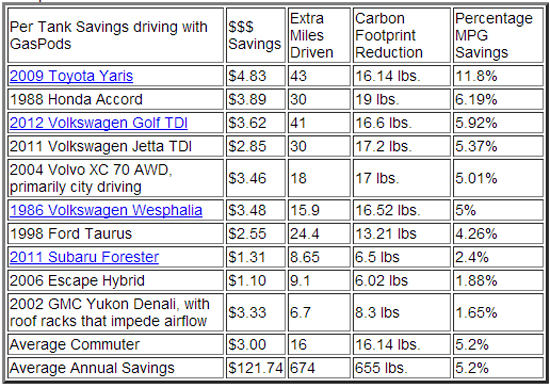
    GasPods - Fuel Savings Chart

    This chart shows some real-world testers results. Some of the results are significant while others not so much.

    It does seem really interesting that these GasPods are so similar to the new aerofin ideas that Toyota is employing. This idea could be a part of the larger fuel savings goal in full-size pickups. While we realize that not everyone that drives a pickup cares about MPG, there are many owners who do. By using this idea and others like the new eVOLVE tires, significant fuel savings could finally be realized. The problem is that nobody really knows for sure since there are so many different, new ideas that have yet to be combined into a real-world test.

    What do you think of these new GasPod innovations? Could simply adding these to your truck improve your MPG?

    Related Posts:

    The post GasPods – Saving Fuel with Roof Attachments appeared first on Tundra Headquarters Blog.

  • The state of cleantech venture capital: what lies ahead

    In late 2011 I decided to write up an internal analysis I’d done at Venrock about the state of cleantech venture capital and make it available broadly. I’m a fact-based, research-driven guy, so I tried to shine the light of data on myths and realities in the field. My macro conclusion was that while it was really early, investment returns to date were on par with VC overall.

    Much has changed since then. With 2012 numbers done and dusted, I figure it’s time to revisit this topic – again, under the light of data. I’ll frame this analysis with the questions I’ve gotten from VCs and entrepreneurs who’ve asked me for an update.

    What’s happening to cleantech venture capital?

    It’s receding.

    TSOCVC_fig1

    • Investment fell 30% in 2012 – and even further at the early stage. The Moneytree survey numbers had cleantech VC investment falling from $4.6 billion in 2011 to $3.3 billion in 2012 – a 28% drop. Further, they showed first-time funding of new start-ups plummeting 58% to just $216 million, and shrinking as the year progressed: By Q4, first-time funding was just 4% of capital invested.
    • Limited partners are backing off. VC firms get the money they invest from limited partners (LPs) like foundations and pension funds. Last December Preqin called up 31 LPs that were invested in at least one cleantech-focused fund and asked if they planned to back any new ones in 2013. Only 22% said yes (down from 31% a year before).
    • The people are changing. Many VC firms parted ways with their cleantech teams in 2012. While February’s ARPA-E conference had a record number of attendees, venture investors were scarce – replaced by a bumper crop of corporate types.

    Why is this happening?

    Cleantech VC performance is substantially lagging venture capital as a whole. This wasn’t true in 2011, but things changed fast in 2012.

    I arrive at this conclusion by comparing two data sets. On one hand, we have data on the interim performance of 19 cleantech-only VC funds as reported by the California Public Employees’ Retirement System (CalPERS), a big LP. On the other, we have equivalent data for the entire universe of VC funds from the National Venture Capital Association. (The data are expressed as “value to paid-in capital, net to LPs,” which means “the current value of the funds divided by the money put into them, accounting for what VCs pay themselves.”) By comparing cleantech-only fund performance with the full VC universe at the same points in time, we can see whether cleantech is doing better or worse than the asset class.

    The answer is that cleantech went sideways in 2012 while VC overall did well. In September 2010, the cleantech VC funds were worth 0.90x the money paid into them while comparable VC funds overall were at 0.96x – roughly the same. Six months later the gap had widened, but both had risen in value and remained within spitting distance. By June of 2012, however (the most recent data available), the cleantech funds had declined slightly while the overall VC universe climbed to 1.23x.

    TSOCVC_fig2

    This is why investment is stalling, LPs are hesitating, and cleantech VCs are thinning: Capital invested in other domains is showing a greater near-term return.

    If minimal money had gone into cleantech, or if the macro environment were rosier, there might be more willingness to forge ahead. But today, fund managers assess the $25 billion worth of cleantech VC invested since 2003 against a backdrop of shale gas and climate apathy – and tighten the purse strings.

    OK, but why is that happening? What’s driving weak cleantech VC performance?

    Two factors. First, there have been too few exits.

    Let’s consider the gold standard of VC wins – an IPO on a major exchange. When I last did this analysis, cleantech was overperforming on the IPO front: In 2009, 2010, and 2011, cleantech’s share of VC-backed IPOs exceeded its share of VC funding. (Note: One must apply an appropriate time lag applied to the latter – I used five years, which is informed by deal-by-deal fundraising data by cleantech start-ups).

    This ended in 2012. Just as in the prior year, three cleantech IPOs took place out of about 50 VC-backed IPOs in total (6%). But cleantech’s corresponding share of VC funding rose to 10% – so cleantech was now underperforming on exits relative to capital invested, instead of overperforming.

    TSOCVC_fig3(Of course, most VC-backed companies exit through acquisition, not an IPO. But the M&A front looks no better for cleantech. When merchant bank Jane Capital counted up every acquisition of a VC-backed cleantech start-up worth more than $50 million in the last 10 years, it found just 27 of them.)

    Second, the winners have disappointed post-IPO. When a start-up goes public, its VC investors rarely get to sell their shares immediately: They have to wait out a lockup period that typically lasts six months. Of the nine VC-backed cleantech start-ups that have done major-market IPOs since 2010 and have been public for more than six months, eight were trading below their IPO price at the 180-day mark.

    TSOCVC_fig4

    In four of those cases, the 180-day share price was also lower than the price at the last venture round. That means VCs who bought shares in that round were under water when the lockup expired.

    So is the pullback in cleantech VC justified?

    Well, it’s certainly expected. The cleantech gold rush of the late 2000s saw hundreds of start-ups funded – many with identical propositions – that greatly exceeded the carrying capacity of their industries: For example, there’s no way that more than a handful of the 219 solar start-ups counted by Greentech Media in 2009 could possibly succeed. This dynamic isn’t unique to cleantech. The Internet VC bubble of the late 90s was the same story, albeit on a much larger scale.

    But just as the boom-and-bust in dot com investment didn’t mean this whole Internet thing was a waste, the same is true for energy and environmental technologies. It’s very likely that multiple billion-dollar companies lurk among today’s cleantech VC portfolios. The question is – given the current retrenchment of capital from the field – how many of them will get the fuel to reach the finish line.

    In the main, energy and environmental start-ups need outsized time, money, and risk tolerance to reach a big outcome. (That’s not true of IT-meets-energy “cleanweb” companies like Opower or Venrock-backed Nest Labs, but it holds for the deep-tech start-ups that comprise most of the category.) As our case study, let’s take First Solar, the pioneering thin-film solar maker. The company’s first instantiation was founded in 1990; it took 12 years to ship a product, was restarted in 1999, and consumed $150 million of equity investment (all Walton family money) before its 2007 IPO. But at that outcome, First Solar was worth $1.4 billion valuing the Walton stake at 8.4x. Two years later at the peak of the solar boom, it was worth 199x!

    If this is what success looks like – that is, if the majority of cleantech start-ups will need more time and money to reach big outcomes compared with VC-backed companies overall – a few conclusions follow:

    • Funds focused solely on cleantech will have a longer and deeper “J-curve” of returns compared with VC as a whole. When they reach the same final return multiple, they will take longer to do so (impacting IRR). Midway through the journey, their performance will look like an “L-curve.”
    • To the extent that cleantech start-ups’ time to exit will be 10 years or more, it’s too early to call success or failure on the current crop – because most of them were founded in 2007 or later. Check back in five years.
    • Because the time frames to an outcome are longer and the amounts of capital required are greater, cleantech investment should be less spikey compared with investment in, say, Internet start-ups. And lo and behold, that’s pretty much what we see:

    TSOCVC_fig5

    Cleantech VC now is like Internet VC in 2001: on the downward slope of a bubble, albeit with a more gradual climb and a gentler descent. Note that Facebook was conceived in 2003 – the lowest point for Internet investing post-bust – and that in 2004, Google’s IPO kicked off the renaissance that persists today.

    So is the cleantech pullback justified? The data says it’s too early to call. However, it also suggests that the time frame required to reach a conclusion will greatly stretch 10-year closed-ended funds.

    (A diligent reader may point out my own numbers showing that when VC-backed cleantech start-ups have gone public, they’ve mostly done so in less than 10 years. My take is that most of these companies were rushed to public markets before they were ready – explaining the awful aftermarket performance.)

    What happens now?

    Cleantech innovation is about to take a walk in the woods. Justified or not, the established path of VC-backed investment is narrowing for a generation of start-ups. Some of those companies – and some of the investment managers that have backed them – will break off into the wilderness to find a new route.

    In this environment, I see opportunities in:

    • Selective recaps. About 270 cleantech start-ups can be characterized as “late stage” (they’ve raised Series C rounds or later). Of those, about 150 have demonstrated proof of economics and are focused on scale-up. If capital keeps receding, there won’t be nearly enough money to fund them to exit – enabling savvy late-stage financiers to pick off the best of the bunch in recaps that reap disproportionate returns. In 2011 I thought this capital gap wouldn’t persist, because the likes of VantagePoint and Silver Lake Kraftwerk were out raising huge funds aimed at it; the failure and scale-back of those efforts leaves the opportunity open.
    • Cross-border plays. The U.S. dominates cleantech innovation, but China and other overseas nations dominate deployment. New vehicles are mobilizing to provide cleantech equity investment coupled with cross-border JV creation and operational help – including Formation8 and a stealth-mode firm I can’t reveal.
    • Strategic investment, rethought. Large corporations in industrials and energy have strategic motivations to foster cleantech start-ups: The likes of GE and General Motors want an innovation pipeline, while utilities want a stream of new equipment to rate-base. Institutions are forming to organize this activity in a merchant banking model, like Broadscale at the late stage and OnRamp Capital at the early.
    • Foreign techno-colonialism. While U.S. investors bemoan a lack of capital for cleantech, many foreign institutions are awash in it – and view American assets as being generally cheap. To U.S. start-ups, they will play a role somewhere on a continuum between savior (e.g. Japanese trading houses bankrolling cleantech start-ups to get the inside track on project financing) and reaper (e.g. Wanxiang’s A123Systems deal).
    • Philanthropic capital. The cleantech projects that would most change the world – think electrofuels, solar antennae, advanced nuclear power – are also the least likely to be funded, because they combine long time frames with extraordinary risk. There is a case to be made for impact investment in these fields using philanthropic capital as a charitable activity. A new effort called PRIME, backed by four visionary family foundations, is leading this charge.

    It’s hard out there for cleantech. The woods are scary and the journey is uncertain. But pioneers are charting a new path through the thicket – blazing trails that others will follow.

    Matthew Nordan (@matthewnordan) is an energy VC investor at Venrockone of the oldest and best-performing VC firms. Earlier, he co-founded and led the energy tech analyst firm Lux Research and forecasted technology futures at Forrester. There’s more where this came from at mnordan.com.

    Related research and analysis from GigaOM Pro:
    Subscriber content. Sign up for a free trial.

  • Senator Whitehouse’s Duplicitous Carbon Tax Amendment

    Last weekend the Senate rejected an amendment to the FY 2014 budget that would have enacted a carbon tax. For those interested in affordable energy and job creation, this was a good thing. Still, it’s worth walking through the actual …

  • Understanding the Stages of Retail

    When Ron Johnson took over the helm at J. C. Penney in November 2011 with a mandate to turn the ailing retailer around, all eyes were on him. He had an amazing legacy: Senior VP of Retail Operations at Apple pioneering the concept of the Apple Retail stores and the Genius Bar. Before that, he was the VP of merchandising for Target (or “Tar-jay”).

    And indeed he had a very innovative strategy for J. C. Penney: get rid of nonstop price promotions and introduce boutique “stores within the store.” Surrounding these shops would be wide aisles that Johnson called “streets” that would feature coffee and ice cream bars and places to surf the internet, and all of this would surround a town square for in-store activities and events. Much has been written about the faulty implementation of this strategy. Consumers failed to understand the confusing new pricing, the new stores could not be constructed quickly enough, and sales and stock price declined precipitously. Indeed, more than a year later, there have been numerous articles suggesting that Ron Johnson should be fired.

    As J. C. Penney’s sales declined, Costco’s sales increased. Recently, Costco reported a 39% jump in quarterly earnings. Costco’s CFO, Richard Galanti stated, “People are eating in more and looking for fresh food, which, along with [our] low gas prices, is what are driving people into our stores more often. Then, once they are inside, they pick up a sweater or a new television.”

    Both this success and the failure stem from the same insight about consumer behavior. Consumers do not just wake up and make a purchase. The purchase process is staged. First, consumers recognize a need, then they search for information about products that might solve that need, they create a consideration set, and finally make a choice. That the purchase process is multi-staged is something we’ve known for years, but in this new age of radical change in retailing and hyper global competition, it is easy to forget the basics. While Costco understood food and gas were critical needs driving people to the store, Ron Johnson forgot that it was the prospect of a sale or a steep discount that drove J. C. Penney’s customers to the store.

    Similar successes and failures can be observed at the information search stage of the purchase process. Best Buy learned this the hard way. Best Buy sales were hurt significantly by consumers who used their big box stores as a showroom to learn about various products that were then purchased for a lower price using the Amazon.com app. Best Buy has recently instituted a “lowest price guarantee” strategy to try and thwart this debilitating behavior.

    On the other hand, Warby Parker used the need to search for information about their product — eye glasses — as a strategy to build loyalty. Warby founders started their business because they recognized that eyeglasses that almost always sold in offline retail outlets were marked up 10-20 times from manufacture to sale. If consumers would buy eyeglasses online directly from them, Warby could eliminate much of the retail markup. But the problem was that purchasing eye glasses can be a daunting task, and consumers search for information in the eyeglasses store with the help of sales experts to guide them. To solve this need for social interaction, Warby invented the “home try-on” concept: their customers can try up to five frames at home for free for five days. This eliminates the need for the in-store expert; consumers can ask their friends, wear their glasses around, or post pictures on Facebook and get reactions. In this case, the information search stage was used as a differential advantage to build allegiance to Warby.

    And the purchase/use stage can also be reimagined. There are multiple new businesses that have recognized that consumers sometimes would rather rent a product than buy it. Zipcar reimagined having a car in the city. Why buy one if it is easy to rent one for several hours, just when you need it. Rent the Runway figured this out with special clothing. Since customers were only wearing the dresses once, renting them made sense. Not a new concept — renting formal wear is an idea that has been here for awhile — but a new execution. And the realization of how consumers want to purchase a product — i.e., temporarily rather than permanently — is building sales at Rent the Runway and destroying sales at traditional department stores.

    The bottom line is that understanding that the decision process is staged is fundamental to understanding how people buy. These stages can be executed by different people, at different times, and at different channels. And understanding consumer buying behavior is fundamental to generating sales. It’s an easy concept, but it’s shocking how easy it is to forget.