Blog

  • EMC to bring out enterprise version of its Syncplicity file-sharing service

    Storage vendor EMC is establishing an enterprise edition of its Syncplicity file-sharing Software as a Service, less than a year after EMC acquired Syncplicity.

    EMC is aiming the new product at companies with more than 25 users. It can work with cloud-based storage and on-premise storage appliances such as EMC’s Isilon network-attached storage and Atmos object-based storage. That could make Syncplicity’s Enterprise Edition an appealing option for IT administrators who want to support the bring-your-own-device trend with a simple user interface but don’t want to worry about the security implications of using Dropbox and other offerings.

    Companies that use EMC’s Documentum enterprise content-management software can also sync files in the Syncplicity Enterprise Edition. Syncplicity keeps a customer’s data centers in multiple geographies automatically updated, and users access files from the nearest data center to keep latency low.

    Instead of requiring customers to pay a different amount of money each month to reflect elastic use of storage resources the way Amazon Web Services does for its Simple Storage Service (S3) and other products, Syncplicity customers pay based on the number of users — a more palatable option for larger businesses with hundreds or thousands of employees, said Jeetu Patel, Syncplicity’s general manager.

    While EMC might have wanted to have a product for small businesses in its line when it bought Syncplicity last year, it’s not surprising to see the company create a version that makes sense for large businesses, too. EMC is no Box, much as Box wants to add enterprise customers. But now it comes closer, by crossing ease of use with the security advantages of on-premise deployments.

    Related research and analysis from GigaOM Pro:
    Subscriber content. Sign up for a free trial.

  • Interim Report for the Triennial Review of the National Nanotechnology Initiative, Phase II

    Final Book Now Available

    Nanotechnology has become one of the defining ideas in global R&D over the past decade. In 2001 the National Nanotechnology Initiative (NNI) was established as the U.S. government interagency program for coordinating nanotechnology research and development across deferral agencies and facilitating communication and collaborative activities in nanoscale science, engineering, and technology across the federal government. The 26 federal agencies that participate in the NNI collaborate to (1) advance world-class nanotechnology research and development; (2) foster the transfer of new technologies into products for commercial and public benefit; (3) develop and sustain educational resources, a skilled workforce and the supporting infrastructure and tools to advance nanotechnology; and (4) support the responsible development of nanotechnology. As part of the third triennial review of the National Nanotechnology Initiative, the Committee on Triennial Review of the National Nanotechnology Initiative: Phase II was asked to provide advice to the Nanoscale Science, Engineering, and Technology (NSET) Subcommittee and the National Nanotechnology Coordination Office in three areas:

    Task 1 – Examine the role of the NNI in maximizing opportunities to transfer selected technologies to the private sector, provide an assessment of how well the NNI is carrying out this role, and suggest new mechanisms to foster transfer of technologies and improvements to NNI operations in this area where warranted.
    Task 2 – Assess the suitability of current procedures and criteria for determining progress towards NNI goals, suggest definitions of success and associated metrics, and provide advice on those organizations (government or non-government) that could perform evaluations of progress.
    Task 3 – Review NNI’s management and coordination of nanotechnology research across both civilian and military federal agencies.

    Interim Report for the Triennial Review of the National Nanotechnology Initiative, Phase II offers initial comment on the committee’s approach to Task 2 and offers initial comments on the current procedures and criteria for determining progress toward and achievement of the desired outcomes.

    [Read the full report]

    Topics: Engineering and Technology

  • Raspberry Pi manufacturing moves to U.K. to meet high western market demand

    Raspberry Pi Manufacturing
    The Raspberry Pi was invented in the United Kingdom and now it’s going to be manufactured there was well. Computerworld UK reports that the Raspberry Pi Foundation has decided to move the main production facility for the Linux-based mini-computer from China to Wales in a bid to meet unexpectedly high demand in western markets. Apparently the foundation was experiencing manufacturing bottlenecks at its Chinese facilities and thus decided to move production closer to home where it will be easier to monitor. The $35 Raspberry Pi has become a surprise hit since its launch in 2012 and has sold around 1 million units in just over a year on the market.

  • Three startups to watch from Founder’s Den spring demo day

    In a refreshing deviation from the 80 companies that generally present at a Y Combinator demo day, only seven companies (plus two off the record startups) pitched to investors and the media at the Founder’s Den in San Francisco on Tuesday.

    Founders Den is “one part co-working space, with 55 to 60 people working here, and one part clubhouse for experienced entrepreneurs,” said Michael Levit, one of the managing partners, and the group hosts demo days about every six months. When I wrote about the group’s last demo day in September 2012, I explained the structure behind the space:

    “The group, which is a co-working space in San Francisco that allows startups to join and collaborate on an invite-only basis, typically picks startups that have already been through other incubator programs like Y Combinator (which was heavily represented among Tuesday’s startups.) Startups selected to join pay competitive prices for the space and gain access to a well-connected community in the city.”

    For its relatively short history and small number of companies per demo day (they’ve hosted about 85 in total), Founders Den has hosted a number of interesting companies. They include Datasift, the Twitter data company that we’ve written about extensively, as well as e-commerce company Wanelo and social video startup Socialcam.

    My colleague Janko Roettgers has written about Movl, the company that provides tools for multiscreen activity on smart TVs. Jeff Roberts wrote for PaidContent about vidIQ, the company that gives enterprise companies a dashboard of tools for YouTube. And two of the company presentations were off the record. But among the other five, here were the three I’d particularly keep an eye on:

    Namo Media

    Namo Media comes from Gabor Cselle, the entrepreneur who presented the slightly tongue-in-cheek app Draw Chat at the last Founders Den event, but is now focused on his “million dollar” opportunity (after auctioning off Draw Chat). Namo Media helps apps do in-stream native advertising, inserting sponsored posts into streams just as Twitter does with promoted tweets or Facebook does with sponsored posts.

    The team mostly comes from backgrounds at Google, working on products like Gmail (Cselle founded reMail, a mail search app that was acquired by Google in 2010). Namo Media just raised a $1.9 million funding round led by Google Ventures with participation from Betaworks, Andreessen Horowitz, Trinity Ventures, and angels.

    Survata

    Survata finds users to complete market research surveys, integrating with other websites to easily acquire responses. The company explained the idea behind its product on its website: “Our customers write surveys, and we find respondents to complete those surveys. But, unlike most market research firms, we don’t use traditional research panels. Rather, we collect survey responses via our partner publishers around the web.” The company’s founders noted that they’re doing surveys for groups like Disney, Microsoft, Harvard, and McKinsey.

    Rollbar

    Rollbar works to help developers find and track errors, installing on sites as “a small library to detect errors and collect context about each,” surfacing the most important issues to the developer’s attention, and then working to understand the problem to find a solution. The company has graduated pricing depending on the scale of operation required.

    Related research and analysis from GigaOM Pro:
    Subscriber content. Sign up for a free trial.

  • Law enforcement groups push law forcing carriers to store all customer text messages

    Carrier Text Message
    In what’s sure to be a controversial proposal, several law enforcement groups are pushing Congress to pass a law requiring wireless carriers to store all their customers’ text messages so they can be accessed by police during investigations. CNET reports that the proposed law is similar to one pushed recently by “a constellation of law enforcement groups, including the Major Cities Chiefs Police Association, the National District Attorneys’ Association, and the National Sheriffs’ Association” late last year.

    Continue reading…

  • Private equity firm reportedly interested in last-minute bid to take Dell private

    Dell Buyout Blackstone
    Private equity firm Blackstone (BX) may be considering a last-minute bid to buy Dell (DELL), according to Bloomberg. Michael Dell and Silver Lake Management have already proposed a $24.4 billion buyout to take the company private, however the deal has been met with backlash from shareholders. Blackstone is said to be considering an offer for Dell higher than the current $13.65 per share offer. Blackstone, Hewlett-Packard (HPQ) and Lenovo (LNVGY) have all reportedly conducted due diligence on Dell, however Blackstone is said to be the only serious contender to counter Silver Lake’s bid. Dell’s board has until March 22nd to examine other options and is allowed to negotiate beyond that date if it receives a “serious” offer. Blackstone has not yet submitted a proposal to the board.

  • Amazon launches “Send to Kindle” button for web publishers and WordPress blogs

    Amazon is now allowing publishers to add “Send to Kindle” buttons to their websites and WordPress blogs, the company announced on the Kindle blog Tuesday. It can be integrated into WordPress blogs as well. The Washington Post, Time magazine and the blog Boing Boing area already using the button.

    Amazon presents “Send to Kindle” as an alternative to read-it-later services like Pocket and Instapaper:

    “The Send to Kindle Button lets you easily send that content to your Kindle to read later, at your convenience. Just send once and read everywhere on any of your Kindle devices or free Kindle reading apps for iPhone, iPad and Android phones or tablets. No more hunting around for that website or blog that caught your eye — just open your Kindle and all the content you sent is right there. The Send to Kindle Button is also great for those who want to collect content from the web to use in work projects, school assignments, or hobbies.”

    The new feature for websites is the most recent in a line of read-it-later services Amazon has launched. Last year, the company announced a “Send to Kindle” button for Google Chrome, and later added support for Firefox. And users can already email files to their Kindles or transmit them using desktop apps. But the browser extensions — and now the web app for publishers — are Amazon’s effort to make the Kindle and Kindle apps an easy way to read all types of content, not just ebooks.

    Developers who want to add the button can do so here, and the WordPress plugin is here.

    Related research and analysis from GigaOM Pro:
    Subscriber content. Sign up for a free trial.

  • Google pitches Nexus 10 as the ideal tablet to help you through pregnancy [video]

    Google Nexus 10 Ad
    People-centric ads have done wonders for Samsung (005930) over the past year and now Google (GOOG) is trying to get in on the action with a new ad for the Nexus 10 that depicts the tablet as a perfect helper for prospective parents. The ad shows two expecting parents using the tablet to help them pick out names, to read books on parenting, to film videos of their baby shower and even to watch relevant comedies such as Knocked Up. While the new ad does fit in with the well-established convention of tablet ads that give laundry lists of applications, it focusses more than most on telling a coherent story and of showing how the tablet can make life easier for people in a specific situation. A video of the entire ad is posted below.

    Continue reading…

  • Meet SnappyTV, the startup behind Twitter’s March Madness video strategy

    When you log on to Twitter during March Madness starting this week, you probably won’t be thinking much beyond the state of your bracket. But if you happen to notice video replays showing up in your feed, they’ll be coming from the technology platform built by SnappyTV, the little startup at the heart of Twitter’s video advertising strategy during one of the biggest sporting events of the year.

    We’ve heard a good deal over the past year or so about Twitter building up advertising opportunities as well as multimedia content, and now it’s all coming together during March Madness. SnappyTV will bridge the tech gap between Twitter and Turner Broadcasting to create new opportunities for advertising revenue around the second screen television experience, providing short highlight videos throughout the entire basketball tournament.

    Twitter is clearly interested in making money from social TV, as it demonstrated with the Bluefin Labs acquisition, so this partnership is a window into what that concept could look like.

    We covered the news about the partnership on Monday that was first reported by USA Today, but today I spoke further with SnappyTV CEO Mike Folgner about the technology involved in his platform and how it presents opportunities for both the basketball fans and Twitter. Folgner built one of the first in-browser video editors with Jumpcut in 2006 before the company was acquired by Yahoo, where Folgner went to become general manager for video.

    The partnership this year will allow editors at Turner TO use SnappyTV’s video-editing platform to put together short, 15-second highlight videos throughout the tournament. Editors with Turner will use both human judgement and an algorithm from SnappyTV that tracks the most-discussed moments on social media to pick the best moments from the games, and less than a minute later, can send out an video with the highlight for people to view and (hopefully) retweet.

    “Let’s say something happens, like there’s a great play, and 20 seconds later, there’s a tweet from the March Madness account with the play. And people can watch it almost instantly and retweet it,” Folgner said. “You just get this really cool second screen experience around Twitter and the game.”

    This isn’t the first year that SnappyTV and Turner have partnered to provide March Madness clips — they actually provided the same function for last year’s tournament. But this is the first year that the videos will be able to take advantage of Twitter cards, which allow you to expand tweets without leaving the main Twitter stream to view content. (Last year the videos were just tweeted out as URLs.) And this is the first year that Twitter has found advertisers specifically for those video — AT&T and Coke Zero will be sponsoring them.

    “The real difference with this year is now these advertisers who are buying these key TV shows, now they have the opportunity to buy the social conversation around the shows as well. And there really hasn’t been that connection before,” Folgner said. “People watch TV and talk about it on Twitter. So by sending the video out, you connect the brand advertisement on television with the branded content on Twitter.”

    Users watching from the March Madness app (available mainly to existing cable customers) will be able to see the social conversation around the games, as well as the highlight videos they’ll be able to replay and tweet out. While the number of videos per game will vary, SnappyTV estimated that it would be about 10 clips per game on the high end. Which, at more than 60 games, is a fair number of video tweets. So you might want to follow the @marchmadness account at your own Twitter discretion.

    It will be interesting to watch how the partnership plays out for this year’s tournament — and if it goes well, just how quickly SnappyTV gets acquired before the next one rolls around.

    Related research and analysis from GigaOM Pro:
    Subscriber content. Sign up for a free trial.

  • Goodbye Yellow Brick Road, SMBs plan to spend much more on tablets than PCs

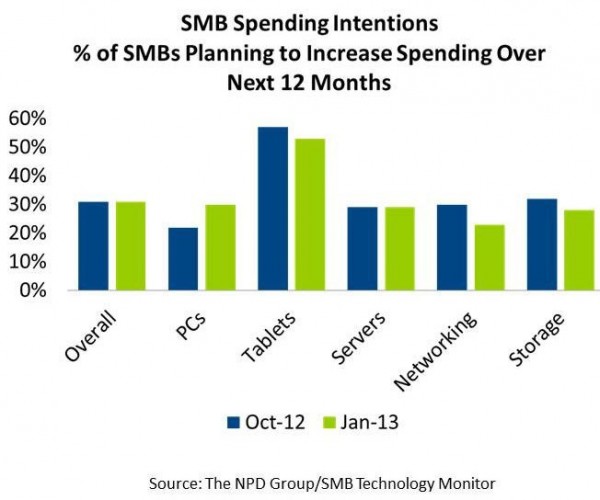
    Keeping with our ongoing “Ding, Dong, the PC’s dead” theme, NPD reports that businesses with 50 to 999 employees will spend more on technology this year. That’s good news for PC manufacturers but much, much better anyone selling tablets — or the ecosystem supporting them. SMBs are suddenly a bright light cast against vast darkness. Yesterday, IDC warned that PC shipments would fall double-digits during first quarter.

    Somebody is buying, at least. Thirty percent of SMBs surveyed by NPD plan to increase PC spending — that’s up from 22 percent just three months ago. Woot! Woot! “PCs are still a core part of the technology arsenal of the typical U.S. corporate employee and a regular rotation of new and upgraded equipment is part of best practices for most mid-sized U.S. businesses”, Stephen Baker, NPD’s vice president of industry analysis, says.

    “The increase in planned spending is likely a combination of the halo effect of new form factors and the upcoming end of official Microsoft support for the Windows XP operating system”, he emphasizes. Yes. Yes. Let’s discuss the form factor thing further. NPD also observes an uptick concurrent with tablet-buying interest (more on that next paragraph). What’s the big, new computer this year with strong small- or medium-business appeal? Surface Pro, baby.

    Nearly twice as many SMBs plan to spend more on tablets than on PCs. Surface Pro appeals to both segments, although NPD didn’t release specific device data. I surmise, of course. Meanwhile, iPad is by far the top-selling tablet.

    Cut differently, the numbers are unsettling. Overall, just 31 percent of SMBs plan to increase IT spending on anything, which is consistent with the previous three-month survey.

    “While a substantial number of mid-sized firms intend to raise their IT spending, it should be noted that almost 70 percent of companies are holding spending steady or decreasing their budgets”, Baker observes. “We continue to see steady spending as the norm during 2013 as cloud and storage requirements, increased penetration of tablets, and the need for a corporate PC refresh force firms to maintain spending levels, even if they are not planning on raising them”.

    Tablets exceed every other category by considerable margin (see chart).

    Dorothy hasn’t exactly dropped a house on the Wicked PC of the West — after all, SMB spending plans are up by 8 points in just three months. PCs are a necessity, but tablets can cost considerably less and offer more flexibility, particularly for smaller shops that need portability over performance.

    Ding! Dong!

    Photo Credit: Helder Almeida/Shutterstock

  • TextMe tries to recreate Skype as a mobile-first app

    When it comes to communication apps we don’t lack for choice. We can message to our hearts content with WhatsApp and make video calls on Tango. And then of course there’s the granddaddy of them all, Skype, which changed how we thought of digital communications. But each of those services has its limitations.

    Those apps — which include Skype, Pinger, WhatsApp, Tango and Viber — are all great apps, said Julien Decot, the new VP of business development and monetization at TextMe. The problem, Decot claimed, is they’re five separate apps, each specializing in a different set of features. TextMe, however, has a plan to combine the best aspects of each of those services into a single multidimensional communications tool.

    Decot spent the last five years at Skype tailoring the VoIP giant’s corporate strategy, and while he believes Skype has designed a juggernaut of a communication platform, it was one that was always optimized for a PC environment. The hole Skype left in mobile was filled led by numerous mobile over-the-top (OTT) communications apps like WhatsApp. What the market needed, Decot said, is a made-for-mobile Skype incorporating the new features of the emerging class of OTT apps.

    Note: This story is just one in an occasional series of stories on important under-the-radar mobile startups.

    Starting with a clean slate

    Julien Decot

    Julien Decot

    Microsoft obviously wasn’t going to rebuild Skype from scratch, but Decot found his new Skype in TextMe, a 2-year-old San Francisco bootstrapped startup, which has already seen 10 million installs in the last two years of its Android, iOS and Windows Phone apps.

    TextMe provides a unified voice, messaging and video chat platform, but it can also reach beyond its own network of users to touch any phone number in the U.S. and more than 40 other countries. It’s designed a device-agnostic platform that can turn any tablet into a phone. And to top it all off it’s created a “freemium” charging platform that allows customers to earn credits for services they would normally pay for.

    One of the most interesting aspects is how it has overcome one of biggest problems plaguing a new over-the-top app developer: cultivating the network effect. To become truly useful, a communication or social network needs a large number of users. TextMe has solved this problem by issuing every user a phone number just as Google Voice does in the PC world. That means any TextMe member can automatically send and receive text messages from any mobile device as well as place or receive calls from any phone — whether or not the person at the opposite end is a TextMe user.

    Of course, not all of the services are free. As with its competitors’ apps, all in-network SMS, voice and video communications are gratis, but TextMe also doesn’t charge for out-of-network text messages to U.S. numbers or for any inbound call, no matter where it originates. TextMe charges for phone calls to non-TextMe numbers, both domestic and international, and this week TextMe this week also introduced a paid international SMS feature.

    TextMe interfaceCustomers start out with 10 free credits, which is enough for a 10 minute domestic or U.K. call or a two-and-a-half minute call to France. TextMe sells credits in buckets: $1 for 40 credits or $10 for a bundle of 500. But the startup also offers ways for customers to earn credits through promotions. If you watch video advertisements or download promoted apps from your devices app store, you’ll accrue credits in one-to 20-point increments.

    “Most of our credits are earned not purchased, but that’s fine with us, as long as it keeps our customers happy,” Decot said. “We get revenue either way.”

    Forget innovation. We need aggregation.

    Like I said before, all of these features are available in one form or another in other OTT apps. Pinger assigns phone numbers to handle its voice messaging and out-of-network texts and calls. Skype and Tango offer in-network video chat, and Skype offers exposure to the wider telephone grid with SkypeIN and SkypeOut. WhatsApp is the king of rich-media mobile messaging. TextMe just wraps them all into a single service.

    TextMe has so far focused its efforts on smartphones, tablets and iPod Touch (effectively turning the Wi-Fi device into a softphone), but the company is exploring PC clients — bringing it full circle back to Skype — and even WebRTC browser-based communications technologies, Decot said. TextMe will even let you make a mobile phone call without a mobile network connection, tapping into Open Garden’s ad hoc mesh network.

    As for competition, take your pick. There is more OTT software in mobile app stores than you can shake a line of code at. The company closest to TextMe’s model, though, is the similarly named TextPlus (formerly named Gogii), which also issues a phone number to each and every user. Last time we checked, TextPlus had racked up 27 million users, and it is even showing signs of adopting an earned-credit charging model via a new partnership with FreedomPop.

    TextMe, though, has stumbled onto an interesting idea. A quick look at my smartphone reveals a miasma of IM, chat and social communication apps. If I wanted to reach out to my wife there are literally 20 different services I could use to reach her. Each of those services offers some kind of compelling feature to recommend it — not only could I call, IM, text or video chat with her I could use an app like Sidecar or Glympse to let her know where I am or where I’m going.

    What I really want is one service that does all of the above.

    Related research and analysis from GigaOM Pro:
    Subscriber content. Sign up for a free trial.

  • A Norwegian startup launches its green data center services

    Norway, known for breathtaking glacier-carved valleys, fjords and abundant hydropower, is also increasingly the home to green data centers that can use the cold air (and water) for cooling, and clean power for electricity. And now a two-year-old Norwegian startup called Fjord IT is counting on the country’s natural environment to help it attract customers to its green data center services, including cloud computing and cloud-based storage.

    Fjord IT has opened up its first data center space, which is a 1,000 square meters (3,280 square feet) pilot project, at the Hogas Industrial Park in Oslo. The space is filled with its efficient cooling technology and is also powered by cheap hydropower, which has a lower carbon footprint than fossil fuel-based power. Those attributes could make its IT services appealing to environmentally-minded businesses as well as businesses in countries that have renewable energy and emission-reduction goals.

    Gallefoss says the company has lined up its first customer in its Oslo space — business software service provider 24SevenOffice — and plans to open another data center space in Notodden, west of Oslo, this summer. The company is hoping to line up $10 million in a second round of funding this year, following a first round of $2.5 million from investors in Europe and Hong Kong.

    Norway fjord

    Gallefoss didn’t want to talk about the cooling technology because he said the company is still applying for patents, but described it as a passive cooling technology that makes use of the cold outside air to maintain a constant temperature indoor. The average temperature of Norway is 7 degrees Celsius (about 45 degrees Fahrenheit). Google and Facebook are using this type of cooling for their data centers in that region of the world, too.

    Fjord IT can keep its operational cost down with the help of the abundant hydropower in Norway, Gallefoss said. Hydropower accounted for about 95 percent of the electricity Norway generated in 2010, according to the International Energy Agency. Retail prices for electricity range from $0.05-$0.10 per kilowatt hour, Gallefoss said.

    Hydropower, being renewable and doesn’t spew pollution into the atmosphere, has become popular for data center operators who want a cheaper, cleaner source of electricity. France-based Internet service provider OVH.com recently opened a data center in Canada that runs on hydropower.

    Iceland also appeals to data center operators for similar reasons. Verne Global has set up a data center in Iceland, and Greenqloud has been selling IT services out of data centers in the country, which runs on hydropower and geothermal electricity.

    Gallefoss said its first data center space can achieve a Power Usage Effectiveness (PUE) of 1.3 while the second one is expected to get PUE 1.05. PUE is a ratio of the power used to run a data center’s IT and servers versus the power for running the entire data center. The measurement is one of the more common metrics for determining a data center’s energy efficiency.

    Germany is the big target market for Fjord IT because the country is keen on reducing its carbon emissions, but for the German market, Fjord IT plans to be a wholesale service provider and rely on its German customers to sell its service. Germany also is the largest solar energy market in the world thanks to government subsidies that pay solar power project owners a premium for the electricity.

    Europe, overall, has set 2020 goals for reducing emissions and making use of energy more efficiently. The European Commission is pleased with the progress it’s making with reducing emissions but not so much with achieving the energy efficiency goal. As a result, it’s keenly interested in IT technology that will help it meet that goal, including the operation of more energy efficient data centers.

    Related research and analysis from GigaOM Pro:
    Subscriber content. Sign up for a free trial.

  • LTE data traffic expected to grow more than 200% in 2013

    LTE Data Traffic
    The United States has outstanding LTE coverage compared to other markets, however worldwide carriers are beginning to upgrade their networks to deliver the high-speed wireless technology to their customers. According to a new report from ABI Research, the total mobile data traffic for 2012 amounted to 13,412 petabytes, an increase of 69% from 2011 when 3G data usage accounted for 46% of all traffic. The accelerated adoption of 4G LTE is expected to increase in 2013, however. The research firm estimates that LTE data traffic will grow an astonishing 207% year-over-year in 2013, compared to 99% growth for 3G traffic. The increase for LTE traffic comes as a result of added 4G deployments in developed markets throughout the world. There are still a number of markets that have not yet upgraded to the technology, though.

  • Intel Capital Invests in Brazilian Big Data

    In the past month, Intel Capital has announced two investments in Brazilian big data and analytics companies. The latest investment came today when Intel Capital announced it backed Geofusion, a Brazilian company providing “geomarketing” data analytics and intelligence to enterprise customers. The amount of the funding is undisclosed. The announcement follows an undisclosed investment it made a few weeks ago in WebRadar, an analytics company delivering operational intelligence for telecom, energy and transportation markets.

    PRESS RELEASE

    Intel Capital Invests in Geofusion

    Leading company in the Geomarketing industry receives investment for business expansion

    São Paulo, March 18, 2013 – Intel Capital, Intel’s global investment and M&A organization, announced a new investment in Geofusion. Based in Sao Paolo, Brazil,    and founded in 1996, Geofusion provides “OnMaps” – a geographic data-based market intelligence, analytics and decision support (“Geomarketing”) platform to enterprise customers of all sizes across a variety of industry verticals.

    The cloud-based OnMap platform combines geographic data with relevant market information, such as industry specific consumption statistics and census-based demographics, offering its customers a suite of cost-effective updated social, demographic and market information via a graphically rich, easy to use web interface. The platform’s robust analytics capability improves the quality of available business intelligence, thereby helping to improve customer decision making on key issues such as placement of key assets, distribution channel coverage and product pricing strategies.

    Geofusion’s platform is able to deliver value by seamlessly combining maps of over 5,000 Brazilian cities with relevant information from over 250 external databases from both public and private sources. The company currently serves more than 200 customers in Brazil primarily in the retail, food service, real estate, education and industrial segments. Well-known customers like McDonalds, Boticario and Coca-Cola FEMSA use Geofusion’s tools to, for example, prepare geographic expansion strategies, analyze performance of specific points of sale, measure consumption potential in specific areas and plan coverage for their sales and trade marketing teams.

    In a single interface, Geofusion’s customers can utilize demographic profiles (social and economic information) and sector consumption data in various geographic scales (from country-wide to city blocks), as well as mapping of retail networks and traffic generation cores. OnMaps allows users to combine this detailed information with their own internal data and intelligence, which can be added to OnMaps to further enhance the information available regarding points of purchase, retailers and territories.

    Intel Capital’s investment will enable Geofusion to expand its go-to-market capability and expand its sales and marketing teams. “Intel Capital’s expertise and resources will help Geofusion capitalize on the momentum it has built here in Brazil.  Companies are searching for data-driven ways to grow sales and increase profitability, by realizing the full potential of their investments across Brazil. The use of Geomarketing tools such as OnMaps is essential for companies to achieve those objectives”, said Pedro Figoli, CEO of Geofusion.

    “We see significant opportunities in the business analytics market in Brazil, where companies are increasingly paying attention to the many ways in which technology can help business,” explained David Thomas, managing director for Intel Capital in Latin America. “Geofusion’s solutions can be useful for a large variety of industry verticals and their software as a service cloud-based business model enables offerings for customers of all sizes, not just large corporations.”

    Joining Intel Capital in this funding round in Geofusion, is original investor Criatec, an investment fund targeting innovative startups whose investors are the National Bank for Social and Economic Development (BNDES) and Banco do Nordeste (BNB), managed by SP Ventures, based in São Paulo. “Geofusion is very well positioned in the current cloud computing revolution. Its solutions bring essential market intelligence tools for companies of all sizes in several different sectors. Even if their client portfolio is currently based in Brazil, we believe their technology will find success in the global market,” commented Francisco Jardim, regional manager at Criatec. Geofusion currently has approximately 60 employees.

    David Thomas is Executive Director for Intel Capital, in charge of all Intel Capital investment activities in Latin America. The Intel Capital team in the region includes professionals Alexandre Villela, Fábio de Paula and Ricardo Arantes, all of based in São Paulo. Alexandre is the Investment Director responsible for Geofusion in collaboration with US-based Investment Director Mark Rostick. Intel Capital has a strong history of activities in the region, with a local presence since 1999 and over 40 investments in Latin America in this period. In 2012, Intel Capital announced seven new investments, six of which in Brazil.

    About Geofusion
    With 17 years of activities, Geofusion is the top Geomarketing company in the country, offering innovative solutions in the areas of market intelligence, expansion, marketing, sales, and others. Using an online platform called OnMaps, the company enables development of customized market analysis, data cross-referencing, audience mapping and features to manage the specific needs of its customers.
    More information: www.geofusion.com.br

    About Intel
    Intel (NASDAQ: INTC) is a global leader in innovation. The company designs and manufactures essential technologies that are the basis for computer devices across the world. More information about Intel is available at http://newsroom.intel.com/community/pt_br.
    Follow Intel Brazil on Twitter: www.twitter.com/intelbrasil
    Like Intel Brazil on Facebook: www.facebook.com/intelbrasil

    About Intel Capital
    Intel Capital, Intel’s global investment and M&A organization, makes equity investments in innovative technology start-ups and companies worldwide. Intel Capital invests in a broad range of companies offering hardware, software, and services targeting enterprise, mobility, health, consumer Internet, digital media and semiconductor manufacturing. Since 1991, Intel Capital has invested more than US$10.8 billion in over 1,276 companies in 54 countries. In that timeframe, 201 portfolio companies have gone public on various exchanges around the world and 317 were acquired or participated in a merger. In 2012, Intel Capital invested US$352 million in 150 investments with approximately 57 percent of funds invested outside North America. For more information on Intel Capital and its differentiated advantages, visit www.intelcapital.com or follow @Intelcapital.

    The post Intel Capital Invests in Brazilian Big Data appeared first on peHUB.

  • HTC confirms HTC One delay

    HTC One Release Date Delay
    HTC (2498) has a lot riding on its next-generation flagship HTC One smartphone, but the company confirmed on Tuesday that the handset’s launch has been delayed. Multiple HTC executives confirmed to The Wall Street Journal that the HTC One will not launch on schedule, citing component sourcing issues as the reason for the delay. “The company has a problem managing its component suppliers as it has changed its order forecasts drastically and frequently following last year’s unexpected slump in shipments,” an unnamed HTC executive told the Journal. “HTC has had difficulty in securing adequate camera components as it is no longer a tier-one customer.” HTC’s marketing chief Benjamin Ho added that HTC expects to start filling preorders by the end of March, with a wider launch to follow “as we approach April.”

  • Fergus Falls is all for Telecommuting

    Last week I wrote about telecommuting in Minnesota, mentioning the move by Yahoo and Best Buy to curb telecommuting in their own offices. I’m not surprised to see others chiming in too – especially in Fergus Falls, a place that has really focused on telecommuting as an economic development strategy. This week the Fergus Falls Journal has run a story on the local impact of telecommuting

    There are about 350 teleworkers in Fergus Falls, and the number is growing, according to Fergus Falls Economic Improvement Executive Director Harold Stanislawski. …

    Stanislawski said he has been in talks with major companies, such as Blue Cross Blue Shield, to expand job opportunities. But while the Twin Cities touts easing traffic congestion as one of the top benefits, Stanislawski puts new job creation at the top of the list. …

    A basic concern for employers is whether or not telecommuting employees will really be working. Stanislawski said research is overwhelming in proving that on average employee productivity actually increases with telecommuting.

    The article cites some of the same advantages I noted for workers – you get to be home for your family and you have access to jobs that may not reside in your zip code. I noted Fergus Fall in my original post too. They really have made a concerted effort to encourage telecommuting. This article mentions a local take on a job listing service designed to help get people telecommuting jobs…

    Mary Robertson reviews telecommuting opportunities for the Economic Improvement Commission’s Telework Initiative in Fergus Falls, and sends out opportunities weekly to those that have signed up for free.

    “We use flexjobs.com because it seems to have the most opportunities, but do encourage people to use minnesotaworks.net too,” Robertson said.

    Using search criteria to view all new jobs in Minnesota that allow telecommuting, Robertson pulled up 1,794 opportunities on her computer. While most were technical positions, there were several opportunities in marketing, writing, social media, sales and customer service.

    Robertson looks at each opportunity to see if it has restrictions, such as a whether a worker must be located in a certain state or area, but until a potential telecommuter contacts an employer, they won’t really know all of the requirements and restrictions.

    Robertson then sends out job listings to the email database.

  • Redbox Instant by Verizon hits Xbox 360

    Way back in the deep, dark early days of Rebox Instant by Verizon, I got the opportunity to take the streaming service for a test drive. We later learned that the service would be exclusive to the Xbox 360 — at least as far as gaming consoles are concerned. That exclusivity begins today.

    Larry Hryb, better known as Major Nelson to Xbox fans everywhere, announces that “the Redbox Instant by Verizon app is available on Xbox 360 now”, though he asterisks this statement with some fine print to let consumers know that they will need that Xbox Live Gold subscription in order to take advantage of the new video-on-demand goodies.

    That is, of course, not the only fee customers will incur here. Like rival Netflix, users also are required to pony up a monthly fee for the streaming privileges. In this case, $8 per month for DVD and $9 for Blu-ray. Before you wonder why those distinctions matter for a streaming service, let me explain. Both subscription models entitle the user to four actual discs per month — you know, the old-fashioned, go to the store and get it from the big red box kind. While that seems very last decade, bear in mind that many movies, especially new releases, are not available for streaming.

    Hryb finishes up by noting that: “As an added bonus, Redbox Instant by Verizon will be unlocked from Gold for a limited time so download it from the Xbox LIVE Marketplace today”. Enjoy it while you can.

  • Space invaders, save us from ourselves! Google adds animated-gif search

    When I first started using the web full time 19 years ago, few pages had movement. Then browsers supported animated gifts, which on many sites were gaudy things. You could count on them to add a touch of crass, no class, to any webpage. MySpace anyone? My disdain, and I’m not alone in this, for animated gifs goes back nearly two decades.

    Funny thing, the moving clips are in-style thanks to better authoring tools and social sharing. Many animated gifs are still gaudy, but who really minds getting one as a joke from friends. Now they’re easier to find using the planet’s most popular search engine.

    “Starting today, there’s an easier way to unearth those gems: when you do an image search, click on ‘Search tools’ below the search box, then select ‘Animated’ under the ‘Any type’ dropdown box”, according to Google.

    The search and information giant calls animated gifs the “de facto standard for short animations on the web”. Cough. Cough. Someone save us. But I must confess to having a good laugh (and wasting too much time) clicking “Grumpy Cat” animations from Google search. In December, I named the beast “Meme of the year” for 2012.

    Google does more: “We’ve also added a second handy filter: if you’re after the perfect picture of Easter basket clipart (goo.gl/XutAa) but must have one with a transparent background, simply select ‘Transparent’ under the ‘Any color’ dropdown box”.

    Well, Google search respects few copyrights anyway. So right now, alongside farting cats for your Facebook Wall, you can steal transparent gifs, too — and dress up your social network feed, Tumblr or other online presence.

  • Samsung to unveil Smart TV at press event tomorrow in New York City

    Samsung Smart TV
    Samsung will be holding a press event tomorrow morning in New York City, and according to our sources at Samsung, the focus will be on Samsung’s Smart TV product. We’re told that a performance or two will accompany the Smart TV and home theater announcements in addition to a full presentation from Samsung executives.

  • Bing Tests Authorship-Looking Images In Search Results

    It appears that Bing is experimenting with showing pictures of people in search results similar to how Google does with its authorship feature, but for when results are about a person, rather than written by them.

    Danny Sullivan at Search Engine Land points to some examples where Bing is doing this for results for journalists Kara Swisher and Nick Bilton.

    According to Sullivan, Bing’s Duane Forrester said Bing is considering something like authorship at the SMX conference last week. It’s unclear whether he was referring to this or something separate. As in the Bilton example Sullivan shares, Bing is not always showing images of the person when it is showing these images. In one case from that example, Bing was simply showing an image from the article.

    Here are a couple of the images Bing is showing for Sullivan himself:

    Sullivan on Bing

    Blind FIve Year Old’s AJ Kohn did some additional on what Bing is up to, and found a bunch of sources for results where Bing is showing these kinds of results including: CrunchBase, Myspace, NBA.com, Quora, TED, ESPN, The Canadian Encyclopedia, Amazon, MTV, Last.fm, Forbes, NNDB, Facebook, Twitter, Yahoo Movies, Hollywood.com, AskMen, FriendFeed, TV Guide, and Comedy Central, to name a few.

    According to Kohn, the images show up more often for about pages, which he says, “supports the idea that Bing is looking for high confidence entity pages and not assigning real authorship.”

    Google has been pretty clear that authorship is going to be an increasingly important factor moving forward. It’s no surprise that Forrester hinted that Bing will be working on this too. Perhaps what we’re seeing now will provide a sufficient supplement to whatever they come up with for real authorship.