
Egyptology News Blog, Andie Byrnes
Revoici l’élection de la voiture gay de l’année. Toujours sujet à polémique, ce titre récompense une fois de plus cette année une italienne.
–> Après la Fiat 500 en 2008 et l’Alfa MiTo en 2009, c’est la 500C qui l’emporte cette année, devant l’Aston Martin DBS Volante, l’Alfa Romeo 8C Spider et la Toyota IQ.

-Du côté des marques, c’est Citroen qui est élue « marque automobile gay de l’année », devant Aston Martin, Alfa Romeo et Mini. Notez qu’il n’y a pas Fiat (20ème.) et que donc ici comme ailleurs, chez Fiat, il y a la 500 et le reste…
-Pas inintéressant de voir Citroen ici, voilà qui confirme un peu plus le très profond changement d’image de la marque.

–> Bien sympathique cette élection mais quelques questions tout de même:
-Combien y a t’il de votants? L’association Ledorga, qui organise ce vote ne le précise pas.
-A quoi sert une élection de voiture ou de marque préférée des gays? Il s’agit malheureusement encore d’une manifestation de communautarisme, auquel est très attaché une minorité de cette communauté. Minorité de loin la plus visible. Par contre, quid de l’avis de tous les gays, pas spécialement « branchouilles » et qui se moquent bien de la Fiat 500 ou des autres et roulent en Clio ou en Passat; pour ceux-là ce genre de choses va à l’encontre d’un droit à l’indifférence et est contre-productif… Car dans le même registre, pourquoi pas ensuite la voiture des végétariens, la voiture des fans de Britney Spears, ou bien encore la voiture de l’année des hétéros célibataires accros à la webcam? Enfin bref, pour aller au but, quel rapport entre automobile et ce genre de choix de vie ou de type de nature?…
-Notez qu’aux Etats-Unis, il existe même un magazine Gaywheels. Il fait un boulot très sérieux, mais sa simple existence pose question, même (et surtout) pour de nombreux homos.
–> Pour conlure sur une note plus légère: si l’adage populaire voulant que grosse voiture, petite ….; alors tant mieux pour les gays qui roulent en Fiat 500 !!!
-Les N°2, 3 et 4:


Nouveau: pour profiter facilement et rapidement des notifications de nouveautés sur le site, pensez à vous abonner via Twitter. Chaque modification, nouvel article ou nouvelle vidéo sur notre chaîne Youtube, fait l’objet d’un Tweet immédiat!
By Nicholas Winning
David Blanchflower, a consistently dovish former member of the Bank of England’s Monetary Policy Committee, or MPC, says the rate-setting body missed the U.K. recession entirely and should be disbanded.
“It is now my view that the MPC’s days are numbered, certainly in terms of its remit and probably its membership,” he wrote in a column published in current affairs magazine the New Statesman Tuesday. “After the [general] election we are going to have to reconsider who sets monetary policy.”
Blanchflower said inflation targeting didn’t protect the U.K. from the greatest economic shock of our lifetimes. The MPC’s focus on the consumer price index as a measure of inflation also excluded the major variable that was increasing a lot – house prices, he said.
“The MPC missed the recession entirely,” he said. “The recession was much deeper because of their failure to act. The MPC was asleep at the wheel. Its inability to communicate adequately what quantitative easing is supposed to do suggests it has learned little.”
Blanchflower said targeting CPI alone no longer has credibility. The U.K. should have a system closer to the U.S. Federal Reserve’s broader remit which takes into account employment, stable prices, and moderate long-term interest rates, he said. “The last thing we need is for interest rates to rise any time soon,” Blanchflower said. “Inflation is going to jump in the short term because of the VAT increase, but will then fall back sharply.”
Official data released Tuesday showed the U.K.’s annual inflation rate, as measured by the consumer price index, posted its largest jump on record to 2.9% in December from 1.9% in November due to a cut in value-added tax, a drop in oil prices, and pre-Christmas discounting in stores in the final month of 2008.
Blanchflower is no stranger to MPC or BOE criticism. In December, he accused Governor Mervyn King of keeping vital information from him at the height of the financial crisis, in the aftermath of the collapse of Lehman Brothers. Earlier, he said and the three other external members of the MPC werent kept in the loop during the crisis. We were not told what was happening to British banks such as Northern Rock, Royal Bank of Scotland, Lloyds, Bradford & Bingley or Alliance & Leicester. Or to U.S. banks such as Lehman Brothers or Bear Stearns.”
 Ever since General Motors announced the Volt, people starting talking about pricing and how much General Motors is going to invest to make the car profitable. Well, according to CEO Ed Whitacre, the car might be priced under $30,000, a tag that would bring some profit to General Motors but also make the vehicle affordable to customers.
Obviously, pricing depends on the technology integrated into the car, with some voices hinting that GM could adjust the final price after considering some spec… (read more)

Is quirky director Tim Burton ready to awaken Sleeping Beauty?
Burton’s new version of Alice in Wonderland, starring Johnny Depp and Anne Hathaway, opens in theaters later this year, and the filmmaker is already planning his next cinema spectacular – Sleeping Beauty. The lensman is in talks to bring Disney’s 1959 animated classic back to life as a live-action picture, according to Aintitcool.com.
Burton hopes to tell the classic story through the eyes of Maleficent, the self-proclaimed “Mistress of Evil” in the Disney adaptation, which centers on Princess Aurora.
 The wait for the fourth model of the MINI range is now over, as after two days of teasing and taunting German carmaker BMW decided to reveal, in all its might, the MINI Countryman or, if you like, our good-old MINI with a SAV attitude. The Countryman will hold under its hood a choice of three petrol and two diesel engines, with power outputs ranging from 90 hp (MINI One D Countryman) to 184 hp (MINI Cooper S Countryman).
The later troop is sourced from the 1.6l four-cylinder petrol engine wh… (read more)
 After achieving an all-time record market share of 1.5 percent in the UK last year, the Spanish carmaker is introducing new models on the British market. First among these new introductions is an addition to the Ibiza range, in the shape of the Ibiza FR TDI, available in SC or 5dr bodystyles with prices starting at £16,465 RRP.
However, though the new models are already available for ordering, deliveries are set to begin in March. Both versions will feature climate control, ESP with SEAT’s ne… (read more)
The European Commission published the results of the first JTI Call: 16 projects were approved among which a big vehicles demonstration project “H2Moves Scandanavia”, involving Daimler and Fiat fuel cell cars. Also the third extension of the succesful Hydrosol project to produce hydrogen from solar thermal has been funded. Five projects will tackle fuel cell degradation and lifetime fundamentals. Two projects will work on effivient electrolysers. For more infomation please visit the JTI website
 Michael Schumacher seems to take all details into consideration when preparing his Formula One return in 2010. According to the latest reports from the German media, one of his superstitions might lead to a number change between him and teammate Nico Rosberg for the upcoming F1 campaign.
Until now, the 41-year old German has become title winner in the Formula One Championship only with odd numbers on his car. His first two winning seasons at Benetton saw Schumacher drive a No 5 and No 1 car r… (read more)
For a while now, we’ve tried very carefully to not make the mistake that is common in the press (and among politicians) to assume that “the recording industry” (i.e., the record labels) is “the music industry.” The two are quite different. In fact, by almost every measure, the music industry has been thriving over the past few years, while the recording industry is in rapid decline. And yet, the two are regularly confused. So it’s nice to see a new paper come out arguing that it’s time to stop inappropriately using “the music industry” to only discuss or identify a small subsegment of the overall music industry. This is important — because when you realize that the recording industry is only a piece of the puzzle, it suddenly makes you realize that the RIAA does not, in fact, represent “the music industry” at all, but rather a tiny segment of the industry.
Permalink | Comments | Email This Story
todas las informaciones como costos de alquiler, alimentos me ayudarian !!!
gracias
Espero que gostem do resultado. Sem mais delongas, vamos às fotos:
1.

2.

3.

4.

5.

6.

:cheers: :cheers: :cheers:
 The Chinese attacks on Google and a myriad of other companies seem have had one beneficial after-effect, apart from the fact that it spurred Google to drop censorship in the country, it has helped browser makers get ahead in some markets after it was revealed that a security hole in Internet Explorer was exploited in the attacks. The … (read more)

The BMW 3 Series coupe and cabriolet facelift for 2011 will also get the M-Sport treatment with sports bumpers and side skirts. M-Sport 18-inch wheels are included (19-inch wheels are available as an option), with sports wheels base and xeno lights. No interior pics are available of the 3 series M-Sport, but we can expect the sports style to continue inside with sports seats, alcantara fabric, and black tint. No autobloc differential is included which is a shame, but more details should be released soon. More pics of the new 3 Series coupe and cabriolet are below, with the first official video after the jump.


http://rapidshare.com/files/337608675/old-172_bbs.11nt.com.rar
The suburbs are home to Americas largest and fastest growing poor population, according to a report released today by the Brookings Institution.
The increase reflects continued population growth in the suburbs in addition to the aftermath of the housing bust and the longstanding woes in the manufacturing sector.
The countrys largest metro areas saw their poor population grow by 25% between 2000 and 2008, according to the report, faster than primary cities and well above the poverty growth in small cities and rural areas. As a result, by 2008 large suburbs were home to 1.5 million more poor than their primary cities and housed almost one-third of the nations poor overall, the report says.
Part of this is simple math. The nations suburban population grew 12.5% between 2000 and 2008, compared with 3.9% in primary cities and 2.4% in rural America. Meantime, over the past decade cities have attracted young professionals and empty nesters that tend to be wealthier and whiter.
Suburbs and so-called exurbs — outer lying areas that sit beyond the suburbs but have lots of urban-bound commuters — also have a large manufacturing presence and were ground zero for the housing boom and subsequent bust. This Wall Street Journal story looked at a block in Palmdale, Calif. — an outer lying city in the Los Angeles area — where people are defaulting on mortgages and then renting similar homes for less money.
From the Brookings report:
| Metro Area | 2000 | 2008 | Change |
| New Orleans, LA | 44.7% | 57.7% | 13.0% |
| Cleveland, OH | 45.9% | 55.2% | 9.3% |
| Baltimore, MD | 41.1% | 50.4% | 9.2% |
| Chicago-Naperville-Joliet, IL-IN-WI | 38.9% | 48.1% | 9.1% |
| Detroit-Warren, MI | 45.5% | 54.6% | 9.1% |
| Atlanta, GA | 75.9% | 84.5% | 8.6% |
| Rochester, NY | 47.8% | 56.0% | 8.3% |
| Minneapolis-St. Paul, MN-WI | 46.0% | 54.0% | 8.0% |
| Cincinnati, OH-KY-IN | 62.7% | 70.2% | 7.6% |
| Houston, TX | 41.9% | 49.2% | 7.3% |
| Tampa-St. Petersburg-Clearwater, FL | 62.4% | 69.6% | 7.2% |
| Washington-Arlington-Alexandria, DC-VA-MD-WV | 60.9% | 67.5% | 6.6% |
| St. Louis, MO-IL | 68.5% | 74.4% | 5.9% |
| San Francisco-Oakland-Fremont, CA | 53.1% | 59.0% | 5.8% |
| Seattle-Tacoma-Bellevue, WA | 60.7% | 66.4% | 5.7% |
| Dallas-Fort Worth-Arlington, TX | 41.0% | 46.6% | 5.6% |
| Philadelphia, PA-NJ-DE-MD | 43.9% | 48.4% | 4.5% |
| New York-Northern New Jersey, NY-NJ-PA | 28.9% | 31.8% | 2.9% |
Source: Brookings Institution
What would a world without secrets look like? Thanks to Facebook, we may find out.
Privacy experts continue to watch in wonder as hundreds of millions of adults around the globe do things online that they would never do in person. Facebook CEO Mark Zuckerberg created a stir recently when he offered a simple explanation: He suggested Web users now see privacy as quaint, and = Facebook is creating a new social norm.
If you look at the data, he's right. According to researcher Larry Ponemon of The Ponemon Institute, Facebook has hypnotized even the most private people , an elite group he calls "privacy-centric." They make up only 8 percent of the population. These folks won't even sign up for supermarket loyalty cards, but they will post pictures and tell stories on Facebook. In fact, they are so mesmerized that, untrue to their nature, they don't even spend more time tweaking their Facebook privacy settings than regular users.
"People want to believe they are safe," Ponemon said. There’s really no way to participate in Facebook without self-revelation – it’s baked right into the product, he points out. Without stepping forward, posting pictures, making your identity searchable, and so on, there is no payoff on Facebook. Because of that, Facebook even trumps personal Web pages – people put pictures and stories on Facebook that they’d never post on their own blogs, he said. "(People) like the tool, so they convince themselves there really isn't much risk.”
Privacy and behavioral economics expert Alessandro Acquisti, a professor at Carnegie Mellon University, agrees that Facebook seems to be eroding even skeptics’ concerns about being overly exposed. But he disagrees with Zuckerberg. There's no new social norm, Acquisti said. There's just a grand illusion.
Facebook has managed to convince users of something economists call an "illusion of control," Acquisti claims. Consumers who think they have power over the outcome of a transaction will naturally be overly self-confident. The effect is most obvious in gambling, where a craps player might believe he or she can roll snake eyes just by tossing the dice a little softer, and thus bet a little more. Human beings are easy to sucker into an "illusion of control."
The illusion at work
Here's how it works in the privacy realm: When consumers believe they can control what happens to their personal information, they don't fret about divulging it. Facebook and other so-called Web 2.0 sites, Acquisti says, has given people a false sense of security about the availability of their personal information to others.
How? By standing by while consumers confuse two different privacy issues – divulging information, and controlling the information after it’s divulged. Facebook users indeed have great control over what information they submit to the service – they have complete controls over what they post in their profile, for example (ignoring, for now, the imposter threat). But they have little control over how the data will be used after it's posted to the site. In a recent yet-to-be published paper on the subject, the distinction is described as control over publication vs. control over access.
"People seem to conflate he two issues, so on a psychological level they feel better because they feel they are in control," Acquisti said. "They underestimate the risks of how the data will actually be used." In an experiment, students who had few qualms offering up very personal information — such as how many sexual partners they had — for a Facebook-like service showed far more reticence when told random researchers would be creating a profile for them. While the end result would be the same, the idea of a human handling the information – gave the students pause. Acquisti and fellow researchers Laura Brandimarte and George Loewenstein attribute the cause to losing control over the actual act of sharing the information.
One other possible explanation, however, would be second thoughts because of human involvement. One college technology professor I know asks students on the first day of class to stand in front and show their Facebook page on a large screen to the rest of the class. No one ever does. Students share things online they don’t want to share in person.
Don't mean what they say?
Acquisti’s “illusion of control” theory is one reason for Facebook users’ seemingly incongruous behavior – so many say they are concerned with privacy, but fail to act as if they are concerned. This privacy paradox, however, is best understood through the simplest explanation. Privacy transactions are notoriously difficult to judge. The payoff from sharing a little information today is obvious; the punishment that may happen in the future is not. Giving a supermarket your phone number today might net you a 50-cent coupon on a gallon of ice cream; that’s an obvious benefit. But what is the cost? Reams of junk mail in the future? A health insurance premium surcharge because your grocery store reveals your bad eating habits? It’s nearly impossible to say. And so it is with Facebook – a picture that looks like fun at 22 could be a career-killer at 32. But people rarely make good choices about vague possibilities 10 years away. If we did, there would be no French fry industry.
Sure, Facebook site settings offer some ways to manage who can see the information. But the settings are easy to evade or hack, and Facebook's terms of service can be changed at any time. Not long ago, Facebook friend pictures ended up in personal ads without the users' permission. The ads were pulled, but they represent a small window into big possibilities.
But even if Facebook privacy settings were completely trustworthy, Acquisti argues that a fundamental usability problem skews the service – and all social networking tools – toward privacy-risky behavior. Two years ago, he did research which showed that only 1 percent of Facebook users had even touched their privacy settings. Facebook says that number has now grown to 20 percent, but still, there is an obvious flaw. It’s far easier to share than conceal. It is an order of magnitude easier to upload photos, for example, than it is to hide them from sets of potential viewers using privacy settings. As a result, site users will always overshare.
"Technology has vastly enhanced our ability to disseminate information, but we still lack controls on how that information will be used," Acquisti said. "It’s like we have made faster cars but have been much slower to develop new brakes."
Nothing to hide? Really? How about…
So what? So what if an ex-girlfriend will occasionally bump into a picture of you bumping and grinding your new beau? What, really, is the harm?
Acquisti, like many psychologists, is convinced of the power of secrets – and he’s not anxious to live in a world without them.
"I do believe that inside each of us is an innate need for privacy, and there is a need to share. Right now, technology is much better at making us reveal than helping us maintain privacy," he said.
The human need for privacy is real. While some elements of privacy are relatively recent human developments, fundamental privacy needs have always existed. Nowhere on the planet do humans regularly make love in public, notes anthropologist Helen Fisher in a recent Psychology Today article.
No normal adult shares the same level of intimacy with their spouse, their friends, their colleagues, and strangers on the bus. It’s unhealthy – or just plain strange – to act otherwise, as anyone who’s ever uttered the words “too much information” can attest.
Meanwhile, the ability to keep secrets is a natural part of maturation. Children tell each other secrets to establish friendships. Adults keep secrets to gain advantage in business dealings. Journalists only gain the trust of sources by proving they can be trusted with secrets. Corporations often count secrets – intellectual property – as their most valuable asset.
And yet, the message implicit in avid use of Facebook is the credo of the 30 percent of adults who are privacy complacent by Ponemon’s scale – “I’ve got nothing to hide, so who cares?”
Privacy researchers spare no time in conjuring up doomsday plots in an attempt to make people care.
It’s easy to imagine an Internet predator using details left by kids to attack them (“Hey, I went to Riverdale Middle School, too! I’m sorry you are having a fight with your best friend…”)
Even sharing seemingly harmless details could have some future consequence.
Telling the world that your favorite rock band is the Beatles or Coldplay might seem innocuous enough, but what happens when an employment background firm shows that Coldplay fans who also like 60s music tend to come late to work? No law prevents that.
A slightly less ominous effect of lost privacy, something called “price discrimination,” is already a reality. Retailers have run numerous tests to hone the fine art of overcharging people who say they like something. For example: die-hard Coldplay fans are almost certainly likely to pay more for a new album than casual fans. Most won’t notice when their music retailer of choice slips in a $1 or $2 fan premium.
Data mining for everyone
Until now, practicality has limited these kinds of scary possibilities, says Hugh Thompson, chief security strategist at People Security. Pulling together that much disparate information left all around the Web was a chore only government agencies would attempt. But that’s not true anymore. A host of new software programs aimed at small-time data mining are slowly becoming available. They scour the Web and create dossiers on target subjects in seconds. One, named Maltego, even provides visualizations of data points that connect people and things online.
“The critical barrier is it hasn’t been easy. It is now,” he said. “What was a ‘data wasteland’ is now the richest environment in human history for backgrounding people. “
It’s easy to see risks here. Few would argue with the need to keep medical conditions private, for example. Even exposed salary information, which sometimes is shared widely, can cause serious problems for the victim. Those with high incomes become an easy target for criminals.
But Acquisti conjures up even more fundamental concerns about lazy attitudes towards privacy. Information, he notes, is power.
“The minute someone knows something about you, they gain a measure of control over you,” he says. This is obvious in the case of an affair: If someone learns about your secret lover, they can hold a wide measure of control over your future. In a less obvious way, a future employer who knows that embarrassing Facebook photos from the past are hurting your job prospects can easily gain an upper hand in salary negotiations.
Worse still, the agency which might exercise that power someday might be a government, Acquisti notes. It would not be hard to use Facebook to determine who voted for McCain or Obama in 2008, even who is Republican and who is a Democrat. Maybe that’s okay; but if databases begin to erode the notion of secrets in politics, the election system could erode with it. Secret ballots are essential to a functioning democracy.
And perhaps the political threat won’t come in the United States. Perhaps, someday soon, foreign governments will screen travelers based on political positions mined from social networks.
“I’m worried about control in the future,” Acquisti said. “I feel that we are more and more getting adjusted to the idea that so much of what was done in private in the past is now done in public. I won't be surprised when corporations or governments make more and more claims on data. We are doing things today that 40 years ago we would have reacted by rioting, but now it is business as usual. By accepting these deals now we are paving the way for even more in the future. That’s why people who say they have nothing to hide…that argument is completely wrong.”
Become a Red Tape Chronicles Facebook fan or follow me at http://twitter.com/RedTapeChron
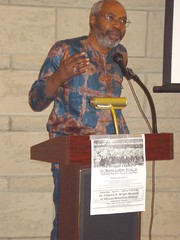
Haiti and the Struggle Against Imperialism
A History of Resistance to Slavery and Occupation
by Abayomi Azikiwe
Editor, Pan-African News Wire
A devastating earthquake struck the Caribbean nation of Haiti on January 12. The quake has left millions homeless and without food, shelter, clothing, medicines and water.
Although various estimates indicate that anywhere between 100,000 and 500,000 people have died as a result of the quake, an accurate assessment of the disaster will take months to fully document. Messages of condolences, support and solidarity have poured into the country from throughout the world.
Various states and organizations have responded to the current situation in Haiti. The Cubans already had over 400 medical personnel inside the country who are now operating field hospitals where care is being provided.
China has sent rescue teams to assist in efforts aimed at finding people trapped under collapsed buildings and homes. Numerous states and non-governmental organizations are on the ground providing assistance to the Haitian people who are exercising a high degree of discipline and self-organization.
Corporate media reports have sought to portray Haiti as a “failed state” with weak or non-existent institutions. The Obama administration’s initiative, which includes the deployment of 10,000 troops and the allocation of $100 million in humanitarian assistance, must be viewed within the broader historical context of U.S. foreign policy toward Haiti.
Despite the pledges of U.S. governmental assistance, which will be coordinated by former Presidents Bill Clinton and George W. Bush, the role of the world’s leading imperialist power overall has not been supportive of the aspirations of the people of Haiti. The U.S. has a history of over two centuries of involvement in suppressing the right of self-determination and national independence of the Haitian people.
The Significance of the Haitian Revolution
Haiti was the most prosperous colony of all the French possessions during the period of slavery. The production of sugar, coffee, and other agricultural products brought tremendous profits to the colonial landowners on the island of Hispaniola, which today encompasses both the Dominican Republic and Haiti. At the time of the uprising on August 14, 1791, which was led by Boukmans, there were over 500,000 African slaves and thousands more free blacks and people of mixed race.
During the rebellion of 1791, over 200 sugar plantations, 600 coffee plantations, 200 indigo plantations were liberated by the Haitian masses. In has been recorded that 12,000 people died during this period including 2,000 European settlers.
The earliest European intervention on the island took place when it was visited by Columbus in his expeditions in the Caribbean during 1492 on behalf of the Spanish monarchy. When the Spanish colonialists occupied the island it already had a population of indigenous people who were divided into five kingdoms ruled by hereditary leaders.
According to Ralph Korngold in his political biography of Haitian revolutionary leader Toussaint Louverture, entitled “Citizen Toussaint, he states that: “When Columbus discovered Haiti, the island, which is about the size of Ireland, had a population estimated at from 1 million to 3 million. When forty-three years later Oviedo visited the island, there were not over 500 of the original inhabitants left.”
Korngold continues to illustrate the degree of cruelty and barbarism exercised against the indigenous people of Hispaniola. The writer says “What could have been the reason for the cruel extermination of a people of whom Las Casas says ‘they never committed against the Spaniards any one mortal offence punishable by the law of man’? The Spanish adventures who flocked to Haiti had only one aim in view: They wanted gold and colonial products.”(Korngold, pp. 5-6)
Competition continued over the three centuries between the French, Spanish and British colonialists seeking dominance over the island. At the time of independence from France in 1804, the island was divided between Haiti and the eastern territory controlled by Spain.
In regard to the fear instilled by the developments in Haiti during the period between 1790s and the first decade of the 19th century, the slaveowners of the United States and the British colonies in the Caribbean saw the Haitian revolution as a serious threat to the slave system. In 1799, the United States Consul General to the French colony in St. Domingo, the part of the island now called Haiti, Edward Stevens, wrote General Thomas Maitland, Commander in Chief of the British Expeditionary Force to the colony, warning that the colony of Jamaica and the United States were in danger of an invasion by the armed forces of General Toussant Louverture.
Korngold noted in his biography of Toussaint said that “Since in 1812 the British did not find it difficult to land an army in the United States, there is reason to believe that with the aid of the French fleet Toussaint could have done the same. He might have proved a more formidable adversary than the British, since thousands of plantation slaves undoubtedly would have joined him.
The writer continues by outlining the plot saying “The invasion plan included seizure of all ships in Haitian waters for use as transports. The American Government took the matter sufficiently to heart to forbid American ships to depart for Haitian ports.” (Korngold, p. x)
After the proclamation of independence on January 1, 1804, the nation of Haiti was subjected to a blockade by France as well as the United States. Because of the French refusal to recognize the Republic of Haiti, in 1825 the Haitians began to pay “indemnity” to the former colonial power for the claims related to the destruction and seizure of the slavemaster’s property during the revolutionary period of 1791-1803.
The defeat of the French in Haiti caused tremendous financial hardships for the colonial power. These events prompted the so-called Louisiana Purchase, enabling the United States to expand its territorial control over large sections of the South and West of the North American continent.
In regard to the United States during the same time period, the political position of the government was exemplified in a statement made by South Carolina Sen. Robert V. Hayne who said that “Our policy with regard to Haiti is plain. We never can acknowledge her independence.” (Haiti: A Slave Revolution, p. 104)
It was not until the period during the U.S. Civil War in 1862 that the recognition of Haiti became a reality. The French maintained economic dominance over Haiti during the 19th century. When the Haitian National Bank was established in the 1880s it was overseen by French officers and financed with capital from the former colonial power.
France remained the principal neo-colonial power in Haiti until the United States invaded and occupied the country between 1915-1934. During this period a guerrilla campaign organized by the Haitian masses was crushed by the U.S. imperialists. Even after the Roosevelt administration withdrew from Haiti in 1934, the U.S. continued to have enormous influence inside the country.
The regimes of Papa Doc and Baby Doc Duvalier further extended the process of labor exploitation and state militarization from the 1950s through the 1980s. The Haitian masses rose up in rebellion in February 1986 and forced the resignation of the Duvalier regime, however, the absence of a well-organized political party or coalition allowed the military to take power over the state.
The social process that unfolded between 1986-1990 saw a sharpening of the political situation inside the country. In 1990 a former priest Jean Bertrand Aristide was elected to office with the overwhelming support of the working class and the poor.
Nonetheless, before the Lavalas coalition could consolidate its hold on power, efforts were under way aimed at regime change in Haiti. Consequently, it was not surprising that President Aristide was overthrown by the U.S.-trained military, which was supported by the American Central Intelligence Agency in 1991.
The Aristide government did not come to power through force of arms and the maintenance of popular para-military and guerrilla strategies. Yet, as soon as Aristide began to send volunteers to Scandinavian countries to train militarily, he was pushed aside by the army and the police, necessitating the U.S. to transport him out of the country into the mainland. Aristide continued to push for the restoration of his government while living in exile in the United States.
A naval blockade of the country during the Bush Sr. administration in 1992, that was designed to prevent Haitians from entering Florida, was continued under the Clinton presidency and is still enforced until this day. The U.S. utilized the re-imposition of Aristide in 1994 as an excuse to continue its racist immigration policy towards Haiti.
Even though Aristide was restored to office in 1994, it was with the understanding that he would only remain in office for one year. Haiti held another election in December 1995 that resulted in the eleciton of Rene Preval. However, the turnout for this election was very low with only 25% of the voters going to the polls.
There were several reasons cited for the paucity of voter response to the 1995 elections. One observation was that the electorate was disillusioned with the agreement imposed on the country by the United States and the United Nations. Many also felt that the elections would not improve the swiftly deteriorating economic conditions in the country, which prompted numerous attempts at commandeering rafters to the U.S. in search of jobs.
Aristide ran again and was elected in 2000 to the great consternation of the United States. In 2003, opposition parties supported by the U.S. engaged in a massive destablization campaign against the Aristide government. This anti-Aristide campaign involved military actions that attacked government offices and resulted in the creation of a coalition of organizations, known as the Group of 184, which opposed the democratically elected ruling party.
On February 29, 2004, President Aristide was kidnapped by invading U.S. military forces and his government was deposed. Under the guise of a humanitarian mission thousands of imperialist troops occupied the country less than one year after the invasion of Iraq. President Aristide was taken to the Central African Republic. A coordinated campaign launched by the International Action Center and the Congressional Black Caucus Haiti Task Force demanded the released of Aristide leading to his re-location in the Republic of South Africa, where he remains to this day.
The Republic of South Africa, led by the African National Congress, was the only state that supported Haiti during its 200 year celebrations in January 2004. The then President Thabo Mbeki traveled to Haiti under extremely dangerous circumstances to participate in the commemorations.
Despite the fact that an aid package for Haiti had been passed by the United States Congress during this period, the Bush administration refused to release the money to the Aristide Government. The U.S. later convinced the United Nations to establish a mission in Haiti where thousands of so-called peacekeepers took over the occupation of the country. Numerous violations of the rights of Haitian people have occurred under the United Nations presence.
The Present Occupation and Need for Another Revolutionary Upsurge
After the coup against Aristide and the occupation of Haiti by the United States, France and Canada in 2004, the MINUSTAH forces targeted the members and supporters of the political party loyal to President Aristide, Fanmi Lavalas. Many of the supporters of President Aristide were harassed, imprisoned, driven into exile and even murdered.
Moreover, the economy of Haiti continued to suffer as a result of the failed policies of the Preval government which faced severe political restrictions imposed as a result of the invasion and occupation of the country. The majority of the people in Haiti still supported Fanmi Lavalas during this period and the scheduled elections of 2007 were postponed due to natural disasters and political unrest in the country.
In early 2008 unrest flared again as a result of the dire economic conditions prevailing in Haiti. This social situation was a manifestation of the deepening world crisis of finance capital that erupted during the previous year in the United States and throughout the capitalist countries.
Food rebellions, strikes and clashes with the United Nations forces and the Haitian police gained international attention during this period. In addition, several hurricanes struck the country resulting in tremendous damage to property and the deaths of hundreds of Haitians.
However, in the early months of 2009, general strikes took place in other parts of the Caribbean under French colonial control. In Guadeloupe and Martinique, workers shut down businesses that are largely owned by the French settlers demanding significant wage increases and the improvement of conditions for the class as a whole. The French dispatched riot police to break the strikes and in Guadeloupe one trade unionist was killed by the authorities.
The strikes and rebellions in Guadeloupe and Martinique exposed the continuing role of French imperialism in the Caribbean. Nonetheless, as a result of the militancy of the trade union organizations and youth on these islands, workers won significant gains in regard to wage increases and the improvement of working conditions.
In Haiti during this same time period, there were mass demonstrations commemorating the coup against Aristide that demanded the return of their legitimately elected president. On the anniversary of the removal of Aristide, 10,000 supporters of Fanmi Lavalas took to the streets demanding an end to the United Nations occupation and the restoration of the elected government that was overthrown five years before.
During March 2009, and less than two weeks after the demonstrations acknowledging the fifth anniversary of the coup, another series of protests took place which sought to lift the ban on candidates who are supporters of exiled President Aristide. A United Nations fact-finding delegation visited the country in an effort to prevent another political crisis from erupting in the country.
According to Haiti Action, a solidarity organization headquartered in the Bay Area of California, “Over 10,000 pro-democracy activists took to the streets of Haiti’s capital, once again, to demand the return of President Aristide, who was kidnapped by U.S. officials five years ago.” (Haitiaction.net, March 12, 20009)
This statement went to say, “While the U.S. State Department assisted its escorts, an assortment of NGO personalities, in avoiding any contact with the largest political party in Haiti, Fanmi Lavalas simply converged on the National Palace from the surrounding neighborhoods.”
While these events unfolded in Haiti, a deportation order in the United States against 30,000 Haitians was opposed by the International Action Center through an online petition drive. In the aftermath of the earthquake on January 12, President Barack Obama temporarily lifted the deportation order pending the outcome of the current humanitarian crisis.
However, as a result of the quake and the presence of U.S. troops, the present situation in Haiti can only be resolved through the independent actions of the masses of workers and youth inside the country. Anti-imperialists and solidarity activists in the United States must demand that the deportation orders be lifted permanently against Haitians.
In addition, those seeking to truly stabilize the political situation in Haiti should demand the restoration of President Aristide to power. In a statement by the President in the immediate aftermath of the quake, he stated from South Africa that he was prepared to return to Haiti as soon as possible.
Haiti should be paid reparations for the years of exploitation and oppression imposed upon the country by the United States, France, Canada and the United Nations. Efforts by the imperialist states has severely hampered the ability of Haiti to become self-reliant and truly independent.
The imperialist-imposed policies directed towards Haiti, which has underdeveloped the country for over two centuries, are at the root cause of poverty and unemployment. The collapse of the agricultural sector derives from the neo-colonial policies designed to preserve the country as a vast reservoir of cheap labor for the capitalist corporations operating in the country.
With the erosion of agricultural production in the rural areas, the masses were forced to re-locate in the urban centers which has resulted in tremendous overcrowding along with an acute shortage of housing. With the earthquake of such magnitude and the efforts of the U.S. to dominate the relief efforts, poverty will inevitably increase in Haiti.
Who will rebuild Haiti and on what basis? Any real progress toward reconstruction has to place the masses of workers and farmers at the center of the process. Although the earthquake has done tremendous damage to the Haitian people and its underdeveloped infrastructure, the current situation provides an opportunity for the workers and youth to exercise independent self-organization based upon its own class and national interests.

 After back in December Japanese trading giant ITOCHU announced an investment of $20 million in battery manufacturer Ener1, the latter and its subsidiary, EnerDel, announced plans to create an advanced battery systems for a residential smart grid energy storage project.
The grid will be installed in a major apartment building near Tokyo, with the support of ITOCHU, marking the second such endeavor from Ener1, after last month’s deal with Mazda for the creation of a similar system.
"T… (read more)
 Although Saab is now involved in a very complicated winding down process, UK dealerships continue to process orders as the US-based manufacturer GM hasn’t provided any information regarding their businesses. As a result, Saab’s production plants in western Sweden will continue to manufacture vehicles until the end of next week, Reuters informed. After that, nobody knows exactly what will happen but more details are expected in the course of this week.
Paul Aukerlund, chairman of Saab’s main u… (read more)
