Blog

  • Why You Should Run Outside, No Matter How Cold it is

    Filed under: , , ,

    Summers are short in Canada and if you hate winter then you live in the wrong country.

    Winter is here; what are you going to do about it? Are you a fair-weather runner who relocates to a treadmill? Does the cold and snow make you want to move all of your exercising efforts inside? Do you want a blankie and a cup of hot chocolate?

    Seriously, with some planning, preparation and mental fortitude you can make the shift from fair-weather outdoor runner to all-weather workout warrior. Admittedly, having access to treadmills with TVs you may wonder about the benefits of getting outdoors when it’s cold enough to freeze Russian vodka, but read on and wonder no more.

    Biomechanical and Metabolic Differences

    Many articles have been written about the biomechanical and metabolic differences of treadmills vs. outdoor running, and the general consensus is that the contrasts are small. The primary mechanical advantages of running outdoors are the addition of wind resistance, and the ability to build muscles specific to going downhill, around turns and on harder or uneven surfaces. Overall, however, a 2008 study by Patrick Riley et al. in the journal of Medicine & Science in Sports & Exercise determined that the kinetics of treadmill vs. outdoor running is very similar.

    Continue reading Why You Should Run Outside, No Matter How Cold it is

    Permalink | Email this | Comments

  • Aid takes center stage in annual education report

    Student groups aren’t the only ones writing Stanford Fund letters to generous alumni — Vice Provost John Bravman and the Office of Development do it every year in the form of the Annual Report on Undergraduate Education.

    The report — separate from the University’s Annual Report, which is created out of the University communications department — tells donors where their money went when they cut a check to the University and provides an opportunity to highlight areas where Stanford would like to invest more money into the undergraduate experience.

    Despite a year of financial belt-tightening, everything about the 2008-2009 Annual Report on Undergraduate Education centers around the new, from the hire of an Earth Systems field program coordinator, to a profile of Stanford’s Arts Intensive summer program, to the just-renovated student residences at Crothers. Even the format of the Annual Report itself — now a “green” 30-page interactive online viewbook — is a departure from past years of a paper-based publication.

    The yearly report — a joint effort by the Vice Provost for Undergraduate Education (VPUE) and the Office of Development — provides donors with a snapshot of key undergraduate programs — crucially, through the lens of donations to The Stanford Fund. It reads like a brochure for prospective students — underscoring a myriad of must-have undergraduate offerings — but with one caveat: If you like these programs, you (the donors) must pay for them.

    Rebecca Smith Vogel, senior director of marketing and communications at the Office of Development, said the Undergraduate Education report is not so much a fundraising strategy as it is a donor update, but the University does highlight some major initiatives and priorities in the report’s pages.

    “In determining which programs to feature in the annual report, we look at allocations that received the most money, and we also try to vary the programs we feature so that donors who are receiving the annual report year after year are getting an opportunity to read about different aspects of the undergraduate experience,” wrote Vogel in an e-mail to The Daily.

    Whereas one year we might focus on the arts, another year we might have more stories that feature work in the sciences or engineering,” Vogel said. “We do try to have something that would interest everyone, so we are aiming to showcase a variety of programs and students in any given report.”

    In mid-December 2009, the Office of Development sent an e-mail to 82,000 undergrad alumni, parents of current students and past donors to inform them about the 2008-2009 Annual Report on Undergraduate Education.

    The 2008-2009 report highlighted three main areas where the University wanted to direct its alumni donations: need-based financial aid, the academic experience and student life. Eighty-two percent of The Stanford Fund dollars were allocated to undergraduate financial aid, 11 percent went to academic experience and seven percent went to student life.

    Financial Aid

    Financial aid, one of President John Hennessy’s highest priorities, moved to the forefront of the outreach message.

    “We have stood by our Financial Aid commitment by using other institutional sources of funding such as The Stanford Fund (annual gift funds) more heavily than we would have if the endowment funds were available,” Karen Cooper, director of financial aid, told The Daily in November.

    After a 27 percent decline in the University’s endowment, 82 percent of the Stanford Fund was earmarked for Financial Aid in 2008-2009 to fill the widening gap. In typical years, about half of The Stanford Fund goes toward financial aid. For 2009-2010, the University projects that 75 percent of The Stanford Fund — 15 million — will go toward Financial Aid. Currently, 49 percent of undergraduates receive need-based financial aid.

    The 2008-2009 Annual Report on Undergraduate Education aimed to personalize the financial aid message by profiling videos of first-time college students like Justin Heermann ’12, who rely heavily on The Stanford Fund.

    “I remember driving down Palm Drive with my dad and seeing the campus open up in front of me, and it got even better when I realized that through Financial Aid, I could actually come here,” Heermann said in a video embedded within the report.

    In the past, the University seemed hesitant to put too much weight on the importance of financial aid. The 2007-2008 Undergraduate Education report stressed that money allocated to increasing access to the University was “more than just financial aid” — and Stanford seemed to follow an approach of actually showing what financial aid does for a student rather than spending time telling donors it was important for its own sake.

    Student Life

    This year’s report also showcased recently completed building plans. The report emphasized that alumni dollars ensured that Stanford students were no longer “stuffed like sardines in a can” due to implementation of The Housing Master Plan, which aimed to create more living space for students. In 2009, Crothers Hall and Crothers Memorial Hall were converted into undergraduate housing units.

    In past years, the University took the approach of profiling a specific student group in the Undergraduate Education report. This year, however, the approach appeared to be a renaissance strategy, showing that the University has it all. The report features an embedded video montage of students saying thank-you from Stanford’s 100-plus registered student groups, from “a cappella to wushu.”

    Academic Experience

    In the academic realm, the new field program coordinator within the Earth Sciences School, Introductory Seminars (Intro-sems) and the Arts Intensive program topped the list for expansions to the undergraduate academic experience.

    The Stanford Fund provides money straight into the coffers of the University’s three undergraduate degree-granting schools: the School of Humanities and Sciences, the School of Engineering and the School of Earth Sciences. The schools then individually determine which department projects to fund with the TSF money.

    The School of Earth Sciences used its 2008-2009 Stanford Fund donations to hire a field program coordinator, Max Borella, to lead outings to Death Valley and Owens Valley and to work with faculty to tailor the undergraduate experience for earth sciences students.

    Intro-sems were also big on the University’s fundraising priority-list. As in past years, they continue to shore up support for the small student programs that were launched under Stanford President Gerhard Casper.

    The report also highlighted the Arts Intensive Program, a three-week immersive experience similar to Sophomore College where juniors and seniors study the arts in the weeks before fall quarter. VPUE launched the Arts Intensive in 2009 with grants from The Stanford Fund and the Hume Endowment for the Arts.

    “Considering the economic times, I am very fortunate to be a part of a community that believes in its youth and in supporting each other,” said Nikesh Patel ’10, a recipient of The Stanford Fund scholarship. “Thank you.”

    VPUE and the Office of Development are hoping donors feel the same way — and write a check to Stanford to show their gratitude.

    In fiscal year 2009, $18.4 million was raised in The Stanford Fund, down from the $19.8 million raised in 2008. The Stanford Fund hit a fundraising peak in 2006 and 2007 at $19.9 million.

  • Women: Zimbabwe’s Unsung Educators

    Women: Zim’s unsung educators

    By Joyce Jenje Makwenda
    Courtesy of the Zimbabwe Herald

    THERE are certain things that we wish to do in our lifetime, but because of circumstances beyond our control, we are sometimes not able to fulfil our dreams.

    Many women wish they could have had access to formal education, knowledge and skills.

    This reminds me of one day when I was on my way to Pretoria from Johannesburg.

    I had decided to take a train and I met immigration officers doing their routine checks.

    One of them asked me for my passport. I gave him the passport and he checked the visa whose condition was “To Study Masters in Music at Wits”. He said: “You are magogo student” (grandmother student). He called some of his colleagues and he said: “Look at magogo student.”

    Some of the officers asked me to sing, but one woman officer who had taken the passport, checked the visa again, while the other officers were asking me to sing.

    I explained to the other officers that the course was not just about singing. It was broader than they thought and singing/performing was just another component of the course.

    When I had finished explaining, the female officer who was quiet all along and had evidently travelled to another world although she was looking at my passport asked me: “Do you think it is possible for me that one day I will also be able to go to school and further my education, like you have done?

    ‘‘I have always wished to further my studies but I wonder if that day will ever come.”

    I was touched and I said: “If you really wish to go back to school, yes one day you will.”

    In one of my articles, I mentioned that I came to understand about music education through my parents who recognised my music talent at an early age, they encouraged me to perform and to take a music course on instrument playing at the College of Music, way back in the 1970s, but I did not then.

    I would have loved to but it was due to circumstances beyond me. In 1984, I was to embark on research and documentation of Zimbabwe township music and my parents gave me all the support as they realised that this was my calling.

    It is because of the research that I had embarked on, on township music from 1930s to today, that saw me lecturing and giving talks at institutions locally and internationally but I still wanted to further my “education”.

    When the opportunity to go to Wits and read for a masters degree came along I was happy to fulfil my dream, although I continued with lecturing in the music and media studies departments.

    I am not the only one who has always wanted to go back to school and advance my education, there are many women who have wanted to fulfil their dreams.

    Littah Hodzi, who went back to school when she was a mother of three, attributes her success to commitment and having focus.

    She did her Junior Certificate in 1976 and 1977, she had to space the course in order to accommodate her children, in each year she wrote three subjects.

    She did her Junior Certificate through correspondence, after that she went on to enrol for some courses so that she could be able to get a job, in order to be financially stable.

    While she was working as a secretary she realised that she needed O-Level qualifications in order for her to climb the corporate ladder.

    By this time she had eight children, and her three older children had finished their O-Levels, and the children became her teachers. “Tendai taught me English, Tsitsi taught me Shona, and Mildred taught me Commerce and I passed the subjects.”

    It is important for women to associate themselves with people who will support them in order to achieve their goals as surrounding themselves with people who do not support them can bring their spirits down and fail to finish whatever they would have endeavoured to do.

    Although she went to night school in order to get tuition, for Littah, her children became her “extra lesson teachers”.

    Alternative ways of learning, like night school and distance education can make it possible for women to get education as they will have time to continue with their lives with little interruption.

    Littah Hodzi did not stop at O-Level but went on to do a Diploma in Personnel Management and another Diploma in Industrial Labour Studies through distance education. Littah Hodzi says she is not going to stop until she gets to university. She had enrolled at one time but had to drop out for reasons beyond her control.

    Obviously, one of the reasons could have been that she failed to make time for school, since she is employed full- time.

    What I do not understand with our higher institutions is that an old woman like her (Littah Hodzi) is required to enrol for a three-year degree and sit in class with someone who has just finished her A-Level.

    This is disrespect by the education system to mothers who have nurtured the nation in order for it to be “educated”. What about the knowledge, wisdom, her experience of going to “school” while at the same time raising eight children, cooking, cleaning the house and also going to work outside the home?

    Is that not a remarkable achievement? Of her eight children, seven of them have degrees and diplomas, and when you talk to them they say that there were inspired by their mother. Is she not a professor?

    Why throw away the education, wisdom from our mothers, because we want to cling to the male-structured education system?

    It is the men mothers have raised who, when they are heading these institutions, craft laws which make it difficult for women to be part of.

    The structuring of our education system is aimed at destroying matriarchal structures by denying women public space, which they can access through high education institutions.

    Zimbabwe has remained a matriarchal society socially because women still teach in the home, but it has not been able to be a matriarchal society politically because of how women are not part of the important structures that run the country, like the education system.

    Are we going to deprive ourselves the knowledge that our mothers have because we look at them as not “educated”?

    This woman is way above the so-called “educated”, in terms of knowledge, wisdom and education.

    Instead she should be teaching in the departments that have to do with her experience or if there are no departments to do with what she has done, they should be created.

    She and other women should go straight to a masters and on an MA research programme and impart their knowledge through writing a thesis, which will be deposited at the university.

    They should also be encouraged to do a PhD, which is basically research and writing, and be given a doctorate. This is not affirmative action, nowhere near it, this is what I call “Mothers Taking Back Their Place in Society to Educate and Pass on Knowledge”. Their lives are enough research.

    The wealth of information these women have should benefit the nation through such programmes and also earning them some degrees. To enrol this woman for a three-year bachelor’s degree seems disrespectful and demoting them from being educators and mothers of our country who have given life to the nation.

    While the mothers are at these higher institutions of learning they will pass on knowledge and also acquire knowledge, it should be a two-way process and by so doing they will feel their worth in society.

    Evangelista Mberi explains education as a basket which includes a whole lot of things, including kukuya dovi (how to make peanut butter from peanuts using a grinding stone). “If you are taught kukuya dovi, then you have been educated in that discipline, that is what education is all about.”

    Our mothers have a basket full of education and knowledge that is waiting to be given away, but they are afraid to “educate” the “educated”.

    The education system should be user-friendly and bring out knowledge from people instead of suppressing it.

    The straitjacket kind of education will not benefit us if we are going to lose the knowledge and information that the older generation has to pass on. We might end up recycling outdated ways of learning that will not help us develop as a nation but only to get certificates, to display and get jobs.

    We appreciate what some universities are doing that of awarding recognition degrees to women who have contributed immeasurably in their particular fields and professions.

    This is very commendable of these institutions as this is a way to acknowledge women’s life achievements. Recently, the Africa Women University awarded recognition degrees to Mavis Moyo and Betty Mutero and others. Betty has contributed immensely in community development and politics, she was the first black councillor in the 1950s in Bulawayo and Mavis has made a name in the media industry and also community development, she is one of the longest-serving journalists.

    One wishes that these women could have their life histories documented as well. Having their biographies documented will help us know how they managed to get to where they are today.

    As they are taking it slowly on their work, this could be the right time for them to write their biographies and the nation can learn a great deal about them. These incredible women should also be invited as guest lecturers at learning institutions.

    I have interviewed Mavis Moyo and Betty Mutero and other journalists and researchers have; they have stories to tell.

    It will benefit the nation if the women could write their biographies, and the relevant institutions fund them to sit down to write, it is for the good of the country and for posterity. Our great-grandchildren need to know about their great-grandmothers and the books they write will add value to our lives.

    Some academics have attained their degrees through our mothers by interviewing them.

    There is nothing wrong with that, but the problem is that their work is part of an exclusive club, which does not reach the general public.

    We would like our mother’s biographies to be accessible across the board, in order to shape the thinking of our society as regards women.

    Women work towards changing the education system in order for you to be recognised for what you have already done, by giving to our nation in order for it to function, your role as educators should not just end in the home but taken to the highest level, institutions of higher learning.

    Women celebrate life, motherhood and womanhood. You are the greatest teachers and great tanks of knowledge!

    –Joyce Jenje Makwenda, a researcher, archivist, writer and producer, can be contacted on: [email protected]

  • Faculty, staff housing sales down for fourth straight year

    A look at year-end numbers for Stanford real estate sales shows a more than 50 percent decrease in single-family residence sales from academic years 2005-2006 to 2008-2009 — down to 23 from 48 — while sale prices stayed within the same ranges as previous years.

    Faculty Staff Housing (FSH), a division of the Office of the Provost, assists eligible faculty and executive-level staff in acquiring permanent housing in the area, including on University-owned land. Most faculty and staff in on-campus housing are found in neighborhoods surrounding the central campus, such as Santa Ynez Street, Mayfield Avenue or condominiums on Peter Coutts Circle or Pearce Mitchell Place.

    In the 2005-2006 academic year, FSH reported 48 sales of single-family residences on campus, including 11 condominiums. By academic year 2008-2009, the total on-campus sales number dropped to 23. As of Jan. 6, 2010, only 10 sales have been made in the current academic year.

    Single-family homes during the 2008-2009 academic year sold for between $1.3 and $2.5 million, whereas condominiums ranged from $350,000 to $840,000.

    In the wake of the housing bubble bust, housing markets in surrounding cities have become noticeably less active, with sales numbers dropping along with home prices, said locals involved in real estate.

    Jan Thomson, Stanford’s FSH manager, explained that the on-campus housing market lags behind the surrounding housing markets, but generally follows outside trends in terms of mortgage rates and other measurements.

    Thomson emphasized, however, that the small campus housing market is likely affected by the limited number of residences available.

    “The [sale] numbers reflect the supply on campus,” she said. “It’s largely dependent on what’s available, as compared to off-campus housing, which has much more available.”

    Thomson noted that declining sales numbers can be partly attributed to the University’s less aggressive recruitment of new faculty because of recent financial restraints. Some rental housing has also been unoccupied, but Thomson hopes to see them occupied in the near future.

    Real estate agents who handle sales on campus agreed that availability plays a large role in determining yearly sales numbers.

    “Clients will look both on and off campus when trying to buy a home in the area,” said real estate agent Monica Corman of Alain Pinel Realtors. “They often end up off campus, simply because there’s nothing available on campus.”

    She noted that faculty and staff who want to reside on campus find “very little inventory” available to them.

    The general market also plays a role; Corman noted that “volume and prices are down everywhere.”

    Coldwell Banker agent Carole Feldstein, who has sold on campus for more than 20 years, said she “has not noticed any trends” specific to the Stanford housing market.

    “Stanford properties follow market tendencies,” she said.

    She said that differences between comparable residences on and off campus depend on available inventory.

    “It would be misleading to generalize about on-campus housing trends,” Feldstein said.

    Looking forward, 39 new faculty- and staff-only residences are in development in the Olmstead Terrace neighborhood near Stanford Avenue, and Olmstead Road sales are expected to begin this spring.

    “The newest housing developments will be very interesting,” Corman said. “The developments are nicer and newer, but higher density. I think it will bring a new energy to campus.”

  • Recalling Cell Block Number One: Abbas Milani’s path from Tehran to Stanford

    After last summer’s anti-government protests following the disputed presidential election in Iran, authorities set up show trials of over 100 alleged opposition leaders. One of Stanford’s own came into focus: Dr. Abbas Milani, co-director of the Iran Democracy Project at the Hoover Institution and director of Iranian Studies at Stanford.

    The statement read that Milani was even more important to the CIA than Shah Reza Pahlavi’s son because of Milani’s close contact with reformists and his position at “an institute called Hooffer”–the most important of the American foundations behind the Velvet Revolution, according to the court’s statement.

    In the U.S., Milani is one of the most respected scholars on Iranian politics. He is the resident Iran expert for The New Republic magazine and has been interviewed on CNN. In July 2009, he testified before the Committee on Foreign Affairs in the House of Representatives.

    His path to success, however, was all but straight. Milani was born into a prominent Iranian family–one uncle a senator, another a minister in the cabinet. At age 15, he was sent to study in the United States and enrolled in Oakland Technical High School, from which he managed to graduate only a year later.

    Milani went on to Oakland’s Merritt College where, as he writes in his 1996 biography “Tales of Two Cities,” the two founders of the Black Panther Party, Bobby Seale and Huey Newton, “gave [him his] first taste of radicalism,” just at the emergence of the Black Power Movement.

    Having transferred to Berkeley in 1968, Milani joined a Marxist student group opposing the Pahlavi regime in power in Iran. He remained stateside until receiving his Ph.D. from the University of Hawaii in 1974, at which point he was ready to return to his homeland.

    “I really wanted to go back quickly to Iran,” he recalled. “I was a radical student. I wanted to go back and make the revolution.”

    In Tehran, he began teaching political science at National University. The revolution that Milani had envisioned, however, never came. Coating his Marxist ideas in metaphors while lecturing, Milani failed to carry on unnoticed. After just two years back in Tehran, he was dealt a five-year prison sentence for opposing the regime, despite his family’s ties in government.

    “In Iran at the time,” he said, “and in Iran today, I think, the one crime that connection cannot solve is political.”

    However, after plea bargaining and agreeing not to attack the regime in a media-packed courtroom, his sentence was shortened to one year. During this time, Milani spent six months in the notorious Evin Prison.

    “Because I was a university professor and came from a prominent family, I was placed in Cell Block Number One, [a division of the prison reserved for special inmates],” he said.

    But despite this, he was granted no special treatment.

    “The head of domestic intelligence told me during one of my interrogations, ‘Don’t think your family can save you. Your ass is mine,’” he recalled.

    At the time, Cell Block Number One held some of the most influential leaders of the revolution yet to come; among them, Grand Ayatollah Montazeri, Ayatollah Rafsanjani and Ayatollah Mahdavi Kani. Milani’s close contact with them turned him into a skeptic of the flowery speeches of democracy that Ayatollah Khomeini delivered from exile in Paris and of the Islamic Revolution itself once it hit the streets of Tehran in 1979.

    “I spent time with these guys in prison. I knew how intolerant they would be,” he said. “I sensed that what was coming was a form of despotism worse than what was leaving us. Mixing religion and democracy would not be an option.”

    Upon his release, the shah’s regime kept barring Milani from the classroom because he was considered a leftist. He believes that the shah’s fear of communism blinded him from the foe that would eventually overthrow him.

    “They thought we–a group of small students–were their main enemy and they allowed the clergy to do anything they wanted,” he said.

    The political science professor also draws a parallel to the Cold War.

    “The US made the same mistake in Afghanistan,” he said. “They thought they could use the Islamists against the Soviet Union and they were successful in doing it. But they created a monster bigger than, or at least as big as, the monster they were fighting.”

    Milani laughs as he recalls the chaos surrounding the hottest days of the Islamic Revolution in ’79. He joined a group of professors with the endeavor of keeping Teheran University a non-militarized zone.

    “People had ransacked army depots–everybody carried a machine gun. Somebody even brought a tank into the University,” he said, pausing with a smile as he remembered the events that followed. “So we asked them to take it out. And they did.”

    According to his students, his apparent ease and lightheartedness are translated into his teaching.

    “[He is] one of the most laid back and personable professors I’ve ever had at Stanford,” said Andi Harrington ’12, one of his students in this quarter’s Polisci 245R: Politics in Modern Iran. “His class offers relief even though the content is so dense through his simple and concise descriptions and of course with a little humor.”

    One of his advisees, Miguel Molina ’11, said that keeping in mind his close interaction with Iranian politics, including imprisonment, makes his impartial work in the classroom all the more impressive.

    “His unbiased scholarship and teaching is remarkable and commendable,” he said. “After each class session, you walk away with the sensation of not just having learned a great deal, but with the intellectual comfort of having the ability of fomenting your own educated opinions.”

    After the Islamic Revolution, Milani went back to teaching, but encountered the same types of barriers to his scholarship that he had under the shah–popularity among students intertwined with suspensions and dismissals.

    In 1986, while Milani sought a second opinion before undergoing open-heart surgery, an American doctor, Dr. Childs at UCLA, said there was nothing wrong with his heart and instead diagnosed the scholar with “Khomeini Syndrome.” Milani understood the time to leave Iran had come once again.

    “I left a job at the top university in the country and came here with no job,” he recalled. “I literally had to work as a bartender initially to make ends meet.”

    The university professor joined the ranks of Spangler’s Bar in Berkeley. Luckily, Notre Dame de Namur University in Belmont, Calif. soon appointed Dr. Milani as Chair of the Department of History and Political Science, where he stayed for 12 years.

    But his longtime comfort at Notre Dame de Namur would soon be briskly disrupted. Milani was again put in the spotlight of Iranian expatriate political life when a group of Persian Americans raised enough money through donations to create the Iran Democracy Project at Hoover.

    Milani speaks lovingly and proudly of the project. Although the Bush administration allocated $75 million in efforts to promote democracy in Iran and, according to Milani, offered him one of those millions, he kindly declined.

    “We decided that we were going to be a grassroots, non-government endeavor and we have remained that,” he explained.

    Only hours prior to speaking to The Daily, Milani went on the Voice of America and addressed this issue of government funding.

    “If you can find evidence that we got one penny from the U.S. government–one penny–I will never utter a word about Iran again,” he stated. He reinforced this to The Daily: “It is absolute, utter nonsense.”

    Khomeini’s government has been the project’s most outspoken opponent, linking it to American imperialism and the CIA. It even named Milani an enemy of the state and now Stanford University is–along with Yale–on the regime’s list of “subversive organizations.”

    The regime that denounced him, Milani explained, is fractured and scared. Even Ahmadinejad’s supporters are leaving what seems to be a sinking ship.

    “They know they are sitting on a seething volcano. They know people hate them,” he said. “Any sudden move can unleash this wrath. If they thought they could’ve gotten away with killing Mousavi [the “runner-up” in June’s presidential election], they would have killed him yesterday. Not only haven’t they killed him, they’ve increased his bodyguards.”

    Even if it wanted to, the Hoover Institution inspiring a democratic revolution in Iran would be a major long shot, if not impossible. But what about a revolution from the Iranian people themselves?

    “Unless people want a potentially bloody civil war, you can’t be looking for a revolution in that sense,” he said. “I think Iran will need a transitional phase before democracy. For that to happen, you need the will of the people and I think we have that.”

  • Students teaching students

    Ever wonder what the deal was with that one-unit class on Disney films being taught by the guy down the hall last spring? Were those fliers a joke or could students actually get academic credit for learning something fun, yet interesting, from a peer? This is just one example of a Student Initiated Course (SIC), a laid-back, discussion-based class option worthy of consideration.

    SICs take advantage of one of Stanford’s most valuable resources–the student body itself. Students have the opportunity to design a curriculum and instruct their peers on a specific topic of interest.

    These one- to two-unit weekly classes taught for credit/no credit cover an eclectic range of unusual–and often under-represented–subjects. This quarter, students had the opportunity to enroll in SICs ranging from “Development and Diversity in Papua New Guinea” to “Discoveries and Debates in Neuroscience Research” to an “Intro to North American Taiko.”

    Jenna Gunderson ’11, an avid sports fan, co-taught a course called “Introduction to American Sports in American Society” last quarter.

    “We thought that some Stanford students might be interested in learning more about sports,” she said. “We thought maybe it would get them pumped for going to different sporting events.”

    Dan Bohm ’10 taught the class with her. Unsurprisingly, he’s also a big sports fan–he writes for The Daily’s sports section and has played and coached different sports throughout his life. In coming up with the idea for the class, both Bohm and Gunderson felt that providing students with greater exposure to sports and their rules, histories and roles in our society might make students more excited about attending Stanford games.

    “We wanted to spread the wealth about sports to a group on campus that we thought wasn’t necessarily as interested as we were,” he said.

    Janani Balasubramanian ‘12 and Matthew Miller ‘12, who are teaching a class called “The Color of Ecoliteracy” this quarter, also wanted to expose fellow students to their combined intellectual passions of racial studies and the environment. They felt that these particular passions were lacking adequate coverage in the available professor-led courses here.

    “We have a lot of really great environmental studies classes and a lot of great classes on race,” Balasubramanian said. “But there aren’t that many classes that deal with both.”

    Miller agreed that SICs like theirs have the potential to provide a more interdisciplinary angle to topics than the typical department offerings might.

    “We feel that a lot of times classes make you fraction off your academic passions and not really deal with the whole equation,” he said.

    One of Miller and Balasubramanian’s students, Rachel Dowling ’10, signed up for the class because of its efforts to synthesize two previously isolated issues.

    “I decided to take this class because there aren’t any other classes that deal with this specific issue,” she said. “It addresses a unique feature of environmentalism.”

    To lead a SIC, teachers-to-be are required to attend training sessions, secure a faculty advisor, fill out an application and prepare for a quarter’s worth of instruction by assembling materials, PowerPoints and discussion ideas.

    According to students who have taken SICs before, their shortcomings are minimal and understandable due to the logistics of these classes; they simply don’t meet that often in any given quarter.

    “For a one-unit class that meets only one hour a week, I thought that most of the drawbacks–lack of coverage of certain topics, for instance–were manageable and understandable,” said Chris Seck ‘10 who took Gunderson and Bohm’s class on sports in the fall.

    Helen Kwan ’11, who took a SIC on Harry Potter her freshman year, had little to say in complaint about her SIC either.

    “Maybe the biggest drawback would be a lack of potential resources that professors have access to,” she stated.

    In addition to providing students with exposure to under-explored areas of interest, SICs also foster a different, more comfortable format of idea exchange within the classroom setting.

    “In most regular classes, the information tends to flow one way–the professor enlightens the student with lectures and stories,” Seck noted. “In student-led classes, the experience tends to be more interactive because the age gap–and experience gap–is not so great.”

  • Mini Countryman leaked pics

    Mini Countryman leaked pics

    Official leaked pics of the Mini Countryman have appeared, only one day after a teaser video of the Mini crossover vehicle. The version of the Mini Countryman seen in these pics is an all-wheel-drive Cooper S, with a new grille and front bumper. It’s similar to the Mini Beachcomber concept seen at the 2010 Detroit auto show, although appears to be slightly more compact, and with a hatch shape closer to the Mini Cooper.

    This particular colour is Pepper White, contrasted with a black roof and blacked out wheels. The mini Countryman keeps the dual exhaust pipes, and has an interior design in classic Mini style, incorporating a speedometer in a centrally mounted position in the dash. It has black seats and white overhead, although the turquoise coloured door and centre trim is a bit bizarre.

    The Mini Countryman won’t officially debut until the 2010 Geneva Motor Show in March, and will be available on the market by the end of the year. It will cost about 25,000 euros, while you can expect to pay about 4,000 euros more for the Cooper S version. Expect to see more details soon, after these leaked pics, and check out the psychedelic teaser video after the jump.

    Mini Countryman leaked pics

    Mini Countryman leaked pics Mini Countryman leaked pics Mini Countryman leaked pics

    Source | World Car Fans


  • 2011 Mustang GT Is the Daytona 500 Official Pace Car

    For the first time in 40 years, a Ford vehicle has been named official pace car for one of the most famed races in the US, the Daytona 500. The Ford in question is a 2011 Mustang GT, a vehicle which, prior to the race, will be auctioned at the 39th Annual Barrett-Jackson Scottsdale Collector Car Auction on Jan. 23, for the benefit of the Juvenile Diabetes Research Foundation (JDRF).

    The Mustang is a preview of the production car which will become available in dealerships later this spring. It… (read more)

  • Lost in frustration

    Photo by Flickr user honikum. Click for sourceNew Scientist has a piece on culture and psychological distress by Ethan Watters, the same chap who wrote the recent and widely discussed New York Times article on the ‘globalisation of mental illness’. This new article looks at similar territory but also pulls out some examples of where concepts and symptoms don’t translate well between different societies.

    The meaning matters as much as the event,” says Ken Miller, a psychologist at Pomona College, Claremont, California, who studied in Afghanistan and elsewhere the reactions to war trauma.

    He found many psychological reactions that were not on any western PTSD symptom list, and a few with no ready translation into English. In Afghanistan, for example, there was asabi, a type of nervous anger, and fishar-e-bala, the sensation of agitation or pressure.

    Giathra Fernando, a psychologist at California State University, Los Angeles, also found culturally distinct psychological reactions to trauma in post-tsunami Sri Lanka. By and large, Sri Lankans didn’t report pathological reactions in line with the internal states making up most of the west’s PTSD checklist (hyperarousal, emotional numbing and the like). Rather, they tended to see the negative consequences of tragic events in terms of damage to social relationships. Fernando’s research showed the people who continued to suffer were those who had become isolated from their social network or who were not fulfilling their role in kinship groups. Thus Sri Lankans conceived the tsunami damage as occurring not inside their minds but outside, in the social environment.

    It’s probably worth mentioning that this goes both ways and there are many everyday psychological concepts in English and Western society that don’t translate well into other languages.

    Some of these become obvious when you read studies that have attempted to translate questionnaires originally in English into other languages.

    For example, here’s an excerpt from a study that translated a mental health questionnaire from the World Health Organisation into Urdu:

    This item [“Do you have trouble thinking clearly?”] presented considerable problems in translation. It measures the disturbance in concentration and cognition associated with depressive disorders. We could not find an exact substitute for the term, “clear thinking” in colloquial Urdu, and the nearest semantic and technically equivalent term that was acceptable in back translation was “wazay soch bichar”

    Unfortunately, it doesn’t say what ‘wazay soch bichar’ is in English, so if you’re an Urdu speaker do get in touch as I’d love to find out.

    It’s also often the case that words such as ‘anxiety’ may have a related word in another language but the sensations associated with it are not the same.

    The New Scientist piece, taken from a forthcoming book by Watters, argues that Western concepts are now being exported around the world and local people are increasingly describing mental and social distress in terms of Western, and particularly, American, diagnoses.

    UPDATE: Many thanks to Mind Hacks reader Matt for getting in touch with the translation:

    i have a translation of ‘wazay soch bichar’ for you. my colleague nasir says the literal translation of it is ‘obvious thinking’ and agrees there is no direct translation of ‘thinking clearly’ in urdu and that ‘wasay….’ is the best available.

    Link to ‘How the US exports its mental illnesses’.

  • Changed Comments From IntenseDebate to Disqus

    I decided to move away from IntenseDebate for my comments, and move over to Disqus. It wasn’t because I was unhappy with IntenseDebate, I just like the features of Disqus better. Some of the cool things you may notice with it is the ability to login to Disqus with your Facebook, Twitter or Yahoo accounts!

    Another thing I like about it is it seems more customizable to me. For instance, for guest commenter’s, I was able to change the generic avatar picture. So now if you leave a guest comment, you have the pleasant image of Bauer-Power Tux!

    Another thing I like about Disqus is that it seems more and more big names are using it. Ping.fm uses it for Media comments, SignOnSanDiego.com uses it as well for article comments!

    Moving over to Disqus is really easy too. They can import all of your Blogger, IntenseDebate, JS-Kit, Movable Type, and WordPress comments!

    Need more reasons to move to Disqus? Here is a list of reasons from the Disqus site:

    Connect Your Conversations disqus

    Sometimes the conversation happens away from your site. That’s OK. Now you can link up with the social web using Reactions, our feature that hooks into results from uberVU and BackType. Seek out social comments and mentions from places such as Twitter, FriendFeed, Digg, and YouTube, then display them with your comments.

    Say Hello to Millions of Commenters

    That’s right — millions of active commenters are already by recognized by the system. Disqus Comments also lets your readers choose their identity, with Facebook Connect, OpenID, or Twitter Sign-in, when they leave a comment.

    Experience Real-time Discussions

    Bring lively, real-time chatter onto your page with real-time posting and updating. With rich interactive features such as threaded replies and comment replies, your discussions never feel dull.

    Spread the Chatter

    Allow your commenters to easily spread the discussion all across the social web, driving new traffic back to your site in the process. Every time someone leaves a comment, they can easily share the discussion happening on your site to friends and followers. Accelerate the distribution of your content by observing how effectively word travels across the Facebook Newsfeed and Twitter stream!

    The Very Best Tools

    Generic content management systems just aren’t built for handling discussions effectively. Our sleek and powerful moderation panel was designed for comments. Features such as multi-site moderation, multiple moderators, bulk actions, and automated decisions make Disqus Comments the most efficient tool for managing a large (or getting-there-large) community.

    Comments Don’t Have to Be Painful

    We’ve all been bitten before. As valuable as comments can be, dealing with them can be a chore. Disqus Comments lets you enjoy the benefits without the need to babysit your site. We use our own proprietary anti-spam that was built and trained to handle the junk some people try to pass off as comments. Disqus VIP also features cutting-edge semantic technology that helps you automatically recognize offensive posts and keep the discussion civilized.

    Know Your Audience, Love Your Audience

    Built-in compatibility with Disqus Profile means that you can encourage verified commenter profiles — real comments from real people. And with global reputation across all sites, you can track influential commenters on and off your site.

    Do you have a blog? Are you using the generic comment system? Have you tried IntenseDebate or Disqus? What do you like best? Hit us up in the comments.

  • TechPunch shows us the REAL CES

    A friend of mine from my previous company named Enrique has joined forces with the folks at TechZulu as a part of of their TechPunch crew. One of the first things they decided to do was to head to the recent CES electronic conference in Las Vegas. When they got there, according to Enrique, CES was all hype, but wasn’t at all what he expected.

    While CES is going on, you see countless internet shows like Tekzilla, G4’s AOTS, and others swarm to CES to show us the latest and greatest in new toys and gadgets. On those shows it looks wild, but according to my friend it is more like a glorified Best Buy. Because of their disappointment they decided to satire their experience.

    From Enrique on TechZulu:

    Simply put, this was the first time Jacob and I had ever been to CES, and honestly – I was expecting a little more than a glorified Best Buy and Radio Shack, sans cash registers. By the middle of the first day, after my awe of “holy moly – that’s a big booth!” wore off, there really wasn’t much else to see… aside from blurry televisions.

    Yes, I understand, 3D is the wave of the future… circa 1950. I get that, and think it’s really neat.

    Here are their videos from CES:


    The Real CES Day 1


    The Real CES Day 2


    If you liked what you saw above, you can keep up with all of their antics over at http://techzulu.com/techpunch. You can also follow them on Twitter @techpunch.

  • Want to Help Haiti? Use This App to Match Photos of Missing Persons

    Yesterday, I opined that not enough social media actions aside from donations actually benefit disaster relief or other humanitarian efforts.

    However, it seems that at least one organization is helping Web users make their time and clicks count for a good cause, and I’ve never been happier to eat my words. The Haiti Earthquake Support Center, a project from The Extraordinaires (more on that later), allows users to make possible matches between submitted photos of missing persons and photos of Haitians post-earthquake.

    Sponsor

    It’s something facial recognition software should be able to do, but in the absence of suitable technology, perhaps the power of human effort and social media will have some positive effects for those searching for loved ones.

    The premise of The Extraordinaires is revolutionary but simple. Organizations can create missions. Users can complete micro-tasks from their mobile devices or computers toward those missions. Currently, the site has around 50 participating organizations and about 6,000 members who have completed in excess of 35,000 micro-tasks. Missions range from mapping safe places for children to play to helping first-aid responders reduce fatalities.

    For this particular mission, photos of missing people are submitted to the site. Then, users are asked to tag images captured during disaster relief efforts. These images are sometimes graphic, depicting the living and dead, the wounded and children. So far, more than 30,000 tags have been recorded. Next, users are asked to spend time deciding whether a particular tagged image matches a photo of a missing person.

    To date, the site has led to only three possible matches between missing persons in Haiti and people in images captured after the Haitian earthquake. Clearly, more users are needed to make this site’s mission a success.

    Finally, if a family member or friend has Internet access, he or she can search for a missing person on the site using keywords that are likely to be used as image tags, such as “male” or “teenager.” So far, 640 such searches have been made.

    We hope that you will take a few minutes (or longer) to use this site yourself and help tag or match images. Also, if you know of similar efforts for social media users to help with disaster relief in Haiti, please let us know in the comments.

    Discuss


  • Goomeo allows local P2P file sharing via WIFI on your smartphone

    goomeo Here is a pretty interesting application that does away with the speed issues associated with Bluetooth file transfer.

    Goomeo lets you share your files with other people using wifi (direct phone to phone) so you can share contacts, MP3’s, playlists, podcasts, videos, pics and other files. It also has a chat feature that lets you text message or voice message (like a walkie talkie) also using wifi over WIFI, which has a 100 m range in free air.  Through Goomeo you can also update your facebook status or tweet and you can provide your location and a meeting point.

    The app is cross platform, but there is an alpha release out for Windows Mobile at present.

    Try the app here and let us know how well it works.

    Via FuzeMobility.com

    Share/Bookmark

  • Bill Gates Joins Twitter and is Following Ashley Tisdale?!

    bill Bill Gates Joins Twitter and is Following Ashley Tisdale?!Well it looks like Bill Gates will now be subjected to Lady Gaga trends, the fail whale, and follow friday because 12 hours ago he finally joined Twitter! His first tweet was “”Hello World.” Hard at work on my foundation letter – publishing on 1/25.” This may just be a jovial way of Bill saying ‘hi’ to his new twitter palls but Hello World is actually an output of a simple program that is taught to beginner programmers. Whether that was intended or not remains to be seen, but knowing Bill – it’s certainly a possibility.  So far it seems Bill has taken a break and his last tweet for the night was “@aplusk thanks to you and all the other people who have welcomed me. I’ve got a lot to learn about Twitter but look forward to sharing more.” and as usual, Ryan Seacrest seems to be blessed, since he got a reply from Mr. Gates as well.  As of 2:49am EST, we followed Bill Gates and his number of followers were bumped from 142459 to 142460. We must point out that one of the strangest people he is following in the midst of the White House, New York Times, and Microsoft is Ashley Tisdale….um, Bill, whyyyy?? I’ll just cough it up to one of your daughters getting a hold of your account…


  • Convert MKV to other video formats like MP4, FLV, AVI, WMV, 3GP, etc.

    Convert MKV to other video formats like MP4, FLV, AVI, WMV, 3GP, etc.

    About MKV files:

    Wikipedia gives an explanation of it as: "The Matroska Multimedia Container is an open standard free container format, a file format that can hold an unlimited number of video, audio, picture or subtitle tracks inside a single file. It is intended to serve as a universal format for storing common multimedia content, like movies or TV shows. Matroska is similar in conception to other containers like AVI, MP4 or ASF, but is entirely open in specification, with implementations consisting mostly of open source software. Matroska file types are .MKV for video (with subtitles and audio), .MKA for audio-only files and .MKS for subtitles only. The most common use of .MKV files is to store HD video files."

    Although MKV files have been one of the most popular video formats, most portable devices, video players, video editors, etc. do not give native supports to them. Therefore, it’s necessary for us to convert this format to many other media formats, so as to play or edit them without trouble.

    How to convert MKV to other video formats like MP4, FLV, AVI, WMV, 3GP, etc.?

    Software you need:

    Pavtube MKV Converter

    Step 1: Click "Add" button to load MKV files.

    Step 2: Click the drop-down list of "Format" to select an output format, which format to select depending on your end use of the generated files. Meanwhile, click the folder icon at the end of "Output" to specify a destination folder.

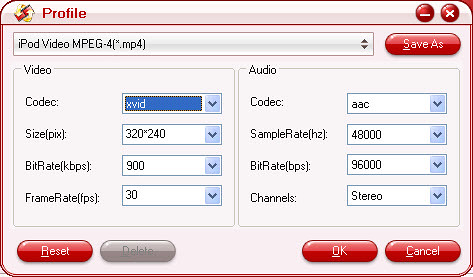
    Step 3: Click "Settings" button to adjust video and audio parameters like aspect ratio, bit rate, frame rate, sample rate, etc.

    Step 4: Click "Convert" button to start conversion.

    Tips:

    1. If you want to combine multiple MKV files to be as one file, please tick the checkbox "Merge into one file".

    2. Click the camera icon, and then you can take screenshot of the playing MKV file, after that, click the folder icon on the right side of this icon to get the screenshots.

    3. Click "Edit" button, then you will be led to the editor interface as below:

    The "Crop" function allows you cutting off black edges and the unwanted areas of the original MKV files.

    The "Trim" function enables you to set the exact duration of the video clip. You can set the "Start" time and "End" time, or you can directly drag the slide bar to the time points as you like.

    Through using "Text Watermark" and "Image/Video Watermark" function, you are able to add your preferred texts, pictures, even GIF animations and videos to be as your watermark, in that way, the "Picture-in-picture" effect will be realized beautifully.

    The "Effect" function permits you adjusting the effects of your MKV files, including "Brightness", "Contrast", "Saturation", and adding special effects like "simple gauss blur", "Simple laplasian sharpen", flip color", etc. to your videos.

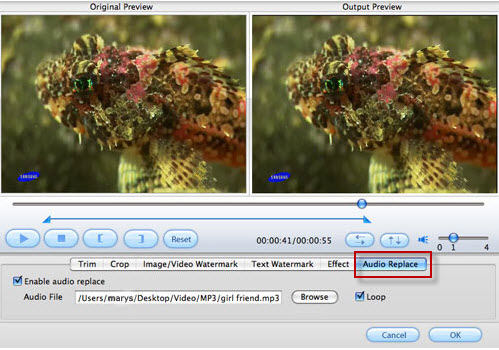
    "Audio Replace" function makes it possible for you to take place of the original audio with your specified audio source.

  • Convert MOD and TOD files generated by JVC camcorders on Windows and Mac

    Convert MOD and TOD files generated by JVC camcorders on Windows and Mac

    JVC camcorder users are usually troubled by MOD and TOD files that generated by their JVC camcorders, because the two formats generally can not be accepted directly by most video players or editors. If you want to enjoy these video files on your computer or portable devices, or even do some further editing with video editing software, you have to convert them to some other common formats previously. This article here will introduce you how to convert MOD and TOD files generated by JVC camcorders on Windows and Mac?If you are in need, please go ahead with it.

    Part 1: About MOD and TOD:

    Both MOD and TOD are the informal tapeless video formats produced by certain digital camcorders. And both of them have never been given to any meaning explanations or official names by their creators JVC or Panasonic. The differences between them lie in: MOD are used by JVC, Panasonic, and Canon in some models of camcorders, such as JVC GZ-MG130, GZ-MS100U, GZ-MG255, Panasonic SDR-SW20, SDR-SW21, SDR-S26, Canon FS100, FS200, FS21 and so on, while TOD is only used by JVC camcorders, like JVC GZ-HD7, GZ-HD5, GZ-HD6, GZ-HD30, and GZ-HD40; Moreover, MOD is only used for standard definition video files, while TOD is exclusively used for high definition video files.

    Part 2: How to convert MOD and TOD files on Windows?

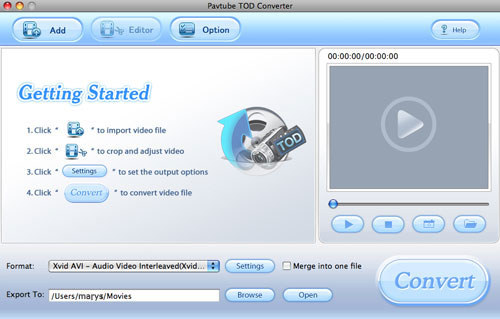
    Step 1: Download, install and run Pavtube TOD Converter

    Step 2: Import video files, select output format and specify store path

    Add your recorded MOD or TOD files to this program, and select whatever formats you need from the drop-down list of “Format”. If you want to play on your cell phone, you can select 3GP; to play on iPod or iPhone, you can select MP4; to share online, you can select FLV. Meanwhile, press output folder to specify where to locate the output files, or you can use the store path set by default. Further more, suppose you need to join several files to be one, you can check “Merge into one file” to realize it.

    Step 3: Set advanced settings:

    You are allowed to do some advanced settings according to your own requirements. In this section, you are able to set parameters for output video, the bigger value, the better quality, but the larger size.

    Step 4: Convert

    Pavtube provides you a friendly interface while converting, and all the conversion info can be found out in the following window, like total progress, the time have spent, the file size have been generated, as well as the possible left time and the entire size probably produced during the conversion.

    Tips:

    1. The converting speed of this software is 1-2 times faster than the similar converters. Batch conversion can be done in a few minutes. Merge multiple files into one file is also available.

    2. It does not have the audio-video sync issues.

    3. With exception of adding text as watermark, images, GIF animations, and videos can also be added as watermarks to realize the picture-in-picture effect.

    4. You can use the “Trim” function to select certain video clips to convert. And you can also take advantage of the “Crop” function to remove black edges or change the screen size.

    Part 3: How to convert MOD and TOD files on Mac?

    Step 1: Download, install and run Pavtube TOD Converter for Mac.

    Step 2: Select formats and do advanced settings

    Add your recorded MOD or TOD files to it, and select whatever formats you need from the drop-down list of “Format”. If you want to edit with iMovie, you can select MOV or MP4; to play on your cell phone, you can select 3GP; to play on iPod or iPhone, you can select MP4; to share online, you can select FLV.

    Meanwhile, you are allowed to do some advanced settings according to your own requirements. For instance, you can reset the screen size or change the bit rate. Increase the bit rate, video quality will be improved, while file size will be enlarged. Decrease the bit rate, file size will be reduced, while quality is inferior to the original.

    Step 3: Export To

    Set which destination folder the output files will be exported to. You can export them to the default path or specify a path to locate them by clicking “Browse”.

    Step 4: Convert

    Tips: Introduce you two more special functions to optimize your conversion.

    Suppose to add logos or images on your videos to show your personalized settings or to reserve your own copyright? The following step will show you the methods of adding watermarks.

    1. Add watermarks to your video

    There are four ways to add watermarks, including adding text, adding images, adding GIF animations, and especially adding videos. Don’t you think a picture-in-picture function is really wonderful?

    2. Audio Replace
    If you want to add some soft music or some other audio resources to match your recorded videos, you can have a try about the function of “Audio Replace” to replace the original audio in your videos. You can click “Browse” to select which audio resources will be used to take place of the original audio.

    Hope this article could definitely relieve your format troubles while handling MOD or TOD video files no matter you are a Windows user or a Mac user. v

  • Kubica Makes Rally Monte Carlo Exit with Engine Failure

    Robert Kubica’s intrusion in the world of rallying lasted only 4 kilometers, as the Polish driver’s Renault Clio R3 suffered an engine failure during the prologue of this week’s Rally Monte Carlo. The round in the Principality counts for the season opener in the International Rally Challenge and was supposed to be Kubica’s first real rally event.

    France’s publication Auto Hebdo reported that Kubica’s miss-happening took place in the icy prologue on Tuesday night, and that the Renault mechanic… (read more)

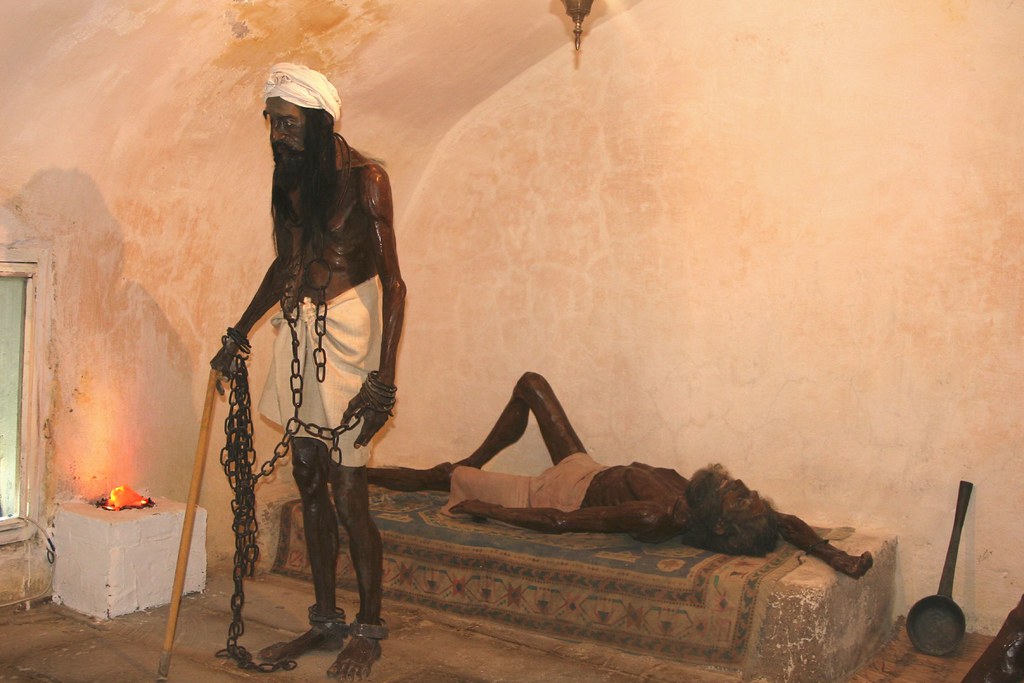
  • The Ateshgah (Fire Temple)

    In Surakhani, there is an eternal fire place. From the ancient times the fire worshippers from remote places and even the Indian priests were coming to Absheron in search of fire and finding it here. They built their main temples here in Surakhani and Ateshgah

    The Baku Ateshgah (Azerbaijani: Atəşgah [1] from Persian: آتشگاه Atashgāh) or "Fire Temple" is a castle-like religious structure in Surakhani, a suburb of greater Baku, Azerbaijan.

    The pentagonal complex, which has a courtyard surrounded by cells for monks and a tetrapillar-altar in the middle, was built during the 17th and 18th centuries. It was abandoned after 1883 when oil and gas plants were established in the vicinity. The complex was turned into a museum in 1975 and now receives 15,000 visitors a year. It was nominated for World Heritage Site status in 1998 and was declared a state historical-architectural reserve by decree of the Azeri President on 19 December 2007.

    The temple was last restored in 1975. Today low, dark cells for monks and pilgrims in the Ateshgah Temple at Surakhany house is an interesting museum, intended to introduce the rudiments of Zoroastrianism to the uninitiated.


    Source: Flickr.com

  • Is the G-Spot a Myth?

    Filed under: , ,


    Have you been looking for your G spot for years with no luck? Are you wondering why it’s proving to be as elusive as the Loch Ness monster? Well, according to a recent study, reported in The Sunday Times by Lois Rogers, that’s because the G spot doesn’t exist. Scientists at King’s College London say there’s no scientific evidence to support the claim that the mythical cluster of nerve endings can be found in any woman.

    So why do so many women claim they have a G spot? And where can you find it?

    Continue reading Is the G-Spot a Myth?

    Permalink | Email this | Comments