
Blog

  • The world is ready for the consumer-grade enterprise

    In the last three decades, we’ve seen a shift in enterprise information technology, from mainframes that automated our financial information, to the client-server and web-based world that aimed to replace most paper-based processes with “systems” like CRM, ERP, e-commerce and email. And now, in the cloud era, we find ourselves on the brink of another transformative shift. This one is driven by the explosion of data and the need for traditional enterprises to find new business value through new business models and building better customer experiences.

    A key question becomes how this shift will become a reality and where we will look for a blueprint to begin. I think the answer, or at least the opportunity to see further, comes from “standing on the shoulders of giants.” And in this case specifically, I’m talking about the consumer internet giants like Google, Facebook and Amazon.

    These companies have created significant new business value and blazed new trails in developing ways to manage and extract meaning from massive amounts of data. As a result, they’re able to deliver meaningful products, features, and experiences rapidly to their customers — essentially,giving customers what they want, when they want it and where they want it. Wouldn’t it be nice for traditional enterprises to have the same capabilities?

    The traditional enterprise must learn from internet technology

    Powered by new data fabrics with custom-built infrastructure, these consumer internet companies interact and serve their customers in the context of who their customers are, where they are and what they are doing in the moment. They are building, deploying and scaling at an unprecedented pace. They are storing, managing and delivering value from large data sets, and they knit all of this together on one unified platform that supports their businesses.

    Structure 2011: Paul Maritz – CEO, VMware

    Paul Maritz at Structure 2011
    (c) Pinar Ozger

    Now add to this mix the emergence of the “internet of things,” the fact that telemetry will become pervasive in coming years. Everything from a fridge to a jet engine will be dialing home in the future, constantly reporting its state. This will drive a new avalanche of data that will arrive in huge quantities and will need to be ingested and reacted to in real time.

    Successful enterprises must become “consumer-grade” in order to win

    Enterprise companies will need ways to store and analyze massive amounts of data cost-effectively, ingest huge numbers of events in real time, reason over the data and events, and react in real time. Teams will need to be able to develop rapidly the new solutions that exploit these underlying capabilities. The need for these capabilities can be seen across a wider set of industries — from industrial control to telecommunications to retail, and even to modern agriculture.

    Addressing these opportunities will require new underpinnings; a new platform, if you like. At the core of this platform, which needs to be cloud-independent to prevent lock-in, will be new approaches to handling big and fast (real-time) data. And history teaches us that when the underlying data fabrics change, a lot else in the IT industry changes, as well.

    “Carrier-grade” or “industrial-grade” — and yes, of course, “enterprise-grade” — once represented best-in-class products and technology while “consumer-grade” was associated with lightweight technology not fit for a professional, high-performance environment. Well, things are changing; the former lightweight is the new heavyweight. Consumer-grade will become the new benchmark.

    Paul Maritz is the former CEO of VMware, current chief strategy officer of EMC and also holds a leadership position with the Pivotal Initiative. He will be part of a fireside chat with GigaOM’s Om Malik on Wednesday, March 20, at Structure: Data in New York.

    Feature image courtesy of Shutterstock user Oleksiy Mark.

    Related research and analysis from GigaOM Pro:
    Subscriber content. Sign up for a free trial.

  • Airport bookstore chain Hudson starts selling print and ebooks online

    Hudson Booksellers, the airport bookstore chain, has launched an online bookstore where it will sell both print and ebooks. The move is intended to induce readers who discover books while traveling to buy them through Hudson once they get home.

    HudsonBooksellers.com is run through the American Booksellers Association’s IndieBound program and sells ebooks through the ABA’s partnership with Kobo. Hudson has 66 bookstores at airports and train stations throughout North America, and sells books at an additional 365 newsstands as well.

    The website focuses on curation — “no impersonal algorithms here” — and features staff picks, an “Ask a Bookseller” feature, a “Rediscover” section for “books you might have missed” and a deal of the day.

    via Shelf Awareness

    Related research and analysis from GigaOM Pro:
    Subscriber content. Sign up for a free trial.

    • Google Flight Search now available for Europe

      Google_Flight_Search_Mobile


      Those of you living in Europe are about to find it just a little easier to search for flights thanks to Google.  The Mountain View giant has released its Flight Search service to those of you living out in the UK, France, Italy, Spain or the Netherlands will be able to utilize the awesome service to not only search for flights, but quickly find, compare and book flights originating from each of these countries to any airport in the world. Additionally, the service will utilize English, French, Italian, Spanish, Basque, Catalan, Galician and Dutch, giving some added ease for most users in that region. Oh and best of all, the service utilizes Google’s simplistic, yet clean and easy-to-use interface— so it should be easy for folks to pick up and start using in no time.

      As previously mentioned, the service is now live for those you of living in Europe, so head on down to google.com/flights and give this service a try today. Trust us— you’ll be glad you did.

      source: ITA Software by Google

      Come comment on this article: Google Flight Search now available for Europe

    • Cyprus: don’t line up the dominoes

      By Stephen Eisenhammer

      Over the past few years we’ve become used to the global economy resting on a knife-edge. So when dramatic events like the levy on bank deposits in Cyprus happen we wait for the dominoes to fall. Two days on we’re still waiting…

      The recovery in the euro zone, so vital to Europe’s emerging markets,  is undoubtedly fragile but the incident in Cyprus doesn’t seem to be enough to knock it all down now that the European Central Bank seems willing to step in if borrowing rates go to high.

      Overall, this should not be read as a game-changer for the global markets but more as background noise creating indeed some volatility, on top of the uncertainty created after the Italian elections – Societe Generale.

      Cyprus is unique due to the size of the economy (the bail-out is 56 percent of the country’s GDP) and the role of the country as an off-shore tax haven, according to Societe Generale.

      The major question mark hangs over Russia, however. The majority of large depositors in Cypriot banks are Russian companies, banks and individuals. Moscow’s blue chip RTS stock index subsequently lost 3 percent as markets opened after the announcement. But falls have been minimal since and the index is largely flat on Tuesday.

      Despite the fact that Russian banks and companies stand to be among the biggest losers of the deal, the effect on the Russian economy or the banking system as a whole should be limited – Capital Economics.

      The bank notes that data on Russian deposits in Cyprus is patchy but estimates that any losses wouldn’t harm the economy considerably.

      If the deal goes ahead as currently proposed, Russian depositors may lose around $3bn. This is equivalent to 0.4% of Russia’s total bank deposits and just 0.15% of Russia’s GDP. Accordingly, these losses look manageable for Russia.

      The main question for Timothy Ash, analyst at Standard Bank, is whether Russia will step into protect its citizens’ savings. The matter is complicated with a lot of the money suspected of being dodgy.

      Russians look set to be hit as well – and likely wealthly/connected individuals, so the question is will Russia finally step in, especially if the Cypriot parliament rejects the latest bail-out plan and more of the burden extends to larger (likely Russian) depositors.

      The impact on Russia, Ash says, might even boost the currency.

      Interesting, in terms of capital flight, whether this latest move brings a reversal of capital flight from Russia, which we estimate at $40 billion per annum, at least for the past decade. Arguably the latest Cyprus news could actually be a rouble positive!


    • ‘Hemlock Grove’, Eli Roth’s Netflix Original Series, Gets a New Trailer

      Eli Roth’s new horror series Hemlock Grove will premiere on Netflix in exactly one month from today, and Netflix has just released a brand new trailer.

      The series, based on the novel of the same name by Brian McGreevy, stars Famke Janssen, Bill Skarsgård, Landon Liboiron, Penelope Mitchell, and Dougray Scott.

      “When the mangled corpse of a local teenager is discovered, rumor and suspicion spread like a plague through Hemlock Grove. As dark secrets bubble to the surface, everyone becomes a suspect in the hunt for a monster that may be hiding in plain sight,” reads Netflix’s summary.

      Hemlock Grove will follow the new Netflix model (House of Cards), releasing all 13 episodes at once on April 19th.

    • Federal Energy and Commerce Committee looking at Lake County

      The ARRA-funded Lake County Fiber Network (LCFN) is getting attention again. A press release from the Energy & Commerce Committee reports…

      In a letter to RUS Acting Administrator John Padalino, the members [Republican leaders of the House Energy and Commerce Committee] requested information regarding the agency’s management and oversight of the BIP program, particularly its review process for awarding $66.4 million in grants and loans to Lake County. Members expressed concern that the Lake County project may be overbuilding areas already served by existing broadband providers, instead of expanding access to underserved or unserved areas, as required by ARRA.

      The leaders wrote, “While the committee recognizes the importance of expanding broadband access to rural areas of the country, we are concerned with suggestions that the BIP program may have been used to overbuild existing systems rather than extend service to areas that legitimately meet the underserved/unserved eligibility requirements. Materials reviewed by committee staff also raise questions as to whether RUS adequately considered the financial viability of the Lake County project before committing $66.4 million in government funding.”

      The letter to the RUS (Rural Utility Service) asks a series of pointed questions:

      Q1: Please provide an overview of your application review process. What information was required from Lake County and how was that information verified?

      Q2: Why did RUS reject Lake County’s Round 1 BIP application? Did RUS make recommendations for Round 2 BIP funding? If so, what were those recommendations, who communicated them to Lake County, and what was RUS’s rationale for making such recommendations?

      Q3: What review did RUS conduct to verify data regarding served, unserved, and underserved populations in Lake County Fiber Network project area? Did the Lake County Fiber Network project enter a market that already served (in whole or in part) by an existing broadband provider? If so, please list those providers and state whether they offered broadband services at speeds in excess of 5Mbps. In addition, what percentage of the projects’ target wholesale and retail customers were already served by one or more broadband providers at the time the Round 2 application was filed?

      Q4: How did RUS define the term “household” for purposes of calculating the number of served, unserved, and underserved premises in the Lake County Fiber Network project area? Did that definition make a distinction for seasonal residences (i.e., cabins and summer homes)? If so, did RUS consider this distinction in reviewing the pricing and take rate assumptions used in Lake County’s financial projections?

      Q5: Is RUS aware of any misrepresentations or inaccuracies in the Lake County Fiber Network project application? If so, what were those misrepresentations or inaccuracies and how there they addresses by RUS?

      Q6: What review did RUS conduct to ensure that Lake County had the necessary legal authority to build the Lake County Fiber Network project? What review did RUS conduct to ensure that Lake Communications would be capable of operating and managing the proposed network? What review did RUS conduct to ensure that the Lake County Fiber Network project would be financially viable?

      Q7: Why were neither National Public Broadband Inc nor Lake Communications listed as co-applicants on the Lake County’s Round 2 BIP application or considered sub-recipients of the load and grant proceeds?

      The also request a large number of documents – such as all written and electronic communications related to the project.

      For better or for worse, many of these issues have already come up for Lake County. They seem to magnets for attention. In fact many of these issues came up last summer in an issue of Communications Daily and then in a House Subcommittee on Communications and Technology. Here are the allegations that came up in the Communications Daily article…

      1. Lake County didn’t have the funding required at the time it.
      2. Lake County didn’t use the most recent census data in its original application.
      3. To be successful, the Lake County plan would require 100 percent take rate, which would be very difficult to obtain.
      4. Lake County has been assured that even if they default on the loan, the RUS would not seek repayment beyond the proceeds of a foreclosure auction on the network.
      5. The replacement consultants hired to manage the project are more like an extension of the County than a separate entity.
      6. There are questions on how much the consultants are getting paid to run the network versus the amount they set to pay the County for access to the network ($8 per line per month).
      7. Minnesota law prevents municipalities from owning a telephone exchange without a super majority approval through a referendum.

      It seems as if the Republican leaders of the House Energy and Commerce Committee have picked up where the House Subcommittee on Communications and Technology left off. It also seems as if many of these issues were discussed and dismissed at the House Subcommittees meeting last summer.

      Some of these issues may be new – but it sort of feels like déjà vu – especially since the same issues have come up in different ways since the Subcommittee Hearing…

      • Soon after the Hearing, local leaders chimed in (Duluth News Tribune) to refute the claim that there had been sort of misrepresentation
      • In July there was some back and forth between Mediacom has been outspoken and local leaders on whether the business plan and take rates are unrealistic. There have also been discussions (Op-Ed letters anyways) seemingly between Minnesota Cable Communications Association and local leaders based on who would pay back the loan in case of default.
      • In August 2012 the Minneapolis Star Tribune ran an article on unserved areas of Lake County. They refer to Mediacom and the Minnesota Cable Communications Association as other providers in the area. Reliability is also mentioned as a factor for infrastructure in Northeast Minnesota. Lake County has had a few major outage issues in the last few years.


    • GetMyBoat.com Inks $500K

      GetMyBoat.com, a peer-to-peer site that allows consumers to rent boats, has raised $500,000 in angel funding. The company is based in San Francisco.

      PRESS RELEASE

      GetMyBoat.com, the largest and fastest growing boat rental site, today announced that it has secured $500,000 in angel financing. This round of funding will contribute to enhanced marketing, adding personnel, and new product development for the ground-breaking site. The San Francisco-based start-up officially launched on March 5, and has already added 400 additional boats (to the previous 2,000) in the last ten days alone.

      “Based on the enthusiasm of our user base, we believe GetMyBoat is destined to be the standout player in the boat rental space,” said Bryan Petro, GetMyBoats Head of Product. “We feel our interface is elegant and easy to use, while at the same time gives boat owners the flexibility they need to list all watercraft types.”

      “Our approach to fundraising has always been milestone driven, selectively securing capital as we build and expand our offering,” said Sascha Mornell, CEO and Co-founder. “The investment support we’ve obtained is important and demonstrates our value to the marketplace, and positions us favorably for the ramp up of GetMyBoat.”

      GetMyBoat includes the following features:
      No Cost Listings for boat owners, including photos, video, boat specs, pricing, and scheduling, all of which can be added to the site in a matter of minutes.
      Chat Functionality, enabling renters to interact directly with the owner prior to purchase.
      Online Calendar Application, enabling renters visiting GetMyBoat to easily find out when boats are available.
      Private and Charter Boat listings, including cross listings for companies with multiple locations.
      No Fees, Commissions or Monthly Membership Dues. Everything from signing up on the site, listing watercraft, and completing reservations is completely free of charge.
      Flexibility. Boats can be rented by the day, hour or by the week, depending on the owner’s specifications. Furthermore, the renter has the option to rent or charter the boat with a captain or without.

      About GetMyBoat
      GetMyBoat.com is the world’s largest peer-to-peer marketplace for watercraft rental. Launched in San Francisco, California in 2013, GetMyBoat serves renters and owners of every type of boat across the world, from California to Croatia and from kayaks to catamarans.

      The post GetMyBoat.com Inks $500K appeared first on peHUB.

    • Massive bot network is draining $6 million a month from online ad industry, says report

      A London analytics firm says it has identified a bot network that is tricking marketers into showing billions of ads every month to phantom visitors. The botnet reportedly relies on more than 120,000 infected Windows computers located in the U.S., and appears to represent a sophisticated scheme to defraud the advertising industry.

      The findings were announced on Tuesday by Spider.io, a firm that specializes in detecting abnormal internet traffic. Spider says it has identified at least 202 websites where the vast majority of visitors are bots rather than normal human visitors, and that that every major brand engaged in automated ad buying has been paying to shows ads to the bots.

      Bot networks, which are a collection of virus-infected computers controlled from afar, are not new and have long been used by hackers for malicious activities like password theft or espionage. In this case, however, Spider says this the first time a bot networks has been deployed specifically to target display ads for which unwitting companies have paid.

      Working with media technology companies, including Boston-based DataXu, Spider studied traffic patterns and ad activity at numerous websites. Spider, DataXu and ad industry executives from two other companies who did not want to be named explained the motives and tactics of the botnet.

      High-tech ad tricks

      The world of “ad tech,” where companies use automated platforms to buy and sell ads in real time, is highly complex. It involves massive online exchanges in which publishers invite marketers to bid on their web real estate; the publishers — and various middlemen — get paid whenever an ad is seen or, in some cases, clicked upon.

      While the exchanges create a more efficient market, they also make it easier for dishonest participants to enter the ad stream. Since marketers buy millions or billions of ad impressions at a time, it can be hard to verify if the ads appear before real people or in front of bots. As described in a Tuesday AdWeek piece, the ad exchange economy has given rise to “ghost sites” that appear to be normal websites but that may actually be vectors for fraudulent traffic.

      According to an ad executive familiar with the Spider investigation, the 202 “ghost sites” that it uncovered include ones that sound like everyday health or consumer sites, like onlinesportskit.com and superstar-gossip.com; many of the sites, which contain a smattering of bare bones news stories, are owned by an ad network (a service that federates ad sales) called AlphaBird. The executive added that, in some cases, the site owners may be unaware of the suspicious activities on the site but that they would at least be aware of the surge in traffic. We’ve reached out to AlphaBird for comment and will update when we hear back.

      So how precisely do the bots make money? According to the executive, the scheme is likely based around “re-targeted” ads, which are display ads that show up based on sites a user has visited already. For instance, a department store’s website may place a cookie on a user’s browser in order to show her an ad for a sale while she is looking at an unrelated travel site later on. In the case of the botnet, a bot will first visit the store site in order to trick the store into paying for an ad when the bot later goes on to visit a ghost site.

      Finding the bots

      In its article describing the botnet, Spider says it has been observing anomalous traffic patterns since last December. It says the individual bots that make up the network act like real internet users but that together they look suspicious: Despite the sophistication of each individual bot at the micro level, the traffic generated by the botnet in aggregate is highly homogenous. All the bot browsers report themselves as being Internet Explorer 9.0 running on Windows 7. The bots visit the same set of websites, with little variation.

      Spider, which compares the botnet it found to large-scale botnets that Microsoft took down in February, also has created infographics, comparing regular traffic and bot traffic side by side:

      BotnetEngagement by spider

      Botnet graphic

      Spider said the “click-through” rates for ads on the 202 sites was 0.02%, which is a normal figure for ad industry; it said the low click-through rate appeared intended to avoid drawing attention to the scam.

      Christian Carrillo, who is VP of Innovation at DataXu, said his company supplied ad data for Spider’s investigation because it wants to help “purify the value chain” of online advertising. ”The industry will benefit from efforts by companies like Spider but this is a longtime process,” said Carillo by phone. He also equated problems in online ad exchanges with earlier efforts to clean-up desktop viruses, a process that took years.

      (Image by Lukiyanova Natalia / frenta via Shutterstock)

      Related research and analysis from GigaOM Pro:
      Subscriber content. Sign up for a free trial.

    • Can publishing giant Wiley take on lynda.com and others with new digital learning site?

      If you want to learn how to create an infographic, build your own website, make heads or tails out of an Excel spreadsheet or accomplish any other software-related goal, you can head to lynda.com, Udemy, Codecademy or any of a growing list of online learning sites. But publishing giant Wiley believes there’s still room for competition and on Tuesday took the wraps off of its own Digital Classroom.

      Launched in partnership with the American Graphics Institute, the new site provides a marketplace of video tutorials and digital books for learning about creative software, web design and development and office applications. Video tutorials range from newbie-level instructions on how to play music and video on your iPhone to more advanced lessons on using CSS with Dreamweaver.

      Like competitors in the space, Digital Classroom targets individuals looking for professional advancement, as well as personal enrichment, and it is looking to snare enterprise clients. Wiley’s move into this space underscores the opportunity companies see in helping individuals and corporations acquire new skills needed to compete in a rapidly changing economy.

      Even though other companies already provide software training courses online, Barry Pruett, vice president and executive publisher for Wiley Professional Development, said they believe they can compete on price ($20 a month or $10 a month with an annual subscription, compared to lynda.com’s starting price of $25 a month) and customization.  Enterprise clients can create their own sites that include the content most appropriate for their employees (potentially including content beyond software training). And college professors can create private groups for their classes, integrate Wiley content with other course content on their university site and track student progress, he said.

      Even though the site offers competitive pricing and flexible content integration options, the initial content itself didn’t seem as engaging to me as that found on Udemy and lynda.com. From a quick tour through the site, it seemed as though most of the video content included screenshots of the software and audio narration. Much of the content on Udemy and lynda.com, however, puts an expert instructor front and center and alternates video of the software with video of a person talking and other shots for a more interesting experience.  But Pruett said future videos could offer more engaging formats and he emphasized that this is just the first version of the site.

      Wiley has a 200-year history and other verticals beyond software training that it could add to Digital Classroom but, for now, its library of 46 courses, 50 digital books and 3,000 videos is dwarfed by lynda.com’s nearly 1.700 courses.

      Related research and analysis from GigaOM Pro:
      Subscriber content. Sign up for a free trial.

    • Lisa Rinna Lip Trouble Discussed on Today

      Kathy Lee is vacationing “on the west coast,” according to her Today co-host Hoda Kotb. In her place on Monday, producers slotted in Melrose Place star and Soap Talk host Lisa Rinna.

      Rinna is well-known for her roles in Melrose Place and Days of Our Lives. More recently, though, the star has been battling her fellow celebrities on season 13 of The Celebrity Apprentice.

      Kotb and Rinna went through the normal small talk about the show and how crazy Omarosa Manigault is, but after that things got interesting. Kotb, seemingly out of the blue, brings up Rinna’s obviously fake lips. What followed wasn’t the normal celebrity brush-off about plastic surgery.

      Rinna recalled that she had gotten her lips injected with silicone when she was 24 after seeing the movie Beaches.

      “Stupid thing to do,” said Rinna.

      She stated that she had all (or nearly all) of the silicone removed in recent years, and that her lips are now what is left after the silicone was removed.

      However much grief Rinna has taken in recent years, she still doesn’t regret getting the procedure done. She even pinned her entire career to her silicone-injected lips.

      “I never had a career before I had the lips,” said Rinna. “So, my lips have had their own career!”

      The lip talk starts at around the 3-minute mark:

      (Image courtesy Chrisa Hickey/Wikimedia Commons)

    • It sold a million units in a single year — so what’s next for Raspberry Pi? [Q&A]

      I’m a huge fan of Raspberry Pi, the super-affordable ARM GNU/Linux computer that’s bringing programming back into schools (and beyond). In one year alone, more than a million Pis have been sold globally, which is a phenomenal achievement, and demand for the uncased credit card-sized device shows no signs of abating.

      I spoke to Liz Upton, Head of Communications at Raspberry Pi Foundation (and wife of the foundation’s Executive Director Eben), about their eventful first year, and plans for the future.

      BN: How did the idea of Raspberry Pi come about?

      LU: Back in 2006, when Eben was teaching at the University of Cambridge he started to notice a decline in both the numbers of kids applying to read Computer Science, and in the level of knowledge that those kids arrived at the university with. We talked about it with our friends in the pub, like you do. And plenty of them thought it was a real problem too — some of them thought it was such a problem that we came together and decided we’d try to do something about it. We had a hypothesis: that the fall in numbers and skills had to do with the disappearance of programmable machines in kids’ lives. Computers like the BBC Micro or the Amiga had been replaced from the bottom end by sealed-unit, black-box consoles, whose whole business model is that you shouldn’t be able to program them. And from the top, there was the PC. Of course, a PC is a wonderfully programmable machine; but in most families it’s also a very vital tool for family life. It’s where you do your banking or your homework. And many kids aren’t allowed to mess around with the family PC for fear of breaking it. We felt a very cheap, programmable unit that kids could buy with their own pocket money, so they had a sense of ownership, was a possible solution. It’s still early days, but on seeing some of the kids who’ve had a Pi for some months now, I’ve a feeling we were on to something.

      BN: Where did the name come from?

      LU: “Raspberry” comes from the tech industry’s fondness for fruit names (there are lots of fruit-named computer companies, like Apricot, Tangerine…those, of course, are the only ones I can think of off the top of my head). And “Pi” is for Python, which has always been our first choice of teaching language (it was even before we knew what the hardware would look like). We initially thought that using Pi rather than Py would make for a really nice logo in the shape of the Greek letter, but as you can see, we didn’t actually end up going that way!

      BN: You’ve just sold your millionth Pi. Are you surprised by its success?

      LU: Around the end of 2011, just before we started selling Pis, we started to worry that perhaps we’d bitten off more than we could chew. We’d managed to raise enough capital among ourselves to produce 20,000, and the plan was to use the profits from those Pis to seed the next batch (which would have taken a couple of months to make), and so on. We realized that we might have a problem on the day when we made a pre-released OS available for the Pi, well before anyone actually had one — all of a sudden 60,000 people arrived on our website and downloaded this buggy software for a platform that didn’t even exist yet. It suggested that the demand was much, much bigger than we’d anticipated. We decided that we’d need to revise the business model, because there was no way we could make enough fast enough with the resources we had to satisfy the sort of demand we were seeing. So we approached RS and Farnell, two British components companies which already had world-wide distribution networks in place, to see if they’d be interested in manufacturing the Pis for us under license so we could build up to a workable level of stock immediately. That was an enormous help in trying to deal with the demand we were seeing, but as you’re probably aware, we’ve still been running to keep up, even though there is currently one Pi coming off the production line in Wales every few seconds!

      BN: Raspberry Pi seems like a very British project, a modern day BBC Micro, but it’s been well received in America. Why do you think that is?

      LU: I think that a need for access to tools is universal. And those problems of introducing kids to programming — the ubiquity of the family PC and the games console — are universal too, at least in the developed world. Industry is starting to notice a decline in standards in young people too; we work with a number of industry bodies in the UK and in the US which are also promoting proper computing for young people, because they don’t want to see a situation where the skills base dries up and blows away either. Eben and I will be at Intel International Science and Engineering Fair in Phoenix in a couple of months, to do some work with the kids there. I love doing this stuff; and it’s always so much fun in the US, with the American tradition of science fairs (which we don’t have a real equivalent of in the UK).

      BN: The Pi is manufactured in the UK. Why did you switch from China?

      LU: Moving production to the UK was a purely pragmatic decision: the Sony factory in Pencoed, South Wales, was able to match the prices we were seeing in China because they use a lot of smart automation and lean practices. It’s far more convenient for us; if there’s a problem we can jump in the car and be there in a few hours, and there’s no language or cultural barrier. And Sony really knows how to build a robust, quality product.

      We really wanted to manufacture in the UK from the start, but none of the factories we spoke to when the Pi was under development (we weren’t aware that Sony had a plant with the capacity to do this back then) were prepared to risk producing a machine for a company with no proven track record and a fuzzy idea of what sales might look like. So we did what so many small manufacturers do, and went to China, where factories were prepared to deal with what we thought at the time would be small volumes.

      From a patriotic point of view, it’s been absolutely wonderful to bring the Pi back home. Eben was born about ten miles away from the factory where the Pis are made, and we still have family out there, so we know the area pretty well. South Wales is one of those places which had a rich manufacturing heritage and used to be quite wealthy, but it’s changed dramatically as the UK’s manufacturing industry has declined. So we’re really, really delighted to be able to bring some jobs back to the area, and to be able to demonstrate to people that yes, you can build in the UK for the same amount of money you’d be spending overseas. We’d love to see more electronics companies in this country do the same; it’s great for the economy, and there’s a real sense of pride in being able to write “Made in the UK” on your product.

      BN: How did the Minecraft Pi edition come about?

      LU: We think that a hook, something that isn’t on-the-face-of-it educational, is vital if you’re going to make something desirable to kids. After all, I learned to program when I was a kid because I had a BBC Micro, I played games on it, and I wanted to make my own. That’s not an unusual trajectory. Minecraft’s a fantastic tool to get kids interested in what they can do with the platform — and for the Pi Edition, Mojang made sure that the game API would be hackable, so kids are encouraged to do a little programming in-game to make their Minecraft world swankier. We’ve seen some great stuff come out of that; kids are making analogue clocks in the Minecraft world, and great big 3D versions of games like Snake and Pacman.

      BN: Any other similar tie in projects planned. An Elite: Dangerous version perhaps?

      LU: I really ought to twist David’s arm on that one! [David Braben, co-author of Elite is one of the Raspberry Pi Foundation’s trustees]

      BN: What are some of your favorite Pi community projects?

      LU: That’s becoming an increasingly hard question to answer. There are so many projects out there that we find at least one thing every day that’s impressive enough to make our blog. It’s hard to beat the Beet Box for humor — it’s a project which uses a Pi and a Makey Makey to make a capacitive-touch drum kit out of root vegetables. There’s loads of fun stuff like that. But if we’re being serious, I’ve been most touched by some of the adaptive technology we’ve seen being made with the Pi; there was a guy who made a single-button audiobook machine for his elderly grandmother, who has very limited vision and mobility, and loves books. Hit the button once: your book starts. Hit it again: it stops. And when you get to the end, it automatically starts the next book. It’s not difficult or terribly complicated technology, but it’s made a huge difference to one lady’s life.

      BN: You’ve had an eventful first year. What have been some of the highlights for you?

      LU: It’s not the awards or the sales figures: the thing that really gets me is watching people’s lives change because of this thing we’re doing. Paul Beech, the guy who won the competition we ran to find a logo, is a great example: when we met him he was a freelance designer, but in the last year he’s set up a company called Pimoroni, with a small factory and a bunch of employees to make Pi cases and other neat Pi stuff. They’re great; they make a big effort in their local community in Sheffield to support making and hacking; and they’re bringing jobs to another part of the UK where manufacturing decline has left things very depressed. Liam Fraser, who was still at school when he first came across the Pi, has done a load of volunteering for the Foundation, and has got a year’s work with a company in Cambridge off the back of that, and a much more impressive university application form. People are building businesses around the Pi; we think entrepreneurship makes the world spin, so it’s wonderful to watch that happening. And, of course, there are the jobs that have come to Wales as a result of the Pi. That’s probably the single thing that makes me proudest.

      Oh — and last year, Steve Furber [principal designer of the BBC Micro and the ARM microprocessor] shook my hand and told me I was doing a great job. Serious hero-worship moment.

      BN: You’ve got a camera board coming out in April that will allow Pi users to build video applications. Any other similar add-ons planned?

      LU: We’re looking at a display board too, but that’s currently in the very early stages.

      BN: What does the future hold for the Pi — new versions?

      LU: The Foundation’s committed to making sure that we don’t suddenly up-sticks and change the platform under people’s feet: the open community has been very good to us, and the last thing we want to do is to make the work they’ve done on the available software redundant. We want to continue selling the Raspberry Pi Model B for a good long time yet; we do have a final hardware revision to make, but the platform will be set in stone after that. We don’t have plans to make a new Pi at the moment; what we are putting a lot of effort into is improving the software stack. We reckon there are orders of magnitude of performance increases we can shake out of Scratch, for example; and this isn’t stuff you can expect the community to do, because it’s a very long and fiddly job. So Scratch, Wayland, Smalltalk: you should see some big improvements coming over this year. We’re also switching a lot of our concentration to our educational mission this year, after a year spent scrambling to get on top of manufacture.

      Photo credit: gijsbertpeijs

    • Get Up Close And Personal With The Samsung Galaxy S 4

      Samsung announced its latest flagship device – the Galaxy S 4 – last week. Since then, we’ve had time to digest all of the new features and gimmicks coming to the new device, but we haven’t been able to take a close look at it just yet.

      To rectify this, Samsung has thrown together a few short live demos of the Galaxy S 4 in action. The demos provide a better look at new Galaxy S 4 features like S Translator, Air View, Dual Camera and Sound & Shot.

      First up is S Translator. Much like Google Translate, Samsung’s software can translate text to speech and vice versa to provide translations in multiple languages. It will be interesting to see if Samsung’s software can outperform Google’s own translation software.

      Air View is one of the more interesting features coming to the Galaxy S 4 as it allows users to simply hover their finger over the screen to preview content. The demonstration shows that Air View will also work when a user is wearing gloves.

      Dual cameras on smartphones are nothing new, but Samsung is doing some interesting things with how the software interacts with the hardware this time around. Users can take pictures of friends with the rear-facing camera while snapping a photo of their face with the front-facing camera. The software then combines the two for a picture of your friend coupled with your disembodied head.

      The final feature on display today is called “Sound & Shot.” The feature allows users to couple a sound clip with a photo so one can save sounds alongside a photo for an extra dosage of nostalgia. It’s the epitome of gimmicks, but I can see some people getting a kick out of it.

      There’s sure to be more information on the Galaxy S 4 released in the coming weeks and months, including its price and launch date. Samsung may even reveal more software features before launch.

    • Skype for Windows Phone 8 now features People Hub integration

      Microsoft is rolling out an updated Skype app for Windows Phone 8 devices featuring integration with the People Hub. The latest move comes nearly two weeks after the software giant teased a similar feature for Outlook.com, which touts Skype integration as “coming soon”.
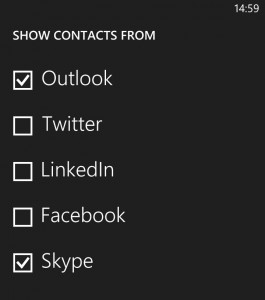
      Skype integration with the People Hub is available for devices running Windows Phone 8 version 8.0.10211.204 and newer and is automatically enabled after installing or updating the app. The new Skype app also brings support for HD video calls, video calls in landscape or portrait mode, and additionally allows users to use both cameras.

      But what does the new Skype integration entail? Windows Phone 8 users can now look up Skype contacts in the People Hub and initiate video and voice calls as well as chats. Users who want Windows Phone 8 to forgo displaying the adjacent contacts should open the People Hub, go to Settings, select “filter my contacts” list and untick “Skype”.

      Skype for Windows Phone 8 is available to download from the Windows Phone Store.

    • Spotify Removes 5-Play-Per-Track Limit for U.K. Users

      Spotify is removing one of the barriers for users in the U.K. who choose to use the streaming service’s free option.

      Starting today, users in the U.K. are no longer limited to 5 plays – the cap has been removed. Until now, Spotify Free users in the U.K. could only stream a specific track 5 times before it was removed from their available options – forever. This 5-play cap kicked in 6 months after users signed up for the free service.

      Spotify first installed the 5-play cap back in 2011, when they also cut the total listening time (after 6 months) in half, from 20 hours per month to 10 hours per month.

      Here’s what Spotify had to say:

      We’ve got some mighty fine news for all Spotify Free users. From today, there’s no more 5 play-per-song limit. You can listen to your favourite songs as many times as you like.

      That’s right, no more greyed-out songs. The tracks that you couldn’t listen to before will once again be available for your listening pleasure.

      Give it a try.

      This move means that free users in the U.K. can now experience Spotify in a way similar to most everyone else in the world – unlimited track streaming with a monthly total hours cap that is supported by ads. U.S. users have never had to deal with a specific track cap.

      France is currently the only country that still has the 5-play-per-track cap.

      Earlier this month, Spotify expanded its web player beta in the U.K., giving users another way to use the service. Spotify’s web player, first announced last year, is set to hit the U.S. later this year.

      [Spotify UK via TechCrunch]

    • 2013 BMW 750Li Sedan: Ridelust Review

      2013 BMW 750Li

      PRO’s: Outstanding luxury, wonderful performance and loads of useful technology.

      CON’s: Big price, hesitant acceleration in comfort mode.

      FINAL THOUGHT: One of the best high-end luxury sedans on the market today, regardless of price or pedigree.

      For most of us, traveling first class is something that dreams are made of. We wait in line, baggage in hand until our group is called, and then, like lemmings jumping to our deaths, get corralled onto our planes or trains, only to find that we’re seated next to the crying baby or the large man with the glandular disorder. It’s an awful experience for all who are involved and it makes us yearn for the better things in life. Every now and then though, fate smiles upon us and presents us with a gift that not only boosts our morale, but brightens our day. This happened to me last week when a new 2013 BMW 750Li press car appeared in my driveway.

      2013 BMW 750Li

      Covered in Alpine white paint and sporting just about every option available, this BMW 750Li is one of the few cars that actually made me feel like I was on the upscale side of life for once. This is a car that is over 17-feet in length, can run to 60 mph in under 5-seconds, top out at 155 mph (limited) and all the while, carry four adults in first class comfort while never once blinking an eye. It will also sit at the stoplight with all of its 445 twin-turbocharged horses running in complete silence, until that is, it’s time to unleash them.

      2013 BMW 750Li
      *By far, one of nicest cabins in all of motoring…

      Realizing that my in-laws would be in town the week I had the 750Li, it was decided that the best course of action would be to load everyone up and head straight to wine country. The beautiful thing about Northern California, aside from the vineyards, weather, shops, beaches and never ending majestic scenery, is that it truly is the best place to see what people think of high-end automobiles.

      2013 BMW 750Li

      As mentioned the BMW 750Li is a BIG car with a big price tag ($115,245.00 as tested), and as such it has a large presence about it – something we found regardless of the parking lot we entered. Pull up in this thing and trust me, people stop and take notice. Remember, this is not some little 1-series, but BMW’s flagship sedan.

      2013 BMW 750Li

      From a visual standpoint I wouldn’t say this car has any truly striking features. Moreover, it’s lines are smooth and possess a soft aggression that gives off a more masculine sense of being. This is a mans car, a modern-day muscle-cruiser from Germany if you will, and whether you’re driving passengers to and from the airport, or out for a spirited Sunday jaunt through the vineyards, this car will not disappoint.

      2013 BMW 750Li

      Understand that for as good as this car is, there are still some areas that can be improved upon. The 750Li is powered by a 4.4-liter twin-turbo V8 that produces 445 hp and 480 lb.ft. of torque. When the go-pedal was depressed however, I found that there always seemed to be a hint of hesitation. This is something that occurred from a dead stop, or while attempting a pass a fellow motorist on the interstate. Putting the car in Sport mode seemed to cure this, but I was curious as to why this was happening in the first place. Another gripe was that damn Start/Stop feature whereby the engine shuts down when the car comes to a complete stop, then starts up again when you’re ready to carry on.

      2013 BMW 750Li
      *Start/Stop kill switch under the starter… I recommend pushing it.

      I understand that this is supposed to save fuel and improve economy, however it was by far the most annoying feature of this car. Thankfully there is a switch to disable it and it’s located right underneath the starter button – don’t say I didn’t warn you.

      2013 BMW 750Li

      Once underway drivers will be hard pressed to find a better full-sized sedan anywhere, as the 2013 BMW 750Li is an absolute dream to drive. This is thanks in part to such features as the ultra-smooth 8-speed automatic transmission, a wonderful heads-up display, outstanding navigation unit and an active suspension system that incorporates four-wheel steering. This means that while you’re hustling this 4,660 lb. machine through the curves, that not only will you have any and all information available to you, but you’ll never have to avert your eyes from the road to find it.

      2013 BMW 750Li
      *This is limo-plush ladies and gentlemen…

      The seats, both front and rear provide outstanding lateral and lumbar support and come with no-less than 20-way power functionality in the front, and four-way power functionality in the rear. A good thing too, as even though the 750Li does a great job of masking its weight, it is still noticeable when pushed hard.

      2013 BMW 750Li

      What’s really amazing is how much fun this big machine was to drive. Seriously, this thing is a hoot in the corners when driven properly, which is something that can’t be said of other cars in this class.

      2013 BMW 750Li
      *Note the raised center channel for the Bang & Olufsen stereo and front view fender integrated cameras.

      One thing that needs mentioning is how vastly improved BMW’s iDRIVE system has become. Driver and rear passenger interface (if so equipped) is a snap, and no longer are we being transported into the technological void of the Gen 1 systems. From the navigation unit, to the Bluetooth functions for your smartphone, everything on the updated unit not only worked flawlessly, but was very intuitive to boot.

      2013 BMW 750Li

      As you’ll notice, this car was indeed equipped with rear monitors and its own separate iDRIVE console for the rear occupants. Watching my rear passengers enjoy the system actually gave me hope that these systems may in fact, have some merit going forward.

      2013 BMW 750Li

      A bit large for daily use, I would list the BMW 750Li as more of an executive sedan that provides its occupants with everything they’ll ever need from the technology end, and it’s driver with the excitement of driving a BMW. Mileage is EPA rated at 16 city / 24 hwy, numbers that I found to be quite accurate. During my stint with the 750Li, I averaged about 19 mpg in combined driving. A decent number for such a large vehicle.

      DSC_1124

      Now, before you go out and plunk down $115k for BMW’s uber-tech sedan, you need to understand that it also comes in the standard wheelbase version, something that I think will appeal to all those 7-series drivers who don’t have to chauffeur people around. However if you’re looking for a premium luxury sedan, that packs just as much technology and interior room as it does horsepower, then you’d be hard pressed to do any better than the 2013 BMW 750Li.

    • MIT to release redacted Aaron Swartz documents

      The Massachusetts Institute of Technology will release documents related to the case against activist Aaron Swartz but it will edit out names and other information, according to a letter from MIT president Rafael Reif to the MIT community. That will probably not be enough to satisfy Swartz’s legal team and other supporters who blame MIT and overzealous prosecutors for Swartz’s death.

      Whiteboard set up at MIT Media Lab for Aaron Swartz memorial.

      Whiteboard set up at MIT Media Lab for Aaron Swartz memorial.

      Late last week, lawyers for Swartz, the 26-year old programmer and civic activist who killed himself in January, requested that these documents be released to the public.

      Swartz’s father Robert Swartz, his partner Taren Stinebrickner-Kauffman and his lawyers maintain that Swartz was railroaded by both MIT and the U.S. Attorney’s office, which prosecuted him on criminal charges for downloading too many articles from JSTOR, a database of academic articles.

      In the letter, Reif said MIT remains committed to openness but needs to protect the privacy of individuals mentioned in the documents and the security of the school’s networks. He acknowledged that Swartz’s lawyers expressly requested that no names be excluded or redacted. But, he wrote:

      “In the time since Aaron Swartz’s suicide, we have seen a pattern of harassment and personal threats. In this volatile atmosphere, I have the responsibility to protect the privacy and safety of those members of our community who have become involved in this matter in the course of doing their jobs for MIT, and to ensure a safe environment for all of us who call MIT home.”

      (The full text of the letter is also available on pastebin.)

      A few weeks after Swartz’s death, MIT named  Hal Abelson,  a professor emeritus of computer science, to head up an inquiry into the school’s role in this matter, but at a memorial service for Swartz last week at MIT’s Media Lab, Stinbrickner-Kauffman expressed skepticism about the process, saying she feared a PR whitewash.

      Related research and analysis from GigaOM Pro:
      Subscriber content. Sign up for a free trial.

    • HTC president: We’re ‘pleased to see no innovation’ in Galaxy S 4 design

      Samsung Galaxy S 4 Criticism
      As HTC’s (2498) struggles continue, the company is seemingly getting to the point where anything goes. Executives at global smartphone companies often tiptoe around questions and choose their words carefully when discussing rivals, but it looks like HTC executives in the U.S. have been given the green light to let loose on the company’s biggest rival, Samsung (005930). HTC president Jason MacKenzie was quoted last week as saying aspects of Samsung’s Galaxy S 4 unveiling were embarrassing, and now HTC’s North American boss Mike Woodward has taken things a step further.

      Continue reading…

    • Challenges and opportunities: International Women’s Day in Afghanistan

      Around International Women’s Day recently, the PRT here had a number of female-focussed visits, including Baroness Warsi and the NATO Secretary General’s wife. Earlier in the same week, Justine Greening, the DFID Secretary of State gave a speech on the importance of tackling violence against women and girls in Afghanistan. Sat at my desk in the Helmand PRT office, this caused me to reflect on what it is like to be a woman here.

      Many people think Helmand is one of the worst places in the world to be a woman. While true that life for women in Helmand is conservative by Afghan standards – compared to Kabul, for example – these challenges also present different opportunities for women.

      Afghan girls in an outdoor lesson

      Afghan girls in an outdoor school lesson

      Finding a voice for women, and changing attitudes to the roles women play, in a culture where they are traditionally valued in home-based roles, is challenging. It cannot be addressed by legal or judicial reform alone, or by imposing Western visions of equality on a society where even women have conservative views about their status. Here, cultural norms pose particular, often practical, problems – for example offices and schools having female-only facilities like bathrooms. These amenities come at a cost and are often more of a barrier than male attitudes towards women being educated or working.

      Already Helmand has hallmarks of future potential: four women on the Provincial Council and 23 policewomen in-service, for instance. But more could be done. Like many places emerging from conflict, Helmand’s focus has rightly been on increasing basic security, improving vital basic services and stimulating economic growth.

      As Afghanistan edges further towards the ‘decade of transformation’, I hope this work will expand to help other vulnerable groups who are at greater risk of violence, poverty and early death. This particularly includes women and girls, often from small rural communities outside the reach of government.

      Helmand has already experienced great transformation. There are now over 26,000 girls enrolled in school from virtually none under the Taliban, and 67% of trainee teachers are female. Community interest and acceptance of innovative mechanisms like Community-Based Education are growing – DANIDA’s programme is running in three rural provinces and 47% of the students are girls.

      In terms of healthcare, in a province with record-high maternal mortality – 59% of women receive at least one antenatal visit but only 18% have births attended by a health worker – there is more work to be done. This includes working to increase the number of community midwives by 150% through provision of a new Midwifery Training Centre funded by the UK government.

      In the world of business, women are increasingly gaining the skills and business knowledge to run licit businesses. A DFID-funded vocational training scheme has graduated 1,918 women and girls since 2011 in tailoring, embroidery, computing and English. In Gereskh, these students now help poor girls attend school by making them school uniforms. Another DFID programme, run by the Ministry of Rural Rehabilitation and Development, has helped two female-run businesses to expand. One business now employs 30 local women to make clothes for men, women and children – and moved the shop from the back to the front of the house to attract more passing trade.

      These are visible signs of women expanding their valuable contributions from their household to their wider community, in a way that conforms to local traditions. These might be small steps along a long pathway to a better life for women in Helmand, but they are brave, important and inspiring steps.


    • Monitor your graphics card load, temperature, fan speed and more with GPU-Z

      TechPowerUp has released GPU-Z 0.6.9, the latest version of its lightweight graphics card information tool.

      This build adds direct support for even more graphics cards, including AMD Radeon HD 8870M, and NVIDIA GeForce GTX 650 Ti Boost, GT 415 and GT 750M.

      NVIDIA Kepler DirectX support has been revised to 11.0. (This complication isn’t TechPower’s fault, though; originally NVIDIA said its Kepler GPUs had full DirectX 11.1 support, but late last year it emerged that four non-gaming features were missing, so 11.0 is more accurate.)

      The interface has gained a few tooltips, which should help beginners to find their way around. Hovering the mouse cursor over that tiny icon to the right of your BIOS version, for instance, will now explain that it can save or upload your BIOS. It’s now easier to spot the PCI Express Render Test (the question mark icon) which helps to confirm your card slot configuration. And there are a few similar additions elsewhere.

      The latest build also adds a couple of fixes. If your system has the Intel OpenCL driver bug, for instance, then the program won’t display the same warning twice. And the shader count for the AMD Radeon HD 7790 is now displayed correctly.

      Otherwise, though, GPU-Z 0.6.9 remains its usual excellent self. It’s small (a 1.24MB download); can be installed or run stand-alone; provides all kinds of details for a wide range of graphics cards (GPU, BIOS, memory type and size, clock speeds, driver details, DirectX support and more); and plots clock speeds, fan speeds, system loads, and voltage over time, making the program an excellent troubleshooting tool.

    • $22 Minimum Wage Matches U.S. Productivity, Says Senator

      Though the minimum wage in the U.S. has risen in recent years, the current $7.25 per hour minimum wage is still looking sparse when considered next to the rising cost of living in the U.S. Large hikes in the minimum wage aren’t likely due to the messiness of congress, but at least one senator believes the minimum wage should be at least triple what it currently is.

      Last week, at a Senate Health, Education, Labor, & Pensions (HELP) Committee meeting, Massachusetts Senator Elizabeth Warren compared the rise in the minimum wage since the 60′s to the rise in American workers’ productivity. Speaking to a University of Massachusetts Amherst economics professor, Warren stated that if the minimum wage had kept pace with productivity, it would be $22 per hour today. Warren pointedly asked the professor, Arindrajit Dube, why this wasn’t the case.

      “My question, Mr. Dube, with a minimum wage of $7.25 an hour, is what happened to the other $14.75,” asked Warren. “I sure didn’t go to the worker.”

      Dube backed up Warren’s math, and even stated that if minimum wage had kept pace with the rise in income of the top 1% of taxpayers that it would have been around $33, before the recent recession.

      Warren then went on to question David Rutigliano, owner of the Southport Brewing Company. Rutigliano took the side of small business owners, stating that his business doesn’t run the same way or with the same volume as a McDonalds, which Warren pointed out could weather a minimum wage hike with relative ease.