Blog

  • RADIOVISION for All (Jan, 1929)

    RADIOVISION for All

    by DON GLASSMAN

    RADIO-MOVIES for everybody is the goal toward which T. Francis Jenkins, Washington Inventor, has been working. Mr. Glassman, author of this article, was present at the first demonstration of Mr. Jenkins’ Radiovisor.

    THE FIRST television broadcasting station, 3XK, Washington, D. C, operated three times weekly at 8 p. m. for the benefit of American Radio Relay League Members, recently began operation on the 4,900-5,000 kilocycle band.

    According to T. Francis Jenkins, builder and operator of the station, members have reported receiving his radiomovies from points all over the Middle West, as distant as Iowa.

    Radiomovies may be received over a simple standard four-tube receiver, which can be built easily by any amateur, along with the recently perfected “Jenkins Radiovisor” which the inventor has just thrown on the open market.

    The “Jenkins Radiovisor” is the first de- vice of its kind to be supplied to the general public. In its cabinet form, the receiver is not a far cry from the ordinary sound receiver, and the two instruments must be linked in circuit if the radioist wishes to see as well as hear.

    The televisor is marked by its simplicity and is different from any similar apparatus ever designed. Its construction makes possible rapid, quantity production. The principal parts are a scanning drum, a. c. motor, four-segment ring, a four-target neon tube, and a reflecting mirror.

    The most important part, however, is the ingenious scanning drum. It consists of two hollow cylinders, the larger about 7 inches in diameter, and the smaller just large enough to accommodate a four-element neon tube. The small cylinder is really the hub to the larger, and the connecting spokes are solid quartz rods which connect liny holes in the rim and the hub. There are 48 such rods and they serve to transmit rays of light through an aperture in the wooden cabinet and onto the overhead reflecting mirror.

    The special neon tube has targets about one-quarter of an inch square, as well as a common element which runs parallel to the inclosing glass wall. Each of these targets supplies the pulsating light flashes to corresponding series of apertures in the drum, which rotates on a direct shaft from the motor at 3,600 r. p. m.

    The other side of the motor attaches to a gear which reduces the speed of the connecting shaft to one-fourth that of the drum, or 900 r. p. m. At this end of the shaft is the brush-contact disc found on other television receivers. The function of this brush is to rotate in step with a scanning disc at the transmitting end. It connects the circuit, one after the other, through four wires which attach themselves to the four targets in the neon tube. The brush disc has four segments and is in contact with two brushes. One brush keeps continuous electrical contact, while the other completes the circuit intermittently.

    The reflecting mirror is mounted at an angle of 45 degrees. The image is enlarged by an ordinary magnifying glass about 10 inches in diameter. The input posts of the radiovisor are connected to the last audio amplifier tube of a receiver.


  • Spy Shots: 2011 Mercedes-Benz SL gets some SLS-inspired rhinoplasty

    Filed under: , , , , , ,

    2011 Mercedes-Benz SL – Click above for high-res image gallery

    On the opening day of the Detroit Auto Show, Mercedes-Benz unveiled a carbonite sculpture depicting its future design direction, featuring two major elements set to infect the rest of the automaker’s line up.

    The first is the massive SLS AMG-inspired fascia with its Flava-Flav-sized three-pointed sta,r and the second was a set of exaggerated rear fenders pulled from the E-Class. Although the sculpture was likely a teaser of the forthcoming CLS update, Mercedes is actively working on incorporating these new design details into the rest of its line and here we see the first recipient.

    While the SL just underwent a refresh in 2008, the former flagship coupe/convertible was caught cold weather testing in Scandinavia wearing M-B’s new fascia, gaping maw and mammoth logo. The prototype headlamps don’t divulge much, but they’re more upright than the current units and don’t appear to stretch as far back onto the fenders. The hood is completely covered in plastic cladding, so it’s safe to assume that a few more ridges and creases will be added to tie the SL’s styling to the SLS’, and the camo-clad rear fenders are a clear indication that the upswept and extruded blisters seen on the E are set to arrive on the SL. Considering the CLS replacement is likely to arrive at the Geneva Motor Show this March, we’d suspect that the revised SL will debut later in the year, so the smart money’s on a Frankfurt rollout.

    Spy Shots: 2011 Mercedes-Benz SL gets some SLS-inspired rhinoplasty originally appeared on Autoblog on Thu, 14 Jan 2010 12:32:00 EST. Please see our terms for use of feeds.

    Permalink | Email this | Comments


    Buy This Item: [Click here to buy this item]

    Read Original Article

  • Detroit 2010: Wrap up

    Filed under:

    We’ve all arrived safely home after our trip to the D for the 2010 Detroit Auto Show. After some much needed sleep, we’ve assembled this wrap up of our live coverage that you can peruse at a glance. Turns out that, like last year, this year’s Detroit show was much smaller in size compared to prior years with fewer vehicles and concepts introduced. Alas, the weakened state of our economy and the industry’s troubles have caught up with the auto show circuit again.

    VEHICLES

    Detroit 2010: Next-gen Ford Focus a C-segment savior [w/video]
    It’s taken far too long, but an all-new Ford Focus has arrived and we’ve just seen it in the metal here at the 2010 Detroit Auto Show. Complete with a new platform, new engine, some shapely sheetmetal and a host of tech, this new Focus that we’ll finally be sharing with Europe and the rest of …
    Detroit 2010: GMC Granite takes Professional Grade in a new direction [w/video]
    Feast your eyes on the next Pontiac Vibe GMC Granite concept. We have to wonder if this car was originally designed to slot into Pontiac lineup before that brand was axed, as it doesn’t really seem to fit into the Professional Grade image that GMC has used as a tagline for ages. Or, it could be …
    Detroit 2010: Regal GS concept seeks to reignite Buick’s performance fire [w/video]
    Is the Buick Regal GS the most important “maybe” of the 2010 Detroit Auto Show? It’s been more than two decades since performance enthusiasts cared about Buick in any meaningful way. The car at that time was the now legendary Buick GNX. Even if the proposed Regal GS makes production – a …
    Detroit 2010: Volkswagen New Compact Coupe concept [w/video]
    It might be cold consolation to those of us desperate for a Scirocco in the States, but the Volkswagen Compact Coupe Concept has the potential to fill that particular hatch-shaped hole in our hearts – with a bit of green cred to boot. With a sharper, more sculpted front fascia than its …
    Detroit 2010: Toyota FT-CH a younger, cheaper brother for the Prius
    Toyota brought a downstream version of the small hybrid Lexus LF-CH concept that was unveiled in Frankfurt to the Detroit Auto Show today. The FT-CH Concept – teased a few weeks ago – not only offers small hybrid mentality with a Toyota badge, it could also be a tremendous sales …
    Detroit 2010: GMC Acadia Denali piles on the frosting
    Nearly lost in the hubbub at this morning’s GMC-Buick press conference here at the Detroit Auto Show was GMC’s new-for-2011 Acadia Denali. This is the first time that GMC has extended its upscale Denali trim to a crossover, but they haven’t changed the formula just because the designation is no …
    Detroit 2010: Mercedes-Benz E-Class Convertible promises four-season topless motoring
    We’ve been friendly with the new Mercedes-Benz E-Class since its introduction. As much as we liked the sedan, we enjoyed the Coupes even more so. That stated, it would figure that we’re going to really dig the new 2010 E-Class Convertible. Of course, here in the D, we just get to look at the …
    Detroit 2010: Mercedes-Benz E-Class Convertible promises four-season topless motoring
    We’ve been friendly with the new Mercedes-Benz E-Class since its introduction. As much as we liked the sedan, we enjoyed the Coupes even more so. That stated, it would figure that we’re going to really dig the new 2010 E-Class Convertible. Of course, here in the D, we just get to look at the …
    Detroit 2010: Dodge Nitro Detonator is massively yellow
    Dodge is rolling out three special edition Nitros here at the Detroit Auto Show named Heat, Detonator and Shock. For now, we’re focusing on the Detonator, a massively loud yellow mid-size SUV. Aside from the eye-scorching paint, the Nitro Detonator gets standard 20-inch wheels, eight premium …
    Detroit 2010: Honda CR-Z promises to bring driving joy to the hybrid equation
    After a few weeks worth of leaked images and brochure fluff, Honda has finally pulled the covers off its next new production hybrid hatchback. The Japanese automaker claims the CR-Z will bring back the kind of driving joy that hasn’t been felt since the CRX last left dealer lots in 1991, saying …
    Detroit 2010: Dodge Viper ACR 1:33 Edition a fitting end note
    We heard about it in Los Angeles, and now we see it here in the D. Meet the 1:33 Edition of Dodge’s most potent ever Viper. Why the name? We’re glad you asked. Back in November, hot-shoe Dodge Chris Winkler managed to hammer the track-focused Viper ACR around Laguna Seca in 1:33.944, faster than …
    Detroit 2010: 2011 Hyundai Santa Fe shows mild freshening, new engines
    The 2010 edition of the Hyundai Santa Fe isn’t getting a full redesign, but a visual refresh does provide a few hints of the “fluidic sculpture” design language that debuted last month on the new Tucson and Sonata. The new hood features a pair of ridges extending back from the grille to the …
    Detroit 2010: Mini Beachcomber Concept leaves the doors behind
    The roof, too. That’s right folks, Mini rolled out a concept of a concept. The Beachcomber (see above) is based on the Mini Crossover. However, the Crossover is no longer just a concept, as it will be making its way to production soon. And it’s not alone, as Mini has also green lit the Coupe and …
    Detroit 2010: Cadillac CTS-V Coupe might just be our best-of-show [w/video]
    Yup, we just saw the 2010 Cadillac CTS-V Coupe in the flesh and… do want. Let’s make that double do want. Why? We think it’s glorious looking, and with the possible exception of the Pontiac Solstice, the CTS Coupe is among the best looking American cars in a very long time. That said, while …
    Detroit 2010: Chevrolet Aveo RS concept answers one question, poses another [w/video]
    We lost track of the number of times the Chevrolet Aveo RS concept was dubbed a “euro hot hatch” during The Bowtie brand’s press conference, and judging by the number of times the word “tuner” was used, Chevy’s desperate to rebrand its econobox. The other reoccurring word: “Concept.” This …
    Detroit 2010: Hyundai plugs in the Blue-Will
    As promised, Hyundai brought its Blue-Will Concept along for the festivities this week at the Detroit Auto Show. There’s not a whole lot more to say – the car was first debuted back in April at the Seoul Motor Show and we’ve heard all about its plug-in hybrid drivetrain. Still, this is the …
    Detroit 2010: Lincoln MKX smiles for the camera
    The first major unveiling on day two of the 2010 Detroit Auto Show has come and gone, and we managed to sneak out of the room with a slew of live photos of the newly refreshed 2011 MKX. We already got the details that make the 2011 model a considerable improvement over its previous incarnation, …
    Detroit 2010: Fiat 500 BEV and Fiat 500 Abarth SS are in the house
    The tiny Italians are coming! That’s right gentle readers, Fiat has dropped two little baby 500s off inside COBO Hall – and one of them’s electric. Let’s start with that one, the uninspiringly titled Fiat 500 BEV (background). The suffix stands for “Battery Electric Vehicle.” Let’s call it …
    Detroit 2010: Cadillac XTS Platinum concept is anything but [w/video]
    Let’s just call this one the Cadillac XTS Platinum “Concept.” For reals y’all, this is one of, if not the most production ready “concepts” we’ve ever seen. For its part, Cadillac stuck to the “It’s just a concept” mantra. Though they might as well have all been nodding, elbowing and winking. If …
    Detroit 2010: Bentley Series 51 Continental GTC
    Bentley was the only ultra-luxury marque to have a stand-alone display at the Detroit Auto Show and the British brand came strong with its upcoming Mulsanne flagship in the flesh and this special edition Continental to pique our interests. The Continental is already a stunner in its “base” …
    Detroit 2010: Jeep Wrangler Islander and Mountain fill out the range
    Few cars are as iconic as the Jeep Wrangler, a vehicle that can trace its heritage directly back to General Patton storming the Third Army up to Messina. Maybe a Porsche 911, maybe. Mini? Not really. Harley-Davidson is probably the closest, but they only have two wheels and aren’t cars. The …
    Detroit 2010: Volvo C30 EV silently motors into the Motor City
    As expected, Volvo brought along an all-electric C30 hatchback concept to the 2010 Detroit Auto Show. While this isn’t a production vehicle at this point, Volvo says the car is a fully drivable prototype with a complete interior, full instrumentation, and enhanced battery packaging. We made …
    Detroit 2010: California Special kicks off Mustang variants for 2011
    Ford is wasting no time in releasing a variation of its 5.0-powered Mustang, starting with the California Special for 2011. The GT/CS was last introduced as a 2007 model and featured a unique appearance and wheel package available only on the premium GT coupe and convertible. Ford hasn’t …
    Detroit 2010: Revenge Verde Supercar adds mean to its green
    U.S.-based Revenge used the 2010 Detroit Auto Show to introduce the world to its Verde Supercar, and we were there with cameras in hand to capture the event on film memory cards. Honestly, we were impressed with the Verde’s outer appearance, though we couldn’t get close enough to see the …
    Detroit 2010: Chrysler 300 S6 and S8 are reminders of Mopar magic
    Chrysler made one of the past decade’s strongest design statements with the 2005 introduction of the 300. The rear-wheel-drive sedan with blocky styling was a knockout with both the general consumer and, maybe more specifically, the aftermarket. Five years on and the 300 is still a SEMA …
    Detroit 2010: CT&T debuts three models, including Multi Amphibious Vehicle
    CT&T is a Korean company that makes tiny electric cars. You may have read about them on Autoblog Green. And if you did read about about CT&T’s current products, you will know that we don’t think very much of them. The truth, or a close approximation of it? They strike us as all-weather …

    FEATURES

    AB’s Top Five Introductions from the 2010 Detroit Auto Show
    We love auto show season, mostly for the chance to see all the coolest new cars and concepts that the world’s best automakers have to offer. This year at the 2010 Detroit Auto Show, though, there …
    Detroit 2010: Motor City Maidens
    This year’s 2010 Detroit Auto Show is over, at least for the press, and while some significant vehicles were unveiled, the overall impression we got is that the industry has scaled back. Less debuts combined with smaller and less elaborate displays made the whole affair feel significantly …
    Detroit 2010: A closer look at the Mustang’s 5.0L V8
    While Ford might not be pulling out all the stops here in Detroit to promote its updated Mustang like it did for the 2010 model year, the 2011 model’s improvements are just as significant, if not more. The new 305 horsepower, 30 mile per gallon V6 debuted at Los Angeles back in December, and the …
    Detroit 2010: Quote of the day
    “… a lot of stuff happened.” – Mark Reuss, General Motors’ new North American president, on 2009 [Image by Bill Pugliano/Getty] …
    Detroit 2010: Mercedes-Benz sculpture is the future of the CLS, Terminator 2 style
    The first concept to be officially unveiled at the Detroit Auto Show is this, a sculpture by Mercedes-Benz that foretells the future of its vehicles – and specifically the CLS. From the SLS AMG-inspired fascia to the overly blistered fenders clearly inspired by the recent E-Class coupe, …
    Detroit 2010: Chrysler Lancia might be a look into the future
    You are looking at… well, no one at the Chrysler booth seemed to know exactly what this is. They didn’t even have a proper name for it. But that tiny little fact will not be stopping us. You are looking at what they call a Chrysler Lancia, or more correctly, a Chrysler-badged Lanica. …

    NEWS/MISC.

    Detroit 2010: Ford sweeps North American Car and Truck of the Year awards for 2010
    For just the third time in the 17-year history of the North American Car and Truck of the Year, one manufacturer has taken home both pieces of etched glass. Ford’s 2010 Fusion Hybrid and Transit Connect have yielded the hardware for the Dearborn automaker here at the Detroit Auto Show, with the …
    Detroit 2010: LaHood says Volt “obviously the kind of green car Americans are looking for”
    The 2010 Detroit Auto Show kicked off this morning with a positive little speech by United States Secretary of Transportation Ray LaHood. Speaking about the coming electrification of the automobile, he said that “this is what the American people want.” When asked how much money the government …
    Detroit 2010: Audi A8 Hybrid coming to Geneva, no mild hybrids… ever
    As stated earlier – and despite quotes to the contrary – Audi is increasingly serious about alternative propulsion. After pioneering direct injection and pushing the envelope of diesel technology, Audi is looking to electricity for its next round of innovations. And the fruits of its …
    Detroit 2010: Cadillac commits to V- or Platinum editions for all models, CTS-V wagon all but certain
    At this morning’s XTS Platinum and CTS-V Coupe debut here at the Detroit Motor Show, newly appointed brand manager Bryan Nesbitt announced to the media that that all Cadillac models will receive V-Series and Platinum models. However, during the media scrum that followed the conference, we …
    Detroit 2010: Audi e-tron Detroit Concept presages production R4
    If you’re wondering what the likelihood of Audi building a production version of its new e-tron Detroit Concept Car (yes, that’s really its official designation), our sources at Audi indicate that a version of the coupe is likely to go into serial production as the oft-rumored R4. The German …
    Detroit 2010: Caption Contest – What the heck are Bob Lutz and Elon Musk talking about?
    Bob Lutz has been an important guy in the auto industry since before most of us were born. Elon Musk is the reason your eBay transactions go so smoothly (he was the co-creator of PayPal). Together, …

    Detroit 2010: Wrap up originally appeared on Autoblog on Thu, 14 Jan 2010 11:57:00 EST. Please see our terms for use of feeds.

    Permalink | Email this | Comments


    Buy This Item: [Click here to buy this item]

    Read Original Article

  • [Wrocław]Moje miasto by Mmaciek

    Witam!!
    Zapewne część userów nie raz miało okazję oglądać już moje zdjęcia (poza SSC używam nicka MMACIEK i dlatego mam prośbę aby się tak do mnie zwracać)
    Swoje foty wrzucam przede wszystkim na hydral, jednak posiadam i wciąż robię masę zdjęć, które przechowuje na dysku, a którymi chciałbym się pochwalić. I tak oto postanowiłem założyć swój wątek fotograficznym z Wrocławiem w roli głównej. Choć profesjonalnym fotografem nie jestem, to jednak mam nadzieje, że moje zdjęcia przypadną wam do gustu.

    Link do mojej galerii na hydralu: Mmaciek

  • Logitech Speaker Lapdesk N700 Review [Reviews]

    Logitech’s basic comfort lapdesk is pretty great product, but I know what you’ve been thinking: “Why doesn’t this thing have speakers and a fan inside??” Behold, the USB-powered Logitech Speaker Lapdesk N700.

    Price

    $80, available now.

    Verdict

    The N700 is a decent product, but we’d like to see the company push the idea even further.

    You see, the Speaker Lapdesk is every bit as comfortable—if a tad heftier—than Logitech’s stock Lapdesk. The firm, mesh pillow is cool and comfortable on your legs. And by plugging in your laptop via integrated USB cable, the N700 instantly allows you to control volume through its own buttons while toggling on/off a low-speed fan that sits under your computer.

    Sound quality? It’s OK—midrange-heavy with tinny highs—but better than my 3-year-old MacBook Pro overall.

    However, my MacBook Pro actually has better high range than the Lapdesk, which cued me to remember another laptop audio gadget I looked at not so long ago, the BassJump. The BassJump came with software (the N700 requires none) that mixed its audio with your laptop’s.

    This simple sound mixing option could really help users milk more overall quality out of the N700, and I urge Logitech to consider it in products moving forward.

    Secondly, while the fan and speakers are handy, the fact that they’re bus powered means that your laptop is working that much harder off its own battery. A small, integrated lithium ion could help guarantee that you won’t need to plug in your laptop while vegging out on the couch.

    As for right now, the N700 is basically a mediocre set of computer speakers integrated into a very comfortable, cooling laptop stand. It’s probably better than what your laptop uses day to day, but then again, spending this much on headphones and one of Logitech’s cheaper desks would garner better results. [Logitech]

    Comfortable

    No drivers necessary

    Audio quality won’t impress you

    Kinda looks like something designed by Walmart


  • Limerick City

    My city, Limerick Ireland population 100,000

  • Heidi Montag Safe After Kidnapping False Alarm

    Have no fear, Spiedi fans — Heidi Montag is safe and sound after a kidnapping rumor sent swarms of police and helicopters to the house the tone-deaf singer shares with hubby Spencer Pratt on Wednesday night.

    The 23-year-old “plastic surgery addict” used a scarf as a shield from the paparazzi while walking into her Los Angeles home. An eyewitness saw Heidi grew concerned at seeing Heidi covered and called the police to report a “possible kidnapping.”

    That turned out to be just a misunderstanding…

    “We’re grateful this was only a false alarm, and I just had my pink Hermes scarf over me,” Heidi says. “A neighbor was concerned and called the police. We’re thankful to the LAPD for their response and making sure we were safe.”


  • Venture capitalists are bullish on the future of game funding

    gamesbeatGame investing is still going strong, even though it did take a hit during the recession. We calculated that game companies raised $600.5 million in 2009, down 36 percent from the year before. But game-savvy venture capitalists are still bullish on games. We did a roundtable Q&A with some of the best-known investors, in conjunction with the launch of Interactive Age, a new magazine focused on the business of games. The magazine is edited by N. Evan Van Zelfden, who has written for us, and will debut around the time of the Game Developers Conference in March.

    Here’s the transcript of our talk with Bing Gordon from Kleiner Perkins Caufield & Byers, Tim Chang from Norwest Venture Partners, Jeremy Liew from Lightspeed Venture Partners, Greg Richardson from Elevation Partners (which invests in later stage companies, including BioWare/Pandemic). A lot of the issues they talk about are bound to come up at our conference, GamesBeat@GDC, on March 10 in San Francisco.

    bingDean Takahashi: Can you bring us up to date on the state of venture capital investments in game companies?

    Bing Gordon (pictured right): The high number of entrepreneurs starting game companies has certainly surprised me. Of course, I probably see most of them, given my background. I am actually more interested in entrepreneurs who are focused on the “video-gamification” of other lines of business from education to ecommerce, advertising to health.  These areas seem less obvious, but offer more room for innovation.

    jeremy liewJeremy Liew (right): I think it’s hard to answer the question without addressing categories. 2005-to-2007 was mostly about virtual worlds: largely social environments, with some lightweight game play incorporated.  There were also some folks trying to build World-of-Warcraft-killers: AAA heavyweight client based MMOs.  Mostly big swing against big visions, with $5-to-$15 million put into development before you see a product, and success predicated on a single game or world being awesome (Turbine, Second Life, Habbo, Red5, Trion, etc). 2007-to-2009 has mostly been about smaller swings and faster iteration against what users tell you.  Call it the “Web 2.0-ification” of the games industry – launch fast in beta, iterate based on user behavior.  This applies to both the folks importing Asian MMOs and the “social gaming” companies.  In each case less than $1 million gets you a shot on goal and you get multiple shots on goal with a venture round.  Success is predicated on repeatedly putting out games that have a shot at making millions versus tens-of-millions (Zynga, Playdom, Playfish, Outspark, K2, etc).

    Greg Richardson: Our perspective will likely be a bit different as we don’t look at early stage opportunities.  What’s changed in our view is the shift away from retail publishing and development which has matured as a business and slowed in growth. The movement towards digital content and publishing models is creating investment opportunities.  To Jeremy’s point, there is a further shift away from hardcore-focused companies and games which are capital intensive to more mass market content offerings with lower capital requirements. The big question is how you build scale against the digital opportunity?  What are the barriers to entry for the more successful startups on the digital side?

    Jeremy Liew: I think the key point that Greg highlights is how you scale.  To me this means how can you repeatedly build (or license) games at volume?  It means building a game factory — which is quite different from the artisan-like approach to making games that the industry has drifted towards as time-lines got longer and budgets got bigger.  Then how do you repeatably solve the discovery problem in a noisy and crowded environment (which is by definition the environment where it doesn’t cost much to build a game)?

    tim changTim Chang (right): Historically, Gaming 1.0 has been a challenging investment area for VCs because of the “hit content risk.” Hence, new publishing, distribution, and service-oriented models around new platforms tended to garner the most attention: “we want to be the EA of ____ (mobile, MMO, social games, etc.)” pitches tend to arise whenever new platforms arise.  Studios and tools deals abound, but these types of companies typically have less interesting exit outcomes from a VC perspective. When retail-based distribution of Gaming 1.0 was dominant, friction to market entry was at its highest, and hence content/hit-risk was extreme.

    Web/Online started to shift the distribution landscape, starting with internet in mid-to-late 90’s – this allowed for the first attempts at basic MMOs and Virtual Worlds (remember The Realm, anybody?), but broadband penetration wasn’t well enough established yet. Pogo was an early foray into early browser-based and downloadables casual games.

    What I call “Gaming 1.5” has been driven by online growth across 2 vectors: 1) AAA or “heavy client” MMO/virtual world (inspired by the success of Ultima Online, Eve, WoW, Second Life, etc.); 2) online casual (increasingly browser-based, vs. Gaming 1.0 casual models of only downloadables: Real Arcade, WildTangent, Mini-Clip, King.com, iWin, BigFish, etc).  Gaming 1.5 is marked by reliance on client download SW for MMO/VW, as well as ad and paid download based models on the casual side.

    Around the same time on the other side of the world, Asian or Asia-influenced casual MMO/Virtual Worlds started leveraging free-to-play and virtual goods models, primarily distributed online (often via PC cafes), typically built with smaller budgets and then localized to foreign markets (Nexon, K2, etc).  Many of these were also client-SW based but innovated on the business model side – often out of necessity (e.g. lower penetration of credit cards in China).

    Gaming 2.0 (in-line with Jeremy’s point on Web2.0-ification) is marked by a shift towards pure browser-based, targeting mass audience on newer platforms like social networks, iPhone, general web. Free-to-play and microtransactions are the de facto business model, which align perfectly with a lower-cost basis for development and faster time to market. Gaming 2.0 is also about bringing gaming to the mass market (and not focusing the smaller percent of the population who are self-identified gamers…and who also tend to be demanding customers and costly to please). Combining “frictionless” gaming (no download, no upfront registration or payment) with more open social platforms (sometimes affording an element of viral distribution) and free-to-play/microtransaction business models is the killer combo, and has fueled fast growth in social gaming.  Representative companies: Gaia, IMVU, Zynga, Ngmoco, Playfish, etc.

    Gaming 3.0 is about leveraging game mechanics and models to re-invigorate other markets: humans are inherently geared towards addictive behaviors and biases that can be exploited through game mechanics like points, achievements, and leveling up. Gaming + Commerce = Swoopo. Gaming + Music = Red Octane, Harmonix. Gaming + Healthcare = Lumos Labs. Gaming + Local Search/LBS = FourSquare. I often joke that “gaming will rescue us all.”  I don’t mean that we all become hardcore WoW players, but that we can utilize game constructs to perhaps revive other industries which no longer monetize as effectively via macro-transaction or advertising.

    Dean Takahashi: What are the hot categories within the game market this year? How would you rank various categories, pointing out the hottest categories and the weakest? Think about them in terms of where startups are drawing the most attention from VCs.

    greg richardsonGreg Richardson (right): It’s difficult to classify segments or categories in gaming right now.  Are casual game portals like Pogo or Real really representative of the “casual” market or are they primarily serving 30-to-60-year-old women? What is an MMO? World of Warcraft? Runescape? Free Realms? Maple Story?

    Social gaming feels like a new “category” but in the long run is it really unique content or just a different distribution/publishing platform? Mobile seems ready to come of age and a lot of the content we currently see through browsers or social networks feels equally relevant to smart mobile devices. The challenge there is for the platform holders to create ecosystems that are content friendly. Will they support multiple price points and biz models? Will the platform holders control all the transactions?  Can developers and publishers market and merchandise their games?

    Bing Gordon: I have seen game company pitches across the board in the past twelve months. I have seen game publisher proposals for mobile, music, social networks, consoles, casual, education and health. I have seen publisher proposals for game companies in India and China, as well as across North America. I have seen platform company pitches for virtual goods, virtual worlds, avatars, virtual card games, and MMOs. I can’t tell you what categories are considered hottest by the universe of investors, but Kleiner Perkins has invested in just ngmoco and Zynga in the West.

    Tim Chang: Games as packaged media or “fire and forget” downloadables is R.I.P.  Games-as-a-service (GaaS) and Cloud Gaming are the inevitable new paradigms. This is an early case study for the shift of media on the whole towards Media-as-a-service, meaning that content creators have to fundamentally rethinking how they design their offerings to be ongoing relationships with their users…and often with only half or less of budgets spent on “launch” and increasing portions used to “operate” the ongoing service (community management, expansion packs/dynamic content updates, microtransactions, virtual goods refreshes, etc)

    The holy grail business model for Media-as-a-Service will be inspired by the gaming industry, and is neither purely ad-supported, all virtual goods, nor subscription-based, but rather a complementary blend of revenue streams for a hybrid business model: free-to-play (85% of users – show them ads, but how else can you “put them to work” to create indirect value and enrich the community or offering as a whole?), microtransactions (15% of users) and tiered-subscriptions/premium memberships (1%-to-3% of users).

    Games as a service will drive new needs at both the infrastructure and services (managed services, payments, loyalty, etc.) layers. Examples of enabling technologies and services here include OnLive, Gaikai, Otoy, Metaverse Mod Squad, Viximo, Vindicia, etc.

    Dean Takahashi: Today, the latest research estimates that virtual goods will become a $1 billion industry in the U.S. in 2009 and it will hit $1.6 billion in revenues in 2010.  Do you agree with those estimates?

    Jeremy Liew: I think the 2009 estimate is probably about right if not a bit high, but 2010 is probably too low.  I think we’ll see a lot more growth in 2010 than just 60%.  Social games are driving a lot of this growth and I would expect many of the social games companies to expand to destination websites by 2010. With the new iPhone billing platform, virtual goods is becoming natively supported for iPhone games (versus the hack of buying a new game identical except that you now have the virtual good), and with more pre-paid cards at retail, I think we’ll see at least a doubling in revenue in 2010.

    Bing Gordon: I assume you are talking about market size outside of Asia, where virtual goods market has already surpassed these numbers.

    I agree directionally with Jeremy that virtual goods will have hockey stick growth in 2010 in the West.  Maybe more than 100%. Free-to-play with virtual goods takes share from existing PC game and casual game markets, and adds new users.

    Dean Takahashi: Will the social games with free-to-play business models start to take market share away from console video games in 2010, or will both industries continue to expand at a good clip?

    Jeremy Liew: Free-to-play is definitely going to grow but because it is attracting a different audience (non gamers).  I don’t think that it will take share from console video game revenue. With consoles, I think the key driver will be new platform release schedules and game release schedules, so will be orthogonal to the drivers of free-to-play growth. I defer to people smarter than me about consoles as to whether that means it will be up or down this year.

    Bing Gordon: I also agree with Jeremy that console games on TV continue to run on their own life cycles, but that iPhone/iPod Touch and other smart phones could start to hurt handheld game sales.

    Jeremy Liew: Bing, I think that’s a great point. iPhone is going to hit handheld game sales hard.

    Dean Takahashi: Zynga’s Cafe World has garnered more than 17 million users in less than two weeks on Facebook. What does that tell you? Can anyone catch up with Zynga in social games?

    Greg Richardson: Zynga’s success tells us that social gaming is a real market with dynamic growth prospects in front of it. Clearly, Bing and Mark and the team have done a tremendous job in establishing a leadership position with Zynga. It’s going to be exciting to watch how things evolve from here. What happens when Facebook introduces its own currency or when it once again changes its policies on publishing updates (e.g. when can a user ask to opt out of updates by application)? What impact will be felt by more established game developers like EA and Sony landing on the social networks with branded and franchise games? In general, it feels like we’re early in establishing the type of content that fully addresses the audience’s interest and the unique aspects of the social network platform. It doesn’t feel obvious that we’ll look back on MobWars or FarmVille as the applications that defined a market.

    Jeremy Liew: Zynga is doing a great job of leveraging their scale for cross-promotion and media buying to be able to launch new games to the top of the charts. The combination of their speed to launch games into categories proven popular by other developers, virality and launch support in the form of advertising dollars and cross-promotion from their other games is very powerful.  However, the games industry is not a winner-take-all market.  Unlike enterprise software, where a customer only buys one product from the category, in social games, people will play more than one game.  As a result, there is room for a number of very valuable companies to be built in the space. As a parallel, among Chinese MMO publishers, the leader is worth $5 billion, but there are 5 or 6 companies worth more than $750 million. So it isn’t really necessary to catch up to Zynga to create a lot of value. That being said, the games industry is still a hit-driven business, and so it is always possible for one of Zynga’s competitors to catch and pass them if Zynga has a run of poor games and/or a competitor has a run of very good games.

    Tim Chang: Zynga has definitely demonstrated the power of scale in “breaking” a new title on Facebook.  The lesson here is that distribution muscle does matter: if content is king (as Hollywood and media 1.0 folks like to think), then distribution is God Almighty. Killer game content + lack of distribution muscle = critical acclaim. Crap content + distribution muscle = lots of units still sellable (look at JoWood volumes in Walmart for deer hunting games). Distribution muscle + ability to quickly copy or iterate good content at cost-effective levels = major new disruptive force.

    That said, the approachable market for social games is potentially gi-normous.  Assume: half of the world will be on social networks within next couple years, half of social network users will try a social game, and up to half of active social game players may be monetizable.

    A healthy, large market can support multiple big winners.  The traditional console game industry also has shown an interesting market share structure: the top publishers rarely command more than 16-to-19% market share, but (used to) garner valuations and multiples akin to leaders in other industries with much larger market share percentage.  Hence, you can have a relatively fragmented market with 2-to-4 big dogs that get great market premiums, yet still have enough room for little players if the market is large enough.  The question here is that social gaming distribution landscape follows different dynamics than retail, and is still being shaped in real-time.

    It does appear that the Big Three have solidified their leads so far: Zynga, Playfish, Playdom.  I’ve looked at many top 20 Facebook social game developers beneath this tier, and they are order-of-magnitude smaller on a monetization basis.

    Dean Takahashi: If you were running a traditional game company, and you saw these trends in the emerging game market, how would you respond?  How quickly do you react to the trends and what strategy will succeed for you?

    Greg Richardson: The big game publishers face the classic innovator’s dilemma.  Even if they intellectually see and understand the shift from packaged goods games targeted at a sub-segment of the 12-to-35-year-old male audience to digital game services for the mass market, it’s going to be difficult for them to execute against it. They still see the vast majority of their revenue coming from packaged goods which can’t help but focus attention and resources away from the emerging opportunities.  The development studios that were so well positioned to create AAA hits aimed at the console market will not easily make the transition to games with lower production values, simpler gameplay mechanisms and shorter play sessions. The obvious path for the big publishers is to acquire the Zyngas of the world and try and pivot off their market position and cultural DNA.

    Jeremy Liew: I agree with Greg.  However, I think that it will be hard for many traditional game companies to acquire the Zyngas of this world, if only because there are more traditional game companies – especially if you include casual games companies in this mix – than there are at scale social games companies.  Everyone adjacent to social games is eyeing the category and trying to understand what it means for them.  I suspect that some will look to buy smaller social games companies and try to use that as the nucleus for expansion in the space.

    Tim Chang: Traditional publishers have attempted to launch their own social games based on existing and new IP – these have largely been met with weak DAU growth and monetization (similar to big media firms who tried to launch Facebook apps, only to end up asking for help from RockYou types).  Old-school game companies will tend to over-design their products, and either miss out on the proper virality characteristics (e.g. building for one-to-one play behavior vs. one-to-many), or else focus too much on production value and eye-candy, which actually scares off most of the social game audience (who are not self-identified gamers).  One analogy I think of is all the Club Penguin knockoffs who looked at CP and said “this looks like crap – I can build a better looking one, and add educational content to appeal to parents too!”  They learned that kids couldn’t care less about educational content, and more often than not got lost trying to navigate full 3D environments.  Your typical social game player is akin to a youth player: short attention span, aversion to complex interfaces, need to get into the action quick!

    2010 will be marked by “Hollywood meets Zynga” dynamics of co-development, license, white-label partnerships driven by various buy/build/outsource strategies that each large game and media company will try. Some smaller development teams will get bought, one of the Big Three will probably get taken out, and we’ll probably see consolidation in social gaming overall.

    Dean Takahashi: Where are the best game markets now, in terms of investment opportunities, on a global basis?

    Greg Richardson: Everyone plays games, from newborns to senior citizens. The best investment opportunities are companies that can create compelling games for everyone: products and services that connect people together, that give them a reason to interact with friends and family and that can be played anywhere and at anytime without a huge investment of time and money.

    Jeremy Liew: From a VC point of view, games that are cheap and fast to make are easier to invest in than games that have long development timelines and big budgets. More shots on goal for the same money is better, given the hit driven nature of the industry.  That’s why social games – or free to play in-browser games more broadly – and publishers importing MMOGs from other geographies are seeing VC investment.

    Tim Chang: Free-to-play MMOs that are delivered in-browser, and leveraging much lower cost-structures – think Nexon as opposed to Trion, Blizzard, etc. Augmented or Alternate Reality Gaming.  Cloud gaming enablers. Micro-payment infrastructure and services. As retail continues to decline, white-label digital download/streaming/delivery stores. “Meta-gaming:” the application of game mechanics on to other industries – FourSquare for music, nutrition, fitness…

    Dean Takahashi: What are your predictions for the future of venture investments in games?  And what will the game industry be like in five years?

    Jeremy Liew: The social games space is already starting to see movement up the cost and complexity curve.  Partly on technology, more on art and marketing costs.  I think that within 12-to-24 months the winners in that space will have been established. There is still a window for new entrants to get to scale, but it is not unlimited.  After that, it will be hard to see more venture investment until we see a new development that can drive cost and cycle time back down in some other popular medium.  This might be something like Unity and other game engines, or greater understanding of western game design in China and India.

    Bing Gordon: Let’s not forget that most of the investment in games comes from publishers rather than financial investors. Billions spent annually in game development.

    One of the bets EA made in its early days was that distribution matters.  Even for a publisher with a broad portfolio, it is difficult to deliver predictable returns without having a distribution advantage.  So the best venture investments in media will unlock distribution leverage, as well as supporting cool products. I predict that the best venture investments in games will depend on disruptions in distribution, rather than predictions of the next creative genius. I would bet that more than 1/3 of total consumer spending on games will be for digital downloads within 5 years. I hope the games business doesn’t follow the newspaper and music businesses in “trading nickels for dollars.”

    Greg Richardson: I agree with Bing that distribution matters even in a digital context although I’m not sure it’s as defensible as EA’s retail presence was in the 90’s.  While there are similarities in the investment and scale necessary in building a retail presence as well as a big audience online, there are big differences. In a digital world there is infinite shelf space, allowing consumers to more easily find and choose the content they want.  The high-order bit in the digital world will be creating compelling content and once you have it, distribution leverage will be created.

    Our view is that the best game investments are going to be companies who can get scale across multiple digital segments – MMO, Social Gaming, Mobile, etc – and do so by combining distribution strength with great content.  I believe we’re going to see game content created in the next three to five years that is completely different from what we’ve seen historically.  I can’t wait to see what great game designers will create once they look beyond young males as their target audience and are thoughtful about how great gameplay can be married to casual social experiences.

    Jeremy Liew: In a Facebook or other digital environment where shelf-space is infinite and there is no chokehold on reaching customers, discovery is more important than distribution. In FB that’s facilitated by the feed, by cross promo, and by good old fashioned advertising.

    Tim Chang: “Gaming will rescue us all” – monetization concepts like free-to-play + microtransactions + tiered-subscription will be successfully applied to all facets of consumer internet and media.  Engagement currency and meta-game point systems will drive Behavioral Economics optimization in all markets. Notions of “operating your content” will be inspired by online games: episodic delivery, mod-able experiences, snack-sized sessions, etc.


    Buy This Item: [Click here to buy this item]

    Read Original Article

  • SGN promotes COO to CEO role to lead mobile gaming expansion

    sgnSGN, one of the top game publishers on the iPhone, has given its chief executive title to No. 2 executive Randy Breen.

    Founder Shervin Pishevar remains at the company as executive chairman at the company. Breen is a former Electronic Arts and LucasArts game veteran who joined the company in the middle of last year as chief operating officer. The company has made its name doing unique games for the iPhone that take advantage of its touchscreen and tilt controls. Among its hits are the flight combat games F.A.S.T. and Skies of Glory, both of which push 3-D graphics to the limit on the iPhone.

    SGN started out as a Facebook game publisher, but shifted much of its focus on the iPhone in 2008 But it has fallen far behind others such Zynga, Playfish and Crowdstar on Facebook and bet heavily that the iPhone will soon become as lucrative a platform.SGN has already had 15 million downloads on the iPhone and iPod Touch, putting its games on one of every three mobile devices that apple makes.

    SGN is planning to expand to the Android and tablet computer markets this year, Pishevar said. SGN raised $15 million in a round of funding from Greylock Partners and others. SGN has expanded to more than 100 employees in Palo Alto, Calif., China and Argentina.


    Buy This Item: [Click here to buy this item]

    Read Original Article

  • TC Electronic PolyTune tunes all your strings at once

    We haven’t seen much reason to trade up from our ancient Boss tuner in all the years we’ve been playing guitar, but the new TC Electronic PolyTune might finally persuade us. Billed as the “world’s first polyphonic tuner,” the PolyTune supposedly lets you tune all your strings at once — you simply strum away and the display tells you which strings need a tweak. There’s also a standard needle mode, two chromatic modes, a real-time stream mode that shows you pitch changes as they happen, and built-in memory so you can lock in your favorite settings. No word on price or availability, but we should find out more at NAMM this week. Check out a video of the prototype in action after the break.

    Continue reading TC Electronic PolyTune tunes all your strings at once

    TC Electronic PolyTune tunes all your strings at once originally appeared on Engadget on Thu, 14 Jan 2010 12:17:00 EST. Please see our terms for use of feeds.

    Permalink   |  sourceTC Electronic  | Email this | Comments

    Buy This Item: [Click here to buy this item]

    Article

  • Worldwide PC shipments up slightly in 2009 — is an even more decent 2010 underway?

    An IDC Quarterly PC Tracker report released yesterdays found that PC shipments overall for 2009 were up about 2.8 percent over 2008 — not exactly a game changing stat or anything, but we’re sure the manufacturers will take what they can get. The upswing was apparently largely due to the strong fourth quarter (and the positive debut of Windows 7), which made up for the abysmal first quarter, second quarter, and semi-abysmal third quarter. In that last quarter of the year, PC sales showed a 15.2 percent growth over 2008 worldwide, while in the US, sales were up 24 percent over the last year, with 20.7 million units shipped. Another trend noted in the report, is, unsurprisingly, the fact that people continue to purchase cheaper PCs — mostly in the form of laptops and netbooks. All this means that retailers and manufacturers profit margins are thinning out, but hey, we’ll leave the worrying to the economists — where’s that circular for the fifteen dollar netbook?

    Worldwide PC shipments up slightly in 2009 — is an even more decent 2010 underway? originally appeared on Engadget on Thu, 14 Jan 2010 11:46:00 EST. Please see our terms for use of feeds.

    Permalink CNET  |  sourceIDC  | Email this | Comments

    Buy This Item: [Click here to buy this item]

    Article

  • Making Higher Education Civic Engagement Matter in the Community

    A thought-provoking essay, written by Randy Stoeker and Mary Beckman, that examines how higher education can better engage with communities.

    Download the PDF Making Higher Education Civic Engagement Matter in the Community

  • Nicole Farhi – Men’s Spring/Summer 2010

    nfarhi-main

    Nicole Farhi’s Men’s Spring/Summer 2010 range covers all grounds while keeping the current trends in mind. Versatility is the key to the collection as most pieces when mixed and matched are ideal for work attire, casual occasions, and even vacations. While regular Spring/Summer 2010 items such as shorts, shirts, and cropped trousers give a better sense of comfort for the warm days, the suiting and the outerwear pieces are quite relaxed in their own way as well.

    Continue reading for more images.


    Source: The Fashionisto


  • ILUMINACION EXTERNA EN EL MUNDO

    Creo este tema porque no encontre donde colocar este video, y porque me parece que hay muchisimas cosas interesantes hoy en dia a nivel mundial cuando hablamos de iluminacion externa de los edificios

    abro con la torre Bayer en Leverkursen, un verdadero espectaculo

    http://www.youtube.com/watch?v=7sS6F…layer_embedded

  • Boeing Receives $22M B-52 Engineering Sustainment Option From US Air Force

    Boeing [NYSE: BA] today announced that it has received a $22 million option to continue supporting the B-52 bomber under the Engineering Sustainment Program (ESP) contract the company received from the U.S. Air Force in June 2009.
    Under the $750 million, 10-year ESP contract, Boeing will continue to perform engineering assignments that maintain the B-52 as a ready, reliable and viable asset to the Air Force.

    “This is the first option of the ESP contract, which includes a total of 9 annual options,” said Mike Houk, B-52 Fleet Support program manager for Boeing.

    “Receiving the option this month allows Boeing to continue supporting our customer by sustaining, modernizing and upgrading the B-52 to meet the warfighter’s needs, both today and in the future.”

    The contract supports approximately 150 jobs at Boeing facilities in Wichita; Oklahoma City; Barksdale Air Force Base in Shreveport, La.; and Edwards Air Force Base, Calif. Boeing engineers will support software, communications, avionics and electrical upgrades; provide structural analysis and rewiring; and perform other tasks as directed by the Air Force.

    All B-52s in the U.S. inventory were built at and delivered from the Boeing facility in Wichita.

    About Boeing Defense, Space & Security

    A unit of The Boeing Company, Boeing Defense, Space & Security is one of the world’s largest defense, space and security businesses specializing in innovative and capabilities-driven customer solutions, and the world’s largest and most versatile manufacturer of military aircraft.

    Headquartered in St. Louis, Boeing Defense, Space & Security is a $32 billion business with 70,000 employees worldwide.

    MEDIA CONTACT:

    Jennifer Hogan, 405-818-7859
    Boeing Maintenance, Modifications and Upgrades
    [email protected]


  • Will Central Maryland Replace MoCo’S I270 Corridor As The Economic Engine of The State?

    With the growth of Fort Meade through BRAC, NSA, U.S Cyber Command, and the numerous private companies setting up shop in Howard and Ann Arundel Counties, that area is seriously poised to have a high tech job core that rivals Tysons Corner in the amount of jobs and commercial office space. Meanwhile Moco and its I270 tech corridor has pretty much been stagnant since the 80’s and economic growth in the dc suburbs has been dominated by Fairfax and the rest of Northern Virginia. So my question is, within the next 10 years will central maryland become the new economic engine of the State?
  • Watch: Naughty Bear has had enough, starts shooting

    A couple of days ago A2M and 505 Games released the first trailer for Naughty Bear, their twisted version of an open-world game. Today they’ve released trailer #2, where Naughty Bear’s anger escalates until it culminates in

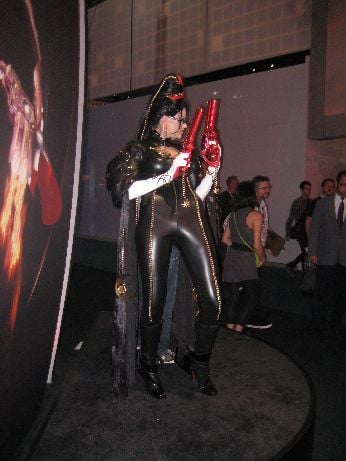
  • In Three Paragraphs: Bayonetta

    Description

    Welcome to a new quickie feature for Playfeed, in which I attempt to distill a game review into a bite-size chunk for you to feed on demurely. At E3, I was singing nothing but praises about Bayonetta, and that was primarily from a one-level demo. Demos, of course, are either used to

    • Sell a product by giving you the best of the best so you salivate like Pavlov’s dogs when you pass the retail copy over
    • Give you the only part of a game that is not festering, abject crap.

    So now the retail copy has launched, and I am left to tell you what to expect, because I am forever carrying the cross of the game reviewer. Hit the jump for Bayonetta in 3 paragraphs.

    NOTE: This is the Xbox 360 version of the game. The PS3 has been known to have some nasty framerate issues.


    Continue reading In Three Paragraphs: Bayonetta

    Tags:
    ,
    ,
    ,
    ,
    ,
    ,
    ,

    In Three Paragraphs: Bayonetta originally appeared on Playfeed on Thu, January 14, 2010 – 9:29:55


  • CitySquares Acquires Yokel

    Wade Roush wrote:

    CitySquares Online, a 5-year-old Boston startup that operates a network of hyperlocal online business directories, said in a news release yesterday that it has acquired Yokel.com, another Boston startup specializing in local product search. Terms of the deal weren’t disclosed. “This deal was a ‘your chocolate in my peanut butter’ moment for CitySquares,” said CitySquares CEO and co-founder Ben Saren in a statement. “We have always specialized in promoting local businesses to neighborhood residents. Now with the acquisition of Yokel, we are able to increase foot-traffic to merchants by driving those searching for products online to their stores.”


  • Will Elton John Replace Simon Cowell On “American Idol?”

    UPDATE: A rep for Elton John has issued a statement denying the Idol reports…..

    Everyone and their dog is in line to replace Cowell on American Idol. The latest rumor on The Snitch Circuit has rock legend Elton John in the running to take over the vacancy once Simon leaves the show in May.