Blog

  • U.S. Chamber warns of ‘double-dip’ recession because of Dem policies

    Ian Swanson
    The Hill
    Tuesday, January 12, 2009

    U.S. Chamber of Commerce President Tom Donohue warned the U.S. faces
    a double-dip recession because of the taxes and regulations under
    consideration by the Democratic Congress and President Barack Obama.

    “Congress, the administration and states must recognize that
    our weak economy simply could not sustain all the new taxes,
    regulations and mandates now under consideration. It’s a
    sure-fire recipe for a double-dip recession, or worse,” Donohue
    said in a speech providing the Chamber’s outlook for 2010.

    Donohue said the lawmakers should not let former President George W.
    Bush’s tax cuts expire at the end of year and lambasted
    Democratic efforts on healthcare and financial regulatory reform as
    well as climate change.

    If the tax cuts are allowed to expire, “we will likely end up
    with even bigger deficits and greater economic misery,” Donohue
    said.

    Full story here.

    Book Mark it-> del.icio.us | Reddit | Slashdot | Digg | Facebook | Technorati | Google | StumbleUpon | Window Live | Tailrank | Furl | Netscape | Yahoo | BlinkList

  • T.Boone Ditches Wind Power Project; Says Natural Gas is Clean Energy of the Future [Video]

    T. Boone Pickens, the oilman turned renewable energy apostle, has shelved plans to develop the world’s largest wind farm in North Texas to instead push for massive adoption of natural gas for transportation.

    Back in May 2008, Pickens oversaw an impressive public relations roll out called the Pickens Plan that included the Pampa wind farm, a $10 billion, 1,000 megawatt initiative that, on paper, would have been one of the world’s largest wind farms.

    In a conference call yesterday Pickens said the Pampa Wind Farm “was off the table”.

    The tough credit conditions, plummeting natural gas prices and a lack of transmission power lines convinced Pickens to ditch his Texas wind project. Pickens’ Mesa Power said it would cut his order with General Electric to 333 turbines from 667 and will instead use them for wind farms in Canada and Minnesota, the Wall Street Journal reports.

    The credit crunch resulting from the global financial crisis also made it nearly impossible to secure funding. Also, as is often the case when it comes to renewable energy, there is a lack of transmission lines linking the wind project to power markets. Already back in July, as Bnet reports, Pickens had already postponed the Pampa project until 2013 when a $4.9 billion transmission line project in Texas was expected to be completed.

    Bnet’s Kirsten Korosec writes:

    Transmission projects are a sticky, expensive business. And they’re a huge obstacle to building wind capacity in the United States. Aside from the cost, a lot of folks simply don’t like the idea of a transmission line going through their backyard.

    During yesterday’s call, Pickens noted that low natural gas prices have made it difficult to finance wind power plants. “You can’t finance wind farms very well when natural gas is under $6,” he said.

    Pickens announced that he would continue his advocacy for natural gas and would call on Congress to pass pending legislation that would offer new incentives for greater use of natural gas in the heavy-duty transport fleet.

  • New York Fed Faces House Subpoena Over AIG Bailout

    Hugh Son
    Bloomberg News
    Tuesday, January 12, 2009

    Jan. 12 (Bloomberg) — The Federal Reserve Bank of New York
    will be compelled to hand over documents related to American
    International Group Inc.’s government bailout after a House
    oversight committee chairman said he will issue a subpoena.

    “To help the committee’s investigation of payments made
    by AIG to its counterparties, I am issuing a subpoena today to the
    Federal Reserve Bank of New York,” Edolphus Towns, the New York
    Democrat who runs the Oversight and Government Reform Committee, said
    in an e-mailed statement. “This subpoena will provide the
    committee with documents that will shed light on how and why taxpayer
    dollars were used for a backdoor bailout.”


    Towns’ attempt to force the New York Fed to provide documents
    comes after the ranking Republican on the committee, Darrell Issa of
    California, obtained e-mails showing the regulator pushed AIG to
    withhold information from public filings about payments to banks. The
    New York Fed in November declined to provide some documents Issa was
    seeking without a subpoena, Issa said in a letter to Towns today.

    Treasury Secretary Timothy Geithner, who was president of the New
    York Fed when AIG was rescued, had been asked by Towns to testify
    during hearings scheduled for next week. The New York Fed’s
    general counsel, Thomas Baxter, said last week that Geithner
    wasn’t aware of efforts to limit New York-based AIG’s
    bailout disclosures because he didn’t think the issue merited
    Geithner’s attention.

    Full story here.

    Book Mark it-> del.icio.us | Reddit | Slashdot | Digg | Facebook | Technorati | Google | StumbleUpon | Window Live | Tailrank | Furl | Netscape | Yahoo | BlinkList

  • Ford Fusion Hybrid Named ‘Best of 2010′ by Cars.com

    Editors Announce Platinum Award Winners

    After driving, debating and tallying the votes, Cars.com’s editors have named the Ford Fusion Hybrid the Best of 2010 in the sites annual Platinum Awards, which recognize the best cars of the new model year.

    Other Platinum Award winners include Best New SUV, Chevrolet Equinox; Best New Compact, Mazda3; Best New Hatchback, Kia Soul; Best New Hybrid Hatchback, Toyota Prius; Best New Hybrid Sedan, Ford Fusion Hybrid; and Best New Wagon, Subaru Outback.

    To choose the 2010 Platinum Awards, Cars.com’s expert reviewers drove and tested all of the newly introduced and redesigned models for 2010. From that pool of about 70 cars, they chose their favorites based on features, driving quality, mileage and overall value.

    “The Cars.com Platinum Awards represent the best work by automakers for the 2010 model year. These vehicles excel on all levels,” said Patrick Olsen, editor in chief at Cars.com.

    “The 2010 Ford Fusion Hybrid outshined all 2010s, earning it the title Best of 2010, Cars.com’s most prestigious award. We’ve seen hybrids come into their own over the past few years, but none have been so free of compromise as the Fusion Hybrid.  We recommend that shoppers – green or otherwise – take a serious look at this car.”

    About the 2010 Platinum Award Winners:

    • Best of 2010, Ford Fusion Hybrid: The Ford Fusion Hybrid surpassed all others to earn Cars.com’s best overall title for 2010. According to Cars.com editors, the Ford Fusion Hybrid distinguishes itself from other hybrids with a more refined ride, smooth brakes, confident acceleration, a comfortable interior and helpful features.  Overall, what the Fusion Hybrid does best is not act like a hybrid at all, while returning mileage of 41/36 mpg city/highway.
    • Best New SUV, 2010 Chevrolet Equinox: The Chevy Equinox vaults into the top tier of small crossovers thanks to its impressive redesign. If you’re a little concerned that a small crossover like the Equinox might not be big enough for your kids, don’t be. It offers one of the largest, most comfortable backseats in its class, and the seat itself can recline and slide rearward for additional legroom. The small crossover segment is crowded with competitive entries like the Toyota RAV4, Subaru Forester and Nissan Rogue, but the new Equinox matches them in many ways and exceeds them in others. It all adds up to one of the most promising new cars of 2010.
    • Best New Compact, 2010 Mazda3: While there are many small cars out there, the Mazda3 is one of the few that’s really fun to drive. There’s good power from either available four-cylinder engine, and in a segment where many cars can’t handle a parking lot, the Mazda3 scoots through corners with gusto. It’s got the right standard features as well as a good mix of options that should let you pick and choose among them to get the best price for your budget – so it’s strong in the “value” category.
    • Best New Hatchback, 2010 Kia Soul: Kia’s foray into the fickle compact-hatch segment had us scratching our heads at first. But the little runabout proved itself. Agile moves and decent cabin quality emerged as strengths early on.  By summer, the Insurance Institute for Highway Safety had crash-tested the Soul, and it emerged a Top Safety Pick on par with the well-established Scion xB. The Soul is also dirt-cheap. Consider this: Well under $14,000 gets you power windows and locks, air conditioning, an iPod-compatible stereo and the sort of safety features for which you’d pay extra in a lot of midsize family sedans just a few years ago. Plus, it has a 10-year powertrain warranty and a cargo area that can handle whatever your teenager chucks in it. Color us convinced. Kia is one of a few brands whose sales are up this year, and cars like the Soul make it easy to see why.
    • Best New Hybrid Hatchback, 2010 Toyota Prius: The Toyota Prius closed out its second generation with a 2009 model that was America’s most efficient car and most affordable hybrid. Truth be told, if it had continued for a seventh model year, its 48/45 mpg city/highway still would have beaten all comers. Instead, the all-new 2010 improves on the previous generation in every way – starting with a markedly higher EPA-estimated 51/48 mpg. Higher mileage usually doesn’t come in larger, faster packages, but the 2010 Prius is both, able to do zero to 60 mph in less than 10 seconds. The base Prius’ improvements over last year’s model would be impressive even if its starting price weren’t lower – yes, lower – by $1,000. Like we said, it’s better in every way.
    • Best New Hybrid Sedan, 2010 Ford Fusion Hybrid: There’s one reason the Fusion Hybrid made this year’s list: It’s a terrific car.  It just happens to also be a hybrid with better gas mileage – 39 mpg combined – than the Toyota Camry Hybrid, which gets 34 mpg combined. It doesn’t reach the Toyota Prius’ levels of efficiency – that iconic car gets 50 mpg combined – but the Fusion Hybrid doesn’t make the sacrifices that the Prius does. The Fusion Hybrid is capable, quiet on the road and sports plenty of creature comforts.  Even though the driving experience is more seamless than almost any past hybrids we’ve tested, Ford doesn’t try to hide its green factor. The Fusion’s innovative and completely customizable gauge cluster is the best we’ve seen from any automaker in terms of looks and displaying useful information.
    • Best New Wagon, 2010 Subaru Outback: Redesigned for 2010, Subaru’s popular wagon is now more like a crossover than a car, and it’s grown up a bit in terms of interior room. That’s not a bad thing as its interior quality has improved, the rear legroom is now spacious – before it was nearly nonexistent – and there are nifty features like self-storing crossbars. The ride is more comfortable, and the driver has a higher seating position than before; the Outback remains a car that’s easy to get the family into and out of. While the Outback can tackle off-road chores, on-road it’s quieter than ever with less wind and road noise, which makes it an infinitely better daily driver. Add up the value equation of the car’s starting price, past reliability and standard all-wheel drive and it’s easy to see why the Outback made our short list.

    About Cars.com

    Cars.com is the leading destination for online car shoppers, offering credible, easy-to-understand information from consumers and experts to help buyers formulate opinions on what to buy, where to buy and how much to pay for a car.

    With comprehensive pricing information, side-by-side comparison tools, photo galleries, videos, unbiased editorial content and a large selection of new- and used-car inventory, Cars.com puts millions of car buyers in control of their shopping process with the information they need to make confident buying decisions.

    Launched in June 1998, Cars.com is a division of Classified Ventures, LLC, which is owned by leading media companies, including Belo (NYSE: BLC), Gannett Co., Inc. (NYSE: GCI), The McClatchy Company (NYSE: MNI), Tribune Company and The Washington Post Company ( WPO).


  • BlackBerry Review: Smartphone Round Robin

    RIM’s approach to the BlackBerry platform is diametrically opposed to Palm’s strategy with webOS: instead of Palm’s complete overhaul, RIM has opted for continuous and relentless incremental upgrades year after year. In my third year looking at the BlackBerry platform my basic thought is this: what we have here are better BlackBerrys. Whether or not that’s enough to sway a webOS user depends entirely on what you think of the platform.

    To see what I think of the platform this year (along with an extended aside about a certain BlackBerry-only feature), read on!

    (I’m (very) late with my BlackBerry Review, but that’s the way of the Smartphone Round Robin and I have to appeal to some post-CES illness. Apologies all around!)

    read more

  • Did the HTC HD2 outsell the Nexus One?

    htchd2vsgooglenexus

    Now of course we do not know how many HTC HD2’s were sold, but we can be very certain HTC’s whole first shipment did in fact sell-out, with shortages all over the place.

    The same can not be set of HTC’s Android ‘superphone’ , which is estimated to have sold only 20 000 units, despite the full force of Google’s all powerful advertising network being behind it.  In fact its likely if you look to the left you will see an add for the Nexus, as Google has been pushing its ad onto many Windows Mobile sites using Google ads, and of course most companies would kill to get a front-page add on the Google search home page.

    Claims of 6 million Nexus One sales in 2010 now seem a tad optimistic – 20 000 x 50 is only equal to one million.

    Read more about the Google Nexus phone sales disappointment at Venturebeat here.

    Share/Bookmark

  • DC/DC Plug-in Converter delivers up to 1500W – Rugged, Industrial Quality

    Absopulse Electronics’ BKP 419-EH is a rugged, industrial quality, DC/DC plug-in converter that uses field-proven technology to generate up to 1500W output power, depending on the cooling method employed. The natural air convection cooled version generates 1000W, and the unit with forced-air cooling by system fans generates up to 1500W. Heat generating components are installed on aluminum heatsink blocks, which are connected to the heatsink fins on the side of the module, ensuring excellent heat dissipation.

    This compact plug-in module measures 4U x 16HP x 12” and is typically used in 19” rack-mount applications. The standard version of this plug-in module can be operated from a 125Vdc (105 – 140V range) line voltage and delivers a single output of either 24Vdc or 48Vdc. Other input and output voltages are available on request. A built-in redundancy diode allows for parallel connection or N+1 redundant operation, including hot-insertion. The front panel of the module has an output voltage ‘ON’ LED indicator, voltage adjustment potentiometer and test points.

    Designed for heavy-duty industrial environments, the BKP 419-EH meets IEC 61371 Categories 1 A & B shock and vibration standards, with additional ruggedizing and conformal coating available as an option. The BKP 419-EH has input and output filtering in compliance with EN55022 EMI standards. Full electronic protection eliminates the possibility of failure due to abnormal operating conditions, including application errors.

  • PACT Water Desalination Systems

    PACT principals are among the pioneers in the water desalination industry. Since the early 70s PACT principals have designed and built scores of water desalination plants both for industrial and municipal applications. Among the various desalination processes such as MSF, VC, MED . (thermal processes) and Reverse Osmosis, the latter is the desalination process where PACT has made its mark among the leaders in the field

    PACT desalination plants treat brackish and high brackish well-water sources as well as seawater sources ranging from 30,000-45,000 mg/l TDS. Standard capacities manufactured by PACT cover few cubic meters per day up to 1000 m 3 /day. Custom-built systems up to the tens of thousand of m 3 /day are designed in-house and built to the most stringent specifications. Making use of high grade SS alloys for protection against aggressive marine environment as well as state-of-the-art energy recovery equipment for the most efficient use of energy (energy is the single most expensive item in cost of water desalination).

  • Metal-Polymer Materials

    PTFE-based metal-polymer materials: DU®, DU®B, DP4™, DP4B™, DP31™, DP10™, DP11™

    Our metal-backed, PTFE-based (polytetrafluoroethylene) polymer bearing materials have a common structure, consisting of a steel backing bonded to a porous bronze sinter layer. This bronze sinter layer is impregnated and overlaid with the filled PTFE bearing lining.

    The steel backing provides mechanical strength, while the bronze sinter layer provides a strong mechanical bond between the backing and the bearing lining. This construction promotes dimensional stability and improves thermal conductivity.

    These polymer bearing linings, being predominantly PTFE, offer exceptionally low friction.

    Thermoplastic-based metal-polymer materials: DX®, DX®10, DS™, HX™

    DX, DS and Hi-eX have a similar structure to the PTFE-based materials described above; but with these products, the bearing lining consists of a filled thermoplastic extruded tape.

    These materials are generally designed to operate with marginal lubrication. DX and HX are most commonly provided with a uniform pattern of indents in the bearing surface that act as grease reservoirs.

    The incorporation of PTFE filler in DS enables this material to operate dry when required. Due to the inherent lower friction of this polymer blend, it is usually supplied without indents.

    The high-performance engineering polymer found in HX gives this material excellent temperature and chemical resistance combined with good load capacity and is particularly suited for operation under arduous conditions with oil lubrication.

  • Special Gearing for a Lowerable Video-Projector System

    Adjust the Projector Height at the Push of a Button

    Multimedia and video – projectors are becoming ever more popular not only as visual aids in lecture halls, seminar and conference rooms but also as home cinema systems. In order to minimize the visual impact of the of the projector itself on the room in which it is installed, the ideal solution is to hide it in a suspended ceiling.

    Ketterer has developed a special motorized ceiling bracket for mounting video projectors in large spaces. The system can be adapted to any size of projector using two linear units that can be continuously varied in with. Its range of two meters enables it to cover even larger distances.

    The projector can be extended at the touch of a button and is immediately ready for use. It can be brought into the exact position desired with an easy-to-use controller.

    An elegant solution, one that not only protects your projector against smoke and dust but also against theft. We can custom-design a system for you that suits your individual needs. Give us a call!

  • Mk High Performance

    MQL oil used in minimal systems for all the alloys of good tough ability

    Specifications:
    Usable for Stainless steel – Steel strongly legacy Compatible with micro pump systems (VIP4) Compatible with Venturi systems (MKD) Greater duration to the tools job Decrease cycle time

    This is a neat cutting oil. It is designed for machining, milling, boring, tapping, moulding, bossing, shearing, and other operations when there is a need for a product with a high EP power.

    It does not contain mineral oils. It is made up of synthetic esters mixed with active/inactive sulphur-containing compounds, greasing agents, sulphur-and¬-phosphorus-containing additives, antioxidants and metal passivators.

  • HP CFO takes cheap-o private jet flight

    When Hewlett-Packard (HPQ) filed its preliminary proxy on Tuesday, we were immediately surprised by one of the numbers in the footnotes to the summary compensation table: the $96 spent by CFO Catherine Lesjak on personal use of the corporate jet.

    Now being all entrepreneurial and all, we don’t spend any time flying around in corporate jets here at footnoted. But we do spend a fair amount of time flying ordinary commercial carriers and we know that $96 doesn’t buy you a lot of time in the air, unless you happen to catch some sort of sale or score some cheapo last-minute flight due to excess availability. A quick scan of Travelocity for example shows that $95 will buy you a one-way ticket between San Jose and Los Angeles. While costs vary, corporate jets tend to cost significantly more — as high as $6,000 an hour for a Gulfstream V according to industry estimates. Here’s HP’s disclosure on personal jet usage:

    For purposes of reporting the value of such personal usage in this table, HP uses data provided by an outside firm to calculate the hourly cost of operating each type of aircraft. These costs include the cost of fuel, maintenance, landing and parking fees, crew, catering and supplies. For trips by NEOs that involve mixed personal and business usage, HP includes the incremental cost of such personal usage (i.e., the excess of the cost of the actual trip over the cost of a hypothetical trip without the personal usage).

    So we decided to send a note to the folks at HP asking them to explain the number since last year (as footnoted regulars may remember) a number in HP’s preliminary proxy for CEO Mark Hurd’s tax gross up on his meals was corrected after we pointed it out.

    A spokesman said that the $96 was in fact accurate and while he couldn’t provide exact details, he said it was likely due to splitting the cost of the flight with other executives. Of course, given that Lesjak only spent $13 on personal jet usage in 2008, the $96 represents a seven-fold increase!

    UPDATE 1/26: A spokesman for HP contacted me yesterday to further clarify the details in HP’s proxy statement. As it turns out the $96 was not for Lesjak’s flight usage, but instead was for her husband, who accompanied her to an HP event that Lesjak was attending. Given that this is the second year in a row that HP had to clarify something in its proxy statement related to the “all other compensation table” it seems as if they need to be a bit more careful with their disclosures in this table.


  • Man Gets Secret Service Visit After Heckling Bush Senior

    Prison Planet.com
    Tuesday, January 12, 2010

    Popout

    UPDATE: The man who heckled Bush has now received a treatening visit
    from the Secret Service, who left after he started recording them.

    Wanted to make you all aware that I was just visited by the Secret
    Service.

    I stupidly opened the door, but then closed and locked it and told
    them I’d be right back with them. Then I put a tape in my camera and
    started to record. They told me they can’t talk on camera and left.

    Thought you all should know in case I go missing, etc.

    SINCERELY,
    greg

    Book Mark it-> del.icio.us | Reddit | Slashdot | Digg | Facebook | Technorati | Google | StumbleUpon | Window Live | Tailrank | Furl | Netscape | Yahoo | BlinkList

  • HTML 5, the Top User Request on YouTube

    Google doesn’t usually let outsiders dictate product features or updates and prefers to do a lot of in-house testing and experimenting. But, then again, YouTube isn’t exactly Google, it managed to keep some of its personality even after being acquired by the giant web company. So it’s taking an alternative approach, by Google standards, by going for&… (read more)

  • The Email Wars Continue as IBM Scores a Victory

    IBM said today that it will moving Panasonic employees to its LotusLive hosted email and collaboration service — delivering a potential blow to Microsoft in the process, whose Exchange server will be jettisoned by the consumer electronics giant. Panasonic Corp. will begin moving 100,000 employees in various departments to LotusLive, expanding to a total of more than 300,000 employees, external partners and suppliers of Panasonic.

    The move is one of several high-profile Exchange defections, as the idea of buying email as a service hosted on the web (some, including IBM, call this the cloud) takes off in the corporate world. The result is a new round of competition among the big email providers. Microsoft in particular is fending off threats from IBM and Google, as well as smaller players like Zimbra (which was just acquired by VMware) for corporate customers (GigaOM Pro, subscription required).

    Additional related GigaOM Pro research:
    Email: The Reports of My Death are Greatly Exaggerated

    Image courtesy of Flickr user CarbonNYC

    Buy This Item: [Click here to buy this item]

    Read Original Article

  • SK Telecom to Rely Heavily on Android for Smartphones, Too

    SK Telecom Co., the largest carrier in South Korea’s (by revenue) has announced that they are planning to sell over 2 million smartphones this year with the bulk of them running Android.  The carrier, speaking today at a press conference, said they expect 15 smartphones this year and 25 in 2013 with Android accounting for around 40% of them.

    “While focusing on the Android operating system, (SK Telecom) will also adopt various kinds of mobile platforms and will help proliferate the usage of smartphones and wireless Internet,” Ha Sung-min, president of SK Telecom’s mobile network operator department.

    SK Telecom, like many carriers, is seeing the importance of handsets that rely more heavily on data features.  And why not?  It’s a cash cow just getting started.  Cash veal?  On a side note, SKT’s biggest rival, Korea Telecom, has been selling the iPhone since November.  So far, they’ve reported around 240,000 units sold.  Will an army of Android handsets overtake Korea or will the iPhone reign supreme?

    Source: The Korea Times

  • Obama’s TSA Nominee Targets Anti-Government Christians

    Former FBI agent Southers says government should pay attention to political Americans

    Obamas TSA Nominee Targets Anti Government Christians 120110top

    Paul Joseph Watson
    Prison Planet.com
    Tuesday, January 12, 2010

    President Obama’s nominee to head the TSA and
    boss the naked body scanners now being installed at airports across the
    country says that white Christian “anti-government” types
    will be the primary target of suspicion for authorities.

    Former FBI agent Erroll Southers has been under
    scrutiny following Republican efforts to block his confirmation after
    it emerged Southers had abused his power to run a database check on his
    ex-wife’s new boyfriend.

    Back in October, Southers told the Senate Homeland
    Security and Governmental Affairs Committee and the Commerce, Science
    and Transportation Committee, both of whom voted on his confirmation,
    that he carried out the search because he was concerned for his wife
    and son. However, after the committees had approved him, Southers
    admitted that he had lied under oath by failing to reveal that he had
    personally conducted the search and had done so on more than one
    occasion, as well as sharing the information with the police (so they
    could harass the target of the search, according to the Ace of Spades blog).

    Given that the potential future head of the TSA has
    abused his power in the past and then lied about it to Congress while
    under oath, how can we have any confidence that he will change the
    climate of corruption and thuggishness that pervades the TSA, as
    stories of innocent people being terrorized and harassed continue to appear on an almost daily basis?

    In a video interview posted to You Tube yesterday,
    Southers states the the government and the TSA has to “pay
    attention” not to Muslim terrorists but to
    “anti-government, anti-abortion, survivalist types” who are
    “christian identity oriented,” before he links such
    individuals with neo-nazi white supremacists and people like Buford
    Furrow, a former Aryan Nations member who killed one and injured three
    during a shooting at the Los Angeles Jewish Community Center in August
    1999.

    Southers subsequently throws in Ben Smith, a spree
    killer who targeted members of racial and ethnic minorities in random
    drive-by shootings in Illinois and Indiana in July 1999.

    “Those groups are groups that claim to be
    extremely anti-government and christian identity oriented,” added
    Southers.

    As we have exhaustively documented for years, even if
    there were hordes of Muslim terrorists planning to bomb airliners, the
    federal government is far more concerned with what politically active
    conservative and libertarian Americans are up to.

    An infamous leaked report
    distributed by the Missouri Information Analysis Center last year
    listed Ron Paul supporters, libertarians, people who display bumper
    stickers, people who own gold, or even people who fly a U.S. flag and
    equated them with radical race hate groups and terrorists.

    The 2009 Virginia Terrorism Threat Assessment,
    produced by the Virginia Fusion Center, smeared anyone who is
    “anti-government,” “anti-abortion,” as
    potential terrorists, equated people who enjoy rifle shooting practice
    and hunting with terrorists, and demonized the use of the Internet and
    websites like You Tube, Fark and Slashdot as terrorist tools. The use
    of “e-protests” is also talked about in the context of
    terrorism.

    The document also discusses “special interest
    groups” who “incorporate a political message” in its
    section about domestic terrorists, which could be defined as any mildly
    political organization whatsoever.

    These are just two of a plethora of similar police and federal government reports
    stretching back well over a decade that identify politically active
    Americans as domestic terrorists and a target of domestic authorities.

    Unless Southers’ ambitions to head up the TSA are
    stopped, incidents of TSA thugs harassing libertarians and
    conservatives at airports, such as the case where a Ron Paul treasurer was interrogated for carrying cash and campaign information, will only become more prevalent.

    Watch the clip below.

    Popout

    Book Mark it-> del.icio.us | Reddit | Slashdot | Digg | Facebook | Technorati | Google | StumbleUpon | Window Live | Tailrank | Furl | Netscape | Yahoo | BlinkList

  • Past decade the hottest on record

    by Amy Heinzerling

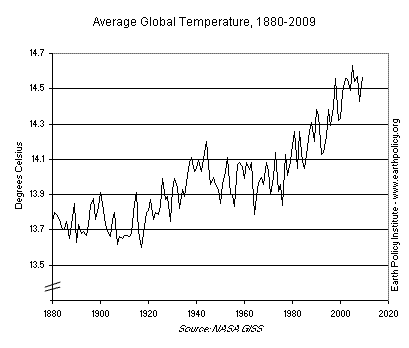
    The first decade of the twenty-first century was the hottest since recordkeeping began in 1880. With an average global temperature of 14.52 degrees C (58.1 degrees F), this decade was 0.2 degrees C (0.36 degrees F) warmer than any previous decade. The year 2005 was the hottest on record, while 2007 and 2009 tied for second hottest. In fact, 9 of the 10 warmest years on record occurred in the past decade.

    Temperature rise has accelerated in recent decades. The earth’s temperature is now 0.8 degrees C (1.4 degrees F) higher than it was in the first decade of the twentieth century, and two-thirds of that increase has taken place since 1970.

    Even with these seemingly small increases in global temperature, natural systems are already starting to respond, as evidenced by melting ice sheets and glaciers, shifting weather patterns, and changes in the timing of seasonal events. If temperatures continue to rise on their current trajectory, by the end of the century they will have left the narrow range in which human civilization has developed and flourished.

    Though temperatures are rising around the globe, some areas are warming faster than others, with the greatest warming taking place in the Arctic. Paleoclimate records from Arctic lakes, tree rings, and ice cores reveal that the past decade was the warmest of the past two millennia. Warming is amplified in the Arctic for a number of reasons, including the loss of the region’s extensive snow and ice cover: as temperatures rise and light-reflecting ice melts, it is replaced by darker water, which absorbs more energy from the sun, thereby accelerating warming. In parts of the Arctic, average annual temperatures have increased by as much as 2–3 degrees C (3.6–5.4 degrees F) since the 1950s. In 2007, Arctic summer sea ice shrank to its lowest extent on record, leaving the Northwest Passage completely ice-free for the first time in human memory. Then 2008 and 2009 brought the second and third lowest extent of Arctic summer ice on record.

    The earth’s temperature is determined by a number of factors. One major influence is the El Niño–Southern Oscillation (ENSO). This cycle, which involves large shifts in atmospheric and ocean temperatures over the tropical Pacific, has two phases: El Niño, which typically raises average global temperature, and La Niña, which lowers it. Year-to-year temperature variations are also influenced by the amount of energy the earth receives from the sun: increases in solar activity tend to raise global temperatures, while decreases in solar activity lower them.

    These natural cycles alone, however, fail to explain the temperature patterns of the last decade. While the strongest El Niño of the century pushed 1998 temperatures up to their then-record high, temperatures in the hottest year (2005) did not receive a boost from El Niño. And 2007 was tied for second hottest year on record, despite the development of a cooling La Niña. Furthermore, while global temperatures have been climbing to record heights, incoming solar energy has in fact been declining since the beginning of the decade. In early 2009, solar activity reached its lowest level in a century.

    Rather than ENSO cycles or variations in solar irradiance, human-induced warming from heat-trapping greenhouse gases has become the dominant climate influence. Carbon dioxide levels in the atmosphere have risen rapidly since the start of the Industrial Revolution, climbing from 280 parts per million (ppm) in the late eighteenth century to 387 ppm today. Researchers recently reported that the last time atmospheric carbon dioxide levels were this high was roughly 15 million years ago, when sea level was 25–40 meters (80 to 130 feet) higher, and temperatures were approximately 3–6 degrees Celsius warmer.

    The risks posed by rising global temperature are widespread. As the atmosphere warms, mountain glaciers that provide water to over a billion people are melting. Melting ice sheets and thermal expansion of oceans raise sea levels, threatening coastal populations. Increasing temperatures bring decreasing crop yields, putting world food supplies at risk. And ecosystems worldwide are irrevocably altered, placing large numbers of species at risk of extinction.

    Higher global temperatures also bring with them more frequent and severe extreme weather events. Over the past few decades, scientists have noted an increase in hot extremes and a decrease in cold extremes across the globe. As temperatures rise further, heat waves will become more frequent and intense. Longer and more severe droughts will take place over wider areas; an upsurge in global drought since the 1970s, associated with higher temperatures, has already been observed.  At the same time, as temperatures rise, the water-holding capacity of the atmosphere increases, leading to more intense storms and flooding in areas that are already wet.

    The past decade saw many record-breaking extreme weather events, providing examples of the kinds of incidents expected to become more frequent with global warming. In the summer of 2003, Europe experienced an intense heat wave that led to over 52,000 deaths. In the United States, where daily record high temperatures occurred twice as often as record lows over the last 10 years, persistent drought plagued parts of the South and West for much of the second half of the decade. A 2006 heat wave affecting the West and Midwest was blamed for 140 deaths in California.

    The combination of high temperatures and drought makes a dangerous recipe for wildfire; indeed, 2006 and 2007 saw the worst fire seasons on record in the United States. A similar combination led to disaster in southeastern Australia in early 2009: on what is now known as Black Saturday, intense, rapidly spreading bushfires killed 173 people and burned over a million acres.

    Other areas have experienced unusually heavy rains and flooding over the past decade. Record flooding hit Central Europe in 2002, causing over 100 deaths and forcing 450,000 people to evacuate. In summer 2007, the worst flooding in 60 years in England and Wales killed nine people and caused billions of dollars worth of damage; that May to July period was the wettest in the region since recordkeeping began in 1766. In 2008, extensive flooding occurred in several parts of the African continent; Algeria saw its worst floods in a century, while Zimbabwe’s floods were its worst on record.

    As temperatures rise, warmer oceans provide more energy to feed tropical storms. The past few decades have seen an increase in the frequency of the most severe hurricanes, and researchers have identified rising sea surface temperatures as the primary cause. The 2005 Atlantic hurricane season was the worst on record, with 27 named storms, 15 of which were classified as hurricanes—including Hurricane Katrina, which caused over 1,300 deaths and $125 billion in financial losses.

    In 2007, the Intergovernmental Panel on Climate Change (IPCC), an international body of over 2,500 scientists, released its Fourth Assessment Report, in which it called the recent warming of the globe “unequivocal.” The report projected a rise in average global temperature of 1.1–6.4 degrees C (2–11 degrees F) by the end of the century. Based on the most recent scientific assessments, if greenhouse gas emissions continue to grow at their current pace, the temperature rise by the end of the century will likely reach or exceed the upper end of these projections. Already, effects of increasing temperatures such as accelerating ice melt and sea level rise are outpacing the IPCC’s predictions of just three years ago.  Without significant cuts in greenhouse gas emissions, global temperature will rise dramatically by the end of the century, creating a world that looks vastly different from the one we know today.

     Data and additional resources available at www.earthpolicy.org.

    Related Links:

    The melting of America

    On the move: Species face race against climate change

    Ice Melting Faster Everywhere


  • And the Pursuit of Happiness – Louis Malle

    I wonder if citizens in each generation, in an inescapable and nostalgic moment, are bound to look back at previous generations with a sense of amazement and feeling of “wow, that was a much simpler time”?

    I think it is interesting to compare and contrast the Americans in Louis Malle’s 1986 “And the Pursuit of Happiness” and the Americans in 2010.

    Amazing film, beautifully made, very sweet at some moments. Highly recommended.

    Posted in Democracy, Documentary, people, united states