Blog

  • Qualcomm’s mirasol display technology brings color and video to eReaders

    Qualcomm's Mirasol technology mimics the structure of a butterfly's wing to provide a low-...

    As eReaders such as the Kindle and the Nook establish themselves with consumers, manufacturers are already looking ahead to the next generation of devices. Moving beyond e-ink, tomorrow’s eReaders will feature color displays and the ability to show video as well. To meet the needs of the most demanding users, eReaders will also need to feature long battery life and displays that are bright enough to read even in direct sunlight. Qualcomm’s Mirasol displays, which will begin shipping this year, address these needs using technology that mimics the coloration of a butterfly’s wings…

    Tags: ,
    ,
    ,
    ,
    ,
    ,

    Related Articles:


  • HTC HD2 now also on Virgin Mobile

    virginmobilehtchd2

    I don’t associate Virgin Mobile with high-end smartphones, but I may have been mistaken.  Coolsmartphone has just noticed the premier Windows Mobile smartphone on the network, and at pretty reasonable prices also.

    Virgin Mobile seems to be the only network still offering 12 month contracts, and even the 18 month contracts are run cheaper than O2’s for the same minutes and period.

    Read more at Virgin Mobile here.

    Via Coolsmartphone.com

    Share/Bookmark

  • Darkness Follows: Renault’s Dacia brand launches Black Line

    Filed under: , ,

    Dacia Black Line Models
    Dacia Logan, Logan MCV and Sandero Black Line – Click above for high-res image gallery

    These days it seems like every color is being claimed for one cause or another. Medical research has laid claim to a few (pink and yellow come to mind), but so has the automotive industry: red for performance, green for hybrids, blue for clean diesels… Mercedes adopted black as the label for its most extreme AMG models, but now the shade is being used for something decidedly more low-rent: Renault‘s budget brand and Romanian subsidiary, Dacia.

    Available on the Logan, Logan MCV and Sandero – though not, apparently, on the Logan pick-up or the upcoming new Duster crossover – the Black Line adds a touch of class to the budget cars. The package, based on the Laureate trim level, adds such “special” touches as metallic paint, visible top-stitching on the black fabric upholstery, MP3-capable CD player and a leather-trimmed steering wheel. Nothing ground-breaking here, and it’s not going to outshine an SL63 by any means, but finally a car Top Gear’s James May can drive to the symphony. Details in the press release after the jump and photos in the gallery below.

    Gallery: Dacia Black Line

    [Source: Renault]

    Continue reading Darkness Follows: Renault’s Dacia brand launches Black Line

    Darkness Follows: Renault’s Dacia brand launches Black Line originally appeared on Autoblog on Sun, 10 Jan 2010 18:15:00 EST. Please see our terms for use of feeds.

    Permalink | Email this | Comments

  • Talkcast 10 pm tonight: Looking ahead to Macworld Expo

    Filed under: ,

    Talkcast time again! We’ll review the week’s news, consider the latest tablet tidbits, and then look back at CES and ahead to Macworld Expo.

    To participate on TalkShoe, you can use the browser-only client, the embedded Facebook app, or the classic TalkShoe Pro Java client; however, for maximum fun, you should call in. For the web UI, just click the “TalkShoe Web” button on our profile page at 10 pm Sunday. To call in on regular phone or VoIP lines (take advantange of your free cellphone weekend minutes if you like): dial (724) 444-7444 and enter our talkcast ID, 45077 — during the call, you can request to talk by keying in *-8.

    If you’ve got a headset or microphone handy on your Mac, you can connect via the free Gizmo or X-Lite SIP clients; basic instructions are here. Talk with you then!

    TUAWTalkcast 10 pm tonight: Looking ahead to Macworld Expo originally appeared on The Unofficial Apple Weblog (TUAW) on Sun, 10 Jan 2010 18:00:00 EST. Please see our terms for use of feeds.

    Read | Permalink | Email this | Comments

    Buy This Item: [Click here to buy this item]

    Read Original Article

  • Manually schedule Software Update ‘the OS X way’ with launchd

    Filed under: ,

    In response to a Macworld article, TidBits’ Chris Pepper elaborated on ways to run Software Update, Apple’s means of delivering updates and patches, on your own schedule. Beginning with the fact that Software Update schedules its next update based on the time it’s currently being run, setting the time for the next update is as easy as running it manually at the time you want it to be scheduled for in the future.

    Later, Pepper delves into the command line method of updating, using the softwareupdate tool (which we’ve talked about on TUAW, too) to run it from Terminal. Taking that a step further, it’s suggested that you run the command from cron, a UNIX command for scheduling tasks, to automate the command-line updates. However, while it still works fine and is perfectly capable of the task, cron has technically been deprecated in OS X since Tiger. I thought I’d mention the newfangled “Mac OS X way” of handling scheduled tasks, and demonstrate a little of its flexibility.

    Launchd is Apple’s replacement for several UNIX ways of doing things, including init, rc.d scripts and cron. It provides a uniform, XML configuration method and — in many cases — is more secure than the replaced methods. Launchd can trigger applications and scripts at boot time, at intervals or even when a file or the contents of a folder change. It can also make sure a daemon or an application keeps running, with the ability to respawn and throttle it. If that’s just a bunch of nerd-speak to you, don’t worry, this isn’t going to be an overly technical post. You can read more specifics about launchd on Apple’s developer site, if you want more geeky goodness.

    Launchd configuration files, like much of OS X, are XML files. Each process has one, and they can exist just about anywhere. A tool called launchctl is used to add and remove them from launchd. While these files are technically human-readable, they’re not the most fun to create and edit. In the interest of keeping this as non-technical as possible, I’m going to use a very handy utility called Lingon. The latest version (2.1.1) can be found at Sourceforge. It’s no longer under active development, but it’s working fine in Leopard and Snow Leopard. Grab a copy, put it in either your Applications folder or into Applications/Utilities, and launch it.

    You’ll see all of your existing daemons and agents in Lingon’s sidbar. Unless you know exactly what you’re doing, you’ll generally only want to edit/add scripts in the “My Agents” section to avoid breaking anything at the system level. Create a new script using the plus button in the upper left, and name it something unique in section 1 of the edit area; I prefix my launchd scripts with my own name, e.g. com.brettterpstra.awesomescript, but anything will work.

    Section 2 is where our command goes. In this case, we’re running the softwareupdate command, and we want it to automatically download any available updates in the background. We’ll use /usr/sbin/softwareupdate --download --all in that field.

    Section 3 gives us the various options for running the command. In Lingon’s interface they’re pretty self-explanatory, so I won’t go through each one. We’ll just use “At a specific date:,” “Every Day,” and whatever time works best for you (and your bandwidth allowances). Make sure the enabled checkbox in the upper right is checked, hit the save button at the top, and you’ve got your own Software Update scheduler. Change the time at will, or use one of the other options to control how often it runs. If you enable this, you’ll probably want to disable the automatic checking in Software Updates panel in System Preferences.

    There are other possibilities, too. For example, if you wanted to be notified as soon as possible about available updates, you could write a script that ran softwareupdate with the “-l” option (to list available updates without downloading them), parse the output and have it send you an email or a direct message if it found any updates. Run it about every 15 minutes and you could be among the first to know about an update! You can also use the launchd manager (launchctl), or Lingon to disable background processes that other programs have added, but that you don’t want running. Whether you’re a UNIX user still hanging on to cron, or are just a regular user who wants something besides iCal for scheduling scripts and launching applications, this will hopefully get you started with the ‘new’ OS X way of doing it.

    TUAWManually schedule Software Update ‘the OS X way’ with launchd originally appeared on The Unofficial Apple Weblog (TUAW) on Sat, 09 Jan 2010 19:00:00 EST. Please see our terms for use of feeds.

    Read | Permalink | Email this | Comments

    Buy This Item: [Click here to buy this item]

    Read Original Article

  • Cartoon: Apple Tablet: Now With Barometer and Bird Call Generator

    caroon_sjobsmain_0110.pngI’m just aching to know if the new Apple tablet (insert caveats, weasel words and qualifiers here) is a potential Cintiq competitor. I don’t think it will be, but you never know. It may also have a built in barometer and bird call generator.

    I’m never sure if Apple does themselves more good than harm with the secrecy and anticipation that surrounds the run-up to these announcements. Unless there’s something truly jaw-dropping about whatever device rises from the stage when Steve Jobs reaches that particular slide in Keynote, the reaction may be muted disappointment: “Oh.” “Huh.” “Wait a minute… my life is still the same miasma of thwarted potential and spiritual anomie that it was half an hour ago!”

    Sponsor

    That said, what are you expecting on Jan. 27?

    cartoon_sjobs_0110.png

    More Noise to Signal.

    Discuss


    Buy This Item: [Click here to buy this item]

    Read Original Article

  • Ten Las Vegas DMV employees indicted for falsifying emissions tests

    Filed under: ,

    Emissions passEmissions tests are often part of the registration renewal ritual for many car owners. Some appreciate being able to breathe deeply, others see it as a de facto tax, while still another group of automotive unfortunates have cars that won’t pass without much expensive work. Whether for purely financial reasons, or a chafing anti-authoritarianism, some drivers elect to circumvent the system.

    Federal indictments have been handed down to 10 Nevada emissions testers for falsifying emissions tests. The ten testers allegedly accepted cash stipends for “clean scanning” a car. Normally during a Nevada emissions test, vehicles are plugged in via their OBD-II port and the Vehicle Identification Number is entered into a computer. The computer then scans the car’s on-board system and passes or fails the automobile. “Clean scanning” is a deception whereby a different vehicle, one that will pass, is connected to the computer, and the VIN of a failing car is entered. More than 1,000 vehicles are believed to have been falsely passed this way by the indicted.

    Fooling around with the federal Environmental Protection Agency has these 10 individuals facing up to two years of incarceration and maximum fines of $250,000 per person. Is it mere coincidence that this high-stakes game of palm greasing happened in Vegas?

    [Source: U.S. Department of Justice | Image: David McNew/Getty]

    Ten Las Vegas DMV employees indicted for falsifying emissions tests originally appeared on Autoblog on Sun, 10 Jan 2010 17:22:00 EST. Please see our terms for use of feeds.

    Read | Permalink | Email this | Comments


    Buy This Item: [Click here to buy this item]

    Read Original Article

  • Will 2010 be mobile advertising’s big year?

    Google’s acquisition of AdMob last November pulled the mobile advertising industry into the spotlight. Until then it had mostly been seen as the poor relation of Internet advertising in terms of revenue, if not of hype. Yet mobile offers advertisers many attractive possibilities. No other device is as personal, interactive and constantly within reach as a cell phone. And cell phones let advertisers target whole new parameters, such as location and context. So will 2010 be the breakout year for the mobile advertising business?

    The Mobile Advertising Ecosystem

    Mobile ads can be delivered in the form of messages like SMS and MMS, banner and full-page ads on Mobile Internet sites, mobile search ads, in-application advertising and mobile video. Mobile ad impressions are generally bought at cost per thousand (CPM) or cost per click (CPC). The main measures of success are the number of users reached, click through rate (CTR) and the number of actions — for example, number of downloads — prompted by the ad. SMS and MMS are still considered the most effective advertising channel, with correspondingly higher pricing. Most users will read at least part of an SMS received.

    Mobile ad networks distribute mobile ads to publishers like mobile websites, application developers and mobile operators. The cheapest way to advertise is via a blind ad network where advertisers can’t pick specific publishers but can often target by country and content channel. Admob and InMobi fit into this category. Premium ad networks like AOL or Nokia focus on a limited number of prestige publishers like mobile operators and specific big-traffic sites, and the advertiser pays extra to target those sites specifically. Some larger publishers and mobile operators run their own ad platform, like the one supplied by Amsterdam-based startup MADS. There are also many small players who supply niche services. Mobclix, for example, is an ad exchange startup targeting smart phones via multiple ad networks. Finally, there are the publishers themselves such as eBuddy, maker of one of the most popular mobile IM applications.

    AdDollarsByAppTypeWhere Is the Money?

    The US mobile ad market was estimated to be around $416 million in 2009. While the majority of US mobile ad spending still goes to messaging like SMS, spending on applications and search is on the rise. MADS Sales Director Jasper de Vreught says, “We do see a development where the average spend per campaign is significantly increasing. CPC will become more important, whereas in the premium model, CPM is now still the predominant charging model.“

    Mobclix supplied me with some data (not shown here) on the highest yielding application categories in October 2009. This data was from 4000+ applications with a 70% reach across iPhones and iPod touches.

    The most popular finance applications (the top 100 serving ads) made 4.5 times the average advertising revenue of the top ad-serving applications overall, while social networking applications make 3.9 times the average and education applications 3.7 the average. So if you are a developer trying to make revenue from advertising, social networking looks like a great choice, since it has high ad revenue and fewer competing applications (2,098 as opposed to 17,147 in entertainment) than other categories. Gaming, on the other hand, looks like it is becoming saturated.

    The most popular entertainment applications only make 0.8 times the average top applications. Despite very high CTR, utilities were also only making 0.8 times the average in October 2009 because of a lack of high-end advertisers. However, by December 2009 this had increased to 1.7 times the average due to an increase in advertisers focusing on specific types of users and apps.

    IM application eBuddy recently started serving mobile ads. According to eBuddy founder Jan-Joost Rueb, “Mobile is rapidly growing even though we started only a few months ago. Mobile advertising revenue is higher than revenue from [eBuddy’s non-ad-supported] pro versions right now. ”

    Targeting and Technology

    One of the most attractive characteristics of mobile for advertisers is the opportunity for more accurate ad targeting. Typical parameters include carrier, device type and mobile channel, with the possibility to add location, behavioral, and demographic information (the latter often requires user opt in). Frequency of use, reach and usage context are the important factors when inserting ads into applications. However, MADS founder Ashu Mathura contends that current targeting software still only does about 25% of what is needed.

    MADs did a H&M campaign in which ads were served to two groups of users: all users, and those who had already clicked on a H&M ad. Unsurprising, the campaign has a much higher response in the second user group. Based on this insight, it might make sense to create a sequence of ads as part of a campaign, where a second ad in the sequence is only served to users who have clicked through the first. I could certainly see myself being interested in ads that remind me when the H&M sale starts and offers a voucher if I make it to the second or third ad. MADS also sees potential in the idea of users opting in for certain types of ads in return for rewards like discounts.

    Interesting developments on the technology side include interactive video advertising (introduced last year by Admob) and making greater use of smartphone features such as the accelerometer and camera, such as for augmented reality ads.

    Mobile Advertising in 2010

    Most players see Google’s Admob acquisition as an endorsement of the mobile ad market in general. InMobi, which is the only ad network to reach profitability other than Admob, thinks that the industry is at the 1.0 stage. According to Anne Frisbee (Head of North America at InMobi), the acquisition has actually occurred “quite early in the evolution of the industry”.

    Jasper de Vreught from MADS says that in the future “there will be a clearer division between two business models: the “long tail model” like AdWords and AdMob, and the “premium model” like Doubleclick and MADS, which are aiming to build a network of premium publishers and attract premium advertisers. MADS’ Mathura also says that while there is a lot of focus on downloaded apps right now, most of this functionality is likely to move into the cloud, and there’ll be a corresponding impact on how advertising is done.

    According to eBuddy, the media agencies have still not really embraced mobile and tend to stick to the old and proven formula. Rueb says “It’s important for eBuddy to get the premium advertisers on board. There are too many VAS (value-added services) advertisers like ring tones right now.” Other players say similar things. Advertisers still like to see things like TV spots, which they understand, even though this is often not rational in terms of return on investment. Maybe 2010 will be the year when advertisers start seeing mobile less as an experiment and more as a serious part of their campaigns.


    Buy This Item: [Click here to buy this item]

    Read Original Article

  • Favi RIOLED-Q and RIOLED-V pico projectors launched: the future is bright, wireless

    Looks like the world’s still got appetite for some more pico projectors, as Favi’s releasing a pair some time between late February and early March for prices yet unknown. First is the RIOLED-Q (pictured) which sports a pretty 800 x 600 native resolution at 50 lumens — supposedly the best brightness in class (like the Optoma PK301), along with built-in SD / MMC card reader, battery, three-watt stereo speaker and an ever-so-handy digital keystone correction. Joining the party is the smaller RIOLED-V which is shy about its display specification, but proudly packs a card reader and WiFi to cater its various web apps for YouTube, Flickr, Picasa, Yahoo News, Weather, Email, Internet Radio and web browser. Too bad it doesn’t do phone calls.

    Favi RIOLED-Q and RIOLED-V pico projectors launched: the future is bright, wireless originally appeared on Engadget on Sun, 10 Jan 2010 17:14:00 EST. Please see our terms for use of feeds.

    Permalink PicoProjector-info (1), (2)  |  sourcePC Magazine  | Email this | Comments

    Buy This Item: [Click here to buy this item]

    Article

  • Washed Out

    Best Wishes and Thanks for viewing 🙂

  • The Price of Apple MacBook Pros Around the World [Chart]

    Brazil is one of my favorite countries. Cool people, great music, heavenly beaches, and caipirinhas. But if you have to buy a Mac, you are screwed. And like this graphic shows, it’s the same in other places in the world.

    Brazil wins, however: The price of one MacBook Pro 17″ there buys you two identical models in the US. It’s the same with other Apple products, so if you can’t live without your Apple fix, you better move to another country.

    I’d take the caipirinhas and the beaches, thank you very much. [cmyplay—Thanks]


  • Never Think Outside the Box: Grant Writing is About Following the Recipe, not Creativity

    A New Yorker cartoon I like:

    outside_the_box_400x544

    If you write proposals, don’t be this cat.

    Any time you’re writing to an RFP—which, for grant writers, is virtually all the time—you’re required to respond to the RFP. If the RFP says, “give services to 300 participants per year,” you should say in your proposal that you’re going to serve 300 participants per year, not 30 or 3,000. If the RFP says, “run a three-year program,” propose a three-year program, not a five-year program. I could go on indefinitely in this vein, but I shouldn’t have to. The point is simple: do exactly what the RFP says you should do. As a grant writing rat in an RFP Skinner Box, you get the treat (money) by pressing the bar (following RFP directions), not by running in circles trying to get out of the box.

    Clients sometimes direct us not to do what the RFP says, even when we advise them that it is best to follow the RFP. Ignoring the RFP instructions almost guarantees they won’t be funded; Isaac has already written about one example in True Believers and Grant Writing: Two Cautionary Tales:

    Writing a YouthBuild proposal is very much a “cookbook” exercise in that the DOL pretty much tells applicants what they want applicants to do, and successful proposals have to regurgitate this stuff within the absurdly short page limit and the obtuse data required by the funder. In other words, if you want a YouthBuild grant, you should, as Rupee says, just Do the Damn Thing.

    The clients for the four funded proposals listened to us, and we were able to craft compelling, technically correct proposals that warmed the stone-like hearts of the DOL reviewers. In contrast, our True Believer client had a vision of how she could use a YouthBuild grant to attack a whole slew of problems faced by at-risk youth in her rural community. Almost none of what she wanted to do, however, had anything to do with YouthBuild, and she fought us throughout the proposal development process. We did our best to make the proposal fundable to no avail. Despite her passion and commitment, no YouthBuild funds are available today to help the young folks she cares so much about.

    A more recent example involved a Department of Education program in which the exact student cohorts to be served are mandated in RFP, as well as the underlying legislation and regulations. It doesn’t get any more specific than this. For reasons that were not made clear to us, our client insisted on removing one of the specified student cohorts from the draft proposal, even though we told him that he could save the postage, as the proposal will likely be deemed technically incorrect, which it is, and be thrown out before it is scored. This particular RFP also includes specific fill-in-the-blanks objectives, which were to be replicated word for word in the proposal. In the first draft, our client modified the wording of the objectives.

    While some RFPs provide significant latitude in program design, many do not and are essentially cookbooks. If you have a cookbook RFP, follow the cookbook. For example, YouthBuild demands that participants being trained in the construction trades have on-site training experiences in the construction/rehabilitation of low-income housing, so you shouldn’t propose a retail mall as a training site, no matter how good an idea that might be to the Executive Director or Board. On a similar subject, remember that every question in the RFP applies to you, no matter how dumb it may seem, how repetitive it may be, or how little you think it should apply. I explain how this works in RFP Lunacy and Answering Repetitive or Impossible Questions.

    Part of not thinking outside the box includes telling the funding agency what they want to hear. One such example is the infamous “sustainability” sections that many federal RFPs include, which we wrote about in detail here. These sections require applicants to state how they will sustain the project after federal funding ends. As Isaac said in the post:

    For the vast majority of nonprofits applicants […] grants and donations [are the only viable financial resources available]. If we know this simple truth, how come foundation and federal program officers seem clueless? If the agency had the couple hundred thousand dollars sitting around to fund a given program, it wouldn’t need the grant and wouldn’t apply.

    Furthermore, the major cost for most human service providers are staff salaries and other operating costs. So it’s improbable that you’ll just need a bunch of money to get off the ground; although startup costs are real, they’re still dwarfed by staffing and ongoing operations costs in most cases. There might be a hypothetical dream project out there, somewhere, that just needs that DHHS grant to get started and then can run indefinitely off of revenue, but we’ve never seen it.

    If you don’t like an RFP’s inane restrictions, remember the golden rule, as articulated in Studio Executives, Starlets, and Funding: “He who has the gold makes the rules.”

    Very occasionally, you have to invent a box for yourself because the funder hasn’t given it to you. Foundations will do this by not putting a maximum cap on requests and/or by having maddeningly opaque guidelines. In such cases, you should look at how much they’ve previously offered in funding; if they’ve historically made grants in the $10,000 – $50,000 range, asking for $400,000 is unlikely to work (for more on this topic, see my post “So, How Much Grant Money Should I Ask For?“).

    Most of the time, however, you’ll be given a box, and if you step outside it, you’re not going to be praised like a precocious high school student. You’re going to be treated like a cat who’s decided to show its creativity by ignoring the litter box. The RFP is your litter box. Ignore it at your peril.

    EDIT 1/25/2010: Isaac wrote a follow-up to this post regarding the importance of conventional wisdom, even when it’s wrong.

  • Irish Charm for All Times

    Best Wishes and Thanks for viewing.

  • Rr Line Adjuvant Anti-hair Loss Lotion

    • Anti-Hair Loss Lotion

    Product Description
    RR line
    Anti-Hair Loss Lotion

    Its formula contains marine amino acids which have an effective toning and revitalising action on the piliferous bulbs, stregnthening them and therefore promoting re-growth of the hair.

    HOT TO USE : after shampooing with energizing anti-hair loss shampoo apply the contents of the phial evenly. Delicately massage and then dry.

    SIZE ; 100 ml / 3.38 FL.OZ.
    Made In Italy… More >>

    Rr Line Adjuvant Anti-hair Loss Lotion

    Possibly related posts: (automatically generated)

  • Wanda Sykes Broken Foot

    Wanda Sykes has suffered a broken foot.

    The comedienne and talk show host — who welcomed twins with her partner eight months ago — sustained the injury during production on her FOX late night program, The Wanda Sykes Show, last Thursday, Sykes tells The Insider’s Niecey Nash.

    The funnywoman battled through the pain and carried on with the recording. It is not known how Sykes broke her foot.

  • Los Misterios del Aeropuerto de Denver

    [IMG]http://www.call2web.com/images/DenverAirport.jpg[/IMG
    cualquier viajero del aeropuerto de denver, colorado puede pasar por una experiencia extraña

    este aeropuerto ha sido sujeto de muchas preguntas debido a los simbolos, imagenes e historias inexplicables, el aeropuerto de denver fue construido en 1995, en un terreno de 53 millas cuadradas, a pesar de que Denver ya tenia un aeropuerto funcionando, se decidió construir un nuevo

    este nuevo aerpuerto tenia menos pistas y ningun avance tecnológico nuevo, la unica cosa que este nuevo aeropuerto tiene que el otro no tenía es un espacio extremadamente grande,
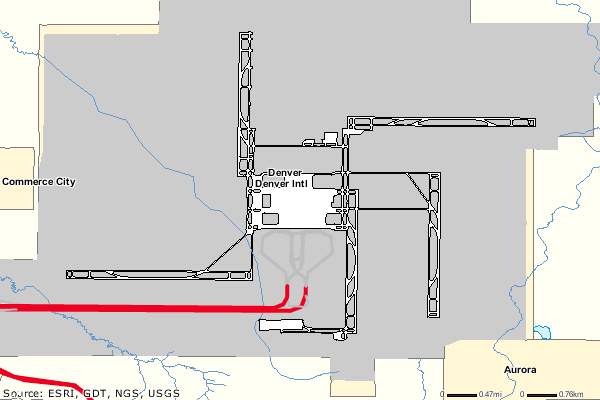
    al mirar una toma aerea del aeropuerto la distribución del mismo ha sorprendido a muchos, las pistas del aeropuerto han sido situadas de tal manera que recuerda una suastica nazi, no solo se ha cuestionado la forma de dicho aeropuerto sino lo que se encuentra adentro, pero quien se encuentra a cargo de todos estos simbolismos extraños dentro de este aeropuerto? el conscenso general indica que se trata de el "New World Order" (Nuevo Orden Mundial),
    ]

    pero que es el New World Order?, son un grupo lider de individuos que incluye muchos de las personas mas ricas del mundo como líderes politicos mundialmente conocidos, y algunos relacionados con la realeza británica, su meta principal es cregar un gobierno mundial unificado que no tenga fronteras regionales pero esto solo sería posible de una manera la cual es cometer un genocidio mundial, y reducir la poblacion mundial a dos billones de personas, la razon de esto es por que habría mas control, el aeropuerto de Denver tiene muchos simbolos que se relacionan con el New World Order, hay una piedra dedicada en el aeropuerto al New World Airport Commission, sin embargo dicha comision no existe, ya que dicha comision nunca fue creada, tambien hay una placa en el piso que hace alución a los símbolos AU Ag, uno de los patrocinadores de este aeropuerto descubrió una nueva clase de epatitis llamada Australia Antigen la cual tambien se simboliza con AUAG.

    lo atemorizante es que este simbolo se encuentra localizado enfrente de un mural el cual es acerca del genocidio.

    hablemos de los murales localizados en el aeropuerto, los cuales son las caracteristicas mas notables de el mismo, el mural principal se extiende por cuatro paredes y fue pintado por el artrista chicano Leo Tanguma el cual es de ascendencia Maya.

    el primer mural muestra tres mujeres muertas, una africana, una nativa americana, y una joven judia, en el fondo se puede ver la destruccion de una ciudad y un bosque, esto trata de mostrar la destruccion del mundo.

    Otra caracteristica notable es una niña cargando una tabla maya la cual hace alusion a la fecha maya Diciembre 21 de 2012, esta fecha es cuando los mayas predijeron que el mundo pasará por una fase de renacimiento

    El enfasis de este mural es la destruccion del mundo y la preservacion de algunas especies,

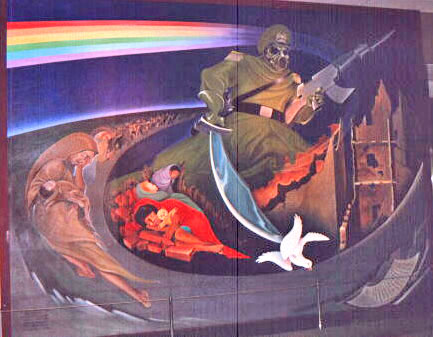
    el segundo mural muestra una enorme figura militar usando una mascara de gas y sosteniendo una ametralladora y una espada, esta espada esta atravesando una paloma la cual se usa como simbolo de la paz, lo cual representa que la paz sera destruida, hay unas franjas grises que emanan de dicha figura que aparentemente representan un gas venenoso que ha matado a todos a su paso, este mural es el que se encuentra enfrente del simbolo AUAG el cual representa el virus Australia Antigen, tambien se puede ver una linea de mujeres llorando sosteniendo a sus hijos muertos y un grupo de niños muertos sobre una pila de ladrillos.

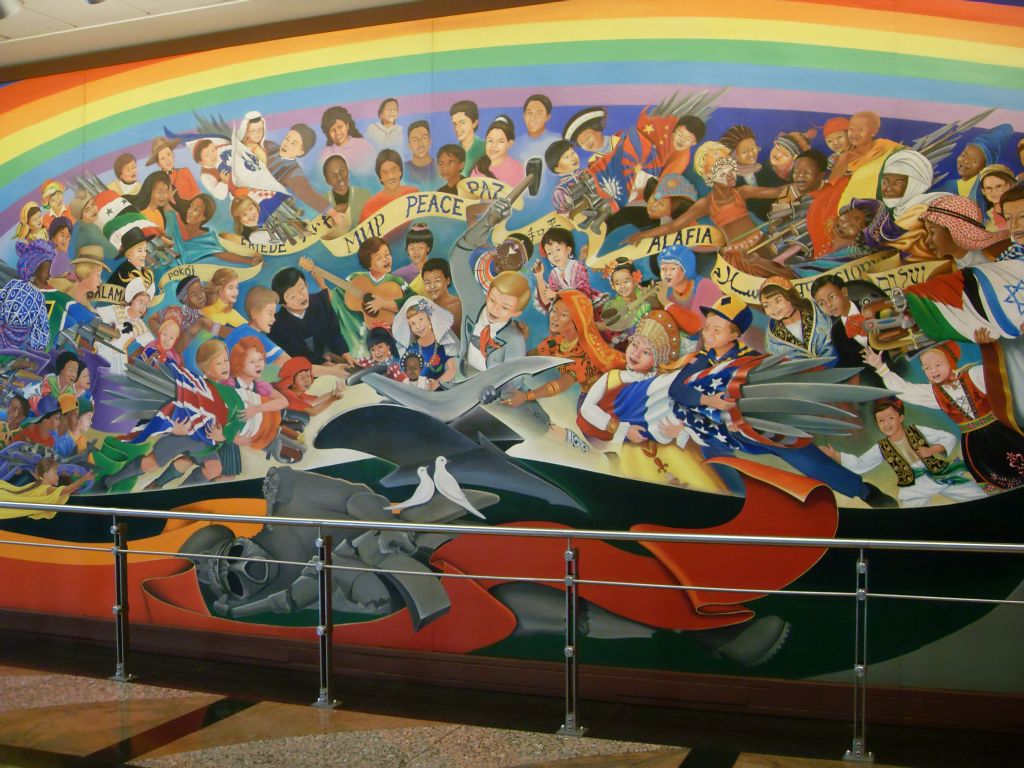
    el tercer mural muestra a los niños del mundo tomando las armas de cada pais, y dandoselas a un niño alemán que las esta moldeando en algo diferente, todos los niños de la escena, son de diferentes etnias, el hombre con mascara de gas se ve muerto con dos palomas sobre su cuerpo, el tema principal de este mural es el retorno de la paz despues de la matanza y no habrá necesidad de armas en este mundo perfecto,

    el mural final tiene una figura enmedio que sostiene una planta la cual simboliza renacimiento,

    toda la gente esta corriendo hacia este hombre con expresiones de felicidad, los animales se encuentran en libertad y todo parece estar en armonia, este mural final alude a un nuevo jardin del eden donde todo es perfecto y todos pueden trabajar juntos despues del genocidio.

    estos murales representan juntos la formacion de un nuevo mundo con menos poblacion y esta es la meta del new world order el cual se encuentra representado en simbolos en todo el aeropuerto,

    el simbolismo de este aeropuerto es tema de debate pero algo que no se cuestiona es que ha habido mucho trabajo de construcción debajo del aeropuerto.

    cuando fue construido el aeropuerto habia originalmente cinco edificios pero supuestamente fueron construidos mal y se ordenó enterrarlos, normalmente un edificio mal construido es demolido, pero en este caso no fue así.

    se dice que se trata de una base subterranea y todavia hay personas que son enviadas a trabajar en esta base subterranea, se ha seguido construyendo bajo tierra y ahora hay tuneles que conectan todos los edificios subterraneos, un se dice que hay un sistema de irrigación en estos tuneles, pero no hay necesidad de un sistema irrigacion en unos tuneles de concreto y bajo tierra, estas bases subterraneas no tienen ningun proposito, y cuando las autoridades del aeropuerto son cuestionadas ellos dicen que son usados para almacenamiento.

    sin embargo la base subterranea es de 88.5 millas cuadradas ningun aeropuerto nedcesita tal cantidad de espacio de almacenamiento, asi que para que es usado ese espacio de almacenamiento.

    se dice que muchos personajes importantes han comprado propiedades cerca del aeropuerto.

  • Salutations

    Greetings Programs!

    I am The Erk, type 1 diabetic of 21 years. I am very friendly and hardly ever bite. (Tho i do kick and scream)
    I am pleased to meet (meat?) you all.

    …TheERK

  • Luanda | Torre Vale das Princesa | F | Em comercialização

    Quote:

    Projecto do Condominio Vale das Princesas Constituido por 5 Torres de 14 Andares , Localizado na comuna do Benfica Ha 100 metros do control da Poliçia. com 2 elevadores por edificio , 4 apartamentos por andares, sendo 3 do tipo T2 com 100m2 e 1 do tipo T3 com 128m2. Parque de estacionamento Composto por 1 cave de 3 niveis , 2 vagas por apartamentos . area de Lazer ,Clube ,Piscina. apartir do 5º andar vista previlegiada para o mar………


  • what foods should spike you, but don’t?

    mine is corn tortillas, I buy the regular ones ( can;t find the low carb) & they are about a buck for 10. Each one has 15 grams carbs. If I eat one at lunch or breakfast, using it as a wrap, I don;t get any spike. However, even one slice of low calorie wheat bread or thins (half of one) which wold have about 10 to 12 carbs, spike me much more.
    What’s your anomaly?
  • El maravilloso mundo de los Timelapses

    Abro este hilo para dar a conocer una bonita forma de ver a nuestras ciudades: el Timelapse.

    El Timelapse consiste en hacer una serie de fotos en un tiempo espaciado y unirlas más tarde. Puede dar resultados tan buenos como estos….

    Un bonito paseo por Madrid, hecho por Luis Caldevilla:

    Prespectiva de Barcelona, no conozco el autor…

    Podeis encontrar muchos más en timelapse.tv , espero que os guste