Blog

  • this place is best shunned and left uninhabited

    mammoth has an interesting post on ways of making nuclear waste sites recognisably dangerous over long periods of time – this place is best shunned and left uninhabited.

    Triggered by the recent revelation that tests at the Pacific Northwest National Laboratory reveal that a seemingly innocuous white substance filling a glass bottle dug up in 2004 is actually “the oldest existing sample of bomb-grade plutonium from a nuclear reactor, with a half-life of 24,110 years,” Juliet Lapidos reviews the Department of Energy’s 1993 recommendations for the construction of a massive nuclear-waste disposal warning landscape. The trouble, of course, is that anything one does to communicate danger is likely to also communicate mystery and excitement to future treasure-hunters or archaeologists:

    The report’s proposed solution is a layered message—one that conveys not only that the site is dangerous but that there’s a legitimate (nonsuperstitious) reason to think so. It should also emphasize that there’s no buried treasure, just toxic trash. Here’s how the authors phrase the essential talking points: “[T]his place is not a place of honor … no highly esteemed deed is commemorated here.” Finally, the marker system should communicate that the danger—an emanation of energy—is unleashed only if you disturb the place physically, so it’s best left uninhabited.

    As for the problem of actually getting these essentials across, the report proposes a system of redundancy—a fancy way of saying throw everything at the wall and hope that something sticks. Giant, jagged earthwork berms should surround the area. Dozens of granite message walls or kiosks, each 25 feet high, might present graphic images of human faces contorted with horror, terror, or pain (the inspiration here is Edvard Munch’s Scream) as well as text in English, Spanish, Russian, French, Chinese, Arabic, and Navajo explaining what’s buried. This variety of languages, as Charles Piller remarked in a 2006 Los Angeles Times story, turns the monoliths into quasi-Rosetta stones. Three rooms—one off-site but nearby, one centrally located, and one underground—would serve as information centers with more detailed explanations of nuclear waste and its hazards, maps showing the location of similar sites around the world, and star charts to help intruders calculate the year the site was sealed…

    Proposals for the “earthworks” component demonstrate that the whole project of communicating with the future is really a creative assignment, more dependent on the imagination than on expertise… The report proposes a “Landscape of Thorns” with giant obelisklike stones sticking out of the earth at odd angles. “Menacing Earthworks” has lightning-shaped mounds radiating out of a square. In “Forbidding Blocks,” a Lego city gone terribly wrong, black, irregular stones “are set in a grid, defining a square, with 5-foot wide ’streets’ running both ways. You can even get ‘in’ it, but the streets lead nowhere, and they are too narrow to live in, farm in, or even meet in.”


  • 1 Million New YouTube Subscriptions Every Day

    Most people use YouTube in a rather straightforward way, they watch the videos that get passed to them and maybe search for a new movie trailer or a popular music video and that’s it. But for those more involved in the process the service transforms entirely and can be a lot more social than at a first glance. One of the ways in which users can be m… (read more)

  • Is it wrong for an 18 year old to find

    a woman of a certain age quite hot?

    I just came back from the gym, and sat down with the girlfriend and watched a bit of the telly. She flicked it over to big brother. I sat down and watched it. Is it just me that find Stephanie Beecham quite attractive? You tap that wouldn’t you?

  • Progress Update – December 2009

    Once again it is time for a goals/progress update. I am pleased to report that annualized dividend income rose in December, extending the streak to 10 months after February 2009’s decline. Since I began publicly tracking annualized dividend income in November 2007, it has increased in 24 of the last 25 months.

    My goals were defined in this December 1, 2007 Investing Goals post and updated in my 2009 Investing Goals post. Below is an updated version of the table found in the original post.

    Description Dividend
    Income
    Annualized
    Yield
    on Cost
    2027 Goal 110,000 20.00%
    2017 Goal 30,000 10.00%
    2009 Goal 8,000 5.00%
    December/2008 5,636 5.28%
    Purchases YTD 4,113 -0.33%
    Div. Changes YTD (483) -0.43%
    Sales YTD (1,992) 0.32%
    December/2009 7,274 4.84%
    Purchases 252 -0.02%
    Div. Changes 5 -0.01%
    Sales 0.00%
    November/2009 7,017 4.87%

    The above information covers the current month and year-to-date through the current month.

    Click here for a Detailed Historical Progress Table.

    For the month, annualized dividend income increased $257, and Yield on Cost (YOC) decreased (0.03%). This month’s changes were a net of new purchases and dividend changes (no sales). Let’s examine each of the these categories:

    Purchases: The $252 increase in annual dividend income and (0.02%) decrease in YOC related to the following purchases (yield at the time of purchase):

    • $68 McDonald’s Corp. (MCD) 3.61% [Analysis]
    • $63 Johnson & Johnson (JNJ) 3.03% [Analysis]
    • $121 Emerging Markets Debt (PCY) 6.26%

    All the above purchases, except PCY,  lowered my YOC. As noted in earlier updates, I generally expect YOC to drop each month since most new investments will yield less than my current YOC, and dividend increases will not be sufficient to offset it.

    Dividend Changes: The $5 increase in annual dividend income and (0.01%) decrease in YOC related to the following dividend changes (a=dividend stated in annual terms, q=quarterly, m=monthly):

    • ($3) Vanguard Inter. Bond ETF (BIV) $3.48a>$3.45a -0.01%
    • ($2) iShares Invest Grade Bond (LQD) $5.74a>$5.71a 0.00%
    • $2 Emerson Electric Co. (EMR) $0.33q>$0.335q 0.00% [Analysis]
    • $20 McDonald’s Corp. (MCD) $0.50q>$0.55q 0.01%
    • ($17) Eaton Vance Global Dividend Fund (ETO) $1.46m>$1.40m -0.01%
    • $4 Emerging Markets Debt (PCY) $1.59m>$1.61m 0.00%
    • $1 Vanguard Inter. Bond ETF (BIV) $3.45m>$3.47m 0.00%

    Sales: There were no sales in this month.

    I exceeded my revised estimate of annualized dividend income of $7,000. However, as anticipated, I fell short of my my original goal of $8,000.

    That’s it for this time. The next monthly progress update will be early February.

    (Photo: sanja gjenero)

    M&T Bank Corp.

    Related Posts:

    Have future posts delivered to you for free! If you enjoyed this post, please bookmark or share it here:

    Print
    email
    Yahoo! Buzz
    Tipd
    Propeller
    StumbleUpon
    del.icio.us
    Digg
    Technorati
    Facebook
    Twitter
    LinkedIn
    NewsVine
    Google Bookmarks
    Reddit
    Live
    Yahoo! Bookmarks

  • SMS 620 Camaro Performance Details Released

    American tuner/manufacturer Steve Saleen’s SMS Supercars announced it will be introducing the first official images of the 2010 SMS Camaro at the upcoming North American International Auto Show in Detroit. The vehicle is scheduled for a market launch in the second quarter of 2010.

    "The SMS 620 Camaro will be the only Camaro authorized to benefit from my heritage and to incorporate innovations derived from my thirty plus years of racing and manufacturing experience. We are exc… (read more)

  • Check this out!

    Check this out, this is Serbia, this is Kosovo http://www.vimeo.com/8606283.
  • BMW Wins Greenest Manufacturer Award

    Whoever said that automakers need to go hybrid in order to get greener was dead wrong. The proof is right here: BMW Group, who’s line up does not include a hybrid car, was awarded the Greenest Manufacturer of the Year Award by UK’s Green-Car-Guide.com.

    BMW was awarded as it had the biggest impact on lowering CO2 emission in the United Kingdom throughout the course of the last year.

    In keeping with Green-Car-Guide’s core philosophy, the focus of our Award is on best… (read more)

  • Staniford On Iraqi Oil

    Stuart Staniford has followed up his recent post on Iraqi oil with a spate of follow up posts. First up, a look at the role water plays in increasing production – The Water Constraint In Iraq.

    I emailed a few people with links to yesterday’s Iraq post. One person who responded (and gave me permission to post his response) was Matt Simmons, who wrote:

    At last fall’s Oil and Money conference, the EIG advisory board discussed BP’s just announced service contract. It was the opinion of both Sadad al-Husseini and Issham Chalabi, former Iraq Oil Minister, that the likelihood of these companies ramping up these oil targets is remote at best and if they happen, it will be like Cantarell, doomed for over production and subsequent rapid collapse. A big problem never addressed is the lack of quality water from the shrinking Iraq rivers to due water injection for creating artificial reservoir pressure.

    Hope this helps shed some truth into these great hypes.

    The other points I’ll respond to at some future time, but the water issue I hadn’t thought about at all, and seemed quite interesting and important. Matt is alluding to the fact that it’s common practice to inject water into oilfields to help drive the oil through the rock to the producing wells, and this water has to come from somewhere.

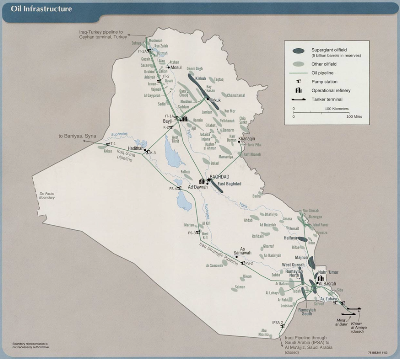
    So this morning I’d like to present a few back-of-the-envelope calculations of how much water might be involved. First, it’s helpful to have a picture of the geography in question. Therefore, here’s a map which I’m borrowing from the Library at the University of Texas. It shows the major oilfields in question, as well as the Tigris and Euphrates, Iraq’s major rivers, and the access to the Persian Gulf. You can click for a larger version. It’s worth noting in passing how many oilfields were not in the table of contracts yesterday.

    As you can see, the Southern fields are fairly close to both rivers, as well as the Persian gulf, but water to be injected into the northern fields would most conveniently come from the Tigris.

    Stuart continues with more at Does al-Shahristani Really Think Six Years? and How Long Do Mega-mega-projects Take?.

    The al-Shahrastani plan in Iraq raises a number of interesting questions. I think there are generally two directions that scepticism could go in. One is scepticism over the reserves and/or plateaus – is there really enough oil in Iraq and in the auctioned fields specifically, to produce 12mbd at any point in the future?
    The second set of questions is around the timing. Is it really realistic that this can be done in six or seven years as the oil minister is claiming?

    To me, the second set of questions seems the more urgent to answer. While the exact amount of oil in Iraq is highly debatable, there’s not much doubt that there’s a heck of a lot of it.

    One way to think about the timing issues is that each of these field contracts is basically a huge megaproject. What al-Shahrastani is proposing, and what Big Oil is signing up to deliver, is a huge set of megaprojects, conducted in parallel, in a country that was a war zone until fairly recently. The potential for chaos is considerable. The potential for some folks to make an awful lot of money is also considerable.

    Consider, for each field, the following things are necessary:

    * Drilling of the oil wells and injector wells
    * Pipelines to bring injection water from somewhere.
    * A water treatment plant to make sure nothing in the injected water will clog the pores in the reservoir rocks and to process any water produced from the field.
    * A GOSP facility to separate out the water, oil, and gas brought to the surface
    * Pipelines to take the oil from the field somewhere
    * A share in export facilities of some kind

    Until all these are present, oil production cannot go too much above the scale it is currently at. So if the al-Shahrastani plan really goes ahead according to the current schedule, we are about to see a sizeable fraction of the world’s oil and gas engineering capabilities, of all kinds, moved to Iraq, as the global oil industry spends over a hundred billion dollars there. By comparison, the GDP of Iraq in 2008 was, on a purchasing power parity basis, 105$b according to the IMF. It seems to me that the best guide to how long these things will take is the set of megaprojects recently conducted in Saudi Arabia. These projects represent similar operating conditions (flat deserts in the Middle East) in neighboring countries. Saudi Aramco is a technically competent operation, as are the big western oil companies that will be developing the Iraqi fields. The projects were generally conducted in a hurry with a desire to restore/enhance Saudi oil production capacity as quickly as possible. The major differences were,

    * Saudi Arabia started with a lot more oil production infrastructure than Iraq has.
    * Saudi Aramco and the Saudi oil ministry had more experience than the Iraqi oil ministry has.
    * Saudi Arabia has had no political instability that would affect oilfield development.
    * The Saudi projects were all smaller than the largest Iraqi megaprojects.

    So Saudi megaprojects probably represent a best case estimate for what could be achieved in Iraq.


  • Nexus One Accessories, Nexus One Accessories 2010 Information

    One recurring issue in the forums is a problem with the phone either not switching to 3G or switching back and forth between 3G and EDGE too frequently — it’s not clear if this is a significant issue or if the complaints are just a symptom of Google’s less-than-stellar customer support.

    InfoWorld writes of the concerns:

    Google appears to be only accepting e-mail customer queries, to which it pledges to reply in one to two days — far too long, say most people who are complaining online.
    Fast: The Nexus One sports a 1GHz Snapdragon processor from Qualcomm, and has on-chip graphical capabilities. This device is capable of some promising 3D potential. Future Android phones are likely to match or upgrade the speed to compete with HTC’s newest phone.

    Pretty: OLED screens are quite pretty, and have incredible contrast ratios. The Nexus One is equipped with such a screen, running at a 480×800 resolution and 3.7 inches. That’s about 25% greater pixel density than Sony’s beautiful 11-inch 1080p OLED screen.

    Fractured: The big problem facing Android is consistency. The Nexus One doesn’t have a keyboard. The Droid does. Upcoming Android phones will have keypads. Screen sizes vary. Internal speeds vary. This is a developer’s nightmare, and is particularly painful for game development.

    Third partied: On the other hand, one of Android’s advantages, namely backgrounding apps, could come to the rescue. We’re starting to see hardware accessories for the iPhone go hand-in-hand with a software package on the device, but this only works when that app is open. On Android, we might see third-party accessories that hook into games via a backgrounding “connector” app. If a company like MadCatz made a slick controller that went along with an API to control games, and that became an industry standard, it could give Android gaming a major edge.

    Ultimately, I think the direction Android is going will attract some great games. It’s a powerful platform, and the upcoming devices are, as Google coined, “superphones.” There’s a problem with the fractured versions of hardware and Android revisions, but if the market is fertile enough, developers will bite the bullet.

    Share/Save/Bookmark

    Related posts:

    1. Nexus One Problems, Nexus One Problems 2010 Information One recurring issue in the forums is a problem with…
    2. Nexus One Complaints, Nexus One Complaints 2010 Information One recurring issue in the forums is a problem with…
    3. Nexus One Verizon, Nexus One For Verizon 2010 “The Nexus One is where web meets phone,” says Google…

    Related posts brought to you by Yet Another Related Posts Plugin.

  • Hangzhou metro 杭州地铁

    Hangzhou metro

    Construction began in march 2006 and the first line will be opened in late 2011. The first line will connect Xiaoshan Xiang Lake, cross below the Qiantang river all the way to Xiasha and Linpin

    On the long term eight lines and 278 kilometres will be built

    Official website: http://hzmetro.com/

  • Nexus One Complaints, Nexus One Complaints 2010 Information

    One recurring issue in the forums is a problem with the phone either not switching to 3G or switching back and forth between 3G and EDGE too frequently — it’s not clear if this is a significant issue or if the complaints are just a symptom of Google’s less-than-stellar customer support.

    InfoWorld writes of the concerns:

    Google appears to be only accepting e-mail customer queries, to which it pledges to reply in one to two days — far too long, say most people who are complaining online.
    Fast: The Nexus One sports a 1GHz Snapdragon processor from Qualcomm, and has on-chip graphical capabilities. This device is capable of some promising 3D potential. Future Android phones are likely to match or upgrade the speed to compete with HTC’s newest phone.

    Pretty: OLED screens are quite pretty, and have incredible contrast ratios. The Nexus One is equipped with such a screen, running at a 480×800 resolution and 3.7 inches. That’s about 25% greater pixel density than Sony’s beautiful 11-inch 1080p OLED screen.

    Fractured: The big problem facing Android is consistency. The Nexus One doesn’t have a keyboard. The Droid does. Upcoming Android phones will have keypads. Screen sizes vary. Internal speeds vary. This is a developer’s nightmare, and is particularly painful for game development.

    Third partied: On the other hand, one of Android’s advantages, namely backgrounding apps, could come to the rescue. We’re starting to see hardware accessories for the iPhone go hand-in-hand with a software package on the device, but this only works when that app is open. On Android, we might see third-party accessories that hook into games via a backgrounding “connector” app. If a company like MadCatz made a slick controller that went along with an API to control games, and that became an industry standard, it could give Android gaming a major edge.

    Ultimately, I think the direction Android is going will attract some great games. It’s a powerful platform, and the upcoming devices are, as Google coined, “superphones.” There’s a problem with the fractured versions of hardware and Android revisions, but if the market is fertile enough, developers will bite the bullet.

    Share/Save/Bookmark

    Related posts:

    1. Nexus One Problems, Nexus One Problems 2010 Information One recurring issue in the forums is a problem with…
    2. Nexus One Accessories, Nexus One Accessories 2010 Information One recurring issue in the forums is a problem with…
    3. Nexus One Verizon, Nexus One For Verizon 2010 “The Nexus One is where web meets phone,” says Google…

    Related posts brought to you by Yet Another Related Posts Plugin.

  • Nexus One Problems, Nexus One Problems 2010 Information

    One recurring issue in the forums is a problem with the phone either not switching to 3G or switching back and forth between 3G and EDGE too frequently — it’s not clear if this is a significant issue or if the complaints are just a symptom of Google’s less-than-stellar customer support.

    InfoWorld writes of the concerns:

    Google appears to be only accepting e-mail customer queries, to which it pledges to reply in one to two days — far too long, say most people who are complaining online.
    Fast: The Nexus One sports a 1GHz Snapdragon processor from Qualcomm, and has on-chip graphical capabilities. This device is capable of some promising 3D potential. Future Android phones are likely to match or upgrade the speed to compete with HTC’s newest phone.

    Pretty: OLED screens are quite pretty, and have incredible contrast ratios. The Nexus One is equipped with such a screen, running at a 480×800 resolution and 3.7 inches. That’s about 25% greater pixel density than Sony’s beautiful 11-inch 1080p OLED screen.

    Fractured: The big problem facing Android is consistency. The Nexus One doesn’t have a keyboard. The Droid does. Upcoming Android phones will have keypads. Screen sizes vary. Internal speeds vary. This is a developer’s nightmare, and is particularly painful for game development.

    Third partied: On the other hand, one of Android’s advantages, namely backgrounding apps, could come to the rescue. We’re starting to see hardware accessories for the iPhone go hand-in-hand with a software package on the device, but this only works when that app is open. On Android, we might see third-party accessories that hook into games via a backgrounding “connector” app. If a company like MadCatz made a slick controller that went along with an API to control games, and that became an industry standard, it could give Android gaming a major edge.

    Ultimately, I think the direction Android is going will attract some great games. It’s a powerful platform, and the upcoming devices are, as Google coined, “superphones.” There’s a problem with the fractured versions of hardware and Android revisions, but if the market is fertile enough, developers will bite the bullet.

    Share/Save/Bookmark

    Related posts:

    1. Nexus One Complaints, Nexus One Complaints 2010 Information One recurring issue in the forums is a problem with…
    2. Nexus One Accessories, Nexus One Accessories 2010 Information One recurring issue in the forums is a problem with…
    3. Nexus One Verizon, Nexus One For Verizon 2010 “The Nexus One is where web meets phone,” says Google…

    Related posts brought to you by Yet Another Related Posts Plugin.

  • Peugeot Gets New International Signature

    The French at Peugeot felt the need to reinvent and set new targets for the near future, so we’re about to witness serious changes. Their aim is quite serious: to move up 3 places in the world car market, to establish Peugeot as the benchmark for style and to become the leader for mobility services.

    In its quest, Peugeot is counting on investing in cutting edge technology: electric propulsion in the i0n and E-Vivacity scooter from 2010, diesel hybrid in the 3008 from 2011, e-HDi (… (read more)

  • Steve McQueen Off-Road Helmet Line by TLD

    Movie and motorcycle legend Steve McQueen continues to be an inspiration for two-wheeled enthusiasts trough the GreenLight corporate, who recently announced a three-year partnership with Troy Lee Designs (TLD) to produce a limited edition helmet line.

    The Steve McQueen limited edition helmet line will be unveiled to the public for the first time today at Angel Stadium, at this weekend’s Anaheim 1 race. The helmet will be worn by the Troy Lee Designs / Lucas Oil / Honda Racing Tea… (read more)

  • Google’s Nexus One Costs $174.15 [Google]

    Google Nexus One Carries $174.15 Materials Cost, iSuppli Teardown Reveals El Segundo, Calif., January 8, 2010-With its new Nexus One, Google Inc. has taken many of the latest smart-phone innovations and combined them in a single product that manages to be both cutting edge and cost competitive, according to a teardown conducted by iSuppli Corp.

    The Nexus One, sold with the Google brand name but manufactured by HTC Corp., carries a Bill Of Materials (BOM) of $174.15, based on a preliminary estimate from iSuppli’s Teardown Analysis Team. This total comprises only hardware and component costs for the Nexus One itself and does not take into consideration other expenses such as manufacturing, software, box contents, accessories and royalties.

    Google Nexus One Carries $174.15 Materials Cost, iSuppli Teardown Reveals

    El Segundo, Calif., January 8, 2010-With its new Nexus One, Google Inc. has taken many of the latest smart-phone innovations and combined them in a single product that manages to be both cutting edge and cost competitive, according to a teardown conducted by iSuppli Corp.

    The Nexus One, sold with the Google brand name but manufactured by HTC Corp., carries a Bill Of Materials (BOM) of $174.15, based on a preliminary estimate from iSuppli’s Teardown Analysis Team. This total comprises only hardware and component costs for the Nexus One itself and does not take into consideration other expenses such as manufacturing, software, box contents, accessories and royalties.

    Google is selling unlocked versions of the Nexus One at an unsubsidized price of $529, or at $179 with a two-year service contract from T-Mobile.

    “With the Nexus One, Google has taken the most advanced features seen in recent smart phone designs and wrapped them up into a single sleek design,” said Kevin Keller, senior analyst, competitive analysis, for iSuppli. “Items like the durable unibody construction, the blazingly fast Snapdragon baseband processor and the bright and sharp Active-Matrix Organic Light Emitting Diode (AM-OLED) display all have been seen in previous phones, but never before combined into a single design. This gives the Nexus One the most advanced features of any smart phone ever dissected by iSuppli’s Teardown Analysis Service-a remarkable feat given the product’s BOM is similar to comparable products introduced during the past year.”

    The attached table presents the preliminary results of iSuppli’s teardown analysis of the Nexus One. iSuppli will conduct a finalized and more detailed analysis later this month.

    Return of the Snapdragon

    At the heart of the Nexus One is Qualcomm Inc.’s Snapdragon baseband processor that sports a blistering 1GHz clock speed.

    “The Snapdragon was first noted in a previous smart phone torn down by iSuppli-the Toshiba Corp. TGO1-which is based on Microsoft Corp.’s Windows Mobile operating system,” Keller said. “However, the Android 2.1 operating system used in the Nexus One better capitalizes on the Snapdragon’s fast performance, making the user interface and applications run very quickly.

    This processing muscle also gives the Nexus One some advanced capabilities, most notably high-definition 720p video playback.”

    iSuppli estimates the cost of the Snapdragon at $30.50, making it the most expensive single component in the Nexus One. With the inclusion of the Snapdragon and the associated power-management and Radio Frequency (RF) transceiver chips, Qualcomm commands 20.4 percent of the Nexus One’s BOM, giving it the biggest dollar share of any component supplier in the design.

    AM-OLED display

    One of the Nexus One’s signature features is its 3.7-inch AM-OLED display, which is superior to the conventional LCDs used in most smart phone designs in a variety of ways. Compared to LCDs, AM-OLEDs deliver a larger color gamut, a faster response time, a thinner form factor and reduced power consumption.

    Prior to the Nexus One, AM-OLED technology appeared in another smart phone, Samsung’s I7500, which features a 3.2-inch display. However, the Nexus One uses a larger display, marking the first use of a 3.7-inch OLED that iSuppli’s Teardown Analysis Service has seen.

    “The 3.7-inch AM-OLED display on the Nexus One delivers a stunning picture,” Keller said.

    With an estimated cost of $23.70, the AM-OLED display is supplied by Samsung Mobile Display Co Ltd.

    Heavenly unibody

    The Nexus One also sports a unibody design, which means that the smart phone’s enclosure comprises a single part. Such a design approach provides greater structural rigidity, providing more protection to the internal electronics in case the phone is dropped. On the other hand, a unibody tends to drive up manufacturing costs.

    Besides Apple Inc.’s iPhone, this marks the first unibody smart-phone design that iSuppli’s teardown analysis team has noted.

    With the Nexus One, HTC has taken a major cue from Apple in the enclosure design, making it the most “Apple-like” product yet seen from any in the competition, and others are likely to follow suit.

    Noises off

    The Nexus One also features a dual microphone design used for cancellation of background noise. This feature also was noted in Motorola’s Droid, another Android-based smart phone. To implement the noise cancellation function, the Nexus One employs a specialized audio voice processor chip from Audience Semiconductor, the first time iSuppli’s Teardown Analysis service has observed a part from this manufacturer in any electronic product.

    Lost memories

    The Nexus One includes a large quantity of DRAM, employing 4Gbit (512MByte) of Samsung Semiconductor’s Double Data Rate (DDR) DRAM. This compares to 1Gbit or 2Gbit for comparable smart phones. The large quantity of DRAM is required to store executable code to support the fast performance of the Snapdragon processor, and allows for better application performance.

    While the Nexus One features 4Gbit of internal NAND flash memory, the same amount as the Droid and the Toshiba TG01, it is bundled with a comparatively small MicroSD card of 4Gbyte. NAND flash is used for storage of user content and media on the smart phone. The Droid and TG01 are supplied with 16Gbyte and 8Gbyte, respectively. This allows Google to keep its overall BOM costs down, yet still allows the user to upgrade as needed. And while the 4Gbyte of internal flash pales against the iPhone’s whopping 16Gbyte, it has the advantage of expandability afforded by the MicroSD card slot where the iPhone has no external storage facility.

    Samsung Semiconductor is the supplier of all the memory in the Nexus One, giving it $20.40, or 11.7 percent, of the product’s total BOM.

    Synaptics gets in touch

    Other notable design winners in the Nexus One include Synaptics Inc., which supplies the phone’s capacitive touch-screen assembly. iSuppli estimates the cost of the assembly at $17.50, or 10 percent of the total BOM. While the module and the Android operating system support multitouch input, the capability is deactivated on the Nexus One.



  • Confirmed: GM Closes Saab, Leaves Little Room for Hope

    General Motors recently confirmed that it will start winding down Saab and revealed the name of the company that will supervise the entire process. AlixPartners will be in charge of Saab’s closing, a process which, according to GM, is expected to take up to several months.

    GM today confirmed it has selected AlixPartners to supervise the orderly wind down of Saab, and has requested approval of the selection by the appropriate authority in Sweden. The use of a wind down supervisor … (read more)

  • Clear says not to expect any WiMAX smartphones before end of 2010

    Clear might be busy bringing WiMAX to as many places as it can, but it looks like that won’t include smartphones — like that just-rumored HTC device for Sprint — anytime soon. That word comes from Phone Scoop, who reportedly confirmed directly with Clear that it doesn’t expect to see any WiMAX-equipped smartphones until at least the end of 2010. The company did say that it expects to see more WiMAX phones available in 2011, however, and that any “phone-type device” that uses WiMAX would use either VoIP or Sprint’s CDMA network for voice calls. Not surprisingly, Clear didn’t drop any hints about exactly who those WiMAX phones might come from.

    Clear says not to expect any WiMAX smartphones before end of 2010 originally appeared on Engadget on Sat, 09 Jan 2010 05:19:00 EST. Please see our terms for use of feeds.

    Permalink   |  sourcePhone Scoop  | Email this | Comments

    Buy This Item: [Click here to buy this item]

    Article

  • Weekend Meditation: On Not Freaking Out

    2010_01_10-flexible.jpgFlexibility is not an easy attribute for many people, yet being a cook (and a host) often requires advanced coping skills to adjust to constantly changing and often challenging circumstances. If we don’t have a little flexibility in us to begin with, you can be sure the kitchen will teach it to us in no time.

    Read Full Post


  • Ottawa takes hard look at biofuel production – Hamilton Spectator

    Ottawa takes hard look at biofuel productionHamilton Spectator"Experiences in the US and Brazil now suggest that existing biofuels production facilities are responsible for the generation of a range of new air- and …