Blog

  • David Tepper Is Still Super-Concentrated In Bank Of America, Citigroup, And Wells Fargo

    david tepper

    (This post originally appeared on The Pragmatic Capitalist)

    David Tepper isn’t exactly a household name, but he will be when 2009 is said and done.   Tepper, who runs hedge fund Appaloosa Management, is estimated to return over 120% after fees in 2009 and Tepper will personally make over $2B.  The manager of the $12B fund made a series of very bold bets that the U.S. economy would thwart depression and rebound sharply in 2009. He was right.

    The fund specializes in distressed debt  and as we mentioned earlier this year 2009 was a once in a generation opportunity.  Tepper capitalized on it in a big way.  He has been reported to keep a pair of brass testicles on his desk, but the real thing was on full display in late 2008 and early 2009 as Tepper moved his fund into the most dangerous of dangerous sectors – the banks.  He reportedly purchased Bank of America near $3.72 and Citi near $0.79. With Bank of America trading at $15.33 and Citi at $3.34 Tepper’s fabulous year is perfectly summed up.

    It hasn’t been all roses for Tepper’s investors over the years, however.  Despite an average return of 30% per year Tepper’s fund is known for its volatility and finished 2008 down by 25%.  An excellent year compared to the S&P 500, but a nail in the coffin for most hedge funds.  Nonetheless, Tepper’s investors stood by the billionaire and they’re glad they did.

    But what is he investing in now?  Tepper doesn’t think the recovery move is over just yet.   Much like John Paulson (who rose to infamy shorting & then buying beaten down names during the crisis) he says rates will stay low and that valuations on stocks and bonds remain favorable.  Staying true to his brass, Tepper is running into the sector of the market where many analysts see the next crisis unfolding.  He is piling money into commercial real estate.  His fund currently has over $2B invested in CMBS and he remains a very large investor in the banks.

    As of Appaloosa’s November 22nd SEC filing, the hedge fund was still largely invested in the banks.  A lone position in Microsoft represents the extent of their tech holdings.  Unlike John Paulson, who is broadly hedged with large holdings in healthcare and gold, Tepper is much more focused.  Their largest positions are as follows:

    1.  Bank of America (BAC) $573MM

    2.  Citigroup (C)  $385MM

    3.  Wells Faro (WFC) $286MM

    4.  Fifth Third Bancorp (FITB) $246MM

    5.  Suntrust (STI) $192MM

    The full holdings can be found here.  Please note that Appaloosa likely has substantial investments outside of their required SEC reporting:

    pragcap1223

    Join the conversation about this story »

    See Also:

  • Panasonic and Sanyo Plan Storage Battery for the Home; Solar Applications

    panasonic storage batteryNow that Panasonic has officially acquired more than 50 percent of Sanyo, it is now Japan’s second largest electronic giant.   Panasonic and Sanyo have already test-manufactured a storage battery for home use, and Panasonic plans to accelerate the development of the storage battery, while planning to sell it together with a system that will enable households to check electricity usage on a home-based TV display.  Currently, solar batteries for home use and fuel cells can generate power, but they cannot store electricity.  This will be a great development for the residential solar industry.  Sanyo believes their storage battery will also have applications in automobile cells for eco-friendly cars such as hybrids or electric vehicles.

    [via physorg]

    Panasonic eco ideas is the Panasonic commitment to developing industry-leading energy conserving products.
    Panasonic manufactures the WhisperGreen vent fans which are 300 – 500% more energy efficient…Read more

  • The next logical step for both bacon and popcorn is bacon-flavored popcorn

    cf26_bacon_popcorn You like bacon? Who doesn’t?! Howsabout popcorn? Yes? If you find yourself short on time every day, perhaps you could combine bacon and popcorn by using BaconPop. Each bag is filled “with delicious, buttery, bacontastic popcorn,” according to ThinkGeek.

    “Damn your tempations, Aamoth!” you scream. “I only eat Kosher food! I can’t eat bacon!” Well this has no actual bacon in it, just bacon flavoring. Although BaconPop NOW WITH REAL BACON CHUNKS! might be the next, next logical step for both bacon and popcorn.

    Five dollars gets you three microwaveable bags and a whole lot of weird looks at work as you moan with delight inside your cubicle.

    BaconPop – Bacon Flavored Popcorn [ThinkGeek.com]


    Buy This Item: [Click here to buy this item]

    Read Original Article

  • Video: Borderlands’ second DLC expansion

    Play Borderlands. You’ll love it and the fact that Gearbox Software keeps releasing modest-sized expansions rocks. The last one, Dr. Ned’s Zombie Island, provided me with a weekend of fun and the next one previewed above, looks just as great. So sit back and watch the teaser trailer for Mad Moxxi’s Underdome Riot. Then go play Borderlands.


    Buy This Item: [Click here to buy this item]

    Read Original Article

  • Project Alesia: News Corp.’s Roman Battle Cry (Does That Cast Googlers as the Gauls?) [BoomTown]

    Alesia-vercingetorix-jules-cesar

    While Internet companies such as Google use baked goods as names for their key strategic initiatives–recent ones related to its Android mobile operating system were called Donut and Eclair, for example–aggressive media giant News Corp. is definitely not going for sweetness in its unusual selection of a codename for its high-profile digital content effort.

    That would be Project Alesia, a moniker which comes from a vicious siege from ancient times and which is widely considered to be one of the more decisive battle of all time.

    And, that is apparently how top News Corp. (NWS) execs think is the best way to describe their plans to stop the decimation of premium content in the digital age and transform their business to take advantage of new means of distribution, according to numerous sources BoomTown spoke to this week about the unusual name.

    “It takes a lot of determination to succeed in what is the biggest challenge newspaper and all media has ever faced,” explained one source. “So, the real path to success will require ingenuity and staying on course over time–perseverance, really, which was critical to that military victory.”

    Interestingly, said several sources, the Project Alesia name was picked by James Murdoch, the chairman and CEO of Europe and Asia for News Corp.

    Widely considered to be heir apparent to the company’s Chairman and CEO Rupert Murdoch, his father, James Murdoch is apparently a dedicated reader and student of Roman history.

    But it’s actually been the elder Murdoch who been cast as the obvious general so far, conducting a recent series of public verbal attacks on Internet targets, especially Google (GOOG).

    He has accused the search giant of “stealing” content, for example, while other News Corp. execs have echoed his jibes in various high-profile forums.

    But James Murdoch has been a key player behind the scenes in the digital strategy, several sources said, an effort which also includes News Corp. Chief Digital Officer Jon Miller and Dow Jones CEO Les Hinton.

    (Full disclosure: News Corp. unit Dow Jones owns this site.)

    Of this top group, it was James Murdoch–who has slowly been emerging as a more high-profile player, especially internationally–who found inspiration in the past.

    Alesia_watercolor

    To get why, you’ll first need a short and truncated history lesson, which I culled from a variety of sources online and off:

    Taking place in September 52 BC in what is now modern-day France, the Siege of Alesia (also referred to as the Battle of Alesia) pitted Rome’s famed leader Julius Caesar against the Gallic tribes under the command of Vercingetorix.

    More importantly–besides being cited as one of the best uses of siege warfare and “circumvallation” (see more on that below)–the battle of Alesia was considered a turning point in bitter wars conducted by the Roman Republic to tame the Gauls, which had finally united as a single force in opposition to the Roman invasion.

    The hard-fought win–in a battle where the Roman army was outnumbered five-to-one, outside a hill-top fort in Alesia–is often credited with reinvigorating Rome’s power over Gaul. After the loss, Gaul became a province of the Roman empire and was pretty much subdued for the next 500 years.

    Alesia is often cited as one of Caesar’s greatest military victories and the fallout from it later led to his ascension to ultimate power in Rome (which was soon followed by his infamous assassination).

    That’s not the ultimate end News Corp. is envisioning, of course, sticking with Alesia’s main themes of perseverance and innovation, said several people with knowledge of the digital content efforts.

    And, no surprise, in the digital battles between traditional media and interlopers from the Web, guess who has been cast as noble Caesar and who plays the role of marauding heathens?

    You know, the ones who even cast their women and children out of the fort into the middle of the siege when food started to run out? That would apparently be the Googlers, although if it were them, the food would be organic!

    400px-SiegeAlesia

    Not all comparisons are the same, said a source. For example, consider circumvallation, which is essentially the building of a series of encircling fortified walls around the enemy. Contravallation is also also part of the strategy, to protect from attacks by enemy reinforcements attacking from the outside.

    One could easily imagine that means creating pay walls around premium content or de-indexing it from search sites like Google, both of which News Corp. has publicly talked about doing.

    Not so!

    “Traditional media companies are interested in investing in innovation too, so the idea of just putting up walls around content is a red herring,” said the source. “The idea is to find new ways of distributing media that also makes money, because why should journalism in [digital] ones and zeros be any different?”

    Of course, with new stats showing sites like Google News and Yahoo News as the place consumers are going to be more and more of their news, that is a big issue in a longer fight, which will grind on for a very long time and well before any side can ever declare victory.

    [The 1899 painting at the top is by Lionel-Noël Royer.]

    Buy This Item: [Click here to buy this item]

    Read Original Article

  • Celebrating Christmas on Facebook [Voices]

    By Marisa Taylor, Reporter, The Wall Street Journal

    Want to spread a little holiday cheer in bits and bytes rather than dollars and cents?

    You’re not alone–seven of the 20 Facebook apps that have gained the most users in the past week are holiday themed, according to AppData, a site that tracks Facebook application metrics.

    In the lead this week is the Christmas Cards! app on Facebook, developed by Janet Currie, which has nearly 200,000 fans and 13.8 million monthly active users. It gained more than 5 million users during the past week. Users select one of several cartoon-like Christmas greetings, including an animated picture of three cats wearing Santa hats.

    The Christmas Greetings app, which allows users to choose from dozens of Christmas-themed “gifts” (read: various photos of Christmas trees and ornaments), has more than 3 million active monthly users and over 52,000 fans. It garnered nearly 2.5 million new users to snag the No. 6 spot on AppData’s list of top gainers this week.

    Read the rest of this post on the original site

    Buy This Item: [Click here to buy this item]

    Read Original Article

  • WePay helps groups manage money, lands $1.65M of its own

    Screen shot 2009-12-23 at 10.58.35 AMWePay, a youthful startup that says it will help groups of people collaboratively manage financial accounts, has just gotten some much-needed validation in the form of a $1.65 million first round of venture funding from August Capital and several angels.

    The virtue of the WePay platform, or so it seems, is that it can be used by any group of people to create accounts, produce invoices, collect money, manage transactions and make easily-monitored payments. It can work for your fantasy football league or high school French club as well as it could for your burgeoning startup or roommates. The overarching goal is to make it easier for many people to operate off the same pool of money, faster, cheaper, and with fewer conflicts.

    Not surprisingly, the company was founded by a pair of recent graduates — college is a time when shared accounts are not only common, but critical. They are needed to run student organizations, to raise funds for charities, to spend money on dorm ski trips, etc. Hailing from Boston College, founders Bill Clerico and Rich Alberman, have now nestled their startup into Silicon Valley, taking up residence in Facebook’s old digs on Palo Alto’s University Avenue.

    But the trip out west was more about venture funding than entrepreneurial buzz. Apparently, the duo had a rough time raising money back in Boston, where more than a dozen investors turned them away for being at too early a stage in the process. Finally they got accepted into Y Combinator’s summer program (Tech Stars also said no).

    With the incubator’s support, WePay launched its private beta, and has plans for a general release early next year. Now with the backing of August and individuals like former Intuit CTO Eric Dunn, this looks like much more of a realistic goal.

    The company’s one challenge? Being pigeon-holed as simply another PayPal ripoff targeted at groups. While WePay does derive revenue by skimming small fees off every transaction, its platform purports to be much more oriented toward social media. It also touts a special WePay debit card, distinguishing it from other online payment channels.

    Alberman and Clerico are also taking a more innovative approach to marketing, hoping to grow first by partnering with small businesses, vacation planners and established, professional groups. Right now, the service is still invitation only — but you can request one on its web site.


    Buy This Item: [Click here to buy this item]

    Read Original Article

  • Video: ModNation Racers track studio walkthrough

    Aside from the actual kart racing part, one of ModNation Racers’ notable features is its track editor. We saw it in action when the game was first unveiled during E3 ’09, and now United Front Games has

  • 2010 Audi S4 Test-Drive Update: A look around the inside

    2010 Audi S4 (Weekly Test-Drive)

    We are currently finishing up our test-drive of the 2010 Audi S4 and figured its time to give you guys a little update. Today we’ll give you a peak around the inside of the 2010 S4.

    There is no doubt that Audi has one of the best interiors in the industry in terms of quality, functionality and ergonomics. Our test-model is equipped with Audi’s third-generation MMI system with a hard-drive based Navigation system including voice control and SIRIUS traffic updates. The system will cost you an additional $2,500 over the base $47,300 price of the S4. Opt for the genuine silk nappa leather seats (extremely comfortable) and get ready to cash out another $1,000. A Bang & Olufsen premium sound system will run you $850 while carbon atlas interior inlays will cost you an additional $500.

    Even with standard interior features, the 2010 Audi S4 looks aesthetically pleasing. The car features a standard 60/40 split-folding rear seat allowing you to stuff more luggage, skis or golf bags in your cargo area. Other standard interior features include Bluetooth connectivity, Homelink remote transmitter, iPod connectivity, 3-spoke leather multifunction steering, three-zone climate control and a glass sunroof.

    Comparing that to the 2010 Audi S4’s key competitor, the BMW 335xi, Audi definitely eats BMW for lunch.

    2010 Audi S4 (Weekly Test-Drive):

    2010 Audi S4 (Weekly Test-Drive) 2010 Audi S4 (Weekly Test-Drive) 2010 Audi S4 (Weekly Test-Drive) 2010 Audi S4 (Weekly Test-Drive)

    – By: Omar Rana

    All Photos Copyright © 2009 Omar Rana – egmCarTech.


  • Shoot It! app now free in the App Store

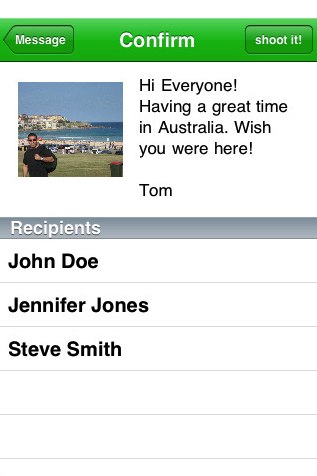
    Shoot It AppSo check it, , one of our absolute favorite apps in the entire iTunes App Store catalogue has finally gone free. As a refresher, shoot it! allows you to take a snapshot and have it sent as a physical postcard to anyone in North America, Europe, and some parts of Asia. It is all kinds of awesome, and we even used it in our Modern Warfare 2 Xbox 360 console giveaway. Fun times. We highly recommend grabbing it and putting it to good use!


    Tags:
    ,
    ,
    ,
    ,
    ,
    ,
    ,
    ,

    Shoot It! app now free in the App Store originally appeared on AppTapper on Wed, December 23, 2009 – 11:23:20


  • Telefonica Buys VOIP Startup Jajah For $206 Million


    Jajah

    Telefonica (NYSE: TEF) is buying up VOIP provider Jajah for $206 million in cash. The company—which had raised $35 million in venture capital funding—had been up for sale for more than a month now and several companies, including Microsoft (NSDQ: MSFT) and Cisco (NSDQ: CSCO) had also been said to be interested. In recent days, however, there were reports that Telefonica had beat out those two companies in the bidding.

    Telefonica says that it will offer Jajah’s services to “customers wishing to extend their communication experience”—beginning in Europe, where the carrier operates under the name O2. It will keep the Jajah brand. Jajah, which claims 25 million customers, is the latest VOIP provider to be bought up; last month Google purchased Gizmo5 for a reported $30 million. Here’s the release.


  • Disney Wants Facebook’s Sheryl Sandberg On Its Board

    Disney’s board today nominated Facebook COO Sheryl Sandberg to be its thirteenth member. It’ll be put to shareholder vote at the next Disney annual meeting, scheduled to be held March 10, 2010.

    Sandberg, who formerly ran global sales and operations at Google and was chief of staff for the Treasury Department, also serves on the boards of Starbucks, the Brookings Institution, Women for Women International, V-Day and the Ad Council. She’s been at Facebook since March 2008.

    Sandberg would join others from the tech industry on Disney’s board, including former Cisco CTO Judith Estrin, Sybase CEO John Chen and Apple CEO Steve Jobs, who became Disney’s largest single shareholder after it bought Pixar.

    Disney, by the way, has 2.9 million fans on Facebook, which is just a few less than “Flipping the Pillow Over to Get to the Cold Side” and a few more than Oreo.

    Please see the disclosure about Facebook in my bio.


  • Is Vimeo Arbitrarily Taking Down Videos It Deems As ‘Commercial’?

    With Vimeo recently getting sued by EMI for supposedly encouraging infringement of their music in videos, it’s interesting to note that Vimeo is apparently arbitrarily and ridiculously aggressive in cutting off anyone who uses the service for any sort of “commercial” purpose (found via Shocklee). The story is quite bizarre, but apparently Vimeo has buried in its terms of service that you can’t use the service for commercial reasons — though almost no one knows this. Yet, Vimeo itself seems to decide rather arbitrarily if your videos are commercial or not and then gives you a 24-hour notice to remove your videos. This is rather disappointing. Vimeo’s player is actually quite nice (much nicer than YouTube’s), and I’ve recommended many others to use its service. I had my own odd problem with Vimeo last year when for some unknown reason the company completely deleted my account and locked me out of using the service. Eventually they restored the account, but no explanation for the deletion was ever given (and it made me look bad, because I had been discussing stuff with someone, who then accused me of deleting my posts).

    The other oddity is the claim that Vimeo says you cannot embed Vimeo videos on sites that show ads, as that’s “commercial use.” Once again, we get into the difficulty of figuring out what is commercial use? If I embed a Vimeo video in a blog post is that commercial use? This is a blog, but it’s part of our business. Similarly, some of the speeches I’ve given in the past couple of years were put online using Vimeo. Are these “commercial use”? Are they then commercial use if I happen to embed the video in the blog? What if I embed someone else’s video in this “commercial” blog? Like — as we did with the Vimeo getting sued story — embedded a video from Vimeo itself? It’s nearly impossible to figure out what is and what’s not commercial. About the only thing you can say is that you probably shouldn’t use Vimeo for anything, because its policies appear to be totally arbitrary and prone to suddenly losing the videos you thought you had legitimately posted.

    Permalink | Comments | Email This Story


  • How China Might Buy More Gold Than America Owns

    china gold bar

    China has a long way to go before coming anywhere near America's gold reserves.

    Yet apparently it's on their to-do list and a must, at least according to the country's China Gold Association.

    Commodity Online: In 1981, China had 395 tonnes of gold holdings; it increased to 500.8 tonnes in 2001, and 600 tonnes in 2002. In April 2009, China officially announced that it has increased its gold holdings to 1054 tonnes. Since then, Chinese officials and People’s Bank of China have been meticulously chalking out plans to build up gold reserves in the next one decade.

    ...

    According to Zhang of the China Gold Association (CGA), India’s decision to buy IMF gold has been the real boost for China’s recent spirited moves to step up gold reserves.

    “In view of the declining US dollar value, it is paramount that China steps up gold reserves. How to do this is the only question that China is debating these days. The possible steps include opening up new gold mines, aggressively going for gold mining, buying gold from the open market etc. All said and done, it is imperative that China needs to buy more gold,” Zhang points out.

    ...

    Free Republic: “We recommend that China’s gold reserve should reach 6000 tons in 3~5 years, and probably reach as high as 10,000 tons in 8~10 years,” according to Ji Xiaonan on November 28 at the third Chinese Industry Stability Forum. He is the head of the supervisory committee at the state-owned Assets Supervision and Administration Commission.

    Join the conversation about this story »

    See Also:

  • REPORT: Subaru says it can’t Justy-fy selling a subcompact in the U.S.

    Filed under: ,

    What do Toyota, Nissan and Honda all have in common? (Besides the fact that they are all Japanese automakers, that is?) They all re-entered the subcompact market in 2006 after abandoning it years ago. What’s more, Mazda is planning to bring its subcompact Mazda2 to U.S. shores next year, Suzuki has signaled its intent to enter the B-segment with its popular Swift hatchback, and the domestics are in the game with the Chevrolet Aveo and forthcoming Ford Fiesta.

    So, where does that leave Subaru? After all, the company has roots in small cars, starting with its first automobile, the downright minuscule 360, all the way up to the off-the-wall, four-wheel drive, three-cylinder Justy and its unconventional CVT.

    Subaru spokesman Michael McHale tells Wards Auto, “The thing with the B-sector is you have to ask how you make money at the lower levels. You look at the pricing on the B segment – it’s a tough segment to make money.” Indeed it is – with base models of some competitors starting just under $10,000, profits are in very short supply.

    For an automaker as small as Subaru, taking a risk on what is likely to be an unprofitable model generally isn’t a smart idea. In other words, don’t hold your breath for another subcompact Subaru any time soon.

    [Source: Wards Auto]

    REPORT: Subaru says it can’t Justy-fy selling a subcompact in the U.S. originally appeared on Autoblog on Wed, 23 Dec 2009 13:58:00 EST. Please see our terms for use of feeds.

    Read | Permalink | Email this | Comments

  • ARTICLE: Pong Research: Can a cell phone case prevent cancer?

    Pong Research makes an iPhone case that they say will redirect radiation from your phone away from your head, reducing SAR levels by over 60%. SAR stands for Specific Absorption Rate, and is the wireless industry’s standard measure of how much RF energy (radiation) is absorbed by the body when using a mobile phone.

    In other words, cell phones emit radiation. Some of that radiation gets absorbed into your body – specifically, into your head when you hold a cell phone up to your ear while using it. Pong claims their case cuts the amount of radiation that winds up  in your body by more than half.

    Whether or not radio waves emitted by cell phones are dangerous to humans is an oft-debated subject with no clear answer. Yet. It stands to reason that, over time, heavy cell phone users either will or won’t develop cancer or other radiation-sourced illnesses. So far we’ve got studies commissioned by folks on both sides of the argument claiming to have definitively proved that cell phones are/aren’t safe.

    Given the fact that I use a lot of cell phones, get to review new products for my job, and don’t much like the idea of a tumor in my head, I contacted Pong to hear about their work and give their iPhone case a whirl. At $59.95, Pong’s case is quite a bit more expensive than your standard silicon iPhone jacket. But, really, if the thing works and ten years from now the other 49.999 million iPhone users all have brain tumors, sixty bucks will seem like a good deal, right?

    The case itself is a pretty standard soft case. You get your choice of black or bright, bright green, and both models have a whole bunch of grippy dots – pips, you could call them – and a white “Pong” logo on the back. The name Pong, by the way, is a play on the word “ping.” Ping as in “Ping-Pong” and ping as in how computers ping one another for data and people ping one another to communicate. So your Pong case keeps you safe from all of that radiation that your phone emits when it’s pinging and being pinged. Get it?

    Pong isn’t the thinnest or sleekest silicon jacket on the market, but it’s not too bad, and it’s proved well-made and comfortable to use in the several weeks I’ve tested it on my iPhone 3GS. My phone fits easily into every dock and cable connector I’ve tried without the need to adjust or remove the case.

    The case has cutouts for the camera sensor, silence switch, headphone jack, and bottom-edge dock port and speakers on the iPhone. Molded caps allow use of the side rocker and top lock buttons. No screen protection is afforded by the case.

    The Pong magic is visible on the inside of the case’s back panel. The “Pong technology module” is a rectangle-shaped, gold-color inlay that looks kind of like a silicon doodad of some sort. According to Pong, the module is “optimally aligned with the phone’s internal antenna” to attract the radiative energy and move it up through the case and away from the user like a chimney moves smoke up and away from the fireplace in your living room. 

    Of course, I have no way of verifying whether or not the Pong case cuts down on radiation leaving an iPhone and entering my head. Nor do I have any way of verifying whether or not various types of cell phone-emitted radiation are, in fact, dangerous to my head (and the rest of my body). So this is where a potential purchaser of a Pong case has to take Pong’s word for it, or not. Enter Pong’s claims and the testing data they’re using to back those claims up:

    In 2002, the FTC conducted an investigation of numerous products claiming to reduce cellphone radiation. All claims were found to have no scientific basis. Pong is the first product to meet international testing standards for SAR reduction and has been verified by industry leading laboratory Cetecom to reduce SAR for the iPhone 3GS in the WCDMA 1900 band by over 60%. 

    CETECOM performs regulatory services required before release to the US, Canada, and European Union markets. Specializing in wireless technologies such as GSM, WCDMA, Bluetooth, and 802.11x, CETECOM provides radiated and conducted emissions and immunity testing for the following: Federal Communications Commission (FCC, Industry Canada (IC), R&TTE, CE Mark.

    It’s not just SAR levels that Pong claims to reduce with their tech, either. Electric Field Intensity drops 85% with a 3GS inside of a Pong case. And signal strength remains at a full 100% as compared to a non-Ponged iPhone. There’s more where that came from on Pong’s site.

    Pong also had Wired Magazine out to the CETECOM facilities to verify their claims. And verify them, they did.

    So while the jury is out on the link between cell phone use and cancer, it does kinda sorta really seem like Pong believes in what they’re selling and has the best data available to back up their claims. Here’s what the folks from Pong themselves have to say:

    “Similar to smoking a cigarette,” says Dr. Alfred Wong, Pong’s Chief Scientist, “one cigarette won’t kill you, but over years of exposure, the effect is cumulative.  Many people are concerned about cell phone radiation, but out of necessity they continue to tolerate their own heavy usage. I think it’s a matter of balancing the fear against the need.”

    “Much of the rest of the world is ahead of the US in terms of awareness of the radiation issue. This year the French government banned the use of cell phones in elementary schools because they recognized the risk to children’s developing brains. When will Americans begin to take precaution against what is potentially a global public health hazard, with over 4 billion people using cellphones in 2010?”

    The way I see it is like this: I have no proof that cell phones cause radiation-related health problems, but I wouldn’t be surprised if they do. So if I’m going to bother keeping my phone in a case, may as well use a case that claims to reduce the potential harm of radiation and is backed by independent test data that proves some of that claim, anyway. I ordered a Pong case and keep my iPhone 3GS in it now. Of course, I don’t always use the 3GS, and Pong doesn’t yet make cases for any other devices. So I’m not totally in the clear, I guess.

    Should you buy a Pong for your iPhone? I can’t answer that for you. As a case it’s good but not the best, and roughly twice as expensive as competitive silicon iPhone jacket. Style-wise, well, it’s not super stylish but not unattractive, either. The black is pretty average looking and the green is downright radioactive in nature. 

    As for the health benefits of Pong, go with your gut. Nobody wants to wind up swindled out of their hard-earned cash, but nobody wants a brain tumor thanks to years of daily cell phone use, either. At least one friend of mine has already ordered her own Pong after seeing mine and asking about it. Honestly, I can’t say I blame her.


  • Home Buyer Tax Credit Hangover

    home sales

    There is a lot of confusion out there today over how the first time home buyer tax credit extension figures into the Commerce Department’s report on sales of new construction.

    “New Home Sales,” as we call it, plummeted 11 percent, quite unexpectedly, after another rise in “Existing Home Sales” yesterday.

    Let’s look at timing, shall we?

    Continue reading at CNBC.com Reality Check »

    Join the conversation about this story »

    See Also:

  • Verizon Wireless laying down LTE plans

    image Verizon wireless is the United State’s current 3G king with the largest 3G map, well it seems that 3 might become a 4 very soon. BGR just yesterday announced that a webcast starting 11 AM ET on Wednesday, January 23, 2010 which is today will have all this info. The webcast will go over the new 4G specification for devices that will run on Verizon’s 700MHZ LTE network.

    The Updates will include information on address network access, SMS requirements, data retry tests, lab and signaling conformance, and details on the device approval and introduction process.

    The current speed the LTE network is aimed at is about 12Mbps,and they are  planning to launch LTE in 25 to 30 markets in 2010 and maybe even take over their current 3G map with LTE by the end of 2013. We’re sure there will be a map for that when Verizon’s 4G finally launches.

    This will make Verizon the largest 4G network in 2010 because Sprint has yet to roll their network into a wider market. They are taking a long time to get a 4G device on there network out, but they have been working on some Windows Mobile Wimax devices which should be coming soon. This news is good news which should mean that we might start to see some 4G LTE and Wimax Windows Mobile devices soon.

    Source:BGR

    Share/Bookmark

  • Rumor: LG Prada 3 Headed to Sprint with Android Power

    Here’s a random rumor from left field that just might make actually pan out. We’re hearing from a couple of places today that LG’s next PRADA handset will be Android-based and run on Sprint’s network. Dubbed PRADA 3, the chatter has pegged the phone with a full QWERTY and touch screen. This would mark the first time the luxury handset would be paired up with a carrier as previous iterations have been SIM-free and unlocked.

    Word around campfire is that the PRADA will be at CES 2010 in January, LG and Sprint have scheduled a joint event.

    Thanks to ‘wen’ for the tip!

    Does Android need a luxury phone? What would be more luxurious than an Xperia X10 or Nexus One?

    Popular Posts That You Might Enjoy!


  • Nexus One Specs Revealed, but Here’s the Real Disruption

    Aside from a few missing tidbits to be determined, the full specifications of Google’s Nexus One are in plain sight on Engadget. I recommend you review the full listing, but here are the highlights, which were mostly leaked prior or shown on video:

    • 512 MB of RAM and ROM
    • 4 GB microSD card included with support for up to 32 GB of removable storage
    • 3.7″ AMOLED display with WVGA resolution
    • 5 megapixel camera sensor with 2x digital zoom
    • 802.11 a/b/g/n Wi-Fi support
    • 1 GHz Qualcomm QSD 8250 processor
    • Removable 1400 mAh battery
    • Voice supported on both AT&T and T-Mobile, but 3G is only good for T-Mo. AT&T’s network will provide EDGE.

    All in all, it looks like the most powerful Android handset yet, but for all of the early hype of this being “the” Google phone, I don’t see the anticipated disruption that was predicted with enthusiasm. Unless of course, the whole story isn’t told yet. Engadget also reports a January 5, 2010 release date by invitation only. I’m not sure what that’s all about, but again, not disruptive — annoying maybe, but not disruptive.

    I’m thinking that Gizmo and Google Voice are the hole cards in this poker game — and possibly Google Talk, which works just like a phone call on the Nokia N900. Google purchased VoIP provider Gizmo last month and when I log into my Google Voice account, I can already set up a Gizmo SIP number as one of my “phones.” I’ve already added a SkypeIn number as well — it works great with Google Voice. A call to my Google Voice number rings any Skype clients on my phones or the Skype client on my PC or Mac. But Google’s investment in Gizmo tells me that Skype won’t be a primary voice solution for Android. Let me turn my own hole card with this thought — do you now see why I was so interested in getting a data-only SIM card on the T-Mobile network? I’m betting on the Google Voice, Google Talk and Gizmo integration because if it comes to pass, it could be the beginning of the end for cellular voice plans.