Blog

  • Facebook to Unveil New News Feed at March 7th Event

    Facebook has just sent out press invites for an event to take place on Thursday, March 7th, at 10am PST.

    The event invitation, no surprises here, is pretty vague. All that it says is “Come see a new look for News Feed.”

    Although Facebook is constantly tweaking their products, the last time that the News Feed went through a major change was back in September of 2011 when they reconfigured the feed to include top news and most recent – plus they added the ticker to the right-hand side.

    The most recent Facebook event took place in mid-January when the company unveiled Graph Search.

    As always, we’ll be covering the event.

  • Turn Printable Files into Industry-Standard PDFs

    Turning documents and other type of printable files into PDFs is not a tough job and it is basically a matter of choosing the right application to do it with. However, some programs are more versatile than others and offer more than just a standard set of features.

    PrimoPDF from Nitro PDF is a simple yet powerful tool that can convert any printable file to PDF forma… (read more)

  • Kickstarter for iOS Gets First Update Since Launch

    Kickstarter has just updated their iOS app for the first time since launching it two weeks ago, and according to the crowdfunding company v1.1 is “better, faster, and stronger.”

    First off, users now have a new “messages view” which sorts messages in the app by inbox and sent.

    Next, creator now have “better” push notifications. The Kickstarter app provides basic project analytics for creators, and they are notified on activity concerning each and every pledge they receive.

    Also, video loading performance has received an update. Kickstart says that some people were having trouble with full-screen video (especially international users), and that problem has been fixed.

    Here’s the full list of what’s new in v1.1:

    • New Messages View: Messages in the app are now sorted by inbox and sent
    • Better Notifications: Creators get better push notifications
    • App Banner Fix: App now opens to just the right spot when you click Open from the website banner.
    • Facebook + Signup Fixes: Some Facebook logins were failing and some new user signups saying “Name is required” even though you entered a name. It’s all fixed, it wasn’t you, it was us.
    • Faster Video + Fixes: Some people were having problems with full screen video, you are now in the clear! International users should see much better performance loading a video.

    “The app is a whole new way to experience Kickstarter. We took things we’ve learned from the past three years of building the site, and applied them to a total redesign for the iPhone. We redesigned the project page, browse pages, and others. And we focused on making three things really useful and fun: finding new projects, keeping up to date with projects you’ve backed, and offering great tools for creators,” said Kickstarter when they first launched the app a couple of weeks ago.

    You can grab the update in the App Store today.

  • Apple’s mini is more popular than iPad, and that’s not a good thing

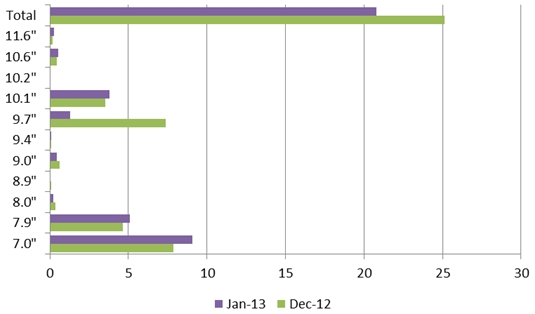
    Nearly two months ago, when forecasting that tablets would outsell laptops this year, NPD DisplaySearch dropped dirty data bomb: shipments of slates with 7-7.9-inch screens will eclipse larger ones. Now the analyst firm puts real numbers behind the prediction, and they are grim for Apple. Talk about mixed blessings. iPad mini sizzles, while iPad fizzles. The problem: Higher sales of one takes away from the other, rather than expands demand. As such, margins are lower for the important category, likely biting Macs, too.

    Panel shipments reveal the trend, and it is dramatic in just one month. “Shipments of 9.7-inch tablet PC panels collapsed, falling from 7.4 to 1.3 million, while 7-inch and 7.9-inch panel shipments grew rapidly, from 12 to 14 million”, David Hsieh, NPD vice president, says. “Shipments of 10.1-inch panels grew only slightly” from December to January. Apple and Sony are the major manufacturers selling 9.7-inch tablets, the overwhelming majority iPad. Starting today, Sony sells the Xperia Tablet Z, in a move to 10.1 inches, but 9.7-inch volumes aren’t high enough to account for such a dramatic shift in panel orders.

    “Apple had planned to sell 40 million iPad minis (7.9 inches) and 60 million iPads (9.7 inches) in 2013”, Hsieh says. “However, the reality seems to be the reverse, as the iPad mini has been more popular than the iPad. We now understand that Apple may be planning to sell 55 million iPad minis and 33 million iPads in 2013. At the same time, Samsung, Amazon, Google, ASUS and Acer are all eyeing the 7-9-inch segment to grab tablet PC market share, while many white box makers in China are also emphasizing the smaller size tablet PC”.

    So Apple’s problem is two-fold: iPad mini saps margins, while competitors bring lower-cost models to market — and we saw plenty of those introduced at Mobile World Congress this week, including a $169 tablet from HP.

    Margin Math

    By my calculations, during calendar Q4, iPad average selling prices fell 12.3 percent quarter on quarter — from $535 to $467. But there’s more! During Apple’s earnings call in January, the CFO acknowledged: “We saw a reduction in our iPad ASPs of about $101 year-over-year in the December quarter — and you can see that, our iPad units grew faster than our iPad revenue in the December quarter”. He later added: “iPad mini gross margin is significantly below the corporate average”.

    As mini goes up, iPad goes down and overall margins with them. Combined, the two tablets make up Apple’s second-largest category by revenue, accounting for 18.9 percent during calendar Q4. Revenues rise with higher volumes, but margins decline in a critical segment that affects others.

    DisplaySearch predicts global tablet shipments will reach 240 million this year. Assuming Apple does 88 million, that’s 36.7 percent. But most of the growth is mini. During 2012, Apple shipped 65 million tablets, but, according to Hsieh, expects to move 55 million iPad minis this year. Do the math.

    Indications are strong that iPad mini cannibalizes the larger tablet’s sales, but the problem is much larger. During Q4, Mac sales fell about 1 million units short of Wall Street consensus. Apple’s excuse about late-delivery of the new iMac rings false, given how much higher are mobile volumes overall. More likely, iPad mini also robs Mac sales.

    Think about it. A family with three kids shops Apple Store looking for a new computer, as the old one, while still functioning, has lost its zip. For less than the cost of the lowest-selling iMac ($1,299), the parents can buy three iPad minis ($987) and three Logitech keyboard covers ($299.85) — $1,286.85. Each student now has a mini-computer and ebook reader usable individually and personalized to taste, rather than fighting over the main Mac, which can still be used on those occasions only a big screen will do.
    Cannibals Attack

    Apple CEO Tim Cook has repeatedly dismissed this scenario. January’s conference call:

    I see cannibalization as a huge opportunity for us. One, our base philosophy is to never fear cannibalization. If we do, somebody else will just cannibalize it and so we never fear it. We know that iPhone has cannibalized some iPod business. It doesn’t worry us, but it’s done that. We know that iPad will cannibalize some Macs that doesn’t worry us. On iPad in particular, we have the mother of all opportunities here, because the Windows market is much, much larger than the Mac market is.

    That’s a lovely misdirection. Apple sells Macs, not Windows PCs. While iPad and mini sales might hurt PC sales more, the market is larger. Meanwhile, mini takes money directly from Apple’s pocket, shifting sales from higher- to lower-margin products.

    Then there is DisplaySearch’s chilling forecast. Apple’s dominance in larger tablets is indisputable. But smaller slates nip overall market share. For example, Android tablet share surged past 50 percent during third quarter, according to IDC, largely because of smaller, lower-cost slates.

    DisplaySearch forecasts that tablets with 7-7.9-inch displays will account for 45 percent of shipments this year, while 9.7-inch slate share falls to just 17 percent. Selling price — $329 to $659 — compared to, say, $199 to $299 for Nexus 7 is iPad’s disadvantage. If Apple cuts prices to gain, or just keep, market share, more margins bleed out.

    I expect Cook to stand firm and use iPad mini sales’ success to benefit the broader iOS ecosystem, particularly based on past comments about cannibalization. Meanwhile, other areas of cannibalization work for Apple.

    “As the smart phone moves to larger sizes such as 5-6 inches, phablets — converged smart phone and tablet PC devices — could cannibalize the 7-inch tablet PC market”, Hsieh says. For those people complaining iPhone 5’s display (4 inches) is too small and iPad mini’s too large, perhaps there is sense to Apple’s approach. The separation should prevent the kind of cannibalization Hsieh warns about.

  • UC Browser HD for Windows 8 Review

    UC Browser is clearly one of the most popular mobile browsers out there, along with Opera Mini and a few other applications that easily dominate this particular market.
    When it comes to Windows 8 and RT tablets, on the other hand, users’ options are pretty limited, as Microsoft is struggling to promote the touch-optimized version of Internet Explorer.

    read more)

  • FCC to investigate cell phone unlocking ban

    Cell Phone Unlocking Ban FCC
    A new law recently went into effect that made it illegal to unlock a cell phone purchased from a carrier without prior permission. The decision was met with widespread backlash from consumers and resulted in an online petition that was singed by more than 100,000 people asking the government to reverse the law. According to TechCrunch, the Federal Communications Commission plans to investigate whether the ban is harmful to consumers and competition in the industry. Chairman Julius Genachowski said that the “ban raises competition concerns; it raises innovation concerns,” adding that “it’s something that we will look at at the FCC to see if we can and should enable consumers to use unlocked phones.” The Chairman did note, however, that the FCC may not have the authority to overturn the law.

  • 2013 Tesla Model S Video: LA to Vegas the hard way

    2013 Tesla Model S

    Patience, understanding and expectations. That’s what it’s going to take for you to go out and purchase an electric car. Recently the guys from Kelly Blue Book got their hands on a 2013 Tesla Model S and decided to take it on a trip from L.A. to Las Vegas. In theory this trip should have gone off without a hitch, however due to a nail in the tire, some large hills and the fact that Tesla’s supercharging stations are few and far between, their journey was extended at bit. There is no doubt in my mind that electric cars are here to stay, and I applaud Tesla for being at the forefront of this technology. However before you go and plunk down your hard earned greenbacks make sure you set realistic expectations so as to make sure that an electric car is truly for you.

    Source: Youtube.com

  • New Witcher 3: Wild Hunt Details Revealed

    It’s been less than one month since CD Projekt RED (CDPR) officially announced The Witcher 3: Wild Hunt, but the Polish developer is already addressing key details an providing screenshots of the game. In fact, ever since it became official that the game would be coming to the PlayStation 4 it has seemed as if CDPR has completed much of the game’s design. The reveal that the game will be released in 2014 lends some credence to that hypothesis.

    This week, CDPR has revealed even more about their upcoming open-world fantasy RPG. In a statement released today the developer is now making bold proclamations about Wild Hunt, such as the claims that all of the players’ decisions in major plot quests and some side quests will interact with each other in some way and change the game world, “creating an even more nonlinear experience than ever before.”

    The Witcher 3 is full of impactful decisions, and gamers will choose between storylines that exclude one another in a single playthrough, ensuring extensive replay value,” said Adam Badowski, managing director of CDPR. “The Witcher 3: Wild Hunt crowns the trilogy with the main narrative, revolving around Geralt’s search for his loved ones and his conflict with the Wild Hunt. As players travel through the game, they visit lands with their own unique atmosphere, communities and memorable characters. CD Projekt RED didn’t create an open world with a singular theme, but concentrated on delivering diversified and engaging environments, 30 times larger than those in The Witcher 2.”

    That may sound like a BioWare or Peter Molyneux-level claim, but CDPR is one of the few studios that might be able pull off an in-depth next-generation RPG. At the very least, the game will provide days worth of entertainment. The studio has announced that the game’s main campaign will take around 50 hours to complete, and that “additional stories” will add another 50 hours of gameplay.

  • Do Not Track Legislation Introduced In The Senate

    Do Not Track was one of the biggest jokes of 2012. Sure, it was a honorable endeavor, but nobody could come to a consensus as to what Do Not Track means even after pledging to do something about it only a few months earlier. After the private sector failed to reach an agreement, some politicians are now bringing out the threat of regulation.

    The Hill reports that Senators Jay Rockefeller and Richard Blumenthal have introduced legislation that would implement Do Not Track rules into federal law. The legislation – The Do Not Track Online Act – would put the FTC in charge of regulating the penalties put on companies that violate a consumer’s opting out of ad tracking.

    In a statement issued on the proposed legislation, Rockefeller says that it’s important to give consumers a choice:

    “Online companies are collecting massive amounts of information, often without consumers’ knowledge or consent. Consumers should be empowered to make their own decision about whether their information can be tracked and used online.”

    This isn’t the first time that Rockefeller has tried to pass online tracking legislation. The first Do Not Track bill was introduced in 2011, but efforts on the bill were put on hold after advertising agencies and privacy proponents came together to work on a solution that would please all parties. That obviously didn’t work out.

    Even if Rockefeller gets this legislation off the ground, it will be met with stiff resistance from the advertising industry. It even already has a campaign in place that it was using against Microsoft’s plans to introduce Do Not Track into Internet Explorer 10.

    Despite all of this, Do Not Track will still probably mean nothing no matter what happens. The advertising industry has stated that it will ignore Do Not Track signals, and you can’t really block advertisers from tracking at least some of your activities online anyway.

    Besides, those worried about their privacy online should be more concerned over FISA than some advertisers wanting to better target you with ads. You can block obtrusive annoying ads. The same can’t be said of widespread surveillance.

  • Sprint Adds Mid-Range, Low-Cost Android in ZTE Force

    ZTEForce

    Do you really need the latest high-end smartphone? For some people it’s the only option. A friend asked me this morning if there was any argument against him getting a Galaxy S III when he bought a new phone this afternoon. No, I told him, unless you want to wait for the Galaxy S IV, or else want a lower-cost phone. He doesn’t, but there are plenty of smartphone users who don’t want to spend $200 on a handset. For them, the ZTE Force, recently released by Sprint, could provide a decent alternative.

    While a 1.5GHz dual-core processor is nothing big these days, it still marks a handset of decent quality. Consider that so many low-cost phones are dealing with 1GHz processors. It also runs Android 4.0, which takes away many of the concerns of a low-cost handset. Again, many of those run Android 2.3, which is basically unusable at this point. Unfortunately, it’s unlikely that the ZTE Force gets an upgrade to 4.1 Jelly Bean. Since carriers have to vet any software upgrades, they tend to do that only for highly popular devices.

    The 4-inch screen is nothing to write home about, and its 800 x 480 resolution won’t leave you dazzled. But really, that’s not the point. The point is that the device can run almost any Android function at 4G LTE speeds at a price that almost anyone can afford.

    What is that price? Just $50 with a two-year agreement. If you don’t want a contract, you can check it out on Sprint’s prepaid brand, Boost Mobile, where you can get the force for $200.

    Via Phone Scoop.

    The post Sprint Adds Mid-Range, Low-Cost Android in ZTE Force appeared first on MobileMoo.

  • Tattoo Shop Mixes Technology, Art In Help-Wanted Ad

    A tattoo shop in Istanbul has come up with a unique way to weed out serious potential employees from the ones who just think it’ll be a fun job: their help-wanted ad merges a QR code with inking skills, so the candidate has to prove they can ink a straight line before they even get into the interview process.

    A QR code–short for Quick Response–is a sort of 2-D barcode that can be easily photographed or scanned as a digital image. Placing a pale one in their ad for tattoo artists, Berrge Tattoo asks applicants to fill it in, snap a pic of it, and send it to their email address to be reviewed if they want to be considered for an interview.

    Of course, it takes a lot more skill to be a tattoo artist than just inking in some boxes, but this is a creative way for a shop to single out who they might be interested in. Take a look.

    Images: Instagram/The Inspiration

    berrge tattoo

    berrge tattoo

  • After winning injunction, investor drops suit against Apple

    Fresh off of his winning an injunction against an Apple shareholder proposal he didn’t like, hedge fund manager David Einhorn of Greenlight Capital has dropped his lawsuit against Apple. A New York federal court closed the case after a Thursday filing, according to MarketWatch.

    Though he got what he wanted in regard to the shareholder proposal, this is not the end of Einhorn’s spat with Apple, whom he recently compared to a Depression Era grandmother because of how conservative the company is about keeping cash around.

    Einhorn owns about 1 million shares of Apple stock. He sued the company because he disagreed with a proposal that would have required Apple to get shareholder approval before issuing any kind of preferred stock. He won an injunction from a federal judge who said Apple had wrongly “bundled” the proposal regarding preferred stock with other tweaks to the company’s charter in one proposal. As a result, Apple was forced to take the proposal off the shareholder ballot, which was voted on this past Tuesday at the company’s annual meeting in California.

    Einhorn has meanwhile taken his plan for Apple to offer a preferred stock he’s dubbed “iPrefs” — that would pay a 50 cent quarterly dividend forever — public. Apple CEO Tim Cook has promised to review the proposal, but hasn’t yet offered a public answer to Einhorn.

    Related research and analysis from GigaOM Pro:
    Subscriber content. Sign up for a free trial.

  • BigData Top 100 Will Rank Data-Crunching Applications

    Revelx

    Revelx

    The “big data” community will get a global ranking system for data applications. The BigData Top 100 will create a counterpart to the Top500, the supercomputing rankings that have generated enormous interest in high performance computing. Charter members of the group include Facebook and Google, illustrating the importance of massive data-crunching to the largest players in Internet infrastructure.

    The project’s objective is to develop an end-to-end application-layer benchmark for big data applications to enable ranking of big data systems, using metrics for performance and efficiency that are developed through a collaboration of academic and industry experts.

    The initiative was announced at the O’Reilly Strata Conference in Santa Clara, California this week. The San Diego Supercomputing Center will serve as the lead academic sponsor of the BigData100, while EMC Greenplum will lead the industry sponsors. Other launch participants include Facebook, Google, Mellanox, Seagate, Brocade, Oracle, NetApp and the University of Toronto.

    Need for Benchmarks

    “Big data is now part of every sector and function of the global economy, and the tremendous growth in data has created the need for benchmarks to quantify system performance and price/performance on big data tasks and applications,” said Chaitan Baru of the San Diego Supercomputing Center. “The existence of such benchmarks enables healthy competition among technology and solution providers, resulting eventually in product improvements and evolution of new technologies.”

    That “healthy competition” can raise the profile of specialized computing. Just look at the Top500, which now serves as the arbiter of supercomputing bragging rights for nations, vendors and universities. The list made national headlines when a supercomputer from China took the top spot in 2012. Major vendors and universities all promote their performance in the twice-yearly list.

    But there’s more than bragging rights at stake. “The goal of this activity is to provide clear objective information to help characterize and understand hardware and system performance and price/performance of big data platforms,” the group said. “The new big data benchmark should characterize the new feature sets, large data sizes, large-scale and evolving system configurations, shifting loads, and heterogeneous technologies of big data platforms.”

    The effort has been spearheaded by the San Diego Supercomputing Center, which has organized several workshops on big data benchmarking. For more info, see the BigData Top 100 web site.

  • Type ‘Do the Harlem Shake’ into YouTube. Just Do It.

    Easter egg time!

    Go to YouTube and search “Do the Harlem Shake” and wait for the drop.

    As popular as the Harlem Shake has been on YouTube in the last few weeks, I can’t say that I’m shocked that the team would give it a shoutout.

    Google, of course, is known for its many wacky and wonderful easter eggs

    Ok, now you can go back to trying to forget about this whole thing.

    [via reddit]

  • 5 potentially disruptive, but “out there,” energy innovations

    Calling for a revival of the moon shot in America has become something of a trend. The Google guys are big fans, particularly with their Google Solve for X project, and the MIT Tech Review has recently been questioning why America can’t solve big problems anymore. But at the ARPA-E Summit this week there were thousands of researchers, inventors, entrepreneurs and investors who are working on “out there” answers to our energy problems, which, if they actually succeed, could be game-changers.

    FastCAP1That’s the whole idea of the ARPA-E program — the small grants are given to high-risk early-stage projects that have the potential to make a big impact, but are likely too early for private investors to support. At the end of the day that means that most of the projects won’t succeed, or as New York Mayor Michael Bloomberg said in a speech on the final morning: probability says most of these projects will flop. But in a year when other forms of government funding, and venture capital funding are drying, up ARPA-E is still giving big energy ideas a glimmer of hope.

    As Bill Gates once said: we need crazy energy entrepreneurs. And they were there in full force at the ARPA-E Summit. Here are 5 projects I checked out this week:

    1). A breakthrough ultracapacitor: Tesla CEO Elon Musk once said he thought ultracapacitors would one day supercede batteries in electric cars. Ultracapacitors store energy in an electric field, rather than in a chemical reaction, and can survive hundreds of thousands more charge and discharge cycles than a battery can, and can also deliver high bursts of power. ARPA-E grant winner FastCAP makes an ultracapacitor that uses carbon nanotubes to increase the surface area of the electrode — the more surface area of the electrode the more energy can be stored. FastCAP says its ultracapacitor has 5 to 10 times higher energy density than commercial ultracapacitors.

    During the ARPA-E Summit showcase FastCAP Director of Operations Jamie Beard told me that an early application that its ultracapacitors are being used for is oil, gas and geothermal drilling. Because the ultracapacitors can be used at very high temperatures they can be used down in deep wells where the temperatures are high and the power needs are high, too. Drill operators don’t want to use standard batteries for this because batteries can catch on fire and 5870888301_b1109744d9_bexplode under high temperatures. Beard says that FastCAP’s ultracapacitors can operate safely between -40 degrees C to 150 degrees C.

    FastCAP is backed by the Chesonis Family Foundation, the Massachusetts Clean Energy Center, and angel investors. The company has 30 or so people, a 18,000 foot factory in Boston, and a 40-foot-long custom-built pilot line for making its ultracaps.

    2). A natural gas tank that works like an intestine: Saul Griffith’s Otherlab is working on a natural gas tank for vehicles that uses small tubes that can conform to the shape of the vehicle. Mimicking how an intestine has boosted capacity in the body, the tubes of the natural gas tank could have maximum storage capacity. Otherlab’s Tucker Gilman pitched the intestinal natural gas tank to investors on the opening night of the Summit. ARPA-E gave the project a $250,000 grant.

    3). The waste annihilating molten salt nuclear reactor: This nuclear project isn’t backed by ARPA-E, but Transatomic Power co-founder and CEO Russ Wilcox pitched the technology to investors at the beginning of the summit. Transatomic is designing a new type of nuclear reactor that can run off of nuclear waste and also produce significantly less waste than the traditional lightwater nuclear reactor. Wilcox is the former CEO and co-founder of display-maker E Ink.

    Two other Transatomic co-founders are Leslie Dewan and Mark Massie (shown in the video) who are both PhD students at MIT’s nuclear engineering department. Transatomic also counts advisors Todd Allen, Director for the Advanced Test Reactor National Scientific User Facility at Idaho National Laboratory, Michael Corradini, president of the American Nuclear society, and Regis Matzie, who was the former CTO for Westinghouse. Kleiner Perkins’ 3761166103_b7a3534347_bDavid Wells gave the company the feedback that while the company and executives are impressive, the project is “out of the range of the VC funding model.”

    4). Tweaking E.Coli to solve our problems: Founded in 2007 by synthetic biologist Yasuo Yoshikuni, Bio Architecture Lab uses synthetic biology and enzyme design to convert seaweed into biochemicals and biofuels. It’s tweaked E.coli to be able to turn kelp into fuel. The company received an ARPA-E grant in 2010 to work on a project with DuPont to turn seaweed into isobutanol. DuPont is actively looking to partner with startups in various areas — check out my interview with DuPont’s CEO Ellen Kullman.

    Ginko Bioworks is another startup that is focused on using synthetic biology to tweak E.coli — it’s developed a strain of E.coli that can directly use carbon dioxide to produce biofuels. Ginko Bioworks researcher Jason Kelly told me during the Summit that the company doesn’t plan on doing any production of the actual fuel and compared the startup to “biological software developers.”

    5). Magnetic algae – say what?: There’s a type of bacteria in the soil that have cells filled with magnetic crystals, and this enables the bacteria to move along magnetic fields. Yeah, that’s pretty weird on its own. But researchers at Los Alamos National Labs are genetically engineering a gene in these bacteria and placing it in algae, creating magnetic algae which can be manipulated using magnets. The technology could theoretically be used in algae biofuel production and fuel use.

    Related research and analysis from GigaOM Pro:
    Subscriber content. Sign up for a free trial.

  • Time Warner Cable’s arrogance perfectly illustrates why the cable industry is so disliked

    Time Warner Cable Criticism
    By now you’ve probably read the comments from Time Warner Cable (TWC) CTO Irene Esteves explaining that her company doesn’t plan to build out fiber to the home because there’s no evidence that American consumers actually want super-fast networks. While a lot of people expressed surprise in response to this attitude, it’s actually been a common refrain from the cable industry and its defenders for quite some time now — let’s recall that National Cable & Telecommunications Association CEO Michael Powell recently described achieving gigabit speeds as an “irrelevant exercise in bragging rights.” That this attitude isn’t just consigned to one company but is apparently held by the entire industry indicates that the market for home broadband in the United States is horrendously uncompetitive and is in desperate need of a shakeup.

    Continue reading…

  • Beyond: Two Souls Stars Willem Dafoe, Releases October 8

    It’s been known for almost a year that Juno star Ellen Page did extensive motion capture work for Beyond: Two Souls, and that her likeness would star in the new Quantic Dream/David Cage video game.

    A release date of October 8 has also been announced for the game.

    Today, Sony has revealed that Willem Dafoe himself will co-star with Page. Dafoe is well-known for his acting in movies such as Platoon, Antichrist, Spider-Man, in which he played the Green Goblin. In Beyond: Two Souls, Dafoe will play Nathan Dawkins, a “government scientist” who grows close to Page’s Jodie Holmes while studying her metaphysical powers.

    The teaser trailer released today showcases a scene in which Dawkins meets Holmes as a child. The graphics don’t seem quite as amazing as those seen in the trailer shown last year, but it does seem more in-line with what gamers can expect to see when playing it on a PlayStation 3.

    In addition to the game footage teaser, a behind-the-scenes footage trailer has also been released. It features a short interview with Dafoe and footage of him acting with Page in the motion capture studio:

  • BlackBerry Picture Editor: Top 5 things you should know

    picture-editor

    Whether you’re a professional photographer or a picture-editing novice, the BlackBerry 10 camera has several features worth exploring. I’ve already shared key information about Screen Share and Story Maker, and today I’d like to further educate you about the benefits of BlackBerry Picture Editor.

    [ YouTube link for mobile viewing ]

    1. Easy editing. Picture Editor is extremely intuitive. Once you pick an image to edit from your photo library, you can open the Picture Editor software by simply tapping the Edit icon.
    2. Awesome effects. With Picture Editor, there are four categories you can use to edit images and add effects:

    • Transform – Rotate images left or right, flip vertically or horizontally, crop to a few different set sizes
    • Enhance – Adjust brightness, balance, contrast, sharpness, saturation
    • Artistic – Add a variety of filters
    • Styles – Add borders

    3. Live Preview. Picture Editor allows you to experiment with different filters without committing to the affects. All you have to do is drag filters up and down an image.

    picture-editor-2

    4. Built-in. Picture Editor is native to BlackBerry 10 OS, which means you don’t have to pay or search for an editing app.
    5. Easy sharing. When you save a photo with Picture Editor, you can share to several social networks with the tap of a button.

    picture-editor-3

    As you can see, with BlackBerry Photo Editor, it’s remarkably easy to create professional-looking pictures right on your BlackBerry 10 device. If you haven’t experimented with Picture Editor already, check out this video to get started. Let us know what you think!

  • Wacom Teases Mobile Tablet With Pro Pressure Sensitivity, Multi-Touch And HD Display Coming This Summer

    surface-pro

    Wacom, the leading player when it comes to pressure-sensitive input devices aimed at photo and digital art professionals, has teased an upcoming mobile tablet product on its Facebook account. In response to what Wacom characterizes as outspoken customer feedback, the company says it’s working on a a device with “a pressure-sensitive professional pen, smooth multi-touch, an HD display, and other valuable features that you haven’t seen in other tablets.”

    The tablet device is said to be something Wacom is working on “24/7,” with a target launch date of sometime this summer. Wacom provides the underlying technology behind a number of current tablets with pressure-sensitive stylus input, including the Surface Pro and Samsung’s Galaxy Note line, so it’s no stranger to doing pressure sensitivity on mobile devices. The company’s own hardware has generally been limited to peripherals, however, like its Bamboo, Intuos and Cintiq line of USB-powered drawing tablets, all of which require a host computer to operate.

    Now, it looks like Wacom wants to branch out into an own-branded standalone tablet device. The tease shares nothing about what platform the device would be based around, but Android is a good bet. Penny Arcade co-creator Mike “Gabe” Krahulik also recently articulated at length his love for the Surface Pro and its built-in Wacom tech for creating digital art, so a device based on Windows 8 also isn’t outside the realm of possibility.

    The only challenge for Wacom might be keeping a standalone device affordable. The Cintiq line of drawing tablets with built-in screens it currently offers start at $899 for the 12WX, which has a 12.1-inch display, but again requires a connected computer to function. Getting a self-sufficient Wacom tablet to a level where it meets the standards of the company’s demanding pros probably won’t come cheap, but the level of tech and the supply chain associated with the necessary components has also matured considerably since the 12WX was introduced in 2007. The proliferation of tablets and smartphones have helped putting more advanced technology in ever-smaller packages increasingly affordable.

    I reached out to Wacom to see if they could provide more detail on this upcoming product, and will update if they respond with additional information.

  • Telefonica’s Tu Go shows that, finally, a telco has figured out the value of the app

    Mobile carriers have been fighting against so-called over-the-top (OTT) apps for quite some time now. These are generally third-party apps we’re talking about here, that are called “OTT” because they run on top of the carriers’ data services.

    The carriers hate OTT apps because – they claim – they don’t make any money off them. This is nonsense, of course: the use of these apps drives the sales of new devices, and of the data services themselves. The real reason carriers hate them is because they’re often better rivals to the carriers’ own legacy services, including voice (Skype, for example) and SMS (WhatsApp).

    And so the carriers have been experimenting with services that act as direct rivals to the likes of Skype and WhatsApp: Orange has Libon, T-Mobile USA has Bobsled and Telefonica has Tu Me. The problem is, these apps all just do what their third-party rivals do. For the carriers that are putting them out, they act as little more than brand ambassadors. They don’t actually create much value for the carriers’ existing customers, nor are their new platforms innovative enough to lure users from third-party rivals.

    Until now. Someone has finally got the point. The carrier in question is Telefonica again, and the app – now available for O2 UK contract customers only – is called Tu Go. The proposition is very simple. Using the Tu Go app on Android, iOS or the PC, subscribers can make and receive calls and texts over Wi-Fi using their normal mobile number. The calls and texts come out of their standard allowances.

    But surely it’s better to use a new-generation platform, I hear you say. Not always. For example, I work from home and I call people using Skype an awful lot, largely because the mobile coverage in my apartment is dreadful. Skype’s cheaper than mobile in most cases, but it doesn’t show the recipient of my calls the phone number printed on my business cards. Also, it means having multiple billing accounts. With a service like Tu Go, problem solved.

    This isn’t trying to create yet another platform. All it’s doing is using the power of the app to bring legacy functionality into the modern age; to make it more useful. Telefonica has realized that you don’t fight the upstart by creating a separate platform to your core product: you adapt and extend your core product instead.

    Will it be enough to fend off the upstarts? For some users, it will; for those who gave up on their mobile operator a while back, it won’t. But it’s the first OTT app I’ve seen from a carrier that doesn’t feel like they’re flailing around in response to their IP-only rivals. Having covered this stuff for a while, I could weep with joy.

    Related research and analysis from GigaOM Pro:
    Subscriber content. Sign up for a free trial.