Blog

  • Lithium and REE: Mercedes-Benz bring electric cars to the roads TNR.v, CZX.v, WLC.v, RM.v, LI.v, CLQ.v, SQM, FMC, ROC, AVL.to, RES.v, CCE.v, QUC.v, F

    TNR has focused on lithium given the commitment of various car manufactures to build battery powered automobiles. The most advanced battery technologies use a large amount of lithium. With Nissan and Federal Express committing to build the first electric cars in 2010, the demand for lithium is projected to rise dramatically in the years to come.”

    From Frankfurt Motor Show 2009 we have reported earlier this year that all three E-Cell Mercedes concepts will be equipped with Lithium-ion batteries. Now they are already on the road and Mercedes in a lot of countries means car by definition, sort of dream to go for. Their leadership in green technologies will bring our Electric Car mass market dreams into reality.


    Mercedes-Benz bring electric cars to the roads

    By Mercedes-Benz,
    Friday, December 11, 2009

    As reported by Mercedes-BenzDr. Dieter Zetsche, Daimler CEO and Head of Mercedes-Benz cars says “As a global supplier of premium cars we want to meet the mobility requirements of our customers all over the world. This is why we are broadly positioned and have developed a modular drive mix to suit different requirements. The smart fortwo electric drive and the Mercedes-Benz B-Class F-CELL are already demonstrating the contribution that electric cars can make to sustainable mobility.
    Experts are unanimous in their belief that the “coexistence” of different drive technologies will shape the face of road traffic for years to come. This is why Daimler’s approach is to develop vehicle concepts with modular drive technologies which ensure that the focus is always on both customer benefits and environmental compatibility. In addition to the optimisation of vehicles with state-of-the-art combustion engines and further efficiency increases with hybridisation tailored to customer needs, the third central focus of development is on fuel cell and battery-powered vehicles that do not produce any local emissions
    . Dr. Thomas Weber, Daimler AG board member responsible for Group Research and Development at Mercedes-Benz Cars says “Each of these technologies demonstrates its advantages with regard to optimum consumption and emission figures in specific fields of application. We are the only manufacturer worldwide to offer our customers appropriate solutions for all fields of application – from personal mobility to local public transport and goods transport on the roads.” Electric cars are now being delivered to customers With the electric cars from smart and Mercedes-Benz that are fully suitable for everyday use, zero-emission driving is already a reality. The new smart for two electric drive is a pioneer among battery electric vehicles which are primarily suited to use in urban areas. The second generation is already being built and now boasts a highly efficient lithium-ion battery which enables a range of 135 kilometres and impressive performance. Following the start of series production in Hambach, France in mid November 2009, the first small series of 1000 vehicles will be handed over to customers in Berlin on 17 December. The two-seater car will initially be delivered to selected customers in six European countries plus the USA and Canada within the framework of a leasing or rental model. Volume production will start in 2012 and the smart for two electric drive will then be available to anyone interested.
    Thanks to its range of around 400 kilometres, the Mercedes-Benz B-Class F-CELL is suitable for both zero-emission driving in city traffic and also for travelling longer distances. Small series production of this electric car has also started. Next year the first of approximately 200 vehicles will be delivered to customers in Europe and the USA.Both electric cars are fully suitable for everyday use. All the main components are housed in a space-saving position between the axles where they are optimally protected, and this means that the interior space is not compromised in the electric versions of the standard cars. Furthermore, the smart – the ultimate city car – has an extremely comfortable range for city driving and it can be charged at any household socket. The B-Class F-CELL offers a large range and is suitable for travelling longer distances as well. As its hydrogen tanks can be fully refuelled in around three minutes it is also the electric car with the shortest charging time.
    Infrastructure is essential.
    An appropriate refuelling and electricity charging infrastructure is essential for wide customer acceptance and quick widespread use of electric vehicles. This is why Daimler is committed to setting up a comprehensive network of electricity charging stations and hydrogen filling stations. In September 2009 together with the Federal Ministry of Transport and partners from the energy sector the company presented a plan for establishing a hydrogen infrastructure in Germany. At the same time Daimler reached an agreement with other leading car manufacturers to bring several hundred thousand fuel cell cars to the roads from 2015. Parallel to this, together with various partners in Europe the Stuttgart car manufacturer is advancing the expansion of a public electricity charging infrastructure. This is because although electric vehicles like the smart for two electric drive can easily be charged at a domestic garage socket, around 40 percent of European vehicle owners do not have a parking space of their own. Publicly accessible charging stations are therefore needed. To enable this to be realised Europe-wide as far as possible with standardised framework conditions, Daimler is developing corresponding standards together with other car manufacturers and utility companies. Electric mobility – an affordable alternative? New technologies generally entail high investments and costs. This means that at the current stage of development electric cars are still more expensive than comparable models with combustion engines. Daimler is applying all available levers to reduce the costs to a level that is economically acceptable and attractive to customers. For example, by industrialising lithium-ion technology with the company Deutsche Accumotive GmbH and the economies of scale resulting from this. Furthermore, in product development Daimler is systematically using a modular E-drive system. This enables synergies to be ideally used between the different vehicle segments. There are also numerous other factors that make electric mobility attractive for customers. Tax relief and other government subsidies are an important aspect. For example, the state of Monaco offers tax relief of up to €9,000 to electric car owners. Other countries have also set up funding programmes for sustainable mobility. France offers a “super environment incentive” of €5000 for vehicles that emit less than 60 grams of CO2 per kilometre. China and Japan have announced subsidies of €6,500 and €11,000 respectively.Customers benefit from lower running costsIn addition, owners of electric cars can benefit from lower running costs. For example, in Germany the electricity costs for a distance of 100 kilometres currently stand at between two and three euros. And many experts believe that in the long-term the costs for hydrogen will level out at a price that makes it an inexpensive alternative to fossil fuels. However, the question of the future taxation of new fuels has not yet been clarified. Dr. Thomas Weber says “It would make sense to find a solution that supports the introduction of new drives during the transitional period – for example with temporary tax exemption for electricity and hydrogen, just as various countries offer tax relief today for natural gas used to power vehicles.” For example, electric cars like the smart for two electric drive are exempted from the city congestion charge in London, enabling their owners to save considerable sums of money. Dr. Joachim Schmidt, Head of Sales and Marketing at Mercedes-Benz Cars says “All things considered we see good prospects for electric mobility with fuel cells and batteries. Whilst other companies are still presenting electric show cars, we at smart and Mercedes-Benz are already bringing two vehicles that are fully suitable for everyday use to the roads.”
    Photos: Mercedes-Benz”
  • Tesla employees going on 2,700 mile road trip from LA to Detroit

    Filed under: , ,

    Tesla Roadster #750 – click above for high res image gallery

    After delivering some 900 Tesla Roadsters, over a dozen employees are taking one on a road trip. Tesla will be back at the Detroit Auto Show next month and this time they’re driving there. On Thursday, December 17, 16 Tesla employees will depart from Los Angeles and head across the Southeast toward Texas and then north east to Chicago and Detroit.

    While the the 2,700 mile trip could be completed in a few days in conventional car, it will take two and a half weeks for the Roadster. According to Tesla’s announcement, ”
    We are out to prove the Roadster is tough and durable, and that range anxiety is for the weak.” While the Roadster may be durable, part of the reason the trip is taking so long is the need to stop and spend several hours recharging every couple of hundred miles. Of course Telsa staff will be using those charging opportunities to show off the car and drum up a few sales.

    Speaking of sales, an anonymous source claiming to have knowledge of the situation tells us that Tesla is currently selling about 20-30 Roadsters a month. New Tesla spokeperson Khobi Brooklyn says the company is currently building about 25 cars a week, but declines to comment on the sales figures.

    [Source: Tesla]

    Tesla employees going on 2,700 mile road trip from LA to Detroit originally appeared on Autoblog on Fri, 11 Dec 2009 18:32:00 EST. Please see our terms for use of feeds.

    Permalink | Email this | Comments

  • Zuckerberg Eats His Openness Dog Food; De-Privatizes His Own Profile

    There’s been a lot of talk — mostly negative — about Facebook’s new privacy settings that try to push users (in somewhat confusing ways) towards revealing a lot more info about themselves. There is a reasonable fear that this will have serious unintended consequences — especially since Facebook was originally designed and used mainly for more private communications between people who knew each other. Opening that up — especially if you don’t quite realize all you’re exposing — could be problematic. Kashmir Hill discovered, however, that Facebook founder/CEO Mark Zuckerberg is eating this new Facebook openness dog food by making most of his profile wide open. This is a massive change from before, when he was extremely private with his Facebook profile. While there was some question of whether or not Zuckerberg did this on purpose, he has clarified it with a statement on his Facebook profile noting:


    For those wondering, I set most of my content to be open so people could see it. I set some of my content to be more private, but I didn’t see a need to limit visibility of pics with my friends, family or my teddy bear 🙂

    While I have mixed feelings (well, mostly apathy) towards the whole open/closed question for Facebook, at the very least it’s a good thing that the company’s CEO and the person most identified with the company does appear to be embracing where the company believes it needs to go. It certainly would raise a lot more questions if he had gone the other way. What may be most interesting — though not being a “friend” of Zuckerberg, I’ll never know — is if anyone notices if he begins to change the way he uses the site because of this.

    Permalink | Comments | Email This Story


  • Real ID Follies Continue with PASS ID Waiting in the Wings

    As 2009 draws to a close, we’re inching ever deeper into the corner that Congress painted us into by passing Real ID under the table in 2005. (Recall that Real ID is the failed, Bush-era attempt to turn state drivers licenses into national ID cards by forcing states to collect and store licensee data in databases, and refusing to accept non-compliant IDs for federal purposes, like boarding a plane or entering a federal building.)

    The official deadline for states to comply with the Department of Homeland Security’s (DHS) final Real ID rule is December 31, 2009, and an estimated 36 states will not be in compliance by then, leading to some ambiguity for many citizens. For example, will residents of Montana be able to board planes in January 2010 with only a driver’s license (a state-supplied, technically non-compliant document) and without a passport (an identity document issued by the federal government)?

    Past history strongly suggests that DHS will issue last-minute waivers to states that have not amped up their drivers licenses to adhere to Real ID. Early in 2008, states that actively opposed Real ID received waivers from DHS, nominally marking the states as “compliant” despite strongly-stated opposition to ever implementing Real ID.

    But waiting in the wings is PASS ID, a bill that attempts to grease the wheels by offering money to the states to implement ID changes. Despite having the appearances of reform, PASS ID essentially echoes Real ID in threatening citizens’ personal privacy without actually justifying its impact on improving security. For this reason, PASS ID is not popular — privacy advocates refuse to support the bill because it still creates a national ID system. It still mandates the scanning and storage of applicants’ critical identity documents (birth certificates, visas, etc.), which will be stored in databases that will become leaky honeypots of sensitive personal data — prime targets for malicious identity thieves or otherwise accessible by individuals authorized to obtain documents from the database. And on the other side, short-sighted surveillance hawks are unhappy with the bill because they support the privacy violations architected into the provisions of the original Real ID Act.

    As such, advocates of PASS ID are publicly wringing their hands over the deadline in order to encourage Congress to approve the PASS ID Act before the end of the year. But the fracas over health reform is suffocating any chance for meaningful debate about the merits of PASS ID before the Dec. 31st deadline.

    A pragmatic analysis should show that Real ID is dead. To date, 24 states have enacted resolutions or binding legislation prohibiting participation in Real ID, and the varied, desperate efforts to reanimate it are misguided. Whether the states or the federal government signs the invoice, the cost ultimately falls to taxpayers, who should be troubled that neither Real ID nor PASS ID is likely to fulfill the stated goal of stopping terrorists from obtaining identity documents. (Just this week, noted security expert Bruce Schneier linked to a report about government investigators successfully using fake identity documents to obtain high-tech “e-passports,” which were then used to buy plane tickets, and board flights — the point being that a fancy, “secure” identity document doesn’t stop individuals from exploiting a weak bureaucracy.)

    On the other hand, the resulting databases filled with scanned identity documents will create tantalizing targets for identity thieves and headaches for people whose digital documents are pilfered; and a national ID system will invite mission creep from the government as well as private entities like credit reporting agencies and advertisers. It’s high time for reason to replace the reflexive defense of a failed scheme. Congress should repeal Real ID for real and seek more inspired, protective solutions to identity document security.

  • Postprandial Hyperglycemia

    Livable Low Carb: Am I Missing Something???

    http://www.cardiab.com/content/pdf/1475-2840-8-23.pdf

    Abstract
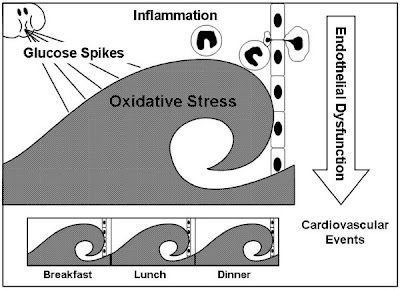
    Postprandial hyperglycemia is characterized by hyperglycemic spikes that induce endothelial
    dysfunction, inflammatory reactions and oxidative stress, which may lead to progression of
    atherosclerosis and occurrence of cardiovascular events. Emerging data indicate that postprandial
    hyperglycemia or even impaired glucose tolerance may predispose to progression of
    atherosclerosis and cardiovascular events.
    There is evidence that postprandial hyperglycemia, but
    not fasting hyperglycemia, independently predicts the occurrence of cardiovascular events.
    We
    proposed a concept of ‘vascular failure’ as a comprehensive syndrome of vascular dysfunction
    extending from risk factors to advanced atherosclerotic disease. Postprandial hyperglycemia is
    therefore one of the very important pathophysiological states contributing to vascular failure.
    Accordingly, controlling postprandial hyperglycemia should be the focus of future clinical
    investigation as a potential target for preventing vascular failure.

  • The Different Types of Lentils

    There are many different types of lentils. Here’s a description of some of the most popular varieties.

    Brown Lentils
    These are the most common type of lentils found in stores. The have a mild flavor and can be used in many different types of recipes. They tend to get mushy if cooked too long. They are good in lentil soup.

    Black or Beluga Lentils
    These lentils are small, delicate, and black and are shiny like Beluga caviar when cooked, hence their name. They are more expensive than other lentils. Use them in lentil soup or salads.

    Puy Lentils or French Green Lentils
    Considered by many to be the most delicate and flavorful of lentils, these small, brownish green or speckled green lentils originated in Le Puy, France. They don’t get as mushy as some other lentils so they’re great in recipes that require the lentils to remain firm.

    Green Lentils
    Like French green lentils, green lentils don’t turn mushy as fast as some other lentils.

    Red Chief Lentils or Split Red Lentils
    Salmon colored lentils that turn golden when cooked. They get soft fast and are therefore great in soups.

    Petite Crimson Lentils
    These are very small lentils that cook very fast and are about a third the size of other lentils.

    Yellow Lentils or Toor Dal
    These lentils are yellow with a mild flavor. In India, they are often ground into a flour.

    White Lentils
    These are black lentils that have had their black skins removed to reveal the white interior.

    Split Black Lentils
    Black lentils that have been split but not skinned, giving

    Macachiados Lentils
    These Mexican lentils are yellow and larger than other lentils.

  • Mercedes confirms next gen C-class to be built in USA and Germany

    Filed under: , ,

    Mercedes-Benz C63 AMG – Click above for high-res image gallery

    The diminishing value of the U.S. dollar, most notably against the Euro and Yen, is causing plenty of grief for foreign automakers. While the US market has been in the tank for the past two years, it still remains a major market for companies like Audi, BMW and Mercedes-Benz. All three brands have been looking at ways to relieve some of the exchange rate pressure and Mercedes has decided that more “dollar zone” production will be part of the solution.

    When the next generation C-Class rolls out in 2014, German production will be consolidated at Daimler’s Bremen factory while units for the North American market will be built in the U.S. There’s been no announcement about where production will take place, but an expansion of the SUV factory in Alabama is one possibility. On a related side note, part of the reason the Premium German brands have recently avoided selling four-cylinder versions of their entry-level models in the States has been the exchange rates and the associated lack of profitability. With new CAFE rules coming, it’s likely that we’ll be seeing more moves like this in the next several years.

    [Source: Daimler]
    Photos Copyright (C)2008 Sam Abuelsamid / Weblogs, Inc.

    Continue reading Mercedes confirms next gen C-class to be built in USA and Germany

    Mercedes confirms next gen C-class to be built in USA and Germany originally appeared on Autoblog on Fri, 11 Dec 2009 18:00:00 EST. Please see our terms for use of feeds.

    Permalink | Email this | Comments

  • InfinityQS Revamps Training Facility with New Technologies

    Software company invests in computing systems to train fast-growing user base in optimizing manufacturing process control
    Chantilly, VA – October 23, 2009 – InfinityQS® International, the leading provider of statistical process control (SPC) software, opened a completely revamped training center to serve its expanding user base with today’s most advanced technologies. The new facility, located at InfinityQS’ global headquarters in Chantilly, Va., will host over 25 training courses in 2010. Customers will still have the option to receive on-site training at their manufacturing facilities.

    The upgrade is a part of InfinityQS’ commitment to provide users with the tools they need to optimize their SPC software implementations for maximum ROI. The training center is designed to promote interactive learning and is equipped with the technical tools and hardware found in a production environment, such as gauging equipment. Improvements to the training center include 24 high-speed workstations, a secure wireless network, and advanced hardware.

    The course curriculum, developed by expert industrial statisticians, educates users not only on InfinityQS software, but also on the statistical methods that allow them to increase process efficiency to save time and money. InfinityQS training courses are taught by industry experts with years of experience in manufacturing facilities who either hold a master’s degree in statistics or are ASQ Certified Quality Engineers (CQE). Courses are also taught in multiple languages for international users.

    “Time and time again, we see that the majority of customers who save millions of dollars a year are the ones who properly train key quality personnel to use InfinityQS software,” said Michael A. Lyle, president and CEO of InfinityQS. “The training courses have a hands-on focus that engages the attendees from day one, and they return to their plant with new insight on how to reduce scrap, rework and other quality costs.”

    The InfinityQS training calendar is available at http://www.infinityqs.com/training.html.

  • JetNet 5018G 16+2G Industrial Managed Gigabit Switch for Large Scale Networks!

    Korenix unveils JetNet5018G, the Intelligent High Power Density Gigabit Ethernet Switch designed for large network applications requiring high-port density and secure connection. Equipped with 16 Fast Ethernet ports and 2 Gigabit SFP combo ports, the switch is capable of aggregating up to 8 fast Ethernet and 1 Gigabit fiber/copper rings while ensuring the network reliability for various distance applications. JetNet 5018G outstands from other similar Switches with its advanced Layer2 management features and network redundancy technologies to provide extended performance with secure data management.
    Combining rugged IP-31 enclosure, -25~70°C wide operating temperature and redundant 12-48VDC power inputs, JetNet 5018G becomes the best fitted device for highly reliable, secure and non-stop network constructions in severe industrial environments, including railways, airports, mining areas, oil & gas fields, power stations, etc.

    Enhanced Performance through Superior Design
    Besides 16 100M ports, JetNet 5018G is designed with additional 2 Gigabit RJ45/SFP combo ports,which can be configured for a variety of gigabit cabling types and distances. With the non-blocking switching performance, JetNet5018G provides 12.8G backplane ensuring the traffic switching without data loss/blocking. The high density switch also supports up to 9K Jumbo frame allowing transmitting larger files with fewer segments.

    Flexible & Non-Stop Transmission with 9 MultiRings
    To ensure the high quality, reliable data transmission in industrial networks JetNet 5018G supports Korenix patented MSR ring with <5ms recovery time and “zero” ms restoration time. With exclusive MultiRing technology, it allows aggregating up to 8 100M rings and 1 Giga Ring into a single switch, as a result increasing the network bandwidth and expanding system through giga fiber/copper rings. Excellent Remote Management & Auto-Network Topology JetNet 5018G provides various software features such as QoS,255 VLANs,IGMP Snooping, DHCP,LACP,etc. for ensuring high-quality performance,bandwidth aggregation and efficient traffic transmission. In addition to SNMP, JetNet 5018G incorporates LLDP and perfectly works with the Korenix patented JetView Pro network management software allowing administrators to automatically discover devices and efficiently manage the industrial network performance in mission critical environments. Korenix Technology www.korenix.com; www.korenixsecurity.com +886-2-8911-1000 [email protected]

  • Large Series AH Worm gear

    This range is offered in 3 basic unit types. Under-driven worm, over-driven worm and vertically mounted with output shaft. The units provide power capacity up to 839 kW in 6 sizes from size 10 to size 24 with worm gear centres from 254mm to 609mm. All are offered with a choice of 14 standard ratios from 5:1 to 70:1. Motorised versions of all units are also available.

    All units are fitted with high capacity taper roller bearings for generous overhung loads, position action oil seals, oil level sight glass and drain holes. Flange mounted units with vertical downshaft have drywells fitted as standard to eliminate a head of oil on the low speed shaft seal and prevent oil leakage. Upper and lower speed shaft bearings are grease lubricated when drywells are fitted. All units can be supplied with holdbacks. Shaft extensions can be supplied with metric or inch dimensions.

    Double Reduction Units (worm/worm)
    Double reduction worm units are constructed using two single reduction worm gear units connected together. All options of unit type and variant are available in double reduction with standard ratios extended to 4,200:1.

    Shaft Mounted Single Reduction Worm Gear Units
    Shaft mounted units can be mounted directly on to the driven shaft dispensing with connecting couplings and baseplates along with alignment of the unit and motor. Motorised units are available. Standard and special torque arms are available on request.

    Single Reduction Stirrer Units
    Stirrer units are offered in standard and heavy duty versions. The heavy duty version incorporating an extended bearing housing to accommodate a larger lower bearing and increased shaft size thus adding extra unit capacity to absorb higher shaft and bearing loads imposed during stirrer applications. Standard features also include top motor mount plate and brackets for V-belt drive, motor flange for direct drive. Drywells are fitted as standard to all units.

    Single Reduction Cooling Tower Units
    Standard cooling tower fan drives are available in 5 sizes. Size 10 to size 20. The design includes an extended wheelshaft and housing with the wheelshaft supported by standard taper roller bearings. Wheelshaft extensions are manufactured to suit customer requirements and fan hubs. Non standard ratios are available. Lubrication is entirely self contained. Gears and lower bearings dip in the oil bath. Oil is pumped to the top wheelshaft bearings by means of a built in mechanical oil pump. Two oilseals are fitted on both the wheelshaft and wormshaft and wheelshaft extensions incorporate a grease chamber. All exposed parts other than the shaft extensions are fitted with corrosion resistant paint. Units are supplied with BSP plugs fitted to oil filler drain and ventilator points suitable for connections to the outsides of the towers. If necessary David Brown Radicon can supply the necessary piping required by customers.

  • David Brown now has a dedicated Wind Turbine service & repair team

    David Brown know that when you operate in the wind turbine industry, expensive downtime is simply not an option.

    The challenging location of many turbines calls for solutions you can fit and forget, which is why we dedicate ourselves to providing a range of vital aftermarket services for wind energy – when and where you need them.

    Our ability to apply a detailed engineering knowledge of geared drive systems into the service and repair of wind turbines, ensures the highest levels of support:

    Problem solving – anywhere, any time
    Repair, overhaul and upgrade
    Retrofit replacement gearboxes
    Spare part manufacture
    David Brown doesn’t just work alongside industries, but within them. We believe that by closely aligning ourselves with key OEMs and wind farm operators, we are able to achieve a greater understanding of the challenges faced in the wind industry.

    Contact David Brown today to ensure you receive the best support available for your wind energy requirements [email protected] .

    Wind Industry Service & Repair
    Please visit the following link to view our latest case studies from work we have recently undertaken in the wind industry.

  • New T30S: convenient, powerful, ergonomic

    The new threephase industrial vacuum T30S provides functional and operative features for the recovery of production waste, faster and safer than ever.

    An incredible bunch of qualities: steadiness, power, the most convenient vacuum of its category, availa¬ble in three different versions: with 50 or 100 liter container and with gravity unload system through a polyethylene LDPE bag or Longopac®, an endless bag for dust collection.

    The cable- and hose-holder and the accessory box optimize the vacuum’s ergonomics. Thanks to the innovative design (patented with a EU Design number) this vacuum is the steadiest and safest machi¬ne of its category.

    From today you can equip your company with an excellent industrial vacuum at the best price.

    Discover other benefits on www.nilfisk-cfm.com

  • What does elevated insulin mean?

    I just got the insulin panel back and it said it was elevated. I guess normal is below 24 and mine was 31. The letter said we needed to start medication at the follow up visit.
    Does this mean I am a diabetic? If I have to much insulin then shouldn’t my sugar levels be low and not high? Two hour after most meals I run about 160 to 250. So I am very confused as to what is going on? Thank you for you help with this.
  • Amanda Knox’s trial and conviction

    Thank you, Sen. Maria Cantwell

    Thank you, Sen. Maria Cantwell for taking the lead in trying to resolve the terrible miscarriage of justice that has landed Amanda Knox in jail for the next 26 years [“Buckets of doubt,” Opinion, editorial, Dec. 8].

    Knox was tried by a nonsequestered jury that was allowed to return home nightly to read the tabloid reports on an “already judged guilty” Knox; tried by a prosecutor who himself faces judgment in January for corruption and illegal wiretapping; an investigative team that allowed evidence to remain in the residence six weeks after the murder was discovered and handled by several people.

    There are many other instances where evidence is flawed and basic investigative procedures were not followed. The prosecution’s chief witness, who lives across street from murder victim, Meredith Kercher’s house, claims she heard three people running from the home. Informal tests confirm it would have been impossible for the woman to have heard these sounds with her windows closed on a cold night in Perugia, Italy.

    My reason for writing is to challenge the reader from Portland who chastised Cantwell, saying she was “out of line” for her criticism of the Italian legal system. This person also cites a miscarriage of justice of two Italians tried in an American court and executed over 80 years ago. If you must go back nearly a century to cite irregularities, I’d say there’s no comparison between American system of justice and the 12-month trial of Amanda Knox in Perugia.

    — Dick Curtis, Issaquah

    Senator’s comments show ignorance of the facts, case

    Sen. Maria Cantwell’s statements show an ignorance of the facts in the Amanda Knox case [“Knox support network: friends, lawyers, scientists and a senator,” page one, Dec. 5].

    Rarely does a defendant provide so much self-damaging evidence.

    Knox provided a statement placing herself at the scene of the crime, while the crime was being committed, covering her ears to close out the victim’s screams. She was even able to provide police with the killer’s name, resulting in an innocent man being arrested. She then claimed she was actually at her boyfriend’s residence during the time of the incident, a claim he was unable to verify.

    The faux burglary reported to police directly pointed to the murder suspect as being a resident of the house. The blanket thrown over the victim contained no blood transfer, showing that the body was covered long after she was killed.

    Cantwell’s statement suggesting that the jury’s verdict was tainted by anti-Americanism again shows her ignorance of the case. There was another defendant on trial with Knox, his name was Raffaele Sollecito, and I don’t believe he is an American.

    — Sam Hurst, Bellevue

    A letter from Italy

    Regarding the Amanda Knox verdict, the Italian judicial system has few similarities to the Anglo-Saxon system.

    As an American who has lived for 34 years in Italy, I can assure you that the media coverage in the last two years has been balanced. Anti-Americanism here is political, not personal.

    Knox lost her credibility when she accused an innocent Congolese man, her ex-boss, as the killer. Everyone was ready to believe he did it. During his two weeks in jail, the whole country believed he was the killer.

    She lied to the police, changed her story, and possibly can’t remember what happened because of drug use.

    A 26-year sentence in Italy will probably mean about 10 years, including weekend passes and then work release.

    The British victim’s family was silent until the verdict. Then they expressed sympathy for the killers’ families. Maybe the Knox family should have followed their example, and spent less time and money in their professional public-relations campaign.

    — Rita Dunn, Pistoia Italy

  • Obama’s Nobel Peace Prize and Afghan war

    Peace is the way, the only way

    Editor, The Times:

    On the eve of President Obama’s Nobel Peace Prize acceptance speech, I found myself wondering to whom he will donate his prize money [“Unlikely praise for Obama’s Nobel talk,” page one, Dec. 11]. He doesn’t need it, and there must be countless organizations vying for the 10 million Swedish kroner.

    Perhaps in light of his commitment to sending another 30,000 troops to Afghanistan, Obama could create a fund to help the families of those — both U.S. troops and Afghans — who will lose their lives as a result of his actions.

    Of course, no amount of money can truly compensate those who will die —U.S. or Afghans — as a result of the hubris of misguided politicians. We can only hope that the voices for peaceful means of addressing conflict will one day soon drown out the cacophony of militarism that has led us to this tragic state.

    The president might take a lesson from a previous Nobel Peace Prize winner, Martin Luther King Jr., who in 1964 was considered by the Nobel committee to be, “the first person in the Western world to have shown us that a struggle can be waged without violence.”

    — Leonard Eiger, North Bend

    Holding Obama to his campaign words

    While President Obama is accepting the Nobel Prize for peace, this nation is committing guns, bombs and blood to combat extremism overseas at the cost of $1 million per soldier per year. A much more cost-effective measure is being overlooked: Education for All.

    Globally, 75 million children could not attend elementary schools, and 255 million children could not attend secondary schools, all due to a lack of resources.

    For boys, every year of education will reduce their chances to be involved in violent crimes by 20 percent. For girls, an education will double their children’s chance to survive beyond age 5.

    These are the significant effects that could be achieved by education. Education of the very poor will have great impacts on family health, hunger, economic development and peace and security of all nations.

    Candidate Obama had promised to contribute $2 billion to a Global Fund for Education in order to help the poor nations educate their young. This is a worthwhile investment that will pay off handsomely toward our own security, sparing the blood of our youth for years to come.

    We need to hold Obama to his words.

    — Terrence Dai, Seattle

  • Shell Oil about to begin drilling in Alaska

    But what about the polar bears?

    I was saddened to read that the Interior Department has approved Shell Oil’s plans to drill exploratory oil wells in the Chukchi Sea off Alaska’s northwest coast [“Oil drilling in Alaska OK’d,” News, Dec. 8].

    This drilling will take place in a sensitive ecosystem, home to one-tenth of the world’s polar bears, who are already suffering and dying as a result of climate change. What will happen to them if there’s an oil spill?

    Shell can’t prove that it can clean up a spill in the extreme weather conditions of the Arctic Ocean.

    Interior Secretary Ken Salazar tried to justify his decision by saying that Chukchi Sea oil exploration would help reduce America’s dependence on foreign oil. This is an admirable goal, but drilling for oil in sensitive ecosystems is not the way to achieve it.

    Instead, we should move away from fossil fuels entirely. We can completely wean ourselves off fossil fuels in the next 20 years by switching to wind, solar, geothermal, tidal and hydroelectric power.

    Isn’t this preferable to further endangering our friends the polar bears —not to mention ourselves?

    — Maggie Willson, Seattle

  • Apple Trying To Patent Anti-Tamper Tape

    Apparently, Apple is trying to patent anti-tamper tape. The patent application, for a “tamper resistant label for detecting device openings,” describes some adhesive tape that could be placed inside devices, which would get torn or damaged if someone opened the device. It seems like there’s a ton of prior art here. In fact, e-voting machines have used an anti-tamper tape for ages that seems quite like what’s described in the claims. Second, it seems pretty ridiculous that Apple is going this far to try to remove the ability of legal purchasers to tinker with devices they own. Yes, I recognize the reasoning (opening the device voids the warranty and they want to know if the warranty has been voided). But, even so, it’s quite an anti-consumer position to take.

    Permalink | Comments | Email This Story


  • Taxes and budget deficits from near and far

    Unjust is right

    Gov. Chris Gregoire is correct: Her proposed state budget is unjust [“Gregoire lifts budget ax: Don’t make me do this,” page one, Dec. 10].

    Unfortunately, given our current economy, in order to provide safety for those without jobs, those who are low-income, and those without health insurance, as well as to provide a quality education in this state, raising taxes is the only option.

    The governor agrees with this.

    But raising the sales tax should not be an option. Here in King County, our sales tax is already 9.5 percent, which is one of the highest in the United States. Sales taxes are regressive and affect those we are trying to help with the safety net the most.

    Washington must implement an income tax — now —that taxes those with the highest incomes the most, and which does not apply income tax to the low-income.

    Under this plan, I will pay more taxes, but it’s worth it, because someday I may need to benefit from the same safety-net programs that I am supporting today.

    — Jamie Flaxman, Seattle

    A voice from Spokane

    It is time for Gov. Chris Gregoire and other elected officials in Olympia — whether they are Republican or Democrat — to take a long hard look at themselves and start being held accountable for what they have done. Instead of pointing fingers and blame at each other, our officials need to stand in front of a mirror and then point their fingers to see who is to blame.

    The budget deficit is not just the fault of the governor, but all who throughout the years have spent Washington state funds and did not stop to notice how high the deficit was becoming.

    Do any of our elected officials think Washington’s high unemployment rate is not Washington, D.C.’s, fault, but perhaps some blame should be placed on our state?

    We need accountability; Washington, D.C., does not run Washington state.

    Our officials need to stop looking toward D.C. and find our own ways to get our state on the right track, and get Washingtonians back to work.

    Big corporations, manufacturers and other large organizations are not the only ones that can put Washington state back to work. Incentives and breaks should also be for the small business, for those that exist and those who want to start a small business.

    — Linda L. Roush, Spokane

    Living with cerebral palsy

    I have had cerebral palsy all of my life, and it’s so important to me to have essential support care in order to stay healthy and live a normal life. I also sent a letter to Gov. Chris Gregoire about rejecting the proposed Medicaid cuts.

    I use a wheelchair, always have, always will. I have no other choice.

    Currently, my specialized computer —which talks for me and has the technology to allow me to write e-mails — is away being repaired, but awaiting government approval for the repair cost.

    So now a friend is typing what I’m dictating. It’s hard to be forced to rely on others for my basic communication needs.

    If the services and support get cut per the Department of Social and Health Services recommendations, I would not be able to maintain the equipment that helps me communicate, and I’m afraid my life would become isolated.

    If the health programs proposed to be cut disappear, I also fear I might end up back in a nursing home, which might cut my life shorter, and would definitely end my ability to live my life as I choose, and run my own business as a filmmaker.

    — Dianne Laurine, Seattle

    The opportunity tax

    Instead of calling it the death tax, would the term opportunity tax be more palatable [“Repeal or reduce the death tax,” Opinion, editorial. Dec. 7]?

    Over the past 20 years, the Republican tax cuts have helped build today’s wonderful economy and increase the divide between the rich and poor until it mirrors the pre-Depression years.

    The difference is debt. So it makes little sense to fuss over yet another tax cut for the few, without addressing the much larger problem.

    The opponents of the estate tax do not offer up an alternate way of taxing the incredible opportunity for success that being an American provides us. They just want more. But the estate tax is just one piece of a much larger system created to maintain a societal balance.

    America succeeded when it shared the gains created by capital and labor in the ’50 s and built a strong middle class. But for the last 30 years, as productivity continued to increase, the middle class remained static or fell behind, while accumulating debt. This is the undoing of our success as a nation.

    The Times should look at the larger picture, especially in light of today’s economy, and investigate how we can reclaim our economic engine.

    — Bill Clapp, Seattle

  • A week to remember

    We should honor fallen soldiers as much as fallen officers

    I commend The Seattle Times for honoring the four fallen officers who died tragically in a senseless act of violence [“‘We will remember them always,’” page one, Dec. 9]. The individual profiles of the courageous officers were touching and inspiring.

    I believe that there should also be a place on the front page of The Times to honor the brave soldiers who have given the ultimate sacrifice in the line of duty.

    The more people can put a name and a face to the death and devastation of the current wars we are engaged in, the less likely it is that they will sit on their hands when our president wants to escalate the violence.

    — Patrick Yates, Seattle

    Where was Cantwell during George W. Bush administration?

    Sen. Maria Cantwell takes the opportunity to use the Amanda Knox verdict to grab some media attention [“Knox support network: friends, lawyers, scientists and a senator,” page one, Dec. 5].

    Where was the senator’s concern for international standards and rule of law when the U.S. unilaterally invaded Iraq, with the senator voting to enable George W. Bush’s bloody quagmire — one that we’re still in with no sight of getting out of?

    We don’t read of Cantwell attending memorials for soldiers killed, or visiting casualties of this war, and as silent as she’s been about this cost in life, resources and dollars, she’s just as predictably silent about the million dead Iraqis and the millions more displaced by this war.

    The anti-Americanism that some claim tainted Knox’s trial is, if anything, the result of policies and actions the senator supports.

    The Italian system may very well be flawed, but any critique coming from a senator who has said nothing against U.S. policies of extraordinary rendition or Guantánamo is presumptuous at best. In this light, Amanda Knox has it pretty good.

    — Ezra Mark, Seattle

    Frigid temperatures + clear skies = true awakening

    I hope travelers on the Alaskan Way Viaduct over the past few days of spectacular bay, mountain and city views have taken a moment to reflect on the immensity of the loss Seattleites will suffer when we are permanently detoured into a dark, soulless tunnel.

    This is progress?

    — Dick Schwartz, Seattle

    Promoting free speech, from east to west

    As we live in America with free speech, it’s hard to imagine that 1.3 billion people in China are censored [“No finger wags in Beijing,” Opinion, editorial. Nov. 18].

    Despite our difference, East and West, our global communication and cooperation is vital for the future of this world. The problem is that communicating and addressing global issues are difficult when a vast population may not hear about all of the world issues.

    President Obama just finished his visit in China, and I applaud that he expressed he is a supporter of non-censorship and that unrestricted Internet access is a source of strength and should be encouraged.

    Ironically his support of non-censorship from the Internet was immediately censored from the Internet in China.

    As we tumble into a world of globalization, free speech needs to be encouraged and supported in the East, to build a strong and healthy global community.

    — Margaret Chang, Seattle

  • Why The Tough November For Retail Doesn’t Mean A Bad December


    Ken Natori, VP Finance, Natori Company (4 min)

    • Comparing November Sales Reports: This time last year retail had bloated inventories and offered deeper discounts. This year, cautious orders in the spring has led to less aggressive discounts in the holiday season.
    • Despite tough times, people are still spending.
    • Forecasting Holiday Sales In December
    • Natori Company’s 2010 Outlook

    Produced By: Kamelia Angelova & William Wei

    More Video: TBI Calendar Click HERE >

    Join the conversation about this story »