 |
Nearly one million teenage boys living in Australia are set to be vaccinated with the human papillomavirus (HPV) vaccine Gardasil in the coming months and years, according to new reports. The first country in the world to give an official green light to the vaccine’s… |
Blog
-
Australian boys become first male guinea pigs in global Gardasil genocide
-
Hospitals and doctors are killing Americans in record numbers

From the late 1990s to now, more and more statistical evidence regarding death and injury from medical interventions, known as iatrogenic deaths and injuries, have been exposed. The rate of iatrogenic deaths is quite high, higher than traffic fatalities, heart attacks… -
Nutritional supplement helps prevent gestational diabetes

Pregnant women are more prone to develop glucose intolerance, also known as gestational diabetes. This is the main reason why pregnant women are encouraged to keep a healthy weight by maintaining proper diet and performing regular exercise. During this time, the woman’s… -
Epidemic of prescription drug deaths hits New York

Over the past 16 years, the rate of drug overdose from prescription opioid drugs skyrocketed seven-fold in New York City. In fact, researchers from Columbia’s Mailman School of Public Health call it nothing less than an “epidemic.” Who are the people in New York overdosing… -
TSA terrorizes three-year-old girl in wheelchair

According to the website of the Transportation Security Administration, the agency was created in the immediate aftermath of the Sept. 11, 2001 terrorist attacks “to strengthen the security of the nation’s transportation systems and ensure the freedom of movement for… -
Seven of the best raw foods to add to your diet now

The health benefits of eating certain foods raw are numerous, as raw foods are essentially living foods that contain live enzymes, undamaged nutrients, and alkaline-forming compounds that help nourish and cleanse the body. And you do not necessarily have to take the… -
Multinational drug companies hold Greece hostage by denying shipments of medicine; 90% supply reduction; citizens in near-panic

In a classic example of an anti-free-market collapse, fifty pharmaceutical companies are now halting supplies of drug medicines to the nation of Greece, causing severe shortages of over 200 popular pharmaceutical medicines there. Pfizer, Roche, GlaxoSmithKline, Sanofi… -
Obama using computer-generated Twitterbots to create appearance of social media support for gun control

All of those Twitter messages that appear to represent millions of people who support President Obama’s gun control agenda… -
Four huge benefits of exercising outdoors

To be sure, exercising outdoors during the winter months in many parts of the country is not easy. Snow, sleet and rain, combined with lower winter temperatures, make it difficult if not impossible to work out in a natural environment, but if you can, you should because… -
Tyson, Cargill among others now drugging your meat with Merck’s new Zilmax

Merck scientists have introduced a new drug to the meat industry – Zilmax. This drug bulks up cattle in the last few weeks of their lives, bringing in more revenue for feedlot owners. Four major meat companies now use Zilmax, including Tyson Foods, JBS SA, Cargill, and… -
Flu shots during pregnancy lead to 4,250 percent increase in fetal deaths

For years, the U.S. Centers for Disease Control and Prevention (CDC) has maintained that the combined influenza vaccine, which was first administered during the 2009 H1N1 pandemic flu season, is perfectly safe and actually encouraged for pregnant women. But a new study… -
MUST-SEE ‘Food Fight’ video; food resistance movement crosses racial lines, black, white, Latino all fight for survival against the processed food death machine

I just saw a jaw-dropping music video that I’m calling the most important video you’ll likely see this year. It’s called “Food Fight” and was put together by Earth Amplified and it rips right to the core of what’s really killing inner city Americans: FOOD. Processed… -
How to beat ADHD without prescription drugs

The latest statistics from the U.S. Centers for Disease Control and Prevention (CDC) estimate that more than 5.4 million American children between the ages of four and 17 living today have been diagnosed with the behavioral disorder known as attention deficit hyperactivity… -
There is a total media blackout on real nutrition

Did you hear anything at the recent inauguration about nutrition, natural cures or disease prevention? Did anyone hear ANY WORDS at all during the presidential campaign about the importance of organic food? No, that’s because there was a complete blackout on nutrition… -
With an Android backup plan already in place, Samsung says no to Firefox OS

-
Bluegrass from, er, New Jersey: Sleepy Man Banjo Boys at TED2013

Photos: James Duncan Davidson
We’ve seen a number of “the young” of the conference’s theme in this session of TED2013. Now, to play us off out into the night are Sleepy Man Banjo Boys, a trio of brothers from New Jersey, the youngest of whom became a YouTube sensation in 2011 when he was only eight years old. “They’re fantastic musicians, really incredible players,” says TED music advisor Bill Bragin of the three, the oldest of whom even now is only 15 years old. “And there’s something about the interaction of a bluegrass band and the way the fiddle, the banjo, and the guitar intersect because they’re brothers. There’s a real intuitive sense that happens when they’re locked in that really comes across.” The crowd certainly feels it; whoops and hollers round off the end of the rollercoaster first day at TED.


-
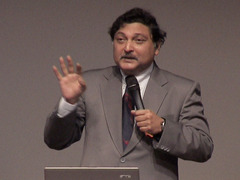
A school in the cloud: Sugata Mitra accepts the TED Prize at TED2013

It’s a question on so many minds: what will the future of education look like?
 Ken Robinson says schools kill creativity It’s something Sir Ken Robinson has asked for decades. And tonight in Session 3 of TED2013, Robinson got the opportunity to announce the winner of the 2013 TED Prize, someone who has a bold answer.
“So many kids are disengaged from education and there’s a tendency to confuse testing with learning,” says Robinson in his introduction. “What drives learning is curiosity, questioning … What fires people up to learn is having their mind opened up by possibilities.”
And with that, he revealed the winner of the $1 million TED Prize: education innovator Sugata Mitra, who has given two TED Talks over the years and released a TED ebook called Beyond The Hole in The Wall.

Mitra wants children around the globe, in addition to traditional schooling, to get a chance to participate in self-organized learning. Translation: to spend time in learning environments where they are given the space to explore on their own, make discoveries and share them with their peers. In his talk from the TED stage, Mitra offered a bold wish: to help design the future of learning by supporting children in tapping into their innate sense of wonder. To this end, Mitra asked the TED community to help him create the School in the Cloud, a learning lab in India where children can embark on intellectual adventures, connecting with information and mentors online. He also asked the community, wherever they may be, to create child-driven learning environments for the kids in their own lives.
In his talk, Mitra points out that schooling as it exists now was created 300 years ago in the British Empire.
 Sugata Mitra: The child-driven education “The Victorians created a global computer made up of people. It’s called the bureaucratic administrative machine,” says Mitra, in the bold opening of his talk. “In order to keep that running, you need lots and lots of people. They must be identical to each other … So they created a system, called school, to make parts [for this human computer]. They must have good handwriting, they must be able to read, and they must be able to add, subtract and do division.”
But these skills aren’t as necessary with the advent of computers.“It’s quite fashionable to say education system is broken,” says Mitra. “It’s not, It’s wonderfully constructed — it’s just that we don’t need it anymore. It’s outdated.”
We can’t imagine the technology of the future, and thus we can’t know what jobs we’ll need the skills for. So Mitra suggests that education should be about developing the ability to learn anything on one’s own.
Mitra has a history of research to back up this wish. In 1999, he began what he calls his “hole in the wall” experiment. He carved a hole in a wall in a Delhi slum — about three feet high — and placed a computer in it. Kids had gathered around within a matter of hours and asked Mitra questions about what this thing was. He responded “I don’t know,” and walked away.
Soon the kids were surfing the internet — and teaching each other how to do it more effectively.
Mitra repeated the experiment 300 miles away, where computers even less familiar. He installed a mysterious computer on the side of a road. A few months later, he returned and found kids playing games on it. Remembers Mitra, “They said, ‘We want a faster processor and a better mouse.’”
Another thing these kids said that was music to his ears: “You’ve given us a machine that works only in English, so we had to teach ourselves English.”
Mitra says, “It was the first time I heard the words ‘teach ourselves’ said so casually.”
Mitra kept testing, seeing if rural students could learn different pronunciation simply by talking into a speech-to-text engine until it understood them. They did it. And then he went even more absurd. He asked: Can Tamil-speaking 12-year-olds learn the biotech of DNA replication by themselves on a streetside computer in English?
 Sugata Mitra shows how kids teach themselvesSlowly but surely, over months, the kids began to learn the material — showing understanding of concepts far advanced for their age. In three months, with a test, they went from 0% comprehension to 30%. But Mitra wanted to see if he could go further. He brought in a 22-year-old woman with no knowledge of the subject to tutor the kids, using “the method of the grandmother.” Instead of traditional instructing, she simply gave encouragement. The kids’ test comprehension scores jumped.
“We live in a world where, when we want to know something, we can learn it in two minutes,” says Mitra. “Could it be, the devastating question, that we’re heading towards a future where knowing is obsolete?”
Mitra isn’t ready to say that, but he is willing to challenge traditional modes of education based on teaching, testing and regurgitation. As Mitra explains, punishments and exams are seen as threats by kids. He says that these are tools no longer needed outside of the age of empire. Mitra urges us all to shift the incentive for education from threat to pleasure.
Mitra shared another one of his experiments — the “granny cloud,” a community of retired teachers who Skyped into learning centers and encouraged children with questions and assignments. He calls this type of environment a SOLE — a self-organized learning environment. It’s based on a curriculum of questions that set curiosity free, varying forms of peer assessment and certification without examination.
“If we let the educational process be a self-organizing organism, learning emerges,” says Mitra. “It’s not about making learning happen, it’s about letting education happen.”
Mitra’s $1 million TED Prize is not a gift– it’s seed money to fund a global initiative toward this vision. The money will help Mitra break ground on the School in the Cloud in India this very year. This school will serve as both an education and research center to further explore approaches to self-directed learning. It will be managed by cloud technology, but with an adult supervisor always on hand. The plans for the school will be open-sourced.
But Mitra is asking for your help, too.
He has released a toolkit for parents, educators and teachers who want to create SOLEs. The online resource will help them support kids (8-12 years old) as they tap into their innate sense of wonder. The key: asking big questions. For example, “If a meteroite was coming toward the earth, how would you figure out if it was going to hit?” Mitra has been amazed with how kids come up with new approaches to questions like this.
Closing his talk, Mitra shared an anecdote. “A little girl was following me around. I said, ‘I want to give a computer to everyone,’” recalls Mitra. “She reached out her hand and she said to me, ‘Get on with it.’”


-
A 12 year old learns to scare lions: Richard Turere at TED2013

Richard Turere is 12 years old, and he lives in Kenya, in Nairobi National Park. It’s a park with lots of animals that roam freely, including lions. The lions kill livestock. So he say, “I grew up hating lions.”
Turere, who took part in the Global Talent Search last year, tried to solve the problem. First, he used fire. But that didn’t work, and actually, “It was helping the lions see through the cowshed.”
So he went to a second idea: a scarecrow. “I was trying to trick the lions. But lions are clever.” On the first day, the lions came, saw the scarecrow and left. The second day, they came and realized it wasn’t moving, and killed the cows.
But one day Turere discovered that lions are afraid of moving lights. So he got a bunch of lights and an old car battery, and the thing from a motor car that makes the blinkers blink. He set up a circuit that made lights flash. It worked: “The lights flash and trick the lions that I’m walking around the cowshed when I’m sleeping in my bed.”
Since then, no problems with lions. Other people nearby heard about it and had similar problems, so they asked him to install lights for them. Now it’s used all across Kenya to scare various predators. Because of this, he received a scholarship to the best college in Kenya, where he now studies.
“A year ago,” says Turere, “I was a boy in a savannah grassland. I saw planes fly over and I said I’d be inside one day. I had a chance to come by plane for the first time for TED. I got to come by plane to come to TED. My dream is to become an aircraft engineer and pilot when I grow up.”
And for now, he lives with the lions without conflict. It’s a wonderful sentiment to end an extraordinary talk, and the audience responds with a full, enthusiastic standing ovation.

-
Ford Sync’s new Spotify integration signals further decline of traditional radio

-
The magic of books: Lisa Bu at TED2013

TED’s own Lisa Bu takes the TED2013 stage now to tell a very personal tale of a journey through literature that began, well, with a shattered dream. Growing up in Hunan, China, in the 1970s, Bu’s parents (yes, she had a Tiger Mother) believed there was only one sure way to happiness: a safe and well-paid job; no matter whether she actually liked it or not. She, in contrast, dreamed of making a career as a Chinese opera singer. But no adults would take her seriously, and when she reached the age of 15, she knew that she was too old to be trained. Her dream was not to be. “I was afraid that for the rest of my life, second-class happiness would be the best I could hope for,” she says. “But that was so unfair! I was determined to find another calling.”
With no one around to teach her, she turned to books, and what follows is her fresh take on some old favorites, including what she took from titles such as Jane Eyre, Cheaper by the Dozen, and Pearl S. Buck’s The Good Earth, a book banned in China she was only able to read after she moved to the US in 1995. “The Bible,” she comments, “is interesting, but strange.” A big laugh here — “that’s a topic for a different day,” she adds wryly.
Moving to a new culture, Bu developed a new habit: Comparative reading, a standard practice in academia that she took to with alacrity. She read books in pairs, to understand the same tale from different perspectives. She read books written by friends such as Katharine Graham and Warren Buffett to compare shared experiences. She read books on different religions. She read books in different languages–finding herself not lost but found in translation.
“Books have given me a magic portal to connect with people of the past and the present,” says Bu. “I know I shall never feel lonely or powerless again. Having your dream shattered is nothing compared to what many others have suffered. I have come to believe that coming true is not the only purpose of a dream. Its most important purpose is to get us in touch with where dreams come from, where passion comes from, where happiness comes from. Even a shattered dream can do that for you.”
It is because of books, she concludes, that she is on the TED stage today. “I live happy, with purpose and clarity (most of the time). May books be always with you,” she says, to applause from many more than just her TED colleagues.
Here are the books only available in Mandarin:
Correspondence in the Family of Fou Lei 傅雷家书
Lessons from History 历史的经验,by Nan Huaijin 南怀瑾


