Blog

  • USGS Estimates 162 Billion Short Tons of Recoverable Coal in the Powder River Basin

    New basin-wide assessment of recoverable resources and reserves

    The Powder River Basin of Wyoming and Montana contains about 162 billion short tons (BST) of recoverable coal from a total of 1.07 trillion short tons of in-place resources according to a new USGS assessment. This assessment also estimates that 25 BST of those resources are currently economical to recover, the first such estimate released by the USGS for coal for an entire basin.

    The Powder River Basin—a large geologic feature located in northeastern Wyoming and southeastern Montana—contains the largest deposits of low-sulfur subbituminous coal in the world. This study is significant because it illustrates that only a relatively small percentage of in-place coal resources are technically and economically recoverable.

    Powder River Basin Assessment Map
    Powder River Basin Assessment Map — A map showing the four assessment units for the 2013 USGS Powder River Basin coal assessment.

    “The United States is well-known for its rich endowment of coal resources and our in-place estimates bear that out,” said USGS Acting Director Suzette Kimball. “It’s important to note, however, the substantial difference between what is in-place and what is technically recoverable, let alone economic. This new basin-wide assessment provides that critical link for government and private managers to make informed decisions.”

    In 2011, the 16 mines in the PRB produced 462 million short tons (MST), about 42 percent of the Nation’s total coal production that year.  Subbituminous coal is typically used in electric power generation.

    The key to this study was taking advantage of the wealth of recently available geologic data from the interpretation of thousands of new drill logs from coalbed methane development in the PRB.  More than 8,000 new drill holes were added to the original Gillette coal field database alone. About 30,000 total data points were used in the entire PRB assessment. This geologic information interpreted from well information of the recent drilling provided an unprecedented level of data about the coal resources for the basin.

    The USGS developed the geologic information that formed the basis of this assessment in cooperation with the Wyoming State Geological Survey and the Montana Bureau of Mines and Geology.

    The Basin was divided into four areas for assessment: the Montana Powder River Basin, the Northern Wyoming Powder River Basin, the Gillette coal field, and the Southwestern Wyoming Powder River Basin.

    Within these four areas, the USGS assessed coal resources for 47 coal beds. The three largest beds by resource are the Canyon coal bed, the Anderson coal bed, and the Smith coal bed. These three coal beds together represent about 38 percent of the total coal resources for the Powder River Basin.

    To arrive at the estimate of recoverable coal and 25 BST of reserves, USGS scientists selected portions of those coal beds from the total in-place resources that were deemed both shallow and thick enough to be recoverable using current surface mining technology. Ten conceptual mine models were developed to account for the differences in coal bed geology using proven mining techniques for each the four assessment areas of the PRB. Then, estimated mining costs were calculated for all of the modeled coal resources.  Finally, those resources that could be produced at or below the current sales price for PRB coal were designated reserves.

    The current 25 BST of reserves does not mean that is all that remains mineable. The size of reserves change because mining costs and coal sales prices are subject to fluctuation  based on market conditions – recoverable resources become reserves with favorable changes in costs, demand, and prices.

    The USGS Energy Resources Program research efforts yield modern, digital assessments of the quantity, quality, location, and accessibility of the Nation’s coal resources.

    To learn more about this or other geologic assessments, please visit the USGS Energy Resources Program website. Stay up to date with USGS energy science by subscribing to our newsletter or by following us on Twitter.

  • Google Shuts Down Notion That It Will Open Retail Stores, Source Of Rumor Sticks To Story

    At Mobile World Congress, Andy Rubin, SVP of Mobile and Digital Content at Google (and co-founder of Android), shut down rumors that Google will be opening up retail stores.

    Last week, 9to5Google put out a report indicating that Google would be opening its own retail stores by the end of the year. The report cited “an extremely reliable source”. According to Rubin, however, Google has no need to open stores, despite other indications that Google Glass will be widely available by the year’s end.

    Ina Fried at All Things D shares some words from him:

    “They don’t have to go in the store and feel it anymore,” Rubin said, during a roundtable with reporters on Tuesday. Plus, he said, the Google hardware effort is still in its infancy. “For Nexus, I don’t think the program is far enough along to think about the necessity of having these things in a retail store.”

    As for whether Google as a whole might nonetheless be considering retail stores. “Google has no plans and we have nothing to announce,” he said.

    Okay, the “nothing to announce” part is pretty commonplace regardless of whether or not the company actually has something in the works. The “Google has no plans” part seems a little bit more definitive.

    Still, it doesn’t sound like the idea is totally ruled out for the future. Perhaps 9to5Google’s “extremely reliable source” is just off on the timeframe.

    Despite Rubin’s comments, Google clearly has a number of items it could easily get into a retail store, and the company already has a presence in some Best Buys and PCWorld/Dixon’s stores.

    Plus, as Google Retail Industry Director Todd Pollak recently said, “The lines between online and offline shopping experiences are blurring.”

    Update: 9to5Google’s Seth Weintraub now has this to say:

    I reported last week that Google had plans to open retail stores within the year, which according to a quick ping of that same source, is still on. When asked about Rubin’s comments, I was told that Rubin wasn’t being forthcoming or AllThingsD misquoted him.

    It should be noted that the retail program is being born (we’re told) out of Google’s (X) labs under Sergey Brin and not out of the Android group and the two groups aren’t always in full cooperation

    The rumor continues…

  • Why Will.i.am and Chris Bosh want to create a new generation of wannabe coders

    Bill Gates, Mark Zuckerberg, Jack Dorsey – it’s little surprise that those titans of tech want to encourage more wannabe coders. But in a short film released Tuesday by the nonprofit Code.org, it’s not just the usual suspects talking up all the reasons why the U.S. needs more computer scientists.

    Code.org filmSure, Silicon Valley luminaries share the stories of their humble beginnings (Gates says his first program was for tic-tac-toe). But NBA all-star Chris Bosh talks about coding in college before joining the Miami Heat and the Black-Eyed Peas’ Will.i.am says “great coders are today’s rockstars.”

    The message of the film – just like the over-arching theme of the nonprofit: the country needs more coders and, really, it’s not as hard as you think.

    Code.org, which launched last month, was founded by brothers Ali and Hadi Partovi to bring more attention to the need for more coders and increase computer programming education opportunities at schools around the country. As evidence of the problem, it says:

    • Less than two percent of students study computer programming – tripling that could close the gap between students and jobs
    • In 41 states, computer science doesn’t count toward high school graduation requirements
    • Programming jobs are growing at double the pace of other jobs but programming is not offered at 90 percent of U.S. schools

    Code.org’s site offers learn-to-code tools supplied by Khan Academy, Codecademy and Scratch. And it’s enlisted big-name supporters from different industries to help with its campaign. Other tech leaders include Marc Andreesen, Ron Conway and Sheryl Sandberg, but it’s also recruited politicians Al Gore and New York Mayor Michael Bloomberg, the presidents or deans of Stanford and Harvard, celebrities like Ashton Kutcher and Bono and top scientists and doctors.

    The short film, which was directed by Lesley Chilcott (producer of An Inconvenient Truth and Waiting for Superman), will be distributed to teachers and classrooms across the country. And, according to The Seattle Times, Microsoft is paying to have the movie shown as a trailer in select theaters.

    In the past year or so, we’ve seen several startups — including Codecademy, Udacity, LearnStreet and others – rush in to fill the skills gap between what our digital economy needs and what students are learning. (Earlier today we covered the Peter Thiel-backed Thinkful, one of the newer startups in the learn-to-code space.) We’ve also seen the rise of technology high schools — like Brooklyn’s Pathways in Technology Early College High School recently endorsed by President Obama — that put programming and STEM skills at the center of the curriculum. But by featuring voices from industry, pop culture and politics Code.org stands to bring awareness to a wider group of people.

    Below, check out the video:

    Related research and analysis from GigaOM Pro:
    Subscriber content. Sign up for a free trial.

  • Meet OneAPI, the technology that could make carriers relevant in mobile apps

    Carriers have devised a new way to insert themselves into the mobile apps value chain. They want to become the identity managers for mobile services that require user registration or authentication. Just as many apps today allow you to log in using your Facebook, LinkedIn or Twitter credentials, carriers are hoping customers will start registering for services with their phone numbers.

    To accomplish this the GSM Association launched a new initiative called the OneAPI Exchange at Mobile World Congress in Barcelona. The idea is to create an application programming interface (API) that any mobile app developer can use to authenticate new users against a carrier’s subscriber identity data. So far AT&T, Orange, Deutsche Telekom, Telefónica and Vodafone have all signed on to the program, and together they represent a healthy chunk of the world’s mobile subscribers.

    At first glance, the initiative seems like a nifty idea. If there is one thing every mobile subscriber in the world has it’s a phone number, making it ideal as a universal credential. But operators are also hoping to be more than just a username replacement. In a demo at Mobile World Congress, the GSMA showed off a bike rental app, in which carrier data was used not only to identify the user, but verify location and charge the rental to the customer’s mobile bill.

    Obviously carriers are looking to make themselves relevant once again in the applications market and take a cut from any mobile transaction. This time they actually stand a chance of succeeding. Unlike previous API initiatives, the GSMA has actually figured out a way to make OneAPI near universal. Instead of tapping into separate APIs and crafting separate business agreements with every operator, developers just have to build to one API and strike one carrier deal, but the identity feature will work across all carriers’ networks.

    The development house that built the OneAPI Exchange, Apigee, wasn’t able to eliminate the widespread fragmentation among carriers’ API platforms, but it rather ingeniously found a way around it. Apigee’s head of marketing, Dave Jordan, explained that the exchange acts as universal bridge between the operators’ disparate network interfaces.

    A developer just picks a single operator to deal with and then builds to that operator’s API, Jordan said. If the app is downloaded on a different operator’s network the exchange will automatically map that carrier’s API onto the app, he said. For instance, if a developer were to pick AT&T’s API, any Orange or Telefónica customer could log in to the app using his carrier’s credentials, but AT&T would federate all of the transactions across those networks.

    Related research and analysis from GigaOM Pro:
    Subscriber content. Sign up for a free trial.

  • Apple Is Losing to Samsung’s Ad Blitz, Says the Man Who Put the ‘i’ in ‘iMac’

    Ken Segall, the marketing man responsible for Apple’s “Think Different” campaign as well as for putting the “i” in “iMac,” has a message for Apple:

    Samsung is crushing you right now.

    At least in terms of advertising. In a new post on his blog Observatory, Segall argues that Apple is losing its vice grip on the being the “master of buzz creation.”

    Here’s what he has to say about Apple’s current ad-battles with Samsung.

    …Samsung’s message has proven to be tremendously potent. The company continues to bash away at Apple, delivering ads that are well produced, well written and seem to be striking a nerve.

    In contrast to Apple, which has been sticking to its product-based ads, Samsung has been scoring points with its people-based ads — most of which play off some growing negative perceptions about Apple.

    Apple has been the master of buzz creation going all the way back to the first iMac. It just isn’t buzzing quite like it used to. Momentum has been lost. Not all of that is Apple’s fault, but some of it certainly is.

    Samsung invested in a two-minute Super Bowl ad; Apple chose to remain silent. Samsung created a new story for the Oscars, tapping the eccentric Tim Burton; Apple ran only a variation of its more traditional product-centric campaign.

    Segall goes to to say that Apple needs to “recalibrate.”

    “I imagine Apple is feeling a bit like Obama after his first debate with Romney. It deeply believes in its ideas; it just needs to express them more forcefully”

    Last week, another big name in Apple’s history, Steve Wozniak made public his own criticisms of the company’s current state. In an interview, Wozniak lamented that Apple may be losing its cool factor.

    [Observatory via Fortune]

  • Uncharted 3 Multiplayer Goes Free To Play This Week

    In the past, Sony has experimented with free to play by making Killzone 3′s multiplayer free to play to a certain point. The experiment must have worked pretty well because Sony is now offering the multiplayer component from Uncharted 3 for free.

    Naughty Dog announced that Uncharted 3 will be broken up into parts and sold separately from each other on the PSN starting today. That means players will be able to play the multiplayer experience separately from the singleplayer experience, or they can buy it all in one big pack. The big change, of course, is that multiplayer is going free to play with some freemium elements thrown in for good measure.

    So, how is this gonna work? Naughty Dog says that everybody can play multiplayer for free, no strings attached, up until level 15. After that, the game will continue to keep track of your experience points if you wish to upgrade to the next level cap. According to Joystiq, upgrading to level 25 will cost $5 and removing the level cap entirely will cost $20.

    Here’s all the extra add-ons players can buy to augment the free-to-play experience:

  • Uncharted 3: Multiplayer Co-op Adventure Add On – Unlocks Co-Op Adventure mode including the Fort Adventure DLC
  • Uncharted 3: Multiplayer Co-op Arena Add On – Unlocks to gain access to the Co-Op Arena Playlist including the Co-Op Shade Survival Mode DLC for Uncharted 3: Multiplayer Free to Play
  • Uncharted 3: Multiplayer Competitive MP (No Level Limit) – Removes the level cap for Uncharted 3: Multiplayer Free to Play
  • Uncharted 3: Multiplayer Competitive MP (Level 25 Limit) – Removes the Level 15 cap and allows you to play Uncharted 3: Multiplayer Free to Play up to Level 25
  • Uncharted 3: Multiplayer Split Screen Add On – Unlocks Co-Op Adventure mode including the Fort Adventure DLC
  • Uncharted 3: Multiplayer DLC Map Packs – Unlocks all three DLC map packs released for Uncharted 3: Drake’s Deception. Includes Flashback Map Pack 1, Flashback Map Pack 2, and Drake’s Deception Map Pack
  • Uncharted 3: Drake’s Deception Single Player Experience – Uncover the Truth. Unlock the Single Player campaign
  • Those who already purchased Uncharted 3 will be given a special Naughty Dog Paw on their rank icon as well as a special Naughty Dog Paw shirt for their in-game character.

    Naughty Dog also promises that more than 40 additional DLC items will be added to the game in the coming months. Here’s hoping one of them is a Donut Drake skin that’s easier to unlock.

    Sony says its next console will accomodate all business models, including free to play, so it’s better to start experimenting in the field now. Uncharted 3 should prove to be an excellent test field to see how well a free to play game performs on consoles.

  • Hot Rod: Circa 1953

    Levi's Hot Rod

    The American hot-rod is an icon. It was crafted out of rebellion, ingenuity and the will to be different. They were meant to go fast, get looks and at days end, announce to the world that you had arrived in style. The truth is though, in the last 60 years not a whole lot has changed. Sure technology has advanced, but deep down the basic DNA has always remained the same. Levi’s recently launched a great ad that not only transports us back to a time when life was a little simpler, but reminds us why cars, of any vintage are all masterpieces just waiting to be turned into hot-rods.

    Source: RalfBecker.com

  • Twitter Updates Windows Phone App

    Twitter announced today that it has a new version of its Twitter app for Windows Phone. It has a new design, which the company says “brings the app in line with the other Twitter apps”. It also includes some new navigation features, new icons and live tiles support.

    The app has four new tabs: Home, Connect, Discover and Me. Familiar territory to iPhone, Android and web users, but Home lets you view Tweets from those you follow, and expand the tweets, and whatnot. The Connect tab shows you your mentions and those who have followed, retweeted or favorited you. The Discover tab shows you trends, new content on Twitter, categories, and suggestions for accounts to follow. Finally, the Me tab lets you read and respond to direct messages, see your lists and your favorites, and view and update your profile.

    Twitter for WIndows PHone

    There are new icon buttons in the Application Bar for composing tweets and searching from anywhere in the app.

    WIth live tiles, you can pin Twitter accounts, lists, and searches to your start screen.

    Twitter also revealed its app for Firefox OS today. More on that here.

  • HP unleashes ‘augmented reality photos’ for iOS

    Today HP announced Live Photo for the iOS platform — an app that claims to bring the user’s photos to life using “augmented reality”. The company claims the app will bring “a new consumer printing experience by embedding short video moments into printed photos”.

    According to Annie Weinberger, a general manager at HP-subsidiary Aurasma, “augmented reality is the new medium for bringing the physical world to digital life and HP Live Photo puts the power of this technology into the hands of everyday consumers”. The free app purports to merge still images and short videos utilizing Aurasma. Once the app has been downloaded from the iTunes App Store the user can choose a video of up to 45-seconds in length and then select an automatically generated still image. From there it is a matter of choosing a template and sharing the new creation. The new photo/video can be shared via email, Facebook or by printing to any AirPrint-enabled printer.

    The app is free and requires iOS 5.1 or newer, but in certain instances can work with iOS 4.2 on some devices. HP promises to bring this technology to other mobile platforms later this year.

  • Gillian Anderson Pilot Ordered by NBC

    TV Guide this week reported that Gillian Anderson, best known for her role as Dana Scully in X-Files, has been cast in a TV pilot for NBC.

    Cast alongside Anderson is Rachael Taylor, known for her work on Grey’s Anatomy, Charlie’s Angels, and 666 Park Avenue. According to TV Guide, Anderson and Taylor will play sisters in the new show, with Taylor starring as an FBI agent and Anderson starring as the CEO of a major company.

    The show, which doesn’t have a title yet, will involve Washington D.C. blackmail, conspiracy, and law enforcement agencies such as the FBI and Secret Service. It’s a conceit that sounds vaguely similar to Showtime’s hit show Homeland. The show is being headed by Rand Ravich, known as the writer/director of The Astronaut’s Wife and the executive producer of the NBC series Life.

    NBC had better hope that their Ravich project or other pilots, such as Hatfields & McCoys, turn out well, because the network’s peacock feathers are beginning to fade. Just last week NBC was projected to come in fifth in the ratings sweeps that took place between January 31 and February 19. Though shows such as The Biggest Loser and The Office received modest ratings, failures such as Do No Harm and 1600 Penn pulled the network below the ratings for Spanish-language network Univision.

  • Preorders For The Gaming-Focused Razer Edge Tablet Start March 1st, Ships Later In The Month

    Razer_Edge_(1)_610x371

    Surface Pro fanboys, Take notice. Your hot little tablet will soon be the runner-up in the ever-growing category of “incredibly expensive Windows 8 tablets aimed at a tiny, but rabid demographic”.

    Razer just announced that the Edge and Edge Pro gaming tablet will ship in late March, with the startup accepting orders starting on March 1st.

    All joking aside, the Razer Edge is pretty damn exciting. Born from the minds of Razer’s fans, the Edge is a hardcore gaming tablet — no tired Fruit Ninja demo here. With a dedicated GPU and either a Core i5 or Core i7 CPU, the Edge can power through nearly any PC game on the market.

    What’s more, Razer designed modular accessories for the Edge. There’s a large gaming pad, keyboard, and dock, allowing the Edge to essentially morph into different products as needed.

    I spent sometime with the Edge at CES 2013 and was instantly impressed. It ran Dirt 3 seemingly as good as my monster desktop. But, also like my gaming PC, the Edge is expensive.

    The Core i5 Razer Edge costs $999 while the Core i7 Razer Edge Pro costs $1299. Plus, each one of the accessories are sold separately. Just the Gamepad Controller is $249. A fully decked-out Razer Edge Pro with Gamepad Controller rings up for $1,698. Ouch.

    The Microsoft Surface Pro has so far won over some Windows loyalists. They like the full computing power combined with the svelte form factor. The Surface Pro, with its Core i5 CPU, can power through most daily tasks and even handle some games, but, quite frankly, the husky Razer Edge is fully capable of beating it up and stealing its lunch money.


  • New York Times backs AP in lawsuit against news collector Meltwater

    The New York Times is supporting the Associated Press in a controversial copyright case against Meltwater, a service that monitors the news and reproduces headlines and story summaries for its clients. The case pits major media outlets who invest in news against technology advocates who fear the case will suppress the free flow of information.

    This week, the New York Times asked a federal court in New York to file a “friend of the court” brief in support of the AP. The brief, which is also signed by newspaper publishers Gannett and McClatchy and others, asks the court to declare that Meltwater is infringing copyright.

    The Times‘ brief argues that Meltwater is “free-riding” on its news collection efforts and that the service should pay for news in the same way it does for rent or electricity. The Times also cites James Madison’s dictum that a democracy needs “popular knowledge” and cites the business plight of newspapers:

    It takes no friend-of-the-court brief for the Court to know that the rise ofthe Internet has been highly disruptive to the nation’s news organizations, as their readers and advertisers have migrated to the Web.

    The Times also says newspapers’ efforts to replace print revenue with digital income are being undercut by those who scrape their news:

    None of these revenue streams can be sustained if news organizations are unable to protect their news reports from the wholesale copying and redistribution by free-riders like Meltwater.

    The brief goes on to contrast Meltwater with other services that pay to license news content, and complains that fewer than one percent of Meltwater subscribers click through to the underlying news article; it claims the rate is much higher for services like Google News.

    The Times’ intervention is likely to fuel a bitter debate over how far to extend copyright on the internet. Critics of the AP suit, like TechDirt’s Mike Masnick, say the wire service has failed to modernize and is instead trying to shake money out of companies that are essentially search engines.

    Meltwater itself claims that it has the right to reproduce headlines and brief snippets of the news under copyright’s fair-use doctrine. It has also filed a counter-claim accusing the AP of libel.

    The case also involves influential organizations in the technology space, like the Electronic Frontier Foundation, which has filed a brief in support of Meltwater. Meanwhile, the Google-backed Computer and Communications Industry Association (CCIA) has weighed in to back Meltwater’s claim that it is a search engine.

    The outcome of the case is likely to turn largely on how much content Meltwater is taking from the news agencies. In the U.S., there is no copyright in headlines and the fair-use doctrine protects the reproduction of short snippets; the AP and the Times, however, argue that Meltwater is taking the heart of their work and that it is also over-stepping the fair-use line by providing clients with an archiving tool.

    The case is further complicated by the AP’s attempt to claim a right to “hot news” — a state law right that largely vanished in the late 20th century, but that news and financial firms are attempting to resurrect. The Times’s brief did not weigh in to support the hot news claim.

    The Times’ decision to file in support of AP may have been driven by the arrival of new CEO Mark Thompson who is a Briton. In the U.K. and Europe, news organizations have prevailed against Meltwater — forcing not only Meltwater but also its customers to buy licenses. Critics say such rules will further stagnate Europe’s attempts to digitize the news business, which are already trailing North America by a wide margin.

    There is also the question of just how much money news organizations, if they succeed with the U.S. copyright claim, can wring out of Meltwater. My colleague Mathew Ingram suggests the litigation is about a power-play more than money.

    You can read the Times filing for yourself here:

    NYT Amicus Brief for Meltwater by


    Related research and analysis from GigaOM Pro:
    Subscriber content. Sign up for a free trial.

  • Andy Rubin: Google Has ‘No Plans’ To Launch Retail Stores

    google-storefront-closed

    In a roundtable discussion with reporters today, Google’s head of Android Andy Rubin came right out and flatly denied the search giant was considering the launch of retail locations. “Google has no plans and we have nothing to announce,” Rubin was reported as saying by AllThingsD’s Ina Fried. Curiously, Rubin’s explanation for why Google doesn’t need stores was basically the exact opposite of argument from third-party observers about why it does.

    Rubin said that consumers “don’t have to go in the store and feel [products] anymore,” according to ATD. That’s a pretty marked contrast to what a lot of people have been saying about why Google might want to get into the brick-and-mortar biz. Just last week, MG suggested that “average consumers are never going to buy [Google’s] projects online without having tried them first,” in fact. Apple has had success providing experience-based shopping environments, after all, which helped greatly in evangelizing and popularizing the concept of the iPad.

    But Rubin believes that consumers these days are better served by online tools, including review sites and word-of-mouth recommendations from friends and social connections, to the point where a hands-on experience isn’t necessary. He added that he believes Google’s Nexus program is still relatively young, and not “far enough along to think about the necessity of having these things in a retail store.”

    Looking at Google’s hardware efforts in the wake of the Chromebook Pixel announcement last week, it does seem that the company is still in a largely experimental mode when it comes to fielding its own devices. A significant retail investment might not make sense until Google decides more firmly what works and what doesn’t with its hardware lineups in terms of meeting current customer needs.

  • Keith Rabois Joins Khosla Ventures’ Bench of “Venture Assistants”

    Keith Rabois, a serial operating executive who most recently resigned as the chief operating officer of the payments company Square, has joined the venture firm Khosla Ventures as a partner. Before joining Square, Rabois spent numerous years at LinkedIn, first as a vice president, then as an executive VP of strategy and business development. Earlier in his career, Rabois, who has a law degree, was also an executive VP focused on public policy at PayPal. He also spent a year as an entrepreneur-in-residence at Clarium Capital, the hedge fund run by PayPal cofounder Peter Thiel.

    Khosla Ventures, launched in 2004 by longtime VC Vinod Khosla, prefers for its investors to call themselves “venture assistants” rather than “venture capitalists.”

    From Vinod Khosla’s blog:

    “Venture Assistance”: A philosophical view of what boards should and should not do

    Most VCs pitch their venture firm as value added to a company’s entrepreneurial founders. Personally, I think leading VC firms do a pretty good job of being supportive of their companies, and most entrepreneurs funded by good funds like their investors. But, on the question of “value added,” most venture capitalists, even among the leading firms, are pretty passive and ineffective when it comes to assisting companies. In my view, many if not most of them haven’t done enough in their careers to earned the right to advise entrepreneurs, a job I consider laden with responsibility.

    A lot of VCs, especially those from the more financially oriented firms, do more harm to startups than good when they get themselves on company boards without ever having built acompany themselves, or seeing one from the inside. What value can a VC as board member add to a company? We constantly ask our young guys (who are monitored pretty closely if they go on a board and are in learning versus advising mode and mostly are at Khosla Ventures for three years before they go out and beentrepreneurs themselves) is “What have you done to earn the right to advise entrepreneurs?” I don’t want entrepreneurs to get inexperienced advice on important matters.

    Our belief in bringing the best resources to our companies is why we’re very excited about the newest addition to the Khosla Ventures team: Keith Rabois. While recruiting him to join us, what I kept asking myself wasn’t whether he’d be a great investor (which he is), but rather whether he’d be sought out by entrepreneurs as a mentor, advisor, and board member. Almost all our reference-checking was done with entrepreneurs (successful and aspiring, seasoned and first-timers), not other investors. The reference checks repeatedly elicited feedback like “He asks the toughest questions”, “He pushes me the most and makes me think”, “He’s always there when I need help”, “Most valuable among all my board members and advisors”, “Doesn’t just tell me what I want to hear”, “Can imagine the future”, “Helps with recruiting”, and on and on.

    As an entrepreneur and operator at PayPal, Linkedin, Slide, Square, and other places, and as a mentor to many startups over the years, Keith has earned the right to advise entrepreneurs. He knows, through Paypal and Square, what growth looks and feels like, and he knows what entrepreneurial struggles feel like through his experience at Slide. He knows how to advise entrepreneurs on hiring/firing,running teams, managing funding, when/how to control burn rate, and making other tough management decisions in the real environment of startups. He’s a practical hands-on kind of guy in growing companies, and he fits Khosla Ventures’ “venture assistance model” of people who have earned the right to advise entrepreneurs.

    That leads me to one of my favorite questions around younger entrepreneurial companies – what is the role of a board member?

    Good board members add many kinds of strategic value that’s critical to building a successful company, and they do it in multiple ways. Most of us don’t know what we don’t know when operating in a new area. The right advisor asks the questions you never knew were important. They serve as guides, helping you navigate the difficult road ofbuilding a company from the ground up, spotting things that an entrepreneurmight otherwise miss (risks and opportunities alike). They carry with them an extensive network that they can bring to bear on all the different problems and challenges that might crop up along the way, whether it’s finding a critical hire with the perfect match of skills and experience or getting a company amake-or-break meeting with a decision-maker at a potential marquee customer. At Khosla Ventures, our “operating partners” are part of our philosophy of offering real targeted help, whether it’s teaching entrepreneurs how to build recruiting orgs that get the best talent or helping craft marketing strategies around new product launches. Good board members also bring different skills and points of view, developed though years of experiences (and failures). They force companies to address the toughest, make-or-break issues before it’s too late, and they push entrepreneurs to greater heights than they might reach themselves. Having this kind of advisor as your coach is like turbo-charging your entrepreneurial engine from the sidelines.

    Entrepreneurs usually deal with many problems at the same time, and being a CEO is a very lonely job. They’re often so buried in the details, whether things are going great or poorly, that they fail to look up over the horizon. The job of a good boardmember and advisor (I use these terms interchangeably) is to help teams raise their heads and spot oncoming problems, scope out hidden opportunities, and get a broader perspective. If things are going great, anticipating problems is even more important since overconfidence can kill a company. Challenging the team to think about risks or position some long-term assets can make a big difference in helping an entrepreneur “create” a larger opportunity. Asking questions that an entrepreneur does not wants to hear is an equally important role, and having advisors who’ve made mistakes before helps. I often talk about my lessons from years of screwing up. The value of diversity in a team and engineering the gene pool of a team to the risks and opportunities itfaces are critical factors that good advisors can bring to a first-time entrepreneur. Understanding how to avoid needing to hire a CEO or what to do when you need to hire a CEO are all better informed by a wealth of previous mistakes. I often say I have a larger collection of personal mistakes than most people in the venture business.

    How do I measure my partners and myself? If with our advice, prodding, and challenging, a team does not expand its opportunity by 2x or more, or if we have not pushed a team to recruit at higher levels than they would have without us or gotten unreachable candidates to consider the company (a company in my view becomes the people it hires), or if we have not helped a team grab opportunities (strategic or tactical big customers) or address risks earlier than they otherwise would have, then we have not added value. We have not done my jobOur goal isn’t to be the nicest among all investors, but rather to push teams to be as great as they can be, to help them see hard reality and the risks coming their way, and to press them to worry about burn rate or accelerate their spending depending upon the circumstances. By the same token, though we can push teams hard (sometimes other VCs will say we push them too much, but these are the passive VCs along for the ride), we are extremely loyal to companies and entrepreneurs who we are engaged with closely (in especially hard circumstances, more so than most VC firms).

    Even more critically, in almost three decades of being on boards and advising companies, I have never once voted against what a team wants to do, even when I strongly disagree with their choice. I will debate every issue hard and push my point of view but leave the final decision to the team. I don’t believe boards of entrepreneurial private companies should ever vote (except on the one issue of hiring and firing the CEO). If the team doesn’t believe in what the board voted on, then they won’t be successful at implementing it. The team that spends eighty hours a week working on a company, understanding all the nuances of the hundred things going on, and being responsible for implementing a decision, should make the decision (not the board that drops in casually every six or eight weeks). The more I believe a team is going the wrong way in their approach, the more I will bug them, push them, cajole them, and plead with them, but I always suggest I and other advisors/board members stop short of making the decision for the team. Decision-making should be a sharp line no board should cross. If a team knows the decision will be left to them, you get much more honest input and feedback, open discussion and vigorous (and sometimes uncomfortable) debate, better understanding of fears and opportunities, and more transparent self-assessments. I find many boards do the opposite by not engaging intimately with teams but still trying to vote on what companies should do. And occasionally, when I find I don’t have good chemistry with a team, I often bow out and let them go on their own way and stop being active in the company. Not every relationship is fun and one has to acknowledge that. If a team does not want help, we don’t want to provide it.

    In contrast to this personal view of an ideal board, many boards are often polite and agreeable, in many cases to a fault. In one instance, a board I was on did not tell a company (which was well-financed and had $45M in the bank) that they did not believe in the plan the team was pursuing. The board members were nice, friendly cheerleaders. I was almost isolated in myview. Three years later and after many wasted years of many lives, the company was sold for $3M and the team was fired almost immediately after the acquisition. I swore I would not let this happen again and have since carried the statement “we prefer brutal honesty to hypocritical politeness” on our website. Instead of focusing on regular board “governance” (an activity I think is only minimally needed in good startups), I ask CEOs to focus on the mostcritical and pivotal risks, questions, and opportunities facing the company. Boards should challenge teams to be bigger, better, and more cautious or more ambitious as appropriate, almost to the limit (but no more) of an entrepreneurs comfort and capability. They should make entrepreneurs think hard and critically. They should have the ability to understand a company’s business well enough to brainstorm strategy in a way the team not only respects but seeks out. I hope every one of my partners brings this to the boards they are on, and I hope entrepreneurs value this as much as I think they should.

    Some of the good entrepreneurs we talked to about Keith Rabois told us he was their toughestcritic and their hardest questioner, and that made him even more attractive to us at Khosla Ventures. We want entrepreneurs to achieve all they can and avoid as many risks as possible. Good entrepreneurs should want activist, thoughtful, loyal, and experienced board members who are also respectful and deferential without being hypocritical nice guys. Incidentally, the less confident, more self-focused (rather than company mission-focused) an entrepreneur is, the more they prefer to be left alone.

    What else can a great board member like Keith bring to the party? Understanding a new space, having the imagination to imagine the possible, and guiding very lean startup-likeexperiments to move towards those goals while not assuming every strategy will work the first time. Most successful plans go through many twists, turns and evolutions, a fact seldom recognized by linear-thinking, “are you meeting your plan” type of board members. Real experience working in startups sensitizes a board member to these realities of startup life. Good advisors have startupexperience themselves. Good advisors have also done a lot of hiring and know what to look for. I have seen boards put together naïve, almost clinical hiring specs that look like something out of Business 101. Real life is much more complex, nuanced, and flexible, andunless you have made enough mistakes in hiring (I assume I cannot do betterthan a 66% success rate in judging how good a hire will be), you don’t know how to advise a team in my view. Hiring may be the most critical thing a company does (if you believe as I do that a company “becomes the people they hire”) and experience in “success and failure factors” in recruiting as well as the “credibility to attract the unreachable candidates” becomes among the most important thing a company’s board contributes. I still spend more time recruiting for our companies (even down to individual critical engineers when needed) than any other single activity.

    Good advisors and board members help entrepreneurs avoid mistakes they might not see because they’re heads down focused on trying to build their business. Board members should serve as a trusted inner-circle of advisors that motivate company management to self-assess and improve, and good boards help founder CEOs scale by helpingthem build the right teams to support them. Sometimes companies need to spend time doing down-the-road planning and sometimes they need to focus on just getting stuff done for the next six months. Good boards know the difference, and they know what’s important when. At Khosla Ventures, we encourage our entrepreneurs to do regular 360 reviews, think about gene pool engineering, do risk analysis, focus on measurable goal setting, do honest competitive analysis, execute RIFLE market analysis when needed, and, most importantly, do rigorous “If-then financial planning”. We call these processes our “standard operating procedures” and, once a quarter, decide for each company at our internal meeting which of these are most relevant to direct a team’s attention to.

    Good entrepreneurship is like having a delicate recipe cooked by an expert chef with ingredients added in the right amounts at the right time. The recipe for startup success is tough to intuit on your own without the help of good advisors. Those advisors don’t make decisions for management. Their only role is to assist entrepreneurs by giving honest advice, even when it’s uncomfortable to hear. They’re not there for governance, making decisions, or casting votes. They’re there to listen, argue, debate, and guide, but leave the final decision to the team that’s going to have to execute it. In the end, advisors should push and challenge without ever making a team feel like they cannot make the final calls or that a board member’s interests diverge from theirs.

    We never refer to ourselves as venture capitalists. We try to be “venture assistants”. Getting good advice is much more important than getting funding. It’s much easier to get money than get the right kind of advice. Making all of the judgment calls that running a startup entails is where having the right advisors really matters. There’s a delicate balancing act between technology, innovation, experience, burn rate, and many other factors that are seldom appreciated by people who have not built large, successful companies that started out small. And having the right kind of help to manage that balancing act creates step-function-type changes in a company’s trajectory. It’s the difference between building a hundred-million-dollar business and a billion-dollar business.

    The post Keith Rabois Joins Khosla Ventures’ Bench of “Venture Assistants” appeared first on peHUB.

  • U.S. smartphone adoption is lowest in developed world, South Korea highest

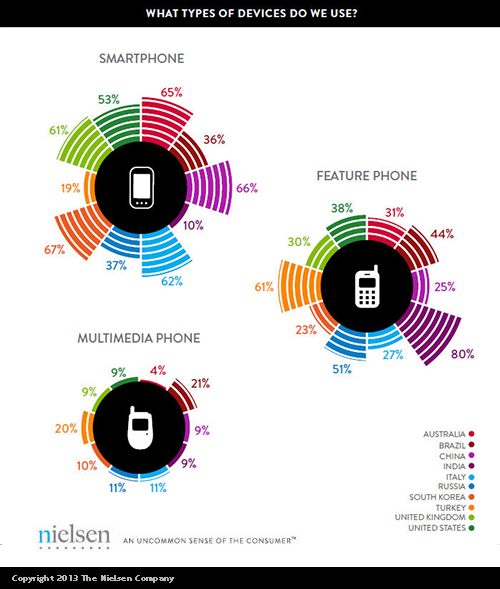
    Today at Mobile World Congress, Nielsen offered a snapshot of the global mobile consumer based on a report released this month. Some of the findings are quite startling. For example, mobile phone usage is highest in South Korea — get this, 99 percent among consumers older than 16. Same goes for smartphones (67 percent). By comparison, the United States has the lowest smartphone adoption among developed markets (53 percent). Now contrast that to China, where two-thirds of handset owners have smartphones, while in India 80 percent have feature phones. In Brazil, feature phones and multimedia handsets combined: 65 percent.

    Mobile phone usage is high in many countries, but infrastructure is not. For example, 98 percent of Russians have mobiles, as do 84 percent in Brazil and 81 percent in India. Problem, according to Nielsen: “The network infrastructure required for smartphones and next generation mobile devices has yet to appear outside of large, urban centers”. Lacking infrastructure explains some of this week’s MWC announcements, such as Firefox OS phones or new Nokia Lumias with fewer smartphone features for lower selling prices going to emerging markets first.

    Smartphone adoption largely, but not wholly, skews with age. According to Nielsen:

    Younger users are more likely to own a smartphone and older users are more likely to own a feature phone, which makes sense since feature phones are more established in the marketplace. Though there are some exceptions — in Italy consumers have higher smartphone ownership among users ages 35-64, whereas in India feature phones have far more penetration than smartphones across all age segments — the broader trend suggests that smartphone adoption will likely continue to rise as younger consumers age.

    In most countries, smartphone adoption is highest among 25-34 year olds:

    • South Korea: 86 percent
    • United Kingdom: 78 percent
    • United States: 73 percent
    • Italy: 72 percent

    Whereas in China and Australia, adoption is greater among 16-24 year olds — 82 percent and 77 percent, respectively — and equal to 25-34 year-olds in South Korea.

    Americans and South Koreans are most likely to have data plans — 96 percent and 89 percent, respectively — followed by Brits (86 percent), Australians (81 percent) and Chinese (77 percent).

    No surprise, text message usage is high in most countries — more than 90 percent in Australia, China, Russia, United Kingdom and United States. Instant messaging is big in South Korea (70 percent) and email in the United States (75 percent).

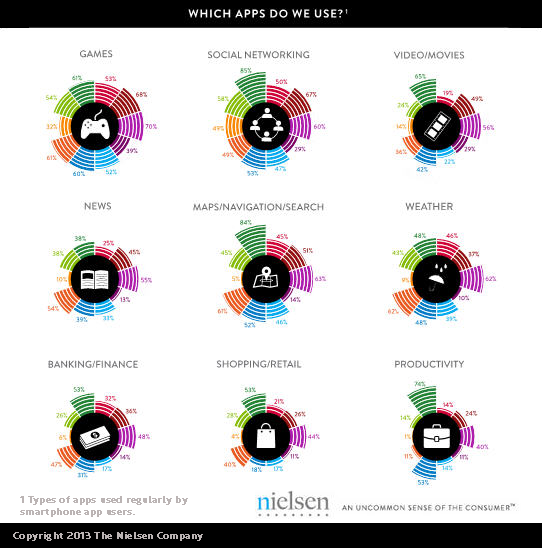
    Brazilians are the most avid social networkers (75 percent), followed by Turks (69 percent), Brits and Americans (both 63 percent). However, social and other activities look differently when taking app usage into account. That’s in part because of how smartphone, feature phone and multimedia phone adoption skews across geographies. Nielsen explains:

    Chinese and American smartphone owners are the heaviest app users overall, with games being the most used type of app in more than half of the selected countries (China, Australia, Italy and Brazil). Social networking app usage is strongest in the U.S., with 85 percent of American smartphone owners as regular users. Smartphone owners in India and Turkey are the least likely to regularly use all categories of apps, but the most popular tend to be more entertainment driven, like social networking and games.

    Data-consuming video is an increasingly popular mobile activity. Nielsen:

    Smartphones are a popular device for watching video, despite the smaller screen size. In most countries, mobile web is the most popular means of accessing mobile video, while smartphone owners in the U.K. and South Korea are more likely to watch mobile video using an app. In the U.S., smartphone owners are equally likely to watch video via mobile Internet and apps (72 percent), and Indian smartphone owners are the most likely to view downloaded video clips (57 percent).

    Video-watching frequency is interesting dynamic and somewhat rings where smartphone adoption and supporting infrastructure is greater. “Chinese smartphone owners are the heaviest users of mobile video, as 17 percent access more than three times a day”, according to Nielsen. American smartphone users lead “all countries in daily mobile video usage (31 percent use at least once per day)”.

    Photo Credit: D. Hammonds/Shutterstock

  • NMA Takes On Honey Boo Boo With Cocaine And Jabba The Hutt

    Honey Boo Boo (the show) is headed to Europe, so naturally, NMA has a video about the news. If your’e a fan of the Taiwanese animation firm’s work, this is pretty much classic NMA material. They’ve turned Honey Boo Boo’s mom into Jabba the Hutt (a cat-butchering version), and Honey Boo Boo herself concocts some kind of Mt. Dew/Red Bull/Cocaine cocktail.

    So yes, typical NMA.

    More of NMA’s work here.

  • Bad Lip Reading Takes on Indie Screenplays

    The folks at Bad Lip Reading are back with their take on the nominees for the Best Screenplay prize at the 2013 Independent Spirit Awards. Funny, though it just makes us want Bad Lip Reading to go ahead and tackle the Oscars. Now that would be something.

  • Remotium Tapped as Most Innovative Security Company at RSA Conference

    Remotium, a San  Mateo, Calif.-based startup that helps companies manage the security risks of mobile devices, was named the Most Innovative Company at the start of the RSA Conference on Monday. The company, which has not yet raised any venture funding, was one of 10 finalists in the startup competition, which featured VC-backed Bromium, Skyhigh Networks and Nok Nok Labs, among others. Last year’s winner of the Innovation Sandbox competition was Appthority, which months later raised $6.25 million from Venrock, U.S. Venture Partners and Gunderson Dettmer.

    PRESS RELEASE

    Remotium Named “Most Innovative Company at RSA® Conference 2013”

    Remotium Chosen for Its Solution to Pressing Enterprise BYOD Management Challenges

    RSA Conference 2013

    SAN FRANCISCO–(BUSINESS WIRE)–News Facts

    • RSA Conference (www.rsaconference.com), the world’s leading information security conferences and expositions, today named Remotium, “Most Innovative Company at RSA® Conference 2013.” Remotium was selected from a group of ten finalists presenting at the Conference’s annual Innovation Sandbox program, a half-day interactive event dedicated to encouraging out of the box ideas and the exploration of new technologies created by emerging information security companies.
    • Remotium won the award based on its potential to impact the broad and pressing enterprise BYOD challenge through a data management approach, all while still enabling employees to comfortably use their own preferred devices.
    • Innovation Sandbox’s panel of esteemed judges, Asheen Chandna, Partner at Greylock Partners; Paul Kocher, President of Cryptography Research; George Hoyem, Investment Partner at In-Q-Tel; Alastair Goldfisher, Editor at Venture Capital Journal and Gerhard Eschelbeck, CTO & SVP at Sophos, deliberated over a record number of submissions before determining finalists and ultimately awarding [company] with the 2013 crown.
    • Past winners of Innovation Sandbox include Appthority, Invincea and Alert Enterprise.

    “Innovation Sandbox’s ten finalists exceeded expectations by providing innovative ideas and solutions to conquer old, new and mounting information security obstacles,” said Sandra Toms LaPedis, Area Vice President and General Manager of RSA Conference. “Remotium demonstrated they were the most innovative by creating a scalable and easily deployable solution to the ever-growing enterprise BYOD challenge. We look forward to watching Remotium grow and expand in the coming years as we believe they will make a great impact on security’s future.”

    About RSA Conference
    RSA Conference helps drive the global information security agenda with annual events in the U.S., Europe, and Asia. Since 1991, RSA Conference consistently attracts the best and brightest in the field, creating opportunities to learn about information security’s most important issues through face-to-face and online interactions with peers, luminaries and emerging and established companies. As information security professionals work to stay ahead of ever-changing security threats and trends, they turn to RSA Conference for a 360-degree view of the industry. RSA Conference seeks to arm participants with the knowledge they need to remain at the forefront of the information security business. More information on events, online programming and the most up-to-date news pertaining to the information security industry can be found at www.rsaconference.com.

    RSA and the RSA Conference logo are either registered trademarks or trademarks of EMC Corporation in the United States and/or other countries. All other products and/or services referenced are trademarks of their respective companies.

    The post Remotium Tapped as Most Innovative Security Company at RSA Conference appeared first on peHUB.

  • Companies Have Split Personalities

    If companies are individuals, they often seem to have dissociative identity disorder. For many organizations, each division, function and channel has its own personality. And, frequently, there are no core corporate values consistently reflected from communications across the enterprise, so that various departments have no common ground from which to work.

    For most large organizations, the core of their corporate infrastructure was developed during the broadcast era. At a time when most media formats were distinct and channels of communication to various specialized audiences more direct, the company saw value in managing relations with each of its stakeholders largely in isolation.

    In effect, this means many entities treat government relations, investor relations, and human resources as distinct departments aimed at a specialty audience with little coordination.

    Meanwhile, the different parts of the organization understands customer in disparate ways: the sales team, the “.com” team, the customer service team, the marketing team, and the corporate communications team are all communicating with the customer, but inconsistently. Not without good reason. Each of these departments is organized by the training and professional standards of their discipline. For instance, customer service professionals are often assessed based on metrics of efficiency: how quickly can they get off the phone with each customer, and how many calls can they take in an hour? The sales team might be measured by the exact opposite metrics: how deeply can they engage a customer? And marketing and communications may be measured by numbers of impressions: what scale of customers can they reach?

    As my co-authors and I write in Spreadable Media, this means that customers’ relationships with the companies they do business with can be quite complicated. For instance, a cable provider might call a customer once a month to promote the “triple play” package. But, when that customer encounters a service disruption and calls in, it may take 15 minutes to get through to someone.

    In actuality, the customer service and sales teams report into different members of the C-Suite, work on campuses in different states, and may be run by leaders who barely know one another. But, as a customer, we often buy into the idea that corporations are individuals, and we expect their brands to behave as human beings would.

    Even within marketing and communications, these disconnects are significant. Corporate communications, the “digital team,” and the various marketing/advertising divisions sometimes find themselves pitted against one another, vying to “own” various channels of communication. These internal turf wars are often mistaken as corporate greed for power but, in actuality, may determine whose team might expand and who might eventually have to let people go.

    In the face of such infrastructural challenges, trying to implement new, qualitative efforts to build deeper relationships with customers, to listen more thoroughly to various stakeholders, and to act as an ombudsman on the customer’s behalf to better align the organization in service of its audiences can be daunting, and the continued reliance on traditional metrics understandable.

    The solution lies in finding common-sense ways to disconnect the flow of communications solely from operating via the org chart. The more horizontal connections an organization creates, the more collaboration that can be created outside these silos. For this to work enterprise-wide, senior leadership must facilitate an environment which makes internal collaboration safe.

    But this isn’t something that just happens at the enterprise level. Teams within the organization can also make this kind of change a priority without waiting for a “cure-all” approach from the top. I’ve seen many instances where communications and customer service, or marketing and sales departments, have streamlined longstanding disconnects, due to the commitment of both teams at all levels to foster a more sustained and integrated working relationship.

    No matter what state internal collaboration is in at your organization, though, the urgency of this issue is clear. Companies that are truly connecting all their communications internally stand a better chance of seeing potential crises, flagging potential opportunities, and moving swiftly as the world around them changes. And those that don’t will continue to turn a blind eye as their brand equity slowly erodes, one seemingly insignificant inconsistency at a time.

  • Former Square executive Keith Rabois to join Khosla Ventures as investor

    Keith Rabois, the longtime Silicon Valley tech executive who most recently left Square as COO in January after sexual harassment allegations, plans to announce Tuesday morning that he’s joining Khosla Ventures in March as an investor.

    “We’re known for big bets and bold swings, and not being like a traditional venture investment firm,” said Vinod Khosla, founder of the firm and who Om feels is one of the Valley’s “super VCs,” in an interview discussing Rabois’ addition.

    “We look for people who’ve earned the right to advise entrepreneurs. So we look for people who entereperneurs look out for and who say, ‘I want you on my board, I want you as a mentor,’” Khosla said. “And Keith, as I did my reference checks in the Valley, he was really at the top of every CEO’s list.”

    Rabois’ next move has been a topic of interest among the technology community, considering his past expertise at companies like PayPay, LinkedIn, Slide, and others. His addition to Khosla was suggested by Kara Swisher at AllThingsD this past weekend, after The Wall Street Journal wrote that he might join Airbnb.

    “I love Khosla Ventures’ vision and passion for assisting the next generation of entrepreneurs,” Rabois said in a statement. “The Khosla team encourages entrepreneurs to be bold. And the team’s legendary work ethic ensures that entrepreneurs will receive the best possible assistance.”

    In January Rabois stepped down from Square, where he was COO, after allegations of sexual harassment by a fellow employee. Square strongly backed Rabois, and the executive wrote in a personal blog post that he had engaged in a relationship with that employee but that it had been mutual. Khosla Ventures did not comment on Rabois’ legal issues. Khosla serves on Square’s board, as Square is one of the firm’s portfolio companies.

    “I couldn’t be more excited to see two of the top entrepreneurs I know, join forces at Khosla Ventures to support and coach the next generation of entrepreneurs the world over,” said Square founder Jack Dorsey in a released statement.

    Related research and analysis from GigaOM Pro:
    Subscriber content. Sign up for a free trial.