Blog

  • Aviary Screen Capture Extension for Google Chrome

    Developers are abuzz over the latest thing to come to Google Chrome. It’s not a new feature in the browser itself, it’s the Extensions Gallery which is about to launch bringing add-on goodness to Chrome. The browser has had some support for extensions for several months, but now that Google thinks it’s ready for a wider roll out, developers are not wasting any time and starting to support the platform. Aviary, a startup specializing in web-based image editors and now even audio editors, has been working on a Chrome extension of its own similar to the Firefox add-on it already offers.

    Installing the Aviary Screen Capture extension for Google Chrome is as easy as any other Chrome extension. It only works on the dev channel builds of Google Chrome, but extensions support should be coming to the beta soon. Once you’re done, a small icon will show up in the right side of the toolbar. With the icon you can access any Aviary tool from a drop-down menu or access the website. The interesting part, though, is the screenshot capture option right at the top of the menu. This is the reason to install the extension in the first place and the feature is one of the easiest ways to capture a web page.

    All it takes is one click and the screenshot opens up in the default Aviary image editor you have setup. Initially, this is set to Aviary Image Markup, which is more of a blog… (read more)

  • Bleeding Edge TV 326: Windows 7 tips and tricks

    In this episode, we give you a look at a bunch of the new little features that you’ll find in . They’re all small things that, we think, will lead to a nice increase in productivity and time-saving. We are talking about things like Aero Peek, Snap, Pin, and the like. None of those terms ring a bell? Then you might wanna hit the play button up there on this episode of Bleeding Edge TV.

    Here’s how to get the show:
    Subscribe: iTunes iPod / H.264 | iTunes MPEG-4 | RSS H.264 Feed | RSS MPEG-4 Feed

    |Download| – iPod-formatted H.264
    |Download| – Apple TV High Resolution
    |Download| – MPEG-4

    Tags:
    ,
    ,
    ,
    ,
    ,
    ,
    ,
    ,
    ,
    ,
    ,
    ,
    ,
    ,

    Bleeding Edge TV 326: Windows 7 tips and tricks originally appeared on The Bleeding Edge on Thu, November 26, 2009 – 1:30:46


  • Scrolling through a Solar System Scale Model

    solar_system_page.jpg
    Solar System Scale Model [phrenopolis.com] shows a scale model of the solar system. The planets are displayed in a scale corresponding to the first image, which is that of the sun. Unlike most solar system visualizations or models, the planets are shown at their true-to-scale average distances from the Sun. That makes the resulting web page rather large: on an ordinary 72 dpi monitor it is just over half a mile wide (~800m), making it possibly one of the “largest” pages on the web. As a consequence, visitors must scroll a considerable amount in order to find the planets, which is part of the fun.

    Strongly reminds me of World Population One and Hydrogen Atom Pixel Model. Via @ datamarket.


  • Hydrogen vehicles are crossing the bridge to Copenhagen

    The EHA in collaboration with Danish Hydrogen supplier H2Logic, HyRaMP, the European 30-member Regions and Muncipalities Partnership for Hydrogen and Fuel Cells, the Joint Undertaking for Hydrogen and Fuel Cells (JU FCH) and its Industrial Grouping, NEW IG  of over 70 of the main European industries cofinacing the JU FCH is organizing a Fuel Cell Vehicle Tour crossing the scenic bridge form Malmoe to Copenhagen. The tour will mark the coming of “commerical age” of fuel cell vehicles and their potential to significantly reduce transport emissions, next to battery cars and second generation biofuelled vehicles. for more inforamtion please visit the  Bridge2H website .

  • How to Store Sweet Potatoes

    Have some sweet potatoes leftover after Thanksgiving? Sweet potatoes are extremely perishable so you’ll want to take some special steps to store them.

    Wipe the dirt from the sweet potatoes but don’t wash them, since any moisture on them will cause them to spoil faster.

    Sweet potatoes should not be refrigerated. They should be kept in a cool, dry, dark place like a cabinet, pantry, or cellar. If the temperature is 50 to 60 degrees in the storage space they should last up to a month. If kept at room temperature, they will last a week or less.

    Once you have wiped off the dirt, place them in a cardboard box lined with paper or in a paper bag with an apple inside. The apple will prevent them from budding.

  • Europe’s response to new challenges in disaster management

    landslide

    At the third Civil Protection Forum, held in Brussels from 25 – 26 November, more than 500 civil protection experts have gathered to explore how EU countries can develop their resilience to disasters. Climate change is likely to increase the frequency and impact of natural disasters, and Europe has to be prepared for this challenge. The Forum has started a debate on a comprehensive European disaster management strategy to enhance resilience.

    At the event, the JRC has presented its activities in this field, such as the European Flood Alert System (EFAS) and the European Forest Fires Information System (EFFIS), as well as the Global Disaster Alert and Coordination System (GDACS). All these tools aim to increase European and global coordination for disaster management by using cutting-edge forecasting applications.

  • Google Profiles Can Now Be Used as OpenIDs

    Google has been a big backer of OpenID, though that’s not exactly a surprise when you have the login standard’s creator, Brad Fitzpatrick, working for you. Fitzpatrick has announced that Google Profiles can now be used as OpenID logins. He has also added that WebFinger for Gmail now supports Google Profiles as well. While any push forward on this front is a good thing, OpenID, in its current form, has several problems and this definitely doesn’t solve them.

    Adding Google Profiles to the list of sites which can be used as an OpenID identity may be convenient for some people, those already using OpenID or, at least, those who understand it. Google Profiles URLs are easy enough to remember and relatively short, something like http://www.google.com/profiles/user.name. But, it’s probably not going to drive adoption and certainly not solve the bigger issue.

    There are several groups trying to tackle the online identity problem. With tens or hundreds of sites and services each with their login information and system it can be a nightmare to handle them all. Most people just use the same user name and password, but this opens up a whole lot of potential security issues. For a couple of years several solutions have popped up which promise one set of credentials working across a myriad of sites.

    One of the … (read more)

  • Making the Most of Animals: Part 1 – Wonderful Offal

    Offal is not to everyone’s liking; and photographs of it being dissected and prepared are probably to even fewer people’s liking – so if you are squeamish about that sort of thing, you might want to duck out now.

    For me this is not about morality. Treating an animal well and making the most of its body when you kill it is better for your health and better for your wallet, so it’s a compelling case regardless of ethics.

    Since we’re on the topic, though, I would observe the following: our physiology has evolved more slowly than society has developed. Hardly surprising when you contrast the mechanism of natural selection with that of cultural development. Hence, vegetarianism – a perfectly reasonable concept borne of advanced cultural thinking, yet ill-suited to our bodies.

    There is a point of view that a good carnivore at least shows respect for the animals he or she eats by ensuring they are well treated and using as much of the creature as possible. To me this makes sense – but I am not a table-thumping evangelist of animal rights; as I say, for me this is a health and finance no-brainer.

    However, please note: eating every part of a badly fed/treated animal is not a wise compromise. Intensively farmed animals are likely to have an unfavourable fat profile and contain antibiotics.

    My point about cost is this: given that eating well-treated animals is essential to ensure healthy meat, then the cheaper way to do this is by eating all of those animals.

    Free Food

    Mrs M and I have been buying most of our non-wild meat from Fordhall Farm in central England. This is how we ensure the animals have been treated well.

    They run a delivery service, but we prefer to drive over in the summer, when it’s possible to see the animals in the fields or enclosures and witness their freedom first hand. The team who run it have even featured on television, where we learned more about the lengths to which they go to ensure a natural existence for the animals.

    Last year, I asked whether they had any offal for sale, other than the few parcels of liver in the frozen section. No, but we have some to give away, was the response. Why would you give it away, I wanted to know. Because otherwise it gets thrown away.

    Healthy Food

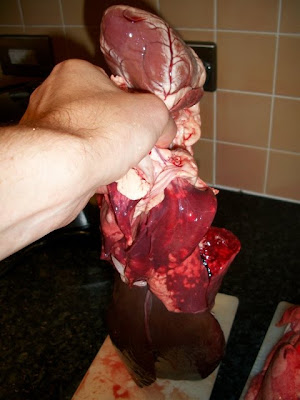
    That day, along with our usual purchases, we returned home with a cow’s heart the size of a soccer ball, two lamb plucks (liver, heart and lungs all still joined together), a cow’s tongue and two pig’s kidneys:
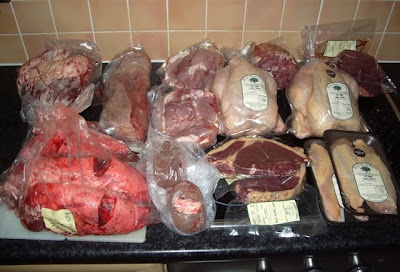
    Chopped up, this made a staggering 16 meals; and I mean man-sized meals. We are talking 300-400 grams of meat per meal. For zero cost.

    What’s more, this is the good stuff. Offal is packed with vitamins, minerals, healthy fats and probably much more besides. Our ancestors would have fought over these parts.

    Squeamish

    The trouble is, people are squeamish about offal. Mrs M is only now taking gentle steps towards eating the stuff. For the last year, I have been eating the offal on days when she is eating with friends or otherwise I make her an omelet or fish instead.

    Part of me wants to shout about offal from the rooftops so that the world wakes up and stops shovelling this amazing food down the drain and can therefore use half as much land to provide the same amount of food. The other part of me wants to keep schtum so that the few of us who like the stuff continue to get it on the cheap.

    Clearly the first part of me has triumphed, because I am writing this post.

    Dealing with Offal

    I’ll show you how I deal with these parts of the animal when I get them home and how best to cook them; but don’t expect recipes: this is about practicalities. I’ll add links to recipe ideas on other blogs at the end.

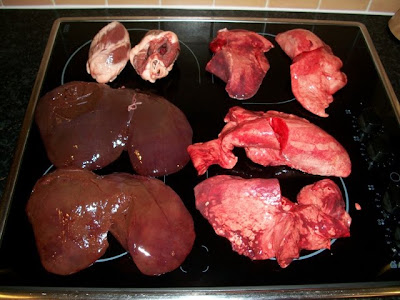
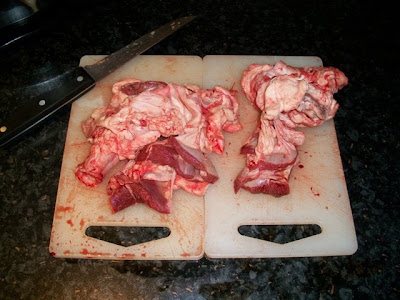
    This weekend, we came home with two lamb plucks as well as our usual haul: . I laid these on a couple of chopping boards, , then separated the liver, heart and lungs into individual pieces by severing then from the main windpipe of the lamb: . What remained was various pieces of fatty, between-organ tissue, bits of muscle and windpipe itself: .
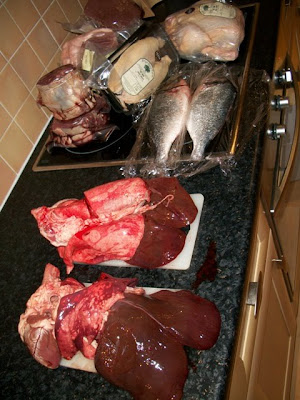
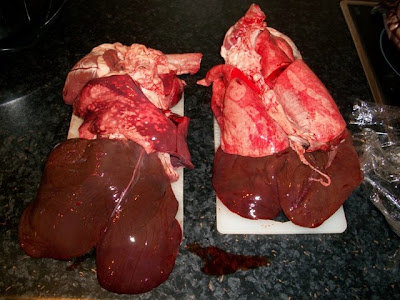
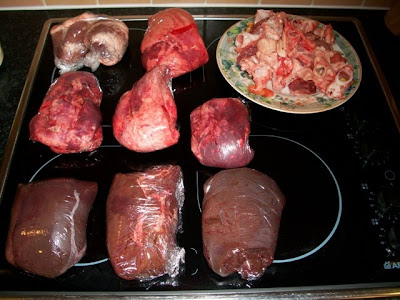
    In total, this lot made nine large meals: .
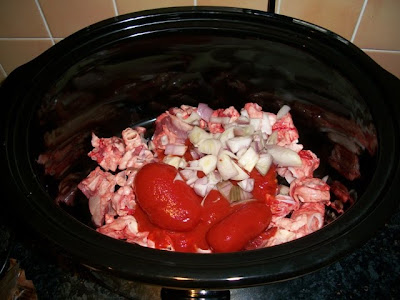
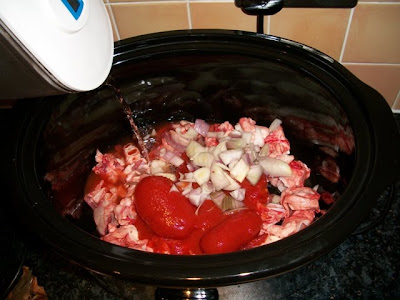
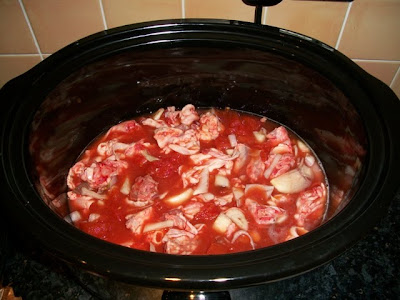
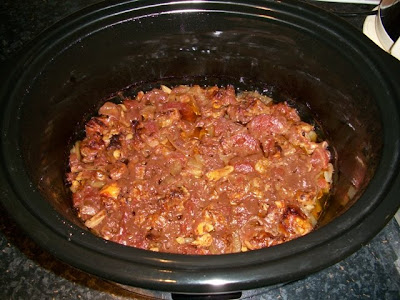
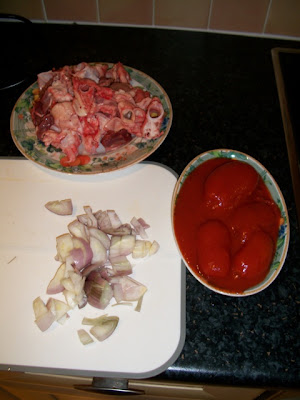
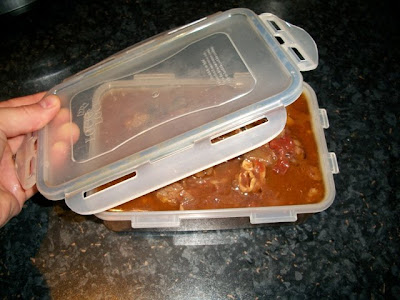
    I took the bits and pieces and slow cooked them with onion, tomato and garlic (I forgot to photograph the garlic): . Five hours later, I put it into a container and into the freezer: .
    Tongue

    This is one of the toughest parts of the animal I have tried. In the early days I sliced it up and stir fried it. It was very tough. In fact I did this again recently because I had not thought ahead. It took be almost 2 hours to chew through the lot: .
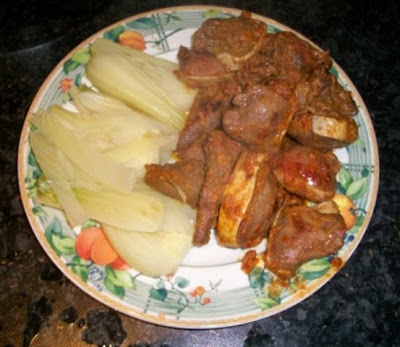
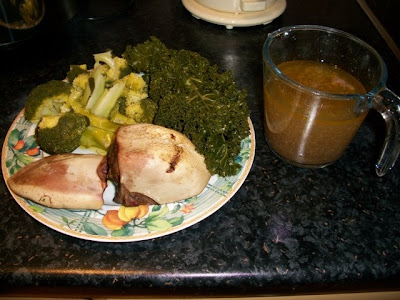
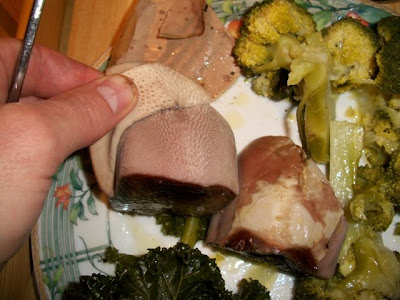
    Braising on low heat heat for up to 2 hours will tenderise the meat more and create a tasty, if thin, gravy…but the smart money is on slow cooking. We bought a slow cooker recently for £30 ($50) and have never looked back. After 5 hours, this piece of tongue was so tender I was able to peel the skin off with my hand: . It was as nice as any fillet steak I have ever had.
    Heart

    I’ve eaten lamb, pig and cow heart. The texture and flavour is rather like a toned down version of liver. Less tender, less piquant. Although you can cook heart by braising or even frying and find it just about tender enough to eat, it does benefit from longer cooking too. Hearts come with a ‘crown’ of fat around the top – this is delicious and it would be a crime to cut this off.

    A cow’s heart usually weighs about 2 kilos, from which I create about 5 portions – here’s one I cut up recently (along with a tongue): .

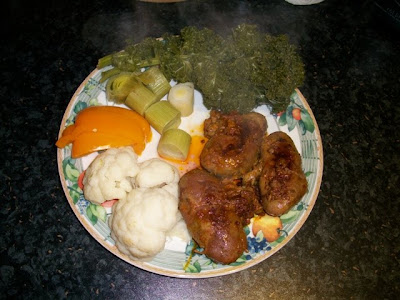
    This is a meal of one such portion, braised: . You can see the tasty fat ‘bubbles’ on the left of the piece of meat.

    Kidney

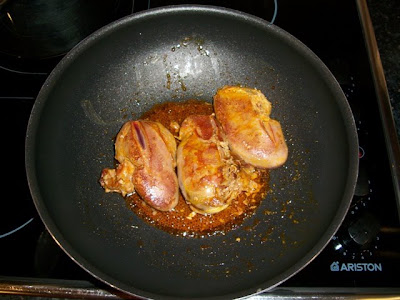
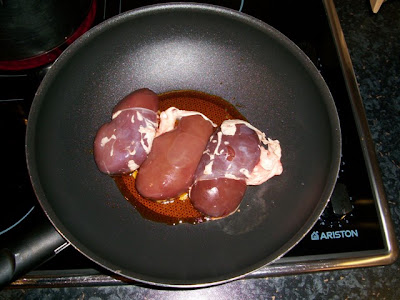
    Kidneys are happy being fried, so this is how I tend to cook them. They can be slightly rubbery, so you may prefer to cook them for longer in casseroles or just by themselves… but I am too lazy for that and in any case they really are reasonably tender when fried. The ammonia smell that sometimes emanates from cooking kidneys is not to everyone’s taste. Here are some pig kidneys I recently made a meal of: .
    Liver

    This one’s easy: just slice it and fry it. The composition of liver is such that it is tender by nature and in fact the only real danger to its palatability is overcooking, which can make it tough.

    Lung

    This is the one organ meat I hesitate to recommend unreservedly. It’s not the taste, but the consistency which is a problem. Not surprisingly given its function, it’s somewhat aerated, and so lacks density, which for me is main appeal of meat.

    I have learned that slicing and frying lung is not the best approach. I have not tried slow cooking yet, but did discover that when I braised the whole piece for 90 minutes, the result had an acceptable tenderness, albeit that it still had that insubstantial, aerated quality.

    Heads, Brains and Others…

    There are some parts of the animal I have not mentioned because we have never tried them.

    Heads: we were once offered a pig’s head at the farm. I wasn’t sure whether we were expected to cook it or put it on the bed of a rival gang member. In the end we said no, mainly because we figured out we did not have a pot big enough to cook it in. Apparently you make something called brawn using pigs’ heads and other parts such as trotters and bones. I am sure the heads of other animals can be cooked in the same way.

    Brains: you occasionally see brains on the menu in expensive restaurants. I have never been offered brains at the farm. It’s a bit of a sensitive issue in the UK after the BSE debacle and perhaps the one thing people are most unsure about eating. That scene from Hannibal doesn’t help.

    Stomach: two dishes I am aware of are tripe, which is made from the stomach of the sheep and haggis, made from the stomachs of cows. I have tried neither, nor have we been offered the stomach of animals at the farm.

    There are, I am sure, many others.

    How to Make Offal Less Unappealing

    Getting used to the idea of eating offal, or persuading someone you cook for to try it can be a challenge. Here are my tips:

    1. Don’t let them see it beforehand (if you are cooking for someone else)
    2. Try to make it look as unlike its original form as possible
    3. Casseroles or stews are a good way to disguise
    4. Use plenty of herbs and spices like garlic – the smell of cooking will win you/them over
    5. Follow a recipe: it will diminish that sense that it’s ‘not right’.
    Recipes

    If you want to see the eating of offal in action, follow me on twitter or keep and eye on the My Meals photo page on this blog. I post photos of my meals on most days, and eat offal about 3 times per week.

    As Mrs M is not yet on board, I revert to plain preparation for offal dishes: at best, I use tomato, onion, garlic, perhaps coconut cream. If I am stir frying I use coconut or red palm oil. The latter is worth exploring because it can add a lovely bacon-like flavour.

    At worst, I simply slow cook it in water.

    For some better recipe ideas, search on Google. There are plenty out there. Mark Sisson has done a couple of good articles on offal and recipes for it:

    Mark’s Daily Apple: Organ meat recipes
    Mark’s Daily Apple: More detailed post about offal (including tripe and brains).

    See Also:
    Making the Most of Animals: Part 2 – Glorious Fat
    Making the Most of Animals: Part 3 – Beautiful Bones

  • A Public Service Announcement For Blue Tooth Wearers

    You have all seen them. Perhaps you are one of them. People who go around wearing your bluetooth headset all the time. Walking down the street, inside buildings, at the gym etc. You know, every place other than the place you are suppose to wear one… IN YOUR CAR!

    The fact of the matter is you are not friggin’ Maverick from Top Gun! You don’t need to have your headset on all the time. The idea is to free your hands when driving, that is it. If you didn’t realize it already, you look like a damned fool! To better illustrate this, my buddy Sundance and I filmed this PSA for Episode 14 of Bauer-Power. We hope we can help you not look like a douche bag.

    Happy Thanksgiving! Now take off your stupid Bluetooth headset!

  • Special Thanksgiving Tribute at Alley Cat Allies

    AlleyCats

    Thanksgiving is the perfect time to reflect on how grateful we are for the special feline friends we have in our lives. I know I am thankful for every moment I have with my furry family members. They bring such joy to my life! And our beloved house cats express their gratitude with purrs and headbutts for what we give to them.

    Unfortunately, there are countless unowned cats roaming the streets who do not have a warm house to return to on a chilly winter night, and worse yet, millions of cats are killed each year in shelters. One organization, Alley Cat Allies, is working to help change this. And on this Thanksgiving Day you can make a contribution to support the cause and leave a special message about the cats in your life that you are thankful for.

    Alley Cat Allies has a special Thanksgiving Gallery on their website. Simply make a donation to support the work that this outstanding organization is doing to help improve the lives of cats in the U.S., and you can upload a tribute message along with a photo of your cats to show how much you care.

    Alley Cat Allies is the leading national resource for educational information about Trap-Neuter-Release, the best method for humanely caring for unowned cats. They are also an advocate for changes to public policy that affect the humane treatment of cats in shelters. Please consider making a donation today.

    >> Click to add your tribute to the Alley Cat Allies Thanksgiving Gallery

  • DS homebrew – STOPPUHR DS

    Homebrew coder Roman Adler has released the first version of STOPPUHR DS, a simple stopwatch for the Nintendo DS with an awesome looking GUI.Feature l…

  • VAIO X Unboxing Video


    VAIOXGold

    Hey guys,

    Here is my commentary of VAIO X and its contents. In this video I talk a little bit about everything from packaging to notebook’s design and its ports. If you would like to learn more about this VAIO and see what it looks like inside, check out this interesting  article where an engineer was invited to assess this VAIO ingenuity and at the end he was pretty impressed at how VAIO developers put their hearts into designing this notebook.  Here is a little abstract from that article:

    Engineers felt that every part of the Vaio X shows ingenuity.

    “I felt that Sony put its whole heart into developing this,” one of them said. “I would like to have a drink with the designers of the Vaio X. I think I will find a kindred spirit in those people.”

    As for the employed components, the Vaio X is the integration of the best possible parts, engineers said. For example, if Sony had designed a PC that is very difficult to reassemble after being torn down, like the MacBook Air, the company would have not had to make that much effort. They were impressed by the fact that Sony realized the slimness while following basic design rules.

    “I was surprised that Sony engineers were allowed to make efforts to realize such thinness,” an engineer said. “It requires cooperation with production plants. At which phase of the project, the plants started to be involved? No matter how much enthusiasm the engineers have, it wouldn’t be possible to realize such a design without the cooperation. Manufactures and engineers have to share the same spirit.”

    Enjoy!

  • Kinesiólogas “masajean” a Sandro para que respire por sí mismo

    Como estan mis amigos??,Informándome sobre la situación de nuestro querido y talentoso cantante “Sandro”, me encuentro con esta publicación del diario mdz on line con las siguientes lineas: (por favor prestar atención a las letras en negrita)

    “Sin que las “Nenas” caigan en la envidia, la terapia kinesiorespiratoria que está recibiendo el cantante es para evitar que sea intubado nuevamente como sucedió esta mañana.

    Burgos explicó que el respirador artificial fue necesario para limpiar los bronquios de las secreciones. Sandro mejora, pese a que hoy fue intubado para limpiar sus pulmones, Sandro mejora y esa es la buena noticia que ofrecieron el cardiocirujano Claudio Burgos, el cardiólogo Sergio Perrone y el neumonólogo Juan Carlos Behler.

    El equipo médico salió a disipar las dudas sobre que el estado del cantante se había agravado y explicaron que un equipo de kinesiólogas, con delicados masajes, están agilizando lo que todos quieren: que el “Gitano” respire por sí solo. En el octavo parte médico, tras seis días de internación, Burgos explicó que Sandro debió ser intubado porque “acumuló secreciones en el pulmón”, por lo que fue sometido a una broncofibroscopía, ya que el cantante aún no puede toser correctamente de forma voluntaria. En palabras simples: “Fue necesario limpiar los bronquios”, manifestó coloquialmente Behler, el especialista en neumonología que se sumó a la conferencia de prensa.

    La presencia del tercer médico fue útil para aclarar las dudas, pero, sobre todo, para tranquilizar el trascendido que corría desde media mañana respecto de que Sandro había sido intubado nuevamente. La extubación fue necesaria para saber cómo el cantante está reaccionando al bloque mecánico y aunque fue antes de lo previsto, la nueva colocación del respirador artificial fue obligatoria para el correcto funcionamiento de los pulmones. Como Sandro “tiene que aprender a toser”, se triplicaron los horarios del equipo de kinesiología para evitar recurrir nuevamente al tubo artificial.

    Concretamente, según detalló Behler, un par de kinesiólogas se encargan de dar una terapia constante de masajes delicados que ayudarán a que el tórax del ídolo recupere su dinámica normal. Mientras se busca una respuesta autónoma a través de los masajes, la broncofibroscopía –mediante un tubo traqueal- permitió aspirar las secreciones del árbol bronquial. Los médicos lo repitieron para dejarlo en claro: todo forma parte de un postoperatorio esperable y lo importante es que “las cosas van bien. Somos optimistas”, recalcó Burgos.

    La nota claramente nos informa el estado de salud del querido cantante, pero nunca hizo referencia al delicado trabajo que realizan esas kinesiologas en un área tan amplia y compleja como es la kinesiología respiratoria, desvirtuando el trabajo de las mismas a la categoría de “simples masajes”. En la nota también podemos encontrar el nombre de todos los médicos o algunos de los que evaluan la salud del cantante, pero el anonimato de las kinesiologas se hace notar y mucho.

    No soy quien para opinar de un diario on line ni mucho menos, ya que soy un simple pibe que escribe en su blog con sus palabras sin seguir directriz u orden alguno, pero dejenme decirle, a ustedes, mis lectores, que no me gusto la forma, la idea, las palabras de dirigirse a las kinesiologas, porque son más que simples masajistas delicadas, son mucho más que eso, y así como honran los nombres de los excelentísimos médicos con nivel internacional, deberían honrar también a nuestras colegas, porque no es que creo, sino que estoy seguro que se lo MERECEN.

    No quiero que se tome como una protesta o discusión planteada… solo lo hago porque quería expresar mis pensamientos, así como lo hago en todas mis entradas de este blog. Mis mayores respetos a Sandro y esperando su pronta recuperación.

  • KatKabin Giveaway Winner

    katkabin_pink_winner

    Congratulations to Morgen A (comment #607), winner of the new hot pink KatKabin! Morgen’s kitties will be toasty warm in their fancy new cat shelter.

    Thanks to the folks at Brinsea for the giveaway!


  • Stop Wallowing And Start Doing Cool Stuff With Business Models, The Wil Wheaton Edition

    We gently knocked Wil Wheaton recently for saying some things that we thought were a bit wrongheaded in terms of dealing with people copying his work — while noting that for the most part he absolutely seemed to “get” where things were heading and had a long history of embracing that. Whatever you think of that minor blip, it looks like he’s definitely got the right idea when it comes to new business models. Reader Avengingwatcher alerts us to a recent blog post by Wheaton where he’s inspired by the fact that people can just “get excited and make things” if they have an idea, rather than having to go through the old gatekeeper model that so many were stuck in for so long. Specifically, he talks about print-on-demand solutions that take much of the upfront risk out of creating just about anything — since you no longer need to pay for massive production at the beginning, and can just see what people want and order:


    This is incredibly inspiring to me, and I hope that it’s just as inspiring to indie artists everywhere. Why not take a creative risk and see if it works out? Unlike the old days, when we had to purchase a lot of stock ahead of time and hope we could sell it, we can just Get Excited and Make Things, knowing that the very worst that can happen is that nobody likes that thing we made as much as we thought they would.

    Much of this is inspired by some experiments some friends are doing and discussing — and one of the links he puts forth tries to tackle the “but this only works if you’re big and famous” fallacy that we’ve debunked in the past.

    I have to admit that 2009 has really become the year of creators embracing cool, working business models. These days, we get probably five to ten submissions per day of more artists embracing these sorts of business models that we talk about. We used to write about many of these, but it’s reached the stage where we really only pick and choose to write about really interesting or unique ones, even as we see that many of these are working wonders. But the key point is the one that Wheaton hinges his post on, which is that more and more people aren’t worrying any more, but they’ve decided to


    Get Excited and Make Things


    Is there any better motto for what’s happening these days?

    Permalink | Comments | Email This Story


  • Researchers: Copying And Imitation Is Good For Society

    When we talk about intellectual property issues, many maximalists on both the copyright and patent side of things have this inherent sense that “copying” is “bad.” Not just “bad,” it’s downright immoral. You hear words like “freeloading,” “parasites,” “pirates,” “thieves,” “copycats,” etc. Yet, time and time again, when we look at industries or societies where there is less (or no) intellectual property protection, we notice something interesting: while there is definitely a lot of copying going on, it hasn’t proven bad for overall innovation, and at times it’s been shown to be very good for overall innovation. When we’ve talked about things like the chemical industry in Switzerland in the late 19th century (which was not covered by patents), there were certainly many chemical companies who focused on copying — but there were also many who were quite innovative, and the overall impact to the economy was very strong.

    The same is true if we look at the fashion industry, which does not have copyrights. It thrives without copyright protection in part because of all that copying. The copying serves a few very useful functions: first, it helps “perfect” the offering, as each “copyist” may improve on it a bit. Second, it helps diffuse the new idea throughout society, by offering it up in many places and ways that the originator was unable to. Third, it offers an element of price differentiation (the wealthy want the original/official version and pay more for it, others want the cheaper knockoffs). Fourth, it actually helps to validate the original idea (if there’s a knockoff, the original must be cool). Finally, it stimulates additional brand new creativity from the original creator, who must realize that he or she cannot rest on any laurels, and needs to get to work on the next great design.

    Copying serves an important function in getting new concepts out there.

    And, now some researchers have started to look into it, and actually have built a model that shows society is likely better off when copying is the norm. Aaron deOliveira alerts us to the research on this, which tries to model societies with creators and innovators, and finds that society is served best when 30% of the population is involved in creating new goods, while 70% is focused on copying. Now, you can read through the full research and quibble with the methodology, but the basic premise is sound, and has been borne out in real life, in situations where copying was widely allowed. Hopefully there will be more research done in this arena, to see if this sort of modeling can be refined a bit more to take more factors into account. But, for now, this is a good place to start, and a reminder to those who seem to think that “copying” is somehow bad, that it serves a valuable part in the overall ecosystem of building and distributing innovative offerings.

    Permalink | Comments | Email This Story


  • U.S. Pledges a 17% Cut in Emissions from 2005 Levels by 2020, 30% by 2025, 42% by 2030 and 83% by 2050

    pod_11-17-09_forbiddencity

    2009Nov25: The U.S. pledges a 17% cut in emissions from 2005 levels by 2020, 30% by 2025, 42% by 2030 and 83% by 2050 (BBC).

    Reference: BBC http://news.bbc.co.uk/2/hi/americas/8378890.stm

    Read the White House press release http://www.whitehouse.gov/the-press-office/president-attend-copenhagen-climate-talks

    Image Description: President Barack Obama looks out over the Forbidden City in Beijing, China. November 17, 2009. (Official White House Photo by Pete Souza). Image Location: White House.gov http://www.whitehouse.gov/photos-and-video/photogallery/november-2009-photo-day Image Permission: This file is in the public domain because it was created by a U.S. government employee.

  • Modern Warfare 2 playlists update on the way, DLC planned in Spring

     Still can’t get enough of Modern Warfare 2 (Xbox 360, PS3, and PC)? Well, here’s another reason to stay home as Infinity Ward has announced that…

  • The Academy – s3 | e7 – Day in the Life

    The recruits of Class 36 experience a day in the life of a firefighter. These simulations bring unpredictable conditions and obstacles of what they will encounter in the field.

    Add this to your queue
    Added: Thu Nov 26 02:35:05 UTC 2009
    Air date: Sat Dec 05 00:00:00 UTC 2009
    Duration: 44:00

  • Coming wave of Capacitive-screened Windows Mobile 6.5 devices?

    hd2withglovesMoPocket claims to have had a word with a Microsoft rep at a tech show, and asked them about what we call Windows Mobile 6.5.1.

    In the apparently revealing response, the Microsoft tech said WM 6.5.1 was a made-up name, and that it may just be called Windows Mobile 6.5. 

    He claimed, as has long been suspected, that the whole design is to cater for new capacitive devices being proposed by OEMs.

    According to MoPocket he said:

    True, the new HTC HD2 (a beautiful phone, I might add), is capacitive and running 6.5. However, in order to pull that off, HTC had to go off and develop countless new UI changes of their own and throw in a new TouchFlo (sense-ui) to make it all work.

    With new devices being proposed with capacitive screens, MS realizes there is a problem and is stepping up to the task.

    The end result may not be as pretty (yet- remember this is still a work in progress and leaked from their labs), but it proves that native capacitive support is possible.

    The HTC HD2 navigates the capacitive mine field on Windows Mobile relatively successfully, and we have seen capacitive screens on roadmaps by other OEMs like Toshiba. I suspect, whether we are fans or not, we are all going to have to get used to these kind of screens very soon.

    Read the full interview here.

    Via WMExperts.com

    Share/Bookmark