Blog

  • Can Universities Make Sure That Drugs Based On Their Research Are Licensed Reasonably?

    Joseph Franklin has written about how a group of universities have agreed to some basic principles (pdf) about providing drugs to developing nations at reasonable costs (or even free) in the interest of better global healthcare. However, Franklin wonders how well this will work in practice, and why it should only apply to developing nations, and not domestically as well. It’s an interesting question, made more complicated by the fact that many drugs have their research started at universities — frequently backed by government money — but are later taken over by pharmaceutical companies who have no interest in such principles. I tend to think that such “principles” are nice to speak about, but are rarely effective in actually creating change. I would think that a much stronger argument is showing the economic benefits in keeping people alive. If you could rid some developing nations of certain diseases, you’d be able to open up vast new markets for other industries. Hell, imagine if you could get companies in other industries (food, clothing, transportation, etc.) to pay for drugs for the poor in developing nations, knowing that keeping them healthy will help those nations build their economy so they can start purchasing the same food, clothing and transportation…

    Permalink | Comments | Email This Story


  • Asset Shortage during Power Shortage

    Dear Energy Professionals, Dear Colleagues,

    In his December 2006 article on the Macroeconomics of Asset Shortages, Economist Ricardo J. Caballero says, “The world has a shortage of financial assets. Asset supply is having a hard time keeping up with the global demand for store of value and collateral by households, corporations, governments, insurance companies, and financial intermediaries more broadly. In equilibrium, the value of the (relatively) few existing assets must rise, which has important global macroeconomic implications. These shortages have been a perennial problem in emerging markets, where many of their economic perils and idiosyncrasies stem from this feature. But we are now seeing a shortage on a global scale. It probably began with the meltdown of a substantial share of Japanese assets in the early 1990s, it was exacerbated by European stagnation and the collective emerging market crises of the late 1990s, and it consolidated in the new millennium by the fast income growth of China and commodity countries, most of which have substantial asset demand needs but are not natural asset producers”.

    It is so sad to visualize that on one hand world assets cannot find proper investments, while on the other hand our local power plant investments cannot find money to get started. There is a great investment credibility problem in our local energy markets. We need to have a clear inspection of this major problem starting from the annual investment requirements of our local market, clear figures of electricity supply demand in the local market, the capacity we will need in the future, and what we face if we do not initiate such investments.

    In order to review the balance of electricity supply demand in Turkey, we look at the internet pages of a local Public Transmission company, and we come up with a Turkish Installed Capacity at 44,472.5 MWe as of November 2009.

    We can also visualize that, on a month-by-month basis, installed capacity is lower in 2009 than in 2008. In 2008, installed capacity was 41817 MWe, and Peak load was 30842 MWe. We understand that we had no such a big shortage problem in year 2008.

    In 2009, our Installed Capacity is 2600 MW higher, but our demand peak is 4% lower than it was in 2008. The hardest years for the Turkish system are the drought years since we have a high sensitivity due to the relatively high hydrocapacity.

    So we multiply the installed capacity by 4650 hours for higher scenarios and by 4500 for lower scenario; this is a rough approximation for capacity utilization. Do note that the system has the ability to achieve more than 5000 hours on average annually. If the resulting number is less than the expected demand, then it means the electricity generation system is under stress.

    44472.5 MW x 4500 hours (average per year overall availability) = 200 TW-hours
    44472.5 MW x 4650 hours = 206.8 TW-hours

    Expected demand for 2009 is 194 TW-hours.
    Expected demand for 2010 is 206.6 TW-hours.

    So without any adding any additional capacity, the existing installed capacity should be enough until the end of 2010.

    In summary, Turkey has almost 45,000 MWe installed capacity, though we did not exceed 36,000 MWe at peak hours in 2009.

    The remaining portion is NOT available since they are not reliable – sources such as wind, solar, hydro, all renewable – or they are out of service, as in case of many old thermal power plants.

    Apart from periods of economic crisis, Turkey needs approximately a 6-8 percent increase per year in electricity output in order to keep the desired growth rate.

    New investments require a project execution period of 2-4 years for natural gas-fired combined-cycle power plants, 1-2 years for wind, 5-7 years for hydro (ILISU?), and 7-20 years for nuclear. In this period, money is allocated, but revenues are not generated before completion.

    Every kw of power created costs approximately $1000 US Dollars on average. Combined-cycle plants cost a bit less, $500-$600 USD per kw, while thermal power plants cost around $2000 USD per kw. There is no average price per kw available for nuclear power plants.

    Now let us do some simple arithmetic with a low end of 6% annual electricity generation increase for an available power capacity of 36K MWe:

    36,000 Mw = 36,000,000 Kw
    Minimum 6 percent increase for each year x 1000 US Dollar investment per Kwe
    0.06 x 36mx 1000 = 2.16 billion US Dollars per year investment needed minimum

    So we feel that the figure of $1 billion USD per year upfront becomes too prudent for a higher expectation of the growth rate. So who will finance such a big investment package??

    Leading local financiers may say that it is easy for Turkish financial capability, but one should not be so sure about that.

    Furthermore, nuclear power plants are NOT a solution to power shortages, since we do not know the project execution period. It could take approximately 7 to 20 years to complete a nuclear power plant at this time for many reasons, including legal battles, technology restraints, fabrication difficulties, financing limitations, and regional and international politics.

    Blackouts in small regions are currently happening already in Turkey. Although people living in big cities like Istanbul, Ankara, etc. do not face these shortages, it is a reality of life in many towns.

    Many of them are classified as power disorders, but those power disorders wander from one area to another in Anatolia. A power failure in one area is repaired (!) and soon after that repair another new power interruption occurs in a neighboring region.

    There may be unexpected blackouts (like the one in Paris or New York, sometime in 2005) due to unforeseen technical problems. But according to optimistic public employees of our local Public Transmission Company, the local system has enough reserve capacity till the end of 2012 in their worst-case scenario.

    The best-case scenario is that we end the prevailing electricity comfort in 2014 or 2015. But capacity projections always have worst-case flexibility to predict a serious problem in 3-5 years in time. Hence, this projection likely reflects the delay between EMRA licensing and full electricity-producing operation. EMRA licenses, which are issued after March 2009 and are not included in the worst-case scenario, could be generating electricity in 5 years time and could delay the situation to 2015-2016.

    In our humble opinion, the ground for an electricity supply crisis has been forming gradually since the beginning of 2006. We may unexpectedly encounter a power shortage crisis, and we turn a blind eye to the facts, in fact the culprits, while searching for other reasons as the cause.

    Project financing is too difficult in Turkey, especially at this time of global financial turmoil. Public institutions have limited or almost no capability. Local investments are generally realized by “corporate finance” methods. Local investors risk their own property in order to get proper “corporate financing” at reasonable interest rates, and payment terms.

    In the past, we have realized energy power plant investments exceeding 4000 MW installed capacity. Those natural gas-firing cogeneration plants quickly pay for themselves and create more money for further investments in new plants.

    However, we do not have the investment environment for “non-recourse” project finance to secure “off taker” contracts. Therefore, it is too difficult to find the necessary project financing for mega projects such as nuclear plants and the plants in Afsin Elbistan. We have lost time in the past and continue to lose more and unable to recover fast in due time.

    Turkey will need more local private financing and local contracting, local engineering, if applied. Your writer sincerely feels that our local private investors deserve all our support to complete new power plant investments, provided that they create jobs for the local engineers and for the local qualified manpower.

    Please do note that above forecast is your writer’s humble calculation and does reflect the opinions of any public or private institution. Your comments are always welcome.


    Haluk Direskeneli, Ankara-based Energy Analyst

  • What Are The Best Board Games For Christmas?

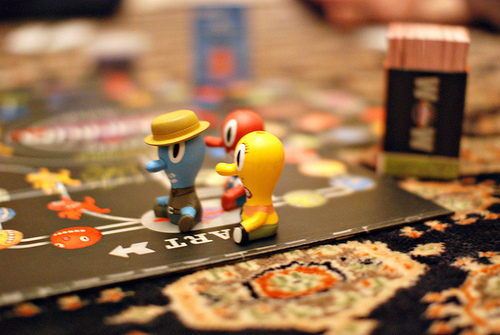
    Christmas is the time of year for sitting on the floor and shouting ridiculous words at your family. Yes, it’s the dreaded board game. And if you’re puzzled by which ones you should be playing this year then help is at hand. Here’s a list of the very best for Christmas 2009:

    Bananagrams


    Yes, I know what you’re thinking. That looks like Scrabble without a board. And I have to say, I think I agree with you. It does look like Scrabble without a board. Except this is Bananagrams and there is no board. Each player takes a ‘bunch’ of letters, then races to form as many connecting words as possible. Then you must ‘peel’ which means taking some more letters from the ‘bunch’ and at some point shout ‘split’. I guess the loser is ‘yellow’ and the winner runs around shouting ‘nana-nanana’ extremely loudly and irritatingly.
    Ages 7 and up
    Price – $15

    Bop-It

    Bop-It is a colourful and noisy little game. It lights up and shouts out commands such as ‘spin’ and ‘pull’ and ‘twist’. Players must do exactly what Bop-It orders as quickly as possible. The higher the score the better the Bop-It. Kids can now download new commands and record their own voice with Bop-It download.
    Ages 8 and up
    Price: $25

    Cranium

    If you like your board games varied then Cranium really is the one for you. The sketching, sculpting, puzzling, acting, humming, quiz-based board game has pretty much everything for pretty much everyone in the family. The game lasts an hour, it’s very colourful and there’s plenty of fun for adults and kids alike. It’s been a huge hit and is sure to be played in thousands of houses on Christmas Day.
    Ages 3 and up
    Price: $25

    Funny Business

    Just as the free market is collapsing round our ankles a game pops up pleading with you to start believing in business all over again. And to laugh. Because business is fun. What you have to do is create hilarious and convincing names for a mall-full of new enterprises. So if a bakery merges with a barber shop, what name will you give it. Win votes from the other players and the business is yours.
    Ages 12 and up
    Price: $20

    Game of Life Extreme Reality Edition

    Life used to be so simple. You got born, went to school, got a job, had two kids, retired and then waved goodbye. But now life is more extreme. There are skydives, TV shows to be on, castles to live in, stunts to perform, sextuplets to give birth to. That’s life according to the Game of Life Extreme Reality Edition anyhow.
    Ages 9 and up
    Price: $30

    Guesstures

    There’s not much really very new in the board game world. Questions, answers, points… Oh and the miming one. Well this is the miming one. Based on charades Guesstures sees players act out four words against the clock. Fail and the cards get ‘munched’. Once the game’s over points are tallied to see who wins ‘Best Performance’. Trophy included!
    Ages 8 and up
    Price: $20

    Pictureka Flipper!

    Fancy spending Christmas Day with a penguin? Good, because in Pictureka Flipper! The penguin pretty much rules. I’m not sure if he, she or it has a name but Penguin flips cards onto the table and players must race to find the fun drawings which correspond with their ‘missions’. And all before Penguin quacks.
    Ages 6 and up
    Price: $20

    Totally Gross

    Kids aren’t interested in knowing who discovered penicillin or what the X stands for in X-ray, what they really want to know is what exactly is snot, who has the smelliest feet, and can mum or dad do the best impression of throwing up. Totally Gross is a science-based board game which will teach kids a bit about chemistry and biology whilst making them laugh until they spew. Eureka!
    Ages 8 and up
    Price: $20

    Trivial Pursuit Team

    The world is getting stupider. It’s a fact. And in accordance with this the brainy team at Trivial Pursuit have found a way of offering their extremely challenging quiz to an audience of complete dummies. Instead of the old strict rules: One question one answer right or wrong, in Trivial Pursuit Team you now have multiple choice options, points for nearly correct answers, closest answers and presumably lots of pats on the back. It’s still fun but it won’t make you feel clever.
    Ages 18 and up
    Price: $30

  • Hulu Sees Its Biggest Month Yet in October

    Watching online video may seem a very different experience to watching TV but, at least with some content, the trends are very similar. Hulu, the US online video outfit centered on TV content, saw a massive jump in viewership and audience in October in tune with the new TV season and the addition of ABC shows. AdAge, citing comScore numbers, reports that Hulu traffic jumped 47 percent from the previous month, the biggest rise this year.

    The online video joint-venture between News Corp., NBC Universal, and Disney has seen its best month yet with people viewing 856 million video in October up from 583 million the previous month. That’s still way below YouTube’s almost seven billion streams, though this number comes from Nielsen which only counted 632 million streams for Hulu in October. ComScore gets direct data from Hulu so its numbers are more accurate.

    In terms of unique visitors, Hulu is also doing much better growing by 10 percent to about 42.5 million viewers in the US. The audience numbers don’t follow the jump in streams. but this means that people were also watching more videos, something backed up by the numbers which show that the average user viewed 132 minutes worth of videos up from just 92 minutes in September.

    While the numbers bode well for the video site, they’re not directly rela… (read more)

  • The Linde Group and Algenol Biofuels cooperate in CO2 and O2 management for biofuel production from algae

    The Linde Group and the US company Algenol Biofuels LLC have agreed to collaborate in a joint development project in order to identify the optimum management of carbon dioxide and oxygen for Algenol’s unique algae and photobioreactor technology. This cooperation will see the companies join forces to develop cost-efficient technologies that capture, store, transport and supply CO2 for Algenol’s proprietary process for the production of third-generation biofuels out of CO2, salt water and algae, as well as remove oxygen from the photobioreactor.

    “Producing fuels or chemicals from algae is a promising way of reducing greenhouse gas emissions,” said Dr Aldo Belloni, member of the Executive Board of Linde AG. “A cost-efficient supply of CO2 is a key factor in this biofuel chain. As a pioneer and leading company in CO2 capture, transport and supply we are delighted to be a key player in major projects in the algae-to-biofuel area.”

    The research collaboration builds on a process developed by Algenol Biofuels and other partners. This method utilizes algae, CO2, salt water and sunlight to directly produce 3G bioethanol and other 3G biofuels or biochemicals in photobioreactors. This technology promises numerous benefits. The production facilities, for example, do not need to be built on land required for food or feed production. Furthermore, the procedure does not consume fresh water nor does it involve costly steps for processing or harvesting and storing biomass. A further key benefit is that the algae also consume CO2 from fossil fuel sources (e.g. combustion flue gases from coal-fired power plants).

    More information here

  • 10 new Mercedes-Benz Citaro FuelCELL-Hybrid in service in Hamburg in 2010.

    Daimler has announced that ten new fuel cell buses ( Mercedes-Benz Citaro FuelCELL-Hybrid) will enter service with the Hamburg transport authority, Hamburger Hochbahn, next year.  Hamburger Hochbahn will also receive 20 fuel cell passenger cars – the Mercedes-Benz B-Class F-CELL model – starting 2010.

    The Citaro FuelCELL-Hybrid is participating in large-scale fleet trials scheduled to take place in Hamburg and other European cities as a follow-up to the European Union’s CUTE and HyFLEET:CUTE projects (conducted between 2003 and 2009). Under the HyFLEET:CUTE project, 36 Citaro buses equipped with the second-generation fuel cell drive system have operated across 12 public transport agencies around the world, including Hamburger Hochbahn. The models have accumulated more than 140,000 hours of operation, during which they covered a total of more than 2.2 million km.

    “The new Citaro FuelCELL-Hybrid clearly demonstrates that electric mobility is already feasible today also with commercial vehicles,” says Hartmut Schick, head of Daimler Buses. “Besides, synergy potentials with our Mercedes-Benz passenger car development and Daimler research can be optimally used in particular with the fuel cell drive system.”

    The Citaro FuelCELL-Hybrid and the B-Class F-CELL share a range of common parts, including fuel cell stacks. Daimler claims that the latest Citaro FuelCELL-Hybrid consumes almost 50% less hydrogen compared to the preceding generation, due to improved fuel cell components and hybridisation with lithium-ion batteries. The operating range of the fuel cell bus is around 250km.

    More information here

  • Tomorrow’s Weather: Building-Size Data Sculpture Predicts the Weather

    tomorrows_weather.jpg<
    Tomorrow’s Weather [bigertbergstrom.com] is a 8 storeys high (~37m) data sculpture which extends 2 arches made up of over 60 molecular globes, forming a double helix. The globes change color depending on tomorrow’s weather forecast so that the interior landscape of structured lights take form as a “premonition of tomorrow”. Tomorrow’s Weather combines modern technology with one of nature’s most basic expressions, the weather, so that its elaborate visual expression changes forever, capturing the volatile nature of climate and the future.

    Reminds me of The Source, Electric Moons and Plastic Trade. Via Seed Media Group Blog.


  • Panicked Gold Buying Forces Vietnam To Devalue Currency

    vietnam gold soccer

    Vietnam has been forced to devalue its currency, the dong, for the third time since June 2008.

    The country’s pegged exchange rate will shift to 17,961 dong per dollar vs. 17,034 previously. The Vietnamese central bank will also hiking interest rates to 8% from 7% in an attempt to control inflation.

    Vietnam’s situation is the opposite of the undervalued pegged currency China is lucky to have. Defending an overvalued pegged currency, the dong, is tough business since it drains dollar reserves rather than builds them.  According to the Wall Street Journal, Vietnam’s dollar reserves have fallen to $16.5 billion from $22 billion at the start of the year.

    The dong has been under substantial pressure all year due to Vietnam’s rapidly expanding trade deficit, which hit $8.7 billion during the first ten months of 2009. Inflation has also been picking up, hitting 4.35% in November.

    Yet it appears that gold arbitrage may have been the straw that finally broke this currency’s back:

    NYT: The immediate reason for the dong’s weakness, traders say, is that demand for dollars has risen because the spread between gold prices in Vietnam and in foreign markets has widened. Vietnam lifted an 18-month old ban on gold imports Nov. 12 in a bid to curb panic buying that had sent the dong plummeting.

    Join the conversation about this story »

    See Also:

  • Yahoo Search Assist Gets Smarter

    Yahoo doesn’t really know whether it is a search company or not, but it’s definitely not giving up entirely on this front. With all the focus on the interface and the way the search engine presents the answers, Yahoo has been steadily introducing new features and updates. Now the company has introduced an upgraded Search Assist feature across most of its proprieties with the notable exception of the main search engine. The tool will now show more than just search suggestions, it will offer information or custom actions inside Search Assist depending on the query.

    “Today we are rolling out several new Search Assist features for the Web search boxes at the top of nearly every property on Yahoo!, including Yahoo! News, Yahoo! Sports, and Yahoo! Finance. These new features can take you directly to the information you need, whether it is real-time stock quotes or movie trailers. You can also get enhanced search suggestions and easily navigate to the Yahoo! property that fits your needs the most,” Linda Wang, senior product manager for Yahoo Search and Drew Geishecker, director of product management at Yahoo Network Services, wrote.

    The new inline information is available for several types of searches like movies, sports, travel destinations, or stock price. Looking up a place you’d want to visit will bring up i… (read more)

  • How to Change The Recovery Model On All Databases at Once in SQL 2005 Management Studio

    In Microsoft SQL there are three ways to set your recovery model. Each method has their own pluses and minus. Each of them have their own reason for using them.

    The three recovery models are Full, Bulk-Logged and Simple. The first one, Full, is set by default in SQL 2005. According to SQL-Recovery.com, Full recovery model is:

    This is your best guarantee for full data recovery. The SQL Server fully logs all operations, so every row inserted through a bulk copy program (bcp) or BULK INSERT operation is written in its entirety to the transaction log. When data files are lost because of media failure the transaction log can be backed up.

    Bulk Logged:

    This model allows for recovery in case of media failure and gives you the best performance using the least log space for certain bulk operations, including BULK INSERT, bcp, CREATE INDEX, WRITETEXT, and UPDATETEXT.

    Simple:

    It allows for the fastest bulk operations and the simplest backup-and-restore strategy. Under this model, SQL Server truncates the transaction log at regular intervals, removing committed transactions. Only full database backups and differential backups are allowed.

    Changing the recovery model is as simple as right clicking on the database in SQL 2005 management Studio, Clicking on Properties, Clicking on Options, and selecting your recovery model from the drop down menu. This can be tedious though if you have multiple databases. Some web servers have 50 plus databases. Do you want to manually change each one? I didn’t think so!

    Below is a simple T-SQL script you can run to change all of your databases to the the recovery model of choice!

    USE master

    GO

    — Declare a variable to store the value [database name] returned by FETCH.

    DECLARE @dbname sysname, @cmd varchar(1000)

    — Declare a cursor to iterate through the list of databases

    DECLARE db_recovery_cursor CURSOR FOR

    SELECT name from sysdatabases

    — Open the cursor

    OPEN db_recovery_cursor

    — Perform the first fetch and store the value in a variable.

    FETCH NEXT FROM db_recovery_cursor INTO @dbname

    — loop through cursor until no more records fetched

    WHILE @@FETCH_STATUS = 0

    BEGIN

    IF (SELECT DATABASEPROPERTYEX(@dbname,’RECOVERY’)) <> ‘<RECOVERYMODEL>’ and @dbName <> ‘tempdb’ BEGIN

    — create the alter database command for each database

    SET @cmd = ‘ALTER DATABASE "’ + @dbname + ‘" SET RECOVERY <RECOVERYMODEL>’

    — alter each dataabase setting the recovery model to <RECOVERYMODEL>

    EXEC(@cmd)

    PRINT @dbname

    end

    FETCH NEXT FROM db_recovery_cursor INTO @dbname

    END

    — close the cursor and deallocate memory used by cursor

    CLOSE db_recovery_cursor

    DEALLOCATE db_recovery_cursor

    NOTE: Replace <RECOVERYMODEL> with your model of choice (I.E. SIMPLE, BULK-LOGGED, FULL)

    What recovery model do you use on your servers in your environment? Why? Hit us up in the comments!

  • Gmail Now Supports Offline Attachments

    Google would love a world where everyone is online all the time. In fact, it’s basing all of its strategies on this. We’re not quite there yet, so, in the meantime, it’s working on making its services available when offline. Gmail makes it possible to work offline with a Google Gears version of the service that has been available since earlier this year. But it’s not a complete stand-in for the regular version and one of the most requested features has been the ability to send offline attachments, something Google has finally introduced.

    “One of the most requested features for Offline Gmail has been the ability to include attachments in messages composed while offline. Starting today, attachments work just the way you would expect them to whether you are online or offline (with the exception that when you’re offline you won’t be able to include inline images). Just add the attachment and send your message,” Andy Palay, software engineer at Google, wrote.

    First things first, if you want to send offline attachments, you need to enable offline access in Gmail. Before you can enable the Labs feature, you need to have Google Gears installed for your browser, which you can get here. Gears is built into Google Chrome, so you can skip this step if you use this browser. Then, go to the Labs tab in the Gmai… (read more)

  • Red Eye – s2 | e625 – Tue, Nov 24, 2009

    Guests Diana Falzone, Carrie Keagan, Jim Norton, John Bolton and Dr. Michael Baden discuss why smoking is bad for your computer.

    Add this to your queue
    Added: Wed Nov 25 06:45:05 UTC 2009
    Air date: Tue Nov 24 00:00:00 UTC 2009
    Duration: 43:41

  • Guerrilla celebrates Killzone anniversary with Double XP Weekend

     Guerrilla Games will celebrate the fifth year anniversary of their highly successful Killzone franchise this November 26 by temporarily slashing…

  • Naked, Package Free, Fresh Handmade Beauty Products by LUSH

    lush.jpg
    LUSH Handmade Cosmetics prides themselves on selling “naked” products. 65% of their products are sold without packaging, making them more environmentally friendly. Furthermore, Lush is against animal testing, as you would expect.

    Our Core Beliefs
    We believe in making effective products from fresh, organic* fruit and vegetables, the finest essential oils and safe synthetics.

    We invent our own products and fragrances. We make them fresh by hand using little or no preservative or packaging, using only vegetarian ingredients, and tell you when they were made.

    We believe in buying ingredients only from companies that do not commission tests on animals and in testing our products on humans.

    We believe in happy people making happy soap, putting our faces on our products and making our mums proud.

    We believe in long candlelit baths, sharing showers, massage, filling the world with perfume and in the right to make mistakes, lose everything and start again.

    We believe our products are good value, that we should make a profit and that the customer is always right.

    * We also believe words like fresh and organic have honest meaning beyond marketing.

    I’ve tried out two LUSH products:

    Breath of Fresh Air Toner by LUSH: This is a nice skin toner that “tones without tightness”. It’s not my all time favorite toner, but I do like it. Perhaps it is the hint of patchouli that reminds me of my Dead tour days. I like that this product uses sea water as an ingredient.

    Vanilla in the Mist Body Soap by LUSH: I’m a big vanilla fan, and I love this soap. It actually uses real vanilla pods to create a wonderful scent. Lush is also “the only cosmetics company in the world using a palm-free soap base, but we’re happy to share the formula with other cosmetics companies (we’ve already done so) so they can make the switch away from palm!”

    Disclosure: We were sent the above described products to test in order to write this review. No advance assurances were given as to whether the review would be positive or negative.


  • N30 Events in Seattle

    After taking action during the day for climate justice, fair trade, and immigrant rights, take the evening to reflect and celebrate the WTO+10 throughout Seattle…

    6 p.m. “Today We Have the Power” produced by Christopher Timm, at University of Washington, Johnson Hall. Click here for more information.

    7 p.m. “Nov 30, 2009: Ten Years to the Day that Seattle Shut Down the WTO”. Eric Holtz-Gimenez, Executive Director of Food First-Institute Food and Development Policy, Author of ‘Food Rebellions: Crisis and the Hunger for Justice’-at the University of WA, Gould Hall, on the corner of NE 40th St. and 15th Ave NE-Admission free of charge

    5:45 p.m. – 7:45 p.m.  N30: 10 year anniversary – The BATTLE in SEATTLE. Commemorate the 10 year anniversary of the “Battle in Seattle” Through International Solidarity, Foods, Arts, Multi-media and being involved in the struggle….After 10 years…Now What? Beacon Hill Library 2821 Beacon Ave, Seattle , WA, Sponsored by: Philippine US-Solidarity, No to WTO / People’s Assembly, International League of Peoples’ Struggle, Bailout the People Movement-Seattleand BAYAN-USA.  For info, email: [email protected]

    8 p.m. “The Whole World Was Watching,” a new half hour program on KCTS Channel 9 Seattle produced by John de Graaf

  • Cal tops Stanford in best Big Game in years

    Thirteen yards and two minutes away from Big Game immortality, Stanford looked poised to beat the Golden Bears in a thrilling 35-34 victory at a filled-to-capacity Stanford Stadium. But Cal linebacker Mike Mohamed had other plans.

    The Bears junior stepped in front of an Andrew Luck pass on second down with just a minute and a half remaining, sending the Cal fan section into a fury and leaving the majority of the 50,000 fans in attendance shellshocked. Mohamed’s play allowed the Bears to return home with the Axe as they defeated the Cardinal in thrilling fashion, 34-28.

    “It wasn’t a good enough throw,” said a disappointed Luck after the game. “I wish I had that one back. I could have done a lot of different things.”

    “We’ve heard a lot of talk about, ‘Oh, they’re going to go to the Rose Bowl,’  Mohamed told media after the game. “We felt like they were overlooking us a little bit. For us to come out and to prove all these guys wrong, it feels good.”

    The tough loss overshadowed another stalwart performance from senior running back Toby Gerhart, who rushed for 136 yards and four touchdowns. His 29-yard reception to get the Cardinal down to the 13-yard line was Heisman-esque, as he bulldozed at least three or four Cal defenders through what appeared to be sheer will.

    The story of the game wasn’t Gerhart’s performance, however, but that of backup Bears running back Shane Vereen. Replacing the injured Jahvid Best for the second game in a row, Vereen and the Cal offensive controlled the majority of Saturday’s game–the sophomore rushed for 193 yards and three touchdowns on an astounding 42 carries.

    “I didn’t even realize he had 42 [carries],” Cal coach Jeff Tedford said. “He’s a great kid. The way he’s performed the past two weeks has been awesome.”
    Vereen got plenty of help from his teammates, too. Coming into the game as a significant underdog, the Bears played one of their best games of the year in shutting down Stanford’s heralded freshman quarterback: Luck probably had his worst game of the year, completing just 10-of-30 passes for 157 yards and committing that crucial interception. Cal quarterback Kevin Riley, who has received criticism from fans and media alike at times this season, gave a solid showing with 235 yards on 17-of-31 passing.

    Though Cal did dominate the game statistically, the Cardinal jumped out to a 14-0 lead in the first half after two Gerhart touchdowns in the first quarter. The first electrified Stanford Stadium, as the running back broke a 61-yard run. The Bears’ defense tightened up from that point on though, containing Gerhart for the rest of the game and stifling Luck all day. Stanford went into halftime with a 14-10 lead, but the second half was all Bears, and the Cardinal found itself down 31-21 with less than ten minutes to go in the game.

    Another Gerhart touchdown made it 31-28, and the Cardinal defense held Cal to a field goal after the Bears had great field position after a failed Stanford fourth-down attempt.  With 2:42 on the clock, Stanford would start the game’s final and decisive drive on its own 42-yard line after the Bears squib-kicked to prevent a return from the ever-dangerous Chris Owusu.

    The 42-yard line seemed to be a perfect starting point for a storybook ending at Stanford Stadium Saturday, but it was not to be as the Bears captured the Axe for the second year in a row.

  • The Dave Ramsey Show – s2 | e192 – Mon, Nov 23, 2009

    Dave talks to a woman having trouble getting her husband to take Dave’s plan seriously, and a man who is drowning in debt and still wants to tithe and wants to know what Dave thinks about it.

    Add this to your queue
    Added: Wed Nov 25 05:48:05 UTC 2009
    Air date: Mon Nov 23 00:00:00 UTC 2009
    Duration: 49:51

  • Red Eye – s2 | e623 – Fri, Nov 20, 2009

    Guests Barret Swatek, Tucker Carlson, Rick Folbaum, Senator Leahy and J.P. Hasson discuss the winning ad for health care reform!

    Add this to your queue
    Added: Wed Nov 25 05:48:05 UTC 2009
    Air date: Fri Nov 20 00:00:00 UTC 2009
    Duration: 43:44

  • Companies Realizing That Content Is Advertising Via Web Series

    The NY Times has an article about the rise of online “web series” shows that are suddenly popular, noting that many brands are creating such things as a way to produce interesting content online while getting some attention for their brand. It’s yet another realization that advertising is content and content is advertising. The key point, that many say they realize (and hopefully they live up to it) is that none of this works if the content itself sucks. So they’re working on these shows with a focus on making them good and enjoyable to watch first, and including the sponsorship as a secondary part of the effort. I’m sure there may be some backlash over this idea, but it actually makes quite a lot of sense. It gets more good content out there, and helps brands get themselves noticed and remembered not for intrusive and annoying advertising, but for sponsoring something cool.

    Permalink | Comments | Email This Story


  • Buckley’s Story Giveaway Winner

    BuckleyStory_winner

    Michelle (comment #62), get out your box of tissues because your very own copy of Buckley’s Story is on it’s way to you! We hope you enjoy this beautiful tale of just how much animals can touch our lives.

    Thanks to Ingrid King for sharing her story!