Online video means YouTube at the moment. There’s a huge number of other video sites and Hulu is coming up strong, but the Google site is on a completely different level. And, while no one is going to threaten its dominance any time soon, eventually there may be someone who could and its name shouldn’t really surprise any one. It’s Facebook of course, the social networking giant has now become the third biggest video site in the US.
Facebook has managed to get 217 million streams in October, almost double from the previous month according to Nielsen numbers. The social network had just entered the top ten most popular venues for video, in terms of the number of videos streamed last month, at number 10. A month later, it shut up passing many established players reaching the third spot only behind Hulu and YouTube. In total 31 million people watched at least one video on Facebook in the previous month.
At number two, professional content video site Hulu strengthened its position with 632 million streams up from 437 million in September. The number of unique visitors stayed flat. Hulu is seeing some very solid growth, but Facebook is storming up its rear at this point and, despite having three times less streams, if it manages to keep up the pace, the social network may soon overtake Hulu as the sec… (read more)
Anyone who knows me knows that I love lists (lists of pretty much anything amuses me), predictions for the next year, and conspiracy theories. As you might guess, I don’t much believe in some of these despite their entertainment value. Gartner Research is usually a good source of lists and predictions (not to mention magic quadrants). And, in this item, I’m even going to count them among conspiracy theorists since they use the term “killer applications”…
However, don’t be fooled by the title. Gartner doesn’t actually name a single app. This lists consists of mobile app categories like money transfer, location-based services, and mobile search (their top three categories). Despite their interesting and mostly well-thought out list, it misses the boat by a wide degree. Here’s what they missed.
1. Games! I know I’m going out on the limb here. But, I predict that people will buy games, lots of games for their mobile devices in 2012. What could lead me to make such wild speculation? Oh, I dunno. Just a hunch 😉
2. eBooks/eReading: I predict that the dedicated ebook readers (like the Amazon Kindle) will be viable but less important products by the end of 2010. General purpose mobile devices like the iPod touch/iPhone, Android smartphones, and netbooks will be the main ebook platform despite their less optimal reading environments (at least using today’s technologies).
3. Mobile Entertainment without traditional game features: This includes location-based social networking type apps and services that have become extremely popular over the past year
4. Apps that move traditional media (especially TV programming, newspapers, and magazines) to the “third screen” (mobile devices)
5. Augmented Reality: I know, I know. Most of what we see now are toy-apps or have limited functionality. This will change.
Let’s get back together in 2012 and see how Garter Research’s list fared against Ogasawara Seat-of-the-Pants Research’s list.
I know, I’m a big fat hypocrite. I said there would be no more Bauer-Puntu, and yet here we are… Awkward….
Anyway, a few weeks ago I said I would be making an Open-Suse distro using Suse Studio. Well after playing with it a little, I decided I wouldn’t do that. Suse Studio really limits the amount of customization you can do. That and no matter what you do, you just can’t get rid of all the damned Suse logos! I mean, what’s the point of making your own distro if you can’t remove all of the logos right?
Anyhoo, so I started playing around with the new version of Ubuntu and immediately started changing the look and feel of it, and then I started thinking to myself, “Why not just make a new distro?” and the rest as they say is history.
So what’s up with this version? Well I went a completely different direction with this one. In the last few version I attempted to make a security/hacking CD with lots of cool auditing and cracking tools. Lets face it though, the number one hacking CD is BackTrack and I just can’t compete. You know what they say, if you can’t beat them, tuck tail and cry to your momma… Okay, maybe not, but you get the idea.
No, in this version I decided to tailor it more toward social media and social networking. If you like Twitter, Facebook, Myspace, Youtube, Digg, Stumble, RSS, blogging and everything else the big WWW has to offer, then this is the distro for you!
Some of the new features of the new version are the same as Ubuntu 9.10 which are:
New chat client – Empathy
Upstart for faster boot
New Software Center
Gnome 2.28
Ubuntu One
Ext4 by default
Grub 2 by default
And a few others. See the release notes for more info
Why Flock? Well Flock is the premiere social media/networking web browser. My buddy Sundance blogged about Flock in the past, so if you want to know some really cool features of Flock and how it can help you get your Digg/Twitter/Youtube Etc on, then just read that article.
I also installed the Stumbleupon toolbar into Flock, so you can waste your days away surfing every far corner of the Internet, discovering things you never thought you would ever see, and perhaps some things you wish you could un-see.
Once again I have created a Live DVD and a Live USB image for portable social time wasting (Hey students and teens! I am talking to you!). You can download them here:
For the writing the USB image on Windows, I recommend using the Roadkil’s Disk Image utility available here: (Roadkil’s Disk Image Portable)
For writing the USB image in Ubuntu I recommend using the USB-ImageWriter program. See here for instructions: (IMG to USB)
Netbook user? Me too! To change Bauer-Puntu into Netbook Remix mode (BPNR) run the following in the terminal:
>sudo apt-get install ubuntu-netbook-remix
Once that is finished, reboot and you will now have BPNR!
Like previous versions, you can install Bauer-Puntu to your hard drive using either the Live DVD or the USB image, or you can just carry them around for mobile social goodness!
For you picture peeps, here are some screen shots:
Xsplash
Login Screen
Desktop
Flock w/ RSS Reader
Installer
I decided to try to keep this version simple. Since social media/networking is primarily web based, that made things easy with Flock, and a few clients like Twhirl and Penguin TV.
Also, I had a LOT of complaints about file hosting and download times last time, so this time I set up a dedicated FTP server. Hopefully downloads won’t be as painful this time around.
Let me know how you like it! Download it, use it, abuse it then hit me up in the comments!
Contrary to the pedestrian screen shot we have seen earlier, Windows Mobile in motion must look much better, as SoloPalmari reports from Mobius:
Revolutionary, no need to take away: the next version of Windows Mobile, as shown by the leaks and the first screenshots of the new system, the Web will soon be spring, we are faced with an upheaval of the logic of interaction and not just a substantial revision of the interface. The concept of “applications”, as the programs continue to live their important identities, will bend to the principle of “user experience”.
Finally the performance, the fluidity in the display of screens, images and icons becomes a priority. As powerful and versatile Windows Mobile will be next, will never submit to slowdowns and delays in the response. How will, indeed, as they did to achieve this result is not yet technically clear. But developers say Microsoft is certain: the experience of use to forget the “old” Windows Mobile.
Sounds a bit like TouchFlo3D, doesn’t it?
Whatever was shown off must have been pretty impressive, as Ryan Block, former chief editor of Engadget reportedly said in a now deleted tweet:
@ryanblock watching a really amazing demo. Really. Amazing.
Hopefully whatever Microsoft is cooking up will reach market sooner rather and later.
We keep hearing stories of law enforcement officials, such as Sheriff Thomas Dart of Cook County Illinois, trying to blame Craigslist for the actions of its users, rather than recognizing that Craigslist can be a great tool for actually monitoring and tracking down crime. Some are realizing this, and Eric Goldman point us to the latest example of this. Police in Palo Alto, California (right in the heart of Silicon Valley, so it’s a good sign that they get this), used a Craigslist ad to help track down a bicycle thief. This is, obviously, a rather simple example, but it does make you wonder why more law enforcement agencies don’t regularly do similar things. It has to be better than suing (or threatening to sue) Craigslist for the activities of its users.
I always when smartphone newbies (at least I assume they are) are shocked and outraged at the price of unlocked phones. Here’s one from “Android and Me”…
Is the Xperia X10 really expensive? Sure, I wouldn’t pay $879 for it. But, if you take a look at other high-end unlocked smartphones, you will find similar high prices. In fact, let’s do this by taking a look at eXpansys Inc.’s US online store in this category found at:
– Motorola AURA $2,034.99 (this is not a typo)
– Apple iPhone 3GS $1,199.99
– HTC HD2 $829.99
– Sony Ericsson Saito $829.99
– Samsung OmniaPro $744.99
– Palm Pre $714.99
– Nokia N900 $699.99
Unlocked phones are also unsubsidized phones. Are this prices ridiculous? I sure think so. But, that’s how it is when you reach the rarified air of the unlocked phone market.
I should note though, that there are also relatively affordable unlocked phones. But, the high-end supercool ones are not usually in the “affordable” range.
Last week, Shakira announced that she had decided to launch her latest video using Ustream and Facebook called ‘Give It Up To Me,’ probably in an attempt to gain more fans on the social network and to part with the tradition of having used MTV for several whole years. It seems that the move was as innovative as it was inspired, since more than 95,000 visitors watched the new video when it was initially broadcast, while the following 24 hours brought around 500,000 viewers. In other words, Shakira’s fans all over the world have definitely appreciated her initiative, so they are likely to see more videos or singles released this way.
Ustream is gradually gaining more and more popularity as a live streaming website, and the audience is also increasing. This could also be due to the fact that the service broadcasts more than just recent music videos, including the memorial service for Michael Jackson, which gained about 4.6 million views, but also the inauguration of Barack Obama as President of United States, which was seen by 3.8 million users. On the other hand, these videos have lasted for hours, as opposed to Shakira’s ‘Give It Up To Me’ that has a length of only ten minutes.
Regarding Shakira’s choice to integrate Ustream into her Facebook page, it is probably motivated by the fact… (read more)
Snow season is upon us, and often neighbors are envious of each others gas-powered, polluting snow blowers that ease the burden of shoveling sidewalks and driveways. An eco-friendly version is now available that will be the envy of those competing to be the greenest on their street: the Sno Wovel Wheeled Snow Shovel.
The Sno Wovel™ is the only non-combustion alternative snow removal device performing equal to or better than a snow blower…Shoveling and snow blower injuries result in approximately 100,000 serious emergency room visits annually in North America. Cumulative injuries affect millions, resulting in lost time and productivity for recovery – all of which are now preventable without sacrificing performance. The University of Massachusetts, one of the top U.S. ergonomic research centers, has released the results of an independent study verifying that use of the patented Sno Wovel wheel-based shovel results in a 3-4 times reduction in lower back stress and cardio exertion. The innovative wheeled design allows for effortless snow clearing on all types of surfaces while avoiding twisting, bending and post snowstorm muscle aches.
I do not personally own a Sno Wovel, nor have I tried one, but I think this is an ingenious invention. According to Eco Cycle, snow blowers “send 30 percent of the unburned fuel out with the exhaust.” From noise pollution to greenhouse gas emission, traditional snow blowers are not good for the earth.
Smartphones in the U.S. provide voice service using either CDMA (Verizon & Sprint) or GSM (AT&T & T-Mobile). Wireless data is provided by a variety of 3G protocol types as well as slower network protocols like EDGE and GPRS. This rumored Google Phone apparently eliminates the traditional voice service (CDMA or GSM) entirely and, like the Amazon Kindle or netbook/notebooks, only have a 3G radio. You could somewhat simulate this situation today if you have, for example, a MiFi (3G/WiFi router) and an iPod touch (2nd or 3rd generation) with some voice over IP app installed.
Can even Google pull off a phone that doesn’t work over conventional cell services? It just might be able to if the phone were very inexpensive with cheap service to match (data only, no voice).
The Blandin Broadband conference started today. It started with a walking tour of Duluth. The weather could not have been better. We got a mini-walking tour of Duluth. It was fun to see the new places –and some of the old places. We ended up at Teatro Zuccone, a new spot in town with a couple of theaters and a bar. It looks like a great place to see a show or just hang out. Apparently it just opened this fall and has been very successful.
We saw the following presentation from Drew Digby of Minnesota Department of Employment and Economic Development (DEED) and heard from some of the locals. It was interesting to hear about what brought (or kept people in) people to Duluth. While many people enjoyed the outdoors, the arts, the size of the town, the colleges, – it was really the business opportunities that brought both people and businesses to the area.
I know when I’ve hurt a man’s feelings. In a segment of the technology business that has recently become fiercely competitive, it’s difficult to report bad news about a team that tries very hard to build a good Web browser. It was very apparent from our interview today at PDC 2009 in Los Angeles that Microsoft Internet Explorer General Manager Dean Hachamovitch has an emotional and personal investment in the product he’s building.
“If I had a script engine that was twice as fast as the one before, the Web should be twice as fast,” said Hatchamovitch today. “But if JavaScript is 10 percent of my site, at most, I’ll shave 5 percent off; and if the site was 1.8 seconds, yea, I’m not going to be able to tell…Yes, we understand that there’s a microscope on JavaScript performance. We’ve made progress on JavaScript performance — we’re all in the same neighborhood now.”
He was referring to the first news of development of Internet Explorer 9, which he confirmed only began weeks ago, but whose early builds — according to both Hatchamovitch and Windows Division President Steven Sinofsky today — were producing JavaScript performance numbers that were comparable to its competition for the first time since Mozilla released Firefox 3.5.
“That’s just going to re-emphasize that it’s the systems that come together. Because as all the JavaScript engines converge on their performance, people are going to notice the other 90 percent [of Web components] a lot more significantly.”
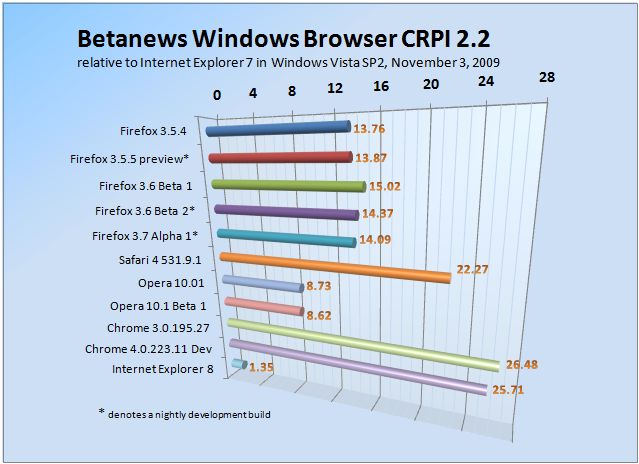
Betanews’ reporting on Internet Explorer in the past few months has not been kind. The October Patch Tuesday round of fixes included one for all versions of Internet Explorer that addressed a very serious, possibly exploitable issue. While we feel addressing this issue is absolutely necessary, we also noticed that applying the patch resulted in a noticeable slowdown in IE performance. At least, noticeable to us.
The most vocal reader response to our reporting could be grouped into three categories: One group vocalized that it did not care about Internet Explorer performance as a factor in computing, since it’s mainly a way to read news articles anyway, and voiced their opinion that we shouldn’t care either. Another group of readers took Microsoft to task for, in their opinion, not caring about IE performance, but added that it shouldn’t be expected to care because nobody else does (or at least, nobody of importance) and that we should drop the subject for that reason. A third group applauded our efforts to, in their opinion, expose Microsoft for not caring about browser performance.
None of these are groups that anyone at Microsoft would want to appear publicly aligned with. So perhaps part of Dean Hachamovitch was interested in speaking with me today, and another part — for absolutely understandable reasons — was dreading the thought.
But bravely, he made his company’s case, a valiant effort to split the difference: JavaScript isn’t the Web, he asserted, but just one of many subsystems. A multitude of other factors will contribute to users’ decisions.
“There’s performance, there’s interoperable standards, and there’s graphics,” said Hatchamovitch. Each component strikes a different chord with different groups of users, he said. Since the Day 2 keynote’s conclusion, he and his press handler had opportunities to ask individuals what they thought of the presentation — or more specifically, what did they remember from it?
“I asked some folks what they heard, and some just said, ‘Yea, you guys are doing a lot of compliance and interop.’ ‘Did you hear anything else?’ ‘No, not really.’ Talked to someone else, ‘So what did you hear?’ ‘You guys are doing some stuff around making the script engine faster.’ ‘Huh. Anything else?’ ‘No, not really.’ So what I’m finding is that this is the classic game of Telephone.”
What resonates with various attendees is essentially aligned with what they want to hear, Hatchamovitch went on…perhaps to illustrate the point that when he asked me the very same question at the start of our interview, I dove right into the performance aspect.
Rendering is another critical aspect, and we saw demonstrations of the changes IE9 will make in the rendering department. Specifically, the next edition of Microsoft’s browser will move away from GDI, the graphics library favored by Windows during the late 1980s, and toward the new Direct2D library which takes fuller advantages of the capabilities of the underlying hardware, including the GPU. In response to my request for a video that showed this performance, Microsoft asked us to include in our story the video you see embedded above, which is as close as the Web can come to approximating the speed and fluidity improvements attainable through Direct2D.
There is absolutely no question that, if IE9’s rendering improvements were to simply stay on the same level as they appear from these early demonstrations, through to the end of the product’s development, the result will be a perceptible qualitative difference that could be the deciding factor in whether Firefox or Chrome or Safari users switch back to IE — as important a factor as computational performance.
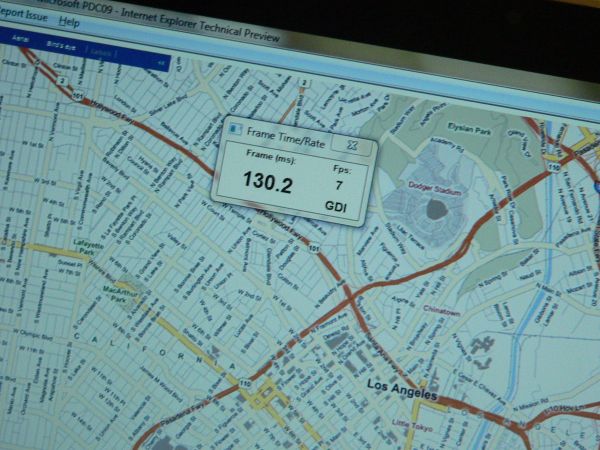
Hachamovitch showed us up close the map rendering demonstration seen from a distance during the Day 2 keynote. Shifting the same road map across the screen on a small Dell XPS laptop produced typical, perceptible jitters using IE8’s GDI graphics methodology, compared to a smooth, even flow using IE9’s Direct2D.
Some folks were confused by the meaning of the number in the demo, and why the slower, jittery-er graphic produced the higher value. This represented the number of milliseconds between frames — a number that plummeted from 130.2 ms as in this photo, or even much higher on occasion, to as low as 8 ms for Direct2D. Actual frames per second rises from around 7 (or lower) for GDI, to about 60 for Direct2D on the same machine.
“Now, that kind of difference — somebody said, ‘Oh, it’s like game-level animation!’ Yea, you can call it like it’s a Pixar movie or an Xbox game. But then they said, ‘But what does that have to do with the Web?’ It has everything to do with the Web. When you’re using Web mail or this mapping site, or you’re previewing photos — imagine going to a photo site, and you want to have 1,000 thumbnails up on the screen. Now we’re using the graphics card, so you’re not waiting on every piece of graphics that way. That’s a huge gain for performance, that’s a huge gain for developers because they can use all their old patterns — they didn’t have to rewrite their sites.”
So graphics does strike the performance chord with users and developers after all.
During the Day 2 keynote, Sinofsky said the IE9 team has been working for all of three weeks, and we were skeptical. Didn’t IE9 development really start after IE8 was released to general availability in March? What was going on all these months?
“There’s a lot of work that went into IE8 for sure,” Hachamovitch responded. “But realize, on March 19 we released IE8 in a few dozen languages. After March 19, we had several waves of languages for IE8 to get out, because it’s worldwide. There’s more than a few dozen languages of IE8. Then we had to finish Windows 7, and all the languages of Windows 7. So we’re three weeks past the general availability of Windows 7. In some ways, we’ve all been on call, ready, working through…well, several Patch Tuesdays since March 19.”
As Microsoft tries for a valiant comeback attempt for IE in the realm of qualitative measures, expect the company to demonstrate any number of various other aspects where the browser makes gains, and say this, too, is the Web.
And if those gains in one or two departments aren’t as significant, expect the message to be, “But that’s not all of the Web.”
We’ve asked Dean Hatchamovitch to join us in responding to your comments to this article.
Next: A word about Dean’s comments about our performance measurements…
A word about Dean’s comments about our performance measurements
It is no secret to the dozens of you who have followed my work over the past few decades that I am a speed fanatic. I give a damn about the performance of my automobile, my coffee maker, my wristwatch, and my Web browser, and my wife knows it doesn’t stop there. It might have something to do with why I edit a publication called Betanews.
The other reason I care is that I’m in the business of improvement, and you can’t improve until you’re ready to accept your own shortcomings. That goes for myself as well as everyone else. It is never fun to be on the losing side of a fair and competitive battle. It may even seem unfair when the reasons have to do with a legitimate effort to address a serious concern.
But as a high school journalism teacher I knew used to tell her students in the sports department covering one of the worst teams ever to take the field, if you can’t do the simplest job in the world — reporting the score — then you shouldn’t be a journalist but a cheerleader. Your heart may want you to change the score; but if you then do it, you’ve lost more than a game.
Dean Hachamovitch raised a few concerns about Betanews’ testing methodology, and I think they’re fair concerns that are worth discussing. First, he contended that it may be confusing to him and others, for us to use Internet Explorer 7 on Windows Vista as a relativity index. I told him I did not want to do as some readers suggested I do — use IE8 as the index browser — because that would be unfair to IE8, disabling its ability to be measured for performance at all. I also could not use any older series of browsers (for example, IE6 or Firefox 2) because they could not even run the tests in our performance battery. I know, I’ve tried.
He also suggested something else: that we go back to using clean installs of operating systems on virtual machines for our test systems, so long as those VMs were running on the same hardware. I explained to him why I changed to testing on physical platforms, mainly in response to reader requests. But I also explained that during our test of IE8 performance after the October Patch Tuesday fix, to validate the numbers I was seeing, I uninstalled the patch and tested again, and reinstalled it and tested again, to verify the values — they were spot on after the validation.
Hatchamovitch winced at this. He said that by uninstalling and reapplying the patch, I may have reduced the “signal-to-noise ratio,” to use his phrase, for IE7 and IE8 on Vista. In other words, I may have polluted the platform and hindered performance. The test results did not suggest that; but my methodology, he argued, could still produce doubt as to the authenticity of my results. This is a fair argument which I will put to the test myself.
Hatchamovitch also suggested we introduce the factor of variability into the test, a plus-or-minus factor, which is often seen in many other scientific measurements of performance. Of course, that’s not a bad idea either; on the other hand, I only want to report numbers that make sense to readers. If I’m “fuzzifying” the meaning of a result, I may not be giving readers data that they can use. It would be like putting a plus-or-minus estimate on the Dow Jones Industrial Average.
I stand behind my current methodology, but as you’ve already seen, I’m open to suggestions for improvement, and I have made improvements based on suggestions. But as I told BASIC interpreter vendors during the 1980s, who for years had seen their performance numbers in my tests slammed again and again and again by Microsoft — which dominated the interpreter market for as long as it was important — winning is not a relative state. Ask anyone who’s improved and come back to win the next round.
The moment IE9 marks a comeback for Microsoft’s Web browser in performance, you’ll read about it here. Yes, performance isn’t the entire Web just as the drivetrain isn’t the entire car. Maybe you don’t think much about the drivetrain every day, but that doesn’t mean it doesn’t exist. Just try riding in a car without one.
…the N97 may not be the very last of the high-end Nokia N-series S60 phones. But, it does apparently mark the beginning of the end. So, with the exception of RIM (BlackBerry) and Microsoft (Windows Mobile), all of the major smartphone platforms are Linux/UNIX based (Android, iPhone, Maemo, webOS).
Many books and articles support the view that an organization must choose between creating value through innovation and creating value by building scale and wringing out cost. The thinking styles and capabilities required for success appear to be diametrically opposed. Innovators are right-brained people who rely heavily on their intuition, whereas the leaders of large, efficiency-oriented organizations achieve results through rigorous, continuously repeated analytical processes and reject decisions based on instinct and judgment. In The Design of Business, Roger Martin contends that organizations can balance intuitive originality and analytic mastery in a dynamic interplay that he calls design thinking. This approach is necessary, according to Martin, to maintain long-term competitive advantage. As the dean of the Rotman School of Management at the University of Toronto and an advisor to many CEOs, Martin has worked with and studied a wide range of organizations. He has come to embrace the design thinking approach after seeing its powerful impact in a diverse array of companies. The vivid articulation of these company stories, paired with some very useful conceptual frameworks, makes The Design of Business both compelling and actionable. Martin anchors many of his concepts in a framework depicting the way knowledge advances. He…
Stewart Brand, author of Whole Earth Discipline, is described on the book cover as an icon of the environmental movement. He actually isn’t and doesn’t want to be. Brand (who, in full disclosure, is a friend) has always been much more of an iconoclast than an icon. In Whole Earth Discipline, he combines his deep concern for the environment, his pugnacious search for windmills to tilt at, and his technological optimism to produce an intriguing, confounding, utterly Brand-type book. By that, I mean a full-throated assault on conventional wisdom, laced with enough ironic riffs and personal confessions of his own past errors to disarm most critics. Brand came to public attention 41 years ago by publishing the wildly successful Whole Earth Catalog, a practical guide for back-to-the-land refugees from suburbia. The catalog questioned virtually every attribute of 1960s middle-class suburban America and offered a telephone directory-sized, annotated compilation of equipment for rural self-reliance. Ultimately, the back-to-the-land movement proved to be vanishingly small, over-fond of drugs, and stuck in a historical cul-de-sac. In Whole Earth Discipline, Brand examines and embraces the scientific basis of some of the principal problems that scare the hell out of environmentalists. Indeed, his bottom line on…
If you’re a born and bred American and you’ve lived in any non-Anglophone country, you may have realized after a time that the local people you met didn’t just speak a different language—they were really weird. They acted in all sorts of ways that struck you as irrational, frustrating, and eventually annoying. They stood too close to you, or too far away. Their voices were too loud, or too soft. They were vague about such basics as time, distance, and probabilities. And after months of this disorienting behavior all around you, you may have wondered whether you were going mad. In a sense, you were. You were suffering from what has come to be called “culture shock”—a sometimes-traumatic condition that results from the removal of familiar cultural cues. In its worst manifestations, culture shock can make you feel as though you’ve been detached from reality. This concept was brought home to Americans by returning Peace Corps volunteers in the 1960s and 1970s. Because volunteers had been immersed by design in local cultures, they brought culture shock to light for many Americans. Fortunately, even before the first Peace Corps volunteers were posted overseas, a cultural anthropologist named Edward T. Hall had…
Matthew Cruse alerts us to the news that the Netherlands is the latest in a long line of governments that are considering a “mileage tax” that would require drivers to have GPS devices that track how far they drive, and then tax you for every mile driven. Various US states, including Oregon, California and Massachussetts have toyed with such ideas, and while some in Congress have pushed for it on a national scale, the Obama administration has come out against the idea.
There are lots of problems with the idea, including the privacy implications of the government collecting data on your driving habits. Plus, the massive expense of equipping cars with such devices should not be underestimated. But, the biggest question of all is why such a thing is needed at all. We already have taxes on fuel, which approximates the same thing (the more you drive, the more you pay) which doesn’t have the same expense or privacy implications and has the added benefit that it helps encourage more fuel efficient driving. The idea to do a GPS-based mileage tax seems like one of those things that politicians come up with because they want more money, and they get infatuated with some new technology, without thinking through the implications (at all).
Starcraft2.com updated today. and damn, does Raynor look badass in the flash header.
In case you haven’t been to the site recently, here’s the list of changes Blizzard did to the Starctaft 2 website
We’ve just uploaded new intel to the StarCraft II website. This latest transmission sheds new light on the goings-on in the Koprulu sector […]
 Online video means YouTube at the moment. There’s a huge number of other video sites and Hulu is coming up strong, but the Google site is on a completely different level. And, while no one is going to threaten its dominance any time soon, eventually there may be someone who could and its name shouldn’t really surprise any one. It’s Facebook of course, the social networking giant has now become the third biggest video site in the US.


 Last week, Shakira announced that she had decided to launch her latest video using Ustream and Facebook called ‘Give It Up To Me,’ probably in an attempt to gain more fans on the social network and to part with the tradition of having used MTV for several whole years. It seems that the move was as innovative as it was inspired, since more than 95,000 visitors watched the new video when it was initially broadcast, while the following 24 hours brought around 500,000 viewers. In other words, Shakira’s fans all over the world have definitely appreciated her initiative, so they are likely to see more videos or singles released this way.


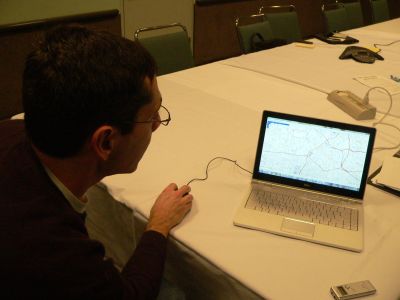 Hachamovitch showed us up close the map rendering demonstration seen from a distance during the Day 2 keynote. Shifting the same road map across the screen on a small Dell XPS laptop produced typical, perceptible jitters using IE8’s GDI graphics methodology, compared to a smooth, even flow using IE9’s Direct2D.