Blog

  • New Technology Drives Therapies For Older Patients, Those With Alzheimer’s

    Technology advances are making life better for the elderly and those with Alzheimer’s disease by allowing the older to stay in their homes and giving the ill a way to interact with society again.

    Kaiser Health News, in collaboration with The Washington Post, reports on “high-tech but simple devices” that are giving older people a better chance at independence later in life as pilot projects in homes and retirement communities see if these approaches can lead to improved at-home patient monitoring. “The goal is to help control problems before they escalate and cut back on the need for costly long-term care and hospital admissions — especially repeat hospital visits for chronic conditions. … The hope is that by closely monitoring patients at home, some of these (major health) events can be avoided or managed better” (Olson, 11/17).

    In other technology news, The Wall Street Journal reports that using music therapy with MP3 players such as iPods allows stroke victims or patients with Alzheimer’s to better interact with others. “Caregivers have observed for decades that Alzheimer’s patients can still remember and sing songs long after they’ve stopped recognizing names and faces. … (T)here’s growing evidence that listening to music can also help stimulate seemingly lost memories and even help restore some cognitive function.” Music can also help infants gain weight, the autistic communicate, stroke patients regain speech and motor function and also help many others’ conditions improve (Beck, 11/16).

  • Amazon’s Kindle now available to Canadians

    kindle2_front

    Canadians that have long been jealous of their Southern neighbours ability to procure an Amazon Kindle need no longer feel hostile, for today Amazon announced it will ship the Kindle to its Canadian customers. To offer over 300,000 books and a wide assortment of international newspapers, a bunch of unique Canadian content has also been added with The Globe and Mail and The National Post having signed up to deliver their dailies to those that wish to subscribe (Canwest’s publications are said to be coming soon if they don’t get visited by the repo man first). The Kindle will set Canadians back $259 USD ($275 CDN) on Amazon’s American website.

    Read

  • YouTube Connects News Outlets With Citizen Reporters

    YouTube has launched a new video platform called YouTube Direct that allows users to submit relevant videos to participating news organizations for broadcast.

    All videos submitted to news organizations and approved by their editors will appear on YouTube with a link back to the news site.

    Key features of YouTube Direct include:
       

    • Built on the YouTube API, this 100% open-source solution provides you with an easily-integrated audience engagement platform for your website
    • The customizable interface allows you to tailor the look and feel of the tool precisely to your audience
    • Visitors can answer your call for content by uploading their videos to YouTube via your site without leaving the page
    • A moderation panel enables your editors to review and approve/reject all submitted videos, deciding which ones meet your organization’s editorial criteria

    News organizations currently testing YouTube Direct include the Huffington Post, NPR, Politico, the San Francisco Chronicle, the Washington Post, and two TV stations in Boston.

    The YouTube Blog provides additional details. "Though we built YouTube Direct to help news organizations expand their coverage and connect directly with their audiences, the application is designed to meet any organization’s goal of leveraging video content submitted by the community."

    "Businesses can use YouTube Direct to solicit promotional videos, nonprofits can use the application to call-out for support videos around social campaigns and politicians can use the platform to ask for user-generated political commercials. The opportunities to use the tool are as broad as the media spectrum itself."
     

    Related Articles:

    > YouTube, Univision Announce Partnership

    >YouTube On Verge Of Supporting 1080p Video

    >YouTube Talks Up Social Side

  • State Health Plans In Washington, Kansas Face Challenges

    Officials in Washington state and Kansas are working to get residents out of or into their state-run insurance programs.

    The Seattle Post-Intelligencer: About as many people are on the wait list for Washington’s Basic Health plan, a state-run, low-cost health insurance program, as are currently enrolled. “As of Monday, 78,834 people were enrolled in Basic Health, the state’s low-cost health care coverage program. An estimated 78,419 people were on the wait list.” But, recent budget cuts mean the program is trying to thin out it rolls, not take on new customers. The economic recession has increased demand for the cash-strapped plan, local experts said (Ho, 11/16).

    Kansas Health Institute: A state insurance program has struggled to enroll patients as the number of uninsured children in the state rose, even as it declined nationally. “Between 2005 and 2008, the number of uninsured children in the state increased about 20,000 to a total of about 70,000 according to a recent report released by Kansas Action for Children.” State officials acknowledge that flaws in the enrollment system for HealthWave, a state-run insurer for low-to-modest-income children and families, may contribute to the surge (Ranney, 11/16).

  • Atlus releasing 3D Dot Game Heroes in North America

    Atlus has announced that they’ve picked up the rights to release From Software’s 3D Dot Game Heroes in North America.The North American version of the…

  • Looking at the Big Picture on the Recovery Act

    Last month, in a first-ever effort by the federal government recipients that received Recovery Act funds had to file a report saying how much they had received, what they had done with it, and how many jobs these funds had saved or created.  The reports were due just 10 days after the end of the federal fiscal year on September 30th, and were posted on Recovery.gov just 20 days later.

    More than 130,000 such reports were filed.  You can go to Recovery.gov and look them up by zip code, or search for them on a map.  It’s a “real-time” update on your tax dollars at work that is unmatched by any federal initiative, ever, of this scale.

    As part of President Obama’s commitment to transparency and disclosure, it’s been a huge success.  When you consider the sheer number of reports that had to be filed, processed, and posted; the fact that this had never been done before; and the very short time to check reports and make sure they were right – the data collected and posted is very impressive.

    Unfortunately, it would be hard to know that by reading some of what’s been written and said about recipient reporting.  The Administration has been criticized for pointing out to the independent Recovery Board some erroneous reports that should not have been posted – and for failing to find all the erroneous reports.  Skeptics have raised doubts about reports that show jobs created with no funds spent (although that is possible, as workers are hired in anticipation of projects starting), or funds spent with no jobs created (when materials are purchased for projects that are not yet underway).

    Some filers, working with the new system, punched in the wrong Congressional district, and some just got the data wrong.  And about 10% of those folks who were supposed to file a report haven’t filed it yet.

    We fully agree with those who find the mistakes in the data frustrating – and we’ve been working with the Recovery Board to find the mistakes, and fix them.   Just because mistakes are inevitable in any new system – especially one this large, and this new — doesn’t mean they are acceptable.  We are going through the reports with a fine tooth comb, identifying mistakes, and working with filers to correct them.  That said, three big picture points should not be lost.

    First, the mistakes are RELATIVELY few, and don’t change the fundamental conclusions one can draw from the data.   Even if as many as 5-10% of the reports or 5-10% of the totals are wrong (and we don’t think it is that high), that still means the Recovery Act saved or created between 600,000 and 700,000 direct jobs in its first seven months – more than most experts predicted when it passed.  And most leading experts agree that – whatever the recipient reported total should be – the actual number of jobs saved or created is about double that, because the recipient reports don’t include direct payments to individuals, the jobs created by Recovery Act tax cuts, and the jobs created when workers on Recovery Act projects spend their paychecks. 

    Second, some of the mistakes are frustrating typos and coding errors that don’t undermine information at the heart of the data.   Yes, it is “silly” that Recovery.gov shows that a project went to the 15th Congressional District in Arizona – when there is no such district.  But a “click” on the project details gives you the address, and a check on the address shows it is in Arizona’s 3rd district.  All this shows is that when people send in 130,000 reports, some will have silly mistakes.  But it doesn’t really undermine the ability of the public to track and follow the data – or the fact that real jobs have been created.

    Third, transparency is going to be messy – but it is better than the alternative.   It would be great if every report filed was correct the first time, on time, and contained no errors.  But that’s not realistic when 130,000 reports are being filed in a 10 day period.  It would be great if the reviewers at the federal agencies, could have found all the mistakes in the 20 days they had to do the job, gotten the reports back to the recipients to be fixed, and reposted  – but again, that isn’t realistic.  And so, it’s all out there now for the public to see – because the Recovery Act chose speed and transparency as its watchwords – and the result is some data errors for the critics to pick over.  But think about it this way:  What government program has ever even attempted to provide this sort of information, on this scale, this quickly?  In my over thirty years of government service, I can tell you without hesitation:  something like this has never happened before.  In previous administrations, hundreds of billions of dollars have been spent without anyone being asked what happened to the money, being asked how it was spent, or being asked how many jobs were created – and some of the loudest critics of Recovery Act data today were shockingly silent.  And if these questions were asked, answers would usually take months or years to produce.

    Last month, something happened that has never happened before.  Critics – some well intentioned, some who just wanted to discredit the Recovery Act — have had over two weeks to try to make hay with  the data.   But no criticism has come close to discrediting the larger and most important point:  that the Recovery Act has helped save or create more than 1 million  jobs across America and across various sectors of the economy.   The data will get better and better – but in the noise over counting jobs, we shouldn’t lose sight of the Recovery Act’s progress in creating them.

    G. Edward DeSeve is Special Advisor to the President, Assistant to the Vice President and Special Advisor to the OMB Director for Implementation of the Recovery Act

  • Another big day in gaming: Assassin’s Creed II, Left 4 Dead 2 & Tony Hawk Part 900

    ac22

    Today’s another big day in gaming, friends. (You’ll notice that we’re practically a game blog now. I blame the publishers for releasing the biggest games of the year within a few days of each other.) Ubisoft’s Assassin’s Creed II, Valve’s Left 4 Dead 2, and Activision’s Tony Hawk Ride come out today (I assume the Tony Hawk franchise is still around because it’s still popular. I haven’t played one since Tony Hawk 4.)

    There’s no Assassin’s Creed II reviews yet, which I’m interpreting as Ubisoft either being control freaks, or that that game isn’t exactly a 10 out of 10. Hopefully the game is halfway as good as that Justice trailer:

    I read one Left 4 Dead 2 review (I’ll do my usual round-up later in the day), from Eurogamer, and it ends with this:

    Whereas once we treated Left 4 Dead as a stopgap between Half-Lifes, this is no longer a weird little side project with modest expectations, and Valve is confident enough to play around with it, safe in the knowledge that you can trust your players. Left 4 Dead proved it. And whereas that game had a personality, this one is overflowing with it.

    Considering the PC version is the “real” version, and my iMac can only just run Call of Duty 1 and Medal of Honor: Allied Assault (which I’ve been playing for the past week), and that I never played the first game, and that I’m really not the biggest fan of online multi-player games, well, what more do I have to say?

    Too. Many. Games.


  • As Senate Debate Approaches, Partisans Step Up Volume

    Volleys of rhetoric, attack ads and procedural parries are rippling through the Congressional health care debate.

    The Philadelphia Inquirer: “Democrats are emailing thousands of people who backed Barack Obama last year in two GOP-controlled Pennsylvania congressional districts, asking them to protest their representatives’ recent ‘no’ votes on health care reform legislation” (Fitzgerald, 11/16).

    Lansing State Journal: The “Democratic National Committee will run radio ads this week targeting four Michigan Republicans in Congress who voted against health care reform this month but represent districts that backed President Barack Obama in last year’s election” (Spangler, 11/16)

    MinnPost: The Democratic National Committee is running ads “in 32 Republican-held congressional districts” around the country “where voters backed Barack Obama in the 2008 presidential election.” The ads attack Republicans for voting against the health-reform bill, claiming, for instance, that one member “stood with the insurance industry, not the people he was elected to represent” (Wallbank, 11/16).

    NPR: Democrats also have taken aim at insurers more broadly, shifting the term for their massive legislative effort from “health care reform” to “health insurance reform.” Experts say the latter may be a more accurate term for a reform effort that squeezes insurers but may not do enough to change the health delivery system and bridle rising health costs (Welna, 11/17).

    Roll Call: “Sen. Tom Coburn (R-Okla.) confirmed Senate Democratic leaders’ fears that he will insist that the massive health care reform bill be read aloud on the Senate floor.” The voluminous bill would take “several days” to read in its entirety (Pierce, 11/16).

    The Washington Times: “Senate Republicans say they’re prepared to file dozens of amendments on the health care bill Democrats send to the floor, targeting proposals to cut Medicare spending and increase taxes, warning that the Democrats’ overhaul plans will raise insurance premiums for all Americans” (Haberkorn, 11/17).

    In a separate story, The Washington Times reports on the two Republican physicians who serve in the Senate and who “don’t sound like other Republican lawmakers when they talk about the debate over reforming the nation’s health care system.” The two doctors, Sens. Tom Coburn of Oklahoma and John Barrasso of Wyoming, “say the Democratic lawmakers’ proposals being presented to Congress would allow the government too much control over physicians’ and patients’ decision-making and destroy the art of medicine. Coburn is also attacking the bills because, he says, they would take the art out of medicine” (Haberkorn, 11/17).

  • Google May Take Over More Design Jobs

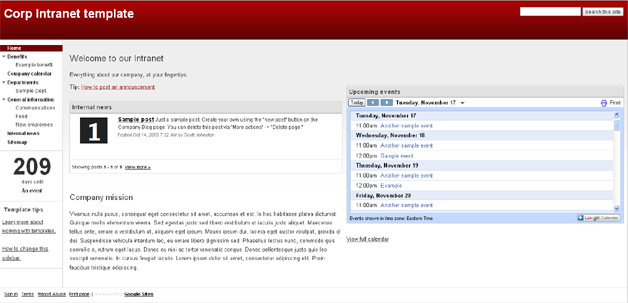
    Web designers beware. Google is expanding its templates for Google Sites, which is part of Google Apps, and the company is really pushing Google Apps these days. What this means is that as more businesses adopt Google Apps and find a wider variety of site templates to choose from, the less they may need the services of web designers for basic design work (developers are a different story).

    Ok, perhaps it is a bit of an exaggeration to assume that this is going to completely put web designers out of work. Website templates have been around for years. It’s just that the potential of Google Apps to infiltrate more and more offices may lead to more widespread use of Google Sites.

    Google has just launched a new template gallery for Google Sites, and it is public. Anyone can contribute templates by simply following these steps:

    1. Open up the site you want to add to the gallery (the site must be published and you must be an owner to submit the site).

    2. Select ‘More actions’, ‘Manage site,’ ‘General’, and chose ‘Publish this site as a template.’

    3. Choose a template name, a category, enter a description and click ‘Submit template.’

    While anyone can browse the gallery, businesses using Google Apps each have a private area where employees can share site templates with coworkers. Site templates can be used not only to build business websites, but intranets and more.

    Corporate Intranet Template

    "The rate that businesses are adopting Google Sites has surpassed our expectations, and templates will make Sites even more useful by dramatically reducing the time it takes to set up collaborative workspaces like employee intranets, project tracking sites, team sites and employee profile pages," says Google Sites product manager Scott Johnston. "Templates let you quickly start a new site with pre-built content, embedded gadgets, page layouts, navigation links, theming and more."

    Given that anyone can contribute templates to the gallery, it stands to reason that it will grow quickly and greatly. One knock against site templates has always been that they don’t make for a unique design. These days the chances of having a truly unique design are getting slimmer and slimmer as the web becomes more flooded with content. However, the more templates that are available, the less chances you have of actually coming across different sites that use the same one. Given that this is a Google product, it’s almost certain that it will get many contributions.

    Do you think designers should worry about Google Sites? Share your thoughts here.

    Related Articles:

    > Google Exec: Docs Can Supplant Office In One Year

    > API Makes Google Sites More Useful for Business

    > Google Launches New Features for Sites

  • Startling New Mammogram Guidelines Incite Debate About Risk, Cost

    The Washington Post: “Women in their 40s should stop routinely having annual mammograms and older women should cut back to one scheduled exam every other year, an influential federal task force has concluded, challenging the use of one of the most common medical tests” (Stein, 11/17).

    The New York Times reports: “The new recommendations, which do not apply to a small group of women with unusual risk factors for breast cancer, reverse longstanding guidelines and are aimed at reducing harm from overtreatment, the group says. …  Just seven years ago, the same group, the United States Preventive Services Task Force, with different members, recommended that women have mammograms every one to two years starting at age 40. … The task force is an independent panel of experts in prevention and primary care appointed by the federal Department of Health and Human Services.”

    The new guidelines, published online in The Annals of Internal Medicine, are aimed at preventing possible harm from overtreatment. “While many women do not think a screening test can be harmful, medical experts say the risks are real. A test can trigger unnecessary further tests, like biopsies, that can create extreme anxiety. And mammograms can find cancers that grow so slowly that they never would be noticed in a woman’s lifetime, resulting in unnecessary treatment” (Kolata, 11/16).

    The Wall Street Journal reports: “…the new guidelines are likely to be controversial and confusing. They also raise concerns that health insurers will curtail coverage and reimbursements for screenings that fall outside the guidelines, according to doctors and groups including the American Cancer Society.”

    “About $3.3 billion was spent on mammograms in the last 12 months, according to the American College of Radiology. … Whether the new guidelines lead to changes in insurance reimbursement is likely to be a big concern among health providers and patients. The Centers for Medicare and Medicaid Services, which administers government health benefits for the elderly and the poor, says the new guidelines wouldn’t change how it covers mammograms for Medicare patients. But that may not be the case for private insurance” (Wang, 11/17).

    NPR notes: “Women in the United States are being diagnosed with breast cancer earlier than their mothers were, as well as women in certain minority groups, says American College of Radiology chairwoman Dr. Constance Lehman. ‘Black women in the U.S. develop breast cancer at a significantly younger age than Caucasian women do.’ This was not addressed or acknowledged by the task force, she says” (Wilson, 11/16). 

    The Los Angeles Times reports: “Oncologists were nearly uniform in their disparagement of the guidelines, fearing the loss of a valuable cancer-prevention tool. Women in their 40s account for at least a quarter of breast cancer diagnoses. … And other groups that issue guidelines about screening and prevention, such as the American Cancer Society, the National Cancer Institute and the American College of Obstetricians and Gynecologists, immediately attacked the federal panel’s conclusion, saying that they would not change their guidelines and would continue to urge women to undergo the tests” (Graham and Maugh, 11/17).

    CBS/The Associated Press: “International guidelines also call for screening to start at age 50; the World Health Organization recommends the test every two years, Britain says every three years. Breast cancer is the most common cancer and the second leading cause of cancer deaths in American women. More than 192,000 new cases and 40,000 deaths from the disease are expected in the U.S. this year. Mammograms can find cancer early, and two-thirds of women over 40 report having had the test in the previous two years. But how much they cut the risk of dying of the disease, and at what cost in terms of unneeded biopsies, expense and worry, have been debated” (11/16).

    CNN: “The task force is composed of 16 health care experts, none of whom are oncologists. The group reviews medical data and bases recommendations on effectiveness and risks involved. ‘All we are saying is, at age 40, a woman should make an appointment with her doctor and have a conversation about the benefits and harms of having a mammography now versus waiting to age 50,’ said Dr. Diana Petitti, vice chair of the task force” (Dellorto, 11/16).

  • Olivet College students provide service to domestic abuse shelter

    Eighteen Olivet College students and two staff members spent the weekend painting the interior of the River House Domestic Abuse Shelter….The trip was conceived by the two schools’ Michigan Campus Compact AmeriCorps VISTA volunteers, Jean Paul Cortes, serving Olivet, and Monica Martinez,

    Read the entire article in the Battle Creek Enquirer

  • Google Gets Ready for Full-Blown Extensions Support in Chrome 4.0.249.0

    Google Chrome is now almost certain to get much better support for extensions very soon, at least in the developer channel builds. After the first clues of an online extensions gallery were spotted yesterday, Google made it more or less official with the latest Chrome release, which now features links and notifiers to a still non-existent extensions gallery. What’s more, Google’s own sample extensions are now working on in the latest Chrome builds.

    While Google doesn’t say it, with the latest Chrome 4.0.249.0 ,extension support is almost fully baked both on the technology front but also in the user interface. Users will notice that the corner in the new tab page has changed and now links to an online extensions gallery. There is also a notification at the bottom, alerting users that Chrome now supports extensions and bookmark sync.

    But probably the most telling clue is the fact that the extensions which Google provides as examples can now be installed with just a couple of clicks. There are three Google extensions at the moment, a Gmail checker, a feed subscriber and the BuildBot Monitor. The Gmail checker is self explanatory, it adds a small icon to the toolbar showing how many unread emails you have. The feed reader subscriber extension adds an RSS icon to the address bar when feeds are available in the page, exactly like Firefox handles the function… (read more)

  • Study Finds Uninsured Trauma Patients Much More Likely To Die In ER

    “Uninsured patients with traumatic injuries, such as car crashes, falls and gunshot wounds, were almost twice as likely to die in the hospital as similarly injured patients with health insurance, according to a troubling new study,” The Associated Press reports. “The findings by Harvard University researchers surprised doctors and health experts who have believed emergency room care was equitable.” The study was published in the November issue of the Archives of Surgery. Senior author Dr. Atul Gawande, a Harvard surgeon and medical journalist, “favors health care reform and has frequently written about the inequities of the current system.” The study could add fodder to the health care debate.

    “The researchers couldn’t pin down the reasons behind the differences they found. The uninsured might experience more delays being transferred from hospital to hospital. Or they might get different care. Or they could have more trouble communicating with doctors. The hospitals that treat them also could have fewer resources. … Federal law requires hospital ERs to treat all patients who are medically unstable. But hospitals can transfer patients, or send them away, once they’re stabilized. A transfer could worsen a patient’s condition by delaying treatment.” The study “analyzed data on nearly 690,000 U.S. patients from 2002 through 2006” (Johnson, 11/16).

    Los Angeles Times: “The researchers offered several possible explanations for the findings. Despite the federal law, uninsured patients often wait longer to see doctors in emergency rooms and sometimes visit ERs at several hospitals before finding one that will treat them. Other studies show that, once they’re admitted, uninsured patients receive fewer services, such as CT and MRI scans, and are less likely to be transferred to a rehabilitation facility. Patients without insurance may have higher rates of untreated underlying conditions that make it harder to recover from trauma injuries, the researchers said. They also may be more passive with doctors and nurses because they don’t interact with them as often. All of these factors could influence whether a trauma patient is able to recover” (Kaplan, 11/17).

    Other outlets are reporting on ways to get health insurance.

    The Salt Lake Tribune answers a reader’s question on how long it would take before the uninsured would get coverage under health reform. While “most of the major provisions won’t kick in for a few years, all the health reform proposals include some immediate reforms, such as the creation of a new high-risk insurance pool. The pool would serve the uninsured and people … who were denied because of a pre-existing condition. The House set aside $5 billion to create the program” (Canham, 11/16).

    USA Today has a tip sheet for people to avoid becoming uninsured after their COBRA subsidy runs out. “Earlier this year, lawmakers agreed to temporarily subsidize health insurance for laid-off workers, providing a big discount for coverage until they got back to work. … Mindful of the 10% unemployment rate, some lawmakers have proposed extending the benefit, but that hasn’t happened yet.” Suggestions include waiting to drop COBRA until you have another insurance option lined up, even if it is expensive, and considering different health insurance options for various members of your family (Block, 11/17).

  • Medicare Doctor Payment “Fix” Could Slip, Jeopardizing AMA Support For Health Reform

    The American Medical Association backed the House Democrats’ reform bill earlier this month, at a time when it appeared likely lawmakers would move to permanently end looming cuts to doctors’ Medicare payments that Congress defers from year to year, Politico reports. While the so-called “doc fix” was not in the final health bill, “[t]he House is expected to pass a bill later this week to permanently plug [the] shortfall …. But prospects for the bill look dim, since the Senate blocked consideration of a similar measure late last month, and House leaders stripped the proposal from their broader health reform package.”

    “The conflicting maneuvers suggest that, rather than a permanent solution, the best the doctors might get is yet another one- or two-year fix, which could threaten their support for health care reform,” according to Politico. In the earlier Senate vote, the Democratic leadership fell 12 votes shy of the 60 needed to pass a bill. Fiscal conservatives have opposed it, saying it would add $247 billion to the deficit over a decade (O’Connor, 11/17).

  • Senate Democrats Wait For CBO Score, Work To Keep Votes

    Senate Majority Leader Harry Reid, D-Nev., is planning a “key test vote by the end of the week” on a health reform bill, according to Senate aides, Politico reports. “The vote on a motion to proceed to the bill could come as early as Friday, teeing up the amendment process to begin after the Thanksgiving break.” Reid may keep the Senate in session over the weekend (Budoff Brown, 11/17).

    Democrats expect to get a CBO score on the bill Tuesday at the earliest, another aide said, which will clear the way for a vote on a motion to proceed, CongressDaily reports (Edney, 11/16).

    The CBO score is key to soothing the cost reservations many Senators have, the Detroit Free Press reports. “Of course, depending on the cost of that CBO estimate, Reid may have to tweak it further before bringing it to the floor” (Spangler, 11/16).

    The New York Times reports that Washington is waiting to hear what CBO director Doug Elmendorf has to say on the bill. “His detailed analyses — ‘scores’ in Washington argot — are highly educated guesswork but are more or less the final word, making him a combination oracle and judge on many of the biggest issues of the day.” Elmendorf is still working to analyze Reid’s bill — one that could “speed the process along, helping Mr. Obama fulfill his hope of signing a bill into law this year” or “could leave the White House and Democrats scrambling” depending on what his office finds (Stolberg, 11/16).

    The Wall Street Journal: “Republicans will likely filibuster the ‘motion to proceed,’ which simply allows the Senate to begin debate. Delaying consideration of the bill until 2010, an election year, could jeopardize its chances and turn the intricacies of the Senate timetable into a political tool for the bill’s opponents.” Reid needs all 60 votes in the Democratic caucus to begin debate on the bill, but it remains to be seen if he can garner such support. Sen. Joe Lieberman, an independent who caucuses with the Democrats, is expected to vote for the motion to proceed, according to an aide, though his vote for passage of the bill is unclear (Hitt, 11/17).

    The Hill reports that Reid can’t afford Democrat defectors on his bill. “Another complicating factor is the health of Sen. Robert Byrd (D-W.Va.), who has missed more than 130 roll call votes this year. Reid needs every member of his party because Republicans have indicated they will vote en masse against the Democratic legislation. … Democrats remain divided over key elements yet to be resolved: whether to create a government-run insurance program, how to pay for expanding insurance coverage and how strongly to prohibit federal dollars from paying for abortion services” (Young, 11/16). 

    One of the centrists being courted is Sen. Blanche Lincoln, D-Ark., “who has become emblematic of the improbable distance that health-care reform has traveled, and how far it still must go before becoming law,” The Washington Post reports. “Hundreds of thousands of Lincoln’s constituents are low-income and lack insurance, the very kind of voters expected to benefit under the Senate bill. … (but) her sometimes uncomfortable role near the center of the debate could cost her in culturally conservative Arkansas. Despite the potential benefits for many in her state, polls show her support weakening, and constituents are expressing doubts about the proposed overhaul” (Murray, 11/17).

  • Chicago Tribune Columnist: Hey You People Online With Opinions… Get Off My Lawn!

    Reader Cannen alerts us to yet another column by yet another old school newspaper guy whining about the fact that “the people” now have the ability to have their voices heard. What’s funny is that his own column seems to contradict his statements.


    Don’t get me wrong. I am also an outraged narcissist, but I had to work six-hour shifts in Bakersfield, Calif., to earn my stripes as a communicator. Nowadays, having a Twitter page qualifies a person to give commentary on CNN. I am not interested in the take of @stinky on the Fort Hood shootings or any other current events. I am watching CNN because I expect them to gather the news, not act as a clearinghouse for any bonehead with a computer, a cable modem and a half-baked opinion.

    Ah yes, so because today it’s easier for people to have a voice, it’s bad. Yes, and you used to walk to school uphill both ways in the snow and television was called radio and had no pictures. But the world improves and progress comes along and gives more people a voice and that’s bad how exactly?


    With the advent of Twitter, Facebook, instant messaging and texting, now almost any fool can set up his or her broadcast hub. Then the likes of CNN, Fox News, Oprah and even the Tribune play right into their hands, giving them instant access to the rest of the world. I beseech the online editors at this paper to turn off the “comments” after each article. If people have opinions about something that they’ve just read, let them write a letter to the editor.

    Yes, but “any fool” doesn’t get quite the attention as, say, a fool who blasts the fact that people have a voice in a major national newspaper, right? Who cares that anyone can say what they want. Most people don’t see those complaints. You call it a “broadcast hub” but most people’s Twitter accounts don’t have very many followers. That’s not the issue at all. The actual complaint seems to be that CNN and Fox and others have elevated a few of these folks (a tiny percentage of the overall population using these tools), and you don’t like it because…. what, exactly? Because they compete with you in being a public “fool”?


    Most of my career has been spent in radio, where call-in comments are somewhat encouraged. The main difference is that we can hang up on people.

    Ok, let me get this straight. Before you were complaining that CNN and Fox were putting these people on their shows, but then you say at least on radio you could “hang up on people.” Do you not sense the contradiction? CNN and Fox can just as easily “hang up” on these people too. So what’s the difference?

    Basically, it sounds like the guy is pissed off that he’s no longer the only person with an opinion getting heard. But, of course, he’s missing the point in blaming the new technology. Yes, lots of people have a voice, but most still don’t get heard very far. The folks who are getting on TV or are making their voices heard are because they’re saying something that resonates, whether it’s stupid or not. And, no, maybe they didn’t have to practice being a public moron in some small town first, but is that really a necessity?

    Permalink | Comments | Email This Story


  • First Look: Nov. 17

    In the wake of the global financial crisis, HBS professor Bill Sahlman analyzes the fallout and suggests a new player to monitor management excess. What he envisions is a monitor that would “take an objective, hard-nosed look at major financial firms on a holistic basis. … [The] new monitor would learn from working with many players in an industry. Auditing the best and worst firms would create powerful tools for improving practice.”

    In his working paper “Management and the Financial Crisis (We Have Met the Enemy and He Is Us …)” [PDF], Sahlman analyzes a host of management problems from the perspective of culture, incentives, control and measurement, accounting, and human capital. Opposed to quick fixes, Sahlman is in favor of soul-searching on the part of corporate managers, followed by clear steps to revise prevailing notions of risk and reward. “We have a unique opportunity to force a review of all the players in the financial system, from individual consumers to politicians and regulators to management teams at financial services firms,” he concludes.

    The changing economic relationship between the United States and China as a result of the 2007-2009 financial crisis is the subject of “The End of Chimerica” [PDF] by HBS professor Niall Ferguson and Moritz Schularick. As they argue, Chinese currency is undervalued in relation to the U.S. dollar. “A continuation of Chimerica and Beijing’s undervalued dollar peg at a time of dollar weakness would introduce new and dangerous distortions to the global economy,” the authors warn. “The dollar depreciation that seems a likely consequence of current U.S. fiscal and monetary policy would be accompanied by a further Chinese depreciation relative to other major currencies.”

    — Martha Lagace

    Working Papers

    User, and Open Collaborative Innovation: Ascendent Economic Models

    Authors: Carliss Y. Baldwin and Eric von Hippel
    Abstract

    In this paper we assess the economic viability of innovation by producers relative to two increasingly important alternative models: innovations by single user individuals or firms and open collaborative innovation projects. We analyze the design costs and architectures and communication costs associated with each model. We conclude that innovation by individual users and also open collaborative innovation increasingly compete with—and may displace—producer innovation in many parts of the economy. We argue that a transition from producer innovation to open single user and open collaborative innovation is desirable in terms of social welfare and so worthy of support by policymakers.

    Download the paper: http://www.hbs.edu/research/pdf/10-038.pdf

    Platform Competition, Compatibility, and Social Efficiency (revised)

    Authors: Ramon Casadesus-Masanell and Francisco Ruiz-Aliseda
    Abstract

    Katz and Shapiro (1985) study systems compatibility in settings with one-sided platforms and direct network effects. We consider systems compatibility in settings with two-sided platforms and indirect network effects to develop an explanation why markets with two-sided platforms are often characterized by incompatibility with one dominant player who may subsidize access to one side of the market. We find that incompatibility gives rise to asymmetric equilibria with a dominant platform that earns more than under compatibility. We also find that incompatibility generates larger total welfare than compatibility when horizontal differences between platforms are small.

    Download the paper: http://www.hbs.edu/research/pdf/09-058.pdf

    From Strategy to Business Models and to Tactics

    Authors: Ramon Casadesus-Masanell and Joan Enric Ricart
    Abstract

    The notion of business model has been used by strategy scholars to refer to “the logic of the firm, the way it operates, and how it creates value for its stakeholders.” On the surface, this notion appears to be similar to that of strategy. We present a conceptual framework to separate and relate business model and strategy. Business model, we argue, is a reflection of the firm’s realized strategy. We find that in simple competitive situations there is a one-to-one mapping between strategy and business model, which makes it difficult to separate the two notions. We show that the concepts of strategy and business model differ when there are important contingencies upon which a well-designed strategy must be based. Our framework also delivers a clear separation between tactics and strategy. This distinction is possible because strategy and business model are different constructs.

    Download the paper: http://www.hbs.edu/research/pdf/10-036.pdf

    The Devil Wears Prada? Effects of Exposure to Luxury Goods on Cognition and Decision Making

    Authors: Roy Y.J. Chua and Xi Zou
    Abstract

    Although the concept of luxury has been widely discussed in social theories and marketing research, relatively little research has directly examined the psychological consequences of exposure to luxury goods. This paper demonstrates that mere exposure to luxury goods increases individuals’ propensity to prioritize self-interests over others’ interests, influencing the decisions they make. Experiment 1 found that participants primed with luxury goods were more likely than those primed with non-luxury goods to endorse business decisions that benefit themselves but could potentially harm others. Using a word recognition task, Experiment 2 further demonstrates that exposure to luxury is likely to activate self-interest but not necessarily the tendency to harm others. Implications of these findings were discussed.

    Download the paper: http://www.hbs.edu/research/pdf/10-034.pdf

    The CHAT Dataset

    Authors: Diego Comin and Bart Hobijn
    Abstract

    This note accompanies the Cross‐country Historical Adoption of Technology (CHAT) dataset. CHAT is an unbalanced panel dataset with information on the adoption of over 100 technologies in more than 150 countries since 1800. The data is available for download at http://www.nber.org/data/chat. We discuss the main aim of CHAT, its scope and limitations, as well as several ways in which we have used the data so far and ways to potentially use the data for other research.

    Download the paper: http://www.hbs.edu/research/pdf/10-035.pdf

    The End of Chimerica

    Authors: Niall Ferguson and Moritz Schularick
    Abstract

    For the better part of the past decade, the world economy has been dominated by a world economic order that combined Chinese export-led development with U.S. over-consumption. The financial crisis of 2007-2009 likely marks the beginning of the end of the Chimerican relationship. In this paper we look at this era as economic historians, trying to set events in a longer-term perspective. In some ways China’s economic model in the decade 1998-2007 was similar to the one adopted by West Germany and Japan after World War II. Trade surpluses with the U.S. played a major role in propelling growth. But there were two key differences. First, the scale of Chinese currency intervention was without precedent, as were the resulting distortions of the world economy. Second, the Chinese have so far resisted the kind of currency appreciation to which West Germany and Japan consented. We conclude that Chimerica cannot persist for much longer in its present form. As in the 1970s, sizeable changes in exchange rates are needed to rebalance the world economy. A continuation of Chimerica at a time of dollar devaluation would give rise to new and dangerous distortions in the global economy.

    Download the paper: http://www.hbs.edu/research/pdf/10-037.pdf

    Management and the Financial Crisis (We have Met the Enemy and He Is Us…)

    Author: William A. Sahlman
    Abstract

    The financial crisis of 2008-2009 has revealed that our broad model of corporate governance is broken, independent of the shortcomings in the regulatory system. Managers and boards of directors in scores of systemically important firms failed to protect employees, customers, or shareholders and placed the global financial system at risk. I assert that the root cause of the crisis can be found in five related systems: incentives, risk management and control, accounting, human capital, and culture. The worst firms had lethal combinations of strong incentives, weak control and risk management, flawed internal and external accounting, low skill and/or low integrity people, and corrosive cultures. Piecemeal attempts to fix elements of corporate governance will fail. The problem, to illustrate, is not just the structure of compensation. Nor will increasing required capital prevent problems at companies with strong incentives and weak controls. I believe that we may need a new kind of external agency for systemically risky firms that would take a holistic look at the five systems to identify weaknesses, make recommendations to managers and boards, and set regulatory policies, including assessing charges for insuring against losses. Without such a comprehensive assessment and improvement plan, boards cannot do their jobs, and the system will remain as subject to calamitous events as it was before the crisis.

    Download the paper: http://www.hbs.edu/research/pdf/10-033.pdf

    Publications

    Lessons for the Current Financial Crisis from Catastrophe Reinsurance

    Author: Kenneth A. Froot
    Publication: In The Irrational Economist: Making Decisions in a Dangerous World, edited by Erwann Michel-Kerjan and Paul Slovic. New York: Public Affairs Books, forthcoming.
    Book Abstract

    Of the 20 most costly catastrophes since 1970, more than half have occurred since 2001. Is this an omen of what the 21st century will be? How might we behave in this new, uncertain, and more dangerous environment? Will our actions be rational or irrational? A select group of scholars, innovators, and Nobel Laureates was asked to address challenges to rational decision making both in our day-to-day life and in the face of catastrophic threats such as climate changes, natural disasters, technological hazards, and human malevolence. At the crossroads of decision sciences, behavioral and neuro-economics, psychology, management, insurance, and finance, their contributions aim to introduce readers to the latest thinking and discoveries. The Irrational Economist challenges the conventional wisdom about how to make the right decisions in the new era we have entered. It reveals a profound revolution in thinking as understood by some of the greatest minds in our day and underscores the growing role and impact of economists and other social scientists as they guide our most important personal and societal decisions.

    Bank Lending During the Financial Crisis of 2008

    Authors: Victoria Ivashina and David S. Scharfstein
    Publication: Journal of Financial Economics (forthcoming)
    Abstract

    This paper documents that new loans to large borrowers fell by 47% during the peak period of the financial crisis (fourth quarter of 2008) relative to the prior quarter and by 79% relative to the peak of the credit boom (second quarter of 2007). New lending for real investment (such as working capital and capital expenditures) fell by only 14% in the last quarter of 2008 but contracted nearly as much as new lending for restructuring (LBOs, M&A, share repurchases) relative to the peak of the credit boom. After the failure of Lehman Brothers in September 2008 there was a run by short-term bank creditors, making it difficult for banks to roll over their short-term debt. We document that there was a simultaneous run by borrowers who drew down their credit lines, leading to a spike in commercial and industrial loans reported on bank balance sheets. We examine whether these two stresses on bank liquidity led them to cut lending. In particular, we show that banks cut their lending less if they had better access to deposit financing, and thus they were not as reliant on short-term debt. We also show that banks that were more vulnerable to credit line drawdowns because they co-syndicated more of their credit lines with Lehman Brothers reduced their lending to a greater extent.

    Nobel Laureate Panel Discussion: What Retirement Means to Me

    Authors: Robert C. Merton, Paul A. Samuelson, and Robert M. Solow
    Publication: Chap. 1 in The Future of Life-Cycle Saving and Investing: The Retirement Phase, edited by Zvi Bodie, Laurence B. Siegel, and Rodney N. Sullivan, 1-14. Charlottesville: CFA Institute, Research Foundation Publications, 2009. (Monograph.)

    Book link: http://www.cfapubs.org/toc/rf/2009/4

    Cases & Course Materials

    Genzyme Center (A)

    Michael W. Toffel and Aldo Sesia Jr.
    Harvard Business School Case 610-008

    Genzyme Corporation is in the midst of planning its new corporate headquarters, which incorporates many innovative green building features. After learning that the building as planned would likely earn a LEED Silver rating, an intermediate score in the LEED green building rating scheme, the CEO charged the building team with exploring opportunities that would enable the building to earn the highest rating, LEED Platinum. Five additional green building features are described, and students are asked to analyze and recommend which, if any, of these features to pursue based on their cost, likelihood of earning LEED credits, and their influence on the building’s environmental performance.

    Purchase this case:

    http://cb.hbsp.harvard.edu/cb/product/610008-PDF-ENG

    Purchase Supplement (B):

    http://cb.hbsp.harvard.edu/cb/product/610009-PDF-ENG

    Purchase Supplement (C):

    http://cb.hbsp.harvard.edu/cb/product/610010-PDF-ENG

    Intellectual Ventures

    Andrei Hagiu, David B. Yoffie, and Alison Berkley Wagonfeld
    Harvard Business School Case 710-423

    Intellectual Ventures (IV) creates and acquires intellectual property (IP), which it then seeks to monetize through non-exclusive licensing. In early 2009, as an increasing number of companies were trying to position themselves as leading intermediaries in the market for intellectual property, IV was looking for the best business model to become such a leading intermediary. Its model was predicated on making it easy for small inventors to monetize their inventions and IP (by selling it to IV) and then using its scale and aggregate IP portfolio to extract revenues from potential licensees (usually technology companies).

    Purchase this case:

    http://cb.hbsp.harvard.edu/cb/product/710423-PDF-ENG

    Noble Group

    C. Fritz Foley, Michael Shih-Ta Chen, Matthew Johnson, and Linnea Meyer
    Harvard Business School Case 210-021

    What role does trade finance play in facilitating global supply chain management? Richard S. Elman, founder and CEO of Noble Group Ltd., a global commodities trading company based in Hong Kong, must raise capital to support the firm’s working capital and investment needs. In evaluating by which means Elman should raise capital, students must consider issues relating to the payment terms and financing arrangements used in world trade, as well as the risk management and operating decisions of a trade intermediary.

    Purchase this case:

    http://cb.hbsp.harvard.edu/cb/product/210021-PDF-ENG

    ZINK Imaging: Zero InkTM

    William A. Sahlman, and Sarah Greene Flaherty
    Harvard Business School Case 810-050

    “ZINK Imaging” describes the issues confronting CEO Wendy Caswell as she uses a partnership model to commercialize ZINK’s disruptive printing technology platform, ZINK Paper. The case focuses on the frameworks ZINK has used to decide which markets to target and which business partners to choose. Caswell contemplates changes to the partnership model in an effort to speed product introduction to manage the company’s burn rate and reach profitability. The context for the case is the company’s imminent need to raise an additional $25 million.

    Purchase this case:

    http://cb.hbsp.harvard.edu/cb/product/810050-PDF-ENG

  • Wisconsin Town Has Highest Rate Of Living Wills, Lowest Cost Of Care

    NPR reports on a town in Wisconsin with the highest rates of living wills in the country.

    “[N]early all adults who die in La Crosse, 96 percent of them, die with a completed advance directive. … But it’s expensive to spend time with patients filling out living wills. Medicare doesn’t reimburse for the time the hospital’s nurses, chaplains and social workers do this. Bud Hammes, the medical ethicist who started the program [at Gundersen Lutheran Hospital], called Respecting Choices, says it costs the hospital system millions of dollars a year. ‘We just build it into the overhead of the organization. We believe it’s part of good patient care. We believe that our patients deserve to have an opportunity at least to have these conversations.’”

    A proposal in the health bill recently passed by the House “would pay for the kind of periodic and continued end-of-life discussions with patients that are routine in La Crosse. Gundersen Lutheran is pushing for it. Hammes says claims that government-run panels would pressure sick people to die are bizarre exaggerations — and that the experience of this Wisconsin city proves it. … One result of the way that care is delivered: At Gundersen Lutheran, less is spent on patients in the last two years of life than any other place in the country” (Shapiro, 11/16).

  • Get your Woot-off right now

    wootoffI plan on getting all of my Christmas shopping done today via this Woot-Off. Someone is going to end up with a Leak Frog, probably my mother-in-law. [Woot]


  • Change your “A” , “W”, and “Q” speed dials

    One thing I noticed after getting my BlackBerry Tour is that there are three keys which you cannot assign a speed dial. Holding down the “A” key locks the system, holding down “W” goes to voice mail, and holding down “Q” puts you into quiet mode (vibrate only). These can be convenient, but for someone who had older operating systems and were used to having these keys available, it can be a slight nuisance. We at BBGeeks are dedicated to eradicating those nuisances so you can better focus on the big issues. So today, a quick way to assign speed dials to A, W, and Q.

    (more…)