The desire to integrate products is strong at Google; it’s not hard to imagine that the company would eventually like to offer one great, big search/video/email/advertising ball. And today, it took a tiny step along that path by rolling together some analytics products.
A post on the AdSense for Feeds blog announced, “If you use either AdSense for feeds or Google FeedBurner to track item clicks and also use Google Analytics, as of today, you will automatically start to see your feed item click analytics show up in Google Analytics with some additional information added to help you understand how distributing your feed with FeedBurner leads to traffic on your site.”
The post then continued, “Specifically, we will help you classify your links by tagging the Source as ‘feedburner,’ the Medium as the channel in which we sent out your feed such as ‘feed’ or ‘email,’ and the Content as the actual endpoint application in which the user viewed your feed content such as ‘Google Reader’ or ‘Yahoo! Mail.’”
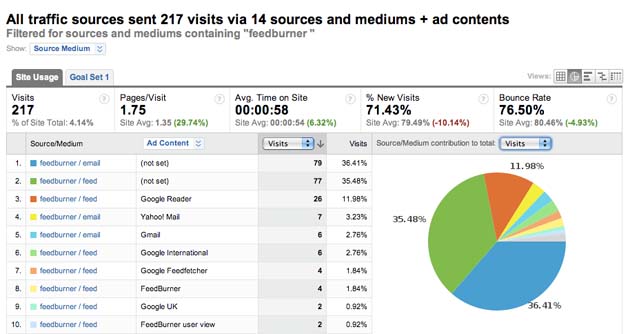
More distribution endpoint labels are on the way, too.
Hopefully this update will help people earn a little extra money heading into the holidays. At the least, it may simplify FeedBurner and AdSense for Feeds users’ lives a little, which would also represent a nice treat this time of year.
Related Articles:
> Google Launches Analytics For Mobile Apps
> Correcting Your Web Analytics Mistakes
> FeedBurner/Google Alum Goes To Twitter
 You might not want to wait until the day after Thanksgiving to pick up that Wii. Toys “R” Us is running a deal this coming weekend where you can pick up a Wii system and a Ready for Play Wii Pack for $249.




 Let’s imagine you’re seeing a case of pneumonia, and you suspect (as is quite reasonable these days) that it is precipitated by H1N1 influenza.

 There’s a certain type of man that wears cufflinks. Don Draper, for example, wears cufflinks. But he’s also a fictional character set in the 1960s. In the real world, these days, it’s usually the well-off that wear them. Basically, you need to have enough money to not care about spending hundreds of dollars on buttons.
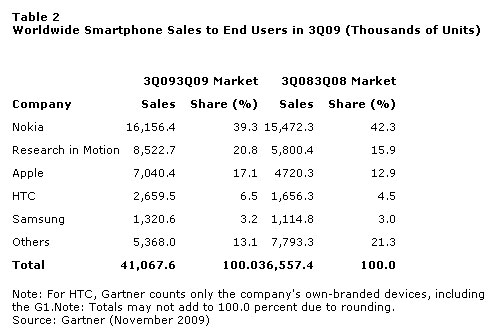
 Google’s Android OS-based phones and Apple’s iPhone maybe get all the media love, but one analyst firm believes that it will be RIM’s BlackBerry that will be the smartphone king of the U.S. market in five years. Pyramid Research expects the device to be the biggest beneficiary of the move to smartphones.