Blog

  • Wind Turbines on the Isthmus of Tehuantepec in Mexico, Can Achieve About 50% of Installed Capacity

    800px-San_Jose_Chichihualtepec

    2009Nov11: Wind turbines on the Isthmus of Tehuantepec in Mexico, can achieve about 50% of installed capacity because of wind speeds of 10 meters per second, according to Dana R. Younger, senior renewable energy adviser to the IFC – the private arm of the World Bank (The Wall Street Journal).

    Reference: The Wall Street Journal http://online.wsj.com/article/BT-CO-20091111-715851.html

    Image Description: San Jose Chichihualtepec, Oaxaca, Mexico. Photo by Joseadrian0593, 2005. Wikimedia Commons http://commons.wikimedia.org/wiki/File:San_Jose_Chichihualtepec.jpg Image Permission: The copyright holder of this work, hereby releases it into the public domain. This applies worldwide.

  • Online Video Rights: Why Technology Isn’t Enough to Bring About Change

    This morning’s Video Rights Roundtable was, as we hoped, a rare opportunity for online video industry players to talk about their conflicts and collaborations in the wild — not in a courtroom or conference room.  In a (more than) two-hour discussion, the nearly 50 attendees shared their perspectives on the increasingly complex world of rights, responsibility and opportunities surrounding online video content. Complete liveblog coverage is available at GigaOM Pro (subscription required), and Ryan Lawler was on-site with some additional event coverage at NewTeeVee. More links below the fold (and full event video coming soon!).  

    • In Round One, Ethan Applen, director of technology and business strategy for Warner Bros., talked about copyright enforcement as video content shifts online. While the DVD business was threatened by the emergence of digital piracy, he said that online distribution is even more vulnerable. To approach the problem, he said, the first line of defense is to make illegal consumption of content online more difficult. “That’s what we need to tackle,” he added (subscription required).

  • Facebook coming to PS3 in mystery update?

    PS3-Update-Rumor-Shot_02
    Some leaked screenshots from Sony show a PS3 interface with what looks like a native Facebook client configurable. There’s also a new photo browser and the ability to change the color of your gamercard, but at those features I make a dismissive gesture— thusly. A Facebook app would be handy, though a constant stream of status updates from heavy players might be lead to mutings by less gaming-orientated friends. “Devin found a new item!”

    But that’s just the usual pain that comes with convergence. Facebook integration was announced for the Xbox 360 back at E3, though it’s not yet to the point of an actual client. It’s been given a few test runs, and I have to say it looks a bit ugly in NXE form, but what doesn’t? I think what irks me the hipshot way the avatars stand. It isn’t right.

    facebook_xbox_360

    See?

    The one small picture of Facebook on the PS3 is at the top (yes, that’s all there is), and it’s not even of a client. It’s a user accounts configuration screen that happens to include Facebook. So it’s not much to look at, but it was traced to Sony UK’s site, so we’re pretty sure it’s legit. Sony “doesn’t comment on rumor or speculation,” obviously, so we won’t be hearing from them, but it would be ridiculous to think that a all-in-one entertainment device like the PS3 wouldn’t have Facebook on it eventually.

    While the ability to post interesting things to Facebook would be pretty limited with a Dual Shock and other inherent console limitations, I’m really loving the development of a meta-layer to the consoles that’s always floating just out of sight. Hit pause, check the latest tweets and status updates, grab another Fresca, and then back to the game. I’m not a part of it yet since the Super Nintendo doesn’t really have that level of connectivity, but I look forward to it once I actually buy into this new generation of consoles.

    [via Joystiq]


  • Facebook for iPhone developer goes from Apple supporter to ‘I quit!’ in 3 months

    By Tim Conneally, Betanews

    If you’re an iPhone user with a Facebook account, chances are good that you have Facebook for iPhone. In fact, it has roughly 17.3 million users, or about 28% of the 60 million users accessing Facebook on a mobile device.

    One of the developers who worked on that app is Joe Hewitt, who today tweeted: “Time for me to try something new. I’ve handed the Facebook iPhone app off to another engineer, and I’m onto a new project.”

    He’s not just leaving the Facebook project, but abandoning the iPhone altogether.

    Hewitt told TechCrunch today that he quit the project because of Apple’s strict approval and management policies in the iTunes App Store.

    He said: “My decision to stop iPhone development has had everything to do with Apple’s policies. I respect their right to manage their platform however they want, however I am philosophically opposed to the existence of their review process. I am very concerned that they are setting a horrible precedent for other software platforms, and soon gatekeepers will start infesting the lives of every software developer.”

    This is quite a turn of events, considering Hewitt’s last blog entry in August said: “No matter how annoyed I get, I will not stop developing for Apple’s platforms or using Apple’s products as long as they continue to produce the best stuff on the market. I never forget how deeply Apple cares about making their users happy, and that counts more than how they treat their developers. Besides, when I have a problem with a friend, I don’t threaten to boycott our friendship until they change, so I’m not going to do that to Apple either.”

    The developer he’s handed the app over to is Owen Yamauchi, a Facebook software developer and former Apple engineer.

    Copyright Betanews, Inc. 2009


    Add to digg
    Add to Google
    Add to Slashdot
    Add to Twitter
    Add to del.icio.us
    Add to Facebook
    Add to Technorati


  • Is Infochimps’ Aggregated Data a Boon to Researchers or a Privacy Nightmare?

    main_logoA pair of slices from a massive scrape of Twitter’s API could be of great use to programmers and researchers alike — as long as users don’t mind. The company behind the mining effort, Infochimps, is trying to demonstrate and promote its data aggregation service while offering up some useful information to interested parties.

    At the end of last year, Infochimps posted a heftier version of its scrape of Twitter, which was taken down at the behest of the micro-messaging site over user privacy concerns. By releasing curated, anonymized chunks of data, the company may avoid most of the user privacy concerns that arose last time around. Then again, it may not.

    One of the sets, a “token count,” adds up the number of particular tokens (individual hashtags, smileys and URLs) that have been tweeted since March 2006. The other links the ID strings between Twitter’s Search API and the standard Twitter API. The two APIs issue different ID numbers to users, which makes it annoying, if not impossible, for developers to link data across both services to one user.

    Infochimps says it hopes “to send a signal that this data is valuable and useful to real-time search engines, Twitter apps, and social media researchers.” It also hopes to “start a conversation about where value really lies in this type of data, [and] the various ownership and privacy issues that arise.” Given the complaints from Twitter the first time data was posted, it’s a smart move on the part of Infochimps to add this disclosure and thoroughly anonymize the data. The company very much wants to avoid any sort of ill will or backlash from the Twitterati over the release of the data sets. Back in 2006, AOL Research released 20 million search keywords attached to user IDs for researchers to use. A number of individuals were identified as a result of the “anonymized” data, leading to a number of concerns over what sorts of data are kosher to be released.

    Ownership and privacy aside, Infochimps is offering the “tokens” data set broken out by month for free, and $9,500 for a version broken out by hour. The “ID/API mapping” data set is being offered for $6,000.

  • Bing Managed Big Gain In October

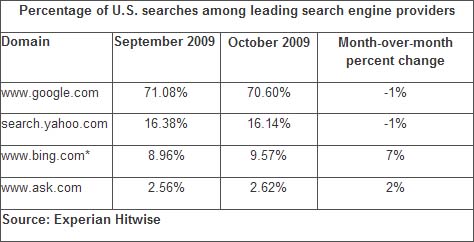
    According to new data from Experian Hitwise, October was the month of the underdog with respect to the search market.  The two search companies that usually dominate lost a bit of share, while Bing (and to a lesser degree, Ask) gained ground.

    Let’s start with the success stories.  Bing’s market share rose from 8.96 percent in September to 9.57 percent in October, which represents an increase of 6.8 percent.  That’s nothing to sneer at, even if Bing remains solidly in third place.

    Fourth-place Ask also made a small amount of progress as its share increased from 2.56 percent to 2.62 percent – a jump of 2.3 percent that’s far better than a dip.

    Meanwhile, Google came sort of close to losing its grasp on the 70 percent mark, slipping from 71.08 percent to 70.60 percent on a month-to-month basis.  And Yahoo fared about the same, moving from a market share of 16.38 percent to 16.14 percent.

    As always, it’s not smart to read too far into a single month’s search report.  Still, Experian Hitwise also recorded a Yahoo loss (and Ask gain) in September, so a trend may be starting to emerge.

    Related Articles:

    > Bing Gets A Bunch Of New Search Features

    > Watch: Bing Goes The Bloodsucker Route

    > New Bing Commercial Inspired By The Shining


  • Microsoft Patents Changing User Privileges Temporarily On The Fly

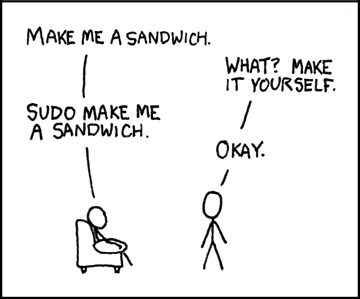
    Someone who prefers to remain anonymous points out that the USPTO, in its infinite wisdom, has granted Microsoft a patent (7,617,530) on a method for “elevating” a user’s rights temporarily. Basically, it’s for a non-admin user who wants to do something (e.g., install a program) that requires admin access, without having to logout and re-login as the admin. As the submitter notes, this sounds like “sudo” or any number of other tools that have been around for ages. Can we submit the following xkcd comic as prior art/evidence of obviousness?


    Permalink | Comments | Email This Story


  • iBuyPower outs its first Core i7 gaming notebook, the Battalion 101 W870CU & M980NU

    W870CU
    IBuyPower is back with a good looking Core i7 gaming notebook. The 17.3-inch Battalion 101 W8u0CU packs just about everything you would expect from a top-tier notebook with the a price tag to match. Or you could opt for the M980NU and net a huge 18.4-inch 1080p LCD. That is, of course, if you don’t ever plan on moving the damn thing.

    The W870CU fun starts out at $2,114 and comes equipped with a 17.3-inch, 1080p LCD three different Core i7 CPU options, up to 8GB of memory, a Blu-ray combo drive option, up to a 500GB HDD or 256 GB SSD options, and a 1GB Nvidia GTX280 GPU. But if you must have the biggest LCD option, the M980NU has the same hardware options but packs a 18.4-inch 1080p LCD instead. This boy has a starting price of $2,505. Both are available now.


  • My Video Interview With Joe Hewitt, Facebook’s iPhone App Guru

    Much of Facebook’s success on the iPhone has come courtesy of Joe Hewitt, an ace programmer who joined the world’s largest social networking site when it acquired Parakey, a company he co-founded with Firefox kid Blake Ross. Hewitt has now decided to shift his focus away from the iPhone. In a tweet sent out earlier today he said, “Time for me to try something new. I’ve handed the Facebook iPhone app off to another engineer, and I’m onto a new project.”

    Joe was named to GigaOM’s Top 15 Mobile Influencers list earlier this year for his contributions to the iPhone app ecosystem — in particular, for single-handedly turning Facebook into a major force on the iconic Apple device. I recently gave him a hard time over the delays in launching Facebook 3.0, which prompted Joe to stop by our office and take part in an impromptu video chat. Here are the excerpts from that conversation.

  • Zombieland Director Goes After Fans, Doesn’t Understand Popularity

    Charles Vestal alerts us to the news that Zombieland writer/director Rhett Reese has apparently be using Twitter to shame people who were mentioning that they were watching unauthorized copies of Zombieland at home, declaring to each one: “You realize we do what we do for money, right? Same as you.” This comes soon after we highlighted some directors and moviemakers have found success by embracing those who were downloading their movie, recognizing that it was leading to more sales.

    And, in fact, at least some of the people that Reese called out complained that they had actually seen the film multiple times in the theater and planning to buy the official DVD once it came out as well. In other words, the reason the movie is downloaded so much is because people like it, and yes, they still are supporting the moviemakers.

    So, what made Reese lash out at these fans? You guessed it. He claimed he had just watched the 60 Minutes episode on movie piracy — the one that we debunked for being factually incorrect, and it resulted in him getting angry at these fans, without thinking through the fact that the download might not be a substitute. But, even after the fans told him they had seen the film multiple times in the theaters, he’s complaining that this decreases the chances of a sequel getting made. Given the massive popularity of the film — both in the theater and online — that seems highly unlikely. As we’ve seen before, the popularity of a movie in unauthorized downloads closely correlates with its box office take in many instances. It’s rarely a sign of “lost revenue,” and quite often a good indicator of actual revenue. In fact, the details show that Zombieland has done amazingly well, already earning back much more than it cost. Reese has a strong and loyal fanbase who want to support him and a very successful movie on his hands. Rather than attacking them, he should look for ways to embrace them and give them more real reasons to buy.

    Permalink | Comments | Email This Story


  • The Droid receives the obligatory teardown treatment

    DroidExplosion
    Did the HTC HD2 teardown from this morning leave you wanting more? Here’s the Droid splayed out for the whole word to see.


  • Google Tries To Save You From Swine Flu

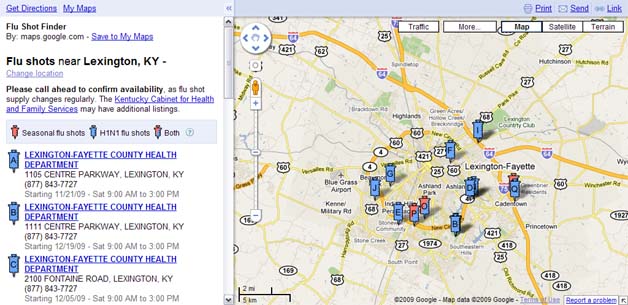
    The media frenzy over swine flu may have died down a little since earlier this year; it’s no longer a top headline on every other news site, at least.  But people remain extremely concerned about it (anyone care to guess how many tons of hand sanitizer have been sold?), and Google’s trying to help out by pointing them towards flu shots.

    A post on the Official Google Blog announced this afternoon, "We’ve been working with [the U.S. Department for Health and Human Services], the Centers for Disease Control and Prevention (CDC) and state and local health agencies to gather information on flu vaccine locations across the country, particularly for the H1N1 flu vaccine . . . .  At the moment we have data for locations of flu vaccine directly from 20 states and counting."

    The post then added, "We are also continuing to add information from chain pharmacies and other providers in all 50 states; today, you’ll find results from chains such as Walgreens, CVS and PDX participants, such as Kmart, Duane Reade, WinnDixie and Giant Eagle."

    The new feature seems to work quite well.  If you intend to follow through on its suggestions and receive a shot, just call ahead to play it safe.  Unless you need to buy some more hand sanitizer, anyway, that is, or perhaps want to pick up a few surgical masks from the corner market.

    Related Articles:

    > Google India Closes Office Due To Swine Flu

    > YouTube Highlights Global Leaders’ Response To Swine Flu

    > Swine Flu Fears Overrun Web

  • Widality President and Momentem developer talks lessons learned

    091024 no1 business app screenshot

    As the developer of one of the most popular business category apps on BlackBerry App World – “Call Time Tracker by momentem” – Terry has learned a lot about how to build a compelling app. In this article, he talks about how he spends his day, and there are some valuable lessons in this article for all app developers.

    Terry writes:

    After users download our app, they have to enter their email address to sign up for our free service. These days, most people are wary of doing that, so to overcome that our description on App World has to be sufficiently friendly and credible; the end result is that 70% of all downloads sign up for the service with a valid email address, which we believe is industry-leading.

    The following day I send a welcome email to each new user, personally welcoming them and giving them tips and tricks on how to get up and running. OK, I don’t manually type them all, I use an email marketing package, but they are simple plain text emails, with no nasty trackable links, with my personal email address for them to reply to. People immediately feel they have a connection with our small company and they reply in large volumes. I am now addicted to receiving their emails every day.

    I don’t push people away and ask them to fill in forms, they simply reply to my email and tell me what’s on their mind. They tell me what they like and don’t like, they tell me how they are using the app to make more money, and most importantly they tell me which features they would love to see added! I add the users to my database of “fans”, so that I can ask them later on to join beta tester groups and focus groups.

    I also personally see every support request and every cancel form, so I feel the users’ pain as they work with our service. I personally follow up with as many support issues as I can, to ensure we have dealt with their request. They love that.

    I literally spend 4 hours of every day engaging with our customers, and I can tell you that it’s the most valuable thing I could be spending my time on. I also spend time every day tracking our key metrics; downloads, sign-ups, the number of call tags being processed every day, email opt-outs, support issues, cancel reasons, and user demographics. I am constantly taking the pulse of our business which enables me to make fast and accurate decisions.

    When we launched on App World, we found that the early adopters were eager to write in with enthusiastic praise. Then, as we moved into the early majority phase, they were far less engaged. So we had to change our techniques and we have now figured out how to get our new users to become equally excited over what we are delivering. Tweak the wording, measure the response, try something different, measure the response, over and over again, and because the app market is evolving the work is never done.


    So, what has this time-consuming process of engaging with customers bought us?

    • Our user reviews are among the best on App World and our average ranking is 4.5 out of 5; people write long useful reviews because they want to help me and because they feel an affinity to my company. Even if users are unhappy to begin with, we resolve their issues so they have no desire to bad-mouth us.
    • Around 10% of all downloads are using our app on a daily basis, even months later, so we have proved that stickiness and loyalty can be earned.
    • We all know how critical word of mouth is; many of the reviews say things like “I tell everyone I know about your great service” and many people have blogged avidly about us.
    • We have learned so much about who our users are and how they use the app.

    The fact that I spend 4 hours a day with customers is a nice problem to have. The acronym “AI” used to mean “artificial intelligence”, but based on what my team has learned in the past few months I think we are pioneers in the all-new world of “App Intelligence” !

    I would be more than happy to receive emails from other developers on this subject …. and I will personally respond to them all ;-)

    © Kyle for BlackBerry Cool, 2009


  • Samsung Behold II To Launch November 18th Priced $199.99 From T-Mobile

    The guys over a tmonews.com have managed to get their hands on an pricing sheet for T-Mobile’s upcoming Samsung Behold II Android phone.

    According to the leaked info, the Samsung Behold II will be available on T-Mobile priced at $199.99 as part of a 2 year service contract with the network.

    samsung behold 2

    Alternatively the handset will be available contract-free for $449.99 or 20 monthly payments of $22.50.

    The Samsung Behold II features a 3.2-inch AMOLED touchscreen display, 5 mega-pixel camera and the TouchWiz User Interface.

    The TouchWiz UI will enable users to quickly and easily customize up to 3 different home screens, along with a ‘cube menu’ that provides quick access to a number of multimedia features including music, photos, videos, the Web, YouTube, and Amazon MP3.

    samsung behold II

    The handset also includes 3G, Wi-Fi, GPS, and Bluetooth 2.1 connectivity, along with up to 16GB of expandable microSD memory.

    The Samsung Behold II is expected to launh on November 18th.

    [via tmonews.com]

    If you’re looking for more info on the new Verizon Android phones, then be sure to check out Droid Forums & Droid Eris Forums

    Samsung Behold II To Launch November 18th Priced $199.99 From T-Mobile

  • Palm Pixi gets unboxed before its release

    Palm-Pixi-13

    Oh, you don’t remember? Well we’re back at it again, this time with one of our connects doing the unboxing ritual for us. There’s not all that much exciting to report, you know, with the handset shipping with a USB cable, charging adapter, instruction manual and battery. But hey, an unboxing is an unboxing damn it, and we’ve got the goods. We promised ourselves we weren’t going to take any shots but, with the Palm Pre going for $99 in Canada and the awesome HTC DROID Eris selling for $99 on Verizon, is anyone really going to spring for a $99-priced Palm Pixi? Only time will tell.

    Thanks, Ninja J!

    Palm-Pixi-1

    Palm-Pixi-2

    Palm-Pixi-3

    Palm-Pixi-4

    Palm-Pixi-5

    Palm-Pixi-7

    Palm-Pixi-8

    Palm-Pixi-9

    Palm-Pixi-10

    Palm-Pixi-11

    Palm-Pixi-12

    Palm-Pixi-13

    Palm-Pixi-14

  • Nurse Practitioner’s Response to The American Spectator’s View Of The New House Health Care Bill

    Below is Peter Ferrara’s opinion of the Health Care Reform Bill that is being considered. I am offended by two points that he makes while referencing health care providers. Read and then go to below to see what I was having a problem with..

    One confusion arising from the House bill is that its provisions are phased in over several years. Over the first 10 years of full operation, the House bill actually cuts Medicare by $800 billion, as scored by CBO. The cuts for Medicare Advantage plans will be close to $200 billion, and despite President Obama’s phony shtick that if you like your health plan you can keep it, the Administration itself estimates that 8 million seniors will lose their Medicare Advantage plan as a result, 73% of those with such plans.

    This is the beginning of health care rationing for seniors, as the payments to their doctors and hospitals for the care that currently maintains their health will be slashed back. In addition, as Betsy McCaughey explains in the Journal, the House bill moves Medicare from a fee-for-service payment system, in which patients choose which doctors to see and doctors are paid for each service they provide, toward what’s called a “medical home.” The medical home is this decade’s version of HMO restrictions on care. A primary care provider manages access to costly specialists and diagnostic tests for a flat monthly fee. The bill specifies that patients may have to settle for a nurse practitioner rather than a physician as the primary care provider. Medical homes begin with demonstration projects, but… HHS…is authorized to “disseminate this approach rapidly on a national basis.”

    What this means is that your doctor is paid a flat monthly fee for your care, and referring you to a specialist or for a diagnostic test effectively comes out of his pocket. So if you need an MRI or a CT scan to see if you have cancer, or to check if that pain in your chest is due to clogged arteries, or if you need to see a specialist to treat cancer or heart disease, the doctor has a financial interest to delay or deny it. Financially, if you are actually this sick, he will be better off if you die sooner rather than later. That is the result of the perverted, inverse incentives the House health bill creates for medical providers.

    I don’t like the inference that one would have to “settle” for a Nurse Practitioner. If you ask my patients, they will tell you that they prefer to see a NP over a physician anyway.

    His idea that primary care providers are the gatekeepers is nothing new. It’s been that way since I can remember. Most specialists require referrals from a patient’s primary.

    My biggest gripe is the insinuation that ANY health care provider would EVER not use whatever resources it takes to accurately diagnose a patient. If a doctor or NP or PA ever kept a patient from being diagnosed because it would take money out of their own pockets, they should be run out of health care immediately! True health care professionals are not just in it for the money. They really like helping patients and feel a moral obligation to do so. Of course we all need to pay the bills and I can’t afford to do it for free. One day, I will be able to donate my services as so many do. Till then, I will keep on taking care of the patients who prefer me! Carry on..

    P.S. This is the response I left on this blog article.

    I find it a little insulting that you think that patients “settle” for a NP. My patients prefer me to other physicians and will tell you so. I am a great health care provider with patients who actually come back and do the necessary maintenance to remain as healthy as they can be. I serve in a rural community who is having a very hard time attracting physicians. I find it appalling that you would think that any health care provider would keep a patient from appropriate testing in order to line their own pockets. If they are doing so, they need to be run out of health care. I take care of patients because it’s a calling and not just because it pays well. I am curious to see if you have ever seen a nurse practitioner in action before you make snap judgments about the quality of our care.


  • Bing vs. Google rematch on video search

    By Scott M. Fulton, III, Betanews

    Banner: Hands On Review

    We’ve known that Microsoft still has work remaining in its itinerary to build Bing into a more competitive search engine — we knew at launch time that not every feature would compete on an absolute par against Google. If it did, then MSN and Windows Live would have been far more popular. But when Microsoft steps forward to say, “Now, we really have something competitive in this department,” it’s difficult to give Bing the same number of “Mulligans” as we did at the beginning.

    This morning, Microsoft rolled out some replacements to its old MSN Video search engine — which had remained online all this time — to produce Bing Video. Like Google Video and unlike YouTube, Bing Video is not a host; it’s a search service for publicly accessible videos. So YouTube videos, although hosted by Google, should appear on Bing as well. The differentiator here, theoretically, should not be inventory, since both services should have access to the same material. Instead, it should be how the material is presented, and whether the search process provides access to not only what the user is looking for, but material that may also be pertinent, relevant, and interesting.

    So this Betanews comparison does not pit Bing against YouTube — let’s be clear about that. This compares Bing Video against Google Video, similar to our initial test of the two services last June.

    With today being Veterans’ Day in the US, I decided to devote our search themes for this contest to the bigger, braver battles that Americans have fought in the interests of our freedom and prosperity, so that we’re able to spend time dealing in more mundane things like browsing through videos. I began with an easy search for “D-Day” footage — I want to see if I can locate the small amount of actual footage shot of the Allies storming the Normandy beaches.
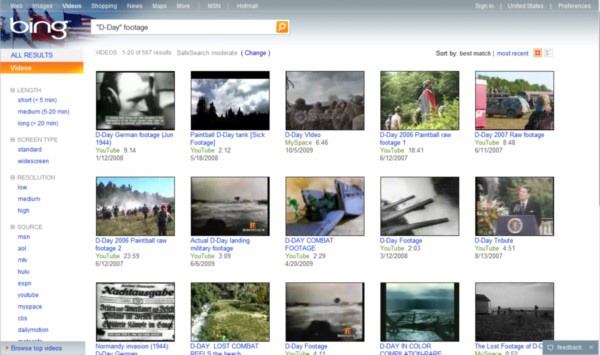
    A search for D-Day videos in Bing Video Search doesn't necessarily pull up footage of the historic event.

    What’s D-Day to some of us who appreciate the extreme sacrifices of the Allies in saving the world, isn’t D-Day to everyone, apparently. Since search engines trust the titles of videos to be truthful about their contents, 6 of the first 20 results returned by Bing actually showed amateur video of paintball competitions called “D-Day,” and one was a stop-motion animation using plastic soldiers attacking a beach fortification made of Styrofoam.
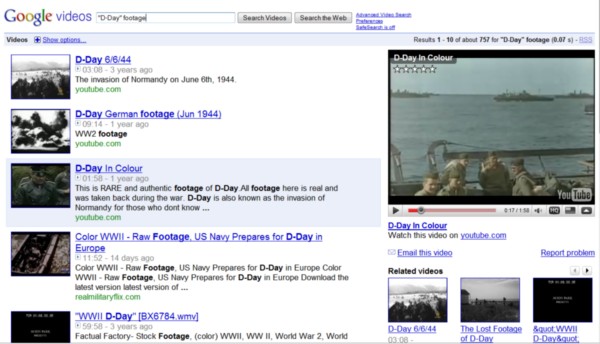
    The same search for D-Day footage in Google Video Search has a few anomalies, but is more historical.

    By comparison, the first 15 items returned by Google were of legitimate historical D-Day footage, while #16 was the same silly Styrofoam recreation. (The title does say “D-Day Lost Combat Reels,” but the word “stop-motion” might also give other clues.) In all, 17 of the top 20 videos Google returned contained D-Day footage, while one contained recent footage of the D-Day Memorial in Normandy.

    You’d think adding material to the search would narrow things down significantly — for example, making the query “D-Day” footage Normandy invasion. And for Google Video, it does, with the first 45 items retrieved showing authentic Normandy footage. Only item #46 in Google’s retrieval shows footage from paintball competitors (even though “Normandy” is nowhere close to “Oklahoma”). Item #12 for Bing Video involves paintball, while #11 shows footage of a legitimate amateur D-Day recreation in Ohio (again, nowhere close to Normandy).

    In browsing through selected videos, Bing continues to show one of its bright spots: the ability to play a segment of the video directly within the thumbnail, complete with sound, before the user actually selects it. This gives the user more of an opportunity to see whether this is actually something she really wants to be seeing. Google Video currently has no counterpart to this, and it really should, although one wonders whether Google’s looking for an opportunity to roll the feature out when no one is noticing.

    This is especially useful for previewing videos hosted by other sites, especially universities, where embedding isn’t normally supported. For example, when we tried a search for the classic 1952 Edward R. Murrow See It Now documentary on “Christmas in Korea” (the query here being Korea Murrow “See It Now”), most of the sites with the longest relevant clips (some of them including the Korea show, some not) are on a non-embedding site, such as Kansas University’s Journalism Dept. Pulling up the whole video would mean leaving the search engine.

    However, a video’s thumbnail alone doesn’t often tell you whether it might contain a minute or two from the edition featuring Murrow’s tour with US troops in the Korean War. So Bing’s ability to preview even non-embeddable videos here is extremely helpful; with only a thumbnail to go on, the only way for you to test a video pulled up by Google is to travel off-site.

    Next: Presentation is the key…
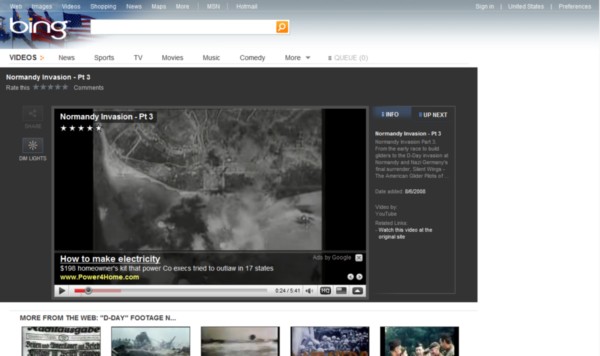
    Bing displays videos from some services in a much more appealing layout than Google.

    Once you’ve selected a video from a site that supports video embedding (so that you don’t leave the context of the search engine), Bing is capable of displaying it in a more pleasing frame than Google. A dark grey viewing region, coupled with light grey text on dark for the description, is much easier on the eyes than Google’s layout, which essentially hands over a pre-annexed rectangle to whatever service is providing the feed (YouTube, DailyMotion, MySpace, etc.).

    Google Video does add an extra space below the playback region, for “Related Videos.” Now, you’d think that your other query results would be full of related videos; but there’s a good reason why these are here: A pre-catalogued index placed these items here, as belonging to the same general category as the video being viewed.

    That’s an important feature that Bing Video lacks, although the “More from the Web” section does present more items from the query in a more optimized layout: two rows of five each, rather than one long column of ten like Google.

    Bing Video would still benefit from stepping aside even further, however, from its former role as a YouTube competitor. Like Google Video, Bing Video should realize that the user of a search engine isn’t really a browser, or a “person who browses” — he’s someone who’s looking for something specific. So showing “Recently Commented Videos” and “Most Watched” videos on unrelated topics to the search at hand, is not a help but a hindrance in this context. When I care about D-Day, I don’t care about Lady Gaga. (Frankly, I don’t care about Lady Gaga at any other time either, but that’s beside the point.)

    Another feature Bing Video could stand to lose is “Up Next,” a holdover from the MSN days. Here, the service has pre-selected a queue of videos for you to watch — not videos pertaining to your search, just something it happened to pull up. In our case with D-Day, Bing Video (or rather, MSN) pulled up an interview with the star of Fox Television’s “Glee,” and an award ceremony interview with Oprah Winfrey’s friend Gayle.

    If Bing is supposed to be a “decision engine,” as Microsoft’s ads put it, then there is no reason for these videos to be here unless they pertain to the search at hand. This is no longer MSN Video, the place to go when you have no place to go and you want the Web to take you somewhere — the Internet equivalent of Sominex. Bing Video is a tool, and should be treated like one. For more on that subject, I would recommend that Bing’s people pay a visit to Bob Muglia at the Tools division of Microsoft.

    The verdict

    Last June, in our initial test just after Bing’s premiere, I gave a very slight edge to Bing Video over Google Video for presenting more sensible results. But I issued a warning to Bing about adopting strange, Microsoft-ian patchwork features like adding wild terms like adlt=strict to the end of queries to guarantee explicit content filters work. There shouldn’t have to be “guarantees;” the feature should either work or not. However, Google, in a never-ending race not to be outdone even with questionable features, has since added a similar feature to Google Video.

    The qualitative distance between the two video search engines remains very slight. In some cases — like with the query “Civil War” Appomattox re-enactment — the search results were essentially identical, just shuffled around a bit. However, for the most part, it does not appear as though Google has devoted as much effort into improving not only the video search process, but also the presentation, as Microsoft with Bing Video.

    Now, those frivolous and unnecessary holdover features from the dark ages of MSN, such as “Up Next,” can be let go anytime. But being able to preview videos as videos is a very compelling feature that still tips the scales toward Bing for now. For Google Video to catch up, it needs to add this feature, and it needs to rearrange the layout of its search results to something more functional. That’s something that can happen tomorrow.

    But that’s the thing with Google these days, isn’t it: These things can happen tomorrow, and they don’t. You never know with Google when something will get back on-track, or fall back off the track. That uncertainty may be Microsoft’s key to maintaining the edge in this and other key departments for Bing, and reclaiming search share one bite at a time.

    Copyright Betanews, Inc. 2009


    Add to digg
    Add to Google
    Add to Slashdot
    Add to Twitter
    Add to del.icio.us
    Add to Facebook
    Add to Technorati


  • How much to tour Bill Gates’ house? About $35k

    gates-house-3Microsoft (and particularly Bill Gates) is well known for it’s philanthropic work, including a charity auction conducted each fall. One of the most popular items donated is a tour of the Bill’s famous Lake Washington home. Last year, the highest bid was $8,600. This year, the bidding skyrocketed up to $35,000!

    These amazing numbers were mentioned to the Seattle blog Techflash during a presentation from Microsoft’s CIO Tony Scott. I have to say, while the house is amazing, $35k seems a bit steep for a tour, but remember this is for charity. Also part of the same auction, the “world’s best bologna sandwich” topped out at $500 this year. No word if you would be allowed to eat the sandwich while touring the house though.


  • The Crunchies Are Back for Round 3!

    crunchieslogo.jpgThe Crunchies, after two successful years, are back to celebrate the entrepreneurs and startups that make technology such an exciting industry. As always, we will be co-hosting the awards — for which nominations are now being accepted — with VentureBeat and TechCrunch. (Check out the photos from last year.)

    Details of the event can be found here. The awards ceremony will be held Friday, Jan. 8 at 7:30 pm at the Herbst Theater in San Francisco and will be followed by an after-party across the street in City Hall’s Grand Rotunda. The nominations for the third annual awards ceremony honoring the best technology achievements of 2009 will remain open through midnight PST on Friday, Dec. 4th. The Crunchies Committee will select five finalists for each of the 18 award categories; final votes will be cast between Dec. 12th and midnight PST on Jan. 6th.

  • AN ECOPRAGMATIST MANIFESTO

    WHOLE EARTH DISCIPLINE: AN ECOPRAGMATIST MANIFESTO
    By Stewart Brand
    Viking, $25.95, 336 pages
    REVIEWED BY MAX SCHULZ  in the Washington Times

    "If Greens don’t embrace science and technology and jump ahead to a leading role in both, they may follow the Reds into oblivion."

    That’s strong, hard-hitting stuff. However, the author who derides environmentalists as anti-intellectual Luddites and compares them to communists isn’t Michelle Malkin or Glenn Beck. It’s Stewart Brand, one of the world’s leading environmentalists and a founder of the modern green movement.

    …The green left’s policy prescriptions arise from a reflexive opposition to the things that have built our technologically advanced, urban society.

    Hence, the greens have made theirs a movement of opposition. They oppose large-scale energy development and consumption. They push a regulatory structure that clamps down on private corporations and landowners in a bid to stop them from despoiling the environment. They oppose scientific efforts to improve food production to feed billions because that just means supporting more people who do damage to the planet.

    Mr. Brand’s "Whole Earth Discipline" says, in effect, that it isn’t enough just to oppose. In fact, in some instances, that opposition has been disastrous.

    "I daresay the environmental movement has done more harm with its opposition to genetic engineering than with any other thing we’ve been wrong about," he writes. "We’ve starved people, hindered science, hurt the natural environment and denied our own practitioners a crucial tool."

    He notes that "Silent Spring" author Rachel Carson, patron saint of the modern environmental movement, actually encouraged pursuing the science of biotic controls, i.e. genetic engineering, but that greens have rejected that counsel in defense of a bizarre idea of what is "natural.

    BOOKS: ‘Whole Earth Discipline’ – Washington Times