Blog

  • Key Senators Could Influence – Even Halt – Action on Health Bill

    In anticipation of the full Senate debate on health reform, news organizations are keeping tabs on lawmakers who could become players – or obstructers – when the bill hits the floor.

    The Washington Post: Sen. Tom Coburn, R-Okla., “has no faith that Congress will improve America’s health care system and says the Senate even makes it hard for him to heal the sick. He recently had to stop delivering babies and now only sees a few patients for free because of what he calls absurd rules governing outside compensation for U.S. senators” (Jordan, 11/10).

    The Burlington Free Press: “As the spotlight on health care reform shifts from the House to the more conservative Senate, Sen. Bernie Sanders, I-Vt., will be pushing for a hard left turn in the form of a single-payer system.” Because even Sanders admits such a plan would not be politically viable nationally, he is pushing to allow states to create their own, miniature single-payer systems (Gaudiano, 11/10).

    Roll Call: Sen. Ben Nelson, D-Neb., a moderate, said he would not vote to allow a reform bill to be debated unless it includes language restricting federal funds to be applied towards private insurance plans that cover abortions (Drucker, 11/9).

    New York Times: Senator Susan Collins, a Maine Republican and pivotal centrist courted by the White House, delivered a blistering critique of the Senate bill on Monday, saying she could not support it because it would increase insurance costs for many middle-income families and small businesses (Pear, 11/9).

  • Senate Braces For Final Reform Drive

    Roll Call: “Senate Democratic leaders are still pushing to bring up their health care reform bill next week, even though the gambit comes with risks as they race against the clock to get a measure passed before the end of the year.” In his effort to bring the health bill to the floor next week before the Thanksgiving recess, Reid “appears to be calculating the public relations dangers of suspending debate” for the weeklong recess “do not outweigh the need to get the debate rolling” (Pierce, 11/10).

    The Hill: “Senior aides and senators say Democrats plan to pivot quickly and file the first procedural vote as early as Monday. A ‘motion to proceed’ vote, which brings the bill to the floor, would require 60 votes — a first, critical test of the caucus’s unity on procedural votes.” Meanwhile, the Congressional Budget Office is expected to complete its cost analysis of the Senate Democrats’ reform bill “by the end of this week or early next” (Rushing, 11/9).

    McClatchy: But the GOP definitely plans to use the Senate’s procedures to their advantage. “Republicans Monday had new hope that they could influence health care deliberations — influence that’s so far eluded them — as the debate moves to the Senate, where the rules and the politics can work to their advantage,” meaning, the Democrats may have difficulty reaching the necessary 60-votes without listening to the more conservative lawmakers Republicans are now working to sway (Lightman, 11/9).

    CQ Politics: “Senate Majority Leader Harry Reid insists that he and his colleagues refuse to be ‘bound by any timelines’ on health care legislation. But House passage of its overhaul bill this weekend has created momentum for — and pressure on — the Nevada Democrat to push forward on a Senate version by year’s end” (11/9).

    The Christian Science Monitor: Five “flash points” to watch in the debate will be: (1) the public option; (2) the cost of the plan; (3) the revenue-raising measures; (4) mandates for people to buy coverage; and (5) abortion (Feldmann, 11/9).

  • Today is Netflix on the PS3 day

    ps3flix (1)

    PS3 owners no longer have to be jealous of Xbox 360 owners. Now, they too can stream Netflix goodness through their gaming console of choice. That is, with a little help from a free Netflix disc they can.

    The loader disc should have arrived last week for those that jumped on the offer right away. Just pop that Netflix disc into your PS3 to load-up the software and away you go. Of course you have to use that disc, which activates the service via Blu-ray’s BD-Live service, every time you want to stream something from Netflix, but it’s better than nothing. Hopefully Sony and Netflix are working on a software update that will enable the service without this step. Hopefully.


  • Google Gives AdWords Users New Alert Options

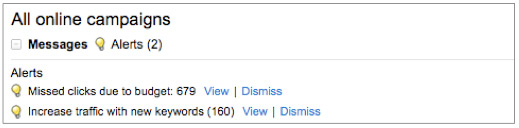
    Google has introduced a couple of new alert options for AdWords advertisers. Users can of course use account alerts, and can also use custom alerts. Now Google has added new alerts for keyword and budget ideas, which are personalized tips to help users improve their campaigns’ effectiveness. These are in the "opportunities" tab.

    "New ideas are usually generated for campaigns and ad groups every few weeks, but you may miss ideas that can expand your coverage and boost your traffic if you don’t check the Opportunities tab regularly," explains Google’s Dan Friedman. "Now, when there are new ideas available for your review, you’ll see them highlighted along with the rest of your campaign alerts."

    AdWords alerts

    Google has also added the ability to create custom alerts for changes in conversion volume, conversion rate, and cost per conversion for users using AdWords conversion tracking.

    "By setting alerts for your conversion data, you can make sure that you’re quickly notified about fluctuations in your key metrics," says Friedman.

    Google says it is still working on bringing custom alerts to all linked accounts for My Client Center (MCC) users, but until then, you can just set custom alerts for individual accounts if you can log into them directly.

    Related Articles:

    > Google Gives AdWords Advertisers New Comparison Option

    > Google Launches Latest Version of AdWords API

    > More "Ads by Google" Across the Web

  • Recent ‘Death Panel’ Uproar Echoes Age-Old Controversy

    Kaiser Health News staff writer Christopher Weaver details events similar to this summer’s “death panel” controversy, but that happened decades ago. “It was early summer. A senior federal health official wrote a memo suggesting that living wills — documents that can convey patients’ wishes about when to end life support — could help curb health-care costs. The memo leaked to the media. By August, a New York Times’ column said the official ‘likes euthanasia.’ Sound like this year’s angry August? Well, this story unfolded in 1977, and the official in question was Robert Derzon, the first administrator of the Health Care Financing Administration, now the Centers for Medicare and Medicaid Services (11/10). Read entire story.

  • Putting the USPTO to Work for Independent Inventors

    My first few months at the USPTO have been exciting and inspiring, and I feel privileged to be leading the USPTO at this critical time for the IP community, and the country as a whole. When I was sworn in 90 days ago, I came in with a clear mandate from Commerce Secretary Locke to fix our broken patent system and reduce the backlog that has hamstrung innovation and hindered job creation and economic growth. We have ambitious goals and, with your help, I feel confident that we can achieve them.   

    I want to take this opportunity to salute the hard work and dedication of the USPTO’s highly capable staff.  As I’ve commented at various events the last several months, the USPTO team is every bit as smart, intense, thoughtful, passionate, and hard-working as any I have ever worked with in the private sector.  And I want to thank the IP community for its valued input and support these past few months.  In order to foster as active and open a dialogue as possible with our stakeholders, we are launching the Director’s Forum public blog. I hope this will be a useful vehicle for sharing ideas and concerns on a regular basis.   

    This past week, I had a chance to participate in the 14th Annual Independent Inventors Conference here at the USPTO campus in Alexandria. This conference, which brought together almost 200 members of the independent inventor community from around the country, was an opportunity to rededicate ourselves to serving the independent inventor community in the ways we already do and to finding new ways to be of service. It was also an opportunity to reflect on what we have accomplished thus far, and to elaborate on some of our priorities from the standpoint of the independent inventor community.

    Thousands of independent inventors and small businesses do critical R&D every day and produce innovative goods and services that benefit the public in so many critical areas. Surgeons invent new tools to save lives right there in the operating room, young people find new ways to write software in a school computer lab, and independent inventors create solar chargers – and a short while later that solar charger has created 900 good jobs here in America.   Innovation generated by the independent inventor community will play an even more central role in the future of the American economy.  To make sure that happens, we must provide you with the incentives and protections of an effective, modern patent system – and we must have a functioning patent system that unlocks funding for start-ups and small businesses.

    How can we best accomplish that?   We have already moved swiftly to implement much needed reforms in the patent examiner count system and have provided incentives that will improve the examination process and reduce pendency. We have rescinded the claims and continuations rules that would have penalized the innovation community. And we have just adopted an application exchange pilot program that is specifically designed for small entities. This program will allow independent inventors and qualifying entities to receive special status for one application in exchange for withdrawing another application that may no longer be needed. Since last year we have noticed a significant upturn in cases being abandoned after the first office action, without reply to the first office action. With this in mind, the program enables applicants to focus USPTO resources on what is important, rather than having examiners review applications that are no longer important to their owners. This allows our users to help us prioritize our workload and will help clear the backlog.  It is a win-win, and we will be actively looking for other such opportunities.   

    In order to fully serve the needs of everyone in the innovation community, however, Congress must pass patent reform legislation.  The legislation being drafted in Congress will ensure that the USPTO gets the funding it desperately needs to operate efficiently and to protect the intellectual property rights of all innovators. And it will give the USPTO the fee-setting authority it needs to do business.
     
    I know that many independent inventors, like most segments of the IP community, have concerns about some of the provisions in the bill, and I had the opportunity to address some of these concerns at last week’s conference. The legislation is the product of a series of compromises in the eyes of virtually every segment of the IP community.  But it is also a vast improvement over what we have now – and there is a strong consensus that the status quo is simply unsustainable.  It is therefore gratifying to have had such an open, vigorous and fact-based discussion on areas of particular concern to this community – namely, the proposed revisions in the post-grant review process and in the priority filing system.

    As I said last week, we’re working with Congress to ensure a fair and balanced approach to post-grant review.  But it needs to be cost-effective and fast, and the bar has to be set high enough to protect against abuse and serial challenges.  Non-meritorious requests should be summarily denied.  And challenges should be quick and cost-effective, and ideally produce a virtually bullet-proof patent at the end of the process.  
     
    With regard to the patent-priority system, the bill’s proposal to move to a first inventor to file system really represents only a minimal change to the process we use now.  The new system would not create a situation where someone could steal an idea and win a race to the patent office.  That person would not be an inventor and would not be eligible for a patent in the first place.  Keep in mind that there are stiff penalties in place to protect against that.  So the real issue involves the case of simultaneous non-collaborative invention that is currently resolved through the interference system.

    The truth is that only .01 percent of all patent applications could be affected by a change to first inventor to file. The interference system is already biased in favor of the first inventor to file and 70 percent of the extremely small number of cases that get into the interference process are decided in favor of the first inventor to file.  For more on these and other issues, I would encourage you to read the text of the speech I gave at the Conference on our Web site.  

    In closing, I want to hear from you. All of us at the USPTO know that we benefit immensely from your input.  We are here to serve all segments of the IP community better. And I am committed to doing what is good for every stakeholder group and every segment of the IP community. That is my pledge to all of you.
     
    Thanks for reading, and I hope you’ll stay tuned.  
     

  • Political Cartoon: ‘A Christmas Carol’

    Kaiser Health News offers a fresh perspective on health policy developments with David Fitzsimmons’ “A Christmas Carol.”

  • Palin Resurrects ‘Death Panel’ Claims, Controversy Is Decades-Old

    CBS News reports: “Sarah Palin has returned to the battle over health care reform with a familiar refrain, slamming what she and others dubbed ‘death panels’ over the summer. Following passage of the health care overhaul in the House on Saturday night, Palin took to her Facebook page to register her well-known opposition to the Democratic plan. The former Alaska governor and Republican vice presidential nominee has received the most attention for coming back in the post to her claim that the bill contains so-called ‘death panels’ – despite the fact that numerous media organizations and nonpartisan fact-checkers have said in the past that there is no such thing in the bill” (Hechtkopf, 11/9).

    Kaiser Health News and NPR take a historical look at the controversy: “It was early summer. A senior federal health official wrote a memo suggesting that living wills — documents that can convey patients’ wishes about when to end life support — could help curb health-care costs. The memo leaked to the media. By August, a New York Times’ column said the official ‘likes euthanasia.’ Sound like this year’s angry August? Well, this story unfolded in 1977, and the official in question was Robert Derzon, the first administrator of the Health Care Financing Administration, now the Centers for Medicare and Medicaid Services.” (Weaver, 11/10).

  • Dutch Health Minister Critiques U.S. Health System

    The New York Times interviews Ab Klink, the Dutch health minister, about the Dutch view of U.S. health care: “The health system in the United States may be twice as expensive as those in Europe, and the population may be less healthy, but at least Americans have access to many more choices of doctors and insurers. Right? No,” [Klink says]. Klink was in Washington, D.C. for an annual meeting sponsored by the Commonwealth Fund, which recently “released the results of a survey of doctors from 11 countries that reflected poorly on the United States.”

    “The Dutch are in the midst of a significant health overhaul to inject greater competition into the nation’s insurance and hospital markets … In the Netherlands, everyone chooses from a list of 10 or so insurers who offer a standardized health plan that can be enriched with other options. Those who cannot afford the premiums are given subsidies; premiums are based on the benefits offered, not on a person’s age, health status or sex” (Harris, 11/9).

  • Report Finds Hospitals Rebound From Recession

    Hospitals are beginning to rebound from the recession, which many economists think ended last month. The Dallas Morning News reports: “Thompson Reuters Corp., a New York-based financial information company, tracked 439 hospitals nationwide – 37 in Texas – covering small, medium and large community hospitals and teaching hospitals” to create a report released Monday that showed the change.

    “Among the key findings: The percentage of hospital revenue left over after regular business expenses increased from zero in the third quarter of 2008 to 4 percent in the second quarter this year.”

    The Thompson Reuters analysis also found that the “average number of days that hospitals could run their business with money readily available increased from 90 days in the first quarter to 150 days in the second quarter.” Hospital patient discharges – “the common way of counting hospital visits” – decreased  with the onset of the recession, “but now it’s growing. … Hospitals once were thought to be recession-proof, but they’ve been hurt by the 10.2 percent unemployment rate and the 6 million jobs lost since December 2007” (Roberson, 11/9).

  • State News: State Budgets And Medicaid Continue To Draw Headlines

    The Associated Press/The Houston Chronicle reports that Texas lawmakers will add $5 million to expand mental health services — specifically veteran-to-veteran peer support groups — in the state. “Gov. Rick Perry on Monday announced the plan that calls for directing money from the state Health and Human Services Commission budget toward mental health treatment programs for veterans and their families” (11/9).

    The New York Times: In an address Monday to the New York state Legislature, Gov. David Paterson called for wide cuts to cover a budget shortfall. Critics believe that New York can no longer afford to spend more than any other state on programs such as Medicaid. “Education and health care advocates have angrily opposed proposed cuts to Medicaid and school financing, the two largest parts of the state’s budget, and the powerful labor unions that dominate debate in the capital are determined to fight them” (Hakim, 11/9).

    The Charleston (W. Va.) Gazette reports that Rep. Shelley Moore Capito, R-W.Va., has asked the West Virginia Health and Human Resources department how much a proposed Medicaid expansion in Congress would cost that state. “In a letter dated Friday, the Republican congresswoman asked Hardy to estimate how the Affordable Health Care for America Act would affect West Virginia’s budget, saying the legislation could ‘lead to a troubling unfunded mandate for state governments’” (Knezevich, 11/8).

  • AMA Sticks With House Bill Endorsement

    The American Medical Association, the official physician lobby, reiterated its endorsement of the House bill Monday. The Associated Press/The Washington Post reports that the AMA “on Monday rebuffed dissident members and voted to stick with support for ongoing health reform efforts, while reiterating wariness over proposals that threaten doctors’ pocketbooks and independence. The action at the group’s semiannual meeting in Houston could be seen as a vote of confidence for AMA leaders who voiced support for the $1.2-trillion, 10-year bill the U.S. House passed Saturday.” Debate regarding proposals to change the group’s policy position “spurred a lengthy debate Sunday that went on for more than eight hours. However, during a two-hour discussion Monday, delegates – physician members who set AMA policy – voted instead to follow the more moderate path chosen by AMA’s leaders including its president, Dr. James Rohack” (Rhor and Tanner, 11/19).

    Congress Daily also reports on the AMA’s decision to maintain its endorsement of the House bill, “saying [the measure] was not perfect but was worth standing behind to move the overhaul effort forward. Some state medical associations and specialty societies rejected AMA’s stance mainly over the House bill’s inclusion of the public option” (11/10). 

    Meanwhile, the Philadelphia Inquirer reports on surveys of physician opinion: “U.S. physicians are torn over what the government should do to make health care more available and affordable, but they’re surprisingly like-minded about one perceived scourge – the insurance industry. As the U.S. Senate considers the health-care bill that narrowly passed the House over the weekend, polls and pundits have tried to gauge doctors’ support for change. The most up-to-date national survey of physicians, published in September in the New England Journal of Medicine, found that most favored expanding health coverage to the uninsured through a government-sponsored program – the so-called public option. The House bill included this choice for needy individuals and small businesses, but it faces tough opposition in the Senate” (McCullough, 11/10). 

    The Tampa Bay Business Journal reports on another survey that found doctors are concerned about tort reform: “Seventy-four percent of American physicians believe they have less control over the way they practice medicine than they did five years ago, mostly due to medical malpractice litigation. That’s according to a survey published Friday by Atlanta-based Jackson Healthcare, which also cited insurance and government interference as reasons. The majority, 85 percent, said the threat of medical malpractice litigation is their primary hindrance to practicing medicine as they see fit. … The survey found that 62 percent of physicians disagreed with the American Medical Association’s (AMA) stance on health care reform. … [and] found other key elements physicians want included in legislation” (11/9).

  • House Health Bill Votes Stir Political Action, Ads

    The Washington Post reports that “the House’s passage Saturday of a sweeping health-care bill has pushed the advertising battle over reform into a new phase, as competing groups have taken to the airwaves to thank or punish Democrats for their votes.” MoveOn.org, for instance, “launched a $500,000 television campaign Monday targeting lawmakers who voted no, including first-termers such as Rep. Glenn Nye (Va.).” Another group — Health Care for America Now— is spending money thanking freshmen lawmakers from battleground districts for their “yes” votes (Davis and Pershing, 11/10).

    The Hill reports that such “vulnerable” seats are sure to be hotly contested in next year’s midterm elections, and health bill votes will be key to opponents’ campaigns. “Many of the at-risk members could soon be on the spot again, and the reactions they get between now and then will have a big impact on the bill’s future. … Playing off the uncertainty, some of the 39 Democrats who opposed the bill Saturday left open the possibility of supporting an improved version” (Blake, 11/10).

    In a separate story, The Hill reports that House Speaker Nancy Pelosi didn’t waver on the inclusion of some public plan in the bill, even when several White House officials — including President Obama himself — didn’t make a large push for the public plan. “The House’s passage of the government-run plan is a testament to Pelosi’s perseverance, tactics and vote-counting abilities. It’s also a demonstration of how she manages the different factions of her caucus” (Soraghan, 11/9).

    Politico reports that “Saturday night’s House vote on health care reform was the most significant liberal legislative triumph in years, and progressives are now scrambling to capitalize on the fast-fading momentum.” And, while few on the left think the House-passed measure will make it into law as is, they do hope “the 220-215 House vote will steel the spines of Democrats in the Senate, where it’s currently hard to see how any bill with a public option even gets to a floor vote” (Thrush, 11/10).

    Meanwhile, Roll Call reports that the GOP is taking its own tactic with Pelosi and Democrats who voted for the bill: hammering them on the bill over the Veterans Day recess. “In a letter attached to the party’s 13-page district work period briefing packet, Republican Conference Chairman Mike Pence (Ind.) encouraged GOP Members to spend the Veterans Day recess talking about how ‘Speaker Pelosi’s 1,990 page bill’ will further ravage the ailing economy and destroy the American health insurance system if it becomes law” (Kucinich, 11/9).

    ABC News reports that the Democratic National Committee is in turn targeting Republicans who opposed health reform in the House. “The DNC’s plans include press events and news releases, not TV advertisements, though a party spokesman said paid ads could come later” (Klein, 11/9).

  • Abortion Restrictions In House Health Reform Bill Triggering Outrage From The Left

    ABC News reports that the abortion amendment to the House health reform bill has reignited a fiery debate on one of the most controversial issues in the country.”  Rep. Diana DeGette, D-Colo., co-chair of the Congressional Pro-Choice Caucus, “said in a statement that the restrictions the amendment would place on a woman’s right to choose ‘sets a terrible precedent and marks a significant step backwards.’ She has gathered 40 signatures from House Democrats “promising to oppose any final bill that includes the amendment.” She has also asked the White House for a meeting with President Obama (Friedman, 11/9).

    The Hill on the thorny road that abortion-rights advocates face: “A number of avowed pro-choice Democrats voted for the (Rep. Bart) Stupak amendment — a pattern that could repeat itself on the Senate floor — underscoring that abortion-rights supporters face a more difficult challenge than on other abortion-related votes” (Young, 11/9).

    Roll Call: “But the flurry of letter-writing and threats to bring down the bill over the abortion issue mirrored an earlier battle over the public insurance option. And in that debate, liberals vowed to vote down any version of the plan not based on Medicare rates only to later vote en masse for a weaker version” (Newmyer, 11/10).

    Finally, the San Francisco Chronicle reports that even women who receive no federal subsidies for their health care coverage could not use insurance exchanges set up by the federal government to purchase coverage that covers abortion: “Rep. Jan Schakowsky, D-Ill., said it is ‘ridiculous’ to expect women to buy separate policies for abortion coverage. ‘No one plans an unplanned pregnancy,’ she said” (Lochhead, 11/10).

  • And our costume contest winner is…


    What do a crane game, two Iron Men, and Wall-E have in common? They’re all some of the amazing costumes you guys sent in to our First Annual Costume Contest. You’ve all picked your winners and it’s time to unveil him – or her – to the world…

    It was a heavily contested race and some of you weren’t happy with the results but Karen AKA Miss Firefox won our costume contest. Her mix of cleverness and cute beat out even two Iron Men and my personal favorite, Wall-E. Thanks to all the entrants and stay tuned for more great contests!


  • Newspaper Execs And Readers View Online News Availability Differently

    By Jack Loechner
    Center for Media Research
    mediapost.com

    American Press Institute, with ITZ Publishing and Belden Interactive, recently published initial results of a study designed to help Newspaper executives understand the current peer practices in generating revenue from digital content, the various pay models, success levels, and approaches to issues like site registration, electronic editions and tracking original content across the Web.

    Among the preliminary findings, nearly 60% of respondents are considering initiating paid access for currently open/free news and information online, and nearly 25% expect to implement a paid strategy in the next six months. This is a big change, says the report, considering that 90% of the responding newspapers currently do not charge for content, and only 3% currently have a paid-only site.

    Capturing new revenue and preserving print are likely the key drivers of any final decision to adopt a paid-content strategy. 34% of respondents think capturing new revenue opportunities is or will be the most important factor, while 28% think it is or will be preserving print circulation.

    Most of the respondents overlook the opportunities and discount the convenience of e-editions, which give users the experience of reading a newspaper online. Most are not charging for e-editions or are not charging enough:

    – Only 67% offer an electronic edition of the paper on their Web sites
    – 59% of those offer it free to their print subscribers
    – The median price for an online-only subscription is $5.99 a month.
    – The median up-charge price, for those who offer it to print subscribers, is $4.99 a month

    Current prices for online subscriptions strongly suggest that “convenience” pricing is generally in play, not tied to rigorous price analysis or research into what people are willing to pay. . . READ FULL STORY

  • Current ‘Death Panel’ Uproar Echoes Decades-Old Controversy

    It was early summer. A senior federal health official wrote a memo suggesting that living wills — documents that can convey patients’ wishes about when to end life support — could help curb health-care costs.

    The memo leaked to the media. By August, a New York Times’ column said the official “likes euthanasia.”

    Sound like this year’s angry August? Well, this story unfolded in 1977, and the official in question was Robert Derzon, the first administrator of the Health Care Financing Administration, now the Centers for Medicare and Medicaid Services.

    Derzon’s memo said, “The cost-savings from a nationwide push toward ‘Living Wills’ is likely to be enormous.” But, it also warned of “some negative public reaction.” (Read the full memo here.)   

    In an August 14, 1977, column, a Times writer called the note an “amazing disclosure of the extent to which some in the Government would go to reduce medical costs.”

    But that’s not exactly what Derzon, who died in June from swine flu, had in mind.

    At his recent memorial service, Clifton Gaus, an associate administrator at HCFA and co-author of the controversial memo, explained. “The hysteria, misinformation and accusations were vicious and lasted for weeks,” Gaus recalled at the memorial service. “What is more surprising is that this country has made big strides in [patients’] rights to living wills and in making death more comfortable,” he said. “Yet the fringe critics still are able to command huge media attention.”

    Former New York Lieutenant Governor and health-care firebrand Betsy McCaughey leveled similar accusations about death panels and current White House adviser Ezekiel Emanuel, who has written about end-of-life care, in the New York Post this summer. Former Alaska Gov. Sarah Palin modernized the hysteria over end-of-life care when she popularized the term death panel” in an August Facebook post.

    The claims went viral in August town halls around the country, but were quickly debunked by news reports, including in the New York Times, which called the rumor “false” in a headline.

    But, back in the ’70s, “The New York Times did exactly what the crazies have done years later,” Gaus said in an interview. Gaus, who also shared his eulogy notes, added that he brought up the unfortunate chapter in his boss’s career in order to set the record straight. “It’s chillingly parallel” to today’s debate, he said.

    The House Democrats’ health care bill — which passed Saturday — preserved the provision to pay for end-of-life counseling, with some extra caveats emphasizing that the counseling is voluntary and not meant to “encourage the promotion of suicide or assisted suicide.” The Senate Finance Committee scrapped it altogether after complaints by leading Republicans and August protests.

  • Picture of the HTC Passion / Dragon’s screen?

    htc-dragon

    Pardon us while we think out loud, but that high resolution screen with an HTC Sense UI-looking clock/weather widget looks like Android to us. We’ve also confirmed that this photo was taken of a Verizon handset, and with all signs pointing to an impending release, we’re just going to venture out on a limb and say that we believe this photo is of HTC’s next Android device for Verizon Wireless. In case you forgot, the rumored device we’re talking about is supposedly one bad ass piece of telephonery — 5 megapixel camera, Android 2.0, and much, much more. One of connects said this thing could be out as early as Black Friday, and while it seems a little far fetched, we’re slowly coming around to the possibility.

    UPDATE: Actually, I meant to write mid-December. Our previous scoop said either the Curve2 or Dragon would come out around Black Friday, and we know that the Curve2 is being released on November 20th.

  • Even more Modern Warfare 2 reviews have surfaced: It’s good

    mw2reviews-1

    You know what day it is! Herein lies my usual review round-up (see yesterday’s preview), starring Modern Warfare 2. Right now I’ll highlight the good in the game, and later today I’ll highlight the bad. Very exciting, yes.

    From 1UP (gave the game an “A”:

    Mixing real-world locations with bombastic set-pieces MW2 continues the guided, thrill-ride experiences of its predecessor, and adds even more depth to its multiplayer offerings. It might not have fixed all the problems from the first game, but there’s just so much quality content packed into this game that it will almost certainly be one of the most-played games in your library for a long time to come.

    From IGN (gave the game a “9.5,” but I wanted to see a “9.7”):

    When you look at the total package, Call of Duty: Modern Warfare 2 is hands-down one of the best first-person shooters out there, and a truly amazing offering across any system. For those planning to check out everything Modern Warefare 2 has to offer – online competition, full co-op Spec Ops mode, as well as the campaign – you’re looking at a no-brainer purchase. For the strictly single player crowd, however, Modern Warfare 2 is surprisingly short, and doesn’t live up to the standard set by previous Call of Duty games. The campaign can be completed in as little as four and a half hours, and the missions make better scenarios and moment-to-moment adrenaline rushes than they do a cohesive, well-told story. If you’re going solo, you’ve officially been warned. Look at the complete Modern Warfare 2 experience though, and there’s no denying its rightful place at the top.

    From Kotaku (no review number, thank God):

    Modern Warfare 2 may not innovate or raise the bar as impressively as Call of Duty 4 did in order to grant it automatic game of the year consideration. The better praise it may deserve is that it’s likely the game that many will be playing well into next year.

    From Joystiq (no review number, thank God)

    Though we can’t comment on the plastic night vision goggles or the other bonuses you’ll get in the Hardened and Prestige editions, the actual disc containing the game is well worth every cent you’ll shell out for it. The single-player campaign might not engross you enough to want to play through the entire game again, but multiplayer and Spec Ops will both bring you back many, many times.

    I’ll add more as I find ‘em throughout the day.

    Additionally, later today I’ll do a round-up of negative things about the game—it seems the single-player is a bit short, which is a problem for me since I’m primarily a single-player guy—as well as some other Modern Warfare 2-related ideas I’ve got in my head.

    Oh, I’m pretty sure none of us have the game yet, so it’ll be a while before you see one of us say “I think the game is such and such.”


  • Review: Nokia Booklet 3G

    scaled.P1040138
    Short Version: When Nokia first announced their Netbook 3G, expectations were mixed. After all, Nokia defined the mobile phone space but they’ve hardly been good at expanding out of the handset market. My take? This is a bit too underpowered and a bit too generic to be a truly great Nokia product but, given the price ($299 with contract) it may be a nice tertiary computer for on-the-go users.

    Well, It’s Small

    This is one of the smallest netbooks I’ve had the pleasure to carry. It weighs less than three pounds and is about 12 inches long. It is quite thin and the 10-inch, 1280×720 pixel screen is covered in glossy glass. The keyboard us tucked tight against the screen giving you about four inches of palm space on the wrist-rest/trackpad portion versus the same space for all the keys.

    The model we tested had a 120GB hard drive, 1GB of RAM, and a Intel Atom Z530 Processor running at 1.6 GHz. I has an SD card slot, SIM slot, and supports WiFi and Bluetooth. It includes an HDMI out port and a 1.3 megapixel camera. It is made of lightweight aluminum and has a definite MacBook feel except for the rounded front and top.

    It also includes integrated A-GPS and GPS along with Ovi Maps, Nokia’s mapping software. It runs Windows 7 Starter edition. More on that shortly.

    So what is this thing?
    If your first question about the Booklet 3G is “Where can I buy it?” you may be slightly surprised. The Booklet is selling at Best Buy for $299.99 with two year Data Connect contract which ensures you’ll have 3G Internet in areas, presumably, where AT&T 3G is supported. It costs $599.99 without contract.

    What you’re essentially buying here, then, is one of the first carrier subsidized netbooks. The question, here, then is whether to buy one of AT&Ts other mobile offerings for about $300 (*cough* iPhone *cough*) or a laptop with a keyboard and Windows 7. Call me old fashioned, but my money is still on a 3G phone when it comes to anything with a screen and a Mi-Fi dongle when it comes to portable networking. To lock yourself into one laptop for two years, especially one so underpowered, is, unfortunately, folly.

    The Booklet scored 2.2 on the Windows Experience Index which puts it in the same classification as that old Dell in the closet or a potato ricer. It got 774 on GeekBench, a fairly lackadaisical score considering the year old MSI Wind scored 837.

    The question, then, is whether this thing is a really big cellphone or a small, underpowered laptop. Given that you can’t make calls on it, I’m aiming for the latter. The buy-in required to own it is also a bit onerous.

    Bad News: It’s Laggy
    The biggest problem I found was lag. Closing a window takes a few seconds while browsing the web is an exercise in frustration. Because the processor can’t render pages fast enough you find yourself waiting quite a bit. YouTube videos took quite a while to load while other Flash load times were interminable. Netbooks were designed for web use and this is one slow web device.

    The trackpad buttons are also a bit hard to press, which adds insult to laggy injury.

    Good News: It literally lasts for hours
    At first couldn’t test the battery on this thing because I didn’t have enough time to sit around and watch it. This laptop literally keeps going and going. It’s rated for 12 hours and I saw about 10 hours in movie playback. That’s great.

    So who is it good for?
    I feel that the Booklet is an odd chimera by any standard. It’s a netbook by one of the most famous cellphone makers and it’s subsidized like a cellphone but is not worth its unsubsidized price. In a nutshell, it doesn’t make a lot of sense.

    Perhaps there is a market out there for subsidized netbooks. Perhaps a fleet of these things given out to a sales force in lieu of BlackBerrys might make sense. However, I’d be hard-pressed to find a mobile professional who wants to skimp on processor power to get WWAN capabilities.

    I think devices like the Booklet are filling a hole in the market that will soon be overtaken by standalone, wireless WWAN-to-WiFi devices or, dare I say it, WiMax dongles. Until then, devices like this will fill that void although I feel that the end user will be underserved with these devices.

    However, Nokia has proven it can make and build a nice netback, all things being equal, for the low end of the market. Is it a dream device? No, but it’s a strong showing and if they can get the unsubsidized price down to the subsidized price I’d be willing to recommend it to the general user.