Blog

  • Why Actor Kevin Pollak Prefers the Online Medium

    Kevin Pollak, who even if his name doesn’t ring a bell, you’ve likely seen before. He’s a comedian, as well as an actor. He’s played in movies alongside Denzel Washington, Bruce Willis, Kiefer Sutherland, Tom Cruise, Tom Hanks, Robert De Niro, Sharon Stone, Jonn Candy, and others.

    Not a moviegoer? He’s also played on his fair share of television shows. You may have seen him on The Drew Carey Show, Shark, Ed, or Entourage. Or maybe you’ve seen him in a comedy club.

    Actually, there’s a good chance you’ve seen him on the web, and if not, you will (I guess you have now either way). Pollak has his own online show (Charlie Rose-style) called simply Kevin Pollak’s Chat Show in which he talks with some pretty big-name people. He’s had guests like Kevin Smith, Levar Burton, Eddie Izzard, Lisa Loeb, Kevin Nealon, Seth Macfarlane, Hank Azaria, and others.

    Are you familiar with Pollak’s work? Comment here.

    Here’s a look at the intro from the first episode of Pollak’s show.
     

    Pollak likes the online format for a variety of reasons. He likes that you can get stuff out all over the world instantly. He likes the lack of limitations. You can do a show uncensored, and you can let it run as long as you want. His shows are normally at least an hour long, and sometimes 2 hours or more.

    The online format is ideal for inspiring audience participation with the show itself as well. Pollak says he’s had users contribute a theme song, questions for guests, and participate in a "Larry King game" (you’d have to watch the show to understand).

    We’re seeing this audience participation with content thing more and more in the online video world. Look at what Paramount’s doing with Mountain Dew, Adobe Flash, and MySpace. They’re marketing with an interactive web series/game.

    In another article I talked about using more than just the obvious communities to spread your message. Kevin Pollak’s Chat Show is a good example of how this can happen on its own, particularly with online video in the mix. His videos are not only on his site, but they’re on YouTube, Beet.tv, Blip.tv, Ustream, and other Video sites.

    The natural shareability of online video combined with the communication power of social media opens up the doors for a whole lot of opportunity. Pollak has presences on Facebook, Twitter, and MySpace. He’s even got one on Mahalo. Pollak’s show proves that you can find success online even if you don’t know that much about the Internet. As Kevin says in our interview with him, he’s learning as he goes. It certainly helps that he is already in show business, but if you can provide interesting enough content, people out there will watch it, and they will share it. Best of all, you can reach people all over the world.

    How has being online expanded your opportunities? Discuss here.

    Related Articles:

    > Why British Singer Matt Goss Likes Twittering with Fans

    > Comedy and Alcohol at BlogWorld

    > Paramount Follows Up "Paranormal" Marketing with More Social Fun


  • More People Relying On The Internet To Buy Vehicles

    Searching online for used vehicles has become the primary way for consumers to locate used automobiles, according to new a report by J.D. Power and Associates.

    The report found the percentage of used-vehicle buyers who rely on the Internet as a way for locating vehicles for sale has increased from 40 percent in 2008 to 46 percent in 2009, equal to the percentage of buyers who visit dealer lots as their main shopping method. In addition, 31 percent of buyers found the vehicle they eventually purchased on the Internet, compared with 28 percent of buyers who found their vehicle by visiting dealerships.

    "Internet shopping provides prospective buyers with the opportunity to search through enormous amounts of specific vehicle information without ever leaving home, allowing for a more efficient medium of matching buyers with unique used vehicles in the market," said Arianne Walker, director of marketing and media research at J.D. Power and Associates.
    Arianne-Walker
    "In light of this, dealers should expect the Internet to continue to increase in importance among used-vehicle shoppers and adjust their online presence accordingly."

    The report also found that awareness of certified pre-owned (CPO vehicle programs is strong, with more than 60 percent of used-vehicle buyers indicating they intend to purchase certified pre-owned vehicles at the start of their shopping process.

    One-half of all buyers of CPO vehicles say they used the Internet to locate used vehicles, while a slightly lower percentage (45%) shopped primarily by driving to dealer lots. The percentage of buyers who visited dealer Web sites specifically for CPO vehicle information has increased considerably to 29 percent in 2009, compared with 19 percent in 2008.

    Among used vehicle buyers who use the Internet in their shopping process, third party sites are visited during the shopping process more frequently than other types of sites, including dealer websites. The majority (91%) of buyers say they visited at least one third-party websites during the shopping process.

    "Not only has visitation increased for third-party sites, but they also continue to be viewed as the most useful sites during the shopping process," said Walker. "Overall, users rate sites such as AutoTrader, Cars.com, and Edmunds highly for overall usefulness. In addition, certain third-party sites are also well regarded for usefulness in specific areas.

    "For example, sites like AutoTrader and eBay Motors are perceived as particularly useful for inventory information, while buyers report that ConsumerReports.org and Edmunds are useful for vehicle appraisals and reviews. Sites such as Kelley Blue Book are perceived as being particularly useful for pricing information."

    Related Articles:

    > Amazon and Wal-Mart Engage In Price War Over Holiday Book Shoppers

    > Consumer Online Spending To Grow 24%

    > PayPal Intros New Student Accounts


  • Using Facebook Traffic to Drive Brand Loyalty

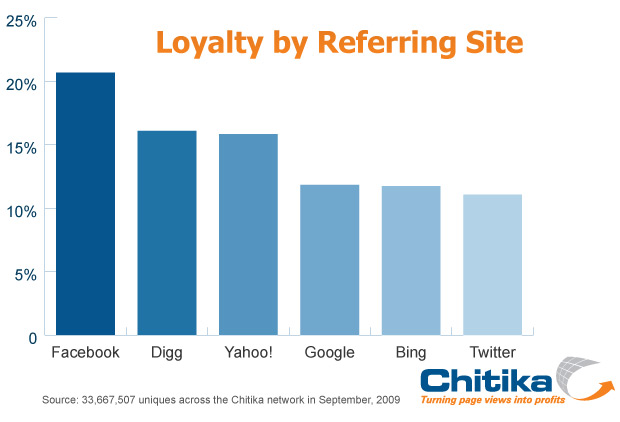
    WebProNews recently covered a study from Chitika, which found that Facebook was the most valuable social media tool for driving repeat readers to content sites. The study was based on 33 million unique users across Chitika’s publisher network in September. It compared the number of visitors coming from major traffic sources Digg, Facebook, Google, Yahoo, Bing, and Twitter, to the number of times those visitors came back to the referred site. Visitors that went to a site four or more times in one week were considered loyal users. By a wide margin, Facebook led the pack in providing loyal traffic. 20% of all visitors from Facebook visited the site four or more times per week.

    Where does your most loyal traffic come from? Facebook or somewhere else? Comment here.

    "We’ve received the most clients from Facebook than any other social media website," a reader commented on the article. "Although we’ve received slightly more visitors from Digg and Stumbleupon, the viewers have not converted into customers the same way they had through Facebook."

    Loyal Readers - Where they come from

    There has certainly been plenty of talk about how Facebook can drive traffic, but clearly there are still a lot of people struggling with just how to go about doing so.

    "Why am I not getting this?" another reader asked. "Blogs I’ve done are boosting my Google, Yahoo, and Bing ratings and getting traffic to my web site, but I’m not getting how Facebok can do this."

    Comments like these are not uncommon, and to be fair, this one was made prior to Microsoft’s announcement of a deal with Facebook (Google has been rumored to be in talks with Facebook as well).

    But not all traffic has to come from search, although Facebook exposure can certainly contribute to that as well, if nothing else, than simply through promotion leading to links.

    When a Facebook user frequently checks for status updates, he/she is likely to see new posts made from Facebook Pages he/she is subscribed to. This means creating a Facebook page can have a great effect on page owners. Making readers aware of the page is key as well. Luckily Facebook has a widget called the Fan box, that you can put on your site, which can lead new visitors directly to your Facebook page.

    Facebook has also just updated another important widget – the share button. Now it will provide a live count of shares, as well as analytical information. You can find out how people are sharing and engaging with your content, and gain further insight into how your stuff is doing with the Facebook community (and adjust your strategy accordingly).

    Traffic is a common goal, but it is not the only one. Going back to the topic at the beginning of this article, brand loyalty is a big one.

    A representative for Stuzo Group, one of Facebook’s exclusive development partners, shared some interesting case studies with us, looking at how they created branded applications and fan pages for brands like Doritos, Budweiser, Smashbox, and Purina.

    "When Stuzo works with these brands, the goals that they have most often in creating these promotions is to increase brand loyalty and recognition, boost traffic to their website, and drive sales," the representative said. "These goals all go hand in hand, and explain why Chitika’s study was so valuable; hits to a website are great, but they don’t mean much unless they contribute to brand loyalty and positive recognition of the brand." (emphasis added)

    A common theme among the case studies provided by Stuzo is that they all present clear objectives for what they want to accomplish with Facebook. For example, Budweiser’s were:

    1. Create brand awareness through a strong fan base and social channel opt-ins

    2. Incentivize users to engage with the brand on a regular basis

    3. Convert new customers and drive increase in sales

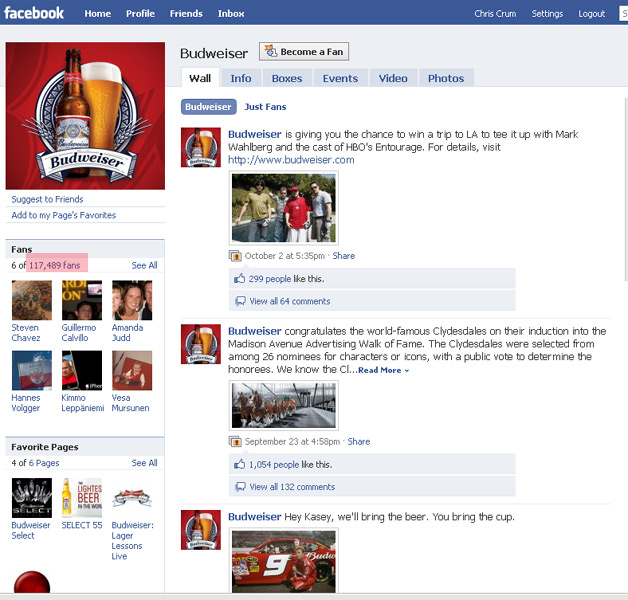
    Budweiser Facebook page

    Budweiser went the route of contests and competitions (which are viral by nature). According to the case study, this has resulted in:

    – Hundreds of thousands of Unique Pageviews

    – Sustained high level of brand engagement by all measurements

    – Significant, continued growth in Budweiser’s Social CRM and social channel opt-ins

    Budweiser is just one example of a big brand finding success through social media, and through the use of Facebook in particular. As I recently discussed, you can find new and interesting ways to integrate social media into your own plans by looking at some of the brands you use yourself and how they employ different tools. This helps you to put yourself in the customer’s shoes and determine the things that work and the things that don’t.

    What brands have you seen using social media in interesting ways?
     Discuss here.

    Related Articles:

    The Most Loyal Traffic Comes from Facebook

    Facebook/Twitter Use May Now Mean More for Google/Bing Rankings

    Some Brands Have Good Ideas For Social Media. Do You?

  • Watch: Bing Goes the Bloodsucker Route

    Microsoft is either taking the holiday marketing approach or the Twilight/Vampire trend approach with its latest commercial. The title is Bing: Vampire Decision Engine.

    The company uploaded the new commercial to its (Google-owned) YouTube channel. Accompanying the video is a short description:

    "When you’re looking for a restaurant that is family friendly, romantic, or maybe something with an otherworldly atmosphere, use Bing’s reviews to stop searching and start deciding."

    You also may be seeing this ad on a television near you.

    What do you think of the latest Bing commercial? Is it good or does it "suck"? Ah Ah. (That was supposed to be the Count). Share your thoughts here.

    Related Articles: 

    > Have You Seen Bing’s Commercials Yet?

    > Bing Commercials Infringe on Patent?

    > Microsoft Seinfeld Ad Not Exactly a Hit

  • The Legend of Hacker

    The development of computers and the Internet not only deliver a variety of facilities in various fields, but also invite various acts of burglary system backed by a variety of motivations. As excerpted in the movie Hackers Outlaws & Angel.
    Hackers Outlaws & Angles who told about the ins and outs of the legendary hacker, Captain Zap (Ian Murphy). Many differences of opinion about the term pendifinisian hacker, someone said that people who break into and destroy someone else’s system can not be called a hacker, there are also different from that which defines a system capable of breaking into other people could be called a hacker. We do not need to argue things like that, which obviously a hacker is someone who wants to learn and keep learning to deepen their knowledge. Hackers could also be interpreted as the people who tried to break through the access control system by taking advantage of existing security gaps in the system. Activities become a serious threat of information system security.

    Like other hackers who have a second name in cyberspace, Ian Murphy, Captain Zap name as its name taken from comic characters in the era of the 80s. Piercing done by changing the hours of AT & T to make the cost of phone bills will be cheaper and disrupt pewaktunya system. Ulahnya result, the system was busy at the time stated is not busy, and then sebaliknya.Ia captured 18 months later. According to Allan while the Brill (Head of Hi-Tech Investigations Kroll Associates) Ian was the first to know the bad things that can be done with a computer. Ian Murphy after undergoing his sentence he was then set up a security consulting firm IAM / Security Data Systems.

    According to Wired magazine piracy at AT & T by Captain Zap was the best piracy ever. How not with minimal equipment at the time he was able to break into a big company. Salute to Captain Zap (The Legend of Hacker)

    Source : Task MKSI courses Univ. Budi Luhur Salemba


  • How Does Bing Rank Tweets?

    As previously reported, Microsoft has made deals with both Facebook and Twitter, which will see Bing feature updates from both networks in real-time search efforts. To me, this says that social media just became an even bigger part of search engine marketing, particularly with Google also on board with Twitter and rumored to be talking to Facebook.

    Bing has already made a beta version of its Twitter search available to users at bing.com/twitter. The most interesting aspect of Bing’s Twitter search is that it offers something plain old Twitter Search (formerly Summize) doesn’t. That is a relevancy factor (or at least an attempted relevancy factor).

    Twitter Search only shows you results displayed chronologically, which has really always seemed to be the essence of real-time search to me anyway. But Bing has a "Best Match" option, which attempts to give certain tweets more weight than others.

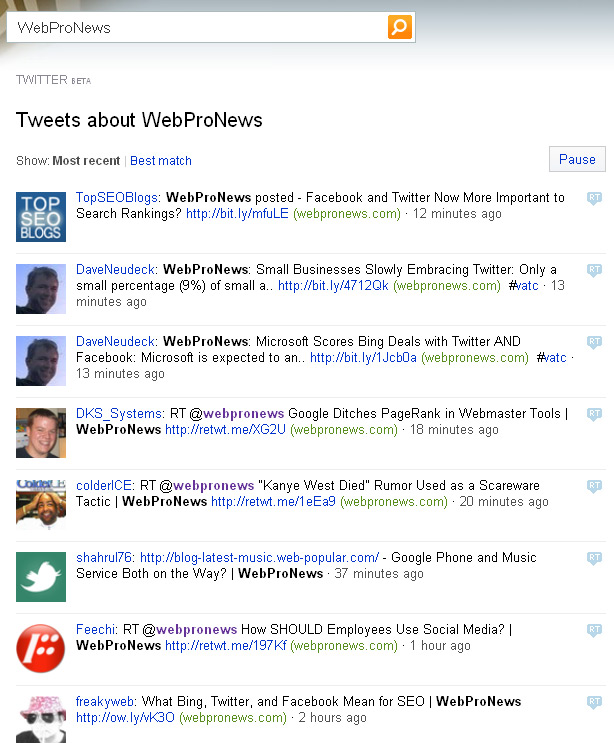
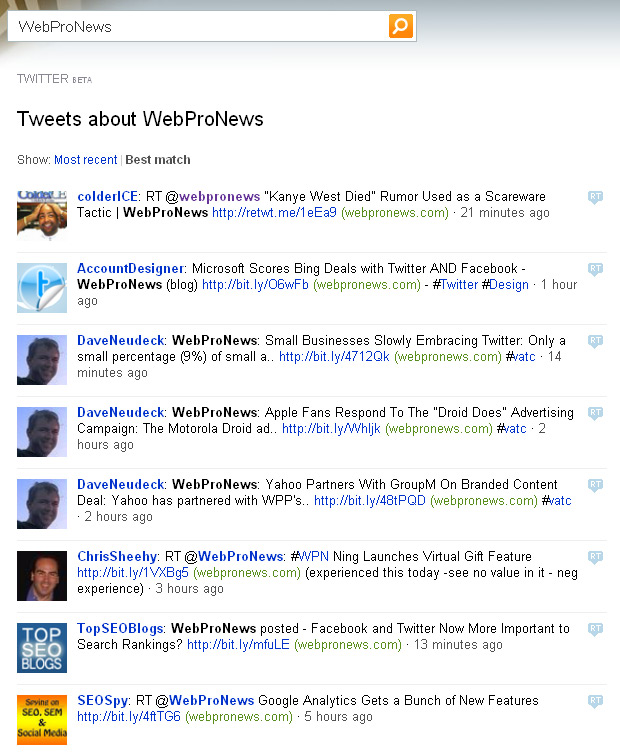
    How do you put relevancy on "real-time" results though? "Real-time" is based on time (obviously). The phrase even has the word "time" in it. A search for "WebProNews" on Bing’s Twitter Search gives me different results for "most recent" and for "best match". I can’t see that the "best match" results are any better than the "most recent" results, however.

    Most recent results for WebProNews

    Best Match results for WebProNews

    The answer is: Bing weighs tweets by follower counts. "If someone has a lot of followers, his/her Tweet may get ranked higher," says Bing. "If a tweet is exactly the same as other Tweets, it will get ranked lower."

    Sidenote: A commenter on this article made a point worth mentioning. What if a new Twitter user tweets about something highly relevant or important, but has not gotten many followers yet? That’s something to think about.

    This is of course the earliest stage for any kind of algorithm Bing may have in place for its Twitter search feature. The feature is still in beta after all. It will be interesting to see if Microsoft makes more details available for how it ranks tweets moving forward. This could be a whole new nut to crack for SEOs. Consider that Bing results will be taking over for Yahoo if the Microsoft-Yahoo deal goes through (plus there is still Google’s Twitter results to worry about).

    I’ll go out on a limb here either way, and suggest that providing good content will be the way to go moving forward. That will bring in followers, and probably do better for your relevancy rankings in the future. That said, defining good content may be considered a little harder at 140 characters or less.

    Related Articles:

    Facebook/Twitter Use May Now Mean More for Google/Bing Rankings

    Social Media Will Not Replace Search

    Microsoft and Google Score Deals with Twitter

    Don’t Lose Yahoo Traffic By Not Optimizing for Bing

    Is ranking in search engines for Twitter results going to be a priority for you? Discuss here.

  • Samsung dual screen camera big bucket of fail

    sc004Bad news people, the Samsung TL225 camera that was released this August? Yeah, it’s pretty much a pile of crap. The front screen is off center, so your pictures look like everyone is staring off to the side, the touchscreen response (the only way to control the camera’s settings) is oddly disconcerting, the shutter lag is excessive, and low light sensitivity is non-existent.

    Samsung really wants you to like this camera, as evidenced by the massive media campaign that they’ve been running (smiling monkeys, anyone?) but it seems to have been for naught. Wired reviewed the camera today and they’ve rated this one a 4/10. In addition to the laundry list of problems listed above, the image quality is also poor, much less then you would expect from a 12.2 megapixel camera.


  • Finally: Panasonic to convert Sanyo into 100% subsidiary next month

    panasonic_sanyo_logo

    The deal has been in the making for months now, but yesterday Panasonic finally announced a tender offer for Sanyo Electric, paving the way to convert Sanyo into a wholly owned subsidiary as early as the middle of next month.

    The tender offer is being supported by Sanyo’s board, and the company’s three main shareholders (all of them are in the finance sector) have agreed to sell their shares to Panasonic. The shares from the companies account for 50.13% of all Sanyo shares.

    Both the Sanyo brand and the company’s listing at the Tokyo Stock Exchange remain untouched however. Panasonic says the primary goal of the acquisition was to boost the company’s position in the field of green energy, i.e. by tapping Sanyo’s expertise in batteries and solar panels. One of Sanyo’s biggest hits in the past few years has been their eneloop series of rechargeable batteries and related products.

    The new giant will rival Japan’s biggest electronics company, Hitachi, in terms of sales.


  • Vaccines for the rich! Wall Street gets H1N1 vaccine bailout while school children told to wait

    (NaturalNews) It seems the financial bailout isn’t the only bailout happening on Wall Street these days. News has now leaked that investment firms Goldman Sachs and Citigroup both received preferential H1N1 swine flu vaccines even while local clinics that treat school children had no supply. The uproar is reminding the public just how much special treatment Wall Street banks get — both financially and medically — while everyday people are hung out to dry.

    Not only that, but taxpayers got to foot the bill for those H1N1 vaccines handed to Wall Street insiders. It’s yet one more way in which the general public is being screwed over (yet again) by the swine flu vaccine agenda.

    There’s one politically incorrect question in all this that’s just begging to be asked, and let’s assume for the moment that H1N1 vaccines actually work to save lives even though they don’t: If a dangerous viral pandemic sweeps through the nation, killing people left and right, are Wall Street investment bankers really the people we want to save first?

    Seriously. Doesn’t it seem that school children should get the medicine first and Wall Street insiders should get it last?

    The CDC claims that the vaccines sent to these Wall Street companies should have only been given to “high-risk people” who worked there. Sure they were, because we all know that Wall Street companies adhere to the highest standards of ethics, morality and civic responsibility. These people are shining examples of glorious human beings who always do the right thing, even if it requires giving up something for the benefit of someone else, right? And if they were on a sinking Titanic, they’d give up the life boats to the poor women and children, right?

    But the real story here isn’t that H1N1 vaccines are now being preferentially given to the rich instead of the school children. The real story is that people are panicking to get their hands on a complete joke of a vaccine — a chemical cocktail that has never been subjected to even a single scientific test proving it actually works. People are lining up, in other words, to attain supply of something that’s totally useless.

    The crumbling social fabric of America
    At the same time, this fabricated emergency reveals to us the complete lack of ethics in the distribution of these vaccines to the Wall Street rich, even while everyday poor people stand in line waiting for their turn.

    It’s yet another powerful commentary on the crumbling social fabric of America — a nation that puts its morally bankrupt money slingers as a higher priority than everyone else. It’s the Wall Streeters who get the trillion-dollar bailouts that the rest of us must someday pay out of our pockets. It’s the Wall Streeters who get preferential treatment by Washington. And it’s the Wall Streeters who are now getting the medicine that should be going to our children.

    Of course, the medicine itself is a joke, too, but that’s beside the point: These people THINK the vaccines are valuable, so their decisions on where to send them first reveal their true intentions.

    There’s a huge moral lesson in all this, by the way: Even those who get the H1N1 vaccine receive no benefit from it. People whose immune systems adaptively respond to the vaccine by building antibodies are the very people who could have done the same thing automatically in response to influenza exposure. Meanwhile, those with suppressed immune systems that are vulnerable to H1N1 have no ability to adaptively produce H1N1 antibodies anyway. In other words, even if you believe the H1N1 vaccine actually works, it only works on the people who don’t need it!

    This is the ultimate comedy. People are desperately fighting over a chemical injection that will help no one. And the only reason they’re so desperate about it is because the hysteria has been entirely fabricated precisely to create irrational demand (http://www.naturalnews.com/027404_hysteria_H1N1_vaccines.html).

    Maybe we should send all the vaccines to Wall Street anyway. Let everybody else stand outside, waiting in lines and soaking up a little sunshine so that their bodies create the only thing that will really save them from influenza in the first place: Vitamin D.

    Or better yet, We the People should charge Wall Street for these vaccines we paid for. And the price? One trillion dollars.

  • Act Threatens Pennsylvanians with Government Takeover and Forced Vaccinations

    (NaturalNews) Pennsylvania House Bill 492, the Emergency Health Powers Act, was introduced by Rep. Ken Smith (D) on February 18, 2009, as an amendment to The Administrative Code of 1929 which outlines provisions for dealing with public health emergencies. HB 492 contains provisions that, during a health emergency, allow for the public takeover of private property and infrastructure, restriction of free trade, quarantines, mandatory medical treatments, and forced vaccinations.

    Similar to the Massachusetts pandemic bills that were passed by both the House and Senate back in October, HB 492 follows suit with a laundry list of unconstitutional mandates not lawfully afforded to the State, even during a pandemic. A final, combined version of the two Massachusetts bills is currently awaiting passage.

    Though the Pennsylvania bill has been sitting with the Veterans Affairs and Emergency Preparedness Committee since February, there is a possibility it could move out of committee and be rushed for a vote in the very near future. Because many other states have begun trying to replicate the Massachusetts template for government tyranny during a crisis, it is crucial for the public to stop this bill and others like it before it ever makes it to the Congressional floor.

    Contents of HB 492
    Section 2523-D furnishes the Governor with the power to mobilize the National Guard for active duty to achieve and enforce the bill’s objectives.
    Section 2532-D allows for the control of facilities, property, trade, food rationing, commodities distribution and the movement of people during a crises.
    Section 2542-D authorizes the coercion of persons to submit to medical examinations, testing, and any other medical treatments deemed necessary by the public health authority. The public health authority is not subject to any judicial restraints or accountability and persons refusing to comply with its mandates will face third-degree misdemeanor penalties.
    Section 2544-D sanctions forced vaccinations if deemed necessary which furnish power to detain, quarantine, and impose third-degree misdemeanor charges for those who refuse to comply.
    Section 2574-D grants immunity from liability to the state for death or injury to persons and for damage caused to property as a result of enforcing said provisions. It grants the same immunity to private persons, firms, or corporations who cause death, injury, or destruction while acting under the direction of the state in helping to enforce the provisions.

    Essentially the bill will allow for the complete takeover of the state during a public health emergency by the Governor, the National Guard, and those from the private sector called upon to assist in the takeover. Aside from the decimation of liberty and free trade, mandatory medical treatments, and forced vaccinations, the state will not be held liable for the death and destruction caused by enforcing its requirements.

    Additionally, private persons, parties, groups, corporations, or whoever is accessible and willing can be called upon to enforce these heinous provisions on their fellow citizens with the same protection from liability for the death and destruction caused by enforcement.

    Since the White House recently declared a national health emergency on October 24, contingency plans like HB 492 on the state level are becoming chillingly more possible and likely. The idea of martial law being declared during an emergency, whether it is a manufactured pandemic or something else, is no longer baseless fear-mongering but a sordid reality.

    It is paramount that concerned citizens actively and forcefully oppose draconian laws such as HB 492 and demand that their elected officials oppose unconstitutional power grabs, especially during crises when those seeking such power prey on the fears of the public.

    Sources:

    House Bill 492 – The General Assembly of Pennsylvania

    Senate, No. 2028 – The Commonwealth of Massachusetts

    Declaration of a National Emergency with Respect to the 2009 H1N1 Influenza Pandemic – The White House

    About the author
    Ethan Huff is a freelance writer and health enthusiast who loves exploring the vast world of natural foods and health, digging deep to get to the truth. He runs an online health publication of his own at http://wholesomeherald.blogspot.com.

  • H1N1 vaccines too little, too late; most people already exposed and immune (opinion)

    (NaturalNews) The Big Pharma frenzy over H1N1 vaccines has turned into a circus of hilarious medical quackery thanks to the fact that by the time the vaccines are available, most people will have already been exposed to the virus. Hence, most people will have already built up their own H1N1 antibodies, rendering the vaccine not just useless, but downright laughable.

    Even with the outlandish rush to get these vaccines approved by the FDA — a hurry that saw the complete abandonment of the principles of “scientific testing” — Big Pharma just couldn’t get these vaccines produced quickly enough to beat the virus itself. Taking a vaccine shot after you’ve already been exposed is medically useless. It’s equivalent to putting on your seat belt after getting into a car wreck.

    Even U.S. News and World Report, which is heavily funded by Big Pharma advertising, is now admitting the swine flu outbreak may be over before the vaccines arrive. It reports:

    “Richard Wenzel, an H1N1 expert and former president of the Infectious Diseases Society of America, predicts that the outbreak will last another four to eight weeks before tapering off. In fact, some areas in the South already are seeing a decline in cases. Given that the vaccine will be produced in limited quantities on a rolling basis, most healthy middle-aged adults — who the government recommends should be vaccinated after children, college students, and pregnant women — won’t be getting immunized before the outbreaks peak and wane.”
    (http://health.usnews.com/articles/health/infectious-diseases/2009/09/24/with-rapid-swine-flu-spread-will-h1n1-vaccine-come-too-late.html)

    Did you catch the significance of that last sentence? Most people won’t be getting immunized before the outbreak tapers off. And that means the whole reason for getting the vaccine in the first place — to avoid being killed by an exploding pandemic — will soon be rendered pointless. Leave it to western medicine to act all heroic, pretending to be saving people’s lives from a pandemic that’s already on the way out…

    Maintaining the illusion
    Of course, infectious disease reality never got in the way of Big Pharma making a buck, so this inane vaccine push will continue whether people need it or not. All these vaccines have already been ordered and paid for with taxpayer dollars. Delivery is on the way, and there are no refunds. If cities, states and nations don’t use all these vaccines, they’ll look pretty darned stupid for buying them, won’t they?

    That’s why health authorities everywhere are determined to use up these vaccines regardless of medical reality. And that means finding enough willing children and adults to be injected. Following that, as the swine flu pandemic fades away (which it was going to do anyway), all the vaccine-pushing health authorities can proclaim, “We did it! We beat the pandemic with the vaccines!”

    But the pandemic was burning out on its own, without any intervention at all.

    Of course, taking credit for solving problems they didn’t really solve is nothing new to the vaccine industry. To this day, the drug companies credit themselves with eradicating smallpox, measles and yellow fever when, in reality, the historical record shows that it was primarily improvements in hygiene and public infrastructure that caused these once-terrible epidemics to wane.

    The transition from open ditches filled with feces to underground public sewage pipes was, all by itself, one of modern civilization’s greatest achievements in terms of reducing infectious disease. Running water, public water treatment systems and sewage processing technologies deserve most of the credit for eradicating infectious disease. Vaccines have relatively little to do with it.

    If you let the pharmaceutical industry write the history books, they make it sound like our modern world would have collapsed into a cesspool of disease without their vaccines. It’s fiction, of course, but it’s the kind of fiction that goes over well with a society that maintains an almost fanatical belief in the bizarre mythology of unproven chemical interventions. To this day, there remains absolutely no credible scientific evidence that H1N1 vaccines work at all. Not a single placebo-controlled study has ever been conducted on them!

    Speaking of rewriting the history books, Big Pharma will no doubt seek to rewrite the history of the 2009 H1N1 Swine Flu, too. Even if the flu fades out just as the vaccines arrive, the vaccine pushers will claim credit for eradicating the pandemic by blurring the factual timelines. They’ll add swine flu to the list of diseases they claim to have eradicated, like the measles.

    The real story here is that swine flu never posed a real threat to humanity, and it would have gone away on its own, even without the vaccines. Tens of millions of people have already been exposed and subsequently built their own H1N1 antibodies.

    And guess what? Their immune systems did it for free. No needles required. Amazing!

  • What’s really in that burger? E.coli and chicken feces both allowed by USDA

    (NaturalNews) There are 14 billion hamburgers consumed each year in the United States alone. The people who eat those burgers, though, have little knowledge of what’s actually in them. Current USDA regulations, for example, openly allow beef contaminated with E. coli to be repackaged, cooked and sold as ready-to-eat hamburgers.

    This simple fact would shock most consumers if they knew about it. People assume that beef found to be contaminated with E. coli must be thrown out or destroyed (or even recalled), but in reality, it’s often just pressed into hamburger patties, cooked, and sold to consumers. This practice is openly endorsed by the USDA.

    But E. coli may not be the worst thing in your burger: USDA regulations also allow chicken feces to be used as feed for cows, meaning your hamburger beef may be made of second-hand chicken poop, recycled through the stomachs of cows.

    Chicken poop in your burgers?
    I remember writing about this two years ago. People sent accusatory hate mails to NaturalNews, saying things like, “Stop making things up and scaring people!” Few people believed that chicken feces was being widely used as cattle feed.

    According to the FDA, farmers feed their cattle anywhere from 1 million to 2 million tons of chicken feces each year. This cross-species crap-as-food practice worries critics who are concerned it may lead to increased risk of mad cow disease contaminating beef products. So they want to ban the practice and disallow the feeding of chicken litter to cows.

    Believe it or not, McDonald’s has joined the fight seeking to ban the practice, saying “We do not condone the feeding of poultry litter to cattle.” Apparently, even they don’t want their customers looking at a Big Mac and thinking, “Wow, this is made out of second-hand chicken crap.”

    CSPI and the Consumers Union have also joined the fight, petitioning the FDA to ban the practice.

    Now, you might wonder how chicken feces could pose a mad cow infection risk to cows. And if you’re not already grossed out by what you’ve read so far, you will be when you read the answer to this question: It’s because chickens are fed ground up parts of other animals such as cows, sheep and other animals. Some of that chicken feed spills out and gets swept up as chicken litter, then fed to cows.

    So now we have a bizarre experiment in animal feed where dead cows, sheep and other animals are fed to chickens, and then chicken feed spills onto the floor where, combined with chicken poop, it gets swept up and fed to cows. Some of those cows, in turn, may eventually be ground up and fed back to the chickens.

    Do you see how this might be a problem?

    Do not feed animals to each other
    First off, in the real world cows are vegetarians. They don’t eat other cows, or chickens, or poop from any creature. Chickens don’t eat cows in the real world, either. If given free range, they live primarily on a diet of bugs and weeds.

    But through the magic of horrific factory food production practices in the USA, dead cows are fed to chickens, and chicken poop is fed to cows. This is precisely how mad cow disease could contaminate this unnatural food cycle and end up contaminating U.S. cattle with mad cow prions.

    Some say this has already happened, and it’s only a matter of time before mad cow disease starts appearing in the U.S. population. It takes approximately 5 – 7 years after eating an infected burger for mad cow disease to destroy the brain of a consumer, and cooking a burger does not destroy the mad cow disease prions. That means even burgers that are fully cooked and handled according to federal safety standards can infect consumers with mad cow disease, causing their brains to turn to mush within 7 years.

    The beef industry doesn’t see a problem with any of this. And that’s why this industry deserves what’s coming: A massive culling of cattle and a complete economic wipeout of cattle ranchers one day after mad cow disease is revealed in U.S. cattle herds. Rather than trying to protect the integrity of their cows, the U.S. beef industry chooses to pretend that there’s nothing wrong with practice of feeding corpses to chickens, and feces to cows. Is there anything too gross, inhumane or horrific for the beef industry to stomach? Seems not.

    Remember, too, that the USDA has banned farmers from testing their own cattle for mad cow disease. So instead of allowing cattle ranchers to protect the safety of their herds, the USDA has a policy of covering their eyes and pretending not to see the very real risks that exist. When it comes to infectious disease, this is a sure recipe for disaster.

    The perfect storm for mass infections
    It all adds up to a “perfect storm” for the mass infection of the beef-eating population with mad cow disease. And remember: Cooking meat does not destroy prions, so if the beef supply becomes contaminated with mad cow disease, it’s only a matter of time before humans start to be stricken with the disease.

    That takes 5-7 years, as I mentioned previously. It’s important to note because it means there could be a five-year gap between the time mad cow disease is present in the beef supply and the time health authorities start to notice a problem. But by that time, most of the population will have already eaten infected beef, and it will be too late to stop the mass human deaths sure to follow.

    Dying from mad cow disease isn’t pretty, painless or quick. It’s ugly. Your brain cells start to turn to mush, slowly shutting down cognitive function little by little like some strange, aggressive form of Alzheimer’s disease. First you lose concentration ability, then your speech goes, and eventually all brain function stops altogether. It’s a horrifying way to waste away.

    Is the risk of that really worth eating burgers?

    Remember: Right now, the practice of feeding chicken feces to cow herds continues. So there is a risk of mad cow disease infection in U.S. beef right now. Very little testing is currently being conducted for mad cow disease, meaning an infection could very easily go undetected for years. Meanwhile, the average hamburger contains beef parts from as many as 1,000 different cows.

    Do the math. Unless cattle feeding practices are significantly reformed, eating beef products of any kind — hot dogs, hamburgers, steaks — is like playing Russian Roulette with your brain cells.

    Sources for this story include:
    http://www.latimes.com/business/la-fi-feed31-2009oct31,0,1227725.story

    http://abcnews.go.com/Health/Wellness/coli-concern-tainted-beef-makes-consumers/story?id=8987973

  • Calling All Moderncat Fans in Phoenix, Arizona! Introducing Moderncat Studio

    Moderncat Studio

    As you may have read in my recent interview with The Conscious Cat, I’ve been working on another little project. I’ve opened Moderncat Studio in downtown Phoenix, Arizona. I’ve always been a crafter, and you may have noticed that I have a bit of an obsession with Etsy (I’m wearing my favorite necklace from Etsy seller Adorn Natural in the photo above — thanks to Giulio Sciorio for taking that photo). Moderncat Studio is a place where I can experiment with my own cat-related handcrafts, plus I’m working with other designers to develop some new cat products, all of which will be handmade and in keeping with the Moderncat style. I also feature the work of other artists and craftspeople whose work I appreciate.

    The studio is open to the public for special events, like the First Friday Artwalk in downtown Phoenix every month. The official website for the studio is not yet finished, but if you’d like to follow along with the development, please become a fan of the Moderncat Studio page on Facebook.

    The plan is to have the studio products for sale on Etsy soon. I’ll be sure to notify you when they are available. In the meantime, if you live in Phoenix, please stop by the actual studio for some serious Moderncat-style holiday shopping for all the cats and cat lovers in your life. We are fully stocked and ready to go! Some of the things you will find at the studio are shown below. Having the studio is also my way to give back. I plan to donate a portion of the profits to local cat rescues and shelters.

    JoeMehl

    Each month, I feature a different guest artist in the studio. This month, the artist is photographer Joe Mehl. We are running a special fundraiser this month – come to the studio and purchase one of Joe’s beautiful cat prints and 50% of the sale will be donated to a local cat charity. We also have Joe’s signature kitty head kaleidoscope on a custom vinyl record wall hanging and also on 8 inch stickers.

    Jake & Micah

    In addition to offering products that we make at the studio, I’ve hand-selected products from some of my favorite companies. Right now we have catnip fortune cookies and retro boomerangs from Jake & Micah, as well as catnip eyeballs and kickin’ sticks from HannaPt.

    HannaPt

    Jewelry & Cards

    We’re also featuring handcrafted sterling silver jewelry from Phoenix-based jewelry designer Gloria Marsiglia and I created a line of handmade cut-paper greeting cards and gift tags using silhouettes of my own cats (these will be on Etsy soon!)

    Tie Toys & EcoToys

    And here are the first two Moderncat Studio exclusive products! Kitties & Fishies cat toys made from re-purposed vintage neckwear with organic catnip, designed and made by yours truly, and EcoToys designed by Collin Smith, made with EcoFi felt from 100% post-consumer recycled plastic water bottles and stuffed with organic catnip.

    So please keep an eye out for more news about the studio and if you’re in Phoenix, please check out the Facebook page for a list of when we’ll be open in the coming months.

  • Playing games is top entertainment for Americans

    The 2009 Today’s Gamers International Survey reveals a fact that has been pretty obvious for quite a while now: more and more US citizens consider pla…

  • PENETRATION AND ENGINEERING THROUGH INTERNET MARKETING STRATEGY

    1.Market Research
    Market Research aims to find out how much market share for products or services you sell. Your business will not work best when limited market share. Major indicator / small share of this market can you find out the Google Keyword Tool.
    Example:
    If you sell a product “Muslim fashion,” then look at the Google Keyword Tool is
    analysis
    The larger “search volume” of the word / phrase associated with “Muslim fashion”
    greater share of existing markets, and vice versa. The word / phrase is what is called “keywords”
    “No matter what business you are in, you must know what words people use when they search for your products online.”
    You should know that “keywords” what people type in “search box” search engines when looking for products like you’re selling. Keywords that you should note that you will need it at the time to optimize your website and your product packaging.
    Knowledge of these keywords is the main capital in the SEO (search engine optimization).

    2. Competitor Analysis
    After knowing the existing market share, then you have to “learn” from your competitors. Visit the site at least 10 of which appear on the first page of Google search results that sell similar products. Consider the following a few important things:
    – Design website (user-friendly website recommended)
    – Photos + wording / text
    – Corporate identity (credibility + trust)
    – Product presentation (categorized)
    – Pricing (packages, discount / promo etc.)
    – Booking terms, payment method, delivery options
    – Website branding
    – SEO aspects
    – Uniqueness is most important – so do NOT copy!

    Now look at your website, make sure you do not do too much mistakes 9 in designing the website as follows:
    – Not to include information “Contact”
    – Many “broken links”
    – Information that is not up-to-date
    – Too many fonts and colors yg different – different
    – Not include “HOME” on the page in
    – Button “Back” disabled
    – Opening a new window (target_blank) each opened a new page
    – Loading is slow
    – Apply advanced technology that has not been popular

    3. Market penetration and Win Competition
    “What makes you different to your Competitors?”
    The question should be can I answer any product or service pack, if I do not know her answers – I’m not going to sell it.
    [i] Unique Product
    If you pack your product exactly what the majority of your competitors, then you will be hard to penetrate / penetrate the market. If the product is exactly what the reason for turning to Customer you? Yes, you already know the answer, “lower prices” – the most popular steps and shortcuts to simply survive.
    Business practices “not healthy” to always be “sacrificed” prices will damage the business climate
    and competition. If prices continue to cut, then you have to press the cost of production
    gradually reducing the product quality is difficult to disappoint customers
    get repeated customer orders decreased by reducing the employee’s business
    all the limitations and waiting for a good reason to be “shut down”. “…. so, be unique ”
    Because if you packed your product is different, then the price was supposed to be different. Even better if your product is exclusive (not imitate someone else) – then this will be the main reason for customers to find you.

    4. Internet marketing strategy
    More than 80% of internet users rely on search engines as a means of information seekers (based on research from Georgia Tech’s GVU Center). This amount will continue to grow given the search engine is the easiest and fastest in the search for information. More importantly, your information will fall on the right person, because a search on the search engine tailored to the keyword / keywords and grouping system is highly structured directory.

    Source : fernandositindaon


  • Nestle’s Kit Kat Bars Give Consumers An RtB In Japan

    Techdirt reader Kathy writes in to let us know about the 200 different flavors of Kit Kat candy bars in Japan. Public Radio International describes how Nestle has developed an interesting sales strategy in Japan where the competition among retailers is apparently so great that stores benefit from constantly updating their shelves with new products. In such a marketplace, Nestle has adopted numerous varieties of its Kit Kat candy bars that can only be purchased in certain locations or at specific times of the year. So instead of trying to peddle the same merchandise to everyone, Nestle has effectively given consumers a reason to buy (RtB) — by making limited edition flavors and targeting the local tastes and customs in Japan. Nestle caters to Japan’s omiage gift-giving culture (where friends are expected to bring back unique trinkets when they travel) with regional Kit Kats. So for example, a potato-flavored version is only sold in the northern part of Japan known for its potatoes, so northerners (or traveling southerners) can give out unique treats that aren’t available nationwide. And all over Japan, the candy bars have also been packaged with mailing labels — so that the candy can be sent as “good luck” charms. Due to the ingenious connection to the Japanese words Kitto Katsu which mean “you will surely win”, the “good luck” symbol for Kit Kats in Japan was also successfully manufactured and marketed and as a result, Kit Kats have been popular with exam-taking students who seem to want good luck, however they can get it.

    Clearly, Nestle must be admired for its efforts to connect with candy fans. And it’s particularly brilliant to see them bundle candy bars as good luck charms — a story that adds intangible value to the otherwise ordinary snacks. Perhaps it’s only a matter of time before some artists write some flavor-inspired songs/plays/films and try to sell loooots of Kit Kats, too.

    Permalink | Comments | Email This Story


  • Hacker understanding based on age

    The word “Hacker” has a unique history, Hacker said even with a positive means, even war hackers have happened throughout the world, korbanpun falling, would know what the history of Hacker? please read my post below.
    Early 1960
    At this year are still in the computer giant, stored refrigerated in a closed room and only the institutions are state-owned 60-memilikinya.Pada era Hacker’s very positive sense, so-called hacker is someone who has a high programming skills and could be to hack a program so they could walk more than the specifications they have. One of the hacker era work programs of the 60 are still revered to this day is the UNIX operating system. Duo who gave birth to this OS is Dennis Ritchie and Ken Thompson.

    Early 1970.
    At this year’s famous phreaks terms, namely that hackers can break through the phone line to access remote melepon for free. Started by John Drapper, he discovered that the whistle prize Cap’n Crunch cereal foods can produce the right tone with 2600 megahertz.Hanya blew the whistle on the telephone receiver remote telephone access to the communications network AT & T will open. Steve Jobs and Steve Wozniak made equipment to hack the phone, called the “Blue boxes”. The two men later was the founder of Apple Inc.

    Year 1980-1991.
    IBM launched a computer “stand-alone” complete with CPU, memory and software in 1981. In 1983 came the film that revealed the hacker’s life, entitled War Games.Film shows the American public about the dangers of hackers that can break through all this period komputer.Selama system, the defense department’s network ARPANET Americans slowly began to turn into the Internet. In this era of birth Two big hacker group, the Legion of Doom is located in the United States and the Chaos Computer Club in Germany. In this era there is also a great hacker war, the two groups are vying with each other to destroy all computer systems, internet and telephone.

    Year 1986-1994.
    Because of the increasing attacks by hackers in 1986 the U.S. Congress issued the Law on the crimes of this era komputer.Pada formed Computer Emergency Response Team (CERT) that investigated the attacks via the Internet. The man who became the first victim for violating laws on computer crime was Robert Morris, he admitted that he intentionally did not release the worm into the Internet. Worm tanggan work of Robert Morris 6000 has crippled computer. As punishment he was prosecuted 10,000 USD. In the same year there was a hacker named Kevin Mitnick is through company-owned network of Digital Equipment Company and stole some software. He was sentenced to 1 year in prison. after escape from punishment Kevin Mitnick is not too sour, he repeated perbuatannnya with stealing 20,000 credit card data and were arrested in 1995 because of the help of a hacker named Tsutomu Shimomura.Operasi Sundevil launched by the U.S. government failed to roll up a hacker group Legion of Doom, but they managed to catch some members of the hacker group Masters of Deception.

    Year 1994-1998.
    In 1994 a Russian hacker named Vladimir Levin managed to break into Citibank’s computers and to transfer money from customer accounts totaled 10 million USD. Citibank raised the most money back tersebut.Pada this era of hackers increasingly bold in conducting such serangannya.Situs U.S. government justice department, air force, CIA, NASA etc. korban.Para hackers had been announced that they managed to break into Pentagon computer network and threatening to sell military satellite software that had been stolen to the terrorists.

    1999 to present
    In the year 2000 computer event of mass destruction in 2000 at 00.00 or better known as Y2K greater. In February of 2000 the Internet community was shocked by the attack “denial of service” (DoS) against several sites such as CNN, Yahoo and E-Bay. Denial is a hacker attack that makes as if millions of surfers accessing a site simultaneously. Servers that “confusion” to serve the millions of surfers will collapse fictitious alias crash. In the same year in May appears exactly I Love You virus that helped mark the beginning of the era Worm.


  • Smartphone Showdown: iPhone 3GS vs. Motorola Droid Round 2

    r2

    My inbox is in pain. Almost immediately after I hit the publish button on last week’s iPhone 3GS vs Motorola Droid Smartphone Showdown, a torrential blast of comments and questions has been barraging just about every communication inlet I’ve got. Phone calls. Twitter DMs. Lots, and lots, and lots of emails. Across the board, it all seems to indicate one thing: people want more. We hear you. There are a number of worthwhile topics I simply didn’t get a chance to touch on, and a few observations I’ve made since that are worth mentioning. For those, may we present: Round 2.

    Read the rest of this entry at MobileCrunch >>


  • New Japanese Avatar trailer features new scenes

    avatar_trailer

    Reactions to John Cameron’s next big movie Avatar, scheduled for release (almost) worldwide on December 18, can be called mixed at best. We’ve shown you two trailers already, and now Japan gets a third one with a handful of scenes not seen before.

    The two-minute clip has English dialogue and is free of spoilers as far as I can tell.

    Watch the newest trailer here:


  • Google CEO: We Won’t Repeat Microsoft’s Mistakes

    Google CEO Eric Schmidt is on a bit of a Microsoft offensive. Earlier this week, while talking to press in Boston when Schmidt was asked to comment on a statement by Microsoft CEO Steve Ballmer, he said, “I’ve learned not to respond to quotes by Steve Ballmer.” Oh Snap!

    “Hopefully we won’t repeat the same mistakes that Microsoft did 10 years ago that ultimately led to all these things that have been happening with them,” Schmidt zinged back today when FOX Business Network’s Neil Cavuto asked him about recent comparisons with Microsoft. I bet Bill Gates must have said the same about IBM.

    He also talked about Twitter and Facebook, the economy, the recession, and a whole bunch of other current events during his interview. Actually, this clip is worth watching, and Cavuto is rational in his questions. So if you have time, check it out.

    Photo courtesy of Charles Haynes via Flickr.