Blog

  • Video: Japanese pen and pencil grab bag from JetPens


    The Japanese, I am told, really love their stationery. Pens, pencils, erasers, special paper, cases for everything — one trip to Muji, my favorite store, will confirm this. Unfortunately, stationeriphilia in the US is more of a high-class “my pen is made out of solid gold” affair. So when JetPens, an etailer for Japanese pens and miscellany, offered to send a couple of their favorite things, I accepted gladly. There’s so much stuff there that I just had them select a few things at random — and this is what I got.


    A stylish little fountain pen
    – thinner and more portable than your average fountain pen (or quill).
    A chubbier fountain pen – what can I say? It’s chubbier.
    Mechanical pencil with auto-rotating lead – I haven’t been able to observe it very closely, but supposedly this pencil actually rotates the pencil lead just a little bit every time you lift the tip from the page, meaning you’re always using a fresh and sharp part of the lead. True? Possibly. Awesome? Definitely.
    Twist eraser that’s all corners – a great idea. It’s a little wobbly, but the fact that it’s made up almost entirely of corners means you can erase little lines without messing with the neighboring letters or other bits of drawing.
    Standing pencil case – honestly, not too exciting. I have one of these already, it’s called the cup on my desk.
    “Beetle tip” highlighter – you can highlight all the text, use just a little tip to circle or whatever, or you can put lines above and below. Not such a huge advance over the traditional wedge shape, but hey, why not?

    I know, I know, this isn’t a stationery blog. But I think sometimes we forget that there is innovation and weird stuff going on where you least expect it — in mechanical pencils and stuff. You like gadgets, so why not have a gadgety pen, or have a crazy pencil that sharpens itself? Live the life!


  • Special feather stylus for early buyers of Legend of Zelda – Spirit Tracks

    zeldaspirittracksstylus
    Well, it looks like Nintendo has done it to us again. Purchasers of the new game, The Legend of Zelda – Spirit Tracks in Japan will receive a special transparent quill stylus when they buy the game. It’s not even a pre-order bonus, it’s going to be given out on launch day — just not in the U.S.

    To be fair, we have seen these stylii before. In 2007, Nintendo offered them as a bribe reward for registering the Phantom Hourglass, and filling out a short survey. And, we don’t know for certain that we won’t see this offered in North America. It hasn’t been mentioned as a pre-order item yet, but who knows. I do know I wouldn’t mind having one. Spirit Tracks will be available in Japan on December 7th.


  • Homebrew game – Powder release 112

    Homebrew coder Jeff Lait has recently released a new version of Powder, a roguelike homebrew game originally developed for the GBA that involves diffe…

  • Preventing Spider Veins

    Spider-veinsSpider veins are the lesser form of varicose veins, but they can be nearly as devastating to the appearance. Women who suffer from spider veins are more likely to hide their legs behind long skirts or stockings in order to avoid the embarrassment of showing off their marked veins. This problem is preventable, though.

    Spider veins tend to appear mainly on the legs, although technically, they could occur on any part of the body. They look like a fine web of dark red, purple or even blue lines under the skin and are not as pronounced as varicose veins. However, they still can cause considerable discomfort. Some women complain that they are extremely painful.

    Keeping up great circulation in your legs is the first step to being able to prevent spider veins. You can do this by not using tight clothing on your legs, which might cut off the circulation and encouraging blood flow to the legs. This might be in the form of a daily leg massage or exercise. Simply walking or jogging a little each day reduces your risk of developing these unsightly veins.

    Your mother may have told you that crossing your legs would cause varicose veins. She was right. Cutting off the circulation to your lower leg and foot is the perfect way to create a varicose vein problem, since both spider and varicose veins are caused by lack of blood flow. Increasing the blood flow to the areas most at risk will help prevent problems later on. This is good advice to follow even if you are very young, as it can prevent spider veins once you get older.

    Maintaining your weight at a healthy level is also very important since extra weight puts extra pressure on your legs and may result in spider veins. This is particularly true during pregnancy when you would gain anyway. Keeping the weight gain to the recommended amount during pregnancy ensures that you are spider vein free after the baby is born.

    Avoiding salt in your diet can keep swelling and hypertension to a minimum as well. These conditions often go hand in hand with spider veins and varicose veins. Adding more Vitamin C and E is also a great natural way to reduce swelling in the legs and may work to prevent vein disorders.

    If you do end up with spider veins, despite all your attempts to keep your circulation high and eat well, there are still alternatives. Surgery is the most invasive, where the veins are actually removed. This is usually reserved for problem veins that don’t respond to other treatments.

    Another treatment is to inject the offending veins with a special liquid that causes the veins to scar up and close. This forces the blood to be redirected and leaves the area clear. The procedure is painless, but may need to be repeated several times. Also, laser surgery may prove effective and is the least invasive of all treatments for spider veins.

    If you wish to prevent or treat spider veins, try the tips above before heading to your doctor. While the preventions given are usually quite effective, it really depends on you and your lifestyle as well as your genetic makeup.

    Related posts:

    1. Understanding Varicose Veins: Basics, Symptoms, Treatment, & Prevention
    2. Foam Sclerotherapy in Treatment of Varicose Veins: Results From Europe
    3. Varicose Vein Treatment Options: Stripping, Ligation, Phlebectomy, Endovenous Treatment (Thermal Or Chemical)
  • Oregon Tries Claiming Copyright Over Gov’t Materials Again

    You may recall last year that the state of Oregon tried to claim copyright in preventing others from republishing Oregon laws. Yes, that seems incredibly counterproductive, and eventually the state backed down. However, it looks like Oregon’s Attorney General is now also claiming copyright on the Attorney General’s Public Record and Public Meeting Manual. Yes. A government official claiming copyright over a document on the public record. Wonderful. Carl Malamud is trying to get the Attorney General to issue an opinion that such things will not be covered by copyright. But, again, can anyone provide any good reason why any government document should be covered by copyright?

    Permalink | Comments | Email This Story


  • Our 13.5-inch Radeon 5870 X2 will blot out the sun!

    1256938919qUpG2SubZi_1_1_l
    ...Then we will benchmark in the shade.

    There’s not a lot more to this story than “this is a freaking huge video card,” so just gaze in awe at this monstrosity and then move on to the next post. [via HardOCP]


  • Senate’s Latest Shield Law Brings Back Protection For Participatory Journalists

    It looks like the Senate has pushed back on the restrictions that the White House wanted on a journalism shield law. Not only does the new Senate version greatly limit the circumstances under which the White House could get around the law, it also goes back to covering amateur/freelance/citizen/participatory journalists as well. The White House had wanted the right to basically claim which stories wouldn’t count for shield law protection (meaning journalists would need to give up their sources). But the “compromise” bill from the Senate will only allow this in cases where the government can show (not just say) that the information is needed to prevent terrorism or substantial harm to national security. That seems a lot more reasonable. Of course, this is only the Senate version and the bill very well might change before it gets approved, but at least it’s good to see that it doesn’t just create a special class of “professional journalists.”

    Permalink | Comments | Email This Story


  • RED updates its lineup, throws a bone to current RED owners

    MonsterGUNNER
    A relatively large announcement went live earlier today from RED, which as you’ll remember, made big promises for digital cinema a while ago — with equally big (and vague) timeframes. Today was a minor solidification of those timeframes, but many RED users were expecting solid shipping dates, and those didn’t happen. Instead, a change in strategy was announced, and a few brave RED owners will participate in an intensive beta program with the pre-production camera, dubbed “Tattoo.” After that, the S35, as it will be called in production, will see a wide simultaneous release, hopefully with some bugs squashed.

    The various “stages” amount to:
    $28k: buy Tattoo, be in hardcore beta program, get Jim Jannard’s cell number.
    $19.5k: buy S35, keep your RED ONE
    $10.5k: buy S35, trade in your RED ONE
    $28k: buy S35 (you don’t own a RED ONE)

    Here is the revised spec list. Of note are the internal motion sensor (good for recording metadata for adding effects later), GPS sensor, and a touchscreen electronic viewfinder (good for adjusting settings, but it also supports… touch focus tracking? -that’s not what I think it is, is it?):

    New MYSTERIUM-X 5K sensor
    5K (2:1) at 1-100fps
    4K (2:1) at 1-125fps
    Quad HD at 1-120fps
    3K (2:1) at 1-160fps
    2K (2:1) at 1-250fps
    1080P (scaled from full frame) at 1-60fps
    Increased Dynamic Range, reduced noise
    Time Lapse, Frame Ramping
    REDCODE 250
    ISO 200-8000
    New FLUT Color Science

    Completely Modular System, each Module individually upgradeable
    Independent Stills and Motion Modes (both record full resolution REDCODE RAW)
    5 Axis Adjustable Sensor Plate
    Multiple Recording Media Options (Compact Flash, 1.8” SSD, RED Drives, RED RAM)
    Wireless REDMOTE control
    Touchscreen LCD control option
    Bomb-EVF, RED-EVF and RED-LCD compatible
    Multiple User Control Buttons
    Interchangeable Lens mounts including focus and iris control of electronic RED, Canon and Nikon lenses (along with Zoom data)
    “Touch Focus Tracking” with electronic lens mounts and RED Touchscreen LCDs
    LDS and /i Data enabled PL Mount
    Rollover Battery Power
    Independent LUTs on Monitor Outputs
    Independent Frame Guides and Menu overlays on Monitor Outputs
    Monitor Ports support both LCD and EVF
    True Shutter Sync In/Out and Strobe Sync Out
    720P, 1080P and 2K monitoring support
    Gigagbit Network interface and 802.11 Wireless interface
    3 Axis internal motion sensor, built in GPS receiver
    Enhanced Metadata
    Full size connectors on Pro I/O Module. AES Digital Audio input, single and dual link HD-SDI
    Support for RED, most Arri 19mm, Studio 15mm, 15mm Lite, Panavision and NATO accessories

    Dimensions- Approx. 4”x4”x5.5”
    Weight (Brain only)- Approx. 6 lbs (2.72kg)

    Canon85

    Jim also posted an actual picture of a brain with grips attached still-camera-style, with a Canon EF mount. Whether they’ll actually be able to take a bite out of established still camera makers is questionable, but we’ll see.

    The Scarlet also gets an update, a response to serious encroachments by cameras like the 7D. Much better audio capability, increased bitrates and color accuracy, 1080p at 60FPS, and a touchscreen LCD among other things. No word on pricing or how these changes might affect it, but it’s still going to be a professional camera, not a consumer or even prosumer one, so expect it to be at least $3000.

    Read the whole thread here; they’re still updating and adding pictures (they’ve added two since I started this post).


  • Betanews Comprehensive Relative Performance Index 2.2: How it works and why

    By Scott M. Fulton, III, Betanews

    We did not have the Comprehensive Relative Performance Index (CRPI — the “Creepy Index”) out for very long before we found it needed to be changed again. The main reason came from one of the architects of the benchmark suites we use, Web developer Sean Patrick Kane. This week, Kane declared his own benchmark obsolete, and unveiled a completely new system to take its place.

    When the author of a benchmark suite says his own methodology was outdated, we really have no choice but to agree and work around it. As you’ll see, Kane replaced his original, simple suite that covers all the bases with a very comprehensive, in-depth battery of classic tests called JSBenchmark that covers just one of those bases. For our CRPI index to continue to be fair, we needed not only to compensate for those areas of the old CK index that were no longer covered, but also to balance those missing points with tests that just as comprehensively covered those missing bases.

    The result is what we call CRPI 2.2 (you didn’t see 2.1, although we tried it and we weren’t altogether pleased with the results). The new index number covers a lot more data points than the old one, and the result…is a set of indices that are stretched back out over the 20.0 mark, like the original 1.0, but whose proportions with respect to one another remain true. In other words, the bars on the final chart look the same shape and length, but there are now more tick marks.

    General explanation of the CRPI

    Since we started this, we’ve maintained one very important methodology: We take a slow Web browser that you might not be using much anymore, and we pick on its sorry self as our test subject. We base our index on the assessed speed of Microsoft Internet Explorer 7 on Windows Vista SP2 — the slowest browser still in common use. For every test in the suite, we give IE7 a 1.0 score. Then we combine the test scores to derive a CRPI index number that, in our estimate, best represents the relative performance of each browser compared to IE7. So for example, if a browser gets a score of 6.5, we believe that once you take every important factor into account, that browser provides 650% the performance of IE7.

    We believe that “performance” means doing the complete job of providing rendering and functionality the way you expect, and the way Web developers expect. So we combine speed, computational efficiency, and standards compliance tests. This way, a browser with a 6.5 score can be thought of as doing the job more than five times faster and better.

    Here now are the ten batteries we use for our CRPI 2.2 suite, and how we’ve modified them where necessary to suit our purposes:

    • Nontroppo CSS rendering test. Up until recently, we were using a modified version of a rendering test used by HowToCreate.co.uk, whose two purposes have been to time how long it takes to re-render the contents of multiple arrays of <DIV> elements and to time the loading of the page that includes those elements. The reason we modified this page was because the JavaScript onLoad event fires at different times for different browsers — despite its documented purpose, it doesn’t necessarily mean the page is “loaded.” There’s a real-world reason for these variations: In Apple Safari, for instance, some page contents can be styled the moment they’re available, but before the complete page is rendered, so firing the event early enables the browser to do its job faster — in other words, Apple doesn’t just do this to cheat. But the actual creators of the test themselves, at nontroppo.org, did a better job of compensating for the variations than we did: Specifically, the new version now tests to see when the browser is capable of accessing that first <DIV> element, even if (and especially when) the page is still loading.

      Here’s how we developed our new score for this test battery: There are three loading events: one for Document Object Model (DOM) availability, one for first element access, and the third being the conventional onLoad event. We counted DOM load as one sixth, first access as two sixths, and onLoad as three sixths of the rendering score. Then we adjusted the re-rendering part of the test so that it iterates 50 times instead of just five. This is because some browsers do not count milliseconds properly in some platforms — this is the reason why Opera mysteriously mis-reported its own speed in Windows XP as slower than it was. (Opera users everywhere…you were right, and we thank you for your persistence.) By running the test for 10 iterations for five loops, we can get a more accurate estimate of the average time for each iteration because the millisecond timer will have updated correctly. The element loading and re-rendering scores are averaged together for a new and revised cumulative score — one which readers will discover is much fairer to both Opera and Safari than our previous version.

    • Celtic Kane JSBenchmark. The very first benchmark tests I ever ran for a published project were taken from Byte Magazine, and the year was 1978. They were classic mathematical and algorithmic challenges, like finding the first handful of prime numbers or finding a route through a random maze, and I was excited at how a TRS-80 trounced an Apple II in the math department. The new JSBenchmark from Sean P. Kane is a modern version of the classic math tests first made popular, if you can believe it, by folks like myself. For instance, the QuickSort algorithm segments an array of random numbers and sorts the results in a minimum number of steps; while a simplified form of genetic algorithms, called the “Genetic Salesman,” finds the shortest route through a geometrically complex maze. It’s good to see a modern take on my old favorites. Like the old CK benchmark, rather than run a fixed number of iterations and time the result, JSBenchmark runs an undetermined number of iterations within a fixed period of time, and produces indexes that represent the relative efficiency of each algorithm during that set period — higher numbers are better.
    • SunSpider JavaScript benchmark. Maybe the most respected general benchmark suite in the field focuses on computational JavaScript performance rather than rendering — the raw ability of the browser’s underlying JavaScript engine. Though it comes from the folks who produce the WebKit open source rendering engine that currently has closer ties with Safari, though is also used elsewhere, we’ve found SunSpider’s results to appear fair and realistic, and not weighted toward WebKit-based browsers. There are nine categories of real-world computational tests (3D geometry, memory access, bitwise operations, complex program control flow, cryptography, date objects, math objects, regular expressions, and string manipulation). Each test in this battery is much more complex, and more in-tune with real functions that Web browsers would perform every day, than the more generalized, classic approach now adopted by JSBenchmark. All nine categories are scored and average relative to IE7 in Vista SP2.
    • Mozilla 3D cube by Simon Speich, also known as Testcube 3D, is an unusual discovery from an unusual source: an independent Swiss developer who devised a simple and quick test of DHTML 3D rendering while researching the origins of a bug in Firefox. That bug has been addressed already, but the test fulfills a useful function for us: It tests only graphical dynamic HTML rendering — which is finally becoming more important thanks to more capable JavaScript engines. And it’s not weighted toward Mozilla — it’s a fair test of anyone’s DHTML capabilities.

      There are two simple heats whose purpose is to draw an ordinary wireframe cube and rotate it in space, accounting for forward-facing surfaces. Each heat produces a set of five results: total elapsed time, the amount of that time spent actually rendering the cube, the average time each loop takes during rendering, and the elapsed time in milliseconds of the fastest and slowest loop. We add those last two together to obtain a single average, which is compared with the other three times against scores in IE7 to yield a comparative index score.

    • SlickSpeed CSS selectors test suite. As JavaScript developers know, there are a multitude of third-party libraries in addition to the browser’s native JS library, that enable browsers to access elements of a very detailed and intricate page (among other things). For our purposes, we’ve chosen a modified version of SlickSpeed by Llama Lab, which covers many more third-party libraries including Llama’s own. This version tests no fewer than 56 shorthand methods that are supposed to be commonly supported by all JavaScript libraries, for accessing certain page elements. These methods are called CSS selectors (one of the tested libraries, called Spry, is supported by Adobe and documented here).

      So Llama’s version of the SlickSpeed battery tests 56 selectors from 10 libraries, including each browser’s native JavaScript (which should follow prescribed Web standards). Multiple iterations of each selector are tested, and the final elapsed times are rendered. Here’s the controversial part: Some have said the final times are meaningless because not every selector is supported by each browser; although SlickSpeed marks each selector that generates an error in bold black, the elapsed time for an error is usually only 1 ms, while a non-error is as high as 1000. We compensate for this by creating a scoring system that penalizes each error for 1/56 of the total, so only the good selectors are scored and the rest “get zeroes.”

      Here’s where things get hairy: As some developers already know, IE7 got all zeroes for native JavaScript selectors. It’s impossible to compare a good score against no score, so to fill the hole, we use the geometric mean of IE7’s positive scores with all the other libraries, as the base number against which to compare the native JavaScript scores of the other browsers, including IE8. The times for each library are compared against IE7, with penalties assessed for each error (Firefox, for example, can generate 42 errors out of 560, for a penalty of 7.5%.) Then we assess the geometric mean, not the average, of each battery — the reason we do this is because we’re comparing the same functions for each library, not different categories of functions as with the other suites. Geometric means will account better for fluctuations and anomalies.

    Next: The other five elements of CRPI 2.2…

    The other five elements of CRPI 2.2

    • Nontroppo table rendering test. As has already been proven in the field, CSS is the better platform for rendering complex pages using magazine-style layout. Still, a great many of the world’s Web pages continue to use HTML’s old <TABLE> element (created to render data in formal tables) for dividing pages into grids. We heard from you that if IE7 is still important (it is our index browser after all), old-style table rendering should still be tested. And we concur.

      The creator of our CSS rendering test has created a similar platform for testing not only how long it takes a browser to render a huge table, but how soon the individual cells (<TD> elements) of that table are available for manipulation. When the test starts, it times the duration until the browser starts rendering the table and then ends that rendering, from the same mark, for two index scores. It also times the loading of the page, for a third index score. Then we have it re-render the contents of the table five times, and average the time elapsed for each one, for a fourth score. The four items are then averaged together for a cumulative score.

    • Nontroppo standard browser load test. (That Nontroppo gets around, eh?) This may very well be the most generally boring test of the suite: It’s an extremely ordinary page with ordinary illustrations, followed by a block full of nested <DIV> elements. But it allows us to take away all the variable elements and concentrate on straight rendering and relative load times, especially when we launch the page locally. It produces document load time, document plus image load times, DOM load times, and first access times, all of which are compared to IE7 and averaged.
    • Canvas rendering test. The canvas object in JavaScript is a local memory segment where client-side instructions can plot complex geometry or even render detailed, animated text, all without communicating with the server. The Web page contains all the instructions the object needs; the browser downloads them, and the contents are plotted locally. We discovered on the blog of Web developer Ernest Delgado a personal test originally meant to demonstrate how much faster the Canvas object was than using Vector Markup Language in Internet Explorer, or Scalable Vector Graphics in Firefox. We’d make use of the VML and SVG test ourselves if Apple’s Safari — in the interest of making things faster — hadn’t implemented a system that replaces them with Canvas by default.
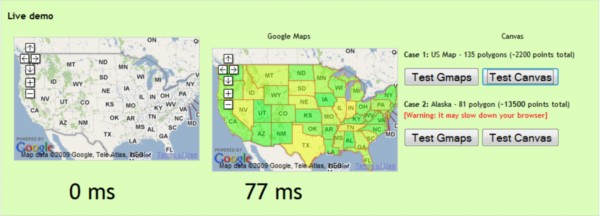
      The Canvas rendering test by Ernest Delgado, appropriated by Betanews for CRPI 2.2.

      So we use Delgado’s rendering test to grab two sets of plot points from Yahoo’s database — one outlining the 48 contiguous United States, and one set outlining Alaska complete with all its islands. Those plot points are rendered on top of Google Maps projections of the mainland US and Alaska at equal scale, and both renderings are timed separately. Those times are compared against IE7, and the two results are averaged with one another for a final score.

    • Testnet.World JS performance test. A decade ago now, someone tried to make a respectable JavaScript benchmark suite out of estimating how long the engine took to execute common math instructions. To be able to count the estimate, each test would run a thousand or so iterations. For today’s computers, they have to run 1,000,000. But at the time the test was released, it was criticized by many who thought timing just the single instructions over and over, didn’t represent overall performance. It doesn’t, but it does represent the efficiency of small parts of the engine, and it’s precisely the part we needed to fill in after Sean P. Kane changed his benchmark suite. So this battery — a rewritten version of the code at this address — times how long it takes the engine to process 15 common keywords and regular functions, from if branches to for loops to string concatenations, one million times each. Results are rendered in milliseconds, and scores in each heat are compared to those from IE7 in Vista SP2. The results are 15 per-heat relative index scores, which we then average out to gain a final score in the battery.
    • Acid3 standards compliance test. The function of the Acid3 test has changed dramatically, especially as most of our browsers become fully compliant. IE7 only scored a 12% on the Acid3, and IE8 scored 20%; but today, most of the alternative browsers are at 100% compliance, with Firefox at 93% and with 3.7 Alpha 1 scoring 96%. So it means less now than it did in earlier months to have Acid3 yield an index score of 8.33, which is the score for any browser that scores 100% thanks to IE7. Now that cumulative index scores are closer to 20, having an eight-and-a-third in the mix has become a deadweight rather than a reward.

      So now we’re making Acid3 count in a different way: For the other batteries that have to do with rendering (all three Nontroppos and TestCube 3D), plus the native JavaScript library portion of the SlickSpeed test, we’re multiplying the index score by the Acid3 percentage. As a result, the amount of any non-compliance with the Web Standards Project’s assessment is applied as a penalty against those rendering scores. Today, only Mozilla and Microsoft browsers are affected by this penalty, and Firefox only slightly — all the others are unaffected.

    Next: Our physical test platform, and why it doesn’t matter…

    Our physical test platform, and why it doesn’t matter

    The physical test platform we’ve chosen for CRPI browser testing is a triple-boot system, which enables us to boot different Windows platforms from the same large hard drive. Our platforms are Windows XP Professional SP3, Windows Vista Ultimate SP2, and Windows 7 RTM.

    All platforms are always brought up to date using the latest Windows updates from Microsoft, prior to testing. We realize, as some have told us, that this could alter the speed of the results obtained. However, we expect real-world users to be making the same changes, rather than continuing to use unpatched and outdated software. Certainly the whole point of testing Web browsers on a continual basis is because folks want to know how Web browsers are evolving, and to what degree, on as close to real-time a scale as possible. When we update Vista, we re-test IE7 on that platform to ensure that all index scores are relative to the most recent available performance, even for that aging browser on that old platform.

    Our physical test system is an Intel Core 2 Quad Q6600-based computer using a Gigabyte GA-965P-DS3 motherboard, an Nvidia 8600 GTS-series video card, 3 GB of DDR2 DRAM, and a 640 GB Seagate Barracuda 7200.11 hard drive (among others). Three Windows XP SP3, Vista SP2, and Windows 7 RC partitions are all on this drive. Since May 2009, we’ve been using a physical platform for browser testing, replacing the virtual test platforms we had been using up to that time. Although there are a few more steps required to manage testing on a physical platform, you’ve told us you believe the results of physical tests will be more reliable and accurate.

    But the fact that we perform all of our tests on one machine, and render their results as relative speeds, means that the physical platform is actually immaterial here. We could have chosen a faster or slower computer (or, frankly, a virtual machine) and you could run this entire battery of tests on whatever computer you happen to own. You’d get the same numbers because our indexes are all about how much faster x is than y, not how much actual time elapsed.

    The speed of our underlying network is also not a factor here, since all of our tests contain code that is executed locally, even if it’s delivered by way of a server. The download process is not timed, only the execution.
    Why don’t we care about download speeds, especially how long it takes to load certain pages? We do, but we’re still in search of a scientifically reliable method to test download efficiency. Web pages change by the second, so any test that measures the time a handful of browsers consumes to download content from any given set of URLs, is almost pointless today. And the speed of the network can vary greatly, so a reliable final score would have to factor out the speed at the time of each iteration. That’s a cumbersome approach, and that’s why we haven’t embarked on it yet.

    There are three major benchmark suites that we have evaluated and re-evaluated, and with respect to their authors, we have chosen not to use. Dromaeo comes from a Firefox contributor whom we respect greatly, named John Resig. We appreciate Resig’s hard work, but we don’t yet feel his results numbers correspond to the differences in performance that we see with our own eyes, or that we can time with a stopwatch. The browsers just aren’t that close together. Meanwhile, we’ve currently rejected Google’s V8 suite — built to test its V8 JavaScript engine — for the opposite reason: Yes, we know Chrome is more capable than IE. But 230 times more capable? No. That’s overkill. There’s a huge exponential curve there that’s not being accounted for, and once it is, we’ll reconsider it.

    We’ve also been asked to evaluate Futuremark’s PeaceKeeper. I’m very familiar with Futuremark’s tests from my days at Tom’s Hardware. Though it’s obvious to me that there’s a lot going on in each of the batteries of the Peacekeeper suite, it doesn’t help much that the final result is rendered only as a single tick-mark. And while that may sound hypocritical from a guy who’s pushing a single performance index, the point is, for us to make sense of it, we need to be able to see into it — how did that number get that high or that low? If Futuremark would just break down the results into components, we could compare each of those components against IE7 and the modern browsers, and we could determine where each browser’s strengths and weaknesses lie. Then we could tally an index based on those strengths and weaknesses, rather than an artificial sum of all values that blurs all those distinctions.

    Copyright Betanews, Inc. 2009


    Add to digg
    Add to Google
    Add to Slashdot
    Add to Twitter
    Add to del.icio.us
    Add to Facebook
    Add to Technorati


  • CrunchDeals: Get Team Fortress 2 for only $2.50 (act quick, only a few minutes left)

    tf2
    Quick, you have until 2:00 PDT to get Team Fortress 2 for only $2.50. That’s a deal. This could be in fact the best deal of the year. After all, TF2 is one of the very best multiplayer games every created. Period. It’s a fact and you can’t say anything otherwise. So, whip out that credit card and spend the $2.50. It’s totally worth it.


  • Verizon’s Droid claims 10,000 apps, graphics co-processor, and ‘a map for that’

    By Jacqueline Emigh, Betanews

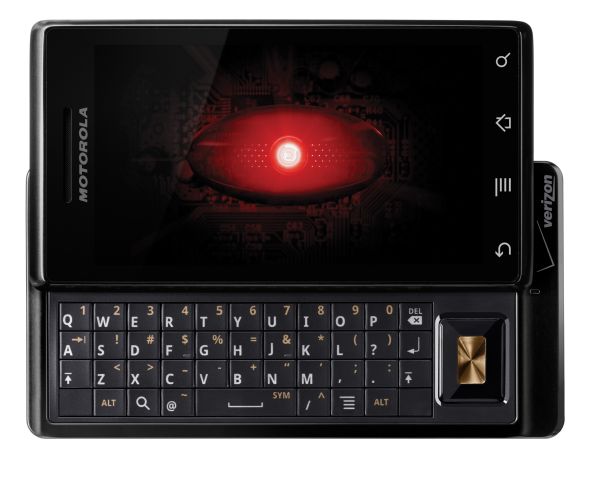
    At a sneak preview in New York City on Thursday night, execs from Verizon Wireless, Motorola, and Google gave reporters from Betanews and elsewhere a point-by-point illustration, supported by a few of Android’s 10,000-plus apps. They also showed off some features not even mentioned in Verizon’s anti-iPhone marketing blitz: a stellar 3.7-inch high res display, turn-by-turn GPS voice navigation with Google Latitude and Street Views, and innovative peripherals like a car mount and multimedia station.

    In a scathing new ad campaign, Verizon takes aim at everything Apple’s rival iPhone doesn’t do. “iDon’t have a real keyboard,” according to an ad. “iDon’t run simultaneous apps,” and so on, and so forth.

    But as they say, seeing is sometimes believing. As I witnessed during demos on Wednesday, Droid does have a “real” slideout keyboard, although some have criticized it as kind of cramped.

    “At 13.7 millimeters, this is the thinnest slider QWERTY around,” said Juan Ignacio Sarmiento, a Motorola marketing evec, as he pulled the slider out from the Droid during the demo.

    Motorola's Droid from Verizon Wireless
    Also aboard the Droid are two software QWERTY keyboards — one in horizontal (landscape mode) orientation, and the other in vertical (portrait mode).

    As advertised, too, the Droid runs multiple apps simultaneously — a feat achieved, of course, through Android multitasking capabilities. Essentially, you don’t need to close out of one app before launching another app, something the iPhone still forces you to do.

    In fact, Android is gaining ground fast against Apple’s App Store for iPhones, with more than 10,000 applications already online in the Android Market, Sarmiento contended.

    I haven’t even come close to viewing all of those thousands of Android apps, so it’s unclear to me how well all of them will work on the Droid. But also during the meeting, Verizon’s Menniti told me that he expects a lot more apps for the Droid to spring from Google’s just released SDK 2.0.

    Other claims from Verizon also ring true. The Linux-based Android environment supports open development. Some of these apps — such as a calculator, for example — are widgets. The Droid’s batteries are indeed interchangeable.

    I haven’t had a chance yet to try out for Droid’s 5-megapixel autofocus camera to take night-time photos (another advertising assertion). But Menniti shot some pics successfully in a dimly light corner of the demo room.

    Sarmiento attributed the Droid’s night-time photo abilities to a dual LED flash, along with work the Droid partners have done around photo issues like color resolution and white balance.

    And yes, the Droid is definitely customizable — and then some. The choice of three different QWERTY keyboards is a help here, and so are the 10,000+ apps and Droid-specific peripherals.

    The Droid’s high-res display — specifically, it offers 480×854 WVGA resolution — is another stunner. With resolution that high, you can view most Web pages at full size, according to Menniti.

    To accommodate this high-res screen in a 4.56-by-2.36-inch gizmo, Motorola’s engineers might possibly have made some trade-offs in overall processing speed. The Droid’s main processor runs at 550 MHz, rather than at the higher rates possible with a heftier chip. But the main processor is also accompanied by a separate on-board graphics chip. And all of the apps I saw operating on Wednesday seemed to be running quite fast enough.

    All of the Droid’s rich functionality is accessible just by touch, without the need for a stylus. By comparison, Microsoft’s Windows Mobile is just starting to reach that goal in its own new version 6.5.

    Also in the plus column is the Droid’s very broad 3G reach. On maps supplied by Verizon Wireless, you can graphically compare Verizon’s huge US coverage area to the much scantier areas served by T-Mobile, Sprint, and even AT&T — whose 3G network is used by Apple’s iPhone in the US.

    Motorola's Droid from Verizon Wireless

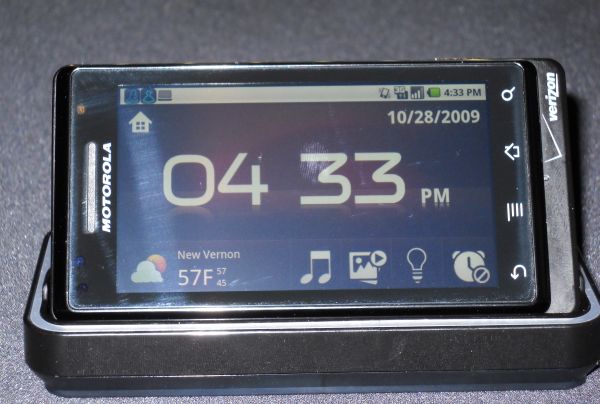
    Sitting in its pint-sized multimedia station, while running clock and radio apps, the Droid becomes a digital alarm clock. Pop the Droid into its car mount, and the gizmo turns into a voice-capable on-board GPS system.

    Although earlier Android phones have run Googe Maps, the Droid is the first to integrate turn-by-turn navigation, said Google’s Michael Siliski, during another demo. This integration also includes Google Latitude and Street Views. According to Siliski, you don’t even need to give a street address to get turn-by-turn instructions for driving to a restaurant, for instance.

    Siliski told me that it’s way too early to tell whether Google will ever market its GPS navigation outside the US.

    “We’re still in beta with this,” he noted. Yet the Droid’s just announced Google Maps Navigation is due to leave test mode when the phone ships on November 6.

    Copyright Betanews, Inc. 2009


    Add to digg
    Add to Google
    Add to Slashdot
    Add to Twitter
    Add to del.icio.us
    Add to Facebook
    Add to Technorati


  • Soy and Hip Fractures

    A study was just published showing that Chinese women living in Singapore who ate more soy had a reduced risk of hip fractures. Compared with women in the lowest one-fourth of intakes for tofu, soy protein, and isoflavones, those in all three of the higher intake categories had a 21%–36% reduction in risk. Soy did not show any benefit for men.

    Koh WP, Wu AH, Wang R, Ang LW, Heng D, Yuan JM, Yu MC. Gender-specific associations between soy and risk of hip fracture in the Singapore Chinese Health Study. Am J Epidemiol. 2009 Oct 1;170(7):901-9. Epub 2009 Aug 31.

  • DSi XL to be available in America & Europe in early 2010

    dsi-ll
    Great news, everyone. Nintendo will release the large-screened DSi in America early next year. It’s been rebadged as the DSi XL instead of the DSi LL. There’s still no word on the price or exact release date, but at least we know it’s coming. Win.

    Nintendo via Kotaku,

    “A new iteration of the Nintendo DSi™ system will be introduced in Japan on November 21, 2009, to be known as Nintendo DSi LL in Japan, and as Nintendo DSi XL in North America and Europe, it will offer a screen 93% larger than the current Nintendo DS Lite with a better view angle, an additional longer touch screen stylus, and preinstalled Nintendo DSiWare™ software. The new version will arrive in North America and Europe in the first quarter of calendar year 2010.”


  • iPhone 3GS vs. Droid: How Do They Really Stack Up?

    droid-by-motorola-front-open-vzw-eye1Our friends at BillShrink, who developed an interactive tool that lets you compare handsets and pick the best phone-plan combination, crunched the data on some of the newer smartphones and compared them with the current champion, the iPhone 3Gs. “While sticker prices are roughly comparable between smartphones, each offers its own particularly generous features,” the company says. But in the end, customers should base their decision on the total cost of ownership of the device over the entire length of their contract with the phone company. So how does iPhone 3GS stack up against the Droid, MyTouch 3G and the  Palm Pre? Results are below the fold.

    bsk_smartphones+droid_graphic


  • GreenPeak Technologies Raises €13 Million

    GreenPeak Technologies, a Dutch developer of ultra low power wireless and battery-free data communication technologies, has raised €13 million in Series B funding. GIMV and Robert Bosch Venture Capital co-led the round, and were joined by return backers DFJ Esprit, Motorola Ventures and Allegro Investment Fund.

    PRESS RELEASE

    GreenPeak Technologies, a leading fabless semiconductor company offering innovative ultra low power wireless and battery-free data communication technologies for consumer electronics and sense and control applications, today announced the closing of a Series B financing round. This financing round totaling €13 ($19) million of venture funding, led by Gimv and Robert Bosch Venture Capital and supported by DFJ Esprit, Motorola Ventures and Allegro Investment Fund will provide the company with the necessary funds to finance its growth in the coming years.

    Cees Links, CEO for GreenPeak Technologies stated, “Securing new funding in this challenging financial climate shows the market potential of GreenPeak’s technology and applications. We are very proud that a world-class company like the Bosch Group via its VC organization is sharing the vision with our existing investors that GreenPeak’s wireless IEEE802.15.4 and ZigBee technology will create a whole new class of wireless products for home, building and industrial automation. Since the company’s establishment we have achieved a series of technology breakthroughs and we have developed very significant customer traction in Europe, the USA as well as in the Asia Pacific region. With this funding the company will be able to expand its distribution channels and ramp volume.”

    Dr. Claus Schmidt, Managing Director with Robert Bosch Venture Capital, is joining the GreenPeak Board of Directors as a new member. “I’m very excited with our investment in GreenPeak,” Mr. Schmidt says, “Bosch covers many fields in home, building and industrial applications and recognizes the potential of wireless sense and control networks in these fields. GreenPeak has impressed us with their clear market vision as an innovator in the wireless and battery-free sense and control networks. I see their enormous potential and their technology lead.”

    “GreenPeak has progressed rapidly since we first invested in 2006 and we’re excited to continue our support.” said Elderd Land, Partner of Gimv, lead investor. “GreenPeak is selling breakthrough technology for remote controls for consumer electronics and has excellent customer traction establishing a platform for home automation, hence creating a new wireless wave of applications. We are happy to continue to support them in their transition from a strong start-up into a major industry leader.”

    About GreenPeak

    GreenPeak is a fabless semiconductor company and is a leader in ultra low power wireless and battery-free communication technology for consumer electronics, and wireless sense and control applications. This revolutionary technology, based on the IEEE 802.15.4/ZigBee wireless networking standard, utilizes energy harvesting to facilitate battery-free operation in a totally wireless environment, without the need for either communications or power connectivity.

    GreenPeak was selected by the World Economic Forum as a 2009 Technology Pioneer, in the “energy” category, for its accomplishments as an innovator of the highest caliber, involved in the development of life-changing technology innovation and with the potential for long-term impact on business and society.

    GreenPeak is based in Utrecht – The Netherlands and has offices in Belgium, Japan and Korea.

    GreenPeak is backed by venture capitalists: Gimv (Belgium), DFJ Esprit (UK), Robert Bosch Venture Capital (Germany), Motorola Ventures (USA) and Allegro Investment Fund (Belgium).

    For more information, please visit www.greenpeak.com

    About Gimv

    Gimv is a European investment company with nearly 30 years of experience in private equity and venture capital. The company is listed on NYSE Euronext Brussels and currently manages around EUR 1.7 billion of assets (including third party funds).

    Gimv undertakes buyouts and provides growth capital to established companies. Local teams in Belgium, France, The Netherlands and Germany concentrate on these activities. Gimv-XL provides growth financing to larger growth companies in Flanders. Gimv makes venture capital investments in high tech sectors through its specialist teams in Life Sciences, Technology and Cleantech.

    www.gimv.com

    About DFJ Esprit

    DFJ Esprit is a leading cross-stage venture capital firm that invests in European technology and media companies. Members of the DFJ Esprit team have been active in technology investing since 1985 and have experience of investing in over 165 companies and generating strong returns for investors through building valuable companies alongside the founders and management teams.

    The DFJ Esprit partners have invested in many of Europe’s most successful venture exits of recent years, including Buy.at, Alphamosaic, KVS and Blackspider. DFJ Esprit is the European partner for the Silicon Valley based Draper Fisher Jurvetson (DFJ) Global Network of venture funds, the largest such network in the world with $6bn under management and offices in 30 cities spanning four continents.

    www.dfjesprit.com

    About Robert Bosch Venture Capital GmbH

    Robert Bosch Venture Capital GmbH (RBVC) is the corporate venture company of the Robert Bosch GmbH, one of the largest private companies worldwide with more than €45.1 billion ($60 billion) of sales in 2008. Founded in 1886, Bosch is a leading global supplier of automotive, industrial technology, consumer goods and building technology.

    RBVC invests in start-up companies either directly or via venture capital funds on a worldwide basis. Investment focus: technology companies along the line of Bosch current and future business. RBVC provides capital for minority stakes in start-ups from early to expansion stage.

    www.rbvc.com

    About Motorola

    Motorola is known around the world for innovation in communications and is focused on advancing the way the world connects. From broadband communications infrastructure, enterprise mobility and public safety solutions to high-definition video and mobile devices, Motorola is leading the next wave of innovations that enable people, enterprises and governments to be more connected and more mobile. Motorola (NYSE: MOT) had sales of US $30.1 billion in 2008.

    www.motorola.com

    About Allegro Investment Fund

    Allegro Investment Fund N.V. is a Leuven-(Belgium) based open-end seed and early stage capital investment fund, focusing on high-tech ventures. The fund combines more than 40 years of relevant business experience in high-tech start-up and early stage management. Allegro invests in disruptive technologies managed by professional teams aiming at a significant and world-wide market. Allegro’s shareholders are Captains of Industry with a wide variety of sector backgrounds.

    www.allegroinvestmentfund.com

    ShareThis


  • Plan For Impressive “Yahooplex” In Motion

    Either Yahoo learned nothing from the real estate bubble, or the company’s got something pretty fantastic up its sleeve.  Or it’s just sending out feelers, not preparing to pour concrete.  Anyway, a fresh report indicates that Yahoo’s taken a step towards building a large, new campus.

    John Letzing wrote earlier today about a campus plan that involves 13 structures and 3 million square feet.  "Yahoo’s proposed campus is made up of sleek, six-story buildings set amid landscaped grounds and expansive plazas.  It bears a resemblance to Google’s Mountain View headquarters, dubbed the ‘Googleplex,’ which is situated less than 10 miles to the northwest," he reported.

    Yahoo LogoThen here’s another important detail: Santa Clara City Planner Carol Anne Painter told Letzing that the Santa Clara City Council could approve the development early next year.

    Just don’t go submitting your application to Yahoo (if you feel this is a sign of success and an expansion) – or betting on its bankruptcy (if you feel otherwise) – quite yet.

    The company told Tom Krazit, "Yahoo purchased 42.5 acres of land in Santa Clara in July 2006.  We submitted initial plans to the City of Santa Clara to redevelop the property in August 2008 and plans are currently with the City to procure entitlements for developing the land.  We are taking the proper steps to secure approval for the development of the land.  We continue to evaluate our real estate portfolio on a worldwide basis to ensure it best supports our business."

    Related Articles:

    > Twitter Lines Up New Office Space

    > Microsoft, Yahoo Miss Deadline Agreement

    > Yahoo Provides Homepage Overhaul Stats

  • DIY: Multi-stage water rocket

    rocketI know, I know. Water rocket. Whatever, right? Been there, done that, it’s cool and all, but it’s kinda like the diet coke & mentos thing. It’s been done to death. Well, this ain’t your daddy’s water rocket, let’s put it that way.

    No sir, this is a multistage water rocket with a nose cone, and parachute recovery system. This is the work of a water rocket scientist, or possibly a student with too much time on his hands. This thing is a beast, and the inventor was kind enough to write up instructions on how you can build one yourself.

    Seriously, fins. Nosecone. A launching system. Two stage rocket. Check it out, it’s quite impressive.


  • The GDP, Small Business and Health Insurance Reform

    This afternoon the President took to the South Court of the Eisenhower Executive Office Building to speak about small business. And as important to the identity and history of America as small businesses are in their own right, it is also the case that they are at the heart of the two issues dominating the news today. 

    The first issue is today’s encouraging news regarding the growth in Gross Domestic Product, as discussed by CEA Chair Christina Romer this morning. As stark a turnaround as this news represents from the past year, it will be in large part small business who convert this growth into actual jobs over the coming months, and indeed it can’t be said enough how much work there is left to do.

    The second issue is the one we have heard so much about over the past months: health insurance reform. But now, with the smoke of the partisan attacks and bickering having begun to clear, it is worth thinking again about the very real and very positive impact reform can have on small business – an impact also fleshed out this morning in a new report posted here.

    The President’s word on the GDP numbers:

    I am gratified that our economy grew in the third quarter of this year.  We’ve come a long way since the first three months of 2009, when our economy shrunk by an alarming 6.4 percent.  In fact, the 3.5 percent growth in the third quarter is the largest three-month gain we have seen in two years.  This is obviously welcome news and an affirmation that this recession is abating and the steps we’ve taken have made a difference.

    But I also know that we got a long way to go to fully restore our economy and recover from what’s been the longest and deepest downturn since the Great Depression.  And while this report today represents real progress, the benchmark I use to measure the strength of our economy is not just whether our GDP is growing, but whether we’re creating jobs, whether families are having an easier time paying their bills, whether our businesses are hiring and doing well.  And that’s what I’m here to talk with you about today.

    And an excerpt on health insurance reform:

    We all know that family premiums have skyrocketed more than 130 percent over the past decade.  They have more than doubled.  But small businesses have been hit harder than most.  A story in the paper just the other day said that many small businesses may see their premiums rise about 15 percent over the coming year — twice the rate they rose last year.  And in part because small businesses pay higher administrative costs than larger ones, your employees pay up to 18 percent more in premiums for the very same health insurance.

    In one national survey, nearly three-quarters of small businesses that don’t offer benefits cited high premiums as the reason — and that’s not surprising.

    The bottom line is that too many Americans like you can’t afford to build the kinds of businesses you’d been hoping to build.  Too many budding entrepreneurs can’t afford to take a gamble on a smart idea because they can’t give up the health insurance they get in their current job.  Too many of you not only can’t afford to provide health insurance to your employees, too many of you are having a tough time just affording health insurance for yourselves.  That’s bad for our economy, it’s bad for our country, and that’s what we’ll change when health insurance reform becomes law.

    Just this morning, the House of Representatives released its version of health reform legislation, and I want to commend Nancy Pelosi and the Democratic Caucus for their leadership in achieving this critical milestone.  They forged a strong consensus that represents a historic step forward.  This bill includes reforms that will finally help make quality insurance affordable.  Importantly, this bill is also fully paid for and will reduce the deficit in the long term. 

    Now, there is no doubt that this legislation, and the legislation that’s being drafted in the Senate, would benefit millions of small businesses.  It’s being written with the interests of Americans like you and your employees in mind.

    And yet, there are those who have a vested interest in the status quo who are claiming otherwise, and they’re using misleading figures and disingenuous arguments.  So I want to try to explain as clearly as I can exactly what health reform would mean for small business owners like you and the workers you employ.

    The first thing I want to make clear is that if you are happy with the insurance plan that you have right now, if the costs you’re paying and the benefits you’re getting are what you want them to be, then you can keep offering that same plan.  Nobody will make you change it.

    What we will do is make the coverage that you’re currently providing more affordable by offering a tax credit to small businesses that are trying to do the right thing and provide coverage for their employees.  Under the House and Senate bills, millions of small businesses would be eligible for a tax credit of up to 50 percent of their premiums.  That’s in the legislation that’s already been proposed.

    The President on GDP, Small Business, and Health Reform

    President Barack Obama remarks on his Administration’s plans to help small businesses while speaking to members of the U.S. Chamber of Commerce, National Federation of Independent Business, and small business owners and organizations from across the country at the White House, Oct. 29, 2009. Official White House Photo by Samantha Appleton.

     
  • Possible Wii 2 specs leaked? 1080p, Blu-ray, 2010, oh my!

    wii2bluray1080p
    Take this rumor like you would any other Internet rumor. You never know though, some of this info is new and might be true. A French website, Logic-Sunrise, is reporting from a very reliable source within the bowels of Nintendo that an update is played for 2010 and it’s going to be a big one. Well, big for Nintendo and on par with the current offerings from Sony and Microsoft, that is.

    Logic-Sunrise translated by Google,

    • The console will carry a Blu-Ray, the primary function is to discourage piracy.
    • It must therefore bear display 720P and 1080P, both for broadcasting video Blu-Ray for games.
    • A release date for 2010 is planned.
    • The output will be worldwide, orchestrated the same day in all countries.
    • A bid to take over your Wii first generation is planned. (All your bases are belong to us?)

    Everyone probably agrees that the Wii is past its prime technology-wise. Hell, it was sort out of date when it was released, but that hasn’t stopped it from winning the console war. Maybe the recent Wii price drop shows that an update isn’t that far off.

    [thanks for the tip, Jon]


  • Atlus has something in store for Demon’s Souls this Halloween

    Demon’s Souls is already one hard game, but this Halloween things will be even tougher. The rewards will be greater, but remember: there are no freebi…